EP2952012B1 - Auf raum und programm reagierendes lautsprechersystem - Google Patents
Auf raum und programm reagierendes lautsprechersystem Download PDFInfo
- Publication number
- EP2952012B1 EP2952012B1 EP14712960.5A EP14712960A EP2952012B1 EP 2952012 B1 EP2952012 B1 EP 2952012B1 EP 14712960 A EP14712960 A EP 14712960A EP 2952012 B1 EP2952012 B1 EP 2952012B1
- Authority
- EP
- European Patent Office
- Prior art keywords
- sound
- program content
- room
- sound program
- segment
- Prior art date
- Legal status (The legal status is an assumption and is not a legal conclusion. Google has not performed a legal analysis and makes no representation as to the accuracy of the status listed.)
- Active
Links
Images


Classifications
-
- H—ELECTRICITY
- H04—ELECTRIC COMMUNICATION TECHNIQUE
- H04R—LOUDSPEAKERS, MICROPHONES, GRAMOPHONE PICK-UPS OR LIKE ACOUSTIC ELECTROMECHANICAL TRANSDUCERS; ELECTRIC HEARING AIDS; PUBLIC ADDRESS SYSTEMS
- H04R3/00—Circuits for transducers
- H04R3/12—Circuits for transducers for distributing signals to two or more loudspeakers
-
- G—PHYSICS
- G10—MUSICAL INSTRUMENTS; ACOUSTICS
- G10K—SOUND-PRODUCING DEVICES; METHODS OR DEVICES FOR PROTECTING AGAINST, OR FOR DAMPING, NOISE OR OTHER ACOUSTIC WAVES IN GENERAL; ACOUSTICS NOT OTHERWISE PROVIDED FOR
- G10K15/00—Acoustics not otherwise provided for
- G10K15/08—Arrangements for producing a reverberation or echo sound
-
- G—PHYSICS
- G10—MUSICAL INSTRUMENTS; ACOUSTICS
- G10L—SPEECH ANALYSIS TECHNIQUES OR SPEECH SYNTHESIS; SPEECH RECOGNITION; SPEECH OR VOICE PROCESSING TECHNIQUES; SPEECH OR AUDIO CODING OR DECODING
- G10L25/00—Speech or voice analysis techniques not restricted to a single one of groups G10L15/00 - G10L21/00
- G10L25/78—Detection of presence or absence of voice signals
-
- H—ELECTRICITY
- H04—ELECTRIC COMMUNICATION TECHNIQUE
- H04R—LOUDSPEAKERS, MICROPHONES, GRAMOPHONE PICK-UPS OR LIKE ACOUSTIC ELECTROMECHANICAL TRANSDUCERS; ELECTRIC HEARING AIDS; PUBLIC ADDRESS SYSTEMS
- H04R1/00—Details of transducers, loudspeakers or microphones
- H04R1/20—Arrangements for obtaining desired frequency or directional characteristics
- H04R1/32—Arrangements for obtaining desired frequency or directional characteristics for obtaining desired directional characteristic only
- H04R1/40—Arrangements for obtaining desired frequency or directional characteristics for obtaining desired directional characteristic only by combining a number of identical transducers
- H04R1/403—Arrangements for obtaining desired frequency or directional characteristics for obtaining desired directional characteristic only by combining a number of identical transducers loud-speakers
-
- H—ELECTRICITY
- H04—ELECTRIC COMMUNICATION TECHNIQUE
- H04R—LOUDSPEAKERS, MICROPHONES, GRAMOPHONE PICK-UPS OR LIKE ACOUSTIC ELECTROMECHANICAL TRANSDUCERS; ELECTRIC HEARING AIDS; PUBLIC ADDRESS SYSTEMS
- H04R29/00—Monitoring arrangements; Testing arrangements
- H04R29/001—Monitoring arrangements; Testing arrangements for loudspeakers
- H04R29/002—Loudspeaker arrays
-
- H—ELECTRICITY
- H04—ELECTRIC COMMUNICATION TECHNIQUE
- H04S—STEREOPHONIC SYSTEMS
- H04S7/00—Indicating arrangements; Control arrangements, e.g. balance control
- H04S7/30—Control circuits for electronic adaptation of the sound field
- H04S7/305—Electronic adaptation of stereophonic audio signals to reverberation of the listening space
Definitions
- Audio system electronics that play program content through loudspeakers with a set of directivities that reflect the characteristics of the playback room environment, and the sound program content. Other embodiments are also described.
- Loudspeakers have two primary specifications: (1) the frequency response pointed in the direction of the listener and (2) the ratio of sound launched towards the listener vs. elsewhere within the room.
- the first specification is known as the listening window response of the loudspeaker and the second specification is the directivity index of the loudspeaker. While a great deal of attention has traditionally been paid to the frequency response, less attention has been paid to the directivity of a loudspeaker.
- WO2009022278 describes an audio reproduction system comprising an arrangement of audio speakers.
- An embodiment of the invention is a home audio system that includes an audio receiver or other source and one or more loudspeakers.
- the audio receiver measures the acoustic properties of the room in which the loudspeakers reside and the audio characteristics of the sound program content to be played through the loudspeakers. Based on these measurements, the audio receiver assigns a directivity ratio to one or more segments of the sound program content. The assigned directivity ratio is used by the receiver to play the segment of the sound program content through the loudspeakers.
- the audio receiver drives the loudspeakers to more accurately represent the position and depth of the sound program content to the listener.
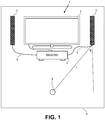
- Figure 1 shows a home audio system 1 that includes an external audio source 2, an audio receiver 3, and one or more loudspeaker arrays 4.
- the home audio system 1 outputs sound program content into a room 5 in which an intended listener is located.
- the listener is traditionally seated at a target location 6 at which the home audio system 1 is primarily directed or aimed.
- the target location 6 is typically in the center of the room 5, but may be in any designated area of the room 5.
- the audio receiver 3 drives the loudspeaker arrays 4 to more accurately represent the position and depth of the sound program content to the listener.
- Each of the elements of the home audio system 1 will be described by way of example below.
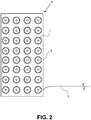
- FIG. 2 shows one loudspeaker array 4 with multiple transducers 7 housed in a single cabinet 8.
- the loudspeaker array 4 has 32 distinct transducers 7 evenly aligned in eight rows within the cabinet 8.
- different numbers of transducers 7 may be used with uniform or non-uniform spacing.
- the transducers 7 may be any combination of full-range drivers, mid-range drivers, subwoofers, woofers, and tweeters.
- Each of the transducers 7 may use a lightweight diaphragm, or cone, connected to a rigid basket, or frame, via a flexible suspension that constrains a coil of wire (e.g. a voice coil) to move axially through a cylindrical magnetic gap.
- a coil of wire e.g. a voice coil
- the loudspeaker arrays 4 may include a single transducer 7 housed in the cabinet 8. In these embodiments, the loudspeaker array 4 is a standalone loudspeaker.
- Each transducer 7 may be individually and separately driven to produce sound in response to separate and discrete audio signals.
- the loudspeaker arrays 4 may produce numerous directivity patterns to simulate or better represent respective channels of the sound program content played in the room 5 by the home audio system 1.
- each loudspeaker array 4 may accept input from each audio channel of the sound program content output by the audio receiver 3 and produce different corresponding beams of audio into the room 5. For example, if a surround channel of the sound program content is supplied by an output of the receiver 3 to a left loudspeaker array, in the instance of having no surround loudspeaker, the beam that is formed by the left loudspeaker array may have a null pointed towards the target location 6 (e.g. a listener), and radiation throughout the rest of the room/space 5. In this way, the left loudspeaker array has a negative directivity index for surround content.
- each loudspeaker array 4 may include two wiring points and the receiver 3 may include complementary wiring points.
- the wiring points may be binding posts or spring clips on the back of the loudspeaker arrays 4 and the receiver 3, respectively.
- the wires 9 are separately wrapped around or are otherwise coupled to respective wiring points to electrically couple the loudspeaker arrays 4 to the audio receiver 3.
- the loudspeaker arrays 4 are coupled to the audio receiver 3 using wireless protocols such that the arrays 4 and the audio receiver 3 are not physically joined but maintain a radio-frequency connection.
- the loudspeaker arrays 4 may include a WiFi receiver for receiving audio signals from a corresponding WiFi transmitter in the audio receiver 3.
- the loudspeaker arrays 4 may include integrated amplifiers for driving the transducers 7 using the wireless audio signals received from the audio receiver 3.
- Figure 1 shows two loudspeaker arrays 4 in the home audio system 1 located at front right and left positions in relation to the target location 7.
- the front right and left loudspeaker arrays 4 may collectively represent left, right, and center front channels and left and right surround channels of the sound program content.
- different numbers and positions of loudspeaker arrays 4 may be used.
- five loudspeaker arrays 4 may be used in which three loudspeaker arrays 4 are placed in front left, right and center positions and two loudspeaker arrays 4 are placed in rear left and right positions.
- the front loudspeaker arrays 4 represent respective left, right, and center channels of the sound program content and the rear left and right channels represent respective left and right surround channels of the sound program content.
- the loudspeaker arrays 4 receive one or more audio signals for driving each of the transducers 7 from the audio receiver 3.
- Figure 3 shows a functional unit block diagram and some constituent hardware components of the audio receiver 3. Although not shown, the receiver 3 has a housing in which the components shown in Figure 3 reside.
- the functions and operations of the audio receiver 3 may be performed by other standalone electronic devices.
- the audio receiver 3 may be implemented by a general purpose computer, a mobile communications device, or a television. In this manner, the use of the term audio receiver 3 is not intended to limit the scope of the home audio system 1 described herein.
- the audio receiver 3 is used to play sound program content through the loudspeaker arrays 4.
- the sound program content may be delivered or contained in a stream of audio that may be encoded or represented in any known form.
- the sound program content may be in an Advanced Audio Coding (AAC) music file stored on a computer or DTS High Definition Master Audio stored on a Blu-ray Disc.
- AAC Advanced Audio Coding
- the sound program content may be in multiple channels or streams of audio.
- the receiver 3 includes multiple inputs 10 for receiving the sound program content using electrical, radio, or optical signals from one or more external audio sources 2.
- the inputs 10 may be a set of digital inputs 10A and 10B and analog inputs 10C and 10D including a set of physical connectors located on an exposed surface of the receiver 3.
- the inputs 10 may include a High-Definition Multimedia Interface (HDMI) input, an optical digital input (Toslink), a coaxial digital input, and a phono input.
- the receiver 3 receives audio signals through a wireless connection with an external audio source 2.
- the inputs 10 include a wireless adapter for communicating with the external audio source 2 using wireless protocols.
- the wireless adapter may be capable of communicating using Bluetooth, IEEE 802.11x, cellular Global System for Mobile Communications (GSM), cellular Code division multiple access (CDMA), or Long Term Evolution (LTE).
- the external audio source 2 may include a television.
- the external audio source 2 may be any device capable of transmitting the sound program content to the audio receiver 3 over a wireless or wired connection.
- the external audio source 2 may include a desktop or laptop computer, a portable communications device (e.g. a mobile phone or tablet computer), a streaming Internet music server, a digital-video-disc player, a Blu-ray DiscTM player, a compact-disc player, or any other similar audio output device.
- the external audio source 2 and the audio receiver 3 are integrated in one indivisible unit.
- the loudspeaker arrays 4 may also be integrated into the same unit.
- the external audio source 2 and audio receiver 3 may be in one television or home entertainment unit with loudspeaker arrays 4 integrated in left and right sides of the unit.
- the receiver 3 upon receiving a digital audio signal through an input 10A and 10B, uses a decoder 11A or 11B to decode the electrical, optical, or radio signals into a set of audio channels representing the sound program content.
- the decoder 11 may receive a single signal containing six audio channels (e.g. a 5.1 signal) and decode the signal into six audio channels.
- the decoder 11 may be capable of decoding an audio signal encoded using any codec or technique including Advanced Audio Coding (AAC), MPEG Audio Layer II, MPEG Audio Layer III, and Free Lossless Audio Codec (FLAC).
- AAC Advanced Audio Coding
- FLAC Free Lossless Audio Codec
- each analog signal received by analog inputs 10C and 10D represents a single audio channel of the sound program content. Accordingly, multiple analog inputs 10C and 10D may be needed to receive each channel of the sound program content.
- the audio channels may be digitized by respective analog-to-digital converters 12A and 12B to form digital audio channels.
- the digital audio channels from each of the decoders 11A and 11B and the analog-to-digital converters 12A and 12B are output to the multiplexer 13.
- the multiplexer 13 selectively outputs a set of audio channels based on a control signal 14.
- the control signal 14 may be received from a control circuit or processor in the audio receiver 3 or from an external device.
- a control circuit controlling a mode of operation of the audio receiver 3 may output the control signal 14 to the multiplexer 13 for selectively outputting a set of digital audio channels.
- the multiplexer 13 feeds the selected digital audio channels to a content processor 15.
- the channels output by the multiplexer 13 are processed by the content processor 15 to produce a set of processed audio channels.
- the processing may operate in both the time and frequency domains using transforms such as the Fast Fourier Transform (FFT), for example.
- the content processor 15 may be a special purpose processor such as application-specific integrated circuit (ASICs), a general purpose microprocessor, a field-programmable gate array (FPGA), a digital signal controller, or a set of hardware logic structures (e.g. filters, arithmetic logic units, and dedicated state machines).
- the content processor 15 may perform various audio processing routines on the digital audio channels to adjust and enhance the sound program content in the channels.
- the audio processing may include directivity adjustment, noise reduction, equalization, and filtering.
- the content processor 15 adjusts the directivity of the audio channels to be played through the loudspeaker arrays 4 according to acoustic properties of the room 5 in which the loudspeaker arrays 4 are located, as well as the audio characteristics of the sound program content to be played through the loudspeaker arrays 4. Adjusting the directivity of the audio channels may include assigning a directivity ratio to one or more segments of the channels. As will be discussed in more detail below, these directivity ratios are used for selecting a set of transducers 7 and corresponding delays and energy levels for playing respective segments of each channel.
- the receiver 3 includes a room acoustics unit 16 for measuring the acoustic properties of the room 5 using acoustic reverberation testing and early reflection detection, and a content characteristics unit 17 for continually measuring the audio characteristics of the sound program content.
- the room acoustics unit 16 and the content characteristics unit 17 will be described in more detail below.
- the room acoustics unit 16 measures the acoustic properties of the room 5.
- the acoustics properties of the room 5 include the reverberation time of the room 5 and its corresponding change with frequency amongst other properties.
- Reverberation time may be defined as the time in seconds for the average sound in a room to decrease by 60 decibels after a source stops generating sound.
- Reverberation time is affected by the size of the room 5 and the amount of reflective or absorptive surfaces within the room 5.
- a room with highly absorptive surfaces will absorb the sound and stop it from reflecting back into the room. This would yield a room with a short reverberation time. Reflective surfaces will reflect sound and will increase the reverberation time within a room. In general, larger rooms have longer reverberation times than smaller rooms. Therefore, a larger room will typically require more absorption to achieve the same reverberation time as a smaller room.
- early reflections may be detected by the receiver as to level, time, direction, and spectrum.
- the directivity of the loudspeaker arrays may then be controlled to reduce the level in particular of specific reflections, reducing them below a criteria level, such as -15 dB for 15 ms.
- the room acoustics unit 16 generates a series of audio samples that are output into the room 5 by one or more of the loudspeaker arrays 4.
- the room acoustics unit 16 transmits the audio samples to the digital-to-analog converters 18.
- the analog signals generated by the digital-to-analog converters 18 are transmitted to the power amplifiers 19 to drive the loudspeaker arrays 4 attached to the outputs 20.
- a microphone 21 coupled to the receiver 3 senses the sounds produced by the loudspeaker arrays 4 as they reflect and reverberate through the room 5.
- the microphone 21 feeds the sensed sounds to the room acoustics unit 16 for processing.
- the microphone 21 may produce a digital signal that is fed directly into the room acoustics unit 16 or it may output an analog signal that requires conversion by a digital-to-analog converter before being fed into the room acoustics unit 16.
- the room acoustics unit 16 analyzes the sensed sounds from the microphone 21 and calculates the reverberation time of the room 5 by, for example, determining the time in seconds for the average sound in the room 5 to decrease by 60 decibels after the loudspeaker arrays 4 stop generating sound.
- the reverberation time of the room 5 may be calculated as an average time or other linear combination, based on multiple reverberation time calculations.
- the room acoustics unit 16 Based on the measured acoustic properties of the room 5, including the determined reverberation time of the room 5, the room acoustics unit 16 generates a directivity ratio for the room 5.
- D R is the room directivity ratio and the distance r and angle ⁇ are in relation to the target location 6 in the room 5.
- the room directivity ratio is proportional to the reverberation time of the room 5 such that as the reverberation time increases from one room to another or for the same room after changes to the room layout have occurred the directivity ratio increases by a proportional amount.
- the room acoustics unit 16 calculates the reverberation time and corresponding room directivity ratio periodically and without direction from a user.
- the audio samples emitted into the room 5 to calculate the reverberation time may be periodically combined with the sound program content played by audio receiver 3 through the loudspeaker arrays 4.
- the audio samples are not audible to listeners but are capable of being picked up by the microphone 21.
- the audio samples may be masked by being hidden underneath the sound program content, occupying the same frequency band, but lying beneath the sound program content so as to remain inaudible.
- the loudspeaker arrays 4 may be used simultaneously with the sound program content and with an ultrasonic probe signal.
- the room acoustics unit 16 measures the acoustic properties of the room 5 over a period of time. These individual measurements may be used to calculate a long-term running average of the acoustic properties of the room 5. In this fashion, the relatively constant and unchanging nature of the acoustics in the room 5 may be more accurately computed by utilizing a wider number of measurements.
- the content characteristics unit 17 measures the constantly changing audio characteristics of the sound program content over shorter periods of time.
- the detection of level, timing, direction and spectrum may be used to steer a beam from the loudspeaker array in such a manner as to reduce the effects of audible reflections, by staying below a threshold value, such as -15 dB spectrum level at times less than 15 ms after the direct sound has passed the listener location.
- a threshold value such as -15 dB spectrum level at times less than 15 ms after the direct sound has passed the listener location.
- this unit analyzes the sound program content to measure audio characteristics of the sound program content and calculate a corresponding content directivity ratio.
- the audio channels representing the sound program content are output by the multiplexer 13 to the content characteristics unit 17 such that each audio channel may be analyzed.
- the content characteristics unit 17 analyzes one segment of an audio channel at a time. These segments may be time divisions or frequency divisions of a channel, of course, shorter or longer time segments are also possible. For example, a channel may be divided into three-second segments. These distinct time segments are analyzed individually by the content characteristics unit 17 and a separate content directivity ratio is calculated for each time segment.
- the sound program content may be analyzed in non-overlapping 100 Hz frequency divisions, of course narrower or wider frequency segments are also possible. This frequency division, as will be described in further detail below, may be in addition to a time division such that each frequency division in a time division is individually analyzed and a separate content directivity ratio is calculated.
- the audio characteristics measured by the content characteristics unit 17 may include various features of the sound program content to be played by the audio receiver 3 through the loudspeaker arrays 4.
- the audio characteristics may include an energy level of a segment, a correlation level between respective segments, and speech detection in a segment.
- the content characteristics unit 17 may include an energy level unit 22, a channel correlation unit 23, and a speech detection unit 24. Each of these audio characteristic units will be described below.
- the energy level unit 22 measures the energy level in a segment of a channel and assigns a corresponding content directivity ratio.
- a high energy level in a segment may indicate that this segment should be associated with a proportionally high content directivity ratio.
- Figure 4 shows a chart of the energy levels for several segments of an example audio channel. In this example, the segments are three-second non-overlapping divisions of an audio channel. The chart in Figure 4 also shows two energy comparison values. Segments that at any point fall below both energy comparison values are assigned a low content directivity ratio; segments that at any point rise above the first energy comparison value but below the second energy comparison value are assigned a medium content directivity ratio; and segments that at any point rise above both energy comparison values are assigned a high content directivity ratio.
- the low, medium, and high content directivity ratios may be predefined and may, for example, be equal to 3 decibels, 9 decibels, and 15 decibels, respectively.
- segment A would be assigned a medium content directivity ratio of 9 decibels as it extends above comparison value 1 but not above comparison value 2;
- segment B would be assigned a low content directivity ratio of 3 decibels as it never extends above comparison values 1 or 2; and
- segment B would be assigned a high content directivity ratio of 15 decibels as it extends above both comparison values 1 and 2.
- more or less energy comparison values may be used to measure the energy levels of segments of the sound program content.
- the energy level unit 22 measures a ratio/fraction of the energy level in a segment of a channel and the sum of the energies of all the channels of the sound program content. This fraction may thereafter be compared against a series of comparison values in a similar fashion as described above to determine a content directivity ratio.
- the channel correlation unit 23 measures a correlation level between a segment in one channel and a corresponding segment in another channel and assigns a content directivity ratio based on the measured correlation value.
- Correlation is a measure of the strength and direction of the linear relationship between two variables that is defined in terms of the covariance of the variables divided by their standard deviations.
- the variables in this case are the signals in the various channels in various combinations, especially pairing among the channels.
- the result of a correlation process lies between 0 and 1, with zero indicating the signals are completely unrelated, to one, indicating the signals are identical.
- a low correlation between channels in a segment of the sound program content may indicate that the segment should be assigned a proportionally low content directivity ratio.
- the speech detection unit 24 detects the presence of speech in a segment and its variation with frequency and assigns a content directivity ratio based on the detection of speech. Detection of speech in a segment may indicate that the segment should include a higher content directivity ratio than that for the average segment of the sound program content. Speech detection or voice activity detection may be performed using any known algorithm or technique. Upon detecting speech in a segment, the speech detection unit 24 assigns a first predefined content directivity ratio to the segment. Upon not detecting speech in a segment, the speech detection unit 24 assigns a second predefined content directivity ratio to the segment that is lower than the first predefined content directivity ratio. For example, a content directivity ratio of 3 decibels may be assigned to a segment that does not contain speech while a content directivity ratio of 15 decibels is assigned to a segment of the sound program content that does contain speech.
- the content directivity ratios assigned to segments containing speech may be varied based on the energy level of other audio characteristics of the segments. For example, a segment with high energy speech may be assigned a content directivity ratio of 18 decibels while a segment with low energy speech may be assigned a content directivity ratio of 12 decibels.
- an overall content directivity ratio may be calculated by the content characteristics unit 17.
- the overall content directivity ratio is a strict average of the individually calculated content directivity ratios.
- the overall content directivity ratio is a weighted average of the individually calculated content directivity ratios. In a weighted average each individually calculated content directivity ratio is assigned a weight from 0.1 to 1.0 based on importance.
- D E is the calculated energy content directivity ratio
- D C is the calculated correlation content directivity ratio
- D S is the calculated speech content directivity ratio
- ⁇ , ⁇ , and ⁇ are respective weights.
- segments of the sound program may include frequency divisions in addition to time divisions.
- a three-second time segment may also be divided into 100 Hz frequency bins or spectral components.
- scaling factor ⁇ is a positive real number that is predefined for each spectral component F.
- Table 1 may represent the values for scaling factor ⁇ for each spectral component.
- Table 1 Spectral Component or Frequency Bin (Hz) ⁇ 1-100 0.4 101-200 0.5 201-500 0.7 501-1,000 1.0 1,001-2,000 1.3 2,001-5,000 1.6 5,001-10,000 2.0
- both directivity ratios are fed into a directivity ratio merger 25.
- the directivity ratio merger 25 combines the content directivity ratio and the room directivity ratio to produce a merged directivity ratio for a segment of one channel of the sound program content.
- This merged directivity ratio takes into account the acoustic properties of the room in which the loudspeaker arrays are located, as well as the audio characteristics of the segment of the sound program content to be played through the loudspeaker arrays.
- D M is the merged directivity ratio
- D F or D W are the content directivity ratio
- D R is the room directivity ratio
- ⁇ and ⁇ are respective weights.
- the merged directivity ratio is passed to the content processor 15 for processing the segment of the sound program content and then the segment may be output by one or more transducers of the loudspeaker arrays 4 to form a directivity pattern that more accurately represents the position and depth of the sound program content to the listener.
- the content processor 15 decides which transducers in one or more loudspeaker arrays 4 output the segment based on the merged directivity ratio. In this embodiment, the content processor 15 may also determine delay and energy settings used to output the segment through the selected transducers. Additionally, the delay, spectrum, and energy may be controlled to reduce the effects of early reflections. The selection and control of a set of transducers, delays, and energy levels allows the segment to be output according to the merged directivity ratio that takes into account both the room acoustics and the audio characteristics of the sound program content.
- the processed segment of the sound program content is passed from the content processor 15 to one or more digital-to-analog converters 18 to produce one or more distinct analog signals.
- the analog signals produced by the digital-to-analog converters 18 are fed to the power amplifiers 19 to drive selected transducers of the loudspeaker arrays 4.
- the measuring test signal may be a set of test tones injected into the loudspeaker arrays and measured at the listening location(s), or at the other loudspeaker arrays, or it may be by use of measuring devices using the program material itself for measurement purposes, or it may be a masked signal placed inaudibly within the program content.
- an embodiment of the invention may be an article of manufacture in which a machine-readable medium (such as microelectronic memory) has stored thereon instructions which program one or more data processing components (generically referred to here as a "processor") to perform the operations described above.
- a machine-readable medium such as microelectronic memory
- data processing components program one or more data processing components (generically referred to here as a "processor") to perform the operations described above.
- some of these operations might be performed by specific hardware components that contain hardwired logic (e.g., dedicated digital filter blocks and state machines). Those operations might alternatively be performed by any combination of programmed data processing components and fixed hardwired circuit components.
Landscapes
- Engineering & Computer Science (AREA)
- Physics & Mathematics (AREA)
- Acoustics & Sound (AREA)
- Signal Processing (AREA)
- Health & Medical Sciences (AREA)
- Otolaryngology (AREA)
- Multimedia (AREA)
- General Health & Medical Sciences (AREA)
- Computational Linguistics (AREA)
- Audiology, Speech & Language Pathology (AREA)
- Human Computer Interaction (AREA)
- Circuit For Audible Band Transducer (AREA)
- Stereophonic System (AREA)
- Obtaining Desirable Characteristics In Audible-Bandwidth Transducers (AREA)
Claims (19)
- Verfahren zum Anpassen von Tonrichtungseigenschaften einer Lautsprecheranordnung (4), umfassend:Messen, durch einen Prozessor, der Akustikeigenschaften eines Raumes (5), der die Lautsprecheranordnung (4) enthält;Berechnen von ersten Tonrichtungseigenschaften für den Raum (5) gemäß den gemessenen Akustikeigenschaften;Messen, kontinuierlich, durch den Prozessor, über die Wiedergabezeit von Tonprogramminhalt, der durch die Lautsprecheranordnung (4) ausgegeben werden soll, von Audioeigenschaften des Tonprogramminhalts;Berechnen, kontinuierlich, durch den Prozessor, über die Wiedergabezeit des Tonprogramminhalts, von zweiten Tonrichtungseigenschaften des Tonprogramminhalts für die Lautsprecheranordnung (4) gemäß den gemessenen Audioeigenschaften; undWiedergeben, durch die Lautsprecheranordnung (4), des Tonprogramminhalts, gemäß den ersten und zweiten Tonrichtungseigenschaften.
- Verfahren nach Anspruch 1, wobei die ersten und zweiten Tonrichtungseigenschaften jeweils ein Verhältnis von Ton, der durch die Lautsprecheranordnung (4) direkt an einen beabsichtigten Zuhörerstandort gerichtet ist, zu dem Gesamtbetrag von Ton, der durch die Lautsprecheranordnung (4) in den Raum (5) gerichtet ist, beinhaltet, oder ein Richtungsverhältnis beinhaltet.
- Verfahren nach Anspruch 1, wobei die Akustikeigenschaften basierend auf diskreten Reflektionen von Ton von der Lautsprecheranordnung (4) von Oberflächen und Objekten in dem Raum (5) gemessen werden.
- Verfahren nach Anspruch 3, wobei die Akustikeigenschaften, die basierend auf diskreten Reflektionen von Ton von der Lautsprecheranordnung (4) gemessen werden, verwendet werden, um eine Tonausgabe von der Anordnung (4) zu steuern, um ein Niveau von frühen Reflektionen unter ein Schwellwertniveau zu verringern.
- Verfahren nach Anspruch 2, wobei die Akustikeigenschaften die Nachhallzeit des Raumes (5) beinhalten.
- Verfahren nach Anspruch 2, wobei das Verhältnis, welches den ersten Tonrichtungseigenschaften entspricht, proportional zu der Nachhallzeit des Raumes (5) ist.
- Verfahren nach Anspruch 2, wobei das Messen der Audioeigenschaften des Tonprogramminhalts umfasst:Messen eines Energieniveaus eines aktuellen Segments des Tonprogramminhalts und Berechnen eines Bruchteils des Energieniveaus für jeden Kanal des Tonprogramminhalts und Messen der Summe der Energien von allen Kanälen des Tonprogramminhalts;Messen eines Korrelationsniveaus zwischen ersten und zweiten Kanälen in einem aktuellen Segment des Tonprogramminhalts; undErkennen von Sprache in dem aktuellen Segment des Tonprogramminhalts, wobei das aktuelle Segment des Tonprogramminhalts ein Segment ist, das durch die Lautsprecheranordnung (4) wiedergegeben werden soll.
- Verfahren nach Anspruch 7, wobei das Berechnen der zweiten Tonrichtungseigenschaften des Tonprogramminhalts umfasst:Erhöhen des Verhältnisses, das in den zweiten Tonrichtungseigenschaften beinhaltet ist, in Antwort auf (1) ein Erkennen eines Energieniveaus in dem aktuellen Segment des Tonprogramminhalts, das höher ist als ein vordefiniertes Energieniveau, oder (2) ein Erkennen, dass der berechnete Bruchteil des Energieniveaus von jedem Kanal des Tonprogramminhalts im Vergleich zu der Summe der Energien von allen Kanälen des Tonprogramminhalts höher als ein vordefinierter Wert ist;Erhöhen des Verhältnisses, das in den zweiten Tonrichtungseigenschaften beinhaltet ist, in Antwort auf ein Erkennen, dass das Korrelationsniveau zwischen den ersten und zweiten Kanälen in dem aktuellen Segment des Tonprogramminhalts höher als ein vordefiniertes Korrelationsniveau ist; undAnpassen des Verhältnisses, das in den zweiten Tonrichtungseigenschaften beinhaltet ist, in Antwort auf ein Erkennen von Sprache in dem aktuellen Segment des Tonprogramminhalts.
- Verfahren nach Anspruch 8, wobei das vordefinierte Energieniveau und das vordefinierte Korrelationsniveau den Energie- und Korrelationsniveaus in einem vorhergehenden Segment des Tonprogramminhalts entsprechen, welches dem aktuellen Segment vorhergeht.
- Verfahren nach Anspruch 2, wobei nichtüberlappende Frequenzaufteilungen des Tonprogramminhalts durch separate Verhältnisse dargestellt werden, die in den zweiten Tonrichtungseigenschaften beinhaltet sind, wobei ein Berechnen der zweiten Tonrichtungseigenschaften des Tonprogramminhalts ferner umfasst:Erhöhen von Verhältnissen für höhere Frequenzaufteilungen; undVerringern von Verhältnissen für niedrigere Frequenzaufteilungen.
- Verfahren nach Anspruch 7, wobei die Lautsprecheranordnung (4) den Tonprogramminhalt von den ersten und zweiten Kanälen wiedergibt, wobei die ersten und zweiten Kanäle mit individuellen ersten und zweiten Richtungseigenschaften für jeden Kanal gleichzeitig ausgegeben werden.
- Audioempfänger zum Betreiben eines Lautsprechers (7), umfassend:eine Raumakustikeinheit (16) zum Messen von Akustikeigenschaften eines Raumes (5) und zum Berechnen von ersten Tonrichtungseigenschaften für den Raum gemäß den gemessenen Akustikeigenschaften des Raums;eine Inhaltseigenschafteneinheit (17) zum Messen von Audioeigenschaften von einem Segment von Tonprogramminhalt und zum Berechnen von zweiten Tonrichtungseigenschaften für den Lautsprecher (7) gemäß den gemessenen Audioeigenschaften des Segments des Tonprogramminhalts; undeine Treibereinheit zum Wiedergeben des Segments des Tonprogramminhalts durch den Lautsprecher (7) gemäß den ersten und zweiten Richtungseigenschaften.
- Audioempfänger nach Anspruch 12, wobei die Raumakustikeinheit (16) geeignet ist, um die ersten und zweiten Tonrichtungseigenschaften als die ersten und zweiten Richtungsverhältnisse beinhaltend zu berechnen, welche Verhältnisse von Ton, der durch den Lautsprecher (7) auf ein Ziel in dem Raum gerichtet ist, zu dem Gesamtbetrag von Ton, der durch die Lautsprecher (7) in den Raum gerichtet wird, sind, oder erste und zweite Richtungsverhältnisse sind.
- Audioempfänger nach Anspruch 12, wobei die Raumakustikeinheit (16) geeignet ist, um erste Tonrichtungseigenschaften als ein erstes Richtungsverhältnis beinhaltend zu berechnen, welches proportional zu der Nachhallzeit des Raumes ist.
- Audioempfänger nach Anspruch 12, wobei die Raumakustikeinheit (16) frühe Reflektionen in dem Raum (5) erkennt und die Treibereinheit ein Richtungsstrahlmuster ausgibt, um den Effekt der frühen Reflektionen zu verringern.
- Audioempfänger nach Anspruch 15, wobei das Richtungsstrahlmuster gesteuert wird, um frühe Reflektionen über einem Kriterienniveau zu verhindern.
- Audioempfänger nach Anspruch 12, wobei die Raumakustikeinheit (16) die Akustikeigenschaften des Raumes (5) vor einem Wiedergeben des Tonprogramminhalts durch die Lautsprecher (7) misst und
wobei die Inhaltseigenschafteneinheit (17) die Audioeigenschaften des Segments vor dem Wiedergeben des Segments durch den Lautsprecher (7) misst. - Audioempfänger nach Anspruch 12, wobei die Inhaltseigenschafteneinheit (17) umfasst:eine Energieniveaueinheit (22) zum Messen des Energieniveaus des Segments des Tonprogramminhalts;eine Kanalkorrelationseinheit (23) zum Messen eines Korrelationsniveaus zwischen ersten und zweiten Quellkanälen in dem Segment des Tonprogramminhalts, wobei das Segment des Tonprogramminhalts ein Segment ist, das durch den Lautsprecher (7) wiedergegeben werden soll; undeinen Sprachdetektor (24) zum Erkennen von Sprache in dem Segment des Tonprogramminhalts, wobei das Energieniveau, das Korrelationsniveau und das Erkennen von Sprache in den Audioeigenschaften beinhaltet sind.
- Maschinenlesbares Speichermedium, das Anweisungen speichert, welche, wenn sie durch eine Rechenvorrichtung ausgeführt werden, die Rechenvorrichtung dazu veranlassen, ein Verfahren nach irgendeinem der Ansprüche 1 bis 11 durchzuführen.
Applications Claiming Priority (2)
| Application Number | Priority Date | Filing Date | Title |
|---|---|---|---|
| US201361774045P | 2013-03-07 | 2013-03-07 | |
| PCT/US2014/021424 WO2014138489A1 (en) | 2013-03-07 | 2014-03-06 | Room and program responsive loudspeaker system |
Publications (2)
| Publication Number | Publication Date |
|---|---|
| EP2952012A1 EP2952012A1 (de) | 2015-12-09 |
| EP2952012B1 true EP2952012B1 (de) | 2018-07-18 |
Family
ID=50382698
Family Applications (1)
| Application Number | Title | Priority Date | Filing Date |
|---|---|---|---|
| EP14712960.5A Active EP2952012B1 (de) | 2013-03-07 | 2014-03-06 | Auf raum und programm reagierendes lautsprechersystem |
Country Status (7)
| Country | Link |
|---|---|
| US (1) | US10091583B2 (de) |
| EP (1) | EP2952012B1 (de) |
| JP (1) | JP6326071B2 (de) |
| KR (1) | KR101887983B1 (de) |
| CN (1) | CN105144746B (de) |
| AU (1) | AU2014225609B2 (de) |
| WO (1) | WO2014138489A1 (de) |
Families Citing this family (111)
| Publication number | Priority date | Publication date | Assignee | Title |
|---|---|---|---|---|
| GB2546025B (en) | 2010-10-01 | 2017-08-23 | Asio Ltd | A Transaction authenticating device and method |
| US9084058B2 (en) | 2011-12-29 | 2015-07-14 | Sonos, Inc. | Sound field calibration using listener localization |
| US9219460B2 (en) | 2014-03-17 | 2015-12-22 | Sonos, Inc. | Audio settings based on environment |
| US9106192B2 (en) | 2012-06-28 | 2015-08-11 | Sonos, Inc. | System and method for device playback calibration |
| US9690539B2 (en) | 2012-06-28 | 2017-06-27 | Sonos, Inc. | Speaker calibration user interface |
| US9706323B2 (en) | 2014-09-09 | 2017-07-11 | Sonos, Inc. | Playback device calibration |
| US9690271B2 (en) | 2012-06-28 | 2017-06-27 | Sonos, Inc. | Speaker calibration |
| US9668049B2 (en) | 2012-06-28 | 2017-05-30 | Sonos, Inc. | Playback device calibration user interfaces |
| US9264839B2 (en) | 2014-03-17 | 2016-02-16 | Sonos, Inc. | Playback device configuration based on proximity detection |
| US9952825B2 (en) | 2014-09-09 | 2018-04-24 | Sonos, Inc. | Audio processing algorithms |
| US9910634B2 (en) | 2014-09-09 | 2018-03-06 | Sonos, Inc. | Microphone calibration |
| US10127006B2 (en) | 2014-09-09 | 2018-11-13 | Sonos, Inc. | Facilitating calibration of an audio playback device |
| US9891881B2 (en) | 2014-09-09 | 2018-02-13 | Sonos, Inc. | Audio processing algorithm database |
| KR102114226B1 (ko) | 2014-09-26 | 2020-05-25 | 애플 인크. | 구성가능한 구역을 구비한 오디오 시스템 |
| WO2016172593A1 (en) | 2015-04-24 | 2016-10-27 | Sonos, Inc. | Playback device calibration user interfaces |
| US10664224B2 (en) | 2015-04-24 | 2020-05-26 | Sonos, Inc. | Speaker calibration user interface |
| US9538305B2 (en) | 2015-07-28 | 2017-01-03 | Sonos, Inc. | Calibration error conditions |
| US9693165B2 (en) | 2015-09-17 | 2017-06-27 | Sonos, Inc. | Validation of audio calibration using multi-dimensional motion check |
| WO2017049169A1 (en) | 2015-09-17 | 2017-03-23 | Sonos, Inc. | Facilitating calibration of an audio playback device |
| US9743207B1 (en) | 2016-01-18 | 2017-08-22 | Sonos, Inc. | Calibration using multiple recording devices |
| US11106423B2 (en) | 2016-01-25 | 2021-08-31 | Sonos, Inc. | Evaluating calibration of a playback device |
| US10003899B2 (en) | 2016-01-25 | 2018-06-19 | Sonos, Inc. | Calibration with particular locations |
| US10095470B2 (en) | 2016-02-22 | 2018-10-09 | Sonos, Inc. | Audio response playback |
| US10097939B2 (en) | 2016-02-22 | 2018-10-09 | Sonos, Inc. | Compensation for speaker nonlinearities |
| US9820039B2 (en) | 2016-02-22 | 2017-11-14 | Sonos, Inc. | Default playback devices |
| US10264030B2 (en) | 2016-02-22 | 2019-04-16 | Sonos, Inc. | Networked microphone device control |
| US10509626B2 (en) | 2016-02-22 | 2019-12-17 | Sonos, Inc | Handling of loss of pairing between networked devices |
| US9965247B2 (en) | 2016-02-22 | 2018-05-08 | Sonos, Inc. | Voice controlled media playback system based on user profile |
| US9947316B2 (en) | 2016-02-22 | 2018-04-17 | Sonos, Inc. | Voice control of a media playback system |
| US9864574B2 (en) | 2016-04-01 | 2018-01-09 | Sonos, Inc. | Playback device calibration based on representation spectral characteristics |
| US9860662B2 (en) | 2016-04-01 | 2018-01-02 | Sonos, Inc. | Updating playback device configuration information based on calibration data |
| US9763018B1 (en) | 2016-04-12 | 2017-09-12 | Sonos, Inc. | Calibration of audio playback devices |
| US9978390B2 (en) | 2016-06-09 | 2018-05-22 | Sonos, Inc. | Dynamic player selection for audio signal processing |
| US10134399B2 (en) | 2016-07-15 | 2018-11-20 | Sonos, Inc. | Contextualization of voice inputs |
| US10152969B2 (en) | 2016-07-15 | 2018-12-11 | Sonos, Inc. | Voice detection by multiple devices |
| US9794710B1 (en) | 2016-07-15 | 2017-10-17 | Sonos, Inc. | Spatial audio correction |
| US9860670B1 (en) | 2016-07-15 | 2018-01-02 | Sonos, Inc. | Spectral correction using spatial calibration |
| US10372406B2 (en) | 2016-07-22 | 2019-08-06 | Sonos, Inc. | Calibration interface |
| US10115400B2 (en) | 2016-08-05 | 2018-10-30 | Sonos, Inc. | Multiple voice services |
| US9693164B1 (en) | 2016-08-05 | 2017-06-27 | Sonos, Inc. | Determining direction of networked microphone device relative to audio playback device |
| US10459684B2 (en) | 2016-08-05 | 2019-10-29 | Sonos, Inc. | Calibration of a playback device based on an estimated frequency response |
| US9794720B1 (en) | 2016-09-22 | 2017-10-17 | Sonos, Inc. | Acoustic position measurement |
| US9942678B1 (en) | 2016-09-27 | 2018-04-10 | Sonos, Inc. | Audio playback settings for voice interaction |
| US9743204B1 (en) | 2016-09-30 | 2017-08-22 | Sonos, Inc. | Multi-orientation playback device microphones |
| GB201617409D0 (en) * | 2016-10-13 | 2016-11-30 | Asio Ltd | A method and system for acoustic communication of data |
| GB201617408D0 (en) | 2016-10-13 | 2016-11-30 | Asio Ltd | A method and system for acoustic communication of data |
| US12341931B2 (en) | 2016-10-13 | 2025-06-24 | Sonos Experience Limited | Method and system for acoustic communication of data |
| US10181323B2 (en) | 2016-10-19 | 2019-01-15 | Sonos, Inc. | Arbitration-based voice recognition |
| GB201704636D0 (en) | 2017-03-23 | 2017-05-10 | Asio Ltd | A method and system for authenticating a device |
| US11183181B2 (en) | 2017-03-27 | 2021-11-23 | Sonos, Inc. | Systems and methods of multiple voice services |
| GB2565751B (en) | 2017-06-15 | 2022-05-04 | Sonos Experience Ltd | A method and system for triggering events |
| US10475449B2 (en) | 2017-08-07 | 2019-11-12 | Sonos, Inc. | Wake-word detection suppression |
| US10048930B1 (en) | 2017-09-08 | 2018-08-14 | Sonos, Inc. | Dynamic computation of system response volume |
| US10446165B2 (en) | 2017-09-27 | 2019-10-15 | Sonos, Inc. | Robust short-time fourier transform acoustic echo cancellation during audio playback |
| US10051366B1 (en) | 2017-09-28 | 2018-08-14 | Sonos, Inc. | Three-dimensional beam forming with a microphone array |
| US10482868B2 (en) | 2017-09-28 | 2019-11-19 | Sonos, Inc. | Multi-channel acoustic echo cancellation |
| US10621981B2 (en) | 2017-09-28 | 2020-04-14 | Sonos, Inc. | Tone interference cancellation |
| US10466962B2 (en) | 2017-09-29 | 2019-11-05 | Sonos, Inc. | Media playback system with voice assistance |
| US10880650B2 (en) | 2017-12-10 | 2020-12-29 | Sonos, Inc. | Network microphone devices with automatic do not disturb actuation capabilities |
| US10818290B2 (en) | 2017-12-11 | 2020-10-27 | Sonos, Inc. | Home graph |
| GB2570634A (en) | 2017-12-20 | 2019-08-07 | Asio Ltd | A method and system for improved acoustic transmission of data |
| US11343614B2 (en) | 2018-01-31 | 2022-05-24 | Sonos, Inc. | Device designation of playback and network microphone device arrangements |
| US11175880B2 (en) | 2018-05-10 | 2021-11-16 | Sonos, Inc. | Systems and methods for voice-assisted media content selection |
| US10847178B2 (en) | 2018-05-18 | 2020-11-24 | Sonos, Inc. | Linear filtering for noise-suppressed speech detection |
| US10959029B2 (en) | 2018-05-25 | 2021-03-23 | Sonos, Inc. | Determining and adapting to changes in microphone performance of playback devices |
| US10681460B2 (en) | 2018-06-28 | 2020-06-09 | Sonos, Inc. | Systems and methods for associating playback devices with voice assistant services |
| US11076035B2 (en) | 2018-08-28 | 2021-07-27 | Sonos, Inc. | Do not disturb feature for audio notifications |
| US10461710B1 (en) | 2018-08-28 | 2019-10-29 | Sonos, Inc. | Media playback system with maximum volume setting |
| US10299061B1 (en) | 2018-08-28 | 2019-05-21 | Sonos, Inc. | Playback device calibration |
| US11206484B2 (en) | 2018-08-28 | 2021-12-21 | Sonos, Inc. | Passive speaker authentication |
| US10878811B2 (en) | 2018-09-14 | 2020-12-29 | Sonos, Inc. | Networked devices, systems, and methods for intelligently deactivating wake-word engines |
| US10587430B1 (en) | 2018-09-14 | 2020-03-10 | Sonos, Inc. | Networked devices, systems, and methods for associating playback devices based on sound codes |
| US11024331B2 (en) | 2018-09-21 | 2021-06-01 | Sonos, Inc. | Voice detection optimization using sound metadata |
| US10811015B2 (en) | 2018-09-25 | 2020-10-20 | Sonos, Inc. | Voice detection optimization based on selected voice assistant service |
| US11100923B2 (en) | 2018-09-28 | 2021-08-24 | Sonos, Inc. | Systems and methods for selective wake word detection using neural network models |
| US10692518B2 (en) | 2018-09-29 | 2020-06-23 | Sonos, Inc. | Linear filtering for noise-suppressed speech detection via multiple network microphone devices |
| US11899519B2 (en) | 2018-10-23 | 2024-02-13 | Sonos, Inc. | Multiple stage network microphone device with reduced power consumption and processing load |
| EP3654249A1 (de) | 2018-11-15 | 2020-05-20 | Snips | Erweiterte konvolutionen und takt zur effizienten schlüsselwortauffindung |
| US11183183B2 (en) | 2018-12-07 | 2021-11-23 | Sonos, Inc. | Systems and methods of operating media playback systems having multiple voice assistant services |
| US11132989B2 (en) | 2018-12-13 | 2021-09-28 | Sonos, Inc. | Networked microphone devices, systems, and methods of localized arbitration |
| US10602268B1 (en) | 2018-12-20 | 2020-03-24 | Sonos, Inc. | Optimization of network microphone devices using noise classification |
| US10867604B2 (en) | 2019-02-08 | 2020-12-15 | Sonos, Inc. | Devices, systems, and methods for distributed voice processing |
| US11315556B2 (en) | 2019-02-08 | 2022-04-26 | Sonos, Inc. | Devices, systems, and methods for distributed voice processing by transmitting sound data associated with a wake word to an appropriate device for identification |
| US10930284B2 (en) | 2019-04-11 | 2021-02-23 | Advanced New Technologies Co., Ltd. | Information processing system, method, device and equipment |
| US11120794B2 (en) | 2019-05-03 | 2021-09-14 | Sonos, Inc. | Voice assistant persistence across multiple network microphone devices |
| US11361756B2 (en) | 2019-06-12 | 2022-06-14 | Sonos, Inc. | Conditional wake word eventing based on environment |
| US11200894B2 (en) | 2019-06-12 | 2021-12-14 | Sonos, Inc. | Network microphone device with command keyword eventing |
| US10586540B1 (en) | 2019-06-12 | 2020-03-10 | Sonos, Inc. | Network microphone device with command keyword conditioning |
| US11138969B2 (en) | 2019-07-31 | 2021-10-05 | Sonos, Inc. | Locally distributed keyword detection |
| US10871943B1 (en) | 2019-07-31 | 2020-12-22 | Sonos, Inc. | Noise classification for event detection |
| US11138975B2 (en) | 2019-07-31 | 2021-10-05 | Sonos, Inc. | Locally distributed keyword detection |
| US10734965B1 (en) | 2019-08-12 | 2020-08-04 | Sonos, Inc. | Audio calibration of a portable playback device |
| US11189286B2 (en) | 2019-10-22 | 2021-11-30 | Sonos, Inc. | VAS toggle based on device orientation |
| US11200900B2 (en) | 2019-12-20 | 2021-12-14 | Sonos, Inc. | Offline voice control |
| US11562740B2 (en) | 2020-01-07 | 2023-01-24 | Sonos, Inc. | Voice verification for media playback |
| US11556307B2 (en) | 2020-01-31 | 2023-01-17 | Sonos, Inc. | Local voice data processing |
| US11308958B2 (en) | 2020-02-07 | 2022-04-19 | Sonos, Inc. | Localized wakeword verification |
| US11308962B2 (en) | 2020-05-20 | 2022-04-19 | Sonos, Inc. | Input detection windowing |
| US11727919B2 (en) | 2020-05-20 | 2023-08-15 | Sonos, Inc. | Memory allocation for keyword spotting engines |
| US11482224B2 (en) | 2020-05-20 | 2022-10-25 | Sonos, Inc. | Command keywords with input detection windowing |
| US12387716B2 (en) | 2020-06-08 | 2025-08-12 | Sonos, Inc. | Wakewordless voice quickstarts |
| CN111711914A (zh) * | 2020-06-15 | 2020-09-25 | 杭州艾力特数字科技有限公司 | 一种具有混响时间测量功能的扩声系统 |
| US11698771B2 (en) | 2020-08-25 | 2023-07-11 | Sonos, Inc. | Vocal guidance engines for playback devices |
| US12283269B2 (en) | 2020-10-16 | 2025-04-22 | Sonos, Inc. | Intent inference in audiovisual communication sessions |
| US11984123B2 (en) | 2020-11-12 | 2024-05-14 | Sonos, Inc. | Network device interaction by range |
| US11551700B2 (en) | 2021-01-25 | 2023-01-10 | Sonos, Inc. | Systems and methods for power-efficient keyword detection |
| CN118303040A (zh) | 2021-09-30 | 2024-07-05 | 搜诺思公司 | 启用和禁用麦克风和语音助手 |
| EP4409571B1 (de) | 2021-09-30 | 2025-03-26 | Sonos Inc. | Konfliktverwaltung für wake-word-detektionsverfahren |
| US12327549B2 (en) | 2022-02-09 | 2025-06-10 | Sonos, Inc. | Gatekeeping for voice intent processing |
| CN115696161B (zh) * | 2022-11-01 | 2025-11-07 | 深圳市东明炬创电子股份有限公司 | 一种扩声系统控制方法、智能终端及存储介质 |
| DE102023105669A1 (de) | 2023-03-07 | 2024-09-12 | Ralph Kessler | Vorrichtung zur akustischen Modifikation einer Innenakustik mit integriertem Schallabsorptionselement und Schallerfassungsmittel |
Family Cites Families (20)
| Publication number | Priority date | Publication date | Assignee | Title |
|---|---|---|---|---|
| JPH0522798A (ja) * | 1991-07-10 | 1993-01-29 | Toshiba Corp | 位相補正装置 |
| FR2738099B1 (fr) | 1995-08-25 | 1997-10-24 | France Telecom | Procede de simulation de la qualite acoustique d'une salle et processeur audio-numerique associe |
| AT410597B (de) | 2000-12-04 | 2003-06-25 | Vatter Acoustic Technologies V | Verfahren, computersystem und computerprodukt zur messung akustischer raumeigenschaften |
| JP2005197896A (ja) * | 2004-01-05 | 2005-07-21 | Yamaha Corp | スピーカアレイ用のオーディオ信号供給装置 |
| WO2006009028A1 (ja) * | 2004-07-20 | 2006-01-26 | Pioneer Corporation | 音響再生装置および音響再生システム |
| JP3915804B2 (ja) * | 2004-08-26 | 2007-05-16 | ヤマハ株式会社 | オーディオ再生装置 |
| DE102004049347A1 (de) * | 2004-10-08 | 2006-04-20 | Micronas Gmbh | Schaltungsanordnung bzw. Verfahren für Sprache enthaltende Audiosignale |
| WO2006126473A1 (ja) * | 2005-05-23 | 2006-11-30 | Matsushita Electric Industrial Co., Ltd. | 音像定位装置 |
| JP4096959B2 (ja) * | 2005-06-06 | 2008-06-04 | ヤマハ株式会社 | スピーカアレイ装置 |
| JP4674505B2 (ja) | 2005-08-01 | 2011-04-20 | ソニー株式会社 | 音声信号処理方法、音場再現システム |
| US7804972B2 (en) * | 2006-05-12 | 2010-09-28 | Cirrus Logic, Inc. | Method and apparatus for calibrating a sound beam-forming system |
| EP1983799B1 (de) * | 2007-04-17 | 2010-07-07 | Harman Becker Automotive Systems GmbH | Akustische Lokalisierung eines Sprechers |
| DE102007031677B4 (de) | 2007-07-06 | 2010-05-20 | Sda Software Design Ahnert Gmbh | Verfahren und Vorrichtung zum Ermitteln einer raumakustischen Impulsantwort in der Zeitdomäne |
| WO2009022278A1 (en) * | 2007-08-14 | 2009-02-19 | Koninklijke Philips Electronics N.V. | An audio reproduction system comprising narrow and wide directivity loudspeakers |
| EP2056627A1 (de) * | 2007-10-30 | 2009-05-06 | SonicEmotion AG | Verfahren und Vorrichtung für erhöhte Klangfeldwiedergabepräzision in einem bevorzugtem Zuhörbereich |
| CA2729744C (en) | 2008-06-30 | 2017-01-03 | Constellation Productions, Inc. | Methods and systems for improved acoustic environment characterization |
| US8538749B2 (en) * | 2008-07-18 | 2013-09-17 | Qualcomm Incorporated | Systems, methods, apparatus, and computer program products for enhanced intelligibility |
| JP5519689B2 (ja) | 2009-10-21 | 2014-06-11 | パナソニック株式会社 | 音響処理装置、音響処理方法及び補聴器 |
| DK2381700T3 (en) | 2010-04-20 | 2015-06-01 | Oticon As | Removal of the reverberation from a signal with use of omgivelsesinformation |
| JP5047339B2 (ja) * | 2010-07-23 | 2012-10-10 | シャープ株式会社 | 画像形成装置 |
-
2014
- 2014-03-06 EP EP14712960.5A patent/EP2952012B1/de active Active
- 2014-03-06 JP JP2015561683A patent/JP6326071B2/ja not_active Expired - Fee Related
- 2014-03-06 KR KR1020157024182A patent/KR101887983B1/ko not_active Expired - Fee Related
- 2014-03-06 AU AU2014225609A patent/AU2014225609B2/en not_active Ceased
- 2014-03-06 CN CN201480021643.2A patent/CN105144746B/zh active Active
- 2014-03-06 WO PCT/US2014/021424 patent/WO2014138489A1/en not_active Ceased
- 2014-03-06 US US14/771,482 patent/US10091583B2/en active Active
Non-Patent Citations (1)
| Title |
|---|
| None * |
Also Published As
| Publication number | Publication date |
|---|---|
| CN105144746A (zh) | 2015-12-09 |
| KR101887983B1 (ko) | 2018-08-14 |
| EP2952012A1 (de) | 2015-12-09 |
| US10091583B2 (en) | 2018-10-02 |
| JP6326071B2 (ja) | 2018-05-16 |
| AU2014225609A1 (en) | 2015-09-24 |
| JP2016515340A (ja) | 2016-05-26 |
| KR20150116889A (ko) | 2015-10-16 |
| US20160007116A1 (en) | 2016-01-07 |
| AU2014225609B2 (en) | 2016-05-19 |
| CN105144746B (zh) | 2019-07-16 |
| WO2014138489A1 (en) | 2014-09-12 |
Similar Documents
| Publication | Publication Date | Title |
|---|---|---|
| US10091583B2 (en) | Room and program responsive loudspeaker system | |
| US11399255B2 (en) | Adjusting the beam pattern of a speaker array based on the location of one or more listeners | |
| US9763008B2 (en) | Timbre constancy across a range of directivities for a loudspeaker | |
| KR101752288B1 (ko) | 스피커 어레이를 사용한 강력한 누화 제거 | |
| CN111654785A (zh) | 具有可配置区的音频系统 | |
| US10524079B2 (en) | Directivity adjustment for reducing early reflections and comb filtering |
Legal Events
| Date | Code | Title | Description |
|---|---|---|---|
| PUAI | Public reference made under article 153(3) epc to a published international application that has entered the european phase |
Free format text: ORIGINAL CODE: 0009012 |
|
| 17P | Request for examination filed |
Effective date: 20150904 |
|
| AK | Designated contracting states |
Kind code of ref document: A1 Designated state(s): AL AT BE BG CH CY CZ DE DK EE ES FI FR GB GR HR HU IE IS IT LI LT LU LV MC MK MT NL NO PL PT RO RS SE SI SK SM TR |
|
| AX | Request for extension of the european patent |
Extension state: BA ME |
|
| DAX | Request for extension of the european patent (deleted) | ||
| STAA | Information on the status of an ep patent application or granted ep patent |
Free format text: STATUS: EXAMINATION IS IN PROGRESS |
|
| 17Q | First examination report despatched |
Effective date: 20161108 |
|
| GRAP | Despatch of communication of intention to grant a patent |
Free format text: ORIGINAL CODE: EPIDOSNIGR1 |
|
| STAA | Information on the status of an ep patent application or granted ep patent |
Free format text: STATUS: GRANT OF PATENT IS INTENDED |
|
| INTG | Intention to grant announced |
Effective date: 20180212 |
|
| GRAS | Grant fee paid |
Free format text: ORIGINAL CODE: EPIDOSNIGR3 |
|
| GRAA | (expected) grant |
Free format text: ORIGINAL CODE: 0009210 |
|
| STAA | Information on the status of an ep patent application or granted ep patent |
Free format text: STATUS: THE PATENT HAS BEEN GRANTED |
|
| AK | Designated contracting states |
Kind code of ref document: B1 Designated state(s): AL AT BE BG CH CY CZ DE DK EE ES FI FR GB GR HR HU IE IS IT LI LT LU LV MC MK MT NL NO PL PT RO RS SE SI SK SM TR |
|
| REG | Reference to a national code |
Ref country code: GB Ref legal event code: FG4D |
|
| REG | Reference to a national code |
Ref country code: CH Ref legal event code: EP |
|
| RAP2 | Party data changed (patent owner data changed or rights of a patent transferred) |
Owner name: APPLE INC. |
|
| REG | Reference to a national code |
Ref country code: IE Ref legal event code: FG4D |
|
| REG | Reference to a national code |
Ref country code: AT Ref legal event code: REF Ref document number: 1020649 Country of ref document: AT Kind code of ref document: T Effective date: 20180815 |
|
| REG | Reference to a national code |
Ref country code: DE Ref legal event code: R096 Ref document number: 602014028653 Country of ref document: DE |
|
| REG | Reference to a national code |
Ref country code: NL Ref legal event code: FP |
|
| REG | Reference to a national code |
Ref country code: DE Ref legal event code: R082 Ref document number: 602014028653 Country of ref document: DE Representative=s name: BARDEHLE PAGENBERG PARTNERSCHAFT MBB PATENTANW, DE |
|
| REG | Reference to a national code |
Ref country code: LT Ref legal event code: MG4D |
|
| REG | Reference to a national code |
Ref country code: AT Ref legal event code: MK05 Ref document number: 1020649 Country of ref document: AT Kind code of ref document: T Effective date: 20180718 |
|
| PG25 | Lapsed in a contracting state [announced via postgrant information from national office to epo] |
Ref country code: NO Free format text: LAPSE BECAUSE OF FAILURE TO SUBMIT A TRANSLATION OF THE DESCRIPTION OR TO PAY THE FEE WITHIN THE PRESCRIBED TIME-LIMIT Effective date: 20181018 Ref country code: GR Free format text: LAPSE BECAUSE OF FAILURE TO SUBMIT A TRANSLATION OF THE DESCRIPTION OR TO PAY THE FEE WITHIN THE PRESCRIBED TIME-LIMIT Effective date: 20181019 Ref country code: SE Free format text: LAPSE BECAUSE OF FAILURE TO SUBMIT A TRANSLATION OF THE DESCRIPTION OR TO PAY THE FEE WITHIN THE PRESCRIBED TIME-LIMIT Effective date: 20180718 Ref country code: BG Free format text: LAPSE BECAUSE OF FAILURE TO SUBMIT A TRANSLATION OF THE DESCRIPTION OR TO PAY THE FEE WITHIN THE PRESCRIBED TIME-LIMIT Effective date: 20181018 Ref country code: PL Free format text: LAPSE BECAUSE OF FAILURE TO SUBMIT A TRANSLATION OF THE DESCRIPTION OR TO PAY THE FEE WITHIN THE PRESCRIBED TIME-LIMIT Effective date: 20180718 Ref country code: LT Free format text: LAPSE BECAUSE OF FAILURE TO SUBMIT A TRANSLATION OF THE DESCRIPTION OR TO PAY THE FEE WITHIN THE PRESCRIBED TIME-LIMIT Effective date: 20180718 Ref country code: FI Free format text: LAPSE BECAUSE OF FAILURE TO SUBMIT A TRANSLATION OF THE DESCRIPTION OR TO PAY THE FEE WITHIN THE PRESCRIBED TIME-LIMIT Effective date: 20180718 Ref country code: RS Free format text: LAPSE BECAUSE OF FAILURE TO SUBMIT A TRANSLATION OF THE DESCRIPTION OR TO PAY THE FEE WITHIN THE PRESCRIBED TIME-LIMIT Effective date: 20180718 Ref country code: IS Free format text: LAPSE BECAUSE OF FAILURE TO SUBMIT A TRANSLATION OF THE DESCRIPTION OR TO PAY THE FEE WITHIN THE PRESCRIBED TIME-LIMIT Effective date: 20181118 Ref country code: AT Free format text: LAPSE BECAUSE OF FAILURE TO SUBMIT A TRANSLATION OF THE DESCRIPTION OR TO PAY THE FEE WITHIN THE PRESCRIBED TIME-LIMIT Effective date: 20180718 |
|
| PG25 | Lapsed in a contracting state [announced via postgrant information from national office to epo] |
Ref country code: AL Free format text: LAPSE BECAUSE OF FAILURE TO SUBMIT A TRANSLATION OF THE DESCRIPTION OR TO PAY THE FEE WITHIN THE PRESCRIBED TIME-LIMIT Effective date: 20180718 Ref country code: LV Free format text: LAPSE BECAUSE OF FAILURE TO SUBMIT A TRANSLATION OF THE DESCRIPTION OR TO PAY THE FEE WITHIN THE PRESCRIBED TIME-LIMIT Effective date: 20180718 Ref country code: HR Free format text: LAPSE BECAUSE OF FAILURE TO SUBMIT A TRANSLATION OF THE DESCRIPTION OR TO PAY THE FEE WITHIN THE PRESCRIBED TIME-LIMIT Effective date: 20180718 |
|
| REG | Reference to a national code |
Ref country code: DE Ref legal event code: R097 Ref document number: 602014028653 Country of ref document: DE |
|
| PG25 | Lapsed in a contracting state [announced via postgrant information from national office to epo] |
Ref country code: IT Free format text: LAPSE BECAUSE OF FAILURE TO SUBMIT A TRANSLATION OF THE DESCRIPTION OR TO PAY THE FEE WITHIN THE PRESCRIBED TIME-LIMIT Effective date: 20180718 Ref country code: CZ Free format text: LAPSE BECAUSE OF FAILURE TO SUBMIT A TRANSLATION OF THE DESCRIPTION OR TO PAY THE FEE WITHIN THE PRESCRIBED TIME-LIMIT Effective date: 20180718 Ref country code: RO Free format text: LAPSE BECAUSE OF FAILURE TO SUBMIT A TRANSLATION OF THE DESCRIPTION OR TO PAY THE FEE WITHIN THE PRESCRIBED TIME-LIMIT Effective date: 20180718 Ref country code: EE Free format text: LAPSE BECAUSE OF FAILURE TO SUBMIT A TRANSLATION OF THE DESCRIPTION OR TO PAY THE FEE WITHIN THE PRESCRIBED TIME-LIMIT Effective date: 20180718 Ref country code: ES Free format text: LAPSE BECAUSE OF FAILURE TO SUBMIT A TRANSLATION OF THE DESCRIPTION OR TO PAY THE FEE WITHIN THE PRESCRIBED TIME-LIMIT Effective date: 20180718 |
|
| PLBE | No opposition filed within time limit |
Free format text: ORIGINAL CODE: 0009261 |
|
| STAA | Information on the status of an ep patent application or granted ep patent |
Free format text: STATUS: NO OPPOSITION FILED WITHIN TIME LIMIT |
|
| PG25 | Lapsed in a contracting state [announced via postgrant information from national office to epo] |
Ref country code: SK Free format text: LAPSE BECAUSE OF FAILURE TO SUBMIT A TRANSLATION OF THE DESCRIPTION OR TO PAY THE FEE WITHIN THE PRESCRIBED TIME-LIMIT Effective date: 20180718 Ref country code: DK Free format text: LAPSE BECAUSE OF FAILURE TO SUBMIT A TRANSLATION OF THE DESCRIPTION OR TO PAY THE FEE WITHIN THE PRESCRIBED TIME-LIMIT Effective date: 20180718 Ref country code: SM Free format text: LAPSE BECAUSE OF FAILURE TO SUBMIT A TRANSLATION OF THE DESCRIPTION OR TO PAY THE FEE WITHIN THE PRESCRIBED TIME-LIMIT Effective date: 20180718 |
|
| 26N | No opposition filed |
Effective date: 20190423 |
|
| PG25 | Lapsed in a contracting state [announced via postgrant information from national office to epo] |
Ref country code: SI Free format text: LAPSE BECAUSE OF FAILURE TO SUBMIT A TRANSLATION OF THE DESCRIPTION OR TO PAY THE FEE WITHIN THE PRESCRIBED TIME-LIMIT Effective date: 20180718 |
|
| PG25 | Lapsed in a contracting state [announced via postgrant information from national office to epo] |
Ref country code: MC Free format text: LAPSE BECAUSE OF FAILURE TO SUBMIT A TRANSLATION OF THE DESCRIPTION OR TO PAY THE FEE WITHIN THE PRESCRIBED TIME-LIMIT Effective date: 20180718 |
|
| REG | Reference to a national code |
Ref country code: CH Ref legal event code: PL |
|
| PG25 | Lapsed in a contracting state [announced via postgrant information from national office to epo] |
Ref country code: LU Free format text: LAPSE BECAUSE OF NON-PAYMENT OF DUE FEES Effective date: 20190306 |
|
| REG | Reference to a national code |
Ref country code: BE Ref legal event code: MM Effective date: 20190331 |
|
| PG25 | Lapsed in a contracting state [announced via postgrant information from national office to epo] |
Ref country code: IE Free format text: LAPSE BECAUSE OF NON-PAYMENT OF DUE FEES Effective date: 20190306 Ref country code: LI Free format text: LAPSE BECAUSE OF NON-PAYMENT OF DUE FEES Effective date: 20190331 Ref country code: CH Free format text: LAPSE BECAUSE OF NON-PAYMENT OF DUE FEES Effective date: 20190331 |
|
| PG25 | Lapsed in a contracting state [announced via postgrant information from national office to epo] |
Ref country code: BE Free format text: LAPSE BECAUSE OF NON-PAYMENT OF DUE FEES Effective date: 20190331 Ref country code: FR Free format text: LAPSE BECAUSE OF NON-PAYMENT OF DUE FEES Effective date: 20190331 |
|
| PG25 | Lapsed in a contracting state [announced via postgrant information from national office to epo] |
Ref country code: TR Free format text: LAPSE BECAUSE OF FAILURE TO SUBMIT A TRANSLATION OF THE DESCRIPTION OR TO PAY THE FEE WITHIN THE PRESCRIBED TIME-LIMIT Effective date: 20180718 |
|
| PG25 | Lapsed in a contracting state [announced via postgrant information from national office to epo] |
Ref country code: MT Free format text: LAPSE BECAUSE OF NON-PAYMENT OF DUE FEES Effective date: 20190306 Ref country code: PT Free format text: LAPSE BECAUSE OF FAILURE TO SUBMIT A TRANSLATION OF THE DESCRIPTION OR TO PAY THE FEE WITHIN THE PRESCRIBED TIME-LIMIT Effective date: 20181118 |
|
| PG25 | Lapsed in a contracting state [announced via postgrant information from national office to epo] |
Ref country code: CY Free format text: LAPSE BECAUSE OF FAILURE TO SUBMIT A TRANSLATION OF THE DESCRIPTION OR TO PAY THE FEE WITHIN THE PRESCRIBED TIME-LIMIT Effective date: 20180718 |
|
| PG25 | Lapsed in a contracting state [announced via postgrant information from national office to epo] |
Ref country code: HU Free format text: LAPSE BECAUSE OF FAILURE TO SUBMIT A TRANSLATION OF THE DESCRIPTION OR TO PAY THE FEE WITHIN THE PRESCRIBED TIME-LIMIT; INVALID AB INITIO Effective date: 20140306 |
|
| PG25 | Lapsed in a contracting state [announced via postgrant information from national office to epo] |
Ref country code: MK Free format text: LAPSE BECAUSE OF FAILURE TO SUBMIT A TRANSLATION OF THE DESCRIPTION OR TO PAY THE FEE WITHIN THE PRESCRIBED TIME-LIMIT Effective date: 20180718 |
|
| P01 | Opt-out of the competence of the unified patent court (upc) registered |
Effective date: 20230526 |
|
| PGFP | Annual fee paid to national office [announced via postgrant information from national office to epo] |
Ref country code: NL Payment date: 20260106 Year of fee payment: 13 |
|
| PGFP | Annual fee paid to national office [announced via postgrant information from national office to epo] |
Ref country code: GB Payment date: 20260106 Year of fee payment: 13 |
|
| PGFP | Annual fee paid to national office [announced via postgrant information from national office to epo] |
Ref country code: DE Payment date: 20260102 Year of fee payment: 13 |