EP2952502A1 - Bis[3 Isopropenyl-alpha,alpha-dimethylbenzyl]carbodiimid, Verfahren zur Herstellung und dessen Verwendung - Google Patents
Bis[3 Isopropenyl-alpha,alpha-dimethylbenzyl]carbodiimid, Verfahren zur Herstellung und dessen Verwendung Download PDFInfo
- Publication number
- EP2952502A1 EP2952502A1 EP14171202.6A EP14171202A EP2952502A1 EP 2952502 A1 EP2952502 A1 EP 2952502A1 EP 14171202 A EP14171202 A EP 14171202A EP 2952502 A1 EP2952502 A1 EP 2952502A1
- Authority
- EP
- European Patent Office
- Prior art keywords
- isopropenyl
- dimethylbenzyl
- bis
- carbodiimide
- cesium
- Prior art date
- Legal status (The legal status is an assumption and is not a legal conclusion. Google has not performed a legal analysis and makes no representation as to the accuracy of the status listed.)
- Granted
Links
Classifications
-
- C—CHEMISTRY; METALLURGY
- C07—ORGANIC CHEMISTRY
- C07C—ACYCLIC OR CARBOCYCLIC COMPOUNDS
- C07C267/00—Carbodiimides
-
- C—CHEMISTRY; METALLURGY
- C08—ORGANIC MACROMOLECULAR COMPOUNDS; THEIR PREPARATION OR CHEMICAL WORKING-UP; COMPOSITIONS BASED THEREON
- C08G—MACROMOLECULAR COMPOUNDS OBTAINED OTHERWISE THAN BY REACTIONS ONLY INVOLVING UNSATURATED CARBON-TO-CARBON BONDS
- C08G18/00—Polymeric products of isocyanates or isothiocyanates
- C08G18/02—Polymeric products of isocyanates or isothiocyanates of isocyanates or isothiocyanates only
-
- C—CHEMISTRY; METALLURGY
- C08—ORGANIC MACROMOLECULAR COMPOUNDS; THEIR PREPARATION OR CHEMICAL WORKING-UP; COMPOSITIONS BASED THEREON
- C08G—MACROMOLECULAR COMPOUNDS OBTAINED OTHERWISE THAN BY REACTIONS ONLY INVOLVING UNSATURATED CARBON-TO-CARBON BONDS
- C08G18/00—Polymeric products of isocyanates or isothiocyanates
- C08G18/02—Polymeric products of isocyanates or isothiocyanates of isocyanates or isothiocyanates only
- C08G18/025—Polymeric products of isocyanates or isothiocyanates of isocyanates or isothiocyanates only the polymeric products containing carbodiimide groups
-
- C—CHEMISTRY; METALLURGY
- C08—ORGANIC MACROMOLECULAR COMPOUNDS; THEIR PREPARATION OR CHEMICAL WORKING-UP; COMPOSITIONS BASED THEREON
- C08G—MACROMOLECULAR COMPOUNDS OBTAINED OTHERWISE THAN BY REACTIONS ONLY INVOLVING UNSATURATED CARBON-TO-CARBON BONDS
- C08G18/00—Polymeric products of isocyanates or isothiocyanates
- C08G18/06—Polymeric products of isocyanates or isothiocyanates with compounds having active hydrogen
- C08G18/08—Processes
- C08G18/09—Processes comprising oligomerisation of isocyanates or isothiocyanates involving reaction of a part of the isocyanate or isothiocyanate groups with each other in the reaction mixture
- C08G18/095—Processes comprising oligomerisation of isocyanates or isothiocyanates involving reaction of a part of the isocyanate or isothiocyanate groups with each other in the reaction mixture oligomerisation to carbodiimide or uretone-imine groups
-
- C—CHEMISTRY; METALLURGY
- C08—ORGANIC MACROMOLECULAR COMPOUNDS; THEIR PREPARATION OR CHEMICAL WORKING-UP; COMPOSITIONS BASED THEREON
- C08G—MACROMOLECULAR COMPOUNDS OBTAINED OTHERWISE THAN BY REACTIONS ONLY INVOLVING UNSATURATED CARBON-TO-CARBON BONDS
- C08G18/00—Polymeric products of isocyanates or isothiocyanates
- C08G18/06—Polymeric products of isocyanates or isothiocyanates with compounds having active hydrogen
- C08G18/70—Polymeric products of isocyanates or isothiocyanates with compounds having active hydrogen characterised by the isocyanates or isothiocyanates used
- C08G18/81—Unsaturated isocyanates or isothiocyanates
-
- C—CHEMISTRY; METALLURGY
- C08—ORGANIC MACROMOLECULAR COMPOUNDS; THEIR PREPARATION OR CHEMICAL WORKING-UP; COMPOSITIONS BASED THEREON
- C08K—Use of inorganic or non-macromolecular organic substances as compounding ingredients
- C08K5/00—Use of organic ingredients
- C08K5/16—Nitrogen-containing compounds
- C08K5/29—Compounds containing one or more carbon-to-nitrogen double bonds
-
- C—CHEMISTRY; METALLURGY
- C08—ORGANIC MACROMOLECULAR COMPOUNDS; THEIR PREPARATION OR CHEMICAL WORKING-UP; COMPOSITIONS BASED THEREON
- C08L—COMPOSITIONS OF MACROMOLECULAR COMPOUNDS
- C08L75/00—Compositions of polyureas or polyurethanes; Compositions of derivatives of such polymers
- C08L75/04—Polyurethanes
-
- C—CHEMISTRY; METALLURGY
- C08—ORGANIC MACROMOLECULAR COMPOUNDS; THEIR PREPARATION OR CHEMICAL WORKING-UP; COMPOSITIONS BASED THEREON
- C08L—COMPOSITIONS OF MACROMOLECULAR COMPOUNDS
- C08L75/00—Compositions of polyureas or polyurethanes; Compositions of derivatives of such polymers
- C08L75/04—Polyurethanes
- C08L75/06—Polyurethanes from polyesters
Definitions
- Another object of the present invention is the bis [3-isopropenyl- ⁇ , ⁇ -dimethylbenzyl] carbodiimide obtainable by the process according to the invention, which preferably contains a proportion of heterocyclic phosphorus compounds, in particular 1-methyl-2-phospholene-1-oxide (MPO). , less than 1 ppm and which is particularly preferably free of heterocyclic phosphorus compounds.
- MPO 1-methyl-2-phospholene-1-oxide
- the catalysts used are preferably dibutyltin dilaurates or triethylenediamine in dipropylene glycol.
- alkali metals of lithium and potassium, as well as the alkaline earth metal carbonates of calcium and strontium have, as shown in Table 1, completely useless with respect to the use as a catalyst for the carbodiimidization of 3-isopropenyl- ⁇ , ⁇ -dimethylbenzylisocyanat in Bis [3 Isopropenyl- ⁇ , ⁇ -dimethylbenzyl] carbodiimide proved.
Landscapes
- Chemical & Material Sciences (AREA)
- Organic Chemistry (AREA)
- Health & Medical Sciences (AREA)
- Chemical Kinetics & Catalysis (AREA)
- Medicinal Chemistry (AREA)
- Polymers & Plastics (AREA)
- Polyurethanes Or Polyureas (AREA)
- Organic Low-Molecular-Weight Compounds And Preparation Thereof (AREA)
- Compositions Of Macromolecular Compounds (AREA)
- Low-Molecular Organic Synthesis Reactions Using Catalysts (AREA)
Abstract
Description
- Die Erfindung betrifft neue Verfahren zur Herstellung von Bis[3-Isopropenyl-α,α-dimethylbenzyl]carbodiimid, das darüber hergestellte Bis[3-Isopropenyl-α,α-dimethylbenzyl]-carbodiimid und dessen Verwendung als Hydrolyseschutzmittel in Polyurethan(PU)-basierten Systemen, vorzugsweise thermoplastisches TPU, PU-Klebstoffen, PU-Gießharzen, PU-Elastomeren oder PU-Schäumen.
- Carbodiimide haben sich in vielen Anwendungen bewährt, z.B. als Hydrolyseschutzmittel für thermoplastische Kunststoffe, Polyole, Polyurethane, Triglyceride und Schmierstofföle etc.
- Die Synthese der Carbodiimide erfolgt nach dem Stand der Technik ausgehend von Isocyanaten die durch basische oder heterocyclische Katalyse unter CO2-Abspaltung carbodiimidisiert werden. Dabei können mono- oder polyfunktionelle Isocyanate zu monomeren oder polymeren Carbodiimiden umgesetzt werden.
- Die üblicherweise verwendeten Katalysatoren sind Alkali- oder Erdalkaliverbindungen, sowie heterocyclische Verbindungen, die Phosphor enthalten, siehe Angew. Chem. 1962, 74, 801-806 und Angew. Chem. 1981, 93, 855-866.
- Die Herstellung von Bis[3-Isopropenyl-α,α,-dimethylbenzyl]carbodiimid ist schwierig, da das Endprodukt oft nur in geringer Ausbeute erzielt werden kann, siehe
WO-A 2005/111136 , in der die Synthese des Bis[3-Isopropenyl-α,α,-dimethylbenzyl]carbodiimids, ausgehend von 3-Isopropenyl-α,α-dimethylbenzylisocyanat mit der heterocyclischen Phosphorverbindung 1-Methyl-2-phospholen-1-oxid (MPO) als Katalysator beschrieben wird, und lediglich eine Ausbeute von 37 % erzielt wird. - Zudem schwierig ist die vollständige Entfernung des in der Regel verwendeten Phosphor-haltigen Katalysators. Da Carbodiimide vorzugsweise bei der Herstellung von Polyurethanen eingesetzt werden, ist die Anwesenheit von Phosphor, selbst im Spurenbereich, extrem störend und ist daher zu vermeiden.
- Die bisher bekannten Synthesen sind somit nicht wirtschaftlich, so dass Bis[3-Isopropenyl-α,α,-dimethylbenzyl]carbodiimid nicht kommerziell für den Hydrolyseschutz von Polyestern und esterbasierten PU-Systemen zur Verfügung gestellt und eingesetzt werden kann.
- Aufgabe der vorliegenden Erfindung war es daher, ein verbessertes Verfahren bereitzustellen, welches die Herstellung von Bis[3-Isopropenyl-α,α,-dimethylbenzyl]carbodiimid in hohen Ausbeuten ermöglicht und zudem zu einem Bis[3-Isopropenyl-α,α-dimethylbenzyl]carbodiimid führt, das frei von organischen Phosphorverbindungen ist, so dass dies bei der Herstellung und/oder Stabilisierung von PU-Systemen eingesetzt werden kann.
- Überraschenderweise wurde nun gefunden, dass diese vorgenannten Aufgaben erfüllt sind, wenn Bis[3-Isopropenyl-α,α-dimethylbenzyl]carbodiimid durch die Umsetzung von 3-Isopropenyl-α,α-dimethylbenzylisocyanat in Gegenwart von 0,1 - 20 Gew.% basischer Cäsiumsalze als Katalysator bei Temperaturen zwischen 160 bis 220° C unter Kohlendioxidabspaltung umgesetzt (carbodiimidisiert) wird.
- Gegenstand der vorliegenden Erfindung ist daher ein Verfahren zur Herstellung von Bis[3-Isopropenyl-α,α-dimethylbenzyl]carbodiimid, wonach 3-Isopropenyl-α,α-dimethyl-benzylisocyanat in Gegenwart von 0,1 - 20 Gew.%, vorzugsweise 0,5 - 10 Gew.%, besonders bevorzugt 1 - 5 Gew.% an basischen Cäsiumssalzen bei Temperaturen zwischen 160 bis 220° C, bevorzugt 180 bis 210°C, besonders bevorzugt 190 bis 200°C, carbodiimidisiert wird.
- Als basische Cäsiumssalze im Sinne der Erfindung werden vorzugsweise Cäsiumcarbonat und/oder Cäsiumalkoholat, vorzugsweise Cäsiummethylat und/oder Cäsiumethylat eingesetzt.
- In einer bevorzugten Ausführungsform des erfindungsgemäßen Verfahrens werden die basischen Cäsiumssalze im Anschluss an die Carbodiimidisierung abfiltriert.
- In einer weiteren bevorzugten Ausführungsform des erfindungsgemäßen Verfahrens findet die Carbodiimisierung in einem Lösemittel statt.
- Als Lösemittel werden bevorzugt ein-, zwei-, drei- oder mehrfach, vorzugsweise zweifach Alkyl-substituierte Benzole und/oder Dibenzole eingesetzt, mit Alkyl = C1 - C3. Als Alkylbenzole sind Xylole besonders bevorzugt.
- Ein weiterer Gegenstand der vorliegenden Erfindung ist das Bis[3-Isopropenyl-α,α-dimethylbenzyl]carbodiimid erhältlich nach dem erfindungsgemäßen Verfahren, welches vorzugsweise einen Anteil an heterocyclischen Phosphorverbindungen, insbesondere 1-Methyl-2-phospholen-1-oxid (MPO), von weniger als 1 ppm aufweist und welches besonders bevorzugt frei von heterocyclischen Phosphorverbindungen ist.
- Gegenstand der vorliegenden Erfindung ist somit auch ein Stabilisator, enthaltend mindestens 90 Gew.% Bis[3-Isopropenyl-α,α-dimethylbenzyl]carbodiimid, der nach dem erfindungsgemäßen Verfahren hergestellt wurde und maximal 1 ppm an heterocyclischen Phosphorverbindungen enthält.
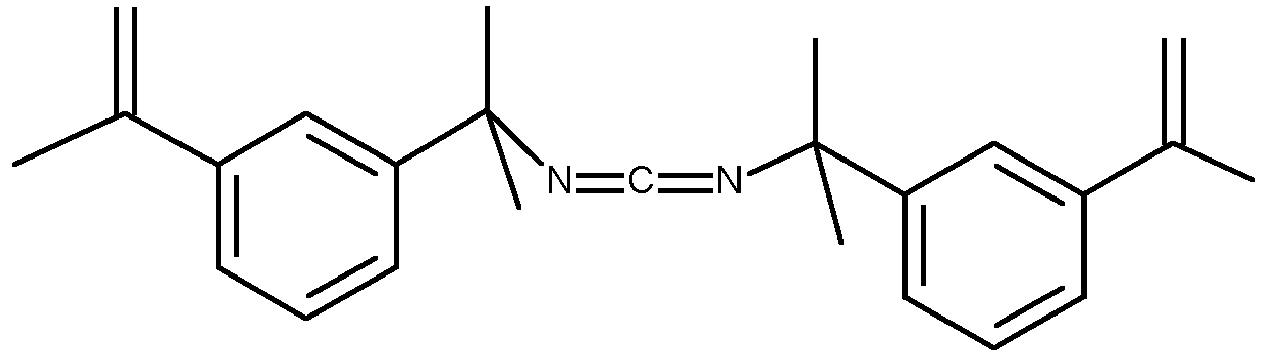
- Bis[3-Isopropenyl-α,α-dimethylbenzyl]carbodiimid entspricht dabei der nachstehend genannten Formel:
- Ein weiterer Gegenstand der vorliegenden Erfindung ist zudem ein Verfahren zur Herstellung von Polyurethanen (PU), bevorzugt thermoplastischen Polyurethanen, wonach die Umsetzung der Polyole, vorzugsweise der Polyesterpolyole, mit den Diisocyanaten in Gegenwart des erfindungsgemäßen Bis[3-Isopropenyl-α,α-dimethylbenzyl]carbodiimids gegebenenfalls in Anwesenheit von Katalysatoren und gegebenenfalls weiterer Hilfs- und Zusatzstoffe durchgeführt wird.
- Die Herstellung der Polyurethane erfolgt dabei vorzugsweise, wie in
WO 2005/111136 A1 beschrieben, unter Verwendung des erfindungsgemäßen Bis[3-Isopropenyl-α,α-dimethylbenzyl]-carbodiimids als Stabilisator.Polyurethane entstehen durch Polyadditionsreaktion von Polyisocyanaten mit mehrwertigen Alkoholen, den Polyolen, nahezu quantitativ. Die Verknüpfung erfolgt durch die Reaktion einer Isocyanatgruppe (-N=C=O) eines Moleküls mit einer Hydroxygruppe (-OH) eines anderen Moleküls unter Bildung einer Urethangruppe (-NH-CO-O-). - Thermoplastische Polyurethane sind dabei unter Temperatureinwirkung verformbare Polyurethane.
- Der Reaktionsverlauf zwischen Diisocyanat und Polyol ist abhängig von dem Molverhältnis der Komponenten. Zwischenstufen mit gewünschtem Durchschnittsmolekulargewicht und gewünschten Endgruppen können durchaus erhalten werden. Diese Zwischenstufen können dann zu einem späteren Zeitpunkt mit einem Diol oder Diamin umgesetzt (kettenverlängert) werden, wobei dann das gewünschte Polyurethan bzw. Polyurethan-Polyharnstoff-Hybrid gebildet wird. Die Zwischenstufen werden im Allgemeinen als Prepolymer bezeichnet.
- Das Molverhältnis zwischen Diisocyanat und Polyol liegt vorzugsweise zwischen 1 : 2 bis 10 : 1. Geeignete Polyole für die Herstellung von Prepolymeren sind Polyalkylenglykolether, Polyetherester oder Polyester mit endständigen Hydroxylgruppen (Polyesterpolyole).
- Bei den Polyolen im Sinne der Erfindung handelt es sich um Verbindungen, die vorzugsweise ein Molekulargewicht in (g/mol) von bis zu 2000, bevorzugt im Bereich von 500 bis 2000 und besonders bevorzugt im Bereich von 500 bis 1000 aufweisen.
- Der Begriff Polyol im Sinne der Erfindung umfasst dabei sowohl Diole als auch Triole, wie auch Verbindungen mit mehr als drei Hydroxylgruppen je Molekül. Die Verwendung von Triolen ist besonders bevorzugt.
- Bevorzugte Polyole sind Polyesterpolyole und/oder Polyetheresterpolyole.
- Vorteilhaft ist es, wenn das Polyol eine OH-Zahl von bis zu 200, vorzugsweise zwischen 20 und 150 und besonders bevorzugt zwischen 50 und 115, aufweist.
- Insbesondere eignen sich Polyesterpolyole, die Reaktionsprodukte von verschiedenen Polyolen mit aromatischen oder aliphatischen Dicarbonsäuren und/oder Polymeren von Lactonen sind.
- Bevorzugt hierbei sind aromatische Dicarbonsäuren, welche zur Bildung geeigneter Polyesterpolyole verwendet werden können. Besonders bevorzugt sind hier Terephthalsäure, Isophthalsäure, Phthalsäure, Phtalsäureanhydrid sowie substituierte Dicarbonsäureverbindungen mit Benzolkern.
- Als aliphatische Dicarbonsäuren sind solche bevorzugt, welche zur Bildung geeigneter Polyesterpolyole verwendet werden können, besonders bevorzugt Sebacinsäure, Adipinsäure und Glutarsäure.
- Als Polymere von Lactonen sind solche bevorzugt, welche zur Bildung geeigneter Polyesterpolyole verwendet werden können, besonders bevorzugt Polycaprolacton.
- Sowohl bei den Dicarbonsäuren als auch bei den Polymeren von Lactonen handelt es sich um handelsübliche Substanzen.
- Besonders bevorzugt sind auch solche Polyole, welche zur Bildung geeigneter Polyesterpolyole verwendet werden können, ganz besonders bevorzugt Ethylenglykol, Butandiol, Neopentylglykol, Hexandiol, Propylenglykol, Dipropylenglykol, Diethylenglykol und Cyclohexandimethanol.
- In einer weiteren bevorzugten Ausführungsform der Erfindung handelt es sich bei den Polyolen um Polyetheresterpolyole.
- Hierfür sind die Reaktionsprodukte von verschiedenen vorhergehend genannten Polyolen mit aromatischen oder aliphatischen Dicarbonsäuren und/oder Polymeren von Lactonen, vorzugsweise Polycaprolacton, bevorzugt.
- Bei den im Sinne der Erfindungen eingesetzten Polyolen handelt es sich um handelsübliche Verbindungen, die bei der Firma Bayer MaterialScience AG unter dem Handelsnamen Baycoll® oder Desmophen® erhältlich sind.
- Als Diisocyanate sind aromatische und aliphatische Diisocyanate bevorzugt. Besonders bevorzugt sind Toluol-2,4-diisocyanat, Toluol-2,6-diisocyanat, Phenylendiisocyanat, 4,4-Diphenylmethandiisocyanat, Methylen-bis(4-phenylisocynat), Naphtalen-1,5-diisocyanat, Tetramethylen-1,4-diisocyanat und/oder Hexamethylen-1,6-diisocyanat, ganz besonders bevorzugt Toluol-2,4-diisocyanat und Toluol-2,6-diisocyanat.
- Bei den im Sinne der Erfindungen eingesetzten Diisocyanaten handelt es sich um handelsübliche Verbindungen, die bei der Firma Bayer MaterialScience AG unter dem Handelsnamen Desmodur® erhältlich sind.
- In einer weiteren Ausführungsform der Erfindung enthält die Zusammensetzung zusätzlich mindestens ein Diamin und/oder Diol.
- Als Diamine, welche für die Kettenverlängerung eingesetzt werden, sind 2-Methylpropyl-3,5-diamino-4-chlorobenzoat, Bis-(4,4'-amino-3-chlorophenyl)-methan, 3,5-Dimethylthio-2,4-toluylendiamin, 3,5-Dimethylthio-2,4-toluylendiamin, 3,5-Diethyl-2,4-toluylendiamin, 3,5-Diethyl-2,6-toluylendiamin, 4,4'-Methylen-bis-(3-chloro-2,6-diethylanilin) und 1,3-Propandiol-bis(4-aminobenzoat) bevorzugt.
- Als Diole sind Butandiol, Neopentylglykol, Hexandiol, Propylenglykol, Dipropylenglykol, Diethylenglykol und/oder Cyclohexandimethanol bevorzugt.
- Bei den im Sinne der Erfindung zur Kettenverlängerung eingesetzten Diaminen oder Diolen handelt es sich um handelsübliche Verbindungen, die bei der Firma Rheinchemie Rheinau GmbH unter dem Handelsnamen Addolink® erhältlich sind.
- Der Anteil an Diamin und/oder Diol beträgt vorzugsweise 1 bis 20 Gew.%, bezogen auf die Gesamtmischung.
- Der Begriff Gesamtmischung steht hierbei für die Summe der Bestandteile der Mischung zur Herstellung der Polyurethane.
- Als Katalysatoren werden vorzugsweise Dibutylzinndilaurate oder Triethylendiamin in Dipropylenglycol eingesetzt.
- Bei den im Sinne der Erfindungen eingesetzten Katalysatoren handelt es sich um handelsübliche Verbindungen, die bei der Fa. Rhein Chemie Rheinau GmbH unter dem Handelsnamen Addocat® erhältlich sind.
- Der Anteil an Katalysator beträgt vorzugsweise 0,1 bis 5 Gew.%, bezogen auf die Gesamtmischung.
- In einer weiteren bevorzugten Ausführungsform der Erfindung werden weitere Hilfs- und Zusatzstoffe, wie vorzugsweise Entformungshilfsmittel, Flammschutzmittel, UV-Stabilisatoren und Weichmacher zugegeben.
- In einer besonders bevorzugten Ausführungsform der vorliegenden Erfindung wird das Bis[3-Isopropenyl-α,α-dimethylbenzyl]carbodiimid in einer Menge von 0,1 bis 2 Gew.%, bevorzugt 0,5 bis 1 Gew.%, bezogen auf die Gesamtmischung, eingesetzt.
- In einer weiteren bevorzugten Ausführungsform der vorliegenden Erfindung wird das Bis[3-Isopropenyl-α,α-dimethylbenzyl]carbodiimid in flüssiger Form (Aggregatzustand flüssig) bevorzugt bei Temperaturen von 20 - 50 °C, besonders bevorzugt 25 - 35 °C eingesetzt.
- Die Zudosierung des erfindungsgemäßen Bis[3-Isopropenyl-α,α-dimethylbenzyl]carbodiimids kann sowohl bei der Herstellung des Polyurethans erfolgen als auch nachträglich dem Polyurethan über Mischaggregate zudosiert werden.
- Die Flüssigdosierung im erfindungsgemäßen Verfahren erfolgt auf diskontinuierlich oder kontinuierlich, vorzugsweise auf kontinuierlich arbeitenden Verarbeitungsmaschinen, wie z.B. Ein-, Zwei- und Mehrwellenextrudern, kontinuierlich arbeitenden Co-Knetern (Typ Buss) und/ oder diskontinuierlich arbeitenden Knetern, z.B. vom Typ Banbury und anderen in der Polymerindustrie üblichen Aggregaten. Diese kann gleich zu Beginn oder im Verlauf der Herstellung des estergruppen-haltigen Polymeren oder gleich zu Beginn oder im Verlauf der Verarbeitung, z.B. zu Monofilamenten oder zu Polymergranulat, erfolgen.
- Unter flüssigdosiert im Sinne der Erfindung wird verstanden, dass die erfindungsgemäßen Carbodiimide in flüssiger Form (in flüssigem Aggregatzustand) gravimetrisch oder volumetrisch den kontinuierlich oder diskontinuierlich arbeitenden Verarbeitungsmaschinen zudosiert werden. Um dies zu ermöglichen, müssen die erfindungsgemäßen Carbodiimide bei der Dosierung flüssig und niederviskos sein, insbesondere bei Umgebungstemperatur, wie sie bei der Polymerverarbeitung üblich ist. Zur Flüssigdosierung in Verarbeitungsprozessen werden die in der Thermoplast-Compoundiertechnologie üblichen, kontinuierlich arbeitenden Dosieraggregate verwendet. Diese können beheizbar sein. Bevorzugt sind diese nicht beheizbar.
- Ein weiterer Gegenstand der vorliegenden Erfindung ist zudem die Verwendung des erfindungsgemäßen Bis[3-Isopropenyl-α,α-dimethylbenzyl]carbodiimids zur Stabilisierung von Polyurethanen.
- Ein weiterer Gegenstand der vorliegenden Erfindung ist die Verwendung des erfindungsgemäßen Bis[3-Isopropenyl-α,α-dimethylbenzyl]carbodiimids zur Stabilisierung von Polyurethanen durch Einarbeiten in das bereits hergestellte Polyurethan mittels Flüssigdosierung bevorzugt bei Temperaturen von 20 - 50 °C, besonders bevorzugt 25 - 35 °C.
- Die nach diesem Verfahren hergestellten Polyurethan(PU)-basierten Systeme zeichnen sich durch eine erhöhte Hydrolysestabilität aus.
- Der Rahmen der Erfindung erfasst alle oben stehenden und im Folgenden aufgeführten allgemeinen oder in Vorzugsbereichen genannten Restedefinitionen, Indizes, Parameter und Erläuterungen untereinander, also auch zwischen den jeweiligen Bereichen und Vorzugsbereichen in beliebiger Kombination.
- Die nachfolgenden Beispiele dienen der Erläuterung der Erfindung, ohne dabei limitierend zu wirken.
-
- Beispiel 1: Herstellung von Bis[3-Isopropenyl-α,α-dimethylbenzyl]carbodiimid auf Basis des Isocyanats 3-Isopropenyl-α,α-dimethylbenzylisocyanat erfindungsgemäß mit Cäsiumcarbonat.
- Beispiele 2 - 6: Herstellung von Bis[3-Isopropenyl-α,α-dimethylbenzyl]carbodiimid auf Basis des Isocyanats 3-Isopropenyl-α,α--dimethylbenzylisocyanat mit anderen Katalysatoren als Vergleichsbeispiele.
- Es wurden 30 g 3-Isopropenyl-α,α-dimethylbenzylisocyanat in einen 100 ml-Dreihalskolben eingewogen, der mit Innenthermometer, Rückflusskühler und Schutzgaseinlass ausgestattet war, und daraufhin wurden 0.6 g (2 Gew.%) des jeweiligen Katalysators gemäß Tabelle 1 zugefügt. In der Aufheizphase wurde ein Argonstrom als Schutzgas über die Dampfphase geleitet. Bei beginnender CO2-Entwicklung wurde das Schutzgas abgestellt. Man ließ 3.5 h bei 195 °C (Beispiel 1-5) kräftig rühren und filtrierte anschließend das auf ca. 100°C abgekühlte Reaktionsgemisch. Die Ausbeute wurde mittels 1H-NMR-Spektroskopie bestimmt (400 MHz, CDCl3)
-
Tabelle 1: Ausbeuten der Synthese des Carbodiimids auf Basis des Isocyanats 3-Isopropenyl-α,α-dimethylbenzylisocyanat (aus NMR). Beispiel Katalysator T [°C] Carbodiimid [%] Isocyanat [%] Nebenprodukt [%] 1 (erf.) Cäsiumcarbonat 195 93 0 7 2 (V) Strontiumcarbonat 195 0 100 0 3 (V) Kaliumcarbonat 195 0 100 0 4 (V) Lithiumcarbonat 195 0 100 0 5 (V) Calciumcarbonat 195 0 100 0 6 (V) Phospholenoxid 180 37 Nicht bestimmt Nicht bestimmt V = Vergleichsbeispiel; erf. = erfindungsgemäß - Die Alkalimetalle des Lithiums und des Kaliums sowie die Erdalkalicarbonate des Calciums und Strontiums haben sich, wie in Tabelle 1 ersichtlich, als völlig unbrauchbar in Bezug auf den Einsatz als Katalysator für die Carbodiimidisierung von 3-Isopropenyl-α,α-dimethylbenzylisocyanat in Bis[3-Isopropenyl-α,α-dimethylbenzyl]carbodiimid erwiesen.
- Überraschenderweise zeigt das Cäsiumcarbonat hingegen für die Carbodiimidisierung eine hohe Katalysatoraktivität und führt zu Ausbeuten von über 90% und ist damit deutlich besser als die Synthese über Phospholenoxid.
- Zudem kann der erfindungsgemäße Katalysator einfach durch Filtration abgetrennt werden, während im Fall des Phospholenoxides als Katalysator eine aufwändige Destillation im Vakuum zur Abtrennung erfolgen muss, so dass die Ausbeute durch diese Aufarbeitung weiter verringert wird.
- Dazu wurden 1.0 Gew.% bzw. 1.5 Gew.% des erfindungsgemäßen Carbodiimids (CDI erf.) sowie der kommerziell erhältlichen Carbodiimide:
- CDI 1= ein monomeres aromatisches Carbodiimid, subsituiert mit Alkylgruppen,
- CDI 2 = ein polymeres aromatisches Carbodiimid,
- Mittels Spritzgussverfahren wurden daraus Prüfkörper hergestellt, die 16 h bei 80°C nachgetempert wurden. Danach wurden sie bei 80°C in Wasser gelagert und in regelmäßigen Abständen die Zugfestigkeit geprüft.
- Tabelle 2 zeigt die prozentuale relative Zugfestigkeit beginnend bei Tag 0 mit 100 %.
Tabelle 2: Referenzmaterial 1x extrudiert CDI 1 1.5 % CDI 2 1.5% CDI erf. 1.5% CDI erf. 1.0 % Tag 0 100 100 100 100 100 100 Tag 5 82 85 83 94 100 n.b. Tag 8 63 62 n.b. n.b. 91 n.b. Tag 14 18 18 n.b. n.b. 86 n.b. Tag 19 7 7 79 90 83 n.b. Tag 26 0 0 76 88 82 n.b. Tag 39 72 88 82 n.b. Tag 45 63 82 76 91 Tag 53 57 88 73 n.b. Tag 57 42 86 76 n.b. Tag 63 21 64 76 n.b. Tag 67 0 13 73 n.b. Tag 80 n.b. 84 Tag 94 n.b. 80 Tag 98 68 n.b. Tag 105 71 n.b. Tag 112 66 n.b. Tag 118 n.b. 81 Tag 140 61 n.b. Tag 143 n.b. 73 Tag 171 n.b. 76 Tag 192 n.b. 62 Tag 196 55, *) n.b. Tag 213 n.b. 5 V = Vergleichsbeispiel; erf. = erfindungsgemäß, n.b. = nicht bestimmt, *) danach waren keine Prüfkörper mehr vorhanden - Die Ergebnisse in der Tabelle 2 zeigen, dass das nach dem erfindungsgemäßen Verfahren hergestellte Bis[3-Isopropenyl-α,α-dimethylbenzyl]carbodiimid eine herausragende Hydrolyseschutzwirkung in thermoplastischem PU (TPU) aufweist und den Carbodiimiden des Standes der Technik überlegen ist.
- Es wurde ein Schmelzklebstoff auf Basis von Dynacoll® 7360, ein linearer Copolyester mit primären Hydroxylfunktionen und einem mittleren molekularen Gewicht von 3500 g/mol, erhältlich von der Firma Evonik AG hergestellt und dieser wurde wie folgt additiviert:
- (A) 2 Gew. % Bis[3-Isopropenyl-α,α-dimethylbenzyl]carbodiimid, hergestellt nach dem erfindungsgemäßen Verfahren,
- (B) 2 Gew.% Bis[3-Isopropenyl-α,α-dimethylbenzyl]carbodiimid, hergestellt nach dem Verfahren aus
WO-A 2005/111136 . - Alle Mengenangaben sind in Gew.-%.
- Der Schmelzklebstoff wurde wie folgt hergestellt:
- Zunächst wird der Copolyester Dynacoll®7360 für 30 Minuten und bei 120 °C evakuiert. Anschließend erfolgt die Zugabe von 11,67 Gew.% Diphenylmethandiisocyanat (MDI), bezogen auf die Gesamtformulierung, und es wird für 60 Minuten bei 120 °C umgesetzt.
- Anschließend wurden die Additive in den Schmelzklebstoff eingearbeitet und eine Einwirkzeit der Additive von 1 Stunde sichergestellt.
- Die so hergestellten und additivierten Schmelzklebstoffe (Hot-Melt) wurden in einer Kartusche einer Temperaturalterung bei 130 °C für 48 Stunden unterworfen. Dazu wurde sie in eine Alukartusche (Licht- und Feuchtigkeitsdicht) abgefüllt und im Umluftofen für 48 Stunden bei 130 °C gealtert.
- Nach der Alterung wurden die Farbe und das Schäumverhalten der Proben visuell beurteilt.
- Die Ergebnisse der Messungen sind in der Tabelle 3 zusammengestellt:
Tabelle 3: Carbodiimid Farbe Schäumverhalten Beispiel 7A (erf.) Farblos bis sehr leicht gelb Kein Schaum, keine oder sehr geringe Blasenbildung Beispiel 7B (V) Gelb-rötlich bis rot- braun Schaum- bzw. starke Blasenbildung V = Vergleichsbeispiel; erf. = erfindungsgemäß - Diese Versuche zeigen, dass durch die Verwendung des erfindungsgemäßen Carbodiimides keine nennenswerten störenden Nebeneffekte bezüglich Verfärbungen und Schaumbildung auftreten. Im Vergleich dazu zeigen Carbodiimide, deren Synthese mit Phospholenoxid katalysiert wurde und die noch Spuren von Phosphor-organischen Verbindungen beinhalten, die entsprechend angegebenen Nachteile von Verfärbung und Schaumbildung.
Claims (12)
- Verfahren zur Herstellung von Bis[3-Isopropenyl-α,α-dimethylbenzyl]carbodiimid, dadurch gekennzeichnet, dass 3-Isopropenyl-α,α-dimethylbenzylisocyanat in Gegenwart von 0,1 - 20 Gew.% basischer Cäsiumssalze bei Temperaturen zwischen 160 bis 220° C carbodiimidisiert wird.
- Verfahren nach Anspruch 1, dadurch gekennzeichnet, dass als basische Cäsiumssalze Cäsiumcarbonat und/oder Cäsiumalkoholat, vorzugsweise Cäsiummethylat und/oder Cäsiumethylat eingesetzt wird.
- Verfahren nach Anspruch 1 oder 2, dadurch gekennzeichnet, dass die basischen Cäsiumssalze im Anschluss an die Carbodiimidisierung abfiltiriert werden.
- Verfahren nach einem der Ansprüche 1 bis 3, dadurch gekennzeichnet, dass die Carbodiimisierung in einem Lösemittel stattfindet.
- Verfahren nach Anspruch 4, dadurch gekennzeichnet, dass als Lösemittel ein-, zwei-, drei- oder mehrfach Alkyl-substituierte Benzole und/oder Dibenzole mit Alkyl = C1 - C3 eingesetzt werden.
- Verfahren nach Anspruch 5, dadurch gekennzeichnet, dass als Alkylbenzole Xylole eingesetzt werden.
- Bis[3-Isopropenyl-α,α-dimethylbenzyl]carbodiimid erhältlich nach einem Verfahren nach einem der Ansprüche 1 bis 6.
- Stabilisator enthaltend mindestens 90 Gew.% Bis[3-Isopropenyl-α,α-dimethylbenzyl]carbodiimid nach Anspruch 7 und maximal 1 ppm an heterocyclischen Phosphorverbindungen.
- Verfahren zur Herstellung von Polyurethanen, bevorzugt thermoplastischen Polyurethanen dadurch gekennzeichnet, dass die Umsetzung der Polyole mit den Diisocyanaten in Gegenwart von Bis[3-Isopropenyl-α,α-dimethylbenzyl]carbodiimid nach Anspruch 7 durchgeführt wird.
- Verfahren nach Anspruch 9, dadurch gekennzeichnet, dass das Bis[3-Isopropenyl-α,α-dimethylbenzyl]carbodiimid in einer Menge von 0,1 bis 2 Gew.%, bevorzugt 0,5 bis 1 Gew.%, bezogen auf die Gesamtmischung, eingesetzt wird.
- Verfahren nach Anspruch 9 und 10, dadurch gekennzeichnet, dass das Bis[3-Isopropenyl-α,α-dimethylbenzyl]carbodiimid bevorzugt in flüssiger Form kontinuierlich oder diskontinuierlich bei Temperaturen 20 - 50 °C besonders bevorzugt 25 - 35 °C zudosiert wird.
- Verwendung von Bis[3-Isopropenyl-α,α-dimethylbenzyl]carbodiimid nach Anspruch 7 zum Hydrolyseschutz.
Priority Applications (15)
| Application Number | Priority Date | Filing Date | Title |
|---|---|---|---|
| PT141712026T PT2952502T (pt) | 2014-06-04 | 2014-06-04 | Bis-[3-isopropenil-alfa,alfa-dimetilbenzil]-carbodi-imida, processos para a sua produção e a sua utilização |
| PL14171202T PL2952502T3 (pl) | 2014-06-04 | 2014-06-04 | Bis[3 izopropenylo-alfa, alfa-dimetylobenzylo] karbodiimid, sposób otrzymywania i zastosowanie |
| HUE14171202A HUE033515T2 (en) | 2014-06-04 | 2014-06-04 | Bis [3-isopropenyl alpha, alpha-dimethylbenzyl] carbodiimide, a process for its preparation and its use |
| ES14171202.6T ES2616281T3 (es) | 2014-06-04 | 2014-06-04 | Bis[3 isopropenil-alfa,alfa-dimetilbencil]carbodiimida, procedimiento para su preparación y su uso |
| EP14171202.6A EP2952502B1 (de) | 2014-06-04 | 2014-06-04 | Bis[3 isopropenyl-alpha,alpha-dimethylbenzyl]carbodiimid, verfahren zur herstellung und dessen verwendung |
| CN201580030247.0A CN106458865B (zh) | 2014-06-04 | 2015-06-03 | 双[3-异丙烯基-α,α-二甲基苄基]碳二亚胺、所述化合物的生产方法和用途 |
| MX2016015818A MX367465B (es) | 2014-06-04 | 2015-06-03 | Bis[3-isopropenil-alfa, alfa-dimetilbencil]carbodiimida, procedimiento de preparacion y uso de dicho compuesto. |
| PCT/EP2015/062410 WO2015185645A1 (de) | 2014-06-04 | 2015-06-03 | Bis[3-isopropenyl-alpha,alpha-dimethylbenzyl]carbodiimid, verfahren zur herstellung und dessen verwendung |
| BR112016028307-4A BR112016028307B1 (pt) | 2014-06-04 | 2015-06-03 | Processo para a produção de bis[3-isopropenil-a,adimetilbenzil]carbodiimida; processo para a produção de poliuretanos; e uso de bis[3-isopropenil-a,adimetilbenzil]carbodiimida |
| KR1020177000064A KR102507433B1 (ko) | 2014-06-04 | 2015-06-03 | 비스[3-아이소프로페닐-α,α-다이메틸벤질]카보다이이미드, 상기 화합물의 제조 방법 및 용도 |
| RU2016152227A RU2703516C2 (ru) | 2014-06-04 | 2015-06-03 | БИС[3-ИЗОПРОПЕНИЛ-α, α-ДИМЕТИЛБЕНЗИЛ]КАРБОДИИМИД, СПОСОБЫ ПОЛУЧЕНИЯ И ПРИМЕНЕНИЕ УКАЗАННОГО СОЕДИНЕНИЯ |
| JP2016571123A JP6496327B2 (ja) | 2014-06-04 | 2015-06-03 | ビス[3−イソプロペニル−アルファ,アルファ−ジメチルベンジル]カルボジイミド、製造方法、および前記化合物の使用 |
| US15/315,498 US10239827B2 (en) | 2014-06-04 | 2015-06-03 | Bis[3-isopropenyl-α,α-dimethylbenzyl]carbodiimide, production methods, and use of said compound |
| CA2950228A CA2950228C (en) | 2014-06-04 | 2015-06-03 | Process for producing bis[3-isopropenyl-alpha, alpha-dimethylbenzyl]carbodiimide via carbodiimidization with cesium salts |
| ZA2017/00024A ZA201700024B (en) | 2014-06-04 | 2017-01-03 | Bis[3-isopropenyl-alpha,alpha-dimethylbenzyl]carbodiimide, production methods, and use of said compound |
Applications Claiming Priority (1)
| Application Number | Priority Date | Filing Date | Title |
|---|---|---|---|
| EP14171202.6A EP2952502B1 (de) | 2014-06-04 | 2014-06-04 | Bis[3 isopropenyl-alpha,alpha-dimethylbenzyl]carbodiimid, verfahren zur herstellung und dessen verwendung |
Publications (2)
| Publication Number | Publication Date |
|---|---|
| EP2952502A1 true EP2952502A1 (de) | 2015-12-09 |
| EP2952502B1 EP2952502B1 (de) | 2017-01-04 |
Family
ID=50846864
Family Applications (1)
| Application Number | Title | Priority Date | Filing Date |
|---|---|---|---|
| EP14171202.6A Active EP2952502B1 (de) | 2014-06-04 | 2014-06-04 | Bis[3 isopropenyl-alpha,alpha-dimethylbenzyl]carbodiimid, verfahren zur herstellung und dessen verwendung |
Country Status (15)
| Country | Link |
|---|---|
| US (1) | US10239827B2 (de) |
| EP (1) | EP2952502B1 (de) |
| JP (1) | JP6496327B2 (de) |
| KR (1) | KR102507433B1 (de) |
| CN (1) | CN106458865B (de) |
| BR (1) | BR112016028307B1 (de) |
| CA (1) | CA2950228C (de) |
| ES (1) | ES2616281T3 (de) |
| HU (1) | HUE033515T2 (de) |
| MX (1) | MX367465B (de) |
| PL (1) | PL2952502T3 (de) |
| PT (1) | PT2952502T (de) |
| RU (1) | RU2703516C2 (de) |
| WO (1) | WO2015185645A1 (de) |
| ZA (1) | ZA201700024B (de) |
Families Citing this family (6)
| Publication number | Priority date | Publication date | Assignee | Title |
|---|---|---|---|---|
| PT3307709T (pt) * | 2015-06-15 | 2019-04-30 | Lanxess Deutschland Gmbh | Processo para a produção de carbodiimidas poliméricas com adição de sais de césio, carbodiimidas poliméricas e sua utilização |
| HUE057882T2 (hu) * | 2017-12-20 | 2022-06-28 | Lanxess Deutschland Gmbh | Eljárás karbodiimidek elõállítására |
| CN111836797A (zh) * | 2018-03-12 | 2020-10-27 | 日清纺化学株式会社 | 碳化二亚胺化合物的制备方法 |
| EP3766864A4 (de) * | 2018-03-12 | 2021-12-29 | Nisshinbo Chemical Inc. | Verfahren zur herstellung einer carbodiimidverbindung |
| CN112625201B (zh) * | 2019-12-26 | 2022-07-19 | 上海朗亿功能材料有限公司 | 碳化二亚胺类聚合物、制备方法、中间体、组合物及应用 |
| EP4667454A1 (de) | 2024-06-18 | 2025-12-24 | LANXESS Deutschland GmbH | Verfahren zur herstellung von tertiären araliphatischen carbodiimiden |
Citations (2)
| Publication number | Priority date | Publication date | Assignee | Title |
|---|---|---|---|---|
| WO1993022282A2 (en) * | 1992-04-29 | 1993-11-11 | E.I. Du Pont De Nemours And Company | Carbodiimides and processes therefor |
| WO2005111136A1 (de) | 2004-05-13 | 2005-11-24 | Basf Aktiengesellschaft | Polyurethane enthaltend carbodiimide |
Family Cites Families (3)
| Publication number | Priority date | Publication date | Assignee | Title |
|---|---|---|---|---|
| JPH09124582A (ja) * | 1995-11-01 | 1997-05-13 | Nisshinbo Ind Inc | カルボジイミド化合物 |
| JP3332701B2 (ja) * | 1995-12-29 | 2002-10-07 | 日清紡績株式会社 | 不飽和ポリエステル樹脂用の添加剤及び該添加剤による不飽和ポリエステル樹脂の耐加水分解安定化方法 |
| EP2423185B1 (de) * | 2010-08-30 | 2017-03-01 | Rhein Chemie Rheinau GmbH | Neuartige wässrige resorcin-formaldehyd-latex-dispersionen, haftungsverbesserte fasern, verfahren zu deren herstellung und deren verwendung |
-
2014
- 2014-06-04 EP EP14171202.6A patent/EP2952502B1/de active Active
- 2014-06-04 ES ES14171202.6T patent/ES2616281T3/es active Active
- 2014-06-04 PL PL14171202T patent/PL2952502T3/pl unknown
- 2014-06-04 HU HUE14171202A patent/HUE033515T2/en unknown
- 2014-06-04 PT PT141712026T patent/PT2952502T/pt unknown
-
2015
- 2015-06-03 CA CA2950228A patent/CA2950228C/en active Active
- 2015-06-03 WO PCT/EP2015/062410 patent/WO2015185645A1/de not_active Ceased
- 2015-06-03 MX MX2016015818A patent/MX367465B/es active IP Right Grant
- 2015-06-03 KR KR1020177000064A patent/KR102507433B1/ko active Active
- 2015-06-03 JP JP2016571123A patent/JP6496327B2/ja active Active
- 2015-06-03 US US15/315,498 patent/US10239827B2/en active Active
- 2015-06-03 CN CN201580030247.0A patent/CN106458865B/zh active Active
- 2015-06-03 BR BR112016028307-4A patent/BR112016028307B1/pt not_active IP Right Cessation
- 2015-06-03 RU RU2016152227A patent/RU2703516C2/ru active
-
2017
- 2017-01-03 ZA ZA2017/00024A patent/ZA201700024B/en unknown
Patent Citations (2)
| Publication number | Priority date | Publication date | Assignee | Title |
|---|---|---|---|---|
| WO1993022282A2 (en) * | 1992-04-29 | 1993-11-11 | E.I. Du Pont De Nemours And Company | Carbodiimides and processes therefor |
| WO2005111136A1 (de) | 2004-05-13 | 2005-11-24 | Basf Aktiengesellschaft | Polyurethane enthaltend carbodiimide |
Non-Patent Citations (2)
| Title |
|---|
| ANGEW. CHEM., vol. 74, 1962, pages 801 - 806 |
| ANGEW. CHEM., vol. 93, 1981, pages 855 - 866 |
Also Published As
| Publication number | Publication date |
|---|---|
| CN106458865A (zh) | 2017-02-22 |
| HUE033515T2 (en) | 2017-12-28 |
| PT2952502T (pt) | 2017-02-24 |
| MX367465B (es) | 2019-08-22 |
| JP2017522279A (ja) | 2017-08-10 |
| ZA201700024B (en) | 2019-06-26 |
| KR20170015457A (ko) | 2017-02-08 |
| BR112016028307B1 (pt) | 2021-06-15 |
| JP6496327B2 (ja) | 2019-04-03 |
| MX2016015818A (es) | 2017-04-25 |
| CN106458865B (zh) | 2019-04-09 |
| EP2952502B1 (de) | 2017-01-04 |
| US10239827B2 (en) | 2019-03-26 |
| WO2015185645A1 (de) | 2015-12-10 |
| US20170088509A1 (en) | 2017-03-30 |
| RU2703516C2 (ru) | 2019-10-18 |
| PL2952502T3 (pl) | 2017-11-30 |
| ES2616281T3 (es) | 2017-06-12 |
| RU2016152227A (ru) | 2018-07-16 |
| CA2950228A1 (en) | 2015-12-10 |
| RU2016152227A3 (de) | 2019-01-17 |
| CA2950228C (en) | 2022-11-01 |
| BR112016028307A2 (pt) | 2017-08-22 |
| KR102507433B1 (ko) | 2023-03-07 |
Similar Documents
| Publication | Publication Date | Title |
|---|---|---|
| EP2952502B1 (de) | Bis[3 isopropenyl-alpha,alpha-dimethylbenzyl]carbodiimid, verfahren zur herstellung und dessen verwendung | |
| EP2997010B1 (de) | Neue carbodiimide mit endständigen harnstoff- und/oder urethangruppen, verfahren zu deren herstellung und deren verwendung | |
| EP3307709B1 (de) | Verfahren zur herstellung von polymeren carbodiimiden unter zusatz von cäsiumsalzen, polymere carbodiimide und deren verwendung | |
| EP2331598B1 (de) | Polyurethane basierend auf polyesterdiolen mit verbessertem kristallisationsverhalten | |
| EP2855573B1 (de) | Neuartige carbodiimid-haltige zusammensetzungen, ein verfahren zu deren herstellung und deren verwendung | |
| EP0597382A1 (de) | Neue Bis-(4-substituierte-2,6-diisopropyl-phenyl)-carbodiimide, ein Verfahren zu ihrer Herstellung und ihre Verwendung sowie die zu ihrer Herstellung verwendbaren 4-substituierten, 2,6-Diisopropyl-phenylisocyanate | |
| EP2844682B1 (de) | Verwendung von carbodiimid-haltigen zusammensetzungen zur steuerung der topfzeit | |
| EP2844681B1 (de) | Verfahren zur steuerung (verlängerung) der topfzeit in kettenverlängerten polyurethan(pu)-basierten systemen | |
| EP0522340B1 (de) | Verfahren zur Herstellung thermoplastischer Polyurethan-Elastomere | |
| EP2671912B1 (de) | Verfahren zur Stabilisierung von Estergruppen-enthaltenden Polymeren | |
| EP4370500B1 (de) | Aromatische carbodiimide, verfahren zu deren herstellung und deren verwendung | |
| WO2025261850A1 (de) | Verfahren zur herstellung von tertiären araliphatischen carbodiimiden | |
| EP4180473A1 (de) | Verfahren zur herstellung von aromatischen polymeren carbodiimiden | |
| DE19951122B4 (de) | Polyisocyanat-Polyadditionsprodukte | |
| DE102004041605A1 (de) | Carbodiimide | |
| DE3442689A1 (de) | Bis-(4-isocyanatophenoxy)-alkane, ein verfahren zu ihrer herstellung und ihre verwendung bei der herstellung von polyurethankunststoffen | |
| DE10351534A1 (de) | Verfahren zur Herstellung von Carbodiimiden |
Legal Events
| Date | Code | Title | Description |
|---|---|---|---|
| PUAI | Public reference made under article 153(3) epc to a published international application that has entered the european phase |
Free format text: ORIGINAL CODE: 0009012 |
|
| AK | Designated contracting states |
Kind code of ref document: A1 Designated state(s): AL AT BE BG CH CY CZ DE DK EE ES FI FR GB GR HR HU IE IS IT LI LT LU LV MC MK MT NL NO PL PT RO RS SE SI SK SM TR |
|
| AX | Request for extension of the european patent |
Extension state: BA ME |
|
| 17P | Request for examination filed |
Effective date: 20160609 |
|
| RBV | Designated contracting states (corrected) |
Designated state(s): AL AT BE BG CH CY CZ DE DK EE ES FI FR GB GR HR HU IE IS IT LI LT LU LV MC MK MT NL NO PL PT RO RS SE SI SK SM TR |
|
| GRAJ | Information related to disapproval of communication of intention to grant by the applicant or resumption of examination proceedings by the epo deleted |
Free format text: ORIGINAL CODE: EPIDOSDIGR1 |
|
| GRAP | Despatch of communication of intention to grant a patent |
Free format text: ORIGINAL CODE: EPIDOSNIGR1 |
|
| INTG | Intention to grant announced |
Effective date: 20160902 |
|
| GRAS | Grant fee paid |
Free format text: ORIGINAL CODE: EPIDOSNIGR3 |
|
| STAA | Information on the status of an ep patent application or granted ep patent |
Free format text: STATUS: GRANT OF PATENT IS INTENDED |
|
| GRAA | (expected) grant |
Free format text: ORIGINAL CODE: 0009210 |
|
| STAA | Information on the status of an ep patent application or granted ep patent |
Free format text: STATUS: THE PATENT HAS BEEN GRANTED |
|
| AK | Designated contracting states |
Kind code of ref document: B1 Designated state(s): AL AT BE BG CH CY CZ DE DK EE ES FI FR GB GR HR HU IE IS IT LI LT LU LV MC MK MT NL NO PL PT RO RS SE SI SK SM TR |
|
| REG | Reference to a national code |
Ref country code: GB Ref legal event code: FG4D Free format text: NOT ENGLISH |
|
| REG | Reference to a national code |
Ref country code: CH Ref legal event code: EP |
|
| REG | Reference to a national code |
Ref country code: AT Ref legal event code: REF Ref document number: 859093 Country of ref document: AT Kind code of ref document: T Effective date: 20170115 |
|
| REG | Reference to a national code |
Ref country code: IE Ref legal event code: FG4D Free format text: LANGUAGE OF EP DOCUMENT: GERMAN |
|
| REG | Reference to a national code |
Ref country code: PT Ref legal event code: SC4A Ref document number: 2952502 Country of ref document: PT Date of ref document: 20170224 Kind code of ref document: T Free format text: AVAILABILITY OF NATIONAL TRANSLATION Effective date: 20170216 |
|
| REG | Reference to a national code |
Ref country code: DE Ref legal event code: R096 Ref document number: 502014002382 Country of ref document: DE |
|
| RAP2 | Party data changed (patent owner data changed or rights of a patent transferred) |
Owner name: LANXESS DEUTSCHLAND GMBH |
|
| REG | Reference to a national code |
Ref country code: NL Ref legal event code: FP Ref country code: DE Ref legal event code: R081 Ref document number: 502014002382 Country of ref document: DE Owner name: LANXESS DEUTSCHLAND GMBH, DE Free format text: FORMER OWNER: RHEIN-CHEMIE RHEINAU GMBH, 68219 MANNHEIM, DE |
|
| REG | Reference to a national code |
Ref country code: LT Ref legal event code: MG4D |
|
| REG | Reference to a national code |
Ref country code: FR Ref legal event code: PLFP Year of fee payment: 4 |
|
| REG | Reference to a national code |
Ref country code: ES Ref legal event code: FG2A Ref document number: 2616281 Country of ref document: ES Kind code of ref document: T3 Effective date: 20170612 |
|
| PG25 | Lapsed in a contracting state [announced via postgrant information from national office to epo] |
Ref country code: HR Free format text: LAPSE BECAUSE OF FAILURE TO SUBMIT A TRANSLATION OF THE DESCRIPTION OR TO PAY THE FEE WITHIN THE PRESCRIBED TIME-LIMIT Effective date: 20170104 Ref country code: NO Free format text: LAPSE BECAUSE OF FAILURE TO SUBMIT A TRANSLATION OF THE DESCRIPTION OR TO PAY THE FEE WITHIN THE PRESCRIBED TIME-LIMIT Effective date: 20170404 Ref country code: LT Free format text: LAPSE BECAUSE OF FAILURE TO SUBMIT A TRANSLATION OF THE DESCRIPTION OR TO PAY THE FEE WITHIN THE PRESCRIBED TIME-LIMIT Effective date: 20170104 Ref country code: GR Free format text: LAPSE BECAUSE OF FAILURE TO SUBMIT A TRANSLATION OF THE DESCRIPTION OR TO PAY THE FEE WITHIN THE PRESCRIBED TIME-LIMIT Effective date: 20170405 Ref country code: IS Free format text: LAPSE BECAUSE OF FAILURE TO SUBMIT A TRANSLATION OF THE DESCRIPTION OR TO PAY THE FEE WITHIN THE PRESCRIBED TIME-LIMIT Effective date: 20170504 Ref country code: FI Free format text: LAPSE BECAUSE OF FAILURE TO SUBMIT A TRANSLATION OF THE DESCRIPTION OR TO PAY THE FEE WITHIN THE PRESCRIBED TIME-LIMIT Effective date: 20170104 |
|
| PG25 | Lapsed in a contracting state [announced via postgrant information from national office to epo] |
Ref country code: LV Free format text: LAPSE BECAUSE OF FAILURE TO SUBMIT A TRANSLATION OF THE DESCRIPTION OR TO PAY THE FEE WITHIN THE PRESCRIBED TIME-LIMIT Effective date: 20170104 Ref country code: BG Free format text: LAPSE BECAUSE OF FAILURE TO SUBMIT A TRANSLATION OF THE DESCRIPTION OR TO PAY THE FEE WITHIN THE PRESCRIBED TIME-LIMIT Effective date: 20170404 Ref country code: RS Free format text: LAPSE BECAUSE OF FAILURE TO SUBMIT A TRANSLATION OF THE DESCRIPTION OR TO PAY THE FEE WITHIN THE PRESCRIBED TIME-LIMIT Effective date: 20170104 Ref country code: SE Free format text: LAPSE BECAUSE OF FAILURE TO SUBMIT A TRANSLATION OF THE DESCRIPTION OR TO PAY THE FEE WITHIN THE PRESCRIBED TIME-LIMIT Effective date: 20170104 |
|
| REG | Reference to a national code |
Ref country code: DE Ref legal event code: R097 Ref document number: 502014002382 Country of ref document: DE |
|
| PG25 | Lapsed in a contracting state [announced via postgrant information from national office to epo] |
Ref country code: RO Free format text: LAPSE BECAUSE OF FAILURE TO SUBMIT A TRANSLATION OF THE DESCRIPTION OR TO PAY THE FEE WITHIN THE PRESCRIBED TIME-LIMIT Effective date: 20170104 Ref country code: SK Free format text: LAPSE BECAUSE OF FAILURE TO SUBMIT A TRANSLATION OF THE DESCRIPTION OR TO PAY THE FEE WITHIN THE PRESCRIBED TIME-LIMIT Effective date: 20170104 Ref country code: EE Free format text: LAPSE BECAUSE OF FAILURE TO SUBMIT A TRANSLATION OF THE DESCRIPTION OR TO PAY THE FEE WITHIN THE PRESCRIBED TIME-LIMIT Effective date: 20170104 |
|
| REG | Reference to a national code |
Ref country code: GB Ref legal event code: 732E Free format text: REGISTERED BETWEEN 20171012 AND 20171018 |
|
| PLBE | No opposition filed within time limit |
Free format text: ORIGINAL CODE: 0009261 |
|
| STAA | Information on the status of an ep patent application or granted ep patent |
Free format text: STATUS: NO OPPOSITION FILED WITHIN TIME LIMIT |
|
| PG25 | Lapsed in a contracting state [announced via postgrant information from national office to epo] |
Ref country code: SM Free format text: LAPSE BECAUSE OF FAILURE TO SUBMIT A TRANSLATION OF THE DESCRIPTION OR TO PAY THE FEE WITHIN THE PRESCRIBED TIME-LIMIT Effective date: 20170104 Ref country code: DK Free format text: LAPSE BECAUSE OF FAILURE TO SUBMIT A TRANSLATION OF THE DESCRIPTION OR TO PAY THE FEE WITHIN THE PRESCRIBED TIME-LIMIT Effective date: 20170104 |
|
| REG | Reference to a national code |
Ref country code: HU Ref legal event code: AG4A Ref document number: E033515 Country of ref document: HU |
|
| PG25 | Lapsed in a contracting state [announced via postgrant information from national office to epo] |
Ref country code: MC Free format text: LAPSE BECAUSE OF FAILURE TO SUBMIT A TRANSLATION OF THE DESCRIPTION OR TO PAY THE FEE WITHIN THE PRESCRIBED TIME-LIMIT Effective date: 20170104 |
|
| PG25 | Lapsed in a contracting state [announced via postgrant information from national office to epo] |
Ref country code: SI Free format text: LAPSE BECAUSE OF FAILURE TO SUBMIT A TRANSLATION OF THE DESCRIPTION OR TO PAY THE FEE WITHIN THE PRESCRIBED TIME-LIMIT Effective date: 20170104 |
|
| REG | Reference to a national code |
Ref country code: IE Ref legal event code: MM4A |
|
| REG | Reference to a national code |
Ref country code: FR Ref legal event code: PLFP Year of fee payment: 5 |
|
| PG25 | Lapsed in a contracting state [announced via postgrant information from national office to epo] |
Ref country code: LU Free format text: LAPSE BECAUSE OF NON-PAYMENT OF DUE FEES Effective date: 20170604 Ref country code: IE Free format text: LAPSE BECAUSE OF NON-PAYMENT OF DUE FEES Effective date: 20170604 |
|
| REG | Reference to a national code |
Ref country code: NL Ref legal event code: PD Owner name: LANXESS DEUTSCHLAND GMBH; DE Free format text: DETAILS ASSIGNMENT: CHANGE OF OWNER(S), MERGE; FORMER OWNER NAME: RHEIN CHEMIE RHEINAU GMBH Effective date: 20180228 |
|
| REG | Reference to a national code |
Ref country code: BE Ref legal event code: PD Owner name: LANXESS DEUTSCHLAND GMBH; DE Free format text: DETAILS ASSIGNMENT: CHANGE OF OWNER(S), FUSION; FORMER OWNER NAME: RHEIN CHEMIE RHEINAU GMBH Effective date: 20180528 |
|
| PG25 | Lapsed in a contracting state [announced via postgrant information from national office to epo] |
Ref country code: MT Free format text: LAPSE BECAUSE OF FAILURE TO SUBMIT A TRANSLATION OF THE DESCRIPTION OR TO PAY THE FEE WITHIN THE PRESCRIBED TIME-LIMIT Effective date: 20170104 |
|
| PG25 | Lapsed in a contracting state [announced via postgrant information from national office to epo] |
Ref country code: CY Free format text: LAPSE BECAUSE OF FAILURE TO SUBMIT A TRANSLATION OF THE DESCRIPTION OR TO PAY THE FEE WITHIN THE PRESCRIBED TIME-LIMIT Effective date: 20170104 |
|
| PG25 | Lapsed in a contracting state [announced via postgrant information from national office to epo] |
Ref country code: MK Free format text: LAPSE BECAUSE OF FAILURE TO SUBMIT A TRANSLATION OF THE DESCRIPTION OR TO PAY THE FEE WITHIN THE PRESCRIBED TIME-LIMIT Effective date: 20170104 |
|
| PG25 | Lapsed in a contracting state [announced via postgrant information from national office to epo] |
Ref country code: AL Free format text: LAPSE BECAUSE OF FAILURE TO SUBMIT A TRANSLATION OF THE DESCRIPTION OR TO PAY THE FEE WITHIN THE PRESCRIBED TIME-LIMIT Effective date: 20170104 |
|
| REG | Reference to a national code |
Ref country code: FR Ref legal event code: PLFP Year of fee payment: 10 |
|
| PGFP | Annual fee paid to national office [announced via postgrant information from national office to epo] |
Ref country code: PT Payment date: 20230602 Year of fee payment: 10 Ref country code: IT Payment date: 20230510 Year of fee payment: 10 Ref country code: CZ Payment date: 20230517 Year of fee payment: 10 |
|
| P01 | Opt-out of the competence of the unified patent court (upc) registered |
Effective date: 20230714 |
|
| PGFP | Annual fee paid to national office [announced via postgrant information from national office to epo] |
Ref country code: TR Payment date: 20230602 Year of fee payment: 10 Ref country code: AT Payment date: 20230525 Year of fee payment: 10 |
|
| PGFP | Annual fee paid to national office [announced via postgrant information from national office to epo] |
Ref country code: BE Payment date: 20230517 Year of fee payment: 10 |
|
| PGFP | Annual fee paid to national office [announced via postgrant information from national office to epo] |
Ref country code: ES Payment date: 20230707 Year of fee payment: 10 Ref country code: CH Payment date: 20230702 Year of fee payment: 10 |
|
| PGFP | Annual fee paid to national office [announced via postgrant information from national office to epo] |
Ref country code: NL Payment date: 20240415 Year of fee payment: 11 |
|
| PGFP | Annual fee paid to national office [announced via postgrant information from national office to epo] |
Ref country code: PL Payment date: 20240312 Year of fee payment: 11 Ref country code: FR Payment date: 20240328 Year of fee payment: 11 |
|
| PGFP | Annual fee paid to national office [announced via postgrant information from national office to epo] |
Ref country code: GB Payment date: 20240402 Year of fee payment: 11 |
|
| PGFP | Annual fee paid to national office [announced via postgrant information from national office to epo] |
Ref country code: HU Payment date: 20240515 Year of fee payment: 11 |
|
| PG25 | Lapsed in a contracting state [announced via postgrant information from national office to epo] |
Ref country code: PT Free format text: LAPSE BECAUSE OF NON-PAYMENT OF DUE FEES Effective date: 20241204 |
|
| PG25 | Lapsed in a contracting state [announced via postgrant information from national office to epo] |
Ref country code: PT Free format text: LAPSE BECAUSE OF NON-PAYMENT OF DUE FEES Effective date: 20241204 |
|
| PG25 | Lapsed in a contracting state [announced via postgrant information from national office to epo] |
Ref country code: CZ Free format text: LAPSE BECAUSE OF NON-PAYMENT OF DUE FEES Effective date: 20240604 |
|
| PG25 | Lapsed in a contracting state [announced via postgrant information from national office to epo] |
Ref country code: CZ Free format text: LAPSE BECAUSE OF NON-PAYMENT OF DUE FEES Effective date: 20240604 |
|
| REG | Reference to a national code |
Ref country code: CH Ref legal event code: PL |
|
| REG | Reference to a national code |
Ref country code: AT Ref legal event code: MM01 Ref document number: 859093 Country of ref document: AT Kind code of ref document: T Effective date: 20240604 |
|
| PG25 | Lapsed in a contracting state [announced via postgrant information from national office to epo] |
Ref country code: BE Free format text: LAPSE BECAUSE OF NON-PAYMENT OF DUE FEES Effective date: 20240630 Ref country code: CH Free format text: LAPSE BECAUSE OF NON-PAYMENT OF DUE FEES Effective date: 20240630 Ref country code: AT Free format text: LAPSE BECAUSE OF NON-PAYMENT OF DUE FEES Effective date: 20240604 |
|
| PG25 | Lapsed in a contracting state [announced via postgrant information from national office to epo] |
Ref country code: IT Free format text: LAPSE BECAUSE OF NON-PAYMENT OF DUE FEES Effective date: 20240604 |
|
| REG | Reference to a national code |
Ref country code: BE Ref legal event code: MM Effective date: 20240630 |
|
| PGFP | Annual fee paid to national office [announced via postgrant information from national office to epo] |
Ref country code: DE Payment date: 20250402 Year of fee payment: 12 |
|
| REG | Reference to a national code |
Ref country code: ES Ref legal event code: FD2A Effective date: 20250728 |
|
| PG25 | Lapsed in a contracting state [announced via postgrant information from national office to epo] |
Ref country code: ES Free format text: LAPSE BECAUSE OF NON-PAYMENT OF DUE FEES Effective date: 20240605 |
|
| REG | Reference to a national code |
Ref country code: NL Ref legal event code: MM Effective date: 20250701 |
|
| PG25 | Lapsed in a contracting state [announced via postgrant information from national office to epo] |
Ref country code: HU Free format text: LAPSE BECAUSE OF NON-PAYMENT OF DUE FEES Effective date: 20250605 |
|
| GBPC | Gb: european patent ceased through non-payment of renewal fee |
Effective date: 20250604 |
|
| PG25 | Lapsed in a contracting state [announced via postgrant information from national office to epo] |
Ref country code: NL Free format text: LAPSE BECAUSE OF NON-PAYMENT OF DUE FEES Effective date: 20250701 |
|
| PG25 | Lapsed in a contracting state [announced via postgrant information from national office to epo] |
Ref country code: GB Free format text: LAPSE BECAUSE OF NON-PAYMENT OF DUE FEES Effective date: 20250604 |
|
| PG25 | Lapsed in a contracting state [announced via postgrant information from national office to epo] |
Ref country code: FR Free format text: LAPSE BECAUSE OF NON-PAYMENT OF DUE FEES Effective date: 20250630 |