EP2953012A1 - Peau électronique, procédé de préparation et utilisation - Google Patents
Peau électronique, procédé de préparation et utilisation Download PDFInfo
- Publication number
- EP2953012A1 EP2953012A1 EP14746641.1A EP14746641A EP2953012A1 EP 2953012 A1 EP2953012 A1 EP 2953012A1 EP 14746641 A EP14746641 A EP 14746641A EP 2953012 A1 EP2953012 A1 EP 2953012A1
- Authority
- EP
- European Patent Office
- Prior art keywords
- electronic skin
- skin according
- layer
- piezoresistive
- microstructure
- Prior art date
- Legal status (The legal status is an assumption and is not a legal conclusion. Google has not performed a legal analysis and makes no representation as to the accuracy of the status listed.)
- Granted
Links
Images





Classifications
-
- G—PHYSICS
- G01—MEASURING; TESTING
- G01L—MEASURING FORCE, STRESS, TORQUE, WORK, MECHANICAL POWER, MECHANICAL EFFICIENCY, OR FLUID PRESSURE
- G01L1/00—Measuring force or stress, in general
- G01L1/18—Measuring force or stress, in general using properties of piezo-resistive materials, i.e. materials of which the ohmic resistance varies according to changes in magnitude or direction of force applied to the material
-
- A—HUMAN NECESSITIES
- A61—MEDICAL OR VETERINARY SCIENCE; HYGIENE
- A61B—DIAGNOSIS; SURGERY; IDENTIFICATION
- A61B1/00—Instruments for performing medical examinations of the interior of cavities or tubes of the body by visual or photographical inspection, e.g. endoscopes; Illuminating arrangements therefor
- A61B1/00147—Holding or positioning arrangements
- A61B1/00149—Holding or positioning arrangements using articulated arms
-
- A—HUMAN NECESSITIES
- A61—MEDICAL OR VETERINARY SCIENCE; HYGIENE
- A61B—DIAGNOSIS; SURGERY; IDENTIFICATION
- A61B3/00—Apparatus for testing the eyes; Instruments for examining the eyes
- A61B3/10—Objective types, i.e. instruments for examining the eyes independent of the patients' perceptions or reactions
- A61B3/16—Objective types, i.e. instruments for examining the eyes independent of the patients' perceptions or reactions for measuring intraocular pressure, e.g. tonometers
-
- A—HUMAN NECESSITIES
- A61—MEDICAL OR VETERINARY SCIENCE; HYGIENE
- A61B—DIAGNOSIS; SURGERY; IDENTIFICATION
- A61B34/00—Computer-aided surgery; Manipulators or robots specially adapted for use in surgery
- A61B34/30—Surgical robots
-
- A—HUMAN NECESSITIES
- A61—MEDICAL OR VETERINARY SCIENCE; HYGIENE
- A61B—DIAGNOSIS; SURGERY; IDENTIFICATION
- A61B5/00—Measuring for diagnostic purposes; Identification of persons
- A61B5/02—Detecting, measuring or recording for evaluating the cardiovascular system, e.g. pulse, heart rate, blood pressure or blood flow
- A61B5/0205—Simultaneously evaluating both cardiovascular conditions and different types of body conditions, e.g. heart and respiratory condition
-
- A—HUMAN NECESSITIES
- A61—MEDICAL OR VETERINARY SCIENCE; HYGIENE
- A61B—DIAGNOSIS; SURGERY; IDENTIFICATION
- A61B5/00—Measuring for diagnostic purposes; Identification of persons
- A61B5/02—Detecting, measuring or recording for evaluating the cardiovascular system, e.g. pulse, heart rate, blood pressure or blood flow
- A61B5/021—Measuring pressure in heart or blood vessels
-
- A—HUMAN NECESSITIES
- A61—MEDICAL OR VETERINARY SCIENCE; HYGIENE
- A61B—DIAGNOSIS; SURGERY; IDENTIFICATION
- A61B5/00—Measuring for diagnostic purposes; Identification of persons
- A61B5/02—Detecting, measuring or recording for evaluating the cardiovascular system, e.g. pulse, heart rate, blood pressure or blood flow
- A61B5/024—Measuring pulse rate or heart rate
-
- A—HUMAN NECESSITIES
- A61—MEDICAL OR VETERINARY SCIENCE; HYGIENE
- A61B—DIAGNOSIS; SURGERY; IDENTIFICATION
- A61B5/00—Measuring for diagnostic purposes; Identification of persons
- A61B5/103—Measuring devices for testing the shape, pattern, colour, size or movement of the body or parts thereof, for diagnostic purposes
- A61B5/11—Measuring movement of the entire body or parts thereof, e.g. head or hand tremor or mobility of a limb
-
- A—HUMAN NECESSITIES
- A61—MEDICAL OR VETERINARY SCIENCE; HYGIENE
- A61B—DIAGNOSIS; SURGERY; IDENTIFICATION
- A61B5/00—Measuring for diagnostic purposes; Identification of persons
- A61B5/48—Other medical applications
- A61B5/4803—Speech analysis specially adapted for diagnostic purposes
-
- B—PERFORMING OPERATIONS; TRANSPORTING
- B29—WORKING OF PLASTICS; WORKING OF SUBSTANCES IN A PLASTIC STATE IN GENERAL
- B29C—SHAPING OR JOINING OF PLASTICS; SHAPING OF MATERIAL IN A PLASTIC STATE, NOT OTHERWISE PROVIDED FOR; AFTER-TREATMENT OF THE SHAPED PRODUCTS, e.g. REPAIRING
- B29C41/00—Shaping by coating a mould, core or other substrate, i.e. by depositing material and stripping-off the shaped article; Apparatus therefor
- B29C41/02—Shaping by coating a mould, core or other substrate, i.e. by depositing material and stripping-off the shaped article; Apparatus therefor for making articles of definite length, i.e. discrete articles
-
- B—PERFORMING OPERATIONS; TRANSPORTING
- B29—WORKING OF PLASTICS; WORKING OF SUBSTANCES IN A PLASTIC STATE IN GENERAL
- B29C—SHAPING OR JOINING OF PLASTICS; SHAPING OF MATERIAL IN A PLASTIC STATE, NOT OTHERWISE PROVIDED FOR; AFTER-TREATMENT OF THE SHAPED PRODUCTS, e.g. REPAIRING
- B29C41/00—Shaping by coating a mould, core or other substrate, i.e. by depositing material and stripping-off the shaped article; Apparatus therefor
- B29C41/34—Component parts, details or accessories; Auxiliary operations
- B29C41/42—Removing articles from moulds, cores or other substrates
-
- B—PERFORMING OPERATIONS; TRANSPORTING
- B29—WORKING OF PLASTICS; WORKING OF SUBSTANCES IN A PLASTIC STATE IN GENERAL
- B29C—SHAPING OR JOINING OF PLASTICS; SHAPING OF MATERIAL IN A PLASTIC STATE, NOT OTHERWISE PROVIDED FOR; AFTER-TREATMENT OF THE SHAPED PRODUCTS, e.g. REPAIRING
- B29C65/00—Joining or sealing of preformed parts, e.g. welding of plastics materials; Apparatus therefor
-
- G—PHYSICS
- G01—MEASURING; TESTING
- G01L—MEASURING FORCE, STRESS, TORQUE, WORK, MECHANICAL POWER, MECHANICAL EFFICIENCY, OR FLUID PRESSURE
- G01L1/00—Measuring force or stress, in general
- G01L1/14—Measuring force or stress, in general by measuring variations in capacitance or inductance of electrical elements, e.g. by measuring variations of frequency of electrical oscillators
-
- G—PHYSICS
- G06—COMPUTING OR CALCULATING; COUNTING
- G06F—ELECTRIC DIGITAL DATA PROCESSING
- G06F3/00—Input arrangements for transferring data to be processed into a form capable of being handled by the computer; Output arrangements for transferring data from processing unit to output unit, e.g. interface arrangements
- G06F3/01—Input arrangements or combined input and output arrangements for interaction between user and computer
- G06F3/03—Arrangements for converting the position or the displacement of a member into a coded form
- G06F3/041—Digitisers, e.g. for touch screens or touch pads, characterised by the transducing means
-
- A—HUMAN NECESSITIES
- A61—MEDICAL OR VETERINARY SCIENCE; HYGIENE
- A61B—DIAGNOSIS; SURGERY; IDENTIFICATION
- A61B2562/00—Details of sensors; Constructional details of sensor housings or probes; Accessories for sensors
- A61B2562/02—Details of sensors specially adapted for in-vivo measurements
- A61B2562/0204—Acoustic sensors
-
- A—HUMAN NECESSITIES
- A61—MEDICAL OR VETERINARY SCIENCE; HYGIENE
- A61B—DIAGNOSIS; SURGERY; IDENTIFICATION
- A61B2562/00—Details of sensors; Constructional details of sensor housings or probes; Accessories for sensors
- A61B2562/02—Details of sensors specially adapted for in-vivo measurements
- A61B2562/0285—Nanoscale sensors
-
- B—PERFORMING OPERATIONS; TRANSPORTING
- B29—WORKING OF PLASTICS; WORKING OF SUBSTANCES IN A PLASTIC STATE IN GENERAL
- B29K—INDEXING SCHEME ASSOCIATED WITH SUBCLASSES B29B, B29C OR B29D, RELATING TO MOULDING MATERIALS OR TO MATERIALS FOR MOULDS, REINFORCEMENTS, FILLERS OR PREFORMED PARTS, e.g. INSERTS
- B29K2083/00—Use of polymers having silicon, with or without sulfur, nitrogen, oxygen, or carbon only, in the main chain, as moulding material
-
- B—PERFORMING OPERATIONS; TRANSPORTING
- B29—WORKING OF PLASTICS; WORKING OF SUBSTANCES IN A PLASTIC STATE IN GENERAL
- B29K—INDEXING SCHEME ASSOCIATED WITH SUBCLASSES B29B, B29C OR B29D, RELATING TO MOULDING MATERIALS OR TO MATERIALS FOR MOULDS, REINFORCEMENTS, FILLERS OR PREFORMED PARTS, e.g. INSERTS
- B29K2995/00—Properties of moulding materials, reinforcements, fillers, preformed parts or moulds
- B29K2995/0003—Properties of moulding materials, reinforcements, fillers, preformed parts or moulds having particular electrical or magnetic properties, e.g. piezoelectric
-
- B—PERFORMING OPERATIONS; TRANSPORTING
- B29—WORKING OF PLASTICS; WORKING OF SUBSTANCES IN A PLASTIC STATE IN GENERAL
- B29K—INDEXING SCHEME ASSOCIATED WITH SUBCLASSES B29B, B29C OR B29D, RELATING TO MOULDING MATERIALS OR TO MATERIALS FOR MOULDS, REINFORCEMENTS, FILLERS OR PREFORMED PARTS, e.g. INSERTS
- B29K2995/00—Properties of moulding materials, reinforcements, fillers, preformed parts or moulds
- B29K2995/0003—Properties of moulding materials, reinforcements, fillers, preformed parts or moulds having particular electrical or magnetic properties, e.g. piezoelectric
- B29K2995/0005—Conductive
-
- B—PERFORMING OPERATIONS; TRANSPORTING
- B29—WORKING OF PLASTICS; WORKING OF SUBSTANCES IN A PLASTIC STATE IN GENERAL
- B29L—INDEXING SCHEME ASSOCIATED WITH SUBCLASS B29C, RELATING TO PARTICULAR ARTICLES
- B29L2009/00—Layered products
- B29L2009/005—Layered products coated
-
- B—PERFORMING OPERATIONS; TRANSPORTING
- B29—WORKING OF PLASTICS; WORKING OF SUBSTANCES IN A PLASTIC STATE IN GENERAL
- B29L—INDEXING SCHEME ASSOCIATED WITH SUBCLASS B29C, RELATING TO PARTICULAR ARTICLES
- B29L2031/00—Other particular articles
- B29L2031/34—Electrical apparatus, e.g. sparking plugs or parts thereof
-
- B—PERFORMING OPERATIONS; TRANSPORTING
- B29—WORKING OF PLASTICS; WORKING OF SUBSTANCES IN A PLASTIC STATE IN GENERAL
- B29L—INDEXING SCHEME ASSOCIATED WITH SUBCLASS B29C, RELATING TO PARTICULAR ARTICLES
- B29L2031/00—Other particular articles
- B29L2031/753—Medical equipment; Accessories therefor
- B29L2031/7546—Surgical equipment
Definitions
- the present invention relates to the field of sensors, more particularly to an electronic skin, a preparation method and a use thereof.
- robots As automatic devices with artificial intelligence, robots have been more and more involved in people's daily lives and have replaced human to perform related work in hazardous industries such as high temperature, high pressure, explosive disposal, etc.
- the existing robot systems By the integration of various sensors, the existing robot systems already have achieved a lot of human sensations, like vision, hearing and olfaction.
- the robot systems are faced with one of the most challenging problems all the time: how to get sensitive tactile sensation like human beings. The birth of electronic skin will bring the robot systems tremendous changes and will enable the robots to get more information from the external environment.
- wearable equipment comes to public attention with advantages such as high sensitivity, low cost, low power consumption, easy portability, more convenient user experience, and so on, extending functions that PC and cell phone do not have.
- advantages such as high sensitivity, low cost, low power consumption, easy portability, more convenient user experience, and so on, extending functions that PC and cell phone do not have.
- wearable equipment By the deep integration with software and hardware technology and by means of highly integrated intelligent terminal, wearable equipment not only creates smart personal life, but also builds smart city and even smart world, thereby bringing the life-style and consumption concept of human being revolutionary changes.
- wearable equipment There will be many varieties of wearable equipment in future, but all of which will be combined with sensor technology, taking the human body as a part of input or output process, then connecting the Internet by itself or by APP on the cell phone, and finally achieving intelligent human-machine interaction.
- the electronic skin with nanostructure, ultrathin thickness, lighter weight, and flexibility similar to human skin is the most suitable material for constructing wearable equipment.
- the world-recognized top journal Nature has reported an ultrathin (2 ⁇ m) electronic skin with OFET structure, which is lighter than feather and still works after being kneaded, stretched out, or drawn back.
- the electronic skin needs high working voltage and high power consumption, but has low sensitivity.
- the reported speech recognition technologies are usually based on methods of speech template, large vocabulary continuous speech recognition, acoustic model, etc.
- these traditional speech recognition technologies have lots of problems. For example, in circumstances of noisy environment, unclear pronunciation with accent or in dialect, or of a multitude of voices from multi-people at the same time, voice input will have a bad effect, low recognition rate and even will fail to be recognized.
- voice acquisition modules capture voices by collecting transmitted signals of voices in the air, while other acoustic sources around will interfere the collecting of voice data.
- One of the goals of the present invention is to provide a piezoresistive electronic skin with a completely new structure, which has advantages of low cost, low driving voltage, high sensitivity, short response time, high stability, etc.
- the present invention provides a piezoresistive electronic skin, comprising:
- At least one of the flexible substrates uses polydimethylsiloxane film, or, at least one of the flexible substrates is made of one or a combination of more of the follows: polyvinylidene fluoride (PVDF), polyvinyl fluoride (PVF), polyvinyl chloride (PVC), polyethylene (PE), polypropylene (PP), polystyrene (PS), polymethyl methacrylate (PMMA), polyvinyl chloride (PVC), nylon (Nylon), polycarbonate (PC), polyurethane (PU), polytetrafluoroethylene (PTFE), polyethylene terephthalate (PET, PETE), and high-polymer rubber materials.
- PVDF polyvinylidene fluoride
- PVDF polyvinyl fluoride
- PVVC polyvinyl chloride
- PE polyethylene
- PP polypropylene
- PS polystyrene
- PMMA polymethyl methacrylate
- PVC polyvinyl chloride
- nylon Nylon
- the flexible substrate uses polydimethylsiloxane film
- at least one surface of the polydimethylsiloxane film is provided with patterns, the sizes of the patterns are between 0.1 and 500 ⁇ m; and the unit amount of the patterns in a square centimeter is between 1 and 10 12 .
- the non-planar structure is formed on the flexible substrates provided with patterned surface, and the patterns are formed by coating the polydimethylsiloxane onto a template and solidifying it.
- the template is anyone of a silicon substrate provided with microstructure, a glass substrate provided with microstructure, a metallic substrate provided with microstructure, a plastic substrate, fabric or silk article provided with microstructure, and a bio-organ provided with microstructure.
- the conductive layer is attached with organic polymer material on the surfaces, wherein the organic polymer material is one or a combination of more of the follows: polyvinylidene fluoride (PVDF), polyvinyl fluoride (PVF), polyvinyl chloride (PVC), polyethylene (PE), polypropylene (PP), polystyrene (PS), polymethyl methacrylate (PMMA), polyvinyl chloride (PVC), nylon (Nylon), polycarbonate (PC), polyurethane (PU), polytetrafluoroethylene (PTFE), polyethylene terephthalate (PET, PETE), PDMS, and high-polymer rubber materials.
- PVDF polyvinylidene fluoride
- PVDF polyvinyl fluoride
- PVVC polyvinyl chloride
- PE polyethylene
- PP polypropylene
- PS polystyrene
- PMMA polymethyl methacrylate
- PVC polyvinyl chloride
- nylon Nylon
- PC polycarbonate
- the present invention also provides a preparation method of the piezoresistive electronic skin, comprising steps as follows:
- the piezoresistive electronic skin uses carbon nanotube films as the conductive layers and uses materials, such as polydimethylsiloxane, polyethylene terephthalate, polyvinyl alcohol, polyvinyl formal, polyethylene, and so on, as the flexible substrates, allowing the substrate to be high flexible and pliable, and to have low operating voltage, little power consumption, as well as high sensitivity and short response time.
- Employing the patterned flexible substrate with the increased amount of contact resistances as the basis greatly improves the sensitivity of electronic skin reacting to tiny applied force from the outside.
- the template used in the patterning process is a soft template, such as fabric, silk cloth, and the like, which has low-cost, is easy to get, and does not need any complex micromachining process, effectively improving the practicality of the technical solution, saving material resources and decreasing the manufacturing cost of the piezoresistive electronic skin.
- Another goal of the present invention is to provide a capacitive electronic skin and the preparation method thereof, which provides a solution to solve the existing problems of high working voltage, high power consumption and low sensitivity.
- the present invention provides a technical solution as follows:
- a capacitive electronic skin comprising a flexible sensitive layer, at least one of an upper surface and a lower surface of the sensitive layer having non-planar structure; and an upper electrode layer and a lower electrode layer respectively formed on the upper surface and the lower surface of the sensitive layer.
- a flexible sensitive layer at least one of an upper surface and a lower surface of the sensitive layer having non-planar structure
- an upper electrode layer and a lower electrode layer respectively formed on the upper surface and the lower surface of the sensitive layer.
- at least one of the upper surface and the lower surface of the upper electrode layer has non-planar structure
- at least one of the upper surface and the lower surface of the lower electrode layer has non-planar structure.
- At least one surface of the sensitive layer has patterns, and the patterns are formed by coating the polydimethylsiloxane onto a template.
- the template is anyone of a silicon substrate provided with microstructure, a glass substrate provided with microstructure, a metallic substrate provided with microstructure, a plastic substrate, fabric or silk article provided with microstructure, and a bio-organ provided with microstructure.
- the material of the sensitive layer is polydimethylsiloxane (PDMS), the thickness of which is in a range of 2-50 ⁇ m.
- the material of the sensitive layer is high molecular material, and the high molecular material is one or a combination of more of polyvinylidene fluoride (PVDF), polyvinyl fluoride (PVF), polyvinyl chloride (PVC), polyethylene (PE), polypropylene (PP), polystyrene (PS), polymethyl methacrylate (PMMA), polyvinyl chloride (PVC), nylon (Nylon), polycarbonate (PC), polyurethane (PU), polytetrafluoroethylene (PTFE), polyethylene terephthalate (PET, PETE), and high-polymer rubber materials.
- PVDF polyvinylidene fluoride
- PVDF polyvinyl fluoride
- PVVC polyvinyl chloride
- PE polyethylene
- PP polypropylene
- PS polystyrene
- a preparation method of the capacitive electronic skin comprising steps as follows:
- the present invention has advantages as follows: By incorporating new micro-nano sensing technology and using the ultrathin, elastic film material which is non-toxic and has good biocompatibility, the capacitive electronic skin of the present invention can be well attached to human skin to form a wearable device and provide excellent user experience. In the meantime, due to the distinctive nanostructure of the sensitive material, the device has high sensitivity, good stability and easy portability with light weight and small size.
- the capacitive electronic skin of the present invention effectively avoids the problem of low carrier mobility, so it needs low working voltage (usually is 2V) and low power consumption, meanwhile, the device has high sensitivity due to its distinctive microstructure.
- the present invention also provides a use of the piezoresistive electronic skin and the capacitive electronic skin in detecting human pulse, cardiac pulsation, tension, breathing, intraocular pressure, vibration of muscle groups in the throat, speech recognition, muscle and skin movement caused by moving, blood pressure, and in medical robot, endoscopic robot system, surgery mechanical arm on the aspect of touching, sensing and protecting human organ.
- Another goal of the present invention is to provide a speech recognition system and a method respectively on the basis of the piezoresistive electronic skin or the capacitive electronic skin so as to solve the problems of poor speech input effect and low recognition rate in the existing technology.
- a speech recognition system which comprises:
- Another speech recognition system is also provided, which comprises:
- the present invention also provides a speech recognition method, comprising steps as follows:
- Another goal of the present invention is to provide a pulse detection system and a method respectively on the basis of the piezoresistive electronic skin or the capacitive electronic skin so as to solve the existing technical problems of the pulse detection device, such as big size, high energy consumption, low accuracy, high cost, disability of displaying a full waveform of pulse wave, etc.
- the analog-to-digital conversion circuit communicates with the display device by Bluetooth, Zigbee or Wifi.
- a pulse detection method comprising steps as follows:
- the present invention has advantages as follows:
- This embodiment provides a piezoresistive electronic skin, comprising: a plurality of overlapped flexible substrates; a conductive layer arranged on contact surface of adjacent flexible substrates, at least one contact area of the conductive layer has non-planar structure; and conductive electrodes electrically connected with the conductive layer.
- the electronic skin comprises two flexible substrates 11, 12; two conductive layers 21, 22 respectively coated on the two flexible substrates 11, 12, the two conductive layers 21, 22 are contacted with each other; two conductive electrodes 31, 32 respectively contacted with the two conductive layers 21,22.
- each of the flexible substrates is made of various materials.
- At least one of the flexible substrates uses a polydimethylsiloxane film, at least one surface of the polydimethylsiloxane film is provided with micro-nano patterns, the sizes of the patterns are between 0.1 and 500 ⁇ m; and the unit amount of the patterns in a square centimeter is between 1 and 10 12 .
- At least one of the flexible substrates is made of one or a combination of more of the follows: polyvinylidene fluoride (PVDF), polyvinyl fluoride (PVF), polyvinyl chloride (PVC), polyethylene (PE), polypropylene (PP), polystyrene (PS), polymethyl methacrylate (PMMA), polyvinyl chloride (PVC), nylon (Nylon), polycarbonate (PC), polyurethane (PU), polytetrafluoroethylene (PTFE), polyethylene terephthalate (PET, PETE), and high-polymer rubber materials.
- PVDF polyvinylidene fluoride
- PVDF polyvinyl fluoride
- PVVC polyvinyl chloride
- PE polyethylene
- PP polypropylene
- PS polystyrene
- PMMA polymethyl methacrylate
- PVC polyvinyl chloride
- nylon Nylon
- PC polycarbonate
- PU polyurethane
- PTFE polyte
- the patterns are preferably formed by coating the polydimethylsiloxane onto a template and solidifying it. Particularly, for example, degassing it in vacuum for 1-30 minutes and coating it onto a template.
- the template is preferably anyone of a silicon substrate provided with microstructure, a glass substrate provided with microstructure, a metallic substrate provided with microstructure, a plastic substrate, fabric or silk article provided with microstructure, and a bio-organ provided with microstructure.
- making a template by material which is easy to get will effectively improve the practicality of the piezoresistive electronic skin and greatly decrease the manufacturing cost of the piezoresistive electronic skin.
- the conductive layers 21, 22 comprise a carbon nanotube film which comprises networks formed by cross-linked carbon nanotubes.
- the light transmittance of the carbon nanotube film is between 50% and 97%, and the sheet resistance of the carbon nanotube film is between 10 2 ⁇ /sq and 10 7 ⁇ /sq.
- the thickness of the carbon nanotube film is approximately between 10nm and 500nm.
- the carbon nanotube film is made of one type or a combination of more types of single-walled carbon nanotubes, double-walled carbon nanotubes and multi-walled carbon nanotubes, wherein the single-walled carbon nanotubes may be metallic single-walled carbon nanotubes, semiconductor-type carbon nanotubes or hybrid single-walled carbon nanotubes containing both metallic single-walled carbon nanotubes and semiconductor-type carbon nanotubes.
- the carbon nanotube film may also be a carbon nanotube film mixed or modified by nitrogen or boron, precious metal, metal, surface active agent, organic macromolecule compound, and so on.
- the carbon nanotubes may be carbon nanotubes functionalized by hydroxy (-OH), carboxyl (-COOH), amidogen (-NH 2 ), by high molecular polymer, by metal nanoparticle, by metallic oxide, or by biomolecule.
- the conductive layers 21, 22 may also be made of one or a combination of more of any conductive metal among copper, silver and gold, and semiconductor materials.
- the conductive layer is attached with organic polymer material on the surface.
- the organic polymer material is preferably likewise one or a combination of more of the follows: polyvinylidene fluoride (PVDF), polyvinyl fluoride (PVF), polyvinyl chloride (PVC), polyethylene (PE), polypropylene (PP), polystyrene (PS), polymethyl methacrylate (PMMA), polyvinyl chloride (PVC), nylon (Nylon), polycarbonate (PC), polyurethane (PU), polytetrafluoroethylene (PTFE), polyethylene terephthalate (PET, PETE), PDMS, and high-polymer rubber materials.
- PVDF polyvinylidene fluoride
- PVDF polyvinyl fluoride
- PVVC polyvinyl chloride
- PE polyethylene
- PP polypropylene
- PS polystyrene
- PMMA polymethyl methacrylate
- PVC polyvinyl chloride
- nylon Nylon
- PC polycarbonate
- PU polyurethane
- PTFE
- the high-polymer rubber materials include, but are not limited to, butyl rubber, cis-polybutadiene rubber, chloroprene rubber, ethylene propylene diene monomer rubber, acrylate rubber, and polyurethane rubber.
- the sensitivity and stability of the conductive layer can be increased by adhering different materials to the surface of the conductive layer.
- a layer of PVDF piezoelectric material (not limited to PVDF) may be added between the conductive film layers 21, 22 shown in fig. 1 , so as to improve the sensitivity and stability of the device.
- the conductive electrode 31 is connected with the conductive layer 21 but is not connected with the conductive layer 22, while the conductive electrode 32 is connected with the conductive layer 22 but is not connected with the conductive layer 21, and the thin film of carbon tubes provided with micro-nano patterns can only be connected with one of the conductive electrodes, respectively.
- the conductive electrodes 31, 32 are made of any material or a combination of more materials of gold, platinum, nickel, silver, indium, copper, carbon nanotube and graphene.
- the way the two layers of patterned conductive films are assembled makes a big impact on the stability of the device.
- the device is packaged by adhering the two layers of films from periphery and surroundings to form a stable quasi-single layer structure.
- the present invention also provides a preparation method of the piezoresistive electronic skin, the steps are as follows:
- the polydimethylsiloxane film is prepared by the following method, comprising a step S11 and a step S12:
- the template may be anyone of a silicon substrate, a glass substrate, a metallic substrate, a plastic substrate, fabric, silk article, each of which has microstructure, and a bio-organ provided with microstructure.
- the organic solvent may be methanol, ethyl alcohol or ethylene glycol.
- One or two surfaces of the prepared polydimethylsiloxane film are placed in the oxygen plasma condition to react for 1 to 60 minutes.
- the polydimethylsiloxane film may also be high molecular materials, including but not limited to one or a combination of more of the follows: polyvinylidene fluoride (PVDF), polyvinyl fluoride (PVF), polyvinyl chloride (PVC), polyethylene (PE), polypropylene (PP), polystyrene (PS), polymethyl methacrylate (PMMA), polyvinyl chloride (PVC), nylon (Nylon), polycarbonate (PC), polyurethane (PU), polytetrafluoroethylene (PTFE), polyethylene terephthalate (PET, PETE), PDMS, and high-polymer rubber materials.
- PVDF polyvinylidene fluoride
- PVDF polyvinyl fluoride
- PVVC polyvinyl chloride
- PE polyethylene
- PP polypropylene
- PS polystyrene
- PMMA polymethyl methacrylate
- PVC polyvinyl chloride
- nylon Nylon
- PC poly
- the high-polymer rubber materials include, but are not limited to, butyl rubber, cis-polybutadiene rubber, chloroprene rubber, ethylene propylene diene monomer rubber, acrylate rubber, and polyurethane rubber.
- the density of the microstructure is (X*Y) lines/cm 2 , wherein 1 ⁇ X ⁇ 10 6 , 1 ⁇ Y ⁇ 10 6 .
- the density of the microstructure is defined as a density in a unit area of a square centimeter.
- the high-density structure refers to a structure with a density more than 44*77 lines/cm 2
- the low-density structure refers to a structure with a density less than 27*38 lines/cm 2
- the preferred density is 44*77 lines/cm 2 .
- the higher density the higher sensitivity.
- the piezoresistive electronic skin has good output capability, wherein the sensitivity may reach up to 1.8KPa -1 , the lower limit of detection may reach to 0.6Pa, and the response time may reach to 10ms.
- SEM scanning electron microscope
- the solution for the conductive layer is a solution of carbon nanotubes, and the conductive layer is preferably a carbon nanotube film. Coating it to the patterned surfaces of the two flexible substrates to form carbon nanotube films, respectively. Assembling the carbon nanotube films by making the patterned surfaces face to face to form a film device with carbon nanotube films being contacted with each other.
- the step S2 may particularly comprise steps S21- S23:
- step S23 comprises steeping the film which has the carbon nanotube film on the surface for several times by deionized water so as to remove the surfactant, disposing the carbon nanotube film in strong acid with a concentration of 3-8M for 0.1-24h after drying it.
- the strong acid may be anyone or a combination of nitric acid and hydrochloric acid.
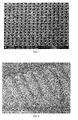
- FIG. 4 it is a SEM image with single-walled carbon nanotubes affixed to the polydimethylsiloxane film, showing that single-walled carbon nanotubes are cross-linked with each other and are affixed to the surface of the polydimethylsiloxane film.
- the conductive materials for electrodes may be silver paste or fulmargin, or may be gas electrode such as gold, silver, copper, aluminum, or the like, which is made by steaming, ion sputtering and so on.
- the resistance value of the piezoresistive sensor is measured as 110-120k ⁇ .
- the resistance values are decreased fast when pressures of 60Pa, 120Pa and 180Pa are accordingly applied respectively.
- the resistance value is rapidly decreased to 95-105k ⁇ . The result indicates that the piezoresistive sensor has high sensitivity and very short response time.
- the piezoresistive electronic skin uses carbon nanotube film as the conductive layer and uses materials, such as polydimethylsiloxane, polyethylene terephthalate, polyvinyl alcohol, polyvinyl formal, polyethylene, and so on, as the flexible substrates, enabling the substrate has advantages of high flexibility and being pliable, and it needs low operating voltage and little power consumption, but has high sensitivity and short response time.
- the electronic skin uses the micro-patterned flexible substrate as the basis, with increased amount of contact resistances and obtains improved sensitivity to tiny applied force from the outside.
- the template used in the patterning process is a soft template, such as fabric, silk cloth, and the like, which has low-cost and is easy to get, does not need any complex micromachining process, effectively improving the practicality of the piezoresistive electronic skin and greatly decreasing the manufacturing cost of the piezoresistive electronic skin.
- the present embodiment provides a capacitive electronic skin.
- the capacitive electronic skin comprises a flexible support layer 1, a flexible sensitive layer 2 formed on an upper surface of the support layer 1, and an upper electrode layer 3 and a lower electrode layer 4 respectively formed on an upper surface of the sensitive layer 2 and a lower surface of the support layer 1.
- the electrodes of the upper electrode layer 3 and the lower electrode layer 4 are formed by evaporation, sputtering or chemical deposition.
- the material of the sensitive layer 2 is preferably PDMS (polydimethylsiloxane), while it may also be one or a combination of more of other high molecular materials, such as polyvinylidene fluoride (PVDF), polyvinyl fluoride (PVF), polyvinyl chloride (PVC), polyethylene (PE), polypropylene (PP), polystyrene (PS), polymethyl methacrylate (PMMA), polyvinyl chloride (PVC), nylon (Nylon), polycarbonate (PC), polyurethane (PU), polytetrafluoroethylene (PTFE), polyethylene terephthalate (PET, PETE), and high-polymer rubber materials.
- PVDF polyvinylidene fluoride
- PVDF polyvinyl fluoride
- PVVC polyvinyl chloride
- PE polyethylene
- PP polypropylene
- PS polystyrene
- PMMA polymethyl methacrylate
- PVC polyvinyl chloride
- At least one of the upper surface and the lower surface of the sensitive layer 2 has non-planar structure. Furthermore, at least one of the upper surface and the lower surface of the upper electrode layer 3 has non-planar structure, and/or at least one of the upper surface and the lower surface of the lower electrode layer 4 has non-planar structure.
- the upper surface of the sensitive layer 2 has non-planar structure, preferably with a plurality of bulging and extending multi-cones 21.
- the bottom of each multi-cone 21 is a square with a side length 10 ⁇ m, the angle between side face and the bottom is 54.7°, and the multi-cone is 7.06 ⁇ m high.
- the upper surface of the sensitive layer 2 may have a shape of other non-planar structures such as wave and the like.
- the lower surface of the sensitive layer 2 may also have non-planar shape. Accordingly, the lower surface of the sensitive layer 2 should also be arranged with an electrode layer.
- At least one surface of the sensitive layer 2 has patterns, and the patterns are formed by coating the polydimethylsiloxane onto a template.
- the template is anyone of a silicon substrate provided with microstructure, a glass substrate provided with microstructure, a metallic substrate provided with microstructure, a plastic substrate, fabric or silk article provided with microstructure, and a bio-organ provided with microstructure.
- the support layer 1 is an ultrathin PE (polyethylene) film with high transparency and high flexibility, which preferably has a thickness of 12 ⁇ m.
- the PE film is to help to readily separate the patterned PDMS film on the surface of the silicon wafer from the template integrally, and meanwhile it serves as a substrate to support the PDMS film.
- the support layer may be made of one or a combination of high-transparency, high-flexibility polyvinyl chloride (PVC) film and polyvinylidene chloride (PVDC) film.
- the material of the upper electrode layer 3 and the lower electrode layer 4 is one or a combination of gold, platinum, nickel, silver, indium, copper, carbon nanotube, graphene, and silver nanowire.
- the entire thickness of the support layer 1 and the sensitive layer 2 is less than 70 ⁇ m.
- the ultrathin electronic skin can function as a wearable device with the same softness with human skin, and it has light weight and can be adhered to skin directly.
- a template provided with microstructure (preferably a four-inch silicon wafer) is provided by processes such as lithography, etching, and so on in MEMS machining technology. At first, cleaning the surface of the silicon wafer, then spin coating with a photoresist, prebaking, performing photoetching, developing, postbaking, and finally shifting the patterning to the silicon wafer by etching, thereby forming a template provided with microstructure.
- the detailed preparation method is as follows:
- the micro-pattern has pyramid structure, the bottom of which is a square with a side length 10 ⁇ m, the angle between side face and the bottom is 54.7°, and the height from the top of the pyramid to the bottom is 7.06 ⁇ m. Making a mask plate according to the drawing size.
- a thin organic (trimethylchlorosilane or perfluorooctyl trichlorosilane) molecular layer on the surface of the template, so as to make sure that PDMS film on the surface of the silicon wafer can be separated from the template integrally and readily.
- spin coating (the preferred rotation rate is 3000r/min, for 30s) a transparent liquid high polymer material (such as polydimethylsiloxane, with a preferred mass ratio of initiator to reactant being 1:10) on the organic molecular layer to form a very thin (the preferred thickness is 50 ⁇ m) and uniform film.
- a transparent liquid high polymer material such as polydimethylsiloxane, with a preferred mass ratio of initiator to reactant being 1:10
- step S3 coating a support layer on the sensitive layer, and then disposing the lower electrode plate on the lower surface of the support layer.
- a layer of high-transparency, high-flexibility ultrathin PE (polyethylene) film (preferably with a thickness of 12 ⁇ m) on the surface of the above-mentioned film without gap and bubble (the layer may also have bubbles and gaps).
- the PDMS layer is fully integrated with the PE film in the meantime. Then, stripping the solidified high polymer film from the surface of the silicon wafer template, thereby molding the micropattern of the silicon wafer template to flexible PDMS film and forming a film provided with pyramid micro-structure.
- the entire thickness of the film is less than 70 ⁇ m, as shown in fig. 8 .
- ultrathin nano conductive film preferably coating Au conductive film with a thickness of 100nm by evaporating Au particles with a purity of 99.9999%
- a flexible electrode from Au nano conductive layer on the upper and lower surfaces of the ultrathin and flexible conductive electronic skin.
- the flexible electrode for example, may be an enameled wire with a diameter of 0.1mm, a flat copper foil tape with a thickness of 20 ⁇ m and with pressure-sensitive adhesive, or a flexible ultrathin copper foil with a thickness of 10 ⁇ m.
- the flexible electrode is a flexible, ultrathin copper foil.
- spin coating preferably at a rotational speed of 5000r/min, for 30s a layer of PDMS, so as to evenly form a very thin (the thickness is less than 10 ⁇ m) protective layer for the Au conductive layer, thereby forming an ultrathin, flexible capacitive electronic skin.
- the template may be anyone of a silicon substrate, a glass substrate, a metallic substrate, fabric, silk article provided with microstructure, and a bio-organ provided with microstructure.
- the organic solvent may be methanol, ethyl alcohol or ethylene glycol.
- One or two surfaces of the prepared polydimethylsiloxane film are placed in the condition of oxygen plasma for 1 to 60 minutes.
- the polydimethylsiloxane film may also be high molecular materials, including but not limited to one or a combination of more of polyethylene terephthalate, polyvinyl alcohol, polyvinyl formal and polyethylene.
- the process for preparing the electronic skin is as follows in detail:
- the entire device is stretched under pressure, resulting in that the dielectric layer of the device gets thinner and bigger and capacitance gets bigger; and the entire device is contracted when the pressure is removed, resulting in that the dielectric layer of the device is recovered quickly and capacitance of the device gets smaller; thereby achieving high sensitivity measurement for pressure based on the present device with capacitor structure.
- a simple, feasible and systematic method for recognizing vibration signals comprising the steps as follows: collecting vibration signals generated by vocal cords during speaking by means of micro/nano sensor instead of collecting transmitted sound signals of voices in the air by means of acquisition module in traditional speech recognition technology, pre-treating the vibration signals, such as amplifying the vibration signals, filtering the vibration signals and the like, extracting characteristic signals, recognizing and analyzing by time domain analysis, frequency domain analysis and the like, and finally displaying the results.
- This embodiment makes innovations on the basis of traditional speech recognition technology, mainly focused on the method for collecting speech signals and on the extracting device. It has advantages of synchronized recognition, high recognition rate, small size and being convenient to carry. In the meantime, due to the use of flexible thin film material, it's convenient to construct the present device as wearable equipment.
- a speech recognition system comprises an electronic skin 101, a data processing module 102 and a display module 103.
- the electronic skin 101 includes piezoresistive electronic skin and capacitive electronic skin.
- the piezoresistive electronic skin or the capacitive electronic skin is used for collecting vibration signals of vocal cords
- the data processing module 102 is used for filtering and amplifying the collected vibration signals, extracting characteristic signals, analyzing and recognizing the characteristic signals by time domain analysis method or frequency domain analysis method
- the display module 103 is used for displaying the recognition results.
- the piezoresistive electronic skin may be the piezoresistive electronic skin provided in the above embodiment 1, the detail structure of which refers to embodiment 1 and need not be repeated here.
- the capacitive electronic skin may be the capacitive electronic skin provided in the above embodiment 3, the detail structure of which refers to embodiment 3 and need not be repeated here.
- the preparation method of the piezoresistive electronic skin may take the preparation method of the piezoresistive electronic skin provided in the above embodiment 2 for reference; and the preparation method of the capacitive electronic skin may take the preparation method of the capacitive electronic skin provided in the above embodiment 4 for reference, both need not be repeated here.
- the capacitive electronic skin when the device is put on the throat where vocal cords are, sensor capacitance changes due to vocal-cord vibration. Then filtering out the background noise signals by means of a filter in circuit to get valid pulse wave signals, amplifying the signals by amplifying circuit and transmitting the signals to the receiving device on the displayer by wireless Bluetooth, Zigbee or Wifi transmitter technology, thereby synchronously displaying the vibration wave of vocal cords generated during speaking on the displayer.
- the vibration signals are automatically collected by sensors, switched and recognized by external circuits, transmitted to the displayer (preferably 7-inch pad) by Bluetooth, and the amplitude and frequency of the waveform shown on the displayer change according to stress, sound duration and the like.
- the detection result of speech recognition is shown in Fig. 11 .
- the capacitive electronic skin has high sensitivity for the speech, and the speech recognition system has a good recognition effect.
- Another embodiment of the present invention provides a speech recognition method, comprising:
- the speech recognition method provided in the present embodiment may use the speech recognition system according to embodiment 5 to detect signals. Due to the high sensitivity of the piezoresistive electronic skin and the capacitive electronic skin and the portability of the speech recognition system, the speech recognition method is feasible, practicable and efficient.
- an embodiment of the present invention provides a pulse detection system.
- the pulse detection system comprises an electronic skin 201, a filter circuit 202, an amplification circuit 203, an analog-to-digital conversion circuit 204 and a display device 205.
- the electronic skin 201 includes piezoresistive electronic skin and capacitive electronic skin.
- the electronic skin in the present embodiment may be the piezoresistive electronic skin provided in embodiment 1 or the capacitive electronic skin provided in embodiment 3, the detail structures thereof refer to the above embodiments, and need not be repeated here.
- Pulse is formed by the flow of the blood shot into aorta by ventricle and flowed along the arterial system from aorta root in the form of waves during the periodic expansion and contraction of the heart.
- the signals of pulse pulsation with good integrality, small distortion, stable baseline and moderate amplitude are automatically collected by the piezoresistive electronic skin or the capacitive electronic skin, then the pulse signals output by the electronic skin are filtered out the background noise signals by means of the filter circuit 202 to get valid pulse wave signals, then the signals are amplified by amplifying circuit and transmitted to ADC circuit 203 (further comprises an analog-to-digital conversion circuit) to be switched, after that, the signals are transmitted to the receiving device on the display device 205 by wireless Bluetooth transmitting technology, Zigbee technology or Wifi technology, and finally the pulse waves are displayed on the displayer in real-time.
- the analog-to-digital conversion circuit 204 and the display device 205 may communicate by GPRS (General Packet Radio Service), GSM (Global System of Mobile communication), WLAN (Wireless Local Area Networks), CDMA (Code Division Multiple Access), TDMA (Time Division Multiple Access), TV communication network, Zigbee technology or Wifi technology, or other telecommunication networks.
- GPRS General Packet Radio Service
- GSM Global System of Mobile communication
- WLAN Wireless Local Area Networks
- CDMA Code Division Multiple Access
- TDMA Time Division Multiple Access
- TV communication network Zigbee technology or Wifi technology, or other telecommunication networks.
- the analog-to-digital conversion circuit 204 and the display device 205 may also be connected in a wired manner.
- preparation method for the above piezoresistive electronic skin may refer to the preparation method for the piezoresistive electronic skin provided in the above embodiment 2
- preparation method for the above capacitive electronic skin may refer to the preparation method for the capacitive electronic skin provided in the above embodiment 4, and both need not be repeated here.
- the pulse detection system provided in the present embodiment has advantages as follows: as the result of using the above piezoresistive electronic skin and capacitive electronic skin, it has advantages of toxic free and good biocompatibility. So it can be adhered to human skin and bring the user excellent experience. In the meantime, due to the distinctive nanostructure of sensitive materials of electronic skin, the pulse detection system has high sensitivity and good stability, has portability as being light, small and flexible on the whole, and has low cost in fabrication, and thus it has good practicability.
- the pulse detection system is used to detect pulse signals.
- sensor capacitance changes with the beat of pulse.
- filtering out the background noise signals by means of a filter circuit to get valid pulse wave signals, amplifying the signals by amplifying circuit and transmitting them to ADC circuit to be switched, transmitting the signals to a receiving device on a displayer by wireless Bluetooth transmitting technology, thereby displaying the pulse waves on the displayer in real-time.
- An embodiment of the present invention provides multiple new uses of the electronic skin in a variety of fields.
- the electronic skin provided in the present invention may be used for detecting human physiology signals comprising arterial pulsation, cardiac pulsation, tension detection, intraocular pressure, vibration of muscle groups in the throat caused by talking, speech recognition caused by contact and non-contact vibration, muscle and skin movement of other parts of the body caused by moving.
- human physiology signals comprising arterial pulsation, cardiac pulsation, tension detection, intraocular pressure, vibration of muscle groups in the throat caused by talking, speech recognition caused by contact and non-contact vibration, muscle and skin movement of other parts of the body caused by moving.
- P-peak, T-peak and D-peak in the pulse can be accurately recognized.
- the arterial pulsation comprises the pulse in each part of the body beating with the arterial pulsation.
- the electronic skin has potential applications on the aspect of touching, sensing and protecting human organ, in respects such as blood pressure, breathing, medical robot, endoscopic robot system, surgery mechanical arm, etc.
- the electronic skin comprises: the piezoresistive electronic skin according to embodiment 1 or the capacitive electronic skin according to embodiment 3, the detail structures thereof need not be repeated here.
- the detection of human pulse signals can be achieved by measuring current signals in real-time when the voltage is at 2V.
- the oscillogram of wrist pulse measured by the piezoresistive electronic skin is shown in fig. 13 .
- Fig. 14 is a typical curve of a single waveform of the pulse wave measured by the piezoresistive electronic skin of the present invention. The result indicates that, the device not only achieves a quick and accurate real-time measurement of human pulse signals, but also may accurately distinguish P-peak, T-peak and D-peak in human pulse waves.
- pulse waves are relevant to information of heart rate, cardiac pulsation, blood viscosity and the like of human body. By accurate detection of the pulse waves, previous diagnosis of human diseases may be achieved.
- the use of the device for measuring pulse at wrist is one embodiment, and the device may also be used for real-time measuring arterial pulsation at other parts of the body, such as at neck, head and the like.
- the recognition of human speech may be achieved by measuring current signals in real-time when the voltage is at 2V.
- the piezoresistive electronic skin when using the piezoresistive electronic skin to detect speech, the real-time I-t curve obtained when a subject says hello is shown in fig. 15 .
- the vibration of vocal cords may cause a vibration of skin, thereby resulting in that the resistance value of the device changes and the current flowed through the device also changes in the meantime. In this way, the relationship between speech and current is established.
- the waveforms of different speech and the changes thereof may be measured and obtained by the conversion of several physical quantities. Referring to fig.
- FIG. 16 it is another detection graph of speech recognition, with the use of a piezoresistive electronic skin of the present invention.
- the piezoresistive electronic skin when the piezoresistive electronic skin is put above a stereo without contact, the device vibrates in response to sound waves from the stereo. So the current value of the device changes. Besides, each type of sound vibration will have its own changing curve of current.
- the piezoresistive/capacitive electronic skin of the present invention may be applied to the detection of tension.
- the deformation of the flexible piezoresistive/capacitive electronic skin caused under the outside tension is precisely controlled by a high-precision stepping platform.
- the dielectric thickness, electrode area and the structure of the piezoresistive/capacitive electronic skin change under the outside tension, and thus the resistance value or capacitance value of the electronic skin device changes.
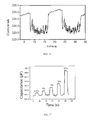
- a response diagram of the capacitive electronic skin detecting the external tension is obtained. As shown in fig.
- the detectable device deformation quantity of the piezoresistive/capacitive electronic skin is in a range of 0.01% to 200% when relevant materials are optimized.
- the electronic skin of the present invention may be applied on medical robot system and realizes functions of medical robot or surgery mechanical arm, touching, sensing and protecting human organ.
- the electronic skin includes the piezoresistive electronic skin and the capacitive electronic skin.
- the piezoresistive electronic skin has same structure with the piezoresistive electronic skin according to embodiment 1; the capacitive electronic skin has same structure with the capacitive electronic skin according to embodiment 3, and both need not be repeated here.
- the piezoresistive electronic skin may be applied on the self-guide endoscopic medical system.
- FIG. 18 it is a signal acquisition graph of the endoscopic robot touching human internal organ, which is sensed by the electronic skin quickly, accurately and in real-time when the piezoresistive electronic skin of the present invention is applied on the endoscopic medical system.
- a sentient electronic skin device with high sensitivity, low energy consumption and high portability (wearable, attachable) may be formed, and new applications thereof, in various fields, may be researched and developed on the basis of physical characteristics of the piezoresistive electronic skin and the capacitive electronic skin.
- the piezoresistive electronic skin has high-sensitivity sensing of small applied force from the outside, and the capacitive electronic skin may be applied on attachable electronic device and system to realize the acquisition of speech information, human physiology signals and the like.
- the piezoresistive electronic skin and the ultrathin capacitive electronic device may be applied for achieving the real-time detection of human physiology signals (such as pulse, heart rate, breathing, blood pressure, and the like), and thereby achieving assessment of human health and previous diagnosis of diseases.
- human physiology signals such as pulse, heart rate, breathing, blood pressure, and the like
Landscapes
- Health & Medical Sciences (AREA)
- Life Sciences & Earth Sciences (AREA)
- Engineering & Computer Science (AREA)
- Surgery (AREA)
- Physics & Mathematics (AREA)
- Animal Behavior & Ethology (AREA)
- Veterinary Medicine (AREA)
- Molecular Biology (AREA)
- Public Health (AREA)
- Biomedical Technology (AREA)
- Heart & Thoracic Surgery (AREA)
- General Health & Medical Sciences (AREA)
- Medical Informatics (AREA)
- Biophysics (AREA)
- Pathology (AREA)
- Cardiology (AREA)
- Physiology (AREA)
- General Physics & Mathematics (AREA)
- Mechanical Engineering (AREA)
- Nuclear Medicine, Radiotherapy & Molecular Imaging (AREA)
- Theoretical Computer Science (AREA)
- General Engineering & Computer Science (AREA)
- Oral & Maxillofacial Surgery (AREA)
- Dentistry (AREA)
- Robotics (AREA)
- Human Computer Interaction (AREA)
- Optics & Photonics (AREA)
- Vascular Medicine (AREA)
- Audiology, Speech & Language Pathology (AREA)
- Radiology & Medical Imaging (AREA)
- Ophthalmology & Optometry (AREA)
- Pulmonology (AREA)
- Measurement Of The Respiration, Hearing Ability, Form, And Blood Characteristics Of Living Organisms (AREA)
- Measurement And Recording Of Electrical Phenomena And Electrical Characteristics Of The Living Body (AREA)
- Force Measurement Appropriate To Specific Purposes (AREA)
- Pressure Sensors (AREA)
- Measuring Pulse, Heart Rate, Blood Pressure Or Blood Flow (AREA)
- Laminated Bodies (AREA)
- Materials For Medical Uses (AREA)
Applications Claiming Priority (5)
| Application Number | Priority Date | Filing Date | Title |
|---|---|---|---|
| CN2013100344781A CN103083007A (zh) | 2013-01-29 | 2013-01-29 | 压阻式电子皮肤及其制备方法 |
| CN201310507497.1A CN104555883A (zh) | 2013-10-24 | 2013-10-24 | 电子皮肤及其制作方法 |
| CN201310508179.7A CN104575500B (zh) | 2013-10-24 | 2013-10-24 | 电子皮肤在语音识别上的应用、语音识别系统和方法 |
| CN201310693411.9A CN104706335B (zh) | 2013-12-17 | 2013-12-17 | 电子皮肤在脉搏检测上的应用、脉搏检测系统和方法 |
| PCT/CN2014/071631 WO2014117724A1 (fr) | 2013-01-29 | 2014-01-28 | Peau électronique, procédé de préparation et utilisation |
Publications (3)
| Publication Number | Publication Date |
|---|---|
| EP2953012A1 true EP2953012A1 (fr) | 2015-12-09 |
| EP2953012A4 EP2953012A4 (fr) | 2016-01-20 |
| EP2953012B1 EP2953012B1 (fr) | 2018-04-18 |
Family
ID=51261470
Family Applications (1)
| Application Number | Title | Priority Date | Filing Date |
|---|---|---|---|
| EP14746641.1A Active EP2953012B1 (fr) | 2013-01-29 | 2014-01-28 | Peau électronique, procédé de préparation et utilisation |
Country Status (7)
| Country | Link |
|---|---|
| US (1) | US9816882B2 (fr) |
| EP (1) | EP2953012B1 (fr) |
| JP (1) | JP6180547B2 (fr) |
| KR (1) | KR101877108B1 (fr) |
| AU (1) | AU2014211862B2 (fr) |
| CA (1) | CA2899676C (fr) |
| WO (1) | WO2014117724A1 (fr) |
Cited By (3)
| Publication number | Priority date | Publication date | Assignee | Title |
|---|---|---|---|---|
| CN108078543A (zh) * | 2017-11-23 | 2018-05-29 | 韩金玲 | 一种高灵敏度电子皮肤的制备方法 |
| KR20190045460A (ko) * | 2017-10-24 | 2019-05-03 | 연세대학교 산학협력단 | 수직 하중과, 전단 하중, 및 비틀림 하중의 측정이 가능한 촉각 센서 |
| US11073434B2 (en) | 2019-07-25 | 2021-07-27 | Korea Institute Of Science And Technology | Manufacturing method for shear and normal force sensor |
Families Citing this family (43)
| Publication number | Priority date | Publication date | Assignee | Title |
|---|---|---|---|---|
| US9494474B2 (en) | 2013-04-03 | 2016-11-15 | Texavie Technologies Inc. | Core-shell nanofiber textiles for strain sensing, and methods of their manufacture |
| EP3076402B1 (fr) * | 2013-11-28 | 2022-06-08 | Bando Chemical Industries, Ltd. | Électrode extensible, feuille de capteur et capteur capacitif |
| CN105361977B (zh) * | 2014-08-26 | 2018-08-10 | 中国科学院苏州纳米技术与纳米仿生研究所 | 电阻式柔性透明关节部位电子皮肤及其制备方法和应用 |
| CN106153178A (zh) * | 2015-03-17 | 2016-11-23 | 中国科学院苏州纳米技术与纳米仿生研究所 | 柔性导电振膜、柔性振动传感器及其制备方法和应用 |
| CN104803339A (zh) * | 2015-04-21 | 2015-07-29 | 电子科技大学 | 一种柔性微压力传感器及其制备方法 |
| WO2017020082A1 (fr) * | 2015-08-03 | 2017-02-09 | Newsouth Innovations Pty Limited | Nanocomposite en tant que capteur de contrainte |
| US20170061824A1 (en) * | 2015-09-01 | 2017-03-02 | Pepe Loves Books, Inc. | Bilingual blocks, application, and system |
| KR101790558B1 (ko) * | 2015-09-07 | 2017-10-27 | 울산과학기술원 | 강유전성 복합 소재 기반 인공 전자 피부 |
| US20170086704A1 (en) * | 2015-09-25 | 2017-03-30 | Intel Corporation | Electronic skin |
| CN113176247A (zh) | 2015-10-07 | 2021-07-27 | 加利福尼亚大学校董会 | 石墨烯系多模态传感器 |
| US11160827B2 (en) * | 2015-11-09 | 2021-11-02 | Shiseido Company, Limited | Compositions and methods for application over skin |
| US9836687B1 (en) * | 2016-05-25 | 2017-12-05 | American Express Travel Related Services Company, Inc. | Ceramic-containing transaction cards and methods of making the same |
| EP3469324B1 (fr) | 2016-06-14 | 2022-08-24 | Technion Research & Development Foundation Ltd. | Détection de forme d'onde cardiaque |
| US10663361B2 (en) | 2016-10-13 | 2020-05-26 | The Trustees Of Columbia University In The City Of New York | Systems and methods for tactile sensing |
| US11660004B2 (en) * | 2016-10-27 | 2023-05-30 | City University Of Hong Kong | System, device and sensor for monitoring circulatory conditions and a method for manufacturing the same |
| WO2018128513A1 (fr) * | 2017-01-09 | 2018-07-12 | 세종대학교 산학협력단 | Système de détection et procédé de détection utilisant un apprentissage machine |
| US10820853B2 (en) * | 2017-06-09 | 2020-11-03 | Bravrr, LLC | Sensor and apparatus for measurement of muscle activity in the detection and treatment of Bruxism Disorder |
| CN107990918B (zh) * | 2017-10-20 | 2020-04-17 | 苏州大学 | 通过多级结构设计制备高敏感度压阻式传感器的方法 |
| US10573323B2 (en) * | 2017-12-26 | 2020-02-25 | Intel Corporation | Speaker recognition based on vibration signals |
| EP3556283A1 (fr) * | 2018-04-17 | 2019-10-23 | Centre National de la Recherche Scientifique | Biocapteur piézoélectrique |
| WO2020060032A1 (fr) * | 2018-09-21 | 2020-03-26 | 동국대학교 산학협력단 | Procédé de dépôt de film mince de matériaux de structure en couches par pulvérisation atomisée et appareil associé |
| KR102104033B1 (ko) | 2019-02-15 | 2020-04-24 | 한국화학연구원 | 전도성 자가치유 하이드로겔 |
| CN111765998A (zh) * | 2019-04-02 | 2020-10-13 | 天津大学 | 柔性电容传感器 |
| EP4322409B1 (fr) * | 2019-05-15 | 2026-01-21 | TDK Electronics AG | Capteur ferroélectrique |
| KR102256248B1 (ko) * | 2019-06-04 | 2021-05-26 | 한국화학연구원 | 페이스트 조성물과 이의 제조방법, 및 이로부터 제조되는 압력센서와 이의 제조방법 |
| CN110636426B (zh) * | 2019-09-28 | 2020-12-18 | 徐州奥拉可电子科技有限公司 | 一种基于电子皮肤技术的听力障碍者辅助用具 |
| CN112985648A (zh) * | 2019-12-13 | 2021-06-18 | 天津大学 | 一种介电层及其制备方法、电容压力传感器及其应用 |
| CN113125054B (zh) * | 2020-01-16 | 2023-03-28 | 深圳第三代半导体研究院 | 一种柔性压力传感器及其制造方法 |
| US11614377B2 (en) | 2020-03-24 | 2023-03-28 | Korea Advanced Institute Of Science And Technology | Transparent and highly sensitive pressure sensor with improved linearity and pressure sensitivity |
| KR102431074B1 (ko) * | 2020-03-24 | 2022-08-10 | 한국과학기술원 | 투명 압력센서, 그 제조방법 및 이을 포함하는 전자기기 |
| EP4141867A4 (fr) * | 2020-05-29 | 2023-06-14 | Huawei Technologies Co., Ltd. | Procédé de traitement de signal vocal et dispositif connexe associé |
| CN113040779A (zh) * | 2021-03-05 | 2021-06-29 | 郑州大学 | 基于剪纸结构的可拉伸电子皮肤及其制备方法与应用 |
| CN113041008B (zh) * | 2021-03-09 | 2022-12-06 | 电子科技大学 | 一种可穿戴热疗电子器件 |
| KR20220133439A (ko) * | 2021-03-25 | 2022-10-05 | 연세대학교 산학협력단 | 웨어러블 욕창 감지 센서 및 이를 포함하는 욕창 감지 시스템 |
| US20240255362A1 (en) * | 2021-05-27 | 2024-08-01 | The University Of Chicago | Strain-insensitive soft pressure sensor and method of measuring pressure |
| US11908478B2 (en) | 2021-08-04 | 2024-02-20 | Q (Cue) Ltd. | Determining speech from facial skin movements using a housing supported by ear or associated with an earphone |
| US12216749B2 (en) | 2021-08-04 | 2025-02-04 | Q (Cue) Ltd. | Using facial skin micromovements to identify a user |
| KR102693548B1 (ko) | 2022-01-06 | 2024-08-12 | 국방과학연구소 | 그래핀층 및 그래핀 나노입자층을 포함한 그래핀 채널, 이를 포함한 바이오 센서 및 웨어러블 기기 |
| CN114674466B (zh) * | 2022-03-23 | 2023-03-24 | 中山大学 | 制备柔性导电微米柱的电容-压阻双模应力传感器的方法 |
| JP2025528023A (ja) | 2022-07-20 | 2025-08-26 | キュー(キュー)リミテッド | 顔面微細運動の検出および利用 |
| CN115029866B (zh) * | 2022-08-12 | 2022-11-22 | 江苏恒力化纤股份有限公司 | 一种柔性电子传感器复合材料的制备方法 |
| CN117433672B (zh) * | 2023-09-20 | 2024-12-17 | 华南理工大学 | 一种基于导电纳米纤维的柔性压阻传感器及其制备方法和应用 |
| CN119074237B (zh) * | 2024-11-08 | 2025-03-21 | 中国科学院自动化研究所 | 刚柔软耦合多层异构拨进连续体机器人 |
Family Cites Families (80)
| Publication number | Priority date | Publication date | Assignee | Title |
|---|---|---|---|---|
| US3565195A (en) * | 1969-04-16 | 1971-02-23 | Sibany Mfg Corp | Electrical weighing apparatus using capacitive flexible mat |
| US3875481A (en) * | 1973-10-10 | 1975-04-01 | Uniroyal Inc | Capacitive weighing mat |
| JPS58150995A (ja) * | 1982-03-03 | 1983-09-07 | 工業技術院長 | 発音特徴抽出装置 |
| US4509527A (en) * | 1983-04-08 | 1985-04-09 | Timex Medical Products Corporation | Cardio-respiration transducer |
| US4654546A (en) * | 1984-11-20 | 1987-03-31 | Kari Kirjavainen | Electromechanical film and procedure for manufacturing same |
| US4852443A (en) * | 1986-03-24 | 1989-08-01 | Key Concepts, Inc. | Capacitive pressure-sensing method and apparatus |
| DE8815246U1 (de) * | 1988-12-07 | 1990-04-05 | Brunner, Wolfgang, Dipl.-Ing. (FH), 88167 Maierhöfen | Meßanordnung, vorzugsweise in Form einer Meßplattform |
| US5642015A (en) * | 1993-07-14 | 1997-06-24 | The University Of British Columbia | Elastomeric micro electro mechanical systems |
| JPH08110272A (ja) * | 1994-10-12 | 1996-04-30 | Fujitsu Ltd | 圧力検出装置 |
| DE19533756A1 (de) * | 1995-09-12 | 1997-03-13 | Fraunhofer Ges Forschung | Elektronisches Bauelement zur statischen und dynamischen Druckerfassung |
| US6216545B1 (en) * | 1995-11-14 | 2001-04-17 | Geoffrey L. Taylor | Piezoresistive foot pressure measurement |
| US5977685A (en) * | 1996-02-15 | 1999-11-02 | Nitta Corporation | Polyurethane elastomer actuator |
| US6543110B1 (en) * | 1997-02-07 | 2003-04-08 | Sri International | Electroactive polymer fabrication |
| US6809462B2 (en) * | 2000-04-05 | 2004-10-26 | Sri International | Electroactive polymer sensors |
| US6882086B2 (en) * | 2001-05-22 | 2005-04-19 | Sri International | Variable stiffness electroactive polymer systems |
| US6891317B2 (en) * | 2001-05-22 | 2005-05-10 | Sri International | Rolled electroactive polymers |
| IL131592A0 (en) * | 1997-03-17 | 2001-01-28 | Non Invasive Systems Inc | Physiologic signs feedback system |
| TW357517B (en) * | 1997-05-29 | 1999-05-01 | Koji Akai | Monitoring system |
| US6555945B1 (en) * | 1999-02-25 | 2003-04-29 | Alliedsignal Inc. | Actuators using double-layer charging of high surface area materials |
| FI108986B (fi) * | 1999-07-01 | 2002-04-30 | Emfitech Oy | Menetelmä anturielementin valmistamiseksi ja anturielementti |
| WO2001063738A2 (fr) * | 2000-02-23 | 2001-08-30 | Sri International | Generateurs de conversion thermique/electrique mettant en oeuvre des polymeres electroactifs |
| WO2002029836A1 (fr) * | 2000-10-02 | 2002-04-11 | Andelman Marc D | Electrode de condensateur a champ de franges pour dispositif electrochimique |
| US7548015B2 (en) * | 2000-11-02 | 2009-06-16 | Danfoss A/S | Multilayer composite and a method of making such |
| US7518284B2 (en) * | 2000-11-02 | 2009-04-14 | Danfoss A/S | Dielectric composite and a method of manufacturing a dielectric composite |
| DE10054247C2 (de) * | 2000-11-02 | 2002-10-24 | Danfoss As | Betätigungselement und Verfahren zu seiner Herstellung |
| US8181338B2 (en) * | 2000-11-02 | 2012-05-22 | Danfoss A/S | Method of making a multilayer composite |
| US6341504B1 (en) * | 2001-01-31 | 2002-01-29 | Vivometrics, Inc. | Composite elastic and wire fabric for physiological monitoring apparel |
| GB0123294D0 (en) * | 2001-09-27 | 2001-11-21 | 1 Ltd | Piezoelectric structures |
| US6689970B2 (en) * | 2001-10-04 | 2004-02-10 | Lester E. Burgess | Pressure actuated switching device and method and system for making same |
| AU2002351736A1 (en) * | 2001-12-21 | 2003-07-15 | Danfoss A/S | Dielectric actuator or sensor structure and method of making it |
| KR20050019885A (ko) * | 2002-07-17 | 2005-03-03 | 쓰리엠 이노베이티브 프로퍼티즈 컴파니 | 미세구조화된 도전층을 갖는 저항성 터치 센서 |
| EP1540807B1 (fr) * | 2002-09-20 | 2013-01-09 | Danfoss A/S | Actionneur en elastomere et procede de fabrication dudit actionneur |
| WO2004053782A1 (fr) * | 2002-12-12 | 2004-06-24 | Danfoss A/S | Element de capteur tactile et matrice de capteur |
| EP1437584A1 (fr) * | 2003-01-07 | 2004-07-14 | IEE INTERNATIONAL ELECTRONICS & ENGINEERING S.A. | Capteur de pression avec une couche sensorique élastique, dont la surface est micro-structurée |
| JP2004230690A (ja) * | 2003-01-30 | 2004-08-19 | Takiron Co Ltd | 制電性透明樹脂板 |
| DE10321099A1 (de) * | 2003-05-09 | 2004-11-25 | Cgs Sensortechnik Gmbh | Vorrichtung zur Druckmessung |
| US7112755B2 (en) * | 2003-05-21 | 2006-09-26 | Nitta Corporation | Pressure-sensitive sensor |
| WO2005117170A2 (fr) * | 2004-03-09 | 2005-12-08 | United States Of America As Represented By The Administrator Of The National Aeronautics And Space Administration | Materiau composite polymere electroactif multicouche |
| AU2006236306A1 (en) * | 2005-04-20 | 2006-10-26 | Vivometrics, Inc. | Systems and methods for non-invasive physiological monitoring of non-human animals |
| US20060287140A1 (en) * | 2005-06-16 | 2006-12-21 | Brandt Richard A | Automated line calling system |
| GB0515175D0 (en) * | 2005-07-25 | 2005-08-31 | Plastic Logic Ltd | Flexible resistive touch screen |
| US8431080B2 (en) * | 2006-06-02 | 2013-04-30 | The Board Of Trustees Of The University Of Illinois | Soft MEMS |
| US20080048996A1 (en) * | 2006-08-11 | 2008-02-28 | Unidym, Inc. | Touch screen devices employing nanostructure networks |
| US7880371B2 (en) * | 2006-11-03 | 2011-02-01 | Danfoss A/S | Dielectric composite and a method of manufacturing a dielectric composite |
| US7732999B2 (en) * | 2006-11-03 | 2010-06-08 | Danfoss A/S | Direct acting capacitive transducer |
| JP5396698B2 (ja) * | 2007-07-25 | 2014-01-22 | セイコーエプソン株式会社 | 圧力センサー |
| US20090064476A1 (en) * | 2007-07-27 | 2009-03-12 | The Penn State Research Foundation | Piezoelectric materials based on flexoelectric charge separation and their fabrication |
| JP4855373B2 (ja) * | 2007-10-30 | 2012-01-18 | ミネベア株式会社 | 曲げセンサ |
| US8161826B1 (en) * | 2009-03-05 | 2012-04-24 | Stryker Corporation | Elastically stretchable fabric force sensor arrays and methods of making |
| US7971489B2 (en) * | 2008-08-29 | 2011-07-05 | Applied Materials, Inc. | Carbon nanotube-based load cells |
| JP2010227334A (ja) * | 2009-03-27 | 2010-10-14 | Seiko Epson Corp | 検出器および測定システム |
| EP2239793A1 (fr) * | 2009-04-11 | 2010-10-13 | Bayer MaterialScience AG | Montage de film polymère électrique commutable et son utilisation |
| JP4868032B2 (ja) * | 2009-06-22 | 2012-02-01 | コニカミノルタビジネステクノロジーズ株式会社 | 現像装置及びこれを備えた画像形成装置 |
| KR101353013B1 (ko) * | 2009-10-14 | 2014-01-22 | 도요타 지도샤(주) | 시트 형상 촉각 센서 시스템 |
| KR101094165B1 (ko) * | 2009-10-20 | 2011-12-14 | 한국표준과학연구원 | 압저항 방식의 터치 패널, 그 제조방법, 이를 포함하는 디스플레이 장치, 터치 패드 및 압력센서 |
| US10441185B2 (en) * | 2009-12-16 | 2019-10-15 | The Board Of Trustees Of The University Of Illinois | Flexible and stretchable electronic systems for epidermal electronics |
| WO2011094347A2 (fr) * | 2010-01-26 | 2011-08-04 | Metis Design Corporation | Structures d'ingénierie cnt multifonctionnelles |
| JP5198608B2 (ja) * | 2010-03-18 | 2013-05-15 | 韓国標準科学研究院 | 半導体ストレインゲージを用いたフレキシブルな力または圧力センサアレイ、そのフレキシブルな力または圧力センサアレイの製造方法、及びそのフレキシブルな力または圧力センサアレイを用いた力または圧力測定方法 |
| WO2011125408A1 (fr) * | 2010-04-09 | 2011-10-13 | 株式会社村田製作所 | Panneau tactile et dispositif d'entrée/sortie comportant le panneau tactile |
| US8322224B2 (en) * | 2010-06-24 | 2012-12-04 | Universal Cement Corporation | Pressure sensor with fixed deformable area |
| US9281415B2 (en) * | 2010-09-10 | 2016-03-08 | The Board Of Trustees Of The Leland Stanford Junior University | Pressure sensing apparatuses and methods |
| CN101963864B (zh) * | 2010-10-14 | 2013-03-13 | 北京富纳特创新科技有限公司 | 触摸屏 |
| KR101161295B1 (ko) * | 2010-10-15 | 2012-07-04 | 서강대학교산학협력단 | 압력 측정 장치 및 그 제조 방법 |
| US9297831B2 (en) * | 2010-12-24 | 2016-03-29 | Graphene Square, Inc. | Touch sensor using graphene for simultaneously detecting a pressure and a position |
| JP5678728B2 (ja) * | 2011-03-03 | 2015-03-04 | 大日本印刷株式会社 | モールドおよびその製造方法 |
| JP5839442B2 (ja) * | 2011-05-26 | 2016-01-06 | 国立研究開発法人科学技術振興機構 | 配線構造体、センサ、及び配線構造体の製造方法 |
| JP2013008877A (ja) * | 2011-06-24 | 2013-01-10 | Kuraray Co Ltd | カーボンナノチューブ層とオーバーコート層とを具備する複合層のパターン形成方法、及び前記方法で形成されたパターン |
| KR101274123B1 (ko) * | 2011-07-01 | 2013-06-13 | 한국과학기술원 | 압저항 방식 터치스크린 패널 |
| US8966997B2 (en) * | 2011-10-12 | 2015-03-03 | Stryker Corporation | Pressure sensing mat |
| KR101214787B1 (ko) * | 2011-12-28 | 2012-12-24 | 한양대학교 산학협력단 | 실 형태의 마이크로-슈퍼커패시터 및 그 제조 방법 |
| US8692442B2 (en) * | 2012-02-14 | 2014-04-08 | Danfoss Polypower A/S | Polymer transducer and a connector for a transducer |
| CN104144873B (zh) * | 2012-03-05 | 2017-12-05 | 英派尔科技开发有限公司 | 柔性电路 |
| CN102749092A (zh) * | 2012-07-13 | 2012-10-24 | 合肥工业大学 | 用于智能机器人人工敏感皮肤的柔性复合式阵列传感器 |
| TWM444569U (zh) * | 2012-07-27 | 2013-01-01 | Seda Chemical Products Co Ltd | 具導電彈性體之非察覺式活動感測裝置 |
| US8904876B2 (en) * | 2012-09-29 | 2014-12-09 | Stryker Corporation | Flexible piezocapacitive and piezoresistive force and pressure sensors |
| CN103083007A (zh) * | 2013-01-29 | 2013-05-08 | 中国科学院苏州纳米技术与纳米仿生研究所 | 压阻式电子皮肤及其制备方法 |
| US9075095B2 (en) * | 2013-02-27 | 2015-07-07 | Synaptics Incorporated | Device and method for localized force sensing |
| US20150248159A1 (en) * | 2013-06-19 | 2015-09-03 | Florida State University Research Foundation, Inc. | Piezoresistive sensors and methods |
| KR102081892B1 (ko) * | 2013-09-05 | 2020-02-26 | 삼성전자주식회사 | 압저항(piezo-resistive) 전극을 구비한 저항성 압력 센서 |
| KR101811214B1 (ko) * | 2015-05-29 | 2017-12-22 | 고려대학교 세종산학협력단 | 비정질 금속을 이용한 유연한 압력 센서와, 압력 및 온도를 동시에 감지하는 유연한 이중모드 센서 |
-
2014
- 2014-01-28 US US14/764,165 patent/US9816882B2/en active Active
- 2014-01-28 EP EP14746641.1A patent/EP2953012B1/fr active Active
- 2014-01-28 AU AU2014211862A patent/AU2014211862B2/en active Active
- 2014-01-28 KR KR1020157022839A patent/KR101877108B1/ko active Active
- 2014-01-28 JP JP2015554045A patent/JP6180547B2/ja active Active
- 2014-01-28 CA CA2899676A patent/CA2899676C/fr active Active
- 2014-01-28 WO PCT/CN2014/071631 patent/WO2014117724A1/fr not_active Ceased
Cited By (3)
| Publication number | Priority date | Publication date | Assignee | Title |
|---|---|---|---|---|
| KR20190045460A (ko) * | 2017-10-24 | 2019-05-03 | 연세대학교 산학협력단 | 수직 하중과, 전단 하중, 및 비틀림 하중의 측정이 가능한 촉각 센서 |
| CN108078543A (zh) * | 2017-11-23 | 2018-05-29 | 韩金玲 | 一种高灵敏度电子皮肤的制备方法 |
| US11073434B2 (en) | 2019-07-25 | 2021-07-27 | Korea Institute Of Science And Technology | Manufacturing method for shear and normal force sensor |
Also Published As
| Publication number | Publication date |
|---|---|
| JP6180547B2 (ja) | 2017-08-16 |
| AU2014211862B2 (en) | 2017-05-18 |
| EP2953012B1 (fr) | 2018-04-18 |
| JP2016516174A (ja) | 2016-06-02 |
| EP2953012A4 (fr) | 2016-01-20 |
| AU2014211862A1 (en) | 2015-09-10 |
| KR20150114509A (ko) | 2015-10-12 |
| CA2899676A1 (fr) | 2014-08-07 |
| US9816882B2 (en) | 2017-11-14 |
| KR101877108B1 (ko) | 2018-07-10 |
| CA2899676C (fr) | 2020-03-24 |
| US20160011063A1 (en) | 2016-01-14 |
| WO2014117724A1 (fr) | 2014-08-07 |
Similar Documents
| Publication | Publication Date | Title |
|---|---|---|
| US9816882B2 (en) | Electronic skin, preparation method and use thereof | |
| Chao et al. | Wearable MXene nanocomposites-based strain sensor with tile-like stacked hierarchical microstructure for broad-range ultrasensitive sensing | |
| He et al. | A Universal high accuracy wearable pulse monitoring system via high sensitivity and large linearity graphene pressure sensor | |
| Kedambaimoole et al. | MXene wearables: properties, fabrication strategies, sensing mechanism and applications | |
| Shahandashti et al. | Highly conformable stretchable dry electrodes based on inexpensive flex substrate for long-term biopotential (EMG/ECG) monitoring | |
| Li et al. | Flexible and wearable healthcare sensors for visual reality health-monitoring | |
| Yu et al. | A microfabricated electrode with hollow microneedles for ECG measurement | |
| CN103961073B (zh) | 压阻式电子皮肤及其制备方法 | |
| CN104706335B (zh) | 电子皮肤在脉搏检测上的应用、脉搏检测系统和方法 | |
| CN109752029B (zh) | 一种纸基电容型柔性传感器的制备方法 | |
| CN113801265B (zh) | 一种电极及信号检测系统 | |
| CN104523368B (zh) | 一种可穿戴柔性电子创可贴及人体健康检测系统 | |
| CN112587140B (zh) | 一种自贴附仿生章鱼吸盘微纳结构干电极 | |
| CN104555883A (zh) | 电子皮肤及其制作方法 | |
| Liu et al. | Wireless battery-free broad-band sensor for wearable multiple physiological measurement | |
| Meng et al. | A flexible dry electrode based on APTES-anchored PDMS substrate for portable ECG acquisition system | |
| CN210400683U (zh) | 一种新型高灵敏度多通道柔性压力传感器 | |
| CN110631750A (zh) | 一种新型高灵敏度多通道柔性压力传感器及其制备方法 | |
| CN120403929A (zh) | 一种受皮肤启发的多级微纳结构柔性可穿戴压力传感器及其制备方法和应用 | |
| CN116295952B (zh) | 一种针对人体运动/语音检测的柔性压力传感器及其制备方法与应用 | |
| CN114674466A (zh) | 柔性导电微米柱的电容-压阻双模应力传感器及制备方法 | |
| Farman et al. | Cleanroom-free fabrication of flexible capacitive pressure sensors using paintable silver electrodes on stationery paper and random microstructured polydimethylsiloxane dielectric layer | |
| CN115028887B (zh) | 基于二维碳化钛/聚苯胺的柔性压阻式压力传感器及其制备方法和电子皮肤传感应用 | |
| CN109350045B (zh) | 一种心电柔性传感器的制造方法 | |
| Zhao et al. | Electrically Stable and Reliably Adhered E-Skin for Heart Health Monitoring |
Legal Events
| Date | Code | Title | Description |
|---|---|---|---|
| PUAI | Public reference made under article 153(3) epc to a published international application that has entered the european phase |
Free format text: ORIGINAL CODE: 0009012 |
|
| 17P | Request for examination filed |
Effective date: 20150828 |
|
| AK | Designated contracting states |
Kind code of ref document: A1 Designated state(s): AL AT BE BG CH CY CZ DE DK EE ES FI FR GB GR HR HU IE IS IT LI LT LU LV MC MK MT NL NO PL PT RO RS SE SI SK SM TR |
|
| AX | Request for extension of the european patent |
Extension state: BA ME |
|
| A4 | Supplementary search report drawn up and despatched |
Effective date: 20151222 |
|
| RIC1 | Information provided on ipc code assigned before grant |
Ipc: G01L 1/18 20060101ALI20151216BHEP Ipc: G06F 3/041 20060101AFI20151216BHEP |
|
| DAX | Request for extension of the european patent (deleted) | ||
| STAA | Information on the status of an ep patent application or granted ep patent |
Free format text: STATUS: EXAMINATION IS IN PROGRESS |
|
| 17Q | First examination report despatched |
Effective date: 20161021 |
|
| GRAP | Despatch of communication of intention to grant a patent |
Free format text: ORIGINAL CODE: EPIDOSNIGR1 |
|
| STAA | Information on the status of an ep patent application or granted ep patent |
Free format text: STATUS: GRANT OF PATENT IS INTENDED |
|
| INTG | Intention to grant announced |
Effective date: 20171106 |
|
| GRAS | Grant fee paid |
Free format text: ORIGINAL CODE: EPIDOSNIGR3 |
|
| GRAA | (expected) grant |
Free format text: ORIGINAL CODE: 0009210 |
|
| STAA | Information on the status of an ep patent application or granted ep patent |
Free format text: STATUS: THE PATENT HAS BEEN GRANTED |
|
| AK | Designated contracting states |
Kind code of ref document: B1 Designated state(s): AL AT BE BG CH CY CZ DE DK EE ES FI FR GB GR HR HU IE IS IT LI LT LU LV MC MK MT NL NO PL PT RO RS SE SI SK SM TR |
|
| REG | Reference to a national code |
Ref country code: GB Ref legal event code: FG4D |
|
| REG | Reference to a national code |
Ref country code: CH Ref legal event code: EP |
|
| REG | Reference to a national code |
Ref country code: AT Ref legal event code: REF Ref document number: 991154 Country of ref document: AT Kind code of ref document: T Effective date: 20180515 |
|
| REG | Reference to a national code |
Ref country code: IE Ref legal event code: FG4D |
|
| REG | Reference to a national code |
Ref country code: DE Ref legal event code: R096 Ref document number: 602014024110 Country of ref document: DE |
|
| REG | Reference to a national code |
Ref country code: SE Ref legal event code: TRGR |
|
| REG | Reference to a national code |
Ref country code: NL Ref legal event code: MP Effective date: 20180418 |
|
| REG | Reference to a national code |
Ref country code: LT Ref legal event code: MG4D |
|
| PG25 | Lapsed in a contracting state [announced via postgrant information from national office to epo] |
Ref country code: NL Free format text: LAPSE BECAUSE OF FAILURE TO SUBMIT A TRANSLATION OF THE DESCRIPTION OR TO PAY THE FEE WITHIN THE PRESCRIBED TIME-LIMIT Effective date: 20180418 |
|
| PG25 | Lapsed in a contracting state [announced via postgrant information from national office to epo] |
Ref country code: ES Free format text: LAPSE BECAUSE OF FAILURE TO SUBMIT A TRANSLATION OF THE DESCRIPTION OR TO PAY THE FEE WITHIN THE PRESCRIBED TIME-LIMIT Effective date: 20180418 Ref country code: AL Free format text: LAPSE BECAUSE OF FAILURE TO SUBMIT A TRANSLATION OF THE DESCRIPTION OR TO PAY THE FEE WITHIN THE PRESCRIBED TIME-LIMIT Effective date: 20180418 Ref country code: BG Free format text: LAPSE BECAUSE OF FAILURE TO SUBMIT A TRANSLATION OF THE DESCRIPTION OR TO PAY THE FEE WITHIN THE PRESCRIBED TIME-LIMIT Effective date: 20180718 Ref country code: NO Free format text: LAPSE BECAUSE OF FAILURE TO SUBMIT A TRANSLATION OF THE DESCRIPTION OR TO PAY THE FEE WITHIN THE PRESCRIBED TIME-LIMIT Effective date: 20180718 Ref country code: FI Free format text: LAPSE BECAUSE OF FAILURE TO SUBMIT A TRANSLATION OF THE DESCRIPTION OR TO PAY THE FEE WITHIN THE PRESCRIBED TIME-LIMIT Effective date: 20180418 Ref country code: LT Free format text: LAPSE BECAUSE OF FAILURE TO SUBMIT A TRANSLATION OF THE DESCRIPTION OR TO PAY THE FEE WITHIN THE PRESCRIBED TIME-LIMIT Effective date: 20180418 Ref country code: PL Free format text: LAPSE BECAUSE OF FAILURE TO SUBMIT A TRANSLATION OF THE DESCRIPTION OR TO PAY THE FEE WITHIN THE PRESCRIBED TIME-LIMIT Effective date: 20180418 |
|
| PG25 | Lapsed in a contracting state [announced via postgrant information from national office to epo] |
Ref country code: GR Free format text: LAPSE BECAUSE OF FAILURE TO SUBMIT A TRANSLATION OF THE DESCRIPTION OR TO PAY THE FEE WITHIN THE PRESCRIBED TIME-LIMIT Effective date: 20180719 Ref country code: HR Free format text: LAPSE BECAUSE OF FAILURE TO SUBMIT A TRANSLATION OF THE DESCRIPTION OR TO PAY THE FEE WITHIN THE PRESCRIBED TIME-LIMIT Effective date: 20180418 Ref country code: LV Free format text: LAPSE BECAUSE OF FAILURE TO SUBMIT A TRANSLATION OF THE DESCRIPTION OR TO PAY THE FEE WITHIN THE PRESCRIBED TIME-LIMIT Effective date: 20180418 Ref country code: RS Free format text: LAPSE BECAUSE OF FAILURE TO SUBMIT A TRANSLATION OF THE DESCRIPTION OR TO PAY THE FEE WITHIN THE PRESCRIBED TIME-LIMIT Effective date: 20180418 |
|
| REG | Reference to a national code |
Ref country code: AT Ref legal event code: MK05 Ref document number: 991154 Country of ref document: AT Kind code of ref document: T Effective date: 20180418 |
|
| PG25 | Lapsed in a contracting state [announced via postgrant information from national office to epo] |
Ref country code: PT Free format text: LAPSE BECAUSE OF FAILURE TO SUBMIT A TRANSLATION OF THE DESCRIPTION OR TO PAY THE FEE WITHIN THE PRESCRIBED TIME-LIMIT Effective date: 20180820 |
|
| REG | Reference to a national code |
Ref country code: DE Ref legal event code: R097 Ref document number: 602014024110 Country of ref document: DE |
|
| PG25 | Lapsed in a contracting state [announced via postgrant information from national office to epo] |
Ref country code: RO Free format text: LAPSE BECAUSE OF FAILURE TO SUBMIT A TRANSLATION OF THE DESCRIPTION OR TO PAY THE FEE WITHIN THE PRESCRIBED TIME-LIMIT Effective date: 20180418 Ref country code: CZ Free format text: LAPSE BECAUSE OF FAILURE TO SUBMIT A TRANSLATION OF THE DESCRIPTION OR TO PAY THE FEE WITHIN THE PRESCRIBED TIME-LIMIT Effective date: 20180418 Ref country code: DK Free format text: LAPSE BECAUSE OF FAILURE TO SUBMIT A TRANSLATION OF THE DESCRIPTION OR TO PAY THE FEE WITHIN THE PRESCRIBED TIME-LIMIT Effective date: 20180418 Ref country code: AT Free format text: LAPSE BECAUSE OF FAILURE TO SUBMIT A TRANSLATION OF THE DESCRIPTION OR TO PAY THE FEE WITHIN THE PRESCRIBED TIME-LIMIT Effective date: 20180418 Ref country code: EE Free format text: LAPSE BECAUSE OF FAILURE TO SUBMIT A TRANSLATION OF THE DESCRIPTION OR TO PAY THE FEE WITHIN THE PRESCRIBED TIME-LIMIT Effective date: 20180418 Ref country code: SK Free format text: LAPSE BECAUSE OF FAILURE TO SUBMIT A TRANSLATION OF THE DESCRIPTION OR TO PAY THE FEE WITHIN THE PRESCRIBED TIME-LIMIT Effective date: 20180418 |
|
| PLBE | No opposition filed within time limit |
Free format text: ORIGINAL CODE: 0009261 |
|
| STAA | Information on the status of an ep patent application or granted ep patent |
Free format text: STATUS: NO OPPOSITION FILED WITHIN TIME LIMIT |
|
| PG25 | Lapsed in a contracting state [announced via postgrant information from national office to epo] |
Ref country code: IT Free format text: LAPSE BECAUSE OF FAILURE TO SUBMIT A TRANSLATION OF THE DESCRIPTION OR TO PAY THE FEE WITHIN THE PRESCRIBED TIME-LIMIT Effective date: 20180418 Ref country code: SM Free format text: LAPSE BECAUSE OF FAILURE TO SUBMIT A TRANSLATION OF THE DESCRIPTION OR TO PAY THE FEE WITHIN THE PRESCRIBED TIME-LIMIT Effective date: 20180418 |
|
| 26N | No opposition filed |
Effective date: 20190121 |
|
| PG25 | Lapsed in a contracting state [announced via postgrant information from national office to epo] |
Ref country code: SI Free format text: LAPSE BECAUSE OF FAILURE TO SUBMIT A TRANSLATION OF THE DESCRIPTION OR TO PAY THE FEE WITHIN THE PRESCRIBED TIME-LIMIT Effective date: 20180418 |
|
| PG25 | Lapsed in a contracting state [announced via postgrant information from national office to epo] |
Ref country code: MC Free format text: LAPSE BECAUSE OF FAILURE TO SUBMIT A TRANSLATION OF THE DESCRIPTION OR TO PAY THE FEE WITHIN THE PRESCRIBED TIME-LIMIT Effective date: 20180418 |
|
| REG | Reference to a national code |
Ref country code: CH Ref legal event code: PL |
|
| PG25 | Lapsed in a contracting state [announced via postgrant information from national office to epo] |
Ref country code: LU Free format text: LAPSE BECAUSE OF NON-PAYMENT OF DUE FEES Effective date: 20190128 |
|
| REG | Reference to a national code |
Ref country code: BE Ref legal event code: MM Effective date: 20190131 |
|
| REG | Reference to a national code |
Ref country code: IE Ref legal event code: MM4A |
|
| PG25 | Lapsed in a contracting state [announced via postgrant information from national office to epo] |
Ref country code: BE Free format text: LAPSE BECAUSE OF NON-PAYMENT OF DUE FEES Effective date: 20190131 |
|
| PG25 | Lapsed in a contracting state [announced via postgrant information from national office to epo] |
Ref country code: CH Free format text: LAPSE BECAUSE OF NON-PAYMENT OF DUE FEES Effective date: 20190131 Ref country code: LI Free format text: LAPSE BECAUSE OF NON-PAYMENT OF DUE FEES Effective date: 20190131 |
|
| PG25 | Lapsed in a contracting state [announced via postgrant information from national office to epo] |
Ref country code: IE Free format text: LAPSE BECAUSE OF NON-PAYMENT OF DUE FEES Effective date: 20190128 |
|
| PG25 | Lapsed in a contracting state [announced via postgrant information from national office to epo] |
Ref country code: TR Free format text: LAPSE BECAUSE OF FAILURE TO SUBMIT A TRANSLATION OF THE DESCRIPTION OR TO PAY THE FEE WITHIN THE PRESCRIBED TIME-LIMIT Effective date: 20180418 |
|
| PG25 | Lapsed in a contracting state [announced via postgrant information from national office to epo] |
Ref country code: MT Free format text: LAPSE BECAUSE OF NON-PAYMENT OF DUE FEES Effective date: 20190128 |
|
| PG25 | Lapsed in a contracting state [announced via postgrant information from national office to epo] |
Ref country code: CY Free format text: LAPSE BECAUSE OF FAILURE TO SUBMIT A TRANSLATION OF THE DESCRIPTION OR TO PAY THE FEE WITHIN THE PRESCRIBED TIME-LIMIT Effective date: 20180418 |
|
| PG25 | Lapsed in a contracting state [announced via postgrant information from national office to epo] |
Ref country code: IS Free format text: LAPSE BECAUSE OF FAILURE TO SUBMIT A TRANSLATION OF THE DESCRIPTION OR TO PAY THE FEE WITHIN THE PRESCRIBED TIME-LIMIT Effective date: 20180818 |
|
| PG25 | Lapsed in a contracting state [announced via postgrant information from national office to epo] |
Ref country code: HU Free format text: LAPSE BECAUSE OF FAILURE TO SUBMIT A TRANSLATION OF THE DESCRIPTION OR TO PAY THE FEE WITHIN THE PRESCRIBED TIME-LIMIT; INVALID AB INITIO Effective date: 20140128 |
|
| PG25 | Lapsed in a contracting state [announced via postgrant information from national office to epo] |
Ref country code: MK Free format text: LAPSE BECAUSE OF FAILURE TO SUBMIT A TRANSLATION OF THE DESCRIPTION OR TO PAY THE FEE WITHIN THE PRESCRIBED TIME-LIMIT Effective date: 20180418 |
|
| PGFP | Annual fee paid to national office [announced via postgrant information from national office to epo] |
Ref country code: SE Payment date: 20260116 Year of fee payment: 13 |
|
| PGFP | Annual fee paid to national office [announced via postgrant information from national office to epo] |
Ref country code: GB Payment date: 20260219 Year of fee payment: 13 |
|
| PGFP | Annual fee paid to national office [announced via postgrant information from national office to epo] |
Ref country code: DE Payment date: 20260206 Year of fee payment: 13 |
|
| PGFP | Annual fee paid to national office [announced via postgrant information from national office to epo] |
Ref country code: FR Payment date: 20260130 Year of fee payment: 13 |