EP2953043A2 - Appareil et procédé de création d'un équipement de protection - Google Patents
Appareil et procédé de création d'un équipement de protection Download PDFInfo
- Publication number
- EP2953043A2 EP2953043A2 EP15398007.3A EP15398007A EP2953043A2 EP 2953043 A2 EP2953043 A2 EP 2953043A2 EP 15398007 A EP15398007 A EP 15398007A EP 2953043 A2 EP2953043 A2 EP 2953043A2
- Authority
- EP
- European Patent Office
- Prior art keywords
- design
- body part
- values
- protective equipment
- database
- Prior art date
- Legal status (The legal status is an assumption and is not a legal conclusion. Google has not performed a legal analysis and makes no representation as to the accuracy of the status listed.)
- Withdrawn
Links
Images




Classifications
-
- A—HUMAN NECESSITIES
- A41—WEARING APPAREL
- A41D—OUTERWEAR; PROTECTIVE GARMENTS; ACCESSORIES
- A41D13/00—Professional, industrial or sporting protective garments, e.g. surgeons' gowns or garments protecting against blows or punches
- A41D13/015—Professional, industrial or sporting protective garments, e.g. surgeons' gowns or garments protecting against blows or punches with shock-absorbing means
-
- G—PHYSICS
- G06—COMPUTING OR CALCULATING; COUNTING
- G06F—ELECTRIC DIGITAL DATA PROCESSING
- G06F30/00—Computer-aided design [CAD]
- G06F30/20—Design optimisation, verification or simulation
-
- A—HUMAN NECESSITIES
- A41—WEARING APPAREL
- A41D—OUTERWEAR; PROTECTIVE GARMENTS; ACCESSORIES
- A41D13/00—Professional, industrial or sporting protective garments, e.g. surgeons' gowns or garments protecting against blows or punches
- A41D13/05—Professional, industrial or sporting protective garments, e.g. surgeons' gowns or garments protecting against blows or punches protecting only a particular body part
- A41D13/0543—Legs
-
- A—HUMAN NECESSITIES
- A41—WEARING APPAREL
- A41D—OUTERWEAR; PROTECTIVE GARMENTS; ACCESSORIES
- A41D13/00—Professional, industrial or sporting protective garments, e.g. surgeons' gowns or garments protecting against blows or punches
- A41D13/05—Professional, industrial or sporting protective garments, e.g. surgeons' gowns or garments protecting against blows or punches protecting only a particular body part
- A41D13/06—Knee or foot
- A41D13/065—Knee protectors
-
- A—HUMAN NECESSITIES
- A41—WEARING APPAREL
- A41D—OUTERWEAR; PROTECTIVE GARMENTS; ACCESSORIES
- A41D13/00—Professional, industrial or sporting protective garments, e.g. surgeons' gowns or garments protecting against blows or punches
- A41D13/05—Professional, industrial or sporting protective garments, e.g. surgeons' gowns or garments protecting against blows or punches protecting only a particular body part
- A41D13/08—Arm or hand
-
- A—HUMAN NECESSITIES
- A41—WEARING APPAREL
- A41H—APPLIANCES OR METHODS FOR MAKING CLOTHES, e.g. FOR DRESS-MAKING OR FOR TAILORING, NOT OTHERWISE PROVIDED FOR
- A41H1/00—Measuring aids or methods
- A41H1/02—Devices for taking measurements on the human body
-
- G—PHYSICS
- G05—CONTROLLING; REGULATING
- G05B—CONTROL OR REGULATING SYSTEMS IN GENERAL; FUNCTIONAL ELEMENTS OF SUCH SYSTEMS; MONITORING OR TESTING ARRANGEMENTS FOR SUCH SYSTEMS OR ELEMENTS
- G05B19/00—Program-control systems
- G05B19/02—Program-control systems electric
- G05B19/18—Numerical control [NC], i.e. automatically operating machines, in particular machine tools, e.g. in a manufacturing environment, so as to execute positioning, movement or co-ordinated operations by means of program data in numerical form
- G05B19/4097—Numerical control [NC], i.e. automatically operating machines, in particular machine tools, e.g. in a manufacturing environment, so as to execute positioning, movement or co-ordinated operations by means of program data in numerical form characterised by using design data to control NC machines, e.g. CAD/CAM
-
- G—PHYSICS
- G06—COMPUTING OR CALCULATING; COUNTING
- G06F—ELECTRIC DIGITAL DATA PROCESSING
- G06F30/00—Computer-aided design [CAD]
-
- A—HUMAN NECESSITIES
- A41—WEARING APPAREL
- A41D—OUTERWEAR; PROTECTIVE GARMENTS; ACCESSORIES
- A41D13/00—Professional, industrial or sporting protective garments, e.g. surgeons' gowns or garments protecting against blows or punches
-
- A—HUMAN NECESSITIES
- A63—SPORTS; GAMES; AMUSEMENTS
- A63B—APPARATUS FOR PHYSICAL TRAINING, GYMNASTICS, SWIMMING, CLIMBING, OR FENCING; BALL GAMES; TRAINING EQUIPMENT
- A63B71/00—Games or sports accessories not covered in groups A63B1/00 - A63B69/00
- A63B71/08—Body-protectors for players or sportsmen, i.e. body-protecting accessories affording protection of body parts against blows or collisions
- A63B71/12—Body-protectors for players or sportsmen, i.e. body-protecting accessories affording protection of body parts against blows or collisions for the body or the legs, e.g. for the shoulders
- A63B71/1225—Body-protectors for players or sportsmen, i.e. body-protecting accessories affording protection of body parts against blows or collisions for the body or the legs, e.g. for the shoulders for the legs, e.g. thighs, knees, ankles, feet
- A63B2071/1258—Body-protectors for players or sportsmen, i.e. body-protecting accessories affording protection of body parts against blows or collisions for the body or the legs, e.g. for the shoulders for the legs, e.g. thighs, knees, ankles, feet for the shin, e.g. shin guards
-
- G—PHYSICS
- G05—CONTROLLING; REGULATING
- G05B—CONTROL OR REGULATING SYSTEMS IN GENERAL; FUNCTIONAL ELEMENTS OF SUCH SYSTEMS; MONITORING OR TESTING ARRANGEMENTS FOR SUCH SYSTEMS OR ELEMENTS
- G05B2219/00—Program-control systems
- G05B2219/30—Nc systems
- G05B2219/35—Nc in input of data, input till input file format
- G05B2219/35044—Tool, design of tool, mold, die tooling
-
- G—PHYSICS
- G05—CONTROLLING; REGULATING
- G05B—CONTROL OR REGULATING SYSTEMS IN GENERAL; FUNCTIONAL ELEMENTS OF SUCH SYSTEMS; MONITORING OR TESTING ARRANGEMENTS FOR SUCH SYSTEMS OR ELEMENTS
- G05B2219/00—Program-control systems
- G05B2219/30—Nc systems
- G05B2219/49—Nc machine tool, till multiple
- G05B2219/49004—Modeling, making, manufacturing model to control machine, cmm
-
- G—PHYSICS
- G06—COMPUTING OR CALCULATING; COUNTING
- G06F—ELECTRIC DIGITAL DATA PROCESSING
- G06F2111/00—Details relating to CAD techniques
- G06F2111/04—Constraint-based CAD
-
- G—PHYSICS
- G06—COMPUTING OR CALCULATING; COUNTING
- G06F—ELECTRIC DIGITAL DATA PROCESSING
- G06F2111/00—Details relating to CAD techniques
- G06F2111/16—Customisation or personalisation
-
- G—PHYSICS
- G06—COMPUTING OR CALCULATING; COUNTING
- G06F—ELECTRIC DIGITAL DATA PROCESSING
- G06F2113/00—Details relating to the application field
- G06F2113/22—Moulding
-
- Y—GENERAL TAGGING OF NEW TECHNOLOGICAL DEVELOPMENTS; GENERAL TAGGING OF CROSS-SECTIONAL TECHNOLOGIES SPANNING OVER SEVERAL SECTIONS OF THE IPC; TECHNICAL SUBJECTS COVERED BY FORMER USPC CROSS-REFERENCE ART COLLECTIONS [XRACs] AND DIGESTS
- Y02—TECHNOLOGIES OR APPLICATIONS FOR MITIGATION OR ADAPTATION AGAINST CLIMATE CHANGE
- Y02P—CLIMATE CHANGE MITIGATION TECHNOLOGIES IN THE PRODUCTION OR PROCESSING OF GOODS
- Y02P90/00—Enabling technologies with a potential contribution to greenhouse gas [GHG] emissions mitigation
- Y02P90/02—Total factory control, e.g. smart factories, flexible manufacturing systems [FMS] or integrated manufacturing systems [IMS]
Definitions
- the present disclosure relates to the field of protective equipment and in particular but not exclusively provides a method and apparatus for creating protective equipment.
- Protective equipment is worn by many people in different fields, for example members of the armed forces or police force and those participating in sports such as football, hockey, rugby etc, in order to protect parts of the body from injury. Protective equipment is also sometimes worn by animals such as horses.
- a method of determining a mold for a body part including the steps of: obtaining information describing dimensions of a body part; using the information, searching a database of anatomical components and selecting components that in combination conform to the dimensions; searching a database of body part models and determining a database body part model that most closely corresponds to the selected components; creating a new model corresponding to the selected components; comparing the database body part model and the new model and determining a value representative of the difference between the two models; and creating a new mold based on the new model when the value is greater than a threshold and using a mold associated with the database body part model when the difference is less than the threshold.
- This method determines whether a pre-existing mold is suitable for the particular information provided or whether it is more appropriate to create a new mold. This allows a degree of customization in the manufacture of protective equipment that results in better fitting equipment without the cost of manufacturing a fully bespoke product.
- the step of searching the database of anatomical components and selecting components that in combination conform to the dimensions may include scaling one or more of the anatomical components before they are combined. By including a scaling step the different anatomical components in the database can be adjusted to more closely fit the information provided.
- the body part may be a human leg and the selected anatomical components may include one or more selected from the group comprising: the calf area, Achilles tendon area, shin area and shin curve.
- Leg protection is particularly common in sports e.g. football, hockey, cricket and some martial arts etc.
- the step of searching the database and determining a database body part model may include determining a plurality of database body part models. If more than one body part model is of a similar close fit to the information provided it may be appropriate to determine a plurality of body part models in order to ensure the best fit is selected.
- the number of database body part models determined may be based upon a configuration input. Thus the user may select the number of database body part models to be selected depending on how closely it is required that the mold matches the input information.
- the body part may be a human leg and the determined mold may be a mold for manufacture of a sock, shin guard or ankle brace.
- the database of anatomical components may include the database of body part models.
- one combined database may be provided instead of two separate databases.
- Different scaling may be applied to each of the selected components based upon a configuration input.
- the user can apply different scaling to the different components in order to arrive at a combination of anatomical components that most closely corresponds to the information provided.
- the relative importance of each of the selected components may be determined based upon a configuration input.
- the user can determine which anatomical components are of greater importance. This allows the user to identify where the focus of the protective equipment should be. For example if an end user of the protective equipment has a previous injury it may be more appropriate for the protective equipment to most closely match the user's body profile in one area than another in order to avoid recurrence of the injury.
- the relative importance of each of the selected components may be determined based upon a configuration input these variations can be taken into account.
- the information relating to the body part may be obtained from measuring the body part.
- the information may be obtained from photographs or video of the body part.
- the information relating to the body part may be obtained from a 3D scan of the body part.
- the method may also include the step of inserting the new model into the database.
- the database can be continually expanded in order to develop the database of information. This allows for a greater number of models to be compared to the information provided and thus can improve the accuracy of the mold selection for future reference.
- the mold determined may be used for manufacturing protective equipment.
- the final product can be manufactured using a mold that bears a close correspondence to the individual's body part.
- a computer implemented method of creating a design for a piece of protective equipment comprising a plurality of dimensional and/or material characteristics, the design conforming to a design constraint defining a performance requirement for a piece of protective equipment manufactured according to the design.
- the method including the steps of: receiving input to define a value for a first characteristic of the plurality of characteristics; determining a limited range of values for at least one of the remaining characteristics based on the value of the first characteristic and the design constraint, such that subsequent selection of values within the limited range of values will result in the design conforming to the design constraint; and constraining possible values for the at least one of the remaining characteristics to be within the limited range of values.
- this method assists in developing a design that complies with particular constraints for example a particular standard.
- a design can be achieved that will comply with the constraint without any need for further verification.
- the method may further include the steps of: receiving input to define a value for a second characteristic; determining a limited range of values for at least one of the remaining characteristics based on the values of the first and second characteristics and the design constraint such that subsequent selection of values within the limited range of values will result in the design conforming to the design constraint; and constraining possible values for the at least one of the remaining characteristics to be within the limited range of the values.
- Altering the value of one characteristic may alter the range of values of the remaining characteristics.
- the method allows for an alteration in the value of one characteristic to automatically change the range of values available for the remaining characteristics.
- a flexible method that allows for easy alteration of the design is provided.
- the characteristics may include one or more selected from the group comprising: material thickness, material finish, material impact resistance, material weight, material volume, material energy absorption capability, height of protection area and width of protection area. Thus a number of different characteristics of an item of protective equipment can be considered.
- the method may further include the step of creating a visual representation or performance description of the design according to the defined values of the characteristics.
- the final design can thus be outputted in order for it to be checked if necessary and subsequently input to a further manufacturing step.
- the method may further include the step of manufacturing the protective equipment according to the design.
- manufacture of a product that complies with the particular restraint can be achieved.
- a computer implemented method of creating a design for a piece of protective equipment comprising a plurality of dimensional and/or material characteristics, the design conforming to a design constraint defining a performance requirement for a piece of protective equipment manufactured according to the design.
- the method including the steps of: receiving input to define a value for a first characteristic of the plurality of characteristics; determining a limited range of values for at least one of the remaining characteristics based on the value of the first characteristic and the design constraint, such that subsequent selection of values within the limited range of values will result in the design conforming to the design constraint; receiving input to define a value for a second characteristic of the plurality of design characteristics; and creating a compliance description which describes whether or not the design complies with the design constraint.
- this aspect information is provided as to whether or not the design complies with the design constraint. It can thus be quickly determined whether the design is appropriate for the particular application.
- a method of manufacturing body protective equipment including the steps of: designing the protective equipment according to the method previously described; determining a mold of the body part according to the method previously described; and manufacturing the protective equipment according to the characteristics and the mold. Design and manufacture of a product that complies with a particular constraint is thus facilitated.
- the method may further include the step of creating a graphical representation of the protective equipment and/or a performance description according to the characteristics of the mold before the protective equipment is manufactured. Thus it can be determined whether or not the design complies with a relevant constraint before it is manufactured.
- the protective equipment may be manufactured by 3D printing. 3D printing allows for straight forward manufacture of customized products.
- the method may further include the step of printing decorative material onto the protective equipment.
- the decorative material may include text, images, signatures, textures or any other graphical elements.
- the decorative material may be based on a configuration input.
- the product can be further customized in terms of its visual appearance in accordance with the particular requirements of the end user.
- the protective equipment may be a shin guard, a knee pad, an elbow pad, or a protective vest.
- a method has been provided which can facilitate the manufacture of a variety of different pieces of protective equipment.
- a computer program product configured to instruct a computer to perform the method previously described.
- an apparatus for creating a design for a piece of protective equipment comprising a plurality of dimensional and/or material characteristics, the design conforming to a design constraint defining a performance requirement for a piece of protective equipment manufactured according to the design
- the apparatus including: a user interface operable to receive an input defining a value for a first characteristic of the plurality of characteristics; a processor operable to determine a limited range of values for at least one of the remaining characteristics based on the value of the first characteristic and the design constraint, such that subsequent selection of value within the limited range of values will result in the design conforming to the design constraint and operable to constrain using the user interface possible values for the at least one of the remaining characteristics to be within the limited range of values.
- An apparatus for developing a design that complies with particular constraints for example a particular standard is envisaged. Thus a design can be achieved that will comply with the constraint without any need for further verification
- the user interface may be operable to receive input defining a value for a second characteristic; and the processor may be operable to determine a limited range of values for at least one of the remaining characteristics based on the values of the first and second characteristics and the design constraint such that subsequent selection of values within the limited range of values will result in the design conforming to the design constraint and operable to constrain using the user interface possible values for the at least one of the remaining characteristics to be within the limited range of values.
- the user interface may be operable to receive input altering the value of one of the plurality of characteristics and wherein the processor is operable to automatically alter the range of values for the remaining characteristics based on the input received.
- the apparatus may further include a design outputting section operable to display a visual representation of the design according to the defined values of the characteristics.
- a design outputting section operable to display a visual representation of the design according to the defined values of the characteristics.
- the design can be displayed to enable it to be approved before it is finalized.
- the apparatus may include an outputter operable to output the protective equipment according to the design.
- the outputter may be a 3D printer.
- an apparatus for determining a mold for a body part including an interface operable to receive inputting information describing the dimensions of a body part; a processor operable to use the information to search a database of anatomical components and select components that in combination conform to the dimensions; and operable to search a database of body part models and determine a database body part model that most closely corresponds to the selected components; a generator operable to create a new model corresponding to the selected components; a comparator operable to compare the database body part model and the new model and to determine a value representative of the difference between the two models; and a generator operable to create a new mold when the value is greater than a threshold; and wherein when the difference is less than a threshold a mold associated with the database body part model is used.
- This apparatus is thus able to determine whether a pre-existing mold is suitable for the particular information provided or whether it is more appropriate to create a new mold. This allows a degree of customization in the manufacture of protective equipment that results in better fitting equipment without the cost of manufacturing a fully bespoke product
- an apparatus for manufacturing body protective equipment including: the apparatus for creating a design for a piece of protective equipment as previously described; the apparatus for determining a mold for a body part as previously described; and an outputter operable to output the protective equipment according the characteristics of the design and the mold.
- the outputter may be a 3D printer.
- a mold is a 3D representation of the particular body part which is to be protected by the protective equipment.
- the mold may be virtual or physical.
- a piece of protective equipment can be designed and manufactured to fit the individual.
- Figure 1 illustrates a method of determining a mold for use in manufacturing a piece of protective equipment. This method makes use of existing data relating to other individuals in order to reduce cost whilst still taking into account the requirements of the individual.
- the method will be described using a shin guard as the example piece of protective equipment, however it will be appreciated that the method could be used to assist in the manufacture of other pieces of protective equipment for use on other parts of the body, such as elbow pads, knee pads, protective vests, face masks and helmets.
- step S1 information relating to the individual's body part is acquired and input to the method.
- the information includes dimensions of the individual's body part and any other information relevant for the determination of a mold, for example information identifying distinctive features of the body part.
- the information may be in the form of a written description or images. This information can be acquired by measuring the relevant body part. Alternatively the information can be inferred from photographs or videos of the individual body part. In another alternative the information can be acquired from a 3D scan of the individual body part. Other alternative means of acquiring the information relating to the individual body part that the skilled person may be aware of can also be used.
- step S2 the information is used to search a database of anatomical components in order to select those components that most closely match the information provided.
- the database is acquired by measuring a large number of body parts. For example in the example of a shin guard a large number of human legs were measured and the information saved in the database.
- the dimensions of the body parts are acquired the dimensions of individual components are acquired by dividing the body parts into the individual components. This may be done by computer software that identifies the individual components that in combination result in the body parts saved in the database.
- Each anatomical component record in the database includes information specifying the dimensions and shape of the component to which the record relates.
- the anatomical components may be individual body components, for example a particular muscle, bone, tendon or ligament, or can be any combination of these relating to a single specific area e.g. an ankle area.
- components such as the Achilles tendon area, shin area, calf area and shin curve may be selected.
- the selection of the anatomical components can be automatically carried out by the algorithm or the software can receive input as to which anatomical components are required.
- the database contains a plurality of the components required, those components that represent the best match to the information provided are selected.
- the "best match" is acquired through a comparison of the anatomical components and the body part information.
- the anatomical components are selected so that they have approximately the same dimensional properties as the input information. For example the 3D shape of the anatomical components resembles the information input to the method. Visual clues relating to the shape of the body part also help to determine which anatomical components to select. For example shadows and colour gradients in any photographs may correspond to the 3D render of the anatomical components.
- a given candidate set of components from the database may be virtually assembled to provide a composite set against which to test the acquired body part information.
- the system may define pre-existing boundaries for each anatomical component to anatomical component interface such that individual anatomical components or subsets of anatomical components from the database may be compared to the acquired body part information without creating a complete candidate set of anatomical components to test against the acquired information.
- step S3 a body part model database is searched and a body part model that most closely matches the selected components is selected.
- the body part model database contains a smaller number of body part models compared to the number of anatomical components. This limited number of body part models are selected be representative of all the anatomical components in the anatomical component database.
- the limited number of body parts is obtained by dividing a large database of anatomical components and body parts into groups of similarly shaped body parts. For each group, the body part that is the dimensional median is selected to represent the group and becomes one of the limited number of body part models from which the closest match is selected.
- the number of groups may be selected automatically or may be set by the user.
- the body part model is not necessarily an exact match to the selected components and the information provided, but provides the best match available in the database.
- a plurality of body part models may be selected that best represent the anatomical components selected. For example if two body part models are an equally close match to the anatomical components.
- the number of models to be selected can be set by the user depending upon their particular requirements. The fewer the number of body part models selected the simpler the production process and the lower the mold creation costs. However with a minimized number of models comes an increased risk that the fit of the manufactured product may be compromised.
- step S4 a new body part model is created corresponding to the particular anatomical components selected.
- This generated body part model differs from the body part model selected in step S3 in that it is an exact match to the anatomical components selected.
- the body part model selected in step S3 is the best match available from the limited number of body part models in the body part database that represent all of the anatomical components available.
- different scaling can be applied to the different components.
- the different anatomical components can have different sizes.
- the different scaling can be automatically programmed for the piece of protective equipment or can alternatively be individually selected by the user.
- the shin area may be given greater importance than the calf area.
- the relevant weighting can be automatically programmed for the particular piece of protective equipment or alternatively such relative weighting can be individually selected by the user.
- a body part model matching the anatomical components selected can be optionally saved into the database of body part models in step S5.
- the generated body part model does not have to be saved into the body part model database but by doing so the database is enlarged and updated with new information which will be of use in the determination of subsequent models.
- the body part database is analysed periodically to check the body part models therein provide a good representation of all of the anatomical components in the anatomical component database. If new models have been obtained then previous models may be replaced to ensure a fair representation of all of the anatomical components.
- the body part database and the anatomical component database are separate but they may alternatively be different record types of a single database.
- the difference between the two models is determined and compared to a threshold value. If the difference between the two models is greater than the threshold value, a new mold corresponding to the newly generated body part model is created. If the difference between the two models is less than the threshold value then it is considered that the existing body part model is an acceptable match for the generated body part model and a mold associated with the existing body part model is used.
- the threshold value may be dependent upon the particular application, for example there may be one threshold for a piece of leg protection and another threshold value for a piece of arm protection.
- the threshold can be determined based on empirical data and/or feedback from users. In one example the threshold is based on the difference in volume between the generated body part model and the selected body part model. A maximum acceptable difference in volume may be 5%. In another example a difference of 5% may be considered unacceptable and the maximum acceptable difference may be 3%. Ongoing feedback from users can be used to assist in the determination of the threshold for the particular application.
- each mold may be associated with a number of different body part models or considered in an alternative way, a number of different body part models may be associated with a single mold. In other interpretations, each model may have a corresponding mold.
- the threshold value may be automatically selected for the particular body part or may be selected by the user depending on how accurate a mold is required.
- the final product can be manufactured using the mold.
- Figure 2 illustrates an apparatus for carrying out a method of determining a mold for a body part.
- a computer is used to carry out the method described.
- the computer includes an interface 2, a processor 3, a first database 4a, a second database 4b, and a memory 5. These components all interact with one another via a bus 7.
- the interface 2 receives information describing the dimensions of a body part. This may be in the form of a description or an image (including a 3D mesh work or other 3D image representation).
- the interface 2 may be a user interface or alternatively may be an interface with another computer in order to receive the information from that computer.
- the processor 3 receives the information from the interface 2 and processes the information.
- Processor 3 uses the information to search a database of anatomical components 4a and select the components that conform to the dimensions provided.
- Processor 3 searches a database of body part models 4b and determines a body part model that most closely corresponds to the anatomical components selected.
- Processor 3 also operates as a first generator, a comparator and a second generator.
- the operation as a first generator creates a new model based on the anatomical components selected.
- the operation as a comparator conducts a comparison of the new model generated by the first generator and the body part model determined from the database of body part models and determines a value representative of the difference between the two models.
- Finally the operation as a second generator creates a new mold when it is determined that the difference between the two models is greater than a threshold value.
- a further optional feature of the apparatus is an outputting section for manufacturing the design.
- This may be any device suitable for manufacturing the design for example a 3D printer or an injection molding machine.
- Such method and apparatus can determine from measurements and/or images reflecting a body part, a set of representative anatomical components and can then determine from that set a model that suitably corresponds to the body part. From the model, a mold for use in manufacturing a piece of protective equipment for that body part can be determined. In the present examples before an item can be manufactured to a mold, the design of the protective equipment is also arrived at.
- Protective equipment may be regulated and must comply with, for example, particular health and safety regulations. Designing a product to comply with particular requirements can be a lengthy and time consuming process as it is only at the end of the design process that it is discovered whether or not the product conforms to the particular requirements.
- a method will now be described that enables a design to be created such that it is ensured that the design will comply with a particular set of requirements. This method is illustrated in Figure 3 .
- the method is implemented on a computer and creates a design for a piece of protective equipment that complies with the relevant regulatory requirements.
- this method could also be applied to any design in which certain characteristics need to be limited for reasons other than compliance with regulatory requirements.
- this method can be used in the design of any product limited by a design constraint.
- a number of different characteristics of the final product are taken into account. These parameters can include material thickness, material finish, material impact resistance, material weight, material volume, material energy absorption capability, shape of protective area including height and width.
- step S10 a value for a first characteristic is input.
- a value may be a quantitative or qualitative value depending on the characteristic concerned.
- step S11 a limited range of values for at least one of the remaining characteristics is determined. This determination is made based on the value input for the first characteristic and the particular design constraint. The determination of the limited range of values is made so that any selection of values within the limited range of values determined necessarily results in the final design complying with the design constraint.
- step S12 possible values for the at least one remaining characteristics are constrained to be within the limited ranges determined in step S11.
- the method is an iterative method and is repeated a number of times depending on how many characteristics need to be constrained. As such steps S13-S16 are optional steps that may be carried out if needed.
- step S13 a value for a second characteristic is input. This value may have been constrained by step S12.
- step S14 a limited range of values for at least one of the remaining characteristics is determined. This time the range of values is determined based on the values of the first and second characteristics and the design constraint.
- step S15 possible values for at least one remaining characteristic are constrained to be within the range of values determined in step S14.
- the method is iterative and can be repeated until all of the relevant characteristics are constrained. In this way a design can be achieved that is ensured to comply with the design constraint.
- step S16 a visual representation or performance description of the design is created so that final approval of the design can be given before it is manufactured in step S17.
- the method also has a direct feedback loop such that if it is decided to alter the value of a particular characteristic, the range of values for the remaining characteristic are automatically updated in view of the new value of the particular characteristic and the design constraint. This facilitates alterations to the design.
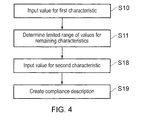
- step S10 a value for a first characteristic is input.
- step S11 a limited range of values for at least one of the remaining characteristics is determined using the value of the first characteristic and the design constraint.
- step S18 a value for a second characteristic is input.
- the method is not limited to this number of inputs. Any number of inputs may be received to define a value for the corresponding number of characteristics.
- step S19 a compliance description is created which describes whether or not the design complies with the particular design constraint. Thus a designer automatically knows whether his design complies with the particular design constraint.
- values for any number of characteristics can be input into the method.
- the compliance description is automatically updated.
- values for a plurality of characteristics may be entered and at each stage the designer receives feedback as to whether his design complies with the particular design constraint.
- any new input to the method results in an automatic update of the compliance description such that the design always knows whether or not their design complies with the design constraint.
- the apparatus is a computer having a user interface 11, a processor 12 and an outputting section 13.
- the user interface 11 is capable of receiving an input defining a value for a characteristic.
- the user interface 11 is further able to receive an input altering one of the characteristics.
- the processor 12 uses the input received at the user interface 11 and the design constraint to determine a limited range of values for at least one remaining characteristic.
- the processor 12 further constrains possible values of the remaining characteristics using the user interface 11.
- the processor 12 is further capable of altering the range of values for the characteristics based on an updated input to the user interface 11.
- the outputting section 13 is capable of displaying a visual representation of the final design. Thus the design can be reviewed before it is finalised.
- a further optional feature of the apparatus is an outputting section for manufacturing the design.
- This may be any apparatus suitable for manufacturing the design for example a 3D printer or an injection molding machine.
- Figure 6 illustrates a method of manufacturing body protective equipment including the method of designing protective equipment and the method of determining a mold described above.
- step S20 the protective equipment is designed in accordance with the method described with reference to Figure 3 or Figure 4 .
- step S21 a mold for a body part is determined according to the method described with reference to Figure 1 .
- step S22 a graphical representation of the final design on the mold can be displayed.
- the final design is determined based on the results of steps S20 and S21.
- S21 constrains the inner shape of the protective equipment whereas S20 constrains the material and outer dimensional characteristics of the protective equipment.
- a description of the final design including a description of its likely performance characteristics can also or alternatively be displayed.
- This step is an optional step that may be used in order for the final design to be approved before it is manufactured if this check is required.
- step S23 the design is manufactured with the assistance of the mold determined in step S21.
- the design is manufactured using any suitable device for example using a 3D printer or an injection molding machine.
- Step 24 is an optional step of applying decorative material to the final product.
- each individual can further customise the final product in terms of its appearance. For example sportsmen and women can incorporate their sponsor's logo into the product.
- step S22 may be carried out after step S20 such that the order of the steps may be:
- step S22 could be carried out first such that the order of the steps may be:
- steps S20, S21 and S22 can be carried out in any particular order as long as step S22 is carried out after step S20.
- An apparatus for manufacturing body protective equipment includes the apparatus described with reference to Figure 5 and the apparatus described with reference to Figure 2 .
- the apparatus also includes a manufacturing apparatus such as a 3D printer for manufacturing the final product.
- the method includes a method of creating a design to comply with a particular design constraint, determining a mold for a body part including the steps of inputting body part information, searching a database of existing anatomical components and selecting components that most closely match the information, searching a database of body part models and selecting at least one body part model that closely corresponds to the selected components, creating a body part model from the selected components, comparing the two models and determining which model is most appropriate and using a mold associated with that model and final manufacture of the piece of protective equipment.
Landscapes
- Engineering & Computer Science (AREA)
- Physics & Mathematics (AREA)
- Textile Engineering (AREA)
- Theoretical Computer Science (AREA)
- Physical Education & Sports Medicine (AREA)
- General Health & Medical Sciences (AREA)
- Health & Medical Sciences (AREA)
- General Physics & Mathematics (AREA)
- General Engineering & Computer Science (AREA)
- Computer Hardware Design (AREA)
- Geometry (AREA)
- Evolutionary Computation (AREA)
- Manufacturing & Machinery (AREA)
- Automation & Control Theory (AREA)
- Life Sciences & Earth Sciences (AREA)
- Biophysics (AREA)
- Human Computer Interaction (AREA)
- Management, Administration, Business Operations System, And Electronic Commerce (AREA)
- Architecture (AREA)
- Software Systems (AREA)
- Injection Moulding Of Plastics Or The Like (AREA)
- Moulds For Moulding Plastics Or The Like (AREA)
Applications Claiming Priority (1)
| Application Number | Priority Date | Filing Date | Title |
|---|---|---|---|
| GB1410094.5A GB2526878A (en) | 2014-06-06 | 2014-06-06 | Apparatus and method for creating protective equipment |
Publications (2)
| Publication Number | Publication Date |
|---|---|
| EP2953043A2 true EP2953043A2 (fr) | 2015-12-09 |
| EP2953043A3 EP2953043A3 (fr) | 2016-07-20 |
Family
ID=51266825
Family Applications (1)
| Application Number | Title | Priority Date | Filing Date |
|---|---|---|---|
| EP15398007.3A Withdrawn EP2953043A3 (fr) | 2014-06-06 | 2015-06-05 | Appareil et procédé de création d'un équipement de protection |
Country Status (3)
| Country | Link |
|---|---|
| US (1) | US10070672B2 (fr) |
| EP (1) | EP2953043A3 (fr) |
| GB (1) | GB2526878A (fr) |
Families Citing this family (19)
| Publication number | Priority date | Publication date | Assignee | Title |
|---|---|---|---|---|
| CN107209956A (zh) | 2015-04-20 | 2017-09-26 | 惠普发展公司有限责任合伙企业 | 创建三维(3d)物体的体素表示 |
| EP3230809B1 (fr) * | 2015-04-24 | 2023-03-15 | Hewlett-Packard Development Company, L.P. | Procédé de génération de modèles d'objets en trois dimensions pour un procédé de fabrication additive |
| US11132811B2 (en) * | 2016-03-08 | 2021-09-28 | The Lycra Company Llc | Method and system for improving size selection of garments |
| CN117837838A (zh) | 2016-07-28 | 2024-04-09 | 莱施菲公司 | 人造睫毛嫁接物 |
| KR102709427B1 (ko) * | 2016-12-20 | 2024-09-25 | 래쉬파이 인코포레이티드 | 인공 속눈썹 연장부에 사용하는 어플리케이터 및 케이스 |
| CN108669681A (zh) * | 2018-05-22 | 2018-10-19 | 石朕 | 一种护腕的制作方法 |
| WO2020040729A1 (fr) * | 2018-08-20 | 2020-02-27 | Hewlett-Packard Development Company, L.P. | Génération d'une prévisualisation d'une pièce à imprimer |
| JP1687380S (fr) | 2018-10-19 | 2021-06-07 | ||
| USD863679S1 (en) | 2018-10-19 | 2019-10-15 | Lashify, Inc. | False eyelash applicator |
| KR102761588B1 (ko) | 2018-10-19 | 2025-02-03 | 래쉬파이 인코포레이티드 | 속눈썹 연장물 보관 케이스 및 그의 사용 및 제조 방법 |
| US11234893B2 (en) | 2019-02-27 | 2022-02-01 | Steven A. Shubin, Sr. | Method and system of creating a replica of an anatomical structure |
| US12136355B2 (en) | 2019-02-27 | 2024-11-05 | Steven A. Shubin, Sr. | Method and system of creating a replica of an anatomical structure |
| DE102019122374B4 (de) | 2019-08-20 | 2021-05-06 | Ottobock Se & Co. Kgaa | Verfahren zum Herstellen eines Prothesenschaftes |
| JP7524697B2 (ja) * | 2020-09-30 | 2024-07-30 | セイコーエプソン株式会社 | 三次元造形用データの生成方法および三次元造形物の製造方法 |
| DE102020126435A1 (de) | 2020-10-08 | 2022-04-14 | Ottobock Se & Co. Kgaa | Verfahren und Computerprogramm zum Erstellen von Fertigungsdaten sowie Verfahren zur Fertigung einer orthopädietechnischen Einrichtung |
| USD980521S1 (en) | 2022-07-20 | 2023-03-07 | Lashify, Inc. | Artificial lash extension separating comb |
| USD984050S1 (en) | 2022-07-20 | 2023-04-18 | Lashify, Inc. | Combined curler and applicator for natural lashes and artificial lash extensions |
| USD995914S1 (en) | 2022-07-20 | 2023-08-15 | Lashify, Inc. | Combined tweezer and applicator for artificial lash extensions |
| USD1072354S1 (en) | 2024-01-08 | 2025-04-22 | Lashify, Inc. | Rounded tweezer and applicator for artificial lash extensions |
Family Cites Families (8)
| Publication number | Priority date | Publication date | Assignee | Title |
|---|---|---|---|---|
| US20130211531A1 (en) * | 2001-05-25 | 2013-08-15 | Conformis, Inc. | Patient-adapted and improved articular implants, designs and related guide tools |
| US20070133850A1 (en) * | 2005-12-08 | 2007-06-14 | Ebi, L.P. | System for making a medical device |
| US7605812B2 (en) * | 2006-12-19 | 2009-10-20 | Siemens Aktiengesellschaft | Intelligent modeling method and system for earmold shell and hearing aid design |
| US8423167B2 (en) * | 2008-07-24 | 2013-04-16 | University Of Washington | Computer aided design and manufacturing of transtibial prosthetic sockets |
| US8908928B1 (en) * | 2010-05-31 | 2014-12-09 | Andrew S. Hansen | Body modeling and garment fitting using an electronic device |
| EP2967813A4 (fr) * | 2013-03-15 | 2016-11-09 | Conformis Inc | Modélisation cinématique et paramétrée pour des implants, outils et procédures chirurgicales adaptés au patient |
| US10319349B2 (en) * | 2013-10-08 | 2019-06-11 | Matthew A. Culver | Contoured pick and a method of multiple variations of 3D CAD models |
| US10733651B2 (en) * | 2014-01-01 | 2020-08-04 | Andrew S Hansen | Methods and systems for identifying physical objects |
-
2014
- 2014-06-06 GB GB1410094.5A patent/GB2526878A/en not_active Withdrawn
-
2015
- 2015-06-05 US US14/732,365 patent/US10070672B2/en not_active Expired - Fee Related
- 2015-06-05 EP EP15398007.3A patent/EP2953043A3/fr not_active Withdrawn
Non-Patent Citations (1)
| Title |
|---|
| None |
Also Published As
| Publication number | Publication date |
|---|---|
| US20150351467A1 (en) | 2015-12-10 |
| GB2526878A (en) | 2015-12-09 |
| EP2953043A3 (fr) | 2016-07-20 |
| GB201410094D0 (en) | 2014-07-23 |
| US10070672B2 (en) | 2018-09-11 |
Similar Documents
| Publication | Publication Date | Title |
|---|---|---|
| US10070672B2 (en) | Apparatus and method for creating protective equipment | |
| CN111832383B (zh) | 姿态关键点识别模型的训练方法、姿态识别方法及装置 | |
| CN111742350B (zh) | 虚拟试穿系统、虚拟试穿方法、信息处理装置、以及存储介质 | |
| Decker et al. | Development and multi-scale validation of a finite element football helmet model | |
| US11969042B2 (en) | Tailored compression garments and methods of tailoring compression garments for individuals | |
| CN112970074A (zh) | 身体活动量化和监测 | |
| RU2628497C2 (ru) | Измерение части тела | |
| CN112052746B (zh) | 目标检测方法、装置、电子设备和可读存储介质 | |
| US20210069984A1 (en) | Computer-implemented method and system for producing an orthopedic device | |
| CN105989617A (zh) | 虚拟试穿装置及虚拟试穿方法 | |
| KR102202490B1 (ko) | 3차원 신체 모델 측정 장치 및 방법 | |
| KR102013705B1 (ko) | 승마시뮬레이터에서 사용자 자세 인식 장치 및 방법 | |
| KR101118372B1 (ko) | 가상 마커 방식을 이용한 비만/체형을 평가하는 시스템 및 방법 | |
| Milošević et al. | 3D technologies in individualized chest protector modelling | |
| JP7312309B2 (ja) | 情報提供装置、情報提供方法、及び制御プログラム | |
| Zhou et al. | Anthropometry model generation based on ANSUR II database | |
| JP2017047105A (ja) | エクササイズメニュー提供システムおよびエクササイズメニュー提供方法 | |
| JPWO2023084780A5 (fr) | ||
| Reddy et al. | Person identification from arbitrary position and posture using kinect | |
| JP2009294767A5 (fr) | ||
| CN112949031B (zh) | 上肢动作空间范围推算系统、其构建方法及使用方法 | |
| CN110321090A (zh) | 一种护具制作装置、方法 | |
| CN113837056B (zh) | 形体信息的确定方法及相关装置、设备和存储介质 | |
| CN108304405A (zh) | 一种信息匹配及推送的方法及装置 | |
| Rajkiewicz et al. | Video markers tracking methods for bike fitting |
Legal Events
| Date | Code | Title | Description |
|---|---|---|---|
| PUAI | Public reference made under article 153(3) epc to a published international application that has entered the european phase |
Free format text: ORIGINAL CODE: 0009012 |
|
| AK | Designated contracting states |
Kind code of ref document: A2 Designated state(s): AL AT BE BG CH CY CZ DE DK EE ES FI FR GB GR HR HU IE IS IT LI LT LU LV MC MK MT NL NO PL PT RO RS SE SI SK SM TR |
|
| AX | Request for extension of the european patent |
Extension state: BA ME |
|
| RIC1 | Information provided on ipc code assigned before grant |
Ipc: A63B 71/00 20060101ALI20160208BHEP Ipc: G06F 17/50 20060101AFI20160208BHEP Ipc: A41H 1/02 20060101ALI20160208BHEP Ipc: A41D 13/08 20060101ALI20160208BHEP Ipc: A41D 13/015 20060101ALI20160208BHEP Ipc: A41D 13/05 20060101ALI20160208BHEP Ipc: G05B 19/4097 20060101ALI20160208BHEP Ipc: A41D 13/06 20060101ALI20160208BHEP |
|
| PUAL | Search report despatched |
Free format text: ORIGINAL CODE: 0009013 |
|
| AK | Designated contracting states |
Kind code of ref document: A3 Designated state(s): AL AT BE BG CH CY CZ DE DK EE ES FI FR GB GR HR HU IE IS IT LI LT LU LV MC MK MT NL NO PL PT RO RS SE SI SK SM TR |
|
| AX | Request for extension of the european patent |
Extension state: BA ME |
|
| RIC1 | Information provided on ipc code assigned before grant |
Ipc: A41D 13/05 20060101ALI20160614BHEP Ipc: A41D 13/08 20060101ALI20160614BHEP Ipc: A41H 1/02 20060101ALI20160614BHEP Ipc: A41D 13/015 20060101ALI20160614BHEP Ipc: A41D 13/06 20060101ALI20160614BHEP Ipc: G06F 17/50 20060101AFI20160614BHEP Ipc: A63B 71/00 20060101ALI20160614BHEP Ipc: G05B 19/4097 20060101ALI20160614BHEP |
|
| STAA | Information on the status of an ep patent application or granted ep patent |
Free format text: STATUS: REQUEST FOR EXAMINATION WAS MADE |
|
| 17P | Request for examination filed |
Effective date: 20170119 |
|
| RBV | Designated contracting states (corrected) |
Designated state(s): AL AT BE BG CH CY CZ DE DK EE ES FI FR GB GR HR HU IE IS IT LI LT LU LV MC MK MT NL NO PL PT RO RS SE SI SK SM TR |
|
| STAA | Information on the status of an ep patent application or granted ep patent |
Free format text: STATUS: EXAMINATION IS IN PROGRESS |
|
| 17Q | First examination report despatched |
Effective date: 20200615 |
|
| STAA | Information on the status of an ep patent application or granted ep patent |
Free format text: STATUS: THE APPLICATION IS DEEMED TO BE WITHDRAWN |
|
| 18D | Application deemed to be withdrawn |
Effective date: 20201027 |