EP2953064B1 - Procédé, dispositif et programme de conversion d'informations - Google Patents
Procédé, dispositif et programme de conversion d'informations Download PDFInfo
- Publication number
- EP2953064B1 EP2953064B1 EP13874037.8A EP13874037A EP2953064B1 EP 2953064 B1 EP2953064 B1 EP 2953064B1 EP 13874037 A EP13874037 A EP 13874037A EP 2953064 B1 EP2953064 B1 EP 2953064B1
- Authority
- EP
- European Patent Office
- Prior art keywords
- value
- hyperplane
- evaluation function
- vector
- cos
- Prior art date
- Legal status (The legal status is an assumption and is not a legal conclusion. Google has not performed a legal analysis and makes no representation as to the accuracy of the status listed.)
- Active
Links
Images



Classifications
-
- G—PHYSICS
- G06—COMPUTING OR CALCULATING; COUNTING
- G06F—ELECTRIC DIGITAL DATA PROCESSING
- G06F21/00—Security arrangements for protecting computers, components thereof, programs or data against unauthorised activity
- G06F21/30—Authentication, i.e. establishing the identity or authorisation of security principals
- G06F21/31—User authentication
- G06F21/32—User authentication using biometric data, e.g. fingerprints, iris scans or voiceprints
-
- G—PHYSICS
- G06—COMPUTING OR CALCULATING; COUNTING
- G06N—COMPUTING ARRANGEMENTS BASED ON SPECIFIC COMPUTATIONAL MODELS
- G06N7/00—Computing arrangements based on specific mathematical models
- G06N7/01—Probabilistic graphical models, e.g. probabilistic networks
-
- G—PHYSICS
- G06—COMPUTING OR CALCULATING; COUNTING
- G06F—ELECTRIC DIGITAL DATA PROCESSING
- G06F16/00—Information retrieval; Database structures therefor; File system structures therefor
- G06F16/20—Information retrieval; Database structures therefor; File system structures therefor of structured data, e.g. relational data
- G06F16/24—Querying
- G06F16/245—Query processing
- G06F16/2458—Special types of queries, e.g. statistical queries, fuzzy queries or distributed queries
- G06F16/2462—Approximate or statistical queries
-
- G—PHYSICS
- G06—COMPUTING OR CALCULATING; COUNTING
- G06F—ELECTRIC DIGITAL DATA PROCESSING
- G06F17/00—Digital computing or data processing equipment or methods, specially adapted for specific functions
- G06F17/10—Complex mathematical operations
- G06F17/18—Complex mathematical operations for evaluating statistical data, e.g. average values, frequency distributions, probability functions, regression analysis
-
- G—PHYSICS
- G06—COMPUTING OR CALCULATING; COUNTING
- G06N—COMPUTING ARRANGEMENTS BASED ON SPECIFIC COMPUTATIONAL MODELS
- G06N20/00—Machine learning
-
- G—PHYSICS
- G06—COMPUTING OR CALCULATING; COUNTING
- G06N—COMPUTING ARRANGEMENTS BASED ON SPECIFIC COMPUTATIONAL MODELS
- G06N5/00—Computing arrangements using knowledge-based models
- G06N5/01—Dynamic search techniques; Heuristics; Dynamic trees; Branch-and-bound
-
- H—ELECTRICITY
- H04—ELECTRIC COMMUNICATION TECHNIQUE
- H04L—TRANSMISSION OF DIGITAL INFORMATION, e.g. TELEGRAPHIC COMMUNICATION
- H04L9/00—Cryptographic mechanisms or cryptographic arrangements for secret or secure communications; Network security protocols
- H04L9/32—Cryptographic mechanisms or cryptographic arrangements for secret or secure communications; Network security protocols including means for verifying the identity or authority of a user of the system or for message authentication, e.g. authorization, entity authentication, data integrity or data verification, non-repudiation, key authentication or verification of credentials
- H04L9/3236—Cryptographic mechanisms or cryptographic arrangements for secret or secure communications; Network security protocols including means for verifying the identity or authority of a user of the system or for message authentication, e.g. authorization, entity authentication, data integrity or data verification, non-repudiation, key authentication or verification of credentials using cryptographic hash functions
Definitions
- the present invention relates to a computer-implemented method, a computer system and an authentication program.
- a technology for speeding up retrieval processing which is achieved by relaxing strictness using feature vectors representing features of data such as finger print, image, sound, or the like to retrieve similar data.
- a method for reducing calculation cost is known by which the feature vectors are converted to binary strings, while holding a distance relationship between the feature vectors, and a Hamming distance is calculated between the binary strings.
- an information processing apparatus sets a plurality of hyperplanes for dividing a feature vector space, and converts feature vectors to binary strings each representing whether an inner product of a normal vector and a feature vector of a hyperplane is positive or negative. That is, the information processing apparatus uses the hyperplane to divide the feature vector space into a plurality of areas, and converts a feature vector to a binary string representing that the feature vector belongs to which of the divided areas.
- LSH locality-sensitive hashing
- a hyperplane for classifying each data according to labels is preferably set to facilitate classification of new data to be registered. Therefore, a technology is known in which a data pair to which the same label is applied, and a data pair to which different labels are applied are used to learn a set of hyperplane for classifying each data according to labels.
- an information processing apparatus selects two feature vectors to which the same label is applied (hereinafter, described as a positive example pair), and two feature vectors to which different labels are applied (hereinafter, described as a negative example pair) from feature vectors to be classified. Then, the information processing apparatus repeatedly optimizes set of hyperplanes so that the positive example pair has a small Hamming distance, and the negative example pair has a large Hamming distance, to learn the set of hyperplane for classifying each data according to labels.
- hyperplanes similarly dividing the feature vector space are apt to be learned, and the accuracy of distance relationship is deteriorated.
- it is an object of the present invention is to readily optimize a set of hyperplanes.
- an information conversion device defines a positional vector of a particle on a unit sphere in a multidimensional space, as a normal vector of a hyperplane configured to divide a feature vector space.
- the information conversion device moves positions of a plurality of particles on the unit sphere according to a value of a probability density function, defining a predetermined evaluation function configured to evaluate the hyperplane, as the probability density function configured to indicate a probability of existence of a particle on the unit sphere.
- the information conversion device converts the feature vector to a binary string, considering a positional vector of the moved particle as a normal vector of the hyperplane.
- a set of hyperplanes is allowed to be readily optimized.
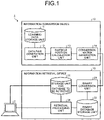
- FIG. 1 is a diagram for illustrating the retrieval system according to the first exemplary embodiment.
- a retrieval system 1 includes a client device 2, an information conversion device 10, and an information retrieval device 20.
- the information conversion device 10 includes a learning data storage unit 11, a data pair generation unit 12, a particle position calculation unit 13, and a conversion matrix generation unit 14.
- the information retrieval device 20 includes a storage unit 21 for database to be retrieved, a binary conversion unit 23, a binary database storage unit 22, and a retrieval processing unit 24.
- the retrieval system 1 illustrated in FIG. 1 retrieves neighbor data to the query data from the storage unit 21 for database to be retrieved.
- the retrieval system 1 is a system for reporting to the client device 2 whether similar data is registered in the vicinity of the query data.
- the information conversion device 10 generates a conversion matrix
- the information retrieval device 20 converts data to be retrieved to a binary string, using the conversion matrix, and retrieves the neighbor data to the query data, using the binary string obtained after the conversion.
- the data to be retrieved in the retrieval system 1 is data such as image, sound, or the like, and a biological data in biometric authentication using a fingerprint pattern or a veinprint pattern. That is, the retrieval system 1 is a system for, when receiving a biological data of a user input to the client device 2 as the query data, determining whether the biological data of the user is registered.
- FIG. 2 is a diagram for illustrating an example of the biometric authentication. It is noted that, in the example illustrated in FIG. 2 , processing in ID-less 1 : N authentication is illustrated in which information such as a user identification (ID) is not input, and sets of biological data are not narrowed down using the user ID. As illustrated in FIG. 2 , the retrieval system 1 stores a plurality of sets of registered biological data by a plurality of users.
- ID user identification
- the retrieval system 1 When receiving, as the query data, biological data from the client device 2, the retrieval system 1 extracts feature vectors indicating features of the input biological data, and retrieves a registered biological data having feature vectors similar to the extracted feature vectors. That is, the retrieval system 1 determines whether the biological data of the user inputting the query data is registered.
- the retrieval system 1 generates the conversion matrix for converting a feature vector to a binary string having a predetermined bit length, and uses the generated conversion matrix to convert a feature vector of the registered biological data to a binary string. Further, the retrieval system 1 converts the feature vectors in the biological data input as the query data to a binary string having a predetermined bit length, and calculates the Hamming distance between the binary string obtained from the query data and the binary string obtained by the conversion of the feature vectors of the registered biological data.
- the retrieval system 1 extracts, as a candidate object to be retrieved, a registered biological data having a Hamming distance not more than a predetermined threshold. Then, the retrieval system 1 performs strict matching of the retrieved registered biological data with the biological data input as the query data, and outputs a result of the strict matching to the client device 2.
- the retrieval system 1 converts the feature vector indicating a feature of the registered biological data to be retrieved to a predetermined binary string, calculates the Hamming distance between the binary string obtained from the registered biological data and the binary string obtained by converting the feature vector of the query data, and narrow down the data to be retrieved.
- the retrieval system 1 performs matching of the data narrowed down with the query data to perform matching in the biometric authentication.
- the feature vector when the input biological data or the registered biological data is an image, the feature vector has vectorized values of such as, a density or coordinates of featured points, a direction, a length, or a gradient of a ridge in a specific are in an image, or a terminal end or branch of the ridge. Further, the input biological data or the registered biological data is sound, the feature vector has vectorized values of, such as, distribution, intensity, or a peak value of frequency components.
- the information conversion device 10 uses learning data stored in the learning data storage unit 11 to generate the conversion matrix for converting the feature vector to the binary string having a predetermined bit length, and reports the generated conversion matrix to the information retrieval device 20.
- the conversion matrix represents a matrix having, as a row component, a normal vector of the hyperplane dividing a feature vector space into a plurality of areas, and the matrix is used when the information retrieval device 20 converts the feature vector to the binary string.
- the information retrieval device 20 calculates multiplication of the feature vector by the conversion matrix to obtain a product. Then, the information retrieval device 20 determines whether each component of the product of the calculated multiplication has a positive value or negative value, and the binary string is generated in which when the component has a positive value, the component is expressed as "1", and when the component has a negative value, the component is expressed as "0". That is, the information retrieval device 20 uses the conversion matrix to convert each feature vector to the binary string indicating which area of the feature vector space divided into a plurality of areas by the hyperplane, the feature vector belongs to.
- a hyperplane for classifying each data according to labels is preferably set.
- the binary string is information indicating which side of each hyperplane the feature vector is, so that when similar hyperplanes are set, the number of redundant bit strings is increased, and accuracy in distance relationship is deteriorated. Therefore, the hyperplanes are preferably set to divide the feature vector space into different areas.
- a technique for optimizing a plurality of hyper planes are considered.
- a positive example pair being a set of feature vectors to which the same label is applied
- a negative example pair being a set of feature vectors to which different labels are applied are used to simultaneously evaluate the plurality of set hyperplanes.
- the amount of calculation is increased, it has been difficult to learn a set of hyperplanes in order to simultaneously optimize the plurality of hyperplanes.
- the information conversion device 10 arranges particles are disposed to have the same number as that of the hyperplanes to be set, on a unit sphere having a dimensional number the same as that of the hyperplane, and conducts a random walk on the particles, considering an evaluation function for evaluation of the hyperplane as a probability density function indicating a probability of existence of a particle on the unit sphere. Then, as a result of the random walk, the information conversion device 10 considers a positional vector of a particle moved to a position at which the probability density function has a maximum value, as the normal vector of the hyperplane.
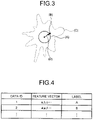
- FIG. 3 is a diagram for illustrating an effect of random walk. It is noted that, in an example illustrated in FIG. 3 , a unit ball having a dimensional number the same as that of the hyperplane is twodimensionally projected.
- the information conversion device 10 arranges a particle indicated by (B) in FIG. 3 on a unit sphere indicated by (A) in FIG. 3 Further, the information conversion device 10 considers the evaluation function for evaluation of the hyperplane as the probability density function, as indicated by (C) in FIG. 3 . Then, the information conversion device 10 conducts the random walk on the particle on the unit sphere.
- the information conversion device 10 considers a positional vector of a particle moved, by the random walk, to a position at which the probability density function has a maximum value, as the normal vector of the hyperplane, to obtain the normal vector of the hyperplane having the maximum value of the evaluation function, as indicated by (D) in FIG. 3
- each particle tends to stay, in the vicinity of an initial arrangement of the particle, at a position at which the probability density function has the maximum value. That is, as a result of the random walk, the particles have a low probability of movement to the same position.
- the information conversion device 10 arranges a plurality of particles on the unit sphere, and considers the evaluation function for evaluation of the hyperplane as the probability density function to conduct the random walk on individual particle. That is, the information conversion device 10 considers the plurality of positional vectors of the particles on the unit sphere as the normal vectors of the hyperplanes, and the evaluation function as the probability density function, and performs sampling according to a Markov chain Monte Carlo method. The information conversion device 10 considers the positional vector at the position to which each particle is moved, as the normal vector of the hyperplane to readily optimize the set of hyperplanes without solving the problem of the optimization of the evaluation function about the set of hyperplanes. Further, the information conversion device 10 is allowed to apply a non-negative integrable function to the evaluation function.
- the learning data storage unit 11 stores learning data for learning of hyperplane by the information conversion device.
- the learning data storage unit 11 stores, as learning data, a plurality of feature vectors for each user.
- the feature vectors stored in the learning data storage unit 11 is part of feature vectors stored in the storage unit 21 for database to be retrieved, described later. That is, the learning data storage unit 11 partially stores feature vectors of the registered biological data registered in the retrieval system 1.
- FIG. 4 is a table for illustrating an example of data stored in the learning data storage unit.
- the learning data storage unit 11 stores a data identification (ID) in association with the feature vectors and the label.
- ID represents a data identifier applied to each data.
- the label represents information indicating similarity between feature vectors, and, for example, represents information indicating a user registering the biological data or the like being a source of each feature vector.
- the learning data storage unit 11 stores 4000-dimensional floating point data "a, b, c " which is feature vectors indicated by a data ID "1", and to which a label "A" is applied. Further, the learning data storage unit 11 stores, as the feature vectors, 4000 dimensional floating point data "d, e, f" which is feature vectors indicated by a data ID "2", and to which a label "B" is applied.
- the data pair generation unit 12 collects data pairs used for learning the hyperplane, from the learning data stored in the learning data storage unit 11. Specifically, the data pair generation unit 12 selects a plurality of the positive example pairs being two feature vectors to which the same label is applied, from the feature vectors stored in the learning data storage unit 11. Further, the data pair generation unit 12 selects a plurality of the negative example pairs being two feature vectors to which different labels are applied, from the feature vectors stored in the learning data storage unit 11. Then, the data pair generation unit 12 outputs the selected positive example pairs and the negative example pairs to the particle position calculation unit 13.
- the particle position calculation unit 13 considers a predetermined evaluation function as the probability density function, and conducts the random walk on the plurality of particles on the unit sphere having a dimensional number the same as that of the hyperplane to calculate a positional vector at a position at which the probability density function has a maximum value. Specifically, the positive example pair and the negative example pair are received from the data pair generation unit 12. Further, the particle position calculation unit 13 arranges, at random, the particles having the same number as that of the hyperplanes set on the unit sphere having a dimensional number the same as that of the hyperplane. Then, the particle position calculation unit 13 performs the following Markov chain Monte Carlo methods (MCMC) for each particle arranged on the unit sphere.
- MCMC Markov chain Monte Carlo methods
- the particle position calculation unit 13 uses the positive example pair and the negative example pair received from the data pair generation unit 12, to calculate a value of the evaluation function, for a hyperplane having a current positional vector of a particle as a normal vector.
- the particle position calculation unit 13 extracts a candidate position as a movement destination of the particle. It is noted that, as a content of extraction processing of the candidate, a method of moving the particle by a predetermined distance, or a method of extracting a candidate position from a proposal distribution using a Metropolis-Hastings algorithm are considered.
- the particle position calculation unit 13 uses the positive example pair and the negative example pair received from the data pair generation unit 12 to calculate a value of the evaluation function, for the hyperplane having a positional vector of the extracted candidate position as a normal vector. Specifically, the particle position calculation unit 13 counts the number of positive example pairs having a feature vector not divided by the hyperplane having a positional vector of the candidate position as a normal vector. Further, the particle position calculation unit 13 counts the number of negative example pairs having a feature vector divided by the hyperplane having a positional vector of the candidate position as a normal vector. Then, the particle position calculation unit 13 uses the number of positive example pairs calculated and the number of negative example pairs calculated to calculate a value for evaluation of the hyperplane, or a value of the evaluation function.
- the particle position calculation unit 13 calculates a value obtained by dividing the value of the evaluation function calculated for the hyperplane having a positional vector of the candidate position as a normal vector, by the value of the evaluation function calculated for the hyperplane having a current positional vector of a particle as a normal vector. Then, the particle position calculation unit 13 calculates a random number having a value of not less than 0 and not more than 1, and when the calculated value is larger than the random number, the candidate position is defined as a new position of the particle. That is, the particle position calculation unit 13 moves the particle to a position at which the value of the evaluation function is increased, in consideration of randomness.
- FIG. 5 is a graph for illustrating the contents of the MCMC method. It is noted that, in FIG. 5 , for easy understanding, each position on the unit sphere is one-dimensionally projected on a horizontal axis, and a value of the evaluation function U(x) is plotted on a vertical axis. For example, the particle position calculation unit 13 selects a position indicated by (F) in FIG. 5 , as the candidate position to which the particle indicated by (E) in FIG. 5 is to be moved.
- the particle position calculation unit 13 obtains a value of the evaluation function U(x), using the positional vector of the candidate position as the normal vector of the hyperplane. Next, the particle position calculation unit 13 calculates the value obtained by dividing the value of the evaluation function U(x) obtained by calculating the positional vector of the candidate position as the normal vector of the hyperplane, by the value of the evaluation function U(x) obtained by calculating the positional vector of the current position as the normal vector of the hyperplane. Then, the particle position calculation unit 13 determines whether a result of the division is larger than the random number of not less than 0 and not more than 1.
- the particle indicated by (E) in FIG. 5 is arranged at a position at which the value of U(x) has a maximum value, the value of U(x) at the candidate position is smaller than the value of U(x) at the current position. Therefore, as a result of the division, the particle has a value of not more than 1, and has a high probability of having a value smaller than the random number. Therefore, the particle indicated by (E) in FIG. 5 has a low probability of moving to the position indicated by (F) in FIG. 5 .
- random walk of a particle indicated by (G) in FIG. 5 will be considered.
- a candidate position for the particle indicated by (G) in FIG. 5 is defined as a position indicated by (I) in FIG. 5
- the value of the evaluation function U(x) is smaller than a current value.
- the candidate position for the particle indicated by (G) in FIG. 5 is defined as a position indicated by (J) in FIG. 5
- the value of the evaluation function U(x) is larger than the current value.
- the particle position calculation unit 13 arranges a plurality of particles on the unit sphere to conduct the random walk on individual particle, and defines the positional vector of each particle as the normal vector of the hyperplane, so that the set of hyperplanes not similar and each having the maximum value of the evaluation function is readily calculated. Further, even if a differentiable evaluation function is not obtained, the particle position calculation unit 13 may readily calculate a set of the normal vectors which may have a maximum value of the evaluation function.
- the particle position calculation unit 13 is allowed to use, as the probability density function, an arbitrary evaluation function which has a small value when the hyperplane is between the positive example pair, and has a large value when the hyperplane is between the negative example pair.
- a plurality of examples of the evaluation function used by the particle position calculation unit 13 will be described below.
- the particle position calculation unit 13 counts the number of positive example pairs having both feature vectors in any of two areas divided by the hyperplane. Specifically, the particle position calculation unit 13 defines the angle of the normal vector and the angle of each feature vector included in the positive example pair as ⁇ 1 (p) and ⁇ 2 (p), respectively, and defines the number of positive example pairs having a positive value of cos ( ⁇ 1 (p)) ⁇ cos ( ⁇ 2 (p) ) as "#PP + ".
- the particle position calculation unit 13 counts the number of negative example pairs in which the hyperplane having the positional vector of the particle as the normal vector divides the feature vectors into different areas, of the negative example pairs received from the data pair generation unit 12. Specifically, the particle position calculation unit 13 defines the angles of the normal vector and each feature vector included in the negative example pair, as ⁇ 1 (p) and ⁇ 2 (p), respectively. The particle position calculation unit 13 defines the number of negative example pairs having a negative value of cos ( ⁇ 1 (p)) ⁇ cos ( ⁇ 2 (p)), as "#NP - ".
- the particle position calculation unit 13 may use a rate of the number of positive example pairs having both feature vectors in any of two areas divided, and a rate of the number of negative example pairs having the feature vectors divided into different areas to calculate the value of the evaluation function. For example, the particle position calculation unit 13 defines the number of positive example pairs received from the data pair generation unit 12 as "#PP", and the number of negative example pairs received from the data pair generation unit 12 as "#NP".
- the particle position calculation unit 13 may use another formula to calculate a value of the evaluation function. For example, the particle position calculation unit 13 calculates an absolute value of cos( ⁇ 1 (p)) + cos( ⁇ 2 (p)) for all positive example pairs, and defines the sum of the calculated absolute values as D. Further, the particle position calculation unit 13 calculates an absolute value of cos( ⁇ 1 (p)) - cos( ⁇ 2 (p)) for all negative example pairs, and defines the sum of the calculated absolute values as E.
- x ⁇ p ⁇ PP cos ⁇ 1 p + cos ⁇ 2 p + ⁇ p ⁇ NP cos ⁇ 1 p ⁇ cos ⁇ 2 p
- the particle position calculation unit 13 may calculate formula (3) considering the rate, similar to formula (2). For example, the particle position calculation unit 13 calculates the absolute value of cos( ⁇ 1 (p)) + cos( ⁇ 2 (p)) for all positive example pairs, and defines the sum of the calculated absolute values as D. Further, the particle position calculation unit 13 calculates the absolute value of cos( ⁇ 1 (p)) - cos( ⁇ 2 (p)) for all negative example pairs, and defines the sum of the calculated absolute values as E.
- the particle position calculation unit 13 defines, as the value of x, the sum of a value obtained by dividing the calculated D by the number of positive example pairs "#PP", and a value obtained by dividing the calculated E by the number of negative example pairs "#NP”, and calculates the value of the evaluation function U(x). That is, the particle position calculation unit 13 uses the following formula (4) to calculate the variable x, and uses the calculated value of the variable x to calculate the value of the evaluation function U(x).
- x 1 # PP ⁇ p ⁇ PP cos ⁇ 1 p + cos ⁇ 2 p + 1 # NP ⁇ p ⁇ NP cos ⁇ 1 p ⁇ cos ⁇ 2 p
- the particle position calculation unit 13 considers the positional vector of the particle as the normal vector of the hyperplane, and calculates the value of the evaluation function having a value increasing according to the number of positive example pairs included in the same area by the hyperplane, and the number of negative example pairs divided into different areas by the hyperplane.
- the particle position calculation unit 13 defines the calculated value of the evaluation function as a value of the probability density function, and moves the particles on the unit sphere in a direction in which the value of the probability density function is increased.
- the particle position calculation unit 13 is allowed to calculate the normal vectors of the set of hyperplanes not similar and each having the maximum value of the evaluation function, or the conversion matrix using a set of optimized hyperplanes, for the set of hyperplanes, without solving the problem of an optimum value of the evaluation function.
- the particle position calculation unit 13 conducts the above-mentioned random walk process on each particle, a predetermined number of times, and moves each particle to the position at which the probability density function has a maximum value. Then, the particle position calculation unit 13 outputs the positional vector of each particle to the conversion matrix generation unit 14.
- the conversion matrix generation unit 14 when receiving the positional vector calculated by the particle position calculation unit 13, the conversion matrix generation unit 14 generates a matrix having collection of received positional vectors, or the conversion matrix. For example, the conversion matrix generation unit 14 receives a plurality of positional vectors, and generates the conversion matrix having row vectors of the received positional vectors. Then, the conversion matrix generation unit 14 outputs the generated conversion matrix to the binary conversion unit 23 of the information retrieval device 20.
- the storage unit 21 for database to be retrieved stores data to be retrieved, or feature vectors of the registered biological data. Specifically, the storage unit 21 for database to be retrieved stores data similar to that of the learning data storage unit 11. It is noted that the storage unit 21 for database to be retrieved may store a larger number of sets of data including the data stored in the learning data storage unit 11.
- the binary database storage unit 22 stores binary symbols obtained by converting the feature vectors using a predetermined conversion matrix, in association with the data IDs before conversion.
- the binary conversion unit 23 when receiving the conversion matrix from the conversion matrix generation unit 14 of the information conversion device 10, uses the received conversion matrix to convert the feature vector stored in the storage unit 21 for database to be retrieved to the binary string.
- the binary conversion unit 23 associates the converted binary string with the data ID having been associated with the feature vector being a conversion source, and stores the binary string to the binary database storage unit 22.
- the retrieval processing unit 24 When receiving the query data from the client device 2, the retrieval processing unit 24 extracts the feature vectors representing the features of the received query data, and converts the extracted feature vectors to the binary string, using the predetermined conversion matrix. Then, the retrieval processing unit 24 retrieves, from the binary strings stored in the binary database storage unit 22, a binary string having a Hamming distance of not more than a predetermined value, or a binary string of feature vectors being a neighborhood candidate of the query data.
- the retrieval processing unit 24 obtains the feature vectors being the conversion source of the retrieved binary string from the storage unit 21 for database to be retrieved.
- the retrieval processing unit 24 performs the following processing. That is, the retrieval processing unit 24 transmits, to the client device 2, matching of the query data and the registered biological data.
- the retrieval processing unit 24 performs the following processing. That is, the retrieval processing unit 24 transmits, to the client device 2, non-matching of the query data and the registered biological data. Therefore, the client device 2 is allowed to perform the biometric authentication of the user inputting the query data.
- the data pair generation unit 12, the particle position calculation unit 13, the conversion matrix generation unit 14, the binary conversion unit 23, and the retrieval processing unit 24 employ an electronic circuit.
- an integrated circuit such as an application specific integrated circuit (ASIC) or a field programmable gate array (FPGA), or a central processing unit (CPU), a micro processing unit (MPU), or the like are applied, as an example of the electronic circuit.
- ASIC application specific integrated circuit
- FPGA field programmable gate array
- CPU central processing unit
- MPU micro processing unit
- the learning data storage unit 11, the storage unit 21 for database to be retrieved, and the binary database storage unit 22 employ a semiconductor memory device such as random access memory (RAM) or flash memory, or a storage device such as a hard disk or an optical disk.
- RAM random access memory
- flash memory or a storage device such as a hard disk or an optical disk.
- FIG. 6 is a flowchart for illustrating a flow of processing performed by the information conversion device. It is noted that, in an example illustrated in FIG. 6 , the information conversion device 10 having n particles 1 to n arranged on the unit sphere. First, the information conversion device 10 determines whether processes subsequent to step S102 are performed by a predetermined number of times (step S101).
- step S101, No the information conversion device 10 selects a plurality of positive example pairs and negative example pairs (step S102) from the learning data storage unit 11. Next, the information conversion device 10 determines whether the processes subsequent to step S102 are performed for all particles 1 to n (step S103). Then, when it is determined that the processes are not performed for all particles (step S103, No), the information conversion device 10 performs the Markov chain Monte Carlo method for a particle i (step S104).
- step S105 the information conversion device 10 adds 1 to the value of i (step S105), and performs the process of step S103 again. Further, when the process of step S104 is performed for all particles 1 to n (step S103, Yes), the information conversion device 10 performs the process of step S101 again. When the processes subsequent to step S102 are performed by the predetermined number of times (step S101, Yes), the information conversion device 10 generates a conversion matrix of the hyperplane, having a positional vector of each particle defined as a normal vector (step S106), and finishes the processing.
- FIG. 7 is a flowchart for illustrating the flow of the MCMC method. It is noted that, in an example illustrated in FIG. 7 , the MCMC method is performed for the particle i.
- the information conversion device 10 uses the Metropolis-Hastings algorithm to extract the candidate position of the particle i from the proposal distribution (step S201).
- the information conversion device 10 calculates a value of the evaluation function at a current position of the particle i (step S202), and defines a calculation result of step S202 as "A" (step S203).
- the information conversion device 10 calculates a value of the evaluation function at the candidate position of the particle i (step S204), and defines a calculation result of step S204 as "B" (step S205).
- the information conversion device 10 extracts a random number C having a value of not less than “0” and not more than “1” (step S206), and determines whether a value obtained by dividing "B" by "A” is larger than "C” (step S207).
- step S207, Yes When the value obtained by dividing "B" by “A” is larger than “C” (step S207, Yes), the information conversion device 10 changes the position of the particle i to the candidate position (step S208), and finishes the processing. That is, the information conversion device 10 determines whether the value of the evaluation function at the candidate position is larger than the current value of the evaluation function, in consideration of randomness in movement of the particle i. When the value of the evaluation function at the candidate position is larger than the current value of the evaluation function, the information conversion device 10 moves the particle i to the candidate position, in consideration of the randomness in movement of the particle i. Whereas, when the value obtained by dividing "B" by “A” is not more than "C” (step S207, No), the information conversion device 10 finishes the processing.
- FIG. 8 is a first flowchart illustrating a flow of processing of calculating the value of the evaluation function.
- the information conversion device 10 defines the positional vector of the particle as the normal vector.
- the angles of the normal vector and each feature vector included in the positive example pair are expressed as ⁇ 1 (p) and ⁇ 2 (p), respectively
- the information conversion device 10 defines the number of positive example pairs having a positive value of cos( ⁇ 1 (p)) ⁇ cos( ⁇ 2 (p)), as "#PP + " (step S301) .
- the information conversion device 10 defines the number of negative example pairs having a negative value of cos( ⁇ 1 (p)) ⁇ cos( ⁇ 2 (p)), as "#NP - " (step S302), The information conversion device 10 uses the sum of "#PP + " and "#NP - " to calculate the value of the evaluation function (step S303), and finishes the processing.
- FIG. 9 is a second flowchart illustrating the flow of processing of calculating the value of the evaluation function. It is noted that step S401 in FIG. 9 has the same process as that of step S301 in FIG. 8 , and step S402 in FIG. 9 has the same process as that of step S302 in FIG. 8 , and descriptions thereof will be omitted.
- the information conversion device 10 defines the number of positive example pairs received from the data pair generation unit 12 as "#PP", and the number of negative example pairs received from the data pair generation unit 12 as "#NP" (step S403). Then, the information conversion device uses the sum of a value obtained by dividing "#PP + “ by "#PP", and a value obtained by dividing "#NP - " by "#NP” to calculate a value of the evaluation function (step S404), and finishes the processing.
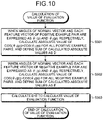
- FIG. 10 is a third flowchart illustrating the flow of processing of calculating the value of the evaluation function.
- the information conversion device 10 calculates an absolute value of cos( ⁇ 1 (p)) + cos( ⁇ 2 (p)) for all positive example pairs, and defines the sum of the calculated absolute values as D (step S501). Further, when the angles of the normal vector and each feature vector included in the negative example pair are expressed as ⁇ 1 (p) and ⁇ 2 (p), respectively, the information conversion device 10 calculates an absolute value of cos( ⁇ 1 (p)) - cos( ⁇ 2 (p)) for all negative example pairs, and defines the sum of the calculated absolute values as E (step S502). The information conversion device 10 uses the sum of the calculated D and E to calculate the value of the evaluation function (step S503), and finishes the processing.
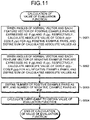
- FIG. 11 is a fourth flowchart illustrating a flow of processing of calculating the value of the evaluation function. It is noted that step S601 in FIG. 11 has the same process as that of step S501 in FIG. 10 , and step S602 in FIG. 11 has the same process as that of step S502 in FIG. 10 , and descriptions thereof will be omitted.
- the information conversion device 10 defines the number of positive example pairs received from the data pair generation unit 12 as "#PP", and the number of negative example pairs received from the data pair generation unit 12 as "#NP" (step S603).
- the information conversion device calculates the value of the evaluation function from the sum of a value obtained by dividing "D" by "#PP", and a value obtained by dividing "E” by "#NP” (step S604), and finishes the processing.
- the information conversion device 10 defines the positional vector of the particle on the unit sphere in a multidimensional space as the normal vector of the hyperplane dividing the feature vector space, and considers the evaluation function as the probability density function indicating a probability of existence of a particle on the unit sphere.
- the information conversion device 10 moves each of the positions of the plurality of particles on the unit sphere to a position at which the evaluation function has a maximum value by random walk. Then, the information conversion device 10 considers the positional vector of each particle as the normal vector of the hyperplane. Therefore, even if the number of hyperplanes to be set is increased, the information conversion device 10 may readily optimize the set of hyperplanes in which each hyperplane does not tie optimum solutions.
- the information conversion device 10 calculates a value obtained by dividing the value of the evaluation function upon consideration of the positional vector at the candidate position to which the particle is moved, as the normal vector, by the value of the evaluation function upon consideration of the positional vector at the current position, as the normal vector. Then, when the calculated value is larger than the random number of not less than 0 and not more than 1, the information conversion device 10 moves the position of the particle to the candidate position. Therefore, the information conversion device 10 is allowed to move the particle to the position at which the evaluation function has a maximum value. Further, the information conversion device 10 holds the randomness in movement of the particle to prevent converging of the values of the evaluation function to a local maximum value.
- the information conversion device 10 repetitively conducts the random walk process on the particle on the unit sphere, a predetermined number of times. Therefore, the information conversion device 10 is allowed to obtain the hyperplane each having a normal vector closer to a maximum value, or a set of hyperplanes further optimized.
- the information conversion device 10 selects a positive example pair and a negative example pair.
- the information conversion device 10 considers an evaluation function having the value reduced when the positive example pair is divided into the different areas, and increased when the negative example pair is divided into the different areas, as the probability density function. Therefore, the information conversion device 10 is allowed to calculate the set of hyperplanes for classifying feature vectors for each label.
- the information conversion device 10 counts the number "#PP + " of positive example pairs including both feature vectors in one of the areas divided by the hyperplane, and the number "#NP - " of negative example pairs including two feature vectors divided into the different areas by the hyperplane.
- the information conversion device 10 uses an evaluation function in which the sum of "#PP + " and "#NP - " is defined as an index, and a Napier's constant is defined as a base. Therefore, the information conversion device 10 is allowed to calculate the set of hyperplanes for classifying feature vectors for each label.
- the information conversion device 10 uses an evaluation function in which the sum of a value obtained by dividing "#PP+” by the number "#PP” of positive example pairs, and a value obtained by dividing "#NP - " by the number "#NP” of negative example pairs is defined as an index, and the Napier's constant as the base. Therefore, the information conversion device 10 is allowed to optimize the set of hyperplanes, according to a rate between data optimally classified by the hyperplane and data not optimally classified by the hyperplane.
- the information conversion device 10 adds, to all positive example pairs, an absolute value of the sum of cosine values of angles between the feature vectors included in the positive example pair and the normal vector. Further, the information conversion device 10 adds, to all negative example pairs, an absolute value of a difference between cosine values of the angles between the feature vectors included in the negative example pair and the normal vector.
- the information conversion device uses an evaluation function in which the sum of the value added to the positive example pair and the value added to the negative example pair is defined as an index, and the Napier's constant as the base. Therefore, the information conversion device 10 is allowed to calculate the set of hyperplanes for comprehensive classification, such as, appropriate divisibility between the whole of the positive example pairs and the whole of the negative example pairs.
- the information conversion device uses an evaluation function in which the sum of a value obtained by dividing the value added to the positive example pair by the number of positive example pairs, and a value obtained by dividing the value added to the negative example pair by the number of negative example pairs is defined as an index, and the Napier's constant as the base. Therefore, the information conversion device 10 is allowed to calculate the set of hyperplanes for comprehensive classification, in consideration of a rate of positive example pairs and negative example pairs properly classified. Further aspects not covered by the independent claims
- the above-mentioned information conversion device 10 selects, as the positive example pair, two feature vectors to which the same label is applied, and selects, as a negative example pair, two feature vectors to which different labels are applied.
- the information conversion device 10 according to other aspects not covered by the independent claims, is allowed to select the positive example pair and the negative example pair including an arbitrary number of feature vectors.
- the information conversion device 10 obtains a data set including at least three feature vectors, from the learning data storage unit 11.
- the information conversion device 10 may generate the positive example pair and the negative example pair from the obtained data set, to calculate a value of the evaluation function using the generated positive example pair and the negative example pair.
- the above-mentioned information conversion device 10 reselects the positive example pair and the negative example pair, each time the MCMC method is performed for all particles.
- the further aspect, not covered by the independent claims, is not limited to this configuration, and for example, the information conversion device 10 may reselect the positive example pair and the negative example pair, each time the MCMC method is performed for one particle.
- the above-mentioned information conversion device 10 is a device independent of the information retrieval device 20.
- the exemplary embodiment is not limited to this configuration, and for example, the information retrieval device 20 may include a function of the information conversion device 10.
- the information conversion device 10 may have a function performed by the binary conversion unit 23 of the information retrieval device 20, generate the conversion matrix for the feature vector stored in the information retrieval device in operation, and use the generated conversion matrix to perform processing of generating the binary string.
- a function of the information conversion device 10 may be provided by a so-called cloud system.
- the mathematical formulae used for calculation of importance by the information conversion device 10 are only examples, and information conversion device 10 may use a mathematical formula of arbitrary type. That is, the information conversion device 10 may use an arbitrary mathematical formula, as far as the conversion matrix is obtained for projecting the feature vectors to the binary string according to a distance relationship between the feature vectors or the label applied to the feature vector. Further, the information conversion device 10 may set a parameter or the like for obtaining the conversion matrix, or may use another evaluation function.
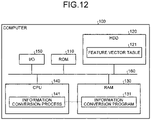
- FIG. 12 is a diagram for illustrating an example of the computer for executing an information conversion program.
- ROM read only memory
- HDD hard disk drive
- RAM random access memory
- CPU central processing unit
- I/O input output
- the HDD 120 stores a feature vector table 121 storing data similar to the data in the learning data storage unit 11. Further, an information conversion program 131 is previously held in the RAM 130.
- the CPU140 reads the information conversion program 131 from the RAM 130 and executes the information conversion program 131, and in an example illustrated in FIG. 12 , the information conversion program 131 functions as an information conversion process 141. It is noted that information conversion process 141 has a function similar to those of the data pair generation unit 12, the particle position calculation unit 13, and the conversion matrix generation unit 14 illustrated in FIG. 1 .
- the information conversion program described in the present exemplary embodiment is achieved by executing a previously prepared program by the computer such as a personal computer or a workstation.
- This program is allowed to be distributed through a network such as the Internet. Further, this program is recorded in a computer-readable recording medium such as a hard disk, a flexible disk (FD), a compact disc read only memory (CD-ROM), a magneto optical disc (MO), or a digital versatile disc (DVD). Further, this program is also allowed to be read from the recording medium by the computer and executed.
Landscapes
- Engineering & Computer Science (AREA)
- Physics & Mathematics (AREA)
- Theoretical Computer Science (AREA)
- General Physics & Mathematics (AREA)
- Data Mining & Analysis (AREA)
- Software Systems (AREA)
- Mathematical Physics (AREA)
- General Engineering & Computer Science (AREA)
- Probability & Statistics with Applications (AREA)
- Pure & Applied Mathematics (AREA)
- Computational Mathematics (AREA)
- Mathematical Analysis (AREA)
- Mathematical Optimization (AREA)
- Artificial Intelligence (AREA)
- Evolutionary Computation (AREA)
- Computing Systems (AREA)
- Computer Security & Cryptography (AREA)
- Algebra (AREA)
- Databases & Information Systems (AREA)
- Computational Linguistics (AREA)
- Bioinformatics & Cheminformatics (AREA)
- Life Sciences & Earth Sciences (AREA)
- Bioinformatics & Computational Biology (AREA)
- Evolutionary Biology (AREA)
- Operations Research (AREA)
- Signal Processing (AREA)
- Computer Vision & Pattern Recognition (AREA)
- Medical Informatics (AREA)
- Computer Networks & Wireless Communication (AREA)
- Computer Hardware Design (AREA)
- Fuzzy Systems (AREA)
- Information Retrieval, Db Structures And Fs Structures Therefor (AREA)
Claims (8)
- Procédé mis en œuvre par ordinateur incluant des étapes effectuées par un système de récupération qui effectue une authentification biométrique, le procédé comprenant les étapes consistant à :recevoir des données biologiques sous forme de données de requête pour l'authentification biométrique ;extraire un vecteur de caractéristiques indiquant des caractéristiques des données biologiques reçues ;récupérer des données biologiques enregistrées présentant des vecteurs de caractéristiques similaires au vecteur de caractéristiques extrait ;générer une matrice de conversion présentant un vecteur normal d'un hyperplan qui divise un espace de vecteurs de caractéristiques pour convertir un vecteur de caractéristiques en une chaîne binaire présentant une longueur de bit prédéterminée ;convertir le vecteur de caractéristiques des données biologiques enregistrées en une chaîne binaire à l'aide de la matrice de conversion ;convertir le vecteur de caractéristiques des données biologiques reçues en une chaîne binaire à l'aide de la matrice de conversion ;calculer une distance de Hamming entre la chaîne binaire obtenue à partir de données biologiques enregistrées et la chaîne binaire obtenue à partir des données biologiques reçues ;extraire des données biologiques enregistrées dont la distance de Hamming ne dépasse pas un seuil prédéterminé ;apparier les données biologiques enregistrées extraites avec les données biologiques reçues ; et
l'étape de génération de la matrice de conversion inclut l'optimisation d'une pluralité d'hyperplans par un premier déplacement de positions d'une pluralité de particules sur une sphère unitaire dans un espace multidimensionnel selon une valeur d'une fonction de densité de probabilité, la fonction de densité de probabilité étant configurée pour indiquer une probabilité d'existence d'une particule sur la sphère unitaire ; etle premier déplacement incluant :le calcul d'un vecteur positionnel de la particule sur la sphère unitaire comme vecteur normal de l'hyperplan,l'obtention d'une fonction d'évaluation qui est une fonction exponentielle configurée pour évaluer l'hyperplan en tant que fonction de densité de probabilité, la fonction d'évaluation sélectionnant une paire de vecteurs de caractéristiques à laquelle la même étiquette est appliquée, en tant que paire d'exemples positifs, sélectionnant une paire de vecteurs de caractéristiques auxquels des étiquettes différentes sont appliquées, en tant que paire d'exemples négatifs à partir de vecteurs de caractéristiques d'entrée, les étiquettes représentant des informations indiquant une similitude entre des vecteurs de caractéristiques de la paire et indiquant un utilisateur qui enregistre les données biologiques qui sont une source de chaque vecteur de caractéristiques, la valeur de fonction d'évaluation étant réduite lors de la division de deux vecteurs de caractéristiques inclus dans la paire d'exemples positifs en différentes zones par l'hyperplan, la valeur de fonction d'évaluation étant augmentée lors de la division de deux vecteurs de caractéristiques inclus dans la paire d'exemples négatifs en différentes zones par l'hyperplan ;l'étape de génération de la matrice de conversion inclut l'exécution d'un procédé de Monte-Carlo par chaînes de Markov pour chacune de la pluralité de particules incluant :l'extraction d'un candidat de destination de déplacement de la particule, le calcul d'une valeur en divisant une valeur de la fonction d'évaluation avec l'entrée d'un vecteur positionnel de la particule déplacée vers le candidat de destination de déplacement par une valeur de la fonction d'évaluation avec l'entrée d'un vecteur positionnel courant de la particule, etun second déplacement de la particule vers le candidat de destination de déplacement extrait, lorsqu'il est obtenu la valeur calculée supérieure à un nombre aléatoire d'au moins 0 et d'au plus 1, ou le blocage du déplacement de la particule, lorsqu'il est obtenu la valeur calculée qui n'est pas supérieure au nombre aléatoire. - Procédé mis en œuvre par ordinateur selon la revendication 1, dans lequel le premier déplacement est effectué de manière répétitive un nombre prédéterminé de fois.
- Procédé mis en œuvre par ordinateur selon la revendication 1, comprenant en outre les étapes consistant à :sélectionner une pluralité des paires d'exemples positifs et une pluralité des paires d'exemples négatifs ;compter le nombre de paires d'exemples positifs incluant les deux vecteurs de caractéristiques dans l'une des zones divisées par l'hyperplan ;compter le nombre de paires d'exemples négatifs comprenant deux vecteurs de caractéristiques divisés en zones différentes par l'hyperplan ;définir une fonction d'évaluation, sous forme d'un exposant x/T, où x est obtenu par une équation : x = #PP+ + #NP-, #PP+ est un nombre de paires d'exemples positifs présentant une valeur positive de cos (θ1 (p)) × cos (θ2 (p)), # NP- est un nombre de paires d'exemples négatifs présentant une valeur négative de cos (θ1 (p)) × cos (θ2 (p)), θ1 (p) et θ2 (p) sont des angles d'un vecteur normal et de chaque vecteur de caractéristiques p inclus dans la paire d'exemples, et T étant un paramètre arbitraire ; etdéfinir une constante de Napier comme base de la fonction d'évaluation.
- Procédé mis en œuvre par ordinateur selon la revendication 3, comprenant en outre les étapes consistant à :sélectionner une pluralité des paires d'exemples positifs et une pluralité des paires d'exemples négatifs ;calculer le rapport de paires d'exemples positifs incluant les deux vecteurs de caractéristiques dans l'une des zones divisées par l'hyperplan ;calculer le rapport de paires d'exemples négatifs comprenant deux vecteurs de caractéristiques divisés en zones différentes par l'hyperplan ;définir une fonction d'évaluation, sous forme d'un exposant x/T, où x est obtenu par une équation :
 #PP est un nombre de paires d'exemples positifs, #NP est un nombre de paires d'exemples négatifs, #PP+ est un nombre de paires d'exemples positifs présentant une valeur positive de cos (θ1 (p)) × cos (θ2 (p)), #NP- est un nombre de paires d'exemples négatifs présentant une valeur négative de cos (θ1 (p)) × cos (θ2 (p)), θ1 (p) et θ2 (p) sont des angles d'un vecteur normal et de chaque vecteur de caractéristiques p inclus dans la paire d'exemples, et T étant un paramètre arbitraire ; etdéfinir une constante de Napier comme base de la fonction d'évaluation.
 - Procédé mis en œuvre par ordinateur selon la revendication 1, comprenant en outre les étapes consistant à :sélectionner une pluralité des paires d'exemples positifs et une pluralité des paires d'exemples négatifs ;ajouter, pour chacune des paires d'exemples positifs, une valeur absolue obtenue en ajoutant une valeur cosinus d'un angle entre un vecteur de caractéristiques inclus dans la paire d'exemples positifs et un vecteur normal de l'hyperplan, et une valeur cosinus d'un angle entre l'autre vecteur de caractéristiques et le vecteur normal de l'hyperplan ;ajouter, pour chacune de la paire d'exemples négatifs, une valeur absolue d'une différence entre une valeur cosinus d'un angle entre un vecteur de caractéristiques inclus dans la paire d'exemples négatifs et un vecteur normal de l'hyperplan, et une valeur cosinus d'un angle entre l'autre vecteur de caractéristiques et le vecteur normal de l'hyperplan ;définir une fonction d'évaluation, sous forme d'un exposant x/T, où x est obtenu par une équation :
 PP indique des paires d'exemples positifs, NP indique des paires d'exemples négatifs, θ1 (p) et θ2 (p) sont des angles d'un vecteur normal et de chaque vecteur de caractéristiques p inclus dans la paire d'exemples, et T étant un paramètre arbitraire ; etdéfinir une constante de Napier comme base de la fonction d'évaluation.
 - Procédé mis en œuvre par ordinateur selon la revendication 1, comprenant en outre les étapes consistant à :sélectionner une pluralité des paires d'exemples positifs et une pluralité des paires d'exemples négatifs ;ajouter, pour chacune des paires d'exemples positifs, une valeur absolue obtenue en ajoutant une valeur cosinus d'un angle entre un vecteur de caractéristiques inclus dans la paire d'exemples positifs et un vecteur normal de l'hyperplan, et une valeur cosinus d'un angle entre l'autre vecteur de caractéristiques et le vecteur normal de l'hyperplan,ajouter, pour chacune des paires d'exemples négatifs, une valeur absolue d'une différence entre une valeur cosinus d'un angle entre un vecteur de caractéristiques inclus dans la paire d'exemples négatifs et un vecteur normal de l'hyperplan, et une valeur cosinus d'un angle entre l'autre vecteur de caractéristiques et le vecteur normal de l'hyperplan etdéfinir une fonction d'évaluation, sous forme d'un exposant x/T, où x est obtenu par une équation :
 PP indique des paires d'exemples positifs, NP indique des paires d'exemples négatifs, θ1 (p) et θ2 (p) sont des angles d'un vecteur normal et de chaque vecteur de caractéristiques p inclus dans la paire d'exemples, #PP est un nombre de paires d'exemples positifs, #NP est un nombre de paires d'exemples négatifs et T étant un paramètre arbitraire ; etdéfinir une constante de Napier comme base de la fonction d'évaluation.
 - Système informatique d'authentification d'utilisateur, le système étant configuré pour exécuter le procédé mis en œuvre par ordinateur selon la revendication 1.
- Programme d'authentification (131) qui, lorsqu'il est exécuté par un ordinateur (100), amène l'ordinateur (100) à exécuter le procédé mis en œuvre par ordinateur selon la revendication 1.
Applications Claiming Priority (1)
| Application Number | Priority Date | Filing Date | Title |
|---|---|---|---|
| PCT/JP2013/052418 WO2014118980A1 (fr) | 2013-02-01 | 2013-02-01 | Procédé, dispositif et programme de conversion d'informations |
Publications (3)
| Publication Number | Publication Date |
|---|---|
| EP2953064A1 EP2953064A1 (fr) | 2015-12-09 |
| EP2953064A4 EP2953064A4 (fr) | 2017-05-10 |
| EP2953064B1 true EP2953064B1 (fr) | 2022-07-06 |
Family
ID=51261722
Family Applications (1)
| Application Number | Title | Priority Date | Filing Date |
|---|---|---|---|
| EP13874037.8A Active EP2953064B1 (fr) | 2013-02-01 | 2013-02-01 | Procédé, dispositif et programme de conversion d'informations |
Country Status (4)
| Country | Link |
|---|---|
| US (1) | US9704100B2 (fr) |
| EP (1) | EP2953064B1 (fr) |
| JP (1) | JP6004016B2 (fr) |
| WO (1) | WO2014118980A1 (fr) |
Families Citing this family (15)
| Publication number | Priority date | Publication date | Assignee | Title |
|---|---|---|---|---|
| JP6453618B2 (ja) * | 2014-11-12 | 2019-01-16 | 株式会社東芝 | 算出装置、方法及びプログラム |
| TWI578240B (zh) * | 2015-12-01 | 2017-04-11 | 財團法人工業技術研究院 | 特徵描述方法及應用其之特徵描述器 |
| JP6828322B2 (ja) * | 2016-09-06 | 2021-02-10 | 日本電気株式会社 | 照合システムと方法とプログラム |
| KR102289419B1 (ko) * | 2017-06-26 | 2021-08-12 | 한국전자통신연구원 | 바이오메트릭을 이용한 사용자의 인증 방법 및 장치 |
| US10452958B2 (en) * | 2017-10-06 | 2019-10-22 | Mitsubishi Electric Research Laboratories, Inc. | System and method for image comparison based on hyperplanes similarity |
| US10789081B2 (en) * | 2017-10-18 | 2020-09-29 | Bank Of America Corporation | Computer architecture for emulating drift-between string correlithm objects in a correlithm object processing system |
| US10810026B2 (en) * | 2017-10-18 | 2020-10-20 | Bank Of America Corporation | Computer architecture for emulating drift-away string correlithm objects in a correlithm object processing system |
| US10824452B2 (en) * | 2017-10-18 | 2020-11-03 | Bank Of America Corporation | Computer architecture for emulating adjustable correlithm object cores in a correlithm object processing system |
| US10915337B2 (en) * | 2017-10-18 | 2021-02-09 | Bank Of America Corporation | Computer architecture for emulating correlithm object cores in a correlithm object processing system |
| US10810028B2 (en) * | 2017-10-18 | 2020-10-20 | Bank Of America Corporation | Computer architecture for detecting members of correlithm object cores in a correlithm object processing system |
| US10860349B2 (en) * | 2018-03-26 | 2020-12-08 | Bank Of America Corporation | Computer architecture for emulating a correlithm object processing system that uses portions of correlithm objects and portions of a mapping table in a distributed node network |
| WO2020100289A1 (fr) * | 2018-11-16 | 2020-05-22 | 富士通株式会社 | Dispositif de calcul de similarité, procédé de calcul de similarité, et programme de calcul de similarité |
| US11372823B2 (en) * | 2019-02-06 | 2022-06-28 | President And Fellows Of Harvard College | File management with log-structured merge bush |
| JP7416400B2 (ja) * | 2019-10-18 | 2024-01-17 | 国立研究開発法人産業技術総合研究所 | 識別補助データ生成技術及び識別情報抽出技術 |
| US12292934B2 (en) * | 2022-09-07 | 2025-05-06 | Sage Global Services Limited | Classifying documents using geometric information |
Family Cites Families (4)
| Publication number | Priority date | Publication date | Assignee | Title |
|---|---|---|---|---|
| JP2006252333A (ja) | 2005-03-11 | 2006-09-21 | Nara Institute Of Science & Technology | データ処理方法、データ処理装置およびそのプログラム |
| JP4565106B2 (ja) | 2005-06-23 | 2010-10-20 | 独立行政法人情報通信研究機構 | 二項関係抽出装置,二項関係抽出処理を用いた情報検索装置,二項関係抽出処理方法,二項関係抽出処理を用いた情報検索処理方法,二項関係抽出処理プログラム,および二項関係抽出処理を用いた情報検索処理プログラム |
| JP2010061176A (ja) | 2006-11-22 | 2010-03-18 | Nec Corp | テキストマイニング装置、テキストマイニング方法、および、テキストマイニングプログラム |
| US20150169644A1 (en) * | 2013-01-03 | 2015-06-18 | Google Inc. | Shape-Gain Sketches for Fast Image Similarity Search |
-
2013
- 2013-02-01 EP EP13874037.8A patent/EP2953064B1/fr active Active
- 2013-02-01 WO PCT/JP2013/052418 patent/WO2014118980A1/fr not_active Ceased
- 2013-02-01 JP JP2014559467A patent/JP6004016B2/ja not_active Expired - Fee Related
-
2015
- 2015-07-30 US US14/814,014 patent/US9704100B2/en not_active Expired - Fee Related
Also Published As
| Publication number | Publication date |
|---|---|
| EP2953064A4 (fr) | 2017-05-10 |
| EP2953064A1 (fr) | 2015-12-09 |
| JPWO2014118980A1 (ja) | 2017-01-26 |
| JP6004016B2 (ja) | 2016-10-05 |
| US20160034821A1 (en) | 2016-02-04 |
| US9704100B2 (en) | 2017-07-11 |
| WO2014118980A1 (fr) | 2014-08-07 |
Similar Documents
| Publication | Publication Date | Title |
|---|---|---|
| EP2953064B1 (fr) | Procédé, dispositif et programme de conversion d'informations | |
| US10671675B2 (en) | Systems and methods for a scalable continuous active learning approach to information classification | |
| US10883345B2 (en) | Processing of computer log messages for visualization and retrieval | |
| CN110059288B (zh) | 用于获得促进机器学习任务用的最佳母小波的系统和方法 | |
| US20130064444A1 (en) | Document classification using multiple views | |
| EP2657884A2 (fr) | Identification d'objets multimédia sur la base de l'empreinte multimédia | |
| Xu et al. | A supervoxel approach to the segmentation of individual trees from LiDAR point clouds | |
| CN105593851A (zh) | 用于跟踪与通过关联的文本和图像可识别的实体相关的微博消息的方法和装置 | |
| CN111046904B (zh) | 一种图像描述方法、图像描述装置及计算机存储介质 | |
| US10635991B2 (en) | Learning method, information processing device, and recording medium | |
| US10121085B2 (en) | Information processing apparatus and method of searching for similar data | |
| Ye et al. | Pat: Geometry-aware hard-label black-box adversarial attacks on text | |
| Hussein et al. | Machine learning approach to sentiment analysis in data mining | |
| CN104866606A (zh) | 一种MapReduce并行化大数据文本分类方法 | |
| CN114942986B (zh) | 文本生成方法、装置、计算机设备及计算机可读存储介质 | |
| US9792561B2 (en) | Learning method, information conversion device, and recording medium | |
| Bhat et al. | Content-based file type identification | |
| US12361027B2 (en) | Iterative sampling based dataset clustering | |
| Guo et al. | Fast tweet retrieval with compact binary codes | |
| CN106557668A (zh) | 基于lf熵的dna序列相似性检验方法 | |
| CN106557533A (zh) | 一种单目标多图像联合检索的方法和装置 | |
| CN102279927B (zh) | 拒识方法和拒识装置 | |
| Özkan et al. | Visual group binary signature for video copy detection | |
| US20250363425A1 (en) | Machine learning model analysis and classification | |
| CN119939349B (zh) | 一种基于距离度量和集成学习的分组密码算法识别方法 |
Legal Events
| Date | Code | Title | Description |
|---|---|---|---|
| PUAI | Public reference made under article 153(3) epc to a published international application that has entered the european phase |
Free format text: ORIGINAL CODE: 0009012 |
|
| 17P | Request for examination filed |
Effective date: 20150728 |
|
| AK | Designated contracting states |
Kind code of ref document: A1 Designated state(s): AL AT BE BG CH CY CZ DE DK EE ES FI FR GB GR HR HU IE IS IT LI LT LU LV MC MK MT NL NO PL PT RO RS SE SI SK SM TR |
|
| AX | Request for extension of the european patent |
Extension state: BA ME |
|
| DAX | Request for extension of the european patent (deleted) | ||
| A4 | Supplementary search report drawn up and despatched |
Effective date: 20170406 |
|
| RIC1 | Information provided on ipc code assigned before grant |
Ipc: G06N 7/00 20060101ALI20170401BHEP Ipc: G06N 99/00 20100101AFI20170401BHEP |
|
| STAA | Information on the status of an ep patent application or granted ep patent |
Free format text: STATUS: EXAMINATION IS IN PROGRESS |
|
| 17Q | First examination report despatched |
Effective date: 20190801 |
|
| REG | Reference to a national code |
Ref country code: DE Ref legal event code: R079 Ref document number: 602013082034 Country of ref document: DE Free format text: PREVIOUS MAIN CLASS: G06N0003000000 Ipc: G06N0099000000 |
|
| RIC1 | Information provided on ipc code assigned before grant |
Ipc: G06F 21/30 20130101ALI20211119BHEP Ipc: G06N 5/00 20060101ALI20211119BHEP Ipc: G06N 7/00 20060101ALI20211119BHEP Ipc: G06N 99/00 20190101AFI20211119BHEP |
|
| GRAP | Despatch of communication of intention to grant a patent |
Free format text: ORIGINAL CODE: EPIDOSNIGR1 |
|
| STAA | Information on the status of an ep patent application or granted ep patent |
Free format text: STATUS: GRANT OF PATENT IS INTENDED |
|
| INTG | Intention to grant announced |
Effective date: 20220131 |
|
| GRAS | Grant fee paid |
Free format text: ORIGINAL CODE: EPIDOSNIGR3 |
|
| GRAA | (expected) grant |
Free format text: ORIGINAL CODE: 0009210 |
|
| STAA | Information on the status of an ep patent application or granted ep patent |
Free format text: STATUS: THE PATENT HAS BEEN GRANTED |
|
| AK | Designated contracting states |
Kind code of ref document: B1 Designated state(s): AL AT BE BG CH CY CZ DE DK EE ES FI FR GB GR HR HU IE IS IT LI LT LU LV MC MK MT NL NO PL PT RO RS SE SI SK SM TR |
|
| REG | Reference to a national code |
Ref country code: GB Ref legal event code: FG4D |
|
| REG | Reference to a national code |
Ref country code: AT Ref legal event code: REF Ref document number: 1503384 Country of ref document: AT Kind code of ref document: T Effective date: 20220715 Ref country code: CH Ref legal event code: EP |
|
| REG | Reference to a national code |
Ref country code: DE Ref legal event code: R096 Ref document number: 602013082034 Country of ref document: DE |
|
| REG | Reference to a national code |
Ref country code: IE Ref legal event code: FG4D |
|
| REG | Reference to a national code |
Ref country code: LT Ref legal event code: MG9D |
|
| REG | Reference to a national code |
Ref country code: NL Ref legal event code: MP Effective date: 20220706 |
|
| PG25 | Lapsed in a contracting state [announced via postgrant information from national office to epo] |
Ref country code: SE Free format text: LAPSE BECAUSE OF FAILURE TO SUBMIT A TRANSLATION OF THE DESCRIPTION OR TO PAY THE FEE WITHIN THE PRESCRIBED TIME-LIMIT Effective date: 20220706 Ref country code: RS Free format text: LAPSE BECAUSE OF FAILURE TO SUBMIT A TRANSLATION OF THE DESCRIPTION OR TO PAY THE FEE WITHIN THE PRESCRIBED TIME-LIMIT Effective date: 20220706 Ref country code: PT Free format text: LAPSE BECAUSE OF FAILURE TO SUBMIT A TRANSLATION OF THE DESCRIPTION OR TO PAY THE FEE WITHIN THE PRESCRIBED TIME-LIMIT Effective date: 20221107 Ref country code: NO Free format text: LAPSE BECAUSE OF FAILURE TO SUBMIT A TRANSLATION OF THE DESCRIPTION OR TO PAY THE FEE WITHIN THE PRESCRIBED TIME-LIMIT Effective date: 20221006 Ref country code: NL Free format text: LAPSE BECAUSE OF FAILURE TO SUBMIT A TRANSLATION OF THE DESCRIPTION OR TO PAY THE FEE WITHIN THE PRESCRIBED TIME-LIMIT Effective date: 20220706 Ref country code: LV Free format text: LAPSE BECAUSE OF FAILURE TO SUBMIT A TRANSLATION OF THE DESCRIPTION OR TO PAY THE FEE WITHIN THE PRESCRIBED TIME-LIMIT Effective date: 20220706 Ref country code: LT Free format text: LAPSE BECAUSE OF FAILURE TO SUBMIT A TRANSLATION OF THE DESCRIPTION OR TO PAY THE FEE WITHIN THE PRESCRIBED TIME-LIMIT Effective date: 20220706 Ref country code: FI Free format text: LAPSE BECAUSE OF FAILURE TO SUBMIT A TRANSLATION OF THE DESCRIPTION OR TO PAY THE FEE WITHIN THE PRESCRIBED TIME-LIMIT Effective date: 20220706 Ref country code: ES Free format text: LAPSE BECAUSE OF FAILURE TO SUBMIT A TRANSLATION OF THE DESCRIPTION OR TO PAY THE FEE WITHIN THE PRESCRIBED TIME-LIMIT Effective date: 20220706 |
|
| PGFP | Annual fee paid to national office [announced via postgrant information from national office to epo] |
Ref country code: GB Payment date: 20221209 Year of fee payment: 11 Ref country code: FR Payment date: 20221202 Year of fee payment: 11 |
|
| REG | Reference to a national code |
Ref country code: AT Ref legal event code: MK05 Ref document number: 1503384 Country of ref document: AT Kind code of ref document: T Effective date: 20220706 |
|
| PG25 | Lapsed in a contracting state [announced via postgrant information from national office to epo] |
Ref country code: PL Free format text: LAPSE BECAUSE OF FAILURE TO SUBMIT A TRANSLATION OF THE DESCRIPTION OR TO PAY THE FEE WITHIN THE PRESCRIBED TIME-LIMIT Effective date: 20220706 Ref country code: IS Free format text: LAPSE BECAUSE OF FAILURE TO SUBMIT A TRANSLATION OF THE DESCRIPTION OR TO PAY THE FEE WITHIN THE PRESCRIBED TIME-LIMIT Effective date: 20221106 Ref country code: HR Free format text: LAPSE BECAUSE OF FAILURE TO SUBMIT A TRANSLATION OF THE DESCRIPTION OR TO PAY THE FEE WITHIN THE PRESCRIBED TIME-LIMIT Effective date: 20220706 Ref country code: GR Free format text: LAPSE BECAUSE OF FAILURE TO SUBMIT A TRANSLATION OF THE DESCRIPTION OR TO PAY THE FEE WITHIN THE PRESCRIBED TIME-LIMIT Effective date: 20221007 |
|
| REG | Reference to a national code |
Ref country code: DE Ref legal event code: R097 Ref document number: 602013082034 Country of ref document: DE |
|
| PG25 | Lapsed in a contracting state [announced via postgrant information from national office to epo] |
Ref country code: SM Free format text: LAPSE BECAUSE OF FAILURE TO SUBMIT A TRANSLATION OF THE DESCRIPTION OR TO PAY THE FEE WITHIN THE PRESCRIBED TIME-LIMIT Effective date: 20220706 Ref country code: RO Free format text: LAPSE BECAUSE OF FAILURE TO SUBMIT A TRANSLATION OF THE DESCRIPTION OR TO PAY THE FEE WITHIN THE PRESCRIBED TIME-LIMIT Effective date: 20220706 Ref country code: DK Free format text: LAPSE BECAUSE OF FAILURE TO SUBMIT A TRANSLATION OF THE DESCRIPTION OR TO PAY THE FEE WITHIN THE PRESCRIBED TIME-LIMIT Effective date: 20220706 Ref country code: CZ Free format text: LAPSE BECAUSE OF FAILURE TO SUBMIT A TRANSLATION OF THE DESCRIPTION OR TO PAY THE FEE WITHIN THE PRESCRIBED TIME-LIMIT Effective date: 20220706 Ref country code: AT Free format text: LAPSE BECAUSE OF FAILURE TO SUBMIT A TRANSLATION OF THE DESCRIPTION OR TO PAY THE FEE WITHIN THE PRESCRIBED TIME-LIMIT Effective date: 20220706 |
|
| PLBE | No opposition filed within time limit |
Free format text: ORIGINAL CODE: 0009261 |
|
| STAA | Information on the status of an ep patent application or granted ep patent |
Free format text: STATUS: NO OPPOSITION FILED WITHIN TIME LIMIT |
|
| PG25 | Lapsed in a contracting state [announced via postgrant information from national office to epo] |
Ref country code: SK Free format text: LAPSE BECAUSE OF FAILURE TO SUBMIT A TRANSLATION OF THE DESCRIPTION OR TO PAY THE FEE WITHIN THE PRESCRIBED TIME-LIMIT Effective date: 20220706 Ref country code: EE Free format text: LAPSE BECAUSE OF FAILURE TO SUBMIT A TRANSLATION OF THE DESCRIPTION OR TO PAY THE FEE WITHIN THE PRESCRIBED TIME-LIMIT Effective date: 20220706 |
|
| PGFP | Annual fee paid to national office [announced via postgrant information from national office to epo] |
Ref country code: DE Payment date: 20221123 Year of fee payment: 11 |
|
| 26N | No opposition filed |
Effective date: 20230411 |
|
| PG25 | Lapsed in a contracting state [announced via postgrant information from national office to epo] |
Ref country code: AL Free format text: LAPSE BECAUSE OF FAILURE TO SUBMIT A TRANSLATION OF THE DESCRIPTION OR TO PAY THE FEE WITHIN THE PRESCRIBED TIME-LIMIT Effective date: 20220706 |
|
| PG25 | Lapsed in a contracting state [announced via postgrant information from national office to epo] |
Ref country code: SI Free format text: LAPSE BECAUSE OF FAILURE TO SUBMIT A TRANSLATION OF THE DESCRIPTION OR TO PAY THE FEE WITHIN THE PRESCRIBED TIME-LIMIT Effective date: 20220706 |
|
| PG25 | Lapsed in a contracting state [announced via postgrant information from national office to epo] |
Ref country code: MC Free format text: LAPSE BECAUSE OF FAILURE TO SUBMIT A TRANSLATION OF THE DESCRIPTION OR TO PAY THE FEE WITHIN THE PRESCRIBED TIME-LIMIT Effective date: 20220706 |
|
| REG | Reference to a national code |
Ref country code: CH Ref legal event code: PL |
|
| REG | Reference to a national code |
Ref country code: BE Ref legal event code: MM Effective date: 20230228 |
|
| PG25 | Lapsed in a contracting state [announced via postgrant information from national office to epo] |
Ref country code: LU Free format text: LAPSE BECAUSE OF NON-PAYMENT OF DUE FEES Effective date: 20230201 Ref country code: LI Free format text: LAPSE BECAUSE OF NON-PAYMENT OF DUE FEES Effective date: 20230228 Ref country code: CH Free format text: LAPSE BECAUSE OF NON-PAYMENT OF DUE FEES Effective date: 20230228 |
|
| REG | Reference to a national code |
Ref country code: IE Ref legal event code: MM4A |
|
| PG25 | Lapsed in a contracting state [announced via postgrant information from national office to epo] |
Ref country code: IT Free format text: LAPSE BECAUSE OF FAILURE TO SUBMIT A TRANSLATION OF THE DESCRIPTION OR TO PAY THE FEE WITHIN THE PRESCRIBED TIME-LIMIT Effective date: 20220706 Ref country code: IE Free format text: LAPSE BECAUSE OF NON-PAYMENT OF DUE FEES Effective date: 20230201 |
|
| PG25 | Lapsed in a contracting state [announced via postgrant information from national office to epo] |
Ref country code: BE Free format text: LAPSE BECAUSE OF NON-PAYMENT OF DUE FEES Effective date: 20230228 |
|
| REG | Reference to a national code |
Ref country code: DE Ref legal event code: R119 Ref document number: 602013082034 Country of ref document: DE |
|
| GBPC | Gb: european patent ceased through non-payment of renewal fee |
Effective date: 20240201 |
|
| PG25 | Lapsed in a contracting state [announced via postgrant information from national office to epo] |
Ref country code: BG Free format text: LAPSE BECAUSE OF FAILURE TO SUBMIT A TRANSLATION OF THE DESCRIPTION OR TO PAY THE FEE WITHIN THE PRESCRIBED TIME-LIMIT Effective date: 20220706 |
|
| PG25 | Lapsed in a contracting state [announced via postgrant information from national office to epo] |
Ref country code: BG Free format text: LAPSE BECAUSE OF FAILURE TO SUBMIT A TRANSLATION OF THE DESCRIPTION OR TO PAY THE FEE WITHIN THE PRESCRIBED TIME-LIMIT Effective date: 20220706 |
|
| PG25 | Lapsed in a contracting state [announced via postgrant information from national office to epo] |
Ref country code: DE Free format text: LAPSE BECAUSE OF NON-PAYMENT OF DUE FEES Effective date: 20240903 |
|
| PG25 | Lapsed in a contracting state [announced via postgrant information from national office to epo] |
Ref country code: GB Free format text: LAPSE BECAUSE OF NON-PAYMENT OF DUE FEES Effective date: 20240201 |
|
| PG25 | Lapsed in a contracting state [announced via postgrant information from national office to epo] |
Ref country code: FR Free format text: LAPSE BECAUSE OF NON-PAYMENT OF DUE FEES Effective date: 20240229 |
|
| PG25 | Lapsed in a contracting state [announced via postgrant information from national office to epo] |
Ref country code: GB Free format text: LAPSE BECAUSE OF NON-PAYMENT OF DUE FEES Effective date: 20240201 Ref country code: FR Free format text: LAPSE BECAUSE OF NON-PAYMENT OF DUE FEES Effective date: 20240229 Ref country code: DE Free format text: LAPSE BECAUSE OF NON-PAYMENT OF DUE FEES Effective date: 20240903 |
|
| PG25 | Lapsed in a contracting state [announced via postgrant information from national office to epo] |
Ref country code: CY Free format text: LAPSE BECAUSE OF FAILURE TO SUBMIT A TRANSLATION OF THE DESCRIPTION OR TO PAY THE FEE WITHIN THE PRESCRIBED TIME-LIMIT; INVALID AB INITIO Effective date: 20130201 |
|
| PG25 | Lapsed in a contracting state [announced via postgrant information from national office to epo] |
Ref country code: HU Free format text: LAPSE BECAUSE OF FAILURE TO SUBMIT A TRANSLATION OF THE DESCRIPTION OR TO PAY THE FEE WITHIN THE PRESCRIBED TIME-LIMIT; INVALID AB INITIO Effective date: 20130201 |
|
| PG25 | Lapsed in a contracting state [announced via postgrant information from national office to epo] |
Ref country code: TR Free format text: LAPSE BECAUSE OF FAILURE TO SUBMIT A TRANSLATION OF THE DESCRIPTION OR TO PAY THE FEE WITHIN THE PRESCRIBED TIME-LIMIT Effective date: 20220706 |