EP2954319B1 - Mesures de conductivité - Google Patents
Mesures de conductivité Download PDFInfo
- Publication number
- EP2954319B1 EP2954319B1 EP14702584.5A EP14702584A EP2954319B1 EP 2954319 B1 EP2954319 B1 EP 2954319B1 EP 14702584 A EP14702584 A EP 14702584A EP 2954319 B1 EP2954319 B1 EP 2954319B1
- Authority
- EP
- European Patent Office
- Prior art keywords
- frequency
- measuring
- conductivity
- pipe
- flow
- Prior art date
- Legal status (The legal status is an assumption and is not a legal conclusion. Google has not performed a legal analysis and makes no representation as to the accuracy of the status listed.)
- Active
Links
Images



Classifications
-
- G—PHYSICS
- G01—MEASURING; TESTING
- G01N—INVESTIGATING OR ANALYSING MATERIALS BY DETERMINING THEIR CHEMICAL OR PHYSICAL PROPERTIES
- G01N22/00—Investigating or analysing materials by the use of microwaves or radio waves, i.e. electromagnetic waves with a wavelength of one millimetre or more
-
- G—PHYSICS
- G01—MEASURING; TESTING
- G01F—MEASURING VOLUME, VOLUME FLOW, MASS FLOW OR LIQUID LEVEL; METERING BY VOLUME
- G01F1/00—Measuring the volume flow or mass flow of fluid or fluent solid material wherein the fluid passes through a meter in a continuous flow
- G01F1/56—Measuring the volume flow or mass flow of fluid or fluent solid material wherein the fluid passes through a meter in a continuous flow by using electric or magnetic effects
- G01F1/58—Measuring the volume flow or mass flow of fluid or fluent solid material wherein the fluid passes through a meter in a continuous flow by using electric or magnetic effects by electromagnetic flowmeters
-
- G—PHYSICS
- G01—MEASURING; TESTING
- G01F—MEASURING VOLUME, VOLUME FLOW, MASS FLOW OR LIQUID LEVEL; METERING BY VOLUME
- G01F1/00—Measuring the volume flow or mass flow of fluid or fluent solid material wherein the fluid passes through a meter in a continuous flow
- G01F1/56—Measuring the volume flow or mass flow of fluid or fluent solid material wherein the fluid passes through a meter in a continuous flow by using electric or magnetic effects
- G01F1/58—Measuring the volume flow or mass flow of fluid or fluent solid material wherein the fluid passes through a meter in a continuous flow by using electric or magnetic effects by electromagnetic flowmeters
- G01F1/582—Measuring the volume flow or mass flow of fluid or fluent solid material wherein the fluid passes through a meter in a continuous flow by using electric or magnetic effects by electromagnetic flowmeters without electrodes
-
- G—PHYSICS
- G01—MEASURING; TESTING
- G01N—INVESTIGATING OR ANALYSING MATERIALS BY DETERMINING THEIR CHEMICAL OR PHYSICAL PROPERTIES
- G01N33/00—Investigating or analysing materials by specific methods not covered by groups G01N1/00 - G01N31/00
- G01N33/26—Oils; Viscous liquids; Paints; Inks
- G01N33/28—Oils, i.e. hydrocarbon liquids
- G01N33/2835—Specific substances contained in the oils or fuels
- G01N33/2847—Water in oils
Definitions
- This invention relates to a measuring system for measuring the characteristics of a fluid flow, especially a multiphase fluid flow comprising a fraction of water.
- the present invention relates to electrical measurements used to determine the content in mixtures of oil, gas, and water and specifically the conductivity of the water of the flow, thus indicating the salinity and/or the water content in the flow.
- Dissolved salts in the water gives the water conductivity. The conductivity depends on the amount and type of ions in the solution, and the temperature.
- the water in a multiphase flow in the oil industry may contain several types of ions, but the by far most common arc Na + and Cl - from sodium chloride.
- salinity we here mean the equivalent amount of sodium chloride, which gives the same conductivity as the actual solution, and it is expressed in % weight of the saline water.
- the solution according to the present invention use a microwave method which primarily provides a measure of the conductivity.
- the salinity can be calculated from the conductivity and the temperature using known models.
- the conductivity can any time be calculated from the salinity and the temperature using the same model in reverse.
- a method for measuring the multiphase flow is described in PCT application WO2005/057142 .
- the properties of the flow are measured as a function of the frequency of the electrical field applied through the transducers.
- the properties of the flow, or more precisely the electromagnetic loss and phase measurements, are measured in at least two directions in the flow, and the degree of annular flow is determined.
- the purpose of the solution disclosed in WO2005/057142 is thus to correct for measurement errors in specific flow regimes, mainly that of annular flow. It measures the cross section and closer to the wall to find out whether there is a difference.
- WO2006/019311 a method is described for measuring the salinity/conductivity of the water in a wet gas flow.
- This patent application relates to measuring the steepness of the phase response at the cut-off frequency. This is related to the losses caused by the conductivity, which are related to the salinity/conductivity.
- the problems with the method are related to the fact that the phenomenon is not monotonous, even though this is not mentioned in the patent, but shown here below.
- WO2008085065 a resonator is described which measures on the liquid film on the pipe wall in a wet gas flow. It is optimized for wet gas, i.e. very small amounts of water, and may become over-sensitive with multiphase flow.
- One problem related to the known art discussed above is to obtain a measure of conductivity/salinity in an oil- or gas-continuous multiphase (including wet gas) flow so as to provide important information such as detection/measurement of formation water in wet gas, and for making a watercut or wet gas meter independent of changes in salinity.
- a resonator has two main features, the resonant frequency and the Q-factor. Both are affected by the complex permittivity (also called dielectric constant). The fact that it is complex means that it has both a real and an imaginary part. The imaginary part is affected by the conductivity. With an oil- or gas-continuous mixture, which can be considered as a low-loss case (the imaginary part being far smaller than the real part) because the mixture is not conductive as a whole, the resonant frequency will depend mainly on the real part of the permittivity and the Q-factor also on the imaginary part.
- microwave resonators can be described in terms of waveguide modes in transmission lines, like e.g. in hollow waveguides.
- a resonator can be formed either in a section bounded by two reflecting discontinuities (like grids, or a change of cut-off frequency) or by a hollow waveguide at cut-off, as explained below.
- Electromagnetic energy can propagate in a hollow pipe (waveguide) as wave modes.
- Theoretically speaking a wave mode is a given field pattern, which is a specific solution to the electromagnetic problem in that environment, taking into account the boundary conditions (e.g. the electric field parallel to the metal wall must be zero at the surface).
- boundary conditions e.g. the electric field parallel to the metal wall must be zero at the surface.
- wave modes There are many solutions, i.e. wave modes. All wave modes in hollow pipes have one thing in common, they have a so-called cut-off frequency. This means that the wave mode can only propagate at frequencies higher than the cut-off frequency. But all modes have different cut-off frequencies.
- the resonator structure can be relatively open (as the fin sensor as disclosed in WO99/063331 ) without causing extra losses reducing the Q-factor.
- wave modes Another peculiar thing about wave modes is that the energy propagates with a velocity, which depends on the distance (in frequency) to the cut-off frequency. The closer to cut-off the slower they propagate. Exactly at the cut-off frequency they do not propagate at all.
- the wave mode is however excited or launched, but the energy stays where it is excited. This is in fact a resonance. I.e. each wave mode has a resonance at cut-off. This can also be used for measuring purposes. This resonance is, however, not a very good one.
- the peak has a given width, i.e. some distribution in the frequency domain. On the lower side of the top of the peak at the resonant/cut-off frequency the pipe provides radiation protection. On the upper side the energy can leak away, because the frequency is above cut-off.
- Such a resonance peak is somewhat asymmetric, being steeper on the low-frequency side. It can, however, be used for measuring purposes.
- One way is to measure only the lower half, and then make a mirror image at the upper side to construct a whole peak.
- An advantage with this kind of resonator is that it is completely non-intrusive. Only some probes/antennas for coupling the energy are required.
- An example of a high-quality cut-off resonator is the above mentioned fin sensor.
- the resonance is a cut-off resonance at the cut-off of the section with the fin.
- the resonator is bounded by sections without a fin, which have a higher cut-off frequency.
- the fact that is bounded i.e. limited to the section with the fin also has an effect on existence and location of the other resonance modes at higher frequencies, and is therefore relevant for the invention, as described below.
- a resonator sensor may be used for measuring complex permittivity under low-loss conditions and therefore a good solution.
- the conductivity affects the imaginary part of the permittivity, and will therefore affect the Q-factor of the resonator, e.g. aus described in WO 2003/034051 .
- the problem is that the imaginary part of the permittivity of an oil- or gas-continuous mixture is not a monotonous function of the conductivity of the water. Therefore the change in the Q-factor is not monotonous as a function of the conductivity. Therefore the measurements are ambiguous. This is seen in practice and predicted by the Bruggeman equation, which is an equation for calculating the permittivity of a mixture from the permittivities of the constituents and the volume fractions.
- the ambiguity of the Q-factor as a function of conductivity is as used in the system according to the present invention, a function of frequency. By performing the same measurement on two frequencies one can therefore solve the conductivity unambiguously, as will be discussed below.
- an additional object of the present invention is to provide a simplified measuring system for accurately and unambiguously monitoring the conductivity of the water in an oil- or gas-continuous multiphase or wet gas flow. This is performed using a measuring system as described in the following and being characterized as stated in the independent claims.
- the method and system according to the invention provides an improved measure of the conductivity in the flow by providing measurements at two resonant frequencies, the first resonant frequency providing information about the water content (watercut or water volume fraction) while the two Q-factors providing information also about the conductivity of the water.
- the two resonant frequencies may be in the same position and resonator, but may also be provided in two different resonators, e.g. having different cut-off frequencies such as in a pipe with two different diameters. Any sensor solution providing clear resonances in the flow may be used. Also, more than two resonant frequencies may be used.
- the first resonant frequency may be close to the "cut-off frequency".
- the wet gas meter or a watercut meter comprising a microwave fraction measuring system uses one resonant frequency to find the permittivity of the mixture. From the permittivity of the mixture, and the permittivities of the constituents, the mixing ratio, i.e. the fractions can be found.
- the Q-factor of the peak is affected by the losses due to conductivity in the water, but it is not unambiguous. But because the phenomenon is frequency dependent, one can get an unambiguous measurement of the conductivity by measuring the Q-factor of two peaks. I.e. one chooses a design such that two peaks are available.
- the resonant frequency of one is used for finding the fractions (watercut or water volume fraction) and the Q-factors of both to find the conductivity. This is a minimum. It is of course possible to make a correlation e.g. using neural networks making the connection between the resonant frequencies, Q-factors, and fractions and the conductivity. Of the two resonances one may be a cut-off type resonance (or even both, if the pipe diameter changes as in a venturi).
- One of the resonances may or may not be a cut-off resonance, as described above. Actually both may be cut-off resonances, if the pipe diameter changes, e.g. one can be measured in the venturi throat, and the other in the larger pipe up- or downstreams of the venturi.
- the core in the invention is to measure the Q-factor of two resonances at different frequencies. From them the conductivity can be calculated. But generally the water content needs to be known, and roughly the frequencies for the Q-factors. Therefore a recommended procedure would be to measure both resonant frequencies and Q-factors, calculate the water content from one resonant frequency, and then the conductivity of the water from both peaks.
- Any resonator has a peak in the insertion loss (i.e. the attenuation of the signal going through), when measured in transmission with two (or more) probes. In the same way any resonator displays a dip in the reflected power (return loss), when measured in reflection using only one probe.
- the frequency response of a resonator whether measured in transmission or reflection, has both an amplitude (power) and a phase, as described in the thesis by Nyfors. Therefore the resonant frequency and Q-factor, or another parameter related to the losses (as e.g. steepness of the phase response), can also be determined by measuring the phase instead of the power, or both.
- resonance peak may also be understood as a “dip” in the spectrum, depending on the provided sensor and the term “Q-factor” also includes related variables such as peak width, related to the quality and definition of the resonance peak.
- Microwave is also to be understood in the broad sense essentially covering the range in the electromagnetic spectrum in which resonance is obtained in the flow.
- WVF is used for water volume fraction, water cut or water content.
- Figure 1a illustrates a conical insert 1 used as a resonator in a pipe 2, as discussed in above-mentioned WO2010/115883 including a coupling device 3.
- the coupling device 3 may constitute a probe for applying the electromagnetic field and/or sensing the electromagnetic field for the purpose of determining the resonant frequency and the Q-factor.
- Figure 1b illustrates the frequency response of a typical conical insert in a frequency range comprising two resonant frequencies 4,5.
- a typical pipe diameter may be in the range of 50mm to 245mm, but this may vary depending on the situation.
- Figure 2a illustrates an alternative resonator constituted by a fin 6 extending into the flow.
- Figure 2b illustrates the two first resonance peaks in this configuration, based on an inner pipe diameter of 146.4mm with a fin length of about one pipe diameter.
- a plain, unobstructed pipe will have a single resonant frequency at the cut-off frequency. It is, however, possible within the scope of the present invention to use two resonators at two different pipe diameters, each resonating at cut-off, comparing the Q-factors (or some other parameter related to the losses, as e.g. the peak width or the steepness of the phase response) for measuring the conductivity according to the invention. Resonance at cut-off will also have some extra loss due to radiation by propagation in the pipe on frequencies above the resonant frequency, i.e.
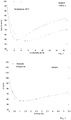
- Figure 3 illustrates an important aspect of the present invention as the measured Q-factor depends on the conductivity of the water in the flow as well as the resonant frequency. At any single frequency the change in the Q-factor due to conductivity is not monotonous. Thus the Q-factor can obtain the same value for two different values for the water conductivity. But because of the frequency dependence, measuring the Q-factor at two different frequencies will provide a unique measure of the conductivity of the water in the flow.
- Figure 6 illustrates a comparison between two sets of measurements at two resonance frequencies, 500 MHz and 1000 MHz, with salinities of 0, 1, 5, 10, and 15%, counterclockwise starting a 0%, with watercut 2.5% and 5%.
- the change in Q-factor ⁇ Q at 500 MHz and 1000 MHz between the salinities at two watercut ratios defined different curves and thus by knowing the watercut the salinity may also be found.
- the resonant frequency is affected primarily by the watercut or the WVF, but also as a secondary effect by the salinity. Therefore the salinity or the water conductivity is normally given as a manual input through the user interface in watercut or wet gas meters. If the salinity varies over time, which may happen of a variety of reasons, this will affect the accuracy of the readings. Therefore the ability of the meter to measure the salinity as according to the invention will provide a higher accuracy for the watercut or WVF measurement, and especially to maintain the accuracy over time as the salinity changes. And in addition the salinity is important information as such, and therefore an important output parameter as an extra feature of a watercut or wet gas meter.
- the salinity is an indicator of the production of formation water, which is very important information.
- the retrieval of the salinity and the watercut or WVF Each point in the diagram defines a unique combination of watercut or WVF and conductivity. Therefore prior knowledge of the watercut/WVF is not needed to be able to calculate the conductivity. I.e. one will get both from just the Q-factors.
- the resonant frequency will give a more accurate measure of the watercut/WVF.
- the system according to the invention thus relates to a system for measuring conductivity of the water in fluid flows constituted by oil- or gas-continuous mixtures
- a measuring section including means for emitting electromagnetic signals into a pipe containing said flow within at least one chosen frequency range and means for detecting resonance frequencies within said range.
- the measurement is preferably performed by transmitting a frequency sweep into said pipe and measuring the response to provide information about the resonant frequencies and Q-factors.
- Q-factors according to the present invention may also be understood as including the phase response or peak width without directly calculating the Q-factor value.
- the measuring section comprising features for providing at least two resonant frequencies within said at least one frequency range.
- the system also comprising means for based on at least one of the resonance frequencies, a first Q-factor related to the corresponding resonance peak as well as the Q-factor of a second resonance peak, calculating the conductivity of the water of said flow. The calculations thus being based on minimum one measured resonant frequency and two Q-factors.
- the second resonant frequency may optionally also be determined in order to increase the accuracy.
- the measuring section may preferably comprise an insert or other structure in said flow, which results in a resonant frequency which is lower than the cut-off frequency of the pipe or the cut-off frequency in each end of the measuring section, and thus may allow the structure to be relatively open and little intrusive, and still have a high Q-factor.
- a high Q-factor i.e. low total losses
- the insert may be chosen from a wide range of structures such as a conical insert, fin or any structure providing a defined reflection at two locations (such as two metal grids, or other open- or short-circuited ends of a transmission line structure, like the open end and the end shorted by the legs of the conical insert, or the ends of the fin) so as to obtain a resonance between the reflecting locations.
- Two different resonant frequencies may be obtained by two structures having two different resonant frequencies or preferably by providing an insert giving two resonant frequencies within the emitted frequency range. More than two resonanct frequencies and Q-factors may also be utilized.
- the measurement section may also preferably comprise a plain pipe, as discussed above, in which case it is a cut-off resonator.
- This structure is preferable if non-intrusiveness is the highest priority.
- the opposite sides of the pipe form the reflecting points as the propagation at the cut-off frequency is purely radial. Because the invention requires a minimum of two resonances, a cut-off resonator must be combined with either another cut-off resonator, where the pipe diameter is different (as in the venturi throat), a resonator based on another structure (such as an insert), or another wave mode may be used.
- a waveguide can support a number of different wave modes, which all have different cut-off frequencies, it is possible to use two different cut-off resonances in the same pipe. Care must then be taken in the choice of modes and the choice of type and location of coupling devices so that power will not leak from the mode with the higher cut-off frequency to the one with the lower cut-off frequency. It may be preferable to use separate coupling devices for the minimum two modes. They can then be mounted at locations, where the other mode has zero electric field, and therefore only couple to the desired mode.
- the calculation comprises a comparison between said measured values and an at least partially empirical model based on a known measuring situation stored in the system.
- the calculation of resonant frequency and Q-factors is performed in a neural network model, thus relating to a model found and stored by the computer as a result of previous measurements and/or a predetermined model.
- the resonant frequencies and Q-factors would normally be calculated first in the "normal" way from the measured frequency response/sweep. Then a neural network or multivariate analysis-based model could be used for finding the conductivity of the water. It may also be contemplated to directly input the raw measurements, without calculating the resonant frequencies and Q-factors at all.
- the detection of the resonance may be performed by different types of measurements, as for example discussed in chapter 3 in the Nyfors report or other of the referred documents, and will not be discussed in detail here.
- the determination of each Q-factor is also per se known, e.g. from the abovementioned publications.
Landscapes
- Physics & Mathematics (AREA)
- Chemical & Material Sciences (AREA)
- General Physics & Mathematics (AREA)
- Life Sciences & Earth Sciences (AREA)
- Health & Medical Sciences (AREA)
- Electromagnetism (AREA)
- Pathology (AREA)
- Immunology (AREA)
- Engineering & Computer Science (AREA)
- Analytical Chemistry (AREA)
- Biochemistry (AREA)
- General Health & Medical Sciences (AREA)
- Fluid Mechanics (AREA)
- Oil, Petroleum & Natural Gas (AREA)
- Medicinal Chemistry (AREA)
- Food Science & Technology (AREA)
- General Chemical & Material Sciences (AREA)
- Chemical Kinetics & Catalysis (AREA)
- Investigating Or Analyzing Materials By The Use Of Electric Means (AREA)
Claims (13)
- Système pour mesurer la conductivité de la fraction d'eau dans un écoulement de fluide à phases multiples, le système comprenant une section de mesure incluant un moyen pour émettre des signaux électromagnétiques dans un conduit contenant ledit écoulement dans au moins une plage de fréquence choisie et un moyen pour détecter des résonances dans ladite plage,
caractérisé en ce que la section de mesure comprend des éléments pour fournir au moins deux résonances dans ladite au moins une plage de fréquence, le système comprenant également un moyen pour calculer la conductivité de l'eau dans ledit écoulement sur la base d'au moins une première fréquence de résonance et d'un premier facteur Q lié au pic de résonance correspondant ainsi que du facteur Q d'un deuxième pic de résonance. - Système selon la revendication 1, dans lequel la section de mesure comprend un élément inséré dans ledit écoulement, par exemple un cône ou une ailette définissant un résonateur dans le conduit.
- Système selon la revendication 1, dans lequel ledit calcul comprend une comparaison entre lesdites valeurs mesurées et un modèle au moins partiellement empirique basé sur une situation de mesure connue.
- Système selon la revendication 1, dans lequel ladite deuxième fréquence de résonance est détectée.
- Système selon la revendication 1, dans lequel ledit calcul de conductivité est effectué dans un modèle de réseau neuronal.
- Système selon la revendication 1, dans lequel le calcul de la fréquence de résonance et de facteurs Q est effectué dans un modèle de réseau neuronal.
- Système selon la revendication 1, dans lequel au moins l'une desdites résonances est à la fréquence de coupure la plus basse dudit conduit.
- Système selon la revendication 7, comprenant deux sections de mesure, chacune incluant un moyen pour émettre des signaux électromagnétiques dans un conduit contenant ledit écoulement dans au moins une plage de fréquence choisie et un moyen pour détecter des fréquences de résonance dans ladite plage, les deux sections de mesure ayant des fréquences de résonance différentes, les premier et deuxième facteurs Q étant trouvés dans lesdites première et deuxième unités de mesure.
- Système selon la revendication 8, dans lequel les deux résonateurs fournissent une résonance à la fréquence de coupure, par exemple l'un dans le conduit et l'autre dans une restriction comme le col de Venturi, ou un agrandissement.
- Système selon la revendication 1, incluant un moyen pour mesurer la réponse de phase dans une plage autour de chaque fréquence de résonance, dans lequel les facteurs Q sont calculés à partir de la pente mesurée de la réponse de phase.
- Système selon la revendication 1, dans lequel l'au moins un desdits résonateurs est constitué par des grilles d'extrémité, qui fournissent des extrémités raccourcies aux ondes électromagnétiques, mais permettent à l'écoulement de passer.
- Système selon la revendication 1, dans lequel l'au moins un desdits résonateurs se situe sous la fréquence de coupure la plus basse sur le conduit.
- Système selon la revendication 1, dans lequel au moins deux résonances sont à des fréquences de coupure de modes d'ondes différents dans le même conduit.
Applications Claiming Priority (2)
| Application Number | Priority Date | Filing Date | Title |
|---|---|---|---|
| NO20130180A NO347105B1 (no) | 2013-02-05 | 2013-02-05 | Konduktivitetsmåling |
| PCT/EP2014/052036 WO2014122093A1 (fr) | 2013-02-05 | 2014-02-03 | Mesures de conductivité |
Publications (2)
| Publication Number | Publication Date |
|---|---|
| EP2954319A1 EP2954319A1 (fr) | 2015-12-16 |
| EP2954319B1 true EP2954319B1 (fr) | 2017-10-04 |
Family
ID=50033558
Family Applications (1)
| Application Number | Title | Priority Date | Filing Date |
|---|---|---|---|
| EP14702584.5A Active EP2954319B1 (fr) | 2013-02-05 | 2014-02-03 | Mesures de conductivité |
Country Status (6)
| Country | Link |
|---|---|
| US (1) | US10359372B2 (fr) |
| EP (1) | EP2954319B1 (fr) |
| CN (1) | CN105008916B (fr) |
| DK (1) | DK2954319T3 (fr) |
| NO (1) | NO347105B1 (fr) |
| WO (1) | WO2014122093A1 (fr) |
Cited By (1)
| Publication number | Priority date | Publication date | Assignee | Title |
|---|---|---|---|---|
| WO2021191177A1 (fr) | 2020-03-25 | 2021-09-30 | Roxar Flow Measurement As | Section de tuyau élargie pour mesures d'écoulement à base de micro-ondes |
Families Citing this family (10)
| Publication number | Priority date | Publication date | Assignee | Title |
|---|---|---|---|---|
| NO20140689A1 (no) * | 2014-06-03 | 2015-12-04 | Roxar Flow Measurement As | Cutoff regulator |
| NO342831B1 (en) * | 2015-04-23 | 2018-08-13 | Roxar Flow Measurement As | System for measuring characteristics of a fluid flow |
| NO338884B1 (en) * | 2015-06-15 | 2016-10-31 | Roxar Flow Measurement As | Fluid measuring system |
| NO349134B1 (en) | 2017-03-28 | 2025-10-13 | Roxar Flow Measurement As | Flow measuring system |
| US11022597B2 (en) * | 2018-05-21 | 2021-06-01 | Saudi Arabian Oil Company | Fluid sensing system using planar resonators |
| US11099168B2 (en) | 2018-07-23 | 2021-08-24 | Schlumberger Technology Corporation | Methods and apparatus for water detection in multiphase flows |
| CN110779585B (zh) * | 2018-07-26 | 2024-10-29 | 斯伦贝谢技术有限公司 | 多相流量计及相关方法 |
| JP7215313B2 (ja) * | 2019-04-23 | 2023-01-31 | 富士通株式会社 | 比導電率の測定方法、比導電率の演算プログラム及び比導電率の測定システム |
| CN110441717B (zh) * | 2019-06-28 | 2022-04-05 | 广东志成冠军集团有限公司 | 超磁致伸缩换能器动态电磁损耗的测量方法及系统 |
| US12546637B2 (en) | 2023-09-27 | 2026-02-10 | Saudi Arabian Oil Company | Fluid conductivity sensor based on magneto-inductive power transfer dissipation |
Family Cites Families (25)
| Publication number | Priority date | Publication date | Assignee | Title |
|---|---|---|---|---|
| US4745617A (en) * | 1987-03-27 | 1988-05-17 | Hughes Aircraft Company | Ideal distributed Bragg reflectors and resonators |
| US5608665A (en) * | 1995-10-03 | 1997-03-04 | Wyszynski; Adam S. | Self-tuned, continuous-time active filter |
| US6182504B1 (en) | 1997-11-03 | 2001-02-06 | Roxar, Inc. | Emulsion composition monitor |
| NO308922B1 (no) | 1998-06-03 | 2000-11-13 | Multi Fluid Asa | MÕler, særlig for kontinuerlig mÕling av blandingsforholdet mellom to fluider som strømmer i rør, f.eks. vanninnhold i olje; samt fremgangsmÕte for gjennomføring av slik mÕling |
| US6351409B1 (en) * | 2001-01-04 | 2002-02-26 | Motorola, Inc. | MRAM write apparatus and method |
| GB2376074B (en) * | 2001-05-30 | 2004-02-04 | Schlumberger Holdings | Methods and apparatus for estimating on-line water conductivity of multiphase mixtures |
| PL348996A1 (en) | 2001-08-01 | 2003-02-10 | B Sp Z Oo Ab | Method of and apparatus for monitoring the parameters of aqueous phase in water-and-oil emulsions |
| NO315584B1 (no) * | 2001-10-19 | 2003-09-22 | Roxar Flow Measurement As | Kompakt stromningsmaler |
| US6696684B2 (en) * | 2001-12-28 | 2004-02-24 | Schlumberger Technology Corporation | Formation evaluation through azimuthal tool-path identification |
| NO323247B1 (no) | 2003-12-09 | 2007-02-12 | Multi Phase Meters As | Fremgangsmåte og strømningsmåler for å bestemme strømningsratene til en flerfaseblanding |
| ATE443855T1 (de) * | 2004-07-13 | 2009-10-15 | Schlumberger Technology Bv | Detektor zum unterscheiden von phasen in einer multi-phasen flüssigkeitsmischung |
| NO323244B1 (no) | 2004-08-20 | 2007-02-12 | Multi Phase Meters As | Metode og utstyr for måling av sammensetning og salinitet i en multifasestrømning |
| ATE366412T1 (de) * | 2004-10-07 | 2007-07-15 | Schlumberger Technology Bv | Probenentnahmegerät |
| US7524423B2 (en) * | 2004-12-10 | 2009-04-28 | Clearwater Systems Corporation | System and method of generating a ringing magnetic pulse for the treatment of flowing liquids |
| NO323451B1 (no) | 2005-08-11 | 2007-05-14 | Multi Phase Meters As | Fremgangsmåte og apparat for å bestemme konduktivitet og volumtraksjon av vann i en flerkomponentblanding |
| GB2432425B (en) * | 2005-11-22 | 2008-01-09 | Schlumberger Holdings | Isokinetic sampling method and system for multiphase flow from subterranean wells |
| NO326977B1 (no) * | 2006-05-02 | 2009-03-30 | Multi Phase Meters As | Fremgangsmåte og innretning for måling av konduktiviteten av vannfraksjonen i en våtgass |
| DE102006052637B4 (de) * | 2006-11-08 | 2009-02-26 | Technische Universität Darmstadt | Vorrichtung und Verfahren zur Bestimmung zumindest eines Parameters eines Mediums |
| NO328801B1 (no) | 2007-01-12 | 2010-05-18 | Roxar Flow Measurement As | System og fremgangsmate for bestemmelse av egenskaper under transport av hydrokarbon-fluider i en rorledning |
| US8027794B2 (en) * | 2008-02-11 | 2011-09-27 | Schlumberger Technology Corporaton | System and method for measuring properties of liquid in multiphase mixtures |
| EP2291630A1 (fr) * | 2008-05-27 | 2011-03-09 | BAE Systems PLC | Détecteurs de détériorations et dispositifs de traitement correspondants |
| US20110095772A1 (en) * | 2008-05-27 | 2011-04-28 | Bae Systems Plc | Damage sensors and processing arrangements therefor |
| NO331270B1 (no) | 2009-04-06 | 2011-11-14 | Roxar Flow Measurement As | Fremgangsmate for a overvake et legeme innsatt i en kanal, samt system som inkluderer en innsats for elektromagnetiske resonansmalinger |
| US9856157B2 (en) * | 2013-01-31 | 2018-01-02 | Reverse Ionizer Systems, Llc | Devices, systems and methods for treatment of water with electromagnetic fields |
| US9851399B2 (en) * | 2013-02-07 | 2017-12-26 | Giesecke+Devrient Mobile Security Gmbh | Method and apparatus for checking a circuit |
-
2013
- 2013-02-05 NO NO20130180A patent/NO347105B1/no unknown
-
2014
- 2014-02-03 WO PCT/EP2014/052036 patent/WO2014122093A1/fr not_active Ceased
- 2014-02-03 EP EP14702584.5A patent/EP2954319B1/fr active Active
- 2014-02-03 DK DK14702584.5T patent/DK2954319T3/en active
- 2014-02-03 CN CN201480005254.0A patent/CN105008916B/zh active Active
- 2014-02-03 US US14/654,773 patent/US10359372B2/en active Active
Non-Patent Citations (1)
| Title |
|---|
| None * |
Cited By (2)
| Publication number | Priority date | Publication date | Assignee | Title |
|---|---|---|---|---|
| WO2021191177A1 (fr) | 2020-03-25 | 2021-09-30 | Roxar Flow Measurement As | Section de tuyau élargie pour mesures d'écoulement à base de micro-ondes |
| US12253395B2 (en) | 2020-03-25 | 2025-03-18 | Roxar Flow Measurement As | Enlarged pipe section for microwave-based flow measurements |
Also Published As
| Publication number | Publication date |
|---|---|
| NO347105B1 (no) | 2023-05-15 |
| CN105008916A (zh) | 2015-10-28 |
| EP2954319A1 (fr) | 2015-12-16 |
| NO20130180A1 (no) | 2014-08-06 |
| DK2954319T3 (en) | 2018-01-08 |
| US10359372B2 (en) | 2019-07-23 |
| US20150346117A1 (en) | 2015-12-03 |
| CN105008916B (zh) | 2017-10-31 |
| WO2014122093A1 (fr) | 2014-08-14 |
Similar Documents
| Publication | Publication Date | Title |
|---|---|---|
| EP2954319B1 (fr) | Mesures de conductivité | |
| Sharma et al. | A microwave cavity resonator sensor for water-in-oil measurements | |
| JP3086689B2 (ja) | インピーダンス測定を用いた組成のモニタ装置及びモニタ方法 | |
| EP2845000B1 (fr) | Appareil de mesure multiphasique | |
| CA2572955C (fr) | Procede et appareil pour mesurer la composition et la salinite de l'eau d'un melange multiphase contenant de l'eau | |
| RU2499229C2 (ru) | Способ и устройство для определения состава и расхода влажного газа | |
| CA2617186C (fr) | Procede et dispositif pour mesurer la conductivite de l'eau et la fraction de volume d'eau d'un melange multiphase contenant de l'eau | |
| NO328801B1 (no) | System og fremgangsmate for bestemmelse av egenskaper under transport av hydrokarbon-fluider i en rorledning | |
| NO326977B1 (no) | Fremgangsmåte og innretning for måling av konduktiviteten av vannfraksjonen i en våtgass | |
| RU2365903C1 (ru) | Способ измерения влагосодержания и солесодержания нефти | |
| EP3308160B1 (fr) | Système de mesure de fluide | |
| RU2199731C1 (ru) | Устройство для определения влажности нефтепродуктов в трубопроводе | |
| EP4127611B1 (fr) | Section de tuyau élargie pour mesures d'écoulement à base de micro-ondes | |
| GB2479741A (en) | Permittivity measurements of pipe deposits | |
| RU102109U1 (ru) | Расходомер | |
| Gryzlov et al. | Challenges with salinity measurements in multiphase flow metering | |
| RU2404421C1 (ru) | Способ определения плотности диэлектрических жидких веществ | |
| Alvarez | Waveguide Mode Propagation in a Transversal Pipe System | |
| Sheikh et al. | A microwave technique for detecting water deposits in an air flow pipelines | |
| Sharma et al. | A non-intrusive sensor for water-in-oil monitoring in multiphase flow |
Legal Events
| Date | Code | Title | Description |
|---|---|---|---|
| PUAI | Public reference made under article 153(3) epc to a published international application that has entered the european phase |
Free format text: ORIGINAL CODE: 0009012 |
|
| 17P | Request for examination filed |
Effective date: 20150602 |
|
| AK | Designated contracting states |
Kind code of ref document: A1 Designated state(s): AL AT BE BG CH CY CZ DE DK EE ES FI FR GB GR HR HU IE IS IT LI LT LU LV MC MK MT NL NO PL PT RO RS SE SI SK SM TR |
|
| AX | Request for extension of the european patent |
Extension state: BA ME |
|
| DAX | Request for extension of the european patent (deleted) | ||
| GRAP | Despatch of communication of intention to grant a patent |
Free format text: ORIGINAL CODE: EPIDOSNIGR1 |
|
| INTG | Intention to grant announced |
Effective date: 20170426 |
|
| GRAS | Grant fee paid |
Free format text: ORIGINAL CODE: EPIDOSNIGR3 |
|
| GRAA | (expected) grant |
Free format text: ORIGINAL CODE: 0009210 |
|
| AK | Designated contracting states |
Kind code of ref document: B1 Designated state(s): AL AT BE BG CH CY CZ DE DK EE ES FI FR GB GR HR HU IE IS IT LI LT LU LV MC MK MT NL NO PL PT RO RS SE SI SK SM TR |
|
| REG | Reference to a national code |
Ref country code: GB Ref legal event code: FG4D |
|
| REG | Reference to a national code |
Ref country code: CH Ref legal event code: EP |
|
| REG | Reference to a national code |
Ref country code: AT Ref legal event code: REF Ref document number: 934510 Country of ref document: AT Kind code of ref document: T Effective date: 20171015 |
|
| REG | Reference to a national code |
Ref country code: IE Ref legal event code: FG4D |
|
| REG | Reference to a national code |
Ref country code: DE Ref legal event code: R096 Ref document number: 602014015331 Country of ref document: DE |
|
| REG | Reference to a national code |
Ref country code: DK Ref legal event code: T3 Effective date: 20180105 |
|
| REG | Reference to a national code |
Ref country code: NL Ref legal event code: FP |
|
| REG | Reference to a national code |
Ref country code: LT Ref legal event code: MG4D |
|
| REG | Reference to a national code |
Ref country code: FR Ref legal event code: PLFP Year of fee payment: 5 |
|
| REG | Reference to a national code |
Ref country code: AT Ref legal event code: MK05 Ref document number: 934510 Country of ref document: AT Kind code of ref document: T Effective date: 20171004 |
|
| PG25 | Lapsed in a contracting state [announced via postgrant information from national office to epo] |
Ref country code: ES Free format text: LAPSE BECAUSE OF FAILURE TO SUBMIT A TRANSLATION OF THE DESCRIPTION OR TO PAY THE FEE WITHIN THE PRESCRIBED TIME-LIMIT Effective date: 20171004 Ref country code: SE Free format text: LAPSE BECAUSE OF FAILURE TO SUBMIT A TRANSLATION OF THE DESCRIPTION OR TO PAY THE FEE WITHIN THE PRESCRIBED TIME-LIMIT Effective date: 20171004 Ref country code: LT Free format text: LAPSE BECAUSE OF FAILURE TO SUBMIT A TRANSLATION OF THE DESCRIPTION OR TO PAY THE FEE WITHIN THE PRESCRIBED TIME-LIMIT Effective date: 20171004 Ref country code: NO Free format text: LAPSE BECAUSE OF FAILURE TO SUBMIT A TRANSLATION OF THE DESCRIPTION OR TO PAY THE FEE WITHIN THE PRESCRIBED TIME-LIMIT Effective date: 20180104 Ref country code: FI Free format text: LAPSE BECAUSE OF FAILURE TO SUBMIT A TRANSLATION OF THE DESCRIPTION OR TO PAY THE FEE WITHIN THE PRESCRIBED TIME-LIMIT Effective date: 20171004 |
|
| PG25 | Lapsed in a contracting state [announced via postgrant information from national office to epo] |
Ref country code: BG Free format text: LAPSE BECAUSE OF FAILURE TO SUBMIT A TRANSLATION OF THE DESCRIPTION OR TO PAY THE FEE WITHIN THE PRESCRIBED TIME-LIMIT Effective date: 20180104 Ref country code: AT Free format text: LAPSE BECAUSE OF FAILURE TO SUBMIT A TRANSLATION OF THE DESCRIPTION OR TO PAY THE FEE WITHIN THE PRESCRIBED TIME-LIMIT Effective date: 20171004 Ref country code: RS Free format text: LAPSE BECAUSE OF FAILURE TO SUBMIT A TRANSLATION OF THE DESCRIPTION OR TO PAY THE FEE WITHIN THE PRESCRIBED TIME-LIMIT Effective date: 20171004 Ref country code: IS Free format text: LAPSE BECAUSE OF FAILURE TO SUBMIT A TRANSLATION OF THE DESCRIPTION OR TO PAY THE FEE WITHIN THE PRESCRIBED TIME-LIMIT Effective date: 20180204 Ref country code: HR Free format text: LAPSE BECAUSE OF FAILURE TO SUBMIT A TRANSLATION OF THE DESCRIPTION OR TO PAY THE FEE WITHIN THE PRESCRIBED TIME-LIMIT Effective date: 20171004 Ref country code: GR Free format text: LAPSE BECAUSE OF FAILURE TO SUBMIT A TRANSLATION OF THE DESCRIPTION OR TO PAY THE FEE WITHIN THE PRESCRIBED TIME-LIMIT Effective date: 20180105 Ref country code: LV Free format text: LAPSE BECAUSE OF FAILURE TO SUBMIT A TRANSLATION OF THE DESCRIPTION OR TO PAY THE FEE WITHIN THE PRESCRIBED TIME-LIMIT Effective date: 20171004 |
|
| REG | Reference to a national code |
Ref country code: DE Ref legal event code: R097 Ref document number: 602014015331 Country of ref document: DE |
|
| PG25 | Lapsed in a contracting state [announced via postgrant information from national office to epo] |
Ref country code: SK Free format text: LAPSE BECAUSE OF FAILURE TO SUBMIT A TRANSLATION OF THE DESCRIPTION OR TO PAY THE FEE WITHIN THE PRESCRIBED TIME-LIMIT Effective date: 20171004 Ref country code: CZ Free format text: LAPSE BECAUSE OF FAILURE TO SUBMIT A TRANSLATION OF THE DESCRIPTION OR TO PAY THE FEE WITHIN THE PRESCRIBED TIME-LIMIT Effective date: 20171004 Ref country code: EE Free format text: LAPSE BECAUSE OF FAILURE TO SUBMIT A TRANSLATION OF THE DESCRIPTION OR TO PAY THE FEE WITHIN THE PRESCRIBED TIME-LIMIT Effective date: 20171004 |
|
| PLBE | No opposition filed within time limit |
Free format text: ORIGINAL CODE: 0009261 |
|
| STAA | Information on the status of an ep patent application or granted ep patent |
Free format text: STATUS: NO OPPOSITION FILED WITHIN TIME LIMIT |
|
| PG25 | Lapsed in a contracting state [announced via postgrant information from national office to epo] |
Ref country code: PL Free format text: LAPSE BECAUSE OF FAILURE TO SUBMIT A TRANSLATION OF THE DESCRIPTION OR TO PAY THE FEE WITHIN THE PRESCRIBED TIME-LIMIT Effective date: 20171004 Ref country code: RO Free format text: LAPSE BECAUSE OF FAILURE TO SUBMIT A TRANSLATION OF THE DESCRIPTION OR TO PAY THE FEE WITHIN THE PRESCRIBED TIME-LIMIT Effective date: 20171004 Ref country code: SM Free format text: LAPSE BECAUSE OF FAILURE TO SUBMIT A TRANSLATION OF THE DESCRIPTION OR TO PAY THE FEE WITHIN THE PRESCRIBED TIME-LIMIT Effective date: 20171004 |
|
| 26N | No opposition filed |
Effective date: 20180705 |
|
| REG | Reference to a national code |
Ref country code: CH Ref legal event code: PL |
|
| PG25 | Lapsed in a contracting state [announced via postgrant information from national office to epo] |
Ref country code: MC Free format text: LAPSE BECAUSE OF FAILURE TO SUBMIT A TRANSLATION OF THE DESCRIPTION OR TO PAY THE FEE WITHIN THE PRESCRIBED TIME-LIMIT Effective date: 20171004 |
|
| REG | Reference to a national code |
Ref country code: IE Ref legal event code: MM4A |
|
| REG | Reference to a national code |
Ref country code: BE Ref legal event code: MM Effective date: 20180228 |
|
| PG25 | Lapsed in a contracting state [announced via postgrant information from national office to epo] |
Ref country code: LU Free format text: LAPSE BECAUSE OF NON-PAYMENT OF DUE FEES Effective date: 20180203 Ref country code: CH Free format text: LAPSE BECAUSE OF NON-PAYMENT OF DUE FEES Effective date: 20180228 Ref country code: SI Free format text: LAPSE BECAUSE OF FAILURE TO SUBMIT A TRANSLATION OF THE DESCRIPTION OR TO PAY THE FEE WITHIN THE PRESCRIBED TIME-LIMIT Effective date: 20171004 Ref country code: LI Free format text: LAPSE BECAUSE OF NON-PAYMENT OF DUE FEES Effective date: 20180228 |
|
| PG25 | Lapsed in a contracting state [announced via postgrant information from national office to epo] |
Ref country code: IE Free format text: LAPSE BECAUSE OF NON-PAYMENT OF DUE FEES Effective date: 20180203 |
|
| PG25 | Lapsed in a contracting state [announced via postgrant information from national office to epo] |
Ref country code: BE Free format text: LAPSE BECAUSE OF NON-PAYMENT OF DUE FEES Effective date: 20180228 |
|
| PG25 | Lapsed in a contracting state [announced via postgrant information from national office to epo] |
Ref country code: MT Free format text: LAPSE BECAUSE OF NON-PAYMENT OF DUE FEES Effective date: 20180203 |
|
| PG25 | Lapsed in a contracting state [announced via postgrant information from national office to epo] |
Ref country code: TR Free format text: LAPSE BECAUSE OF FAILURE TO SUBMIT A TRANSLATION OF THE DESCRIPTION OR TO PAY THE FEE WITHIN THE PRESCRIBED TIME-LIMIT Effective date: 20171004 |
|
| PGFP | Annual fee paid to national office [announced via postgrant information from national office to epo] |
Ref country code: DE Payment date: 20200227 Year of fee payment: 7 Ref country code: DK Payment date: 20200227 Year of fee payment: 7 |
|
| PG25 | Lapsed in a contracting state [announced via postgrant information from national office to epo] |
Ref country code: PT Free format text: LAPSE BECAUSE OF FAILURE TO SUBMIT A TRANSLATION OF THE DESCRIPTION OR TO PAY THE FEE WITHIN THE PRESCRIBED TIME-LIMIT Effective date: 20171004 |
|
| PG25 | Lapsed in a contracting state [announced via postgrant information from national office to epo] |
Ref country code: CY Free format text: LAPSE BECAUSE OF FAILURE TO SUBMIT A TRANSLATION OF THE DESCRIPTION OR TO PAY THE FEE WITHIN THE PRESCRIBED TIME-LIMIT Effective date: 20171004 Ref country code: HU Free format text: LAPSE BECAUSE OF FAILURE TO SUBMIT A TRANSLATION OF THE DESCRIPTION OR TO PAY THE FEE WITHIN THE PRESCRIBED TIME-LIMIT; INVALID AB INITIO Effective date: 20140203 Ref country code: MK Free format text: LAPSE BECAUSE OF NON-PAYMENT OF DUE FEES Effective date: 20171004 |
|
| PG25 | Lapsed in a contracting state [announced via postgrant information from national office to epo] |
Ref country code: AL Free format text: LAPSE BECAUSE OF FAILURE TO SUBMIT A TRANSLATION OF THE DESCRIPTION OR TO PAY THE FEE WITHIN THE PRESCRIBED TIME-LIMIT Effective date: 20171004 |
|
| REG | Reference to a national code |
Ref country code: DE Ref legal event code: R119 Ref document number: 602014015331 Country of ref document: DE |
|
| REG | Reference to a national code |
Ref country code: DK Ref legal event code: EBP Effective date: 20210228 |
|
| PG25 | Lapsed in a contracting state [announced via postgrant information from national office to epo] |
Ref country code: DE Free format text: LAPSE BECAUSE OF NON-PAYMENT OF DUE FEES Effective date: 20210901 Ref country code: DK Free format text: LAPSE BECAUSE OF NON-PAYMENT OF DUE FEES Effective date: 20210228 |
|
| PGFP | Annual fee paid to national office [announced via postgrant information from national office to epo] |
Ref country code: NL Payment date: 20260121 Year of fee payment: 13 |
|
| PGFP | Annual fee paid to national office [announced via postgrant information from national office to epo] |
Ref country code: GB Payment date: 20260122 Year of fee payment: 13 |
|
| PGFP | Annual fee paid to national office [announced via postgrant information from national office to epo] |
Ref country code: IT Payment date: 20260121 Year of fee payment: 13 |
|
| PGFP | Annual fee paid to national office [announced via postgrant information from national office to epo] |
Ref country code: FR Payment date: 20260121 Year of fee payment: 13 |