EP2955389B1 - Système hydraulique avec récupération d'énergie - Google Patents
Système hydraulique avec récupération d'énergie Download PDFInfo
- Publication number
- EP2955389B1 EP2955389B1 EP14397522.5A EP14397522A EP2955389B1 EP 2955389 B1 EP2955389 B1 EP 2955389B1 EP 14397522 A EP14397522 A EP 14397522A EP 2955389 B1 EP2955389 B1 EP 2955389B1
- Authority
- EP
- European Patent Office
- Prior art keywords
- actuator
- line
- directional control
- control valve
- pressure
- Prior art date
- Legal status (The legal status is an assumption and is not a legal conclusion. Google has not performed a legal analysis and makes no representation as to the accuracy of the status listed.)
- Not-in-force
Links
Images



Classifications
-
- F—MECHANICAL ENGINEERING; LIGHTING; HEATING; WEAPONS; BLASTING
- F15—FLUID-PRESSURE ACTUATORS; HYDRAULICS OR PNEUMATICS IN GENERAL
- F15B—SYSTEMS ACTING BY MEANS OF FLUIDS IN GENERAL; FLUID-PRESSURE ACTUATORS, e.g. SERVOMOTORS; DETAILS OF FLUID-PRESSURE SYSTEMS, NOT OTHERWISE PROVIDED FOR
- F15B21/00—Common features of fluid actuator systems; Fluid-pressure actuator systems or details thereof, not covered by any other group of this subclass
- F15B21/14—Energy-recuperation means
-
- E—FIXED CONSTRUCTIONS
- E02—HYDRAULIC ENGINEERING; FOUNDATIONS; SOIL SHIFTING
- E02F—DREDGING; SOIL-SHIFTING
- E02F9/00—Component parts of dredgers or soil-shifting machines, not restricted to one of the kinds covered by groups E02F3/00 - E02F7/00
- E02F9/20—Drives; Control devices
- E02F9/22—Hydraulic or pneumatic drives
- E02F9/2217—Hydraulic or pneumatic drives with energy recovery arrangements, e.g. using accumulators, flywheels
-
- E—FIXED CONSTRUCTIONS
- E02—HYDRAULIC ENGINEERING; FOUNDATIONS; SOIL SHIFTING
- E02F—DREDGING; SOIL-SHIFTING
- E02F9/00—Component parts of dredgers or soil-shifting machines, not restricted to one of the kinds covered by groups E02F3/00 - E02F7/00
- E02F9/20—Drives; Control devices
- E02F9/22—Hydraulic or pneumatic drives
- E02F9/2221—Control of flow rate; Load sensing arrangements
- E02F9/2225—Control of flow rate; Load sensing arrangements using pressure-compensating valves
- E02F9/2228—Control of flow rate; Load sensing arrangements using pressure-compensating valves including an electronic controller
-
- E—FIXED CONSTRUCTIONS
- E02—HYDRAULIC ENGINEERING; FOUNDATIONS; SOIL SHIFTING
- E02F—DREDGING; SOIL-SHIFTING
- E02F9/00—Component parts of dredgers or soil-shifting machines, not restricted to one of the kinds covered by groups E02F3/00 - E02F7/00
- E02F9/20—Drives; Control devices
- E02F9/22—Hydraulic or pneumatic drives
- E02F9/2221—Control of flow rate; Load sensing arrangements
- E02F9/2232—Control of flow rate; Load sensing arrangements using one or more variable displacement pumps
- E02F9/2235—Control of flow rate; Load sensing arrangements using one or more variable displacement pumps including an electronic controller
-
- E—FIXED CONSTRUCTIONS
- E02—HYDRAULIC ENGINEERING; FOUNDATIONS; SOIL SHIFTING
- E02F—DREDGING; SOIL-SHIFTING
- E02F9/00—Component parts of dredgers or soil-shifting machines, not restricted to one of the kinds covered by groups E02F3/00 - E02F7/00
- E02F9/20—Drives; Control devices
- E02F9/22—Hydraulic or pneumatic drives
- E02F9/2278—Hydraulic circuits
- E02F9/2296—Systems with a variable displacement pump
-
- F—MECHANICAL ENGINEERING; LIGHTING; HEATING; WEAPONS; BLASTING
- F15—FLUID-PRESSURE ACTUATORS; HYDRAULICS OR PNEUMATICS IN GENERAL
- F15B—SYSTEMS ACTING BY MEANS OF FLUIDS IN GENERAL; FLUID-PRESSURE ACTUATORS, e.g. SERVOMOTORS; DETAILS OF FLUID-PRESSURE SYSTEMS, NOT OTHERWISE PROVIDED FOR
- F15B2211/00—Circuits for servomotor systems
- F15B2211/20—Fluid pressure source, e.g. accumulator or variable axial piston pump
- F15B2211/205—Systems with pumps
- F15B2211/2053—Type of pump
- F15B2211/20546—Type of pump variable capacity
-
- F—MECHANICAL ENGINEERING; LIGHTING; HEATING; WEAPONS; BLASTING
- F15—FLUID-PRESSURE ACTUATORS; HYDRAULICS OR PNEUMATICS IN GENERAL
- F15B—SYSTEMS ACTING BY MEANS OF FLUIDS IN GENERAL; FLUID-PRESSURE ACTUATORS, e.g. SERVOMOTORS; DETAILS OF FLUID-PRESSURE SYSTEMS, NOT OTHERWISE PROVIDED FOR
- F15B2211/00—Circuits for servomotor systems
- F15B2211/20—Fluid pressure source, e.g. accumulator or variable axial piston pump
- F15B2211/205—Systems with pumps
- F15B2211/2053—Type of pump
- F15B2211/20569—Type of pump capable of working as pump and motor
-
- F—MECHANICAL ENGINEERING; LIGHTING; HEATING; WEAPONS; BLASTING
- F15—FLUID-PRESSURE ACTUATORS; HYDRAULICS OR PNEUMATICS IN GENERAL
- F15B—SYSTEMS ACTING BY MEANS OF FLUIDS IN GENERAL; FLUID-PRESSURE ACTUATORS, e.g. SERVOMOTORS; DETAILS OF FLUID-PRESSURE SYSTEMS, NOT OTHERWISE PROVIDED FOR
- F15B2211/00—Circuits for servomotor systems
- F15B2211/30—Directional control
- F15B2211/305—Directional control characterised by the type of valves
- F15B2211/30525—Directional control valves, e.g. 4/3-directional control valve
- F15B2211/3053—In combination with a pressure compensating valve
- F15B2211/30535—In combination with a pressure compensating valve the pressure compensating valve is arranged between pressure source and directional control valve
-
- F—MECHANICAL ENGINEERING; LIGHTING; HEATING; WEAPONS; BLASTING
- F15—FLUID-PRESSURE ACTUATORS; HYDRAULICS OR PNEUMATICS IN GENERAL
- F15B—SYSTEMS ACTING BY MEANS OF FLUIDS IN GENERAL; FLUID-PRESSURE ACTUATORS, e.g. SERVOMOTORS; DETAILS OF FLUID-PRESSURE SYSTEMS, NOT OTHERWISE PROVIDED FOR
- F15B2211/00—Circuits for servomotor systems
- F15B2211/30—Directional control
- F15B2211/305—Directional control characterised by the type of valves
- F15B2211/30525—Directional control valves, e.g. 4/3-directional control valve
- F15B2211/3053—In combination with a pressure compensating valve
- F15B2211/3055—In combination with a pressure compensating valve the pressure compensating valve is arranged between directional control valve and return line
-
- F—MECHANICAL ENGINEERING; LIGHTING; HEATING; WEAPONS; BLASTING
- F15—FLUID-PRESSURE ACTUATORS; HYDRAULICS OR PNEUMATICS IN GENERAL
- F15B—SYSTEMS ACTING BY MEANS OF FLUIDS IN GENERAL; FLUID-PRESSURE ACTUATORS, e.g. SERVOMOTORS; DETAILS OF FLUID-PRESSURE SYSTEMS, NOT OTHERWISE PROVIDED FOR
- F15B2211/00—Circuits for servomotor systems
- F15B2211/30—Directional control
- F15B2211/305—Directional control characterised by the type of valves
- F15B2211/3056—Assemblies of multiple valves
- F15B2211/30565—Assemblies of multiple valves having multiple valves for a single output member, e.g. for creating higher valve function by use of multiple valves like two 2/2-valves replacing a 5/3-valve
- F15B2211/3058—Assemblies of multiple valves having multiple valves for a single output member, e.g. for creating higher valve function by use of multiple valves like two 2/2-valves replacing a 5/3-valve having additional valves for interconnecting the fluid chambers of a double-acting actuator, e.g. for regeneration mode or for floating mode
-
- F—MECHANICAL ENGINEERING; LIGHTING; HEATING; WEAPONS; BLASTING
- F15—FLUID-PRESSURE ACTUATORS; HYDRAULICS OR PNEUMATICS IN GENERAL
- F15B—SYSTEMS ACTING BY MEANS OF FLUIDS IN GENERAL; FLUID-PRESSURE ACTUATORS, e.g. SERVOMOTORS; DETAILS OF FLUID-PRESSURE SYSTEMS, NOT OTHERWISE PROVIDED FOR
- F15B2211/00—Circuits for servomotor systems
- F15B2211/40—Flow control
- F15B2211/405—Flow control characterised by the type of flow control means or valve
- F15B2211/40553—Flow control characterised by the type of flow control means or valve with pressure compensating valves
- F15B2211/40569—Flow control characterised by the type of flow control means or valve with pressure compensating valves the pressure compensating valve arranged downstream of the flow control means
-
- F—MECHANICAL ENGINEERING; LIGHTING; HEATING; WEAPONS; BLASTING
- F15—FLUID-PRESSURE ACTUATORS; HYDRAULICS OR PNEUMATICS IN GENERAL
- F15B—SYSTEMS ACTING BY MEANS OF FLUIDS IN GENERAL; FLUID-PRESSURE ACTUATORS, e.g. SERVOMOTORS; DETAILS OF FLUID-PRESSURE SYSTEMS, NOT OTHERWISE PROVIDED FOR
- F15B2211/00—Circuits for servomotor systems
- F15B2211/40—Flow control
- F15B2211/415—Flow control characterised by the connections of the flow control means in the circuit
-
- F—MECHANICAL ENGINEERING; LIGHTING; HEATING; WEAPONS; BLASTING
- F15—FLUID-PRESSURE ACTUATORS; HYDRAULICS OR PNEUMATICS IN GENERAL
- F15B—SYSTEMS ACTING BY MEANS OF FLUIDS IN GENERAL; FLUID-PRESSURE ACTUATORS, e.g. SERVOMOTORS; DETAILS OF FLUID-PRESSURE SYSTEMS, NOT OTHERWISE PROVIDED FOR
- F15B2211/00—Circuits for servomotor systems
- F15B2211/40—Flow control
- F15B2211/415—Flow control characterised by the connections of the flow control means in the circuit
- F15B2211/41509—Flow control characterised by the connections of the flow control means in the circuit being connected to a pressure source and a directional control valve
-
- F—MECHANICAL ENGINEERING; LIGHTING; HEATING; WEAPONS; BLASTING
- F15—FLUID-PRESSURE ACTUATORS; HYDRAULICS OR PNEUMATICS IN GENERAL
- F15B—SYSTEMS ACTING BY MEANS OF FLUIDS IN GENERAL; FLUID-PRESSURE ACTUATORS, e.g. SERVOMOTORS; DETAILS OF FLUID-PRESSURE SYSTEMS, NOT OTHERWISE PROVIDED FOR
- F15B2211/00—Circuits for servomotor systems
- F15B2211/40—Flow control
- F15B2211/465—Flow control with pressure compensation
-
- F—MECHANICAL ENGINEERING; LIGHTING; HEATING; WEAPONS; BLASTING
- F15—FLUID-PRESSURE ACTUATORS; HYDRAULICS OR PNEUMATICS IN GENERAL
- F15B—SYSTEMS ACTING BY MEANS OF FLUIDS IN GENERAL; FLUID-PRESSURE ACTUATORS, e.g. SERVOMOTORS; DETAILS OF FLUID-PRESSURE SYSTEMS, NOT OTHERWISE PROVIDED FOR
- F15B2211/00—Circuits for servomotor systems
- F15B2211/50—Pressure control
- F15B2211/505—Pressure control characterised by the type of pressure control means
- F15B2211/50563—Pressure control characterised by the type of pressure control means the pressure control means controlling a differential pressure
-
- F—MECHANICAL ENGINEERING; LIGHTING; HEATING; WEAPONS; BLASTING
- F15—FLUID-PRESSURE ACTUATORS; HYDRAULICS OR PNEUMATICS IN GENERAL
- F15B—SYSTEMS ACTING BY MEANS OF FLUIDS IN GENERAL; FLUID-PRESSURE ACTUATORS, e.g. SERVOMOTORS; DETAILS OF FLUID-PRESSURE SYSTEMS, NOT OTHERWISE PROVIDED FOR
- F15B2211/00—Circuits for servomotor systems
- F15B2211/50—Pressure control
- F15B2211/515—Pressure control characterised by the connections of the pressure control means in the circuit
-
- F—MECHANICAL ENGINEERING; LIGHTING; HEATING; WEAPONS; BLASTING
- F15—FLUID-PRESSURE ACTUATORS; HYDRAULICS OR PNEUMATICS IN GENERAL
- F15B—SYSTEMS ACTING BY MEANS OF FLUIDS IN GENERAL; FLUID-PRESSURE ACTUATORS, e.g. SERVOMOTORS; DETAILS OF FLUID-PRESSURE SYSTEMS, NOT OTHERWISE PROVIDED FOR
- F15B2211/00—Circuits for servomotor systems
- F15B2211/50—Pressure control
- F15B2211/515—Pressure control characterised by the connections of the pressure control means in the circuit
- F15B2211/5151—Pressure control characterised by the connections of the pressure control means in the circuit being connected to a pressure source and a directional control valve
-
- F—MECHANICAL ENGINEERING; LIGHTING; HEATING; WEAPONS; BLASTING
- F15—FLUID-PRESSURE ACTUATORS; HYDRAULICS OR PNEUMATICS IN GENERAL
- F15B—SYSTEMS ACTING BY MEANS OF FLUIDS IN GENERAL; FLUID-PRESSURE ACTUATORS, e.g. SERVOMOTORS; DETAILS OF FLUID-PRESSURE SYSTEMS, NOT OTHERWISE PROVIDED FOR
- F15B2211/00—Circuits for servomotor systems
- F15B2211/70—Output members, e.g. hydraulic motors or cylinders or control therefor
- F15B2211/705—Output members, e.g. hydraulic motors or cylinders or control therefor characterised by the type of output members or actuators
- F15B2211/7051—Linear output members
- F15B2211/7052—Single-acting output members
-
- F—MECHANICAL ENGINEERING; LIGHTING; HEATING; WEAPONS; BLASTING
- F15—FLUID-PRESSURE ACTUATORS; HYDRAULICS OR PNEUMATICS IN GENERAL
- F15B—SYSTEMS ACTING BY MEANS OF FLUIDS IN GENERAL; FLUID-PRESSURE ACTUATORS, e.g. SERVOMOTORS; DETAILS OF FLUID-PRESSURE SYSTEMS, NOT OTHERWISE PROVIDED FOR
- F15B2211/00—Circuits for servomotor systems
- F15B2211/70—Output members, e.g. hydraulic motors or cylinders or control therefor
- F15B2211/705—Output members, e.g. hydraulic motors or cylinders or control therefor characterised by the type of output members or actuators
- F15B2211/7051—Linear output members
- F15B2211/7053—Double-acting output members
-
- F—MECHANICAL ENGINEERING; LIGHTING; HEATING; WEAPONS; BLASTING
- F15—FLUID-PRESSURE ACTUATORS; HYDRAULICS OR PNEUMATICS IN GENERAL
- F15B—SYSTEMS ACTING BY MEANS OF FLUIDS IN GENERAL; FLUID-PRESSURE ACTUATORS, e.g. SERVOMOTORS; DETAILS OF FLUID-PRESSURE SYSTEMS, NOT OTHERWISE PROVIDED FOR
- F15B2211/00—Circuits for servomotor systems
- F15B2211/70—Output members, e.g. hydraulic motors or cylinders or control therefor
- F15B2211/705—Output members, e.g. hydraulic motors or cylinders or control therefor characterised by the type of output members or actuators
- F15B2211/7058—Rotary output members
-
- F—MECHANICAL ENGINEERING; LIGHTING; HEATING; WEAPONS; BLASTING
- F15—FLUID-PRESSURE ACTUATORS; HYDRAULICS OR PNEUMATICS IN GENERAL
- F15B—SYSTEMS ACTING BY MEANS OF FLUIDS IN GENERAL; FLUID-PRESSURE ACTUATORS, e.g. SERVOMOTORS; DETAILS OF FLUID-PRESSURE SYSTEMS, NOT OTHERWISE PROVIDED FOR
- F15B2211/00—Circuits for servomotor systems
- F15B2211/70—Output members, e.g. hydraulic motors or cylinders or control therefor
- F15B2211/71—Multiple output members, e.g. multiple hydraulic motors or cylinders
- F15B2211/7114—Multiple output members, e.g. multiple hydraulic motors or cylinders with direct connection between the chambers of different actuators
- F15B2211/7121—Multiple output members, e.g. multiple hydraulic motors or cylinders with direct connection between the chambers of different actuators the chambers being connected in series
-
- F—MECHANICAL ENGINEERING; LIGHTING; HEATING; WEAPONS; BLASTING
- F15—FLUID-PRESSURE ACTUATORS; HYDRAULICS OR PNEUMATICS IN GENERAL
- F15B—SYSTEMS ACTING BY MEANS OF FLUIDS IN GENERAL; FLUID-PRESSURE ACTUATORS, e.g. SERVOMOTORS; DETAILS OF FLUID-PRESSURE SYSTEMS, NOT OTHERWISE PROVIDED FOR
- F15B2211/00—Circuits for servomotor systems
- F15B2211/70—Output members, e.g. hydraulic motors or cylinders or control therefor
- F15B2211/71—Multiple output members, e.g. multiple hydraulic motors or cylinders
- F15B2211/7135—Combinations of output members of different types, e.g. single-acting cylinders with rotary motors
-
- F—MECHANICAL ENGINEERING; LIGHTING; HEATING; WEAPONS; BLASTING
- F15—FLUID-PRESSURE ACTUATORS; HYDRAULICS OR PNEUMATICS IN GENERAL
- F15B—SYSTEMS ACTING BY MEANS OF FLUIDS IN GENERAL; FLUID-PRESSURE ACTUATORS, e.g. SERVOMOTORS; DETAILS OF FLUID-PRESSURE SYSTEMS, NOT OTHERWISE PROVIDED FOR
- F15B2211/00—Circuits for servomotor systems
- F15B2211/80—Other types of control related to particular problems or conditions
- F15B2211/88—Control measures for saving energy
Definitions
- the presented solution relates to a hydraulic system for recovering hydraulic energy.
- Construction, forestry and agricultural equipment and mobile working machines have movable members which are operated by an actuator, such as a motor or a hydraulic cylinder with a moving piston rod.
- the movable members are e.g. boom parts rotatably connected to each other in a boom crane.
- the boom cranes are used for handling loads or controlling a tool connected to an end of a boom part of the boom crane.
- Pressurized hydraulic fluid from a pump to the actuator can be controlled by a set of valves.
- a control lever is operated to send signals to the valves for the cylinder associated with that movable member.
- the valve is opened to supply pressurized fluid to a chamber of the cylinder on one side of the piston and to allow fluid forced from the opposite chamber of the cylinder to drain to a reservoir or a tank.
- Hydraulic systems waste hydraulic energy (i.e. potential energy) by lowering loads using pressurized fluid, valves generating pressure losses and pumps generating hydraulic energy and fluid flow while lowering the loads.
- potential energy produced in an actuator of a hydraulic system by the loads may be used to operate another simultaneous actuator function.
- a hydraulic system of this type is known from the document DE 102006060351 .
- a solution is presented relating to recovering potential energy produced in a hydraulic system by loads, e.g. when a load acts on an actuator.
- the recovered energy in the form of pressurized fluid is used to drive another simultaneous actuator function or several simultaneous actuator functions.
- the actuator function is driven with the help of the recovered energy solely or simultaneously with the hydraulic energy generated by a pressure source of the hydraulic system, e.g. a pump.
- the recovered energy is supplied by one actuator or several actuators.
- the hydraulic system directs the fluid forced from an actuator, e.g. a chamber of a hydraulic cylinder, to assist in driving another actuator, e.g. a chamber of another hydraulic cylinder, rather than routing the fluid to a tank.
- an actuator e.g. a chamber of a hydraulic cylinder
- the fluid is drained from an actuator being not driven by a pump but by a lowering load.
- the actuator may be a hydraulic cylinder, a hydraulic motor or a hydraulic pump-motor. Recycling the pressurized fluid is referred to as regeneration or recovery.
- FIG. 1 An example of movable members controlled by the hydraulic system according to the solution is shown in Figure 1 .
- the movable members relate to a boom crane 210.
- the boom crane 210 can be turned in lateral directions, and it typically comprises two or more arms or boom parts 214 and 216 moving in a vertical plane and which are connected to each other by means of a joint 220.
- the boom part 214 is connected by means of a joint 218 to a base 212 providing swivelling movements.
- the base 212 may be a part of a chassis of a working machine.
- the base 212 is connected to the chassis by means of a swivelling device 222 providing turning in the lateral directions.
- the positions of the boom crane 210 and its boom parts are controlled by actuators to generate hoisting and lowering movements of an implement or a tool connected to the end of the outermost boom part 216.
- the actuator is a hydraulic cylinder utilizing hydraulic energy which is transmitted to the actuator by means of lines, i.e. hydraulic transmission lines.
- a hydraulic system is needed for generating the hydraulic energy and it is placed e.g. in the chassis or on the boom crane.
- one boom part is telescopically operating, for example the outermost boom part 216.
- a cylinder 224 is connected between the base 212 and the boom part 214 for lifting and lowering the boom part 214.
- a cylinder 226 is connected between the boom part 214 and the boom part 216 for lifting and lowering the boom part 216.
- Recyclable potential energy is generated in a chamber of the cylinder 224 when lowering the boom part 214 with the help of the weight of both a load and the boom parts 214 and 216.
- potential energy is generated in a chamber of the cylinder 226 when lowering the boom part 216 with the help of the weight of both the load and the boom part 216.
- the piston rod 224a of the cylinder 224 is connected to the boom part 214 for controlling the boom part 214 and hydraulic energy is generated in the bottom chamber of the cylinder 224.
- the presented solution can be utilized to control the actuators in Figure 1 and is represented by an exemplary hydraulic system shown in Figures 2 and 3 .
- the actuators in use are double acting hydraulic cylinders.
- the system represented by the subsystems of Figures 2 and 3 includes a hydraulic circuit for recovering hydraulic energy.
- the components necessary for the hydraulic circuit are as explained in the following description.
- Other components for good controllability of the system, subsystems and the hydraulic circuit are as explained in the following description.
- Various combinations of the presented components may be used for realizing the system, the subsystems or the hydraulic circuit based on different needs and applications.
- Hydraulic transmission lines between various components of the system are designated by solid lines, and pressure sensing hydraulic transmission lines are designated by dashed lines.
- the figures show one example to create connections between the lines and the various components of the presented system. Other examples or alternatives are mentioned in this description.
- a line may have branches for allowing various components to be connected to the line or to isolate a section of the line from another section of the line.
- Two lines may be connected to each other at several alternative locations or at a component such that the lines are in communication with each other so that flow of fluid is made possible.
- Various components may be in communication with each other via lines between the components.
- the line may be a hose, a pipe or a channel, or a combination of the same.
- the channel may be located in e.g. a block-like element connecting two separate components or several components.
- a line may be connected to another line at a location at the end of the other line or along the other line, or, at a location where the line is connected to a component, e.g. a valve.
- Various components of the system may receive electronic control signals from a system controller 120, which is e.g. a microcomputer based device.
- the system controller 120 may receive inputs from operator input devices such as a joystick.
- Pressurized hydraulic fluid is provided by at least one pump 32 driven by e.g. a motor which serves as the prime mover of the hydraulic system.
- the motor may be an engine in a mobile working machine or a separate motor, e.g. an electric motor.
- the hydraulic system is incorporated in equipment, a boom crane or a mobile working machine that has movable members operated by hydraulically driven actuators, such as cylinders 24 and 26 with piston rods 24a and 26a.
- the first cylinder 24 is a double acting type in that pressurized fluid can be applied to either side of its piston rod 24a.
- the second cylinder 26 is a double acting type and pressurized fluid can be applied to either side of its piston rod 26a.
- a first chamber 24b of the first cylinder 24 is the chamber supplying fluid under pressure and providing potential energy for recovery.
- the first chamber 24b is the bottom chamber of the cylinder 24.
- the first cylinder 24 in Figure 2 is used as the actuator 224 and controls the boom part 214.
- the first chamber 24b is driven by the flow of fluid from the pump 32 to raise a load.
- potential energy is available from the first cylinder 24 with cylinder differential connection implemented e.g. with a valve 112 connecting and disconnecting the first and second chambers 24b, 24c of the first cylinder 24 or the lines leading to them.
- the valve 112 is e.g. an electrically controlled shut-off valve. When in an open state, the valve 112 leads hydraulic fluid from the piston side chamber of the first cylinder 24 (i.e. the first chamber 24b) to the piston rod side chamber of the first cylinder 24 (i.e. the second chamber 24c), or vice versa.
- the moving speed of the first cylinder 24 and its piston rod 24a increases.
- the first cylinder 24 in Figure 2 is used as the actuator 226 of Figure 1 connected between the boom parts 214 and 216 to control the boom part 216.
- the second cylinder 26 of Figure 3 controls the boom part 214 and the first chamber 26b of the second cylinder 26 is driven by the flow of fluid from the pump 32 to raise a load.
- a directional control valve 28 controls the flow of hydraulic fluid into and out of the two chambers 24b, 24c within the cylinder 24.
- a directional control valve 30 controls the flow of hydraulic fluid into and out of the two chambers 26b, 26c within the cylinder 26.
- This type of valve is depicted schematically as an electrically controlled directional control valve having different states.
- fluid from the pump 32 is supplied via supply lines 46, 82 to the directional control valves 28 and 30.
- the supply lines may have branch supply lines leading hydraulic fluid to an appropriate component.
- the supply lines may be connected to a common supply line 105 receiving hydraulic fluid from the pump 32.
- Tank lines 80, 104 lead hydraulic fluid from the directional control valves 28, 30 to a tank 34 receiving hydraulic fluid from the system.
- the system may comprise several tanks or several connections to a tank.
- the system may comprise separate tank lines for each directional control valve.
- the tank lines may include branch tank lines leading hydraulic fluid from an appropriate component.
- the tank lines may be connected to a common tank line 106 leading hydraulic fluid to the tank 34.
- the system may further comprise an additional tank line 107 for leading hydraulic fluid from the directional control valve 28 to the tank 34.
- the tank line 107 may be used to bypass components and lines connected to the tank line 80.
- the tank line 107 may be connected to the common tank line 106.
- the tank line 107 is not necessary when the tank line 80 only is used for receiving hydraulic fluid from the directional control valve 28 and the directional control valve 28 is not equipped with a port or channeling for the tank line 107.
- the directional control valves 28 and 30 are e.g. spool-type directional control valves which control flow of hydraulic fluid by moving a spool within a bore to selectively in different states connect different ports of the valve and thus different lines of the presented hydraulic system.
- the states of the directional control valves 28 and 30 are represented in the Figures as adjacent boxes showing the respective connections.
- the first directional control valve 28 with its first state controls the flow of fluid from the supply line 46 to the first chamber 24b of the first cylinder 24 and the flow of fluid drained from the second chamber 24c of the first cylinder 24 to the tank line 80 or to the tank line 107 as shown in Figure 2 .
- the first directional control valve 28 controls the flow of fluid drained from the first chamber 24b of the first cylinder 24 to the tank line 80.
- the second chamber 24c of the first cylinder 24 is disconnected from the supply line 46 in the second state.
- the second chamber 24c of the first cylinder 24, the supply line 46 and the tank line 107 are closed in the second state.
- the first directional control valve 28 or the second directional control valve 30, or both of them, are proportional control valves operated electrically, hydraulically, mechanically or pneumatically.
- the directional control valves 28 and 30 are e.g. electrically operated valves with solenoid operation or proportional solenoid operation.
- the directional control valves 28 and 30 and their states are operated by electric signals from the system controller 120.
- the first directional control valve 28 may further have a third state in which it controls the flow of fluid from the supply line 46 to the second chamber 24c of the first cylinder 24 and the flow of fluid drained from the first chamber 24b of the cylinder 24 to the tank line 80.
- the tank line 107 is closed in the third state.
- the first directional control valve 28 may further have a closed state disconnecting or shutting the supply line 46, the second chamber 24c of the first cylinder 24, the first chamber 24b of first the cylinder 24 and the tank lines 80 and 170.
- the first directional control valve 28 may have at least one state disconnecting the tank line 80 and the recovery line 64 from the first actuator.
- the first and third states of the first directional control valve 28 are used for moving the piston rod 24a in and out.
- the second state, and the third state, are in use when recovering hydraulic energy.
- the second cylinder 26 comprises the first chamber 26b and the second chamber 26c.
- the second directional control valve 30 with its first state controls the flow of fluid from the supply line 82 to the first chamber 26b of the second cylinder 26 and the flow of fluid drained from the second chamber 26c of the second cylinder 26 to the tank line 104.
- the second directional control valve 30 controls the flow of fluid drained from the first chamber 26b of the second cylinder 26 to the tank line 104.
- the second chamber 26c of the second cylinder 26 is disconnected from the supply line 82 in the second state.
- the second chamber 26c of the second cylinder 26 and the supply line 82 are closed in the second state.
- the second directional control valve 30 may further have a third state in which it controls the flow of fluid from the supply line 82 to the second chamber 26c of the second cylinder 26 and the flow of fluid drained from the first chamber 26b of the second cylinder 26 to the tank line 104.
- the second directional control valve 30 may further have a closed state disconnecting or shutting the supply line 82, the second chamber 26c of the second cylinder 26, the first chamber 26b of the second cylinder 26 and the tank line 104. 9.
- the second directional control valve 30 may have at least one state disconnecting the recovery line 64 or the supply line 82 from the second actuator.
- the first and second states of the second directional control valve 30 are used for moving the piston rod 26a in and out with or without the hydraulic fluid drained from the first cylinder 24.
- the pump 32 is a load-sensing variable displacement pump for improving energy efficiency of the system and reducing energy losses.
- the pump 32 is configured to control its output flow of hydraulic fluid by matching the output flow with the load pressure sensed at the second cylinder 26.
- the pump 32 may further be configured to match the output flow with the load pressure sensed at the first cylinder 24.
- the pump 32 is a fixed displacement pump with a 3-way pressure compensator valve.
- the pump 32 senses the load pressure by using e.g. a load sensing line in communication with a line, a port or a point representing the load pressure of an actuator in e.g. a chamber of a hydraulic cylinder.
- the load sensing line is connected to a load control unit 42 of the pump 32.
- the pump 32 has a load sensing line 60 in communication with the first chamber 26b of the second cylinder 26 when the second directional control valve 30 is in the first state.
- the load sensing line 60 may be in communication with the second chamber 26c of the second cylinder 26 when the second directional control valve 30 is in the third state.
- the load pressure may be sensed by a pressure sensor connected to the system controller 120 which controls the load control unit 42 or the pump 32.
- the pressure sensor is connected to a line, a port or a point representing the load pressure of an actuator in e.g. a chamber of a hydraulic cylinder.
- the pump 32 may further have a load sensing line 44 in communication with the first chamber 24b of the first cylinder 24 when the first directional control valve 28 is in the first state.
- the load sensing line 44 may be in communication with the second chamber 24c of the first cylinder 24 when the first directional control valve 28 is in the third state.
- the system comprises a recovery line 64 receiving fluid under pressure from the first directional control valve 28 via e.g. the tank line 80.
- the fluid under pressure is supplied from a first actuator represented by the first cylinder 24 and its first chamber 24b when the first directional control valve 28 is in the second state or in the third state.
- the recovery line 64 conveys fluid under pressure for driving a second actuator represented by the second cylinder 26 via the supply line 82. Fluid under pressure available in the recovery line 64 is supplied to the first chamber 26b of the second cylinder 26 when the second directional control valve 30 is in the first state.
- Fluid under pressure available in the recovery line 64 may be supplied to the second chamber 26c of the second cylinder 26 when the second directional control valve 30 is in the third state.
- the system comprises a check valve 74 which permits a flow of fluid from the recovery line 64 to the supply line 82, e.g. via the common supply line 105.
- the check valve 74 blocks the flow of fluid from the supply line 82, or the common supply line 105, to the recovery line 64. Blocking is used when the fluid pressure in the supply line 82 is higher than the fluid pressure in the recovery line 64 or the common supply line 105.
- the system may further comprise a check valve 78 which permits a flow of fluid from the pump 32 to the supply line 82.
- the check valve 78 blocks the reverse flow of fluid from the supply line 82 to the pump 32.
- the check valve 78 is used to protect the pump 32 when the fluid pressure in the supply line 82 is higher than the fluid pressure of the hydraulic fluid delivered by the pump 32.
- the check valve 78 further permits a flow of fluid only from the pump 32 to the supply line 46 and the common supply line 105.
- the check valve 78 also blocks the flow of fluid back to the pump 32.
- An additional check valve in the supply line 46 instead of the check valve 78 may be used to permit a flow of fluid from the pump 32 only, or from the common supply line 105, to the supply line 46 and to block the flow of fluid in the reverse direction.
- the check valve 78 may be located elsewhere in the supply line 82 or the common supply line 105.
- the presented system comprises a pressure compensating valve 66 for regulating the recovery of the hydraulic energy.
- the pressure compensating valve 66 controls the flow of fluid received from the first directional control valve 28 and being led to a tank, e.g. the tank 34.
- the first pressure compensating valve 66 is located in the tank line 80 or it is in communication with the tank line 80 and the tank or the common tank line 106.
- the first directional control valve 28, the recovery line 64 and the pressure compensating valve 66 are connected in such a way that fluid under pressure from the first directional control valve 28 has a passage to both the pressure compensating valve 66 and the recovery line 64.
- the recovery line 64 is connected to the tank line 80 between the first directional control valve 28 and the pressure compensating valve 66.
- the pressure compensating valve 66 is a pressure compensator used to maintain a preset pressure differential across a hydraulic component to minimize the influence of pressure variation on a flow rate passing through the component.
- the component is the first directional control valve 28 in the second state or the third state.
- the pressure compensator has a controllable orifice and two fluid pressure sensing lines for controlling the controllable orifice.
- the controllable orifice is normally open when the pressure differential across a measuring orifice, i.e. the hydraulic component, is below a predetermined limit.
- the pressure compensating valve 66 is configured to have a setting defining the predetermined limit which the pressure differential across the controllable orifice should not exceed.
- the setting is implemented by e.g. an adjustable spring.
- the pressure compensating valve 66 comprises two fluid pressure sensing lines 67 and 68.
- the first fluid pressure sensing line 67 is connected to a point in communication with the recovery line 64 and the fluid pressure in the recovery line 64.
- the second fluid pressure sensing line 68 is connected to a point in communication with the first actuator, i.e. the first chamber 24b of the first cylinder 24, when the first directional control valve 28 is in the second state or the third state.
- the pressure compensating valve 66 starts controlling the flow of fluid from the first actuator or the first chamber 24b.
- the fluid pressure of the recovery line 64 rises and fluid under pressure is available for use.
- the fluid under pressure is used by the second actuator, i.e. the second cylinder 26.
- Fluid under pressure available in both the recovery line 64 and the supply line 82, or the common supply line 105, is used for driving and controlling the second actuator when there is not enough fluid under pressure available solely from the recovery line 64.
- the first directional control valve 28 is configured to connect the second pressure sensing line 68 with the first chamber 24b of the first cylinder 24.
- the internal structure or a moving spool, or both of them, of the first directional control valve 28 comprises channels for connecting the second pressure sensing line 68 with the first actuator or the first chamber 24b, or, with a line 48 connecting the first actuator or the first chamber 24b and the first directional control valve 28.
- the internal structure and the spool may further comprise channels for connecting the load sensing line 44 with the first actuator, the first chamber 24b or the line 48.
- the second directional control valve 30 may be equipped with an internal structure or a moving spool, or both of them, with channels for connecting the load sensing line 60 with the second actuator or the first chamber 26b of the second cylinder 26, or, with a line 54 connecting the second actuator or the first chamber 26b and the second directional control valve 30 in the first state.
- the same principle relating to the internal structure or the moving spool applies to the second state of the second directional control valve 30 for connecting the load sensing line 60 with the second actuator or the second chamber 26c of the second cylinder 26, or, with a line 56 connecting the second actuator or the second chamber 26c and the second directional control valve 30.
- the hydraulic system in Figures 2 and 3 utilizes the fluid under pressure being forced from the first chamber 24b of the first cylinder 24 to be available in the recovery line 64 for driving the second actuator or the second cylinder 26 when the first directional control valve 28 is in the second state or in the third state.
- the fluid pressure in the recovery line 64 is dependent on the fluid pressure in the first chamber 24b, and the pressure compensating valve 66 controls the fluid flow in the recovery line 64.
- potential energy produced in the first actuator or the first chamber 24b of the first cylinder 24 may be used in the second actuator.
- Fluid under pressure is available in the recovery line 64 independently of the state of the second directional control valve 30.
- energy is saved when the first directional control valve 28 is in the second state, or in the third state, and there is no need to supply fluid under pressure from the pump 32 to the first actuator or the first cylinder 24. Energy is saved even in a case where supplementing fluid under pressure is led to the first actuator or the second chamber 24c of the first cylinder 24 from the pump 32 in the third state of the first directional control valve 28.
- Additional energy is saved in at least the first state or the second state of the second directional control valve 30 when the second actuator or the second cylinder 26 can be supplied with fluid under pressure from the first actuator or the first cylinder 24 only or partially supplemented with fluid under pressure from the pump 32 in the third state of the second directional control valve 30.
- the fluid under pressure that is not used will be directed to the tank 34 or the common tank line 106 via the pressure compensating valve 66. Additionally, in the third state of the first directional control valve 28, when driving the first actuator or the second chamber 24c of the first cylinder 24 with fluid under pressure from the pump 32, additional potential energy produced in the first actuator or the first chamber 24b of the first cylinder 24 may be used in the second actuator.
- the system may be provided with a second pressure compensating valve 70 in the recovery line 64.
- the second pressure compensating valve 70 controls the flow of fluid from the recovery line 64 to the supply line 82 or the common supply line 105 via the second check valve 74.
- the second pressure compensating valve 70 is a pressure compensator and has two fluid pressure sensing lines 72 and 84.
- the first pressure sensing line 72 is connected to a point in communication with the recovery line 64 and the fluid pressure in recovery line 64.
- the second pressure sensing line 84 is connected to a point in communication with the first actuator, i.e. the first chamber 24b of the first cylinder 24, when the first directional control valve 28 is in the second state or the third state.
- the first directional control valve 28 is configured to connect the second pressure sensing line 84 and the first actuator or the first chamber 24b of the first cylinder 24.
- the internal structure or a moving spool of the first directional control valve 28 comprises channels for making necessary connections.
- the second pressure sensing line 84 of the second pressure compensating valve 70 is connected to the second pressure sensing line 68 of the first pressure compensating valve 66.
- the second pressure compensating valve 70 is a pressure compensator used for maintaining a preset pressure differential across the first directional control valve 28 in the second state or the third state.
- the second pressure compensating valve 70 is configured to have a setting defining a predetermined limit preferably higher than the predetermined limit of the first pressure compensating valve 66.
- the setting is implemented with e.g. an adjustable spring. Fluid under pressure is available in the recovery line 64 for driving the second actuator or the second cylinder 26.
- the system may further have in the supply line 46 a third pressure compensating valve 86 for the first directional control valve 28 for improved pressure control of the first actuator or the first cylinder 24.
- the third pressure compensating valve 86 has a first pressure sensing line 87 in communication with or connected to the supply line 46 and a second pressure sensing line 85 in communication with the first actuator or the first chamber 24b of the first cylinder 24 when the first directional control valve 28 is in the first state, or, with the first actuator or the second chamber 24c of the first cylinder 24 when the first directional control valve 28 is in the third state.
- the second pressure sensing line 85 is connected to the first load sensing line 44 of the pump 32.
- the system may further comprise, in the supply line 82, a fourth pressure compensating valve 88 for the second directional control valve 30 for improved pressure control of the second actuator or the second cylinder 26.
- the fourth pressure compensating valve 88 has a first pressure sensing line 89 in communication with or connected to the supply line 82 and a second pressure sensing line 94 in communication with the second actuator or the first chamber 26b of the second cylinder 26 when the second directional control valve 30 is in the first state, or, with the second actuator or the second chamber 26c of the second cylinder 26 when the second directional control valve 30 is in the second or third state.
- the second pressure sensing line 94 is connected to the second load sensing line 60 of the pump 32.
- the system may further have a first anti-cavitation check valve 38 for allowing a flow of fluid from the tank line 104 or the common tank line 106 to the first actuator or the second chamber 24c of the first cylinder 24.
- the anti-cavitation check valve 38 is used when the first directional control valve 28 is in the second state.
- the system may have a line 50 connecting the first directional control valve 28 and the first actuator or the second chamber 24c of the first cylinder 24.
- the first anti-cavitation check valve 38 is located in a line 52 connecting the tank line 104 or the common tank line 106 to the line 50.
- the anti-cavitation check valve 38 connects the first actuator to a tank line, e.g. the tank line 106, for receiving substitute fluid from the tank line.
- system may comprise a second anti-cavitation check valve 90 for allowing a flow of fluid from the tank line 104, the common tank line 106, or the line 52 to the first actuator, the first chamber 24b of the first cylinder 24 or the line 48.
- the system may comprise a check valve 76 allowing a flow of fluid to the tank 34 from the common tank line 106 or the tank lines 80 and 104.
- the check valve 76 is located between the tank 34 and the pressure compensating valve 66.
- the check valve 76 guarantees an adequate fluid pressure at the anti-cavitation check valves for avoiding cavitation.
- the system may further comprise a third anti-cavitation check valve 40 for allowing a flow of fluid from the tank line 104 or the common tank line 106 to the second actuator or the second chamber 26c of the second cylinder 26.
- the third anti-cavitation check valve 40 is used e.g. when the second directional control valve 30 is in the second state or the fluid pressure of the second actuator decreases below the fluid pressure of the tank line 104.
- the system may have the line 56 connecting the second directional control valve 30 and the second actuator or the second chamber 26c of the second cylinder 26.
- the third anti-cavitation check valve 40 is located in a line 58 connecting the tank line 104 or the common tank line 106 to the line 56.
- system may comprise a fourth anti-cavitation check valve 92 for allowing a flow of fluid from the tank line 104 or the common tank line 106 to the second actuator, the first chamber 26b of the second cylinder 26 or the line 54.
- the presented solution is also used in apparatuses and systems other than a boom crane.
- the presented system may comprise additional cylinders or actuators driven by the hydraulic fluid supplied by the pump of the system.
- the additional cylinders or actuators are connected to e.g. the supply lines, the common supply line 105, the tank lines and the common tank line 106 in the same manner as in Figure 3 .
- the presented system may comprise two or more subsystems as shown in Figure 2 and providing energy recovery.
- the presented system may comprise additional cylinders or actuators providing fluid under pressure as shown in Figure 2 .
- one or both cylinders 24, 26 are installed upside down compared to Figure 1 .
- the second chamber 24c and the first chamber 24b switch places and potential energy is generated in the second chamber 24c.
- the second chamber 24c is the piston rod side chamber of the first cylinder 24.
- the directional control valves of the system in Figure 2 may further have additional functionalities and states.
- One or more of the anti-cavitation check valves 38, 40, 90 and 92 may have further functionality or are integrated in a pressure reducing valve or a safety valve as shown in Figure 2 .
- the presented solution is further represented by a second exemplary hydraulic system in which the first cylinder 24 shown in Figure 2 is replaced with an actuator which is a pump-motor 108 having two ports 108a and 108b.
- the pump-motor assembly is a combination of a motor and a pump.
- the pump-motor 108 has two directions of flow. One direction of flow may be used to raise a load connected to the pump-motor 108 and the opposite direction of flow of fluid under pressure is generated by e.g. a lowering load.
- the pump-motor 108 may be of variable displacement type or fixed displacement type.
- the recovered energy in the form of pressurized fluid supplied by the port 108a is used to drive another simultaneous actuator function, e.g. the second actuator or the second cylinder 26 shown in Figure 3 .
- the port 108b of the pump-motor 108 is connected in a manner similar to the second chamber 24c of the first cylinder 24, and the port 108a of the pump-motor 108 is connected in a manner similar to the first chamber 24b of the first cylinder 24.
- the functionality, principles and details already explained and relating to the components of the subsystem shown in Figure 2 apply to the subsystem of Figure 4 showing similar components.
- the presented solution is further represented by a third exemplary hydraulic system in which the first cylinder 24 shown in Figure 2 is replaced with an actuator which is a hydraulic cylinder 109.
- the cylinder 109 is of a single acting type in that pressurized fluid can be supplied to a chamber 109b on one side of its piston rod 109a only.
- the chamber 109b is driven by the flow of fluid from e.g. the pump 32 to e.g. raise a load. For example, a lowering load generates potential energy in the chamber 109b.
- the recovered energy in the form of pressurized fluid from the chamber 109b is used to drive another simultaneous actuator function, e.g. the second actuator or the second cylinder 26 shown in Figure 3 .
- the chamber 109b of the cylinder 109 is connected in a manner similar to the first chamber 24b of the first cylinder 24.
- the functionality, principles and details already explained and relating to the components of the subsystem shown in Figure 2 apply to the subsystem of Figure 5 showing similar components.
- the line 50 and the anti-cavitation check valve 38 of Figure 2 are not necessary in the subsystem of Figure 5 .
- the tank line 107 of Figure 2 is not necessary but may be included in the system of Figure 5 and the first directional control valve 28 of Figure 5 may equipped correspondingly, e.g. with an additional port similar to Figure 2 .
- the first directional control valve 28 may have a simplified configuration as shown in Figure 5 when used with the cylinder 109.
- the directional control valve 28 controls the flow of hydraulic fluid into and out of the chamber 109b.
- the directional control valve 28 of Figure 5 may have less ports than in Figure 2 .
- the first directional control valve 28 with its first state controls the flow of fluid from the supply line 46 to the chamber 109b and with its second state controls the flow of fluid drained from the chamber 109b to the tank line 80.
- the supply line 46 in the second state the supply line 46 is closed or in the first state the tank line 80 is closed.
- the first directional control valve 28 may further have a closed state disconnecting or shutting the supply line 46, the chamber 109b and the tank line 80.
- the first state of the first directional control valve 28 is used for moving the piston rod 109a out.
- the second state is in use when recovering hydraulic energy.
- the pressure sensing line 68, and the pressure sensing line 84 are connected to a point in communication with the chamber 109b when the first directional control valve 28 is in the second state.
- the first directional control valve 28 is configured to connect the second pressure sensing line 68 and the chamber 109b by means of the internal structure or the moving spool of the first directional control valve 28.
- the load sensing line 44 is in communication with the chamber 109b when the first directional control valve 28 is in the first state.
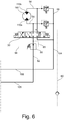
- the presented solution is further represented by a fourth exemplary hydraulic system in which the second cylinder 26 shown in Figure 3 is replaced with an actuator which is a motor 110 having two ports 110a and 110b.
- the motor 110 is of the fixed displacement type, or the variable displacement type, with two directions of flow.
- the port 110b of the motor 110 is connected in a manner similar to the second chamber 26c of the second cylinder 26 and the port 110a of the motor 110 is connected in a manner similar to the first chamber 26b of the second cylinder 26.
- the functionality, principles and details already explained and relating to the components of the subsystem shown in Figure 3 apply to the subsystem of Figure 6 showing similar components.
- Fluid under pressure available in the recovery line 64 or in the supply line 82, or both, is used for driving and controlling the motor 110.
- the presented solution is further represented by a fifth exemplary hydraulic system in which the cylinder 26 shown in Figure 3 is replaced with an actuator which is a hydraulic cylinder 111.
- the cylinder 111 is of the single acting type in that pressurized fluid can be supplied to a chamber 111b on one side of its piston rod 111a only.
- the chamber 111b is driven by fluid under pressure available in the recovery line 64 or in the supply line 82, or both.
- the chamber 111b is connected in a manner similar to the first chamber 26b of the second cylinder 26.
- the functionality, principles and details already explained and relating to the components of the subsystem shown in Figure 3 apply to the subsystem of Figure 7 showing similar components.
- the line 56 and the anti-cavitation check valve 40 of Figure 3 are not necessary in the subsystem of Figure 7 .
- the second directional control valve 30 may have a simplified configuration when used with the cylinder 111.
- the directional control valve 30 controls the flow of hydraulic fluid into and out of the chamber 111b.
- the directional control valve 30 of Figure 7 may have less ports than in Figure 3 .
- the second directional control valve 30 with its first state controls the flow of fluid from the supply line 82 to the chamber 111b, and with its second state controls the flow of fluid drained from the chamber 111b to the tank line 104.
- the supply line 82 in the second state the supply line 82 is closed or in the first state the tank 104 line is closed.
- the second directional control valve 30 may further have a closed state disconnecting or shutting the supply line 82, the chamber 111b and the tank line 104.
- the first state of the second directional control valve 30 is used for moving the piston rod 111a out.
- the load sensing line 60 is connected to a point in communication with the chamber 111b when the second directional control valve 30 is in the first state.
- the second directional control valve 30 is configured to connect the load sensing line 60 and the chamber 111b by means of the internal structure or the moving spool of the second directional control valve 30.
- the subsystem of Figure 2 may be replaced with one or both of the subsystems in Figures 4 and 5 .
- the presented system may have one or both of the subsystems of Figures 4 and 5 .
- the subsystem of Figure 3 may be replaced with one or both of the subsystems in Figures 6 and 7 .
- the presented system may have one or both of the subsystems in Figures 6 and 7 .
Landscapes
- Engineering & Computer Science (AREA)
- General Engineering & Computer Science (AREA)
- Mining & Mineral Resources (AREA)
- Civil Engineering (AREA)
- Structural Engineering (AREA)
- Physics & Mathematics (AREA)
- Fluid Mechanics (AREA)
- Mechanical Engineering (AREA)
- Chemical & Material Sciences (AREA)
- Analytical Chemistry (AREA)
- Fluid-Pressure Circuits (AREA)
Claims (18)
- Système hydraulique permettant de récupérer de l'énergie hydraulique, le système hydraulique comprenant au moins :- un premier actionneur (24, 108, 109) permettant de générer de l'énergie hydraulique et de fournir un fluide sous pression,- une ligne de réservoir (80) permettant de recevoir le fluide sous pression vidangé du premier actionneur (24, 108, 109),- un second actionneur (26, 110, 111) entraîné par le fluide sous pression vidangé du premier actionneur (24, 108, 109),- une ligne de récupération (64) permettant de fournir le fluide sous pression vidangé du premier actionneur (24, 108, 109) au second actionneur (26, 110, 111) afin d'entraîner le second actionneur (26, 110, 111), dans lequel la pression du fluide dans la ligne de récupération (64) dépend de la pression de fluide dans le premier actionneur (24, 108, 109),- une première soupape de commande directionnelle (28) présentant au moins un état dans lequel le premier actionneur (24, 108, 109) est en communication avec la ligne de réservoir (80) et la ligne de récupération (64), dans lequel la ligne de réservoir (80) et la ligne de récupération (64) reçoivent le fluide sous pression du premier actionneur (24, 108, 109) via la première soupape de commande directionnelle (28),- une seconde soupape de commande directionnelle (30) présentant au moins un état dans lequel le second actionneur (26, 110, 111) est en communication avec la ligne de récupération (64), dans lequel le second actionneur (26, 110, 111) reçoit le fluide sous pression de la ligne de récupération (64) via la seconde soupape de commande directionnelle (30),caractérisé en ce que le système hydraulique comprend en outre :- une soupape de compensation de pression (66) qui commande l'écoulement de fluide dans la ligne de réservoir (80) et maintient un différentiel de pression de fluide à travers la première soupape de commande directionnelle (28) lorsque la première soupape de commande directionnelle (28) est dans l'état reliant le premier actionneur (24, 108, 109), la ligne de réservoir (80) et la ligne de récupération (64), ledit différentiel de pression de fluide dépendant d'un réglage de la première soupape de compensation de pression (66), dans lequel la première soupape de compensation de pression (66) est dotée de :- une première ligne de détection de pression de fluide (67) en communication avec la ligne de récupération (64), et- une seconde ligne de détection de pression de fluide (68) en communication avec le premier actionneur (24, 108, 109) lorsque la première soupape de commande directionnelle (28) est dans l'état reliant le premier actionneur (24, 108, 109), la ligne de réservoir (80) et la ligne de récupération (64).
- Système selon la revendication 1, dans lequel le premier actionneur est un cylindre hydraulique à double action (24), un cylindre hydraulique à action unique (109) ou un moteur-pompe hydraulique (108), et dans lequel le second actionneur est un cylindre hydraulique à double action (26), un cylindre hydraulique à action unique (111) ou un moteur hydraulique (110).
- Système selon la revendication 1 ou 2, dans lequel le système comprend plusieurs actionneurs (24, 108, 109) générant de l'énergie hydraulique et fournissant un fluide sous pression afin d'entraîner un ou plusieurs autre(s) actionneur(s) (26, 110, 111), ou, le système comprend plusieurs actionneurs (26, 110, 111) entraînés par un fluide sous pression vidangé d'un ou plusieurs actionneur(s) (24, 108, 109) générant de l'énergie hydraulique et fournissant un fluide sous pression.
- Système selon l'une quelconque des revendications 1 à 3, dans lequel le système hydraulique comprend en outre un clapet de non-retour (74) dans la ligne de récupération (64) permettant de bloquer l'écoulement de fluide du second actionneur (26, 110, 111) à la ligne de récupération (64).
- Système selon l'une quelconque des revendications 1 à 4, dans lequel le système comprend en outre :- une ligne d'alimentation (46, 105) pour l'alimentation de fluide sous pression au premier actionneur (24, 108, 109) afin d'entraîner le premier actionneur (24, 108, 109), et- une autre ligne de réservoir (107) permettant de recevoir du fluide vidangé du premier actionneur (24, 108, 109),- dans lequel la première soupape de commande directionnelle (28) présente en outre un état reliant la ligne d'alimentation (46) et l'autre ligne de réservoir (107) au premier actionneur (24, 108, 109).
- Système selon la revendication 5, dans lequel la seconde ligne de détection de pression de fluide (68) de la soupape de compensation de pression (66) est débranchée du premier actionneur (24, 108, 109) lorsque la première soupape de commande directionnelle (28) est dans l'état reliant le premier actionneur (24, 108, 109), la ligne d'alimentation (46) et l'autre ligne de réservoir (107).
- Système selon l'une quelconque des revendications 1 à 6, dans lequel le système comprend en outre une ligne d'alimentation (82, 105), permettant de fournir du fluide sous pression au second actionneur (26, 110, 111), dans lequel la seconde soupape de commande directionnelle (30) présente en outre au moins un état dans lequel le second actionneur (26, 110, 111) est en communication avec la ligne de récupération (64) et la ligne d'alimentation (82, 105) de sorte que du fluide sous pression soit disponible à la fois dans la ligne de récupération (64) et la ligne d'alimentation (82) afin d'entraîner le second actionneur (26, 110, 111).
- Système selon l'une quelconque des revendications 1 à 7, dans lequel la première soupape de commande directionnelle (28) est configurée afin de relier la seconde ligne de détection de pression (68) de la soupape de compensation de pression (66) au premier actionneur (24, 108, 109).
- Système selon l'une quelconque des revendications 1 à 8, dans lequel le système comprend en outre :- une ligne de réservoir (104) permettant de recevoir du fluide vidangé du second actionneur (26, 110, 111),- dans lequel la seconde soupape de commande directionnelle (30) présente en outre au moins un état reliant la ligne de réservoir (104) au second actionneur (26, 110, 111).
- Système selon l'une quelconque des revendications 1 à 9, dans lequel le système comprend en outre :- une seconde soupape de compensation de pression (70) qui commande l'écoulement de fluide dans la ligne de récupération (64) et maintient un différentiel de pression de fluide à travers la première soupape de commande directionnelle (28) lorsque la première soupape de commande directionnelle (28) est dans l'état reliant le premier actionneur (24, 108, 109), la ligne de réservoir (80) et la ligne de récupération (64), ledit différentiel de pression de fluide dépendant d'un réglage de la seconde soupape de compensation de pression (70), dans lequel la seconde soupape de compensation de pression (70) est dotée de :- une première ligne de détection de pression (72) en communication avec la ligne de récupération (64), et- une seconde ligne de détection de pression (84) en communication avec le premier actionneur (24, 108, 109), lorsque la première soupape de commande directionnelle (28) est dans l'état reliant le premier actionneur (24, 108, 109), la ligne de réservoir (80) et la ligne de récupération (64).
- Système selon la revendication 10, dans lequel la première soupape de commande directionnelle (28) est configurée afin de relier la seconde ligne de détection de pression (84) de la seconde soupape de compensation de pression (70) avec le premier actionneur (24, 108, 109), ou, la seconde ligne de détection de pression (84) de la seconde soupape de compensation de pression (70) est raccordée à la seconde ligne de détection de pression (68) de la première soupape de compensation de pression (66).
- Système selon l'une quelconque des revendications 1 à 11, dans lequel la ligne de récupération (64) est raccordée à la ligne de réservoir (80) en un point situé entre la première soupape de commande directionnelle (28) et la soupape de compensation de pression (66).
- Système selon l'une quelconque des revendications 1 à 12, dans lequel le système comprend en outre une pompe (32) alimentant un fluide sous pression à une ligne d'alimentation (46, 82, 105), dans lequel la pompe (32) est de type à détection de charge et présente une première ligne de détection de charge (44) en communication avec le premier actionneur (24, 108, 109), lorsque la première soupape de commande directionnelle (28) est dans l'état reliant le premier actionneur (24, 108, 109), la ligne de réservoir (80) et la ligne de récupération (64).
- Système selon la revendication 13, dans lequel la première soupape de commande directionnelle (28) est configurée afin de relier la première ligne de détection de charge (44) au premier actionneur (24, 108, 109).
- Système selon la revendication 13 ou 14, dans lequel la pompe (32) est en outre dotée d'une seconde ligne de détection de charge (60) en communication avec le second actionneur (26, 110, 111), lorsque la seconde soupape de commande directionnelle (30) est dans l'état reliant le second actionneur (26, 110, 111) et la ligne de récupération (64) ou la ligne d'alimentation (46, 82, 105).
- Système selon l'une quelconque des revendications 1 à 15, dans lequel le système comprend en outre une soupape de compensation de pression (86) qui commande l'écoulement de fluide fourni à la première soupape de commande directionnelle (28), ladite soupape de compensation de pression (86) est dotée de :- une première ligne de détection de pression (87) en communication avec l'écoulement de fluide fourni à la première soupape de contrôle directionnelle (28), et- une seconde ligne de détection de pression (85) en communication avec le premier actionneur (24, 108, 109) lorsque la première soupape de contrôle directionnelle (28) est dans l'état reliant le premier actionneur (24, 108, 109), la ligne de réservoir (80) et la ligne de récupération (64).
- Système selon l'une quelconque des revendications 1 à 16, dans lequel le système comprend en outre une soupape de compensation de pression (88) qui commande l'écoulement de fluide fourni à la seconde soupape de commande directionnelle (30), ladite soupape de compensation de pression (88) est dotée de :- une première ligne de détection de pression (89) en communication avec l'écoulement de fluide fourni à la seconde soupape de commande directionnelle (30), et- une seconde ligne de détection de pression (94) en communication avec le second actionneur (26, 110, 111) lorsque la seconde soupape de commande directionnelle (30) est dans l'état reliant la ligne de récupération (64), ou la ligne d'alimentation (46, 82, 105), et le second actionneur (26, 110, 111).
- Système selon l'une quelconque des revendications 1 à 17, dans lequel le système comprend en outre une soupape (112) pour un raccordement différentiel cylindrique, ladite soupape présente un fluide hydraulique menant à un état, entre une chambre côté piston du premier actionneur (24) et une chambre côté tige de piston du premier actionneur (24).
Priority Applications (2)
| Application Number | Priority Date | Filing Date | Title |
|---|---|---|---|
| EP14397522.5A EP2955389B1 (fr) | 2014-06-13 | 2014-06-13 | Système hydraulique avec récupération d'énergie |
| US14/735,829 US9797419B2 (en) | 2014-06-13 | 2015-06-10 | Hydraulic system with energy recovery |
Applications Claiming Priority (1)
| Application Number | Priority Date | Filing Date | Title |
|---|---|---|---|
| EP14397522.5A EP2955389B1 (fr) | 2014-06-13 | 2014-06-13 | Système hydraulique avec récupération d'énergie |
Publications (2)
| Publication Number | Publication Date |
|---|---|
| EP2955389A1 EP2955389A1 (fr) | 2015-12-16 |
| EP2955389B1 true EP2955389B1 (fr) | 2019-05-22 |
Family
ID=51176310
Family Applications (1)
| Application Number | Title | Priority Date | Filing Date |
|---|---|---|---|
| EP14397522.5A Not-in-force EP2955389B1 (fr) | 2014-06-13 | 2014-06-13 | Système hydraulique avec récupération d'énergie |
Country Status (2)
| Country | Link |
|---|---|
| US (1) | US9797419B2 (fr) |
| EP (1) | EP2955389B1 (fr) |
Families Citing this family (9)
| Publication number | Priority date | Publication date | Assignee | Title |
|---|---|---|---|---|
| DE102017219645A1 (de) * | 2017-11-06 | 2019-05-09 | Zf Friedrichshafen Ag | Ventil, Hydrauliksystem und Kraftfahrzeuggetriebe |
| JP6914206B2 (ja) * | 2018-01-11 | 2021-08-04 | 株式会社小松製作所 | 油圧回路 |
| CN108755823A (zh) * | 2018-07-05 | 2018-11-06 | 伊婕 | 一种具有压差液能和势能回收装置的挖掘机 |
| US10641297B2 (en) * | 2018-08-17 | 2020-05-05 | Robert Bosch Gmbh | Hydraulic control valve |
| CN110872857A (zh) * | 2019-11-29 | 2020-03-10 | 徐州徐工液压件有限公司 | 多功能能量回收装置及搭载该装置的液压挖掘机系统 |
| TR202010537A2 (tr) * | 2020-07-03 | 2021-01-21 | Hidromek Hidrolik Ve Mekanik Makina Imalat Sanayi Ve Ticaret Anonim Sirketi | Kazici ve yükleyi̇ci̇, lasti̇kli̇ yükleyi̇ci̇ ve ekskavatör i̇ş maki̇neleri̇nde kaldirma?i̇ndi̇rme si̇li̇ndi̇ri̇nde i̇ndi̇rme esnasinda çi̇ft sürgülü yön valfleri̇ i̇le enerji̇ kazanimi sağlayan hi̇droli̇k si̇stem |
| IT202100009830A1 (it) * | 2021-04-19 | 2022-10-19 | Walvoil Spa | Distributore idraulico con dispositivo di compensazione per valvole direzionali |
| EP4587650A1 (fr) * | 2022-09-12 | 2025-07-23 | Epiroc Rock Drills Aktiebolag | Système hydraulique |
| CN115727040B (zh) * | 2022-10-31 | 2025-11-28 | 三一海洋重工有限公司 | 势能回收方法、系统和工程机械 |
Family Cites Families (6)
| Publication number | Priority date | Publication date | Assignee | Title |
|---|---|---|---|---|
| JP2004011168A (ja) * | 2002-06-04 | 2004-01-15 | Komatsu Ltd | 建設機械 |
| SE531309C2 (sv) * | 2006-01-16 | 2009-02-17 | Volvo Constr Equip Ab | Styrsystem för en arbetsmaskin och förfarande för styrning av en hydraulcylinder hos en arbetsmaskin |
| DE102006060351B8 (de) * | 2006-12-20 | 2008-07-24 | Sauer-Danfoss Gmbh & Co Ohg | Hydraulische Schaltungsanordnung mit Energierückgewinnung |
| DE102008038992A1 (de) * | 2008-08-13 | 2010-02-18 | Schuler Smg Gmbh & Co. Kg | Hydraulische Presse |
| KR20120040684A (ko) * | 2009-05-29 | 2012-04-27 | 볼보 컨스트럭션 이큅먼트 에이비 | 유압 시스템 및 그러한 유압 시스템을 포함하는 작동 기계 |
| JP5574375B2 (ja) * | 2010-06-30 | 2014-08-20 | キャタピラー エス エー アール エル | エネルギ回生用制御回路および作業機械 |
-
2014
- 2014-06-13 EP EP14397522.5A patent/EP2955389B1/fr not_active Not-in-force
-
2015
- 2015-06-10 US US14/735,829 patent/US9797419B2/en not_active Expired - Fee Related
Also Published As
| Publication number | Publication date |
|---|---|
| EP2955389A1 (fr) | 2015-12-16 |
| US9797419B2 (en) | 2017-10-24 |
| US20150361998A1 (en) | 2015-12-17 |
Similar Documents
| Publication | Publication Date | Title |
|---|---|---|
| EP2955389B1 (fr) | Système hydraulique avec récupération d'énergie | |
| US9080310B2 (en) | Closed-loop hydraulic system having regeneration configuration | |
| US9783960B2 (en) | Driving device for work machine | |
| CN101802417B (zh) | 执行适应性流动控制的致动器控制系统 | |
| KR101683317B1 (ko) | 중장비의 유압 펌프 제어 장치 | |
| US5490384A (en) | Hydraulic flow priority system | |
| US9528531B2 (en) | Hydraulic drive apparatus for work machine | |
| US9932993B2 (en) | System and method for hydraulic energy recovery | |
| EP3106677B1 (fr) | Appareil motrice hydraulique pour machine de construction | |
| US11318988B2 (en) | Hydraulic steering control system | |
| AU2010250869A1 (en) | Hydraulic switching mechanism for mobile hydraulics, mobile hydraulic machine and valve unit | |
| CN106321537B (zh) | 液压控制系统以及相应的移动式工作设备 | |
| EP3311034B1 (fr) | Système hydraulique à détection de charge pour une machine de travail | |
| JP6514522B2 (ja) | アンロード弁および油圧ショベルの油圧駆動システム | |
| CN108909832B (zh) | 转向液压系统及装载机 | |
| US20110030816A1 (en) | Control system for controlling a directional control valve | |
| EP3683453B1 (fr) | Dispositif de commande pour engin de chantier | |
| CN109563695B (zh) | 挖土机、挖土机用控制阀门 | |
| US20170108015A1 (en) | Independent Metering Valves with Flow Sharing | |
| CN111677704B (zh) | 液压系统和工程机械 | |
| CN105971043B (zh) | 挖土机 | |
| EP2910796B1 (fr) | Assemblage avec un dispositif de vanne de commande à position flottante | |
| US20140033698A1 (en) | Meterless hydraulic system having force modulation | |
| KR102385608B1 (ko) | 쇼벨 및 쇼벨용 컨트롤밸브 | |
| US8806862B2 (en) | Smart flow sharing system |
Legal Events
| Date | Code | Title | Description |
|---|---|---|---|
| PUAI | Public reference made under article 153(3) epc to a published international application that has entered the european phase |
Free format text: ORIGINAL CODE: 0009012 |
|
| AK | Designated contracting states |
Kind code of ref document: A1 Designated state(s): AL AT BE BG CH CY CZ DE DK EE ES FI FR GB GR HR HU IE IS IT LI LT LU LV MC MK MT NL NO PL PT RO RS SE SI SK SM TR |
|
| AX | Request for extension of the european patent |
Extension state: BA ME |
|
| 17P | Request for examination filed |
Effective date: 20160613 |
|
| RBV | Designated contracting states (corrected) |
Designated state(s): AL AT BE BG CH CY CZ DE DK EE ES FI FR GB GR HR HU IE IS IT LI LT LU LV MC MK MT NL NO PL PT RO RS SE SI SK SM TR |
|
| RIC1 | Information provided on ipc code assigned before grant |
Ipc: F15B 11/024 20060101AFI20181029BHEP Ipc: E02F 9/22 20060101ALI20181029BHEP Ipc: F15B 21/14 20060101ALI20181029BHEP |
|
| GRAP | Despatch of communication of intention to grant a patent |
Free format text: ORIGINAL CODE: EPIDOSNIGR1 |
|
| STAA | Information on the status of an ep patent application or granted ep patent |
Free format text: STATUS: GRANT OF PATENT IS INTENDED |
|
| INTG | Intention to grant announced |
Effective date: 20190104 |
|
| GRAS | Grant fee paid |
Free format text: ORIGINAL CODE: EPIDOSNIGR3 |
|
| GRAA | (expected) grant |
Free format text: ORIGINAL CODE: 0009210 |
|
| STAA | Information on the status of an ep patent application or granted ep patent |
Free format text: STATUS: THE PATENT HAS BEEN GRANTED |
|
| AK | Designated contracting states |
Kind code of ref document: B1 Designated state(s): AL AT BE BG CH CY CZ DE DK EE ES FI FR GB GR HR HU IE IS IT LI LT LU LV MC MK MT NL NO PL PT RO RS SE SI SK SM TR |
|
| REG | Reference to a national code |
Ref country code: GB Ref legal event code: FG4D |
|
| REG | Reference to a national code |
Ref country code: CH Ref legal event code: EP |
|
| REG | Reference to a national code |
Ref country code: IE Ref legal event code: FG4D |
|
| REG | Reference to a national code |
Ref country code: DE Ref legal event code: R096 Ref document number: 602014047154 Country of ref document: DE |
|
| REG | Reference to a national code |
Ref country code: AT Ref legal event code: REF Ref document number: 1136462 Country of ref document: AT Kind code of ref document: T Effective date: 20190615 |
|
| REG | Reference to a national code |
Ref country code: NL Ref legal event code: MP Effective date: 20190522 |
|
| REG | Reference to a national code |
Ref country code: LT Ref legal event code: MG4D |
|
| PG25 | Lapsed in a contracting state [announced via postgrant information from national office to epo] |
Ref country code: AL Free format text: LAPSE BECAUSE OF FAILURE TO SUBMIT A TRANSLATION OF THE DESCRIPTION OR TO PAY THE FEE WITHIN THE PRESCRIBED TIME-LIMIT Effective date: 20190522 Ref country code: NO Free format text: LAPSE BECAUSE OF FAILURE TO SUBMIT A TRANSLATION OF THE DESCRIPTION OR TO PAY THE FEE WITHIN THE PRESCRIBED TIME-LIMIT Effective date: 20190822 Ref country code: ES Free format text: LAPSE BECAUSE OF FAILURE TO SUBMIT A TRANSLATION OF THE DESCRIPTION OR TO PAY THE FEE WITHIN THE PRESCRIBED TIME-LIMIT Effective date: 20190522 Ref country code: NL Free format text: LAPSE BECAUSE OF FAILURE TO SUBMIT A TRANSLATION OF THE DESCRIPTION OR TO PAY THE FEE WITHIN THE PRESCRIBED TIME-LIMIT Effective date: 20190522 Ref country code: LT Free format text: LAPSE BECAUSE OF FAILURE TO SUBMIT A TRANSLATION OF THE DESCRIPTION OR TO PAY THE FEE WITHIN THE PRESCRIBED TIME-LIMIT Effective date: 20190522 Ref country code: HR Free format text: LAPSE BECAUSE OF FAILURE TO SUBMIT A TRANSLATION OF THE DESCRIPTION OR TO PAY THE FEE WITHIN THE PRESCRIBED TIME-LIMIT Effective date: 20190522 Ref country code: SE Free format text: LAPSE BECAUSE OF FAILURE TO SUBMIT A TRANSLATION OF THE DESCRIPTION OR TO PAY THE FEE WITHIN THE PRESCRIBED TIME-LIMIT Effective date: 20190522 Ref country code: PT Free format text: LAPSE BECAUSE OF FAILURE TO SUBMIT A TRANSLATION OF THE DESCRIPTION OR TO PAY THE FEE WITHIN THE PRESCRIBED TIME-LIMIT Effective date: 20190922 Ref country code: FI Free format text: LAPSE BECAUSE OF FAILURE TO SUBMIT A TRANSLATION OF THE DESCRIPTION OR TO PAY THE FEE WITHIN THE PRESCRIBED TIME-LIMIT Effective date: 20190522 |
|
| PG25 | Lapsed in a contracting state [announced via postgrant information from national office to epo] |
Ref country code: RS Free format text: LAPSE BECAUSE OF FAILURE TO SUBMIT A TRANSLATION OF THE DESCRIPTION OR TO PAY THE FEE WITHIN THE PRESCRIBED TIME-LIMIT Effective date: 20190522 Ref country code: LV Free format text: LAPSE BECAUSE OF FAILURE TO SUBMIT A TRANSLATION OF THE DESCRIPTION OR TO PAY THE FEE WITHIN THE PRESCRIBED TIME-LIMIT Effective date: 20190522 Ref country code: BG Free format text: LAPSE BECAUSE OF FAILURE TO SUBMIT A TRANSLATION OF THE DESCRIPTION OR TO PAY THE FEE WITHIN THE PRESCRIBED TIME-LIMIT Effective date: 20190822 Ref country code: GR Free format text: LAPSE BECAUSE OF FAILURE TO SUBMIT A TRANSLATION OF THE DESCRIPTION OR TO PAY THE FEE WITHIN THE PRESCRIBED TIME-LIMIT Effective date: 20190823 |
|
| REG | Reference to a national code |
Ref country code: AT Ref legal event code: MK05 Ref document number: 1136462 Country of ref document: AT Kind code of ref document: T Effective date: 20190522 |
|
| REG | Reference to a national code |
Ref country code: DE Ref legal event code: R119 Ref document number: 602014047154 Country of ref document: DE |
|
| PG25 | Lapsed in a contracting state [announced via postgrant information from national office to epo] |
Ref country code: CZ Free format text: LAPSE BECAUSE OF FAILURE TO SUBMIT A TRANSLATION OF THE DESCRIPTION OR TO PAY THE FEE WITHIN THE PRESCRIBED TIME-LIMIT Effective date: 20190522 Ref country code: SK Free format text: LAPSE BECAUSE OF FAILURE TO SUBMIT A TRANSLATION OF THE DESCRIPTION OR TO PAY THE FEE WITHIN THE PRESCRIBED TIME-LIMIT Effective date: 20190522 Ref country code: EE Free format text: LAPSE BECAUSE OF FAILURE TO SUBMIT A TRANSLATION OF THE DESCRIPTION OR TO PAY THE FEE WITHIN THE PRESCRIBED TIME-LIMIT Effective date: 20190522 Ref country code: DK Free format text: LAPSE BECAUSE OF FAILURE TO SUBMIT A TRANSLATION OF THE DESCRIPTION OR TO PAY THE FEE WITHIN THE PRESCRIBED TIME-LIMIT Effective date: 20190522 Ref country code: RO Free format text: LAPSE BECAUSE OF FAILURE TO SUBMIT A TRANSLATION OF THE DESCRIPTION OR TO PAY THE FEE WITHIN THE PRESCRIBED TIME-LIMIT Effective date: 20190522 Ref country code: AT Free format text: LAPSE BECAUSE OF FAILURE TO SUBMIT A TRANSLATION OF THE DESCRIPTION OR TO PAY THE FEE WITHIN THE PRESCRIBED TIME-LIMIT Effective date: 20190522 |
|
| REG | Reference to a national code |
Ref country code: CH Ref legal event code: PL |
|
| PG25 | Lapsed in a contracting state [announced via postgrant information from national office to epo] |
Ref country code: MC Free format text: LAPSE BECAUSE OF FAILURE TO SUBMIT A TRANSLATION OF THE DESCRIPTION OR TO PAY THE FEE WITHIN THE PRESCRIBED TIME-LIMIT Effective date: 20190522 Ref country code: SM Free format text: LAPSE BECAUSE OF FAILURE TO SUBMIT A TRANSLATION OF THE DESCRIPTION OR TO PAY THE FEE WITHIN THE PRESCRIBED TIME-LIMIT Effective date: 20190522 Ref country code: IT Free format text: LAPSE BECAUSE OF FAILURE TO SUBMIT A TRANSLATION OF THE DESCRIPTION OR TO PAY THE FEE WITHIN THE PRESCRIBED TIME-LIMIT Effective date: 20190522 |
|
| PLBE | No opposition filed within time limit |
Free format text: ORIGINAL CODE: 0009261 |
|
| REG | Reference to a national code |
Ref country code: BE Ref legal event code: MM Effective date: 20190630 |
|
| STAA | Information on the status of an ep patent application or granted ep patent |
Free format text: STATUS: NO OPPOSITION FILED WITHIN TIME LIMIT |
|
| PG25 | Lapsed in a contracting state [announced via postgrant information from national office to epo] |
Ref country code: TR Free format text: LAPSE BECAUSE OF FAILURE TO SUBMIT A TRANSLATION OF THE DESCRIPTION OR TO PAY THE FEE WITHIN THE PRESCRIBED TIME-LIMIT Effective date: 20190522 |
|
| 26N | No opposition filed |
Effective date: 20200225 |
|
| GBPC | Gb: european patent ceased through non-payment of renewal fee |
Effective date: 20190822 |
|
| PG25 | Lapsed in a contracting state [announced via postgrant information from national office to epo] |
Ref country code: PL Free format text: LAPSE BECAUSE OF FAILURE TO SUBMIT A TRANSLATION OF THE DESCRIPTION OR TO PAY THE FEE WITHIN THE PRESCRIBED TIME-LIMIT Effective date: 20190522 Ref country code: IE Free format text: LAPSE BECAUSE OF NON-PAYMENT OF DUE FEES Effective date: 20190613 Ref country code: DE Free format text: LAPSE BECAUSE OF NON-PAYMENT OF DUE FEES Effective date: 20200101 |
|
| PG25 | Lapsed in a contracting state [announced via postgrant information from national office to epo] |
Ref country code: SI Free format text: LAPSE BECAUSE OF FAILURE TO SUBMIT A TRANSLATION OF THE DESCRIPTION OR TO PAY THE FEE WITHIN THE PRESCRIBED TIME-LIMIT Effective date: 20190522 Ref country code: LU Free format text: LAPSE BECAUSE OF NON-PAYMENT OF DUE FEES Effective date: 20190613 Ref country code: BE Free format text: LAPSE BECAUSE OF NON-PAYMENT OF DUE FEES Effective date: 20190630 Ref country code: CH Free format text: LAPSE BECAUSE OF NON-PAYMENT OF DUE FEES Effective date: 20190630 Ref country code: LI Free format text: LAPSE BECAUSE OF NON-PAYMENT OF DUE FEES Effective date: 20190630 |
|
| PG25 | Lapsed in a contracting state [announced via postgrant information from national office to epo] |
Ref country code: FR Free format text: LAPSE BECAUSE OF NON-PAYMENT OF DUE FEES Effective date: 20190722 |
|
| PG25 | Lapsed in a contracting state [announced via postgrant information from national office to epo] |
Ref country code: GB Free format text: LAPSE BECAUSE OF NON-PAYMENT OF DUE FEES Effective date: 20190822 |
|
| PG25 | Lapsed in a contracting state [announced via postgrant information from national office to epo] |
Ref country code: CY Free format text: LAPSE BECAUSE OF FAILURE TO SUBMIT A TRANSLATION OF THE DESCRIPTION OR TO PAY THE FEE WITHIN THE PRESCRIBED TIME-LIMIT Effective date: 20190522 |
|
| PG25 | Lapsed in a contracting state [announced via postgrant information from national office to epo] |
Ref country code: IS Free format text: LAPSE BECAUSE OF FAILURE TO SUBMIT A TRANSLATION OF THE DESCRIPTION OR TO PAY THE FEE WITHIN THE PRESCRIBED TIME-LIMIT Effective date: 20190922 |
|
| PG25 | Lapsed in a contracting state [announced via postgrant information from national office to epo] |
Ref country code: HU Free format text: LAPSE BECAUSE OF FAILURE TO SUBMIT A TRANSLATION OF THE DESCRIPTION OR TO PAY THE FEE WITHIN THE PRESCRIBED TIME-LIMIT; INVALID AB INITIO Effective date: 20140613 Ref country code: MT Free format text: LAPSE BECAUSE OF FAILURE TO SUBMIT A TRANSLATION OF THE DESCRIPTION OR TO PAY THE FEE WITHIN THE PRESCRIBED TIME-LIMIT Effective date: 20190522 |
|
| PG25 | Lapsed in a contracting state [announced via postgrant information from national office to epo] |
Ref country code: MK Free format text: LAPSE BECAUSE OF FAILURE TO SUBMIT A TRANSLATION OF THE DESCRIPTION OR TO PAY THE FEE WITHIN THE PRESCRIBED TIME-LIMIT Effective date: 20190522 |