EP2955856B1 - Verfahren zum finden und verfolgen eines interessanten signals von einem satelliten und schmalband-rssi-anzeiger - Google Patents
Verfahren zum finden und verfolgen eines interessanten signals von einem satelliten und schmalband-rssi-anzeiger Download PDFInfo
- Publication number
- EP2955856B1 EP2955856B1 EP15170496.2A EP15170496A EP2955856B1 EP 2955856 B1 EP2955856 B1 EP 2955856B1 EP 15170496 A EP15170496 A EP 15170496A EP 2955856 B1 EP2955856 B1 EP 2955856B1
- Authority
- EP
- European Patent Office
- Prior art keywords
- signal
- band
- interest
- antenna
- satellite
- Prior art date
- Legal status (The legal status is an assumption and is not a legal conclusion. Google has not performed a legal analysis and makes no representation as to the accuracy of the status listed.)
- Active
Links
Images


Classifications
-
- H—ELECTRICITY
- H04—ELECTRIC COMMUNICATION TECHNIQUE
- H04B—TRANSMISSION
- H04B1/00—Details of transmission systems, not covered by a single one of groups H04B3/00 - H04B13/00; Details of transmission systems not characterised by the medium used for transmission
- H04B1/06—Receivers
- H04B1/10—Means associated with receiver for limiting or suppressing noise or interference
- H04B1/1027—Means associated with receiver for limiting or suppressing noise or interference assessing signal quality or detecting noise/interference for the received signal
- H04B1/1036—Means associated with receiver for limiting or suppressing noise or interference assessing signal quality or detecting noise/interference for the received signal with automatic suppression of narrow band noise or interference, e.g. by using tuneable notch filters
-
- G—PHYSICS
- G01—MEASURING; TESTING
- G01S—RADIO DIRECTION-FINDING; RADIO NAVIGATION; DETERMINING DISTANCE OR VELOCITY BY USE OF RADIO WAVES; LOCATING OR PRESENCE-DETECTING BY USE OF THE REFLECTION OR RERADIATION OF RADIO WAVES; ANALOGOUS ARRANGEMENTS USING OTHER WAVES
- G01S3/00—Direction-finders for determining the direction from which infrasonic, sonic, ultrasonic or electromagnetic waves, or particle emission, not having a directional significance, are being received
- G01S3/02—Direction-finders for determining the direction from which infrasonic, sonic, ultrasonic or electromagnetic waves, or particle emission, not having a directional significance, are being received using radio waves
- G01S3/04—Details
-
- G—PHYSICS
- G01—MEASURING; TESTING
- G01S—RADIO DIRECTION-FINDING; RADIO NAVIGATION; DETERMINING DISTANCE OR VELOCITY BY USE OF RADIO WAVES; LOCATING OR PRESENCE-DETECTING BY USE OF THE REFLECTION OR RERADIATION OF RADIO WAVES; ANALOGOUS ARRANGEMENTS USING OTHER WAVES
- G01S3/00—Direction-finders for determining the direction from which infrasonic, sonic, ultrasonic or electromagnetic waves, or particle emission, not having a directional significance, are being received
- G01S3/02—Direction-finders for determining the direction from which infrasonic, sonic, ultrasonic or electromagnetic waves, or particle emission, not having a directional significance, are being received using radio waves
- G01S3/14—Systems for determining direction or deviation from predetermined direction
- G01S3/38—Systems for determining direction or deviation from predetermined direction using adjustment of real or effective orientation of directivity characteristic of an antenna or an antenna system to give a desired condition of signal derived from that antenna or antenna system, e.g. to give a maximum or minimum signal
-
- H—ELECTRICITY
- H04—ELECTRIC COMMUNICATION TECHNIQUE
- H04B—TRANSMISSION
- H04B7/00—Radio transmission systems, i.e. using radiation field
- H04B7/14—Relay systems
- H04B7/15—Active relay systems
- H04B7/185—Space-based or airborne stations; Stations for satellite systems
- H04B7/1851—Systems using a satellite or space-based relay
-
- H—ELECTRICITY
- H04—ELECTRIC COMMUNICATION TECHNIQUE
- H04B—TRANSMISSION
- H04B1/00—Details of transmission systems, not covered by a single one of groups H04B3/00 - H04B13/00; Details of transmission systems not characterised by the medium used for transmission
- H04B1/06—Receivers
- H04B1/10—Means associated with receiver for limiting or suppressing noise or interference
- H04B1/1027—Means associated with receiver for limiting or suppressing noise or interference assessing signal quality or detecting noise/interference for the received signal
- H04B2001/1063—Means associated with receiver for limiting or suppressing noise or interference assessing signal quality or detecting noise/interference for the received signal using a notch filter
Definitions
- the present invention relates to receivers for systems and, more particularly, to a narrowband Received Signal Strength Indicator (NbRSSI) for finding and tracking a signal of interest and method for finding and tracking a signal of interest in space from a signal transmitting device.
- NbRSSI narrowband Received Signal Strength Indicator
- INSs Inertial Navigation Systems
- Such geo-location and attitude information coupled with angular position sensors (which describe the angular relationship between an antenna Line-of-Sight (LOS)) and detailed ephemeris information (which describes the location and inclination of the satellite of interest), can be used to compute pointing angles needed to point the earth-station antenna at the satellite of interest.
- LOS Line-of-Sight
- ephemeris information which describes the location and inclination of the satellite of interest
- RSSI Received Signal Strength Indicator
- RSSIs measure a power level that a Radio Frequency (RF) device is receiving from a radio infrastructure at a given location and time.
- RSSIs often employ a broad-spectrum envelope power detector to sense the RF energy from a whole satellite transponder or from all the transponders on a particular satellite. Based on the received signal strength, the pointing angles for the antenna can be calculated.
- Yet another option for determining the pointing angles is to use an envelope power detector to first find a certain, particularly strong satellite signal on a Direct Broadcast Satellite (DBS) service. Pointing then can be offset from the found signal to find the actual satellite of interest.
- DBS Direct Broadcast Satellite
- beacon receivers Another class of systems use beacon receivers to help solve the problem of properly pointing the earth-station antenna. This often introduces considerable cost and complexity to the system since beacon receivers operate on very low power satellite signals which, in turn, require that the beacon receiver have an exceptionally narrow bandwidth (on the order of a few hundred Hz for a small aperture antenna). This makes such systems extremely vulnerable to clock drift and Doppler frequency shift, and usually requires the use of Phase Lock Loop Low Noise Blocks (LNBs) along with a precision, temperature compensated ten MHz reference.
- LNBs Phase Lock Loop Low Noise Blocks
- the beacon to be tracked is usually found on one of the two possible polarizations, and is often located on the satellite transponder band edge. Further, not all satellites of interest are equipped or even provisioned to provide a suitable beacon signal.
- US 2002/0097184 A1 discloses a method for location of a radio frequency emitting target with the step of emulating an antenna moving at very high velocities to induce a Virtual Doppler shift on signals incident upon a linear antenna array.
- US 2003/0078040 A1 discloses a terrestrial communication system using satellite uplink and downlink frequencies mutual interference between cell sites and satellites is reduced to tolerable levels by adding pattern nulls to terrestrial cell site antennas.
- US 3,309,699 A discloses a tracking system for communication satellites comprising a receiver.
- Said receiver comprising a set of filters with different bandwidths being selectable by controlling of switches during conditions such as attentuation of the communication signal by weather conditions or signal jamming conditions, the filters may be utilized which may reduce the information path there through but also reduce the actual noise bandwidth.
- some systems require the use of costly, large and heavy, narrow beamwidth antennas, which have beamwidths less than the angular spacing of the geo-stationary satellites.
- Use of such narrow-beam antennas can introduce significant challenges in the acquisition and tracking of satellites, especially for on-the-move systems.
- the object is achieved by the method comprising the features of claim 1 and by the narrow-band received signal strength indicator (NbRSSI) circuit for tracking signal of interest comprising the features of claim 13.
- NbRSSI narrow-band received signal strength indicator
- NbRSSI narrow-band RSSI
- the device and method in accordance with the present disclosure can solve the problem of optimally pointing an earth-station antenna and specifically the locating of, pointing to, and tracking of a Radio Frequency or Intermediate Frequency (IF) signal from an earth-orbiting satellite.
- the device and method in accordance with the present disclosure are useful with wide beamwidth antennas, which have beamwidths greater than the angular spacing of geo-stationary satellites. In this regard, interference that comes from the presence of adjacent satellites transmitting in the same RF band can be suppressed.
- the components required to realize the design in accordance with the present disclosure are small, low-cost, and low-power. This allows narrow-band RSSI features to be incorporated into a wide variety of embedded systems where size, weight, power and cost are critical design parameters.
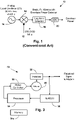
- the power can be sampled by an Analog to Digital Converter (ADC) 20, whereas a purely analog system could directly use the output of the Log Amp Detector 18.
- ADC Analog to Digital Converter
- Some systems use a simple square-law diode (not shown) instead of a Log Amp Detector 18.
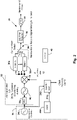
- the circuit 30 enables an antenna acquisition and tracking system to find and track a particular carrier frequency.
- the circuit 30 uses a simple, low cost receiver 32 to convert the incoming Intermediate Frequency signal 12 down to baseband, which is typically 4 MHz and below, via mixer 14.
- the receiver 32 can be set to look at a particular frequency band via a software-controlled Local Oscillator 16 that is tied to a high frequency stability clock source 34, which may be formed by a Global Positioning System (GPS) receiver 34a, an inexpensive oscillator 34c and a counter 34b.
- GPS Global Positioning System
- the software-controlled LO consists of this high frequency stability clock source (34) and a Phase-Lock Loop (PLL) 32a within the receiver which multiplies the base oscillator frequency (typically 25 MHz) up to IF band (950 - 2150 MHz).
- PLL Phase-Lock Loop
- the frequency drift of the inexpensive oscillator portion of the Inexpensive Oscillator 34c can be compensated for by comparing its output with the Pulse per Second (PPS) output of the GPS receiver 34a.
- PPS Pulse per Second
- the GPS PPS is a highly accurate time synchronization signal found on most commercial GPS receivers, and it provides a one milli-second wide pulse once per second. The rising edge of this pulse is tied to the atomic clock system used as part of the overall GPS system and it is accurate to 60 ns or better.
- the PPS output of the GPS receiver 34a is connected to a reset input of the counter 34b, and a count input of the counter 34b is connected to an output of the inexpensive oscillator 34c.
- the exact frequency of the inexpensive oscillator 34c can be continuously measured as this oscillator slowly drifts over time and temperature. This information can then be used to continually adjust the PLL 32a within the receiver so as to keep the LO at the particular desired frequency. By reducing this source of frequency drift, a tighter filter can be used, thus improving Signal to Noise Ratio (SNR) of the circuit.
- SNR Signal to Noise Ratio
- circuitry will be understood to refer to both hardware circuits (e.g., circuits formed from discrete components and/or ASICs) as well as microprocessor based circuits that execute logic in the form of code stored in memory.
- the earth-station antenna is moving relative to the satellite from which it is receiving a signal, this will result in a Doppler frequency shift on the downconverted IF signal on which the RSSI circuit is operating.
- This normally requires that the selected filter have extra bandwidth to accommodate the range of relative speeds that the earth-station antenna will experience.
- the extra bandwidth on this filter, beyond the bandwidth of the desired signal, results in a degradation of the Signal to Noise Ratio (SNR).
- SNR Signal to Noise Ratio
- geo-location navigation data of Earth Station and/or satellite ephemeris data is used to calculate the Doppler frequency shift of the incoming signal 12 within a processor.
- the frequency shift to be expected is a function of the carrier frequency itself and the relative speed along the line-of-sight axis between the satellite and the earth-station. This calculated frequency shift is then be used to proactively adjust the receiver down-converter frequency so that the baseband signal is kept relatively constant in frequency. This will allow a tighter filter to be used, thus improving Signal to Noise Ratio. Additionally, the receiver 32 can be configured to adjust the front-end, pre-mixer gain as well as adjust the outgoing baseband gain using a priori knowledge of the desired signal strength to maximize gain while avoiding saturation.
- the gain stages are typically built into the receiver and are controlled by software commands.
- the output of the receiver 32 is then fed to an assortment of analog filters 36a-36n, the output of which can be selected by a multiplexer 38 which then feeds a logarithmic power detection amplifier 18.
- Multiplexor 38 may be under the control of controller 40, which may be a dedicated discrete hardware circuit or ASIC, or a microprocessor-based circuit.
- controller 40 which may be a dedicated discrete hardware circuit or ASIC, or a microprocessor-based circuit.
- the analog output of the amplifier 18 is then sampled via ADC 20 and software can then interpret the resultant value as a Receive Signal Strength Indicator (RSSI).
- RSSI Receive Signal Strength Indicator
- Multiplexor 38 may be under the control of a controller, such as a microprocessor-based controller.
- a suitably fast Analog-to-Digital Converter can be used at any point along the path of the circuit and all subsequent steps can be performed in software.
- ADC Analog-to-Digital Converter
- Filters 36a-36n are selected to have a bandwidth that is as wide as the carrier frequency to be tracked, but not wider.
- Selectable filters 36a-36n of various bandwidths allow maximization of Signal to Noise Ratio. Signals out of band are rejected, which improves pointing accuracy. Sources of frequency drift such as Doppler shift and clock drift are compensated for using the clock source 34 or alternative methodology, which enables the use of tighter filters and in turn allows for higher Signal to Noise Ratio.
- NbNS Narrow-band Null Search mode
- NbSBS Narrow-band Stop-Band Search
- NbPBR Narrow-band Pseudo-Beacon Receiver
- the employed filter architecture in accordance with the present disclosure allows for more selective pointing of the earth-station antenna, which minimizes the problem of locking on the wrong satellite or being drawn-off the desired satellite (mispointing error) by undesired emissions from adjacent satellites.
- the filter architecture allows for more accurate pointing of the earth-station antenna, which reduces the problem of adjacent satellite interference.
- Adjacent satellite interference can be particularly acute for low-profile and small aperture antennas ( ⁇ 30 wavelengths in size in either height or width) which tend to have beamwidths on the same order or larger than the angular spacing of earth-orbiting, geo-stationary satellites (typically between 2 degrees to 3 degrees).
- the filter architecture also allows for faster acquisition of the satellite of interest, which reduces set-up time.
- the device and method in accordance with the present disclosure can be used across a variety of product lines including flat-plate antennas, phased array antennas, dish antennas, and any antenna whose beam can be steered.
- the device and method in accordance with the present disclosure can be used across a variety of RF bands including, but not limited to, L-Band, S-Band, C-Band, X-Band, Ku-Band, Ka-Band, Q-Band, E-Band, V-Band and W-band.
- the device and method are especially useful for wide beamwidth antennas, as it helps them avoid interference that comes from the presence of adjacent satellites transmitting in the same RF band.
- a wide beamwidth antenna is defined as an antenna having a beamwidth greater than the angular spacing of geo-stationary satellites (typically 30 wavelengths or smaller in height, width or diameter).
- the described invention can provide interference suppression benefits when employed in non-geo-stationary (NGSO) satellite systems as well where interference with adjacent NGSO and adjacent GSO satellites is of increased concern due to the relative movement of NGSO satellites as observed from earth.
- GSO geo-stationary orbit
- FIG. 3 illustrated is a block diagram of an antenna pointing and tracking system 50 that incorporates a narrow-band RSSI circuit 30 in accordance with the present disclosure.
- An input of the RSSI circuit 30 in accordance with the present disclosure is coupled to a signal output of antenna 52.
- An output of the RSSI circuit 30 is operatively coupled to a processor 54 and memory 54a, which may be a PLC or other smart controller.
- Stored in the memory 54a and executable by the processor 54 may be logic for carrying various operations, including selection of the one or more filters 36a-36n, positioning the antenna 52 and tracking a signal of interest.
- the processor and memory receives data corresponding to a signal provided at the antenna output.
- the processor 54 analyzes the data provided by the RSSI circuit 30 and select the appropriate filter 36a-36n and the appropriate tracking methodology. Further details regarding such logic are described in more detail below and in particular with respect to Figure 6 .
- the processor 54 can include positioning circuitry that, based on the data from the RSSI circuit 30, determines whether or not the antenna 52 should be repositioned in order to obtain an improved signal. Positioning of the antenna 52 can be based on the signal strength, as described below with respect to Figure 4 . Should the antenna 52 require repositioning, the processor 54 can provide a position command to an actuator, which may be embodied as a motor controller 56 and motor (or motors) 58, so as to alter a position of the antenna 52 to correspond to the commanded position.
- an actuator which may be embodied as a motor controller 56 and motor (or motors) 58, so as to alter a position of the antenna 52 to correspond to the commanded position.
- an exemplary (time) profile of a narrow-band RSSI signal is illustrated during find, acquire, peak-up and track of a satellite signal of interest.
- the x-axis represents time (seconds) and the y-axis represents signal strength in normalized units. From time 0 to approximately 22 seconds, the antenna beam is swept in azimuth while the processor 54 monitors the narrow-band RSSI signal provided by the NbRSSI circuit 30. The sharp peak observed at approximately 21 seconds is caused by the antenna 52 sweeping past the signal of interest.
- the device and method in accordance with the present disclosure allow an antenna pointing and tracking system to operate with a satellite that has only partially populated transponders, meaning satellite transponders which are lightly-loaded, with much of the allocated frequency bandwidth of the transponder unused (not modulated.) Additionally, since systems which rely on a wide-band RSSI signal respond to a broad range of frequencies, these systems tend to have an increased susceptibility to interference from adjacent satellites as compared to the approach in accordance with the present disclosure, which utilizes a much more selective narrow-band RSSI signal.
- the RSSI approach is useful for antenna pointing calibration for both mechanically steered and Electronically Scanned Arrays (ESAs).
- the device and method in accordance with the present disclosure will aid in satellite acquisition, antenna pointing and satellite tracking while stationary or on-the-move (ground mobile, marine, as well as airborne) for antennas across a multiplicity of RF bands.
- the device and method in accordance with the present disclosure are particularly useful for wide beamwidth antennas, which have beamwidths greater than the angular spacing of geo-stationary satellites.
- the device and method in accordance with the present disclosure can avoid interference that comes from the presence of adjacent satellites transmitting in the same RF frequency band.
- MEO Mid-Earth Orbit
- LEO Low-Earth Orbit
- UAVs Unmanned Aerial Vehicles
- missiles airships and other airborne platforms.
- the device and method in accordance with the present disclosure can be used to implement a Narrow-band Stop-Band Search (NbSBS), which allows wide beamwidth antennas (which have beamwidths greater than the angular spacing of geo-stationary satellites) to avoid interference that comes from the presence of adjacent satellites transmitting in the same RF band.
- NbSBS Narrow-band Stop-Band Search
- This particular scenario takes advantage of the staggering of frequency bands that is typical of satellite transponder frequency assignments.
- the transmissions at one satellite are offset in frequency from those on the neighboring satellites by exactly one half the width of a transponder band.
- the two neighbor satellites on either side of it will always use a stop-band assignment scheme which is the complement of that particular satellite.
- NbNSs can also be used to implement a Narrow-band Null Search (NbNS).
- NbNSs is advantageous in that it allows wide beam width antennas (which have beam widths greater than the angular spacing of geo-stationary satellites) to avoid interference that comes from the presence of adjacent satellites transmitting in the same RF band.
- the antenna system 50 tracks on a narrow frequency band on the satellite of interest where no energy is being transmitted as long as both adjacent satellites contain energy in this band.
- the system 50 can first use a wide band filter 36a-36n to make sure it sees the adjacent satellite energy and peak up the antenna pointing using a con-scan approach.
- the system 50 can quickly switch to using a narrower filter 36a-36n, selected so that it is narrower than the null band of the satellite of interest.
- the system 50 then can conical scan the antenna 52 and, using inverse logic based on signal minimization, steer the antenna 52 so that it peaks up this null band and thus avoid being pulled-off by the adjacent satellites.
- the system 50 can switch to the wider filter 36a-36n to make sure the system is not steering away from the entire satellite cluster.
- the device and method in accordance with the present disclosure can also be used to implement a Narrow-band Pseudo-Beacon Receiver (NbPBR) mode, which allows wide beamwidth antennas (which have beamwidths greater than the angular spacing of geo-stationary satellites) avoid interference that comes from the presence of adjacent satellites transmitting in the same RF band.
- NbPBR Narrow-band Pseudo-Beacon Receiver
- the satellite system operator hosts a narrow bandwidth signal on the satellite of interest at a band that is not being used by the two adjacent neighbors (i.e. a pseudo-beacon signal).
- the earth-station antenna system 50 selects a filter 36a-36n with a bandwidth matching the narrow bandwidth signal and uses this signal to find and track the satellite of interest without interference from the adjacent satellites.
- FIG. 6 a flow diagram 70 illustrating an exemplary hierarchical method for utilizing Narrow-band Receive Signal Strength Indicator, Narrow-band Stop-Band Search, Narrow-band Null Search, and Narrow-band Pseudo-Beacon Receiver using the NbRSSI circuitry and processing in accordance with the present disclosure.
- the methodology illustrated in Fig. 6 may be implemented, for example via the circuit 50 of Fig. 3 .
- the flow diagram includes a number of process blocks arranged in a particular order.
- many alternatives and equivalents to the illustrated steps may exist and such alternatives and equivalents are intended to fall with the scope of the claims appended hereto.
- Alternatives may involve carrying out additional steps or actions not specifically recited and/or shown, carrying out steps or actions in a different order from that recited and/or shown, and/or omitting recited and/or shown steps.
- Alternatives also include carrying out steps or actions concurrently or with partial concurrence.
- the presence of neighboring satellites may be determined by performing a scan over a region several times the antenna beamwidth using a wide-bandwidth filter. Data collected during the scan can be analyzed to determine if only a single satellite is present or if a plurality of satellites are present. By observing the -3 dB beamwidth of the observed signal map in both azimuth and elevation and comparing it to the known -3 dB beamwidth of one's own antenna, the presence of neighboring satellites can be determined. The presence of interfering satellites will make the observed -3 dB beamwidth much larger than -3 dB beamwidth of the antenna by itself.
- a filter 36a-36n is selected.
- data from the RSSI circuit 30 is used to track the carrier signal on the satellite of interest.
- the method moves to block 78 where it is determined if the two neighbors both have signals present within the band of interest.
- determination may be made, for example, by performing a scan over the band of interest while using a filter wide enough to cover the band of interest and analyzing data received during the scan. By observing the -3 dB beamwidth of the observed signal map in both azimuth and elevation and comparing it to the known -3 dB beamwidth of our own antenna, the presence of neighbors with signals within the band of interest can be determined.
- a request is made to the satellite service operator to create a narrow null-band on the satellite of interest.
- a request may be transmitted to the satellite service provider to include a null band of a certain width at a particular frequency by negotiating with the hub at the network provider's home frequency where remote users first log in and request a service assignment.
- a null band is a band of frequencies where there is no transmission from the satellite. Then at block 82 the filter 36a-36n having the largest bandwidth that is smaller than the width of the requested null-band is selected.
- the requested width of the null band can be compared to the known bandwidths of the filters 36a-36n, and the filter with the largest bandwidth that is smaller than the width of the requested null-band is selected via multiplexor 38.
- data provided by the RSSI circuit 30 is used in Narrow-band Null Search (NbNS) mode to track the narrow null-band on the satellite of interest.
- NbNS Narrow-band Null Search
- the method moves to block 86 where it is determined if the satellite of interest has signal power at the center of the transponder band.
- the presence of this signal may be determined by performing a scan over a region several times the antenna beamwidth using a filter just smaller than the transponder stop band and centered at the mid-point frequency of the transponder.
- the data collected during the scan can be analyzed to determine if the satellite of interest has a signal at the center of the transponder band - a region where the neighbors have stop bands.
- the method moves to block 88 where the filter 36a-36n having the largest bandwidth that is smaller than the width of the transponder stop band is selected.
- the width of the transponder stop band may be known or otherwise determined. The known bandwidths of the filters 36a-36n then can be compared to the transponder stop bandwidth, and the filter 36a-36n having the largest bandwidth that is smaller than the width of the transponder stop band is selected, for example, via multiplexor 38.
- the RSSI circuit 30 is used in Narrow-band Stop-Band Search (NbSBS) mode to track the signal at the center transponder band on the satellite of interest.
- NbSBS Narrow-band Stop-Band Search
- the method moves to block 92 where the satellite service provided is requested to create a narrow, pseudo-beacon signal at a band unused by both neighbors.
- a suitable band to use can be found by selecting the filter with the second narrowest bandwidth and then sweeping the frequency of the RSSI circuit across the range of frequencies on the satellite transponder while observing the received power. If a frequency band is found which has no power (i.e. the power level is comparable to that of cold sky), then that band is open and can be used for hosting and tracking a pseudo-beacon signal.
- Such requests may be made, for example, by specifying a narrow, pseudo-beacon signal of a particular width and transmitting a request to the satellite service provider. This request is typically made/negotiated with the hub at the network provider's home frequency where remote users first log in and request a service assignment. Then at block 94 the filter 36a-36n having the smallest bandwidth is selected via multiplexor 38. Next, at block 96, the RSSI circuit 30 is used in Narrow-band Pseudo-Beacon Receiver (NbPBR) mode to track the narrow, pseudo-beacon signal on the satellite of interest.
- NbPBR Narrow-band Pseudo-Beacon Receiver
Landscapes
- Engineering & Computer Science (AREA)
- Physics & Mathematics (AREA)
- General Physics & Mathematics (AREA)
- Radar, Positioning & Navigation (AREA)
- Remote Sensing (AREA)
- Computer Networks & Wireless Communication (AREA)
- Signal Processing (AREA)
- Astronomy & Astrophysics (AREA)
- Aviation & Aerospace Engineering (AREA)
- Radio Relay Systems (AREA)
- Variable-Direction Aerials And Aerial Arrays (AREA)
Claims (15)
- Verfahren zum Auffinden und Verfolgen eines interessierenden Signals im Weltraum von einer signalübertragenden Vorrichtung, wobei die signalübertragende Vorrichtung ein Satellit ist, wobei das Verfahren unter Verwendung einer Filterbank mit einer Vielzahl von Filtern (36a-36n) durchgeführt wird, wobei mindestens zwei der Vielzahl von Filtern (36a-36n) unterschiedliche Bandbreiten haben, und einer Antenne (52) zum Abtasten des interessierenden Signals, dadurch gekennzeichnet, dass das Verfahren umfasst:- Berechnung einer Doppler-Frequenzverschiebung des interessierenden Signals anhand der Navigationsdaten der Erdstation des Satelliten und/oder der Ephemeridendaten des Satelliten;- Empfang des interessierenden Signals von der Antenne und Abwärtskonvertierung in das Basisband in einem Empfänger;- wobei die Abwärtswandlerfrequenz des Empfängers unter Verwendung der berechneten Doppler-Frequenzverschiebung angepasst wurde, um ein Basisbandsignal mit relativ konstanter Frequenz zu erhalten;- Einspeisung des Ausgangs des Empfängers in eine Vielzahl von Filtern;- Auswählen des Ausgangs eines Filters aus der Vielzahl von Filtern (36a-36n), der die größte Bandbreite hat, die gleich oder kleiner als die Bandbreite des interessierenden Signals ist, um einen logarithmischen Leistungserfassungsverstärker zu speisen oder um einen Analog-Digital-Wandler zu speisen, gefolgt von der Funktion eines logarithmischen Leistungserfassungsverstärkers, die durch Software ausgeführt wird.
- Verfahren nach Anspruch 1, ferner umfassend das Bestimmen des Vorhandenseins anderer Sendevorrichtungen innerhalb einer Strahlenbreite der Antenne (52), und, wenn sich andere Sendevorrichtungen nicht innerhalb der Strahlenbreite der Antenne (52) befinden, umfasst das Auswählen das Auswählen des Ausgangs eines Filters aus der Vielzahl von Filtern (36a-36n), der die größte Bandbreite hat, die gleich oder kleiner als die Bandbreite des interessierenden Signals ist, um einen logarithmischen Leistungserfassungsverstärker oder einen Analog-Digital-Wandler zu speisen.
- Verfahren nach Anspruch 1, ferner umfassend das Bestimmen des Vorhandenseins anderer Sendevorrichtungen innerhalb einer Strahlungsbreite der Antenne (52), und, wenn sich andere Sendevorrichtungen innerhalb der Strahlungsbreite der Antenne (52) befinden, das Bestimmen, ob die zusätzlichen Sendevorrichtungen Signale innerhalb eines interessierenden Bandes aufweisen.
- Verfahren nach Anspruch 3, bei dem, wenn die zusätzlichen Sendevorrichtungen Signale innerhalb eines interessierenden Bandes aufweisen, ein Satellitendienstbetreiber aufgefordert wird, ein Null-Band auf dem interessierenden Signal zu erzeugen.
- Verfahren nach Anspruch 4, wobei die Auswahl des Ausgangs eines Filters die Auswahl des Ausgangs eines Filters aus der Vielzahl von Filtern (36a-36n) umfasst, das die größte Bandbreite aufweist, die gleich oder kleiner als ein Null-Band des interessierenden Signals ist.
- Verfahren nach einem der Ansprüche 4 bis 5, ferner umfassend die Verwendung einer Schmalband-Null-Suchmethodik, um das Null-Band auf dem interessierenden Signal zu verfolgen.
- Verfahren nach Anspruch 3, wobei das Verfahren, wenn die zusätzlichen Sendevorrichtungen keine Signale innerhalb eines interessierenden Bandes aufweisen, die Bestimmung umfasst, ob die Sendevorrichtung ein Signal in einem mittleren Transponderband aufweist.
- Verfahren nach Anspruch 7, wobei, wenn die Sendevorrichtung ein Signal in einem mittleren Transponderband hat, das Auswählen des Ausgangs eines Filters das Auswählen des Ausgangs eines Filters der Vielzahl von Filtern (36a-36n) mit einer größten Bandbreite umfasst, die gleich oder kleiner als ein Transponder-Sperrband des interessierenden Signals ist.
- Verfahren nach einem der Ansprüche 7 bis 8, ferner umfassend die Verwendung einer Schmalband-Nullsuche, um das Signal im mittleren Transponderband zu verfolgen.
- Verfahren nach Anspruch 7, wobei das Verfahren, wenn die Sendevorrichtung kein Signal in einem mittleren Transponderband hat, die Aufforderung an einen Satellitendienstbetreiber umfasst, ein Pseudo-Bakensignal in einem Band zu erzeugen, das von anderen Sendevorrichtungen innerhalb der Antennenstrahlbreite nicht genutzt wird.
- Verfahren nach Anspruch 10, wobei die Auswahl des Ausgangs eines Filters die Auswahl des Ausgangs eines Filters aus der Vielzahl von Filtern (36a-36n) mit einer größten Bandbreite, die gleich oder kleiner als das Pseudo-Bakensignal ist, einschließt.
- Verfahren nach einem der Ansprüche 10 bis 11, ferner umfassend die Verwendung einer Schmalband-Pseudobaken-Empfänger-Methode zur Verfolgung des Pseudo-Bakensignals auf dem interessierenden Signal.
- Schmalband-Empfangssignalstärke-Indikatorschaltung (NbRSSI) (30) zum Auffinden und Verfolgen eines interessierenden Signals von einer signalübertragenden Vorrichtung, die ein Satellit ist, über eine Breitbandantenne (52), umfassend:eine Empfängerschaltung (32) zum Empfang eines Signals und zur Abwärtskonvertierung des empfangenen Signals in das Basisband;einem logarithmischen Leistungserfassungsverstärker (18) oder einem Analog-Digital-Wandler; undeine Filterbank mit einer Vielzahl von Filtern (36a-36n), die selektiv zwischen einem Ausgang der Empfängerschaltung (32) und einem Eingang des logarithmischen Leistungserfassungsverstärkers (18) oder des Analog-Digital-Wandlers koppelbar sind, wobei mindestens zwei der Vielzahl von Filtern (36a-36n) unterschiedliche Bandbreiten aufweisen;gekennzeichnet durchein wirksames Mittel zur- Berechnung der Doppler-Frequenzverschiebung des interessierenden Signals anhand der Navigationsdaten der Erdstation des Satelliten und/oder der Ephemeridendaten des Satelliten;- Empfang und Abwärtskonvertierung des interessierenden Signals in das Basisband in einem Empfänger;- wobei die Abwärtswandlerfrequenz des Empfängers unter Verwendung der berechneten Doppler-Frequenzverschiebung angepasst wurde, um ein Basisbandsignal mit relativ konstanter Frequenz zu erhalten;- den Ausgang des Empfängers einer Vielzahl von Filtern zuführen;- und einen Controller, um den Ausgang eines Filters aus der Vielzahl von Filtern (36a-36n) auszuwählen, der die größte Bandbreite hat, die gleich oder kleiner als die Bandbreite des interessierenden Signals ist, um den logarithmischen Leistungserfassungsverstärker zu speisen oder um einen Analog-Digital-Wandler zu speisen, der eine Softwareimplementierung der Funktion eines logarithmischen Leistungserfassungsverstärkers speist.
- NbRSSI-Schaltung nach Anspruch 13, wobei der Controller so konfiguriert ist, dass erdas Vorhandensein anderer Sendevorrichtungen innerhalb einer Strahlenbreite der Antenne (52) bestimmt und,wenn sich andere Sendevorrichtungen nicht innerhalb der Strahlenbreite der Antenne (52) befinden, ein Filter mit einer größten Bandbreite der mehreren Filter (36a-36n) auswählt, die gleich oder kleiner als ein Trägersignal des interessierenden Signals ist.
- NbRSSI-Schaltung nach Anspruch 13, wobei der Controller so konfiguriert ist, dass erdas Vorhandensein anderer Sendevorrichtungen innerhalb einer Strahlenbreite der Antenne (52) bestimmt und,wenn sich andere Sendevorrichtungen innerhalb der Strahlenbreite der Antenne (52) befinden, feststellt, ob die zusätzlichen Sendevorrichtungen Signale innerhalb eines interessierenden Bandes aufweisen.
Applications Claiming Priority (1)
| Application Number | Priority Date | Filing Date | Title |
|---|---|---|---|
| US14/302,854 US9479207B2 (en) | 2014-06-12 | 2014-06-12 | Narrowband RSSI technique(s) for the mitigation of adjacent satellite interference |
Publications (2)
| Publication Number | Publication Date |
|---|---|
| EP2955856A1 EP2955856A1 (de) | 2015-12-16 |
| EP2955856B1 true EP2955856B1 (de) | 2022-08-03 |
Family
ID=53396251
Family Applications (1)
| Application Number | Title | Priority Date | Filing Date |
|---|---|---|---|
| EP15170496.2A Active EP2955856B1 (de) | 2014-06-12 | 2015-06-03 | Verfahren zum finden und verfolgen eines interessanten signals von einem satelliten und schmalband-rssi-anzeiger |
Country Status (4)
| Country | Link |
|---|---|
| US (1) | US9479207B2 (de) |
| EP (1) | EP2955856B1 (de) |
| CA (1) | CA2894050C (de) |
| ES (1) | ES2928701T3 (de) |
Families Citing this family (6)
| Publication number | Priority date | Publication date | Assignee | Title |
|---|---|---|---|---|
| FR3043513B1 (fr) * | 2015-11-10 | 2017-12-22 | Thales Sa | Procede de caracterisation des performances d'une charge utile d'un satellite en orbite et systeme de test iot associe |
| US10277308B1 (en) | 2016-09-22 | 2019-04-30 | Viasat, Inc. | Methods and systems of adaptive antenna pointing for mitigating interference with a nearby satellite |
| US10840998B2 (en) * | 2017-06-21 | 2020-11-17 | Blue Digs LLC | Broadband satellite terminal |
| US10871575B2 (en) | 2018-10-26 | 2020-12-22 | Viasat, Inc. | Multi-mode frequency compensation in mobile terminals |
| US10749557B1 (en) | 2019-07-12 | 2020-08-18 | Bae Systems Information And Electronic Systems Integration Inc. | Adaptive spur processing |
| CN112165350B (zh) * | 2020-08-24 | 2022-04-12 | 中国电子科技集团公司第二十九研究所 | 一种面向中低轨卫星下行相控阵捷变波束控制装置及方法 |
Family Cites Families (6)
| Publication number | Priority date | Publication date | Assignee | Title |
|---|---|---|---|---|
| US3309699A (en) | 1964-05-21 | 1967-03-14 | Hughes Aircraft Co | Tracking system for communication satellites |
| US6735437B2 (en) | 1998-06-26 | 2004-05-11 | Hughes Electronics Corporation | Communication system employing reuse of satellite spectrum for terrestrial communication |
| US6628231B2 (en) | 2000-02-17 | 2003-09-30 | Lockheed Martin Corp. | Location of radio frequency emitting targets |
| WO2003105374A1 (en) * | 2002-06-07 | 2003-12-18 | Koninklijke Philips Electronics N.V. | Receiver signal strength indication |
| US8121223B2 (en) * | 2006-12-19 | 2012-02-21 | Massachusetts Institute Of Technology | Architectures for universal or software radio |
| US9088328B2 (en) * | 2011-05-16 | 2015-07-21 | Intel Mobile Communications GmbH | Receiver of a mobile communication device |
-
2014
- 2014-06-12 US US14/302,854 patent/US9479207B2/en active Active
-
2015
- 2015-06-03 EP EP15170496.2A patent/EP2955856B1/de active Active
- 2015-06-03 ES ES15170496T patent/ES2928701T3/es active Active
- 2015-06-10 CA CA2894050A patent/CA2894050C/en active Active
Also Published As
| Publication number | Publication date |
|---|---|
| ES2928701T3 (es) | 2022-11-22 |
| EP2955856A1 (de) | 2015-12-16 |
| CA2894050C (en) | 2021-10-26 |
| CA2894050A1 (en) | 2015-12-12 |
| US9479207B2 (en) | 2016-10-25 |
| US20150365116A1 (en) | 2015-12-17 |
Similar Documents
| Publication | Publication Date | Title |
|---|---|---|
| EP2955856B1 (de) | Verfahren zum finden und verfolgen eines interessanten signals von einem satelliten und schmalband-rssi-anzeiger | |
| EP3334060B1 (de) | Beschleunigtes satellitenerfassungsverfahren durch erweiterung des sichtfelds einer konfigurierbaren phasengesteuerten gruppenantenne. | |
| US9673888B2 (en) | Acquiring LEO satellites without compass | |
| AU2013354340B2 (en) | Apparatuses, systems and methods for obtaining information about electromagnetic energy emitted from the earth, such as for locating an interference source on earth | |
| Blázquez-García et al. | Experimental comparison of Starlink and OneWeb signals for passive radar | |
| US20110006948A1 (en) | Onboard antenna system for satellite tracking with polarization control | |
| CN113438006A (zh) | 卫星信号捕获方法、装置、系统和存储介质 | |
| US20140266872A1 (en) | Space Needles | |
| US11472578B2 (en) | Method and system for estimating the direction of a satellite in the transfer phase from an initial orbit to a mission orbit | |
| KR101289058B1 (ko) | 멀티 위성 수신용 자동 포지셔닝 안테나 시스템 및 위성 추적 방법 | |
| Blazquez-Garcia et al. | Experimental acquisition of Starlink satellite transmissions for passive radar applications | |
| US12607756B2 (en) | Ground data transmission and fan out for a terminal of a satellite communication system | |
| Gomez-Del-Hoyo et al. | Digital steerable antenna control system for IoO tracking in Starlink based Passive Radar applications | |
| US20250337483A1 (en) | Terminal for a satellite communication system | |
| US7230569B1 (en) | Search algorithm for phased array antenna | |
| US20250132826A1 (en) | Terminal operation with interference avoidance between satellite systems using common spectrum | |
| Machado et al. | The Ka-and Q-band AlphaSat ground station in Vigo | |
| US20250374253A1 (en) | Satellite communication system | |
| US20260019144A1 (en) | Low data rate service for a satellite communication system | |
| US20250370143A1 (en) | Ground data receipt and fan out for a satellite communication system | |
| US20260019213A1 (en) | Low data rate service for a terminal of a satellite communication system | |
| US20250373325A1 (en) | Antenna beam setup for a satellite communication system | |
| US20250374254A1 (en) | Waveform and data characteristics for a terminal of a satellite communication system | |
| Copeland et al. | The APL 18.3 m station upgrade and its application to lunar missions | |
| WO2025222004A1 (en) | Satellite communication system |
Legal Events
| Date | Code | Title | Description |
|---|---|---|---|
| PUAI | Public reference made under article 153(3) epc to a published international application that has entered the european phase |
Free format text: ORIGINAL CODE: 0009012 |
|
| AK | Designated contracting states |
Kind code of ref document: A1 Designated state(s): AL AT BE BG CH CY CZ DE DK EE ES FI FR GB GR HR HU IE IS IT LI LT LU LV MC MK MT NL NO PL PT RO RS SE SI SK SM TR |
|
| AX | Request for extension of the european patent |
Extension state: BA ME |
|
| 17P | Request for examination filed |
Effective date: 20160616 |
|
| RBV | Designated contracting states (corrected) |
Designated state(s): AL AT BE BG CH CY CZ DE DK EE ES FI FR GB GR HR HU IE IS IT LI LT LU LV MC MK MT NL NO PL PT RO RS SE SI SK SM TR |
|
| STAA | Information on the status of an ep patent application or granted ep patent |
Free format text: STATUS: EXAMINATION IS IN PROGRESS |
|
| 17Q | First examination report despatched |
Effective date: 20180717 |
|
| REG | Reference to a national code |
Ref country code: DE Ref legal event code: R079 Ref document number: 602015080116 Country of ref document: DE Free format text: PREVIOUS MAIN CLASS: H04B0001260000 Ipc: G01S0003040000 |
|
| GRAP | Despatch of communication of intention to grant a patent |
Free format text: ORIGINAL CODE: EPIDOSNIGR1 |
|
| STAA | Information on the status of an ep patent application or granted ep patent |
Free format text: STATUS: GRANT OF PATENT IS INTENDED |
|
| RIC1 | Information provided on ipc code assigned before grant |
Ipc: H04B 1/26 20060101ALI20220218BHEP Ipc: H04B 7/185 20060101ALI20220218BHEP Ipc: G01S 3/42 20060101ALI20220218BHEP Ipc: G01S 3/38 20060101ALI20220218BHEP Ipc: G01S 3/04 20060101AFI20220218BHEP |
|
| INTG | Intention to grant announced |
Effective date: 20220309 |
|
| GRAS | Grant fee paid |
Free format text: ORIGINAL CODE: EPIDOSNIGR3 |
|
| GRAA | (expected) grant |
Free format text: ORIGINAL CODE: 0009210 |
|
| STAA | Information on the status of an ep patent application or granted ep patent |
Free format text: STATUS: THE PATENT HAS BEEN GRANTED |
|
| AK | Designated contracting states |
Kind code of ref document: B1 Designated state(s): AL AT BE BG CH CY CZ DE DK EE ES FI FR GB GR HR HU IE IS IT LI LT LU LV MC MK MT NL NO PL PT RO RS SE SI SK SM TR |
|
| REG | Reference to a national code |
Ref country code: AT Ref legal event code: REF Ref document number: 1509173 Country of ref document: AT Kind code of ref document: T Effective date: 20220815 Ref country code: CH Ref legal event code: EP |
|
| REG | Reference to a national code |
Ref country code: DE Ref legal event code: R096 Ref document number: 602015080116 Country of ref document: DE |
|
| REG | Reference to a national code |
Ref country code: IE Ref legal event code: FG4D |
|
| REG | Reference to a national code |
Ref country code: ES Ref legal event code: FG2A Ref document number: 2928701 Country of ref document: ES Kind code of ref document: T3 Effective date: 20221122 |
|
| REG | Reference to a national code |
Ref country code: LT Ref legal event code: MG9D |
|
| REG | Reference to a national code |
Ref country code: NL Ref legal event code: MP Effective date: 20220803 |
|
| PG25 | Lapsed in a contracting state [announced via postgrant information from national office to epo] |
Ref country code: SE Free format text: LAPSE BECAUSE OF FAILURE TO SUBMIT A TRANSLATION OF THE DESCRIPTION OR TO PAY THE FEE WITHIN THE PRESCRIBED TIME-LIMIT Effective date: 20220803 Ref country code: RS Free format text: LAPSE BECAUSE OF FAILURE TO SUBMIT A TRANSLATION OF THE DESCRIPTION OR TO PAY THE FEE WITHIN THE PRESCRIBED TIME-LIMIT Effective date: 20220803 Ref country code: PT Free format text: LAPSE BECAUSE OF FAILURE TO SUBMIT A TRANSLATION OF THE DESCRIPTION OR TO PAY THE FEE WITHIN THE PRESCRIBED TIME-LIMIT Effective date: 20221205 Ref country code: NO Free format text: LAPSE BECAUSE OF FAILURE TO SUBMIT A TRANSLATION OF THE DESCRIPTION OR TO PAY THE FEE WITHIN THE PRESCRIBED TIME-LIMIT Effective date: 20221103 Ref country code: NL Free format text: LAPSE BECAUSE OF FAILURE TO SUBMIT A TRANSLATION OF THE DESCRIPTION OR TO PAY THE FEE WITHIN THE PRESCRIBED TIME-LIMIT Effective date: 20220803 Ref country code: LV Free format text: LAPSE BECAUSE OF FAILURE TO SUBMIT A TRANSLATION OF THE DESCRIPTION OR TO PAY THE FEE WITHIN THE PRESCRIBED TIME-LIMIT Effective date: 20220803 Ref country code: LT Free format text: LAPSE BECAUSE OF FAILURE TO SUBMIT A TRANSLATION OF THE DESCRIPTION OR TO PAY THE FEE WITHIN THE PRESCRIBED TIME-LIMIT Effective date: 20220803 Ref country code: FI Free format text: LAPSE BECAUSE OF FAILURE TO SUBMIT A TRANSLATION OF THE DESCRIPTION OR TO PAY THE FEE WITHIN THE PRESCRIBED TIME-LIMIT Effective date: 20220803 |
|
| REG | Reference to a national code |
Ref country code: AT Ref legal event code: MK05 Ref document number: 1509173 Country of ref document: AT Kind code of ref document: T Effective date: 20220803 |
|
| PG25 | Lapsed in a contracting state [announced via postgrant information from national office to epo] |
Ref country code: PL Free format text: LAPSE BECAUSE OF FAILURE TO SUBMIT A TRANSLATION OF THE DESCRIPTION OR TO PAY THE FEE WITHIN THE PRESCRIBED TIME-LIMIT Effective date: 20220803 Ref country code: IS Free format text: LAPSE BECAUSE OF FAILURE TO SUBMIT A TRANSLATION OF THE DESCRIPTION OR TO PAY THE FEE WITHIN THE PRESCRIBED TIME-LIMIT Effective date: 20221203 Ref country code: HR Free format text: LAPSE BECAUSE OF FAILURE TO SUBMIT A TRANSLATION OF THE DESCRIPTION OR TO PAY THE FEE WITHIN THE PRESCRIBED TIME-LIMIT Effective date: 20220803 Ref country code: GR Free format text: LAPSE BECAUSE OF FAILURE TO SUBMIT A TRANSLATION OF THE DESCRIPTION OR TO PAY THE FEE WITHIN THE PRESCRIBED TIME-LIMIT Effective date: 20221104 |
|
| PG25 | Lapsed in a contracting state [announced via postgrant information from national office to epo] |
Ref country code: SM Free format text: LAPSE BECAUSE OF FAILURE TO SUBMIT A TRANSLATION OF THE DESCRIPTION OR TO PAY THE FEE WITHIN THE PRESCRIBED TIME-LIMIT Effective date: 20220803 Ref country code: RO Free format text: LAPSE BECAUSE OF FAILURE TO SUBMIT A TRANSLATION OF THE DESCRIPTION OR TO PAY THE FEE WITHIN THE PRESCRIBED TIME-LIMIT Effective date: 20220803 Ref country code: DK Free format text: LAPSE BECAUSE OF FAILURE TO SUBMIT A TRANSLATION OF THE DESCRIPTION OR TO PAY THE FEE WITHIN THE PRESCRIBED TIME-LIMIT Effective date: 20220803 Ref country code: CZ Free format text: LAPSE BECAUSE OF FAILURE TO SUBMIT A TRANSLATION OF THE DESCRIPTION OR TO PAY THE FEE WITHIN THE PRESCRIBED TIME-LIMIT Effective date: 20220803 Ref country code: AT Free format text: LAPSE BECAUSE OF FAILURE TO SUBMIT A TRANSLATION OF THE DESCRIPTION OR TO PAY THE FEE WITHIN THE PRESCRIBED TIME-LIMIT Effective date: 20220803 |
|
| REG | Reference to a national code |
Ref country code: DE Ref legal event code: R097 Ref document number: 602015080116 Country of ref document: DE |
|
| PG25 | Lapsed in a contracting state [announced via postgrant information from national office to epo] |
Ref country code: SK Free format text: LAPSE BECAUSE OF FAILURE TO SUBMIT A TRANSLATION OF THE DESCRIPTION OR TO PAY THE FEE WITHIN THE PRESCRIBED TIME-LIMIT Effective date: 20220803 Ref country code: EE Free format text: LAPSE BECAUSE OF FAILURE TO SUBMIT A TRANSLATION OF THE DESCRIPTION OR TO PAY THE FEE WITHIN THE PRESCRIBED TIME-LIMIT Effective date: 20220803 |
|
| PLBE | No opposition filed within time limit |
Free format text: ORIGINAL CODE: 0009261 |
|
| STAA | Information on the status of an ep patent application or granted ep patent |
Free format text: STATUS: NO OPPOSITION FILED WITHIN TIME LIMIT |
|
| P01 | Opt-out of the competence of the unified patent court (upc) registered |
Effective date: 20230523 |
|
| PG25 | Lapsed in a contracting state [announced via postgrant information from national office to epo] |
Ref country code: AL Free format text: LAPSE BECAUSE OF FAILURE TO SUBMIT A TRANSLATION OF THE DESCRIPTION OR TO PAY THE FEE WITHIN THE PRESCRIBED TIME-LIMIT Effective date: 20220803 |
|
| 26N | No opposition filed |
Effective date: 20230504 |
|
| REG | Reference to a national code |
Ref country code: DE Ref legal event code: R082 Ref document number: 602015080116 Country of ref document: DE Representative=s name: MEISSNER BOLTE PATENTANWAELTE RECHTSANWAELTE P, DE |
|
| PG25 | Lapsed in a contracting state [announced via postgrant information from national office to epo] |
Ref country code: SI Free format text: LAPSE BECAUSE OF FAILURE TO SUBMIT A TRANSLATION OF THE DESCRIPTION OR TO PAY THE FEE WITHIN THE PRESCRIBED TIME-LIMIT Effective date: 20220803 |
|
| PG25 | Lapsed in a contracting state [announced via postgrant information from national office to epo] |
Ref country code: MC Free format text: LAPSE BECAUSE OF FAILURE TO SUBMIT A TRANSLATION OF THE DESCRIPTION OR TO PAY THE FEE WITHIN THE PRESCRIBED TIME-LIMIT Effective date: 20220803 |
|
| PG25 | Lapsed in a contracting state [announced via postgrant information from national office to epo] |
Ref country code: MC Free format text: LAPSE BECAUSE OF FAILURE TO SUBMIT A TRANSLATION OF THE DESCRIPTION OR TO PAY THE FEE WITHIN THE PRESCRIBED TIME-LIMIT Effective date: 20220803 |
|
| REG | Reference to a national code |
Ref country code: CH Ref legal event code: PL |
|
| REG | Reference to a national code |
Ref country code: BE Ref legal event code: MM Effective date: 20230630 |
|
| PG25 | Lapsed in a contracting state [announced via postgrant information from national office to epo] |
Ref country code: LU Free format text: LAPSE BECAUSE OF NON-PAYMENT OF DUE FEES Effective date: 20230603 |
|
| REG | Reference to a national code |
Ref country code: IE Ref legal event code: MM4A |
|
| PG25 | Lapsed in a contracting state [announced via postgrant information from national office to epo] |
Ref country code: LU Free format text: LAPSE BECAUSE OF NON-PAYMENT OF DUE FEES Effective date: 20230603 |
|
| PG25 | Lapsed in a contracting state [announced via postgrant information from national office to epo] |
Ref country code: IE Free format text: LAPSE BECAUSE OF NON-PAYMENT OF DUE FEES Effective date: 20230603 |
|
| PG25 | Lapsed in a contracting state [announced via postgrant information from national office to epo] |
Ref country code: IE Free format text: LAPSE BECAUSE OF NON-PAYMENT OF DUE FEES Effective date: 20230603 Ref country code: CH Free format text: LAPSE BECAUSE OF NON-PAYMENT OF DUE FEES Effective date: 20230630 |
|
| PG25 | Lapsed in a contracting state [announced via postgrant information from national office to epo] |
Ref country code: BE Free format text: LAPSE BECAUSE OF NON-PAYMENT OF DUE FEES Effective date: 20230630 |
|
| PG25 | Lapsed in a contracting state [announced via postgrant information from national office to epo] |
Ref country code: BG Free format text: LAPSE BECAUSE OF FAILURE TO SUBMIT A TRANSLATION OF THE DESCRIPTION OR TO PAY THE FEE WITHIN THE PRESCRIBED TIME-LIMIT Effective date: 20220803 |
|
| PG25 | Lapsed in a contracting state [announced via postgrant information from national office to epo] |
Ref country code: BG Free format text: LAPSE BECAUSE OF FAILURE TO SUBMIT A TRANSLATION OF THE DESCRIPTION OR TO PAY THE FEE WITHIN THE PRESCRIBED TIME-LIMIT Effective date: 20220803 |
|
| PGFP | Annual fee paid to national office [announced via postgrant information from national office to epo] |
Ref country code: DE Payment date: 20250520 Year of fee payment: 11 |
|
| PGFP | Annual fee paid to national office [announced via postgrant information from national office to epo] |
Ref country code: GB Payment date: 20250520 Year of fee payment: 11 |
|
| PGFP | Annual fee paid to national office [announced via postgrant information from national office to epo] |
Ref country code: IT Payment date: 20250520 Year of fee payment: 11 |
|
| PGFP | Annual fee paid to national office [announced via postgrant information from national office to epo] |
Ref country code: FR Payment date: 20250520 Year of fee payment: 11 |
|
| PG25 | Lapsed in a contracting state [announced via postgrant information from national office to epo] |
Ref country code: CY Free format text: LAPSE BECAUSE OF FAILURE TO SUBMIT A TRANSLATION OF THE DESCRIPTION OR TO PAY THE FEE WITHIN THE PRESCRIBED TIME-LIMIT; INVALID AB INITIO Effective date: 20150603 |
|
| PG25 | Lapsed in a contracting state [announced via postgrant information from national office to epo] |
Ref country code: HU Free format text: LAPSE BECAUSE OF FAILURE TO SUBMIT A TRANSLATION OF THE DESCRIPTION OR TO PAY THE FEE WITHIN THE PRESCRIBED TIME-LIMIT; INVALID AB INITIO Effective date: 20150603 |
|
| PGFP | Annual fee paid to national office [announced via postgrant information from national office to epo] |
Ref country code: ES Payment date: 20250701 Year of fee payment: 11 |
|
| PG25 | Lapsed in a contracting state [announced via postgrant information from national office to epo] |
Ref country code: TR Free format text: LAPSE BECAUSE OF FAILURE TO SUBMIT A TRANSLATION OF THE DESCRIPTION OR TO PAY THE FEE WITHIN THE PRESCRIBED TIME-LIMIT Effective date: 20220803 |