EP2956449B1 - Procede de synthese de composes 4-(heterocycloalkyl)-benzene-1,3-diol - Google Patents
Procede de synthese de composes 4-(heterocycloalkyl)-benzene-1,3-diol Download PDFInfo
- Publication number
- EP2956449B1 EP2956449B1 EP14710599.3A EP14710599A EP2956449B1 EP 2956449 B1 EP2956449 B1 EP 2956449B1 EP 14710599 A EP14710599 A EP 14710599A EP 2956449 B1 EP2956449 B1 EP 2956449B1
- Authority
- EP
- European Patent Office
- Prior art keywords
- general formula
- group
- benzene
- palladium
- diol
- Prior art date
- Legal status (The legal status is an assumption and is not a legal conclusion. Google has not performed a legal analysis and makes no representation as to the accuracy of the status listed.)
- Not-in-force
Links
- 238000000034 method Methods 0.000 title claims description 32
- 230000008569 process Effects 0.000 title description 18
- 238000002360 preparation method Methods 0.000 title description 5
- OKKJLVBELUTLKV-UHFFFAOYSA-N Methanol Chemical compound OC OKKJLVBELUTLKV-UHFFFAOYSA-N 0.000 claims description 33
- GHMLBKRAJCXXBS-UHFFFAOYSA-N resorcinol Chemical compound OC1=CC=CC(O)=C1 GHMLBKRAJCXXBS-UHFFFAOYSA-N 0.000 claims description 33
- XEKOWRVHYACXOJ-UHFFFAOYSA-N Ethyl acetate Chemical compound CCOC(C)=O XEKOWRVHYACXOJ-UHFFFAOYSA-N 0.000 claims description 31
- KDLHZDBZIXYQEI-UHFFFAOYSA-N Palladium Chemical compound [Pd] KDLHZDBZIXYQEI-UHFFFAOYSA-N 0.000 claims description 28
- 150000001875 compounds Chemical class 0.000 claims description 25
- HEMHJVSKTPXQMS-UHFFFAOYSA-M Sodium hydroxide Chemical compound [OH-].[Na+] HEMHJVSKTPXQMS-UHFFFAOYSA-M 0.000 claims description 24
- 229960001755 resorcinol Drugs 0.000 claims description 22
- YMWUJEATGCHHMB-UHFFFAOYSA-N Dichloromethane Chemical compound ClCCl YMWUJEATGCHHMB-UHFFFAOYSA-N 0.000 claims description 21
- LFQSCWFLJHTTHZ-UHFFFAOYSA-N Ethanol Chemical compound CCO LFQSCWFLJHTTHZ-UHFFFAOYSA-N 0.000 claims description 18
- 239000002798 polar solvent Substances 0.000 claims description 16
- KWYUFKZDYYNOTN-UHFFFAOYSA-M Potassium hydroxide Chemical compound [OH-].[K+] KWYUFKZDYYNOTN-UHFFFAOYSA-M 0.000 claims description 15
- 230000015572 biosynthetic process Effects 0.000 claims description 15
- XLYOFNOQVPJJNP-UHFFFAOYSA-N water Substances O XLYOFNOQVPJJNP-UHFFFAOYSA-N 0.000 claims description 15
- 125000004430 oxygen atom Chemical group O* 0.000 claims description 14
- 238000003786 synthesis reaction Methods 0.000 claims description 14
- QTBSBXVTEAMEQO-UHFFFAOYSA-N Acetic acid Chemical compound CC(O)=O QTBSBXVTEAMEQO-UHFFFAOYSA-N 0.000 claims description 12
- UFHFLCQGNIYNRP-UHFFFAOYSA-N Hydrogen Chemical compound [H][H] UFHFLCQGNIYNRP-UHFFFAOYSA-N 0.000 claims description 12
- KFZMGEQAYNKOFK-UHFFFAOYSA-N Isopropanol Chemical compound CC(C)O KFZMGEQAYNKOFK-UHFFFAOYSA-N 0.000 claims description 12
- 229910052739 hydrogen Inorganic materials 0.000 claims description 12
- 239000001257 hydrogen Substances 0.000 claims description 12
- 150000001298 alcohols Chemical class 0.000 claims description 11
- WYURNTSHIVDZCO-UHFFFAOYSA-N Tetrahydrofuran Chemical compound C1CCOC1 WYURNTSHIVDZCO-UHFFFAOYSA-N 0.000 claims description 10
- 239000003054 catalyst Substances 0.000 claims description 10
- WMFOQBRAJBCJND-UHFFFAOYSA-M Lithium hydroxide Chemical compound [Li+].[OH-] WMFOQBRAJBCJND-UHFFFAOYSA-M 0.000 claims description 9
- 239000000203 mixture Substances 0.000 claims description 9
- 229910052763 palladium Inorganic materials 0.000 claims description 8
- YOWKBQJYLCDVMN-UHFFFAOYSA-N 4-(3-hydroxyoxan-3-yl)benzene-1,3-diol Chemical compound OC1=CC(O)=CC=C1C1(O)COCCC1 YOWKBQJYLCDVMN-UHFFFAOYSA-N 0.000 claims description 6
- 239000002841 Lewis acid Substances 0.000 claims description 6
- BLRPTPMANUNPDV-UHFFFAOYSA-N Silane Chemical compound [SiH4] BLRPTPMANUNPDV-UHFFFAOYSA-N 0.000 claims description 6
- 239000003638 chemical reducing agent Substances 0.000 claims description 6
- 150000007517 lewis acids Chemical class 0.000 claims description 6
- 229910052990 silicon hydride Inorganic materials 0.000 claims description 6
- KTUJPVAEORROIU-UHFFFAOYSA-N 4-(4-hydroxyoxan-4-yl)benzene-1,3-diol Chemical compound OC1=CC(O)=CC=C1C1(O)CCOCC1 KTUJPVAEORROIU-UHFFFAOYSA-N 0.000 claims description 5
- 238000006243 chemical reaction Methods 0.000 claims description 4
- 239000012454 non-polar solvent Substances 0.000 claims description 4
- 229910052760 oxygen Inorganic materials 0.000 claims description 4
- 239000001301 oxygen Substances 0.000 claims description 4
- WSLDOOZREJYCGB-UHFFFAOYSA-N 1,2-Dichloroethane Chemical compound ClCCCl WSLDOOZREJYCGB-UHFFFAOYSA-N 0.000 claims description 3
- WQDUMFSSJAZKTM-UHFFFAOYSA-N Sodium methoxide Chemical compound [Na+].[O-]C WQDUMFSSJAZKTM-UHFFFAOYSA-N 0.000 claims description 3
- 150000001735 carboxylic acids Chemical class 0.000 claims description 3
- 150000002148 esters Chemical class 0.000 claims description 3
- 150000002170 ethers Chemical class 0.000 claims description 3
- 229910052744 lithium Inorganic materials 0.000 claims description 3
- 239000002184 metal Substances 0.000 claims description 3
- NXJCBFBQEVOTOW-UHFFFAOYSA-L palladium(2+);dihydroxide Chemical compound O[Pd]O NXJCBFBQEVOTOW-UHFFFAOYSA-L 0.000 claims description 3
- YJVFFLUZDVXJQI-UHFFFAOYSA-L palladium(ii) acetate Chemical compound [Pd+2].CC([O-])=O.CC([O-])=O YJVFFLUZDVXJQI-UHFFFAOYSA-L 0.000 claims description 3
- LPNYRYFBWFDTMA-UHFFFAOYSA-N potassium tert-butoxide Chemical compound [K+].CC(C)(C)[O-] LPNYRYFBWFDTMA-UHFFFAOYSA-N 0.000 claims description 3
- YLQBMQCUIZJEEH-UHFFFAOYSA-N tetrahydrofuran Natural products C=1C=COC=1 YLQBMQCUIZJEEH-UHFFFAOYSA-N 0.000 claims description 3
- NINIDFKCEFEMDL-UHFFFAOYSA-N Sulfur Chemical group [S] NINIDFKCEFEMDL-UHFFFAOYSA-N 0.000 claims 7
- QVGXLLKOCUKJST-UHFFFAOYSA-N atomic oxygen Chemical compound [O] QVGXLLKOCUKJST-UHFFFAOYSA-N 0.000 claims 2
- 239000012429 reaction media Substances 0.000 description 11
- 0 O=C1C*CCC1 Chemical compound O=C1C*CCC1 0.000 description 10
- 229910052717 sulfur Inorganic materials 0.000 description 9
- 125000004434 sulfur atom Chemical group 0.000 description 9
- IAZDPXIOMUYVGZ-WFGJKAKNSA-N Dimethyl sulfoxide Chemical compound [2H]C([2H])([2H])S(=O)C([2H])([2H])[2H] IAZDPXIOMUYVGZ-WFGJKAKNSA-N 0.000 description 7
- MPCCNXGZCOXPMG-UHFFFAOYSA-N 4-bromobenzene-1,3-diol Chemical compound OC1=CC=C(Br)C(O)=C1 MPCCNXGZCOXPMG-UHFFFAOYSA-N 0.000 description 6
- VEXZGXHMUGYJMC-UHFFFAOYSA-N Hydrochloric acid Chemical compound Cl VEXZGXHMUGYJMC-UHFFFAOYSA-N 0.000 description 6
- CSNNHWWHGAXBCP-UHFFFAOYSA-L Magnesium sulfate Chemical compound [Mg+2].[O-][S+2]([O-])([O-])[O-] CSNNHWWHGAXBCP-UHFFFAOYSA-L 0.000 description 6
- MZRVEZGGRBJDDB-UHFFFAOYSA-N N-Butyllithium Chemical compound [Li]CCCC MZRVEZGGRBJDDB-UHFFFAOYSA-N 0.000 description 6
- IMNFDUFMRHMDMM-UHFFFAOYSA-N N-Heptane Chemical compound CCCCCCC IMNFDUFMRHMDMM-UHFFFAOYSA-N 0.000 description 6
- 239000000243 solution Substances 0.000 description 6
- 239000002904 solvent Substances 0.000 description 6
- 125000000592 heterocycloalkyl group Chemical group 0.000 description 5
- 239000007787 solid Substances 0.000 description 5
- CXUMBMYFFYBAAA-UHFFFAOYSA-N 1-bromo-2,4-bis(phenylmethoxy)benzene Chemical compound C1=C(OCC=2C=CC=CC=2)C(Br)=CC=C1OCC1=CC=CC=C1 CXUMBMYFFYBAAA-UHFFFAOYSA-N 0.000 description 4
- IJGRMHOSHXDMSA-UHFFFAOYSA-N Atomic nitrogen Chemical compound N#N IJGRMHOSHXDMSA-UHFFFAOYSA-N 0.000 description 4
- FAPWRFPIFSIZLT-UHFFFAOYSA-M Sodium chloride Chemical compound [Na+].[Cl-] FAPWRFPIFSIZLT-UHFFFAOYSA-M 0.000 description 4
- WTEOIRVLGSZEPR-UHFFFAOYSA-N boron trifluoride Chemical compound FB(F)F WTEOIRVLGSZEPR-UHFFFAOYSA-N 0.000 description 4
- 238000005984 hydrogenation reaction Methods 0.000 description 4
- 239000000543 intermediate Substances 0.000 description 4
- -1 methanol for example Chemical class 0.000 description 4
- 230000009467 reduction Effects 0.000 description 4
- AQRLNPVMDITEJU-UHFFFAOYSA-N triethylsilane Chemical compound CC[SiH](CC)CC AQRLNPVMDITEJU-UHFFFAOYSA-N 0.000 description 4
- YVJHGULPEXKTIJ-UHFFFAOYSA-N 4-(oxan-4-yl)benzene-1,3-diol Chemical compound OC1=CC(O)=CC=C1C1CCOCC1 YVJHGULPEXKTIJ-UHFFFAOYSA-N 0.000 description 3
- OLWFCALCIRMVMM-UHFFFAOYSA-N 4-(thian-4-yl)benzene-1,3-diol Chemical compound OC1=CC(O)=CC=C1C1CCSCC1 OLWFCALCIRMVMM-UHFFFAOYSA-N 0.000 description 3
- 229910015900 BF3 Inorganic materials 0.000 description 3
- 230000008901 benefit Effects 0.000 description 3
- 229910052943 magnesium sulfate Inorganic materials 0.000 description 3
- 235000019341 magnesium sulphate Nutrition 0.000 description 3
- 239000003921 oil Substances 0.000 description 3
- 239000012074 organic phase Substances 0.000 description 3
- LNUWONFHSWUIFQ-UHFFFAOYSA-N 4-(oxan-3-yl)benzene-1,3-diol Chemical compound OC1=CC(O)=CC=C1C1COCCC1 LNUWONFHSWUIFQ-UHFFFAOYSA-N 0.000 description 2
- MYMOFIZGZYHOMD-UHFFFAOYSA-N Dioxygen Chemical compound O=O MYMOFIZGZYHOMD-UHFFFAOYSA-N 0.000 description 2
- VYPSYNLAJGMNEJ-UHFFFAOYSA-N Silicium dioxide Chemical compound O=[Si]=O VYPSYNLAJGMNEJ-UHFFFAOYSA-N 0.000 description 2
- UIIMBOGNXHQVGW-UHFFFAOYSA-M Sodium bicarbonate Chemical compound [Na+].OC([O-])=O UIIMBOGNXHQVGW-UHFFFAOYSA-M 0.000 description 2
- 150000004703 alkoxides Chemical class 0.000 description 2
- AGEZXYOZHKGVCM-UHFFFAOYSA-N benzyl bromide Chemical compound BrCC1=CC=CC=C1 AGEZXYOZHKGVCM-UHFFFAOYSA-N 0.000 description 2
- 239000007806 chemical reaction intermediate Substances 0.000 description 2
- 230000008878 coupling Effects 0.000 description 2
- 238000010168 coupling process Methods 0.000 description 2
- 238000005859 coupling reaction Methods 0.000 description 2
- 239000000706 filtrate Substances 0.000 description 2
- 229910052757 nitrogen Inorganic materials 0.000 description 2
- 229920001843 polymethylhydrosiloxane Polymers 0.000 description 2
- 239000000843 powder Substances 0.000 description 2
- 239000000047 product Substances 0.000 description 2
- 239000011541 reaction mixture Substances 0.000 description 2
- 239000000741 silica gel Substances 0.000 description 2
- 229910002027 silica gel Inorganic materials 0.000 description 2
- 239000011780 sodium chloride Substances 0.000 description 2
- VQYGQJRXEMXWOW-UHFFFAOYSA-N 4-(4-hydroxythian-4-yl)benzene-1,3-diol Chemical compound OC1=CC(O)=CC=C1C1(O)CCSCC1 VQYGQJRXEMXWOW-UHFFFAOYSA-N 0.000 description 1
- 239000008346 aqueous phase Substances 0.000 description 1
- 125000004429 atom Chemical group 0.000 description 1
- 235000019445 benzyl alcohol Nutrition 0.000 description 1
- 150000003938 benzyl alcohols Chemical class 0.000 description 1
- 125000001797 benzyl group Chemical group [H]C1=C([H])C([H])=C(C([H])=C1[H])C([H])([H])* 0.000 description 1
- 238000004587 chromatography analysis Methods 0.000 description 1
- 238000010511 deprotection reaction Methods 0.000 description 1
- 239000003480 eluent Substances 0.000 description 1
- 238000006386 neutralization reaction Methods 0.000 description 1
- URUUZIAJVSGYRC-UHFFFAOYSA-N oxan-3-one Chemical compound O=C1CCCOC1 URUUZIAJVSGYRC-UHFFFAOYSA-N 0.000 description 1
- ISWSIDIOOBJBQZ-UHFFFAOYSA-N phenol group Chemical group C1(=CC=CC=C1)O ISWSIDIOOBJBQZ-UHFFFAOYSA-N 0.000 description 1
- 150000002989 phenols Chemical class 0.000 description 1
- 238000000746 purification Methods 0.000 description 1
- 239000012047 saturated solution Substances 0.000 description 1
- 238000000926 separation method Methods 0.000 description 1
- 235000017557 sodium bicarbonate Nutrition 0.000 description 1
- 229910000030 sodium bicarbonate Inorganic materials 0.000 description 1
- 239000007858 starting material Substances 0.000 description 1
- 239000000725 suspension Substances 0.000 description 1
- OVRJVKCZJCNSOW-UHFFFAOYSA-N thian-4-one Chemical compound O=C1CCSCC1 OVRJVKCZJCNSOW-UHFFFAOYSA-N 0.000 description 1
- 230000017105 transposition Effects 0.000 description 1
Images

Classifications
-
- C—CHEMISTRY; METALLURGY
- C07—ORGANIC CHEMISTRY
- C07D—HETEROCYCLIC COMPOUNDS
- C07D335/00—Heterocyclic compounds containing six-membered rings having one sulfur atom as the only ring hetero atom
- C07D335/02—Heterocyclic compounds containing six-membered rings having one sulfur atom as the only ring hetero atom not condensed with other rings
-
- C—CHEMISTRY; METALLURGY
- C07—ORGANIC CHEMISTRY
- C07D—HETEROCYCLIC COMPOUNDS
- C07D309/00—Heterocyclic compounds containing six-membered rings having one oxygen atom as the only ring hetero atom, not condensed with other rings
- C07D309/02—Heterocyclic compounds containing six-membered rings having one oxygen atom as the only ring hetero atom, not condensed with other rings having no double bonds between ring members or between ring members and non-ring members
- C07D309/04—Heterocyclic compounds containing six-membered rings having one oxygen atom as the only ring hetero atom, not condensed with other rings having no double bonds between ring members or between ring members and non-ring members with only hydrogen atoms, hydrocarbon or substituted hydrocarbon radicals, directly attached to ring carbon atoms
- C07D309/06—Radicals substituted by oxygen atoms
-
- C—CHEMISTRY; METALLURGY
- C07—ORGANIC CHEMISTRY
- C07D—HETEROCYCLIC COMPOUNDS
- C07D309/00—Heterocyclic compounds containing six-membered rings having one oxygen atom as the only ring hetero atom, not condensed with other rings
- C07D309/02—Heterocyclic compounds containing six-membered rings having one oxygen atom as the only ring hetero atom, not condensed with other rings having no double bonds between ring members or between ring members and non-ring members
- C07D309/08—Heterocyclic compounds containing six-membered rings having one oxygen atom as the only ring hetero atom, not condensed with other rings having no double bonds between ring members or between ring members and non-ring members with hetero atoms or with carbon atoms having three bonds to hetero atoms with at the most one bond to halogen, e.g. ester or nitrile radicals, directly attached to ring carbon atoms
- C07D309/10—Oxygen atoms
Definitions
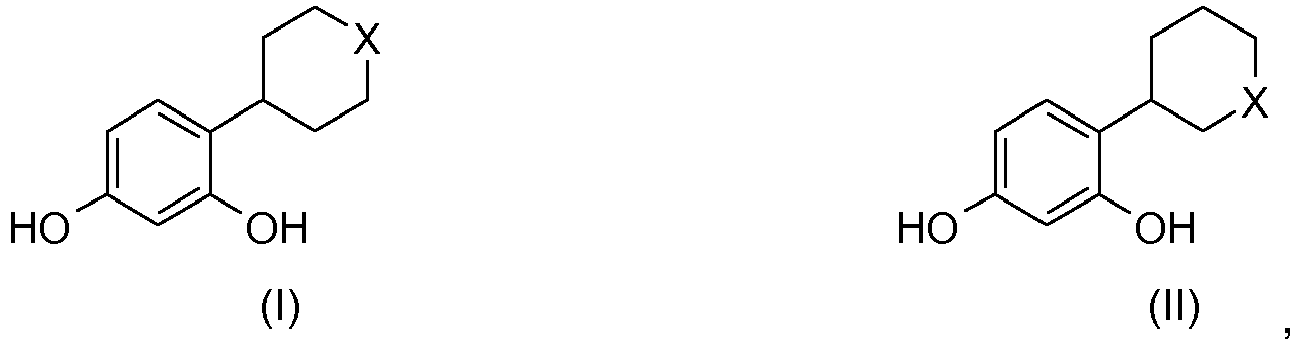
- the present invention relates to a process for the synthesis of 4- (heterocycloalkyl) -benzene-1,3-diol compounds having the following general formulas (I) and (II): in which X represents an oxygen atom or a sulfur atom.
- 2,4-dibenzyloxy bromobenzene (2) then reacts in the presence of butyllithium with heterocycloalkanones of general formula (3a) or (3b) ( Figures 1 and 2 ) to provide the benzyl alcohols, respectively, of the general formula (4a) or (4b).
- a first disadvantage of this process is the introduction of a sequence of protection / deprotection reactions of phenols with benzyl groups. Indeed, the need to protect the phenol functions of the compound (1) leads, on the one hand, to add two steps in the synthesis of the compounds (I) and (II) and on the other hand, to unnecessarily increase the mass of the intermediates (2), (4a) or (4b), which is not adapted from an industrial point of view, especially in terms of the economy of atoms.
- a second disadvantage of this synthetic route is the use, at the second stage, of cryogenic conditions (Butyllithium, of the order of -70 ° C.) which require equipment adapted to the industrial scale and which result in a additional cost in this process.
- cryogenic conditions butyllithium, of the order of -70 ° C.
- the present invention therefore aims to solve the problems mentioned above by proposing a process for the synthesis of 4- (heterocycloalkyl) -benzene-1,3-diol of general formula (I) or (II), comprising fewer steps, more economical, simpler and adaptable to the industrial scale.
- the object of the present invention relates to a process for the synthesis of a 4- (heterocycloalkyl) -benzene-1,3-diol corresponding to the general formula (I) in which X represents an oxygen or sulfur atom, characterized in that a compound corresponding to the general formula (7a) reacts with hydrogen in the presence of a palladium catalyst in a polar solvent when X represents an oxygen atom or with a silicon hydride reducing agent and a Lewis acid in an apolar solvent when X represents a sulfur atom.
- X represents an oxygen atom.
- Another subject of the invention relates to a process for the synthesis of a 4- (heterocycloalkyl) -benzene-1,3-diol corresponding to the general formula (II) in which X represents an oxygen or sulfur atom, characterized in that a compound corresponding to the general formula (7b) reacts with hydrogen in the presence of a palladium catalyst in a polar solvent when X represents an oxygen atom or with a silicon hydride reducing agent and a Lewis acid in an apolar solvent when X represents a sulfur atom.
- the polar solvent used in the two above processes is selected from the group comprising alcohols such as methanol for example, carboxylic acids such as acetic acid for example, esters such as ethyl acetate by for example, ethers such as tetrahydrofuran, for example, water and a mixture of these solvents.
- the alcohols are chosen from methanol, ethanol and isopropanol.
- the apolar solvent is chosen from the group comprising dichloromethane and 1,2-dichloroethane.
- the palladium catalyst is selected from the group consisting of palladium on carbon, palladium hydroxide and palladium acetate.
- the hydrogen pressure used in the processes of the invention is between 1 and 10 bar.
- the compound corresponding to the general formula (7a) in which X represents an oxygen atom or a sulfur atom is obtained by reacting resorcinol with a heterocycloalkanone corresponding to the general formula (3a) in a polar solvent and in the presence of a base.
- the compound corresponding to the general formula (7b) in which X represents an oxygen atom or a sulfur atom is obtained by reacting resorcinol with a heterocycloalkanone corresponding to the general formula (3b) in a polar solvent and in the presence of a base.
- the base is selected from the group consisting of sodium hydroxide, potassium hydroxide, lithium hydroxide and metal alkoxides, preferably sodium methanolate and potassium tert-butoxide.
- the base is sodium hydroxide or potassium hydroxide.
- the polar solvent is selected from the group consisting of water and alcohols, preferably methanol, ethanol, and isopropanol.
- the polar solvent is water.
- resorcinol and heterocycloalkanone (3a) or (3b) are used in a resorcinol / heterocycloalkanone molar ratio of between 1 and 8.
- Another subject of the invention relates to the compound of general formula (7a) or (7b) wherein X represents an oxygen atom or a sulfur atom.
- the compound is selected from the group consisting of 4- (4-Hydroxy-tetrahydro-pyran-4-yl) -benzene-1,3-diol and 4- (3-hydroxy-tetrahydro-pyran-3- yl) -benzene-1,3-diol.
- This new synthetic route uses resorcinol (6) as a starting material, which is economically very advantageous compared to the price of 2,4-dihydroxybromobenzene (1).
- the first step of this new synthetic route is an original step of coupling resorcinol (6) with heterocycloalkanones (3a) or (3b) in the presence of a base.
- the base used is preferably selected from the group consisting of sodium hydroxide, potassium hydroxide, lithium hydroxide and metal alkoxides. sodium methanolate or potassium tert-butoxide, for example.
- This step is carried out in a polar solvent, preferably in water or in alcohols, and allows the compounds (7a) or (7b) to be obtained directly, respectively.
- the alcohols are preferably selected from the group comprising methanol, ethanol and isopropanol.
- an excess of resorcinol (6) is preferably used to react on the heterocycloalkanone (3a) or (3b). More specifically, the resorcinol / heterocycloalkanone molar ratio is between 1 and 8 and preferably between 2 and 4.
- the temperature at which this coupling step is performed represents another advantage of this new synthetic route. Indeed, this first step is carried out at ambient temperature, in water or in alcohols, which makes it possible to avoid the cryogenic step (of the order of -70 ° C.) of the process disclosed in WO 2010/063773 .
- the reaction intermediates (7a) or (7b) are obtained in crystalline form after neutralization of the medium and makes it possible to dispense with the purification steps.
- the separation on a chromatography column to isolate the reaction intermediates (7a) or (7b) is not necessary, which is another advantage for the transposition of this process on an industrial scale. It is preferable to have a pH equal to 7 or a pH of 7 to 8.
- the pH is equal to 7.
- the second step of this new synthesis route is a hydrogenation or reduction step of the intermediates (7a) or (7b) to obtain the compounds of formula (I) or (II), respectively.
- the hydrogenation of the intermediates (7a) or (7b) is carried out in a polar solvent.
- Preferred polar solvents are selected from the group consisting of alcohols such as methanol for example, carboxylic acids such as acetic acid for example, esters such as ethyl acetate for example, ethers such as tetrahydrofuran for example, water and a mixture of these solvents.
- the alcohols are preferably selected from the group comprising methanol, ethanol and isopropanol.
- the hydrogenation is carried out in the presence of a palladium-based catalyst.
- the preferred catalysts are selected from the group consisting of palladium on carbon, palladium hydroxide, palladium acetate, or any other reduction catalyst known to those skilled in the art.
- the hydrogen pressure used is between 1 and 10 bar and preferably between 3 and 7 bar.
- the reduction of the intermediates (7a) or (7b) is carried out in an apolar solvent.
- Preferred apolar solvents are selected from the group consisting of dichloromethane and 1,2-dichloroethane.
- the reduction is carried out in the presence of a silicon hydride reducing agent and a Lewis acid.
- the preferred reducing agents are selected from the group consisting of triethylsilane, polymethylhydrosiloxane (PMHS) and any other silicon hydride known to those skilled in the art.
- the preferred Lewis acids are selected from the group consisting of boron trifluoride and its complexes such as, for example, trifluoroborane etherate.
Landscapes
- Chemical & Material Sciences (AREA)
- Organic Chemistry (AREA)
- Pyrane Compounds (AREA)
- Pharmaceuticals Containing Other Organic And Inorganic Compounds (AREA)
- Organic Low-Molecular-Weight Compounds And Preparation Thereof (AREA)
Description
- La présente invention se rapporte à un procédé de synthèse de composés 4-(hétérocycloalkyl)-benzène-1,3-diol répondant aux formules générales (I) et (II) suivantes :

- La synthèse de composés analogues à ceux des formules (I) et (II) ci-dessus a été décrite dans la demande de brevet
WO 2010/063773 . Cette synthèse est réalisée en trois étapes (figures 1 et 2 ) - Dans la première étape du procédé décrit dans la demande de brevet
WO 2010/063773 (figures 1 et 2 ), le 2,4-dihydroxy bromobenzene (1) est mis en réaction avec du bromure de benzyle pour fournir le 2,4-dibenzyloxy bromobenzene (2).
- Le 2,4-dibenzyloxy bromobenzene (2) réagit ensuite en présence de butyllithium avec des hétérocycloalkanones de formule générale (3a) ou (3b) (
Figures 1 et 2 ) pour fournir les alcools benzyliques, respectivement, de formule générale (4a) ou (4b).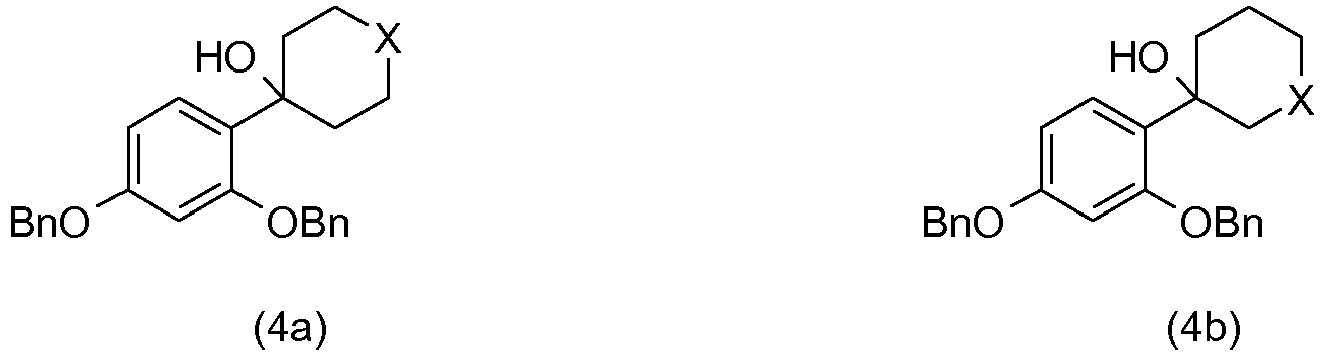
- Les composés de formule générale (I) et (II)
- Un premier inconvénient de ce procédé est l'introduction d'une séquence de réactions de protection / déprotection des phénols par des groupements benzyles. En effet, la nécessité de protéger les fonctions phénols du composé (1) conduit, d'une part, à rajouter deux étapes dans la synthèse des composés (I) et (II) et d'autre part, à augmenter inutilement la masse des intermédiaires (2), (4a) ou (4b), ce qui n'est pas adapté d'un point de vue industriel, notamment au niveau de l'économie d'atomes.
- De plus, cette synthèse fait intervenir du bromure de benzyle dont les propriétés lacrymogènes rendent délicate la manipulation à l'échelle industrielle.
- Un deuxième inconvénient de cette voie de synthèse est l'utilisation, à la deuxième étape, de conditions cryogéniques (Butyllithium, de l'ordre de -70°C) qui nécessitent un équipement adapté à l'échelle industrielle et qui ont pour conséquence un coût supplémentaire dans ce procédé.
- Enfin, un troisième inconvénient de ce procédé est le prix élevé du 2,4-dihydroxy bromobenzene ainsi que celui du butyllithium.
- Dans le cadre du développement de ces composés, il existe un besoin de disposer d'une méthode permettant de préparer économiquement et dans des conditions de sécurité les composés de formule générale (I) ou (II) tout en évitant les inconvénients mentionnés ci-dessus.
- La présente invention vise donc à résoudre les problèmes cités ci-dessus en proposant un procédé de synthèse de 4-(hétérocycloalkyl)-benzene-1,3-diol de formule générale (I) ou (II), comportant moins d'étapes, plus économique, plus simple et susceptible d'être adapté à l'échelle industrielle.
- L'objet de la présente invention est relatif à un procédé de synthèse d'un 4-(hétérocycloalkyl)-benzene-1,3-diol répondant à la formule générale (I)


- Un autre objet de l'invention concerne un procédé de synthèse d'un 4-(hétérocycloalkyl)-benzene-1,3-diol répondant à la formule générale (II)


- De préférence, le solvant polaire utilisé dans les deux procédés ci-dessus est choisi dans le groupe comprenant les alcools comme le méthanol par exemple, les acides carboxyliques comme l'acide acétique par exemple, les esters comme l'acétate d'éthyle par exemple, les éthers comme le tetrahydrofuranne par exemple, l'eau et un mélange de ces solvants. Avantageusement, les alcools sont choisis parmi le méthanol, l'éthanol et l'isopropanol.
- De préférence, le solvant apolaire est choisi dans le groupe comprenant le dichlorométhane et le dichloro-1,2-éthane.
- De préférence, le catalyseur à base palladium est choisi dans le groupe constitué par le palladium sur charbon, l'hydroxyde de palladium et l'acétate de palladium.
- De préférence, la pression d'hydrogène utilisée dans les procédés de l'invention est comprise entre 1 et 10 bars.
- Dans un autre mode de réalisation particulier, le composé répondant à la formule générale (7a)

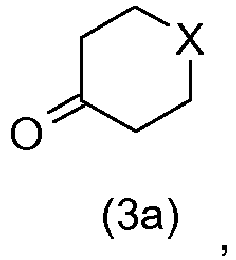
- Dans un autre mode de réalisation particulier, le composé répondant à la formule générale (7b)


- De préférence, la base est choisie dans le groupe comprenant l'hydroxyde de sodium, l'hydroxyde de potassium, l'hydroxyde de lithium et les alcoolates de métaux, de préférence le méthanolate de sodium et le tert-butylate de potassium. Avantageusement, la base est l'hydroxyde de sodium ou l'hydroxyde de potassium.
- De préférence, le solvant polaire est choisi dans le groupe comprenant l'eau et les alcools, de préférence le méthanol, l'éthanol, et l'isopropanol. Avantageusement, le solvant polaire est l'eau.
- De préférence, le résorcinol et l'hétérocycloalkanone (3a) ou (3b) sont utilisés dans un rapport molaire résorcinol/hétérocycloalkanone compris entre 1 et 8.
- Un autre objet de l'invention concerne le composé de formule générale (7a) ou (7b)

- Le nouveau procédé de synthèse de 4-(hétérocycloalkyl)-benzene-1,3-diol (I) ou (II), de l'invention et tel qu'illustré aux
figures 3 et 4 , présente l'avantage d'être une synthèse courte comprenant au maximum une séquence linéaire de 2 étapes. - Cette nouvelle voie de synthèse utilise le résorcinol (6) comme produit de départ, ce qui, économiquement, est très avantageux comparé au prix du 2,4-dihydroxy bromobenzene (1).
- La première étape de cette nouvelle voie de synthèse est une étape originale de couplage du résorcinol (6) avec les hétérocycloalkanones (3a) ou (3b) en présence d'une base. La base utilisée est choisie de préférence dans le groupe comprenant l'hydroxyde de sodium, l'hydroxyde de potassium, l'hydroxyde de lithium et les alcoolates de métaux comme le méthanolate de sodium ou le tert-butylate de potassium par exemple. Cette étape est réalisée dans un solvant polaire, de préférence dans l'eau ou dans des alcools, et permet d'obtenir directement les composés (7a) ou (7b) respectivement. Les alcools sont choisis de préférence dans le groupe comprenant le méthanol, l'éthanol et l'isopropanol.
- Lors de cette première étape, un excès de résorcinol (6) est de préférence utilisé pour réagir sur l'hétérocycloalkanone (3a) ou (3b). Plus spécifiquement, le rapport molaire résorcinol/hétérocycloalkanone est compris entre 1 et 8 et, de préférence, entre 2 et 4.
- La température à laquelle est effectuée cette étape de couplage représente un autre avantage de cette nouvelle voie de synthèse. En effet, cette première étape est réalisée à température ambiante, dans l'eau ou dans les alcools, ce qui permet d'éviter l'étape cryogénique (de l'ordre de -70°C) du procédé divulgué dans
WO 2010/063773 . D'autre part, les intermédiaires réactionnels (7a) ou (7b) sont obtenus sous forme cristalline après neutralisation du milieu et permet de s'affranchir des étapes de purification. Ainsi, la séparation sur une colonne de chromatographie pour isoler les intermédiaires réactionnels (7a) ou (7b)
- La seconde étape de cette nouvelle voie de synthèse est une étape d'hydrogénation ou de réduction des intermédiaires (7a) ou (7b) pour obtenir respectivement les composés de formule (I) ou (II).
- Dans le cas où X représente un atome d'oxygène, l'hydrogénation des intermédiaires (7a) ou (7b) est réalisée dans un solvant polaire. Les solvants polaires préférés sont choisis dans le groupe comprenant les alcools comme le méthanol par exemple, les acides carboxyliques comme l'acide acétique par exemple, les esters comme l'acétate d'éthyle par exemple, les éthers comme le tetrahydrofuranne par exemple, l'eau et un mélange de ces solvants. Les alcools sont choisis de préférence dans le groupe comprenant le méthanol, l'éthanol et l'isopropanol.
- L'hydrogénation est réalisée en présence d'un catalyseur à base de palladium. Les catalyseurs préférés sont choisis dans le groupe constitué par le palladium sur charbon, l'hydroxyde de palladium, l'acétate de palladium, ou encore tout autre catalyseur de réduction connu de l'homme du métier. La pression d'hydrogène utilisée est comprise entre 1 et 10 bars et de préférence entre 3 et 7 bars.
- Dans le cas où X représente un atome de soufre, la réduction des intermédiaires (7a) ou (7b) est réalisée dans un solvant apolaire. Les solvants apolaires préférés sont choisis dans le groupe comprenant le dichlorométhane et le dichloro-1,2-éthane. La réduction est réalisée en présence d'un réducteur de type hydrure de silicium et d'un acide de Lewis. Les réducteurs préférés sont choisis dans le groupe constitué par le triethylsilane, le polymethylhydrosiloxane (PMHS) et encore tout autre hydrure de silicium connu de l'homme du métier. Les acides de Lewis préférés sont choisis dans le groupe constitué par le trifluorure de bore et ses complexes comme par exemple l'éthérate de trifluoroborane.
-
-
Figure 1 : Préparation des composés de formule (I) décrite dansWO 2010/063773 -
Figure 2 : Préparation des composés de formule (II) décrite dansWO 2010/063773 -
Figure 3 : Procédé de préparation des composés de l'invention de formule (I) -
Figure 4 : Procédé de préparation des composés de l'invention de formule (II) - Les exemples suivants sont maintenant présentés en vue d'illustrer le procédé tel que décrit précédemment. Ces exemples qui illustrent le procédé de l'invention ne sont pas limitatifs.
- Dans un réacteur double enveloppe de 6 L, 550 g (5 moles, 4eq) de résorcinol sont chargés sous azote puis 1530 ml d'une solution de soude 3M sont ajoutés en maintenant la température à 17°C. 125 g de tetrahydro-4-pyranon-4-one (1.25 mol, 1 eq) sont ajoutés au milieu réactionnel. Le mélange est alors agité 2 heures à température ambiante, l'avancement de la réaction est contrôlé par plaque CCM (éluant hept /AcOEt 2/1). La réaction est arrêtée par l'ajout d'une solution d'acide chlorhydrique 2M jusqu'à obtenir un pH = 7 (pH metre). 830 g de NaCl sont alors ajoutés et le milieu réactionnel est agité une nuit à température ambiante. Le solide est filtré puis lavé trois fois avec 11 d'eau. Le solide est essoré puis séché sous vide à 50°C une nuit pour fournir 125 g de 4-(4-hydroxy-tetrahydro-pyran-4-yl)-benzene-1,3-diol sous forme de poudre blanche cristalline. Rdt = 48%. Tf = 152 ° C
RMN 1 H (DMSO D6, 400 MHz): 1.50 (m, 2H) ; 2.21 (m, 2H) ; 3.69 (m, 4H) ; 5.50 (sl, 1 H) ; 6.20 (m, 2H) ; 7.16 (d, J = 8 Hz, 1 H) ; 6.82 (d, J = 8.4 Hz, 1 H) ; 8.95 (s, 1 H) ; 9.11 (sl, 2H). - Dans un réacteur de PARR sous azote, 100 g (0.47 mol) de 4-(4-hydroxy-tetrahydro-pyran-4-yl)-benzene-1,3-diol sont placés suivis par 100 mL d'acide acétique ainsi que 10 g de palladium sur charbon à 10%. 400 mL de THF sont ajoutés et le milieu réactionnel est agité 5 heures sous 5 bars d'hydrogène et à température ambiante. La solution est alors filtrée sur clarcel, le clarcel est lavé avec 250 ml de THF puis le filtrat est concentré jusqu'à obtenir un volume final de150 mL. 50 mL d'acétate d'éthyle sont alors ajoutés et le mélange réactionnel est agité une heure à 0°C. Le solide est filtré puis lavé avec 50 ml d'acétate d'éthyle supplémentaire puis séché sous vide pour fournir 84 g de 4-(Tetrahydro-pyran-4-yl)-benzene-1,3-diol sous forme de produit cristallin. Rdt = 92%.
Tf = 223 °C
RMN 1 H (DMSO D6, 400 MHz): 1.54 (m, 4H) ; 2.92 (m, 1 H) ; 3.39 (m, 2H) ; 3.90 (m, 2H) ; 6.14 (dd, J = 8.4 & 2.4 Hz, 1 H) ; 6.25 (d, J = 2.4 Hz, 1 H) ; 6.82 (d, J = 8.4 Hz, 1 H) ; 8.95 (s, 1 H) ; 9.11 (s, 1 H).
RMN 13 C (DMSO D6, 100 MHz) : 32.6, 33.5, 67.7, 102.3, 106.0, 122.4, 126.7, 155.2, 156.0. - 13.43 g (0.115 mol, 1 éq) de tétrahydro-thiopyran-4-one en suspension dans 100 mL d'eau sont ajoutés sur un mélange dégazé de 25.45 g (0.231 mol, 2.0 éq) de résorcinol solubilisés dans 115 mL (0.231 mol, 2.0 éq) d'hydroxyde de sodium 2N. Le milieu réactionnel est agité à température ambiante pendant 2 heures et 30 minutes. Le milieu réactionnel est traité avec 100 mL d'une solution d'acide chlorhydrique 2N (pH 5) et extrait à l'acétate d'éthyle. Les phases organiques sont rassemblées, séchées sur sulfate de magnésium, filtrées et évaporées. 40.88 g d'huile jaune sont obtenus.
Cette huile est solubilisée dans 1 L de dichlorométhane et engagée dans l'étape suivante. - 55 mL (0.345 mol, 3 éq) de triéthylsilane suivis de 44 mL (0.345 mol, 3 éq) d'éthérate de trifluoroborane sont ajoutés goutte à goutte sur une solution (0.115 mol, 1 éq) de 4-(4-hydroxy-tetrahydro-thiopyran-4-yl)-benzene-1,3-diol brut tel qu'obtenu à l'étape précédente dans 1 L de dichlorométhane. Le milieu réactionnel est agité à température ambiante pendant 10 minutes. 400 mL d'eau sont ajoutés dans le milieu réactionnel suivis de 250 mL d'une solution saturée d'hydrogénocarbonate de sodium. Le mélange est décanté et la phase aqueuse est extraite avec du dichlorométhane. Les phases organiques sont rassemblées, lavées à l'eau, séchées sur sulfate de magnésium et concentrées. L'insoluble est filtré. 6.85g de 4-(tétrahydro-thiopyran-4-yl)-benzène-1,3-diol sont obtenus sous forme d'une poudre blanche. Rendement = 28% sur les deux étapes
Tf = 171 °C
RMN 1 H (DMSO D6, 400 MHz): 1.61 (m, 2H) ; 1.92 (m, 2H) ; 2.55 (m, 2H), 2.72 (m, 3H) ; 6.14 (dd, J = 8.4 & 2.4 Hz, 1 H) ; 6.25 (d, J = 2.4 Hz, 1 H) ; 6.80 (d, J = 8.4 Hz, 1 H) ; 8.95 (s, 1 H) ; 9.10 (s, 1 H).
RMN 13 C (DMSO D6, 100 MHz) : 28.7, 33.8, 35.6, 102.3, 106.0, 123.5, 126.7, 154.8, 156.0. - 2.1 g (0.02 mol, 1 éq) de dihydro-pyran-3-one en solution dans 2 mL d'eau sont ajoutés goutte à goutte sur un mélange dégazé de 8.8 g (0.08 mol, 4.0 éq) de résorcinol solubilisés dans 25 mL (0.075 mol, 3.7 éq) d'hydroxyde de sodium 3N. Le milieu réactionnel est agité à température ambiante pendant 1 heure. Le milieu réactionnel est traité avec 5 mL d'une solution d'acide chlorhydrique concentré (pH 7) et 9 g de chlorure de sodium sont ajoutés. Le mélange est refroidi dans un bain de glace et extrait à l'acétate d'éthyle. Les phases organiques sont rassemblées, séchées sur sulfate de magnésium, filtrées et évaporées. Le résidu est chromatographié sur gel de silice (colonne AnaLogix SF40-150g, Spot II) élué à l'heptane/acétate d'éthyle 80/20 puis 20/80. 2.91 g de 4-(3-hydroxy-tétrahydro-pyran-3-yl)-benzène-1,3-diol sont obtenus sous forme d'un solide amorphe blanc. Rendement = 69%
- Un mélange de 2.9 g (0.14 mol, 1 éq) de 4-(3-hydroxy-tétrahydro-pyran-3-yl)-benzène-1,3-diol dans 60 mL d'acétate d'éthyle et 6 mL de méthanol en présence de 580 mg (20% en masse) de palladium sur charbon à 10% est agité sous pression d'hydrogène de 5 bars à température ambiante pendant 5 heures puis chauffé à 50°C pendant 24 heures (formation de 10% de produit). 580 mg (20% en masse) de palladium sur charbon à 10% sont rajoutés et le milieu réactionnel est chauffé à 60°C sous pression d'hydrogène de 5 bars pendant 6 jours. 580 mg (20% en masse) de palladium sur charbon à 10% sont rajoutés et le milieu réactionnel est chauffé à 60°C sous pression d'hydrogène de 5 bars pendant 24 heures. Le milieu réactionnel est filtré sur papier filtre et le filtrat est évaporé. Le résidu est chromatographié sur gel de silice (colonne AnaLogix SF40-150g, Spot II) élué à l'heptane/acétate d'éthyle 78/22 à 50/50. L'huile obtenue est cristallisée dans dichlorométhane/heptane, filtré et séché sous vide à 40°C. 1.21 g de 4-(tétrahydro-pyran-3-yl)-benzène-1,3-diol sont obtenus sous forme d'un solide blanc. (Tf = 148-149°C). Rendement = 44%
RMN 1 H (DMSO D6, 400 MHz): 1.54-1.77 (m, 4H) ; 2.94 (m, 1 H) ; 3.12 (t, J = 10.6 Hz, 1H) ; 3.30 (m, 1H), 3.75 (m, 1H) ; 3.81 (d, J = 11 Hz, 1 H); 6.15 (dd, J = 8.4 & 2.4 Hz, 1 H) ; 6.26 (d, J = 2.4 Hz, 1 H); 6.84 (d, J = 8.4 Hz, 1 H) ; 9.00 (s, 1 H) ; 9.18 (s, 1 H).
RMN 13 C (DMSO D6, 100 MHz) : 26.2; 28.8; 34.9; 67.2; 72.1; 102.3; 106.0; 119.0; 127.3; 155.6; 156.4.
Claims (15)
- Procédé de synthèse d'un 4-(hétérocycloalkyl)-benzene-1,3-diol répondant à la formule générale (I)


- Procédé de synthèse d'un 4-(heterocycloalkyl)-benzene-1,3-diol répondant à la formule générale (II)


- Procédé selon la revendication 1 ou 2, caractérisé en ce que le solvant polaire est choisi dans le groupe comprenant les alcools, de préférence le méthanol, les acides carboxyliques, de préférence l'acide acétique, les esters, de préférence l'acétate d'éthyle, les éthers, de préférence le tetrahydrofuranne, l'eau et un mélange de ces solvants.
- Procédé selon la revendication 3, caractérisé en ce que les alcools sont choisis dans le groupe comprenant le méthanol, l'éthanol et l'isopropanol.
- Procédé selon la revendication 1 ou 2, caractérisé en ce que le solvant apolaire est choisi dans le groupe comprenant le dichlorométhane et le dichloro-1,2-éthane.
- Procédé selon la revendication 1 ou 2, caractérisé en ce que le catalyseur à base de palladium est choisi dans le groupe constitué par le palladium sur charbon, l'hydroxyde de palladium et l'acétate de palladium.
- Procédé selon la revendication 1 ou 2, caractérisé en ce que la pression d'hydrogène utilisée est comprise entre 1 et 10 bars.
- Procédé selon la revendication 1, caractérisé en ce que le composé répondant à la formule générale (7a)


- Procédé selon la revendication 2, caractérisé en ce que le composé répondant à la formule générale (7b)


- Procédé selon la revendication 8 ou 9, caractérisé en ce que la base utilisée est choisie dans le groupe comprenant l'hydroxyde de sodium, l'hydroxyde de potassium, l'hydroxyde de lithium et les alcoolates de métaux comme le methanolate de sodium ou le tert-butylate de potassium, et de préférence choisie dans le groupe comprenant l'hydroxyde de sodium et l'hydroxyde de potassium.
- Procédé selon la revendication 8 ou 9, caractérisé en ce que solvant polaire est choisi dans le groupe comprenant l'eau et les alcools, de préférence, l'eau, le méthanol, l'éthanol ou l'isopropanol.
- Procédé selon la revendication 8 ou 9, caractérisé en ce que le résorcinol et l'heterocycloalkanone (3a) ou (3b) sont utilisés dans un rapport molaire résorcinol/heterocycloalkanone compris entre 1 et 8.
- Composé de formule générale (7a) ou (7b)

- Composé selon la revendication 13 caractérisé en ce qu'il est choisi dans le groupe constitué par le 4-(4-Hydroxy-tetrahydro-pyran-4-yl)-benzene-1,3-diol et le 4-(3-Hydroxy-tetrahydro-pyran-3-yl)-benzene-1,3-diol.
- Procédé de synthèse selon la revendication 1 caractérisé en ce que X représente un atome d'oxygène.
Applications Claiming Priority (3)
| Application Number | Priority Date | Filing Date | Title |
|---|---|---|---|
| US201361764638P | 2013-02-14 | 2013-02-14 | |
| FR1351252 | 2013-02-14 | ||
| PCT/FR2014/050312 WO2014125231A1 (fr) | 2013-02-14 | 2014-02-14 | Procede de synthese de composes 4-(heterocycloalkyl)-benzene-1,3-diol |
Publications (2)
| Publication Number | Publication Date |
|---|---|
| EP2956449A1 EP2956449A1 (fr) | 2015-12-23 |
| EP2956449B1 true EP2956449B1 (fr) | 2017-06-28 |
Family
ID=51353520
Family Applications (1)
| Application Number | Title | Priority Date | Filing Date |
|---|---|---|---|
| EP14710599.3A Not-in-force EP2956449B1 (fr) | 2013-02-14 | 2014-02-14 | Procede de synthese de composes 4-(heterocycloalkyl)-benzene-1,3-diol |
Country Status (4)
| Country | Link |
|---|---|
| US (1) | US9745281B2 (fr) |
| EP (1) | EP2956449B1 (fr) |
| ES (1) | ES2635290T3 (fr) |
| WO (1) | WO2014125231A1 (fr) |
Family Cites Families (1)
| Publication number | Priority date | Publication date | Assignee | Title |
|---|---|---|---|---|
| FR2939136B1 (fr) | 2008-12-02 | 2010-12-03 | Galderma Res & Dev | Nouveaux composes 4-(heterocycloalkyl)-benzene-1,3-diol comme inhibiteurs de la tyrosinase, leur procede de preparation et leur utilisation en medecine humaine ainsi qu'en cosmetique |
-
2014
- 2014-02-14 WO PCT/FR2014/050312 patent/WO2014125231A1/fr not_active Ceased
- 2014-02-14 US US14/767,762 patent/US9745281B2/en not_active Expired - Fee Related
- 2014-02-14 ES ES14710599.3T patent/ES2635290T3/es active Active
- 2014-02-14 EP EP14710599.3A patent/EP2956449B1/fr not_active Not-in-force
Non-Patent Citations (1)
| Title |
|---|
| None * |
Also Published As
| Publication number | Publication date |
|---|---|
| EP2956449A1 (fr) | 2015-12-23 |
| WO2014125231A1 (fr) | 2014-08-21 |
| US9745281B2 (en) | 2017-08-29 |
| ES2635290T3 (es) | 2017-10-03 |
| US20160185749A1 (en) | 2016-06-30 |
Similar Documents
| Publication | Publication Date | Title |
|---|---|---|
| WO2002048078A1 (fr) | Chlorhydrate du 2-butyl-3-(4-'3-(dibutylamino)propoxy!benzoyl)-5-nitro-benzofurane et sa preparation | |
| EP2931708B1 (fr) | Composes cyclopropylboroniques, leur procede de preparation et leur utilisation | |
| CA2736600A1 (fr) | Procede de preparation de nebivolol | |
| CA1173447A (fr) | Derives de l'indene, procedes pour leur preparation, et leur utilisation comme medicaments | |
| EP2956438B1 (fr) | Procede de synthese de 4-piperidin-4-yl-benzene-1,3-diol et de ses sels et compose 4-(2,4-dihydroxy-phenyl)-4-hydroxy-piperidine-1-carboxylate de tert-butyle | |
| CA2851960C (fr) | Procede de synthese du 3,4-dimethoxybicyclo[4.2.0]octa-1,3,5-triene-7-carbonitrile, et application a la synthese de l'ivrabradine et de ses sels d'addition a un acide pharmaceutiquement acceptable | |
| WO2014125231A1 (fr) | Procede de synthese de composes 4-(heterocycloalkyl)-benzene-1,3-diol | |
| EP0258160A2 (fr) | Dérivés de 2,3 dihydrofuranne leur procédé de préparation, leur utilisation comme intermédiaire pour la préparation de tétrahydrofuranne | |
| CA2055325A1 (fr) | Nouveaux derives d'imidazole, leur procede de preparation et les compositions pharmaceutiques qui les contiennent | |
| EP2331549B1 (fr) | Procede de preparation du 1,6:2,3-dianhydro-beta-d-mannopyranose | |
| EP0685473B1 (fr) | Composés benzohétérocycliques, en tant qu'antioxydants | |
| EP0414686B1 (fr) | Derives de trifluoromethyl-1-tetralines, leur preparation et leur application pour la synthese de composes presentant des proprietes therapeutiques | |
| EP0177398A1 (fr) | Dérivés chlores de l'hexadécène, leur préparation et leur emploi dans la synthèse de la vitamine e | |
| KR100570279B1 (ko) | 코엔자임 Qn의 중간체 및 그 중간체의 제조방법 | |
| FR2614619A1 (fr) | Procede de preparation de n-((chloro-2)-benzyl) (thienyl-2)-2 ethylamine | |
| FR2494696A1 (fr) | Nouveau procede de preparation de steroides 3-amines et leurs sels | |
| FR3126708A1 (fr) | Procédé de fabrication de l’anion pentazolate à l’aide d’un oxydant à l’iode hypervalent | |
| FR2923826A1 (fr) | Procede de synthese de l'acide 4-benzofurane carboxylique | |
| JP2022029075A (ja) | チオエステル誘導体の製造方法 | |
| EP0097550A1 (fr) | Procédé de préparation de dérivés de la cystamine à activité oncostatique | |
| CA2646346A1 (fr) | Procede de preparation de derives [2-(2,3-dihydro-benzofuran- ou benzofuran-7-yloxy)-ethyl]-(3-cyclopenten-1-yl-benzyl)-amines et intermediaire de synthese | |
| FR2479190A1 (fr) | Procede de preparation de 2-substitue-4-hydroxy-2-cyclopenten-1-ones | |
| JPS6213935B2 (fr) | ||
| BE833577A (fr) | Derives d'acide prostanoique, leur procede de preparation et leurs applications | |
| JPS6228780B2 (fr) |
Legal Events
| Date | Code | Title | Description |
|---|---|---|---|
| PUAI | Public reference made under article 153(3) epc to a published international application that has entered the european phase |
Free format text: ORIGINAL CODE: 0009012 |
|
| 17P | Request for examination filed |
Effective date: 20150902 |
|
| AK | Designated contracting states |
Kind code of ref document: A1 Designated state(s): AL AT BE BG CH CY CZ DE DK EE ES FI FR GB GR HR HU IE IS IT LI LT LU LV MC MK MT NL NO PL PT RO RS SE SI SK SM TR |
|
| AX | Request for extension of the european patent |
Extension state: BA ME |
|
| DAX | Request for extension of the european patent (deleted) | ||
| 17Q | First examination report despatched |
Effective date: 20160818 |
|
| GRAP | Despatch of communication of intention to grant a patent |
Free format text: ORIGINAL CODE: EPIDOSNIGR1 |
|
| INTG | Intention to grant announced |
Effective date: 20170203 |
|
| GRAS | Grant fee paid |
Free format text: ORIGINAL CODE: EPIDOSNIGR3 |
|
| GRAA | (expected) grant |
Free format text: ORIGINAL CODE: 0009210 |
|
| AK | Designated contracting states |
Kind code of ref document: B1 Designated state(s): AL AT BE BG CH CY CZ DE DK EE ES FI FR GB GR HR HU IE IS IT LI LT LU LV MC MK MT NL NO PL PT RO RS SE SI SK SM TR |
|
| REG | Reference to a national code |
Ref country code: GB Ref legal event code: FG4D Free format text: NOT ENGLISH |
|
| REG | Reference to a national code |
Ref country code: CH Ref legal event code: EP |
|
| REG | Reference to a national code |
Ref country code: AT Ref legal event code: REF Ref document number: 904724 Country of ref document: AT Kind code of ref document: T Effective date: 20170715 |
|
| REG | Reference to a national code |
Ref country code: IE Ref legal event code: FG4D Free format text: LANGUAGE OF EP DOCUMENT: FRENCH |
|
| REG | Reference to a national code |
Ref country code: DE Ref legal event code: R096 Ref document number: 602014011216 Country of ref document: DE |
|
| REG | Reference to a national code |
Ref country code: ES Ref legal event code: FG2A Ref document number: 2635290 Country of ref document: ES Kind code of ref document: T3 Effective date: 20171003 |
|
| PG25 | Lapsed in a contracting state [announced via postgrant information from national office to epo] |
Ref country code: GR Free format text: LAPSE BECAUSE OF FAILURE TO SUBMIT A TRANSLATION OF THE DESCRIPTION OR TO PAY THE FEE WITHIN THE PRESCRIBED TIME-LIMIT Effective date: 20170929 Ref country code: NO Free format text: LAPSE BECAUSE OF FAILURE TO SUBMIT A TRANSLATION OF THE DESCRIPTION OR TO PAY THE FEE WITHIN THE PRESCRIBED TIME-LIMIT Effective date: 20170928 Ref country code: FI Free format text: LAPSE BECAUSE OF FAILURE TO SUBMIT A TRANSLATION OF THE DESCRIPTION OR TO PAY THE FEE WITHIN THE PRESCRIBED TIME-LIMIT Effective date: 20170628 Ref country code: HR Free format text: LAPSE BECAUSE OF FAILURE TO SUBMIT A TRANSLATION OF THE DESCRIPTION OR TO PAY THE FEE WITHIN THE PRESCRIBED TIME-LIMIT Effective date: 20170628 Ref country code: LT Free format text: LAPSE BECAUSE OF FAILURE TO SUBMIT A TRANSLATION OF THE DESCRIPTION OR TO PAY THE FEE WITHIN THE PRESCRIBED TIME-LIMIT Effective date: 20170628 |
|
| REG | Reference to a national code |
Ref country code: NL Ref legal event code: MP Effective date: 20170628 |
|
| REG | Reference to a national code |
Ref country code: LT Ref legal event code: MG4D |
|
| REG | Reference to a national code |
Ref country code: AT Ref legal event code: MK05 Ref document number: 904724 Country of ref document: AT Kind code of ref document: T Effective date: 20170628 |
|
| PG25 | Lapsed in a contracting state [announced via postgrant information from national office to epo] |
Ref country code: NL Free format text: LAPSE BECAUSE OF FAILURE TO SUBMIT A TRANSLATION OF THE DESCRIPTION OR TO PAY THE FEE WITHIN THE PRESCRIBED TIME-LIMIT Effective date: 20170628 Ref country code: RS Free format text: LAPSE BECAUSE OF FAILURE TO SUBMIT A TRANSLATION OF THE DESCRIPTION OR TO PAY THE FEE WITHIN THE PRESCRIBED TIME-LIMIT Effective date: 20170628 Ref country code: SE Free format text: LAPSE BECAUSE OF FAILURE TO SUBMIT A TRANSLATION OF THE DESCRIPTION OR TO PAY THE FEE WITHIN THE PRESCRIBED TIME-LIMIT Effective date: 20170628 Ref country code: LV Free format text: LAPSE BECAUSE OF FAILURE TO SUBMIT A TRANSLATION OF THE DESCRIPTION OR TO PAY THE FEE WITHIN THE PRESCRIBED TIME-LIMIT Effective date: 20170628 Ref country code: BG Free format text: LAPSE BECAUSE OF FAILURE TO SUBMIT A TRANSLATION OF THE DESCRIPTION OR TO PAY THE FEE WITHIN THE PRESCRIBED TIME-LIMIT Effective date: 20170928 |
|
| REG | Reference to a national code |
Ref country code: FR Ref legal event code: PLFP Year of fee payment: 5 |
|
| PG25 | Lapsed in a contracting state [announced via postgrant information from national office to epo] |
Ref country code: RO Free format text: LAPSE BECAUSE OF FAILURE TO SUBMIT A TRANSLATION OF THE DESCRIPTION OR TO PAY THE FEE WITHIN THE PRESCRIBED TIME-LIMIT Effective date: 20170628 Ref country code: EE Free format text: LAPSE BECAUSE OF FAILURE TO SUBMIT A TRANSLATION OF THE DESCRIPTION OR TO PAY THE FEE WITHIN THE PRESCRIBED TIME-LIMIT Effective date: 20170628 Ref country code: CZ Free format text: LAPSE BECAUSE OF FAILURE TO SUBMIT A TRANSLATION OF THE DESCRIPTION OR TO PAY THE FEE WITHIN THE PRESCRIBED TIME-LIMIT Effective date: 20170628 Ref country code: SK Free format text: LAPSE BECAUSE OF FAILURE TO SUBMIT A TRANSLATION OF THE DESCRIPTION OR TO PAY THE FEE WITHIN THE PRESCRIBED TIME-LIMIT Effective date: 20170628 Ref country code: AT Free format text: LAPSE BECAUSE OF FAILURE TO SUBMIT A TRANSLATION OF THE DESCRIPTION OR TO PAY THE FEE WITHIN THE PRESCRIBED TIME-LIMIT Effective date: 20170628 |
|
| PG25 | Lapsed in a contracting state [announced via postgrant information from national office to epo] |
Ref country code: IS Free format text: LAPSE BECAUSE OF FAILURE TO SUBMIT A TRANSLATION OF THE DESCRIPTION OR TO PAY THE FEE WITHIN THE PRESCRIBED TIME-LIMIT Effective date: 20171028 Ref country code: PL Free format text: LAPSE BECAUSE OF FAILURE TO SUBMIT A TRANSLATION OF THE DESCRIPTION OR TO PAY THE FEE WITHIN THE PRESCRIBED TIME-LIMIT Effective date: 20170628 Ref country code: SM Free format text: LAPSE BECAUSE OF FAILURE TO SUBMIT A TRANSLATION OF THE DESCRIPTION OR TO PAY THE FEE WITHIN THE PRESCRIBED TIME-LIMIT Effective date: 20170628 |
|
| REG | Reference to a national code |
Ref country code: DE Ref legal event code: R097 Ref document number: 602014011216 Country of ref document: DE |
|
| PG25 | Lapsed in a contracting state [announced via postgrant information from national office to epo] |
Ref country code: DK Free format text: LAPSE BECAUSE OF FAILURE TO SUBMIT A TRANSLATION OF THE DESCRIPTION OR TO PAY THE FEE WITHIN THE PRESCRIBED TIME-LIMIT Effective date: 20170628 |
|
| PLBE | No opposition filed within time limit |
Free format text: ORIGINAL CODE: 0009261 |
|
| STAA | Information on the status of an ep patent application or granted ep patent |
Free format text: STATUS: NO OPPOSITION FILED WITHIN TIME LIMIT |
|
| 26N | No opposition filed |
Effective date: 20180329 |
|
| PG25 | Lapsed in a contracting state [announced via postgrant information from national office to epo] |
Ref country code: SI Free format text: LAPSE BECAUSE OF FAILURE TO SUBMIT A TRANSLATION OF THE DESCRIPTION OR TO PAY THE FEE WITHIN THE PRESCRIBED TIME-LIMIT Effective date: 20170628 |
|
| REG | Reference to a national code |
Ref country code: CH Ref legal event code: PL |
|
| PG25 | Lapsed in a contracting state [announced via postgrant information from national office to epo] |
Ref country code: MC Free format text: LAPSE BECAUSE OF FAILURE TO SUBMIT A TRANSLATION OF THE DESCRIPTION OR TO PAY THE FEE WITHIN THE PRESCRIBED TIME-LIMIT Effective date: 20170628 Ref country code: MT Free format text: LAPSE BECAUSE OF FAILURE TO SUBMIT A TRANSLATION OF THE DESCRIPTION OR TO PAY THE FEE WITHIN THE PRESCRIBED TIME-LIMIT Effective date: 20170628 |
|
| REG | Reference to a national code |
Ref country code: IE Ref legal event code: MM4A |
|
| REG | Reference to a national code |
Ref country code: BE Ref legal event code: MM Effective date: 20180228 |
|
| PG25 | Lapsed in a contracting state [announced via postgrant information from national office to epo] |
Ref country code: LI Free format text: LAPSE BECAUSE OF NON-PAYMENT OF DUE FEES Effective date: 20180228 Ref country code: LU Free format text: LAPSE BECAUSE OF NON-PAYMENT OF DUE FEES Effective date: 20180214 Ref country code: CH Free format text: LAPSE BECAUSE OF NON-PAYMENT OF DUE FEES Effective date: 20180228 |
|
| PG25 | Lapsed in a contracting state [announced via postgrant information from national office to epo] |
Ref country code: IE Free format text: LAPSE BECAUSE OF NON-PAYMENT OF DUE FEES Effective date: 20180214 |
|
| PG25 | Lapsed in a contracting state [announced via postgrant information from national office to epo] |
Ref country code: BE Free format text: LAPSE BECAUSE OF NON-PAYMENT OF DUE FEES Effective date: 20180228 |
|
| PG25 | Lapsed in a contracting state [announced via postgrant information from national office to epo] |
Ref country code: TR Free format text: LAPSE BECAUSE OF FAILURE TO SUBMIT A TRANSLATION OF THE DESCRIPTION OR TO PAY THE FEE WITHIN THE PRESCRIBED TIME-LIMIT Effective date: 20170628 |
|
| PG25 | Lapsed in a contracting state [announced via postgrant information from national office to epo] |
Ref country code: PT Free format text: LAPSE BECAUSE OF FAILURE TO SUBMIT A TRANSLATION OF THE DESCRIPTION OR TO PAY THE FEE WITHIN THE PRESCRIBED TIME-LIMIT Effective date: 20170628 |
|
| PG25 | Lapsed in a contracting state [announced via postgrant information from national office to epo] |
Ref country code: CY Free format text: LAPSE BECAUSE OF FAILURE TO SUBMIT A TRANSLATION OF THE DESCRIPTION OR TO PAY THE FEE WITHIN THE PRESCRIBED TIME-LIMIT Effective date: 20170628 Ref country code: MK Free format text: LAPSE BECAUSE OF NON-PAYMENT OF DUE FEES Effective date: 20170628 Ref country code: HU Free format text: LAPSE BECAUSE OF FAILURE TO SUBMIT A TRANSLATION OF THE DESCRIPTION OR TO PAY THE FEE WITHIN THE PRESCRIBED TIME-LIMIT; INVALID AB INITIO Effective date: 20140214 |
|
| PG25 | Lapsed in a contracting state [announced via postgrant information from national office to epo] |
Ref country code: AL Free format text: LAPSE BECAUSE OF FAILURE TO SUBMIT A TRANSLATION OF THE DESCRIPTION OR TO PAY THE FEE WITHIN THE PRESCRIBED TIME-LIMIT Effective date: 20170628 |
|
| PGFP | Annual fee paid to national office [announced via postgrant information from national office to epo] |
Ref country code: IT Payment date: 20210112 Year of fee payment: 8 |
|
| PGFP | Annual fee paid to national office [announced via postgrant information from national office to epo] |
Ref country code: ES Payment date: 20210305 Year of fee payment: 8 |
|
| PGFP | Annual fee paid to national office [announced via postgrant information from national office to epo] |
Ref country code: FR Payment date: 20230221 Year of fee payment: 10 |
|
| REG | Reference to a national code |
Ref country code: ES Ref legal event code: FD2A Effective date: 20230428 |
|
| PG25 | Lapsed in a contracting state [announced via postgrant information from national office to epo] |
Ref country code: IT Free format text: LAPSE BECAUSE OF NON-PAYMENT OF DUE FEES Effective date: 20220214 |
|
| PGFP | Annual fee paid to national office [announced via postgrant information from national office to epo] |
Ref country code: GB Payment date: 20230221 Year of fee payment: 10 Ref country code: DE Payment date: 20230216 Year of fee payment: 10 |
|
| PG25 | Lapsed in a contracting state [announced via postgrant information from national office to epo] |
Ref country code: ES Free format text: LAPSE BECAUSE OF NON-PAYMENT OF DUE FEES Effective date: 20220215 |
|
| REG | Reference to a national code |
Ref country code: DE Ref legal event code: R119 Ref document number: 602014011216 Country of ref document: DE |
|
| GBPC | Gb: european patent ceased through non-payment of renewal fee |
Effective date: 20240214 |
|
| PG25 | Lapsed in a contracting state [announced via postgrant information from national office to epo] |
Ref country code: DE Free format text: LAPSE BECAUSE OF NON-PAYMENT OF DUE FEES Effective date: 20240903 |
|
| PG25 | Lapsed in a contracting state [announced via postgrant information from national office to epo] |
Ref country code: GB Free format text: LAPSE BECAUSE OF NON-PAYMENT OF DUE FEES Effective date: 20240214 |
|
| PG25 | Lapsed in a contracting state [announced via postgrant information from national office to epo] |
Ref country code: FR Free format text: LAPSE BECAUSE OF NON-PAYMENT OF DUE FEES Effective date: 20240229 |
|
| PG25 | Lapsed in a contracting state [announced via postgrant information from national office to epo] |
Ref country code: GB Free format text: LAPSE BECAUSE OF NON-PAYMENT OF DUE FEES Effective date: 20240214 Ref country code: FR Free format text: LAPSE BECAUSE OF NON-PAYMENT OF DUE FEES Effective date: 20240229 Ref country code: DE Free format text: LAPSE BECAUSE OF NON-PAYMENT OF DUE FEES Effective date: 20240903 |