EP2957549B1 - Kultursubstrat mit einer Wasserverfügbarkeit, die mit Torf vergleichbar ist - Google Patents
Kultursubstrat mit einer Wasserverfügbarkeit, die mit Torf vergleichbar ist Download PDFInfo
- Publication number
- EP2957549B1 EP2957549B1 EP14305960.8A EP14305960A EP2957549B1 EP 2957549 B1 EP2957549 B1 EP 2957549B1 EP 14305960 A EP14305960 A EP 14305960A EP 2957549 B1 EP2957549 B1 EP 2957549B1
- Authority
- EP
- European Patent Office
- Prior art keywords
- bark
- fraction
- based composition
- composition
- water availability
- Prior art date
- Legal status (The legal status is an assumption and is not a legal conclusion. Google has not performed a legal analysis and makes no representation as to the accuracy of the status listed.)
- Active
Links
Images

Classifications
-
- C—CHEMISTRY; METALLURGY
- C05—FERTILISERS; MANUFACTURE THEREOF
- C05F—ORGANIC FERTILISERS NOT COVERED BY SUBCLASSES C05B, C05C, e.g. FERTILISERS FROM WASTE OR REFUSE
- C05F11/00—Other organic fertilisers
-
- A—HUMAN NECESSITIES
- A01—AGRICULTURE; FORESTRY; ANIMAL HUSBANDRY; HUNTING; TRAPPING; FISHING
- A01G—HORTICULTURE; CULTIVATION OF VEGETABLES, FLOWERS, RICE, FRUIT, VINES, HOPS OR SEAWEED; FORESTRY; WATERING
- A01G24/00—Growth substrates; Culture media; Apparatus or methods therefor
- A01G24/20—Growth substrates; Culture media; Apparatus or methods therefor based on or containing natural organic material
- A01G24/22—Growth substrates; Culture media; Apparatus or methods therefor based on or containing natural organic material containing plant material
- A01G24/23—Wood, e.g. wood chips or sawdust
-
- C—CHEMISTRY; METALLURGY
- C09—DYES; PAINTS; POLISHES; NATURAL RESINS; ADHESIVES; COMPOSITIONS NOT OTHERWISE PROVIDED FOR; APPLICATIONS OF MATERIALS NOT OTHERWISE PROVIDED FOR
- C09K—MATERIALS FOR MISCELLANEOUS APPLICATIONS, NOT PROVIDED FOR ELSEWHERE
- C09K17/00—Soil-conditioning materials or soil-stabilising materials
- C09K17/52—Mulches
Definitions
- the present invention relates to the manufacture of culture substrates having properties and in particular a water availability similar to that of peat.
- peats are highly valued because of their high water availability, which translates water that can be stored by a substrate and extracted easily by the roots of most horticultural plants. common. This can also be referred to as a useful reserve or an easily usable reserve.
- peat presents significant constraints. Indeed, peat is organic matter from wet areas, frequently in sensitive and protected areas. Peat is present only in certain regions of the world, which is problematic for their transport because they require transport over long distances. In addition, their training process is very slow, so they can not be considered renewable. In addition, commonly used extraction processes release significant amounts of carbon and greenhouse gases.
- peat substitute materials have been sought for many years, and in particular materials with water availability similar to peat.
- materials with water availability similar to peat Among the many materials studied, none reaches water availability comparable to that of peat, for example between 250 and 400 mL per L of substrate.
- the water availability corresponds to the water released between matrix potentials of -1 kPa and -10 kPa; the measurement is carried out according to the methodology defined in the standard EN 13041 with a depression of 10 cm and a height of 100 cm of water.
- Shredded and sieved bark substitutes have also been proposed in order to exploit the benefits of bark to wood, ie greater resistance to biological degradation, and greater water retention.
- the barks are thus usually crushed and sieved to obtain particle size fractions of between 0 and 40 mm, which makes it possible to obtain drainage and aeration capacities of interest, but remains insufficient in terms of water availability.
- Fine grindings of bark have been proposed, but pose problems in terms of control and reproduction of the grain size, and in terms of clogging of the macroporosity due to the migration of the finest particles during cultivation.
- composting of the bark makes it possible to improve the availability of water obtained, without however making it possible to reach values close to those of the peats.
- composting is a process with several drawbacks, among which can be mentioned a significant duration of immobilization of the stock, losses of organic materials, non-reproducibility, and the need for dedicated infrastructure and resulting in a significant investment.
- the document FR 2,900,923 presents a process for obtaining a culture support from bark. However, this document presents the obtaining of interesting characteristics; pH, high absorbency, low bulk density, but which are common to many materials used for the production of culture media, and the method described in this document makes no mention of obtaining water availability values obtained .
- the document WO2012 / 047416 presents a culture support made from bark.
- the document EP 0147349 presents a culture support formed from wood chips.
- the present invention thus aims to provide a culture medium having a water availability comparable to that of peat.
- the present invention provides a culture support characterized in that it is carried out by defibration of a composition based on bark, said culture medium having a water availability greater than or equal to 250 mL / L.
- the bark composition comprises at least 80% by volume of bark.
- the remaining volume of the bark composition is typically wood.
- the bark is, for example, the outer bark of woody plants.
- the bark is, for example, the outer bark of woody plants.
- the defibration of the bark-based composition is typically carried out by elevation of temperature and compression, for example by means of a worm machine or any other device or preceded.
- the method may also include a step of grinding and sieving the bark-based composition, so that the bark-based composition to be extruded has a particle size of 25/40 mm.
- the composition to be extruded has a particle size of 10/25 mm
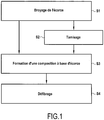
- the figure 1 schematically illustrates an exemplary method according to one aspect of the invention.
- a first optional step S1 the bark is crushed, typically conifer bark.
- the bark thus ground is sieved so as to obtain a bark having a determined particle size. It is thus sought to obtain a bark comprising particles of between 5 and 40 mm.
- the bark typically has a particle size of 25/40 mm, or a particle size of 10/25 mm.
- This second optional step S2 can be performed following the first optional step S1, and can also be performed independently of the first optional step S1.
- a bark-based composition is formed.
- the bark-based composition is formed by grouping bark, typically conifer bark, which is then typically grouped with wood, for example chips or wood chips. According to an embodiment not forming part of the claimed invention, the bark forms at least 70% by volume of the bark-based composition, or for example at least 80% by volume, or even more precisely at least 90% by volume of the bark composition, or at least 95% by volume of the bark composition. The remaining volume of the bark composition is typically wood.
- the bark-based composition consists of 100% bark. Other types of bark can be used. Depending on the nature of the bark, for example in the case of hardwood bark, it may be necessary to perform a preliminary step of treatment of phyto-toxicity.
- optional grinding and optional sieving may be performed after step S3 of forming the bark-based composition.
- a fourth step S4 the bark-based composition is defibrated, for example by extrusion by means of a machine, typically a worm, so as to achieve a compression and a rise in temperature. of the bark-based composition.
- a machine typically a worm
- the grinding can be achieved by means of other machines or processes.
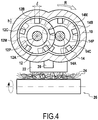
- the Figures 2 to 4 represent an example of a machine for carrying out a method according to one aspect of the invention.
- the figure 2 is a schematic top view of a defibration installation for carrying out the method of the invention, in which the wall of the sheath is cut.
- the figure 3 is a schematic view corresponding to a view of the installation of the figure 1 in section in plan II-II of the figure 2 the parts of the screw 14 present in this plane being omitted.
- the figure 4 is a section along line III-III of the figure 2 .
- the installation shown in the figures comprises a sleeve 10 in which two screws 12, 14 meshing with one another are arranged, thus forming a worm extrusion machine. Indeed, the spacing e between the two screws is less than the outer diameter of their nets.
- the shafts 12A and 14A of the screws 12 and 14 are rotated by a motor M and supported in rotation by bearings, such as the bearings 15.
- the outer wall of the sheath has the shape of two portions of secant cylinders each adapted to the diameter of the screws 12 and 14.
- the sheath has, preferably over its entire length, an opening cover forming one of its longitudinal walls for allow maintenance and cleaning, if necessary.
- the bark composition 16 to be defibrated that is to say reduced in fiber, is loaded into the sheath by a feed 20, located at the upstream end 10A of the sheath and having for example the shape of a hopper located on the upper face of the sheath, in which the bark-based composition is conveyed by any appropriate means, for example by a screw conveyor, not shown.
- the sheath At its downstream end 10B, the sheath has an outlet 22.
- This conveyor can be equipped a tunnel (not shown), ventilated by a gas such as air, preferably filtered, to progressively cool the fibers during their conveying.
- the opening of the wall of the sheath formed in the feed 20 is advantageously symmetrical with respect to the ratio to the median vertical plane between the axes 12A and 12B of the screws to ensure the good distribution of the bark-based composition on the two screws. as soon as they enter the sheath.
- the opening formed at the outlet 22 of the sheath is advantageously symmetrical with respect to the same vertical plane.
- the bark-based composition Due to the rotation of the screws, the bark-based composition is driven in the S direction from upstream to downstream.
- one or more extraction filters 28 used for extracting the juices from the grinding or washing waters of the bark-based composition, thus making it possible to regulate the final moisture of the product.
- these filters are placed at the upstream end of the braking zones which will be described below.
- the two screws 12 and 14 rotate in the same direction R and at the same rotational speed. Indeed, on each section of the vis-à-vis screws, the threads of the two screws are in the same direction. For each screw, the threads have an upstream series SM and a downstream series SA of sections.
- the nets also have an intermediate series SI located between the upstream SM and downstream SA series.
- the SM, SI and SA series are successively arranged from upstream to downstream of the sleeve.
- Each of these series itself comprises an upstream zone of training, respectively SME, SIE and SAE for the upstream, intermediate and downstream series, as well as a downstream braking zone, respectively SMF, SIF and SAF for the intermediate upstream series. and downstream.
- SME upstream zone of training
- SIE for the upstream
- a downstream braking zone respectively SMF, SIF and SAF for the intermediate upstream series. and downstream.
- These drive and braking zones are respectively described as upstream and downstream because, for each series, the drive zone is upstream of the braking zone in the advancing direction S of the bark composition. being defibrated.
- the threads 12B and 14B of the screws 12 and 14 are in direct pitch. This means that, by the rotation of the screws in the direction R, these nets naturally advance downstream the material that is located between them.
- the threads 12B and 14B are in reverse pitch, that is to say that the rotation of the screws in the R direction tends to cause the composition to reverse upstream. bark located between them. As a result, for each series, the bark-based composition being defibrated tends to agglutinate at the interface between the drive zone and the braking zone.
- the threads of the braking zones have interruptions or notches 12C, 14C.
- these notches form throttling zones through which the bark composition is forced to pass, under the effect of the thrust exerted, upstream, the bark-based composition driven downstream by the upstream driving zone.
- the bark-based composition undergoes a rise in temperature due to the pressure exerted within the extruder, which can be regulated in particular by the number and dimensions of the notches of the braking zones. By the effect of the increase of the temperature, the pressure and the friction, the bark disintegrates to keep only the primary structures constituting it, thus realizing the de-grinding.
- each thread has 5 identical notches, respectively 12C and 14C regularly distributed angularly.
- the geometric axes of the screws are materialized by the references 12A and 14A, which are the axes of rotation of their carrier shafts, respectively 12P and 14P.
- the screw sections being advantageously removable, their threads are carried by sleeves, respectively 12M and 14M, which are mounted on the bearing shafts and are secured to them in rotation by any appropriate means, for example by axial splines (not shown).
- the notches are delimited radially between the outer radial periphery of the thread and its inner radial periphery, delimited by the outer surface of the sleeve, respectively 12M and 14M.
- the outer diameter of each screw, delimited by the outer radial periphery of its thread is 240 mm
- the radial height h of a notch is 44 mm
- the width of a notch is 16 mm.
- the notches 12C or 14C of two consecutive threads of the same screw are slightly angularly offset.
- the notches of the threads which are located first from the cutting plane are shown in thick lines, while the position of the notches which equip the threads immediately downstream of these first threads has been shown in fine lines.
- the angular offset is of the order of 10 to 20 degrees and is oriented in the direction of rotation R of the screws, so that a line connecting two corresponding notches of two adjacent nets is oriented in the same direction. meaning that the nets with direct pitch.
- the supply of the installation is carried out continuously and the feed rate is set to respect pressure and temperature parameters.
- the installation advantageously comprises at least one temperature sensor CT located upstream of the downstream braking zone SMF of the upstream series (in the region of the section plane III-III).
- a correspondence table between temperature and pressure can be established.
- an increase in temperature revealed by the temperature sensor CT may reveal a risk of excessive pressure rise.
- the plant can be regulated by decreasing the feed rate of bark-based composition.
- the measurements of these sensors (at least that of the temperature sensor CT) can be inputted to a microprocessor which provides control to the bark-based composition supply system, for example a worm, as previously indicated. .
- the microprocessor can, in memory, have a temperature / pressure correspondence table. If a direct measurement of pressure is performed, the microprocessor can control the power system in composition based on bark on the basis of the two temperature / pressure data supplied to it. For a composition based on determined bark and a known humidity, it can be established a relationship between on the one hand, the pressure and temperature parameters and, on the other hand, the electrical power consumed by the engine that drives the screw in rotation (or the electric intensity delivered, if the electric tension is constant, as it is often the case). This relationship can be determined empirically by testing. As this relationship is known, the desired pressure and temperature parameters can be obtained by adjusting the bark composition feed so as to consume a target power.
- the Applicant has found that the residence time / pressure / temperature parameters are optimized if the machine is fed with bark-based composition so as to obtain an output fiber flow such that, knowing the total section notches of each net of the downstream series SA, the ratio R sd remains in the range of 65 to 85 mm 2 / m 3 h -1 , preferably between 75 and 85 mm 2 / M 3 h -1 . It has also been found that bark grinding requires less energy than wood grinding. For example, bark grinding requires about 80 kWh / T while wood grinding requires about 120 kWh / T. Of course, the settings of the plant and the process can be refined depending on the composition based on fluffed bark. An installation comprising two parallel screws rotating in the same direction and at the same speed in the sheath has been described above. A different number of parallel screws could be used, for example 4.
- the extrusion using a worm machine of a composition comprising 100% 10 / 25mm Scots pine bark achieved a water availability of 369.1 mL / L, a water availability substantially equal to that of the blonde peat.
- Extrusion using a worm machine of a composition comprising 90% by volume of 10/25 mm Scots pine bark and 10% by volume of wood chips resulted in availability in water of 256.1 mL / L, a water availability comparable to that of black peat.
- the extrusion using a worm machine of a composition comprising 100% maritime pine bark and 10 / 25mm black pine yielded a water availability of 346 mL / L, or a water availability substantially equal to that of the blonde peat.
- Extrusion using a worm machine of a composition comprising 80% by volume of maritime pine bark and 10/25 mm black pine and 20% by volume of wood chips allowed obtain a water availability of 277 mL / L, a water availability comparable to that of black peat.
- the extrusion using a worm machine of a composition comprising 70% by volume of maritime pine bark and 10/25 mm black pine and 30% by volume of pine wood chips has made it possible to obtain water availability 243 mL / L, a water availability that is approximately equal to that of black peat.
- the method presented thus makes it possible to obtain a culture support having a water availability comparable to that of peat, that is to say greater than or equal to 250 ml / L, which the known processes did not allow to carry out. .
- the method can be used to achieve a water availability greater than or equal to 240 mL / L, 260 mL / L, 270 mL / L, 280 mL / L, 290 mL / L, 300 mL / L, 310 mL / L, 320 mL / L, 330 mL / L, 340 mL / L, 350 mL / L, 360 mL / L, 370 mL / L or 375 mL / L.
- Table 1 presents the results of a particle size analysis of fibers resulting from a bark grinding process on the one hand, and wood on the other hand.
- the particles are concentrated between 100 and 1000 ⁇ m, this range of values representing approximately 65% of the fibers.
- the fine fraction corresponding to fibers less than 100 ⁇ m is reduced, here less than 5%.
- it is this fraction that can cause clogging of the porosity and a change in characteristics over time.
- a thin fraction poorly represented as obtained by bark grinding is therefore advantageous.
- the variation of the amount of wood in the bark composition makes it possible to influence other properties of the culture medium obtained. Increasing the amount of wood in the bark composition thus makes it possible, for example, to increase the aeration of the culture medium obtained. Moreover, the increase in the amount of wood in the composition based on bark leads to a gradual decrease in water availability. It is therefore possible, by varying the volume of bark and wood of the bark-based composition, to provide a culture support having desired water availability and aeration properties.
Landscapes
- Life Sciences & Earth Sciences (AREA)
- Chemical & Material Sciences (AREA)
- Organic Chemistry (AREA)
- Environmental Sciences (AREA)
- Engineering & Computer Science (AREA)
- Biodiversity & Conservation Biology (AREA)
- Ecology (AREA)
- Forests & Forestry (AREA)
- Wood Science & Technology (AREA)
- Cultivation Of Plants (AREA)
Claims (9)
- Zellkulturträger, dadurch gekennzeichnet, dass er durch Zerfasern einer Zusammensetzung auf Basis von Rinde hergestellt ist, wobei der Zellkulturträger eine Wasserverfügbarkeit von mehr als oder gleich 250 ml/l aufweist, wobei die Zusammensetzung auf Basis von Rinde 100 Volumenprozent Rinde umfasst, und umfasst:- eine Feinfraktion, die Teilchen von weniger als 100 µm entspricht und weniger als 10 % beträgt,- eine Mittelfraktion, die Teilchen zwischen 100 µm und 1000 µm entspricht und mehr als 50 % beträgt,- eine Grobfraktion, die Teilchen zwischen 1000 µm und 10000 µm entspricht und weniger als 40 % beträgt.
- Zellkulturträger gemäß Anspruch 1, wobei die Rinde äußere Rinde von Gehölzen ist.
- Zellkulturträger gemäß einem der Ansprüche 1 oder 2, wobei:- die Feinfraktion weniger als 5 % beträgt;- die Mittelfraktion mehr als 60 % beträgt;- die Grobfraktion weniger als 30 % beträgt.
- Verfahren zur Behandlung einer Zusammensetzung auf Basis von Rinde, bei dem die Zusammensetzung auf Basis von Rinde zerfasert wird, um Zellkulturträger mit einer Wasserverfügbarkeit von mehr als oder gleich 250 ml/l herzustellen, wobei die Zusammensetzung auf Basis von Rinde 100 Volumenprozent Rinde umfasst, und umfasst:- eine Feinfraktion, die Teilchen von weniger als 100 µm entspricht und weniger als 10 % beträgt,- eine Mittelfraktion, die Teilchen zwischen 100 µm und 1000 µm entspricht und mehr als 50 % beträgt,- eine Grobfraktion, die Teilchen zwischen 1000 µm und 10000 µm entspricht und weniger als 40 % beträgt.
- Verfahren gemäß Anspruch 4, wobei die Rinde äußere Rinde von Gehölzen ist.
- Verfahren gemäß einem der Ansprüche 4 oder 5, wobei die Zusammensetzung auf Basis von Rinde durch Erhöhen der Temperatur und Verdichten zerfasert wird.
- Verfahren gemäß Anspruch 5, bei dem das Erhöhen der Temperatur und das Verdichten mittels einer Schneckenmaschine durchgeführt werden.
- Verfahren gemäß einem der Ansprüche 6 oder 7, umfassend einen Schritt des Zermahlens und Siebens von Rinde, sodass die extrudierte Zusammensetzung auf Basis von Rinde eine Teilchengröße von 25/40 mm aufweist.
- Verfahren gemäß Anspruch 8, wobei die extrudierte Zusammensetzung eine Teilchengröße von 10/25 mm aufweist.
Priority Applications (5)
| Application Number | Priority Date | Filing Date | Title |
|---|---|---|---|
| ES14305960.8T ES2694801T3 (es) | 2014-06-20 | 2014-06-20 | Medio de cultivo que presenta una disponibilidad de agua comparable a una turba |
| EP14305960.8A EP2957549B1 (de) | 2014-06-20 | 2014-06-20 | Kultursubstrat mit einer Wasserverfügbarkeit, die mit Torf vergleichbar ist |
| US14/313,485 US20150368165A1 (en) | 2014-06-20 | 2014-06-24 | Cultivation medium presenting water availability comparable to that of a peat |
| CA2857861A CA2857861C (en) | 2014-06-20 | 2014-07-25 | A cultivation medium presenting water availability comparable to that of a peat |
| US15/647,422 US10703684B2 (en) | 2014-06-20 | 2017-07-12 | Cultivation medium presenting water availability comparable to that of a peat |
Applications Claiming Priority (1)
| Application Number | Priority Date | Filing Date | Title |
|---|---|---|---|
| EP14305960.8A EP2957549B1 (de) | 2014-06-20 | 2014-06-20 | Kultursubstrat mit einer Wasserverfügbarkeit, die mit Torf vergleichbar ist |
Publications (2)
| Publication Number | Publication Date |
|---|---|
| EP2957549A1 EP2957549A1 (de) | 2015-12-23 |
| EP2957549B1 true EP2957549B1 (de) | 2018-08-08 |
Family
ID=51167822
Family Applications (1)
| Application Number | Title | Priority Date | Filing Date |
|---|---|---|---|
| EP14305960.8A Active EP2957549B1 (de) | 2014-06-20 | 2014-06-20 | Kultursubstrat mit einer Wasserverfügbarkeit, die mit Torf vergleichbar ist |
Country Status (4)
| Country | Link |
|---|---|
| US (2) | US20150368165A1 (de) |
| EP (1) | EP2957549B1 (de) |
| CA (1) | CA2857861C (de) |
| ES (1) | ES2694801T3 (de) |
Families Citing this family (6)
| Publication number | Priority date | Publication date | Assignee | Title |
|---|---|---|---|---|
| US10266457B2 (en) * | 2014-06-29 | 2019-04-23 | Profile Products L.L.C. | Bark and wood fiber growing medium |
| KR102481020B1 (ko) | 2014-06-29 | 2022-12-26 | 프로파일 프러덕츠 엘엘씨 | 나무껍질 및 목재 섬유 성장 배지 |
| WO2016003903A1 (en) | 2014-06-29 | 2016-01-07 | Profile Products L.L.C. | Naturally dyed mulch and growing media |
| CA2953521C (en) | 2014-06-29 | 2023-05-23 | Profile Products L.L.C. | Growing medium and mulch fiber opening apparatus |
| US11686021B2 (en) * | 2014-06-29 | 2023-06-27 | Profile Products L.L.C. | Growing medium and mulch fiber opening apparatus |
| US10858492B2 (en) * | 2016-09-13 | 2020-12-08 | Dow Global Technologies Llc | Nucleating agent for foamable cable insulation |
Family Cites Families (9)
| Publication number | Priority date | Publication date | Assignee | Title |
|---|---|---|---|---|
| FR2556930B1 (fr) * | 1983-12-22 | 1986-05-16 | Fertil Aquitaine | Nouveau milieu de culture pour plantes |
| CH680290A5 (de) * | 1990-03-20 | 1992-07-31 | Iup Inst Fuer Umweltpflege Ag | |
| DE19757028B4 (de) * | 1997-12-20 | 2004-03-04 | Bioprodukte Prof. Steinberg Gmbh | Verfahren zur Herstellung eines hochwertigen Torfersatzstoffes |
| RU2298313C1 (ru) * | 2005-11-10 | 2007-05-10 | Общество с ограниченной ответственностью "Береста-ЭкоДом" | Способ сохранения продуктов полеводства и садоводства |
| FR2900923B1 (fr) | 2006-05-11 | 2008-12-05 | Ct Valorisation Ind Agro Resso | Procede d'obtention d'un substitut a la tourbe |
| WO2008027426A1 (en) * | 2006-08-29 | 2008-03-06 | Naturnorth Technologies, Llc | Birch bark pelletization and methods for obtaining natural products from birch bark pellets |
| CA2813593A1 (en) * | 2010-10-05 | 2012-04-12 | Nahum Shpak | Plant growth medium |
| FR2980333B1 (fr) * | 2011-09-26 | 2014-08-29 | Florentaise | Installation pour preparer des fibres de bois pour un substrat de culture |
| FR2998296B1 (fr) * | 2012-11-16 | 2015-03-06 | Valagro Carbone Renouvelable Poitou Charentes | Procede d'obtention de polyphenols a partir d'une matiere premiere vegetale en contenant |
-
2014
- 2014-06-20 EP EP14305960.8A patent/EP2957549B1/de active Active
- 2014-06-20 ES ES14305960.8T patent/ES2694801T3/es active Active
- 2014-06-24 US US14/313,485 patent/US20150368165A1/en not_active Abandoned
- 2014-07-25 CA CA2857861A patent/CA2857861C/en active Active
-
2017
- 2017-07-12 US US15/647,422 patent/US10703684B2/en active Active
Non-Patent Citations (1)
| Title |
|---|
| None * |
Also Published As
| Publication number | Publication date |
|---|---|
| US20150368165A1 (en) | 2015-12-24 |
| ES2694801T3 (es) | 2018-12-27 |
| US20170305802A1 (en) | 2017-10-26 |
| US10703684B2 (en) | 2020-07-07 |
| CA2857861C (en) | 2021-08-24 |
| CA2857861A1 (en) | 2015-12-20 |
| EP2957549A1 (de) | 2015-12-23 |
Similar Documents
| Publication | Publication Date | Title |
|---|---|---|
| EP2957549B1 (de) | Kultursubstrat mit einer Wasserverfügbarkeit, die mit Torf vergleichbar ist | |
| EP0324689B1 (de) | Verfahren, Produkt und Vorrichtung zum Herstellen des als Kultursubstrat zu verwendenden Produktes | |
| CH682366A5 (fr) | Procédé de traitement des feuilles de tabac. | |
| WO2013057402A1 (fr) | Installation et procede pour preparer des fibres de bois pour un substrat de culture | |
| FR2462981A1 (fr) | Procede et appareil pour la formation de fibres de bois | |
| CA2678834A1 (fr) | Separateur a fumier avec presse a rouleaux en cascade | |
| WO2010100377A1 (fr) | Machine de granulation d'une matiere compacte, notamment d'une matiere compacte a base de bois | |
| WO2013045820A1 (fr) | Procede de preparation de fibres de bois pour un substrat de culture. | |
| FR3045659A1 (fr) | Procede de fabrication de granules bois a partir de branchages non ecorces et installation pour la mise en oeuvre dudit procede. | |
| FR2479297A1 (fr) | Procede de reduction des residus grossiers et des eclats de bois dans la fabrication de pate de bois | |
| EP0947130B1 (de) | Pflanzenzuchtmittel aus Holzfasern und Verfahren zur Herstellung eines solchen Zuchtmittels | |
| EP0988948B1 (de) | Verfahren zur Herstellung von Gegenständen aus rohem, pflanzlichem Material durch Spritzgiessen | |
| FR2774007A1 (fr) | Dispositif de filtration d'une suspension contenant des fibres et des fines indesirables | |
| FR3068626A1 (fr) | Appareil et procede de fractionnement de graines oleagineuses | |
| FR2648371A1 (fr) | Procede et appareillage de traitement de dechets pour l'obtention de produits conformes autoporteurs | |
| FR2905627A1 (fr) | Procede de fabrication de pieces bois densifie, notamment de granules de bois ou de buchettes de bois, destine a alimenter des chaudieres a bois ou des poeles a bois. | |
| FR2540400A1 (fr) | Procede et installation de melange de produits fibreux et de produits se presentant a l'etat divise, et application dans le domaine agricole pour l'orientation d'un melange pour l'alimentation d'animaux herbivores | |
| FR1465863A (fr) | Procédé pour la fabrication de pâte à papier | |
| EP3594314A1 (de) | Aufbereitungsverfahren von grünabfällen | |
| FR2898286A1 (fr) | Dispositif pour le broyage et le calibrage d'objets | |
| FR3047062B1 (fr) | Procede et installation de sechage d'un materiau poreux, par intermittence, dans lequel les periodes de sechage coincident avec la periode d'accessibilite initiale de sechage | |
| FR2628412A1 (fr) | Procede de preparation d'un melange de matieres minerales et produit broye et agglomere obtenu par ce procede | |
| EP3015443A1 (de) | Herstellungsverfahren einer organischen düngerzusammensetzung auf der basis von federn, entsprechende vorrichtung und so erhaltene düngerzusammensetzung | |
| BE851429Q (fr) | Procede et dispositif de fabrication de panneaux de copeaux | |
| WO1998001220A1 (fr) | Appareil pour la deshydratation de produits |
Legal Events
| Date | Code | Title | Description |
|---|---|---|---|
| PUAI | Public reference made under article 153(3) epc to a published international application that has entered the european phase |
Free format text: ORIGINAL CODE: 0009012 |
|
| AK | Designated contracting states |
Kind code of ref document: A1 Designated state(s): AL AT BE BG CH CY CZ DE DK EE ES FI FR GB GR HR HU IE IS IT LI LT LU LV MC MK MT NL NO PL PT RO RS SE SI SK SM TR |
|
| AX | Request for extension of the european patent |
Extension state: BA ME |
|
| 17P | Request for examination filed |
Effective date: 20160602 |
|
| RBV | Designated contracting states (corrected) |
Designated state(s): AL AT BE BG CH CY CZ DE DK EE ES FI FR GB GR HR HU IE IS IT LI LT LU LV MC MK MT NL NO PL PT RO RS SE SI SK SM TR |
|
| STAA | Information on the status of an ep patent application or granted ep patent |
Free format text: STATUS: EXAMINATION IS IN PROGRESS |
|
| 17Q | First examination report despatched |
Effective date: 20170313 |
|
| REG | Reference to a national code |
Ref country code: DE Ref legal event code: R079 Ref document number: 602014029890 Country of ref document: DE Free format text: PREVIOUS MAIN CLASS: C05F0011000000 Ipc: A01G0024230000 |
|
| GRAP | Despatch of communication of intention to grant a patent |
Free format text: ORIGINAL CODE: EPIDOSNIGR1 |
|
| STAA | Information on the status of an ep patent application or granted ep patent |
Free format text: STATUS: GRANT OF PATENT IS INTENDED |
|
| RIC1 | Information provided on ipc code assigned before grant |
Ipc: A01G 24/23 20180101AFI20180215BHEP |
|
| INTG | Intention to grant announced |
Effective date: 20180308 |
|
| GRAS | Grant fee paid |
Free format text: ORIGINAL CODE: EPIDOSNIGR3 |
|
| GRAA | (expected) grant |
Free format text: ORIGINAL CODE: 0009210 |
|
| STAA | Information on the status of an ep patent application or granted ep patent |
Free format text: STATUS: THE PATENT HAS BEEN GRANTED |
|
| AK | Designated contracting states |
Kind code of ref document: B1 Designated state(s): AL AT BE BG CH CY CZ DE DK EE ES FI FR GB GR HR HU IE IS IT LI LT LU LV MC MK MT NL NO PL PT RO RS SE SI SK SM TR |
|
| REG | Reference to a national code |
Ref country code: GB Ref legal event code: FG4D Free format text: NOT ENGLISH |
|
| REG | Reference to a national code |
Ref country code: CH Ref legal event code: EP Ref country code: AT Ref legal event code: REF Ref document number: 1025929 Country of ref document: AT Kind code of ref document: T Effective date: 20180815 |
|
| REG | Reference to a national code |
Ref country code: IE Ref legal event code: FG4D Free format text: LANGUAGE OF EP DOCUMENT: FRENCH |
|
| REG | Reference to a national code |
Ref country code: DE Ref legal event code: R096 Ref document number: 602014029890 Country of ref document: DE |
|
| REG | Reference to a national code |
Ref country code: NL Ref legal event code: FP |
|
| REG | Reference to a national code |
Ref country code: LT Ref legal event code: MG4D |
|
| REG | Reference to a national code |
Ref country code: CH Ref legal event code: NV Representative=s name: MICHELI AND CIE SA, CH |
|
| PG25 | Lapsed in a contracting state [announced via postgrant information from national office to epo] |
Ref country code: NO Free format text: LAPSE BECAUSE OF FAILURE TO SUBMIT A TRANSLATION OF THE DESCRIPTION OR TO PAY THE FEE WITHIN THE PRESCRIBED TIME-LIMIT Effective date: 20181108 Ref country code: GR Free format text: LAPSE BECAUSE OF FAILURE TO SUBMIT A TRANSLATION OF THE DESCRIPTION OR TO PAY THE FEE WITHIN THE PRESCRIBED TIME-LIMIT Effective date: 20181109 Ref country code: PL Free format text: LAPSE BECAUSE OF FAILURE TO SUBMIT A TRANSLATION OF THE DESCRIPTION OR TO PAY THE FEE WITHIN THE PRESCRIBED TIME-LIMIT Effective date: 20180808 Ref country code: SE Free format text: LAPSE BECAUSE OF FAILURE TO SUBMIT A TRANSLATION OF THE DESCRIPTION OR TO PAY THE FEE WITHIN THE PRESCRIBED TIME-LIMIT Effective date: 20180808 Ref country code: FI Free format text: LAPSE BECAUSE OF FAILURE TO SUBMIT A TRANSLATION OF THE DESCRIPTION OR TO PAY THE FEE WITHIN THE PRESCRIBED TIME-LIMIT Effective date: 20180808 Ref country code: LT Free format text: LAPSE BECAUSE OF FAILURE TO SUBMIT A TRANSLATION OF THE DESCRIPTION OR TO PAY THE FEE WITHIN THE PRESCRIBED TIME-LIMIT Effective date: 20180808 Ref country code: RS Free format text: LAPSE BECAUSE OF FAILURE TO SUBMIT A TRANSLATION OF THE DESCRIPTION OR TO PAY THE FEE WITHIN THE PRESCRIBED TIME-LIMIT Effective date: 20180808 Ref country code: IS Free format text: LAPSE BECAUSE OF FAILURE TO SUBMIT A TRANSLATION OF THE DESCRIPTION OR TO PAY THE FEE WITHIN THE PRESCRIBED TIME-LIMIT Effective date: 20181208 Ref country code: BG Free format text: LAPSE BECAUSE OF FAILURE TO SUBMIT A TRANSLATION OF THE DESCRIPTION OR TO PAY THE FEE WITHIN THE PRESCRIBED TIME-LIMIT Effective date: 20181108 |
|
| PG25 | Lapsed in a contracting state [announced via postgrant information from national office to epo] |
Ref country code: LV Free format text: LAPSE BECAUSE OF FAILURE TO SUBMIT A TRANSLATION OF THE DESCRIPTION OR TO PAY THE FEE WITHIN THE PRESCRIBED TIME-LIMIT Effective date: 20180808 Ref country code: AL Free format text: LAPSE BECAUSE OF FAILURE TO SUBMIT A TRANSLATION OF THE DESCRIPTION OR TO PAY THE FEE WITHIN THE PRESCRIBED TIME-LIMIT Effective date: 20180808 Ref country code: HR Free format text: LAPSE BECAUSE OF FAILURE TO SUBMIT A TRANSLATION OF THE DESCRIPTION OR TO PAY THE FEE WITHIN THE PRESCRIBED TIME-LIMIT Effective date: 20180808 |
|
| PG25 | Lapsed in a contracting state [announced via postgrant information from national office to epo] |
Ref country code: EE Free format text: LAPSE BECAUSE OF FAILURE TO SUBMIT A TRANSLATION OF THE DESCRIPTION OR TO PAY THE FEE WITHIN THE PRESCRIBED TIME-LIMIT Effective date: 20180808 Ref country code: RO Free format text: LAPSE BECAUSE OF FAILURE TO SUBMIT A TRANSLATION OF THE DESCRIPTION OR TO PAY THE FEE WITHIN THE PRESCRIBED TIME-LIMIT Effective date: 20180808 |
|
| REG | Reference to a national code |
Ref country code: DE Ref legal event code: R097 Ref document number: 602014029890 Country of ref document: DE |
|
| PG25 | Lapsed in a contracting state [announced via postgrant information from national office to epo] |
Ref country code: SK Free format text: LAPSE BECAUSE OF FAILURE TO SUBMIT A TRANSLATION OF THE DESCRIPTION OR TO PAY THE FEE WITHIN THE PRESCRIBED TIME-LIMIT Effective date: 20180808 Ref country code: DK Free format text: LAPSE BECAUSE OF FAILURE TO SUBMIT A TRANSLATION OF THE DESCRIPTION OR TO PAY THE FEE WITHIN THE PRESCRIBED TIME-LIMIT Effective date: 20180808 Ref country code: SM Free format text: LAPSE BECAUSE OF FAILURE TO SUBMIT A TRANSLATION OF THE DESCRIPTION OR TO PAY THE FEE WITHIN THE PRESCRIBED TIME-LIMIT Effective date: 20180808 |
|
| PLBE | No opposition filed within time limit |
Free format text: ORIGINAL CODE: 0009261 |
|
| STAA | Information on the status of an ep patent application or granted ep patent |
Free format text: STATUS: NO OPPOSITION FILED WITHIN TIME LIMIT |
|
| 26N | No opposition filed |
Effective date: 20190509 |
|
| PG25 | Lapsed in a contracting state [announced via postgrant information from national office to epo] |
Ref country code: SI Free format text: LAPSE BECAUSE OF FAILURE TO SUBMIT A TRANSLATION OF THE DESCRIPTION OR TO PAY THE FEE WITHIN THE PRESCRIBED TIME-LIMIT Effective date: 20180808 |
|
| PG25 | Lapsed in a contracting state [announced via postgrant information from national office to epo] |
Ref country code: MC Free format text: LAPSE BECAUSE OF FAILURE TO SUBMIT A TRANSLATION OF THE DESCRIPTION OR TO PAY THE FEE WITHIN THE PRESCRIBED TIME-LIMIT Effective date: 20180808 |
|
| PG25 | Lapsed in a contracting state [announced via postgrant information from national office to epo] |
Ref country code: TR Free format text: LAPSE BECAUSE OF FAILURE TO SUBMIT A TRANSLATION OF THE DESCRIPTION OR TO PAY THE FEE WITHIN THE PRESCRIBED TIME-LIMIT Effective date: 20180808 |
|
| PG25 | Lapsed in a contracting state [announced via postgrant information from national office to epo] |
Ref country code: IE Free format text: LAPSE BECAUSE OF NON-PAYMENT OF DUE FEES Effective date: 20190620 |
|
| PG25 | Lapsed in a contracting state [announced via postgrant information from national office to epo] |
Ref country code: PT Free format text: LAPSE BECAUSE OF FAILURE TO SUBMIT A TRANSLATION OF THE DESCRIPTION OR TO PAY THE FEE WITHIN THE PRESCRIBED TIME-LIMIT Effective date: 20181208 |
|
| REG | Reference to a national code |
Ref country code: AT Ref legal event code: UEP Ref document number: 1025929 Country of ref document: AT Kind code of ref document: T Effective date: 20180808 |
|
| PG25 | Lapsed in a contracting state [announced via postgrant information from national office to epo] |
Ref country code: CY Free format text: LAPSE BECAUSE OF FAILURE TO SUBMIT A TRANSLATION OF THE DESCRIPTION OR TO PAY THE FEE WITHIN THE PRESCRIBED TIME-LIMIT Effective date: 20180808 |
|
| PG25 | Lapsed in a contracting state [announced via postgrant information from national office to epo] |
Ref country code: HU Free format text: LAPSE BECAUSE OF FAILURE TO SUBMIT A TRANSLATION OF THE DESCRIPTION OR TO PAY THE FEE WITHIN THE PRESCRIBED TIME-LIMIT; INVALID AB INITIO Effective date: 20140620 Ref country code: MT Free format text: LAPSE BECAUSE OF FAILURE TO SUBMIT A TRANSLATION OF THE DESCRIPTION OR TO PAY THE FEE WITHIN THE PRESCRIBED TIME-LIMIT Effective date: 20180808 |
|
| PG25 | Lapsed in a contracting state [announced via postgrant information from national office to epo] |
Ref country code: MK Free format text: LAPSE BECAUSE OF FAILURE TO SUBMIT A TRANSLATION OF THE DESCRIPTION OR TO PAY THE FEE WITHIN THE PRESCRIBED TIME-LIMIT Effective date: 20180808 |
|
| REG | Reference to a national code |
Ref country code: DE Ref legal event code: R082 Ref document number: 602014029890 Country of ref document: DE Representative=s name: CBDL PATENTANWAELTE GBR, DE Ref country code: DE Ref legal event code: R082 Ref document number: 602014029890 Country of ref document: DE Representative=s name: CBDL PATENTANWAELTE EGBR, DE |
|
| PGFP | Annual fee paid to national office [announced via postgrant information from national office to epo] |
Ref country code: LU Payment date: 20240524 Year of fee payment: 11 |
|
| PGFP | Annual fee paid to national office [announced via postgrant information from national office to epo] |
Ref country code: DE Payment date: 20240613 Year of fee payment: 11 |
|
| PGFP | Annual fee paid to national office [announced via postgrant information from national office to epo] |
Ref country code: CZ Payment date: 20240425 Year of fee payment: 11 Ref country code: AT Payment date: 20240521 Year of fee payment: 11 |
|
| PGFP | Annual fee paid to national office [announced via postgrant information from national office to epo] |
Ref country code: BE Payment date: 20240620 Year of fee payment: 11 |
|
| PGFP | Annual fee paid to national office [announced via postgrant information from national office to epo] |
Ref country code: IT Payment date: 20240607 Year of fee payment: 11 |
|
| PGFP | Annual fee paid to national office [announced via postgrant information from national office to epo] |
Ref country code: CH Payment date: 20240704 Year of fee payment: 11 |
|
| REG | Reference to a national code |
Ref country code: DE Ref legal event code: R119 Ref document number: 602014029890 Country of ref document: DE |
|
| PGFP | Annual fee paid to national office [announced via postgrant information from national office to epo] |
Ref country code: GB Payment date: 20251226 Year of fee payment: 12 |
|
| PGFP | Annual fee paid to national office [announced via postgrant information from national office to epo] |
Ref country code: NL Payment date: 20251226 Year of fee payment: 12 Ref country code: FR Payment date: 20251226 Year of fee payment: 12 |
|
| PG25 | Lapsed in a contracting state [announced via postgrant information from national office to epo] |
Ref country code: CZ Free format text: LAPSE BECAUSE OF NON-PAYMENT OF DUE FEES Effective date: 20250620 |
|
| REG | Reference to a national code |
Ref country code: CH Ref legal event code: H13 Free format text: ST27 STATUS EVENT CODE: U-0-0-H10-H13 (AS PROVIDED BY THE NATIONAL OFFICE) Effective date: 20260127 |
|
| PGFP | Annual fee paid to national office [announced via postgrant information from national office to epo] |
Ref country code: ES Payment date: 20251229 Year of fee payment: 12 |
|
| REG | Reference to a national code |
Ref country code: AT Ref legal event code: MM01 Ref document number: 1025929 Country of ref document: AT Kind code of ref document: T Effective date: 20250620 |
|
| PG25 | Lapsed in a contracting state [announced via postgrant information from national office to epo] |
Ref country code: LU Free format text: LAPSE BECAUSE OF NON-PAYMENT OF DUE FEES Effective date: 20250620 |
|
| REG | Reference to a national code |
Ref country code: BE Ref legal event code: MM Effective date: 20250630 |
|
| PG25 | Lapsed in a contracting state [announced via postgrant information from national office to epo] |
Ref country code: DE Free format text: LAPSE BECAUSE OF NON-PAYMENT OF DUE FEES Effective date: 20260101 |
|
| PG25 | Lapsed in a contracting state [announced via postgrant information from national office to epo] |
Ref country code: AT Free format text: LAPSE BECAUSE OF NON-PAYMENT OF DUE FEES Effective date: 20250620 |
|
| PG25 | Lapsed in a contracting state [announced via postgrant information from national office to epo] |
Ref country code: BE Free format text: LAPSE BECAUSE OF NON-PAYMENT OF DUE FEES Effective date: 20250630 Ref country code: IT Free format text: LAPSE BECAUSE OF NON-PAYMENT OF DUE FEES Effective date: 20250620 |
|
| PG25 | Lapsed in a contracting state [announced via postgrant information from national office to epo] |
Ref country code: CH Free format text: LAPSE BECAUSE OF NON-PAYMENT OF DUE FEES Effective date: 20250630 |