EP2957867B1 - Lokalisierungsverfahren eines geräts, das in einem dreidimensionalen raum bewegt wird - Google Patents
Lokalisierungsverfahren eines geräts, das in einem dreidimensionalen raum bewegt wird Download PDFInfo
- Publication number
- EP2957867B1 EP2957867B1 EP15172437.4A EP15172437A EP2957867B1 EP 2957867 B1 EP2957867 B1 EP 2957867B1 EP 15172437 A EP15172437 A EP 15172437A EP 2957867 B1 EP2957867 B1 EP 2957867B1
- Authority
- EP
- European Patent Office
- Prior art keywords
- displacement
- particle
- zone
- particles
- law
- Prior art date
- Legal status (The legal status is an assumption and is not a legal conclusion. Google has not performed a legal analysis and makes no representation as to the accuracy of the status listed.)
- Active
Links
Images
Classifications
-
- G—PHYSICS
- G01—MEASURING; TESTING
- G01V—GEOPHYSICS; GRAVITATIONAL MEASUREMENTS; DETECTING MASSES OR OBJECTS; TAGS
- G01V9/00—Prospecting or detecting by methods not provided for in groups G01V1/00 - G01V8/00
-
- G—PHYSICS
- G01—MEASURING; TESTING
- G01B—MEASURING LENGTH, THICKNESS OR SIMILAR LINEAR DIMENSIONS; MEASURING ANGLES; MEASURING AREAS; MEASURING IRREGULARITIES OF SURFACES OR CONTOURS
- G01B21/00—Measuring arrangements or details thereof, where the measuring technique is not covered by the other groups of this subclass, unspecified or not relevant
- G01B21/16—Measuring arrangements or details thereof, where the measuring technique is not covered by the other groups of this subclass, unspecified or not relevant for measuring distance of clearance between spaced objects
-
- G—PHYSICS
- G01—MEASURING; TESTING
- G01C—MEASURING DISTANCES, LEVELS OR BEARINGS; SURVEYING; NAVIGATION; GYROSCOPIC INSTRUMENTS; PHOTOGRAMMETRY OR VIDEOGRAMMETRY
- G01C21/00—Navigation; Navigational instruments not provided for in groups G01C1/00 - G01C19/00
- G01C21/10—Navigation; Navigational instruments not provided for in groups G01C1/00 - G01C19/00 by using measurements of speed or acceleration
- G01C21/12—Navigation; Navigational instruments not provided for in groups G01C1/00 - G01C19/00 by using measurements of speed or acceleration executed aboard the object being navigated; Dead reckoning
- G01C21/16—Navigation; Navigational instruments not provided for in groups G01C1/00 - G01C19/00 by using measurements of speed or acceleration executed aboard the object being navigated; Dead reckoning by integrating acceleration or speed, i.e. inertial navigation
- G01C21/166—Mechanical, construction or arrangement details of inertial navigation systems
-
- G—PHYSICS
- G01—MEASURING; TESTING
- G01C—MEASURING DISTANCES, LEVELS OR BEARINGS; SURVEYING; NAVIGATION; GYROSCOPIC INSTRUMENTS; PHOTOGRAMMETRY OR VIDEOGRAMMETRY
- G01C21/00—Navigation; Navigational instruments not provided for in groups G01C1/00 - G01C19/00
- G01C21/20—Instruments for performing navigational calculations
- G01C21/206—Instruments for performing navigational calculations specially adapted for indoor navigation
Definitions
- the invention relates to a method for locating an apparatus that is moved within a three-dimensional space.
- the invention also relates to an information recording medium, an electronic unit and an apparatus for implementing this method.
- GPS positioning method (“Global Positioning System”) of the apparatus is not possible. This is for example often the case inside buildings.
- Known localization methods use the measurements of an inertial unit housed inside the apparatus itself to measure its direction of movement and the amplitude of its displacement in that direction from a previous position.
- some use particle filters to estimate the position of the apparatus in the three-dimensional environment.
- particle filters exploit the fact that there are predefined constraints on the movements of the device within the three-dimensional environment. For example, a typical constraint is that a move can not traverse a wall.
- the object of the invention is to remedy this problem by proposing a method of locating the apparatus more precisely even in the presence of a bias on the direction of displacement or on the amplitude of the displacement of this apparatus.
- first particles are associated with a first initial value for the corrective factor and second particles are associated with a second initial value for the same corrective factor.
- first initial value is close to the true value of the bias to be corrected.
- second initial value is further from the true value of the bias to be corrected.
- the values of the corrective factor associated with the first particles make it possible to compensate the bias more correctly and thus to estimate more precisely, from the same measurements, the displacement of the apparatus.
- steps c) to e the position of the second particles is further and further away from the actual position of the apparatus.
- the position of the first particles remains close to the actual position of the apparatus.
- Embodiments of this locating method may include one or more of the additional features of the dependent claims.
- the invention also relates to an information recording medium comprising instructions for performing the above method of location, when these instructions are executed by an electronic computer.
- the invention also relates to an electronic positioning unit.
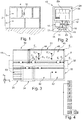
- the figure 1 represents an assembly comprising a building 2, inside which a pedestrian 4 can move freely while walking.
- Building 2 is divided into several floors. Here, only a ground floor 6 and a first floor 8 are shown.
- the floors are connected to each other by floor change zones such as a staircase or an elevator.
- Each floor has rooms and corridors defined by walls impassable by the pedestrian 4.
- the pedestrian 4 can enter inside a room only by crossing a door.
- the interior of a room may also include impassable obstacles by the pedestrian 4 such as, for example, pillars or other building components of the building 2.
- the apparatus 10 is able to locate on a map of the building 2 without using other sensors than those it contains internally.
- the apparatus 10 can locate its position inside the building 2 without using a navigation system using external locator beacons located in the environment of the building 2. These external beacons can be satellites or satellites.
- the apparatus 10 can locate its position without using a GPS system ("Global Positioning System").
- the apparatus 10 comprises an electronic positioning unit 11.
- This unit 11 comprises a memory 12 as well as a programmable electronic calculator 14 capable of executing instructions stored in the memory 12.
- the memory 12 comprises the instructions necessary to execute the method of the figure 4 .
- the memory 12 includes a card 16 of the building 2. This card is described in more detail with reference to the figure 3 .
- the apparatus 12 also comprises an inertial unit 17.
- the inertial unit 17 transmits to the computer 14, via an information transmission bus 19, measurements of the direction in which the apparatus 10 moves and of the amplitude of the displacement in this direction since the last position noted for this apparatus 10.
- the inertial unit 17 comprises a triaxial accelerometer 18, a gyrometer 19 and a triaxial magnetometer 20.
- the inertial unit 17 also comprises a barometer 21 for measuring the altitude of the apparatus 10.
- the apparatus 10 is equipped with a screen 24 making it possible to display a graphical representation 26 of the card 16 and, in this graphical representation, a point PA representing the current position of the apparatus 4 inside the building 2. This point PA is therefore located in the graphical representation 26 at the location of the card 16 corresponding to the current position of the apparatus 10 and thus of the pedestrian 4.
- the apparatus 10 is a smartphone or electronic tablet programmed to execute the process of the figure 4 .
- the figure 3 graphically represents the contents of the map 16 for floor 8 of building 2. What will now be described for floor 8 of building 2 applies to each floor of this building and to the ground floor 6.
- the card 16 has several zones 30 to 35 whose juxtaposition covers the entire surface of the floor 8. These areas are parallel to the floor of the floor and contained in the same plane called "plan floor”. This floor plan is typically horizontal.
- Zones 30 to 35 are contiguous and do not overlap. However, to increase the readability of the figure 3 zones 30 to 35 are represented as overlapping, but in reality this is not the case. Thus, here, each portion of the periphery of each zone is common with at most a portion of the periphery of another different zone.
- each zone is located at the location of an impassable obstacle by the pedestrian 4 such as a wall.
- the same area may include several rooms of the building 2. This is for example the case for the zone 33 which surrounds a room 40 and another room 42 smaller.
- the periphery of each room is delimited by walls represented in fine lines.
- each piece has at least one opening to access the interior of this room.
- the openings are located between the ends of the walls marked by dots. An opening is typically a door.
- An area may also include obstacles impassable by the pedestrian 4 located inside a room.
- an impassable obstacle is an interior partition or a pillar or any other element of the building 2 which can not be crossed by the pedestrian 4.
- Such an area is illustrated by the zone 31 which comprises two partitions 44 and 46 located at the door. inside a room 48.
- the XYZ mark is an orthogonal mark in which the X and Y directions are horizontal and the Z direction is vertical.
- each zone is rectangular. Thus, only the coordinates of the two diagonally opposite vertices of a zone are recorded in the map 16 to save memory.
- each obstacle identifier is associated with a pair of points E jd and E jf .
- the points E jd and E jf respectively mark the beginning and the end of the segment [E jd ; E jf ], where j is the identifier of the impassable obstacle.
- the coordinates of the points E jd and E jf , in the plane of the floor, are known and contained in the map 16.
- the zone 31 comprises eight obstacle identifiers IdO 1 to IoT 8 .
- the identifiers IdO 1 to IdO 8 correspond, respectively, to the segments [E a ; E b ]; [E b ; E c ]; [E c ; E d ]; [E d ; E f ]; [E f ; E g ]; [E h ; E i ]; [E j ; E R ] and [E p ; E m ].
- the position of the points E a to E m is represented on the figure 3 .
- Each displacement law makes it possible to calculate, from the measurements of the inertial unit 17, at a time t k , the displacement of a particle S i from a previous position P i k-1 to a new position P i k .
- This displacement is directly correlated with that of the apparatus 10.
- this displacement between the positions P i k-1 and P i k is identical or very close to that of the apparatus 10 between the instants t k-1 and t k .
- the exponent "i" is the identifier of the particle and the index "k” is the order number of the moment when the direction and the amplitude of the displacement of the apparatus are measured. .
- the inertial unit 17 measures the angle ⁇ k , in the plane of the stage, between the direction of movement of the apparatus 10 and the direction X.
- the measurements of the gyrometer 19 and the magnetometer 20 can be used. Subsequently, the direction measured at time t k is called “direction ⁇ k ".
- the inertial unit 17 is also capable of providing a physical quantity representative of the amplitude I k of the displacement of the apparatus 10 in the direction ⁇ k between the instants t k-1 and t k .
- a physical quantity representative of the amplitude I k of the displacement of the apparatus 10 in the direction ⁇ k between the instants t k-1 and t k it is possible to integrate the measurement of the accelerometer 18 between the instants t k-1 and t k and, if this is zero, to keep the previous measured speed v k-1 .
- the computer 14 detects from the measurements of the accelerometer 18 the moment when a foot of the pedestrian 4 comes in contact with the floor. From these successive moments, the calculator 14 calculates a frequency f k of pedestrian steps 4.
- the coefficients A, B and C are coefficients independent of the morphological characteristics of the pedestrian.
- the coefficient T must be chosen equal to the size of the pedestrian 4. By default, the coefficient T is taken equal to the average size of a human being, for example 1.78 m.
- the standard deviation ⁇ xy is constant and independent of the measurements of the inertial unit 17 for an update at each step.
- the standard deviation ⁇ xy is greater than 5 cm or 10 cm and preferably less than 35 cm.
- the law Lp xy is a uniform distribution or a Gaussian distribution.
- a measurement bias called direction bias
- direction bias On the measurement of the direction ⁇ k .
- Such a steering bias may be due to a fault on the sensors of the inertial unit 17.
- This steering bias can also be caused by the fact that the pedestrian 4 turns the device 10 in a horizontal plane.
- a measurement bias here called a step bias
- This step bias can come from a fault of the sensors of the inertial unit. In the example described here, it can also come from a modeling error and more precisely from an error with respect to the default value of the coefficient T in the pitch model. Indeed, the true size of pedestrian 4 is unknown.
- the random variables ⁇ i ⁇ and ⁇ i ⁇ are used for the same reasons and in the same way as the variables ⁇ i x and ⁇ i y previously introduced.
- a new value of the variables ⁇ i ⁇ and ⁇ i ⁇ is randomly drawn at each new instant t k and for each particle S i as a function, respectively, of a predefined law of probability Lp ⁇ and of a predefined law. probability Lp ⁇ .
- these laws Lp ⁇ and Lp ⁇ are the same for all the particles S i .
- the mathematical expectations of the laws Lp ⁇ and Lp ⁇ are equal to zero. Therefore, as for the random variables x ⁇ i and ⁇ i are the average values of each random variable ⁇ ⁇ i and ⁇ i is different successive times t k tends to zero as k increases.
- Step 96 is the step in which the coordinates of the particle S i are updated. This step is described in more detail with reference to the figure 4 .
- the standard deviation ⁇ ⁇ is constant.
- the previous ratio can also be written: (pq) ⁇ ⁇ / T. In this case, whatever p and q, the ratio is constant.
- the difference pq is generally large enough to cover a period of time greater than 1 s or 4 s, and generally less than 10 min or 5 min or 1 min. For example, this difference between p and q is constant whatever p.
- the variables ⁇ i x and ⁇ i y make it possible to explore a large number of possible values for the corrective factors ⁇ i and ⁇ i .
- the values of the measured variables z k and z k-1 are obtained, typically, from the measurements of the barometer 21.
- the zone 35 is associated with this second displacement law. All other zones of the stage 8 are associated with the first law of displacement.
- zones 30, 31, 33 and 34 in which the pedestrian 4 can freely move in all directions. In other words, in these areas, it is considered that all directions of displacement are equiprobable. In this case, these areas do not have a preferred direction of travel.
- zones of building 2 where all directions of travel are not equiprobable.
- the zone 32 is a long corridor parallel to the direction X. In this zone 32, the most probable directions of movement for a pedestrian are parallel to the direction X. Indeed, it is less likely that the pedestrian 4 moves transversely to the longitudinal direction of the corridor. In this case, it is said that there is a preferred direction of movement in this zone 32.
- each preferred direction is coded by an angle ⁇ , in the plane of the floor, between this preferred direction and the direction X.
- each preferred direction is also associated with an angular tolerance ⁇ ⁇ .
- This angular tolerance is generally expressed in degrees or radians.
- the zone 35 is also associated with a preferred direction for going up and down the stairs 50.
- the unit 11 implements a localization algorithm known as the "particle filter".
- the operation of a particulate filter is well known.
- the reader can refer to the state of the art cited in the introduction of this patent application and, in particular, Straub 2010. Thus, thereafter, only the new specificities of implementation of this algorithm are described in detail. In particular, the management of the changes of stages is carried out, for example, as described in Straub 2010.
- step 90 the initial position P i 0 and the initial values w i 0 , ⁇ i 0 and ⁇ i 0 are initialized.
- Many methods for initializing positions P i 0 and w i 0 values of each particle are known. For example, if the initial position of the apparatus 10 is known within plus or minus 1 m, the values P i 0 of all the particles S i are drawn at random within a circle centered on the known position. and of radius equal to 1 m. We can also take each value w i 0 equal to 1 / N 0 , where No is the initial number of particles generated.
- Each value ⁇ i 0 is drawn at random so that the distribution of the initial values ⁇ i 0 follows a law Lp ⁇ 0 of predetermined probability such as a uniform distribution or Gaussian or other.
- the law Lp ⁇ 0 is generally not the same as the law Lp ⁇ used to obtain the values of the random variable ⁇ i ⁇ .
- the standard deviation ⁇ ⁇ 0 is chosen equal to 360 ° if we have no information on the directional bias. In another example, the standard deviation ⁇ ⁇ 0 is chosen to be less than 45 ° if there is some information on the steering bias. Unlike the case of previous random variables, this probability law Lp ⁇ 0 does not necessarily have a zero mean.
- Each initial value ⁇ i 0 is chosen as described previously for the initial values ⁇ i 0 except that a predefined law Lp ⁇ 0 of probability for the bias of steps instead of the law Lp ⁇ 0 is used .
- the probability law Lp ⁇ 0 is not necessarily identical to the law Lp ⁇ 0 . Indeed, generally, the direction and step biases are not correlated.
- the standard deviation ⁇ ⁇ 0 of the law Lp ⁇ 0 is equal to 30% to plus or minus 5% if we have no information on the step bias. In another example, the standard deviation ⁇ ⁇ 0 is chosen less than 20% if one has some information on the pitch bias.
- the inertial unit 17 transmits its measurements to the computer 14 which receives them. From these measurements, the computer 14 calculates the speed v k and the angle ⁇ k of the current displacement of the apparatus 10 since its last position. Here, new measurements of the speed v k and the angle ⁇ k are calculated each time the computer detects that a foot of the pedestrian just touched the floor.
- the particle S i belongs to the zone j.
- the computer 14 first tests whether the particle S i belongs to the same zone as that to which it previously belonged. If a particle S i does not belong to any zone, then a particular treatment is triggered. For example, this particle is deleted.
- the displacement law to be used is therefore that associated with the zone identified during step 94.
- the coordinates of the new position P i k are established using the first displacement law.
- the coordinates of the new position P i k are established using the second displacement law.
- step 96 the new values for the variables ⁇ i x , ⁇ i y , ⁇ i ⁇ and ⁇ i ⁇ are randomly drawn using the laws, respectively, Lp xy , Lp ⁇ and Lp ⁇ .
- the computer 14 updates the weights w i of each particle S i . More precisely, the computer 14 decreases the weight w i of the particle S i if its last displacement from the position P i k-1 to the position P i k has violated predefined constraints associated with the zone inside which it is located.
- a constraint on the displacement of the particle S i is defined here as being a condition which, if it is verified by the particle S i , is used to increase the weight w i of this particle S i with respect to the weight particles that do not check this condition. Conversely, if this condition is not satisfied by the particle Si, then it is used to reduce the weight w i of this particle S'with respect to the weights of the particles which satisfy this condition.
- the calculator 14 searches for an intersection between the segment [P i k-1 ; P i k ] and each impassable obstacle of the zone inside which the particle is situated. This zone has been identified during step 94. This intersection search is performed only with the impassable obstacles whose identifiers are contained in the list associated with the identified zone. Here, since each obstacle is coded by a segment, this intersection search is like looking for an intersection between two segments.
- a very low value is a value less than 0.2 or 0.1 for example. In the opposite case, the value of the weight w i remains unchanged.
- the constraint 2) is not used to update the weight w i . Otherwise, the constraint 2) is used.
- the computer 14 calculates a weight w i ⁇ from the difference between the measured direction ⁇ k for the displacement of the particle S i and the preferred direction of the zone inside which it is located.
- the value of the weight w i ⁇ increases as the angular difference between the preferred direction ⁇ and the direction of displacement of the position P i k-1 to P i k is small.
- the weight value w i ⁇ is established taking into account the tolerance ⁇ ⁇ associated with this preferred direction.
- the weight value w i ⁇ is therefore greater if the angular difference between the direction of displacement of the particle S i and the preferred direction is within the tolerance margin defined by the value of ⁇ ⁇ and, if not, the value of the weight w i ⁇ is smaller.
- the value of the weight w i is taken equal to its previous value multiplied by the value of the weight w i ⁇ thus obtained.
- the calculator 14 proceeds to the normalization of the weights w i of all the particles S'so that the sum of all these weights is equal to one. For example, the calculator 14 calculates the sum W of all the weights w i and then divides each weight w i by the sum W.
- the computer 14 resamples the particles S i .
- This resampling step consists of removing the particles whose weights w i have become too weak to replace them with particles associated with parameters whose weights are stronger.
- this resampling method first consists of classifying the particles into two groups: the particles to be regenerated, that is to say all the particles whose weight is below a predetermined threshold and the surviving particles, that is to say the other particles.
- calculator 14 randomly draws a particle from the group of surviving particles. This draw is preferably carried out so that the probability of being fired is proportional to the weight of the surviving particle.
- the position P i k and the values ⁇ i k and ⁇ i k of the surviving particle drawn are assigned to the new particle generated.
- the computer preferably adds a random perturbation on the position and on the values of the correction factors by using, for example, the random variables ⁇ x , ⁇ y , ⁇ ⁇ and ⁇ ⁇ .
- these disturbances are calibrated in such a way that the values ⁇ i k and ⁇ i k assigned to the generated particle remain very close to the current values for the corrective factors associated with the surviving particle drawn.
- the average of the values ⁇ i k assigned to the particles generated is closer to the average of the values ⁇ i k of the surviving particles than to the average of the values ⁇ i k of the deleted particles. It is the same for the values ⁇ i k assigned to the generated particles.
- a new weight is also assigned to each generated particle and possibly to the surviving particle from which it is derived.
- a step 104 the computer 14 estimates the position PA of the apparatus 10 from positions P i k and weights w i of all the particles S i .
- the position PA is taken equal to that of the particle S i having the weight w i the strongest.
- the position PA is taken equal to the average of the positions P i k of the particles S i by weighting each position P i k by the weight w i . Another method is also described in the application WO 2012158441 .
- a point is displayed at the position PA on the graphical representation 26 of the map 16 to indicate to the pedestrian 4 its position on this map and thus its position inside the building 2.
- Steps 92 to 106 are repeated in loop. As these iterations proceed, the accuracy of the estimate of the position of the apparatus 10 increases because only the most probable positions P i k are retained.
- the calculator 14 calculates an estimate E ⁇ of the direction bias and an estimate E ⁇ of the step bias from, respectively, the values ⁇ i k and ⁇ i k current particles S i .
- the estimate E ⁇ is taken as the average of the current values ⁇ i k of all the particles S i .
- the value of the estimate E ⁇ is taken as the average of the current values ⁇ i k of all the particles S i .
- the accuracy of the estimates E ⁇ and E ⁇ increases as the reiterations of the steps 92 to 106 progress. Indeed, it is very probable that the particle S i associated with an incorrect current value for the corrective factor ⁇ i or ⁇ i quickly violates the constraints evaluated in step 98. Therefore, the particles S i associated with incorrect current values for the correction factors are preferably removed in step 102. Thus, as iterations of the steps 92 to 106, the particles S i associated with correct current values for the correction factors are preferentially selected as surviving particles in step 102. Therefore, the estimates E ⁇ and E ⁇ converge towards the true values of the direction biases and not.
- the estimates E ⁇ and E ⁇ can be displayed on the screen 24 or used by other applications to correct the direction and pitch biases.
- some more sophisticated sensors provide an average value of the measured variable at a time k and a standard deviation on that measure (see for example Straub 2010).
- the measured values of the angle ⁇ k and the amplitude I k are obtained by randomly drawing the values using a Gaussian probability law whose mean and standard deviation are equal to those transmitted by the sensors. This allows in particular to take into account the measurement noise.
- the apparatus 10 may be attached to a cart pushed by the pedestrian.
- the speed v k is obtained by integrating the acceleration measured by the carriage.
- Another solution is to detect the frequency of shocks that occur each time a truck wheel rolls on a joint between two tiles of a floor covering.
- the locating method described also applies to the case where the apparatus 10 is transported by a motorized robot which moves without the assistance of the pedestrian 4.
- the amplitude of the displacement can be measured by measuring the number of wheel turns of a driving wheel of the robot.
- the method described above applies to any type of three-dimensional space where the apparatus 10 can be moved.
- it can also be an outdoor space outside any building.
- this method is useful for locating a person in a location where a GPS location or from a telephone relay is impossible.
- the weight w i is increased if the position P i k is close to this approximate position and, on the contrary, decreased if the position P i k is far from this approximate position.
- the approximate position is obtained from the power of a signal radio received by the apparatus 10 and the known position in the XYZ mark of the transmitter of this radio signal.
- the transmitter is a Wi-Fi kiosk.
- the step 100 of normalizing the weight w i of the particles S i is omitted.
- KLD Kullbak-Leibler-Divergence
- each new current value ⁇ i k and ⁇ i k is a function of one or more of the values ⁇ i k associated with the particles that have not been removed and independent of the values a i k associated with the particles that have been removed. It is the same for the new value ⁇ i k .
- the resampling step 102 is omitted. Even if resampling is not carried out, the above method makes it possible to increase the accuracy of the location of the position of the apparatus 10 because the weight w i of each particle S i associated with a current value ⁇ i k or ⁇ i k incorrect decreases as iterations of steps 92 to 104.
- Straub 2010 describes an alternative method usable in the case of polygonal areas of more complicated shape than a simple rectangle.
- an area may have the shape of a circle.
- the coordinates of its center and its radius are recorded in the map 16.
- each zone is associated with both impassable obstacle identifiers, a displacement law and a privileged direction.
- the law of displacement is the same for several immediately contiguous zones.
- the zones 30 to 34 which are all associated with the first law of displacement.
- Each stratum has at least one zone and, typically, a set of several zones covering the entire surface of the floor. Areas of a stratum are distinguished areas of another stratum by the type of property it associates with that area. For example, a first stratum includes only areas associated only with impassable obstacle identifiers.
- a second layer has only areas associated only with a respective displacement law.
- a third layer has only areas associated only with a preferred direction.
- the zones of the first layer are, for example, identical to the zones 30 to 35 except that they comprise only the impassable obstacle identifiers.
- the second layer is limited here to two areas. One of them is identical to the zone 35 except that it is only associated with the second law of displacement.
- the other zone of this second layer corresponds to the meeting of the zones 30 to 34 and is only associated with the first law of displacement.
- the third layer has four areas here.
- the first and second zones are identical, respectively, to zones 32 and 35 except that they are only associated with a respective preferred direction.
- the third zone corresponds to the meeting of the zones 30 and 31 and the fourth zone then corresponds to the meeting of the zones 33 and 34 which are not associated with any privileged direction.
- the operation of the location method with a map comprising several layers is identical to that described above except that for each particle S i , the zone of each layer within which it is located is identified. Then, it is these zones within which it is located that make it possible to identify the displacement law to be used and the predefined constraints to be tested in order to update the value of its weight w i . Using multiple layers of zones can simplify the definition of these zones.
- one of these strata corresponds to an accessibility map as described in Straub 2010 in chapter 5.1.2.
- the different contiguous boxes of the Straub 2010 accessibility map associated with the same value of the degree ⁇ of accessibility are grouped together within the same zone.
- Each zone can also be associated with additional predefined constraints to update the weight w i of the particles located in this zone. For example, it is possible to associate with each zone an accessibility coefficient w a which represents the probability of a pedestrian entering this zone. Then, when updating the weight w i of a particle S i situated in this zone, the weight w i is taken equal to its previous value multiplied by this coefficient w a .
- the standard deviations ⁇ ⁇ and ⁇ ⁇ are not necessarily constant. In this case, they are constant over long periods of time and then modified for a short period of time before returning to their previous values. For example, only during this short time interval, the ratios ⁇ ⁇ k / T and / or ⁇ ⁇ k / T are allowed to exceed the thresholds previously defined.
- the temporary increase in the values of the standard deviations ⁇ ⁇ and ⁇ ⁇ is used to reset the current values ⁇ i k and ⁇ i k .
- the values of the standard deviations ⁇ ⁇ and ⁇ ⁇ are constant for more than 90% of the time of use of the apparatus 10 so as to prevent, during these 90% of the time, a rapid variation of the values of the factors patches ⁇ i and ⁇ i . It is possible to verify that the ratio ⁇ ⁇ k / T is kept below a predetermined threshold over at least 90% of the time of use, for example, by taking the difference pq equal to a constant. Then, the ratio ⁇ ⁇ k / T is calculated for each value of p corresponding to an iteration of step 96 occurring during this time of use.
- the ratio ⁇ ⁇ k / T is kept below this predetermined threshold for more than 90% of the time of use.
- the same calculation can be used for the ratio ⁇ ⁇ k / T.
- the time of use is for example a period of continuous use of the apparatus 10 without stopping the process of the figure 4 .
- the expectation of one of the probability laws Lp ⁇ or Lp ⁇ is not zero. This then introduces an additional bias that adds to the actual bias.
- the current value ⁇ i k or ⁇ i k can also be calculated from another previous value than ⁇ i k-1 or ⁇ i k-1 . For example, ⁇ i k is calculated from the previous value ⁇ i kn , where n is a constant strictly greater than one.
- the first and second displacement laws are simplified by removing the corrective factor ⁇ i .
- the first displacement law is simplified by removing the corrective factor ⁇ i .
- the corrective factor remaining in the first displacement law is then estimated as described above with reference to the figure 4 .
- it is possible to add additional correction factors in the first displacement law. For example, if the best possible value of the coefficient A in the pitch model of the first displacement law is not known precisely, we can then use the following step model I k ⁇ Af k + BT + C, where ⁇ is an additional corrective factor.
- the value of the factor ⁇ is then estimated in the same way as that described for the correction factors ⁇ i and ⁇ i . Note that in the case of the corrective factor ⁇ , it is a multiplicative factor and not a subtractive factor, that is, it multiplies the measured variable f k .
- Step 106 or 108 is not necessarily performed after each iteration of steps 92 to 104. For example, these steps are performed only once in two.
- the selection of a specific displacement law as a function of the zone in which the particle is located can be implemented independently of the other characteristics of the process of the figure 4 .
- this selection of the displacement law can be implemented independently of the use of corrective factors such as the factors ⁇ i and ⁇ i and / or independently of the use, as predefined constraints, of the privileged directions of displacement.
- the use of preferred directions of movement associated with zones can also be implemented independently of the other characteristics of the method of the invention. figure 4 .
- the use, as predefined constraints, of the preferred directions of displacement can be implemented independently of the use of corrective factors such as the factors ⁇ i and ⁇ i and / or independently of the selection of the law. displacement depending on the area within which the particle is located.
Landscapes
- Engineering & Computer Science (AREA)
- Radar, Positioning & Navigation (AREA)
- Remote Sensing (AREA)
- Physics & Mathematics (AREA)
- General Physics & Mathematics (AREA)
- Automation & Control Theory (AREA)
- Life Sciences & Earth Sciences (AREA)
- General Life Sciences & Earth Sciences (AREA)
- Geophysics (AREA)
- Navigation (AREA)
- Position Fixing By Use Of Radio Waves (AREA)
Claims (11)
- Lokalisierungsverfahren eines Gerätes, das im Inneren eines dreidimensionalen Raums bewegt wird, wobei dieses Verfahren Folgendes aufweist:a) das Bereitstellen einer Karte des dreidimensionalen Raums und von vorbestimmten Vorgaben hinsichtlich der Bewegungen des Gerätes in diesem dreidimensionalen Raum,b) das Erzeugen (90) durch einen elektronischen Rechner von mehreren diskreten Teilchen, wobei jedes Teilchen Folgendem zugeordnet wird:- Koordinaten, die seine Position auf der Karte kodieren und- einem Gewicht, das die Wahrscheinlichkeit darstellt, dass sich das Gerät an der Stelle dieses Teilchens befindet,c) das Empfangen (92) von Messungen, die für die Richtung der Bewegung des Gerätes und die Amplitude dieser Bewegung von seiner vorherigen Position repräsentativ sind, wobei diese Messungen durch Sensoren, die in dem bewegten Gerät eingebettet sind, durchgeführt werden,d) das Aktualisieren (96) der Koordinaten der Position von jedem Teilchen in Abhängigkeit von den Messungen, die während des Schrittes c) empfangen werden, und eines vorbestimmten Bewegungsgesetzes, um dieses Teilchen von seiner vorhergehenden Position Pi k-1 zu einer neuen Position Pi k korreliert mit der gemessenen Bewegung des Gerätes zu bewegen, wobei jedes Bewegungsgesetz hierzu mindestens eine erste gemessene Variable, deren Wert von der Messung der Bewegungsrichtung abhängig ist, die im Schritt c) empfangen wird, und eine zweite gemessene Variable aufweist, deren Wert von der Messung der Amplitude dieser Bewegung abhängig ist, die während des Schrittes c) empfangen wird, und danne) für jedes Teilchen, wenn die letzte Bewegung dieses Teilchens von der Position Pi k-1 zu der Position Pi k die vorbestimmten Vorgaben erfüllt, das Erhöhen (98) des Gewichtes, das diesem Teilchen zugeordnet wird, in Bezug auf die Gewichte der Teilchen, deren letzte Bewegung gegen diese vorbestimmten Vorgaben verstößt,- das Wiederholen der Schritte c) bis e) undf) das Abschätzen (106) der Position des Gerätes ausgehend von den Positionen der Teilchen und den Gewichten, die diesen Teilchen zugeordnet werden, indem während dieses Abschätzens den Positionen der Teilchen, die den höchsten Gewichten zugeordnet werden, mehr Bedeutung beigemessen wird,
dadurch gekennzeichnet, dass:- das Bewegungsgesetz ebenfalls einen Korrekturfaktor einer Verzerrung aufweist, der durch eine arithmetische Operation mit einer der gemessenen Variablen kombiniert wird, und- jedes Teilchen ebenfalls einem aktuellen Wert dieses Korrekturfaktors zugeordnet wird, wobei der aktuelle Wert dieses Korrekturfaktors bei jedem Wiederholen des Schrittes d) ausgehend von einem vorhergehenden aktuellen Wert dieses Korrekturfaktors konstruiert wird, der während eines vorhergehenden Wiederholens des Schrittes d) berechnet wird, zu dem eine Zufallsvariable hinzugefügt wird, die nach einem vordefinierten Wahrscheinlichkeitsgesetz abgeleitet wird, und wobei die aktuellen Werte von verschiedenen Teilchen vor der ersten Ausführung des Schritts d) auf verschiedene Anfangswerte initialisiert werden, und- während des Schrittes d) für jedes Teilchen, dessen Koordinaten mit Hilfe dieses Bewegungsgesetzes aktualisiert werden, der Wert des Korrekturfaktors in dem Bewegungsgesetz gleich dem aktuellen Wert dieses Korrekturfaktors, der diesem Teilchen zugeordnet wird, genommen wird. - Verfahren nach Anspruch 1, wobei der Korrekturfaktor in dem Bewegungsgesetz zu der zweiten gemessenen Variablen addiert oder damit multipliziert wird und die Variation der Standardabweichung σε des vordefinierten Wahrscheinlichkeitsgesetzes unter 10 % pro Sekunde während mehr als 90 % der Verwendungszeit des Verfahrens zum Lokalisieren des Gerätes gehalten wird, wobei die Variation der Standardabweichung σε durch das folgende Verhältnis gegeben wird:
 - σεk die Standardabweichung des vordefinierten Wahrscheinlichkeitsgesetzes während des k-ten Wiederholens des Schrittes d) ist,- Σσεk die Summe der Standardabweichungen σεk zwischen dem q-ten Wiederholen und dem p-ten Wiederholen des Schrittes d) ist, wobei q eine ganze Zahl ist, die grundsätzlich kleiner als p ist,- T die Dauer in Sekunden des Zeitintervalls ist, das zwischen dem q-ten Wiederholen und dem p-ten Wiederholen des Schrittes d) verstrichen ist.
 - Verfahren nach Anspruch 1, wobei der Korrekturfaktor in dem Bewegungsgesetz zu der ersten gemessenen Variablen addiert oder damit multipliziert wird und die Variation der Standardabweichung σα des vordefinierten Wahrscheinlichkeitsgesetzes unter 10 % pro Sekunde während mehr als 90 % der Verwendungszeit des Verfahrens zum Lokalisieren des Gerätes gehalten wird, wobei die Variation der Standardabweichung σα durch das folgende Verhältnis gegeben wird:
 - σαk die Standardabweichung des vordefinierten Wahrscheinlichkeitsgesetzes während des k-ten Wiederholens des Schrittes d) ist,- Σσαk die Summe der Standardabweichungen σαk zwischen dem q-ten Wiederholen und dem p-ten Wiederholen des Schrittes d) ist, wobei q eine ganze Zahl ist, die grundsätzlich kleiner als p ist,- T die Dauer in Sekunden des Zeitintervalls ist, das zwischen dem q-ten Wiederholen und dem p-ten Wiederholen des Schrittes d) verstrichen ist.
 - Verfahren nach einem der vorhergehenden Ansprüche, wobei das Verfahren nach mehreren Wiederholungen der Schritte c) bis e) einen Schritt (102) des Wiederabtastens der Teilchen aufweist, bei dem:- die Teilchen, die den niedrigsten Gewichten zugeordnet werden, gelöscht werden, und- neue Teilchen automatisch generiert werden, um die gelöschten Teilchen zu ersetzen, wobei ein neuer aktueller Wert dieses Korrekturfaktors jedem neuen Teilchen zugeordnet wird, wobei jeder neue Wert von einem oder mehreren der aktuellen Werte des Korrekturfaktors abhängig ist, die den Teilchen zugeordnet werden, die nicht gelöscht worden sind, und von den aktuellen Werten des Korrekturfaktors unabhängig ist, die den Teilchen zugeordnet werden, die gelöscht worden sind.
- Verfahren nach einem der vorhergehenden Ansprüche, wobei:- während des Schrittes a) die bereitgestellten vorbestimmten Vorgaben, die Koordinaten enthalten, die die Positionen und die Abmessungen von Hindernissen, die von dem Gerät unüberwindbar sind, in dem dreidimensionalen Raum kodieren, und- der Schritt e) für jedes Teilchen Folgendes aufweist:• das Suchen einer Schnittstelle zwischen dem Segment [Pi k-1; Pi k] und dem unüberwindbaren Hindernis unter Verwendung der Koordinaten dieses unüberwindbaren Hindernisses, die während des Schrittes a) bereitgestellt werden, und• das Verringern des Gewichtes, das diesem Teilchen zugeordnet wird, wenn eine derartige Schnittstelle vorhanden ist, und im gegenteiligen Fall die Abwesenheit eines Verringerns oder das Erhöhen des Gewichtes, das diesem Teilchen zugeordnet wird.
- Verfahren nach dem Anspruch 5, wobei:- während des Schrittes a) die bereitgestellte Karte mehrere unterschiedliche Bereiche aufweist, wobei jeder unterschiedliche Bereich Folgendem zugeordnet wird:• Koordinaten, die die Position seiner Peripherie auf der Karte definieren, und• einer Liste von Kennungen der einzigen unüberwindbaren Hindernisse, die im Inneren dieses Bereichs angeordnet sind,- der Schritt e) für jedes Teilchen systematisch Folgendes aufweist:• einen Identifizierungsvorgang (94) des Bereichs, in dessen Innerem sich das Teilchen befindet, indem die aktualisierten Koordinaten dieses Teilchens mit den Peripherien der Bereiche der Karte verglichen werden, die von den Koordinaten definiert werden, die während des Schrittes a) bereitgestellt werden, und dann• einen Suchvorgang einer Schnittstelle zwischen dem Segment [Pi k-1; Pi k] und nur den unüberwindbaren Hindernissen, deren Kennungen in der Liste enthalten sind, die dem Bereich zugeordnet wird, der während des Identifizierungsvorgangs identifiziert wird.
- Verfahren nach einem der vorhergehenden Ansprüche, wobei:- während des Schrittes a) die bereitgestellte Karte mehrere unterschiedliche Bereiche aufweist, wobei jeder unterschiedliche Bereich Folgendem zugeordnet wird:• Koordinaten, die die Position seiner Peripherie auf der Karte definieren, und• ein Bewegungsgesetz unter einer Gruppe von mehreren verschiedenen Bewegungsgesetzen, wobei das Bewegungsgesetz, das einem Bereich zugeordnet wird, ermöglicht, ausgehend von den gleichen empfangenen Messungen die Richtung und die Amplitude der Bewegung des Gerätes genauer abzuschätzen, wenn sich dieses im Inneren dieses Bereiches befindet, als wenn irgendeines der anderen Bewegungsgesetze der Gruppe verwendet worden wäre, wozu sich die verschiedenen Bewegungsgesetze durch die mathematischen Operationen voneinander unterscheiden, die die Koordinaten von einem Teilchen mit den Messungen verbinden, die während des Schrittes c) erhalten werden, und- der Schritt d) für jedes Teilchen systematisch Folgendes aufweist:• einen Identifizierungsvorgang (94) des Bereichs, in dessen Innerem sich das Teilchen befindet, indem die Koordinaten dieses Teilchens mit den Peripherien der Bereiche der Karte verglichen werden, die von den Koordinaten definiert werden, die während des Schrittes a) bereitgestellt werden, und dann• einen Verwendungsvorgang zum Aktualisieren der Koordinaten dieses Teilchens des einzigen Bewegungsgesetzes, das dem Bereich zugeordnet wird, der während des Identifizierungsvorgangs identifiziert wird.
- Verfahren nach einem der vorhergehenden Ansprüche, wobei:- während des Schrittes a) die bereitgestellte Karte mindestens einen Bereich mit bevorzugter Bewegungsrichtung enthält, der Folgendem zugeordnet wird:• Koordinaten, die die Position seiner Peripherie auf der Karte definieren, und• einer bevorzugten Bewegungsrichtung in diesem Bereich,- der Schritt e) für jedes Teilchen Folgendes aufweist:• einen Erfassungsvorgang (94) der Anwesenheit dieses Teilchens im Innerem des Bereichs mit bevorzugter Bewegungsrichtung durch Vergleichen der Koordinaten dieses Teilchens mit der Peripherie des Bereichs mit bevorzugter Bewegungsrichtung, der von den Koordinaten definiert wird, die während des Schrittes a) bereitgestellt werden, und dann• wenn das Teilchen erfasst wird, dass es im Inneren des Bereichs mit bevorzugter Bewegungsrichtung vorhanden ist, ein Vorgang des Erhöhens (98) des Gewichtes dieses Teilchens, wenn die Winkelabweichung zwischen der Bewegungsrichtung dieses Teilchens von der Position Pi k-1 zu der Position Pi k und der bevorzugten Bewegungsrichtung, die diesem Bereich zugeordnet wird, gleich 0 ° oder 180 ° bei mehr oder weniger etwa σγ ist, wobei dieses Erhöhen in Bezug auf die Gewichte der anderen Teilchen durchgeführt wird, die im Inneren des gleichen Bereichs angeordnet sind und für die diese Abweichung nicht gleich 0 ° oder 180 ° bei mehr oder weniger etwa σγ ist, wobei σγ eine vorbestimmte Winkeltoleranz ist, und• wenn das Teilchen erfasst wird, dass es außerhalb des Bereichs mit bevorzugter Bewegungsrichtung vorhanden ist, das Unterbinden der Verwendung der bevorzugten Bewegungsrichtung, die diesem Bereich zugeordnet wird, um das Gewicht dieses Teilchens zu aktualisieren.
- Informationsaufzeichnungsmedium, dadurch gekennzeichnet, dass es Anweisungen aufweist, um ein Verfahren nach einem der vorhergehenden Ansprüche auszuführen, wenn diese Anweisungen von einem elektronischen Rechner ausgeführt werden.
- Elektronische Lokalisierungseinheit eines Gerätes, das im Inneren eines dreidimensionalen Raums bewegt werden kann, wobei diese elektronische Einheit Folgendes aufweist:- einen Speicher (12), der eine Karte des dreidimensionalen Raums und der vorbestimmten Vorgaben hinsichtlich der Bewegungen des Gerätes in diesem dreidimensionalen Raum enthält,- einen elektronischen Rechner (14), der für Folgendes programmiert ist:b) Erzeugen von mehreren diskreten Teilchen, wobei jedes Teilchen Folgendem zugeordnet wird:- Koordinaten, die seine Position auf der Karte kodieren und- einem Gewicht, das die Wahrscheinlichkeit darstellt, dass sich das Gerät an der Stelle dieses Teilchens befindet,c) Empfangen von Messungen, die für die Richtung der Bewegung des Gerätes und die Amplitude dieser Bewegung von seiner vorherigen Position repräsentativ sind, wobei diese Messungen durch Sensoren, die in dem bewegten Gerät eingebettet sind, durchgeführt werden,d) Aktualisieren der Koordinaten der Position von jedem Teilchen in Abhängigkeit von den Messungen, die empfangen werden, und eines vorbestimmten Bewegungsgesetzes, um dieses Teilchen von seiner vorhergehenden Position Pi k-1 zu einer neuen Position Pi k korreliert mit der gemessenen Bewegung des Gerätes zu bewegen, wobei jedes Bewegungsgesetz hierzu mindestens eine erste gemessene Variable, deren Wert von der empfangenen Messung der Bewegungsrichtung abhängig ist, und eine zweite gemessene Variable aufweist, deren Wert von der empfangenen Messung der Amplitude dieser Bewegung abhängig ist,e) für jedes Teilchen, wenn die letzte Bewegung dieses Teilchens von der Position Pi k-1 zu der Position Pi k die vorbestimmten Vorgaben erfüllt, Erhöhen des Gewichtes, das diesem Teilchen zugeordnet wird, in Bezug auf die Gewichte der Teilchen, deren letzte Bewegung gegen diese vorbestimmten Vorgaben verstößt,- Wiederholen der Schritte c) bis e) undf) Abschätzen der Position des Gerätes ausgehend von den Positionen der Teilchen und den Gewichten, die diesen Teilchen zugeordnet werden, indem während dieses Abschätzens den Positionen der Teilchen, die den höchsten Gewichten zugeordnet werden, mehr Bedeutung beigemessen wird,
dadurch gekennzeichnet, dass:- das Bewegungsgesetz ebenfalls einen Korrekturfaktor einer Verzerrung aufweist, der durch eine arithmetische Operation mit einer der gemessenen Variablen kombiniert wird, und- jedes Teilchen ebenfalls einem aktuellen Wert dieses Korrekturfaktors zugeordnet wird, wobei der aktuelle Wert dieses Korrekturfaktors bei jedem Wiederholen des Schrittes d) ausgehend von einem vorhergehenden aktuellen Wert dieses Korrekturfaktors konstruiert wird, der während eines vorhergehenden Wiederholens des Schrittes d) berechnet wird, zu dem eine Zufallsvariable hinzugefügt wird, die nach einem vordefinierten Wahrscheinlichkeitsgesetz abgeleitet wird, und wobei die aktuellen Werte von verschiedenen Teilchen vor der ersten Ausführung des Schritts d) auf verschiedene Anfangswerte initialisiert werden, und- der Rechner programmiert ist, um für jedes Teilchen, dessen Koordinaten mit Hilfe dieses Bewegungsgesetzes aktualisiert werden, den Wert des Korrekturfaktors in diesem Bewegungsgesetz anzunehmen, der gleich dem aktuellen Wert dieses Korrekturfaktors ist, der diesem Teilchen zugeordnet wird. - Gerät, das direkt von einem Fußgänger transportierbar ist, der sich im Inneren eines dreidimensionalen Raums bewegt, wobei dieses Gerät eine inertiale Messeinheit (17) aufweist, die geeignet ist, physikalische Größen zu messen, die für die Bewegungsrichtung dieses Gerätes und die Amplitude dieser Bewegung repräsentativ sind,
dadurch gekennzeichnet, dass das Gerät auch eine elektronische Lokalisierungseinheit (11) nach Anspruch 10 aufweist.
Applications Claiming Priority (1)
| Application Number | Priority Date | Filing Date | Title |
|---|---|---|---|
| FR1455575A FR3022622B1 (fr) | 2014-06-18 | 2014-06-18 | Procede de localisation d'un appareil qui est deplace a l'interieur d'un espace tridimentionnel |
Publications (2)
| Publication Number | Publication Date |
|---|---|
| EP2957867A1 EP2957867A1 (de) | 2015-12-23 |
| EP2957867B1 true EP2957867B1 (de) | 2016-12-28 |
Family
ID=51225830
Family Applications (1)
| Application Number | Title | Priority Date | Filing Date |
|---|---|---|---|
| EP15172437.4A Active EP2957867B1 (de) | 2014-06-18 | 2015-06-16 | Lokalisierungsverfahren eines geräts, das in einem dreidimensionalen raum bewegt wird |
Country Status (3)
| Country | Link |
|---|---|
| US (2) | US10408970B2 (de) |
| EP (1) | EP2957867B1 (de) |
| FR (1) | FR3022622B1 (de) |
Families Citing this family (3)
| Publication number | Priority date | Publication date | Assignee | Title |
|---|---|---|---|---|
| US9541404B2 (en) * | 2014-08-29 | 2017-01-10 | Samsung Electronics Co., Ltd. | System for determining the location of entrances and areas of interest |
| FR3104705B1 (fr) * | 2019-12-13 | 2021-11-19 | Onera (Off Nat Aerospatiale) | Filtrage particulaire et centrale de navigation a correlation de mesure |
| WO2023162384A1 (ja) * | 2022-02-25 | 2023-08-31 | 三菱パワー株式会社 | 回転機械のフランジ変位量推定方法、この方法を実行するためのプログラム、及び、この方法を実行する装置 |
Family Cites Families (13)
| Publication number | Priority date | Publication date | Assignee | Title |
|---|---|---|---|---|
| US7042391B2 (en) * | 2003-12-12 | 2006-05-09 | Xerox Corporation | Mobile device and method for determining location of mobile device |
| WO2009021068A1 (en) * | 2007-08-06 | 2009-02-12 | Trx Systems, Inc. | Locating, tracking, and/or monitoring personnel and/or assets both indoors and outdoors |
| JP2009159336A (ja) * | 2007-12-26 | 2009-07-16 | Panasonic Corp | 行動範囲把握方法および行動把握装置 |
| US20130245991A1 (en) * | 2012-02-28 | 2013-09-19 | Richard Kriss | Method for determining the remaining life of a thermal mass in a shipping package while in transit |
| ES2551099T3 (es) * | 2009-12-22 | 2015-11-16 | 9Solutions Oy | Sistema de seguimiento de la posición |
| US8825388B2 (en) | 2010-07-13 | 2014-09-02 | Qualcomm Incorporated | Indoor likelihood heatmap |
| US9532734B2 (en) * | 2010-08-09 | 2017-01-03 | Nike, Inc. | Monitoring fitness using a mobile device |
| WO2012062339A1 (en) * | 2010-11-08 | 2012-05-18 | Elektrobit Automotive Gmbh | Technique for calibrating dead reckoning positioning data |
| US8583400B2 (en) * | 2011-05-13 | 2013-11-12 | Google Inc. | Indoor localization of mobile devices |
| US8548738B1 (en) | 2011-07-08 | 2013-10-01 | Google Inc. | Constructing paths based on a particle model |
| US9377308B2 (en) | 2012-02-02 | 2016-06-28 | MCube Inc. | Indoor map data as a recalibration source for low-cost MEMS inertial navigation |
| US9130611B2 (en) * | 2012-08-17 | 2015-09-08 | Qualcomm Incorporated | Method of using zoning map for beam searching, tracking and refinement |
| US9188445B2 (en) * | 2013-05-21 | 2015-11-17 | Honda Motor Co., Ltd. | System and method for storing and recalling location data |
-
2014
- 2014-06-18 FR FR1455575A patent/FR3022622B1/fr active Active
-
2015
- 2015-06-16 EP EP15172437.4A patent/EP2957867B1/de active Active
- 2015-06-17 US US14/741,818 patent/US10408970B2/en active Active
-
2019
- 2019-08-29 US US16/555,163 patent/US10976466B2/en active Active
Non-Patent Citations (1)
| Title |
|---|
| None * |
Also Published As
| Publication number | Publication date |
|---|---|
| US20150369958A1 (en) | 2015-12-24 |
| FR3022622B1 (fr) | 2016-07-29 |
| FR3022622A1 (fr) | 2015-12-25 |
| US10408970B2 (en) | 2019-09-10 |
| US10976466B2 (en) | 2021-04-13 |
| EP2957867A1 (de) | 2015-12-23 |
| US20190383964A1 (en) | 2019-12-19 |
Similar Documents
| Publication | Publication Date | Title |
|---|---|---|
| EP1886517B1 (de) | Verfahren und Einrichtung zur Ortsbestimmung eines Endgeräts in einem drahtlosen lokalen Netzwerk | |
| EP2718670B1 (de) | Vereinfachtes verfahren zur schätzung der ausrichtung eines objekts und lagesensor zur durchführung dieses verfahrens | |
| EP2428934B1 (de) | Verfahren zur Schätzung der Bewegung eines Trägers im Verhältnis zu einer Umgebung, und Berechnungsvorrichtung für ein Navigationssystem | |
| WO2005031262A1 (fr) | Procede d'estimation de distance pour un mobile soumis a des contraintes dynamiques de parcours | |
| EP1985233A1 (de) | Verfahren und Vorrichtung zur Erfassung einer extrem unveränderlichen Drehachse | |
| EP2923227B1 (de) | Verfahren zur automatischen erkennung eines bewegten magnetischen objekts | |
| WO2015058986A1 (fr) | Procede de localisation en interieur et exterieur et dispositif portatif mettant en œuvre un tel procede. | |
| EP2815615B1 (de) | Verfahren zur abbildung von wi-fi-signaturen mittels blinder sammlung von rss-messungen | |
| WO2019239062A1 (fr) | Procédé de calibration de magnétomètres équipant un objet | |
| EP2957867B1 (de) | Lokalisierungsverfahren eines geräts, das in einem dreidimensionalen raum bewegt wird | |
| EP3230771B1 (de) | Verfahren zur ortung von mindestens einem beweglichen magnetischen objekt und zugehöriges system | |
| EP3308104B1 (de) | Verfahren zur verarbeitung von messungen von mindestens einem elektronischen sensor in einer tragbaren vorrichtung | |
| WO2015011067A1 (fr) | Procede de caracterisation de parametres mecaniques d'une chaussee | |
| EP2957865B1 (de) | Lokalisierungsverfahren eines geräts, das in einem dreidimensionalen raum bewegt wird | |
| EP2957866B1 (de) | Lokalisierungsverfahren eines geräts, das in einem dreidimensionalen raum bewegt wird | |
| EP2889648B1 (de) | Verfahren zur Lokalisierung von mobilen Geräten vor einem Netz von Magnetometern | |
| EP3556287B1 (de) | Kalibrierungsverfahren eines magnetometernetzwerks | |
| EP2372912A1 (de) | Eichungsverfahren und -system, Datenträger für dieses Verfahren | |
| EP4361563A1 (de) | Verfahren zur registrierung mehrerer bittere, entsprechendes computerprogrammprodukt und vorrichtung zur registrierung | |
| FR2985588A1 (fr) | Procede de localisation d'un mobile en milieu construit | |
| EP4432036A1 (de) | Verfahren zur bestimmung von informationen bezüglich einer landmarkenänderung; programm, informationsträger und system zur durchführung des verfahrens | |
| EP1575328A1 (de) | Verfahren und Vorrichtung zur Lokalisierung eines Endgerätes in einem drahtlosen LAN | |
| EP3526551B1 (de) | Verbesserungen an verfahren zur ausrichtung von trägheitsnavigationssystemen | |
| FR3165505A1 (fr) | Procédé de géolocalisation en position et en attitude d'un dispositif mobile par recalage sur au moins trois amers, produit programme d'ordinateur et dispositif de géolocalisation associés |
Legal Events
| Date | Code | Title | Description |
|---|---|---|---|
| PUAI | Public reference made under article 153(3) epc to a published international application that has entered the european phase |
Free format text: ORIGINAL CODE: 0009012 |
|
| AK | Designated contracting states |
Kind code of ref document: A1 Designated state(s): AL AT BE BG CH CY CZ DE DK EE ES FI FR GB GR HR HU IE IS IT LI LT LU LV MC MK MT NL NO PL PT RO RS SE SI SK SM TR |
|
| AX | Request for extension of the european patent |
Extension state: BA ME |
|
| 17P | Request for examination filed |
Effective date: 20160530 |
|
| RBV | Designated contracting states (corrected) |
Designated state(s): AL AT BE BG CH CY CZ DE DK EE ES FI FR GB GR HR HU IE IS IT LI LT LU LV MC MK MT NL NO PL PT RO RS SE SI SK SM TR |
|
| GRAP | Despatch of communication of intention to grant a patent |
Free format text: ORIGINAL CODE: EPIDOSNIGR1 |
|
| RIC1 | Information provided on ipc code assigned before grant |
Ipc: G01V 9/00 20060101ALI20160630BHEP Ipc: G01C 21/16 20060101AFI20160630BHEP Ipc: G01C 21/20 20060101ALI20160630BHEP Ipc: G01B 21/16 20060101ALI20160630BHEP |
|
| INTG | Intention to grant announced |
Effective date: 20160720 |
|
| GRAS | Grant fee paid |
Free format text: ORIGINAL CODE: EPIDOSNIGR3 |
|
| GRAA | (expected) grant |
Free format text: ORIGINAL CODE: 0009210 |
|
| AK | Designated contracting states |
Kind code of ref document: B1 Designated state(s): AL AT BE BG CH CY CZ DE DK EE ES FI FR GB GR HR HU IE IS IT LI LT LU LV MC MK MT NL NO PL PT RO RS SE SI SK SM TR |
|
| REG | Reference to a national code |
Ref country code: GB Ref legal event code: FG4D Free format text: NOT ENGLISH |
|
| REG | Reference to a national code |
Ref country code: CH Ref legal event code: EP |
|
| REG | Reference to a national code |
Ref country code: AT Ref legal event code: REF Ref document number: 857691 Country of ref document: AT Kind code of ref document: T Effective date: 20170115 |
|
| REG | Reference to a national code |
Ref country code: IE Ref legal event code: FG4D Free format text: LANGUAGE OF EP DOCUMENT: FRENCH |
|
| REG | Reference to a national code |
Ref country code: DE Ref legal event code: R096 Ref document number: 602015001127 Country of ref document: DE |
|
| PG25 | Lapsed in a contracting state [announced via postgrant information from national office to epo] |
Ref country code: LV Free format text: LAPSE BECAUSE OF FAILURE TO SUBMIT A TRANSLATION OF THE DESCRIPTION OR TO PAY THE FEE WITHIN THE PRESCRIBED TIME-LIMIT Effective date: 20161228 |
|
| REG | Reference to a national code |
Ref country code: LT Ref legal event code: MG4D |
|
| PG25 | Lapsed in a contracting state [announced via postgrant information from national office to epo] |
Ref country code: NO Free format text: LAPSE BECAUSE OF FAILURE TO SUBMIT A TRANSLATION OF THE DESCRIPTION OR TO PAY THE FEE WITHIN THE PRESCRIBED TIME-LIMIT Effective date: 20170328 Ref country code: SE Free format text: LAPSE BECAUSE OF FAILURE TO SUBMIT A TRANSLATION OF THE DESCRIPTION OR TO PAY THE FEE WITHIN THE PRESCRIBED TIME-LIMIT Effective date: 20161228 Ref country code: LT Free format text: LAPSE BECAUSE OF FAILURE TO SUBMIT A TRANSLATION OF THE DESCRIPTION OR TO PAY THE FEE WITHIN THE PRESCRIBED TIME-LIMIT Effective date: 20161228 Ref country code: GR Free format text: LAPSE BECAUSE OF FAILURE TO SUBMIT A TRANSLATION OF THE DESCRIPTION OR TO PAY THE FEE WITHIN THE PRESCRIBED TIME-LIMIT Effective date: 20170329 |
|
| REG | Reference to a national code |
Ref country code: NL Ref legal event code: MP Effective date: 20161228 |
|
| REG | Reference to a national code |
Ref country code: AT Ref legal event code: MK05 Ref document number: 857691 Country of ref document: AT Kind code of ref document: T Effective date: 20161228 |
|
| PG25 | Lapsed in a contracting state [announced via postgrant information from national office to epo] |
Ref country code: HR Free format text: LAPSE BECAUSE OF FAILURE TO SUBMIT A TRANSLATION OF THE DESCRIPTION OR TO PAY THE FEE WITHIN THE PRESCRIBED TIME-LIMIT Effective date: 20161228 Ref country code: RS Free format text: LAPSE BECAUSE OF FAILURE TO SUBMIT A TRANSLATION OF THE DESCRIPTION OR TO PAY THE FEE WITHIN THE PRESCRIBED TIME-LIMIT Effective date: 20161228 Ref country code: FI Free format text: LAPSE BECAUSE OF FAILURE TO SUBMIT A TRANSLATION OF THE DESCRIPTION OR TO PAY THE FEE WITHIN THE PRESCRIBED TIME-LIMIT Effective date: 20161228 |
|
| PG25 | Lapsed in a contracting state [announced via postgrant information from national office to epo] |
Ref country code: NL Free format text: LAPSE BECAUSE OF FAILURE TO SUBMIT A TRANSLATION OF THE DESCRIPTION OR TO PAY THE FEE WITHIN THE PRESCRIBED TIME-LIMIT Effective date: 20161228 |
|
| REG | Reference to a national code |
Ref country code: FR Ref legal event code: PLFP Year of fee payment: 3 |
|
| PG25 | Lapsed in a contracting state [announced via postgrant information from national office to epo] |
Ref country code: SK Free format text: LAPSE BECAUSE OF FAILURE TO SUBMIT A TRANSLATION OF THE DESCRIPTION OR TO PAY THE FEE WITHIN THE PRESCRIBED TIME-LIMIT Effective date: 20161228 Ref country code: IS Free format text: LAPSE BECAUSE OF FAILURE TO SUBMIT A TRANSLATION OF THE DESCRIPTION OR TO PAY THE FEE WITHIN THE PRESCRIBED TIME-LIMIT Effective date: 20170428 Ref country code: EE Free format text: LAPSE BECAUSE OF FAILURE TO SUBMIT A TRANSLATION OF THE DESCRIPTION OR TO PAY THE FEE WITHIN THE PRESCRIBED TIME-LIMIT Effective date: 20161228 Ref country code: RO Free format text: LAPSE BECAUSE OF FAILURE TO SUBMIT A TRANSLATION OF THE DESCRIPTION OR TO PAY THE FEE WITHIN THE PRESCRIBED TIME-LIMIT Effective date: 20161228 Ref country code: CZ Free format text: LAPSE BECAUSE OF FAILURE TO SUBMIT A TRANSLATION OF THE DESCRIPTION OR TO PAY THE FEE WITHIN THE PRESCRIBED TIME-LIMIT Effective date: 20161228 |
|
| PG25 | Lapsed in a contracting state [announced via postgrant information from national office to epo] |
Ref country code: IT Free format text: LAPSE BECAUSE OF FAILURE TO SUBMIT A TRANSLATION OF THE DESCRIPTION OR TO PAY THE FEE WITHIN THE PRESCRIBED TIME-LIMIT Effective date: 20161228 Ref country code: PT Free format text: LAPSE BECAUSE OF FAILURE TO SUBMIT A TRANSLATION OF THE DESCRIPTION OR TO PAY THE FEE WITHIN THE PRESCRIBED TIME-LIMIT Effective date: 20170428 Ref country code: AT Free format text: LAPSE BECAUSE OF FAILURE TO SUBMIT A TRANSLATION OF THE DESCRIPTION OR TO PAY THE FEE WITHIN THE PRESCRIBED TIME-LIMIT Effective date: 20161228 Ref country code: BG Free format text: LAPSE BECAUSE OF FAILURE TO SUBMIT A TRANSLATION OF THE DESCRIPTION OR TO PAY THE FEE WITHIN THE PRESCRIBED TIME-LIMIT Effective date: 20170328 Ref country code: PL Free format text: LAPSE BECAUSE OF FAILURE TO SUBMIT A TRANSLATION OF THE DESCRIPTION OR TO PAY THE FEE WITHIN THE PRESCRIBED TIME-LIMIT Effective date: 20161228 Ref country code: ES Free format text: LAPSE BECAUSE OF FAILURE TO SUBMIT A TRANSLATION OF THE DESCRIPTION OR TO PAY THE FEE WITHIN THE PRESCRIBED TIME-LIMIT Effective date: 20161228 Ref country code: SM Free format text: LAPSE BECAUSE OF FAILURE TO SUBMIT A TRANSLATION OF THE DESCRIPTION OR TO PAY THE FEE WITHIN THE PRESCRIBED TIME-LIMIT Effective date: 20161228 |
|
| REG | Reference to a national code |
Ref country code: DE Ref legal event code: R097 Ref document number: 602015001127 Country of ref document: DE |
|
| PLBE | No opposition filed within time limit |
Free format text: ORIGINAL CODE: 0009261 |
|
| STAA | Information on the status of an ep patent application or granted ep patent |
Free format text: STATUS: NO OPPOSITION FILED WITHIN TIME LIMIT |
|
| PG25 | Lapsed in a contracting state [announced via postgrant information from national office to epo] |
Ref country code: DK Free format text: LAPSE BECAUSE OF FAILURE TO SUBMIT A TRANSLATION OF THE DESCRIPTION OR TO PAY THE FEE WITHIN THE PRESCRIBED TIME-LIMIT Effective date: 20161228 |
|
| 26N | No opposition filed |
Effective date: 20170929 |
|
| PG25 | Lapsed in a contracting state [announced via postgrant information from national office to epo] |
Ref country code: MC Free format text: LAPSE BECAUSE OF FAILURE TO SUBMIT A TRANSLATION OF THE DESCRIPTION OR TO PAY THE FEE WITHIN THE PRESCRIBED TIME-LIMIT Effective date: 20161228 |
|
| PG25 | Lapsed in a contracting state [announced via postgrant information from national office to epo] |
Ref country code: SI Free format text: LAPSE BECAUSE OF FAILURE TO SUBMIT A TRANSLATION OF THE DESCRIPTION OR TO PAY THE FEE WITHIN THE PRESCRIBED TIME-LIMIT Effective date: 20161228 |
|
| REG | Reference to a national code |
Ref country code: IE Ref legal event code: MM4A |
|
| PG25 | Lapsed in a contracting state [announced via postgrant information from national office to epo] |
Ref country code: LU Free format text: LAPSE BECAUSE OF NON-PAYMENT OF DUE FEES Effective date: 20170616 Ref country code: IE Free format text: LAPSE BECAUSE OF NON-PAYMENT OF DUE FEES Effective date: 20170616 |
|
| REG | Reference to a national code |
Ref country code: BE Ref legal event code: MM Effective date: 20170630 |
|
| REG | Reference to a national code |
Ref country code: FR Ref legal event code: PLFP Year of fee payment: 4 |
|
| PG25 | Lapsed in a contracting state [announced via postgrant information from national office to epo] |
Ref country code: BE Free format text: LAPSE BECAUSE OF NON-PAYMENT OF DUE FEES Effective date: 20170630 |
|
| PG25 | Lapsed in a contracting state [announced via postgrant information from national office to epo] |
Ref country code: MT Free format text: LAPSE BECAUSE OF FAILURE TO SUBMIT A TRANSLATION OF THE DESCRIPTION OR TO PAY THE FEE WITHIN THE PRESCRIBED TIME-LIMIT Effective date: 20161228 |
|
| REG | Reference to a national code |
Ref country code: CH Ref legal event code: PL |
|
| PG25 | Lapsed in a contracting state [announced via postgrant information from national office to epo] |
Ref country code: CH Free format text: LAPSE BECAUSE OF NON-PAYMENT OF DUE FEES Effective date: 20180630 Ref country code: LI Free format text: LAPSE BECAUSE OF NON-PAYMENT OF DUE FEES Effective date: 20180630 |
|
| PG25 | Lapsed in a contracting state [announced via postgrant information from national office to epo] |
Ref country code: HU Free format text: LAPSE BECAUSE OF FAILURE TO SUBMIT A TRANSLATION OF THE DESCRIPTION OR TO PAY THE FEE WITHIN THE PRESCRIBED TIME-LIMIT; INVALID AB INITIO Effective date: 20150616 |
|
| PG25 | Lapsed in a contracting state [announced via postgrant information from national office to epo] |
Ref country code: CY Free format text: LAPSE BECAUSE OF FAILURE TO SUBMIT A TRANSLATION OF THE DESCRIPTION OR TO PAY THE FEE WITHIN THE PRESCRIBED TIME-LIMIT Effective date: 20161228 |
|
| PG25 | Lapsed in a contracting state [announced via postgrant information from national office to epo] |
Ref country code: MK Free format text: LAPSE BECAUSE OF FAILURE TO SUBMIT A TRANSLATION OF THE DESCRIPTION OR TO PAY THE FEE WITHIN THE PRESCRIBED TIME-LIMIT Effective date: 20161228 |
|
| PG25 | Lapsed in a contracting state [announced via postgrant information from national office to epo] |
Ref country code: TR Free format text: LAPSE BECAUSE OF FAILURE TO SUBMIT A TRANSLATION OF THE DESCRIPTION OR TO PAY THE FEE WITHIN THE PRESCRIBED TIME-LIMIT Effective date: 20161228 |
|
| PG25 | Lapsed in a contracting state [announced via postgrant information from national office to epo] |
Ref country code: AL Free format text: LAPSE BECAUSE OF FAILURE TO SUBMIT A TRANSLATION OF THE DESCRIPTION OR TO PAY THE FEE WITHIN THE PRESCRIBED TIME-LIMIT Effective date: 20161228 |
|
| PGFP | Annual fee paid to national office [announced via postgrant information from national office to epo] |
Ref country code: DE Payment date: 20250514 Year of fee payment: 11 |
|
| PGFP | Annual fee paid to national office [announced via postgrant information from national office to epo] |
Ref country code: GB Payment date: 20250515 Year of fee payment: 11 |
|
| PGFP | Annual fee paid to national office [announced via postgrant information from national office to epo] |
Ref country code: FR Payment date: 20250523 Year of fee payment: 11 |