EP2957982B1 - Selbst-synchronisierbares Netzwerk - Google Patents
Selbst-synchronisierbares Netzwerk Download PDFInfo
- Publication number
- EP2957982B1 EP2957982B1 EP14173279.2A EP14173279A EP2957982B1 EP 2957982 B1 EP2957982 B1 EP 2957982B1 EP 14173279 A EP14173279 A EP 14173279A EP 2957982 B1 EP2957982 B1 EP 2957982B1
- Authority
- EP
- European Patent Office
- Prior art keywords
- time
- node
- synchronization signal
- network
- continuous synchronization
- Prior art date
- Legal status (The legal status is an assumption and is not a legal conclusion. Google has not performed a legal analysis and makes no representation as to the accuracy of the status listed.)
- Not-in-force
Links
Images


Classifications
-
- G—PHYSICS
- G06—COMPUTING OR CALCULATING; COUNTING
- G06F—ELECTRIC DIGITAL DATA PROCESSING
- G06F1/00—Details not covered by groups G06F3/00 - G06F13/00 and G06F21/00
- G06F1/04—Generating or distributing clock signals or signals derived directly therefrom
- G06F1/12—Synchronisation of different clock signals provided by a plurality of clock generators
-
- H—ELECTRICITY
- H04—ELECTRIC COMMUNICATION TECHNIQUE
- H04L—TRANSMISSION OF DIGITAL INFORMATION, e.g. TELEGRAPHIC COMMUNICATION
- H04L7/00—Arrangements for synchronising receiver with transmitter
- H04L7/02—Speed or phase control by the received code signals, the signals containing no special synchronisation information
- H04L7/033—Speed or phase control by the received code signals, the signals containing no special synchronisation information using the transitions of the received signal to control the phase of the synchronising-signal-generating means, e.g. using a phase-locked loop
Definitions
- the present invention relates to a synchronizable network.
- the present invention specifically relates to clock distribution and self-organized synchronization in large scale networks, like high performance Multiprocessor System-on-Chips (MPSoCs) architectures.
- MPSoCs Multiprocessor System-on-Chips
- MPSoCs have become a key component for modern communications and computation systems. Lately, the trend to integrate more and more processing cores in a single silicon die has gained momentum, aided by promising benefits in mechanical footprint, computational performance, energy and cost efficiency. Hence, increasing the number of cores directly translates into high performance through parallel processing and high efficiency compared to single-core solutions.
- GALS globally asynchronous locally synchronous
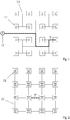
- a globally synchronous design as shown in Fig. 1 where all cores 12 of a clocking network 11 share one master clock 13, is used.
- the communication latencies between cores are drastically reduced compared to GALS clocking.
- a very large chip area has to be clocked synchronously.
- the clock signals within MPSoCs have to be transmitted over ranges of some millimeters, which is a well-known bottleneck for speed, power and reliability.
- traditional globally synchronous clocking circuits have become too difficult for large MPSoCs with many cores, constantly growing chip size and wire induced delays.
- the clock trees consume a significant amount of power which is critical for mobile communication systems.
- Another strategy for network synchronization and clock distribution relates to self-organized synchronization of distributed network nodes in absence of an entraining master clock.
- Mutually connected phase-locked loop networks dynamical models and design parameters
- F.M. Orsatti, R. Carareto, J.R.C. Piqueira, IET Circuit Devices Syst.,2008, Vol. 2, No. 6, pp. 495-508 relates to distributing clock signals by using mutually connected architectures instead of master-slave type architectures.
- Mutually connected digital PLL networks are studied and conditions for the existence of synchronized states are derived, depending on individual node parameters and network connectivity, considering that the nodes are nonlinear oscillators with nonlinear coupling conditions.
- WO 2013/178237 A1 relates to a communication network of interconnected communication nodes, each node comprising an oscillator that is mutually coupled to oscillators of other communication nodes.
- the oscillator generates periodic synchronization pulses.
- the communication node further comprises a transmitter for transmitting the synchronization pulses to other communication nodes; a receiver for receiving synchronization pulses from other communication nodes; and a synchronization unit for synchronizing the phase of the synchronization pulses generated by the oscillator with the phase of the synchronization pulses received from other communication nodes by adjusting the phase of the synchronization pulses generated by the oscillator upon receipt of synchronization pulses from other communication nodes.
- the synchronization unit adjusts the phase of the synchronization pulses generated by the oscillator in such a way that a guaranteed network-wide synchronization is achieved for all communication nodes of the communication network.
- WO 2013/178237 A1 explicitly limits a transmission time delay of the synchronization pulses between the communication nodes to one eighth of the period of the oscillator.
- this disclosure does not provide a suitable solution for networks exhibiting a transmission time delay exceeding one eighth of the period of the oscillator, e.g., highly integrated chip networks.
- this solution assumes pulse coupling. Stochastic synchronization pulse emission is required to guarantee synchronization.
- this solution is not suitable for clock distributions with time-continuous coupling.
- This objective is achieved with a node according to the independent apparatus claim and a method for synchronizing a network according to the independent method claim.
- the present invention relates to a node for a network comprising a plurality of interconnected nodes.
- the node comprises a controllable oscillator generating a time-continuous synchronization signal for synchronizing the plurality of interconnected nodes of the network.
- the node further comprises a controller for comparing and synchronizing a phase of the time-continuous synchronization signal generated by the controllable oscillator, which is transmitted to other nodes of the network, with the phase of an external time-continuous synchronization signal received from other nodes of the network by adjusting a frequency of the time-continuous synchronization signal generated by the controllable oscillator.
- the external time-continuous synchronization signal received from another node of the network is delayed with respect to the time-continuous synchronization signal transmitted by the other node by a total time delay.
- the total time delay is a transmission time delay resulting from a transmission time between the transmission of the external time-continuous synchronization signal by the other node and the following receipt of the external time-continuous synchronization signal by the node.
- the total time delay also comprises any tunable additional time delays in addition to the transmission time delay.
- the controller iteratively adjusts the frequency of the time-continuous synchronization signal generated by the controllable oscillator such that a network-wide synchronization of oscillators is achieved for all nodes of the network.
- the synchronization is thus achieved in a continuous self-organized process in interaction with other nodes of the network.
- the controller may be any control system with feedback of the continuous synchronization signal generated by the tunable oscillator.
- the controller in combination with the controllable oscillator may form a phase locked loop (PLL).
- PLLs are electronic components able to synchronize their synchronization signals by evaluating mutual phase differences and adjusting their frequencies accordingly.
- the controller then comprises a phase detector (PD) and a loop filter (LF).
- the controllable oscillator may be a voltage controlled oscillator (VCO).
- the phase detector compares the phase of the external time-continuous synchronization signal with the phase of the time-continuous synchronization signal generated by the controllable oscillator.
- a model for mutually coupled PLLs is described below using an analog PLL as an example.
- the present invention is not restricted to analog PLLs.
- the phase detector multiplies an external input signal x l with the output signal x k of the VCO.
- Total time delays, for example resulting from transmission time delays and/or tunable additional time delays between the PLLs are accounted for by a delay ⁇ T of the received signal.
- a feedback delay between the VCO and the PD is accounted for by a delay ⁇ f in the VCO signal. However, the feedback delay may be zero.
- the output x k C of the LF yields the control signal for the VCO.
- the first term containing a phase difference describes low frequency components of the signal, while the second term containing a sum of phases describes high frequency components. Approximating the LF as ideal, these high frequency components are fully damped and can therefore be omitted.
- K K VCO / 2 is the coupling strength and has the dimension of a frequency.
- the cosine function containing the phase difference is called the coupling function. This is a closed phase equation for two mutually delay-coupled PLLs.
- Eq. (5) can be extended to a phase model for N delay coupled PLLs with transmission delays between coupled oscillators.
- a standard state-of-the-art PLL handles only a single input signal.
- the controller then compares and synchronizes a phase of the time-continuous synchronization signal generated by the controllable oscillator with the phases of external time-continuous synchronization signals received from a plurality of other nodes of the network by adjusting a frequency of the time-continuous synchronization signal generated by the controllable oscillator.
- One aspect of the present invention relates to a combiner for combining external time-continuous synchronization signals received from other nodes of the network to generate a combined external time-continuous synchronization signal.
- the phase detector compares the phase of the time-continuous synchronization signal generated by the controllable oscillator with the phase of the combined external time-continuous synchronization signal.
- the combiner may be part of the phase detector (PD).
- the combiner may be a noninverting adder.
- the phase detector (PD) may be a multiplier for analog signals or an XOR gate for digital signals.
- the phase detector may compare the phase of the time-continuous synchronization signal generated by the controllable oscillator with the phase of each external time-continuous synchronization signal individually to generate a plurality of phase detector signals.
- the combiner then combines the phase detector signals to control the controllable oscillator.
- One aspect of the present invention relates to tuning the total time delay between mutually coupled PLLs.
- a stable in-phase synchronized solution, Eq. (8), with global frequency ⁇ cannot be achieved for arbitrary total time delays between coupled synchronizers.
- the total time delay is a design parameter and can be tuned by an additional delayer and the design of the network.
- a node may comprise a delayer for inducing an additional time delay to a transmission time delay.
- the total time delay effectively induces a frequency-dependent phase shift to a synchronization signal and, if appropriately tuned, changes the coupling properties such that stable synchronized states become possible.
- a delayer may be any means suitable to induce such phase shifts. The delayer may need to be specifically tuned for each input path.
- the total time delay may comprise a period of the controllable oscillator. Specifically, it may exceed one eighth of a period of the controllable oscillator.
- the node may further comprise a feedback delayer for inducing a feedback delay ⁇ f in a feedback path between the controllable oscillator and the phase detector.
- the feedback delay may compensate for the total time delay.
- the collective frequency then depends on the difference between the total time delay and the feedback delay.
- the total time delay may be tuned such that it minimizes a perturbation response rate ⁇ in order to arrive at an in-phase synchronized state with maximum stability as will be explained.
- the total time delay ⁇ T in combination with the feedback delay ⁇ f may be tuned such that a maximum perturbation decay can be achieved by optimizing the perturbation response rate ⁇ , see Eq. (9).
- further design parameters for optimizing the perturbation response rate ⁇ are the free running frequency ⁇ of the controllable oscillator, the coupling strength K, and the impulse response p(u) of a filter within the controller, i.e., the loop filter.
- One aspect of the present invention relates to optimizing the perturbation response by tuning the cut-off frequency of the loop filter.
- This equation can have multiple solutions in ⁇ for each eigenvalue ⁇ .
- the time-continuous synchronization signal may be a digital signal or an analog signal.
- the node may be a clocking node and the time-continuous synchronization signal may be a clock signal for clocking the clocking node.
- the present invention further relates to a usage of a node as described above within a network comprising a plurality of interconnected nodes that are continuously coupled.
- the network may be designed to yield a desired perturbation response rate and/or collective frequency.
- a design parameter of the network is the distance between a node and another node that determines the total time delay.
- the total time delay corresponding to an optimum perturbation response rate may be achieved either by adjusting the distance alone and/or the additional time delay induced by a delayer.
- the present invention further relates to a method for synchronizing a network comprising a plurality of interconnected nodes.
- the method comprises generating a time-continuous synchronization signal in each node; transmitting the time-continuous synchronization signal of each node to other nodes of the network; receiving in each node a delayed external time-continuous synchronization signal from other nodes of the network; synchronizing in each node a phase of the time-continuous synchronization signal with a phase of the external time-continuous synchronization signal received from another node by delaying the external time-continuous synchronization signal received from another node of the network with respect to the external time-continuous synchronization signal transmitted by the other node by a total time delay comprising a transmission time delay resulting from a transmission time between the transmission of the external time-continuous synchronization signal by the other node and the following receipt of the external time-continuous synchronization signal by the node and any tunable additional time delay in addition to the transmission time delay, it
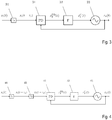
- Fig. 2 shows a dynamic clocking network 22 comprising a plurality of interconnected clocking nodes 21 that are continuously delay-coupled. Each clocking node is implemented as a PLL. Thus, the clocking network 22 is network of mutually delay-coupled PLLs with continuous coupling.
- the PLL comprises a phase detector 31, a loop filter 32 and a voltage controlled oscillator 33 that generates a time-continuous clocking signal x k ( t ) .
- the PLL synchronizes the phase of the clocking signal generated by the VCO 33 with the phase of the external clocking signal x l ( t - ⁇ s ) which is delayed by the transmission time delay ⁇ s , indicated by transmission delayer 34, by adjusting the frequency of the clocking signal of the VCO such that a network-wide synchronization of the VCOs is achieved for all clocking nodes of the dynamic clocking network.
- the phase detector 31 compares the phase of the external clocking signal x l ( t- ⁇ s ) with the phase of the clocking signal x k ( t ) generated by the VCO 33 to generate a phase detector signal x k PD t . After filtering with the loop filter 32 this yields the control signal x k C t for the VCO 33.
- Fig. 4 shows the node of Fig. 3 comprising an additional delayer 45 to adjust the total time delay.
- Transmission time delay ⁇ s and additional time delay ⁇ d yield the total time delay ⁇ T .
- the phase detector 41 compares the phase of the additionally delayed external clocking signal x l ( t- ⁇ T ) with the phase of the clocking signal x k ( t ) generated by the VCO 43 to generate the phase detector signal x k PD t . After filtering with the loop filter 42 this yields the control signal x k C t for the VCO 43.
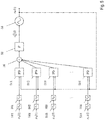
- Fig. 5 shows a clocking node with a plurality of external clocking signals x 1 ( t ), x 2 ( t ), x 3 ( t ), ..., x n ( t ).
- Each input path comprises an individual delayer 551, 552, 553, 554 that induces an additional time delay to the transmission time delay indicated by transmission delayers 541, 542, 543, 544.
- Each phase detector 511, 512, 513, 514 compares the phase of the clocking signal x k ( t ) generated by the controllable oscillator 53 with the phase of each external clock signal individually to generate a plurality of phase detector signals.
- the combiner 56 combines the phase detector signals to generate a combined phase detector signal to control the controllable oscillator.
- the combined phase detector signal is filtered by the loop filter 52 to yield the control signal x k C t for the VCO.
- the PLL of each clocking node thus adjusts the frequency of the clocking signal of each VCO such that a network-wide synchronization of the VCOs is achieved for all clocking nodes of the dynamic clocking network. By properly inducing individual additional time delays to each input path, stable solutions for the collective frequency of the network can be achieved.
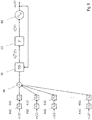
- Fig. 6 shows a clocking node with a plurality of external clocking signals x 1 ( t ), x 2 ( t ), x 3 ( t ), ..., x n ( t ).
- Each input path comprises an individual delayer 651, 652, 653, 654 that induces an additional time delay to the transmission time delay indicated by transmission delayers 641, 642, 643, 644.
- the combiner 66 combines the plurality of external clocking signals to generate a combined external clocking signal.
- the phase detector 61 compares the phase of the clocking signal generated by the VCO 63 with the phase of the combined external clocking signal to generate the phase detector signal x k PD t . After filtering with the loop filter 62 this yields the control signal x k C t for the VCO 63.
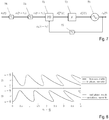
- Fig. 7 shows the clocking node of Fig. 4 comprising a feedback delayer 77 for introducing a time delay in the feedback loop of the PLL comprising the phase detector 71, loop filter 72 and VCO 73.
- the feedback delay may be induced to compensate for a total time delay.
- the individual total time delays ⁇ T in any of the described embodiments are design parameters. Only if chosen properly, a stable synchronous state can be achieved as will be explained with reference to Fig. 8 which shows the global frequency ⁇ of the in-phase and anti-phase synchronized state as a function of the total time delay ⁇ T for a clocking network comprising two clocking nodes.
- Full lines denote stable solutions and dashed lines denote unstable solutions.
- the total time delay can be chosen for a given free running frequency of the VCO in order to achieve a desired synchronous state and global frequency of the network. If no additional time delay is induced, the transmission time delay corresponds to the total time delay.
- a transmission time delay can be achieved that yields a stable synchronous state.
- the total time delay may be chosen such that a perturbation response rate given by Re( ⁇ ) is minimized, see Eq. (14).
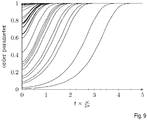
- Fig. 10 shows a diagram showing the perturbation response rate versus the total time delay for a clocking network comprising two clocking nodes.
- Fig. 11 shows the perturbation response rate versus the total time delay for different cut-off frequencies of the loop filter.
- the present invention proposes a novel synchronization strategy, specifically for spatially distributed clocks. These clocks are synchronized by networks of mutually coupled phase-locked loops. An important feature is the total time delay in the time-continuous coupling between phase-looked loops which enables synchronized states in the presence of a non-attractive coupling mechanism. As the transmission time delay is not limited to one eighth of a period of the oscillator as is the case with the solution disclosed in WO 2013/178237 A1 , networks with larger total time delays between nodes can be synchronized. Important applications are, e.g., high performance MPSoCs architectures, distributed antenna arrays, and other large scale electronic clocking systems communicating by means of time-continuous signals.
- the present invention specifically provides a simplified clock network compared to the prior art tree structure.
- the synchronized network thus enables an increased energy efficiency due to shorter connections and less amplification. Moreover, it exhibits increased robustness towards failure of individual components due to decentralized architecture. Furthermore, the synchronized network is designed for high quality of oscillations.
- the synchronized network can be realized using readily available hardware components. Thus, this solution works with readily available hardware combined in a novel way and additionally simplifies clock distribution, thereby reducing power consumption and increasing scalability.
Landscapes
- Engineering & Computer Science (AREA)
- Theoretical Computer Science (AREA)
- Physics & Mathematics (AREA)
- General Engineering & Computer Science (AREA)
- General Physics & Mathematics (AREA)
- Computer Networks & Wireless Communication (AREA)
- Signal Processing (AREA)
- Stabilization Of Oscillater, Synchronisation, Frequency Synthesizers (AREA)
- Synchronisation In Digital Transmission Systems (AREA)
Claims (13)
- Knoten (21) für ein Netz (22) mit mehreren miteinander verbundenen Knoten, wobei jeder Knoten (21) folgendes umfasst:einen steuerbaren Oszillator (33), der ein zeitkontinuierliches Synchronisationssignal zum Synchronisieren der mehreren miteinander verbundenen Knoten (21) des Netzes (22) erzeugt;eine Steuereinheit (31, 32) zum Vergleichen und Synchronisieren einer Phase des zeitkontinuierlichen Synchronisationssignals, das durch den steuerbaren Oszillator (33) erzeugt wird, das zu anderen Knoten (21) des Netzes (22) gesendet wird, mit der Phase eines externen zeitkontinuierlichen Synchronisationssignals, das von anderen Knoten (21) des Netzes (22) empfangen wird, durch Einstellen einer Frequenz des zeitkontinuierlichen Synchronisationssignals, das durch den steuerbaren Oszillator (33) erzeugt wird,dadurch gekennzeichnet, dass das externe zeitkontinuierliche Synchronisationssignal, das von einem anderen Knoten (21) des Netzes (22) empfangen wird, in Bezug auf das externe zeitkontinuierliche Synchronisationssignal, das durch den anderen Knoten (21) gesendet wird, um eine Gesamtzeitverzögerung mit einer Sendezeitverzögerung, die sich aus einer Sendezeit zwischen dem Senden des externen zeitkontinuierlichen Synchronisationssignals durch den anderen Knoten (21) und dem folgenden Empfang des externen zeitkontinuierlichen Synchronisationssignals durch den Knoten (21) ergibt, und irgendeiner abstimmbaren zusätzlichen Zeitverzögerung zusätzlich zur Sendezeitverzögerung verzögert wird;wobei die Steuereinheit (31, 32) die Frequenz des zeitkontinuierlichen Synchronisationssignals, das durch den steuerbaren Oszillator (33) erzeugt wird, iterativ einstellt, so dass eine netzweite Synchronisation von Oszillatoren (33) für alle Knoten (21) des Netzes (22) in einem kontinuierlichen selbstorganisierten Prozess in Zusammenwirkung mit dem anderen Knoten (21) des Netzes (22) erreicht wird,wobei mindestens einer der folgenden Parameter: die Gesamtzeitverzögerung τT, die Rückkopplungsverzögerung τf , eine Freilauffrequenz ω des steuerbaren Oszillators (33), eine Kopplungsstärke K, eine Impulsreaktion p(u) eines Filters (32) innerhalb der Steuereinheit (31, 32) abgestimmt wird, um eine gewünschte Störungsreaktionsrate λ, d. h. eine Störungsreaktionsrate λ mit Re(λ)<0, und/oder eine kollektive Frequenz Ω zu erbringen; undwobei die gewünschte Störungsreaktionsrate λ
 α=Kh'(-Ω[τT -τf ]), wobei h' eine erste Ableitung einer Kopplungsfunktion h bezeichnet;
 wobei die kollektive Frequenz Ω Folgendes löst:
- Knoten nach Anspruch 1, wobei die Steuereinheit (31, 32) einen Phasendetektor (31) umfasst, der dazu konfiguriert ist, die Phase des externen zeitkontinuierlichen Synchronisationssignals mit der Phase des zeitkontinuierlichen Synchronisationssignals zu vergleichen, das durch den steuerbaren Oszillator (33) erzeugt wird.
- Knoten nach Anspruch 1 oder 2, wobei die Steuereinheit (61, 62) eine Phase des zeitkontinuierlichen Synchronisationssignals, das durch den steuerbaren Oszillator (63) erzeugt wird, das zu anderen Knoten (21) des Netzes (22) gesendet wird, mit den Phasen von externen zeitkontinuierlichen Synchronisationssignalen, die von anderen Knoten (21) des Netzes (22) empfangen werden, vergleicht und durch Einstellen einer Frequenz des zeitkontinuierlichen Synchronisationssignals, das durch den steuerbaren Oszillator (33) erzeugt wird, synchronisiert,
wobei die externen zeitkontinuierlichen Synchronisationssignale, die von anderen Knoten (21) des Netzes (22) empfangen werden, in Bezug auf das zeitkontinuierliche Synchronisationssignal, das durch die anderen Knoten (21) gesendet wird, um eine Gesamtzeitverzögerung verzögert werden; und
wobei die Steuereinheit (61, 62) die Frequenz des zeitkontinuierlichen Synchronisationssignals, das durch den steuerbaren Oszillator (63) erzeugt wird, iterativ einstellt, so dass eine netzweite Synchronisation von Oszillatoren für alle Knoten (21) des Netzes (22) in einem kontinuierlichen selbstorganisierten Prozess in Zusammenwirkung mit den anderen Knoten (21) des Netzes (22) erreicht wird. - Knoten nach Anspruch 3, der ferner einen Kombinator (66) umfasst, um die externen zeitkontinuierlichen Synchronisationssignale, die von anderen Knoten (21) des Netzes (22) empfangen werden, zu kombinieren, um ein kombiniertes externes zeitkontinuierliches Synchronisationssignal zu erzeugen, und wobei der Phasendetektor die Phase des zeitkontinuierlichen Synchronisationssignals, das durch den steuerbaren Oszillator (63) erzeugt wird, mit der Phase des kombinierten externen zeitkontinuierlichen Synchronisationssignals vergleicht (61).
- Knoten nach Anspruch 3, wobei der Phasendetektor (511, 512, 513, 514) die Phase des zeitkontinuierlichen Synchronisationssignals, das durch den steuerbaren Oszillator (53) erzeugt wird, mit der Phase jedes externen zeitkontinuierlichen Synchronisationssignals individuell vergleicht, um mehrere Phasendetektorsignale zu erzeugen; und wobei der Kombinator (56) die Phasendetektorsignale kombiniert, um den steuerbaren Oszillator (53) zu steuern.
- Knoten nach Anspruch 4 oder 5, wobei die Steuereinheit den Kombinator (56; 66) umfasst.
- Knoten nach einem der Ansprüche 1 bis 6 mit einem Verzögerer (45) zum Induzieren einer zusätzlichen Zeitverzögerung zusätzlich zu einer Sendezeitverzögerung, um die Gesamtzeitverzögerung zu erbringen.
- Knoten nach einem der Ansprüche 3 bis 6 mit mehreren Verzögerern (551, 552, 553, 554; 651, 652, 653, 654) zum Induzieren einer zusätzlichen Zeitverzögerung zusätzlich zu einer Sendezeitverzögerung, um die Gesamtzeitverzögerung für jedes empfangene externe zeitkontinuierliche Synchronisationssignal zu erbringen.
- Knoten nach einem der Ansprüche 1 bis 8 mit einem Rückkopplungsverzögerer (77) zum Induzieren einer Rückkopplungszeitverzögerung in einem Rückkopplungspfad zwischen dem steuerbaren Oszillator (73) und dem Phasendetektor (71).
- Knoten nach einem der Ansprüche 1 bis 9, wobei das zeitkontinuierliche Synchronisationssignal ein digitales Signal oder ein analoges Signal ist.
- Knoten nach einem der Ansprüche 1 bis 10, wobei der Knoten (21) ein Taktknoten ist und wobei das zeitkontinuierliche Synchronisationssignal ein Taktsignal zum Takten des Taktknotens (21) ist.
- Knoten nach einem der Ansprüche 1 bis 11, der in einem Netz (22) mit mehreren miteinander verbundenen Knoten (21) verwendet wird, die zeitkontinuierlich mit einem Abstand zwischen einem Knoten (21) und einem anderen Knoten (21) gekoppelt sind, der Gesamtzeitverzögerungen bestimmt, um die gewünschte Störungsreaktionsrate und/oder kollektive Frequenz zu erbringen.
- Verfahren zum Synchronisieren eines Netzes (22) mit mehreren miteinander verbundenen Knoten (21), wobei das Verfahren Folgendes umfasst:Erzeugen eines zeitkontinuierlichen Synchronisationssignals in jedem Knoten (21);Senden des zeitkontinuierlichen Synchronisationssignals jedes Knotens (21) zu anderen Knoten (21) des Netzes (22);Empfangen eines verzögerten externen zeitkontinuierlichen Synchronisationssignals in jedem Knoten (21) von anderen Knoten (21) des Netzes (22);gekennzeichnet durchSynchronisieren einer Phase des zeitkontinuierlichen Synchronisationssignals mit einer Phase des externen zeitkontinuierlichen Synchronisationssignals, das von einem anderen Knoten (21) empfangen wird, in jedem Knoten durch Verzögern des externen zeitkontinuierlichen Synchronisationssignals, das von einem anderen Knoten (21) des Netzes (22) empfangen wird, in Bezug auf das externe zeitkontinuierliche Synchronisationssignal, das durch den anderen Knoten (21) gesendet wird, um eine Gesamtzeitverzögerung mit einer Sendezeitverzögerung, die sich aus einer Sendezeit zwischen dem Senden des externen zeitkontinuierlichen Synchronisationssignals durch den anderen Knoten (21) und dem folgenden Empfang des externen zeitkontinuierlichen Synchronisationssignals durch den Knoten (21) ergibt, und irgendeiner abstimmbaren zusätzlichen Zeitverzögerung zusätzlich zur Sendezeitverzögerung;iteratives Einstellen der Frequenz des zeitkontinuierlichen Synchronisationssignals, so dass eine netzweite Synchronisation für alle Knoten (21) des Netzes (22) in einem kontinuierlichen selbstorganisierten Prozess in Zusammenwirkung mit den anderen Knoten (21) des Netzes (22) erreicht wird,Abstimmen mindestens eines der folgenden Parameter: der Gesamtzeitverzögerung τT , der Rückkopplungsverzögerung τf, einer Freilauffrequenz ω des steuerbaren Oszillators (33), einer Kopplungsstärke K, einer Impulsreaktion p(u) eines Filters (31) innerhalb der Steuereinheit (31, 32), um eine gewünschte Störungsreaktionsrate λ, d. h. eine Störungsreaktionsrate λ mit Re(λ)<0, und/oder eine kollektive Frequenz Ω zu erbringen; undwobei die gewünschte Störungsreaktionsrate λ
 α=Kh'(-Ω[τT -τf ]), wobei h' eine erste Ableitung einer Kopplungsfunktion h bezeichnet;
 wobei die kollektive Frequenz Ω Folgendes löst:
Priority Applications (6)
| Application Number | Priority Date | Filing Date | Title |
|---|---|---|---|
| EP14173279.2A EP2957982B1 (de) | 2014-06-20 | 2014-06-20 | Selbst-synchronisierbares Netzwerk |
| PCT/EP2015/064008 WO2015193512A1 (en) | 2014-06-20 | 2015-06-22 | Self-synchronizable network |
| US15/316,307 US10241539B2 (en) | 2014-06-20 | 2015-06-22 | Self-synchronizable network |
| KR1020177001616A KR102029320B1 (ko) | 2014-06-20 | 2015-06-22 | 자가-동기화 가능한 네트워크 |
| TW104120060A TWI721948B (zh) | 2014-06-20 | 2015-06-22 | 可同步網路及用於同步網路的方法 |
| CN201580032941.6A CN106462177B (zh) | 2014-06-20 | 2015-06-22 | 可自同步网络 |
Applications Claiming Priority (1)
| Application Number | Priority Date | Filing Date | Title |
|---|---|---|---|
| EP14173279.2A EP2957982B1 (de) | 2014-06-20 | 2014-06-20 | Selbst-synchronisierbares Netzwerk |
Publications (2)
| Publication Number | Publication Date |
|---|---|
| EP2957982A1 EP2957982A1 (de) | 2015-12-23 |
| EP2957982B1 true EP2957982B1 (de) | 2017-08-09 |
Family
ID=51062668
Family Applications (1)
| Application Number | Title | Priority Date | Filing Date |
|---|---|---|---|
| EP14173279.2A Not-in-force EP2957982B1 (de) | 2014-06-20 | 2014-06-20 | Selbst-synchronisierbares Netzwerk |
Country Status (6)
| Country | Link |
|---|---|
| US (1) | US10241539B2 (de) |
| EP (1) | EP2957982B1 (de) |
| KR (1) | KR102029320B1 (de) |
| CN (1) | CN106462177B (de) |
| TW (1) | TWI721948B (de) |
| WO (1) | WO2015193512A1 (de) |
Families Citing this family (3)
| Publication number | Priority date | Publication date | Assignee | Title |
|---|---|---|---|---|
| CN105743555B (zh) * | 2016-03-25 | 2018-08-14 | 四川大学 | 一种分程式分布天线发射波束优化形成方法 |
| DE102017127805B4 (de) * | 2017-11-24 | 2019-10-17 | Infineon Technologies Ag | Oszillatoranordnung und Verfahren zum Synchronisieren eines Oszillators |
| CN109829536A (zh) * | 2019-02-20 | 2019-05-31 | 杭州职业技术学院 | 一种基于遗传算法的网络同步性能优化方法 |
Family Cites Families (8)
| Publication number | Priority date | Publication date | Assignee | Title |
|---|---|---|---|---|
| GB2279190A (en) * | 1993-06-15 | 1994-12-21 | Ibm | Synchronisation apparatus |
| US7218229B2 (en) * | 2003-11-07 | 2007-05-15 | Wherenet Corp | Location system and method that achieves time synchronized network performance with nodes divided into separate networks |
| KR100574980B1 (ko) * | 2004-04-26 | 2006-05-02 | 삼성전자주식회사 | 빠른 주파수 락을 위한 위상 동기 루프 |
| KR100594297B1 (ko) * | 2004-10-12 | 2006-06-30 | 삼성전자주식회사 | 외부 클럭 신호의 주파수에 순응하는 발진기를 이용하는지연 동기 루프 및 방법 |
| US7954000B2 (en) * | 2008-01-14 | 2011-05-31 | International Business Machines Corporation | Power supply current spike reduction techniques for an integrated circuit |
| CN102237941B (zh) * | 2010-04-28 | 2015-06-03 | 中兴通讯股份有限公司 | 时间同步系统及方法 |
| US9209959B2 (en) * | 2012-03-26 | 2015-12-08 | Electronics And Telecommunications Research Institute | Method of frequency synchronization in distributed network |
| WO2013178237A1 (en) | 2012-05-31 | 2013-12-05 | Max-Planck-Gesellschaft zur Förderung der Wissenschaften e. V. | Communication node and method for self-organizing synchronization of a communication network |
-
2014
- 2014-06-20 EP EP14173279.2A patent/EP2957982B1/de not_active Not-in-force
-
2015
- 2015-06-22 KR KR1020177001616A patent/KR102029320B1/ko not_active Expired - Fee Related
- 2015-06-22 CN CN201580032941.6A patent/CN106462177B/zh not_active Expired - Fee Related
- 2015-06-22 US US15/316,307 patent/US10241539B2/en active Active
- 2015-06-22 TW TW104120060A patent/TWI721948B/zh not_active IP Right Cessation
- 2015-06-22 WO PCT/EP2015/064008 patent/WO2015193512A1/en not_active Ceased
Non-Patent Citations (1)
| Title |
|---|
| None * |
Also Published As
| Publication number | Publication date |
|---|---|
| WO2015193512A1 (en) | 2015-12-23 |
| CN106462177B (zh) | 2020-02-07 |
| US10241539B2 (en) | 2019-03-26 |
| KR20170021303A (ko) | 2017-02-27 |
| CN106462177A (zh) | 2017-02-22 |
| KR102029320B1 (ko) | 2019-11-08 |
| TW201601566A (zh) | 2016-01-01 |
| EP2957982A1 (de) | 2015-12-23 |
| TWI721948B (zh) | 2021-03-21 |
| US20170139438A1 (en) | 2017-05-18 |
Similar Documents
| Publication | Publication Date | Title |
|---|---|---|
| US5481573A (en) | Synchronous clock distribution system | |
| CN103957003B (zh) | 一种时间数字转换器、频率跟踪装置及方法 | |
| EP3076553B1 (de) | Taktsynchronisator | |
| US10523224B2 (en) | Techniques for signal skew compensation | |
| US10571953B2 (en) | Method and apparatus to utilize a digital-time-conversion (DTC) based clocking in computing systems | |
| JP6485003B2 (ja) | 信号生成システム及び方法 | |
| EP2957982B1 (de) | Selbst-synchronisierbares Netzwerk | |
| CN104467757B (zh) | 时钟脉冲系统、时钟脉冲集成电路以及时钟脉冲产生方法 | |
| US20130088268A1 (en) | Multi-Phase Clock Generation System and Clock Calibration Method Thereof | |
| TWI654844B (zh) | 在fdsoi技術中產生本地振盪器訊號之數位倍頻器 | |
| JP2004266639A (ja) | クロック整形器とこれを用いた電子機器 | |
| US8692595B1 (en) | Transceiver circuitry with multiple phase-locked loops | |
| Kinali et al. | Fault-tolerant clock synchronization with high precision | |
| JP2012130003A (ja) | 信号伝搬遅延を補償するための装置及び方法 | |
| Korniienko et al. | Control law synthesis for distributed multi-agent systems: Application to active clock distribution networks | |
| US6636532B1 (en) | Apparatus for adjusting phase | |
| CN101436856A (zh) | 频率同步装置,频率同步方法及使用其的频率产生装置 | |
| US9258110B2 (en) | Phase detector | |
| JP2013232831A (ja) | 注入同期発振器 | |
| Korniienko et al. | H∞ loop shaping control for distributed PLL network | |
| US20260005651A1 (en) | Resonant clocking architecture | |
| KR100708591B1 (ko) | 정재파를 이용한 클럭 분배 방법 및 그 장치 | |
| Piqueira et al. | Models for Master‐Slave Clock Distribution Networks with Third‐Order Phase‐Locked Loops | |
| US7269093B2 (en) | Generating a sampling clock signal in a communication block of a memory device | |
| KR101855354B1 (ko) | 저주파 동기신호를 생성하는 장치 및 방법 |
Legal Events
| Date | Code | Title | Description |
|---|---|---|---|
| PUAI | Public reference made under article 153(3) epc to a published international application that has entered the european phase |
Free format text: ORIGINAL CODE: 0009012 |
|
| AK | Designated contracting states |
Kind code of ref document: A1 Designated state(s): AL AT BE BG CH CY CZ DE DK EE ES FI FR GB GR HR HU IE IS IT LI LT LU LV MC MK MT NL NO PL PT RO RS SE SI SK SM TR |
|
| AX | Request for extension of the european patent |
Extension state: BA ME |
|
| 17P | Request for examination filed |
Effective date: 20160623 |
|
| RBV | Designated contracting states (corrected) |
Designated state(s): AL AT BE BG CH CY CZ DE DK EE ES FI FR GB GR HR HU IE IS IT LI LT LU LV MC MK MT NL NO PL PT RO RS SE SI SK SM TR |
|
| GRAP | Despatch of communication of intention to grant a patent |
Free format text: ORIGINAL CODE: EPIDOSNIGR1 |
|
| INTG | Intention to grant announced |
Effective date: 20170208 |
|
| RIN1 | Information on inventor provided before grant (corrected) |
Inventor name: WETZEL, LUCAS Inventor name: JOERG, DAVID JOSEF Inventor name: POLLAKIS, ALEXANDROS Inventor name: RAVE, WOLFGANG Inventor name: FETTWEIS, GERHARD Inventor name: JUELICHER, FRANK |
|
| GRAS | Grant fee paid |
Free format text: ORIGINAL CODE: EPIDOSNIGR3 |
|
| GRAA | (expected) grant |
Free format text: ORIGINAL CODE: 0009210 |
|
| AK | Designated contracting states |
Kind code of ref document: B1 Designated state(s): AL AT BE BG CH CY CZ DE DK EE ES FI FR GB GR HR HU IE IS IT LI LT LU LV MC MK MT NL NO PL PT RO RS SE SI SK SM TR |
|
| REG | Reference to a national code |
Ref country code: GB Ref legal event code: FG4D |
|
| REG | Reference to a national code |
Ref country code: CH Ref legal event code: EP Ref country code: AT Ref legal event code: REF Ref document number: 917505 Country of ref document: AT Kind code of ref document: T Effective date: 20170815 |
|
| REG | Reference to a national code |
Ref country code: IE Ref legal event code: FG4D |
|
| REG | Reference to a national code |
Ref country code: DE Ref legal event code: R096 Ref document number: 602014012768 Country of ref document: DE |
|
| REG | Reference to a national code |
Ref country code: NL Ref legal event code: MP Effective date: 20170809 |
|
| REG | Reference to a national code |
Ref country code: LT Ref legal event code: MG4D |
|
| REG | Reference to a national code |
Ref country code: AT Ref legal event code: MK05 Ref document number: 917505 Country of ref document: AT Kind code of ref document: T Effective date: 20170809 |
|
| PG25 | Lapsed in a contracting state [announced via postgrant information from national office to epo] |
Ref country code: LT Free format text: LAPSE BECAUSE OF FAILURE TO SUBMIT A TRANSLATION OF THE DESCRIPTION OR TO PAY THE FEE WITHIN THE PRESCRIBED TIME-LIMIT Effective date: 20170809 Ref country code: HR Free format text: LAPSE BECAUSE OF FAILURE TO SUBMIT A TRANSLATION OF THE DESCRIPTION OR TO PAY THE FEE WITHIN THE PRESCRIBED TIME-LIMIT Effective date: 20170809 Ref country code: AT Free format text: LAPSE BECAUSE OF FAILURE TO SUBMIT A TRANSLATION OF THE DESCRIPTION OR TO PAY THE FEE WITHIN THE PRESCRIBED TIME-LIMIT Effective date: 20170809 Ref country code: FI Free format text: LAPSE BECAUSE OF FAILURE TO SUBMIT A TRANSLATION OF THE DESCRIPTION OR TO PAY THE FEE WITHIN THE PRESCRIBED TIME-LIMIT Effective date: 20170809 Ref country code: SE Free format text: LAPSE BECAUSE OF FAILURE TO SUBMIT A TRANSLATION OF THE DESCRIPTION OR TO PAY THE FEE WITHIN THE PRESCRIBED TIME-LIMIT Effective date: 20170809 Ref country code: NO Free format text: LAPSE BECAUSE OF FAILURE TO SUBMIT A TRANSLATION OF THE DESCRIPTION OR TO PAY THE FEE WITHIN THE PRESCRIBED TIME-LIMIT Effective date: 20171109 Ref country code: NL Free format text: LAPSE BECAUSE OF FAILURE TO SUBMIT A TRANSLATION OF THE DESCRIPTION OR TO PAY THE FEE WITHIN THE PRESCRIBED TIME-LIMIT Effective date: 20170809 |
|
| PG25 | Lapsed in a contracting state [announced via postgrant information from national office to epo] |
Ref country code: GR Free format text: LAPSE BECAUSE OF FAILURE TO SUBMIT A TRANSLATION OF THE DESCRIPTION OR TO PAY THE FEE WITHIN THE PRESCRIBED TIME-LIMIT Effective date: 20171110 Ref country code: BG Free format text: LAPSE BECAUSE OF FAILURE TO SUBMIT A TRANSLATION OF THE DESCRIPTION OR TO PAY THE FEE WITHIN THE PRESCRIBED TIME-LIMIT Effective date: 20171109 Ref country code: IS Free format text: LAPSE BECAUSE OF FAILURE TO SUBMIT A TRANSLATION OF THE DESCRIPTION OR TO PAY THE FEE WITHIN THE PRESCRIBED TIME-LIMIT Effective date: 20171209 Ref country code: RS Free format text: LAPSE BECAUSE OF FAILURE TO SUBMIT A TRANSLATION OF THE DESCRIPTION OR TO PAY THE FEE WITHIN THE PRESCRIBED TIME-LIMIT Effective date: 20170809 Ref country code: ES Free format text: LAPSE BECAUSE OF FAILURE TO SUBMIT A TRANSLATION OF THE DESCRIPTION OR TO PAY THE FEE WITHIN THE PRESCRIBED TIME-LIMIT Effective date: 20170809 Ref country code: LV Free format text: LAPSE BECAUSE OF FAILURE TO SUBMIT A TRANSLATION OF THE DESCRIPTION OR TO PAY THE FEE WITHIN THE PRESCRIBED TIME-LIMIT Effective date: 20170809 Ref country code: PL Free format text: LAPSE BECAUSE OF FAILURE TO SUBMIT A TRANSLATION OF THE DESCRIPTION OR TO PAY THE FEE WITHIN THE PRESCRIBED TIME-LIMIT Effective date: 20170809 |
|
| PG25 | Lapsed in a contracting state [announced via postgrant information from national office to epo] |
Ref country code: RO Free format text: LAPSE BECAUSE OF FAILURE TO SUBMIT A TRANSLATION OF THE DESCRIPTION OR TO PAY THE FEE WITHIN THE PRESCRIBED TIME-LIMIT Effective date: 20170809 Ref country code: DK Free format text: LAPSE BECAUSE OF FAILURE TO SUBMIT A TRANSLATION OF THE DESCRIPTION OR TO PAY THE FEE WITHIN THE PRESCRIBED TIME-LIMIT Effective date: 20170809 Ref country code: CZ Free format text: LAPSE BECAUSE OF FAILURE TO SUBMIT A TRANSLATION OF THE DESCRIPTION OR TO PAY THE FEE WITHIN THE PRESCRIBED TIME-LIMIT Effective date: 20170809 |
|
| REG | Reference to a national code |
Ref country code: DE Ref legal event code: R097 Ref document number: 602014012768 Country of ref document: DE |
|
| PG25 | Lapsed in a contracting state [announced via postgrant information from national office to epo] |
Ref country code: SM Free format text: LAPSE BECAUSE OF FAILURE TO SUBMIT A TRANSLATION OF THE DESCRIPTION OR TO PAY THE FEE WITHIN THE PRESCRIBED TIME-LIMIT Effective date: 20170809 Ref country code: IT Free format text: LAPSE BECAUSE OF FAILURE TO SUBMIT A TRANSLATION OF THE DESCRIPTION OR TO PAY THE FEE WITHIN THE PRESCRIBED TIME-LIMIT Effective date: 20170809 Ref country code: SK Free format text: LAPSE BECAUSE OF FAILURE TO SUBMIT A TRANSLATION OF THE DESCRIPTION OR TO PAY THE FEE WITHIN THE PRESCRIBED TIME-LIMIT Effective date: 20170809 Ref country code: EE Free format text: LAPSE BECAUSE OF FAILURE TO SUBMIT A TRANSLATION OF THE DESCRIPTION OR TO PAY THE FEE WITHIN THE PRESCRIBED TIME-LIMIT Effective date: 20170809 |
|
| PLBE | No opposition filed within time limit |
Free format text: ORIGINAL CODE: 0009261 |
|
| STAA | Information on the status of an ep patent application or granted ep patent |
Free format text: STATUS: NO OPPOSITION FILED WITHIN TIME LIMIT |
|
| REG | Reference to a national code |
Ref country code: FR Ref legal event code: PLFP Year of fee payment: 5 |
|
| 26N | No opposition filed |
Effective date: 20180511 |
|
| PG25 | Lapsed in a contracting state [announced via postgrant information from national office to epo] |
Ref country code: SI Free format text: LAPSE BECAUSE OF FAILURE TO SUBMIT A TRANSLATION OF THE DESCRIPTION OR TO PAY THE FEE WITHIN THE PRESCRIBED TIME-LIMIT Effective date: 20170809 |
|
| REG | Reference to a national code |
Ref country code: CH Ref legal event code: PL |
|
| REG | Reference to a national code |
Ref country code: BE Ref legal event code: MM Effective date: 20180630 |
|
| REG | Reference to a national code |
Ref country code: IE Ref legal event code: MM4A |
|
| PG25 | Lapsed in a contracting state [announced via postgrant information from national office to epo] |
Ref country code: MC Free format text: LAPSE BECAUSE OF FAILURE TO SUBMIT A TRANSLATION OF THE DESCRIPTION OR TO PAY THE FEE WITHIN THE PRESCRIBED TIME-LIMIT Effective date: 20170809 Ref country code: LU Free format text: LAPSE BECAUSE OF NON-PAYMENT OF DUE FEES Effective date: 20180620 |
|
| PG25 | Lapsed in a contracting state [announced via postgrant information from national office to epo] |
Ref country code: IE Free format text: LAPSE BECAUSE OF NON-PAYMENT OF DUE FEES Effective date: 20180620 Ref country code: CH Free format text: LAPSE BECAUSE OF NON-PAYMENT OF DUE FEES Effective date: 20180630 Ref country code: LI Free format text: LAPSE BECAUSE OF NON-PAYMENT OF DUE FEES Effective date: 20180630 |
|
| PG25 | Lapsed in a contracting state [announced via postgrant information from national office to epo] |
Ref country code: BE Free format text: LAPSE BECAUSE OF NON-PAYMENT OF DUE FEES Effective date: 20180630 |
|
| PG25 | Lapsed in a contracting state [announced via postgrant information from national office to epo] |
Ref country code: MT Free format text: LAPSE BECAUSE OF NON-PAYMENT OF DUE FEES Effective date: 20180620 |
|
| PG25 | Lapsed in a contracting state [announced via postgrant information from national office to epo] |
Ref country code: TR Free format text: LAPSE BECAUSE OF FAILURE TO SUBMIT A TRANSLATION OF THE DESCRIPTION OR TO PAY THE FEE WITHIN THE PRESCRIBED TIME-LIMIT Effective date: 20170809 |
|
| PG25 | Lapsed in a contracting state [announced via postgrant information from national office to epo] |
Ref country code: PT Free format text: LAPSE BECAUSE OF FAILURE TO SUBMIT A TRANSLATION OF THE DESCRIPTION OR TO PAY THE FEE WITHIN THE PRESCRIBED TIME-LIMIT Effective date: 20170809 |
|
| PG25 | Lapsed in a contracting state [announced via postgrant information from national office to epo] |
Ref country code: HU Free format text: LAPSE BECAUSE OF FAILURE TO SUBMIT A TRANSLATION OF THE DESCRIPTION OR TO PAY THE FEE WITHIN THE PRESCRIBED TIME-LIMIT; INVALID AB INITIO Effective date: 20140620 Ref country code: MK Free format text: LAPSE BECAUSE OF NON-PAYMENT OF DUE FEES Effective date: 20170809 Ref country code: CY Free format text: LAPSE BECAUSE OF FAILURE TO SUBMIT A TRANSLATION OF THE DESCRIPTION OR TO PAY THE FEE WITHIN THE PRESCRIBED TIME-LIMIT Effective date: 20170809 |
|
| PG25 | Lapsed in a contracting state [announced via postgrant information from national office to epo] |
Ref country code: AL Free format text: LAPSE BECAUSE OF FAILURE TO SUBMIT A TRANSLATION OF THE DESCRIPTION OR TO PAY THE FEE WITHIN THE PRESCRIBED TIME-LIMIT Effective date: 20170809 |
|
| PGFP | Annual fee paid to national office [announced via postgrant information from national office to epo] |
Ref country code: GB Payment date: 20240620 Year of fee payment: 11 |
|
| PGFP | Annual fee paid to national office [announced via postgrant information from national office to epo] |
Ref country code: DE Payment date: 20240626 Year of fee payment: 11 |
|
| PGFP | Annual fee paid to national office [announced via postgrant information from national office to epo] |
Ref country code: FR Payment date: 20240617 Year of fee payment: 11 |
|
| REG | Reference to a national code |
Ref country code: DE Ref legal event code: R119 Ref document number: 602014012768 Country of ref document: DE |
|
| GBPC | Gb: european patent ceased through non-payment of renewal fee |
Effective date: 20250620 |
|
| PG25 | Lapsed in a contracting state [announced via postgrant information from national office to epo] |
Ref country code: GB Free format text: LAPSE BECAUSE OF NON-PAYMENT OF DUE FEES Effective date: 20250620 |
|
| PG25 | Lapsed in a contracting state [announced via postgrant information from national office to epo] |
Ref country code: DE Free format text: LAPSE BECAUSE OF NON-PAYMENT OF DUE FEES Effective date: 20260101 |
|
| PG25 | Lapsed in a contracting state [announced via postgrant information from national office to epo] |
Ref country code: FR Free format text: LAPSE BECAUSE OF NON-PAYMENT OF DUE FEES Effective date: 20250630 |