EP2958044A1 - Procédé informatique et système permettant de commander dynamiquement l'exécution d'un code - Google Patents
Procédé informatique et système permettant de commander dynamiquement l'exécution d'un code Download PDFInfo
- Publication number
- EP2958044A1 EP2958044A1 EP14305954.1A EP14305954A EP2958044A1 EP 2958044 A1 EP2958044 A1 EP 2958044A1 EP 14305954 A EP14305954 A EP 14305954A EP 2958044 A1 EP2958044 A1 EP 2958044A1
- Authority
- EP
- European Patent Office
- Prior art keywords
- code
- control word
- priori
- flow graph
- control flow
- Prior art date
- Legal status (The legal status is an assumption and is not a legal conclusion. Google has not performed a legal analysis and makes no representation as to the accuracy of the status listed.)
- Granted
Links
Images



Classifications
-
- G—PHYSICS
- G06—COMPUTING OR CALCULATING; COUNTING
- G06F—ELECTRIC DIGITAL DATA PROCESSING
- G06F21/00—Security arrangements for protecting computers, components thereof, programs or data against unauthorised activity
- G06F21/50—Monitoring users, programs or devices to maintain the integrity of platforms, e.g. of processors, firmware or operating systems
- G06F21/52—Monitoring users, programs or devices to maintain the integrity of platforms, e.g. of processors, firmware or operating systems during program execution, e.g. stack integrity ; Preventing unwanted data erasure; Buffer overflow
- G06F21/54—Monitoring users, programs or devices to maintain the integrity of platforms, e.g. of processors, firmware or operating systems during program execution, e.g. stack integrity ; Preventing unwanted data erasure; Buffer overflow by adding security routines or objects to programs
-
- G—PHYSICS
- G06—COMPUTING OR CALCULATING; COUNTING
- G06F—ELECTRIC DIGITAL DATA PROCESSING
- G06F21/00—Security arrangements for protecting computers, components thereof, programs or data against unauthorised activity
- G06F21/50—Monitoring users, programs or devices to maintain the integrity of platforms, e.g. of processors, firmware or operating systems
- G06F21/55—Detecting local intrusion or implementing counter-measures
- G06F21/56—Computer malware detection or handling, e.g. anti-virus arrangements
- G06F21/566—Dynamic detection, i.e. detection performed at run-time, e.g. emulation, suspicious activities
-
- G—PHYSICS
- G06—COMPUTING OR CALCULATING; COUNTING
- G06F—ELECTRIC DIGITAL DATA PROCESSING
- G06F8/00—Arrangements for software engineering
- G06F8/70—Software maintenance or management
- G06F8/75—Structural analysis for program understanding
-
- G—PHYSICS
- G06—COMPUTING OR CALCULATING; COUNTING
- G06F—ELECTRIC DIGITAL DATA PROCESSING
- G06F21/00—Security arrangements for protecting computers, components thereof, programs or data against unauthorised activity
- G06F21/10—Protecting distributed programs or content, e.g. vending or licensing of copyrighted material ; Digital rights management [DRM]
- G06F21/12—Protecting executable software
-
- G—PHYSICS
- G06—COMPUTING OR CALCULATING; COUNTING
- G06F—ELECTRIC DIGITAL DATA PROCESSING
- G06F21/00—Security arrangements for protecting computers, components thereof, programs or data against unauthorised activity
- G06F21/50—Monitoring users, programs or devices to maintain the integrity of platforms, e.g. of processors, firmware or operating systems
- G06F21/52—Monitoring users, programs or devices to maintain the integrity of platforms, e.g. of processors, firmware or operating systems during program execution, e.g. stack integrity ; Preventing unwanted data erasure; Buffer overflow
-
- G—PHYSICS
- G06—COMPUTING OR CALCULATING; COUNTING
- G06F—ELECTRIC DIGITAL DATA PROCESSING
- G06F21/00—Security arrangements for protecting computers, components thereof, programs or data against unauthorised activity
- G06F21/60—Protecting data
- G06F21/62—Protecting access to data via a platform, e.g. using keys or access control rules
- G06F21/6218—Protecting access to data via a platform, e.g. using keys or access control rules to a system of files or objects, e.g. local or distributed file system or database
- G06F21/6281—Protecting access to data via a platform, e.g. using keys or access control rules to a system of files or objects, e.g. local or distributed file system or database at program execution time, where the protection is within the operating system
-
- G—PHYSICS
- G06—COMPUTING OR CALCULATING; COUNTING
- G06F—ELECTRIC DIGITAL DATA PROCESSING
- G06F2221/00—Indexing scheme relating to security arrangements for protecting computers, components thereof, programs or data against unauthorised activity
- G06F2221/03—Indexing scheme relating to G06F21/50, monitoring users, programs or devices to maintain the integrity of platforms
- G06F2221/033—Test or assess software
-
- G—PHYSICS
- G06—COMPUTING OR CALCULATING; COUNTING
- G06F—ELECTRIC DIGITAL DATA PROCESSING
- G06F2221/00—Indexing scheme relating to security arrangements for protecting computers, components thereof, programs or data against unauthorised activity
- G06F2221/03—Indexing scheme relating to G06F21/50, monitoring users, programs or devices to maintain the integrity of platforms
- G06F2221/034—Test or assess a computer or a system
-
- G—PHYSICS
- G06—COMPUTING OR CALCULATING; COUNTING
- G06F—ELECTRIC DIGITAL DATA PROCESSING
- G06F2221/00—Indexing scheme relating to security arrangements for protecting computers, components thereof, programs or data against unauthorised activity
- G06F2221/21—Indexing scheme relating to G06F21/00 and subgroups addressing additional information or applications relating to security arrangements for protecting computers, components thereof, programs or data against unauthorised activity
- G06F2221/2107—File encryption
-
- G—PHYSICS
- G06—COMPUTING OR CALCULATING; COUNTING
- G06F—ELECTRIC DIGITAL DATA PROCESSING
- G06F2221/00—Indexing scheme relating to security arrangements for protecting computers, components thereof, programs or data against unauthorised activity
- G06F2221/21—Indexing scheme relating to G06F21/00 and subgroups addressing additional information or applications relating to security arrangements for protecting computers, components thereof, programs or data against unauthorised activity
- G06F2221/2125—Just-in-time application of countermeasures, e.g., on-the-fly decryption, just-in-time obfuscation or de-obfuscation
Definitions
- Cyber attacks consist into running a software code in a way that has not been anticipated at design time.
- An alternative which can be considered to implement cyber attacks consists in bringing the program in a non-specified state by sending it crafted data. This means that the program is designed to follow a certain amount of paths, but that malevolent inputs are able to abuse the programme. This results in a hijacking of the execution flow and leads to a remote takeover. It is customary to make the distinction between the crafted user-provided data that allows deflecting the program from its intended behaviour (also referred to as the trigger) and the malicious behaviour (also referred to as the payload).
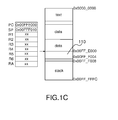
- Listing 1 is a simple C program which is used hereinafter to illustrate the principle of stack smashing.
- the stack 101 grows from address 0x00FF_FFFC downwards, and contains the stacking of multiple frames, a frame comprising local variables, arguments and a return address.
- the stack depth is equal to the depth of the functions call tree.
- the program is itself in a .text segment 100, from address 0x0000_0000 upwards.
- the attacker is able to write some data in the buffer which is intended to be used by the program, then some data 103 can be written into the stack 101.
- the return address of a called function can be overwritten and replaced by a different address 102 chosen by the attacker (see figure 1A ).
- the stack is deliberately a memory area which can be freely read from and written to. Indeed, some processors are able to forbid some accesses to some given memory areas. For instance, when a MMU (Memory Management Unit) is implemented in a processing system, large portions of the RAM memory (Random Access Memory) can be set in read-only mode. This prevents for instance a program from inadvertently or malevolently overwriting constants.
- the .text segment 100 can also be set to read-only mode when executing it.
- the stack is nevertheless a general purpose memory chunk where any access is possible, for a better convenience of the execution. Therefore, the attacker is able to corrupt the stack by illegally writing out a buffer boundaries.
- NX bit technology is described in the document entitled “ Data Execution Prevention”, Hewlett Packard, 2005 .
- ROP return-oriented programming technique
- Virus can be detected and then quarantined or removed by « anti-viruses » programs, that either check statistically their source code (against some portions of the binary that are renowned to be evil) or dynamically analyze their behaviors.
- anti-viruses act too late, since they detect the virus once it is already inserted in the execution system.
- JIT just-in-time »
- the first strategy is called randomization.
- the ASLR technique Address Space Layout Randomization
- the memory locations of program functions and data are chosen differently at each execution, and thus their addresses are not predictable.
- the ASLR can be bypassed.
- some advanced attacks manage to execute the virus within the ASLR. Hence, this protection can be considered as weak.
- CFI Control Flow Integrity
- a computer implemented method for controlling dynamically the execution of a code by a processing system said execution being described by a control flow graph comprising a plurality of basic blocks composed of at least an input node and an output node, a transition in the control flow graph corresponding to a link between an output node of origin belonging to a first basic block and an input node of a second basic block, a plurality of initialization vectors being associated to the output nodes at the time of generating the code, an a priori control word being associated to each input node which is linked to the same output node of origin according the control flow graph, said a priori control word being precomputed at the time of generating the code by applying a predefined deterministic function F to the initialization vector associated to its output node of origin, the following steps being applied once the execution of the output node belonging to a first basic block is terminated and at the time of executing the input node of a second basic block:
- the code execution is interrupted when an output control word and an input control word belonging to two subsequent basic blocs are not identical.
- the second basic block is enciphered at the time of generating the code by using its associated a priori control word as a ciphering key, said method comprising the step of deciphering the second basic block by using its associated a posteriori control word as a deciphering key at the time of executing the input node of said second basic block.
- the initialization vectors encode the nature of the jumps implementing allowed transitions in the control flow graph.
- the initialization vectors are memorized in the processing system using a set of dedicated registers.
- function F can be adapted to take into account an additional input which plays the role of an activation key.
- the activation key is unique per device.
- the activation key can be unique per program.
- the basic blocks are enciphered at the time of generating the code by using their associated a priori control words as a ciphering key, said system comprising a module to decipher said basic blocks at the time of executing their input node by using their associated a posteriori control word as a deciphering key.
- the control flow diagram is determined for example through a static analysis of an initial code, said initial code being a source code.
- control flow diagram is determined through a static analysis of an initial code, said initial code being an assembly code.
- the initialization vectors are attributed randomly.
- the value of an a priori control word is chosen as a function F of at least a destination address which is the address where the instruction corresponding to an input node following an output node of origin according to the control flow graph is located.
- the a priori control words are inserted inside the code to be executed.
- the a priori control words are inserted in line with the instructions corresponding to their associated input node.
- the initialization vectors are inserted in line with the instructions corresponding to their associated output nodes.
- a computer program product stored on a computer readable medium comprising code means for causing a computer to implement the method for generating an improved version of an initial code as described before.
- a basic block designates linear portions of code, that is to say a sequence of instructions without deviations from a straight execution.
- the jump from the output node of a first basic block towards the input node of a second basic block is designated as a transition.
- word instruction refers to an assembly line of code.
- a source code can be analyzed in order to produce an oriented graph, customarily referred as the CFG (Control Flow Graph).
- the CFG is an oriented graph wherein each instruction is a node (or vertex) and possible sequences of instructions are indicated by the presence of an oriented edge from one node to the other.
- Basic blocks correspond to linear portions of a control flow graph. In such a block, and without special instruction, the program implicitly continues to the next instruction.
- PC Program Counter
- a first family comprises the dynamic jumps whose possible destinations are known to belong to a finite state when the program is analyzed. Those are called direct jumps. Direct jumps are:
- a second family comprises the other dynamic jumps which are called indirect jumps. For these jumps, the number of destinations is unknown at the compilation. Indirect jumps are:
- the destination of a jump is called a label and is noted L.
- the destination of a function call is called as the function address and is noted &f, f being the function. It can also be noted f like in the C language.
- the destination of a return has no special name, but it is implicitly saved by the processor. It is a destination address.
- a special case is for longjumps in C and exceptions in C++ ; in this case, the stack management is « exceptional » as the execution flow.
- a program can be associated with a control flow graph which describes all of its instructions.
- FIG. 2A is an example of control flow graph CFG.
- Each circle 200-211 stands for one instruction, that is to say one line in the assembly dump of the code. More precisely, the CFG is depicted by the full arrows 212-222.
- the dashed arrows 223, 224 represent the next instruction of a given instruction 202, 203, that allow deriving the return address in function calls.
- Figure 2B provides an example of a control flow graph which is abstracted as an oriented graph containing only basic blocks 230-235.
- a basic block is made of one or more instructions jumping from one to the following without divergences or convergences, except for the first and the last ones.
- the array of function pointers f_ptr contains the addresses of two functions, namely f and g. This representation illustrates function calls / returns but is also applicable to jumps.
- Some programs are more complex since they are not monolithic, but use dynamic libraries as for example .so object files under GNU/Linux and .dll under Windows.
- the call between basic blocks from the main program to a dynamic library needs to pass through dedicated functions, but that can still be seen as basic blocks.
- control flow diagram can be achieved through a static analysis of the source code. It is also possible to recover the structure of a binary code. The recovery might be partial, all the more so as obfuscation techniques are employed to obscure the binary. But still, tools like IDA Pro perform quite well in this functionality and one can write its own disassembly tool.
- Figure 3 illustrates a method for controlling dynamically the execution of a code
- figure 4 gives an example of a representation of a control flow graph including input and output nodes across which the control is enforced.
- This method is computer-implemented. This means that the steps (or substantially all the steps) of the method are executed by at least one processor.
- the method comprises a sequence of several steps which are applied during the code execution each time a basic block execution terminates, that is to say before the execution of a subsequent instruction.
- the unaltered execution of the code can be described by a control flow graph comprising a plurality of basic blocks 420-425 and edges defining allowed transitions between basic blocks.
- a basic block 420-425 is composed of at least an input node 400-405 and an output node 410-415 which are representing respectively a convergence and a divergence in the control flow graph.
- a node corresponds to an instruction of the code to be executed such as a machine code.
- a plurality of initialization vectors is attributed to the output nodes at the time of generating the code, for example at the time of compiling a source code or at the time of analyzing an assembly code.
- a distinct initialization vector is generated for each output node identified in the control flow graph.
- the initialization vectors can be memorized into the processing system.
- the initialization vectors are memorized in the processing system using a set of dedicated registers.
- the method according to the invention carries out several steps once the execution of an output node belonging to a first basic block is terminated and at the time of executing the input node of a second basic block.
- a step 300 aims at providing an a priori control word associated to the input node of the second basic block.
- This a priori control word is precomputed at the time of generating the code by applying a predefined function F to an initialization vector, said initialization vector being associated to the output node of origin.
- an allowed transition according to the control flow graph can be defined by an output node of origin which belongs to a first basic block and an input node of destination which belongs to a second basic block.
- an initialization vector is associated to the output node of origin and an a priori control word is associated to the input node of destination. More precisely, the a priori control word is deduced of the initialization vector associated to the output node of origin by applying function F to it.
- the a priori control word is inserted inside the code to be executed, for example in line with the instruction corresponding to the input node of the basic blocks.
- Another step 301 aims at providing the initialization vector associated to the output node of the first basic block.
- this initialization vector is memorized in a dedicated register, providing this vector means reading its value for a future use.
- the initialization vector is inserted inside the code to be executed, for example in line with the instruction corresponding to the output node of the basic blocks.
- a different initialization vector is randomly attributed to output nodes for every authorized transitions or edges in the control flow graph.
- an a posteriori control word is determined by applying the predefined function F to the provided initialization vector.
- the same deterministic function F should be used for computing the a priori and the a posteriori control words associated to a given transition in the control flow graph.
- the method also comprises a step of determining 303, 304 if one of the a priori control words matches with the a posteriori control word.
- a security policy is enforced by triggering a hardware and/or software function.
- Figure 5 illustrates a processing system comprising a mechanism to control the execution of a code.
- the processing system comprises a central processing unit (CPU) 500 connected to an internal communication BUS 501, a random access memory (RAM) 502 also connected to the BUS.
- the processing system further comprises a mass storage device controller 504 managing accesses to a mass memory device, such as hard drive.
- Mass memory devices suitable for tangibly embodying computer program instructions and data include all forms of non-volatile memory, including by way of example semiconductor memory devices, such as EPROM, EEPROM, and flash memory devices; magnetic disks such as internal hard disks and removable disks; magneto-optical disks; and CD-ROM disks. Any of the foregoing may be supplemented by, or incorporated in, specially designed ASICs (application-specific integrated circuits).
- a memory area located for example in the random access memory 502 stores the code to be executed.
- a memory which is located in the mass memory device 504 can be used to store the code to be executed.
- This code execution can be described by a control flow graph which comprises a plurality of basic blocks.
- a basic block is composed of at least an input node and an output node which are representing respectively a convergence and a divergence in the control flow graph.
- a plurality of initialization vectors is attributed to the output nodes at the time of generating said code which means before its execution by the processing system.
- the processing system also comprises a memory area wherein a plurality of a priori control words is stored.
- a priori control words are precomputed at the time of generating the code.
- a predefined function F is applied to the aforementioned initialization vectors.
- the a priori control word is inserted inside the code to be executed, for example in line with the instruction corresponding to the input node.
- the processing system comprises a hardware implemented module 503 for generating a posteriori control words.
- An a posteriori control word is generated by applying the function F to the initialization vector which is associated to a given output node at the time of executing an instruction which follows the execution of this output node.
- the processing system comprises a module for determining if an a posteriori control word which has been calculated at the time of leaving a basic block matches an a priori control word. An alteration of the code execution is detected if the two control words do not match.
- This module can be either software or hardware implemented. For example, this module can be implemented by the processor 500.
- Figure 6 provides an example of a method for generating an improved version of a code which is executable by the processing system according to the invention.
- the improved code can be generated thanks to a computer implemented method which uses an initial code as an input.
- a step 600 determines a control flow graph representative of an unaltered execution of the initial code.
- the control flow graph comprises a plurality of basic blocks, a basic block being composed of at least an input node and an output node which are representing respectively a convergence and a divergence in the control flow graph.
- the method also comprises a step 601 for generating a plurality of initialization vectors, a given initialization vector being allocated to a given output node.
- a step 602 determines an a priori control word by applying a predefined function F to said initialization vector.
- the function F is hardware accelerated.
- the initial code is modified 603 in order to generate an improved version of the code by inserting the a priori control words in line with their corresponding instructions, that is to say the instructions corresponding to their associated input nodes.
- the modification 603 of the code also embeds initialization vectors in the improved version of the code in line with their corresponding instructions, that is to say the instructions corresponding to their associated output nodes.
- a program is said to execute with an unaltered control flow diagram if it dynamically upon execution travels through the edges and nodes previously identified statically during the link and/or dynamic link processes, for example at compilation.
- a processing system such as a processor can typically identify at runtime divergences (that correspond for example to « jump » instructions) but has no means to identify which instruction is a licit destination. This comes from the fact that this information is not present statically in a binary code because the notion of convergence has been semantically removed after compilation.
- control word can be added directly to a set of chosen instructions or between instructions in order to secure the association between intended departures and arrival points. This means that the .text segment 100 will slightly grow. Alternatively, the control words may be calculated on the fly.
- control word is a precomputed value which is inserted statically in the binary at compile time.
- control flow graph alteration is detected unambiguously if the control words do not match across a jump, for example if they differ.
- control words are provided hereafter by means of examples. They are obtained by the evaluation of a function F, that can have one or more inputs, depending on the targeted security level.
- a jump destination refers to the first instruction of a basic block.
- the jump destination instructions that are considered in this case include conditional jumps and even dynamic jumps, except as discussed before instructions such as return from exported function or calls to virtual functions.
- initialization vector is an input to the function F in charge of creating control words.
- the previous minimal example (the nature of jump shall impact the control word) can be seen as a special case of an initialization vector wherein the nature of the jump is implicitly converted as an initialization vector. For example:
- the value of a control word can be chosen as a function of the destination address that should be reached after a jump instruction.
- control words may depend on a key concealed in the processor.
- the advantage of this embodiment is that it prevents the dynamic forgery of the control words.
- control words may depend on a key concealed in a segment of the code that is not readable from outside.
- the advantage of this embodiment is also that it prevents the dynamic forgery of the control words.
- the binary .text section 100 must be upgraded in order to embed the control words and/or the initialization vectors. They can be placed after the opcodes in line. This means that the words must be longer or that a second memory must be used as a « padding » of the first one.
- specific instructions may be used, said instructions being adapted such that:
- At least one register is added to the system. This additional register comprises the initialization vector.
- this initial vector can be set and reset by a specific instructions which is added to the instruction set of the processing system.
- the initialization vector is a piece of information that is required for the a priori and a posteriori control words (over a « jump ») to be compatible by association.
- a deterministic function F is used and designed to compute the control words.
- This function F is implemented in the processing system.
- F takes as input at least the initialization vector, which for instance encodes the nature of the opcode, that is to say: jump or not, and if jump, several subcategories can be defined (classes of matching end points).
- an example of a deterministic function of an initialization vector is a SHA cryptographic hash of said initialization vector.
- the function F also aims at recomputing dynamically and just in time (JIT) a control word during the program execution. It is in particular automatically reevaluated if the current instruction is a jump (this can be achieved trivially in the pipeline of a processor, and is indeed most of the time already implemented, let alone to know whether the PC must be incremented [no jump] or loaded from an external value [jump]).
- the result of applying the F function is a control word, that is compared with a Boolean test to the statically and read-only declared a priori control word, which can be found in the binary.
- the function F can advantageously be adapted to take into account an additional input which plays the role of a key.
- this key can be unique per device or unique per program. Alternatively, it can be unique per process, a process being an instance of a program.
- Using a key has the advantage to associate one binary code to one device or program or process, thereby further reducing the possibility of an attacker to fraud the protection. In that case, a second additional register is required to host the key.
- the function F might well depends on only a subset of these arguments, depending on the expected level of verification. For example, if the association between the code and the processing system is not a requirement, the « key » input can be ignored.
- the F function can be advantageously chosen so that it will be collision resistant.
- the F function can be one-way (at least for the key). That way, it will not possible to recover its arguments by knowing its output. This will advantageously protect the processing system against the recovery of the key.
- the F function can be chosen such that it will be fast to compute, ideally in one clock cycle or with the number of clock cycles required to execute one instruction on the processing system, so as not to impede the latency.
- An opcode can be added to initialize/set a new initialization vector, which can be for example equal to zero by default.
- Figure 7 shows the operation of an opcode designed to set a new initialization vector in the form of a finite state machine with one state 700 and three transitions 701-703.
- An opcode can be added to request the verification of a control word, in the case this is not done by default at each clock cycle. This implicit behavior does not slow down the execution, because the control word computation and check is done in parallel with the nominal program execution.
- Figure 8 illustrates the upgraded operation of the processing system in the form of a new finite state machine with two states 800, 803 and two transitions 801, 802.
- the minimal condition for the control word to be checked is twofold:
- the new finite state machine enters an error state 803 which means that the control flow graph has been corrupted.
- several actions can be taken, for example halt the program execution and/or active some defensive countermeasures (erase some secrets from memory).
- the opcodes can be enciphered by a transformation function that depends on the control words. This does not impede the normal execution of the code, as the verification of the control word is necessary before executing the sequel of the code: hence the control word is readily available to decipher in real-time the arriving enciphered opcodes.
- encoding the opcodes is done using a block cipher, the key being equal or derived from the control word, for example by using a hash function.
- the block cipher is used in conjunction with cryptographic mode of operations such as ECB (Electronic Code Book), CBC (Cipher Block Chaining), PCBC (Propagating Cipher Block Chaining), CFB (Cipher Feedback), OFB (Output Feedback) and CTR (CounTeR).
- ECB Electronic Code Book
- CBC Cipher Block Chaining
- PCBC Propagating Cipher Block Chaining
- CFB Cipher Feedback
- OFB Output Feedback
- CTR CounTeR
- encoding the opcodes is done by means of a stream cipher, the key being equal or derived from the control word, for example by using a hash function.
- control flow graph is made more robust by modifying the ends of the basic blocks, so that:
- the transmission of the control word can be done on the stack.
- the modified final instruction of the basic block 900 and the modified first instruction of the basic bloc 901 are both represented hatched subset of instructions.
- the initialization vector (IV) is not pushed in the clear on the stack. Instead, it is encrypted by some function that depend on an exposed key (to avoid their retrieval) and on their address (namely %esp, to avoid replay).
Landscapes
- Engineering & Computer Science (AREA)
- Computer Security & Cryptography (AREA)
- Software Systems (AREA)
- Theoretical Computer Science (AREA)
- General Engineering & Computer Science (AREA)
- General Physics & Mathematics (AREA)
- Physics & Mathematics (AREA)
- Computer Hardware Design (AREA)
- Virology (AREA)
- General Health & Medical Sciences (AREA)
- Health & Medical Sciences (AREA)
- Executing Machine-Instructions (AREA)
- Storage Device Security (AREA)
- Devices For Executing Special Programs (AREA)
Priority Applications (5)
| Application Number | Priority Date | Filing Date | Title |
|---|---|---|---|
| EP14305954.1A EP2958044B1 (fr) | 2014-06-20 | 2014-06-20 | Procédé informatique et système permettant de commander dynamiquement l'exécution d'un code |
| PCT/EP2015/063880 WO2015193500A1 (fr) | 2014-06-20 | 2015-06-19 | Procédé mis en œuvre par ordinateur et système pour commander de manière dynamique l'exécution d'un code |
| CN201580033156.2A CN107077562B (zh) | 2014-06-20 | 2015-06-19 | 用于动态控制代码执行的计算机实现的方法和系统 |
| US15/317,325 US10354064B2 (en) | 2014-06-20 | 2015-06-19 | Computer implemented method and a system for controlling dynamically the execution of a code |
| HK16106050.6A HK1218172A1 (en) | 2014-06-20 | 2016-05-27 | A computer implemented method and a system for controlling dynamically the execution of a code |
Applications Claiming Priority (1)
| Application Number | Priority Date | Filing Date | Title |
|---|---|---|---|
| EP14305954.1A EP2958044B1 (fr) | 2014-06-20 | 2014-06-20 | Procédé informatique et système permettant de commander dynamiquement l'exécution d'un code |
Publications (2)
| Publication Number | Publication Date |
|---|---|
| EP2958044A1 true EP2958044A1 (fr) | 2015-12-23 |
| EP2958044B1 EP2958044B1 (fr) | 2019-09-18 |
Family
ID=51485531
Family Applications (1)
| Application Number | Title | Priority Date | Filing Date |
|---|---|---|---|
| EP14305954.1A Active EP2958044B1 (fr) | 2014-06-20 | 2014-06-20 | Procédé informatique et système permettant de commander dynamiquement l'exécution d'un code |
Country Status (5)
| Country | Link |
|---|---|
| US (1) | US10354064B2 (fr) |
| EP (1) | EP2958044B1 (fr) |
| CN (1) | CN107077562B (fr) |
| HK (1) | HK1218172A1 (fr) |
| WO (1) | WO2015193500A1 (fr) |
Cited By (1)
| Publication number | Priority date | Publication date | Assignee | Title |
|---|---|---|---|---|
| US11442738B2 (en) | 2017-09-22 | 2022-09-13 | Commissariat A L'energie Atomique Et Aux Energies Alternatives | Method for executing a machine code of a secure function |
Families Citing this family (18)
| Publication number | Priority date | Publication date | Assignee | Title |
|---|---|---|---|---|
| US10365937B2 (en) * | 2015-07-24 | 2019-07-30 | Red Hat Israel, Ltd. | Entropy increase by executable loader |
| US10007787B2 (en) * | 2015-12-28 | 2018-06-26 | International Business Machines Corporation | Runtime return-oriented programming detection |
| US10268601B2 (en) | 2016-06-17 | 2019-04-23 | Massachusetts Institute Of Technology | Timely randomized memory protection |
| US10310991B2 (en) * | 2016-08-11 | 2019-06-04 | Massachusetts Institute Of Technology | Timely address space randomization |
| CN106407809B (zh) * | 2016-09-20 | 2019-03-01 | 四川大学 | 一种Linux平台恶意软件检测方法 |
| US10768979B2 (en) * | 2016-09-23 | 2020-09-08 | Apple Inc. | Peer-to-peer distributed computing system for heterogeneous device types |
| US20180203885A1 (en) * | 2017-01-18 | 2018-07-19 | Microsoft Technology Licensing, Llc | Controlling creation/access of physically senses features |
| CN107545174B (zh) * | 2017-08-22 | 2020-03-10 | 武汉大学 | 一种基于llvm的抵御控制流劫持的系统和方法 |
| US10496383B2 (en) * | 2017-12-20 | 2019-12-03 | Intel Corporation | Methods and apparatus to convert a non-series-parallel control flow graph to data flow |
| CA2990205A1 (fr) * | 2017-12-28 | 2019-06-28 | Techinsights Inc. | Systeme d'analyse de donnees d'ingenierie inverse, et outil de traitement de donnees de composant de circuit integre et methode associee |
| US10628286B1 (en) | 2018-10-18 | 2020-04-21 | Denso International America, Inc. | Systems and methods for dynamically identifying program control flow and instrumenting source code |
| US10657025B2 (en) * | 2018-10-18 | 2020-05-19 | Denso International America, Inc. | Systems and methods for dynamically identifying data arguments and instrumenting source code |
| KR102569820B1 (ko) * | 2018-10-25 | 2023-08-24 | 에스케이하이닉스 주식회사 | 메모리 컨트롤러 및 그 동작 방법 |
| US11809563B2 (en) * | 2021-07-07 | 2023-11-07 | University Of South Florida | System and method for protecting against control-flow attacks |
| CN115130113B (zh) * | 2022-07-19 | 2025-06-27 | 东风汽车集团股份有限公司 | 一种汽车ecu固件的漏洞分析方法、系统和介质 |
| CN116501378B (zh) * | 2023-06-27 | 2023-09-12 | 武汉大数据产业发展有限公司 | 一种逆向工程还原源代码的实现方法、装置和电子设备 |
| CN117270878B (zh) * | 2023-11-22 | 2024-02-09 | 常熟理工学院 | 程序执行路径中程序变量的约束条件提取方法及设备 |
| CN121071868B (zh) * | 2025-08-20 | 2026-02-03 | 众合云科信息技术集团有限公司 | 一种基于策略的敏感代码隔离执行方法 |
Family Cites Families (11)
| Publication number | Priority date | Publication date | Assignee | Title |
|---|---|---|---|---|
| US7721275B2 (en) * | 2004-05-14 | 2010-05-18 | Sap Ag | Data-flow based post pass optimization in dynamic compilers |
| US7506217B2 (en) * | 2005-12-30 | 2009-03-17 | Intel Corporation | Apparatus and method for software-based control flow checking for soft error detection to improve microprocessor reliability |
| US20090307500A1 (en) * | 2006-02-06 | 2009-12-10 | Taichi Sato | Program obfuscator |
| US8046751B1 (en) * | 2007-01-11 | 2011-10-25 | The Mathworks, Inc. | Structuring unstructured regions in a control flow graph |
| US8359583B2 (en) * | 2007-08-22 | 2013-01-22 | Coverity, Inc. | Methods for selectively pruning false paths in graphs that use high-precision state information |
| US9117070B2 (en) * | 2008-05-30 | 2015-08-25 | Nxp, B.V. | Method for adapting and executing a computer program and computer architecture therefore |
| US8285999B1 (en) * | 2008-12-05 | 2012-10-09 | The Research Foundation Of State University Of New York | System and method for authenticating remote execution |
| US8516467B2 (en) * | 2010-01-29 | 2013-08-20 | Nintendo Co., Ltd. | Method and apparatus for enhancing comprehension of code time complexity and flow |
| US9965744B1 (en) * | 2012-06-29 | 2018-05-08 | Google Llc | Automatic dynamic vetting of browser extensions and web applications |
| US9298453B2 (en) * | 2012-07-03 | 2016-03-29 | Microsoft Technology Licensing, Llc | Source code analytics platform using program analysis and information retrieval |
| US9824214B2 (en) * | 2014-08-15 | 2017-11-21 | Securisea, Inc. | High performance software vulnerabilities detection system and methods |
-
2014
- 2014-06-20 EP EP14305954.1A patent/EP2958044B1/fr active Active
-
2015
- 2015-06-19 US US15/317,325 patent/US10354064B2/en active Active
- 2015-06-19 CN CN201580033156.2A patent/CN107077562B/zh active Active
- 2015-06-19 WO PCT/EP2015/063880 patent/WO2015193500A1/fr not_active Ceased
-
2016
- 2016-05-27 HK HK16106050.6A patent/HK1218172A1/en unknown
Non-Patent Citations (4)
| Title |
|---|
| HEWLETT PACKARD, DATA EXECUTION PREVENTION, 2005 |
| MARTÍN ABADI ET AL: "Control-flow integrity principles, implementations, and applications", ACM TRANSACTIONS ON INFORMATION AND SYSTEM SECURITY, ACM, NEW YORK, NY, US, vol. 13, no. 1, 1 October 2009 (2009-10-01), pages 4:1 - 4:40, XP001574403, ISSN: 1094-9224, [retrieved on 20091001], DOI: 10.1145/1609956.1609960 * |
| NAHMSUK OH ET AL: "Control-Flow Checking by Software Signatures", IEEE TRANSACTIONS ON RELIABILITY, IEEE SERVICE CENTER, PISCATAWAY, NJ, US, vol. 51, no. 1, 1 March 2002 (2002-03-01), XP011079413, ISSN: 0018-9529 * |
| NAMJOO M ED - INSTITUTE OF ELECTRICAL AND ELECTRONICS ENGINEERS: "TECHNIQUES FOR CONCURRENT TESTING OF VLSI PROCESSOR OPERATION", QUALITY PRODUCTIVITY PROFIT. PHILADELPHIA, 15 - 18 NOVEMBER 1982; [INTERNATIONAL TEST CONFERENCE], SILVER SPRING, IEEE COMP. SOC. PRESS, US, vol. SYMP. 1982, 1 November 1982 (1982-11-01), pages 461 - 468, XP000746184 * |
Cited By (1)
| Publication number | Priority date | Publication date | Assignee | Title |
|---|---|---|---|---|
| US11442738B2 (en) | 2017-09-22 | 2022-09-13 | Commissariat A L'energie Atomique Et Aux Energies Alternatives | Method for executing a machine code of a secure function |
Also Published As
| Publication number | Publication date |
|---|---|
| CN107077562B (zh) | 2020-11-06 |
| HK1218172A1 (en) | 2017-02-03 |
| US20170124322A1 (en) | 2017-05-04 |
| EP2958044B1 (fr) | 2019-09-18 |
| CN107077562A (zh) | 2017-08-18 |
| US10354064B2 (en) | 2019-07-16 |
| WO2015193500A1 (fr) | 2015-12-23 |
Similar Documents
| Publication | Publication Date | Title |
|---|---|---|
| EP2958044B1 (fr) | Procédé informatique et système permettant de commander dynamiquement l'exécution d'un code | |
| KR102558104B1 (ko) | 호출 경로 의존 인증 | |
| US9514305B2 (en) | Code pointer authentication for hardware flow control | |
| KR101256149B1 (ko) | 프로그램 카운터 인코딩을 이용한 간접 함수 호출 보호 방법 및 보호 장치 | |
| US11232194B2 (en) | Method for executing a binary code of a secure function with a microprocessor | |
| KR101216995B1 (ko) | 인덱스 테이블 기반 코드 암호화 및 복호화 장치 및 그 방법 | |
| US20110191848A1 (en) | Preventing malicious just-in-time spraying attacks | |
| US12086278B2 (en) | Method of encoding and decoding memory data for software security, recording medium and apparatus for performing the method | |
| CN106164872A (zh) | 基于硬件的堆栈控制信息保护 | |
| JP2013535725A (ja) | ソフトウェアの完全性を保証するためのプロセッサにより実施される方法 | |
| Qiu et al. | Physical unclonable functions-based linear encryption against code reuse attacks | |
| US11704128B2 (en) | Method for executing a machine code formed from blocks having instructions to be protected, each instruction associated with a construction instruction to modify a signature of the block | |
| WO2016198831A1 (fr) | Appareil et procédés permettant d'effectuer une transition entre une zone sécurisée et une zone moins sécurisée | |
| EP4248340B1 (fr) | Protection de flux de code avec propagation d 'erreurs | |
| US11442738B2 (en) | Method for executing a machine code of a secure function | |
| US8694548B2 (en) | Defense-in-depth security for bytecode executables | |
| CN111475168A (zh) | 一种代码编译方法及装置 | |
| EP3944106A1 (fr) | Procédé d'obscurcissement de code de protection |
Legal Events
| Date | Code | Title | Description |
|---|---|---|---|
| PUAI | Public reference made under article 153(3) epc to a published international application that has entered the european phase |
Free format text: ORIGINAL CODE: 0009012 |
|
| AK | Designated contracting states |
Kind code of ref document: A1 Designated state(s): AL AT BE BG CH CY CZ DE DK EE ES FI FR GB GR HR HU IE IS IT LI LT LU LV MC MK MT NL NO PL PT RO RS SE SI SK SM TR |
|
| AX | Request for extension of the european patent |
Extension state: BA ME |
|
| 17P | Request for examination filed |
Effective date: 20160620 |
|
| RBV | Designated contracting states (corrected) |
Designated state(s): AL AT BE BG CH CY CZ DE DK EE ES FI FR GB GR HR HU IE IS IT LI LT LU LV MC MK MT NL NO PL PT RO RS SE SI SK SM TR |
|
| REG | Reference to a national code |
Ref country code: HK Ref legal event code: DE Ref document number: 1218172 Country of ref document: HK |
|
| RIN1 | Information on inventor provided before grant (corrected) |
Inventor name: GUILLEY, SYLVAIN Inventor name: PORTEBOEUF, THIBAULT |
|
| RIC1 | Information provided on ipc code assigned before grant |
Ipc: G06F 21/54 20130101AFI20190118BHEP |
|
| GRAP | Despatch of communication of intention to grant a patent |
Free format text: ORIGINAL CODE: EPIDOSNIGR1 |
|
| STAA | Information on the status of an ep patent application or granted ep patent |
Free format text: STATUS: GRANT OF PATENT IS INTENDED |
|
| RIN1 | Information on inventor provided before grant (corrected) |
Inventor name: PORTEBOEUF, THIBAULT Inventor name: GUILLEY, SYLVAIN |
|
| INTG | Intention to grant announced |
Effective date: 20190307 |
|
| GRAJ | Information related to disapproval of communication of intention to grant by the applicant or resumption of examination proceedings by the epo deleted |
Free format text: ORIGINAL CODE: EPIDOSDIGR1 |
|
| STAA | Information on the status of an ep patent application or granted ep patent |
Free format text: STATUS: REQUEST FOR EXAMINATION WAS MADE |
|
| REG | Reference to a national code |
Ref country code: DE Ref legal event code: R079 Ref document number: 602014053777 Country of ref document: DE Free format text: PREVIOUS MAIN CLASS: G06F0021540000 Ipc: G06F0008750000 |
|
| GRAR | Information related to intention to grant a patent recorded |
Free format text: ORIGINAL CODE: EPIDOSNIGR71 |
|
| GRAS | Grant fee paid |
Free format text: ORIGINAL CODE: EPIDOSNIGR3 |
|
| STAA | Information on the status of an ep patent application or granted ep patent |
Free format text: STATUS: GRANT OF PATENT IS INTENDED |
|
| INTC | Intention to grant announced (deleted) | ||
| GRAA | (expected) grant |
Free format text: ORIGINAL CODE: 0009210 |
|
| STAA | Information on the status of an ep patent application or granted ep patent |
Free format text: STATUS: THE PATENT HAS BEEN GRANTED |
|
| RIC1 | Information provided on ipc code assigned before grant |
Ipc: G06F 21/54 20130101ALI20190715BHEP Ipc: G06F 8/75 20180101AFI20190715BHEP |
|
| AK | Designated contracting states |
Kind code of ref document: B1 Designated state(s): AL AT BE BG CH CY CZ DE DK EE ES FI FR GB GR HR HU IE IS IT LI LT LU LV MC MK MT NL NO PL PT RO RS SE SI SK SM TR |
|
| INTG | Intention to grant announced |
Effective date: 20190812 |
|
| REG | Reference to a national code |
Ref country code: GB Ref legal event code: FG4D |
|
| REG | Reference to a national code |
Ref country code: CH Ref legal event code: EP |
|
| REG | Reference to a national code |
Ref country code: DE Ref legal event code: R096 Ref document number: 602014053777 Country of ref document: DE |
|
| REG | Reference to a national code |
Ref country code: AT Ref legal event code: REF Ref document number: 1182117 Country of ref document: AT Kind code of ref document: T Effective date: 20191015 |
|
| REG | Reference to a national code |
Ref country code: IE Ref legal event code: FG4D |
|
| REG | Reference to a national code |
Ref country code: NL Ref legal event code: MP Effective date: 20190918 |
|
| PG25 | Lapsed in a contracting state [announced via postgrant information from national office to epo] |
Ref country code: NO Free format text: LAPSE BECAUSE OF FAILURE TO SUBMIT A TRANSLATION OF THE DESCRIPTION OR TO PAY THE FEE WITHIN THE PRESCRIBED TIME-LIMIT Effective date: 20191218 Ref country code: SE Free format text: LAPSE BECAUSE OF FAILURE TO SUBMIT A TRANSLATION OF THE DESCRIPTION OR TO PAY THE FEE WITHIN THE PRESCRIBED TIME-LIMIT Effective date: 20190918 Ref country code: HR Free format text: LAPSE BECAUSE OF FAILURE TO SUBMIT A TRANSLATION OF THE DESCRIPTION OR TO PAY THE FEE WITHIN THE PRESCRIBED TIME-LIMIT Effective date: 20190918 Ref country code: FI Free format text: LAPSE BECAUSE OF FAILURE TO SUBMIT A TRANSLATION OF THE DESCRIPTION OR TO PAY THE FEE WITHIN THE PRESCRIBED TIME-LIMIT Effective date: 20190918 Ref country code: LT Free format text: LAPSE BECAUSE OF FAILURE TO SUBMIT A TRANSLATION OF THE DESCRIPTION OR TO PAY THE FEE WITHIN THE PRESCRIBED TIME-LIMIT Effective date: 20190918 Ref country code: BG Free format text: LAPSE BECAUSE OF FAILURE TO SUBMIT A TRANSLATION OF THE DESCRIPTION OR TO PAY THE FEE WITHIN THE PRESCRIBED TIME-LIMIT Effective date: 20191218 |
|
| REG | Reference to a national code |
Ref country code: LT Ref legal event code: MG4D |
|
| PG25 | Lapsed in a contracting state [announced via postgrant information from national office to epo] |
Ref country code: GR Free format text: LAPSE BECAUSE OF FAILURE TO SUBMIT A TRANSLATION OF THE DESCRIPTION OR TO PAY THE FEE WITHIN THE PRESCRIBED TIME-LIMIT Effective date: 20191219 Ref country code: AL Free format text: LAPSE BECAUSE OF FAILURE TO SUBMIT A TRANSLATION OF THE DESCRIPTION OR TO PAY THE FEE WITHIN THE PRESCRIBED TIME-LIMIT Effective date: 20190918 Ref country code: LV Free format text: LAPSE BECAUSE OF FAILURE TO SUBMIT A TRANSLATION OF THE DESCRIPTION OR TO PAY THE FEE WITHIN THE PRESCRIBED TIME-LIMIT Effective date: 20190918 Ref country code: RS Free format text: LAPSE BECAUSE OF FAILURE TO SUBMIT A TRANSLATION OF THE DESCRIPTION OR TO PAY THE FEE WITHIN THE PRESCRIBED TIME-LIMIT Effective date: 20190918 |
|
| REG | Reference to a national code |
Ref country code: AT Ref legal event code: MK05 Ref document number: 1182117 Country of ref document: AT Kind code of ref document: T Effective date: 20190918 |
|
| PG25 | Lapsed in a contracting state [announced via postgrant information from national office to epo] |
Ref country code: ES Free format text: LAPSE BECAUSE OF FAILURE TO SUBMIT A TRANSLATION OF THE DESCRIPTION OR TO PAY THE FEE WITHIN THE PRESCRIBED TIME-LIMIT Effective date: 20190918 Ref country code: NL Free format text: LAPSE BECAUSE OF FAILURE TO SUBMIT A TRANSLATION OF THE DESCRIPTION OR TO PAY THE FEE WITHIN THE PRESCRIBED TIME-LIMIT Effective date: 20190918 Ref country code: PL Free format text: LAPSE BECAUSE OF FAILURE TO SUBMIT A TRANSLATION OF THE DESCRIPTION OR TO PAY THE FEE WITHIN THE PRESCRIBED TIME-LIMIT Effective date: 20190918 Ref country code: RO Free format text: LAPSE BECAUSE OF FAILURE TO SUBMIT A TRANSLATION OF THE DESCRIPTION OR TO PAY THE FEE WITHIN THE PRESCRIBED TIME-LIMIT Effective date: 20190918 Ref country code: AT Free format text: LAPSE BECAUSE OF FAILURE TO SUBMIT A TRANSLATION OF THE DESCRIPTION OR TO PAY THE FEE WITHIN THE PRESCRIBED TIME-LIMIT Effective date: 20190918 Ref country code: PT Free format text: LAPSE BECAUSE OF FAILURE TO SUBMIT A TRANSLATION OF THE DESCRIPTION OR TO PAY THE FEE WITHIN THE PRESCRIBED TIME-LIMIT Effective date: 20200120 Ref country code: EE Free format text: LAPSE BECAUSE OF FAILURE TO SUBMIT A TRANSLATION OF THE DESCRIPTION OR TO PAY THE FEE WITHIN THE PRESCRIBED TIME-LIMIT Effective date: 20190918 Ref country code: IT Free format text: LAPSE BECAUSE OF FAILURE TO SUBMIT A TRANSLATION OF THE DESCRIPTION OR TO PAY THE FEE WITHIN THE PRESCRIBED TIME-LIMIT Effective date: 20190918 |
|
| PG25 | Lapsed in a contracting state [announced via postgrant information from national office to epo] |
Ref country code: IS Free format text: LAPSE BECAUSE OF FAILURE TO SUBMIT A TRANSLATION OF THE DESCRIPTION OR TO PAY THE FEE WITHIN THE PRESCRIBED TIME-LIMIT Effective date: 20200224 Ref country code: SM Free format text: LAPSE BECAUSE OF FAILURE TO SUBMIT A TRANSLATION OF THE DESCRIPTION OR TO PAY THE FEE WITHIN THE PRESCRIBED TIME-LIMIT Effective date: 20190918 Ref country code: SK Free format text: LAPSE BECAUSE OF FAILURE TO SUBMIT A TRANSLATION OF THE DESCRIPTION OR TO PAY THE FEE WITHIN THE PRESCRIBED TIME-LIMIT Effective date: 20190918 Ref country code: CZ Free format text: LAPSE BECAUSE OF FAILURE TO SUBMIT A TRANSLATION OF THE DESCRIPTION OR TO PAY THE FEE WITHIN THE PRESCRIBED TIME-LIMIT Effective date: 20190918 |
|
| REG | Reference to a national code |
Ref country code: DE Ref legal event code: R097 Ref document number: 602014053777 Country of ref document: DE |
|
| PLBE | No opposition filed within time limit |
Free format text: ORIGINAL CODE: 0009261 |
|
| STAA | Information on the status of an ep patent application or granted ep patent |
Free format text: STATUS: NO OPPOSITION FILED WITHIN TIME LIMIT |
|
| PG2D | Information on lapse in contracting state deleted |
Ref country code: IS |
|
| PG25 | Lapsed in a contracting state [announced via postgrant information from national office to epo] |
Ref country code: DK Free format text: LAPSE BECAUSE OF FAILURE TO SUBMIT A TRANSLATION OF THE DESCRIPTION OR TO PAY THE FEE WITHIN THE PRESCRIBED TIME-LIMIT Effective date: 20190918 Ref country code: IS Free format text: LAPSE BECAUSE OF FAILURE TO SUBMIT A TRANSLATION OF THE DESCRIPTION OR TO PAY THE FEE WITHIN THE PRESCRIBED TIME-LIMIT Effective date: 20200119 |
|
| 26N | No opposition filed |
Effective date: 20200619 |
|
| PG25 | Lapsed in a contracting state [announced via postgrant information from national office to epo] |
Ref country code: SI Free format text: LAPSE BECAUSE OF FAILURE TO SUBMIT A TRANSLATION OF THE DESCRIPTION OR TO PAY THE FEE WITHIN THE PRESCRIBED TIME-LIMIT Effective date: 20190918 |
|
| PG25 | Lapsed in a contracting state [announced via postgrant information from national office to epo] |
Ref country code: MC Free format text: LAPSE BECAUSE OF FAILURE TO SUBMIT A TRANSLATION OF THE DESCRIPTION OR TO PAY THE FEE WITHIN THE PRESCRIBED TIME-LIMIT Effective date: 20190918 |
|
| REG | Reference to a national code |
Ref country code: CH Ref legal event code: PL |
|
| PG25 | Lapsed in a contracting state [announced via postgrant information from national office to epo] |
Ref country code: LU Free format text: LAPSE BECAUSE OF NON-PAYMENT OF DUE FEES Effective date: 20200620 |
|
| REG | Reference to a national code |
Ref country code: BE Ref legal event code: MM Effective date: 20200630 |
|
| PG25 | Lapsed in a contracting state [announced via postgrant information from national office to epo] |
Ref country code: LI Free format text: LAPSE BECAUSE OF NON-PAYMENT OF DUE FEES Effective date: 20200630 Ref country code: IE Free format text: LAPSE BECAUSE OF NON-PAYMENT OF DUE FEES Effective date: 20200620 Ref country code: CH Free format text: LAPSE BECAUSE OF NON-PAYMENT OF DUE FEES Effective date: 20200630 |
|
| PG25 | Lapsed in a contracting state [announced via postgrant information from national office to epo] |
Ref country code: BE Free format text: LAPSE BECAUSE OF NON-PAYMENT OF DUE FEES Effective date: 20200630 |
|
| PG25 | Lapsed in a contracting state [announced via postgrant information from national office to epo] |
Ref country code: TR Free format text: LAPSE BECAUSE OF FAILURE TO SUBMIT A TRANSLATION OF THE DESCRIPTION OR TO PAY THE FEE WITHIN THE PRESCRIBED TIME-LIMIT Effective date: 20190918 Ref country code: MT Free format text: LAPSE BECAUSE OF FAILURE TO SUBMIT A TRANSLATION OF THE DESCRIPTION OR TO PAY THE FEE WITHIN THE PRESCRIBED TIME-LIMIT Effective date: 20190918 Ref country code: CY Free format text: LAPSE BECAUSE OF FAILURE TO SUBMIT A TRANSLATION OF THE DESCRIPTION OR TO PAY THE FEE WITHIN THE PRESCRIBED TIME-LIMIT Effective date: 20190918 |
|
| PG25 | Lapsed in a contracting state [announced via postgrant information from national office to epo] |
Ref country code: MK Free format text: LAPSE BECAUSE OF FAILURE TO SUBMIT A TRANSLATION OF THE DESCRIPTION OR TO PAY THE FEE WITHIN THE PRESCRIBED TIME-LIMIT Effective date: 20190918 |
|
| REG | Reference to a national code |
Ref country code: HK Ref legal event code: WD Ref document number: 1218172 Country of ref document: HK |
|
| PGFP | Annual fee paid to national office [announced via postgrant information from national office to epo] |
Ref country code: DE Payment date: 20250805 Year of fee payment: 12 |
|
| PGFP | Annual fee paid to national office [announced via postgrant information from national office to epo] |
Ref country code: GB Payment date: 20250807 Year of fee payment: 12 |
|
| PGFP | Annual fee paid to national office [announced via postgrant information from national office to epo] |
Ref country code: FR Payment date: 20250804 Year of fee payment: 12 |