EP2958128A1 - Dispositif de tube à rayons x à enveloppe tournante - Google Patents
Dispositif de tube à rayons x à enveloppe tournante Download PDFInfo
- Publication number
- EP2958128A1 EP2958128A1 EP13875076.5A EP13875076A EP2958128A1 EP 2958128 A1 EP2958128 A1 EP 2958128A1 EP 13875076 A EP13875076 A EP 13875076A EP 2958128 A1 EP2958128 A1 EP 2958128A1
- Authority
- EP
- European Patent Office
- Prior art keywords
- envelope
- electrons
- target
- shield ring
- cathode
- Prior art date
- Legal status (The legal status is an assumption and is not a legal conclusion. Google has not performed a legal analysis and makes no representation as to the accuracy of the status listed.)
- Withdrawn
Links
- ZOKXTWBITQBERF-UHFFFAOYSA-N Molybdenum Chemical compound [Mo] ZOKXTWBITQBERF-UHFFFAOYSA-N 0.000 claims description 4
- 229910045601 alloy Inorganic materials 0.000 claims description 4
- 239000000956 alloy Substances 0.000 claims description 4
- 239000000470 constituent Substances 0.000 claims description 4
- 229910052750 molybdenum Inorganic materials 0.000 claims description 4
- 239000011733 molybdenum Substances 0.000 claims description 4
- WFKWXMTUELFFGS-UHFFFAOYSA-N tungsten Chemical compound [W] WFKWXMTUELFFGS-UHFFFAOYSA-N 0.000 claims description 4
- 229910052721 tungsten Inorganic materials 0.000 claims description 4
- 239000010937 tungsten Substances 0.000 claims description 4
- 229910052715 tantalum Inorganic materials 0.000 claims description 3
- GUVRBAGPIYLISA-UHFFFAOYSA-N tantalum atom Chemical compound [Ta] GUVRBAGPIYLISA-UHFFFAOYSA-N 0.000 claims description 3
- 238000002844 melting Methods 0.000 description 12
- 230000008018 melting Effects 0.000 description 12
- 230000000903 blocking effect Effects 0.000 description 7
- 229910052751 metal Inorganic materials 0.000 description 4
- 239000002184 metal Substances 0.000 description 4
- 238000012986 modification Methods 0.000 description 4
- 230000004048 modification Effects 0.000 description 4
- 239000010936 titanium Substances 0.000 description 4
- 238000010276 construction Methods 0.000 description 3
- 238000000034 method Methods 0.000 description 3
- 230000005540 biological transmission Effects 0.000 description 2
- 238000003745 diagnosis Methods 0.000 description 2
- 238000010894 electron beam technology Methods 0.000 description 2
- 239000010935 stainless steel Substances 0.000 description 2
- 229910001220 stainless steel Inorganic materials 0.000 description 2
- RTAQQCXQSZGOHL-UHFFFAOYSA-N Titanium Chemical compound [Ti] RTAQQCXQSZGOHL-UHFFFAOYSA-N 0.000 description 1
- 230000001133 acceleration Effects 0.000 description 1
- 239000000919 ceramic Substances 0.000 description 1
- 230000000694 effects Effects 0.000 description 1
- 230000005684 electric field Effects 0.000 description 1
- 239000011810 insulating material Substances 0.000 description 1
- 230000002093 peripheral effect Effects 0.000 description 1
- 230000001502 supplementing effect Effects 0.000 description 1
- 229910052719 titanium Inorganic materials 0.000 description 1
- 238000002834 transmittance Methods 0.000 description 1
Images


Classifications
-
- H—ELECTRICITY
- H01—ELECTRIC ELEMENTS
- H01J—ELECTRIC DISCHARGE TUBES OR DISCHARGE LAMPS
- H01J35/00—X-ray tubes
- H01J35/02—Details
- H01J35/16—Vessels; Containers; Shields associated therewith
-
- H—ELECTRICITY
- H01—ELECTRIC ELEMENTS
- H01J—ELECTRIC DISCHARGE TUBES OR DISCHARGE LAMPS
- H01J35/00—X-ray tubes
- H01J35/24—Tubes wherein the point of impact of the cathode ray on the anode or anticathode is movable relative to the surface thereof
- H01J35/30—Tubes wherein the point of impact of the cathode ray on the anode or anticathode is movable relative to the surface thereof by deflection of the cathode ray
- H01J35/305—Tubes wherein the point of impact of the cathode ray on the anode or anticathode is movable relative to the surface thereof by deflection of the cathode ray by using a rotating X-ray tube in conjunction therewith
-
- H—ELECTRICITY
- H01—ELECTRIC ELEMENTS
- H01J—ELECTRIC DISCHARGE TUBES OR DISCHARGE LAMPS
- H01J2235/00—X-ray tubes
- H01J2235/16—Vessels
- H01J2235/165—Shielding arrangements
- H01J2235/168—Shielding arrangements against charged particles
Definitions
- This invention relates to an envelope rotation type X-ray tube apparatus having an envelope rotatable with a target.
- a conventional X-ray tube apparatus as shown in Fig. 4 , includes a cathode 105 which releases electrons (also called thermion or electron beams), deflection coils 106 which deflect the electrons released from the cathode 105, a target 107 which generates X-rays (with sign xr in Fig. 4 ) by allowing the electrons deflected by the deflection coils 106 to bombard on its disk peripheries (see Patent Document 1, for example).
- An envelope rotation type X-ray tube 101 has an envelope 102 rotatable about a rotation center line R with the target 107.
- the target 107 is an anode.
- a tube voltage is applied between the cathode 105 and the target 107 which is an anode.
- the tube voltage is a voltage for accelerating the electrons released from the cathode 105.
- An amount of deflection of the electrons deflected by the deflection coils 106 depends on the tube voltage. Therefore, in order to keep constant focal positions for causing the electrons to bombard on positions of the target 107 set beforehand and generate X-rays, an amount of current flowing to the deflection coils 106 is controlled according to variations in the tube voltage.
- Patent Document 2 discloses a construction for supplementing recoil electrons, among electrons having bombarded on a rotating anode target, which repeat scattering without being converted into heat or X-rays.
- control is made to apply the tube voltage, for example, after fixing the current flowing to the deflection coils 106.
- the tube voltage when the tube voltage is low, the amount of deflection of the electrons will become large.
- the electrons will strike outer peripheral parts outward of a focal track of the target 107, or will strike the envelope 102.
- a rise time and a fall time of the tube voltage as shown in Fig. 5 , there inevitably exist periods when the tube voltage is low, though short in time. In such periods, the amount of deflection of the electrons becomes large, causing the electrons to strike the envelope 102.
- the tube voltage is usually controlled to have a predetermined value, but this control may fail to attain perfection when a discharge occurs between the cathode 105 and the target 107 which is an anode. There can also be a case where the tube voltage lowers temporarily. Further, malfunctioning of a high voltage power source can lower the tube voltage below a set value. In such cases, the electrons will strike the envelope 102.
- the envelope 102 may be damaged when the electrons strike the envelope 102.
- the envelope 102 is usually made of stainless steel or a Ti (titanium) alloy, which can melt even with a brief irradiation of electron beam.
- an X-ray emitting window 102b of the envelope 102 is set to a small thickness from the necessity for X-ray transmission. Therefore, when the X-ray emitting window 102b is damaged, there is a possibility of vacuum leakage.
- the envelope 102 When the electrons strike the envelope 102, there is also a possibility of the envelope 102 becoming melted, with constituents of the envelope 102 scattering to the target 107.
- Soft X-rays are included in X-rays which are generated by the electrons accelerated when the tube voltage is low and bombarding on the target 107.
- Soft X-rays have low transmittance with respect to the human body and tend to be absorbed by the human body. This amounts to the patient being irradiated with X-rays not contributing to diagnosis, which results in a disadvantage such as of increasing the patient's exposure to the X-rays. It is therefore desired to reduce the soft X-rays.
- This invention has been made having regard to the state of the art noted above, and its object is to provide an envelope rotation type X-ray tube apparatus which prevents damage to an envelope caused by electron bombardment. A further object is to provide an envelope rotation type X-ray tube apparatus which reduces soft X-rays.
- this invention provides the following construction.
- An envelope rotation type X-ray tube apparatus comprises a cathode for releasing electrons; an electron deflector for deflecting the electrons released from the cathode; a target for generating X-rays by being bombarded with the electrons deflected by the electron deflector; a shield ring, while allowing passage through a ring interior of those of the electrons deflected by the electron deflector that head for an area of the target set beforehand, blocks electrons heading outward of the area; and an envelope containing the cathode, the target and the shield ring, and rotatable with the target.
- the cathode releases electrons, and the electrons released from the cathode are deflected by the electron deflector.
- the target generates X-rays by being bombarded with the electrons deflected by the electron deflector.
- the shield ring allows passage through the ring interior of those of the electrons deflected by the electron deflector that head for the area of the target set beforehand, and blocks the electrons heading outward of that area. Consequently, the electrons are inhibited from bombarding on areas of the target outward of the area and the envelope. This can prevent damage to the envelope.
- the shield ring is rotatable with the envelope and the target. Consequently, even if the shield ring frequently undergoes a bombardment with electrons when blocking the electrons, the electron bombardment is dispersed, thereby to inhibit melting of the shield ring.
- the envelope rotation type X-ray tube apparatus comprises a controller for controlling, in a state of giving an electron deflecting force set beforehand by the electron deflector, to perform one of application of a tube voltage set beforehand between the cathode and the target and removal of the tube voltage applied. Consequently, the electrons at a time of low tube voltage are blocked by the shield ring against bombardment on the target, thereby to be able to reduce soft X-rays included in the generated X-rays. Further, it is not necessary for the controller to control the deflecting force given to the electron deflector according to the tube voltage, which can simplify control of the electron deflector.
- the shield ring is formed of one of tungsten, molybdenum, tantalum, and an alloy having one of these as a main constituent. That is, the shield ring is formed of metal with a high melting point. Therefore, when blocking the electrons with the shield ring, melting of the shield ring is inhibited even under frequent bombardment with the electrons.
- the shield ring is disposed in a portion having the smallest diameter of the envelope. This allows the shield ring to be formed small.
- the shield ring is disposed in a position closer to the target than a portion having the smallest diameter of the envelope. Consequently, the blocking portion of the shield ring has an increased circumference, to be able to receive the electrons in an enlarged area.
- the cathode releases electrons, and the electrons released from the cathode are deflected by the electron deflector.
- the target generates X-rays by being bombarded with the electrons deflected by the electron deflector.
- the shield ring allows passage through the ring interior of those of the electrons deflected by the electron deflector that head for the area of the target set beforehand, and blocks the electrons heading outward of that area. Consequently, the electrons are inhibited from bombarding on areas of the target outward of the area and the envelope. This can prevent damage to the envelope.
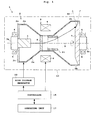
- Fig. 1 is a schematic view of an envelope rotation type X-ray tube apparatus according to the embodiment.
- Fig. 2 is an enlarged view of a portion of Fig. 1 .
- An envelope rotation type X-ray tube apparatus 1 includes an envelope 2 shaped to have a constricted middle portion.
- the envelope 2 has rotary shafts 3a and 3b arranged at opposite ends thereof.
- the rotary shafts 3a and 3b are rotatably supported by bearings 4.
- the envelope 2 has an envelope body 2a, an X-ray emitting window 2b and an insulating wall 2c.
- the envelope body 2a is formed of stainless steel, Ti or the like while the X-ray emitting window 2b is formed of Ti or the like.
- the insulating wall 2c is formed of an insulating material such as ceramics.
- the X-ray emitting window 2b is set to a small thickness from the necessity for X-ray transmission as noted hereinbefore.
- the envelope rotation type X-ray tube apparatus 1 includes a cathode 5 which releases electrons, deflection coils 6 which deflect the electrons released from the cathode 5, and a target 7 which generates X-rays by being bombarded with the electrons deflected by the deflection coils 6.
- the cathode 5 and target 7 are arranged opposite each other on a rotation center line R.
- the cathode 5 releases the electrons toward the target 7 along the rotation center line R.
- the cathode 5 has a disk-shaped electron emission source (emitter) and a converging electrode (neither shown).
- the deflection coils 6 are arranged outside and adjacent the constriction of the envelope 2. Although two deflection coils 6 are arranged opposite each other across the rotation center line R in Fig. 1 , four deflection coils 6 are provided like a quadrupole coil, for example. The four deflection coils 6 can deflect the electrons upward, downward and in the depth directions of the plane of the drawing. The deflection coils 6 correspond to the electron deflector in this invention.
- the target 7 is formed of metal with a high melting point such as tungsten or molybdenum.
- the target 7 serves as an outer wall of the envelope 2 as shown in Fig. 1 , and the rotary shaft 3b is provided on the target 7.
- the envelope 2 instead of the target 7 serving as the outer wall, the envelope 2 may be provided to cover an outer wall adjacent the target 7, with the target 7 attached to this outer wall. The same applies also to the cathode 5.
- an electron accelerating and converging element 8 is provided for accelerating and converging the electrons released from the cathode 5.
- the electron accelerating and converging element 8 is an anode, and not only the electron accelerating and converging element 8, but the envelope body 2a, X-ray emitting window 2b and target 7 are also anodes. That is, the electron accelerating and converging element 8 is at the same potential as the envelope body 2a, X-ray emitting window 2b and target 7.
- the shield ring 11 is a ring-shaped (cylindrical) member, and is attached to the envelope body 2a.
- the shield ring 11 is formed of tungsten, molybdenum or tantalum, or an alloy having one of these as a main constituent. That is, the shield ring 11 is formed of metal with a high melting point. Therefore, when blocking the electrons with the shield ring 11, melting of the shield ring 11 is inhibited even under frequent bombardment with the electrons.
- the shield ring 11 while allowing passage through the ring interior of those of the electrons deflected by the deflection coils 6 that head for an area F (see Fig. 2 ) of the target 7 defining a focal track set beforehand, blocks the electrons heading outward of that area F. That is, the electrons deflected by the deflection coils 6 pass through the ring interior of the shield ring 11, and reach the area F of the target 7 defining the focal track set beforehand. When the amount of deflection of the electrons by the deflection coils 6 is enlarged, the electrons will strike the inner wall of the shield ring 11 to be captured.
- the electrons are therefore prevented from flying to outer peripheries outward of the area F of the target 7 defining the focal track set beforehand, and to the envelope 2 and X-ray emitting window 2a.
- the focal track is a track of focal positions where the electrons bombard to generate X-rays, and is formed to describe a circle on the target 7.
- the side of the shield ring 11 opposed to the target 7 is set such that an outer side of the area F of the target 7 defining the focal track be a boundary.
- the side of the shield ring 11 opposed to the cathode 5 is set to cover a range where bombardments on the envelope 2 are assumed to occur as a result of large deflections by the deflection coils 6.
- the envelope rotation type X-ray tube apparatus 1 has the entire envelope 2 rotated in use. That is, the envelope 2, rotary shafts 3a and 3b, cathode 5, target 7, electron accelerating and converging element 8 and shield ring 11 are integrated, and these integrated envelope 2 and so on are rotated about the rotation center line R by a driver such as a motor not shown.
- the shield ring 11 is therefore constructed to rotate with the envelope 2 and target 7. Consequently, even if the shield ring 11 frequently undergoes a bombardment with electrons when blocking the electrons, the electron bombardment is dispersed, thereby to inhibit melting of the shield ring 11.
- a space surrounded by the envelope 2 and target 7 is in a vacuum state.
- the envelope 2 and so on are contained in a housing 13, and a space between the envelope 2 and so on and the housing 13 is filled with insulating oil.
- the envelope rotation type X-ray tube apparatus 1 includes a controller 15 for performing overall control of the respective components of this apparatus 1, an operating unit 17 for operating the envelope rotation type X-ray tube apparatus 1, and a high voltage generator (high voltage power source) 19 for supplying a tube voltage and a tube current required for X-ray generation.
- the operating unit 17 is made up of switches, a touch panel input unit and so on.
- the controller 15 is formed of a central processing unit (CPU) and so on.
- the controller 15 controls rotation of the envelope 2, controls a power source not shown to supply a current set beforehand to the deflection coils 6, and controls the high voltage generator 19 to supply the tube current and tube voltage between the cathode 5 and the anodes such as the electron accelerating and converging element 8 and so on.
- the controller 15 applies the tube voltage set beforehand between the cathode 5 and the target 7, electron accelerating and converging element 8 and so on. Further, in the state of giving the electron deflecting force set beforehand by the deflection coils 6, the controller 15 removes the applied tube voltage.
- the cathode 5 releases electrons, and the electron accelerating and converging element 8 accelerates and converges the electrons released from the cathode 5.
- the deflection coils 6 deflect the accelerated and converged electrons.
- the deflected electrons pass through the ring interior of the shield ring 11, and bombard on focal positions set beforehand on disk peripheries of the target 7.
- X-rays generate from the focal positions of the target 7 where the electrons have bombarded, and are emitted outward of the envelope rotation type X-ray tube apparatus 1 through the X-ray emitting window 2b.
- the shield ring 11 allows passage through the ring interior of those of the electrons deflected by the deflection coils 6 that head for the area F of the target 7 defining the focal track set beforehand, and blocks the electrons heading outward of that area F. Consequently, the electrons are prevented from striking areas of the target 7 outward of the area F and the envelope 2 such as the X-ray emitting window 2b. Since the shield ring 11 is formed of metal with a high melting point, melting of the shield ring 11 is inhibited even under frequent bombardment with the electrons. Further, since the shield ring 11 rotates with the envelope 2 and target 7, the electron bombardment can be dispersed even if the electrons bombard frequently, thereby to inhibit melting of the shield ring 11.
- the controller 15 In the state of applying the amount of current set beforehand to the deflection coils 6, as shown in Fig. 5 , to give an electron deflecting force set beforehand to the deflection coils 6, the controller 15 generates X-rays by applying the tube voltage set beforehand between the cathode 5 and the target 7, electron accelerating and converging element 8 and so on. Further, in the state of giving the electron deflecting force set beforehand to the deflection coils 6, the controller 15 removes the applied tube voltage to stop the generation of X-rays.
- the controller 15 in the state of applying the amount of current set beforehand to the deflection coils 6 as in this embodiment, selectively performs either application of the tube voltage set beforehand or removal of the applied tube voltage. At this time, those of the electrons deflected by the deflection coils 6 that head for the area of the target 7 set beforehand are allowed to pass through the ring interior of the shield ring 11, and the electrons heading outward of that area are blocked by the shield ring 11. Consequently, the envelope 2 and so on are shielded against the electrons heading therefor, and the electrons at a time of low tube voltage are blocked by the shield ring 11 against bombardment on the target 7, thereby to be able to reduce soft X-rays included in the generated X-rays. Further, it is not necessary for the controller 15 to control the amount of current flowing to the deflection coils 6 according to the tube voltage, which can simplify control of the deflection coils 6.
- the cathode 5 releases electrons, and the electrons released from the cathode 5 are deflected by the deflection coils 6.
- the target 7 generates X-rays by being bombarded with the electrons deflected by the deflection coils 6.
- the shield ring 11 allows passage through the ring interior of those of the electrons deflected by the deflection coils 6 that head for the area F of the target 7 set beforehand, and blocks the electrons heading outward of that area F. Consequently, the electrons are inhibited from bombarding on areas of the target 7 outward of the area F and the envelope 2. This can prevent damage to the envelope 2.
Landscapes
- X-Ray Techniques (AREA)
Applications Claiming Priority (2)
| Application Number | Priority Date | Filing Date | Title |
|---|---|---|---|
| JP2013029186 | 2013-02-18 | ||
| PCT/JP2013/082488 WO2014125702A1 (fr) | 2013-02-18 | 2013-12-03 | Dispositif de tube à rayons x à enveloppe tournante |
Publications (2)
| Publication Number | Publication Date |
|---|---|
| EP2958128A1 true EP2958128A1 (fr) | 2015-12-23 |
| EP2958128A4 EP2958128A4 (fr) | 2016-04-20 |
Family
ID=51353721
Family Applications (1)
| Application Number | Title | Priority Date | Filing Date |
|---|---|---|---|
| EP13875076.5A Withdrawn EP2958128A4 (fr) | 2013-02-18 | 2013-12-03 | Dispositif de tube à rayons x à enveloppe tournante |
Country Status (4)
| Country | Link |
|---|---|
| US (1) | US9972473B2 (fr) |
| EP (1) | EP2958128A4 (fr) |
| JP (1) | JP5915810B2 (fr) |
| WO (1) | WO2014125702A1 (fr) |
Families Citing this family (5)
| Publication number | Priority date | Publication date | Assignee | Title |
|---|---|---|---|---|
| US11282668B2 (en) * | 2016-03-31 | 2022-03-22 | Nano-X Imaging Ltd. | X-ray tube and a controller thereof |
| JP6667366B2 (ja) * | 2016-05-23 | 2020-03-18 | キヤノン株式会社 | X線発生管、x線発生装置、およびx線撮影システム |
| CN109564842B (zh) | 2016-08-01 | 2021-11-23 | 皇家飞利浦有限公司 | X射线单元 |
| JP7337312B1 (ja) | 2022-03-31 | 2023-09-01 | キヤノンアネルバ株式会社 | X線発生装置、x線撮像装置、および、x線発生装置の調整方法 |
| US12482626B2 (en) * | 2022-08-19 | 2025-11-25 | John Canazon | X-ray tube with corrugated wall |
Family Cites Families (17)
| Publication number | Priority date | Publication date | Assignee | Title |
|---|---|---|---|---|
| NL33344C (fr) * | 1929-10-24 | |||
| DE571710C (de) * | 1930-04-24 | 1933-03-03 | Siemens Reiniger Veifa Ges Fue | Einrichtung zum Betriebe von Roentgenroehren |
| DE19820243A1 (de) * | 1998-05-06 | 1999-11-11 | Siemens Ag | Drehkolbenstrahler mit Fokusumschaltung |
| DE19854480A1 (de) * | 1998-11-25 | 2000-06-08 | Siemens Ag | Verfahren zur Herstellung einer Röntgenröhre mit einem Flächengetter, Kathode für eine Röntgenröhre sowie verfahrensgemäß hergestellte Röntgenröhre |
| DE19900467A1 (de) * | 1999-01-08 | 2000-04-20 | Siemens Ag | Röntgenröhre mit Elektronenfänger |
| DE10301068B4 (de) | 2003-01-14 | 2006-09-21 | Siemens Ag | Röntgeneinrichtung mit einer Röntgenröhre |
| DE10313897A1 (de) * | 2003-03-27 | 2004-10-28 | Siemens Ag | Röntgenröhre mit Strahlenaustrittsfenster |
| DE102004056110A1 (de) * | 2004-11-19 | 2006-06-01 | Siemens Ag | Drehkolben-Röntgenstrahler |
| JP2009021182A (ja) * | 2007-07-13 | 2009-01-29 | Shimadzu Corp | X線管装置 |
| JP4978695B2 (ja) * | 2007-08-09 | 2012-07-18 | 株式会社島津製作所 | X線管装置 |
| US7835499B2 (en) * | 2007-12-07 | 2010-11-16 | David U. Yu | Compact, short-pulse X-ray and T-ray fused source |
| JP5267202B2 (ja) * | 2009-02-23 | 2013-08-21 | 株式会社島津製作所 | X線管装置 |
| US8565130B2 (en) | 2009-12-16 | 2013-10-22 | Lg Electronics Inc. | Transmitting system and method of processing digital broadcast signal in transmitting system, receiving system and method of receiving digital broadcast signal in receiving system |
| JP5468911B2 (ja) | 2010-01-05 | 2014-04-09 | 株式会社日立メディコ | X線管装置及びそれを用いたx線ct装置 |
| DE102010022595B4 (de) * | 2010-05-31 | 2012-07-12 | Siemens Aktiengesellschaft | Röntgenröhre mit Rückstreuelektronenfänger |
| JP5839859B2 (ja) * | 2011-06-30 | 2016-01-06 | 株式会社東芝 | X線管装置 |
| US9208986B2 (en) * | 2012-11-08 | 2015-12-08 | General Electric Company | Systems and methods for monitoring and controlling an electron beam |
-
2013
- 2013-12-03 EP EP13875076.5A patent/EP2958128A4/fr not_active Withdrawn
- 2013-12-03 WO PCT/JP2013/082488 patent/WO2014125702A1/fr not_active Ceased
- 2013-12-03 JP JP2015500098A patent/JP5915810B2/ja active Active
- 2013-12-03 US US14/768,413 patent/US9972473B2/en not_active Expired - Fee Related
Also Published As
| Publication number | Publication date |
|---|---|
| WO2014125702A1 (fr) | 2014-08-21 |
| JP5915810B2 (ja) | 2016-05-11 |
| EP2958128A4 (fr) | 2016-04-20 |
| US20150380201A1 (en) | 2015-12-31 |
| US9972473B2 (en) | 2018-05-15 |
| JPWO2014125702A1 (ja) | 2017-02-02 |
Similar Documents
| Publication | Publication Date | Title |
|---|---|---|
| US9972473B2 (en) | Envelope rotation type X-ray tube apparatus | |
| JP6502514B2 (ja) | 電子ビームの操縦及び集束用の2元的グリッド及び2元的フィラメントの陰極を有するx線管 | |
| CN101494149B (zh) | 用于多点x射线的基于场发射体的电子源 | |
| US20110142193A1 (en) | X-ray tube for microsecond x-ray intensity switching | |
| US8477908B2 (en) | System and method for beam focusing and control in an indirectly heated cathode | |
| EP2869327A1 (fr) | Tube à rayons x | |
| JP2009538500A (ja) | 電子ビームが回転性陽極運動と同時に処理されるx線管 | |
| US9484179B2 (en) | X-ray tube with adjustable intensity profile | |
| JP5426089B2 (ja) | X線管及びx線ct装置 | |
| TWI732319B (zh) | X射線產生裝置、x射線攝影系統及x射線焦點徑之調整方法 | |
| JP2007095689A (ja) | 冷電子源によるx線発生装置 | |
| SE424243B (sv) | Rontgenror for rontgendiagnostisk apparatur | |
| US9741523B2 (en) | X-ray tube | |
| US9224572B2 (en) | X-ray tube with adjustable electron beam | |
| WO2021246254A1 (fr) | Dispositif d'émission de champ, procédé d'émission de champ et procédé de positionnement et de fixation | |
| US20190189384A1 (en) | Bipolar grid for controlling an electron beam in an x-ray tube | |
| US20220406555A1 (en) | Constant discharge current bleeder | |
| JP2018060621A (ja) | X線管 | |
| JP5267202B2 (ja) | X線管装置 | |
| JP2001273860A (ja) | マイクロフォーカスx線管装置 | |
| EP4503086A1 (fr) | Générateur de rayons x, imageur à rayons x et procédé de réglage d'un générateur de rayons x | |
| EP3226277A1 (fr) | Émetteur plat angulaire pour cathode de grande puissance avec commande d'émission électrostatique | |
| EP3518267A1 (fr) | Tube à rayons x | |
| JP2012084400A (ja) | 回転陽極型x線管及びx線管装置 | |
| US10468222B2 (en) | Angled flat emitter for high power cathode with electrostatic emission control |
Legal Events
| Date | Code | Title | Description |
|---|---|---|---|
| PUAI | Public reference made under article 153(3) epc to a published international application that has entered the european phase |
Free format text: ORIGINAL CODE: 0009012 |
|
| 17P | Request for examination filed |
Effective date: 20150813 |
|
| AK | Designated contracting states |
Kind code of ref document: A1 Designated state(s): AL AT BE BG CH CY CZ DE DK EE ES FI FR GB GR HR HU IE IS IT LI LT LU LV MC MK MT NL NO PL PT RO RS SE SI SK SM TR |
|
| AX | Request for extension of the european patent |
Extension state: BA ME |
|
| A4 | Supplementary search report drawn up and despatched |
Effective date: 20160318 |
|
| RIC1 | Information provided on ipc code assigned before grant |
Ipc: H01J 35/16 20060101AFI20160314BHEP Ipc: H01J 35/26 20060101ALI20160314BHEP Ipc: H01J 35/14 20060101ALI20160314BHEP |
|
| DAX | Request for extension of the european patent (deleted) | ||
| 17Q | First examination report despatched |
Effective date: 20170213 |
|
| GRAP | Despatch of communication of intention to grant a patent |
Free format text: ORIGINAL CODE: EPIDOSNIGR1 |
|
| INTG | Intention to grant announced |
Effective date: 20180514 |
|
| STAA | Information on the status of an ep patent application or granted ep patent |
Free format text: STATUS: THE APPLICATION IS DEEMED TO BE WITHDRAWN |
|
| 18D | Application deemed to be withdrawn |
Effective date: 20180925 |