EP2959609B1 - Verfahren und netzwerkknoten in einem funkkommunikationsnetz - Google Patents
Verfahren und netzwerkknoten in einem funkkommunikationsnetz Download PDFInfo
- Publication number
- EP2959609B1 EP2959609B1 EP14716306.7A EP14716306A EP2959609B1 EP 2959609 B1 EP2959609 B1 EP 2959609B1 EP 14716306 A EP14716306 A EP 14716306A EP 2959609 B1 EP2959609 B1 EP 2959609B1
- Authority
- EP
- European Patent Office
- Prior art keywords
- channel state
- cqi
- state information
- mobile station
- channel
- Prior art date
- Legal status (The legal status is an assumption and is not a legal conclusion. Google has not performed a legal analysis and makes no representation as to the accuracy of the status listed.)
- Active
Links
- 238000000034 method Methods 0.000 title claims description 72
- 238000004891 communication Methods 0.000 title claims description 35
- 238000005315 distribution function Methods 0.000 claims description 56
- 238000012549 training Methods 0.000 claims description 45
- 238000004422 calculation algorithm Methods 0.000 claims description 38
- 238000013139 quantization Methods 0.000 claims description 32
- 238000013507 mapping Methods 0.000 claims description 11
- 230000000875 corresponding effect Effects 0.000 description 23
- 230000009471 action Effects 0.000 description 22
- 230000008901 benefit Effects 0.000 description 14
- 230000006978 adaptation Effects 0.000 description 11
- 238000004590 computer program Methods 0.000 description 11
- 238000013459 approach Methods 0.000 description 10
- 230000006870 function Effects 0.000 description 10
- 238000005259 measurement Methods 0.000 description 10
- 238000004364 calculation method Methods 0.000 description 9
- 238000005516 engineering process Methods 0.000 description 7
- 238000012545 processing Methods 0.000 description 7
- 238000013213 extrapolation Methods 0.000 description 6
- 238000012935 Averaging Methods 0.000 description 5
- 230000014509 gene expression Effects 0.000 description 5
- 238000012417 linear regression Methods 0.000 description 5
- 239000011159 matrix material Substances 0.000 description 5
- 230000005540 biological transmission Effects 0.000 description 4
- 230000001413 cellular effect Effects 0.000 description 4
- 238000005562 fading Methods 0.000 description 4
- 238000005070 sampling Methods 0.000 description 4
- 238000010586 diagram Methods 0.000 description 3
- 230000005654 stationary process Effects 0.000 description 3
- 230000003044 adaptive effect Effects 0.000 description 2
- 230000006399 behavior Effects 0.000 description 2
- 238000010295 mobile communication Methods 0.000 description 2
- 230000003287 optical effect Effects 0.000 description 2
- 230000008569 process Effects 0.000 description 2
- 230000004044 response Effects 0.000 description 2
- 241000760358 Enodes Species 0.000 description 1
- XUIMIQQOPSSXEZ-UHFFFAOYSA-N Silicon Chemical compound [Si] XUIMIQQOPSSXEZ-UHFFFAOYSA-N 0.000 description 1
- 230000004075 alteration Effects 0.000 description 1
- 230000002596 correlated effect Effects 0.000 description 1
- 230000001419 dependent effect Effects 0.000 description 1
- 230000000694 effects Effects 0.000 description 1
- 238000011156 evaluation Methods 0.000 description 1
- 238000011835 investigation Methods 0.000 description 1
- 230000007774 longterm Effects 0.000 description 1
- 230000007246 mechanism Effects 0.000 description 1
- 230000002441 reversible effect Effects 0.000 description 1
- 230000008054 signal transmission Effects 0.000 description 1
- 230000011664 signaling Effects 0.000 description 1
- 229910052710 silicon Inorganic materials 0.000 description 1
- 239000010703 silicon Substances 0.000 description 1
- 238000004088 simulation Methods 0.000 description 1
- 230000003068 static effect Effects 0.000 description 1
- 238000006467 substitution reaction Methods 0.000 description 1
- 238000011144 upstream manufacturing Methods 0.000 description 1
Images


Classifications
-
- H—ELECTRICITY
- H04—ELECTRIC COMMUNICATION TECHNIQUE
- H04B—TRANSMISSION
- H04B7/00—Radio transmission systems, i.e. using radiation field
- H04B7/02—Diversity systems; Multi-antenna system, i.e. transmission or reception using multiple antennas
- H04B7/04—Diversity systems; Multi-antenna system, i.e. transmission or reception using multiple antennas using two or more spaced independent antennas
- H04B7/06—Diversity systems; Multi-antenna system, i.e. transmission or reception using multiple antennas using two or more spaced independent antennas at the transmitting station
- H04B7/0613—Diversity systems; Multi-antenna system, i.e. transmission or reception using multiple antennas using two or more spaced independent antennas at the transmitting station using simultaneous transmission
- H04B7/0615—Diversity systems; Multi-antenna system, i.e. transmission or reception using multiple antennas using two or more spaced independent antennas at the transmitting station using simultaneous transmission of weighted versions of same signal
- H04B7/0619—Diversity systems; Multi-antenna system, i.e. transmission or reception using multiple antennas using two or more spaced independent antennas at the transmitting station using simultaneous transmission of weighted versions of same signal using feedback from receiving side
- H04B7/0621—Feedback content
- H04B7/0626—Channel coefficients, e.g. channel state information [CSI]
-
- H—ELECTRICITY
- H04—ELECTRIC COMMUNICATION TECHNIQUE
- H04B—TRANSMISSION
- H04B17/00—Monitoring; Testing
- H04B17/30—Monitoring; Testing of propagation channels
- H04B17/373—Predicting channel quality or other radio frequency [RF] parameters
-
- H—ELECTRICITY
- H04—ELECTRIC COMMUNICATION TECHNIQUE
- H04B—TRANSMISSION
- H04B7/00—Radio transmission systems, i.e. using radiation field
- H04B7/02—Diversity systems; Multi-antenna system, i.e. transmission or reception using multiple antennas
- H04B7/04—Diversity systems; Multi-antenna system, i.e. transmission or reception using multiple antennas using two or more spaced independent antennas
- H04B7/06—Diversity systems; Multi-antenna system, i.e. transmission or reception using multiple antennas using two or more spaced independent antennas at the transmitting station
- H04B7/0613—Diversity systems; Multi-antenna system, i.e. transmission or reception using multiple antennas using two or more spaced independent antennas at the transmitting station using simultaneous transmission
- H04B7/0615—Diversity systems; Multi-antenna system, i.e. transmission or reception using multiple antennas using two or more spaced independent antennas at the transmitting station using simultaneous transmission of weighted versions of same signal
- H04B7/0619—Diversity systems; Multi-antenna system, i.e. transmission or reception using multiple antennas using two or more spaced independent antennas at the transmitting station using simultaneous transmission of weighted versions of same signal using feedback from receiving side
- H04B7/0621—Feedback content
- H04B7/063—Parameters other than those covered in groups H04B7/0623 - H04B7/0634, e.g. channel matrix rank or transmit mode selection
-
- H—ELECTRICITY
- H04—ELECTRIC COMMUNICATION TECHNIQUE
- H04B—TRANSMISSION
- H04B7/00—Radio transmission systems, i.e. using radiation field
- H04B7/02—Diversity systems; Multi-antenna system, i.e. transmission or reception using multiple antennas
- H04B7/04—Diversity systems; Multi-antenna system, i.e. transmission or reception using multiple antennas using two or more spaced independent antennas
- H04B7/06—Diversity systems; Multi-antenna system, i.e. transmission or reception using multiple antennas using two or more spaced independent antennas at the transmitting station
- H04B7/0613—Diversity systems; Multi-antenna system, i.e. transmission or reception using multiple antennas using two or more spaced independent antennas at the transmitting station using simultaneous transmission
- H04B7/0615—Diversity systems; Multi-antenna system, i.e. transmission or reception using multiple antennas using two or more spaced independent antennas at the transmitting station using simultaneous transmission of weighted versions of same signal
- H04B7/0619—Diversity systems; Multi-antenna system, i.e. transmission or reception using multiple antennas using two or more spaced independent antennas at the transmitting station using simultaneous transmission of weighted versions of same signal using feedback from receiving side
- H04B7/0621—Feedback content
- H04B7/0632—Channel quality parameters, e.g. channel quality indicator [CQI]
Definitions
- Implementations described herein generally relate to a mobile station and a method in a mobile station.
- a mechanism is herein described, for predicting a channel state information metric of a downlink channel of a radio network node in a wireless communication network.
- a mobile station also known as a User Equipment (UE)
- UE User Equipment
- wireless terminal and/ or mobile terminal is enabled to communicate wirelessly in a wireless communication network, sometimes also referred to as a cellular radio system.
- the communication may be made, e.g., between user equipment, between a user equipment and a wire connected telephone and/ or between a user equipment and a server via a Radio Access Network (RAN) and possibly one or more core networks.
- RAN Radio Access Network
- the wireless communication may comprise various communication services such as voice, messaging, packet data, video, broadcast, etc.
- the mobile station may further be referred to as mobile telephone, cellular telephone, computer tablet or laptop with wireless capability, etc.
- the mobile station in the present context may be, for example, portable, pocket-storable, hand-held, computer-comprised, or vehicle-mounted mobile devices, enabled to communicate voice and/ or data, via the radio access network, with another entity, such as another mobile station, a stationary entity or a server.
- the wireless communication network covers a geographical area which is divided into cell areas, with each cell area being served by a radio network node, network node or base station, e.g., a Radio Base Station (RBS) or Base Transceiver Station (BTS), which in some networks may be referred to as "eNB”, “eNodeB”, “NodeB” or “B node”, depending on the technology and/ or terminology used.
- a radio network node e.g., a Radio Base Station (RBS) or Base Transceiver Station (BTS)
- RBS Radio Base Station
- BTS Base Transceiver Station
- the expression "cell” may be used for denoting the radio network node itself.
- the cell may also in normal terminology be used for the geographical area where radio coverage is provided by the radio network node at a base station site.
- One network node, situated on the base station site, may serve one or several cells.
- the radio network nodes may communicate over the air interface operating on radio frequencies with any mobile station within range of the respective radio network node.
- GSM Global System for Mobile Communications
- radio network nodes which may be referred to as eNodeBs or eNBs, may be connected to a gateway, e.g., a radio access gateway, to one or more core networks.
- LTE is based on the GSM/ EDGE and UMTS/ HSPA network technologies, increasing the capacity and speed using a different radio interface together with core network improvements.
- LTE-Advanced i.e. LTE Release 10 and later releases are set to provide higher bitrates in a cost efficient way and, at the same time, completely fulfil the requirements set by International Telecommunication Union (ITU) for the International Mobile Telecommunications (IMT)-Advanced, also referred to as 4G (i.e. 4th Generation).
- ITU International Telecommunication Union
- 4G i.e. 4th Generation
- the expressions downlink, downstream link or forward link may be used for the transmission path from the radio network node to the mobile station.
- the expression uplink, upstream link or reverse link may be used for the transmission path in the opposite direction, i.e., from the mobile station to the radio network node.
- CSI Channel State Information
- CQI Channel Quality Indicator
- PMI Precoding Matrix Index
- RI Rank Indication
- CQI is an index between 0 and 15, indicating the highest modulation and code rate at which the Block Error Rate (BLER) of the channel being analysed does not exceed 10%.
- PMI indicates the best precoding matrix used for close-loop spatial multiplexing mode.
- RI is a measurement, indicating the best rank of the transmitted downlink signal.
- the mobile station may measure any, some or all of these three quality indicators and transmit the information in the uplink to the radio network node which then may adapts the signal transmission in the downlink accordingly, although this is not mandatory.
- the channel quality measurement and CQI / PMI / RI estimation methodologies at the mobile station are implementation specific. Thus, the manufacturers /chipset makers have certain freedom in algorithms and implementation.
- ⁇ CQI there is a CQI feedback delay, ⁇ CQI , which e.g. may be 8 ms long.
- This delay , ⁇ CQI is the difference in time between the moment that the mobile station reports a certain CQI and the time that the radio network node transmits data to this mobile station according to the reported CQI (which may not be exactly the same as the reported).
- ⁇ CQI is the difference in time between the moment that the mobile station reports a certain CQI and the time that the radio network node transmits data to this mobile station according to the reported CQI (which may not be exactly the same as the reported).
- Figure 1 illustrates an example of the general link adaptation process while Figure 2 illustrates channel variation and CQI feedback delay, EPA channel at a mobile station speed of 10 km/h, corresponding to Doppler ⁇ 20Hz.
- short-term averaging and first order adaptive Infinite Impulse Response (IIR) filters are used for prediction. They are however more suitable when the mobile station speed is high. Under high speed mobile station scenarios, CQI feedback delay is significantly larger than the channel coherence time. However, short-term averaging and first order adaptive IIR filters are not appropriate for prediction at, or under walking speed of the mobile station, as their prediction performance will degrade at low Doppler, corresponding to walking speed or slower.
- IIR Infinite Impulse Response
- Linear regression based prediction is a straight-forward prediction approach with simple mathematical representation. Its performance can hardly be beaten when the Doppler of the mobile station is very low, for example under 2 Hz Doppler. However, its performance degrades fast when Doppler increases. Moreover, it has the problem of overshoots when the varying trend changes at peaks and dips.
- Cubic spline based extrapolation for predicting the Signal to Interference and Noise Ratio has also been investigated.
- Cubic spline has good performance for interpolation.
- the performance is in general not satisfying.
- the boundary conditions setting here include how to set the derivatives at the end points.
- the impact of the noise for interpolation is limited, while the impact of the noise for extrapolation is heavy, especially by the noise at the end points. For this reason, this approach is inappropriate for channel prediction.
- the channel information is correlated. Therefore, if the correlation coefficients are known, the channel information in the future may be estimated/ predicted based on the latest channel information. In such case, the MMSE solution may be a possible approach. Such prediction can be based on the metrics like channel response, SINR, Resource Block Information Rate (RBIR), Mutual Information (MI), Effective Exponential SINR Mapping (EESM), etc.
- the MMSE based prediction approach may be directly applied in the prediction of other similar metrics mentioned earlier.
- the metric values of these sub-frames form a stationary process.
- the auto-correlation of the process may be computed and form a Yule-Walker equation system to predict the metric.
- the performance of this linear MMSE-based M prediction may depend on many issues: If the correlation between the history metric values and the future metric values at the time to be predicted is strong, then a good performance can be expected. However, this is directly related to the Doppler and the value of ⁇ CQI , the larger Doppler or larger ⁇ CQI will results in worse prediction performance.
- the accuracy of the sample auto-correlation will affect the performance. To have a more accurate sample autocorrelation, the channel metric is required to be stationary for a long enough time so that abundant samples to estimate the autocorrelation coefficients are collected. Again, this requires low Doppler, and some more conditions so that to satisfy the stationary condition.
- the correlation vector r When the Doppler is high or ⁇ CQI is large, then the correlation vector r is very close to zero. In that case, the predicted metric value will converge to the short-term mean. This makes intuitive sense because from the latest metric values, no conclusion may be drawn concerning the metric values at the future time of prediction due to the small correlation. Further, the performance also depends on the choice of the filter order p.
- the filter order p may be e.g. between 5 and 20. When the filter order p is small, there will not be sufficient information for prediction while, when the order is big, the complexity grow high, especially for the matrix inversion operation.
- the prediction performance of the Short-term averaging based prediction is not good for low Doppler, corresponding to a mobile station speed below 10 km/h.
- Linear regression based prediction is not suitable for a non-static mobile station due to channel fading. Moreover, Linear regression based prediction has the problem of over-shooting, as it usually render prediction values that are higher than the peak at time right after the fading peak, and lower than the dip at time right after the fading dip.
- Cubic-spline based prediction method is very sensitive to end-point conditions and thus works unsatisfying other than for very low speed of the mobile station and very low noise level.
- Linear-MMSE based prediction method still suffer from the over-shooting problem. Moreover, for these different metrics, their variation over time, caused by channel variation at the mobile station side are not really linear in nature, so linear method is in nature sub-optimal.
- US 2011/261713 A1 discloses a mobile station and a method for predicting CQI or PMI after a control delay. Further related technologies are disclosed in WO 2012/040935 A1 .
- a mobile station configured for predicting a channel state information metric of a downlink channel of a radio network node in a wireless communication network.
- the mobile station comprises a receiver, configured for receiving a wireless signal from a radio network node on the downlink channel. Further, the mobile station also comprises a processor, configured for determining a length of a feedback delay; and configured for predicting the channel state information metric of the channel on which the wireless signal was received, at a future point in time, corresponding to the determined length of the feedback delay, wherein said prediction is based on a non-linear predicting algorithm.
- the processor is configured for predicting the channel state information metric based on the non-linear predicting algorithm by collecting channel state information metric data of the downlink channel, to be used as training data, during a training data period. Further, the processor is configured for estimating a conditional probability distribution function, within a period, based on the collected training data. In further addition, the processor is configured for computing the predicted channel state information metric based on the estimated conditional probability distribution function at the future point in time, corresponding to the determined length of the feedback delay.
- the channel state metric variation is predicted with improved precision, in particular when the user of the mobile station is moving at walking speed.
- the mobile station can provide feed-back based on a predicted future channel state, thereby enabling an improved link adaptation.
- a higher throughput is achieved, as the radio network node may adapt modulation scheme and code rate to a predicted channel state which is closer to the real channel state than according to conventional channel state prediction methods, leading to less retransmission and higher throughput.
- An advantage by collecting training data comprising history channel state information it is possible to make a conditional expectation of the probability distribution function at the future point in time, corresponding to the determined length of the feedback delay, leading to an improved prediction of the channel state information metric.
- the conditional probability distribution function may be estimated by: p ( M [ t + ⁇ CQI ]
- the conditional probability distribution function may be estimated by: p( M [ t + ⁇ CQI ]
- channel state information metric may be made also with limited training data available. Also, difficulties that may arise when estimating the continuous conditional probability distribution function may be avoided, thanks to simplified calculation.
- conditional probability distribution function may be estimated by: p ( M [ t + ⁇ CQI ]
- channel state information metric may be made also with limited training data available. Also, difficulties that may arise when estimating the continuous conditional probability distribution function may be avoided, thanks to simplified calculation.
- L 0 may be an integer within an interval 3 ⁇ L 0 ⁇ 5.
- the processor may be further configured for performing quantization of channel state metric values into bins by running a quantization function, such that the continuous conditional probability distribution function becomes discrete.
- An advantage in addition to other benefits of this implementation comprises enabling an efficient implementation of the non-linear prediction method.
- An advantage in addition to other benefits of this implementation comprises enabling an efficient implementation of the non-linear prediction method, as the computational complexity is further reduced.
- the channel state information metric comprises any of: Mutual Information (MI), Effective Exponential Signal to interference and noise Mapping (EESM), Received Bit mutual Information Rate (RBIR), Signal to Noise Ratio (SNR), effective SNR, or a similar metric related to the quality of the downlink channel.
- MI Mutual Information
- EESM Effective Exponential Signal to interference and noise Mapping
- RBIR Received Bit mutual Information Rate
- SNR Signal to Noise Ratio
- effective SNR or a similar metric related to the quality of the downlink channel.
- the processor is further configured for selecting a Channel Quality Indicator (CQI), based on the predicted channel state information metric of the channel; and wherein the mobile station further comprises a transmitter, configured for transmitting an index associated with the selected Channel Quality Indicator (CQI), to the radio network node.
- CQI Channel Quality Indicator
- the radio network node By utilising known metrics for determining the channel state of the downlink for mapping the predicted channel state information metric with a Channel Quality Indicator (CQI), implementation of the method is facilitated. Further, by transmitting an index associated with the selected Channel Quality Indicator (CQI), the radio network node obtains feedback from the mobile station concerning the channel quality, using a minimum of bandwidth.
- CQI Channel Quality Indicator
- the processor is further configured for predicting the channel state information metric based on a linear prediction algorithm when the non-linear predicting algorithm is not performable due to insufficient amount of training data during the training data period.
- a method for use in a mobile station.
- the method aims at predicting a channel state information metric of a downlink channel of a radio network node in a wireless communication network.
- the method comprises receiving a wireless signal from a radio network node on the downlink channel.
- the method further comprises determining length of a feedback delay.
- the method furthermore comprises predicting the channel state information metric of the channel on which the wireless signal was received, at a future point in time, corresponding to the determined length of the feedback delay, wherein said prediction is at least partially based on a non-linear predicting algorithm.
- the prediction of the channel state information metric based on the non-linear predicting algorithm further comprises collecting channel state information metric data of the downlink channel, to be used as training data, during a training data period. Also, the non-linear predicting algorithm additionally comprises estimating conditional probability distribution function within a period, based on the collected training data. In addition, the non-linear predicting algorithm comprises computing the predicted channel state information metric based on the estimated conditional probability at the future point in time, corresponding to the determined length of the feedback delay.
- the channel state metric variation is predicted with improved precision, in particular when the user of the mobile station is moving at walking speed.
- the mobile station can provide feed-back based on a predicted future channel state, thereby enabling an improved link adaptation.
- a higher throughput is achieved, as the radio network node may adapt modulation scheme and code rate to a predicted channel state which is closer to the real channel state than according to conventional channel state prediction methods, leading to less retransmission and higher throughput.
- An advantage by collecting training data comprising history channel state information it is possible to make a conditional expectation of the probability distribution function at the future point in time, corresponding to the determined length of the feedback delay, leading to an improved prediction of the channel state information metric.
- the conditional probability distribution function may comprise: p ( M [ t + ⁇ CQI ]
- the conditional probability distribution function may comprise: p ( M [ t + ⁇ CQI ]
- channel state information metric may be made also with limited training data available. Also, difficulties that may arise when estimating the continuous conditional probability distribution function may be avoided, thanks to simplified calculation.
- the conditional probability distribution function may comprise: p ( M [ t + ⁇ CQI ]
- channel state information metric may be made also with limited training data available. Also, difficulties that may arise when estimating the continuous conditional probability distribution function may be avoided, thanks to simplified calculation.
- L 0 may be an integer within an interval 3 ⁇ L 0 ⁇ 5.
- the method further may comprise quantization of the channel state metric values into bins by running a quantization function, such that the continuous conditional probability distribution function becomes discrete.
- An advantage in addition to other benefits of this implementation comprises enabling an efficient implementation of the non-linear prediction method.
- An advantage in addition to other benefits of this implementation comprises enabling an efficient implementation of the non-linear prediction method, as the computational complexity is further reduced.
- the channel state information metric may comprise any of: Mutual Information (MI), Effective Exponential Signal to interference and noise Mapping (EESM), Received Bit mutual Information Rate (RBIR), Signal to Noise Ratio (SNR), effective SNR, or a similar metric associated with the quality of the downlink channel.
- MI Mutual Information
- EESM Effective Exponential Signal to interference and noise Mapping
- RBIR Received Bit mutual Information Rate
- SNR Signal to Noise Ratio
- An advantage is that implementation of the method thereby is facilitated.
- the method may further comprise selecting a Channel Quality Indicator (CQI), based on the predicted channel state information metric of the channel; and transmitting an index associated with the selected Channel Quality Indicator (CQI), to the radio network node.
- CQI Channel Quality Indicator
- the radio network node By utilising known metrics for determining the channel state of the downlink for mapping the predicted channel state information metric with a Channel Quality Indicator, implementation of the method is facilitated. Further, by transmitting an index associated with the selected Channel Quality Indicator, the radio network node obtains feedback from the mobile station concerning the channel quality, using a minimum of bandwidth.
- the prediction of the channel state information metric may be further based on a linear prediction algorithm when the non-linear predicting algorithm is not performable due to insufficient amount of training data during the training data period,
- a computer program product comprising a computer readable storage medium storing program code thereon, for use in a mobile station.
- the computer program product aims at predicting a channel state information metric of a downlink channel of a radio network node in a wireless communication network.
- the program code comprises instructions for executing a method comprising receiving a wireless signal from a radio network node on the downlink channel; determining length of a feed-back delay; and predicting the channel state information metric of the channel on which the wireless signal was received, at a future point in time, corresponding to the determined length of the feedback delay, wherein said prediction is at least partially based on a non-linear predicting algorithm.
- the channel state metric variation is predicted with improved precision, in particular when the user of the mobile station is moving at walking speed.
- the mobile station can provide feed-back based on a predicted future channel state, thereby enabling an improved link adaptation.
- a higher throughput is achieved, as the radio network node may adapt modulation scheme and code rate to a predicted channel state which is closer to the real channel state than according to conventional channel state prediction methods, leading to less retransmission and higher throughput.
- an improved performance within the wireless communication network is provided.
- Embodiments of the invention described herein are defined as a mobile station and a method in a mobile station, which may be put into practice in the embodiments described below. These embodiments may, however, be exemplified and realised in many different forms and are not to be limited to the examples set forth herein; rather, these illustrative examples of embodiments are provided so that this disclosure will be thorough and complete.
- FIG 3 is a schematic illustration over a wireless communication network 100 comprising a radio network node 110, and a mobile station 120.
- the radio network node 110 may be the serving radio network node of the mobile station 120.
- the wireless communication network 100 may at least partly be based on radio access technologies such as, e.g., 3GPP LTE, LTE-Advanced, 4G, Evolved Universal Terrestrial Radio Access Network (E-UTRAN), Universal Mobile Telecommunications System (UMTS), Global System for Mobile Communications (originally: Groupe Special Mobile) (GSM)/ Enhanced Data rate for GSM Evolution (GSM/EDGE), Wideband Code Division Multiple Access (WCDMA), Time Division Multiple Access (TDMA) networks, Frequency Division Multiple Access (FDMA) networks, Orthogonal FDMA (OFDMA) networks, Single-Carrier FDMA (SC-FDMA) networks, Worldwide Interoperability for Microwave Access (WiMax), or Ultra Mobile Broadband (UMB), High Speed Packet Access (HSPA) Evolved Universal Terrestrial Radio Access (E-UTRA), Universal Terrestrial Radio Access (UTRA), GSM EDGE Radio Access Network (GERAN), 3GPP2 CDMA technologies, e.g., CDMA2000 1x R
- the wireless communication network 100 may be configured to operate according to the Time Division Duplex (TDD) and/ or the Frequency Division Duplex (FDD) principle, according to different embodiments.
- TDD Time Division Duplex
- FDD Frequency Division Duplex
- TDD is an application of time-division multiplexing to separate uplink and downlink signals in time, possibly with a Guard Period (GP) situated in the time domain between the uplink and downlink signalling.
- FDD means that the transmitter and receiver operate at different carrier frequencies.
- the purpose of the illustration in Figure 3 is to provide a simplified, general overview of the wireless communication network 100 and the involved methods and nodes, such as the radio network node 110 and the mobile station 120 herein described, and the functionalities involved.
- the methods, radio network node 110 and mobile station 120 will subsequently, as a non-limiting example, be described in a 3GPP LTE/ LTE-Advanced environment.
- the disclosed embodiments may operate in a wireless communication network 100 based on another access technology such as, e.g., any of the above already enumerated.
- the embodiments of the invention are described based on, and using the lingo of, 3GPP LTE systems, it is by no means limited to 3GPP LTE.
- the terms radio network node, network node, base station, and cell are used interchangeably in the sequel.
- the illustrated radio network node 110 comprised in the wireless communication network 100 may send and receive radio signals in order to communicate wirelessly with the mobile station 120.
- the radio network node 110 may send a pilot signal or similar, to be received by the mobile station 120, which in turn may perform channel quality measurements on the received signal.
- the wireless communication network 100 may comprise any other number and/ or combination of the discussed radio network node 110 and/ or mobile station 120.
- a plurality of mobile stations 120 and another configuration of radio network nodes 110 may thus be involved in some embodiments of the disclosed invention.
- radio network node 110 and/ or mobile station 120 may be involved, according to some embodiments.
- the radio network node 110 may be configured for downlink transmission and uplink reception, and may be referred to, respectively, as e.g., a base station, a NodeB, an evolved Node Bs (eNB, or eNode B), a base transceiver station, an Access Point Base Station, a base station router, a Radio Base Station (RBS), a micro base station, a pico base station, a femto base station, a Home eNodeB, a sensor, a beacon device, a relay node, a repeater or any other network node configured for communication with the mobile station 120 over a wireless interface, depending, e.g., of the radio access technology and/ or terminology used.
- a base station e.g., a NodeB, an evolved Node Bs (eNB, or eNode B), a base transceiver station, an Access Point Base Station, a base station router, a Radio Base Station (RBS), a micro base station,
- the mobile station 120 may correspondingly be represented by, e.g. a wireless communication terminal, a mobile cellular phone, a Personal Digital Assistant (PDA), a wireless platform, a user equipment, a tablet computer, a portable communication device, a laptop, a computer, a wireless terminal acting as a relay, a relay node, a mobile relay, a Customer Premises Equipment (CPE), a Fixed Wireless Access (FWA) nodes or any other kind of device configured to communicate wirelessly with the radio network node 110, according to different embodiments and different vocabulary.
- PDA Personal Digital Assistant
- PDA Personal Digital Assistant
- a wireless platform e.g., a wireless platform
- a user equipment e.g., a user equipment
- a tablet computer e.g., a portable communication device
- laptop e.g., a laptop
- CPE Customer Premises Equipment
- FWA Fixed Wireless Access
- Some embodiments of the invention may define a modular implementation approach, and make it possible to reuse legacy systems such as e.g. standards, algorithms, implementations, components and products.
- the herein described method provides a method to predict the channel state information with the current and some historic knowledge of the channel state. With the prediction, the mobile station 120 is enabled to report the CQI to the radio network node 110, based on the predicted channel state information at time t + ⁇ CQI instead of at time t.
- y k , l , t H k , l , t s k , l , t + n k , l , t , where k denotes subcarrier k, / denotes OFDM symbol / within subframe t, H is the channel matrix, s is the transmitted symbol, and n is the noise vector, and y is the received signal vector.
- mapping algorithms from channel H ( k, I, t ) at time t into certain metrics such as e.g. SINR, EESM, Mutual Information (MI) based Exponential Signal to noise ratio Mapping (MIESM), Resource Block Information Rate (RBIR) etc.
- MI Mutual Information
- MIESM Exponential Signal to noise ratio Mapping
- RBIR Resource Block Information Rate
- channel state information metrics M such as e.g. SINR, EESM, MIESM and RBIR that may be used in different embodiments
- their physical meanings are somewhat related and they follow the channel fading similarly.
- a certain prediction method may be applied on these, or other similar, different metrics in a similar fashion.
- the disclosed method is generic and may be applied on any of these or other similar metrics.
- M ( k, I, t ) may be used to denote the metric calculated based on the channel H ( k, I, t ).
- the metric M ( k, I, t ) may be mutual information (MI) or any of the metrics calculated in EESM, MIESM, RBIR or other similar methods.
- the non-linear method in predicting the channel state metrics may be combined with linear methods for improving robustness and performance of the method.
- This conditional expectation based prediction is actually a non-linear Minimum Mean Square Error (MMSE) prediction.
- MMSE Minimum Mean Square Error
- the disclosed non-linear channel state metric prediction is limited by the fact that the conditional probability distribution function only may be trained with a given history of channel state information. Further, it may only be assumed that the channel is a stationary process within a short period, for example within 1 second or a few seconds. This means that the amount of training data will be limited. Although the channel state metrics values are bounded, they are usually continuous random variables, thus given very limited amount of training data, it is not possible to precisely estimate the conditional probability distribution function. Because of the scope of the conditional probability distribution function is of dimension L + 1, corresponding information in order to estimate the conditional probability distribution function may be lacking at most of the positions within the L + 1 dimensional space. L is an integer within an interval of several or tens of milliseconds.
- the problem of large dimension may be solved in the following way. It may be observed that the mobile station 120 moving at walking speed, there is strong correlation between channel instances that are very close in time. This may be illustrated by plotting the sequence of channel state metric values for a period; thereby the sequence looks like a continuously varying curve, where the neighbouring channel state metric values are quite close to each other. This is to say, at walking speed, the channel coherence time is several times larger than 1ms, which may be the time difference between neighbouring frames, namely neighbouring channel state metric values. Thus, when the channel state metric sequence is down-sampled a few times, not much information is lost.
- conditional probability distribution function may be made according to some embodiments: p ( M [ t + ⁇ CQI ]
- the proper value of L 0 may depend on the channel coherence time. In some embodiments, the value of L 0 may be set to value between 1 and 10, such as e.g. 3, 4 or 5, as has found appropriate in performed simulations.
- the channel state metric values may be quantized into small bins, such that the continuous conditional probability distribution function becomes discrete.
- the estimation of the conditional probability distribution function is reduced to counting numbers and doing averaging.
- the above discussed difficulties of estimating the continuous conditional probability distribution function may be avoided, or at least somewhat reduced.
- the quantized conditional probability distribution function may be estimated. Essentially, it may only be required to know the conditional mean for prediction.
- the following is a non-limiting example of the discrete conditional mean, which is trained with 1000 mean-MI values each were separated 1ms. Where the MI range is [0 ⁇ 1], and the quantization step size is 0.05, and the row index in the following table is the quantization index of M [ t - L 0 ] , the column index is the quantization index of M [ t ] .
- Those non-zero values in the table are the conditional mean, and the zero values in the table correspond to invalid prediction due to lack of corresponding information within the training data.
- Table 1 illustrates a non-limiting example of estimated quantized M conditional probability distribution.
- the performance may be improved by using the 4 discrete conditional probability distribution bins surrounding the point (0.54, 0.57).
- they are the conditional probability distribution functions corresponding to: p M ⁇ t + ⁇ CQI
- conditional probability distribution function p ( M [ t + ⁇ CQI ]
- M [ t ] , M [ t - L 0 ]) may comprise sufficient amount of the total information present in the true conditional probability distribution p ( M [ t + ⁇ CQI ]
- the non-linear prediction method may be implemented efficiently by regarding the channel as stationary within a short period. Thereby, the latest one or few seconds channel statistics may be utilised.
- the mean M values of each frame may be used in some embodiments, to train the estimator to obtain the conditional probability distribution. There may be 1000 such mean M values in the training data within 1 second in LTE system.
- non-linear method for predicting the channel state metrics.
- the disclosed non-linear method may in some embodiments be combined with other methods, such as e.g. linear predicting methods, to achieve better robustness and better performance.
- a performance evaluation according to an embodiment of the described method has been made.
- the linear MMSE based M prediction has been integrated into a test program.
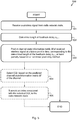
- Figure 4 illustrates an embodiment of the method.
- channel state information metric data may be collected and the window of collected data may be updated. This data may also be referred to as training data.
- conditional probability distribution function may be estimated/ re-estimated at a time interval which may be predetermined or configurable.
- the conditional probability distribution function may be estimated, based on the window of collected data. Then, the conditional means to be used for prediction may be computed.
- Figure 5 is a flow chart illustrating embodiments of a method 500 for use in a mobile station 120 for, predicting a channel state information metric M of a downlink channel of a radio network node 110 in a wireless communication network 100.
- the channel state information metric M may comprise any of: Mutual Information (MI), Effective Exponential Signal to interference and noise Mapping (EESM), Received Bit mutual Information Rate (RBIR), Signal to Noise Ratio (SNR), effective SNR, or a similar metric associated with the quality of the downlink channel such as for example: Reference Signal Received Power (RSRP), Reference Signal Received Quality (RSRQ), Channel State Information (CSI), Channel Quality Indicators (CQI), Signal to Noise and Interference Ratio (SINR), Signal to Interference Ratio (SIR), Signal to Noise plus Interference Ratio (SNIR), or any other appropriate measurement reflecting the strength and/ or quality of a signal, and/ or a ratio between a certain desired signal and undesired interference or noise.
- MI Mutual Information
- EESM Effective Exponential Signal to interference and noise Mapping
- RBIR Received Bit mutual Information Rate
- SNR Signal to Noise Ratio
- effective SNR effective SNR
- a similar metric associated with the quality of the downlink channel such
- the method 500 may comprise a number of actions 501-505.
- any, some or all of the described actions 501-505, may be performed in a somewhat different chronological order than the enumeration indicates, be performed simultaneously or even be performed in a completely reversed order according to different embodiments. Also, some actions such as e.g. actions 504 and/ or 505 may be performed only within some alternative embodiments. Further, it is to be noted that some actions may be performed in a plurality of alternative manners according to different embodiments, and that some such alternative manners may be performed only within some, but not necessarily all embodiments.
- the method 500 may comprise the following actions:
- a wireless signal is received from the radio network node 110 on the downlink channel.
- ⁇ CQI The length of a feedback delay, ⁇ CQI is determined.
- the length of a feedback delay, ⁇ CQI may be determined by calculating the time it takes from reception 501 of the wireless signal until a feedback concerning a measured quality or strength of the received 501 signal may be provided back to the radio network node 110.
- the channel state information metric M of the channel on which the wireless signal was received is predicted at a future point in time, corresponding to the determined length of the feedback delay ⁇ CQI , wherein said prediction is at least partially based on a non-linear predicting algorithm.
- the prediction of the channel state information metric M may in some embodiments be made based on the non-linear predicting algorithm that further comprises: collecting channel state information metric data of the downlink channel, to be used as training data, during a training data period; estimating conditional probability distribution function p within a period, based on the collected training data; and computing the predicted channel state information metric M based on the estimated conditional probability at the future point in time, corresponding to the determined length of the feedback delay ⁇ CQI .
- the conditional probability distribution function p may in some embodiments comprise: p ( M [ t + ⁇ CQI ]
- conditional probability distribution function p may comprise: p ( M [ t + ⁇ CQI ]
- conditional probability distribution function p comprises: p ( M [ t + ⁇ CQI ]
- L 0 may be an integer within an interval 3 ⁇ L 0 ⁇ 5.
- a quantization of the channel state metric values into bins may be comprised, by running a quantization function Q, such that the continuous conditional probability distribution function p becomes discrete.
- the prediction of the channel state information metric M may in some embodiments be further based on a linear prediction algorithm when the non-linear predicting algorithm is not performable due to insufficient amount of training data during the training data period.
- This action may be performed in some, but not necessarily all embodiments.
- a Channel Quality Indicator is selected, based on the predicted channel state information metric M of the downlink channel.
- This action may be performed in some, but not necessarily all embodiments.
- An index associated with the selected Channel Quality Indicator (CQI) is transmitted to the radio network node 110.
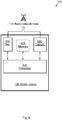
- Figure 6 illustrates an embodiment of a mobile station 120, configured for predicting a channel state information metric, M, of a downlink channel of a first network node 110 in a wireless communication network 100.
- the mobile station 120 is configured for performing the method 500 according to at least some of the previously described actions 501-505 for predicting the channel state information metric M of the downlink channel.
- the mobile station 120 comprises a receiver 610, configured for receiving a wireless signal on the downlink channel from the radio network node 110.
- the receiver 610 may be configured for receiving radio signals over a wireless interface.
- the signals may be received from, e.g., the network node 110, another network node, or any other entity configured for communication within the wireless communication system 100, according to some embodiments.
- the mobile station 120 also comprises a processor 620, configured for determining a length of a feedback delay, ⁇ CQI ; and configured for predicting the channel state information metric, M, of the channel on which the wireless signal was received, at a future point in time, corresponding to the determined length of the feedback delay ⁇ CQI , wherein said prediction is at least partially based on a non-linear predicting algorithm.
- a processor 620 configured for determining a length of a feedback delay, ⁇ CQI ; and configured for predicting the channel state information metric, M, of the channel on which the wireless signal was received, at a future point in time, corresponding to the determined length of the feedback delay ⁇ CQI , wherein said prediction is at least partially based on a non-linear predicting algorithm.
- the processor 620 may be further configured for predicting the channel state information metric M based on the non-linear predicting algorithm by collecting channel state information metric data of the downlink channel, to be used as training data, during a training data period. Further, the processor 620 may be configured for estimating a conditional probability distribution function p , within a period, based on the collected training data. In addition, the processor 620 may also be configured for computing the predicted channel state information metric M based on the estimated conditional probability distribution function p at the future point in time, corresponding to the determined length of the feedback delay ⁇ CQI .
- the conditional probability distribution function p may in some embodiments comprise: p ( M [ t + ⁇ CQI ]
- conditional probability distribution function p may comprise: p ( M [ t + ⁇ CQI ]
- conditional probability distribution function p comprises: p ( M [ t + ⁇ CQI ]
- L 0 may be an integer within an interval 3 ⁇ L 0 ⁇ 5.
- a quantization of the channel state metric values into bins may be comprised, by running a quantization function Q, such that the continuous conditional probability distribution function p becomes discrete.
- the prediction of the channel state information metric M may in some embodiments be further based on a linear prediction algorithm when the non-linear predicting algorithm is not performable due to insufficient amount of training data during the training data period.
- the processor 620 may optionally be further configured for selecting a Channel Quality Indicator, based on the predicted channel state information metric M of the channel; and wherein the mobile station 120 further comprises a transmitter 630, configured for transmitting an index associated with the selected Channel Quality Indicator, to the radio network node 110.
- the processor 620 may also be further configured for predicting the channel state information metric M based on a linear prediction algorithm when the non-linear predicting algorithm is not performable due to insufficient amount of training data during the training data period.
- Such processor 620 may comprise one or more instances of a processing circuit, i.e. a Central Processing Unit (CPU), a processing unit, a processing circuit, a processor, an Application Specific Integrated Circuit (ASIC), a microprocessor, or other processing logic that may interpret and execute instructions.
- a processing circuit i.e. a Central Processing Unit (CPU), a processing unit, a processing circuit, a processor, an Application Specific Integrated Circuit (ASIC), a microprocessor, or other processing logic that may interpret and execute instructions.
- CPU Central Processing Unit
- ASIC Application Specific Integrated Circuit
- microprocessor may thus represent a processing circuitry comprising a plurality of processing circuits, such as, e.g., any, some or all of the ones enumerated above.
- the mobile station 120 also may comprise a transmitter 630, configured for transmitting a wireless signal e.g. comprising signal measurements, and/ or a CQI measurement and/ or an index representing a CQI measurement. Such signal may be transmitted over a wireless interface according to different embodiments.
- the transmitter 630 may be configured for transmitting measurement data of the signal received from the network node 110, in some embodiments.
- the mobile station 130 may further comprise at least one memory 625, according to some embodiments.
- the optional memory 625 may comprise a physical device utilised to store data or programs, i.e., sequences of instructions, on a temporary or permanent basis.
- the memory 625 may comprise integrated circuits comprising silicon-based transistors. Further, the memory 625 may be volatile or non-volatile.
- the channel state information metric M may comprise any of: Mutual Information (MI), Effective Exponential Signal to interference and noise Mapping (EESM), Received Bit mutual Information Rate (RBIR), Signal to Noise Ratio (SNR), effective SNR, or a similar metric associated with the quality of the downlink channel such as for example: Reference Signal Received Power (RSRP), Reference Signal Received Quality (RSRQ), Channel State Information (CSI), Channel Quality Indicators (CQI), Signal to Noise and Interference Ratio (SINR), Signal to Interference Ratio (SIR), Signal to Noise plus Interference Ratio (SNIR), or any other appropriate measurement reflecting the strength and/ or quality of a signal, and/ or a ratio between a certain desired signal and undesired interference or noise.
- MI Mutual Information
- EESM Effective Exponential Signal to interference and noise Mapping
- RBIR Received Bit mutual Information Rate
- SNR Signal to Noise Ratio
- effective SNR effective SNR
- a similar metric associated with the quality of the downlink channel such
- the above described actions 501-505 to be performed in the mobile station 120 may be implemented through the one or more processors 620 in the mobile station 120, together with computer program product for performing at least some of the functions of the actions 501-505.
- a computer program product comprising instructions for performing the actions 501-505 in the mobile station 120 may perform a method 500 comprising at least some of the method actions 501-505, for predicting a channel state information metric M of a downlink channel of a radio network node 110 in a wireless communication network 100, when the computer program is loaded into a processor 620 of the mobile station 120.
- a computer program product comprising a computer readable storage medium storing program code thereon for use by a mobile station 120 in order to predict a channel state information metric M of a downlink channel of a radio network node 110 in a wireless communication network 100.
- the program code may comprise instructions for executing a method 500 comprising: receiving 501 a wireless signal from a radio network node 110 on the downlink channel; determining 502 length of a feedback delay ⁇ CQI ; and predicting 503 the channel state information metric M of the channel on which the wireless signal was received, at a future point in time, corresponding to the determined length of the feedback delay ⁇ CQI , wherein said prediction is at least partially based on a non-linear predicting algorithm.
- the computer program product mentioned above may be provided for instance in the form of a data carrier carrying computer program code for performing at least some of the actions 501-505 according to some embodiments when being loaded into the processor 620 of the mobile station 120.
- the data carrier may be, e.g., a hard disk, a CD ROM disc, a memory stick, an optical storage device, a magnetic storage device or any other appropriate medium such as a disk or tape that may hold machine readable data in a non transitory manner.
- the computer program product may furthermore be provided as computer program code on a server and downloaded to the mobile station 120 remotely, e.g., over an Internet or an intranet connection.
- the term “and/ or” comprises any and all combinations of one or more of the associated listed items.
- the singular forms “a”, “an” and “the” are to be interpreted as “at least one”, thus also possibly comprising a plurality of entities of the same kind, unless expressly stated otherwise.
- the terms “includes”, “comprises”, “including” and/ or “comprising”, specifies the presence of stated features, actions, integers, steps, operations, elements, and/ or components, but do not preclude the presence or addition of one or more other features, actions, integers, steps, operations, elements, components, and/ or groups thereof.
- a single unit such as e.g. a processor may fulfil the functions of several items.
- a computer program may be stored/ distributed on a suitable medium, such as an optical storage medium or a solid-state medium supplied together with or as part of other hardware, but may also be distributed in other forms such as via Internet or other wired or wireless communication system.
Landscapes
- Engineering & Computer Science (AREA)
- Computer Networks & Wireless Communication (AREA)
- Signal Processing (AREA)
- Physics & Mathematics (AREA)
- Quality & Reliability (AREA)
- Electromagnetism (AREA)
- Mathematical Physics (AREA)
- Mobile Radio Communication Systems (AREA)
Claims (13)
- Mobilstation (120), die zum Vorhersagen einer Kanalzustandsinformationsmetrik M eines Downlink-Kanals in einem Funkkommunikationsnetz (100) konfiguriert ist, wobei die Mobilstation (120) Folgendes umfasst:einen Empfänger (610), der zum Empfangen eines Funksignals von einem Funknetzknoten (110) auf dem Downlink-Kanal konfiguriert ist; undeinen Prozessor (620), der zum Bestimmen einer Länge einer Rückmeldungsverzögerung δCQI konfiguriert ist und zum Vorhersagen der Kanalzustandsinformationsmetrik M des Kanals, auf welchem das Funksignal empfangen wurde, zu einem zukünftigen Zeitpunkt, welcher der bestimmten Länge der Rückmeldungsverzögerung δCQI entspricht, konfiguriert ist,wobeidas Vorhersagen auf einem nichtlinearen Vorhersagealgorithmus basiert, wobei der Prozessor (620) zum Vorhersagen der Kanalzustandsinformationsmetrik basierend auf dem nichtlinearen Vorhersagealgorithmus durch Folgendes konfiguriert ist:Sammeln von Daten der Kanalzustandsinformationsmetrik des Downlink-Kanals, die während eines Trainingsdatenzeitraums als Trainingsdaten verwendet werden sollen;Schätzen einer bedingten Wahrscheinlichkeitsverteilungsfunktion p innerhalb eines Zeitraums basierend auf den gesammelten Trainingsdaten; undBerechnen der vorhergesagten Kanalzustandsinformationsmetrik M basierend auf der geschätzten bedingten Wahrscheinlichkeitsverteilungsfunktion p zu dem zukünftigen Zeitpunkt, welcher der bestimmten Länge der Rückmeldungsverzögerung δCQI entspricht.
- Mobilstation (120) nach Anspruch 1, wobei die bedingte Wahrscheinlichkeitsverteilungsfunktion p durch Folgendes geschätzt wird:

M die mittlere Kanalzustandsinformationsmetrik ist, δCQI die bestimmte Rückmeldungsverzögerung ist und L eine ganze Zahl innerhalb eines Intervalls von mehreren oder dutzenden Millisekunden ist. - Mobilstation (120) nach Anspruch 1, wobei die bedingte Wahrscheinlichkeitsverteilungsfunktion p durch Folgendes geschätzt wird:

M die mittlere Kanalzustandsinformationsmetrik ist, δCQI die bestimmte Rückmeldungsverzögerung ist und L0 eine ganze Zahl innerhalb eines Intervalls 0≤L0 ≤10 ist. - Mobilstation (120) nach Anspruch 1, wobei die bedingte Wahrscheinlichkeitsverteilungsfunktion p durch Folgendes geschätzt wird:

M die mittlere Kanalzustandsinformationsmetrik ist, δCQI die bestimmte Rückmeldungsverzögerung ist und L0 eine ganze Zahl innerhalb eines Intervalls 0≤L0 ≤10 ist. - Mobilstation (120) nach einem der Ansprüche 2-4, wobei L0 eine ganze Zahl innerhalb eines Intervalls 3≤L0 ≤5 ist.
- Mobilstation (120) nach einem der Ansprüche 1-5, wobei der Prozessor (620) ferner zum Durchführen einer Quantisierung von Kanalzustandsmetrikwerten in "Bins" durch das Anwenden einer Quantisierungsfunktion Q konfiguriert ist, derart, dass die kontinuierliche bedingte Wahrscheinlichkeitsverteilungsfunktion p diskret wird.
- Mobilstation (120) nach Anspruch 6, wobei das bedingte Mittel durch Folgendes berechnet wird:

- Mobilstation (120) nach einem der Ansprüche 1-7, wobei die Kanalzustandsinformationsmetrik M jegliche der Folgenden umfasst: MI (Mutual Information - gegenseitige Information), EESM (Effective Exponential Signal to interference and noise Mapping - effektive exponentielle SIR-Abbildung), RBIR (Received Bit mutual Information Rate - gegenseitige empfangene Bit-Informationsrate), SNR (Signal to Noise Ratio - Signal-Rausch-Verhältnis), effektives SNR oder eine ähnliche Metrik in Bezug auf die Qualität des Downlink-Kanals.
- Mobilstation (120) nach einem der Ansprüche 1-8, wobei der Prozessor (620) ferner zum Auswählen eines Kanalqualitätsindikators basierend auf der vorhergesagten Kanalzustandsinformationsmetrik M des Kanals konfiguriert ist, und wobei die Mobilstation (120) ferner einen Sender (630), der zum Senden eines Index im Zusammenhang mit dem ausgewählten Kanalqualitätsindikator an den Funknetzknoten (110) konfiguriert ist, umfasst.
- Mobilstation (120) nach einem der Ansprüche 1-9, wobei der Prozessor (620) ferner zum Vorhersagen der Kanalzustandsinformationsmetrik M basierend auf einem linearen Vorhersagealgorithmus konfiguriert ist, wenn der nichtlineare Vorhersagealgorithmus aufgrund einer unzureichenden Menge an Trainingsdaten während des Trainingsdatenzeitraums nicht durchführbar ist.
- Verfahren (500) in einer Mobilstation (120) zum Vorhersagen einer Kanalzustandsinformationsmetrik M eines Downlink-Kanals in einem Funkkommunikationsnetz (100), wobei das Verfahren (500) Folgendes umfasst:Empfangen (501) eines Funksignals von einem Funknetzknoten (110) auf dem Downlink-Kanal;Bestimmen (502) einer Länge einer Rückmeldungsverzögerung δCQI; undVorhersagen (503) der Kanalzustandsinformationsmetrik M des Kanals, auf welchem das Funksignal empfangen wurde, zu einem zukünftigen Zeitpunkt, welcher der bestimmten Länge der Rückmeldungsverzögerung δCQI entspricht,wobeidie Vorhersage auf einem nichtlinearen Vorhersagealgorithmus basiert, wobei die Vorhersage (503) der Kanalzustandsinformationsmetrik M basierend auf dem nichtlinearen Vorhersagealgorithmus ferner Folgendes umfasst:Sammeln von Daten der Kanalzustandsinformationsmetrik des Downlink-Kanals, die während eines Trainingsdatenzeitraums als Trainingsdaten verwendet werden sollen;Schätzen einer bedingten Wahrscheinlichkeitsverteilungsfunktion p innerhalb eines Zeitraums basierend auf den gesammelten Trainingsdaten; undBerechnen der vorhergesagten Kanalzustandsinformationsmetrik M basierend auf der geschätzten bedingten Wahrscheinlichkeit zu dem zukünftigen Zeitpunkt, welcher der bestimmten (502) Länge der Rückmeldungsverzögerung δCQI entspricht.
- Verfahren (500) nach Anspruch 11, wobei die bedingte Wahrscheinlichkeitsverteilungsfunktion p Folgendes umfasst:

M die mittlere Kanalzustandsinformationsmetrik ist, δCQI die bestimmte Rückmeldungsverzögerung ist und L eine ganze Zahl innerhalb eines Intervalls von mehreren oder dutzenden Millisekunden ist. - Verfahren (500) nach Anspruch 11, wobei die bedingte Wahrscheinlichkeitsverteilungsfunktion p Folgendes umfasst:

M die mittlere Kanalzustandsinformationsmetrik ist, δCQI die bestimmte Rückmeldungsverzögerung ist und L0 eine ganze Zahl innerhalb eines Intervalls 0≤L0 ≤10 ist.
Applications Claiming Priority (1)
| Application Number | Priority Date | Filing Date | Title |
|---|---|---|---|
| PCT/EP2014/057097 WO2015154800A1 (en) | 2014-04-08 | 2014-04-08 | Methods and network nodes in a wireless communication network |
Publications (2)
| Publication Number | Publication Date |
|---|---|
| EP2959609A1 EP2959609A1 (de) | 2015-12-30 |
| EP2959609B1 true EP2959609B1 (de) | 2018-06-06 |
Family
ID=50473305
Family Applications (1)
| Application Number | Title | Priority Date | Filing Date |
|---|---|---|---|
| EP14716306.7A Active EP2959609B1 (de) | 2014-04-08 | 2014-04-08 | Verfahren und netzwerkknoten in einem funkkommunikationsnetz |
Country Status (3)
| Country | Link |
|---|---|
| EP (1) | EP2959609B1 (de) |
| CN (1) | CN105409134A (de) |
| WO (1) | WO2015154800A1 (de) |
Cited By (2)
| Publication number | Priority date | Publication date | Assignee | Title |
|---|---|---|---|---|
| US10763941B2 (en) | 2016-04-29 | 2020-09-01 | Huawei Technologies Co., Ltd. | Method and apparatus for line-of-sight antenna array |
| US10951354B2 (en) | 2017-03-07 | 2021-03-16 | Huawei Technologies Co., Ltd. | Method and apparatus for adjusting channel quality information (CQI) considering handover |
Families Citing this family (5)
| Publication number | Priority date | Publication date | Assignee | Title |
|---|---|---|---|---|
| CN106713188B (zh) * | 2015-11-13 | 2020-05-29 | 中兴通讯股份有限公司 | 信道响应的获取方法和装置 |
| CN106209316B (zh) * | 2016-07-12 | 2019-01-29 | 东南大学 | 一种基于cdma的m2m通信中的多用户检测方法 |
| CN107659375B (zh) * | 2016-07-25 | 2020-03-24 | 电信科学技术研究院 | 反馈方法及装置 |
| TWI608710B (zh) * | 2016-12-06 | 2017-12-11 | 財團法人工業技術研究院 | 通道預編碼的方法及應用其的基地台與伺服器 |
| WO2023075456A1 (en) * | 2021-10-27 | 2023-05-04 | Samsung Electronics Co., Ltd. | Method and apparatus for performing csi prediction |
Family Cites Families (4)
| Publication number | Priority date | Publication date | Assignee | Title |
|---|---|---|---|---|
| JP5103357B2 (ja) * | 2008-11-04 | 2012-12-19 | 株式会社エヌ・ティ・ティ・ドコモ | 移動端末装置及び無線基地局装置 |
| CN102742202B (zh) * | 2010-02-05 | 2015-12-02 | 瑞典爱立信有限公司 | 无线通信系统中的方法和装置 |
| WO2012040935A1 (en) * | 2010-09-30 | 2012-04-05 | France Telecom Research & Development Beijing Company Limited | Channel quality information prediction method, device and system |
| EP2501068B1 (de) * | 2011-03-14 | 2016-02-10 | Alcatel Lucent | Bereitstellung von Kanalstatusinformationen über einen Radiokanal |
-
2014
- 2014-04-08 CN CN201480014484.3A patent/CN105409134A/zh active Pending
- 2014-04-08 EP EP14716306.7A patent/EP2959609B1/de active Active
- 2014-04-08 WO PCT/EP2014/057097 patent/WO2015154800A1/en not_active Ceased
Non-Patent Citations (1)
| Title |
|---|
| None * |
Cited By (2)
| Publication number | Priority date | Publication date | Assignee | Title |
|---|---|---|---|---|
| US10763941B2 (en) | 2016-04-29 | 2020-09-01 | Huawei Technologies Co., Ltd. | Method and apparatus for line-of-sight antenna array |
| US10951354B2 (en) | 2017-03-07 | 2021-03-16 | Huawei Technologies Co., Ltd. | Method and apparatus for adjusting channel quality information (CQI) considering handover |
Also Published As
| Publication number | Publication date |
|---|---|
| CN105409134A (zh) | 2016-03-16 |
| WO2015154800A1 (en) | 2015-10-15 |
| EP2959609A1 (de) | 2015-12-30 |
Similar Documents
| Publication | Publication Date | Title |
|---|---|---|
| JP6453468B2 (ja) | Csi予測のための方法および構成 | |
| CA2759845C (en) | Channel state information reconstruction from sparse feedback data | |
| US9693350B2 (en) | Method and network node for determining channel state information in an upcoming time slot | |
| WO2015154800A1 (en) | Methods and network nodes in a wireless communication network | |
| JP4917648B2 (ja) | チャネル品質指標(cqi)値の予測方法 | |
| US9998937B2 (en) | Method and device for estimating communication load, radio station and upper-level apparatus in radio communication system | |
| US10177865B2 (en) | Radio network node and method performed therein | |
| EP2398269B1 (de) | Verfahren und vorrichtung zur messung eines signal/interferenz- bzw. signal/geräusch-verhältnisses (sinr) | |
| US20150312796A1 (en) | Wireless communication terminal and method for estimating network communication load in communication network | |
| US9480032B2 (en) | Tracking received power in wireless communications | |
| EP1962434B1 (de) | Empfangsvorrichtung, Pfaderkennungsvorrichtung, Verfahren dafür und Programm, das in einer Basisstation benutzt wird | |
| US20190140726A1 (en) | Radio network node, wireless device and methods performed therein | |
| US9844011B2 (en) | Method and network node for handling AGC and TPC scaling | |
| EP3850477B1 (de) | Eingangsdatenwert und strahlindexfilterung in lte und 5g-basisstationen | |
| JP6293277B2 (ja) | 受信機において干渉除去がサポートされるときにcqiを報告する、ユーザ機器および方法 | |
| EP2321919B1 (de) | Frequenzselektive sinr-regeneration | |
| JPWO2012093675A1 (ja) | 移動体通信装置およびチャネル品質指標推定方法 | |
| Feki et al. | Measurement model optimization for channel prediction improvement in wireless networks |
Legal Events
| Date | Code | Title | Description |
|---|---|---|---|
| PUAI | Public reference made under article 153(3) epc to a published international application that has entered the european phase |
Free format text: ORIGINAL CODE: 0009012 |
|
| 17P | Request for examination filed |
Effective date: 20150924 |
|
| AK | Designated contracting states |
Kind code of ref document: A1 Designated state(s): AL AT BE BG CH CY CZ DE DK EE ES FI FR GB GR HR HU IE IS IT LI LT LU LV MC MK MT NL NO PL PT RO RS SE SI SK SM TR |
|
| AX | Request for extension of the european patent |
Extension state: BA ME |
|
| DAX | Request for extension of the european patent (deleted) | ||
| GRAP | Despatch of communication of intention to grant a patent |
Free format text: ORIGINAL CODE: EPIDOSNIGR1 |
|
| STAA | Information on the status of an ep patent application or granted ep patent |
Free format text: STATUS: GRANT OF PATENT IS INTENDED |
|
| RIC1 | Information provided on ipc code assigned before grant |
Ipc: H04B 17/373 20150101ALI20171030BHEP Ipc: H04B 7/06 20060101AFI20171030BHEP |
|
| INTG | Intention to grant announced |
Effective date: 20171123 |
|
| GRAS | Grant fee paid |
Free format text: ORIGINAL CODE: EPIDOSNIGR3 |
|
| GRAA | (expected) grant |
Free format text: ORIGINAL CODE: 0009210 |
|
| STAA | Information on the status of an ep patent application or granted ep patent |
Free format text: STATUS: THE PATENT HAS BEEN GRANTED |
|
| AK | Designated contracting states |
Kind code of ref document: B1 Designated state(s): AL AT BE BG CH CY CZ DE DK EE ES FI FR GB GR HR HU IE IS IT LI LT LU LV MC MK MT NL NO PL PT RO RS SE SI SK SM TR |
|
| REG | Reference to a national code |
Ref country code: GB Ref legal event code: FG4D |
|
| REG | Reference to a national code |
Ref country code: CH Ref legal event code: EP Ref country code: AT Ref legal event code: REF Ref document number: 1007179 Country of ref document: AT Kind code of ref document: T Effective date: 20180615 |
|
| REG | Reference to a national code |
Ref country code: IE Ref legal event code: FG4D |
|
| REG | Reference to a national code |
Ref country code: DE Ref legal event code: R096 Ref document number: 602014026625 Country of ref document: DE |
|
| REG | Reference to a national code |
Ref country code: NL Ref legal event code: MP Effective date: 20180606 |
|
| REG | Reference to a national code |
Ref country code: LT Ref legal event code: MG4D |
|
| PG25 | Lapsed in a contracting state [announced via postgrant information from national office to epo] |
Ref country code: CY Free format text: LAPSE BECAUSE OF FAILURE TO SUBMIT A TRANSLATION OF THE DESCRIPTION OR TO PAY THE FEE WITHIN THE PRESCRIBED TIME-LIMIT Effective date: 20180606 Ref country code: ES Free format text: LAPSE BECAUSE OF FAILURE TO SUBMIT A TRANSLATION OF THE DESCRIPTION OR TO PAY THE FEE WITHIN THE PRESCRIBED TIME-LIMIT Effective date: 20180606 Ref country code: LT Free format text: LAPSE BECAUSE OF FAILURE TO SUBMIT A TRANSLATION OF THE DESCRIPTION OR TO PAY THE FEE WITHIN THE PRESCRIBED TIME-LIMIT Effective date: 20180606 Ref country code: FI Free format text: LAPSE BECAUSE OF FAILURE TO SUBMIT A TRANSLATION OF THE DESCRIPTION OR TO PAY THE FEE WITHIN THE PRESCRIBED TIME-LIMIT Effective date: 20180606 Ref country code: NO Free format text: LAPSE BECAUSE OF FAILURE TO SUBMIT A TRANSLATION OF THE DESCRIPTION OR TO PAY THE FEE WITHIN THE PRESCRIBED TIME-LIMIT Effective date: 20180906 Ref country code: BG Free format text: LAPSE BECAUSE OF FAILURE TO SUBMIT A TRANSLATION OF THE DESCRIPTION OR TO PAY THE FEE WITHIN THE PRESCRIBED TIME-LIMIT Effective date: 20180906 Ref country code: SE Free format text: LAPSE BECAUSE OF FAILURE TO SUBMIT A TRANSLATION OF THE DESCRIPTION OR TO PAY THE FEE WITHIN THE PRESCRIBED TIME-LIMIT Effective date: 20180606 |
|
| PG25 | Lapsed in a contracting state [announced via postgrant information from national office to epo] |
Ref country code: LV Free format text: LAPSE BECAUSE OF FAILURE TO SUBMIT A TRANSLATION OF THE DESCRIPTION OR TO PAY THE FEE WITHIN THE PRESCRIBED TIME-LIMIT Effective date: 20180606 Ref country code: RS Free format text: LAPSE BECAUSE OF FAILURE TO SUBMIT A TRANSLATION OF THE DESCRIPTION OR TO PAY THE FEE WITHIN THE PRESCRIBED TIME-LIMIT Effective date: 20180606 Ref country code: HR Free format text: LAPSE BECAUSE OF FAILURE TO SUBMIT A TRANSLATION OF THE DESCRIPTION OR TO PAY THE FEE WITHIN THE PRESCRIBED TIME-LIMIT Effective date: 20180606 Ref country code: GR Free format text: LAPSE BECAUSE OF FAILURE TO SUBMIT A TRANSLATION OF THE DESCRIPTION OR TO PAY THE FEE WITHIN THE PRESCRIBED TIME-LIMIT Effective date: 20180907 |
|
| REG | Reference to a national code |
Ref country code: AT Ref legal event code: MK05 Ref document number: 1007179 Country of ref document: AT Kind code of ref document: T Effective date: 20180606 |
|
| PG25 | Lapsed in a contracting state [announced via postgrant information from national office to epo] |
Ref country code: NL Free format text: LAPSE BECAUSE OF FAILURE TO SUBMIT A TRANSLATION OF THE DESCRIPTION OR TO PAY THE FEE WITHIN THE PRESCRIBED TIME-LIMIT Effective date: 20180606 |
|
| PG25 | Lapsed in a contracting state [announced via postgrant information from national office to epo] |
Ref country code: PL Free format text: LAPSE BECAUSE OF FAILURE TO SUBMIT A TRANSLATION OF THE DESCRIPTION OR TO PAY THE FEE WITHIN THE PRESCRIBED TIME-LIMIT Effective date: 20180606 Ref country code: SK Free format text: LAPSE BECAUSE OF FAILURE TO SUBMIT A TRANSLATION OF THE DESCRIPTION OR TO PAY THE FEE WITHIN THE PRESCRIBED TIME-LIMIT Effective date: 20180606 Ref country code: RO Free format text: LAPSE BECAUSE OF FAILURE TO SUBMIT A TRANSLATION OF THE DESCRIPTION OR TO PAY THE FEE WITHIN THE PRESCRIBED TIME-LIMIT Effective date: 20180606 Ref country code: EE Free format text: LAPSE BECAUSE OF FAILURE TO SUBMIT A TRANSLATION OF THE DESCRIPTION OR TO PAY THE FEE WITHIN THE PRESCRIBED TIME-LIMIT Effective date: 20180606 Ref country code: CZ Free format text: LAPSE BECAUSE OF FAILURE TO SUBMIT A TRANSLATION OF THE DESCRIPTION OR TO PAY THE FEE WITHIN THE PRESCRIBED TIME-LIMIT Effective date: 20180606 Ref country code: IS Free format text: LAPSE BECAUSE OF FAILURE TO SUBMIT A TRANSLATION OF THE DESCRIPTION OR TO PAY THE FEE WITHIN THE PRESCRIBED TIME-LIMIT Effective date: 20181006 Ref country code: AT Free format text: LAPSE BECAUSE OF FAILURE TO SUBMIT A TRANSLATION OF THE DESCRIPTION OR TO PAY THE FEE WITHIN THE PRESCRIBED TIME-LIMIT Effective date: 20180606 |
|
| PG25 | Lapsed in a contracting state [announced via postgrant information from national office to epo] |
Ref country code: SM Free format text: LAPSE BECAUSE OF FAILURE TO SUBMIT A TRANSLATION OF THE DESCRIPTION OR TO PAY THE FEE WITHIN THE PRESCRIBED TIME-LIMIT Effective date: 20180606 Ref country code: IT Free format text: LAPSE BECAUSE OF FAILURE TO SUBMIT A TRANSLATION OF THE DESCRIPTION OR TO PAY THE FEE WITHIN THE PRESCRIBED TIME-LIMIT Effective date: 20180606 |
|
| REG | Reference to a national code |
Ref country code: DE Ref legal event code: R097 Ref document number: 602014026625 Country of ref document: DE |
|
| PLBE | No opposition filed within time limit |
Free format text: ORIGINAL CODE: 0009261 |
|
| STAA | Information on the status of an ep patent application or granted ep patent |
Free format text: STATUS: NO OPPOSITION FILED WITHIN TIME LIMIT |
|
| 26N | No opposition filed |
Effective date: 20190307 |
|
| PG25 | Lapsed in a contracting state [announced via postgrant information from national office to epo] |
Ref country code: SI Free format text: LAPSE BECAUSE OF FAILURE TO SUBMIT A TRANSLATION OF THE DESCRIPTION OR TO PAY THE FEE WITHIN THE PRESCRIBED TIME-LIMIT Effective date: 20180606 Ref country code: DK Free format text: LAPSE BECAUSE OF FAILURE TO SUBMIT A TRANSLATION OF THE DESCRIPTION OR TO PAY THE FEE WITHIN THE PRESCRIBED TIME-LIMIT Effective date: 20180606 |
|
| REG | Reference to a national code |
Ref country code: DE Ref legal event code: R119 Ref document number: 602014026625 Country of ref document: DE |
|
| PG25 | Lapsed in a contracting state [announced via postgrant information from national office to epo] |
Ref country code: AL Free format text: LAPSE BECAUSE OF FAILURE TO SUBMIT A TRANSLATION OF THE DESCRIPTION OR TO PAY THE FEE WITHIN THE PRESCRIBED TIME-LIMIT Effective date: 20180606 |
|
| REG | Reference to a national code |
Ref country code: CH Ref legal event code: PL |
|
| REG | Reference to a national code |
Ref country code: BE Ref legal event code: MM Effective date: 20190430 |
|
| PG25 | Lapsed in a contracting state [announced via postgrant information from national office to epo] |
Ref country code: MC Free format text: LAPSE BECAUSE OF FAILURE TO SUBMIT A TRANSLATION OF THE DESCRIPTION OR TO PAY THE FEE WITHIN THE PRESCRIBED TIME-LIMIT Effective date: 20180606 Ref country code: LU Free format text: LAPSE BECAUSE OF NON-PAYMENT OF DUE FEES Effective date: 20190408 |
|
| PG25 | Lapsed in a contracting state [announced via postgrant information from national office to epo] |
Ref country code: DE Free format text: LAPSE BECAUSE OF NON-PAYMENT OF DUE FEES Effective date: 20191101 Ref country code: LI Free format text: LAPSE BECAUSE OF NON-PAYMENT OF DUE FEES Effective date: 20190430 Ref country code: CH Free format text: LAPSE BECAUSE OF NON-PAYMENT OF DUE FEES Effective date: 20190430 |
|
| PG25 | Lapsed in a contracting state [announced via postgrant information from national office to epo] |
Ref country code: FR Free format text: LAPSE BECAUSE OF NON-PAYMENT OF DUE FEES Effective date: 20190430 Ref country code: BE Free format text: LAPSE BECAUSE OF NON-PAYMENT OF DUE FEES Effective date: 20190430 |
|
| PG25 | Lapsed in a contracting state [announced via postgrant information from national office to epo] |
Ref country code: TR Free format text: LAPSE BECAUSE OF FAILURE TO SUBMIT A TRANSLATION OF THE DESCRIPTION OR TO PAY THE FEE WITHIN THE PRESCRIBED TIME-LIMIT Effective date: 20180606 |
|
| PG25 | Lapsed in a contracting state [announced via postgrant information from national office to epo] |
Ref country code: IE Free format text: LAPSE BECAUSE OF NON-PAYMENT OF DUE FEES Effective date: 20190408 |
|
| PG25 | Lapsed in a contracting state [announced via postgrant information from national office to epo] |
Ref country code: PT Free format text: LAPSE BECAUSE OF FAILURE TO SUBMIT A TRANSLATION OF THE DESCRIPTION OR TO PAY THE FEE WITHIN THE PRESCRIBED TIME-LIMIT Effective date: 20181008 |
|
| PG25 | Lapsed in a contracting state [announced via postgrant information from national office to epo] |
Ref country code: MT Free format text: LAPSE BECAUSE OF FAILURE TO SUBMIT A TRANSLATION OF THE DESCRIPTION OR TO PAY THE FEE WITHIN THE PRESCRIBED TIME-LIMIT Effective date: 20180606 Ref country code: HU Free format text: LAPSE BECAUSE OF FAILURE TO SUBMIT A TRANSLATION OF THE DESCRIPTION OR TO PAY THE FEE WITHIN THE PRESCRIBED TIME-LIMIT; INVALID AB INITIO Effective date: 20140408 |
|
| REG | Reference to a national code |
Ref country code: GB Ref legal event code: 732E Free format text: REGISTERED BETWEEN 20210812 AND 20210818 |
|
| PG25 | Lapsed in a contracting state [announced via postgrant information from national office to epo] |
Ref country code: MK Free format text: LAPSE BECAUSE OF FAILURE TO SUBMIT A TRANSLATION OF THE DESCRIPTION OR TO PAY THE FEE WITHIN THE PRESCRIBED TIME-LIMIT Effective date: 20180606 |
|
| PGFP | Annual fee paid to national office [announced via postgrant information from national office to epo] |
Ref country code: GB Payment date: 20250306 Year of fee payment: 12 |