EP2959631B1 - Überprüfungssystem und -verfahren mit zusätzlicher sicherheit für eingabeaufzeichnungen mit geringerer entropie - Google Patents
Überprüfungssystem und -verfahren mit zusätzlicher sicherheit für eingabeaufzeichnungen mit geringerer entropie Download PDFInfo
- Publication number
- EP2959631B1 EP2959631B1 EP14709183.9A EP14709183A EP2959631B1 EP 2959631 B1 EP2959631 B1 EP 2959631B1 EP 14709183 A EP14709183 A EP 14709183A EP 2959631 B1 EP2959631 B1 EP 2959631B1
- Authority
- EP
- European Patent Office
- Prior art keywords
- hash
- value
- digital
- record
- input
- Prior art date
- Legal status (The legal status is an assumption and is not a legal conclusion. Google has not performed a legal analysis and makes no representation as to the accuracy of the status listed.)
- Active
Links
Images



Classifications
-
- H—ELECTRICITY
- H04—ELECTRIC COMMUNICATION TECHNIQUE
- H04L—TRANSMISSION OF DIGITAL INFORMATION, e.g. TELEGRAPHIC COMMUNICATION
- H04L9/00—Cryptographic mechanisms or cryptographic arrangements for secret or secure communications; Network security protocols
- H04L9/32—Cryptographic mechanisms or cryptographic arrangements for secret or secure communications; Network security protocols including means for verifying the identity or authority of a user of the system or for message authentication, e.g. authorization, entity authentication, data integrity or data verification, non-repudiation, key authentication or verification of credentials
- H04L9/3247—Cryptographic mechanisms or cryptographic arrangements for secret or secure communications; Network security protocols including means for verifying the identity or authority of a user of the system or for message authentication, e.g. authorization, entity authentication, data integrity or data verification, non-repudiation, key authentication or verification of credentials involving digital signatures
- H04L9/3257—Cryptographic mechanisms or cryptographic arrangements for secret or secure communications; Network security protocols including means for verifying the identity or authority of a user of the system or for message authentication, e.g. authorization, entity authentication, data integrity or data verification, non-repudiation, key authentication or verification of credentials involving digital signatures using blind signatures
-
- G—PHYSICS
- G06—COMPUTING OR CALCULATING; COUNTING
- G06F—ELECTRIC DIGITAL DATA PROCESSING
- G06F21/00—Security arrangements for protecting computers, components thereof, programs or data against unauthorised activity
- G06F21/60—Protecting data
- G06F21/62—Protecting access to data via a platform, e.g. using keys or access control rules
- G06F21/6218—Protecting access to data via a platform, e.g. using keys or access control rules to a system of files or objects, e.g. local or distributed file system or database
- G06F21/6227—Protecting access to data via a platform, e.g. using keys or access control rules to a system of files or objects, e.g. local or distributed file system or database where protection concerns the structure of data, e.g. records, types, queries
-
- G—PHYSICS
- G06—COMPUTING OR CALCULATING; COUNTING
- G06F—ELECTRIC DIGITAL DATA PROCESSING
- G06F21/00—Security arrangements for protecting computers, components thereof, programs or data against unauthorised activity
- G06F21/60—Protecting data
- G06F21/64—Protecting data integrity, e.g. using checksums, certificates or signatures
-
- H—ELECTRICITY
- H04—ELECTRIC COMMUNICATION TECHNIQUE
- H04L—TRANSMISSION OF DIGITAL INFORMATION, e.g. TELEGRAPHIC COMMUNICATION
- H04L9/00—Cryptographic mechanisms or cryptographic arrangements for secret or secure communications; Network security protocols
- H04L9/32—Cryptographic mechanisms or cryptographic arrangements for secret or secure communications; Network security protocols including means for verifying the identity or authority of a user of the system or for message authentication, e.g. authorization, entity authentication, data integrity or data verification, non-repudiation, key authentication or verification of credentials
- H04L9/3236—Cryptographic mechanisms or cryptographic arrangements for secret or secure communications; Network security protocols including means for verifying the identity or authority of a user of the system or for message authentication, e.g. authorization, entity authentication, data integrity or data verification, non-repudiation, key authentication or verification of credentials using cryptographic hash functions
-
- H—ELECTRICITY
- H04—ELECTRIC COMMUNICATION TECHNIQUE
- H04L—TRANSMISSION OF DIGITAL INFORMATION, e.g. TELEGRAPHIC COMMUNICATION
- H04L9/00—Cryptographic mechanisms or cryptographic arrangements for secret or secure communications; Network security protocols
- H04L9/32—Cryptographic mechanisms or cryptographic arrangements for secret or secure communications; Network security protocols including means for verifying the identity or authority of a user of the system or for message authentication, e.g. authorization, entity authentication, data integrity or data verification, non-repudiation, key authentication or verification of credentials
- H04L9/3236—Cryptographic mechanisms or cryptographic arrangements for secret or secure communications; Network security protocols including means for verifying the identity or authority of a user of the system or for message authentication, e.g. authorization, entity authentication, data integrity or data verification, non-repudiation, key authentication or verification of credentials using cryptographic hash functions
- H04L9/3242—Cryptographic mechanisms or cryptographic arrangements for secret or secure communications; Network security protocols including means for verifying the identity or authority of a user of the system or for message authentication, e.g. authorization, entity authentication, data integrity or data verification, non-repudiation, key authentication or verification of credentials using cryptographic hash functions involving keyed hash functions, e.g. message authentication codes [MACs], CBC-MAC or HMAC
-
- H—ELECTRICITY
- H04—ELECTRIC COMMUNICATION TECHNIQUE
- H04L—TRANSMISSION OF DIGITAL INFORMATION, e.g. TELEGRAPHIC COMMUNICATION
- H04L9/00—Cryptographic mechanisms or cryptographic arrangements for secret or secure communications; Network security protocols
- H04L9/32—Cryptographic mechanisms or cryptographic arrangements for secret or secure communications; Network security protocols including means for verifying the identity or authority of a user of the system or for message authentication, e.g. authorization, entity authentication, data integrity or data verification, non-repudiation, key authentication or verification of credentials
- H04L9/3263—Cryptographic mechanisms or cryptographic arrangements for secret or secure communications; Network security protocols including means for verifying the identity or authority of a user of the system or for message authentication, e.g. authorization, entity authentication, data integrity or data verification, non-repudiation, key authentication or verification of credentials involving certificates, e.g. public key certificate [PKC] or attribute certificate [AC]; Public key infrastructure [PKI] arrangements
- H04L9/3265—Cryptographic mechanisms or cryptographic arrangements for secret or secure communications; Network security protocols including means for verifying the identity or authority of a user of the system or for message authentication, e.g. authorization, entity authentication, data integrity or data verification, non-repudiation, key authentication or verification of credentials involving certificates, e.g. public key certificate [PKC] or attribute certificate [AC]; Public key infrastructure [PKI] arrangements using certificate chains, trees or paths; Hierarchical trust model
-
- H—ELECTRICITY
- H04—ELECTRIC COMMUNICATION TECHNIQUE
- H04L—TRANSMISSION OF DIGITAL INFORMATION, e.g. TELEGRAPHIC COMMUNICATION
- H04L9/00—Cryptographic mechanisms or cryptographic arrangements for secret or secure communications; Network security protocols
- H04L9/50—Cryptographic mechanisms or cryptographic arrangements for secret or secure communications; Network security protocols using hash chains, e.g. blockchains or hash trees
-
- G—PHYSICS
- G06—COMPUTING OR CALCULATING; COUNTING
- G06F—ELECTRIC DIGITAL DATA PROCESSING
- G06F2221/00—Indexing scheme relating to security arrangements for protecting computers, components thereof, programs or data against unauthorised activity
- G06F2221/21—Indexing scheme relating to G06F21/00 and subgroups addressing additional information or applications relating to security arrangements for protecting computers, components thereof, programs or data against unauthorised activity
- G06F2221/2145—Inheriting rights or properties, e.g., propagation of permissions or restrictions within a hierarchy
Definitions
- This invention relates to a system and method for verifying that any of a set of digital records has not been altered, without leaking any information about the contents of other records.
- syslog may be used as "a standard for computer data logging. It separates the software that generates messages from the system that stores them and the software that reports and analyzes them. Syslog can be used for computer system management and security auditing as well as generalized informational, analysis, and debugging messages. It is supported by a wide variety of devices (like printers and routers) and receivers across multiple platforms. Because of this, syslog can be used to integrate log data from many different types of systems into a central repository" (http://en.wikipedia.org/wiki/Syslog).
- Rsyslog developed by Rainer Gerhards, extends syslog as "an open source software utility used on UNIX and Unix-like computer systems for forwarding log messages in an IP network. It implements the basic syslog protocol, extends it with content-based filtering, rich filtering capabilities, flexible configuration options and adds important features such as using TCP for transport" (http://en.wikipedia.org/wiki/Rsyslog).
- Such logs may be maintained not only for "real" computer systems but for virtualized computers ("virtual machines" - VMs) as well; indeed, the system and state changes of VMs themselves may be logged as events. Events are not restricted to computers, of course.
- telephone companies routinely log all uses of their subscribers' phones, including any exchange of voice, text, network communications, often including time-tracking, and not only for purposes of billing. In short, any activity that can be recorded and stored in digital form can be considered to be a loggable event.
- Loggable events - singularly or grouped - can be treated as such records and signed as any others so as to provide a certain level of assurance that a log of these events, or some individually signed subset, presented later, exactly matches what was signed.
- One potential problem, however, is that the data contained in event logs or other input data sets may display unacceptably low entropy, that is, the possible input data may be too limited or is too "organized"; for example, it may have relatively few possible variations or a relatively higher probability of occurrence of one entry given another entry.
- WO01/11843 A1 discloses a system to create and validate authorization certificates.
- a hash-tree data structure is created containing a pre-defined list of possible information, such as authorizations, restrictions, privileges, or validity period notices.
- This invention relates to a system and method for verifying that a set of digital input records has not been altered after being entered into and signed by the system.
- the invention is particularly useful where the universe of possible inputs is small enough that exhaustive attacks have a higher than acceptable chance of success, that is, where the entropy of the input records is unacceptably low.
- the input records are event logs, such as system or other event logs for computer systems (both physical and virtual), telephone and other telecommunications devices, computer-controlled machine and processes, etc.
- the invention may be used, however, in any situation where increased security is desired, including even for high-entropy data that one wishes to be able to verify.
- Embodiments of the invention provide a digital data-signing scheme that will achieve almost all of the goals mentioned above - there will in some chosen implementations be some trade-offs on the efficiency goals, but typically this will not compromise the security goals.
- aspects of the invention are described below in the context of securely and digitally signing event logs, although, as mentioned elsewhere, the invention can also be used to increase security even in the case of other types of input records to be signed.
- a computational process producing a log may, in principle, run indefinitely and thus the log as an abstract entity need not (but of course may) have a well-defined beginning and end.
- the log is modeled as an ordered sequence of blocks, where each block in turn is an ordered sequence of a finite number of records.
- a log 100 is illustrated as containing a sequence of events ... e(k-1), e(k), e(k+1), ..., e(k+5)....
- e(k+1)-e(k+4) are illustrated as being grouped into a block B1.
- each block may contain many more than four entries, on the order of thousands or even millions, but B1 is shown in the figure as comprising only four records for ease of illustration and without loss of generality. Systems designers will know how to choose the proper block size for given implementations of the invention.
- a possible improvement over both of the above naive strategies would be to compute a hash value of each record in a log block and then sign the sequence of hash values instead of the records themselves. This would ensure the integrity of the whole log block, significantly reduce the overhead compared to signing each record separately and also remove the need to ship the whole log block when a single record is needed as evidence; however, the size of the proof of a record would still be linear in the size of the block, which can easily run into multiple millions of records for a busy system.
- This invention does not depend on any particular method for defining the size of a block to be processed.
- One common and natural choice is, as used by way of example here, to define a block as having a certain number of entries.
- One advantage of this choice is that one can if desired set the block size to be some number that is easy for processing or indexing, such as a power of two.
- Another choice could be to define a block as being all entries that occur in certain time intervals.
- Yet another choice might be to define certain events as "triggers", such that a new block is started upon the occurrence of one or more starting events (such as migration of a virtual machine, switching to execution of chosen processes, I/O requests, etc.), and is terminated and processed upon the occurrence of any ending event. Skilled programmers will know how to make still other choices, such as those involving multiple selection rules, for example, those combining both numerical and temporal limits and/or triggers.
- any known method may be used to define them as an unambiguous set of digital data for processing and signature.
- this invention is particular suitable for verifying individual members of sets of relatively low-entropy input records, but it may also be used more generally to provide additional security even for sets of relatively high-entropy input records such as general documents converted into or originally created in digital form, insurance, financial, legal or medical records or results or other test data, SMS telephone messages (telephone "text message”), a sub-set of a hard disk, one or more files representing the whole or partial state of a virtual machine, or any of countless other types of digital records one might want to securely verify.
- the records may be aggregated using a Merkle tree data and computational structure, that is, a binary tree whose leaves are the hash values of the records and each non-leaf node is computed as the hash value of the concatenation of the values in its child nodes.
- a Merkle tree structure or a similar hash tree structure, may be used (with adaptation according to this invention) in conjunction with a data-signing infrastructure.
- the hash value in the root node of the hash tree may then be digitally signed and for each leaf node a compact (logarithmic in the number of leaves) proof extracted showing that the hash value in the leaf participated in the computation that led to the signed root hash value.
- One sufficient method for accomplishing this is appending the height of the sub-tree to the concatenated hash values from the child nodes before hashing; this then limits the length of the hash chains accepted during verification and allows for the security of the scheme to be formally proven.
- the second complication is that the hash chain extracted from the Merkle tree for one node contains hash values of other nodes.
- a strong hash function cannot generally be directly reversed to learn the input value from which the hash value in the chain was created, but a typical log record may contain insufficient entropy for this to hold true - an attacker who knows the pattern of the input could exhaustively test all possible variants to find the one that yields the hash value actually in the chain and thus learn the contents of the record.
- a blinding mask with sufficient entropy is added, preferably to each record before aggregating the hash values.
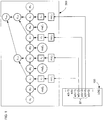
- Figure 1 illustrates a computation component - a chained masking hash tree 200 - and its method of operation for log-signing using a Merkle tree with interlinks and blinding masks: rec i are the records to be signed; r i are the hash values of the records; rnd is a random or pseudo-random number; m i are the blinding masks; x i are leaves; x a,b are internal nodes of the Merkle tree; and x root is the value to be signed.
- each input record rec i is a respective one of the events e(k+1) ... e(k+4).
- r i would be the root hash values from aggregators and x root the calendar value computed by the core; "aggregators", “calendar value” and “core” are explained below in the context of one possible and advantageous signing infrastructure.
- Figure 1 illustrates the resulting data structure, where the hashing and signing process may run as follows:
- the hash chain from any leaf to the root can be extracted and presented as a proof that the leaf participated in the computation that yielded the signed root hash value.
- salting typically involves a one-to-one association of some output based on a known function of a single password/passphrase plus a known (at least in the sense of being stored, with the possibility of being hacked) salt, there is still the possibility of reverse computation, albeit generally slower than otherwise. Since the salt and the hash output will be known, a brute force attack will still often be unacceptably feasible if the input data has lower entropy than the universe of passwords typically has.
- the hashing structure of this invention makes it in practice impossible to compute in reverse from the x i or x a,b value to any of the input records (except the records the attacker already possesses, obviously), because the attacker does not have access to the rnd value, even in implementations where a single rnd is applied for all entries in a given block.
- the shape of the Merkle tree is not specified. If the number of leaves is an even power of two, building a complete binary tree seems natural, but in other cases the appropriate shape is not necessarily obvious. The only requirement, however, is that the tree should be built in a deterministic manner so that a verifier is able to construct the exact same tree as the signer did. A practical consideration, however, is that to achieve the logarithmic size of the integrity proofs of the individual records, the tree should preferably not be overly unbalanced.
- Figure 2 eleven leaves (single-ring nodes), grouped into three complete trees (two-ring nodes) are merged to a single tree with minimal height (three-ring nodes).
- the tree-building process may be as follows:
- canonical trees A useful property of canonical trees is that they can be built on-line, as the new leaf nodes arrive, without knowing in advance the eventual size of the tree, and keeping in memory only a logarithmic number of nodes (the root nodes of the complete trees constructed so far). Therefore, using the scheme outlined here, all the security goals are achieved, and almost the performance goals as well:
- Example Procedure 1 aggregates a block of records for signing or verification.
- the input description numbers the records 1, ..., N, but the value of N is not used and the example procedure can easily be implemented for processing the records on-line.
- the amortized processing time per record is constant and the worst-case actual processing time per record is logarithmic in the number of records in the block, as is the size of the auxiliary working memory needed.
- the last leaf hash value of the previous log block should preferably also be saved along with rnd and the signature in practice; otherwise, the verification process for the current block will need to re-hash the previous block to obtain the required input for the current verification. Assuming a consistent storage policy, for that, in turn, the next previous block would need to be re-hashed, etc. While this would obviously be inefficient, an even more dangerous consequence is that any damage to any log block would make it impossible to verify any following log blocks, as one of the required inputs for verification would no longer be available.
- the only conclusion that could be made from a failed verification is that something has been changed in either the log block or the authentication data. If it is desirable to be able to detect the changes more precisely, either the record hash values r i or the leaf hash values x i computed by Example Procedure 1 could be saved along with the other authentication data. Then the sequence of hash values can be authenticated against the signature and each record checked against its hash value, at the expense of small per-record storage overhead. It should also be noted that if the record hashes are saved, they should be kept with the same confidentiality as the log data itself, to prevent them being used for the informed brute-force attack that the blinding masks are to prevent.
- Example Procedure 1 Aggregate a block of records for signing or verification
- Example Procedure 2 extracts the hash chain needed to prove or verify the integrity of an individual record.
- the core procedure is similar to that in Example Procedure 1, with additional tracking of the hash values that depend on the target record and collecting a hash chain based on that tracking.
- Example Procedure 2 Extract a hash chain for verifying one record
- the output value is a sequence of (direction, sibling hash, level correction) triples.
- the direction means the order of concatenation of the incoming hash value and the sibling hash value.
- the level correction value is included to account for cases when two sub-trees of unequal height are merged and the node level value increases by more than 1 on the step from the root of the lower sub-tree to the root of the merged tree. (The step from the lower three-ringed node to the higher one on Figure 2 is an example.) Because Example Procedure 2 is closely based on Example Procedure 1, its performance will also be similar and thus it falls somewhat short of the proposed ideal of sub-linear runtime for hash chain extraction.
- the hash values could be indexed and each of them seeked to in constant time if the same-size values would be stored in the order in which they are computed as x i and R j in Example Procedure 1.Other techniques could also be applied to similar effect.
- Example Procedure 2 the need to access the full log file in this example procedure is not a compromise of confidentiality goals, since the extraction process may be executed by the owner of the log file and only the relevant log records and the hash chains computed for them by Example Procedure 2 are supplied to outside parties.
- Example Procedure 3 computes the root hash value of the Merkle tree from which the input hash chain was extracted in one prototype of the invention.
- the hash chain produced by Example Procedure 2 and the corresponding log record will typically be fed into Example Procedure 3 and the output hash value verified against the signature to prove the integrity of the record.
- Example Procedure 3 Compute the root hash value from a hash chain
- users will be satisfied simply to verify an input event up to the level of the x root . value associated with the respective block.
- x root .. will also encode information from all previous blocks.
- Digitally signing x root .. with any standard signature may then also suffice, if desired at all. Nonetheless, a digital signing method is described below that ensures the integrity of x root .. even within a potentially much larger framework so as to provide even greater security.
- greater security can be provided by a prudent choice of a signing system for x root .. as well.
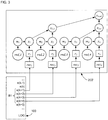
- FIG. 1 illustrates a "counter mode" embodiment of the masking hash tree computation module 200', in which, to compute m j , there is no hashing of rnd with the previous x value x j - 1 .
- each m j is preferably computed as a hash of the current block's rnd and the block record number j .
- m j hash( rnd ⁇ j ).
- the log is modeled as an ordered sequence of blocks, where each block in turn is an ordered sequence of a finite number of records, and note that the case of syslog output being sent to a periodically rotated log file could be viewed as an instantiation of this model.
- the model is here refined to distinguish the physical blocks (the rotated files) from the logical blocks (implied by signing), because it is often desirable to sign the records with a finer granularity than the frequency of rotating the log files.
- the system may allow a log file to contain several signed blocks, but prohibit a signed block from spanning across file boundaries. This means that when logs are rotated, the current signature block will always be closed and a new one started from the beginning of the new log file.
- the hash links from the last record of previous block to the first record of the next block do span the file boundaries, though, and thus still enable verification of the integrity of the whole log, however the files may have been rotated.
- the invention can also be implemented for record-level log signing in multi-tenant environments, that is, environments in which two or more differently defined entities generate events that are logged in the same log.
- multi-tenant environments that is, environments in which two or more differently defined entities generate events that are logged in the same log.
- a first assumption is that logs will have records from different tenants interleaved and that these logs will need to be separated before delivery to the respective tenants.
- a second assumption is that in an interleaved log, the origin of each record will be clearly decidable. If this second assumption is violated, the log-separation problem will lack a well-defined solution, such that the question of signature separation is not applicable.
- One property of the multi-tenant case is that the separation of the shared log into a set of interleaved threads is pre-determined: one can assume that the first step in any log processing is separation of records by tenant and after that each tenant will perform any further analysis on its own subset. Therefore, it could be beneficial to provide for a signing mechanism that protects the integrity of each thread as well as the integrity of the whole log.
- the server would need to keep K additional log(N/K)-sized root lists and archive K additional signatures.
- the number of signatures could be reduced back to one by adding one extra aggregation layer (corresponding, in Figure 1 , to one extra "level” in the tree) to combine the K+1 root hash values into one and signing only this aggregate of aggregates.
- the records themselves (and the per-record hash values, if desired) may then still be kept in only one copy by the host. (A copy of the relevant records may then be made and provided to each tenant.)
- Each tenant will then be able to verify that no records have been altered in, added to, or removed from its thread after the log was signed.
- the uppermost value x root of the tree structure is then preferably digitally signed.
- Three of very many common and known methods are PKCS#7 or OpenPGP signature or a PKI-signed RFC3161 time-stamp.
- Guardtime AS of Tallinn, Estonia has developed a signing infrastructure that includes a distributed hash tree structure that provides exceptionally high reliability for authentication of digital records (defined essentially as any set of digital information) with no need for keys. See, for example, http://www.guardtime.com/signatures/technology-overview/ for a summary of the Guardtime technology. Aspects of the Guardtime system are disclosed as well in U.S. Patent Nos. 7,698,557 ; 8,347,372 ; and 8,312,528 (all "System and method for generating a digital certificate").
- this invention does not require any particular signing scheme, but the Guardtime system is described here because of its particular advantages (among others, a high level of security, computational efficiency, substantially unlimited scalability, and not requiring keys) in general, and in the specific context of this invention in particular.
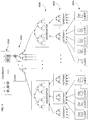
- the general Guardtime infrastructure has several different layers: a client layer 2000 comprising a number of client systems; a layer of gateways 3000; a layer including one or more aggregation systems 4000; and an uppermost layer 5000 that includes the "core", which is described in greater detail below.
- Figure 4 shows the various layers as being separate and distinct, some implementations of the main principles of the infrastructure might consolidate or do without some of the layers or might need to add additional layers for administrative or other purposes. The description below of what the various layers do will make it clear to those skilled in the art of systems architecture design how to implement such changes.
- the core layer 5000 will in general be common to all users of the system, whereas lower layers 2000, 3000, 4000 will in many implementations have a unique configuration depending on the needs and preferences of users.
- the distinction between "core/common” and “unique/distributed” is not hard and fast, however - in some implementations, the core, that is, centrally administered system, will encompass structures and functions that also are used in lower layers.
- One of the advantages of this infrastructure is that it allows for almost unlimited scalability and reconfiguration of the non-core layers to meet particular implementation needs. All that is required is that the various layers perform the specified functions, with common protocols for entering a digital record into the verification system and for generating registration requests.
- a client is the system where digital records are prepared and entered into the verification/signature system.
- the "client” will be the hardware and software entity that creates the log 100 (or other input set of digital records, whether low-entropy or not) and incorporates, implements and evaluates the a masking hash tree 200, Note that it is not necessary for the same hardware and/or software entity to embody the log 100 and the tree 200; for example, it would be possible for a component in the same system as the log 100 to transmit log entries to a separate system that performs the aggregation and hash computations involved in generating blinding masks and evaluating the masking hash tree 200.
- the digital input record for the verification system will be the x root value output by the masking tree computation module 200.
- a gateway in the gateway layer 3000 will typically be a computer system such as a server with which one or more of the clients communicates so as to receive requests for registration of each digital record that a client submits.
- a gateway will be a server controlled by an enterprise or some third-party provider, which may be a server known to and maybe even controlled by an organization to which the client user belongs, or a server accessed through a network such as the Internet.
- a gateway may generally be any server located anywhere and configured to receive requests from clients for digital record registration. Gateway systems do not need to be of the same type; rather, one gateway might be a server within a company that employs many clients, whereas another gateway might be a server accessible online by arbitrary users. Of course, gateways could also be commercial systems, such that access for verification is granted only upon payment of a fee.
- An aggregator in the aggregation layer 4000 will similarly be a computer system such as a server intended to receive registration requests that have been consolidated by respective gateways.
- any aggregator could also be controlled by the owner of the core, or the owner of the same systems as the gateways and clients, or could be provided by an entirely different entity, and in some cases it would also be possible to consolidate the aggregator and gateways for particular set of clients.
- the central system would be for the central system to include a set of aggregators as part of the "core” system, with lower-level, non-core aggregators submitting requests by communicating through the "core aggregators.”
- core aggregators geographically, such as one or more aggregators in each of Europe, North America and Asia, to reduce latency or for administrative reasons.
- gateways and aggregators could all be configured using "cloud computing" such that a user at the client level has no idea where any particular gateway or aggregator is located or who controls the servers.
- cloud computing One of the advantages of this infrastructure is that digital input records can still be verified with near total security even in situations where users and others do not know if they can trust the systems in the gateway or aggregation layers 3000, 4000; indeed, it is not even necessary to trust the administrator of the core 5000 in order to have essentially total reliability of verification.
- Figure 5 shows the infrastructure of Figure 4 in more detail.
- Figure 5 illustrates various data structures used in the authentication process.
- the various clients are represented as 2010-1, ..., 2010-n; gateways are represented as 3010-1, 3010-2, ... , 3010-m; and two (by way of example only) aggregators are shown as 4010-1, 4010-k.
- An aggregator will typically communicate into each of the lowest level hash tree nodes within the core. Only two aggregators are shown in Figure 5 for the sake of simplicity.
- client system 2010-1 which will be whatever type of system that generates or inputs digital records that are to be registered for later verification.
- client system 2010-1 which will be whatever type of system that generates or inputs digital records that are to be registered for later verification.
- client system 2010-1 Just a few of the countless physical and software systems that may create digital inputs records, and that can be client systems in the sense of this invention, are a physical or virtual computer, a telecommunications device such as a mobile phone, hybrids of these two classes of devices, other computer-supervised machines for which state changes or other activities are logged (for example, flight data recorders or industrial processes), as well as pure software entities that have logged activities.
- each client system that wishes to use the verification infrastructure is loaded with a software package or internal system routines for convenient or even automatic communication and submission "upwards" of digital information.
- the software package may include some application program interface (API) 2014 that transforms submitted digital records into a proper form for processing.
- API application program interface
- a digital record 2012 created, selected, or otherwise input in any way is then submitted by way of the API 2014 to a software module 2016 that uses the digital data from the record 2012 as at least one argument in a transformation function such as a hash function.
- the "client” will typically be a routine within the client system itself capable of extracting and submitting all or any desired portion of an event log as the input record to be signed and verified.
- the event log may be separated or even remote from the system that receives or extracts the events or event log.
- the events relate to interactions between a mobile phone, tablet computer, etc., and a central telephone or wireless network system, or other types of system state changes of these devices. Examples of such events/state changes might be starting and shutting down the device, initiating and ending calls, transmitting or receiving sms messages or email, accessing the internet, moving from one cellular zone to another, receiving software updates, etc. Since these events are also detectable in the central exchange run by the service provider, events may be logged centrally and entered into the verification system either instead of or in addition to in and by the device itself.
- Cryptographic hash functions are very well known in many areas of computer science and are therefore not described in greater detail here.
- MD Message Digest
- hash functions include the MD2, MD3, MD4, MD5,... functions and the various "secure hash algorithm” family (SHA-1, SHA-2, etc.).
- the x root value itself is the result of evaluation of the masking hash tree 200, it will in many implementations not be necessary to further hash it within the client. Additional hashing within the client may be desired, however to include additional information depending on the design protocol of the infrastructure. Just a few of the many possible arguments the system designer might optionally choose to include as arguments of the additional hash function 2016 are an identifier of the person or entity requesting registration, an identifier of the particular client system being used, a time indication, information relating to the geographic location of the client or other system, or any other information desired to be incorporated as part of the registration request.
- a software module 2020 is preferably included to transmit the output of the transformation 2016 to higher layers of the infrastructure as a request (REQ), along with any other parameters and data necessary to communicate with a gateway and initiate the registration request.
- transformation function 2016 is a hash function because this will be the most common and efficient design choice, and also because the properties of hash functions are so well understood; moreover, many different hash functions are used in the field of cryptology, security, etc., within commodity computers.
- One other advantageous property of hash functions is that they can reduce even large amounts of digital information to a size that is more easily processed, with a statistically insignificant chance of two different inputs leading to the same output.
- many well-known hash functions will be suitable for use throughout the infrastructure of this infrastructure, and can be chosen using normal design considerations. Nonetheless, the function that transforms digital records into a form suitable for submission as a request need not be a hash function as long as its properties are known.
- the transformation function may simply be viewed as an identity function, which may then also append whatever other additional information is needed according to the core system administration to form a proper registration request.
- the data structure of a binary hash tree is illustrated within the gateway 3010-2.
- Each of the lowest level nodes will correspond to the transformed dataset 2018 (which may be either x root as is, or some augmented function of x root ) submitted as a request from a client, along with any other parameters or data used in any given implementation to form a request.
- the values represented by each pair of nodes in the data structure form inputs to a parent node, which then computes a combined output value, for example, as a hash of the two input values from its "children" nodes.
- Each thus combined output/hash value is then submitted as one of two inputs to a "grandparent" node, which in turn computes a combined output/hash value for these two inputs, and so on, until a single combined output/hash value is computed for the top node in the gateway.
- Aggregators such as the system 4010-1 similarly include computation modules that compute combined output values for each node of a hash tree data structure. As in the gateways, the value computed for each node in the aggregator's data structure uses its two "children" nodes as inputs. Each aggregator will therefore ultimately compute an uppermost combined output value as the result of application of a hash function that includes information derived from the digital input record(s) of every client that submitted a request to a gateway in the data structure under that aggregator.
- the aggregator layer 4000 does not necessarily need to be controlled by the same system administrator that is in charge of the core layer 5000. In other words, as long as they are implemented according to the required protocols and use the correct hash functions (or whatever other type of function is chosen in a given implementation), then the client, gateway, and aggregation layers may be configured to use any type of architecture that various users prefer.
- the core 5000 is maintained and controlled by the overall system administrator.
- a hash tree data structure is computed using the root hash values of each aggregator as lowest level inputs.
- the hash computations and structure within the core form an aggregation of aggregation values.
- the core will therefore compute a single current uppermost core hash value at the respective tree node 5001 at each calendar time interval t 0 , t 1 , ..., t n .
- This uppermost value is referred to here alternatively as the "calendar value” or "current calendar value” for the time interval. Note that the time origin and granularity are both design choices.
- the uppermost tree node 5001 represents the root node of the entire tree structure of nodes junior to it. As is explained later, this will change upon recomputation of a new uppermost core hash value at the end of the next period of accumulating requests and generating signature vectors ("also referred to as "data signatures") containing recomputation parameters.
- signature vectors also referred to as "data signatures”
- Other arrangements would, however, be possible. For example, to reduce or eliminate single-point-of-failure possibility, it would be possible for requests to be sent upward to and hashed into multiple aggregators as long as some mechanism is included to arbitrate between and/or consolidate the then multiple root hash values that include the lower level's root hash value.
- FIG. 5 certain ones of the hash tree nodes in the gateway 3010-2, the aggregator 4010-1, and the core 5000 are marked with an "X". Notice if one traverses the various tree paths upward from the value 2018 in the client 2010-1, it is possible to compute every value upward in the tree structures all the way to the most current uppermost core value 5001 given the values in the X-marked tree nodes (the siblings of the nodes in the direct recomputation path) and a knowledge of the hash functions applied at each successive parent node.
- Figure 6 illustrates the "reduced" infrastructure whose hash tree node values contain the information necessary to recompute the hash tree path all the way to the top of the system to the value in node 5001. It is not necessary for the recomputation to be carried out in any gateway, aggregator or the core; indeed, it is not even necessary for recomputation to take place within the same client 2010-1 that originally submitted the verification request for the digital record 2012. All that is necessary is the vector containing the "sibling" tree values at each level, as well as knowledge of which hash functions are used to compute each parent node. In other words, given this information, even a third-party would be able to perform the recomputation and compare with the node value 5001 and thereby either authenticate any given representation of what is supposed to be digital record 2012, or to detect any difference.
- the sibling hash values needed for recomputation are numbered 0-9. If nodes are created in time order, and if order is important in the chosen hash function, then whether a sibling at each level is to the "right" or "left” in the hash structure will be relevant. In the example shown in Figure 6 , not only the value but also the order (0: from left, 1: from right) is indicated in the vector ( ⁇ sibling values 0-1 ⁇ , ⁇ order bits ⁇ , ⁇ other ⁇ ) returned along with any other chosen information as the data signature 8000. At this point, one may see one advantage of using a binary hash tree structure: at each level, there will be only one sibling value needed for upward recomputation.
- Figure 4 shows a database or file (the "calendar") 6000 that includes all calendar values from the beginning of system time. This would allow new aggregators, gateways and clients to join the infrastructure with minimal administrative burden and would enable recomputation and authentication of any digital record without having to involve levels higher than the client-level entity wishing to authenticate the digital record.
- the core may return the data signature vector 8000 to clients and/or other layers directly, or it can be constructed or passed "downward" as a return. For example, when the core computes the current calendar value 5001 at the new calendar time interval, it may return to aggregator 4010-1 its sibling (X-marked) lowest core node value from aggregator 4010-k, and the aggregator 4010-1 can then return downwards the X-marked hash values to the gateway 3010-2, which in turn can return downwards to the client 2010-1 all of the above, plus the X-marked hash values computed within that gateway's hash tree structure.
- the hash computation infrastructure may be distributed over various layers (vertically) and also "horizontally" at each layer, but the responsibility for communicating requests upward and partial or entire signature vectors downwards can also be distributed and can be carried out simultaneously in many different locations.
- the procedure for returning a signature vector for each input digital record 2012 for client 2010-1 (note that a single client may input more than one digital record for verification in each time interval) is preferably duplicated for all digital input records received in the time interval over which values were accumulated for the computation of node value 5001.
- the gateways 3000 may be more local to various clients whereas the aggregators are more regional. For example, it would be possible to locate aggregators in different parts of the world not only to distribute the workload, but also to increase throughput. Although it appears in Figures 4-6 that clients are associated with a particular gateway and gateways are associated with a particular aggregator, this is not necessary. Rather, client requests could be submitted over a network, and the first gateway that responds could then be associated with that client for that authentication transaction. Similarly, requests from gateways could be submitted to an open network and processed by whichever aggregator first establishes a connection. Locating aggregators and gateways both physically and logically in an efficient manner will therefore typically better distribute workload and reduce latency. This may not be desired in other implementations, however. For example, entities such as the government, defense contractors, or companies that wish to maintain strict security and tight control of the entire infrastructure could control and specify the relationship between all of the layers of the infrastructure, or any subset of these.
- users may choose or be obligated to rely on the security of the administrator of the core.
- government entities might implement a system in which users must simply rely on the government administrators. In these cases, recomputation up to the corresponding calendar value may be considered sufficiently reliable authentication. In the context of this infrastructure, this can be viewed as "first-level" verification.
- One hypothetical example of where such a system might be implemented would be where a government agency requires companies, laboratories, etc. to submit a copy of its calendar to the government entity every time the company's system updates its calendar. The government would then be able to audit the company's records and verify the authenticity of any given digital record by recomputing up to the proper calendar value, which the government will have stored. In practice, this would amount to requiring the company to keep updated a "calendar audit trail" with the auditing entity (such as the government).
- All but the last digital record requesting registration in a calendar time period will typically need to wait for all other requests in the calendar time interval to be processed before a calendar value will be available that will enable authenticating recomputation. If the calendar time interval is kept short enough, this delay may be acceptable. To increase the level of security during the delay, it would also be possible to implement an option, whenever a client submits an authentication registration request, to generate and return not only the data signature vector but also a key-based signed certificate, which may be issued by any higher layer system such as the current gateway, aggregator, or even core.
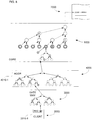
- Figure 7 illustrates an extension of the basic calendar-reliant verification process that provides "second-level" verification that is a method for permanent verification with no need for keys or trust of any entity, not even the administrator of the core.
- all of the calendar values computed over a publication time interval Tp are themselves used as inputs to an additional hash tree structure that is preferably hashed together (for example, using a Merkle tree structure) with previous calendar values to compute a composite calendar value (a "publication value”) that may then be submitted for publication in some medium 7000 such as a newspaper, online posting, etc., that forms an unchangeable record of the composite calendar value.
- the published composite calendar value may encode information obtained from every input digital record over the entire publication time interval, and if the current calendar value for the current calendar period is hashed together with the previous one, which is hashed with the one before it, and so on, as shown in Figure 7 , then each published composite calendar value will encode information from every digital record ever submitted for registration from the beginning of calendar time at t 0 . This guarantees the integrity of the entire system: Changing even a single bit in a single digital record registered in the past will cause a different publication value to be computed, which would then not match the actual publication value.
- the composite signature value is published (that is, the publication value)
- any signed digital certificate which might be provided as before to increase security until the composite value is published, at which point it will not be needed
- the data signature vector and the calendar values which are advantageously stored in each of the aggregators
- Figure 8 illustrates an optional extension of the signature vector to include the values obtained during computation of the publication value as well.
- the "X-marked" nodes are the sibling hash values for the digital record corresponding to the request REQ from client 2010-1.
- the X-marked values are sufficient to recompute the calendar value marked "C", but the hash values in the nodes marked "E” in the data structure (in Figure 8 , the Merkle tree structure) within the core that converts calendar values into the publication value are necessary to recomputed all the way up to the published value 7000.
- the core therefore preferably extends or augments the signature vectors to include the "E" values, along with corresponding order bits as previously.
- any party can verify the authenticity of a given digital record as long as it has the extended signature vector, knowledge of the hash (or other) functions used, and the corresponding publication value - if recomputation leads to a match, then the digital record must be identical to the original; if not, then something has been altered.
- any change of order in the time of receipt for any to digital input records will also affect the computed values in the core as well as the published composite signature value.
- This invention involves an extension to this scheme: additional hash nodes comprising blinding masks are generated as random or pseudo-random numbers and are included in hash computations, preferably in the core layer, but optionally in other layers instead or in addition. These additional node values (randomly generated numbers) can then be included in a returned data signature just as is they were any other node value, thereby enabling recomputation.
- each publication time interval Tp eight calendar values are shown in each publication time interval Tp.
- the number of calendar time intervals in each publication time interval Tp is conveniently a power of 2. This may not be so in other implementations, depending on the choice of intervals. For example, if a calendar value is generated each second, but publication occurs only once every week (604,800 seconds), then there will not be a power of 2 number of calendar values as leaf nodes of the Merkle tree structure. As in other trees, this can be handled in a known manner as in giving "byes" in single-elimination sports tournaments by adjusting the tree branches, by using "dummy" inputs, etc.
- a recomputation vector can also be associated with each event input e(i) so as to allow recomputation from its value, up through the blinding mask hash tree (in the illustrated case, a Merkle tree) to x root .
- Example Procedure 3 is one example of how this can be done within the computation module 200.
- the vector (a form of "local" data signature for the tree structure 200) ⁇ ( left , m 2 ), (left, x 1 ), (right, x 3,4 ) ⁇ is associated with rec 2 , which corresponds to e(k+2).
- the component 200 acting now as a verification engine, can compute r 2 by hashing rec 2 (e(k+2)).
- Hashing m 1 ⁇ r 1 will then yield x 1
- hashing x 1 ⁇ x 2 will yield x 1,2
- hashing x 1 , 2 ⁇ x 3,4 will yield x root , but only if the value of e(k+2) used in this recomputation is in fact totally identical to the one that led to computation of x root originally.
- it is not necessary to know the value of any other event e(j) it is not necessary to know the value of any other event e(j), and in fact any attempt to try to compute backwards to any other event value would require the practically impossible - backwards computation through one or more hash functions, whose input is high-entropy by virtue of the blinding mask.
- the client 2010-1 is shown as having a software module 2016 to do this.
- the hardware and software modules required to input values and compute outputs according to pre-programmed functions are of course well known in the art of computer science. Similar structures will be found in the other systems of the infrastructure, as well as the hardware and software needed for communication between the different illustrated systems, including where this communication is over a network.
Landscapes
- Engineering & Computer Science (AREA)
- Computer Security & Cryptography (AREA)
- Theoretical Computer Science (AREA)
- Computer Networks & Wireless Communication (AREA)
- Signal Processing (AREA)
- General Physics & Mathematics (AREA)
- Bioethics (AREA)
- General Health & Medical Sciences (AREA)
- Computer Hardware Design (AREA)
- Software Systems (AREA)
- Physics & Mathematics (AREA)
- General Engineering & Computer Science (AREA)
- Health & Medical Sciences (AREA)
- Databases & Information Systems (AREA)
- Power Engineering (AREA)
- Storage Device Security (AREA)
- Information Retrieval, Db Structures And Fs Structures Therefor (AREA)
Claims (15)
- Verfahren zur sicheren Authentifizierung digitaler Einträge, GEKENNZEICHNET DURCH:Eingeben einer Abfolge von Eintragsblöcken, wobei jeder Block (B1) eine Vielzahl der digitalen Einträge (rec1, ..., rec4 ) umfasst, wobei jeder digitale Eintrag ein Computersystemereignis angibt und einem Computersystemereignis entspricht, das in einem Systemprotokoll dargestellt und gespeichert ist;Erzeugen wenigstens einer im Wesentlichen zufälligen Zahl (rndB1 );für jeden Eintragsblock:
Berechnen eines Eingangseintrags-Hashwertes (r1, ..., r4 ) für jeden der digitalen Einträge in dem Block;Berechnen eines Blindmaskenwertes (m1 , ..., m4 ) als Hash-Funktion mit der im Wesentlichen zufälligen Zahl als Eingangsparameter;Berechnen eines maskierten gehashten Eingangswertes (x1, ..., x4 ) für jeden Eingangseintrags-Hashwert als Hash des Eingangseintrags-Hashwertes und eines jeweiligen der Blindmaskenwerte, wobei die maskierten gehashten Eingangswerte Knoten eines Hash-Baumse bilden;Berechnen nachfolgend aggregierter Hash-Baumwerte, um einen einzelnen Wurzel-Hashwert (Xroot ) zu bilden;schlüsselloses digitales Signieren des Wurzel-Hashwertes; undin einer Verifizierungsphase:
Verifizieren eines Eintragsblocks mit dem schlüssellos digital signierten Wurzel-Hashwert. - Verfahren nach Anspruch 1, weiterhin GEKENNZEICHNET DURCH in der Verifizierungsphase:Empfangen eines Kandidaten-Digitaleingangseintrags, der einem bestimmten der Digitaleinträge entspricht; undNeuberechnen des Wurzel-Hashwertes (Xroot ) bei gegebenem Blind-Hashwert, der mit dem bezeichneten Digitaleintrag verknüpft ist, und gleichgeordneter Knotenwerte des bezeichneten Digitaleintrags in einem Berechnungspfad in dem Hash-Baum von dem bezeichneten Digitaleintrag bis zum Wurzel-Hashwert, wodurch der Kandidaten-Digitaleingangseintrag als identisch verifiziert zu dem entsprechenden ursprünglich Digitaleingangseintrag angesehen wird, wenn der neu berechnete Wurzel-Hashwert gleich dem Wurzel-Hashwert ist, den man bei der ursprünglichen Berechnung erhalten hatte.
- Verfahren nach Anspruch 1 oder 2, DADURCH GEKENNZEICHNET, dass der Hash-Baum ein Merkle-Baum ist.
- Verfahren nach einem der Ansprüche 1 bis 3, weiterhin GEKENNZEICHNET DURCH Berechnen des Blindmaskenwertes (m1 , ..., m4 ) als Hash-Funktion, die als einen Eingangsparameter die im Wesentlichen zufällige Zahl und als weiteren Eingangsparameter, den maskierten gehashten Eingangswert hat, der einem zuvor übermittelten Digitaleintrag entspricht, so dass die Berechnung der maskierten gehashten Eingangswerte verkettet wird; oder
DURCH Berechnen des Blindmaskenwertes (m1, ..., m4 ) als Hash-Funktion, die als einen Eingangsparameter die im Wesentlichen zufällige Zahl und als weiteren Eingangsparameter einen Zähler hat, der die Ordnungsposition des jeweiligen digitalen Eingangseintrags in der Vielzahl von digitalen Eingangseinträgen in dem aktuellen Block kennzeichnet. - Verfahren nach einem der Ansprüche 1 bis 4, DADURCH GEKENNZEICHNET, dass das Berechnen der anschließend aggregierten Hash-Baumwerte zur Bildung eines einzigen Wurzel-Hashwertes das Berechnen einer aufeinanderfolgend abnehmenden Anzahl von Knotenwerten umfasst, wobei jeder Knotenwert als Hash-Funktion von wenigstens zwei niedrigeren Knotenwerten und einem Ebenenwert berechnet wird, der die Ebene jedes Knotens im Hash-Baum anzeigt; oder
DURCH:Berechnen einer anderem im Wesentlichen zufälligen Zahl für jeden Block, undVerwenden derselben zufälligen Zahl bei der Berechnung des Blindmaskenwertes für die maskierten gehashten Eingangswerte in demselben Block. - Verfahren nach einem der Ansprüche 1 bis 5, DADURCH GEKENNZEICHNET, dass die digitalen Einträge Systemereignisse (e(k-1), ..., e(k + 5)) sind, wie etwa Computersystemprotokolleinträge, Syslog-Einträge oder Syslog-Varianteneinträge, Rsyslog-Einträge, protokollierte Ereignisse einer Telekommunikationsvorrichtung, Zustandsänderungen einer virtuellen Maschine oder Zustandsänderungen einer mobilen Telekommunikationsvorrichtung.
- Verfahren nach einem der Ansprüche 1 bis 6, bei dem die digitalen Eingangseinträge Ereignisse von mehr als einer in einem gemeinsamen Protokoll protokollierten Einheit sind, weiterhin GEKENNZEICHNET DURCH:Identifizieren und Gruppieren der Ereignisse pro Einheit in separate Ereignis-Threads; und für jeden Thread Berechnen eines separaten Thread-Wurzel-Hashwertes; undDURCH separates digitales Signieren jedes Thread-Wurzel-Hashwertes.
- Verfahren nach einem der Ansprüche 1 bis 7, GEKENNZEICHNET DURCH
Übermitteln des Wurzel-Hashwerts an ein schlüsselloses, verteiltes Hash-Baum-Authentifizierungssystem (2000, 3000, 4000, 5000); und
Empfangen einer mit dem Wurzel-Hashwert verknüpften digitalen Signatur von dem schlüssellosen verteilten Hash-Baum-Authentifizierungssystem. - Verfahren nach Anspruch 8, weiterhin GEKENNZEICHNET DURCH
Empfangen, in einem Kernsystem (5000) auf einer Kernverarbeitungsebene, von jedem von wenigstens einem höchsten Nichtkern-Verarbeitungssystem (4010-1, ..., 4010-k) auf einer jeweiligen höchsten Nichtkern-Verarbeitungsebene (4000), eines aktuellen kombinierten Ausgangswertes höchster Ebene, der als digitale Kombinationen von aufeinanderfolgend kombinierten Ausgangswerten niedriger Ebene ausgebildet wird, die in niedrigeren Nichtkern-Verarbeitungsebenen als Knotenwerte des schlüssellosen, verteilten Hash-Authentifizierungssystems berechnet werden, das die Eingänge niedrigster Ebene hat, die als digitale Transformationen, berechnet in Systemen auf Benutzerebene, aus wenigstens einem digitalen Eingangseintrag einschließlich der Wurzel-Hashwerte ausgebildet werden;
Berechnen innerhalb des Kernsystems eines aktuellen Wurzelkalenderwertes als digitale Kombination der aktuellen kombinierten Ausgangswerte höchster Ebene und einer Funktion von wenigstens einem vorherigen Wurzelkalenderwert;
periodisches Berechnen und Bewirken der Veröffentlichung eines Ausgangswertes in einer im Wesentlichen permanenten Form, der in Abhängigkeit von wenigstens einer Teilmenge der kombinierten Ausgangswerte höchster Ebene berechnet wird;
woraufhin ein beliebiger nachfolgender digitaler Testeintrag in Bezug auf den entsprechenden digitalen Eingangseintrag als dauerhaft authentifiziert betrachtet wird, sofern unter Anwendung der entsprechenden digitalen Transformation auf den digitalen Testeintrag bei Verwendung der Neuberechnungsparameter des aktuellen Kalenderwertes und des zusammengesetzten Kalenderwertes zum erneuten Berechnen der Knotenwerte aufwärts durch die Baumdatenstruktur und den Kern derselbe zusammengesetzte Kalenderwert erreicht wird, als wenn er ursprünglich berechnet worden wäre;
Berechnen des zusammengesetzten Kalenderwertes in Abhängigkeit einer Vielzahl von aktuellen Kalenderwerten, die über einen Veröffentlichungszeitraum berechnet wurden, einschließlich nicht nur des aktuellen Kalenderwertes, sondern auch wenigstens eines vorherigen aktuellen Kalenderwertes;
wobei:die digitalen Kombinationen kryptographische Hashes sind;die Neuberechnungsparameter für jeden digitalen Eingangseintrag die gleichgeordneten Knotenwerte in einem gerichteten Pfad in der Baumdatenstruktur von den digitalen Transformationen des digitalen Eingangseintrags bis zu dem zusammengesetzten Kalenderwert umfassen; unddie Neuberechnungsparameter schlüssellos sind, so dass spätestens nach Veröffentlichung des zusammengesetzten Kalenderwertes die Neuberechnungsparameter unabhängig von etwaigen Vertrauensstellenparametern wie digitalen Zertifikaten oder kryptographischen Schlüsseln sind. - Verfahren nach Anspruch 7, weiterhin GEKENNZEICHNET DURCH Aggregieren der Thread-Wurzel-Hashwerte in den einzelnen Wurzel-Hashwert.
- System zur sicheren Authentifizierung digitaler Einträge, GEKENNZEICHNET DURCH:ein Protokoll (100), das digitale Darstellungen einer Abfolge von Ereignissen (e(k-1), ..., e(k + 5)) umfasst, die jeweils einen digitalen Eintrag bilden, wobei jeder digitale Eintrag ein Computersystemereignis anzeigt und diesem entspricht;eine Maskierungs-Hash-Baum-Berechnungskomponente (200), die Unterkomponenten umfasst:
die die digitalen Einträge (reci ) eingeben und sie zu Blöcken (B1) gruppieren; für jeden Eintragsblock:einen Eingangseintrags-Hashwert (ri ) für jeden der digitalen Einträge in dem Block berechnen;einen Blindmaskenwert (mi ) als Hash-Funktion mit einer im Wesentlichen zufälligen Zahl (rnd) als Eingangsparameter berechnen;für jeden Eingangseintrags-Hashwert einen maskierten gehashten Eingangswert (xi ) als einen Hash des Eingangseintrags-Hashwertes und einen jeweiligen der Blindmaskenwerte berechnen, wobei die maskierten gehashten Eingangswerte Knoten einer Hash-Baum-Berechnungsstruktur bilden; unddie anschließend aggregierten Hash-Baumwerte berechnen, um einen einzelnen Wurzel-Hashwert (xroot ) auszubilden;wobei die Maskierungs-Hash-Baum-Berechnungskomponente weiterhin ein Untermodul umfasst, das den Wurzel-Hashwert an ein schlüsselloses digitales Signatursystem übermittelt und dem Wurzel-Hashwert eine empfangene digitale Signatur zuordnet,eine Einrichtung zum Verifizieren eines Eintragsblocks unter Verwendung des schlüssellos digital signierten Wurzel-Hashwertes. - System nach Anspruch 11, DADURCH GEKENNZEICHNET,
DASS die Komponente des Maskierungs-Hash-Baums in einer Überprüfungsphase:einen Kandidaten-Digitaleingangseintrag empfängt, der einem bestimmten der Digitaleinträge entspricht; undden Wurzel-Hashwert bei gegebenem Blind-Hashwert, der mit dem bezeichneten Digitaleintrag verknüpft ist, und gleichgeordneter Knotenwerte des bezeichneten Digitaleintrags in einem Berechnungspfad in der Hash-Baum-Berechnungsstruktur von dem bezeichneten Digitaleintrag bis zum Wurzel-Hashwert neu berechnet, wodurch der Kandidaten-Digitaleingangseintrag als identisch verifiziert zu dem entsprechenden ursprünglich Digitaleingangseintrag angesehen wird, wenn der neu berechnete Wurzel-Hashwert gleich dem Wurzel-Hashwert ist, den man bei der ursprünglichen Berechnung erhalten hatte. - System nach Anspruch 12, weiterhin GEKENNZEICHNET DURCH ein Hash-Berechnungs-Submodul, das den Blindmaskenwert als eine Hash-Funktion berechnet, die die im Wesentlichen zufällige Zahl (rnd) als den einen Eingangsparameter und als einen weiteren Eingangsparameter den maskierten gehashten Eingangswert hat, der einem zuvor übermittelten Digitaleintrag entspricht, so dass die Berechnung der maskierten gehashten Eingangswerte verkettet ist; und/oder
DURCH ein Hash-Berechnungs-Submodul, das den Blindmaskenwert als eine Hash-Funktion berechnet, die die im Wesentlichen zufällige Zahl als den einen Eingangsparameter und als einen weiteren Eingangsparameter einen Zähler umfasst, der die Ordnungsposition des jeweiligen Digitaleingangseintrags in der Vielzahl von Digitaleingangseinträgen in dem aktuellen Block anzeigt. - System nach Anspruch 11 oder 12, DADURCH GEKENNZEICHNET, dass die Hash-Baum-Berechnungsstruktur eine Merkle-Tree-Hash-Struktur ist, die aggregierte Hash-Baumwerte berechnet, um den einzelnen Wurzel-Hashwert (xroot) durch Berechnen einer nacheinander abnehmenden Anzahl von Knotenwerten auszubilden, wobei jeder Knotenwert als Hash-Funktion von wenigstens zwei niedrigeren Knotenwerten und einem Ebenenwert, der die Ebene jedes Knotens im Hash-Baum anzeigt, berechnet wird; oder DADURCH, DASS die digitalen Einträge Systemereignisse (e(k-1), ..., e(k + 5)) sind, wie etwa Computersystemprotokolleinträge, Syslog-Einträge oder Syslog-Varianteneinträge, Rsyslog-Einträge, protokollierte Ereignisse einer Telekommunikationsvorrichtung, Zustandsänderungen einer virtuellen Maschine oder Zustandsänderungen einer mobilen Telekommunikationsvorrichtung.
- System nach Anspruch 12, GEKENNZEICHNET DURCH ein schlüsselloses, verteiltes Hash-Baum-Authentifizierungssystem (2000, 3000, 4000, 5000), wodurch die Maskierungs-Hash-Baum-Berechnungskomponente den Wurzel-Hashwert an das schlüssellose, verteilte Hash-Baum-Authentifizierungssystem übermittelt und von dem schlüssellosen, verteilten Hash-Baum-Authentifizierungssystem eine digitale Signatur empfängt, die dem Wurzel-Hashwert zugeordnet ist
Applications Claiming Priority (3)
| Application Number | Priority Date | Filing Date | Title |
|---|---|---|---|
| US201361768386P | 2013-02-22 | 2013-02-22 | |
| US13/902,778 US20140245020A1 (en) | 2013-02-22 | 2013-05-24 | Verification System and Method with Extra Security for Lower-Entropy Input Records |
| PCT/EP2014/000429 WO2014127904A1 (en) | 2013-02-22 | 2014-02-17 | Verification system and method with extra security for lower-entropy input records |
Publications (2)
| Publication Number | Publication Date |
|---|---|
| EP2959631A1 EP2959631A1 (de) | 2015-12-30 |
| EP2959631B1 true EP2959631B1 (de) | 2019-06-26 |
Family
ID=51389490
Family Applications (1)
| Application Number | Title | Priority Date | Filing Date |
|---|---|---|---|
| EP14709183.9A Active EP2959631B1 (de) | 2013-02-22 | 2014-02-17 | Überprüfungssystem und -verfahren mit zusätzlicher sicherheit für eingabeaufzeichnungen mit geringerer entropie |
Country Status (6)
| Country | Link |
|---|---|
| US (1) | US20140245020A1 (de) |
| EP (1) | EP2959631B1 (de) |
| JP (1) | JP2016509443A (de) |
| CN (1) | CN105164971A (de) |
| AU (2) | AU2014221033A1 (de) |
| WO (1) | WO2014127904A1 (de) |
Families Citing this family (61)
| Publication number | Priority date | Publication date | Assignee | Title |
|---|---|---|---|---|
| US20150199217A1 (en) * | 2014-01-14 | 2015-07-16 | Cisco Technology, Inc. | Entropy resource allocation management in virtualized environments |
| US9854436B2 (en) * | 2014-09-25 | 2017-12-26 | Intel Corporation | Location and proximity beacon technology to enhance privacy and security |
| US10862690B2 (en) * | 2014-09-30 | 2020-12-08 | Telefonaktiebolaget Lm Ericsson (Publ) | Technique for handling data in a data network |
| WO2016131473A1 (en) * | 2015-02-16 | 2016-08-25 | Nec Europe Ltd. | Method and system for verifying information of a data item in a plurality of different data items |
| EP3259873B1 (de) | 2015-02-20 | 2018-12-12 | Telefonaktiebolaget LM Ericsson (publ) | Verfahren zur bereitstellung eines hash-wertes für einen datenblock, elektronische vorrichtung und computerprogramm |
| PT3259871T (pt) * | 2015-02-20 | 2020-11-10 | Ericsson Telefon Ab L M | Método para proporcionar um valor de dispersão para uma parte de dados, dispositivo eletrónico e programa de computador |
| US9967093B2 (en) * | 2015-03-25 | 2018-05-08 | Intel Corporation | Techniques for securing and controlling access to data |
| EP3281145B1 (de) | 2015-04-10 | 2019-11-06 | Telefonaktiebolaget LM Ericsson (publ) | Überprüfungswege von blättern eines baumes |
| US10042782B2 (en) * | 2015-06-02 | 2018-08-07 | ALTR Solutions, Inc. | Immutable datastore for low-latency reading and writing of large data sets |
| WO2017039775A2 (en) | 2015-06-11 | 2017-03-09 | PeerNova, Inc. | Making cryptographic claims about stored data using an anchoring system |
| US10482078B2 (en) | 2015-06-30 | 2019-11-19 | Telefonaktiebolaget Lm Ericsson (Publ) | Methods and devices for handling hash-tree based data signatures |
| US9864878B2 (en) * | 2015-07-27 | 2018-01-09 | International Business Machines Corporation | Event log tamper detection |
| US10303887B2 (en) * | 2015-09-14 | 2019-05-28 | T0.Com, Inc. | Data verification methods and systems using a hash tree, such as a time-centric merkle hash tree |
| CN105187218B (zh) * | 2015-09-30 | 2018-11-23 | 谈建 | 一种多核心基础设施的数字化记录签名、验证方法 |
| US9977918B2 (en) | 2015-09-30 | 2018-05-22 | Robert Bosch Gmbh | Method and system for verifiable searchable symmetric encryption |
| EP3375131B1 (de) * | 2015-11-13 | 2019-09-04 | Telefonaktiebolaget LM Ericsson (publ.) | Überprüfung des dienstzugriffs in einem kommunikationssystem |
| KR101977109B1 (ko) * | 2015-11-17 | 2019-08-28 | (주)마크애니 | 해시함수 기반의 대규모 동시 전자서명 서비스 시스템 및 그 방법 |
| TWI569166B (zh) * | 2016-01-05 | 2017-02-01 | 精品科技股份有限公司 | 資料驗證方法 |
| KR101772554B1 (ko) | 2016-02-02 | 2017-08-30 | 주식회사 코인플러그 | 파일에 대한 노터리 서비스를 제공하고 상기 노터리 서비스를 사용하여 기록된 파일에 대한 검증을 수행하는 방법 및 서버 |
| KR101735708B1 (ko) | 2016-02-02 | 2017-05-15 | 주식회사 코인플러그 | 파일에 대한 노터리 서비스를 제공하고 상기 노터리 서비스를 사용하여 기록된 파일에 대한 검증을 수행하는 방법 및 서버 |
| WO2017200438A1 (en) * | 2016-05-19 | 2017-11-23 | Telefonaktiebolaget Lm Ericsson (Publ) | Methods and devices for handling hash-tree based data signatures |
| US9774578B1 (en) | 2016-05-23 | 2017-09-26 | Accenture Global Solutions Limited | Distributed key secret for rewritable blockchain |
| US10552138B2 (en) | 2016-06-12 | 2020-02-04 | Intel Corporation | Technologies for secure software update using bundles and merkle signatures |
| CN106130718B (zh) * | 2016-06-29 | 2019-05-21 | 谈建 | 一种数字记录的签名数据生成方法和验证方法 |
| US10242065B1 (en) * | 2016-06-30 | 2019-03-26 | EMC IP Holding Company LLC | Combining merkle trees in graph databases |
| US10841097B2 (en) | 2016-07-08 | 2020-11-17 | Mastercard International Incorporated | Method and system for verification of identity attribute information |
| GB201611948D0 (en) * | 2016-07-08 | 2016-08-24 | Kalypton Int Ltd | Distributed transcation processing and authentication system |
| JP2019532442A (ja) * | 2016-07-26 | 2019-11-07 | バイエル、ビジネス、サービシズ、ゲゼルシャフト、ミット、ベシュレンクテル、ハフツングBayer Business Services Gmbh | 階層データの同期 |
| CN106547648A (zh) * | 2016-10-21 | 2017-03-29 | 杭州嘉楠耘智信息科技有限公司 | 一种备份数据处理方法及装置 |
| FR3058813A1 (fr) * | 2016-11-16 | 2018-05-18 | Stmicroelectronics (Rousset) Sas | Stockage dans une memoire non volatile |
| CN107040582B (zh) * | 2017-02-17 | 2020-08-14 | 创新先进技术有限公司 | 一种数据处理方法及装置 |
| FR3065552A1 (fr) * | 2017-04-24 | 2018-10-26 | Mohamad Badra | Procede et systeme d’authentification et de non-repudiation |
| US10937083B2 (en) | 2017-07-03 | 2021-03-02 | Medici Ventures, Inc. | Decentralized trading system for fair ordering and matching of trades received at multiple network nodes and matched by multiple network nodes within decentralized trading system |
| EP4395233A3 (de) * | 2017-08-11 | 2024-09-04 | ALTR Solutions, Inc. | Unveränderlicher datenspeicher zum lesen und schreiben mit niedriger latenz von grossen datensätzen |
| US10296248B2 (en) | 2017-09-01 | 2019-05-21 | Accenture Global Solutions Limited | Turn-control rewritable blockchain |
| GB2568453A (en) * | 2017-09-14 | 2019-05-22 | Blockpass Idn Ltd | Systems and methods for user identity |
| US10887090B2 (en) * | 2017-09-22 | 2021-01-05 | Nec Corporation | Scalable byzantine fault-tolerant protocol with partial tee support |
| WO2019070227A1 (en) | 2017-10-02 | 2019-04-11 | Hewlett-Packard Development Company, L.P. | DEVICE AUTHENTICATION |
| WO2019081919A1 (en) * | 2017-10-24 | 2019-05-02 | Copa Fin Limited | STORING AND VERIFYING DATA |
| WO2019098873A1 (en) | 2017-11-16 | 2019-05-23 | Accenture Global Solutions Limited | Blockchain operation stack for rewritable blockchain |
| CN108809942A (zh) * | 2018-05-10 | 2018-11-13 | 山东恒云信息科技有限公司 | 云服务环境中对日志取证实现数据完整性验证的方法 |
| BE1026342B9 (fr) * | 2018-06-04 | 2020-02-04 | Worldline Sa | Dispositif et procede pour l'identification securisee d'un utilisateur |
| US10873462B1 (en) * | 2018-06-21 | 2020-12-22 | Onu Technology, Inc. | Verification of computation by untrusted source |
| EP3588841B1 (de) * | 2018-06-22 | 2025-11-12 | QuBalt GmbH | Verfahren und vorrichtung zur ausführung eines authentifizierungsschemas |
| EP3588843A1 (de) * | 2018-06-22 | 2020-01-01 | QuBalt GmbH | Verfahren und system zur ausführung eines informationstheoretischen sicheren authentifizierungsschemas |
| EP3588842A1 (de) * | 2018-06-22 | 2020-01-01 | QuBalt GmbH | Verfahren und vorrichtung zur ausführung eines authentifizierungsschemas |
| WO2020142526A1 (en) * | 2018-12-31 | 2020-07-09 | Guardtime Sa | Verifiable object state data tracking |
| US10778452B2 (en) * | 2019-06-03 | 2020-09-15 | Alibaba Group Holding Limited | Blockchain ledger authentication |
| US10880260B1 (en) | 2019-06-19 | 2020-12-29 | Etherweb Technologies LLC | Distributed domain name resolution and method for use of same |
| GB2592338A (en) | 2019-07-25 | 2021-09-01 | Nchain Holdings Ltd | Digital contracts using blockchain transactions |
| US11201746B2 (en) | 2019-08-01 | 2021-12-14 | Accenture Global Solutions Limited | Blockchain access control system |
| KR102218297B1 (ko) | 2019-08-01 | 2021-02-24 | 주식회사 블룸테크놀로지 | 원장의 증명 가능 프루닝 시스템 |
| JP7162634B2 (ja) * | 2019-12-12 | 2022-10-28 | 株式会社bitFlyer Blockchain | 証明書データをデジタルに利用可能にするための装置、方法及びそのためのプログラム |
| EP3846383A1 (de) * | 2019-12-30 | 2021-07-07 | QuantiCor Security GmbH | Kryptographisches signatursystem |
| US10846372B1 (en) * | 2019-12-31 | 2020-11-24 | Onu Technology Inc. | Systems and methods for trustless proof of possession and transmission of secured data |
| US20210336789A1 (en) * | 2020-03-30 | 2021-10-28 | Facebook, Inc. | Deterministic sparse-tree based cryptographic proof of liabilities |
| JP2021175016A (ja) * | 2020-04-20 | 2021-11-01 | 株式会社日立製作所 | デジタル署名の管理方法、デジタル署名の管理システム |
| CN111818074B (zh) * | 2020-07-17 | 2022-08-05 | 上海朝夕网络技术有限公司 | 一种基于芯片的分布式网络节点认证方法 |
| EP4142211A1 (de) * | 2021-08-26 | 2023-03-01 | BitFlow GmbH | Dokumentenintegritätsschutz |
| US20230316274A1 (en) * | 2022-03-31 | 2023-10-05 | Lenovo (Singapore) Pte. Ltd. | Activity authentication using time-based one-time password |
| CN115328875A (zh) * | 2022-08-16 | 2022-11-11 | 中国银行股份有限公司 | 一种数据认证方法及系统 |
Family Cites Families (16)
| Publication number | Priority date | Publication date | Assignee | Title |
|---|---|---|---|---|
| GB2288476A (en) * | 1994-04-05 | 1995-10-18 | Ibm | Authentication of printed documents. |
| WO2001011843A1 (en) * | 1999-08-06 | 2001-02-15 | Sudia Frank W | Blocked tree authorization and status systems |
| US7546298B2 (en) * | 2001-01-09 | 2009-06-09 | Nextair Corporation | Software, devices and methods facilitating execution of server-side applications at mobile devices |
| US7257711B2 (en) * | 2001-11-08 | 2007-08-14 | The Johns Hopkins University | Efficient authenticated dictionaries with skip lists and commutative hashing |
| US7698557B2 (en) | 2003-12-22 | 2010-04-13 | Guardtime As | System and method for generating a digital certificate |
| WO2006075150A1 (en) * | 2005-01-12 | 2006-07-20 | British Telecommunications Public Limited Company | Radio frequency identification transponder security |
| US7634651B1 (en) * | 2005-10-21 | 2009-12-15 | Intuit Inc. | Secure data transmission web service |
| US7705753B2 (en) * | 2005-10-22 | 2010-04-27 | Sytex, Inc. | Methods, systems and computer-readable media for compressing data |
| JP4622811B2 (ja) * | 2005-11-04 | 2011-02-02 | 株式会社日立製作所 | 電子文書の真正性保証システム |
| JP4939851B2 (ja) * | 2006-06-21 | 2012-05-30 | パナソニック株式会社 | 情報処理端末、セキュアデバイスおよび状態処理方法 |
| US8943332B2 (en) * | 2006-10-31 | 2015-01-27 | Hewlett-Packard Development Company, L.P. | Audit-log integrity using redactable signatures |
| EP2116005A1 (de) * | 2007-01-31 | 2009-11-11 | Tufin Software Technologies Ltd. | System und verfahren zur prüfung eines sicherheitsverfahrens |
| US8037145B2 (en) * | 2007-09-30 | 2011-10-11 | Symantec Operating Corporation | System and method for detecting email content containment |
| US8407518B2 (en) * | 2007-10-26 | 2013-03-26 | Vmware, Inc. | Using virtual machine cloning to create a backup virtual machine in a fault tolerant system |
| US7502972B1 (en) * | 2008-03-16 | 2009-03-10 | International Business Machines Corporation | Reducing log entries using hash keys |
| CA2731954C (en) * | 2008-07-25 | 2014-10-21 | Roberto Tamassia | Apparatus, methods, and computer program products providing dynamic provable data possession |
-
2013
- 2013-05-24 US US13/902,778 patent/US20140245020A1/en not_active Abandoned
-
2014
- 2014-02-17 WO PCT/EP2014/000429 patent/WO2014127904A1/en not_active Ceased
- 2014-02-17 JP JP2015558371A patent/JP2016509443A/ja active Pending
- 2014-02-17 EP EP14709183.9A patent/EP2959631B1/de active Active
- 2014-02-17 CN CN201480016974.7A patent/CN105164971A/zh active Pending
- 2014-02-17 AU AU2014221033A patent/AU2014221033A1/en not_active Abandoned
-
2017
- 2017-12-05 AU AU2017272163A patent/AU2017272163B2/en active Active
Non-Patent Citations (1)
| Title |
|---|
| None * |
Also Published As
| Publication number | Publication date |
|---|---|
| AU2014221033A1 (en) | 2015-09-10 |
| US20140245020A1 (en) | 2014-08-28 |
| CN105164971A (zh) | 2015-12-16 |
| WO2014127904A1 (en) | 2014-08-28 |
| AU2017272163A1 (en) | 2017-12-21 |
| JP2016509443A (ja) | 2016-03-24 |
| EP2959631A1 (de) | 2015-12-30 |
| AU2017272163B2 (en) | 2019-12-05 |
Similar Documents
| Publication | Publication Date | Title |
|---|---|---|
| AU2017272163B2 (en) | Verification system and method with extra security for lower-entropy input records | |
| US8719576B2 (en) | Document verification with distributed calendar infrastructure | |
| EP3031169B1 (de) | Dokumentenüberprüfung mit id-verstärkung | |
| US10200199B2 (en) | Strengthened entity identity for digital record signature infrastructure | |
| US9853819B2 (en) | Blockchain-supported, node ID-augmented digital record signature method | |
| US20180152442A1 (en) | Blockchain-supported, hash tree-based digital signature infrastructure | |
| Wang et al. | Enabling public auditability and data dynamics for storage security in cloud computing | |
| CN112532389B (zh) | 一种基于区块链的智能电网轻量级隐私保护数据聚合方法 | |
| CN114139203B (zh) | 基于区块链的异构身份联盟风险评估系统、方法及终端 | |
| CN111294352A (zh) | 云端与边缘节点之间的数据安全认证方法 | |
| CN114553604B (zh) | 一种物联网终端节点访问控制方法 | |
| CN119484028A (zh) | 一种基于区块链技术实现物联网设备安全认证的方法及其系统 | |
| CN118413321B (zh) | 资源公钥基础设施的资源签发方法、资源验证方法及系统 | |
| CN120429882A (zh) | 一种安全移动存储的多层级访问控制与权限同步方法 | |
| Zou et al. | Dynamic provable data possession based on ranked Merkle hash tree | |
| Wang et al. | Blockchain-based sdn security guarantee model | |
| Abbdal et al. | An Efficient Public Verifiability and Data Integrity Using Multiple TPAs in Cloud Data Storage | |
| CN121567323A (zh) | 基于可信执行环境的动态信誉存储时间证明方法及系统 | |
| Zhao et al. | DIV-DU: Data Integrity Verification and Dynamic Update of Cloud Storage in Distributed Machine Learning | |
| CN121997362A (zh) | 一种基于区块链的楼盘信息共享方法、装置、设备及介质 | |
| CN121458288A (zh) | 一种针对联盟链的数据处理方法及相关设备 | |
| CN120934770A (zh) | 一种基于工业生产数据的数字化认证方法及系统 | |
| CN121711090A (zh) | 可验证追溯的量子密钥数据库安全系统及其实现方法 | |
| CN121396581A (zh) | 一种计算机科学技术的数据分布式安全存储系统及方法 | |
| CN121098499A (zh) | 基于零知识证明与密码累加器的云存储数据完整性审计方法 |
Legal Events
| Date | Code | Title | Description |
|---|---|---|---|
| PUAI | Public reference made under article 153(3) epc to a published international application that has entered the european phase |
Free format text: ORIGINAL CODE: 0009012 |
|
| 17P | Request for examination filed |
Effective date: 20150821 |
|
| AK | Designated contracting states |
Kind code of ref document: A1 Designated state(s): AL AT BE BG CH CY CZ DE DK EE ES FI FR GB GR HR HU IE IS IT LI LT LU LV MC MK MT NL NO PL PT RO RS SE SI SK SM TR |
|
| AX | Request for extension of the european patent |
Extension state: BA ME |
|
| DAX | Request for extension of the european patent (deleted) | ||
| STAA | Information on the status of an ep patent application or granted ep patent |
Free format text: STATUS: EXAMINATION IS IN PROGRESS |
|
| 17Q | First examination report despatched |
Effective date: 20180208 |
|
| GRAP | Despatch of communication of intention to grant a patent |
Free format text: ORIGINAL CODE: EPIDOSNIGR1 |
|
| STAA | Information on the status of an ep patent application or granted ep patent |
Free format text: STATUS: GRANT OF PATENT IS INTENDED |
|
| RIC1 | Information provided on ipc code assigned before grant |
Ipc: H04L 9/32 20060101AFI20190115BHEP Ipc: G06F 21/64 20130101ALI20190115BHEP Ipc: G06F 21/62 20130101ALI20190115BHEP |
|
| INTG | Intention to grant announced |
Effective date: 20190206 |
|
| GRAS | Grant fee paid |
Free format text: ORIGINAL CODE: EPIDOSNIGR3 |
|
| GRAA | (expected) grant |
Free format text: ORIGINAL CODE: 0009210 |
|
| STAA | Information on the status of an ep patent application or granted ep patent |
Free format text: STATUS: THE PATENT HAS BEEN GRANTED |
|
| RAP1 | Party data changed (applicant data changed or rights of an application transferred) |
Owner name: GUARDTIME SA |
|
| AK | Designated contracting states |
Kind code of ref document: B1 Designated state(s): AL AT BE BG CH CY CZ DE DK EE ES FI FR GB GR HR HU IE IS IT LI LT LU LV MC MK MT NL NO PL PT RO RS SE SI SK SM TR |
|
| REG | Reference to a national code |
Ref country code: GB Ref legal event code: FG4D |
|
| REG | Reference to a national code |
Ref country code: CH Ref legal event code: EP |
|
| REG | Reference to a national code |
Ref country code: AT Ref legal event code: REF Ref document number: 1149573 Country of ref document: AT Kind code of ref document: T Effective date: 20190715 |
|
| REG | Reference to a national code |
Ref country code: DE Ref legal event code: R096 Ref document number: 602014049026 Country of ref document: DE |
|
| REG | Reference to a national code |
Ref country code: IE Ref legal event code: FG4D |
|
| REG | Reference to a national code |
Ref country code: NL Ref legal event code: MP Effective date: 20190626 |
|
| PG25 | Lapsed in a contracting state [announced via postgrant information from national office to epo] |
Ref country code: AL Free format text: LAPSE BECAUSE OF FAILURE TO SUBMIT A TRANSLATION OF THE DESCRIPTION OR TO PAY THE FEE WITHIN THE PRESCRIBED TIME-LIMIT Effective date: 20190626 Ref country code: SE Free format text: LAPSE BECAUSE OF FAILURE TO SUBMIT A TRANSLATION OF THE DESCRIPTION OR TO PAY THE FEE WITHIN THE PRESCRIBED TIME-LIMIT Effective date: 20190626 Ref country code: HR Free format text: LAPSE BECAUSE OF FAILURE TO SUBMIT A TRANSLATION OF THE DESCRIPTION OR TO PAY THE FEE WITHIN THE PRESCRIBED TIME-LIMIT Effective date: 20190626 Ref country code: LT Free format text: LAPSE BECAUSE OF FAILURE TO SUBMIT A TRANSLATION OF THE DESCRIPTION OR TO PAY THE FEE WITHIN THE PRESCRIBED TIME-LIMIT Effective date: 20190626 Ref country code: FI Free format text: LAPSE BECAUSE OF FAILURE TO SUBMIT A TRANSLATION OF THE DESCRIPTION OR TO PAY THE FEE WITHIN THE PRESCRIBED TIME-LIMIT Effective date: 20190626 Ref country code: NO Free format text: LAPSE BECAUSE OF FAILURE TO SUBMIT A TRANSLATION OF THE DESCRIPTION OR TO PAY THE FEE WITHIN THE PRESCRIBED TIME-LIMIT Effective date: 20190926 |
|
| REG | Reference to a national code |
Ref country code: LT Ref legal event code: MG4D |
|
| PG25 | Lapsed in a contracting state [announced via postgrant information from national office to epo] |
Ref country code: RS Free format text: LAPSE BECAUSE OF FAILURE TO SUBMIT A TRANSLATION OF THE DESCRIPTION OR TO PAY THE FEE WITHIN THE PRESCRIBED TIME-LIMIT Effective date: 20190626 Ref country code: GR Free format text: LAPSE BECAUSE OF FAILURE TO SUBMIT A TRANSLATION OF THE DESCRIPTION OR TO PAY THE FEE WITHIN THE PRESCRIBED TIME-LIMIT Effective date: 20190927 Ref country code: LV Free format text: LAPSE BECAUSE OF FAILURE TO SUBMIT A TRANSLATION OF THE DESCRIPTION OR TO PAY THE FEE WITHIN THE PRESCRIBED TIME-LIMIT Effective date: 20190626 Ref country code: BG Free format text: LAPSE BECAUSE OF FAILURE TO SUBMIT A TRANSLATION OF THE DESCRIPTION OR TO PAY THE FEE WITHIN THE PRESCRIBED TIME-LIMIT Effective date: 20190926 |
|
| REG | Reference to a national code |
Ref country code: AT Ref legal event code: MK05 Ref document number: 1149573 Country of ref document: AT Kind code of ref document: T Effective date: 20190626 |
|
| PG25 | Lapsed in a contracting state [announced via postgrant information from national office to epo] |
Ref country code: PT Free format text: LAPSE BECAUSE OF FAILURE TO SUBMIT A TRANSLATION OF THE DESCRIPTION OR TO PAY THE FEE WITHIN THE PRESCRIBED TIME-LIMIT Effective date: 20191028 Ref country code: SK Free format text: LAPSE BECAUSE OF FAILURE TO SUBMIT A TRANSLATION OF THE DESCRIPTION OR TO PAY THE FEE WITHIN THE PRESCRIBED TIME-LIMIT Effective date: 20190626 Ref country code: CZ Free format text: LAPSE BECAUSE OF FAILURE TO SUBMIT A TRANSLATION OF THE DESCRIPTION OR TO PAY THE FEE WITHIN THE PRESCRIBED TIME-LIMIT Effective date: 20190626 Ref country code: NL Free format text: LAPSE BECAUSE OF FAILURE TO SUBMIT A TRANSLATION OF THE DESCRIPTION OR TO PAY THE FEE WITHIN THE PRESCRIBED TIME-LIMIT Effective date: 20190626 Ref country code: RO Free format text: LAPSE BECAUSE OF FAILURE TO SUBMIT A TRANSLATION OF THE DESCRIPTION OR TO PAY THE FEE WITHIN THE PRESCRIBED TIME-LIMIT Effective date: 20190626 Ref country code: EE Free format text: LAPSE BECAUSE OF FAILURE TO SUBMIT A TRANSLATION OF THE DESCRIPTION OR TO PAY THE FEE WITHIN THE PRESCRIBED TIME-LIMIT Effective date: 20190626 Ref country code: AT Free format text: LAPSE BECAUSE OF FAILURE TO SUBMIT A TRANSLATION OF THE DESCRIPTION OR TO PAY THE FEE WITHIN THE PRESCRIBED TIME-LIMIT Effective date: 20190626 |
|
| PG25 | Lapsed in a contracting state [announced via postgrant information from national office to epo] |
Ref country code: ES Free format text: LAPSE BECAUSE OF FAILURE TO SUBMIT A TRANSLATION OF THE DESCRIPTION OR TO PAY THE FEE WITHIN THE PRESCRIBED TIME-LIMIT Effective date: 20190626 Ref country code: IS Free format text: LAPSE BECAUSE OF FAILURE TO SUBMIT A TRANSLATION OF THE DESCRIPTION OR TO PAY THE FEE WITHIN THE PRESCRIBED TIME-LIMIT Effective date: 20191026 Ref country code: SM Free format text: LAPSE BECAUSE OF FAILURE TO SUBMIT A TRANSLATION OF THE DESCRIPTION OR TO PAY THE FEE WITHIN THE PRESCRIBED TIME-LIMIT Effective date: 20190626 |
|
| PG25 | Lapsed in a contracting state [announced via postgrant information from national office to epo] |
Ref country code: TR Free format text: LAPSE BECAUSE OF FAILURE TO SUBMIT A TRANSLATION OF THE DESCRIPTION OR TO PAY THE FEE WITHIN THE PRESCRIBED TIME-LIMIT Effective date: 20190626 |
|
| PG25 | Lapsed in a contracting state [announced via postgrant information from national office to epo] |
Ref country code: PL Free format text: LAPSE BECAUSE OF FAILURE TO SUBMIT A TRANSLATION OF THE DESCRIPTION OR TO PAY THE FEE WITHIN THE PRESCRIBED TIME-LIMIT Effective date: 20190626 Ref country code: DK Free format text: LAPSE BECAUSE OF FAILURE TO SUBMIT A TRANSLATION OF THE DESCRIPTION OR TO PAY THE FEE WITHIN THE PRESCRIBED TIME-LIMIT Effective date: 20190626 |
|
| PG25 | Lapsed in a contracting state [announced via postgrant information from national office to epo] |
Ref country code: IS Free format text: LAPSE BECAUSE OF FAILURE TO SUBMIT A TRANSLATION OF THE DESCRIPTION OR TO PAY THE FEE WITHIN THE PRESCRIBED TIME-LIMIT Effective date: 20200224 |
|
| REG | Reference to a national code |
Ref country code: DE Ref legal event code: R097 Ref document number: 602014049026 Country of ref document: DE |
|
| PLBE | No opposition filed within time limit |
Free format text: ORIGINAL CODE: 0009261 |
|
| STAA | Information on the status of an ep patent application or granted ep patent |
Free format text: STATUS: NO OPPOSITION FILED WITHIN TIME LIMIT |
|
| PG2D | Information on lapse in contracting state deleted |
Ref country code: IS |
|
| 26N | No opposition filed |
Effective date: 20200603 |
|
| PG25 | Lapsed in a contracting state [announced via postgrant information from national office to epo] |
Ref country code: SI Free format text: LAPSE BECAUSE OF FAILURE TO SUBMIT A TRANSLATION OF THE DESCRIPTION OR TO PAY THE FEE WITHIN THE PRESCRIBED TIME-LIMIT Effective date: 20190626 |
|
| REG | Reference to a national code |
Ref country code: BE Ref legal event code: MM Effective date: 20200229 |
|
| PG25 | Lapsed in a contracting state [announced via postgrant information from national office to epo] |
Ref country code: MC Free format text: LAPSE BECAUSE OF FAILURE TO SUBMIT A TRANSLATION OF THE DESCRIPTION OR TO PAY THE FEE WITHIN THE PRESCRIBED TIME-LIMIT Effective date: 20190626 Ref country code: LU Free format text: LAPSE BECAUSE OF NON-PAYMENT OF DUE FEES Effective date: 20200217 |
|
| PG25 | Lapsed in a contracting state [announced via postgrant information from national office to epo] |
Ref country code: IE Free format text: LAPSE BECAUSE OF NON-PAYMENT OF DUE FEES Effective date: 20200217 |
|
| PG25 | Lapsed in a contracting state [announced via postgrant information from national office to epo] |
Ref country code: BE Free format text: LAPSE BECAUSE OF NON-PAYMENT OF DUE FEES Effective date: 20200229 |
|
| PG25 | Lapsed in a contracting state [announced via postgrant information from national office to epo] |
Ref country code: MT Free format text: LAPSE BECAUSE OF FAILURE TO SUBMIT A TRANSLATION OF THE DESCRIPTION OR TO PAY THE FEE WITHIN THE PRESCRIBED TIME-LIMIT Effective date: 20190626 Ref country code: CY Free format text: LAPSE BECAUSE OF FAILURE TO SUBMIT A TRANSLATION OF THE DESCRIPTION OR TO PAY THE FEE WITHIN THE PRESCRIBED TIME-LIMIT Effective date: 20190626 |
|
| PG25 | Lapsed in a contracting state [announced via postgrant information from national office to epo] |
Ref country code: MK Free format text: LAPSE BECAUSE OF FAILURE TO SUBMIT A TRANSLATION OF THE DESCRIPTION OR TO PAY THE FEE WITHIN THE PRESCRIBED TIME-LIMIT Effective date: 20190626 |
|
| PGFP | Annual fee paid to national office [announced via postgrant information from national office to epo] |
Ref country code: DE Payment date: 20250225 Year of fee payment: 12 |
|
| PGFP | Annual fee paid to national office [announced via postgrant information from national office to epo] |
Ref country code: CH Payment date: 20250301 Year of fee payment: 12 |
|
| PGFP | Annual fee paid to national office [announced via postgrant information from national office to epo] |
Ref country code: FR Payment date: 20250218 Year of fee payment: 12 |
|
| PGFP | Annual fee paid to national office [announced via postgrant information from national office to epo] |
Ref country code: IT Payment date: 20250226 Year of fee payment: 12 Ref country code: GB Payment date: 20250218 Year of fee payment: 12 |
|
| REG | Reference to a national code |
Ref country code: DE Ref legal event code: R082 Ref document number: 602014049026 Country of ref document: DE |