EP2960808A1 - Dispositif serveur, programme de recherche privée, support d'enregistrement et système de recherche privée - Google Patents
Dispositif serveur, programme de recherche privée, support d'enregistrement et système de recherche privée Download PDFInfo
- Publication number
- EP2960808A1 EP2960808A1 EP13875718.2A EP13875718A EP2960808A1 EP 2960808 A1 EP2960808 A1 EP 2960808A1 EP 13875718 A EP13875718 A EP 13875718A EP 2960808 A1 EP2960808 A1 EP 2960808A1
- Authority
- EP
- European Patent Office
- Prior art keywords
- search
- keyword
- encrypted keyword
- deterministic
- encrypted
- Prior art date
- Legal status (The legal status is an assumption and is not a legal conclusion. Google has not performed a legal analysis and makes no representation as to the accuracy of the status listed.)
- Ceased
Links
Images






Classifications
-
- G—PHYSICS
- G06—COMPUTING OR CALCULATING; COUNTING
- G06F—ELECTRIC DIGITAL DATA PROCESSING
- G06F21/00—Security arrangements for protecting computers, components thereof, programs or data against unauthorised activity
- G06F21/70—Protecting specific internal or peripheral components, in which the protection of a component leads to protection of the entire computer
- G06F21/71—Protecting specific internal or peripheral components, in which the protection of a component leads to protection of the entire computer to assure secure computing or processing of information
- G06F21/72—Protecting specific internal or peripheral components, in which the protection of a component leads to protection of the entire computer to assure secure computing or processing of information in cryptographic circuits
-
- G—PHYSICS
- G06—COMPUTING OR CALCULATING; COUNTING
- G06F—ELECTRIC DIGITAL DATA PROCESSING
- G06F21/00—Security arrangements for protecting computers, components thereof, programs or data against unauthorised activity
- G06F21/60—Protecting data
- G06F21/62—Protecting access to data via a platform, e.g. using keys or access control rules
-
- G—PHYSICS
- G06—COMPUTING OR CALCULATING; COUNTING
- G06F—ELECTRIC DIGITAL DATA PROCESSING
- G06F21/00—Security arrangements for protecting computers, components thereof, programs or data against unauthorised activity
- G06F21/60—Protecting data
- G06F21/62—Protecting access to data via a platform, e.g. using keys or access control rules
- G06F21/6218—Protecting access to data via a platform, e.g. using keys or access control rules to a system of files or objects, e.g. local or distributed file system or database
- G06F21/6245—Protecting personal data, e.g. for financial or medical purposes
-
- G—PHYSICS
- G09—EDUCATION; CRYPTOGRAPHY; DISPLAY; ADVERTISING; SEALS
- G09C—CIPHERING OR DECIPHERING APPARATUS FOR CRYPTOGRAPHIC OR OTHER PURPOSES INVOLVING THE NEED FOR SECRECY
- G09C1/00—Apparatus or methods whereby a given sequence of signs, e.g. an intelligible text, is transformed into an unintelligible sequence of signs by transposing the signs or groups of signs or by replacing them by others according to a predetermined system
-
- H—ELECTRICITY
- H04—ELECTRIC COMMUNICATION TECHNIQUE
- H04L—TRANSMISSION OF DIGITAL INFORMATION, e.g. TELEGRAPHIC COMMUNICATION
- H04L9/00—Cryptographic mechanisms or cryptographic arrangements for secret or secure communications; Network security protocols
- H04L9/30—Public key, i.e. encryption algorithm being computationally infeasible to invert or user's encryption keys not requiring secrecy
Definitions
- the present invention relates to a server device which conducts a concealed search, a concealed search program, a recording medium, and a concealed search system.
- a searcher can search data saved in a server, by specifying a keyword.
- the data and keyword are concealed from the server.
- the concealed search system is expected to be applied to the outsourcing of confidential data management and the filtering of encrypted mail in a mail server.
- Various techniques have been proposed for the concealed search system such as a technique to achieve different types of security requirements as well as techniques to reduce the server storage, a searcher storage, communication overhead, and computation overhead.
- the concealed search can be roughly classified into those that are based on deterministic encryption and those that are based on probabilistic encryption.
- the concealed search based on deterministic encryption is advantageous because, since the same keyword corresponds to the same encrypted keyword, the server only needs to conduct a binary matching check based on a specified encrypted keyword, enabling high-speed concealed search employing an existing search technique.
- the keyword frequency information directly appears as the encrypted keyword frequency information. This leads to a defect that an attack called "frequency analysis" is possible in which the server estimates a corresponding keyword by examining the encrypted keyword frequency.
- Patent Literature 1 discloses a method of searching the value of a probabilistic encryption at a high speed by preparing a table that stores the value of the probabilistic encryption and a table that stores the value of the deterministic encryption and utilizing a table that holds an encrypted relation between the two tables.
- Patent Literature 1 JP 2011-198079
- both the value of a probabilistic encryption and the value of a deterministic encryption are transmitted to a server.
- Information concerning the correspondence of the two values is encrypted in a later process. Therefore, if data leaks to an external attacker, the attacker cannot associate the value of the probabilistic encryption and the value of the deterministic encryption, so that the security of the data is maintained to the same level as with the probabilistic encryption.
- the server itself can associate the value of the probabilistic encryption and the value of the deterministic encryption at the time of the data registration process. If the server is malicious, it can make a frequency analysis attack using the information on the correspondence of the two values. Then, the security against the server decreases to the same level as with the deterministic encryption.
- the present invention has been made to solve the above problem, and has as its object to increase the search speed of the concealed search system as a whole by adopting the element of deterministic encryption, without the risk of decreasing the security against the server from the level of concealed search based on the probabilistic encryption.
- a server device executes a concealed search and includes:
- the search speed of the concealed search system as a whole can be increased without the risk of decreasing the security against the server from the level of concealed search based on the probabilistic encryption.
- Embodiment 1 will be described with reference to Figs. 1 to 25 .
- Figs. 1 to 4 are diagrams illustrating the configurations of a concealed search system 100 and other devices.
- Figs. 5 to 20 are illustrations representing the statuses of storage regions.
- Figs. 21 to 25 are flowcharts indicating the operations of the devices. Where a constituent element is indicated in parentheses, the constituent element is the subject of the process.
- Fig. 1 illustrates a configuration example of the concealed search system 100.
- the user can search data (search target data) saved in a server device 201, by specifying a keyword.
- the concealed search system 100 conceals the data and the keyword from the server device 201.
- the concealed search system 100 includes the server device 201, an information registration device 301, and an information search device 401.
- the server device 201, the information registration device 301, and the information search device 401 are connected to a network 101 and communicate with each other via the network 101.
- the information registration device 301 and the information search device 401 will be respectively referred to as the registration device 301 and the search device 401 hereinafter.
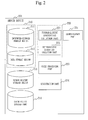
- Fig. 2 is a block diagram illustrating a configuration example of the server device 201, in the concealed search system 100, where the data and keyword are held and searched for.
- the constituent elements of each device illustrated in Fig. 2 will be described below.
- Fig. 3 is a block diagram illustrating a configuration example of the registration device 301 in the concealed search system 100, which registers the encrypted data (search target data) to the server device 201.
- Fig. 4 is a block diagram illustrating a configuration example of the search device 401 in the concealed search system 100, which requests the server device 201 to search encrypted data.
- Fig. 21 indicates initial setting of the server device 201 and the like.
- the server device 201 stores the cache policy to the cache policy storage region 214.
- the cache policy is, for example, a policy on "whether or not to store the search request sent from the search device 401 and the result of a search process to the search history storage region 213 and the encrypted keyword storage region 211".
- the cache policy may be decided by the administrator of a company or the like that utilizes the search device 401 and the concealed search system 100, and sent to the server device 201 by the administrator.
- the cache policy may be decided by the server device 201 itself. In the following description, the cache policy is "to cache all search requests and search results".
- the search device 401 stores the private information to be used for data decryption, trapdoor generation, and deterministic encrypted keyword generation, to the search cipher key storage region 411.
- the private information may be generated by the data decryption processing part 421, trapdoor generating part 422, and deterministic encrypted keyword generating part 423 themselves. Alternatively, private information appropriately generated by an external device may be acquired. If the private information for data decryption and trapdoor generation is to be generated by the search device 401 itself, corresponding cipher keys for data encryption and encrypted keyword generation may be open to the public or sent to the registration device 301.
- the registration device 301 stores the cipher keys to be used for data encryption and encrypted keyword generation to the registration cipher key storage region 311.
- the registration device 301 acquires cipher keys corresponding to the private information stored in the search cipher key storage region 411 of the search device 401, and stores the acquired cipher keys. The procedure is now completed.
- the registration device 301 transmits data to the server device 201
- the registration device 301 transmits encrypted keyword and encrypted data separately so that the search device 401 can perform concealed search later on.
- the server device 201 that has received the encrypted keyword and encrypted data stores the encrypted keyword and encrypted data to the encrypted keyword storage region 211 and the data storage region 212 by referring to the search history storage region 213 as required. This procedure will be described below step by step together with a practical example.
- Fig. 22 is a flowchart of the transmission process of the registration device 301. The process of transmitting data to the server device 201 by the registration device 301 will be described with reference to Fig. 22 .
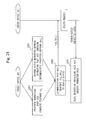
- Fig. 23 is a flowchart of a data registration process of the server device 201. The data registration process by the server device 201 will be described with reference to Fig. 23 .
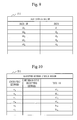
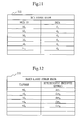
- the probabilistic encryption collation part 221 conducts a keyword matching check of the trapdoors (td 1 ) to (td 5 ) and the encrypted keyword (c 6 ). If keyword matching is confirmed between (td 2 ) and (c 6 ), it indicates that the deterministic encrypted keyword corresponding to the encrypted keyword (c 6 ) is (det 2 ). Thus, (c 6 ) and (det 2 ) are associated with each other and stored in the encrypted keyword storage region 211. As a result, the encrypted keyword storage region 211 is updated as in Fig. 13 . If a keyword matching is not found, no particular process is performed. The procedure is now completed.
- the right search device 401 can perform concealed search for data stored in the server device 201 by specifying a keyword. This procedure will be described below step by step together with a practical example.
- Fig. 24 is a flowchart indicating a search request process of the search device 401.
- the search request transmission process by the search device 401 will be described with reference to Fig. 24 .
- Fig. 25 is a process flowchart of a concealed search of the server device 201.
- the concealed search process of the server device 201 will be described with reference to Fig. 25 .
- a cache process of "search request and search result" is further practiced (S312). More specifically, the cache processing part 223 stores the search request to the search history storage region 213 in accordance with the content of the cache policy (history policy) stored in the cache policy storage region 214. For the record with a matching keyword among the records of the encrypted keyword storage region 211, the cache processing part 223 stores the deterministic encrypted keyword (det x ) included in the search request, as the deterministic encrypted keyword (det) (S311, S312).
- the cache processing part 223 decides whether or not to store det x included in the search request (td x , det x ) in accordance with the content of the cache policy (association policy) stored in the cache policy storage region 214. If the cache policy instructs to store det x , the cache processing part 223 stores det x of the search request by associating det x with (c k ) of the encrypted keyword storage region 211.
- the data decryption processing part 421 of the search device 401 that has received the encrypted data, being the search result, decrypts the encrypted data using the data decryption key stored in the search cipher key storage region 411.
- an existing cryptographic technology that allows only the right search device 401 to decrypt is utilized. The procedure is now completed.
- (det 6 ) is a value that is different from any one of (det 1 ) to (det 5 ).
- the deterministic encryption collation part 222 of the server device 201 searches the search history storage region 213 ( Fig. 12 ) for the deterministic encrypted keyword (det 6 )
- the deterministic encrypted keyword (det 6 ) cannot be found.
- the probabilistic encryption collation part 221 searches the encrypted keyword storage region 211 ( Fig. 10 ) for an encrypted keyword that matches the trapdoor (td 6 ).
- the server device 201 transmits encrypted data (d 2 ) and (d 5 ) corresponding to (c 2 ) and (c 5 ) to the search device 401 as the search result.
- the cache processing part 223 of the server device 201 stores the deterministic encrypted keyword (det 6 ) to a matching record in the encrypted keyword storage region 211 ( Fig. 10 ) and stores the search request (td 6 , det 6 ) to the search history storage region 213 ( Fig. 12 ).
- the encrypted keyword storage region 211 and search history storage region 213 are updated as in Figs. 14 and 15 , respectively.
- the search device 401 further transmits a search request (td 7 , det 6 ) generated from the same keyword to the server device 201 (note that the deterministic encrypted keywords have the same value while the trapdoors have different values).
- the deterministic encryption collation part 222 of the server device 201 searches the search history storage region 213 ( Fig. 15 ) for the deterministic encrypted keyword (det 6 )
- the deterministic encrypted keyword that has been stored as described above is found.
- the deterministic encryption collation part 222 searches the encrypted keyword storage region 211 ( Fig. 14 ) for a record that includes the deterministic encrypted keyword (det 6 ).
- records that include (c 2 ) and (c 5 ) are hit.
- the server device 201 transmits encrypted data (d 2 ) and (d 5 ) corresponding to (c 2 ) and (c 5 ) to the search device 401 as the search results. Since the deterministic encrypted keyword is found this time by the binary matching checking of the search history storage region 213 ( Fig. 15 ), a cache process concerning the search request and search result will not be performed.
- the procedures of (A. Initial Device Setting) to (C. Search and Acquisition of Data) can realize a concealed search system in which the search device 401 can perform search while concealing data and keyword from the server device 201.
- a process (concealed search based on probabilistic encryption) by the probabilistic encryption collation part 221 is not performed at all, and all keyword matching checks are performed only as a binary matching check of the deterministic encryption collation part 222. Therefore, the time required for the search process can be shortened largely.
- the method described in this embodiment additionally discloses only the deterministic encrypted keyword (det x ) included in the search request to the server device 201.
- the security against the server device 201 does not decrease at all.
- the keyword identicalness may leak for some encrypted keywords in Fig. 14 , ((c 2 ) and (c 5 )) stored in the encrypted keyword storage region 211. Note that this information is available to the server device 201 even in conventional concealed search (that employs only probabilistic encryption). Thus, the security against the server device 201 is not decreased.
- the server device 201 stores the deterministic encrypted keyword, additional information may leak to an attacker if data leaks to the external attacker. More specifically, in the conventional search request (that employs only the probabilistic encryption), when data leaks, the external attacker cannot make a frequency analysis attack. On the contrary, with the method described in this embodiment, a frequency analysis attack for a searched keyword is possible. This poses the issue of trade-off between "high-speed search" and "security against an external attacker".
- the cache policy storage region 214 and cache processing part 223 have as one of their roles to control this issue. More specifically, if the user side of the concealed search system 100 puts the highest priority to the speed-up of the search, all search histories and all search results may be cached, as in this embodiment. Alternatively, if the speed-up need be ensured only for a frequently used search keyword, a cache policy that satisfies it may be set.
- Another significance of the cache policy is to control the number of trapdoors to be stored in the search history storage region 213. If all the search histories (or the trapdoors included in all the search histories) are cached as in Embodiment 1, when the number of trapdoors increases, data registration in the procedure of (B. Transmission and Storage of Search Target Data) wastes time for the collation process of the encrypted keyword and each trapdoor (S203). In view of this, a cache policy that restricts the number of trapdoors to be stored in the search history storage region 213 may be set, so that data registration will not take too much time.
- an encrypted keyword (c) collated (collation of S309) with a certain trapdoor (td x ) and an encrypted keyword (c) non-collated may mix in the encrypted keyword storage region 211. Therefore, information for distinguishing the two different keywords is necessary.
- the encrypted keyword storage region 211 stores a content as represented in Fig. 16 and that the search history storage region 213 stores a content as represented in Fig. 17 .
- Figs. 16 and 17 can express the following contents.
- Fig. 17 can express the following circumstance. For record IDs 1 to 5 (c 1 to c 5 ) of the encrypted keyword storage region 211 ( Fig.
- the registration device 301 also encrypts data (pre-encryption data which will form the encrypted data) not used for search and transmits the encrypted data to the server device 201.
- data pre-encryption data which will form the encrypted data
- the registration device 301 also encrypts data (pre-encryption data which will form the encrypted data) not used for search and transmits the encrypted data to the server device 201.
- the data need not be concealed, it may be transmitted to the server device 201 without being encrypted. If data that needs to be concealed and data that does not mix among data that are not to be used for search, only the data that needs to be concealed may be encrypted and transmitted to the server device 201.
- encryption for example, common key cryptography such as AES
- AES common key cryptography
- the keyword need not always be encrypted as far as the same keyword is transformed into the same value and that the original keyword is concealed.
- a keyed hash function such as HMAC may be employed.
- a deterministic encrypted keyword and a trapdoor which is generated probabilistically from a keyword are employed as the search request. If a trapdoor that can be collated with an encrypted keyword (which is generated probabilistically) can be generated from a keyword deterministically, then a single deterministic trapdoor can be imparted with the function of the trapdoor and the function of the deterministic encrypted keyword.
- This can be realized by, for example, deterministically generating a random number to be used for probabilistic trapdoor generation (by means of, for example, applying the hash function to the keyword). In this case, it is necessary to pay attention because deterministic random number generation may decrease the security of the method.
- the cache policy determined in the procedure stays unchanged throughout the entire system.
- the cache policy may be changed by, for example, the administrator of the company that uses the system.
- each time the server device 201 receives an encrypted keyword the server device 201 conducts a collation process with respect to each of the trapdoors stored in the search history storage region 213.
- this collation process may be performed as a batch process during, for example, the night (where the server device 201 may have a surplus processing capability).
- a collated encrypted keyword and a non-collated encrypted keyword with respect to a trapdoor in the search history storage region 213 may exist in the encrypted keyword storage region 211.
- information for distinguishing the two types of keywords is necessary.
- the registration device 301 assigns a data ID to each piece of data and associates the encrypted keyword and the encrypted data with each other. Alternatively, this may be performed by the server device 201. More specifically, the registration device 301 transmits a set (c x , d x ) of an encrypted keyword and encrypted data to the server device 201. Then, the server device 201 assigns a unique data ID (id x ) to the set, and stores (c x , id x ) to the encrypted keyword storage region 211 and (id x , d x ) to the data storage region 212.
- the encrypted keyword and the encrypted data are stored separately in the encrypted keyword storage region 211 and data storage region 212, respectively.
- the data to be stored will be, for example, as indicated in Fig. 18 .
- This embodiment indicates an example in which one keyword corresponds to one piece of data.
- a plurality of keywords may correspond to one piece of data.
- the data indicated in Fig. 19 are stored in the encrypted keyword storage region 211.
- encrypted keywords (c 3 ) and (c 4 ) correspond to data associated with (id 3 ).
- the data storage region 212 is utilized to return the encrypted data as the search result.
- the server device 201 need not have the data storage region 212.
- the encrypted data may be held by another device, and only the data ID may be returned to enable access to the encrypted data.
- the registration device 301 and the search device 401 are separate devices. However, in a case where, for example, only the information searcher can register information, the registration device 301 and the search device 401 may be put together into one device. In that case, the encrypted keyword generation key and the like no longer need be open to the public. As a result, the concealed search system 100 can be operated without the risk of giving unsolicited information to the attacker.
- the cipher key and the private information are stored in the registration cipher key storage region 311 of the registration device 301 and the search cipher key storage region 411 of the search device 401.
- they may be acquired from the outside when necessary.
- the cipher key and the private information may be acquired from an IC card or automatically generated from the password or biological information.
- a single set of registration device 301 and a single set of search device 401 are employed.
- a plurality of registration devices 301 and a plurality of search devices 401 may be employed that can register and search data independently.
- the plurality of search devices 401 share the trapdoor generation key and the deterministic encrypted keyword generation key, different devices can obtain the same search result.
- search results are to differ from one device to another using the same search keyword, the different devices must have different trapdoor generation keys as well as different deterministic encrypted keyword generation keys.
- Embodiment 2 will now be described with reference to Figs. 26 and 27 .
- Embodiment 2 explains the hardware configuration of a server device 201, a registration device 301, or a search device 401 each being a computer. Since the server device 201, the registration device 301, and the search device 401 are each a computer, the server device 201 will be explained below as an example. The following explanation on the server device 201 applies to the registration device 301 and the search device 401 as well.
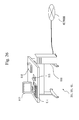
- Fig. 26 is an illustration of an example of the appearance of the server device 201 which is a computer.
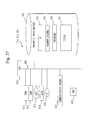
- Fig. 27 is a diagram illustrating an example of the hardware resources of the server device 201 which is a computer.
- the server device 201 includes hardware resources such as a system unit 830, a display device 813 such as a CRT (Cathode Ray Tube) or LCD (Liquid Crystal Display) having a display screen, a keyboard 814 (K/B), a mouse 815, and a compact disk drive 818 (CDD: Compact Disk Drive). These hardware resources are connected via cables and signal lines.
- the system unit 830 is connected to a network.
- the server device 201 has a CPU 810 (Central Processing Unit) which executes programs.
- the CPU 810 is connected to a ROM (Read Only Memory) 811, a RAM (Random Access Memory) 812, the display device 813, the keyboard 814, the mouse 815, a communication board 816, the CDD 818, and a magnetic disk device 820 via a bus 825, and controls these hardware devices.
- a storage device such as an optical disc device or flash memory may be employed.
- the RAM 812 is an example of a volatile memory.
- Storage media such as the ROM 811, the CDD 818, and the magnetic disk device 820 are examples of a nonvolatile memory. These memories are examples of a storage device, storage part, storing part, buffer, or storage region.
- the communication board 816, keyboard 814, and the like are examples of an input part or input device. Also, the communication board 816, display device 813, and the like are examples of an output part or output device.
- the communication board 816 (communication part) is connected to the network.
- the magnetic disk device 820 stores an operating system 821 (OS), a window system 822, programs 823, and files 824.
- OS operating system
- window system 822 programs 823
- files 824 files 824.
- the CPU 810, operating system 821, and window system 822 execute each program of the programs 823.
- the programs 823 include a program that executes the function described as a "part" in the description of this embodiment.
- the program is read and executed by the CPU 810.
- Information, data, signal values, variable values, parameters, and the like described as the "checking result”, “calculation result”, “extraction result”, “generation result”, or “processing result” in the above explanation of the embodiments are stored in the files 824 as the items of a "file” or “database”.
- the "file” and “database” are stored in a recording medium such as a disk or memory.
- the information, data, signal values, variable values, and parameters stored in a storage medium such as a disk or memory are read into the main memory or cache memory by the CPU 810 through a read/write circuit, and are used for the operation of the CPU 810 such as extraction, search, look-up, comparison, computation, calculation, processing, output, print, and display.
- the information, data, signal values, variable values, and parameters are temporarily stored in the main memory, cache memory, or buffer memory during the operation of the CPU such as extraction, search, look-up, comparison, computation, calculation, processing, output, print, and display.
- the data and signals are recorded in a recording medium such as the memory of the RAM 812, the compact disk of the CDD 818, the magnetic disk of the magnetic disk device 820, an optical disc, a minidisc, a DVD (Digital Versatile Disk), or the like.
- the data and signals are transmitted online via the bus 825, the signal lines, the cables, or other transmission media.
- What is described as a “part” in the description of the above embodiments may be a “means”; or a “step”, “procedure”, or “process”. Namely, what is described as a “part” may be implemented only as software, as a combination of software and hardware, or as a combination of software, hardware, and firmware.
- the firmware and software are stored, as programs, in a recording medium such as the magnetic disk, flexible disk, optical disk, compact disc, minidisc, or DVD.
- the program is read by the CPU 810 and executed by the CPU 810. That is, the program causes the computer to function as a "part” mentioned above. Alternatively, the program causes the computer to execute the procedure or method of a "part” mentioned above.
- the server device 201 is explained.
- the server device 201 can also be treated as a concealed search program which is to serve as the server device 201.
- the operation of each "part" of the server device 201 can be treated as a concealed search method.
- 100 concealed search system; 201: server device; 210: data storage part; 211: encrypted keyword storage region; 212: data storage region; 213: search history storage region; 214: cache policy storage region; 220: checking part; 221: probabilistic encryption collation part; 222: deterministic encryption collation part; 223: cache processing part; 224: registration part; 231: communication part; 301: information registration device; 311: registration cipher key storage region; 321: data encryption processing part; 322: encrypted keyword generating part; 331: communication part; 401: information search device; 411: search cipher key storage region; 421: data decryption processing part; 422: trapdoor generating part; 423: deterministic encrypted keyword generating part; 431: communication part
Landscapes
- Engineering & Computer Science (AREA)
- Theoretical Computer Science (AREA)
- Physics & Mathematics (AREA)
- General Physics & Mathematics (AREA)
- Computer Security & Cryptography (AREA)
- Computer Hardware Design (AREA)
- Bioethics (AREA)
- General Health & Medical Sciences (AREA)
- Health & Medical Sciences (AREA)
- General Engineering & Computer Science (AREA)
- Software Systems (AREA)
- Computing Systems (AREA)
- Computer Networks & Wireless Communication (AREA)
- Signal Processing (AREA)
- Medical Informatics (AREA)
- Databases & Information Systems (AREA)
- Mathematical Physics (AREA)
- Storage Device Security (AREA)
- Information Retrieval, Db Structures And Fs Structures Therefor (AREA)
Applications Claiming Priority (1)
| Application Number | Priority Date | Filing Date | Title |
|---|---|---|---|
| PCT/JP2013/054735 WO2014128958A1 (fr) | 2013-02-25 | 2013-02-25 | Dispositif serveur, programme de recherche privée, support d'enregistrement et système de recherche privée |
Publications (2)
| Publication Number | Publication Date |
|---|---|
| EP2960808A1 true EP2960808A1 (fr) | 2015-12-30 |
| EP2960808A4 EP2960808A4 (fr) | 2016-10-26 |
Family
ID=51390781
Family Applications (1)
| Application Number | Title | Priority Date | Filing Date |
|---|---|---|---|
| EP13875718.2A Ceased EP2960808A4 (fr) | 2013-02-25 | 2013-02-25 | Dispositif serveur, programme de recherche privée, support d'enregistrement et système de recherche privée |
Country Status (5)
| Country | Link |
|---|---|
| US (1) | US10235539B2 (fr) |
| EP (1) | EP2960808A4 (fr) |
| JP (1) | JP5963936B2 (fr) |
| CN (1) | CN104995621B (fr) |
| WO (1) | WO2014128958A1 (fr) |
Cited By (4)
| Publication number | Priority date | Publication date | Assignee | Title |
|---|---|---|---|---|
| EP3382576A4 (fr) * | 2016-01-14 | 2018-10-03 | Mitsubishi Electric Corporation | Système de recherche anonyme, procédé de recherche anonyme et programme de recherche anonyme |
| CN110226190A (zh) * | 2017-01-27 | 2019-09-10 | 三菱电机株式会社 | 检索装置、监视装置、监视方法和检索程序 |
| US11005645B2 (en) | 2016-01-15 | 2021-05-11 | Mitsubishi Electric Corporation | Encryption device, encryption method, computer readable medium, and storage device |
| US11106740B2 (en) | 2017-04-25 | 2021-08-31 | Mitsubishi Electric Corporation | Search device, search system, search method, and computer readable medium |
Families Citing this family (23)
| Publication number | Priority date | Publication date | Assignee | Title |
|---|---|---|---|---|
| CN104702781A (zh) * | 2015-02-04 | 2015-06-10 | 深圳市中兴移动通信有限公司 | 一种信息加密的方法及装置 |
| JP6441160B2 (ja) * | 2015-04-27 | 2018-12-19 | 株式会社東芝 | 秘匿化装置、復号装置、秘匿化方法および復号方法 |
| US10936757B2 (en) * | 2016-05-27 | 2021-03-02 | Mitsubishi Electric Corporation | Registration destination determination device, searchable encryption system, destination determination method, and computer readable medium |
| FR3057123A1 (fr) * | 2016-09-30 | 2018-04-06 | Orange | Procede et systeme de detection d'intrusions sur un reseau |
| US11196541B2 (en) | 2017-01-20 | 2021-12-07 | Enveil, Inc. | Secure machine learning analytics using homomorphic encryption |
| US11777729B2 (en) | 2017-01-20 | 2023-10-03 | Enveil, Inc. | Secure analytics using term generation and homomorphic encryption |
| US11507683B2 (en) | 2017-01-20 | 2022-11-22 | Enveil, Inc. | Query processing with adaptive risk decisioning |
| WO2018136811A1 (fr) | 2017-01-20 | 2018-07-26 | Enveil, Inc. | Navigation web sécurisée par chiffrement homomorphique |
| US10880275B2 (en) | 2017-01-20 | 2020-12-29 | Enveil, Inc. | Secure analytics using homomorphic and injective format-preserving encryption |
| WO2018136801A1 (fr) | 2017-01-20 | 2018-07-26 | Enveil, Inc. | Opérations sécurisées de bout en bout à l'aide d'une matrice d'interrogation |
| KR101979267B1 (ko) * | 2017-05-29 | 2019-05-16 | 성균관대학교산학협력단 | 클라우드 저장 기반 암호화 시스템 및 방법 |
| AU2018387969B2 (en) * | 2017-12-18 | 2021-07-22 | Ntt, Inc. | Secret computation system and method |
| AU2018389418B2 (en) * | 2017-12-19 | 2021-11-04 | Ntt, Inc. | Retrieval device, retrieval method, program, and recording medium |
| US20210067317A1 (en) * | 2018-01-17 | 2021-03-04 | Mitsubishi Electric Corporation | Data management device, data management method, and computer readable medium |
| WO2019220531A1 (fr) * | 2018-05-15 | 2019-11-21 | 三菱電機株式会社 | Dispositif et procédé de recherche de secret |
| US10902133B2 (en) | 2018-10-25 | 2021-01-26 | Enveil, Inc. | Computational operations in enclave computing environments |
| US10817262B2 (en) | 2018-11-08 | 2020-10-27 | Enveil, Inc. | Reduced and pipelined hardware architecture for Montgomery Modular Multiplication |
| CN109766314A (zh) * | 2019-01-07 | 2019-05-17 | 西安电子科技大学 | 基于概率陷门的密文数据多关键词搜索方法 |
| US11601258B2 (en) | 2020-10-08 | 2023-03-07 | Enveil, Inc. | Selector derived encryption systems and methods |
| CN112784309B (zh) * | 2021-02-20 | 2022-08-23 | 青岛大学 | 数据安全管理方法、电子设备和存储介质 |
| CN113904823B (zh) * | 2021-09-28 | 2024-02-27 | 长沙学院 | 常数级授权计算复杂度的属性基可搜索加密方法及系统 |
| DE112021008343B4 (de) | 2021-12-14 | 2026-04-02 | Mitsubishi Electric Corporation | Geheimsuchsystem, geheimsuchverfahren, und geheimsuchprogramm |
| US12197615B2 (en) | 2022-07-19 | 2025-01-14 | IronCore Labs, Inc. | Secured search for ready-made search software |
Family Cites Families (52)
| Publication number | Priority date | Publication date | Assignee | Title |
|---|---|---|---|---|
| US5991414A (en) | 1997-09-12 | 1999-11-23 | International Business Machines Corporation | Method and apparatus for the secure distributed storage and retrieval of information |
| JP3457184B2 (ja) | 1998-06-25 | 2003-10-14 | シャープ株式会社 | 検索装置及びその制御プログラムを記憶した媒体 |
| US7068787B1 (en) | 1998-10-23 | 2006-06-27 | Contentguard Holdings, Inc. | System and method for protection of digital works |
| US6519700B1 (en) | 1998-10-23 | 2003-02-11 | Contentguard Holdings, Inc. | Self-protecting documents |
| JP4519963B2 (ja) | 1999-06-21 | 2010-08-04 | 富士通株式会社 | 生体情報の暗号化・復号化方法および装置並びに、生体情報を利用した本人認証システム |
| CA2341979A1 (fr) * | 2000-03-24 | 2001-09-24 | Contentguard Holdings, Inc. | Systeme et methode de protection d'oeuvres numeriques |
| US7496767B2 (en) | 2001-01-19 | 2009-02-24 | Xerox Corporation | Secure content objects |
| KR20040039357A (ko) * | 2001-09-14 | 2004-05-10 | 컴퓨터 어소시에이츠 싱크, 인코포레이티드 | 컴퓨터 바이러스 검출 및 치료 방법과 시스템, 프로그램저장 매체, 암호형 데이터 해독 방법, 암호형 컴퓨터바이러스 치료 방법 |
| US7171557B2 (en) | 2001-10-31 | 2007-01-30 | Hewlett-Packard Development Company, L.P. | System for optimized key management with file groups |
| JP2003178070A (ja) | 2001-12-12 | 2003-06-27 | Canon Inc | 情報検索装置 |
| US20050271246A1 (en) | 2002-07-10 | 2005-12-08 | Sharma Ravi K | Watermark payload encryption methods and systems |
| US20050004924A1 (en) * | 2003-04-29 | 2005-01-06 | Adrian Baldwin | Control of access to databases |
| CN100568253C (zh) * | 2003-09-26 | 2009-12-09 | 日本电信电话株式会社 | 标签隐私保护方法、更新装置、更新委托装置、标签装置 |
| JP4395611B2 (ja) | 2003-10-28 | 2010-01-13 | 独立行政法人情報通信研究機構 | 暗号化データベース検索装置および方法ならびに暗号化データベース検索プログラム |
| US20050138393A1 (en) | 2003-12-22 | 2005-06-23 | Challener David C. | Determining user security level using trusted hardware device |
| JP2005284915A (ja) | 2004-03-30 | 2005-10-13 | Canon Inc | 情報検索装置および方法、ならびに情報検索システムおよびその制御方法 |
| EP1815637B1 (fr) | 2004-11-16 | 2016-04-20 | Koninklijke Philips N.V. | Calcul fiable d'une mesure de similitude |
| JP2006210964A (ja) | 2005-01-24 | 2006-08-10 | National Institute Of Information & Communication Technology | エルガマル暗号による情報授受伝達方法及び装置 |
| JP2006262333A (ja) | 2005-03-18 | 2006-09-28 | Ic Brains Co Ltd | 生体認証システム |
| JP4722620B2 (ja) | 2005-08-19 | 2011-07-13 | Kddi株式会社 | 暗号化文書検索方法および暗号化文書検索システム |
| JP4961214B2 (ja) | 2006-03-29 | 2012-06-27 | 株式会社日立情報制御ソリューションズ | 生体認証方法およびシステム |
| JP2008097438A (ja) | 2006-10-13 | 2008-04-24 | Hitachi Ltd | ユーザ認証システム、認証サーバ、端末、及び耐タンパデバイス |
| US20090094200A1 (en) * | 2007-10-05 | 2009-04-09 | Yahoo! Inc. | Method for Admission-controlled Caching |
| JP2009129210A (ja) | 2007-11-25 | 2009-06-11 | Tokyo Institute Of Technology | チャレンジ・レスポンス生体認証方法 |
| US8995665B1 (en) | 2008-08-20 | 2015-03-31 | Symantec Corporation | Role based encryption without key management system |
| US8165305B2 (en) | 2008-12-08 | 2012-04-24 | Harrison Corporation | Enhanced relational database security through encryption of table indices |
| JP5147673B2 (ja) | 2008-12-18 | 2013-02-20 | 株式会社日立製作所 | 生体認証システムおよびその方法 |
| JP2010160235A (ja) | 2009-01-07 | 2010-07-22 | Nippon Telegr & Teleph Corp <Ntt> | 検索システム、端末装置、データベース装置、検索方法及びプログラム |
| JP2010165275A (ja) | 2009-01-19 | 2010-07-29 | Mitsubishi Electric Corp | データ格納システム及び情報送信装置及びサーバ装置 |
| US8837718B2 (en) | 2009-03-27 | 2014-09-16 | Microsoft Corporation | User-specified sharing of data via policy and/or inference from a hierarchical cryptographic store |
| EP2426640A4 (fr) | 2009-04-28 | 2018-01-03 | Fujitsu Limited | Dispositif, procédé et programme d'authentification biométrique |
| US8495056B2 (en) * | 2009-09-21 | 2013-07-23 | At&T Intellectual Property I, L.P. | System and method for caching database reports |
| WO2011052056A1 (fr) | 2009-10-29 | 2011-05-05 | 三菱電機株式会社 | Dispositif de traitement de données |
| JP5269209B2 (ja) | 2010-01-13 | 2013-08-21 | 三菱電機株式会社 | 秘匿検索システム及び公開パラメータ生成装置及び暗号化装置及びユーザ秘密鍵生成装置及びクエリ発行装置及び検索装置及びコンピュータプログラム及び秘匿検索方法及び公開パラメータ生成方法及び暗号化方法及びユーザ秘密鍵生成方法及びクエリ発行方法及び検索方法 |
| US8615668B2 (en) | 2010-01-15 | 2013-12-24 | Mitsubishi Electric Corporation | Confidential search system and cryptographic processing system |
| JP5432736B2 (ja) | 2010-01-18 | 2014-03-05 | 日本電信電話株式会社 | 暗号化された情報のためのキーワード検索システム、キーワード検索方法、検索要求装置、検索代行装置、プログラム、記録媒体 |
| JP5411034B2 (ja) * | 2010-03-19 | 2014-02-12 | 株式会社日立ソリューションズ | データベース暗号化システム及び方法 |
| JP5573293B2 (ja) | 2010-03-30 | 2014-08-20 | 富士通株式会社 | 認証装置、暗号化装置、トークンデバイス、認証方法、および認証プログラム |
| JP5557683B2 (ja) * | 2010-10-07 | 2014-07-23 | 三菱電機株式会社 | 情報検索装置および情報検索方法 |
| JP5412414B2 (ja) * | 2010-12-08 | 2014-02-12 | 株式会社日立製作所 | 検索可能暗号処理システム |
| US8429421B2 (en) * | 2010-12-17 | 2013-04-23 | Microsoft Corporation | Server-side encrypted pattern matching |
| EP2665052B1 (fr) | 2011-01-13 | 2018-08-15 | Mitsubishi Electric Corporation | Dispositif de traitement de données et dispositif d'archivage de données |
| WO2012098649A1 (fr) | 2011-01-18 | 2012-07-26 | 三菱電機株式会社 | Système de chiffrement, procédé de gestion de chiffrement pour un système de chiffrement, dispositif de chiffrement, programme de chiffrement, dispositif de déchiffrement, programme de déchiffrement, dispositif de paramétrage, programme de paramétrage, dispositif de génération de clé, programme de génération de clé, dispositif d'attribution de clé et programme d'attribution de clé |
| JP2012164031A (ja) * | 2011-02-03 | 2012-08-30 | Mitsubishi Electric Corp | データ処理装置及びデータ保管装置及びデータ処理方法及びデータ保管方法及びプログラム |
| JP5496410B2 (ja) | 2011-02-22 | 2014-05-21 | 三菱電機株式会社 | 類似度算出システム及び類似度算出装置及びコンピュータプログラム及び類似度算出方法 |
| JP2012248940A (ja) * | 2011-05-25 | 2012-12-13 | Mitsubishi Electric Corp | データ生成装置、データ生成方法、データ生成プログラム及びデータベースシステム |
| US8549653B2 (en) | 2011-09-14 | 2013-10-01 | Morgan Stanley | Secure wildcard searchable database |
| WO2013080320A1 (fr) | 2011-11-30 | 2013-06-06 | 三菱電機株式会社 | Dispositif de traitement de données, procédé de traitement de données et programme |
| US9087212B2 (en) * | 2012-01-25 | 2015-07-21 | Massachusetts Institute Of Technology | Methods and apparatus for securing a database |
| WO2013111284A1 (fr) | 2012-01-25 | 2013-08-01 | 三菱電機株式会社 | Dispositif, procédé et programme de recherche de données, dispositif, procédé et programme d'enregistrement de données et dispositif de traitement d'informations |
| US20140019454A1 (en) * | 2012-07-10 | 2014-01-16 | Jason A. Carter | Systems and Methods for Caching Data Object Identifiers |
| EP2945313B1 (fr) | 2013-01-12 | 2017-09-06 | Mitsubishi Electric Corporation | Dispositif de génération de clé, programme de génération de clé, système de recherche de données cachées et procédé de distribution de clé |
-
2013
- 2013-02-25 JP JP2015501221A patent/JP5963936B2/ja active Active
- 2013-02-25 CN CN201380072944.3A patent/CN104995621B/zh active Active
- 2013-02-25 US US14/765,050 patent/US10235539B2/en active Active
- 2013-02-25 WO PCT/JP2013/054735 patent/WO2014128958A1/fr not_active Ceased
- 2013-02-25 EP EP13875718.2A patent/EP2960808A4/fr not_active Ceased
Cited By (5)
| Publication number | Priority date | Publication date | Assignee | Title |
|---|---|---|---|---|
| EP3382576A4 (fr) * | 2016-01-14 | 2018-10-03 | Mitsubishi Electric Corporation | Système de recherche anonyme, procédé de recherche anonyme et programme de recherche anonyme |
| US10872158B2 (en) | 2016-01-14 | 2020-12-22 | Mitsubishi Electric Corporation | Secret search system, secret search method, and computer readable medium |
| US11005645B2 (en) | 2016-01-15 | 2021-05-11 | Mitsubishi Electric Corporation | Encryption device, encryption method, computer readable medium, and storage device |
| CN110226190A (zh) * | 2017-01-27 | 2019-09-10 | 三菱电机株式会社 | 检索装置、监视装置、监视方法和检索程序 |
| US11106740B2 (en) | 2017-04-25 | 2021-08-31 | Mitsubishi Electric Corporation | Search device, search system, search method, and computer readable medium |
Also Published As
| Publication number | Publication date |
|---|---|
| US20150371062A1 (en) | 2015-12-24 |
| CN104995621B (zh) | 2018-06-05 |
| EP2960808A4 (fr) | 2016-10-26 |
| CN104995621A (zh) | 2015-10-21 |
| JPWO2014128958A1 (ja) | 2017-02-02 |
| WO2014128958A1 (fr) | 2014-08-28 |
| JP5963936B2 (ja) | 2016-08-03 |
| US10235539B2 (en) | 2019-03-19 |
Similar Documents
| Publication | Publication Date | Title |
|---|---|---|
| US10235539B2 (en) | Server device, recording medium, and concealed search system | |
| US9461819B2 (en) | Information sharing system, computer, project managing server, and information sharing method used in them | |
| US9600677B2 (en) | Database apparatus, method, and program | |
| CN109344631B (zh) | 区块链的数据修改及区块验证方法、装置、设备和介质 | |
| US20240061790A1 (en) | Locally-stored remote block data integrity | |
| CN109981297B (zh) | 区块链处理方法、装置、设备及存储介质 | |
| US10361840B2 (en) | Server apparatus, search system, terminal apparatus, search method, non-transitory computer readable medium storing server program, and non-transitory computer readable medium storing terminal program | |
| US10872158B2 (en) | Secret search system, secret search method, and computer readable medium | |
| US20160379013A1 (en) | Cryptographic assurances of data integrity for data crossing trust boundaries | |
| CN101925913A (zh) | 加密文件访问的方法和系统 | |
| CN113645226B (zh) | 一种基于网关层的数据处理方法、装置、设备及存储介质 | |
| JP2012164031A (ja) | データ処理装置及びデータ保管装置及びデータ処理方法及びデータ保管方法及びプログラム | |
| CN111737720B (zh) | 数据处理方法、装置及电子设备 | |
| US9087181B2 (en) | Method of managing virtual computer, computer system and computer | |
| US11829498B2 (en) | Real-time dynamic blockchain securitization platform | |
| CN112567441A (zh) | 信息处理系统、信息处理方法和信息处理装置 | |
| US20210081562A1 (en) | Data processing apparatus, data processing method, and computer readable medium | |
| CN109891425A (zh) | 序列验证 | |
| US8924733B2 (en) | Enabling access to removable hard disk drives | |
| JP6381861B2 (ja) | 登録先決定装置、登録装置、秘匿検索システム、登録先決定方法及び登録先決定プログラム | |
| US9086999B2 (en) | Data encryption management | |
| US9560022B1 (en) | Avoiding collection of biometric data without consent | |
| JP2013114534A (ja) | データ処理装置及びデータ処理方法及びプログラム | |
| WO2020245898A1 (fr) | Dispositif de recherche, dispositif serveur, procédé de recherche, procédé de traitement d'informations, programme de recherche, et programme de traitement d'informations | |
| JP2014203065A (ja) | 検索データ保護装置、情報検索システム、検索データ保護方法、及びそのプログラム |
Legal Events
| Date | Code | Title | Description |
|---|---|---|---|
| PUAI | Public reference made under article 153(3) epc to a published international application that has entered the european phase |
Free format text: ORIGINAL CODE: 0009012 |
|
| 17P | Request for examination filed |
Effective date: 20150806 |
|
| AK | Designated contracting states |
Kind code of ref document: A1 Designated state(s): AL AT BE BG CH CY CZ DE DK EE ES FI FR GB GR HR HU IE IS IT LI LT LU LV MC MK MT NL NO PL PT RO RS SE SI SK SM TR |
|
| AX | Request for extension of the european patent |
Extension state: BA ME |
|
| DAX | Request for extension of the european patent (deleted) | ||
| A4 | Supplementary search report drawn up and despatched |
Effective date: 20160926 |
|
| RIC1 | Information provided on ipc code assigned before grant |
Ipc: G06F 21/62 20130101ALI20160920BHEP Ipc: G09C 1/00 20060101ALI20160920BHEP Ipc: H04L 9/30 20060101ALI20160920BHEP Ipc: G06F 21/60 20130101ALI20160920BHEP Ipc: G06F 17/30 20060101AFI20160920BHEP |
|
| 17Q | First examination report despatched |
Effective date: 20170802 |
|
| REG | Reference to a national code |
Ref country code: DE Ref legal event code: R003 |
|
| STAA | Information on the status of an ep patent application or granted ep patent |
Free format text: STATUS: THE APPLICATION HAS BEEN REFUSED |
|
| 18R | Application refused |
Effective date: 20181204 |