EP2963032A1 - Neuartiges naphthotriazolderivat und organisches elektrolumineszenzelement - Google Patents
Neuartiges naphthotriazolderivat und organisches elektrolumineszenzelement Download PDFInfo
- Publication number
- EP2963032A1 EP2963032A1 EP14756351.4A EP14756351A EP2963032A1 EP 2963032 A1 EP2963032 A1 EP 2963032A1 EP 14756351 A EP14756351 A EP 14756351A EP 2963032 A1 EP2963032 A1 EP 2963032A1
- Authority
- EP
- European Patent Office
- Prior art keywords
- group
- layer
- organic
- compound
- naphthotriazole
- Prior art date
- Legal status (The legal status is an assumption and is not a legal conclusion. Google has not performed a legal analysis and makes no representation as to the accuracy of the status listed.)
- Withdrawn
Links
- 0 C*1CCCCC1 Chemical compound C*1CCCCC1 0.000 description 1
- WHENHJMHLFNBDI-UHFFFAOYSA-N CC1(C)c(cc(cc2)C(c(ccc(F)c3)c3C3=N)=CC3=[NH+][NH2+]c(cccc3)c3-c3ccncc3)c2-c2c1cccc2 Chemical compound CC1(C)c(cc(cc2)C(c(ccc(F)c3)c3C3=N)=CC3=[NH+][NH2+]c(cccc3)c3-c3ccncc3)c2-c2c1cccc2 WHENHJMHLFNBDI-UHFFFAOYSA-N 0.000 description 1
- HLDVTTDXWQMJTD-PPRAKOQASA-N N=C(C=C(c(cc1)ccc1-c1c(cccc2)c2c(-c2ccccc2)c2c1cccc2)c1ccccc11)/C1=N\Nc(cc1)ccc1-c1c(cccc2)c2cnc1 Chemical compound N=C(C=C(c(cc1)ccc1-c1c(cccc2)c2c(-c2ccccc2)c2c1cccc2)c1ccccc11)/C1=N\Nc(cc1)ccc1-c1c(cccc2)c2cnc1 HLDVTTDXWQMJTD-PPRAKOQASA-N 0.000 description 1
- GIYWPJAQOYSNRK-JLMMSTIFSA-N N=C(C=C(c1c2cccc1)c1c(cccc3)c3c(-c3cc(cccc4)c4nc3)c3c1cccc3)/C2=N\Nc(cc1)ccc1-c1cccnc1 Chemical compound N=C(C=C(c1c2cccc1)c1c(cccc3)c3c(-c3cc(cccc4)c4nc3)c3c1cccc3)/C2=N\Nc(cc1)ccc1-c1cccnc1 GIYWPJAQOYSNRK-JLMMSTIFSA-N 0.000 description 1
- IVHCJETZXZTOHU-XPCQCAEASA-N N=C(c(cccc1)c1C(c1c(cccc2)c2c(-c2cccc3ccccc23)c2c1cccc2)=C1)/C1=N\Nc(cc1)ccc1-c1ccncc1 Chemical compound N=C(c(cccc1)c1C(c1c(cccc2)c2c(-c2cccc3ccccc23)c2c1cccc2)=C1)/C1=N\Nc(cc1)ccc1-c1ccncc1 IVHCJETZXZTOHU-XPCQCAEASA-N 0.000 description 1
- RRYXQLZVAPPSRI-AHVPZKOUSA-O N=C(c(cccc1)c1C(c1cc(-c2ccccc2)ccc1)=C1)/C1=[NH+]\Nc(cc1)ccc1-c1ccncc1 Chemical compound N=C(c(cccc1)c1C(c1cc(-c2ccccc2)ccc1)=C1)/C1=[NH+]\Nc(cc1)ccc1-c1ccncc1 RRYXQLZVAPPSRI-AHVPZKOUSA-O 0.000 description 1
- YZPSLYICKCFKDS-SGYGWNTKSA-O N=C(c(cccc1)c1C=C1c2c(cccc3)c3c(-c3cccc4c3cccc4)c3c2cccc3)/C1=[NH+]\Nc(cc1)ccc1-c1cnccc1 Chemical compound N=C(c(cccc1)c1C=C1c2c(cccc3)c3c(-c3cccc4c3cccc4)c3c2cccc3)/C1=[NH+]\Nc(cc1)ccc1-c1cnccc1 YZPSLYICKCFKDS-SGYGWNTKSA-O 0.000 description 1
- ABWASHWXQHNKJR-AHVPZKOUSA-N N=C(c1ccccc1C(c(cc1)ccc1-c1ccccc1)=C1)/C1=N\Nc(cc1)ccc1-c1cnccc1 Chemical compound N=C(c1ccccc1C(c(cc1)ccc1-c1ccccc1)=C1)/C1=N\Nc(cc1)ccc1-c1cnccc1 ABWASHWXQHNKJR-AHVPZKOUSA-N 0.000 description 1
Images


Classifications
-
- C—CHEMISTRY; METALLURGY
- C07—ORGANIC CHEMISTRY
- C07D—HETEROCYCLIC COMPOUNDS
- C07D401/00—Heterocyclic compounds containing two or more hetero rings, having nitrogen atoms as the only ring hetero atoms, at least one ring being a six-membered ring with only one nitrogen atom
- C07D401/02—Heterocyclic compounds containing two or more hetero rings, having nitrogen atoms as the only ring hetero atoms, at least one ring being a six-membered ring with only one nitrogen atom containing two hetero rings
- C07D401/10—Heterocyclic compounds containing two or more hetero rings, having nitrogen atoms as the only ring hetero atoms, at least one ring being a six-membered ring with only one nitrogen atom containing two hetero rings linked by a carbon chain containing aromatic rings
-
- C—CHEMISTRY; METALLURGY
- C07—ORGANIC CHEMISTRY
- C07D—HETEROCYCLIC COMPOUNDS
- C07D401/00—Heterocyclic compounds containing two or more hetero rings, having nitrogen atoms as the only ring hetero atoms, at least one ring being a six-membered ring with only one nitrogen atom
- C07D401/02—Heterocyclic compounds containing two or more hetero rings, having nitrogen atoms as the only ring hetero atoms, at least one ring being a six-membered ring with only one nitrogen atom containing two hetero rings
- C07D401/04—Heterocyclic compounds containing two or more hetero rings, having nitrogen atoms as the only ring hetero atoms, at least one ring being a six-membered ring with only one nitrogen atom containing two hetero rings directly linked by a ring-member-to-ring-member bond
-
- C—CHEMISTRY; METALLURGY
- C07—ORGANIC CHEMISTRY
- C07D—HETEROCYCLIC COMPOUNDS
- C07D401/00—Heterocyclic compounds containing two or more hetero rings, having nitrogen atoms as the only ring hetero atoms, at least one ring being a six-membered ring with only one nitrogen atom
- C07D401/14—Heterocyclic compounds containing two or more hetero rings, having nitrogen atoms as the only ring hetero atoms, at least one ring being a six-membered ring with only one nitrogen atom containing three or more hetero rings
-
- C—CHEMISTRY; METALLURGY
- C07—ORGANIC CHEMISTRY
- C07D—HETEROCYCLIC COMPOUNDS
- C07D409/00—Heterocyclic compounds containing two or more hetero rings, at least one ring having sulfur atoms as the only ring hetero atoms
- C07D409/14—Heterocyclic compounds containing two or more hetero rings, at least one ring having sulfur atoms as the only ring hetero atoms containing three or more hetero rings
-
- C—CHEMISTRY; METALLURGY
- C09—DYES; PAINTS; POLISHES; NATURAL RESINS; ADHESIVES; COMPOSITIONS NOT OTHERWISE PROVIDED FOR; APPLICATIONS OF MATERIALS NOT OTHERWISE PROVIDED FOR
- C09K—MATERIALS FOR MISCELLANEOUS APPLICATIONS, NOT PROVIDED FOR ELSEWHERE
- C09K11/00—Luminescent materials, e.g. electroluminescent or chemiluminescent
- C09K11/06—Luminescent materials, e.g. electroluminescent or chemiluminescent containing organic luminescent materials
-
- H—ELECTRICITY
- H10—SEMICONDUCTOR DEVICES; ELECTRIC SOLID-STATE DEVICES NOT OTHERWISE PROVIDED FOR
- H10K—ORGANIC ELECTRIC SOLID-STATE DEVICES
- H10K85/00—Organic materials used in the body or electrodes of devices covered by this subclass
- H10K85/60—Organic compounds having low molecular weight
- H10K85/615—Polycyclic condensed aromatic hydrocarbons, e.g. anthracene
-
- H—ELECTRICITY
- H10—SEMICONDUCTOR DEVICES; ELECTRIC SOLID-STATE DEVICES NOT OTHERWISE PROVIDED FOR
- H10K—ORGANIC ELECTRIC SOLID-STATE DEVICES
- H10K85/00—Organic materials used in the body or electrodes of devices covered by this subclass
- H10K85/60—Organic compounds having low molecular weight
- H10K85/649—Aromatic compounds comprising a hetero atom
- H10K85/654—Aromatic compounds comprising a hetero atom comprising only nitrogen as heteroatom
-
- H—ELECTRICITY
- H10—SEMICONDUCTOR DEVICES; ELECTRIC SOLID-STATE DEVICES NOT OTHERWISE PROVIDED FOR
- H10K—ORGANIC ELECTRIC SOLID-STATE DEVICES
- H10K85/00—Organic materials used in the body or electrodes of devices covered by this subclass
- H10K85/60—Organic compounds having low molecular weight
- H10K85/649—Aromatic compounds comprising a hetero atom
- H10K85/657—Polycyclic condensed heteroaromatic hydrocarbons
- H10K85/6572—Polycyclic condensed heteroaromatic hydrocarbons comprising only nitrogen in the heteroaromatic polycondensed ring system, e.g. phenanthroline or carbazole
-
- H—ELECTRICITY
- H10—SEMICONDUCTOR DEVICES; ELECTRIC SOLID-STATE DEVICES NOT OTHERWISE PROVIDED FOR
- H10K—ORGANIC ELECTRIC SOLID-STATE DEVICES
- H10K85/00—Organic materials used in the body or electrodes of devices covered by this subclass
- H10K85/60—Organic compounds having low molecular weight
- H10K85/649—Aromatic compounds comprising a hetero atom
- H10K85/657—Polycyclic condensed heteroaromatic hydrocarbons
- H10K85/6576—Polycyclic condensed heteroaromatic hydrocarbons comprising only sulfur in the heteroaromatic polycondensed ring system, e.g. benzothiophene
-
- C—CHEMISTRY; METALLURGY
- C09—DYES; PAINTS; POLISHES; NATURAL RESINS; ADHESIVES; COMPOSITIONS NOT OTHERWISE PROVIDED FOR; APPLICATIONS OF MATERIALS NOT OTHERWISE PROVIDED FOR
- C09K—MATERIALS FOR MISCELLANEOUS APPLICATIONS, NOT PROVIDED FOR ELSEWHERE
- C09K2211/00—Chemical nature of organic luminescent or tenebrescent compounds
- C09K2211/10—Non-macromolecular compounds
- C09K2211/1003—Carbocyclic compounds
- C09K2211/1007—Non-condensed systems
-
- C—CHEMISTRY; METALLURGY
- C09—DYES; PAINTS; POLISHES; NATURAL RESINS; ADHESIVES; COMPOSITIONS NOT OTHERWISE PROVIDED FOR; APPLICATIONS OF MATERIALS NOT OTHERWISE PROVIDED FOR
- C09K—MATERIALS FOR MISCELLANEOUS APPLICATIONS, NOT PROVIDED FOR ELSEWHERE
- C09K2211/00—Chemical nature of organic luminescent or tenebrescent compounds
- C09K2211/10—Non-macromolecular compounds
- C09K2211/1003—Carbocyclic compounds
- C09K2211/1011—Condensed systems
-
- C—CHEMISTRY; METALLURGY
- C09—DYES; PAINTS; POLISHES; NATURAL RESINS; ADHESIVES; COMPOSITIONS NOT OTHERWISE PROVIDED FOR; APPLICATIONS OF MATERIALS NOT OTHERWISE PROVIDED FOR
- C09K—MATERIALS FOR MISCELLANEOUS APPLICATIONS, NOT PROVIDED FOR ELSEWHERE
- C09K2211/00—Chemical nature of organic luminescent or tenebrescent compounds
- C09K2211/10—Non-macromolecular compounds
- C09K2211/1018—Heterocyclic compounds
- C09K2211/1025—Heterocyclic compounds characterised by ligands
- C09K2211/1029—Heterocyclic compounds characterised by ligands containing one nitrogen atom as the heteroatom
-
- C—CHEMISTRY; METALLURGY
- C09—DYES; PAINTS; POLISHES; NATURAL RESINS; ADHESIVES; COMPOSITIONS NOT OTHERWISE PROVIDED FOR; APPLICATIONS OF MATERIALS NOT OTHERWISE PROVIDED FOR
- C09K—MATERIALS FOR MISCELLANEOUS APPLICATIONS, NOT PROVIDED FOR ELSEWHERE
- C09K2211/00—Chemical nature of organic luminescent or tenebrescent compounds
- C09K2211/10—Non-macromolecular compounds
- C09K2211/1018—Heterocyclic compounds
- C09K2211/1025—Heterocyclic compounds characterised by ligands
- C09K2211/1059—Heterocyclic compounds characterised by ligands containing three nitrogen atoms as heteroatoms
-
- C—CHEMISTRY; METALLURGY
- C09—DYES; PAINTS; POLISHES; NATURAL RESINS; ADHESIVES; COMPOSITIONS NOT OTHERWISE PROVIDED FOR; APPLICATIONS OF MATERIALS NOT OTHERWISE PROVIDED FOR
- C09K—MATERIALS FOR MISCELLANEOUS APPLICATIONS, NOT PROVIDED FOR ELSEWHERE
- C09K2211/00—Chemical nature of organic luminescent or tenebrescent compounds
- C09K2211/10—Non-macromolecular compounds
- C09K2211/1018—Heterocyclic compounds
- C09K2211/1025—Heterocyclic compounds characterised by ligands
- C09K2211/1092—Heterocyclic compounds characterised by ligands containing sulfur as the only heteroatom
-
- H—ELECTRICITY
- H10—SEMICONDUCTOR DEVICES; ELECTRIC SOLID-STATE DEVICES NOT OTHERWISE PROVIDED FOR
- H10K—ORGANIC ELECTRIC SOLID-STATE DEVICES
- H10K50/00—Organic light-emitting devices
- H10K50/10—OLEDs or polymer light-emitting diodes [PLED]
- H10K50/11—OLEDs or polymer light-emitting diodes [PLED] characterised by the electroluminescent [EL] layers
-
- H—ELECTRICITY
- H10—SEMICONDUCTOR DEVICES; ELECTRIC SOLID-STATE DEVICES NOT OTHERWISE PROVIDED FOR
- H10K—ORGANIC ELECTRIC SOLID-STATE DEVICES
- H10K50/00—Organic light-emitting devices
- H10K50/10—OLEDs or polymer light-emitting diodes [PLED]
- H10K50/14—Carrier transporting layers
- H10K50/16—Electron transporting layers
-
- H—ELECTRICITY
- H10—SEMICONDUCTOR DEVICES; ELECTRIC SOLID-STATE DEVICES NOT OTHERWISE PROVIDED FOR
- H10K—ORGANIC ELECTRIC SOLID-STATE DEVICES
- H10K50/00—Organic light-emitting devices
- H10K50/10—OLEDs or polymer light-emitting diodes [PLED]
- H10K50/17—Carrier injection layers
- H10K50/171—Electron injection layers
-
- H—ELECTRICITY
- H10—SEMICONDUCTOR DEVICES; ELECTRIC SOLID-STATE DEVICES NOT OTHERWISE PROVIDED FOR
- H10K—ORGANIC ELECTRIC SOLID-STATE DEVICES
- H10K50/00—Organic light-emitting devices
- H10K50/10—OLEDs or polymer light-emitting diodes [PLED]
- H10K50/18—Carrier blocking layers
-
- H—ELECTRICITY
- H10—SEMICONDUCTOR DEVICES; ELECTRIC SOLID-STATE DEVICES NOT OTHERWISE PROVIDED FOR
- H10K—ORGANIC ELECTRIC SOLID-STATE DEVICES
- H10K85/00—Organic materials used in the body or electrodes of devices covered by this subclass
- H10K85/60—Organic compounds having low molecular weight
- H10K85/615—Polycyclic condensed aromatic hydrocarbons, e.g. anthracene
- H10K85/626—Polycyclic condensed aromatic hydrocarbons, e.g. anthracene containing more than one polycyclic condensed aromatic rings, e.g. bis-anthracene
Definitions
- This invention relates to novel naphthotriazole derivatives. More specifically, the invention relates to novel naphthotriazole derivatives into which a naphthotriazole ring structure has been introduced and to organic electroluminescent devices that have an organic layer containing the above derivatives between the electrodes.
- organic electroluminescent device (hereinafter often called organic EL device) is a spontaneously luminous device which features higher brightness and higher legibility than those of the liquid crystal devices enabling vivid display to be attained and has, therefore, been vigorously studied.
- the above organic EL device is constituted by laminating layers of a fluorescent body capable of transporting electrons and an organic material capable of transporting holes. Upon injecting both electric charges into the layer of the fluorescent body to emit light, the device is capable of attaining a brightness of as high as 1000 cd/m 2 or more with a voltage of not higher than 10 V.
- the organic EL device has been widely known having a structure comprising an anode, a hole injection layer, a hole-transporting layer, a luminous layer, an electron-transporting layer, an electron injection layer and a cathode which are arranged in this order on a substrate more finely dividing their roles than ever before.
- the device of this kind is achieving a high efficiency and a high durability.
- the electric charges injected from the two electrodes recombine together in the luminous layer to emit light.
- the hole migration rate is higher than the electron migration rate arousing a problem of a decrease in the efficiency since the holes partly pass through the luminous layer. Therefore, it has been desired to provide an electron-transporting material that has a higher electron migration rate.
- Tris(8-hydroxyquinoline) aluminum (hereinafter abbreviated as Alq 3 ) which is a representative luminous material has also been generally used as an electron-transporting material having, however, a low electron mobility and a work function of 5.6 eV and, therefore, having a hole-blocking capability which is far from satisfactory.
- a method of inserting a hole-blocking layer is one of the measures for preventing the holes from partly passing through the luminous layer to improve the probability of recombination of the electric charge in the luminous layer.
- a hole-blocking material used for forming the hole-blocking layer for example, a patent document 1 discloses a 3-(4-biphenylyl)-4-phenyl-5-(4-t-butylphenyl) -1,2,4-triazole (hereinafter abbreviated as TAZ).
- BCP bathocuproin
- BAlq mixed ligand complex of aluminum such as aluminum (III) bis(2-methyl-8-quinolinato)-4-phenyl phenolate
- the TAZ has a work function of as large as 6.6 eV and a large hole-blocking power, and is used for forming an electron-transporting hole-blocking layer that is laminated on the cathode side of a fluorescent luminous layer or a phosphorescent luminous layer prepared by vacuum evaporation or by coating and, therefore, contributes to improving the efficiency of the organic EL devices.
- the BCP Because of its low electron-transporting capability, however, the TAZ had to be used in combination with an electron-transporting material having a higher electron-transporting capability.
- the BCP has a work function of as large as 6.7 eV and a large hole-blocking power but a glass transition point (Tg) of as low as 83°C. In the form of a thin film, therefore, the BCP lacks stability and still leaves much room for improvement for forming a hole-blocking layer that works maintaining stability.
- a patent document 2 discloses a general electron-transporting compound which, however, still lacks stability when it is formed into a film or lacks the function for blocking the holes to a sufficient degree.
- Patent Documents
- the object of the present invention is to provide a novel organic compound that excels in electron injection/transporting capability, features a high hole-blocking power and a high stability in the form of a thin film, and can be used as a material for producing highly efficient and highly durable organic electroluminescent devices.
- Another object of the invention is to provide a highly efficient and highly durable organic electroluminescent device having an organic layer that is formed by using the above organic compound.
- the present inventors have paid attention to that a hetero atom of an aromatic heterocyclic ring having affinity to electron has a capability of being coordinated on a metal, that a naphthotriazole ring structure has a high electron transporting capability, that the aromatic heterocyclic ring and, specifically, the naphthotriazole ring structure has excellent resistance against the heat, and have designed and chemically synthesized a compound that has the naphthotriazole ring structure, have prepared various organic electroluminescent devices by using the above compound on an experimental basis, have keenly evaluated the properties of the device and, as a result, have confirmed that a high efficiency and a high durability can be obtained and have thus completed the present invention.
- Naphthotriazole derivatives represented by the following general formula (1), wherein, Ar 1 is an aromatic hydrocarbon group or an aromatic heterocyclic group, R 1 to R 5 may be the same or different, and are hydrogen atoms, deuterium atoms, fluorine atoms, chlorine atoms, cyano groups, alkyl groups having 1 to 6 carbon atoms, aromatic hydrocarbon groups or aromatic heterocyclic groups, A is a monovalent group represented by the following structural formula (1a), wherein, m is an integer of 0, 1 or 2, Ar 2 is an aromatic heterocyclic group, R 6 to R 9 may be the same or different, and are hydrogen atoms, deuterium atoms, fluorine atoms, chlorine atoms, cyano groups, alkyl groups having 1 to 6 carbon atoms, aromatic hydrocarbon groups or aromatic heterocyclic groups, X is a carbon atom or a nitrogen atom, and wherein if X is a nitrogen atom, R 9 is not present on the
- an organic electroluminescent device having a pair of electrodes and at least one organic layer interposed therebetween, wherein at least one of the organic layers contains the naphthotriazole derivative.
- the organic layer containing the naphthotriazole derivative is, for example, an electron-transporting layer, a hole-blocking layer, a luminous layer or an electron injection layer.
- the naphthotriazole derivatives of the invention represented by the above general formula (1) are novel compounds and have a naphthotriazole ring and an aromatic heterocyclic ring.
- the naphthotriazole derivatives having the above structure feature the following properties.
- the naphthotriazole derivatives of the present invention can be used as an organic layer that is provided between the electrodes of an organic electroluminescent device, and impart the following properties to the organic EL device.
- the organic EL device forming the electron injection layer and/or the electron-transporting layer by using the naphthotriazole derivative of the invention features a high electron injection/migration rate, an improved electron transport efficiency from the electron-transporting layer into the luminous layer and, therefore, features a high luminous efficiency, a low driving voltage and a large durability.
- the organic EL device having a hole-blocking layer formed by using the naphthotriazole derivative of the invention features excellent hole-blocking power and electron-transporting capability and, therefore, requires a decreased driving voltage yet maintaining a high luminous efficiency and, besides, features an improved resistance against the electric current and an improved maximum brightness.
- the naphthotriazole derivative of the invention features excellent electron transport capability and a wide band gap and can, therefore, be used as a host material for the luminous layer.
- the naphthotriazole derivative of the invention as a luminous layer which, further, carries a fluorescent material or a luminous phosphor called dopant thereon, it is made possible to lower the driving voltage of the organic EL device and to improve the luminous efficiency.
- the naphthotriazole derivative of the present invention is useful as a material for constituting the electron injection layer, electron-transporting layer, hole-blocking layer or luminous layer of the organic EL device, works to improve the luminous efficiency and the power efficiency of the organic EL device, to lower the practical driving voltage, to realize a low luminescence start voltage and to increase the durability.
- novel naphthotriazole derivatives of the present invention are represented by the following formula (1) and have a structure in which an aromatic heterocyclic group Ar 2 is bonded to a nitrogen atom in the napthotriazole ring directly or via a divalent group,
- Ar 1 is an aromatic hydrocarbon group or an aromatic heterocyclic group.
- the aromatic hydrocarbon group and the aromatic heterocyclic group may have a monocyclic structure or a condensed polycyclic structure.
- aromatic groups aromatic hydrocarbon groups and aromatic heterocyclic groups
- aromatic groups include phenyl group, biphenylyl group, terphenylyl group, tetrakisphenyl group, styryl group, naphthyl group, anthryl group, acenaphthenyl group, phenanthryl group, fluorenyl group, indenyl group, pyrenyl group, triazyl group, pyridyl group, pyrimidyl group, furyl group, pyrolyl group, thienyl group, quinolyl group, isoquinolyl group, benzofuranyl group, benzothienyl group, indolyl group, carbazolyl group, benzoxazolyl group, benzothiazolyl group, quinoxalyl group, benzimidazolyl group, pyrazolyl group, dibenzofuranyl group, dibenzothienyl group, naphthyridinyl
- the above aromatic groups may have a substituent.
- substituents there can be exemplified deuterium atom; fluorine atom; chlorine atom; cyano group; trifluoromethyl group; hydroxyl group; nitro group; straight-chain or branched alkyl group having 1 to 6 carbon atoms; cyclic alkyl group (e.g., cyclopentyl group, cyclohexyl group); straight-chain or branched alkoxy group having 1 to 6 carbon atoms; dialkyl-substituted group having, as a substituent, a straight-chain or branched alkyl group having 1 to 6 carbon atoms; aryl groups such as phenyl group, naphthyl group, anthryl group, fluorenyl group and styryl group; and aromatic heterocyclic groups such as pyridyl group, pyridoindolyl group, quinolyl group, isoquinolyl group and benzothiazolyl group.
- substituents may, further, have substitu
- alkyl groups and alkoxy groups in the above substituents may be the same as those represented by R 1 to R 5 in the general formula (1) that will be described below.
- R 1 to R 5 may be the same or different and are hydrogen atoms, deuterium atoms fluorine atoms, chlorine atoms, cyano groups, alkyl groups having 1 to 6 carbon atoms, aromatic hydrocarbon groups or aromatic heterocyclic groups.
- the alkyl groups having 1 to 6 carbon atoms may be in the form of a straight chain or may be branched, and are methyl groups, ethyl groups, n-propyl groups, i-propyl groups, n-butyl groups, 2-methylpropyl groups, t-butyl groups, n-pentyl groups, 3-methylbutyl groups, tert-pentyl groups, n-hexyl groups, iso-hexyl groups or tert-hexyl groups.
- the aromatic hydrocarbon groups and aromatic heterocyclic groups may have a monocyclic structure or a condensed polycyclic structure. Besides, these aromatic groups may be the same as the aromatic groups represented by Ar 1 .
- aromatic hydrocarbon groups and the aromatic heterocyclic groups may have a substituent.
- substituent there can be exemplified those that may be possessed by the aromatic group Ar 1 .
- the monovalent group A bonded to the nitrogen atom in the naphthotriazole ring is a group that contains an aromatic heterocyclic group (Ar 2 ), and is concretely represented by the following structural formula (1a),
- m is an integer of 0, 1 or 2.
- Ar 2 is an aromatic heterocyclic group
- R 6 to R 9 are hydrogen atoms, deuterium atoms, fluorine atoms, chlorine atoms, cyano groups, alkyl groups having 1 to 6 carbon atoms, aromatic hydrocarbon groups or aromatic heterocyclic groups.
- X is a carbon atom or a nitrogen atom, and if X is a nitrogen atom, R 9 is not present on the ring that includes the nitrogen atoms, if m is 0, Ar 2 is directly bonded to the nitrogen atom in the triazole ring and if m is 2, the plurality of R 6 to R 9 and X may be the same or different from each other.
- examples of the aromatic heterocyclic group represented by Ar 2 include such groups as triazinyl group, pyridyl group, pyrimidyl group, furyl group, pyrrolyl group, thienyl group, quinolyl group, isoquinolyl group, benzofuranyl group, benzothienyl group, indolyl group, carbazolyl group, benzoxazolyl group, benzothiazolyl group, quinoxalyl group, benzimidazolyl group and pyrazolyl group.
- preferred examples are the nitrogen-containing aromatic heterocyclic groups such as triazinyl group, pyridyl group, pyrimidyl group, quinolyl group, isoquinolyl group, indolyl group, carbazolyl group, benzoxazolyl group, benzothiazolyl group, quinoxalyl group, benzimidazolyl group and pyrazolyl group. More preferred examples are pyridyl group, quinolyl group and isoquinolyl group, and most preferred example is the pyridyl group.
- aromatic heterocyclic group represented by Ar 2 may have a substituent.
- substituents there can be exemplified the same substituents as those that may be possessed by Ar 1 in the general formula (1).
- Ar 2 aromatic heterocyclic group
- the alkyl groups having 1 to 6 carbon atoms represented by R 6 to R 9 in the structural formula (1a) may be in the form of a straight chain or may be branched, and their concrete examples are the same as the alkyl groups represented by R 1 to R 5 in the general formula (1).
- the aromatic hydrocarbon groups and the aromatic heterocyclic groups represented by R 6 to R 9 in the structural formula (1a) may have a monocyclic structure or a condensed polycyclic structure.
- aromatic groups there can be exemplified the same aromatic groups as those represented by Ar 1 in the general formula (1).
- aromatic groups aromatic hydrocarbon groups and aromatic heterocyclic groups represented by R 6 to R 9 may have a substituent.
- substituent there can be exemplified the same substituents as those that may be possessed by Ar 1 in the general formula (1).
- the naphthotriazole derivatives of the present invention represented by the above general formula (1) can be synthesized, for example, by a method described below.
- an aminoarylazonaphthalene derivative is synthesized from a 1,2-diaminonaphthalene derivative and an aromatic heterocyclic derivative having a nitro group according to a known method.
- the aminoarylazonaphthalene derivative is subjected to an oxidative cyclization reaction with an iodobenzenediacetate to synthesize a 2-arylnaphthotriazole derivative (e.g., see Aust. J. Chem., 45, 371 (1992 )).
- the obtained compound is refined by a column chromatography, by an adsorption refining using silica gel, activated carbon or activated clay, by a recrystallization method using a solvent or by a crystallization method.
- the compound is identified by the NMR analysis.
- naphthotriazole derivatives of the present invention many of favorable examples are those of the type in which Ar 1 in the general formula (1) is bonded to the fifth position of the naphthotriazole ring (fourth position of the naphthalene ring in the naphthotriazole ring), and are represented, for example, by the following general formula (1-1),
- Ar 1 , R 1 to R 5 and a monovalent group A are, respectively as defined in the general formula (1).
- Ar 2 and R 6 to R 9 are, respectively, as defined in the structural formula (1a).
- the above structural formula (A-1) is the one in which m of the group A represented by the structural formula (1a) is 1.
- the structural formula (A-2) is the one in which m in the structural formula (1a) is 2.
- the structural formula (A-3), too, is the one in which m in the structural formula (1a) is 2.
- the most desired naphthotriazole derivative has A represented by the following structural formula (A-4), (A-5), (A-6) or (A-7) in the above general formula (1).
- the above naphthotriazole derivatives of the present invention have high glass transition points (Tg), make it possible to form a thin film having excellent heat resistance, stably maintain amorphous state and, therefore, stably maintain the state of a thin film.
- the naphthotriazole derivatives of the invention feature good electron injection rates, high electron moving rates and high hole-blocking power. For example, if the compound of the present invention is deposited to form a film of a thickness of 100 nm and if the film is measured for its work function, a very high value is exhibited.
- the naphthotriazole derivatives of the present invention are very useful as a material for forming an organic layer that is possessed by organic EL devices.
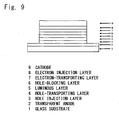
- the organic EL device having the organic layer formed by using the above naphthotriazole derivative of the present invention has a structure as shown, for example, in Fig. 9 .
- a transparent anode 2 a hole injection layer 3, a hole-transporting layer 4, a luminous layer 5, a hole-blocking layer 6, an electron-transporting layer 7, an electron injection layer 8 and a cathode 9 are formed on a glass substrate 1 (which may be any transparent substrate such as transparent resin substrate or the like substrate).
- the organic EL device to which the naphthotriazole derivative of the present invention is applied is not limited to the one of the above layer structure, as a matter of course.
- the organic EL device may have an electron-blocking layer formed between the hole-transporting layer 4 and the luminous layer 5, or may have a simplified layer structure omitting the electron injection layer 8 and the hole injection layer 3.
- some layers can be omitted from the above multilayer structure.
- the organic EL device can be fabricated in a simple layer structure having the anode 2, hole-transporting layer 4, luminous layer 5, electron-transporting layer 7 and cathode 9 formed on the substrate 1.
- the naphthotriazole derivative of the invention is preferably used as a material for forming organic layers (e.g., luminous layer 5, hole-blocking layer 6, electron-transporting layer 7 and electron injection layer 8) between the anode 2 and the cathode 9.
- organic layers e.g., luminous layer 5, hole-blocking layer 6, electron-transporting layer 7 and electron injection layer 8
- the transparent anode 2 may be formed by using an electrode material which has been known per se, i.e., by vapor-depositing an electrode material having a large work function, such as ITO or gold on the substrate 1 (transparent substrate such as glass substrate or the like).
- the hole injection layer 3 can be formed on the transparent anode 2 by using the materials that have been known per se, such as those described below.
- PEDOT poly(3,4-ethylenedioxythiophene)
- PSS poly(styrene sulfonate)
- the layer (thin film) can be formed by using the above materials relying not only upon the vacuum evaporation method but also upon the known methods such as spin-coating method or ink-jet method.
- the layers described below, too, can similarly be formed by the vacuum evaporation, the spin-coating or the ink-jet method.
- the hole-transporting layer 4, too, can be formed on the hole injection layer 3 by using a hole-transporting material that has been known per se.
- Representative examples of the hole-transporting materials are:
- the compounds for forming the hole-transporting layer may be used alone to form a film or may be used being mixed together in two or more kinds to form a film. Or the above compounds may be used in one kind or in a plurality of kinds to form a plurality of layers, and a multiplicity of films formed by laminating such layers may be used as a hole-transporting layer.
- the hole injection transporting layer can be formed by being coated with a high molecular material such as PEDOT.
- the material usually used for forming the layer may, further, be P-doped with a trisbromophenylaminehexachloroantimony or the like. It is also allowable to form the hole-transporting layer 4 (or the hole injection layer 3) by using a high molecular compound having a basic skeleton of TPD.
- the electron-blocking layer (that can be formed between the hole-transporting layer 4 and the luminous layer 5) that has not been shown, there can be used a known electron-blocking compound having the electron-blocking action, such as carbazole derivative or a compound that has a triphenylsilyl group yet having a triarylamine structure. Described below are concrete examples of the carbazole derivative and the compound having the triarylamine structure.
- the electron-blocking layer is formed by using one, two or more kinds of the above known electron-blocking materials. It is, however, also allowable to form a plurality of layers by using one or a plurality of kinds of the electron-blocking materials, and use a multiplicity of films formed by laminating such layers as the electron-blocking layer.
- the luminous layer 5 of the organic EL device can be formed by using the above naphthotriazole derivative of the invention as the luminous material.
- the luminous layer 5, however, can also be formed by using a metal complex of a quinolynol derivative as represented by Alq 3 as well as various metal complexes such as of zinc, beryllium and aluminum, and luminous materials such as anthracene derivative, bisstyrylbenzene derivative, pyrene derivative, oxazole derivative and polyparaphenylenevinylene derivative.
- thiazole derivative As the host material in this case, there can be used thiazole derivative, benzimidazole derivative and polydialkylfluorene derivative in addition to the above luminous materials.
- the dopant material there can be used quinacridone, cumalin, rubrene, perylene and derivatives thereof, benzopyran derivatiive, Rhodamine derivative and aminostyryl derivative.
- the luminous layer 5 too, can be formed in a single-layer structure by using one or two or more kinds of the luminous materials, or in a multi-layer structure by laminating a plurality of layers.
- the phosphorescent luminous material there can be used a phosphorescent luminous body of a metal complex such as of iridium or platinum.
- a green luminous phosphor such as Ir(ppy) 3
- a blue luminous phosphor such as Flrpic or Flr 6
- a red luminous phosphor such as Btp 2 lr(acac).
- CBP 4,4'-di(N-carbazolyl)biphenyl
- carbazole derivative such as TCTA or mCP
- the electron-transporting host material there can be used p-bis (triphenylsilyl) benzene (hereinafter abbreviated as UGH2) or 2,2',2"-(1,3,5-phenylene)-tris (1-phenyl-1H-benzimidazole) (hereinafter abbreviated as TPBI).
- UGH2 triphenylsilyl
- TPBI 2,2',2"-(1,3,5-phenylene)-tris (1-phenyl-1H-benzimidazole)
- the host material is desirably doped with the phosphorescent luminous material in an amount in a range of 1 to 30% by weight relative to the whole luminous layer relying on the vacuum coevaporation.
- the luminous material further, it is also allowable to use a material that emits retarded fluorescence, such as CDCB derivative like PIC-TRZ, CC2TA, PXZ-TRZ or 4CzlPN (see Appl. Phys. Let., 98, 083302 (2011)).
- CDCB derivative like PIC-TRZ, CC2TA, PXZ-TRZ or 4CzlPN
- the hole-blocking layer 6 can also be formed between the luminous layer 5 and the electron-transporting layer 7 by using a known compound having the hole-blocking action in addition to using the naphthotriazole derivative of the present invention.
- Phenanthrolene derivatives such as bathocuproin (hereinafter abbreviated as BCP) and the like; Metal complexes of quinolinol derivatives such as aluminum (III) bis(2-methyl-8-quinolinato)-4-phenylphenolate (hereinafter abbreviated as BAlq) and the like; Various rare earth complexes; Triazole derivatives; Triazine derivatives; and Oxadiazole derivatives.
- the hole-blocking layer 6 and the electron-transporting layer 7 can be formed as one layer.
- the hole-blocking layer 6, too, can be formed in the structure of a single layer or of a laminate of a multiplicity of layers, the layers being formed by using one kind, two kinds or more kinds of the above-mentioned compounds having hole-blocking action.
- the electron-transporting layer 7 can be formed by using electron-transporting compounds that have been known per se. such as metal complexes of quinolinol derivatives like Alq 3 , BAlq, as well as various metal complexes, triazole derivatives, triazine derivatives, oxadiazole derivatives, thiadiazole derivatives, carbodiimide derivatives, quinoxaline derivatives, phenanthroline derivatives and silole derivatives in addition to using the naphthotriazole derivatives of the present invention.
- electron-transporting compounds that have been known per se. such as metal complexes of quinolinol derivatives like Alq 3 , BAlq, as well as various metal complexes, triazole derivatives, triazine derivatives, oxadiazole derivatives, thiadiazole derivatives, carbodiimide derivatives, quinoxaline derivatives, phenanthroline derivatives and silole derivatives in addition to using the naphthotriazole derivative
- the electron-transporting layer 7, too, can be formed in the structure of a single layer or of a laminate of a multiplicity of layers, the layers being formed by using one kind, two kinds or more kinds of the above-mentioned electron-transporting compounds.
- the electron injection layer 8, too, can be formed by using known compounds, i.e., by using alkali metal salts such as lithium fluoride and cesium fluoride, alkaline earth metal salts such as magnesium fluoride, and metal oxides such as aluminum oxide in addition to using the naphthotriazole derivatives of the present invention.
- alkali metal salts such as lithium fluoride and cesium fluoride
- alkaline earth metal salts such as magnesium fluoride
- metal oxides such as aluminum oxide in addition to using the naphthotriazole derivatives of the present invention.
- an electrode material having a low work function such as aluminum
- an electrode material of an alloy having a lower work function such as magnesium-silver alloy, magnesium-indium alloy or aluminum-magnesium alloy.
- the organic EL device forming at least one of the organic layers e.g., at least any one of electron injection layer 8, electron-transporting layer 7, hole-blocking layer 6 or luminous layer 5) by using the naphthotriazole derivative of the present invention, features a high luminous efficiency, a high power efficiency, a low practical driving voltage, a low luminance start voltage and very excellent durability.
- Fig. 1 shows the results of the 1 H-NMR measurement.
- the second intermediate halide synthesized in Example 1 5.59 g, ⁇ 9,10-Diphenylanthracene-2-il ⁇ boronic acid 6.25 g, 2M Potassium carbonate aqueous solution 14 ml, 1,4-Dioxane 56 ml, and Tetrakistriphenylphosphine palladium (0) 0.64 g, were put into the reaction vessel purged with nitrogen, and were heated and refluxed for 4.0 hours with stirring.
- Fig. 2 shows the results of the 1 H-NMR measurement.
- Fig. 3 shows the results of the 1 H-NMR measurement.
- Fig. 4 shows the results of the 1 H-NMR measurement.
- the reaction solution was concentrated, and the precipitated crystals were picked up by filtration. Through the dispersion washing with an isopropanol, there was obtained a grey powder of 2-(4-nitrophenyl)pyridine crystals in an amount of 41.5 g (yield, 84.8%).
- the thus obtained 2-(4-nitrophenyl)pyridine 3.5 g, 4-Bromo-1,2-diaminonaphthalene 4.0 g, Caustic soda 1.4 g, and Toluene 50 ml, were put into the reaction vessel purged with nitrogen, and were heated and refluxed for 7 hours with stirring.
- Fig. 5 shows the results of the 1 H-NMR measurement.
- the second intermediate halide synthesized in Example 1 2.3 g, 3-(10-Phenylanthracene-9-il ⁇ phenylboronic acid 2.4 g, 2M Potassium carbonate aqueous solution 11 ml, Toluene 44 ml, Ethanol 11 ml, and Tetrakistriphenylphosphine palladium (0) 0.1 g, were put into the reaction vessel purged with nitrogen, and were heated and refluxed for 22.0 hours with stirring.
- Fig. 6 shows the results of the 1 H-NMR measurement.
- Fig. 7 shows the results of the 1 H-NMR measurement.
- Fig. 8 shows the results of the 1 H-NMR measurement.
- the compounds of the present invention have glass transition points which are not lower than 100°C indicating that the thin films formed by using the compounds of the invention maintain stability (remain stable).
- films were vapor-deposited in a thickness of 100 nm on an ITO substrate and were measured for their work functions by using an apparatus for measuring ionization potentials (Model PYS-202 manufactured by Sumitomo Jukikai Kogyo Co.). The results were as follows: Compound Nos. Work functions Compound 9 6.13 eV Compound 74 6.02 eV Compound 76 6.05 eV Compound 75 5.96 eV Compound 77 5.84 eV Compound 53 6.05 eV
- the compounds of the present invention have values larger than a work function of 5.4 eV possessed by general hole-transporting materials such as NPD, TPD and the like, and have large hole-blocking powers.
- An organic EL device of a layer structure shown in Fig. 9 was fabricated by vapor-depositing a hole injection layer 3, a hole-transporting layer 4, a luminous layer 5, a hole-blocking layer 6, an electron-transporting layer 7, an electron injection layer 8 and a cathode (aluminum electrode) 9 in this order on a glass substrate 1 on which an ITO electrode has been formed in advance as a transparent anode 2.
- the glass substrate 1 on which the ITO film has been formed in a thickness of 150 nm was washed with an organic solvent and was, thereafter, washed on its surfaces by an oxygen plasma treatment. Thereafter, the glass substrate with the ITO electrode was placed in a vacuum evaporation machine, and the pressure therein was reduced down to 0.001 Pa or lower.
- a compound 80 of the following structural formula was vapor-deposited at a deposition rate of 6 nm/min. in a thickness of 20 nm so as to cover the transparent anode 2.
- a compound 81 of the following structural formula was vapor-deposited as the hole-transporting layer 4 at a deposition rate of 6 nm/min. in a thickness of 40 nm.
- the luminous layer 5 was formed in a thickness of 30 nm by two-way-depositing a compound 82 of the following structural formula and a compound 83 of the following structural formula at a deposition rate of compound 82/compound 83 was 5/95.
- the compound 9 of the invention synthesized in Example 1 was vapor-deposited at a deposition rate of 6 nm/min. in a thickness of 30 nm so as to work both as the hole-blocking layer 6 and the electron-transporting layer 7.
- the electron injection layer 8 was formed in a thickness of 0.5 nm by vapor-depositing lithium fluoride at a deposition rate of 0.6 nm/min.
- the organic EL device forming an organic layer (hole-blocking layer/electron-transporting layer) by using the compound 9 of the invention was impressed with a DC voltage to measure the luminous properties which were as shown in Table 1.
- An organic EL device was fabricated under the same conditions as in Example 11 but using the compound 53 of Example 6 as the material for forming the hole-blocking layer/electron-transporting layer 6 and 7 instead of using the compound 9 of the invention synthesized in Example 1.
- the organic EL device was measured for its properties in the atmosphere at normal temperature.
- the organic EL device was impressed with a DC voltage to measure the luminous properties which were as shown in Table 1.
- An organic EL device was fabricated under the same conditions as in Example 11 but using the compound 74 of Example 2 as the material for forming the hole-blocking layer/electron-transporting layer 6 and 7 instead of using the compound 9 of Example 1.
- the thus fabricated organic EL device was measured for its properties in the atmosphere at normal temperature.
- the thus fabricated organic EL device was impressed with a DC voltage to measure the luminous properties which were as shown in Table 1.
- An organic EL device was fabricated under the same conditions as in Example 11 but using the compound 75 of Example 4 as the material for forming the hole-blocking layer/electron-transporting layer 6 and 7 instead of using the compound 9 of Example 1.
- the thus fabricated organic EL device was measured for its properties in the atmosphere at normal temperature.
- the thus fabricated organic EL device was impressed with a DC voltage to measure the luminous properties which were as shown in Table 1.
- An organic EL device was fabricated under the same conditions as in Example 11 but using the compound 76 of Example 3 as the material for forming the hole-blocking layer/electron-transporting layer 6 and 7 instead of using the compound 9 of Example 1.
- the thus fabricated organic EL device was measured for its properties in the atmosphere at normal temperature.
- the thus fabricated organic EL device was impressed with a DC voltage to measure the luminous properties which were as shown in Table 1.
- An organic EL device was fabricated under the same conditions as in Example 11 but using the compound 77 of Example 5 as the material for forming the hole-blocking layer/electron-transporting layer 6 and 7 instead of using the compound 9 of Example 1.
- the thus fabricated organic EL device was measured for its properties in the atmosphere at normal temperature.
- the thus fabricated organic EL device was impressed with a DC voltage to measure the luminous properties which were as shown in Table 1.
- an organic EL device was fabricated under the same conditions as in Example 11 but using the compound 84 of the following structural formula disclosed in WO2003/060956 as the material for forming the hole-blocking layer/electron-transporting layer 6 and 7 instead of using the compound 9 of Example 1.
- Examples 11 to 16 of the invention have driving voltages of as low as 5.19 to 5.83 V as compared to 5.95 V of the organic EL device (Comparative Example 1) that uses the compound 84 of the above structural formula.
- Examples 11 to 16 of the invention exhibit brightnesses of from 840 to 983 cd/m 2 which are great improvements over 792 cd/m 2 of Comparative Example 1.
- Examples 11 to 16 of the invention exhibit luminous efficiencies (current efficiencies) of from 8.40 to 9.87 cd/A which are great improvements over 7.92 cd/A of Comparative Example 1.
- Examples 11 to 16 of the invention exhibit power efficiencies of from 4.67 to 5.95 lm/W which are great improvements over 4.19 lm/W of Comparative Example 1.
- the organic EL device of the present invention features excellent luminous efficiency and power efficiency as compared to the device that uses the compound 84 of the above general formula that is a widely employed electron-transporting material, and is capable of achieving a conspicuous decrease in the practical driving voltage.
- the naphthotriazole derivative of the present invention has good electron injection property and excellent hole-blocking power, remains stable in its thin film state, and can be used as an excellent compound for fabricating the organic EL devices.
- Upon fabricating the organic EL devices by using the above compound further, it is allowed to attain a high luminous efficiency and power efficiency while lowering the practical driving voltage and improving the durability. Its use can, therefore, be expanded to, for example, domestic appliances and illumination equipment.
Landscapes
- Chemical & Material Sciences (AREA)
- Organic Chemistry (AREA)
- Engineering & Computer Science (AREA)
- Materials Engineering (AREA)
- Physics & Mathematics (AREA)
- Spectroscopy & Molecular Physics (AREA)
- Electroluminescent Light Sources (AREA)
- Plural Heterocyclic Compounds (AREA)
Applications Claiming Priority (2)
| Application Number | Priority Date | Filing Date | Title |
|---|---|---|---|
| JP2013035979 | 2013-02-26 | ||
| PCT/JP2014/053995 WO2014132871A1 (ja) | 2013-02-26 | 2014-02-20 | 新規なナフトトリアゾール誘導体および有機エレクトロルミネッセンス素子 |
Publications (2)
| Publication Number | Publication Date |
|---|---|
| EP2963032A1 true EP2963032A1 (de) | 2016-01-06 |
| EP2963032A4 EP2963032A4 (de) | 2016-10-12 |
Family
ID=51428142
Family Applications (1)
| Application Number | Title | Priority Date | Filing Date |
|---|---|---|---|
| EP14756351.4A Withdrawn EP2963032A4 (de) | 2013-02-26 | 2014-02-20 | Neuartiges naphthotriazolderivat und organisches elektrolumineszenzelement |
Country Status (7)
| Country | Link |
|---|---|
| US (1) | US9871210B2 (de) |
| EP (1) | EP2963032A4 (de) |
| JP (1) | JP6294866B2 (de) |
| KR (1) | KR102140853B1 (de) |
| CN (1) | CN105143198A (de) |
| TW (1) | TWI607997B (de) |
| WO (1) | WO2014132871A1 (de) |
Cited By (1)
| Publication number | Priority date | Publication date | Assignee | Title |
|---|---|---|---|---|
| EP3680947A1 (de) * | 2019-01-09 | 2020-07-15 | Samsung Display Co., Ltd. | Organische elektrolumineszenzvorrichtung und anzeigevorrichtung damit |
Families Citing this family (3)
| Publication number | Priority date | Publication date | Assignee | Title |
|---|---|---|---|---|
| WO2015156325A1 (ja) * | 2014-04-10 | 2015-10-15 | 保土谷化学工業株式会社 | キノリノトリアゾール誘導体および有機エレクトロルミネッセンス素子 |
| CN107112425B (zh) * | 2014-12-24 | 2019-05-17 | 保土谷化学工业株式会社 | 有机电致发光器件 |
| CN107210382B (zh) * | 2015-02-03 | 2020-01-10 | 保土谷化学工业株式会社 | 有机电致发光器件 |
Family Cites Families (8)
| Publication number | Priority date | Publication date | Assignee | Title |
|---|---|---|---|---|
| JP2734341B2 (ja) | 1993-03-26 | 1998-03-30 | 住友電気工業株式会社 | 有機エレクトロルミネッセンス素子 |
| EP0647694B1 (de) | 1993-03-26 | 1999-09-15 | Sumitomo Electric Industries, Ltd. | Organische elektroluminineszente elementen |
| KR100691543B1 (ko) | 2002-01-18 | 2007-03-09 | 주식회사 엘지화학 | 새로운 전자 수송용 물질 및 이를 이용한 유기 발광 소자 |
| EP2265092B1 (de) | 2002-06-06 | 2018-03-14 | UDC Ireland Limited | Elektrolumineszierende Vorrichtung |
| CN1784445B (zh) | 2003-05-05 | 2010-05-26 | 西巴特殊化学品控股有限公司 | 在光学器件中使用的含苯并三唑的新聚合物 |
| US20080027226A1 (en) * | 2003-12-05 | 2008-01-31 | Jonathan Rogers | Electroluminescent Device |
| JP5138582B2 (ja) | 2005-04-28 | 2013-02-06 | チバ ホールディング インコーポレーテッド | 電子発光装置 |
| JP5979873B2 (ja) | 2009-03-18 | 2016-08-31 | 保土谷化学工業株式会社 | ベンゾトリアゾール環構造を有する化合物および有機エレクトロルミネッセンス素子 |
-
2014
- 2014-02-20 JP JP2015502889A patent/JP6294866B2/ja active Active
- 2014-02-20 KR KR1020157025440A patent/KR102140853B1/ko not_active Expired - Fee Related
- 2014-02-20 WO PCT/JP2014/053995 patent/WO2014132871A1/ja not_active Ceased
- 2014-02-20 EP EP14756351.4A patent/EP2963032A4/de not_active Withdrawn
- 2014-02-20 CN CN201480023194.5A patent/CN105143198A/zh active Pending
- 2014-02-20 US US14/769,651 patent/US9871210B2/en not_active Expired - Fee Related
- 2014-02-26 TW TW103106561A patent/TWI607997B/zh not_active IP Right Cessation
Cited By (2)
| Publication number | Priority date | Publication date | Assignee | Title |
|---|---|---|---|---|
| EP3680947A1 (de) * | 2019-01-09 | 2020-07-15 | Samsung Display Co., Ltd. | Organische elektrolumineszenzvorrichtung und anzeigevorrichtung damit |
| US11335857B2 (en) | 2019-01-09 | 2022-05-17 | Samsung Display Co., Ltd. | Organic electroluminescence device and display device including the same |
Also Published As
| Publication number | Publication date |
|---|---|
| US20160005982A1 (en) | 2016-01-07 |
| US9871210B2 (en) | 2018-01-16 |
| KR20150123264A (ko) | 2015-11-03 |
| CN105143198A (zh) | 2015-12-09 |
| JP6294866B2 (ja) | 2018-03-14 |
| TW201439071A (zh) | 2014-10-16 |
| KR102140853B1 (ko) | 2020-08-03 |
| TWI607997B (zh) | 2017-12-11 |
| JPWO2014132871A1 (ja) | 2017-02-02 |
| EP2963032A4 (de) | 2016-10-12 |
| WO2014132871A1 (ja) | 2014-09-04 |
Similar Documents
| Publication | Publication Date | Title |
|---|---|---|
| EP2767534B1 (de) | Neue benzotriazolderivative und organisches elektrolumineszenzelement damit | |
| KR102245875B1 (ko) | 유기 전계발광소자용 재료, 이것을 이용한 유기 전계발광소자 및 전자 기기 | |
| EP2540707A1 (de) | Substituierte pyridylverbindung und organisches elektrolumineszentes element | |
| US10026903B2 (en) | Compound having substituted triphenylene ring structure, and organic electroluminescent device | |
| EP3663289A1 (de) | Pyrimidinderivate und organisches elektrolumineszenzvorrichtungen | |
| EP2492986A1 (de) | Organisches elektrolumineszenzelement | |
| EP3248966B1 (de) | Pyrimidinderivat und organisches elektrolumineszenzelement | |
| US20160087215A1 (en) | Novel pyrimidine derivatives and organic electroluminescent devices | |
| EP2669284B1 (de) | Verbindung mit einer pyridoindol-ringstruktur sowie einer substituierten bipyridylgruppe und organisches elektrolumineszenzelement | |
| EP2963032A1 (de) | Neuartiges naphthotriazolderivat und organisches elektrolumineszenzelement | |
| EP3029034B1 (de) | Benzotriazolderivate und organisches elektrolumineszentes element | |
| US9634258B2 (en) | Compounds having bipyridyl group and carbazole ring, and organic electroluminescent element | |
| EP2679582A1 (de) | Zusammensetzung mit einer substituierten o-terphenyl-struktur und organisches elektrolumineszenzelement | |
| WO2015156325A1 (ja) | キノリノトリアゾール誘導体および有機エレクトロルミネッセンス素子 |
Legal Events
| Date | Code | Title | Description |
|---|---|---|---|
| PUAI | Public reference made under article 153(3) epc to a published international application that has entered the european phase |
Free format text: ORIGINAL CODE: 0009012 |
|
| 17P | Request for examination filed |
Effective date: 20150820 |
|
| AK | Designated contracting states |
Kind code of ref document: A1 Designated state(s): AL AT BE BG CH CY CZ DE DK EE ES FI FR GB GR HR HU IE IS IT LI LT LU LV MC MK MT NL NO PL PT RO RS SE SI SK SM TR |
|
| AX | Request for extension of the european patent |
Extension state: BA ME |
|
| DAX | Request for extension of the european patent (deleted) | ||
| STAA | Information on the status of an ep patent application or granted ep patent |
Free format text: STATUS: THE APPLICATION HAS BEEN WITHDRAWN |
|
| A4 | Supplementary search report drawn up and despatched |
Effective date: 20160914 |
|
| RIC1 | Information provided on ipc code assigned before grant |
Ipc: C09K 11/06 20060101ALI20160908BHEP Ipc: H01L 51/54 20060101ALI20160908BHEP Ipc: C07D 401/10 20060101AFI20160908BHEP |
|
| 18W | Application withdrawn |
Effective date: 20160928 |