EP2963140B1 - Procédé de fabrication d'un élément de véhicule automobile en aluminium - Google Patents
Procédé de fabrication d'un élément de véhicule automobile en aluminium Download PDFInfo
- Publication number
- EP2963140B1 EP2963140B1 EP15163147.0A EP15163147A EP2963140B1 EP 2963140 B1 EP2963140 B1 EP 2963140B1 EP 15163147 A EP15163147 A EP 15163147A EP 2963140 B1 EP2963140 B1 EP 2963140B1
- Authority
- EP
- European Patent Office
- Prior art keywords
- cooling
- blank
- carried out
- tool
- forming
- Prior art date
- Legal status (The legal status is an assumption and is not a legal conclusion. Google has not performed a legal analysis and makes no representation as to the accuracy of the status listed.)
- Active
Links
- 238000000034 method Methods 0.000 title claims description 47
- 238000004519 manufacturing process Methods 0.000 title claims description 10
- 229910052782 aluminium Inorganic materials 0.000 title claims description 9
- XAGFODPZIPBFFR-UHFFFAOYSA-N aluminium Chemical compound [Al] XAGFODPZIPBFFR-UHFFFAOYSA-N 0.000 title claims description 9
- 239000004411 aluminium Substances 0.000 title claims 2
- 238000001816 cooling Methods 0.000 claims description 52
- 238000010438 heat treatment Methods 0.000 claims description 26
- 230000002787 reinforcement Effects 0.000 claims description 19
- 238000005496 tempering Methods 0.000 claims description 19
- 229910000838 Al alloy Inorganic materials 0.000 claims description 11
- 230000008569 process Effects 0.000 description 10
- 239000000463 material Substances 0.000 description 7
- BASFCYQUMIYNBI-UHFFFAOYSA-N platinum Chemical compound [Pt] BASFCYQUMIYNBI-UHFFFAOYSA-N 0.000 description 7
- 230000003014 reinforcing effect Effects 0.000 description 7
- 238000003466 welding Methods 0.000 description 4
- 238000005097 cold rolling Methods 0.000 description 3
- 238000010168 coupling process Methods 0.000 description 3
- 229910052751 metal Inorganic materials 0.000 description 3
- 239000002184 metal Substances 0.000 description 3
- 229910000831 Steel Inorganic materials 0.000 description 2
- 239000000853 adhesive Substances 0.000 description 2
- 238000004026 adhesive bonding Methods 0.000 description 2
- 230000001070 adhesive effect Effects 0.000 description 2
- 238000005275 alloying Methods 0.000 description 2
- 230000008901 benefit Effects 0.000 description 2
- 239000013078 crystal Substances 0.000 description 2
- 238000013461 design Methods 0.000 description 2
- 238000007654 immersion Methods 0.000 description 2
- 238000012432 intermediate storage Methods 0.000 description 2
- 238000005304 joining Methods 0.000 description 2
- 229910001092 metal group alloy Inorganic materials 0.000 description 2
- 238000005096 rolling process Methods 0.000 description 2
- 239000010959 steel Substances 0.000 description 2
- 238000003756 stirring Methods 0.000 description 2
- 238000004381 surface treatment Methods 0.000 description 2
- 238000012546 transfer Methods 0.000 description 2
- 238000011144 upstream manufacturing Methods 0.000 description 2
- FYYHWMGAXLPEAU-UHFFFAOYSA-N Magnesium Chemical compound [Mg] FYYHWMGAXLPEAU-UHFFFAOYSA-N 0.000 description 1
- PWHULOQIROXLJO-UHFFFAOYSA-N Manganese Chemical compound [Mn] PWHULOQIROXLJO-UHFFFAOYSA-N 0.000 description 1
- 239000011248 coating agent Substances 0.000 description 1
- 238000000576 coating method Methods 0.000 description 1
- 239000002131 composite material Substances 0.000 description 1
- 238000010276 construction Methods 0.000 description 1
- 238000007739 conversion coating Methods 0.000 description 1
- 230000008878 coupling Effects 0.000 description 1
- 238000005859 coupling reaction Methods 0.000 description 1
- 230000001419 dependent effect Effects 0.000 description 1
- 230000000694 effects Effects 0.000 description 1
- 238000005516 engineering process Methods 0.000 description 1
- 230000007613 environmental effect Effects 0.000 description 1
- 239000000835 fiber Substances 0.000 description 1
- 229910052749 magnesium Inorganic materials 0.000 description 1
- 239000011777 magnesium Substances 0.000 description 1
- 229910052748 manganese Inorganic materials 0.000 description 1
- 239000011572 manganese Substances 0.000 description 1
- 239000007769 metal material Substances 0.000 description 1
- 238000000465 moulding Methods 0.000 description 1
- 238000005457 optimization Methods 0.000 description 1
- 238000010422 painting Methods 0.000 description 1
- 230000008092 positive effect Effects 0.000 description 1
- 238000003825 pressing Methods 0.000 description 1
- 238000012545 processing Methods 0.000 description 1
- 230000009467 reduction Effects 0.000 description 1
- 230000000087 stabilizing effect Effects 0.000 description 1
- 239000007858 starting material Substances 0.000 description 1
- 238000009864 tensile test Methods 0.000 description 1
- 238000003856 thermoforming Methods 0.000 description 1
- 230000007704 transition Effects 0.000 description 1
Images


Classifications
-
- C—CHEMISTRY; METALLURGY
- C22—METALLURGY; FERROUS OR NON-FERROUS ALLOYS; TREATMENT OF ALLOYS OR NON-FERROUS METALS
- C22F—CHANGING THE PHYSICAL STRUCTURE OF NON-FERROUS METALS AND NON-FERROUS ALLOYS
- C22F1/00—Changing the physical structure of non-ferrous metals or alloys by heat treatment or by hot or cold working
- C22F1/04—Changing the physical structure of non-ferrous metals or alloys by heat treatment or by hot or cold working of aluminium or alloys based thereon
- C22F1/047—Changing the physical structure of non-ferrous metals or alloys by heat treatment or by hot or cold working of aluminium or alloys based thereon of alloys with magnesium as the next major constituent
-
- B—PERFORMING OPERATIONS; TRANSPORTING
- B62—LAND VEHICLES FOR TRAVELLING OTHERWISE THAN ON RAILS
- B62D—MOTOR VEHICLES; TRAILERS
- B62D29/00—Superstructures, understructures, or sub-units thereof, characterised by the material thereof
- B62D29/008—Superstructures, understructures, or sub-units thereof, characterised by the material thereof predominantly of light alloys, e.g. extruded
-
- C—CHEMISTRY; METALLURGY
- C22—METALLURGY; FERROUS OR NON-FERROUS ALLOYS; TREATMENT OF ALLOYS OR NON-FERROUS METALS
- C22C—ALLOYS
- C22C21/00—Alloys based on aluminium
- C22C21/06—Alloys based on aluminium with magnesium as the next major constituent
- C22C21/08—Alloys based on aluminium with magnesium as the next major constituent with silicon
Definitions
- the present invention relates to a method for producing a motor vehicle component according to the features in the preamble of patent claim 1.
- motor vehicle components made of aluminum.
- Aluminum is used here as a light metal component and, due to its low specific weight, enables a corresponding weight saving.
- the production of the aluminum component for motor vehicles is for example from the DE 10 2009 008 282 A1 known.
- thermoforming manufactured automotive sheet metal molding which consists of a non-hardenable aluminum alloy.
- the object of the present invention is, starting from the prior art, to show a method for producing a motor vehicle component from a light metal alloy, with which it is economically feasible and cost-effective to produce a motor vehicle component having mutually different strength ranges.
- a naturally hard and / or work-hardened board made of a 5000 aluminum alloy which has dislocations in the crystal lattice and thereby a yield strength between 400 MPa and 500 MPa, which is also referred to as the initial yield point.
- the board is partially heated in at least a first area.
- An at least second region then remains at the starting temperature, which preferably represents room temperature, in particular between 10 ° C and 30 ° C. Any heating or co-heating occurring in the second area (s) in the range of a few degrees Celsius, for example in the edge area heating up to 40 ° C or 50 ° C, are negligible within the scope of the invention.
- the partial heating in the first region is followed by a softening of the material structure, the temperature and / or the time of the heating depending on achieving strength and ductility is selected.
- the yield strength is the yield strength RP 0.2.
- the entire board is heated to a homogeneous temperature of between 150 ° C and 350 ° C, preferably to 300 ° C.
- the tempered board then has very good forming properties and by the preceding partial heating on each other different strength properties.
- the tempered homogeneously to the aforementioned temperature board is then processed by forming technology to the motor vehicle component further and then cooled.
- the tempering is carried out in a separate tempering tool, which in turn can then connect to the tempering a combined forming and cooling tool or a forming tool and this separate cooling tool.
- the heating and / or tempering is preferably carried out with a planar tempering tool by contact with the system, which allows a reduction of the production costs of the production line as well as an increased precision of the adjustment of the temperature.
- the forming is furthermore preferably carried out in a press forming tool and the cooling is carried out in the case of the combined forming and pressing tool in a coolable forming tool.
- the cooling can alternatively also be done in a separate cooling tool by contact. It is also possible that the cooling takes place in a dip tank, so that the entire vehicle component is immersed.
- the cooling can also be carried out in a first and second cooling process, being cooled in the first cooling operation to a temperature between 120 and 200 ° C. In the second cooling operation is then preferably cooled to room temperature, wherein the second cooling operation in less than 20 s, in particular less than 10 s and very particularly preferably in less than 2.2 s to 5 s is performed, as well as the first cooling operation.
- the first and second cooling processes may be carried out in a cooling tool, but especially in two separate cooling tools.
- the first and second cooling processes can be carried out in chronological succession, but at least one transfer time from one cooling tool to a second cooling tool and / or a predetermined waiting time between the first and second cooling processes can also be introduced.
- each of the aforementioned process steps is carried out in a time of less than 20 s, preferably less than 10 s, in particular in 2 s to 5 s. Any intermediate transfers are furthermore preferably also carried out in less than 10 s, very particularly preferably in less than 5 s.
- an aluminum alloy designated AW / AA5xxx-Hxx is preferably a work-hardened aluminum alloy, which is correspondingly work-hardened, in particular by an upstream rolling process, and may optionally have been thermally post-treated in intermediate steps or subsequently. These are, in particular, a cold rolling upstream of the heating according to the invention.
- a cold rolling upstream of the heating according to the invention By cold rolling, dislocations are formed in the crystal lattice, so that the work-hardened aluminum alloy has an initial yield strength between 200 MPa and 450 MPa, preferably up to 500 MPa, more preferably 300 MPa to 450 MPa. The strength state is detectable on the solidified starting material or else on a motor vehicle component produced therefrom by a tensile test.
- an aluminum alloy according to the European standard EN515: 1993 in the material state H12, H14, H16, H18, H19, H22, H24, H26, H28, H32, H34, H36 or H38 is processed, which as alloying elements in addition to aluminum at least magnesium and possibly manganese and further alloying elements.
- strengths of between 250 MPa and 120 MPa are set, and in the second range, strengths of between 450 MPa and 200 MPa are set.
- a rather hard area as well as a softer or more ductile area on the opposite side becomes Board and then set directly to the downstream manufactured motor vehicle component or direct production of the motor vehicle component on this directly.
- the board is end cut before, during or after the forming. This makes it possible to determine the outer component contour.
- a board is formed with at least two mutually different wall thicknesses.
- a tailored material is used here, wherein the different wall thicknesses are produced in particular by a partial rolling during cold rolling. This is known as Tailor Rolled Blank.
- Tailor Welded Blank it is also possible to use a Tailor Welded Blank, thus a circuit board in which two sheet metal platinum parts with different wall thickness are thermally joined.
- the friction stir welding but also other cohesive coupling methods can be used.
- it is also possible to use a patched board so that a local component patch is applied to the board. The board is then reshaped together with the component patch.
- the component patch is glued in particular to the board and by mechanical or thermal methods, such. Clinching, riveting, friction stir welding, spot welding fixed in position, wherein the adhesive is thermally activated and is glued together when heating the board to forming temperature accordingly with the board together.
- the values relate in each case to the motherboard, that is, to the larger of the printed circuit boards, to which at least one patch board has been applied.
- the same aluminum alloy as for the motherboard can be used as the material for the patch board.
- the initial delivery state or the heat treatment of the patch board should be selected so that at least the deformation capacity of the corresponding region of the Motherboard is reached. The same is true when using another patch material.
- the board may then have at least partially thicker wall thicknesses, wherein the thicker wall thicknesses between 1 mm and 15 mm, in particular between 3 mm and 12 mm and most preferably between 3.5 mm and 10 mm and in particular up to 3 mm thicker than the remaining areas of the board.
- the method according to the invention produces a motor vehicle component made from an aluminum alloy which, in the event of a collision, should locally undergo a deformation predefined in its design, wherein the motor vehicle component can continue to be joined with further reinforcement parts.
- the reinforcing parts can also be produced by the process according to the invention.
- the reinforcing parts themselves are joined to the motor vehicle component after completion of the forming process.
- this involves an internal reinforcement and / or an external reinforcement.
- the internal reinforcement can be applied, for example in the form of a patch, to the manufactured motor vehicle component.
- it is also possible to produce a corresponding hollow component by the coupling with the inner reinforcement and / or the outer reinforcement.
- the reinforcements are in particular also aluminum components.
- the reinforcement may also be designed as a steel component or applied from fiber composite material.
- the reinforcement is glued to the motor vehicle component. Bonding is particularly combined with a thermal or mechanical joining process to hold the reinforcement in place during curing. In the context of the invention, however, it is also possible that the two components are thermally joined together. Also form-fitting coupling methods such as rivets, in particular punch rivets or a clinching operation are possible.
- the cooling tool can be in the context of the invention, a flat cooling tool, which causes cooling by plant contact.
- the cooling tool is formed, for example, as an immersion bath, so that the entire tempered circuit board and / or made tempered and molded automotive component are immersed in the immersion bath and this is cooled.
- a combined cooling and forming tool is used to achieve the highest possible component precision and cost-effectiveness.
- the printed circuit board or the component are furthermore particularly preferably surface-treated.
- This is to be understood in particular as meaning a coating, very particularly preferably a conversion coating.
- the surface treatment of the board or of the component has a particularly advantageous effect on the further processing with regard to a joining. Due to the surface treatment, the board or the component, in contrast to the inhomogeneous and contaminated oxide layer which automatically forms under environmental influence, has defined, reproducible surface properties. This particularly has a positive effect on all subsequent manufacturing processes which produce a bond with this surface, e.g. Gluing, painting or for stabilizing the process as reproducible input characteristics as possible, such. Arc welding.
- a tool for carrying out the method, which has different sections, wherein the sections in the tool can assume different temperatures with respect to heating or cooling.
- the various sections in the forming or tempering for example, by mutually independent Temperiersegmente, which are in particular isolated from each other, allows become.
- the cooling can be carried out in the tool for partial heating or alternatively in a separate cooling tool.
- an intermediate step after the partial heating of the board and before tempering.
- the intermediate step provides that the partially heated board is first completely cooled, preferably to a temperature between 5 ° and 40 ° Celsius, preferably to room temperature.
- This completely cooled board can then be tempered again immediately after cooling, in this case, heated or alternatively stored.
- the intermediate storage can take place over a short period of, for example, a few minutes to a few hours, but may also include several days, thereby changing the structural state of the board at room temperature is not or negligible.
- After the intermediate storage is then again a tempering in the form of heating.
- An alternative preferred embodiment variant of the present invention provides that the partially heated board is tempered in time immediately following the partial heating process and then correspondingly completely heated for temperature control and / or cooled in the partial region to the temperature.
- the tempering can be carried out in the same tool, which also serves for partial heating. Alternatively, the tempering can also be performed in a separate from the partial heating tool Termperierwerkmaschine.
- a cooling of room air without time limit is preferably provided.
- a rapid cooling in a special cooling station is possible.
- the subsequent process step is performed temporally or spatially separated from the immediately preceding process step of heating the board, then it is possible according to the invention to stockpile the boards thus produced, for example, in a warehouse and to call them up as required.
- FIG. 1a shows an inventive motor vehicle component 1 in the form of a B-pillar in side view.
- the B-pillar has a head portion 2 for connection to a roof rail, not shown, as well as a foot portion 3 for connection to a side skirts, not shown.
- a middle section 4 extends with an opening ⁇ .
- the foot region 3 and a lower part of the middle section 4 are now formed as the first region 5, which during the forming on the forming temperature is maintained, so that here a softer or more ductile structure is set with preferably between 120 and 250 MPa.
- the upper middle section 4 and the head section 2 are here designed as a second region 6, which has harder properties compared to the first region 5 and has a yield strength between 250 MPa and 450 MPa. Separated are first region 5 and second region 6 through a transition Ü, which extends over 1 mm to 100 mm, preferably 15 mm to 50 mm.
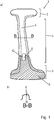
- FIG. 1b is a cross section according to the section line BB shown, so that it can be seen that at least the central portion 4 has been formed in the form of a hat profile in cross section during the forming process. Thus, the component has been shaped three-dimensionally.
- FIGS. 2a and b an outer reinforcement plate 7 in side view and in cross-sectional view.
- the outer reinforcement plate 7 has a substantially homogeneous cross-sectional profile and is according to FIG. 2b designed as a U-shaped reinforcement plate. This is on the outside 8 according to FIG. 1b of the motor vehicle component 1, in particular by bonding, particularly preferably with thermally activatable adhesive.
- an inner reinforcing plate 9 is shown that in FIG. 3a as a side view, FIG. 3b as a longitudinal section and Figure 3c is shown as a cross section.
- the inner reinforcing plate 9 is on an inner side according to FIG. 1b attached to the B-pillar.
- the inner reinforcing plate 9 has according to longitudinal section line DD partially different wall thicknesses 11 in the longitudinal direction.
- the cross section is shown in Figure 3c according to section line AA, wherein this is formed homogeneous and flat.
- the inner reinforcing plate 9 is on the inside 10 according to FIG. 1b applied, preferably by gluing.
- the inner reinforcing sheet is preferably produced from an extruded aluminum alloy to a profile, wherein different wall thicknesses are set in profile and in a subsequent process step, the profile is longitudinally trimmed, optionally unwound and / or press-formed to its final shape.
Landscapes
- Chemical & Material Sciences (AREA)
- Engineering & Computer Science (AREA)
- Mechanical Engineering (AREA)
- Organic Chemistry (AREA)
- Metallurgy (AREA)
- Materials Engineering (AREA)
- Crystallography & Structural Chemistry (AREA)
- Physics & Mathematics (AREA)
- Thermal Sciences (AREA)
- Architecture (AREA)
- Structural Engineering (AREA)
- Combustion & Propulsion (AREA)
- Transportation (AREA)
- Body Structure For Vehicles (AREA)
Claims (11)
- Procédé de fabrication d'une pièce de véhicule automobile (1), en particulier d'un pied de véhicule automobile, caractérisé par les étapes de procédé suivantes :- fourniture d'un flan écroui en un alliage d'aluminium de la série 5000,- chauffage partiel du flan dans une première zone (5) à une température supérieure à 350 °C, dans lequel le flan est maintenu dans une deuxième zone (6) à une température comprise entre 15 °C et 30 °C et le chauffage partiel est effectué en moins de 20 s,- thermorégulation de l'ensemble du flan à une température comprise entre 150 et 350 °C en moins de 20 s, dans laquelle la thermorégulation est effectuée dans un outil de thermorégulation séparé, dans laquelle un outil combiné de mise en forme et de refroidissement ou un outil de mise en forme et un outil de refroidissement séparé de celui-ci fait suite à l'outil de thermorégulation,- mise en forme du flan afin d'obtenir la pièce de véhicule automobile (1) en moins de 20 s et refroidissement de la pièce de véhicule automobile (1),- dans lequel, avec le procédé, une limite de dilatation est réglée inférieure à 250 MPa et supérieure à 120 MPa dans la première zone (5) et inférieure à 450 MPa et supérieure à 200 MPa dans la deuxième zone (6).
- Procédé selon la revendication 1, caractérisé en ce que le refroidissement est effectué dans un outil de mise en forme, dans lequel le refroidissement est effectué pendant et/ou après la mise en forme.
- Procédé selon la revendication 1 ou 2, caractérisé en ce que la mise en forme et le refroidissement sont effectués dans un outil combiné de mise en forme et de refroidissement en moins de 20 s.
- Procédé selon l'une quelconque des revendications 1 à 3, caractérisé en ce que l'outil de thermorégulation est un poste de thermorégulation.
- Procédé selon l'une quelconque des revendications 1 à 4, caractérisé en ce que le flan est découpé avant, pendant ou après la mise en forme.
- Procédé selon l'une quelconque des revendications 1 à 5, caractérisé en ce qu'un flan est mis en forme comme flan laminé sur mesure (Tailored Rolled Blank) ou flan soudé sur mesure (Tailored Welded Blank) avec au moins deux épaisseurs (11) différentes l'une de l'autre.
- Procédé selon l'une quelconque des revendications 1 à 6, caractérisé en ce qu'un pied de véhicule automobile en aluminium est fabriqué, dans lequel le pied de véhicule automobile est couplé à une tôle de renfort intérieure (9) et/ou à une tôle de renfort extérieure (7).
- Procédé selon l'une quelconque des revendications 1 à 7, caractérisé en ce que le refroidissement est effectué avec une première opération de refroidissement, dans laquelle on refroidit à une température comprise entre 120 et 200 °C dans la première opération de refroidissement et, après la première opération de refroidissement, une deuxième opération de refroidissement est effectuée, dans laquelle la deuxième opération de refroidissement est effectuée en moins de 20 s et on refroidit à température ambiante.
- Procédé selon la revendication précédente, caractérisé en ce que la deuxième opération de refroidissement est effectuée dans un outil de refroidissement séparé.
- Procédé selon l'une quelconque des revendications 1 à 9, caractérisé en ce que le flan est soumis à un traitement de surface.
- Procédé selon l'une quelconque des revendications 1 à 10, caractérisé en ce que, après le chauffage partiel et avant la thermorégulation de l'ensemble du flan, une étape intermédiaire est effectuée, dans lequel l'étape intermédiaire prévoit que le flan partiellement chauffé soit complètement refroidi.
Applications Claiming Priority (1)
| Application Number | Priority Date | Filing Date | Title |
|---|---|---|---|
| DE102014108114.5A DE102014108114B4 (de) | 2014-06-10 | 2014-06-10 | Verfahren zur Herstellung eines Kraftfahrzeugbauteils aus Aluminium |
Publications (2)
| Publication Number | Publication Date |
|---|---|
| EP2963140A1 EP2963140A1 (fr) | 2016-01-06 |
| EP2963140B1 true EP2963140B1 (fr) | 2019-06-12 |
Family
ID=53005469
Family Applications (1)
| Application Number | Title | Priority Date | Filing Date |
|---|---|---|---|
| EP15163147.0A Active EP2963140B1 (fr) | 2014-06-10 | 2015-04-10 | Procédé de fabrication d'un élément de véhicule automobile en aluminium |
Country Status (4)
| Country | Link |
|---|---|
| US (1) | US9938613B2 (fr) |
| EP (1) | EP2963140B1 (fr) |
| CN (1) | CN105200213B (fr) |
| DE (1) | DE102014108114B4 (fr) |
Families Citing this family (3)
| Publication number | Priority date | Publication date | Assignee | Title |
|---|---|---|---|---|
| JP6898169B2 (ja) * | 2017-08-02 | 2021-07-07 | トヨタ自動車株式会社 | ボディ骨格構造 |
| DE102017218475A1 (de) * | 2017-10-16 | 2019-04-18 | Bayerische Motoren Werke Aktiengesellschaft | Verfahren zur Herstellung eines Karosseriebauteils mit lokal unterschiedlichen Härteeigenschaften |
| CN111822570A (zh) * | 2020-07-10 | 2020-10-27 | 首钢集团有限公司 | 一种加热热冲压强化工艺 |
Citations (2)
| Publication number | Priority date | Publication date | Assignee | Title |
|---|---|---|---|---|
| EP2415882A1 (fr) * | 2010-08-02 | 2012-02-08 | Benteler Automobiltechnik GmbH | Procédé de fabrication d'une pièce de formage en tôle à partir d'un alliage en aluminium non durcissable durci par laminage |
| US8486206B2 (en) * | 2003-02-26 | 2013-07-16 | Constellium France | Method for warm swaging Al-Mg alloy parts |
Family Cites Families (10)
| Publication number | Priority date | Publication date | Assignee | Title |
|---|---|---|---|---|
| US6550302B1 (en) * | 1999-07-27 | 2003-04-22 | The Regents Of The University Of Michigan | Sheet metal stamping die design for warm forming |
| JP2009148823A (ja) * | 2007-11-27 | 2009-07-09 | Nippon Steel Corp | アルミニウム合金冷延板の温間プレス成形方法 |
| DE102009008282A1 (de) * | 2009-02-10 | 2010-08-19 | Benteler Automobiltechnik Gmbh | Verfahren zur Herstellung eines Blechformteils aus einer walzharten, nicht aushärtbaren Aluminiumlegierung |
| US8211251B2 (en) * | 2009-08-14 | 2012-07-03 | GM Global Technology Operations LLC | Local heat treatment of aluminum panels |
| EP2415895B2 (fr) * | 2010-08-02 | 2019-07-31 | Benteler Automobiltechnik GmbH | Méthode pour la production d'une pièce de formage en tôle pour véhicule automobile |
| EP2518173B1 (fr) * | 2011-04-26 | 2017-11-01 | Benteler Automobiltechnik GmbH | Procédé de fabrication d'un composant de structure en tôle ainsi que composant de structure en tôle |
| US9279167B2 (en) | 2011-07-20 | 2016-03-08 | GM Global Technology Operations LLC | Method of forming a stamped article |
| CN103421943A (zh) | 2013-07-23 | 2013-12-04 | 西南交通大学 | 提高5052铝合金搅拌摩擦焊接接头性能的处理工艺方法 |
| US10384252B2 (en) * | 2014-02-17 | 2019-08-20 | GM Global Technology Operations LLC | Warm forming of work-hardened sheet alloys |
| DE102014108113A1 (de) * | 2014-06-10 | 2015-12-17 | Benteler Automobiltechnik Gmbh | Verfahren zur Herstellung eines Kraftfahrzeugbauteils aus Aluminium |
-
2014
- 2014-06-10 DE DE102014108114.5A patent/DE102014108114B4/de not_active Expired - Fee Related
-
2015
- 2015-04-10 EP EP15163147.0A patent/EP2963140B1/fr active Active
- 2015-04-10 CN CN201510380976.0A patent/CN105200213B/zh not_active Expired - Fee Related
- 2015-04-10 US US14/683,896 patent/US9938613B2/en active Active
Patent Citations (2)
| Publication number | Priority date | Publication date | Assignee | Title |
|---|---|---|---|---|
| US8486206B2 (en) * | 2003-02-26 | 2013-07-16 | Constellium France | Method for warm swaging Al-Mg alloy parts |
| EP2415882A1 (fr) * | 2010-08-02 | 2012-02-08 | Benteler Automobiltechnik GmbH | Procédé de fabrication d'une pièce de formage en tôle à partir d'un alliage en aluminium non durcissable durci par laminage |
Also Published As
| Publication number | Publication date |
|---|---|
| CN105200213A (zh) | 2015-12-30 |
| CN105200213B (zh) | 2018-09-04 |
| EP2963140A1 (fr) | 2016-01-06 |
| US20150354043A1 (en) | 2015-12-10 |
| DE102014108114A1 (de) | 2015-12-17 |
| DE102014108114B4 (de) | 2018-02-22 |
| US9938613B2 (en) | 2018-04-10 |
Similar Documents
| Publication | Publication Date | Title |
|---|---|---|
| EP2955237B1 (fr) | Procédé de fabrication d'une tôle en aluminium | |
| EP2441850B1 (fr) | Colonne de véhicule automobile et procédé de fabrication d'une colonne de véhicule automobile déformée à chaud et durcie à la presse | |
| EP2496371B1 (fr) | Procédé de fabrication d'éléments avec des zones de ductilité différente | |
| EP3045551B1 (fr) | Procédé de traitement thermique partiel d'un composant de véhicule automobile déformé à chaud et trempé sous presse | |
| DE102010012832B4 (de) | Kraftfahrzeugsäule | |
| DE102013108265B4 (de) | Baugruppe von gehärteten Bauteilen und Verfahren zur Herstellung | |
| EP3003599B1 (fr) | Procédé de fabrication d'un dôme de jambe de force | |
| EP2415895B1 (fr) | Pièce de formage en tôle pour véhicule automobile | |
| EP2987878B1 (fr) | Procédé de fabrication d'un élément de véhicule automobile en alliage d'aluminium durcissable | |
| WO2016074666A1 (fr) | Élément de carrosserie ou de châssis à protection anticorrosion et procédé pour le produire | |
| EP2942418B1 (fr) | Procédé de fabrication d'un élément de véhicule automobile en aluminium | |
| EP2963140B1 (fr) | Procédé de fabrication d'un élément de véhicule automobile en aluminium | |
| DE102010012833B4 (de) | Längsträger sowie Längsträgeranordnung | |
| EP3296104B1 (fr) | Procédé de fabrication d'un élément de carrosserie à tendance réduite à la fissuration | |
| DE102011001849A1 (de) | Verfahren zum Herstellen eines Blechstrukturbauteils sowie Blechstrukturteil | |
| DE102011009891A1 (de) | Verfahren zum Herstellen von Blechbauteilen sowie Vorrichtung zur Durchführung des Verfahrens | |
| DE102018118201A1 (de) | Verfahren zur Herstellung eines Kraftfahrzeugbauteils als Fügebauteil sowie Kraftfahrzeugbauteil | |
| DE102013224685A1 (de) | Verfahren und Vorrichtung zur Herstellung eines Kompositbauteils | |
| DE102023204330B4 (de) | Verfahren zum Herstellen einer Seitenrahmenstruktur eines Fahrzeugs | |
| WO2018065230A1 (fr) | Procédé de fabrication d'un élément tube haute résistance | |
| EP2999559B1 (fr) | Procédé de façonnage pour une pièce métallique de grande dureté |
Legal Events
| Date | Code | Title | Description |
|---|---|---|---|
| PUAI | Public reference made under article 153(3) epc to a published international application that has entered the european phase |
Free format text: ORIGINAL CODE: 0009012 |
|
| AK | Designated contracting states |
Kind code of ref document: A1 Designated state(s): AL AT BE BG CH CY CZ DE DK EE ES FI FR GB GR HR HU IE IS IT LI LT LU LV MC MK MT NL NO PL PT RO RS SE SI SK SM TR |
|
| AX | Request for extension of the european patent |
Extension state: BA ME |
|
| 17P | Request for examination filed |
Effective date: 20160608 |
|
| STAA | Information on the status of an ep patent application or granted ep patent |
Free format text: STATUS: EXAMINATION IS IN PROGRESS |
|
| 17Q | First examination report despatched |
Effective date: 20170623 |
|
| GRAP | Despatch of communication of intention to grant a patent |
Free format text: ORIGINAL CODE: EPIDOSNIGR1 |
|
| STAA | Information on the status of an ep patent application or granted ep patent |
Free format text: STATUS: GRANT OF PATENT IS INTENDED |
|
| INTG | Intention to grant announced |
Effective date: 20190307 |
|
| GRAS | Grant fee paid |
Free format text: ORIGINAL CODE: EPIDOSNIGR3 |
|
| RBV | Designated contracting states (corrected) |
Designated state(s): AL AT BE BG CH CY CZ DK EE ES FI FR GB GR HR HU IE IS IT LI LT LU LV MC MK MT NL NO PL PT RO RS SE SI SK SM TR |
|
| REG | Reference to a national code |
Ref country code: DE Ref legal event code: R108 |
|
| GRAA | (expected) grant |
Free format text: ORIGINAL CODE: 0009210 |
|
| STAA | Information on the status of an ep patent application or granted ep patent |
Free format text: STATUS: THE PATENT HAS BEEN GRANTED |
|
| AK | Designated contracting states |
Kind code of ref document: B1 Designated state(s): AL AT BE BG CH CY CZ DK EE ES FI FR GB GR HR HU IE IS IT LI LT LU LV MC MK MT NL NO PL PT RO RS SE SI SK SM TR |
|
| REG | Reference to a national code |
Ref country code: GB Ref legal event code: FG4D Free format text: NOT ENGLISH |
|
| REG | Reference to a national code |
Ref country code: CH Ref legal event code: EP |
|
| REG | Reference to a national code |
Ref country code: AT Ref legal event code: REF Ref document number: 1142631 Country of ref document: AT Kind code of ref document: T Effective date: 20190615 |
|
| REG | Reference to a national code |
Ref country code: IE Ref legal event code: FG4D Free format text: LANGUAGE OF EP DOCUMENT: GERMAN |
|
| REG | Reference to a national code |
Ref country code: NL Ref legal event code: MP Effective date: 20190612 |
|
| REG | Reference to a national code |
Ref country code: LT Ref legal event code: MG4D |
|
| PG25 | Lapsed in a contracting state [announced via postgrant information from national office to epo] |
Ref country code: AL Free format text: LAPSE BECAUSE OF FAILURE TO SUBMIT A TRANSLATION OF THE DESCRIPTION OR TO PAY THE FEE WITHIN THE PRESCRIBED TIME-LIMIT Effective date: 20190612 Ref country code: LT Free format text: LAPSE BECAUSE OF FAILURE TO SUBMIT A TRANSLATION OF THE DESCRIPTION OR TO PAY THE FEE WITHIN THE PRESCRIBED TIME-LIMIT Effective date: 20190612 Ref country code: FI Free format text: LAPSE BECAUSE OF FAILURE TO SUBMIT A TRANSLATION OF THE DESCRIPTION OR TO PAY THE FEE WITHIN THE PRESCRIBED TIME-LIMIT Effective date: 20190612 Ref country code: NO Free format text: LAPSE BECAUSE OF FAILURE TO SUBMIT A TRANSLATION OF THE DESCRIPTION OR TO PAY THE FEE WITHIN THE PRESCRIBED TIME-LIMIT Effective date: 20190912 Ref country code: SE Free format text: LAPSE BECAUSE OF FAILURE TO SUBMIT A TRANSLATION OF THE DESCRIPTION OR TO PAY THE FEE WITHIN THE PRESCRIBED TIME-LIMIT Effective date: 20190612 Ref country code: HR Free format text: LAPSE BECAUSE OF FAILURE TO SUBMIT A TRANSLATION OF THE DESCRIPTION OR TO PAY THE FEE WITHIN THE PRESCRIBED TIME-LIMIT Effective date: 20190612 |
|
| PG25 | Lapsed in a contracting state [announced via postgrant information from national office to epo] |
Ref country code: RS Free format text: LAPSE BECAUSE OF FAILURE TO SUBMIT A TRANSLATION OF THE DESCRIPTION OR TO PAY THE FEE WITHIN THE PRESCRIBED TIME-LIMIT Effective date: 20190612 Ref country code: LV Free format text: LAPSE BECAUSE OF FAILURE TO SUBMIT A TRANSLATION OF THE DESCRIPTION OR TO PAY THE FEE WITHIN THE PRESCRIBED TIME-LIMIT Effective date: 20190612 Ref country code: BG Free format text: LAPSE BECAUSE OF FAILURE TO SUBMIT A TRANSLATION OF THE DESCRIPTION OR TO PAY THE FEE WITHIN THE PRESCRIBED TIME-LIMIT Effective date: 20190912 Ref country code: GR Free format text: LAPSE BECAUSE OF FAILURE TO SUBMIT A TRANSLATION OF THE DESCRIPTION OR TO PAY THE FEE WITHIN THE PRESCRIBED TIME-LIMIT Effective date: 20190913 |
|
| PG25 | Lapsed in a contracting state [announced via postgrant information from national office to epo] |
Ref country code: PT Free format text: LAPSE BECAUSE OF FAILURE TO SUBMIT A TRANSLATION OF THE DESCRIPTION OR TO PAY THE FEE WITHIN THE PRESCRIBED TIME-LIMIT Effective date: 20191014 Ref country code: EE Free format text: LAPSE BECAUSE OF FAILURE TO SUBMIT A TRANSLATION OF THE DESCRIPTION OR TO PAY THE FEE WITHIN THE PRESCRIBED TIME-LIMIT Effective date: 20190612 Ref country code: NL Free format text: LAPSE BECAUSE OF FAILURE TO SUBMIT A TRANSLATION OF THE DESCRIPTION OR TO PAY THE FEE WITHIN THE PRESCRIBED TIME-LIMIT Effective date: 20190612 Ref country code: CZ Free format text: LAPSE BECAUSE OF FAILURE TO SUBMIT A TRANSLATION OF THE DESCRIPTION OR TO PAY THE FEE WITHIN THE PRESCRIBED TIME-LIMIT Effective date: 20190612 Ref country code: RO Free format text: LAPSE BECAUSE OF FAILURE TO SUBMIT A TRANSLATION OF THE DESCRIPTION OR TO PAY THE FEE WITHIN THE PRESCRIBED TIME-LIMIT Effective date: 20190612 Ref country code: SK Free format text: LAPSE BECAUSE OF FAILURE TO SUBMIT A TRANSLATION OF THE DESCRIPTION OR TO PAY THE FEE WITHIN THE PRESCRIBED TIME-LIMIT Effective date: 20190612 |
|
| PG25 | Lapsed in a contracting state [announced via postgrant information from national office to epo] |
Ref country code: ES Free format text: LAPSE BECAUSE OF FAILURE TO SUBMIT A TRANSLATION OF THE DESCRIPTION OR TO PAY THE FEE WITHIN THE PRESCRIBED TIME-LIMIT Effective date: 20190612 Ref country code: IT Free format text: LAPSE BECAUSE OF FAILURE TO SUBMIT A TRANSLATION OF THE DESCRIPTION OR TO PAY THE FEE WITHIN THE PRESCRIBED TIME-LIMIT Effective date: 20190612 Ref country code: SM Free format text: LAPSE BECAUSE OF FAILURE TO SUBMIT A TRANSLATION OF THE DESCRIPTION OR TO PAY THE FEE WITHIN THE PRESCRIBED TIME-LIMIT Effective date: 20190612 Ref country code: IS Free format text: LAPSE BECAUSE OF FAILURE TO SUBMIT A TRANSLATION OF THE DESCRIPTION OR TO PAY THE FEE WITHIN THE PRESCRIBED TIME-LIMIT Effective date: 20191012 |
|
| PG25 | Lapsed in a contracting state [announced via postgrant information from national office to epo] |
Ref country code: TR Free format text: LAPSE BECAUSE OF FAILURE TO SUBMIT A TRANSLATION OF THE DESCRIPTION OR TO PAY THE FEE WITHIN THE PRESCRIBED TIME-LIMIT Effective date: 20190612 |
|
| PLBE | No opposition filed within time limit |
Free format text: ORIGINAL CODE: 0009261 |
|
| STAA | Information on the status of an ep patent application or granted ep patent |
Free format text: STATUS: NO OPPOSITION FILED WITHIN TIME LIMIT |
|
| PG25 | Lapsed in a contracting state [announced via postgrant information from national office to epo] |
Ref country code: DK Free format text: LAPSE BECAUSE OF FAILURE TO SUBMIT A TRANSLATION OF THE DESCRIPTION OR TO PAY THE FEE WITHIN THE PRESCRIBED TIME-LIMIT Effective date: 20190612 Ref country code: PL Free format text: LAPSE BECAUSE OF FAILURE TO SUBMIT A TRANSLATION OF THE DESCRIPTION OR TO PAY THE FEE WITHIN THE PRESCRIBED TIME-LIMIT Effective date: 20190612 |
|
| 26N | No opposition filed |
Effective date: 20200313 |
|
| PG25 | Lapsed in a contracting state [announced via postgrant information from national office to epo] |
Ref country code: IS Free format text: LAPSE BECAUSE OF FAILURE TO SUBMIT A TRANSLATION OF THE DESCRIPTION OR TO PAY THE FEE WITHIN THE PRESCRIBED TIME-LIMIT Effective date: 20200224 Ref country code: SI Free format text: LAPSE BECAUSE OF FAILURE TO SUBMIT A TRANSLATION OF THE DESCRIPTION OR TO PAY THE FEE WITHIN THE PRESCRIBED TIME-LIMIT Effective date: 20190612 |
|
| PG2D | Information on lapse in contracting state deleted |
Ref country code: IS |
|
| PG25 | Lapsed in a contracting state [announced via postgrant information from national office to epo] |
Ref country code: MC Free format text: LAPSE BECAUSE OF FAILURE TO SUBMIT A TRANSLATION OF THE DESCRIPTION OR TO PAY THE FEE WITHIN THE PRESCRIBED TIME-LIMIT Effective date: 20190612 |
|
| REG | Reference to a national code |
Ref country code: CH Ref legal event code: PL |
|
| PG25 | Lapsed in a contracting state [announced via postgrant information from national office to epo] |
Ref country code: LI Free format text: LAPSE BECAUSE OF NON-PAYMENT OF DUE FEES Effective date: 20200430 Ref country code: LU Free format text: LAPSE BECAUSE OF NON-PAYMENT OF DUE FEES Effective date: 20200410 Ref country code: CH Free format text: LAPSE BECAUSE OF NON-PAYMENT OF DUE FEES Effective date: 20200430 |
|
| REG | Reference to a national code |
Ref country code: BE Ref legal event code: MM Effective date: 20200430 |
|
| PG25 | Lapsed in a contracting state [announced via postgrant information from national office to epo] |
Ref country code: BE Free format text: LAPSE BECAUSE OF NON-PAYMENT OF DUE FEES Effective date: 20200430 |
|
| PG25 | Lapsed in a contracting state [announced via postgrant information from national office to epo] |
Ref country code: IE Free format text: LAPSE BECAUSE OF NON-PAYMENT OF DUE FEES Effective date: 20200410 |
|
| REG | Reference to a national code |
Ref country code: AT Ref legal event code: MM01 Ref document number: 1142631 Country of ref document: AT Kind code of ref document: T Effective date: 20200410 |
|
| PG25 | Lapsed in a contracting state [announced via postgrant information from national office to epo] |
Ref country code: AT Free format text: LAPSE BECAUSE OF NON-PAYMENT OF DUE FEES Effective date: 20200410 |
|
| PG25 | Lapsed in a contracting state [announced via postgrant information from national office to epo] |
Ref country code: MT Free format text: LAPSE BECAUSE OF FAILURE TO SUBMIT A TRANSLATION OF THE DESCRIPTION OR TO PAY THE FEE WITHIN THE PRESCRIBED TIME-LIMIT Effective date: 20190612 Ref country code: CY Free format text: LAPSE BECAUSE OF FAILURE TO SUBMIT A TRANSLATION OF THE DESCRIPTION OR TO PAY THE FEE WITHIN THE PRESCRIBED TIME-LIMIT Effective date: 20190612 |
|
| PG25 | Lapsed in a contracting state [announced via postgrant information from national office to epo] |
Ref country code: MK Free format text: LAPSE BECAUSE OF FAILURE TO SUBMIT A TRANSLATION OF THE DESCRIPTION OR TO PAY THE FEE WITHIN THE PRESCRIBED TIME-LIMIT Effective date: 20190612 |
|
| PGFP | Annual fee paid to national office [announced via postgrant information from national office to epo] |
Ref country code: GB Payment date: 20220425 Year of fee payment: 8 Ref country code: FR Payment date: 20220421 Year of fee payment: 8 |
|
| GBPC | Gb: european patent ceased through non-payment of renewal fee |
Effective date: 20230410 |
|
| PG25 | Lapsed in a contracting state [announced via postgrant information from national office to epo] |
Ref country code: GB Free format text: LAPSE BECAUSE OF NON-PAYMENT OF DUE FEES Effective date: 20230410 |
|
| PG25 | Lapsed in a contracting state [announced via postgrant information from national office to epo] |
Ref country code: GB Free format text: LAPSE BECAUSE OF NON-PAYMENT OF DUE FEES Effective date: 20230410 Ref country code: FR Free format text: LAPSE BECAUSE OF NON-PAYMENT OF DUE FEES Effective date: 20230430 |