EP2964017B1 - Endophytes fongiques - Google Patents
Endophytes fongiques Download PDFInfo
- Publication number
- EP2964017B1 EP2964017B1 EP14760058.9A EP14760058A EP2964017B1 EP 2964017 B1 EP2964017 B1 EP 2964017B1 EP 14760058 A EP14760058 A EP 14760058A EP 2964017 B1 EP2964017 B1 EP 2964017B1
- Authority
- EP
- European Patent Office
- Prior art keywords
- spp
- secale
- plant
- endophyte
- species
- Prior art date
- Legal status (The legal status is an assumption and is not a legal conclusion. Google has not performed a legal analysis and makes no representation as to the accuracy of the status listed.)
- Active
Links
Images



Classifications
-
- A—HUMAN NECESSITIES
- A01—AGRICULTURE; FORESTRY; ANIMAL HUSBANDRY; HUNTING; TRAPPING; FISHING
- A01H—NEW PLANTS OR NON-TRANSGENIC PROCESSES FOR OBTAINING THEM; PLANT REPRODUCTION BY TISSUE CULTURE TECHNIQUES
- A01H17/00—Symbiotic or parasitic combinations including one or more new plants, e.g. mycorrhiza
-
- C—CHEMISTRY; METALLURGY
- C12—BIOCHEMISTRY; BEER; SPIRITS; WINE; VINEGAR; MICROBIOLOGY; ENZYMOLOGY; MUTATION OR GENETIC ENGINEERING
- C12N—MICROORGANISMS OR ENZYMES; COMPOSITIONS THEREOF; PROPAGATING, PRESERVING, OR MAINTAINING MICROORGANISMS; MUTATION OR GENETIC ENGINEERING; CULTURE MEDIA
- C12N1/00—Microorganisms; Compositions thereof; Processes of propagating, maintaining or preserving microorganisms or compositions thereof; Processes of preparing or isolating a composition containing a microorganism; Culture media therefor
- C12N1/14—Fungi; Culture media therefor
-
- A—HUMAN NECESSITIES
- A01—AGRICULTURE; FORESTRY; ANIMAL HUSBANDRY; HUNTING; TRAPPING; FISHING
- A01H—NEW PLANTS OR NON-TRANSGENIC PROCESSES FOR OBTAINING THEM; PLANT REPRODUCTION BY TISSUE CULTURE TECHNIQUES
- A01H15/00—Fungi; Lichens
-
- A—HUMAN NECESSITIES
- A01—AGRICULTURE; FORESTRY; ANIMAL HUSBANDRY; HUNTING; TRAPPING; FISHING
- A01N—PRESERVATION OF BODIES OF HUMANS OR ANIMALS OR PLANTS OR PARTS THEREOF; BIOCIDES, e.g. AS DISINFECTANTS, AS PESTICIDES OR AS HERBICIDES; PEST REPELLANTS OR ATTRACTANTS; PLANT GROWTH REGULATORS
- A01N63/00—Biocides, pest repellants or attractants, or plant growth regulators containing microorganisms, viruses, microbial fungi, animals or substances produced by, or obtained from, microorganisms, viruses, microbial fungi or animals, e.g. enzymes or fermentates
- A01N63/30—Microbial fungi; Substances produced thereby or obtained therefrom
-
- C—CHEMISTRY; METALLURGY
- C12—BIOCHEMISTRY; BEER; SPIRITS; WINE; VINEGAR; MICROBIOLOGY; ENZYMOLOGY; MUTATION OR GENETIC ENGINEERING
- C12N—MICROORGANISMS OR ENZYMES; COMPOSITIONS THEREOF; PROPAGATING, PRESERVING, OR MAINTAINING MICROORGANISMS; MUTATION OR GENETIC ENGINEERING; CULTURE MEDIA
- C12N1/00—Microorganisms; Compositions thereof; Processes of propagating, maintaining or preserving microorganisms or compositions thereof; Processes of preparing or isolating a composition containing a microorganism; Culture media therefor
- C12N1/14—Fungi; Culture media therefor
- C12N1/145—Fungi isolates
-
- C—CHEMISTRY; METALLURGY
- C12—BIOCHEMISTRY; BEER; SPIRITS; WINE; VINEGAR; MICROBIOLOGY; ENZYMOLOGY; MUTATION OR GENETIC ENGINEERING
- C12R—INDEXING SCHEME ASSOCIATED WITH SUBCLASSES C12C - C12Q, RELATING TO MICROORGANISMS
- C12R2001/00—Microorganisms ; Processes using microorganisms
- C12R2001/645—Fungi ; Processes using fungi
-
- Y—GENERAL TAGGING OF NEW TECHNOLOGICAL DEVELOPMENTS; GENERAL TAGGING OF CROSS-SECTIONAL TECHNOLOGIES SPANNING OVER SEVERAL SECTIONS OF THE IPC; TECHNICAL SUBJECTS COVERED BY FORMER USPC CROSS-REFERENCE ART COLLECTIONS [XRACs] AND DIGESTS
- Y02—TECHNOLOGIES OR APPLICATIONS FOR MITIGATION OR ADAPTATION AGAINST CLIMATE CHANGE
- Y02A—TECHNOLOGIES FOR ADAPTATION TO CLIMATE CHANGE
- Y02A40/00—Adaptation technologies in agriculture, forestry, livestock or agroalimentary production
- Y02A40/10—Adaptation technologies in agriculture, forestry, livestock or agroalimentary production in agriculture
Definitions
- the present invention generally relates to an epichloae endophyte that forms a stable symbiotic association with ryecorn ( Secale cereale ).
- Secale cereale commonly known as Rye
- the grain is used primarily for making flour, bread and for direct consumption, particularly in those countries having a history of rye-bread consumption.
- the vegetative portions of S. cereale may be used as straw, or converted to silage, for use as animal fodder, including for in situ grazing.
- rye is mainly grown for grain. Therefore, effective pest protection during cultivation is required to ensure that a good quantity of acceptable quality grain is produced.
- Rye is typically considered an autumnal crop with seeds generally sown in the fall. Crop rotation with other cereals or field crops can be used to reduce the build-up of pests and/or fungal diseases present in soil or that develop in crop debris.
- Principal pests of rye include, but are not limited to, aphids; thrips; wireworms and white grubs; leatherjackets ( Tipula spp.); wheat bulb fly ( Delia coarctata ); leaf miners ( Agromyza spp.); frit fly ( Oscinella frit ); ground beetle ( Zabrus tenebrioides ); saddle gall midge ( Haplodiplosis marginata ); cereal leaf beetles ( Oulema melanopus, O. gallaeciana ); nematodes; and slugs.
- Known methods of pest control for rye include some or all of the following practices: the use of pest resistant cultivars, optimizing time of planting and planting with healthy seeds, effective crop rotation, destruction, and/or burial or removal of crop debris (stubble). Additional methods of pest control that may be required include the use of various pesticides on plants and/or seeds. At times, simultaneous application of two or more active substances may be required for the control of pests.
- pesticides may be difficult to control in variable environmental conditions leading to unwanted dispersal of toxic compounds, for example by drift of sprays or by soil leaching.
- the pests may develop pesticide resistance for a number of reasons, including improper practice and handling, which can pose a real threat to crop (grain) yields. Accordingly there is a need for pest control measures that do not use applied pesticides.
- WO 02/13616 describes methods for endophyte inoculation and testing for stable infection.
- WO 2008/100892 provides a list of Triticeae grasses into which endophytes may be introduced.
- the present invention relates to an isolated strain of epichloae fungal endophyte selected from the group consisting of AR3039 (NRRL# 50716), AR3046 (NRRL# 50576), AR3049 (NRRL#50577), AR3050 (NRRL# 50578), AR3064 (NRRL# 50718), AR3067 (NRRL# 50719), AR3068 (NRRL# 50720), AR3073 (NRRL# 50721), AR3074 (NRRL# 50722), AR3076 (NRRL# 50723), and AR3078 (NRRL# 50724), and combinations thereof.
- the invention relates to strains AR3039, AR3046, AR3050, AR3067, AR3068, AR3074 and AR3078, preferably AR3046, AR3050 or AR3068.
- the isolated strain may be biologically pure.
- the invention also relates to a Secale spp. plant infected with a fungal endophyte of the invention.
- the Secale spp. is not a natural host of the endophyte, and the plant and endophyte form a stable symbiotic association that allows the plant to progress through a normal life cycle.
- the endophyte is transmitted from a first generation of Secale spp. to a second generation of Secale spp. by vertical transmission.
- vertical transmission from a first generation of host plant to a second generation of host plant is by seeds.
- the endophyte is an endophyte isolated from Elymus spp..
- the endophyte is isolated from Elymus mutabilis.
- the endophyte is an epichloae endophyte.
- the epichloae endophyte is an epichloae endophyte strain selected from the group consisting of AR3039 (NRRL# 50716), AR3046 (NRRL# 50576), AR3049 (NRRL#50577), AR3050 (NRRL# 50578), AR3064 (NRRL# 50718), AR3067 (NRRL# 50719), AR3068 (NRRL# 50720), AR3073 (NRRL# 50721), AR3074 (NRRL# 50722), AR3076 (NRRL# 50723), and AR3078 (NRRL# 50724), or combinations thereof.
- the invention relates to endophyte strains AR3039, AR3046, AR3050, AR3067, AR3068, AR3074 and AR3078, preferably AR3046, AR3050 or AR3068.
- the Secale spp. infected with the fungal endophyte shows no external symptoms of endophyte infection.
- the Secale spp. infected with the fungal endophyte shows a normal morphological phenotype.
- the Secale spp. infected with the fungal endophyte may produce loline alkaloids and/or peramine.
- the Secale spp. infected with the fungal endophyte has increased resistance to one or more pests or increased resistance to plant disease or both, as compared to Secale spp. that is not infected with a fungal endophyte.
- the Secale spp. infected with the fungal endophyte has increased resistance to one or more pests, wherein the one or more pests are selected from the group consisting of: (1) species of aphids (Aphididae) represented by Rhopalosiphum padi, Schizaphis graminum, Rhopalosiphum maidis, Metopoliphium dirhodum, Sitobion spp., Sitobion avenae, Sitobion fragariae, Diuraphis noxis; (2) species of grass and cereal flies (Agromyzidae; Anthomyiidae, Chloropidae, Cephidae and Cecidomyiidae) represented by Oscinella frit, Oscinella pusilla, Mayetiola destructor, Cerodontha spp., Cerodontha australis, Cerodontha angustipennis, Formia fum
- Chromatomyia fuscula Cephus pygmaeus, Chromatomyia fuscula, Contarinia tritici
- species of thrips Thripidae represented by Limothrips cerealium, Limothrips denticornis, Aptinothrips rufus, Stenothrips graminum
- species of grasshoppers and crickets (Acrididae and Gryllidae) represented by Locusta migratoria, Phaulacridium marginale, Phaulacridium.
- the pests are nematodes, preferably root lesion nematodes ( Pratylenchus spp.), or leaf mining flies, Cerodontha australis (Diptera: Agromyzidae), also known as wheat sheath miner.
- the Secale spp. infected with the fungal endophyte has increased resistance to plant disease, wherein the plant disease is caused by a plant pathogen selected from the group consisting of Barley yellow dwarf virus (Leteovirus), wheat soil-borne mosaic virus (Furovirus) and wheat streak mosaic virus (Tritimovirus), Xanthomonas campestris, Pseudomonas syringae, Colletotrichum graminicola, Glomerella graminicola [teleomorph], Alternaria spp., Cladosporium herbarum, Mycosphaerella tassiana [teleomorph], Epicoccum spp., Sporobolomyces spp., Stemphylium spp., Bipolaris sorokiniana, Cochliobolus sativus [teleomorph], Fusarium spp., Tilletia caries, Tilletia tritici, Tilletia laevis, Tillet
- the plant pathogen is Puccinia recondita, Puccinia triticina, Puccinia graminis, Fusarium spp., Pythium spp., Rhynchosporium secalis, Puccinia striiformis, Gaeumannomyces graminis, Rhizoctonia solani or Fusarium pseudograminearum.
- the Secale spp. infected with the fungal endophyte is selected from the group consisting of Secale cereale, Secale montanum, Secale strictum, Secale sylvestre and Secale vavilovii.
- the Secale spp. is Secale cereale.
- the invention also relates to a method of making a stable host plant/epichloae fungal endophyte combination comprising artificially infecting a Secale spp. plant with at least one fungal endophyte of the invention that forms a stable combination with the inoculated plant wherein the host plant shows no external symptoms of endophyte infection.
- the stable plant/fungal combination is sufficiently stable to allow vertical transmission of the endophyte.
- Vertical transmission may be by tillers, particularly by floral tillers into seed, or by propagules.
- Preferably vertical transmission from a first generation of host plant to a second generation of host plant is by seeds.
- vertical transmission of the endophyte results in vertical transmission of the endophyte from a first generation to a second generation of host plants.
- Preferably vertical transmission from a first generation of host plant to a second generation of host plant is by seeds.
- the method may comprise the step of selecting a Secale host plant showing no external symptoms of endophyte infection from a population of infected host plants.
- the disclosure also relates to a method of conferring at least some level of pest protection on a host Secale spp. plant comprising artificially infecting a Secale spp. plant with at least one epichloae fungal endophyte wherein the fungal endophyte- Secale plant combination produces at least one alkaloid at a level sufficient to confer at least some level of pest protection on the host plant.
- the disclosure also relates to a method of conferring pest protection on a host Secale spp. plant comprising artificially infecting a Secale spp. plant with at least one epichloae fungal endophyte wherein the fungal endophyte- Secale plant combination produces at least one alkaloid that confers said pest protection on the host plant.
- the at least one alkaloid may be an alkaloid selected from the group consisting of peramine, N -acetylnorloline, loline, N -formylloline, N -acetylloline, and N -methylloline.
- the at least one alkaloid may beloline or peramine or both.
- the loline may be produced at a level of at least 25 ug/g.
- the loline may be produced at a level as shown in Table 7 for loline.
- the loline may be produced in a range of at least 25 ug/g to about 3660 ug/g.
- the peramine may be produced at a level of at least 1 ug/g.
- the peramine may be produced at a level as shown in Table 7 for peramine.
- the peramine may be produced in a range of at least 1 ug/g to about 45 ug/g.
- the disclosure also relates to a method comprising the step of selecting a fungal endophyte- Secale plant combination that produces at least one alkaloid at a level sufficient to confer at least some level of pest protection on the host plant.
- the disclosure also relates to a Secale spp. seed infected with an epichloae fungal endophyte.
- the Secale spp. seed is a seed of a Secale spp. selected from the group consisting of Secale cereale, Secale montanum, Secale strictum, Secale sylvestre and Secale vavilovii. More preferably the seed is a seed of Secale cereale.
- the Secale spp. may be selected from the group consisting of Secale cereale, Secale montanum, Secale strictum, Secale sylvestre and Secale vavilovii.
- the Secale spp. is Secale cereale.
- the at least one fungal endophyte may be an endophyte isolated from Elymus spp.
- the fungal endophyte is isolated from Elymus mutabilis.
- the fungal endophyte is an epichloae endophyte and is selected from the group consisting of AR3039 (NRRL# 50716), AR3046 (NRRL# 50576), AR3049 (NRRL#50577), AR3050 (NRRL# 50578), AR3064 (NRRL# 50718), AR3067 (NRRL# 50719), AR3068 (NRRL# 50720), AR3073 (NRRL# 50721), AR3074 (NRRL# 50722), AR3076 (NRRL# 50723), and AR3078 (NRRL# 50724), and combinations thereof.
- the invention relates to strains AR3039, AR3046, AR3050, AR3067, AR3068, AR3074 and AR3078, preferably AR3046, AR3050 or AR3068.
- plant encompasses whole plants and all parts of a plant from all stages of a plant lifecycle including but not limited to vegetative and reproductive cells and tissues, propagules, seeds, embryos, shoots, stems, leaves, leaf sheaths and blades, inflorescences, roots, anthers, ligules, palisade, mesophyll, epidermis, auricles, palea, lemma and tillers.
- epichloae refers to a collective group of fungal endophytes containing two genera of fungal endophytes: the members of the anamorphic form genus Neotyphodium and the members of the teleomorphic genus Epichlo ⁇ .
- epichloae endophyte refers to an endophyte of the "epichloae” group that is known in the art, or has been shown herein, to form a symbiotic association with a host plant.
- conferring at least some level of pest protection encompasses measurably reducing the incidence, severity and/or duration of the effects of a pest on a Secale spp. plant.
- a measureable reduction is a statistically significant reduction with a P-value of 0.05 or less.
- a level sufficient to confer pest protection means any level of an alkaloid produced by the plant-endophyte symbiosis that is sufficient to produce a measureable reduction in of the incidence, severity or duration of a pest infestation infection or detrimental effect on a Secale spp. host plant that is infected with a fungal endophyte according to the invention.
- the alkaloid is peramine or loline or a loline derivative.
- a measureable reduction is a statistically significant reduction with a P-value of 0.05 or less.
- statically significant refers to the likelihood that a result or relationship is caused by something other than random chance.
- a result may be found to be statistically significant using statistical hypothesis testing as known and used in the art.
- Statistical hypothesis testing provides a "P-value" as known in the art, which represents the probability that the measured result is due to random chance alone. It is believed to be generally accepted in the art that levels of significance of 5% (0.05) or lower are considered to be statistically significant.
- enhanced pest protection refers to a level of pest protection conferred on a Secale spp. plant in symbiotic association with an epichloae fungal endophyte that reduces the incidence, severity and/or duration of a pest infestation, infection or detrimental effect on the plant due to the presence and/or activity of a given pest as compared to the incidence, severity and/or duration of the same pest infestation, infection and/or detrimental effect on a Secale spp. plant lacking a fungal endophyte (a control plant), and/or a Secale spp. plant having a different fungal endophyte.
- in planta refers to the endophyte when it is living symbiotically within a host plant.
- stable plant/fungal symbiosis refers to a symbiotic association that persists throughout the lifecycle of the plant where the plant shows no external symptoms of endophyte infection.
- stable symbiotic combination the host plant is infected with the endophyte in a first generation and produces seeds which when germinated grow into a second generation of host plants that are also infected with the endophyte.
- normal life cycle refers to the normal reproductive cycle of Secale which includes growth of a first generation of plant to produce seeds which when germinated grow into a second generation of plant.
- substantially normal morphological phenotype of a host plant as used herein refers to the typical morphology of the host plant as known and generally accepted in the art for that host plant for a given set of growth conditions.
- normal phenotype of a host plant refers to the typical morphology, growth and other phenotypic characteristics of the host plant as displayed during the life cycle of the host plant, including the host plant reproductive cycle and host plant seed as known and generally accepted in the art for that host plant when not containing endophyte.
- abnormal phenotype referring to a host plant as used herein refers to the morphology, growth or other phenotypic characteristics of the host plant at any stage of the host plant life cycle including the host plant reproductive cycle and host plant seed which is different from that known and generally accepted in the art as typical or within the generally observed range for that host plant.
- abnormal phenotype referring to a host plant as used herein may include stunted plants or dwarf plants or plants with obvious visual external evidence of endophyte infection or plants failing to complete normal reproduction through seed, but is not limited thereto.
- Neotyphodium species are considered closely related to species of the genus Epichlo ⁇ . Many Neotyphodium species may have evolved from Epichlo ⁇ by processes involving interspecific hybridization (Tsai et al., 1994). Based on molecular phylogenetic evidence, some authors consider that asexual Neotyphodium species are derived either from individual Epichlo ⁇ species, or from hybrids sharing at least two ancestral Epichlo ⁇ species (Tsai et al., 1994; Moon et al., 2004).
- Neotyphodium are very closely related members within the teleomorphic genus Epichlo ⁇ (Glenn et al., 1996).
- a form genus refers to an asexual spore or vegetative state
- a teleomorphic genus refers to the sexual state.
- the code of botanical nomenclature treats a single fungus with a single naming protocol (Miller et al. 2011).
- the two genera, Neotyphodium and Epichlo ⁇ are known in the art as the "epichloae" endophytes.
- the inventors have determined that artificial inoculation can be used to establish stable plant/fungal symbioses between some epichloae fungal endophytes and Secale spp. host plants.
- inventive methods described herein the inventors are able to produce infected Secale spp. host plants that form a stable symbiotic association with the infecting fungus that allows the infected plant to progress through a normal life cycle, and/or where the infected plant shows no external symptoms of endophyte infection.
- the inventors have found that the establishment of such symbiotic associations can provide at least some level of benefit to the host plant in terms of the production in the plant of at least one loline alkaloid, loline alkaloid derivative, or peramine, or a combination thereof that may confer at least some level of pest protection to the host plant.
- the inventors have surprisingly determined that certain fungal endophyte isolates taken from wild relatives of cereals are suitable for establishing stable plant/fungal symbioses with Secale spp. host plants, particularly Secale cereale.
- the inventors have established symbiotic associations that result in a fungal endophyte/ Secale spp. host plant combination that may have at least some level of enhanced pest protection as compared to Secale spp. control plants; i.e., plants of the same Secale spp. that are un-infected with the same symbiotic epichloae fungal strain.
- the inventors believe that enhanced pest protection is to be expected in fungal endophyte/host plant combinations that produce certain alkaloids, particularly loline, loline derivatives and/or peramine. Accordingly, the inventors believe that the production of loline and/or peramine alkaloid(s) by the epichloae fungal endophyte or the fungal endophyte/host plant combination provides at least some level of enhanced pest protection to the host plant.
- the inventors following from the use of the inventive endophyte strains and methods disclosed herein, the inventors have established that Secale spp. host plants, particularly Secale cereale host plants, infected with certain strains of epichloae fungal endophyte have enhanced protection against nematodes as compared to Secale control plants.
- the applicants have identified for the first time, epichloae fungi capable of forming stable plant/fungal symbioses with Secale spp. host plants.
- the applicants have further identified endophytes capable of conferring to an infected host plant, when in symbiosis with Secale spp. host plants, particularly Secale cereale host plants, the ability to produce one or more alkaloids known to provide at least some level of enhanced pest protection to the plant, as compared to an un-infected control plant.
- the one or more alkaloids may be loline, loline derivatives or peramine alkaloids.
- the present invention relates to an isolated strain of epichloae fungal endophyte selected from the group consisting of AR3039 (NRRL# 50716), AR3046 (NRRL# 50576), AR3049 (NRRL#50577), AR3050 (NRRL# 50578), AR3064 (NRRL# 50718), AR3067 (NRRL# 50719), AR3068 (NRRL# 50720), AR3073 (NRRL# 50721), AR3074 (NRRL# 50722), AR3076 (NRRL# 50723), and AR3078 (NRRL# 50724), and combinations thereof.
- the isolated strain is biologically pure.
- the invention relates to strains AR3039, AR3046, AR3050, AR3067, AR3068, AR3074 and AR3078, preferably AR3046.
- the endophytes were isolated from Elymus spp., including E. mutabilis, obtained from locations in Kyrgyzstan, Ukraine, the USSR and Russia as shown in Table 6.
- the isolated and/or biologically pure fungal endophyte may be cultured using standard techniques as known in the art and as disclosed herein, including in the examples.
- the fungal endophyte is cultured on antibiotic potato dextrose agar (ABPDA) between 20°C and 25°C, preferably between 21°C and 23°C.
- ABSPDA antibiotic potato dextrose agar
- the optimal temperature for growth of the fungal endophyte is 22°C. Growth of the fungal endophyte at temperatures above or below this range may be possible although growth may be reduced or may cease entirely.
- the fungal endophyte is cultured in the dark.
- the invention also relates to a method of protecting a Secale spp. plant from pests comprising artificially infecting a Secale spp. plant with at least one epichloae fungal endophyte of the invention wherein the fungal endophyte in planta produces at least one alkaloid at a level sufficient to confer at least some level of pest protection to the host plant.
- the at least one alkaloid is an alkaloid selected from the group consisting of peramine, N -acetylnorloline, loline, N- formylloline, N -acetylloline and N -methylloline.
- Inoculation may be carried out using Secale spp. seedlings that have been germinated for about two weeks. Preferably the seedlings have been germinated for 4 to 9 days.
- seedlings may still form effective associations but in some cases may be too young or too old for establishment of the fungal endophyte. Seeds need to be free of non-target fungi and bacteria to ensure that the seedlings are not overcome by microbial contamination.
- artificial inoculation may be carried out using basal inoculation of Secale spp. seedlings.
- inoculation of the endophyte should be made into the host plant meristem by incision of the plant and insertion of cultured fungal mycelium.
- Lolines are a group of related bioactive natural products which share distinct chemical and biological characteristics. Lolines are alkaloids, i.e. organic compounds containing basic nitrogen atoms and are chemically defined as saturated 1-aminopyrrolizidines with an internal ether bridge joining two ring (C-2 to C-7) carbons. The internal ether bridge, which is uncommon in organic compounds, is considered a signature feature of the group.
- lolines include norloline and derivatives of its 1- amino moiety being loline (with a methyl group), N -methylloline (with two methyl groups, NML), N -acetylnorloline (with an acetyl group, NANL), N- acetylloline (with a methyl group and an acetyl group, NAL) and N -formylloline (with a formyl group, NFL) (Schardl et al., 2007; Schardl et al., 2012).
- Lolines are known to be generally pesticidal and pest-deterring compounds produced in grasses infected by endophytic epichloae fungal symbionts ( Epichlo ⁇ / Neotyphodium spp.). Lolines have been shown to increase resistance of the host grass plants to pest herbivory (Bush et al., 1997). The specific lolines may have some variations in the bioactivities against specific pests. It has also been suggested that the presence of lolines may provide a host plant with some level of protection from environmental stresses including drought and spatial competition (Malinowski and Belesky, 2000).
- Loline alkaloids could be produced in the symbiotic combination by either the fungal endophyte or the host plant. What is important is the production of loline alkaloids by the combination, where the production is induced in the combination by the presence of the fungal endophyte on or within the plant tissues, particularly by the presence of fungal hyphae between plant cells. Historically, the reproduction of the conditions experienced in symbiosis to allow the production of loline alkaloids in vitro was found to be extremely difficult (Porter 1994). It was therefore unknown, until relatively recently, if the loline alkaloids observed to be produced in these symbiotic associations were produced by the fungal endophyte itself, or if they were synthesized in the plant in response to infection.
- Peramine a pyrrolopyrazine alkaloid
- Peramine production has been shown to be dependent upon the functioning of at least one gene of endophyte origin (Tanaka et al., 2005).
- Peramine has been shown to be a feeding deterrent of some insects which cause damage to plants and can confer protection against infestation of endophyte-infected plants by some insects (Rowan and Latch, 1994).
- the invention further relates to a method of making a stable host plant/epichloae fungal endophyte combination comprising artificially infecting a Secale spp. plant with at least one fungal endophyte as listed in claim 1 that forms a stable combination with the inoculated plant wherein the host plant shows no external symptoms of endophyte infection.
- a stable host plant/epichloae fungal endophyte combination comprising artificially infecting a Secale spp. plant with at least one fungal endophyte as listed in claim 1 that forms a stable combination with the inoculated plant wherein the host plant shows no external symptoms of endophyte infection.
- fungal endophytes that are obligate symbionts of one host plant species or strain may be introduced to different host plant species or strain to form a combination that is not normally found in nature.
- combinations can be unstable and result in host plants having an abnormal phenotype, i.e., abnormal morphological and/or physiological features as compared to host plants of the same strain or species that are either uninfected or that comprise a naturally occurring symbiont.
- Abnormal phenotypic features can include dwarf plants (Simpson and Mace, 2012), plants with conspicuous epiphytic growth (Christensen et al., 2012), vascular bundle colonisation (Christensen et al., 2001) and localised cell death (Christensen, 1995).
- Stable symbiotic combinations can exhibit a normal morphological phenotype, and a complete and normal reproductive cycle.
- the stable symbiotic combination is sufficient to allow vertical transmission of the endophyte.
- vertical transmission is by floral tillers and subsequently produced seeds.
- vertical transmission of the endophyte is from a first generation to a second generation of host plants.
- Preferably vertical transmission from a first generation of host plant to a second generation of host plant is by seeds.
- the host plant is a Secale spp. selected from the group consisting of Secale cereale, Secale montanum, Secale strictum, Secale sylvestre and Secale vavilovii.
- the host plant is Secale cereale.
- the disclosure also relates to endophytes capable of conferring to a Secale spp. host plant upon infection, the ability for the endophyte/plant combination to produce one or more of loline, loline derivatives and/or peramine alkaloids.
- the invention further relates to a seed of a Secale spp. plant that is infected with at least one epichloae fungal endophyte of the invention.
- the epichloae endophyte is selected from the group consisting of AR3039 (NRRL# 50716), AR3046 (NRRL# 50576), AR3049 (NRRL#50577), AR3050 (NRRL# 50578), AR3064 (NRRL# 50718), AR3067 (NRRL# 50719), AR3068 (NRRL# 50720), AR3073 (NRRL# 50721), AR3074 (NRRL# 50722), AR3076 (NRRL# 50723), and AR3078 (NRRL# 50724), and combinations thereof.
- the invention relates to strains AR3039, AR3046, AR3050, AR3067, AR3068, AR3074 and AR3078, preferably AR3046.
- the Secale spp. seed is a Secale cereale, Secale montanum, Secale strictum, Secale sylvestre or Secale vavilovii seed. More preferably the seed is Secale cereale seed.
- Protocol 1 was as described (Moon et al., 1999), except that an annealing temperature of 60°C was used. In this protocol forward primers were labelled at the 5' terminus with the fluorophore 6-FAMTM (Applied Biosystems, Foster City, California).
- Protocol 2 forward primers were synthesised with a 21 nucleotide M13 tail sequence at the 5'-terminus (5'-TGTAAAACGACGGCCAGT-3') (SEQ ID NO: 1), to facilitate universal labelling of PCR products by a 6-FAMTM-labelled M13 primer (Schuelke, 2000).
- Reverse primers were synthesised with the sequence 5'-GTTTCTT-3' (SEQ ID NO: 2) at the 5'-terminus end to promote non-templated adenylation at the 3'-terminus end of PCR product (Brownstein et al., 1996).
- PCR reaction volume containing approximately 10 ng of total genomic DNA, 2.5 mM magnesium chloride, 1x PCR buffer, 0.05 mM of each dNTP, 0.0375 ⁇ M forward primer, 0.15 ⁇ M reverse primer, 0.15 ⁇ M of fluorescent-labelled M13 primer and 0.75 U of Platinum Taq DNA polymerase (Invitrogen, Carlsbad, California).
- PCR was carried out using the following profile: (1) 94°C for 4:00 minutes, (2) 30 cycles of: 94°C for 30 seconds, 55°C for 30 seconds and 72°C for 30 seconds, (3) 8 cycles of: 94°C for 30 seconds, 53°C for 30 seconds and 72°C for 30 seconds, (4) 72°C for 30 minutes (after Schuelke 2000).
- PCR products were analysed by capillary electrophoresis on an ABI 3100 Genetic Analyser using a 22 cm capillary array with POP-7TM polymer (Applied Biosystems). GS500 LIZ (Applied Biosystems) was used as an internal size standard. Electropherograms were analysed using ABI Prism GeneScan (v 3.7, Applied Biosystems), and genotype data was scored using ABI Prism Genotyper (v 3.7, Applied Biosystems).
- Plants examined above were then further characterised by performing chemical analyses.
- Six infected seedlings were further examined for the presence of alkaloids, attributable to the presence of endophytes, such as indole diterpenes, ergot alkaloids, peramine and lolines.
- Representatives of each fungal genotype were sampled for more detailed genotyping using primers selected for polymorphic SSR loci.
- table 2 and figure 2 show that the endophytes of this invention belong to a single clade designated Group 1 in table 2, and may be characterised as sharing at least most of the SSR allele sizes for the SSR loci listed in table 1 and table 2.
- Other endophytes of table 2, table 3 and figure 2 are examples for the purposes of illustrating the occurrence and relationships of different endophyte types which do not meet the requirements of this invention.
- Group 1 AR3039, 3046, 3049, 3050, 3064, 3067, 3068, 3073, 3074, 3076 and 3078 4
- Group 2 AR3002, 3005, 3015, 3017 and 3020
- Fungus was isolated from a large number of endophyte-infected plants following surface sterilisation of plant tissue as generally known in the art, particularly as described by Christensen et al. (2002).
- Tillers were removed from plants by cutting at the base and trimming to about 5 cm before surface sterilising. Sectioned tillers were surface sterilised by quick rinse with 96% ethanol and a 1 minute soak in a 10% bleach solution followed by rinsing twice in sterile water. Tillers were sectioned transversely; sheath rings were separated and placed on to 5 ⁇ g/ml tetracycline antibiotic potato dextrose agar (ABPDA). The Petri plates were incubated in the dark at 22-25°C for 3-5 weeks. Cultures could be sub-cultured on the same medium.
- Neotyphodium In vitro characteristics when grown on PDA were consistent with descriptions of Neotyphodium (Christensen et al., 1993; Glenn et al., 1996), being slow to moderately slow growing, ranging after 4 weeks on PDA. Colonies raised from the agar, white, cottony, slightly to strongly convoluted, felty, with abundant aerial hyphae. Colony reverse tan to cream at margin. Conidiogenous cells were solitary, arising perpendicularly from the hyphae, wider at the base and tapering at the tip. Phialidic conidia were hyaline, smooth, navicular to lunate, 2.05-14.96 ⁇ m long ⁇ 1.37-8.19 ⁇ m wide. None of the isolates were sterile. Individual characteristics per strain are listed in table 3.
- Fungal endophytes of grasses can be Epichlo ⁇ species or Neotyphodium species. Some, but not all Neotyphodium species are apparently hybrids derived from two or more Epichlo ⁇ species as disclosed primarily by comparing selected gene sequences (Moon et al., 2004).
- the primers and conditions used for the PCR amplifications were modified so as to better ensure multiple alleles of tub 2 were observable in all samples for which hybrid origins were considered likely or possible.
- the primer sequences selected were forward primer TCG GCC TCA CGA CGC ACA AC (RJ251-F) (SEQ ID NO: 29) and reverse primer CCC ATA CAT TAC ACC TTT CTG GCG (RJ252-R) (SEQ ID NO: 30) chosen so as to yield PCR products of endophytes from Elymus spp. corresponding substantially to and inclusive of the corresponding sequences reported and used for determination of relationships of Epichlo ⁇ and Neotyphodium endophytes and their hybrids (Moon et al., 2004).
- the PCR was conducted with initial step of 95° (3 minutes); 35 cycles of 95° (30 seconds), 62° (30 seconds), 72° (45 seconds); final step 72° (5 minutes).
- PCR products were sequenced by the method of Sanger (1997) on an ABI PRISM 3700 DNA Analyzer (Applied Biosystems). Sequences that contained multiple overlapping peaks were considered to have come from hybrids whereas those that did not were considered to have come from non-hybrids.
- the endophytes AR3039, AR3046 and AR3064 of this application yield two tub 2 sequences consistent with the endophytes being hybrids of E. bromicola and E. amarillans. This is a hitherto unreported hybrid and may be considered a new species which is for the present designated E. bromicola x amarillans.
- Endophyte strains AR3049, AR3050, AR3067, AR3068, AR3073, AR3074, and AR3078 group closely with AR3039, AR3046 and AR3064 by SSR analysis ( Figure 1 ) and may also be considered most likely to be of E. bromicola x amarillans.
- Three of the other endophytes in comparative testing were considered to group with just E. bromicola and one other endophyte with E. yangzii, these being representative of other groups of endophytes with shared patterns of SSR genotypes observed from Elymus spp. sources.
- Seeds of Secale cereale, cultivars Rahu, Amilo, and "KWS", and selections of S. cereale cultivars obtained from Dr Mark Newell, The Samuel Roberts Noble Foundation (NF95307A, NF95319B, 97326, Bates RS4, or MATON2) were surface sterilised and inoculated as described by Latch and Christensen (1985). Seeds were surface sterilised by immersion in a 50% sulphuric acid solution for 15 minutes followed by a five times rinse with tap water and immersion in a 10% domestic bleach (Janola) solution for 15 minutes followed by two rinses in sterile water.
- Seeds were dried in a laminar flow cabinet on sterile Whatmann filter paper before arranging on 4% water agar Petri plates. The seeds on plates were germinated in the dark at 22-25°C for 4-9 days and resulting etiolated seedlings were inoculated before being returned to the dark incubator for 7 days. Following this incubation plates were placed under white fluorescent lights for at least 7 days before removing seedlings and planting them in commercial potting mix and growing them in a glasshouse. Plants were grown for ca. 6 weeks before identifying infected individuals. Infected plants were identified by the method of Simpson et al. (2012). Plants were further grown in a glasshouse to examine the plant phenotype of infected plants in comparison with the typical uninfected plants and in particular to determine whether inflorescences and seed heads would be formed.
- Table 4 A summary of successful inoculations marked with "yes” is included in Table 4 for those endophyte strains where at least some of the inoculated plants were of substantially normal phenotype and were able to progress through a normal life cycle ( Figure 2 ). Seeds were collected from the plants as indicated in Table 4. Table 4. Strains inoculated into and infecting S. cereale and examples of seed production.
- Leaf blades and pseudostems of Elymus mutabilis, Elymus caninus, Elymus uralensis, Elymus nevskii and Elymus mutabilis var. oschensis plants infected with particular endophyte strains were analysed for loline alkaloids and peramine by minor modifications of established methods (Kennedy and Bush, 1983; Yates et al., 1989) and peramine (Rasmussen et al., 2012). The results are shown in Table 5. The total amount of loline alkaloids was greater in the leaves of the examined plants than in the pseudostems.
- Table 6 lists a number of isolated endophyte strains disclosed herein, the source accession numbers from which they were obtained, the putative species of the original host plant accession, and the regional source of the accession.
- the Elymus spp. host plants were generally obtained from central Asia. Table 6. Strains of isolated endophytes by AR code number, original putative host species, regional source, and source accession number. Endophyte Elymus Host Region Source of accession AR3039 E. caninus not known RBG 1 0006334 AR3046 E. mutabilis Lake Issyk Kul, Kyrgyzstan PI 2 564954 AR3049 E.
- Neotyphodium uncinatum meadow fescue with and without its natural endophyte ( Neotyphodium uncinatum ) has been used because it is known to produce loline alkaloids and has known activity against aphids.
- the aphid Rhopalosiphum padi is a significant pest of cereal plants because it transmits barley yellow dwarf virus.
- Aceria spp. notably A. tosichella
- A. tosichella are mites which transmit the wheat streak mosaic virus in Australia.
- the mite used in these trials has been identified as of Aceria spp., tentatively as A. tosichella.
- This insect has known sensitivity to bioactives produced by endophytes in ryegrass. It has been used here to indicate the presence of bioactives in E. mutabilis plants infected with AR3046.
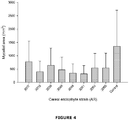
- Roots were incubated in an illuminated growth cabinet at 20°C for 30 days. Plants were then removed from the soil, the roots washed, then cleared using 1.5% sodium chloride for 3 minutes. Nematodes within the roots were stained using aniline blue in glycerol. Roots were then examined under a microscope and numbers of nematodes within root systems counted. Endophyte infection did not influence root weight.
- loline alkaloids produced by AR3046 are responsible for conferring at least some level of pest protection on infected Secale by deterring nematode colonization of the roots of endophyte infected Secale plants. This is consistent with lolines being shown to have deterrent and pesticidal effects with nematodes (Bacetty et al., 2009a 2009b).
- Grasses and cereals in New Zealand and Australia are frequently infested by larvae of a leaf mining fly, Cerodontha australis (Diptera: Agromyzidae), also known as wheat sheath miner. Larvae of this fly feed internally on the tissues of a range of grasses and cereals, causing damage that can result in tiller death. The mines leave a visible trail in the leaves.
- Cerodontha australis Diptera: Agromyzidae
- Larvae of this fly feed internally on the tissues of a range of grasses and cereals, causing damage that can result in tiller death.
- the mines leave a visible trail in the leaves.
- loline alkaloids produced by AR3046 are responsible for conferring at least some level of pest protection on infected Secale spp. by reducing infestations of C. australis on endophyte infected Secale spp. plants. This is consistent with lolines being shown to have deterrent and pesticidal effects with other insects and plant pests (Schardl et. al., 2007; Bacetty et al., 2009a 2009b).
- loline alkaloids produced by AR3046 are responsible for conferring at least some level of pest protection on infected Secale by reducing infestations of Spittle bugs on endophyte infected Secale plants. This is consistent with lolines being shown to have deterrent and pesticidal effects with other insects and plant pests (Schardl et. al., 2007; Bacetty et al., 2009a 2009b).
- epichloae endophyte strains plant/fungal symbioses, seeds produced from such symbioses and methods of making such symbioses according to the invention as disclosed herein all have industrial application for the production of plants that are used for human or animal consumption
Landscapes
- Life Sciences & Earth Sciences (AREA)
- Health & Medical Sciences (AREA)
- Engineering & Computer Science (AREA)
- Zoology (AREA)
- Chemical & Material Sciences (AREA)
- Microbiology (AREA)
- Biotechnology (AREA)
- Wood Science & Technology (AREA)
- Mycology (AREA)
- General Health & Medical Sciences (AREA)
- Genetics & Genomics (AREA)
- Bioinformatics & Cheminformatics (AREA)
- Organic Chemistry (AREA)
- Botany (AREA)
- Virology (AREA)
- Tropical Medicine & Parasitology (AREA)
- Environmental Sciences (AREA)
- General Engineering & Computer Science (AREA)
- Medicinal Chemistry (AREA)
- Biomedical Technology (AREA)
- Biochemistry (AREA)
- Developmental Biology & Embryology (AREA)
- Natural Medicines & Medicinal Plants (AREA)
- Pest Control & Pesticides (AREA)
- Agronomy & Crop Science (AREA)
- Plant Pathology (AREA)
- Dentistry (AREA)
- Agricultural Chemicals And Associated Chemicals (AREA)
- Pretreatment Of Seeds And Plants (AREA)
- Micro-Organisms Or Cultivation Processes Thereof (AREA)
- Breeding Of Plants And Reproduction By Means Of Culturing (AREA)
Claims (15)
- Souche isolée d'endophyte fongique epichloae sélectionnée parmi le groupe consistant en AR3039 (NRRL# 50716), AR3046 (NRRL# 50576), AR3049 (NRRL# 50577), AR3050 (NRRL# 50578, AR3064 (NRRL# 50718), AR3067 (NRRL# 50719), AR3068 (NRRL# 50720), AR3073 (NRRL# 50721), AR3074 (NRRL# 50722), AR3076 (NRRL# 50723) et AR3078 (NRRL# 50724) et des combinaisons de celles-ci.
- Plante Secale spp. infectée avec un endophyte fongique selon la revendication 1.
- Plante Secale spp. selon la revendication 2, où la Secale spp. n'est pas un hôte naturel de l'endophyte, et où la plante et l'endophyte forment une association symbiotique stable qui permet à la plante de progresser au cours d'un cycle de vie normal, et où l'endophyte fongique est un endophyte epichloae.
- Plante Secale spp. selon la revendication 2 ou 3, où l'endophyte est transmis d'une première génération de plante Secale spp. à une deuxième génération de plante Secale spp. par transmission verticale, de préférence où la transmission verticale de la première génération de plante Secale spp. à la deuxième génération de plante Secale spp. se fait par les graines.
- Plante Secale spp. selon l'une quelconque des revendications 2 à 4, où l'endophyte est un endophyte isolé d'Elymus spp., de préférence d'Elymus mutabilis.
- Plante Secale spp. selon l'une quelconque des revendications 2 à 5, où la plante Secale spp. infectée avec l'endophyte fongique présente un phénotype morphologique normal.
- Plante Secale spp. selon l'une quelconque des revendications 2 à 6, où la plante Secale spp. infectée avec l'endophyte fongique produit des alcaloïdes de loline et/ou de la peramine.
- Plante Secale spp. selon l'une quelconque des revendications 2 à 7, où la plante Secale spp. infectée avec l'endophyte fongique a une résistance accrue à un ou plusieurs nuisibles ou bien une résistance accrue à au moins une maladie des plantes ou aux deux, telle que comparée à une plante Secale spp. qui n'est pas infectée avec un endophyte fongique, de préférence où les nuisibles sont sélectionnés parmi le groupe consistant en : (1) des espèces de pucerons (Aphididae), de préférence Rhopalosiphum padi, Scizaphis graminum, Rhopalosiphum maidis, Metopoliphium dirhodum, Sitobion spp., Sitobion avenae, Sitobion fragariae, Diuraphis noxis ; (2) des espèces de mouches mineuses des graminées et céréales (Agromyzidae ; Anthomyiidae, Chloropidae, Cephidae et Cecidomyiidae), de préférence Oscinella frit, Oscinella pusilla, Mayetiola destructor, Cerodontha spp., Cerodontha australis, Cerodontha augustipennis, Formia fumigata, Meromyze americana, Haplodiplosis marginata, Chlorops pumilionis, Tipula spp. Chromatomyia fuscula, Cephus pygmaeus, Chromatomyia fuscula, Contarinia tritici ; (3) des espèces de thrips (Thripidae), de préférence Limothrips cerealium, Limothrips denticornis, Aptinothrips rufus, Stenothrips graminum ; (4) des espèces de sauterelles et de grillons (Acrididae et Gryllidae), de préférence Locusta migratoria, Phaulacridium marginale, Phaulacridium vittatum, Melanoplus spp., Teleogryllus commodus ; (5) des espèces de punaises (Lygaeidae), de préférence Nyssius huttoni, Blissus leucopertus leucopertus ; (6) des espèces de charançons (Curculionidae), de préférence Sphenophorus spp., (7) des espèces de chenilles de leucanie et de noctuelles des moissons (Noctuidae), de préférence Pseudaletia unipuncta, Spodoptera spp., Mythimna separata ; Persectania aversa, Agrosis ipsilon ; (8) des espèces de coloptères des feuilles (Chysomelidae), de préférence Oulema melanopus ; (9) des espèces de vers blancs (Scarabaeidae), de préférence Popillia japonica, Costelytra zealandica, Phyllopertha spp., Rhizotrogus majalis, Anisoplia segetum ; (10) des espèces de cochenilles des serrres (Peudococcidae et Coccidae), de préférence Phenacoccus hordei, Balanococcus poae, Ripersella rumicis, Porphyrophora tritici ; (11) des espèces de larves de taupin (Elateridae), de préférence Conoderus spp., Limonius spp., des espèces de scarabées (Caribidae), de préférence Zabrus tenebrioides ; (13) des espèces d'acariens (Eriophyidae et Penthaleidae), de préférence Penthaleus spp., Halotydeus destructor, Aceria spp. ; (14) des espèces de nuisibles des denrées stockées (Curculionidae, Silvanidae, Pyralidae, Gelechiidae, Tenebrionidae, Bostrichidae), de préférence Sitophilus oryzae, Sitophilus granarius, Sitotroga cerealella, Rhyzopertha dominica, Cryptolestes spp., Oryzaephilus surinamensis, Cadra cautella, Plodia interpunctella, Tribolium confusum, Tribolium castaneum, Lasioderma erricorne ; (15) des espèces de cercopes (Cercopoidea), de préférence Philaenus spumarius, (16) des espèces de nématodes de préférence un nématode de lésion des racines (Pratylenchus spp., particulièrement P. thornei, P. crenatus, P. neglectus et P. penetrans), un nématode à kyste des céréales (Heterodera spp. et Punctodera spp., particulièrement H. avenae, H. latipons, H. hordecalis, H. filipjevi, H. mani, H. bifenestra, H. pakistanensis et P. punctata), un nématode des nœuds des racines (Meloidogyne spp., particulièrement M. chitwoodi, M. naasi, M. artiellia, M. microtyla, M. ottersoni, M. graminicola, M. graminis, M. kikuyensis et M. spartinae), un nématode des tiges (Ditylenchus spp., particulièrement D. dipsicai et D. radicicola) ; un nématode à galles des graines (Anguina tritici) ; (17) des espèces de limaces (Deroceras reticulatum et Arion spp., particulièrement A. hertensis agg. et A. subfuscus), de préférences les nuisibles sont des nématodes, de préférence des nématodes de lésion aux racines (Pratylenchus spp.), ou des mouches mineuses des feuilles, Cerodontha australis (Diptera : Agromyzidae), également connues comme des mineuses de l'épi de blé, et de préférence où la maladie des plantes est causée par un pathogène des plantes sélectionné parmi le groupe consistant en virus de la jaunisse nanisante de l'orge (Luteovirus), virus du sol de la mosaïque du blé (Furovirus) et virus de la mosaïque striée du blé (Tritimovirus), Xanthomonas campestris, Pseudomonas syringae, Collectotrichum graminicola, Glomerella graminicola [téléomorphe], Alternaria spp., Cladosporium herbarum, Mycosphaerella tassiana [téléomorphe], Epicoccum spp., Sporobolomyces spp., Stemphylium spp., Bipolaris sorokiniana, Cochliobolus sativus [téléomorphe], Fusarium spp., Tilletia caries, Tilletia tritici, Tilletia laevis, Tilletia foetida, Hymenula cerealis, Cephalosporium gramineum, Helminthosporium sativum, Cochliobolus sativus [téléomorphe], Coprinus sychromorbidus, Dilophospora alopecuri, Tilletia controversa, Claviceps purpurea, Sphacelia segetum [anamorphe], Fusarium culmorum, Pseudoseptoria donacis, Selenophoma donacis, Neovossia indica, Tilletia indica, Puccinia recondita, Aecidium clematidis [anamorphe], Cercosporidium graminis, Scolicotrichum graminis, Phaeosphaeria herpotrichoides, Leptosphaeria herpotrichoides, Ustilago tritici, Microdochium nivale, Fusarium nivale, Monographella nivalis [téléomorphe], Erysiphe graminis, Pythium aphanidermatum, Pythium arrhenomanes, Pythium debaryanum, Pythium graminicola, Pythium ultimum, Gibberella zeae, Fusarium graminaerum [anamorphe], Septoria secalis, Septoria tritici, Mycosphaerella graminicola [téléomorphe], Rhizoctonia cerealis, Rhizoctonia solani, Rhizoctonia zeae, Blumeria spp., Ceratobasidium cereale [téléomorphe], Myriosclerotinia borealis, Sclerotinia borealis, Typhula idahoensis, Typhula incarnate, Typhula ishikariensis, Typhula ishikariensis var. canadensis, Stagonospora nodorum, Septoria nodorum, Phaeosphaeria nodorum [téléomorphe], Leptosphaeria nodorum, Urocystis occulta, Puccinia graminis, Aspergillus spp., Nigrospora spp., Penicillium spp., Rhizopus spp., Pseudocercosporella herpotrichoides, Tapesia acuformis [téléomorphe], Uredo glumarum [anamorphe], Pyrenophora triticirepentis, Drechslera tritici-repentis [anamorphe], Helminthosporium tritici-repentis, Puccinia triticina, Pythium spp., Rhynchosporium secalis, Puccinia striiformis, Gaeumannomyces graminis et Fusarium pseudograminearum, de préférence où le pathogène des plantes est Puccinia recondita, Puccinia triticina, Puccinia graminis, Fusarium spp., Pythium spp., Rhynchosporium secalis, Puccinia striiformis, Gaeumannomyces graminis, Rhizoctonia solani ou Fusarium pseudograminearum.
- Plante Secale spp. selon l'une quelconque des revendications 2 à 8, où la plante Secale spp. est sélectionnée parmi le groupe consistant en Secale cereale, Secale montanum, Secale strictum, Secale sylvestre et Secale vavilovii, de préférence Secale cereale.
- Procédé de préparation d'une combinaison de plante hôte stable/endophyte fongique epichloae comprenant infecter artificiellement une plante Secale spp. avec au moins un endophyte fongique selon la revendication 1 qui forme une combinaison symbiotique stable avec la plante inoculée, où la plante hôte ne présente pas de symptômes externes d'infection d'endophyte.
- Procédé pour conférer au moins un certain niveau de protection contre les nuisibles à une plante hôte Secale spp., comprenant infecter artificiellement une plante Secale spp. pour former une combinaison symbiotique stable avec au moins un endophyte fongique epichloae selon la revendication 1, où la combinaison d'endophyte fongique-plante Secale produit au moins un alcaloïde à un niveau suffisant pour conférer au moins un certain niveau de protection contre les nuisibles à la plante hôte.
- Graine de Secale spp. infectée avec un endophyte fongique epichloae selon la revendication 1.
- Graine de Secale spp. selon la revendication 12, où la graine est une graine d'une Secale spp. sélectionnée parmi le groupe consistant en Secale cereale, Secale montanum, Secale strictum, Secale sylvestre et Secale vavilovii, de préférence une graine de Secale cereale.
- Graine de Secale spp. selon la revendication 12 ou la revendication 13, où le au moins un endophyte fongique est un endophyte isolé d'Elymus spp. de préférence d'Elymus mutabilis.
- Souche isolée d'endophyte fongique epichloae sélectionnée parmi le groupe consistant en AR3039, AR3046, AR3050, AR3067, AR3068, AR3074 et AR3078, de préférence où l'endophyte est AR3046, AR3050 ou AR3068.
Priority Applications (1)
| Application Number | Priority Date | Filing Date | Title |
|---|---|---|---|
| PL14760058T PL2964017T3 (pl) | 2013-03-06 | 2014-03-06 | Endofity grzybowe |
Applications Claiming Priority (2)
| Application Number | Priority Date | Filing Date | Title |
|---|---|---|---|
| US201361773722P | 2013-03-06 | 2013-03-06 | |
| PCT/IB2014/059479 WO2014136070A1 (fr) | 2013-03-06 | 2014-03-06 | Endophytes fongiques améliorés |
Publications (3)
| Publication Number | Publication Date |
|---|---|
| EP2964017A1 EP2964017A1 (fr) | 2016-01-13 |
| EP2964017A4 EP2964017A4 (fr) | 2017-01-04 |
| EP2964017B1 true EP2964017B1 (fr) | 2020-08-05 |
Family
ID=51490697
Family Applications (1)
| Application Number | Title | Priority Date | Filing Date |
|---|---|---|---|
| EP14760058.9A Active EP2964017B1 (fr) | 2013-03-06 | 2014-03-06 | Endophytes fongiques |
Country Status (12)
| Country | Link |
|---|---|
| US (1) | US10251365B2 (fr) |
| EP (1) | EP2964017B1 (fr) |
| CN (1) | CN105072891B (fr) |
| AU (3) | AU2014224189B2 (fr) |
| CA (1) | CA2902946C (fr) |
| DK (1) | DK2964017T3 (fr) |
| ES (1) | ES2828223T3 (fr) |
| NZ (1) | NZ628696A (fr) |
| PL (1) | PL2964017T3 (fr) |
| RU (1) | RU2683379C2 (fr) |
| UA (1) | UA120250C2 (fr) |
| WO (1) | WO2014136070A1 (fr) |
Families Citing this family (18)
| Publication number | Priority date | Publication date | Assignee | Title |
|---|---|---|---|---|
| US20130104263A1 (en) * | 2010-01-07 | 2013-04-25 | Agriculture Victoria Services Pty Ltd | Endophytes and related methods |
| CN105838782B (zh) * | 2016-01-28 | 2021-02-09 | 中国计量学院 | 一种快速稳定分离鉴定菰黑粉菌性亲和单倍体菌株的方法 |
| CA3033405A1 (fr) * | 2016-08-12 | 2018-02-15 | Agriculture Victoria Services Pty Ltd | Procedes de caracterisation d'endophytes |
| CN106047729B (zh) * | 2016-08-19 | 2019-05-24 | 云南大学 | 一株腐霉菌株及其应用 |
| CN106718181B (zh) * | 2017-02-10 | 2020-05-26 | 北京农学院 | 一种鉴定植物对根结线虫抗性的方法 |
| CN108004154B (zh) * | 2017-12-06 | 2020-12-18 | 河南省农业科学院植物保护研究所 | 腥掷孢酵母菌17wy1、其微生物制剂及其在小麦白粉病防治中的应用 |
| KR101983575B1 (ko) * | 2017-12-21 | 2019-06-03 | 대한민국 | 신균주 세라토바시디움 속 js1289 및 이의 용도 |
| CN111918551A (zh) * | 2018-02-21 | 2020-11-10 | 格拉斯兰兹技术有限公司 | 香柱菌属内生菌 |
| RU2020130394A (ru) * | 2018-02-21 | 2022-03-15 | Нэшнл Юниверсити Корпорейшн Тоттори Юниверсити | Скрининг эндофитов |
| CN109269865B (zh) * | 2018-08-24 | 2020-11-27 | 中南民族大学 | 用于分离摇蚊头壳亚化石的染色剂及其染色方法 |
| CN109504610B (zh) * | 2018-12-12 | 2021-11-19 | 安徽中医药大学 | 一种植物内生真菌Aspergillus sp.MBL1612提取物及其用途 |
| CN110468057B (zh) * | 2019-09-02 | 2021-09-24 | 昆明理工大学 | 一株植物内生盘双端毛孢属真菌m7sb 41及其应用 |
| CN110713937B (zh) * | 2019-09-20 | 2022-02-01 | 兰州大学 | 提高中华羊茅-内生真菌菌株pa次生代谢产物波胺含量的方法 |
| CN110669801B (zh) * | 2019-09-20 | 2022-02-01 | 兰州大学 | 提高中华羊茅-内生真菌菌株pa次生代谢产物震颤素含量的方法 |
| CN111657304B (zh) * | 2020-06-30 | 2021-10-08 | 安徽农业大学 | 黄曲霉tl-f3强化黑麦草修复重金属污染土壤的方法 |
| CN111793566B (zh) * | 2020-07-31 | 2021-11-16 | 南京林业大学 | 一种杉木内生真菌及其生物防治应用 |
| CN115885937B (zh) * | 2022-12-16 | 2025-08-05 | 云南省微生物发酵工程研究中心有限公司 | 一种烟草根结线虫的室内培养方法 |
| CN118086076B (zh) * | 2024-04-19 | 2024-07-05 | 云南林业职业技术学院 | 核桃树皮内生真菌Coprinellus sp.YAFEF312分离及应用 |
Family Cites Families (6)
| Publication number | Priority date | Publication date | Assignee | Title |
|---|---|---|---|---|
| AU2001284955B2 (en) | 2000-08-15 | 2004-11-11 | The Board Of Trustees Of The University Of Arkansas | Plants infected with non-toxic endophytes |
| WO2004082384A2 (fr) * | 2003-03-18 | 2004-09-30 | Board Of Trustees Operating Michigan State University | Amelioration de la production de cultures cerealieres par inoculation de mutants attenues de champignons pathogenes |
| US7892813B2 (en) * | 2007-02-12 | 2011-02-22 | The Samuel Roberts Noble Foundation | Fungal endophytes of Elymus canadensis |
| CA2673696A1 (fr) * | 2008-07-25 | 2010-01-25 | The Samuel Roberts Noble Foundation, Inc. | Amelioration de biomasse et de productivite dans des plants de gazon |
| US8975489B2 (en) * | 2010-12-02 | 2015-03-10 | The Samuel Roberts Noble Foundation | Grass fungal endophytes and uses thereof |
| CN102283118A (zh) * | 2011-07-06 | 2011-12-21 | 西安文理学院 | 一种筛选能够提高农作物抗真菌病害能力内生真菌的方法 |
-
2014
- 2014-03-06 CN CN201480012493.9A patent/CN105072891B/zh not_active Expired - Fee Related
- 2014-03-06 RU RU2015141764A patent/RU2683379C2/ru active
- 2014-03-06 DK DK14760058.9T patent/DK2964017T3/da active
- 2014-03-06 CA CA2902946A patent/CA2902946C/fr active Active
- 2014-03-06 PL PL14760058T patent/PL2964017T3/pl unknown
- 2014-03-06 WO PCT/IB2014/059479 patent/WO2014136070A1/fr not_active Ceased
- 2014-03-06 AU AU2014224189A patent/AU2014224189B2/en active Active
- 2014-03-06 EP EP14760058.9A patent/EP2964017B1/fr active Active
- 2014-03-06 UA UAA201509381A patent/UA120250C2/uk unknown
- 2014-03-06 NZ NZ628696A patent/NZ628696A/en unknown
- 2014-03-06 ES ES14760058T patent/ES2828223T3/es active Active
- 2014-03-06 US US14/772,169 patent/US10251365B2/en active Active
-
2020
- 2020-03-04 AU AU2020201594A patent/AU2020201594A1/en not_active Abandoned
-
2022
- 2022-05-16 AU AU2022203250A patent/AU2022203250A1/en not_active Abandoned
Non-Patent Citations (1)
| Title |
|---|
| None * |
Also Published As
| Publication number | Publication date |
|---|---|
| RU2015141764A (ru) | 2017-04-10 |
| EP2964017A4 (fr) | 2017-01-04 |
| PL2964017T3 (pl) | 2021-04-06 |
| AU2020201594A1 (en) | 2020-03-19 |
| RU2683379C2 (ru) | 2019-03-28 |
| WO2014136070A1 (fr) | 2014-09-12 |
| CA2902946A1 (fr) | 2014-09-12 |
| AU2014224189A1 (en) | 2015-10-29 |
| AU2014224189B2 (en) | 2019-12-19 |
| ES2828223T3 (es) | 2021-05-25 |
| EP2964017A1 (fr) | 2016-01-13 |
| UA120250C2 (uk) | 2019-11-11 |
| CN105072891B (zh) | 2017-10-27 |
| NZ628696A (en) | 2018-07-27 |
| DK2964017T3 (da) | 2020-11-09 |
| CN105072891A (zh) | 2015-11-18 |
| US10251365B2 (en) | 2019-04-09 |
| AU2022203250A1 (en) | 2022-06-02 |
| CA2902946C (fr) | 2023-03-21 |
| US20160262335A1 (en) | 2016-09-15 |
Similar Documents
| Publication | Publication Date | Title |
|---|---|---|
| EP2964017B1 (fr) | Endophytes fongiques | |
| Singh et al. | Wheat blast: a disease spreading by intercontinental jumps and its management strategies | |
| Li et al. | Identification of a new soybean rust resistance gene in PI 567102B | |
| Talgø et al. | Sydowia polyspora associated with current season needle necrosis (CSNN) on true fir (Abies spp.) | |
| US12089547B2 (en) | Endophyte screening | |
| Shard et al. | Hybridization and cospeciation hypotheses for the evolution of grass endophytes | |
| US11839187B2 (en) | Epichloë endophyte | |
| WO2022157556A1 (fr) | Endophyte epichloë | |
| White | Wheat pre-breeding towards disease resistance of fungal pathogens | |
| Das et al. | Screening of banana hybrids (Phase II) resistant to Helicotylenchus multicinctus | |
| De Carvalho | Novel Approaches for Controlling Plant Pathogenic Bacteria and Viruses and Characterization of Emerging Phytobacteria | |
| STRELKOV et al. | Tri-society conference: Canadian Phytopthogological Society, Canadian Society for Horticultural Science, Canadian Society of Agronomy, 2023/Conférence des trois sociétés: La Société Canadienne de Phytopthologie, La Société Canadienne de Science horticole, La Société Candienne d’Agronomie, 2023 | |
| WO2025186708A1 (fr) | Endophyte fongique | |
| KARTHIK | Master of Science (Agriculture) | |
| APPEL et al. | 2015 Southern Division Meeting Abstracts | |
| Lavanya et al. | Magnaporthe Blast of Pearl Millet in India | |
| Iftikhar et al. | Huanglongbing: Pathogen detection system |
Legal Events
| Date | Code | Title | Description |
|---|---|---|---|
| PUAI | Public reference made under article 153(3) epc to a published international application that has entered the european phase |
Free format text: ORIGINAL CODE: 0009012 |
|
| 17P | Request for examination filed |
Effective date: 20150819 |
|
| AK | Designated contracting states |
Kind code of ref document: A1 Designated state(s): AL AT BE BG CH CY CZ DE DK EE ES FI FR GB GR HR HU IE IS IT LI LT LU LV MC MK MT NL NO PL PT RO RS SE SI SK SM TR |
|
| AX | Request for extension of the european patent |
Extension state: BA ME |
|
| RIC1 | Information provided on ipc code assigned before grant |
Ipc: C12N 1/14 20060101ALI20160824BHEP Ipc: C12R 1/645 20060101ALI20160824BHEP Ipc: A01N 63/04 20060101AFI20160824BHEP Ipc: A01H 17/00 20060101ALI20160824BHEP |
|
| A4 | Supplementary search report drawn up and despatched |
Effective date: 20161205 |
|
| RIC1 | Information provided on ipc code assigned before grant |
Ipc: A01H 17/00 20060101ALI20161129BHEP Ipc: A01N 63/04 20060101AFI20161129BHEP Ipc: C12N 1/14 20060101ALI20161129BHEP Ipc: C12R 1/645 20060101ALI20161129BHEP |
|
| STAA | Information on the status of an ep patent application or granted ep patent |
Free format text: STATUS: EXAMINATION IS IN PROGRESS |
|
| 17Q | First examination report despatched |
Effective date: 20180307 |
|
| REG | Reference to a national code |
Ref country code: DE Ref legal event code: R079 Ref document number: 602014068590 Country of ref document: DE Free format text: PREVIOUS MAIN CLASS: A01H0015000000 Ipc: A01N0063300000 |
|
| RIC1 | Information provided on ipc code assigned before grant |
Ipc: A01N 63/30 20200101AFI20200116BHEP Ipc: C12R 1/645 20060101ALI20200116BHEP Ipc: A01H 17/00 20060101ALI20200116BHEP Ipc: C12N 1/14 20060101ALI20200116BHEP |
|
| GRAP | Despatch of communication of intention to grant a patent |
Free format text: ORIGINAL CODE: EPIDOSNIGR1 |
|
| STAA | Information on the status of an ep patent application or granted ep patent |
Free format text: STATUS: GRANT OF PATENT IS INTENDED |
|
| RIC1 | Information provided on ipc code assigned before grant |
Ipc: A01N 63/30 20200101AFI20200131BHEP Ipc: C12N 1/14 20060101ALI20200131BHEP Ipc: C12R 1/645 20060101ALI20200131BHEP Ipc: A01P 3/00 20060101ALI20200131BHEP Ipc: A01H 17/00 20060101ALI20200131BHEP |
|
| INTG | Intention to grant announced |
Effective date: 20200224 |
|
| GRAS | Grant fee paid |
Free format text: ORIGINAL CODE: EPIDOSNIGR3 |
|
| GRAA | (expected) grant |
Free format text: ORIGINAL CODE: 0009210 |
|
| STAA | Information on the status of an ep patent application or granted ep patent |
Free format text: STATUS: THE PATENT HAS BEEN GRANTED |
|
| AK | Designated contracting states |
Kind code of ref document: B1 Designated state(s): AL AT BE BG CH CY CZ DE DK EE ES FI FR GB GR HR HU IE IS IT LI LT LU LV MC MK MT NL NO PL PT RO RS SE SI SK SM TR |
|
| AX | Request for extension of the european patent |
Extension state: BA ME |
|
| REG | Reference to a national code |
Ref country code: GB Ref legal event code: FG4D |
|
| REG | Reference to a national code |
Ref country code: CH Ref legal event code: EP |
|
| REG | Reference to a national code |
Ref country code: AT Ref legal event code: REF Ref document number: 1297432 Country of ref document: AT Kind code of ref document: T Effective date: 20200815 |
|
| REG | Reference to a national code |
Ref country code: IE Ref legal event code: FG4D |
|
| REG | Reference to a national code |
Ref country code: DE Ref legal event code: R096 Ref document number: 602014068590 Country of ref document: DE |
|
| REG | Reference to a national code |
Ref country code: DK Ref legal event code: T3 Effective date: 20201102 |
|
| REG | Reference to a national code |
Ref country code: LT Ref legal event code: MG4D |
|
| REG | Reference to a national code |
Ref country code: NL Ref legal event code: MP Effective date: 20200805 |
|
| REG | Reference to a national code |
Ref country code: AT Ref legal event code: MK05 Ref document number: 1297432 Country of ref document: AT Kind code of ref document: T Effective date: 20200805 |
|
| PG25 | Lapsed in a contracting state [announced via postgrant information from national office to epo] |
Ref country code: BG Free format text: LAPSE BECAUSE OF FAILURE TO SUBMIT A TRANSLATION OF THE DESCRIPTION OR TO PAY THE FEE WITHIN THE PRESCRIBED TIME-LIMIT Effective date: 20201105 Ref country code: AT Free format text: LAPSE BECAUSE OF FAILURE TO SUBMIT A TRANSLATION OF THE DESCRIPTION OR TO PAY THE FEE WITHIN THE PRESCRIBED TIME-LIMIT Effective date: 20200805 Ref country code: HR Free format text: LAPSE BECAUSE OF FAILURE TO SUBMIT A TRANSLATION OF THE DESCRIPTION OR TO PAY THE FEE WITHIN THE PRESCRIBED TIME-LIMIT Effective date: 20200805 Ref country code: GR Free format text: LAPSE BECAUSE OF FAILURE TO SUBMIT A TRANSLATION OF THE DESCRIPTION OR TO PAY THE FEE WITHIN THE PRESCRIBED TIME-LIMIT Effective date: 20201106 Ref country code: LT Free format text: LAPSE BECAUSE OF FAILURE TO SUBMIT A TRANSLATION OF THE DESCRIPTION OR TO PAY THE FEE WITHIN THE PRESCRIBED TIME-LIMIT Effective date: 20200805 Ref country code: NO Free format text: LAPSE BECAUSE OF FAILURE TO SUBMIT A TRANSLATION OF THE DESCRIPTION OR TO PAY THE FEE WITHIN THE PRESCRIBED TIME-LIMIT Effective date: 20201105 Ref country code: PT Free format text: LAPSE BECAUSE OF FAILURE TO SUBMIT A TRANSLATION OF THE DESCRIPTION OR TO PAY THE FEE WITHIN THE PRESCRIBED TIME-LIMIT Effective date: 20201207 Ref country code: FI Free format text: LAPSE BECAUSE OF FAILURE TO SUBMIT A TRANSLATION OF THE DESCRIPTION OR TO PAY THE FEE WITHIN THE PRESCRIBED TIME-LIMIT Effective date: 20200805 Ref country code: SE Free format text: LAPSE BECAUSE OF FAILURE TO SUBMIT A TRANSLATION OF THE DESCRIPTION OR TO PAY THE FEE WITHIN THE PRESCRIBED TIME-LIMIT Effective date: 20200805 |
|
| PG25 | Lapsed in a contracting state [announced via postgrant information from national office to epo] |
Ref country code: RS Free format text: LAPSE BECAUSE OF FAILURE TO SUBMIT A TRANSLATION OF THE DESCRIPTION OR TO PAY THE FEE WITHIN THE PRESCRIBED TIME-LIMIT Effective date: 20200805 Ref country code: LV Free format text: LAPSE BECAUSE OF FAILURE TO SUBMIT A TRANSLATION OF THE DESCRIPTION OR TO PAY THE FEE WITHIN THE PRESCRIBED TIME-LIMIT Effective date: 20200805 Ref country code: NL Free format text: LAPSE BECAUSE OF FAILURE TO SUBMIT A TRANSLATION OF THE DESCRIPTION OR TO PAY THE FEE WITHIN THE PRESCRIBED TIME-LIMIT Effective date: 20200805 Ref country code: IS Free format text: LAPSE BECAUSE OF FAILURE TO SUBMIT A TRANSLATION OF THE DESCRIPTION OR TO PAY THE FEE WITHIN THE PRESCRIBED TIME-LIMIT Effective date: 20201205 |
|
| PG25 | Lapsed in a contracting state [announced via postgrant information from national office to epo] |
Ref country code: RO Free format text: LAPSE BECAUSE OF FAILURE TO SUBMIT A TRANSLATION OF THE DESCRIPTION OR TO PAY THE FEE WITHIN THE PRESCRIBED TIME-LIMIT Effective date: 20200805 Ref country code: SM Free format text: LAPSE BECAUSE OF FAILURE TO SUBMIT A TRANSLATION OF THE DESCRIPTION OR TO PAY THE FEE WITHIN THE PRESCRIBED TIME-LIMIT Effective date: 20200805 Ref country code: CZ Free format text: LAPSE BECAUSE OF FAILURE TO SUBMIT A TRANSLATION OF THE DESCRIPTION OR TO PAY THE FEE WITHIN THE PRESCRIBED TIME-LIMIT Effective date: 20200805 Ref country code: EE Free format text: LAPSE BECAUSE OF FAILURE TO SUBMIT A TRANSLATION OF THE DESCRIPTION OR TO PAY THE FEE WITHIN THE PRESCRIBED TIME-LIMIT Effective date: 20200805 |
|
| REG | Reference to a national code |
Ref country code: DE Ref legal event code: R097 Ref document number: 602014068590 Country of ref document: DE |
|
| REG | Reference to a national code |
Ref country code: ES Ref legal event code: FG2A Ref document number: 2828223 Country of ref document: ES Kind code of ref document: T3 Effective date: 20210525 |
|
| PG25 | Lapsed in a contracting state [announced via postgrant information from national office to epo] |
Ref country code: AL Free format text: LAPSE BECAUSE OF FAILURE TO SUBMIT A TRANSLATION OF THE DESCRIPTION OR TO PAY THE FEE WITHIN THE PRESCRIBED TIME-LIMIT Effective date: 20200805 |
|
| PGFP | Annual fee paid to national office [announced via postgrant information from national office to epo] |
Ref country code: DK Payment date: 20210323 Year of fee payment: 8 Ref country code: TR Payment date: 20210304 Year of fee payment: 8 |
|
| RAP4 | Party data changed (patent owner data changed or rights of a patent transferred) |
Owner name: GRASSLANZ TECHNOLOGY LIMITED Owner name: THE GRAINS RESEARCH AND DEVELOPMENT CORPORATION |
|
| PLBE | No opposition filed within time limit |
Free format text: ORIGINAL CODE: 0009261 |
|
| STAA | Information on the status of an ep patent application or granted ep patent |
Free format text: STATUS: NO OPPOSITION FILED WITHIN TIME LIMIT |
|
| PG25 | Lapsed in a contracting state [announced via postgrant information from national office to epo] |
Ref country code: SK Free format text: LAPSE BECAUSE OF FAILURE TO SUBMIT A TRANSLATION OF THE DESCRIPTION OR TO PAY THE FEE WITHIN THE PRESCRIBED TIME-LIMIT Effective date: 20200805 |
|
| 26N | No opposition filed |
Effective date: 20210507 |
|
| PG25 | Lapsed in a contracting state [announced via postgrant information from national office to epo] |
Ref country code: IT Free format text: LAPSE BECAUSE OF FAILURE TO SUBMIT A TRANSLATION OF THE DESCRIPTION OR TO PAY THE FEE WITHIN THE PRESCRIBED TIME-LIMIT Effective date: 20200805 |
|
| PG25 | Lapsed in a contracting state [announced via postgrant information from national office to epo] |
Ref country code: SI Free format text: LAPSE BECAUSE OF FAILURE TO SUBMIT A TRANSLATION OF THE DESCRIPTION OR TO PAY THE FEE WITHIN THE PRESCRIBED TIME-LIMIT Effective date: 20200805 |
|
| PGFP | Annual fee paid to national office [announced via postgrant information from national office to epo] |
Ref country code: ES Payment date: 20210525 Year of fee payment: 8 |
|
| PG25 | Lapsed in a contracting state [announced via postgrant information from national office to epo] |
Ref country code: MC Free format text: LAPSE BECAUSE OF FAILURE TO SUBMIT A TRANSLATION OF THE DESCRIPTION OR TO PAY THE FEE WITHIN THE PRESCRIBED TIME-LIMIT Effective date: 20200805 |
|
| REG | Reference to a national code |
Ref country code: CH Ref legal event code: PL |
|
| GBPC | Gb: european patent ceased through non-payment of renewal fee |
Effective date: 20210306 |
|
| REG | Reference to a national code |
Ref country code: BE Ref legal event code: MM Effective date: 20210331 |
|
| PG25 | Lapsed in a contracting state [announced via postgrant information from national office to epo] |
Ref country code: CH Free format text: LAPSE BECAUSE OF NON-PAYMENT OF DUE FEES Effective date: 20210331 Ref country code: LU Free format text: LAPSE BECAUSE OF NON-PAYMENT OF DUE FEES Effective date: 20210306 Ref country code: LI Free format text: LAPSE BECAUSE OF NON-PAYMENT OF DUE FEES Effective date: 20210331 Ref country code: GB Free format text: LAPSE BECAUSE OF NON-PAYMENT OF DUE FEES Effective date: 20210306 Ref country code: IE Free format text: LAPSE BECAUSE OF NON-PAYMENT OF DUE FEES Effective date: 20210306 Ref country code: FR Free format text: LAPSE BECAUSE OF NON-PAYMENT OF DUE FEES Effective date: 20210331 |
|
| PG25 | Lapsed in a contracting state [announced via postgrant information from national office to epo] |
Ref country code: BE Free format text: LAPSE BECAUSE OF NON-PAYMENT OF DUE FEES Effective date: 20210331 |
|
| REG | Reference to a national code |
Ref country code: DK Ref legal event code: EBP Effective date: 20220331 |
|
| PG25 | Lapsed in a contracting state [announced via postgrant information from national office to epo] |
Ref country code: DK Free format text: LAPSE BECAUSE OF NON-PAYMENT OF DUE FEES Effective date: 20220331 |
|
| REG | Reference to a national code |
Ref country code: ES Ref legal event code: FD2A Effective date: 20230526 |
|
| PG25 | Lapsed in a contracting state [announced via postgrant information from national office to epo] |
Ref country code: HU Free format text: LAPSE BECAUSE OF FAILURE TO SUBMIT A TRANSLATION OF THE DESCRIPTION OR TO PAY THE FEE WITHIN THE PRESCRIBED TIME-LIMIT; INVALID AB INITIO Effective date: 20140306 |
|
| PG25 | Lapsed in a contracting state [announced via postgrant information from national office to epo] |
Ref country code: CY Free format text: LAPSE BECAUSE OF FAILURE TO SUBMIT A TRANSLATION OF THE DESCRIPTION OR TO PAY THE FEE WITHIN THE PRESCRIBED TIME-LIMIT Effective date: 20200805 |
|
| PG25 | Lapsed in a contracting state [announced via postgrant information from national office to epo] |
Ref country code: ES Free format text: LAPSE BECAUSE OF NON-PAYMENT OF DUE FEES Effective date: 20220307 |
|
| PG25 | Lapsed in a contracting state [announced via postgrant information from national office to epo] |
Ref country code: MK Free format text: LAPSE BECAUSE OF FAILURE TO SUBMIT A TRANSLATION OF THE DESCRIPTION OR TO PAY THE FEE WITHIN THE PRESCRIBED TIME-LIMIT Effective date: 20200805 |
|
| PG25 | Lapsed in a contracting state [announced via postgrant information from national office to epo] |
Ref country code: MT Free format text: LAPSE BECAUSE OF FAILURE TO SUBMIT A TRANSLATION OF THE DESCRIPTION OR TO PAY THE FEE WITHIN THE PRESCRIBED TIME-LIMIT Effective date: 20200805 |
|
| REG | Reference to a national code |
Ref country code: DE Ref legal event code: R082 Ref document number: 602014068590 Country of ref document: DE Representative=s name: DENNEMEYER & ASSOCIATES RECHTSANWALTSGESELLSCH, DE |
|
| PGFP | Annual fee paid to national office [announced via postgrant information from national office to epo] |
Ref country code: DE Payment date: 20260319 Year of fee payment: 13 |
|
| PGFP | Annual fee paid to national office [announced via postgrant information from national office to epo] |
Ref country code: PL Payment date: 20260227 Year of fee payment: 13 |