EP2965653A1 - Sac à dos avec mécanisme de réglage de longueur de torse - Google Patents
Sac à dos avec mécanisme de réglage de longueur de torse Download PDFInfo
- Publication number
- EP2965653A1 EP2965653A1 EP14176397.9A EP14176397A EP2965653A1 EP 2965653 A1 EP2965653 A1 EP 2965653A1 EP 14176397 A EP14176397 A EP 14176397A EP 2965653 A1 EP2965653 A1 EP 2965653A1
- Authority
- EP
- European Patent Office
- Prior art keywords
- holder
- backpack
- force transmitting
- transmitting element
- shoulder straps
- Prior art date
- Legal status (The legal status is an assumption and is not a legal conclusion. Google has not performed a legal analysis and makes no representation as to the accuracy of the status listed.)
- Withdrawn
Links
- 239000004744 fabric Substances 0.000 claims description 5
- 238000010276 construction Methods 0.000 description 7
- 230000009286 beneficial effect Effects 0.000 description 3
- 239000000463 material Substances 0.000 description 2
- 238000009423 ventilation Methods 0.000 description 2
- 210000000707 wrist Anatomy 0.000 description 2
- 239000000853 adhesive Substances 0.000 description 1
- 230000001070 adhesive effect Effects 0.000 description 1
- 230000000295 complement effect Effects 0.000 description 1
- 230000000694 effects Effects 0.000 description 1
- 230000003993 interaction Effects 0.000 description 1
- 230000004048 modification Effects 0.000 description 1
- 238000012986 modification Methods 0.000 description 1
- 238000009877 rendering Methods 0.000 description 1
Images


Classifications
-
- A—HUMAN NECESSITIES
- A45—HAND OR TRAVELLING ARTICLES
- A45F—TRAVELLING OR CAMP EQUIPMENT: SACKS OR PACKS CARRIED ON THE BODY
- A45F3/00—Travelling or camp articles; Sacks or packs carried on the body
- A45F3/04—Sacks or packs carried on the body by means of two straps passing over the two shoulders
- A45F3/047—Sacks or packs carried on the body by means of two straps passing over the two shoulders with adjustable fastenings for the shoulder straps or waist belts
-
- A—HUMAN NECESSITIES
- A45—HAND OR TRAVELLING ARTICLES
- A45F—TRAVELLING OR CAMP EQUIPMENT: SACKS OR PACKS CARRIED ON THE BODY
- A45F3/00—Travelling or camp articles; Sacks or packs carried on the body
- A45F3/12—Shoulder-pads
- A45F2003/122—Back cushioning parts or details of backpacks, e.g. with ventilation
- A45F2003/125—Back cushioning parts or details of backpacks, e.g. with ventilation with ventilation
Definitions
- the present invention relates to a backpack with a torso length adjustment mechanism.
- Such a backpack typically comprises two shoulder straps connected to a bag of the backpack at different positions in order to fit the shoulder straps to the torso length of a user.
- the size adjustment of the shoulder straps can be of particular interest when the backpack is used by a user for the first time. It is however also of interest to be able to adjust the size of the backpack during wearing the same. In some situations, the user may want a bigger torso length setting compared to other situations.
- known systems demand that the user takes off the backpack and adjusts the shoulder straps to the desired size. This is however time consuming and annoying for the user.
- the present invention relates to a backpack with a torso length adjustment mechanism.
- the backpack comprises a holder fixedly connected to bag.
- the holder can comprise any shape which allows for holding the bag when the same is connected to the bag.
- the holder can be sewn on the bag or adhered thereto by an adhesive. Both kinds of connection allow a secure fixation of the holder on the bag.
- the backpack comprises a mesh back support having a back mesh contactable to the bag of a user and a supporting element for spacedly supporting the back mesh on the holder.
- the mesh back support in either case comprises the latter two elements, that is a back mesh and a supporting element.
- the back mesh comprises a mesh structure allowing air to pass through the same.
- the back mesh can comprise openings which can have different shapes as long as it is possible for air to pass through the back mesh for ventilation purposes.
- the back mesh is spacedly supported on the holder by means of the supporting element.
- the supporting element can be a frame structure for instance.
- Such a frame structure can be constructed so as to be connected to the holder in its middle portion and to hold the back mesh at its upper and lower portions respectively.
- the supporting element is constructed such that the back mesh is tensioned.
- it is possible to preset the tensioning force of the back mesh such that the back mesh is able to rest against the back of a user when the backpack is worn.
- the back mesh is tensioned such that it is able to follow the shape of the users back.
- the supporting element comprises a curved structure and its ends are connected to each other by means of the back mesh which extends from one end, preferably the lower end, of the supporting element to the other end, preferably the upper end of the supporting element.
- the back mesh can be arranged on the supporting element such that there is no further contact between the back mesh and the supporting element other than at the ends of their supporting element.
- a middle portion of the supporting element is spaced from the back mesh.
- the middle portion of the supporting element can be fixed to the holder.
- a fixed connection between the supporting element and the holder is achieved while the back mesh is arranged at a distance from the holder.
- the holder is fixedly connected to the bag so that a configuration is achieved in which the back mesh is spaced from the bag over a wide range of the construction. By this, a space is provided between the mesh and the holder which is accessible from the side.
- the shoulder strap length adjusting mechanism comprises a force transmitting element for transmitting a force from the holder to the shoulder straps of the backpack.
- the force transmitting element is designed to transmit a force from the holder to the shoulder straps.
- the force transmitting element is arranged lockably moveable on the holder between a first position in which a size of the shoulder straps is the largest and a second position in which the size of the shoulder straps is smallest.
- the direction in which the force transmitting element is movable can be a direction along the length of a user's back or in other words along the longitudinal extension direction of the back mesh. With such a configuration, the distance between the ends of each shoulder strap is made smaller or larger.
- first position and the second position are to be understood as end positions and the force transmitting element can be lockable at various positions between both end positions.
- the shoulder strap length adjustment mechanism further comprises a locking mechanism at the holder for releasably locking a relative movement of the force transmitting element and the holder with respect to each other.
- a relative movement can occur in different ways including a movement of the force transmitting element with respect to the holder, a movement of the holder with respect to the force transmitting element or a combined movement of both elements with respect to each other.
- the locking mechanism can be constructed so as to lock the movement of the force transmitting element with respect to the holder in one direction only. In practical use, it might be enough to provide a locking in one direction only.
- the locking mechanism must be able to lock at least a movement of the holder with respect to the force transmitting element in this direction.
- the locking mechanism comprises an operating section for releasing the locking, wherein the operating section is accessible through the space provided between the back mesh and the holder when the backpack is worn by the user.
- the operating section is accessible through the space provided between the back mesh and the holder when the backpack is worn by the user.
- the user can easily operate the operating section with his own hand while carrying the backpack.
- the user simply has to insert his hand into the space behind his back and to operate the operating section.
- the locking mechanism and the operating section on the holder, a natural posture of the wrist of the user's hand can be maintained and the operating section is easily operable.
- the holder and the locking mechanism can be arranged so as to face the back mesh and consequently the user's back when the backpack is worn. Accordingly, a simple construction is achieved which allows the user to unlock the locking mechanism for a shoulder strap length adjustment while carrying the back pack.
- the locking mechanism comprises a latching portion engageable with an engagement portion of the force transmitting element and a gripping portion for pulling or holding the engagement portion.
- a ratchet type connection can be provided by interaction of the latching portion and the engagement portion of the force transmitting element.
- the latching portion can be arranged on the holder so as to be moveable with respect to the engagement portion.
- the latching portion is provided rotatably moveable on the holder.
- the latching portion and the engagement portion are designed complementary in order to enable an engagement between the same.
- the latching portion can comprise a protrusion and the engagement portion can comprise a recess into which a protrusion is engageable.
- the gripping portion can have different shapes as long as it is possible for the user to grip the engagement portion for pulling or holding the same.
- the gripping portion is provided at an end of the engagement portion, preferably the end of the engagement portion facing downwards when the user wears the backpack.
- the gripping portion is provided so as to be accessible through the space provided between the back mesh and the holder.
- the gripping portion is provided below the latching portion.
- the gripping portion is a loop fixed on the engagement portion.
- the loop can be made of a fabric and fixedly mounted at the bottom of the engagement portion.
- the loop can be formed by providing an opening in an end portion of the engagement portion. In this case, the loop is integrally formed with the engagement portion.
- the engagement portion comprises a strip with a locking profile.
- the locking profile can be a toothed profile.
- the toothed profile can be provided over the entire width of the strip and the latching portion can be correspondingly formed so as to engage with the toothed profile.
- the latching portion can be constructed to engage with multiple teeth at the same time. This has the beneficial effect that a higher load can be transferred to the force transmitting element via the locking profile.
- the toothed profile or locking profile can have the same orientation over substantially the entire width of the engagement portion. With such a profile, it is possible to releasably lock the force transmitting element in one direction. On the other hand, it is possible to provide two portions over the width of the engagement portion in which the toothed profile is oriented in opposite direction. By using a corresponding latching portion, it is possible to releasably lock a movement of the force transmitting element in both directions.
- the latching portion can comprise a locking latch releasably engageable with the locking profile.
- This locking latch is operable from a lock condition to a release condition.
- a movability of the force transmitting element is restricted at least towards the first position.
- the first position is the position in which the size of the shoulder straps is the largest.
- the locking latch can be mounted so as to be urged towards the engagement portion.
- a spring element can be provided urging the locking latch towards the engagement portion.
- the force transmitting element comprises a shoulder strap attachment means for attaching end portions of the shoulder straps directly on the force transmitting element.
- the shoulder strap attachment means can have any configuration as long as it is possible to connect the shoulder straps with the force transmitting element and can be formed integrally with the force transmitting element or can be a separate element of the force transmitting element.
- the shoulder strap attachment means can be a bar-like member or portion extending cross to the extension direction of the engaging portion. In this case, the bar-like member and engaging portion can be regarded as main parts of the force transmitting element. It is also possible to provide openings in the force transmitting element through which ends of the shoulder straps can be passed and fixed thereto.
- the shoulder strap attachment means is realized by a portion of the force transmitting element in which the openings are formed.
- the shoulder strap attachment means comprises a bar-like member
- the shoulder straps to the force transmitting element can be connected to the same by screwing or bonding them to the bar-like member.
- a hook and loop fastener as shoulder strap attachment means.
- loops can be provided on the end portions of the shoulder straps which can be clipped to hooks provided on the force transmitting element.
- the force transmitting element can comprise a T-shape having a horizontal portion to which the end portions of the shoulder straps can be mounted next to each other.
- the bar-like member as described above can form the horizontal portion. In this configuration the engagement portion of the force transmitting element can extend from the middle of the horizontal portion of the force transmitting element in a direction substantially perpendicular to the horizontal portion of the force transmitting element.
- the backpack further comprises a connecting portion fixedly connecting the end portions of the shoulder straps at least at a predetermined distance from the shoulder strap attachment means.
- the connecting portion can extend substantially parallel to the shoulder strap attachment means which in turn extends in a substantially horizontal direction when the backpack is worn by a user.
- the connecting portion extends substantially perpendicular to the extension direction of the engaging portion of the force transmitting element.
- the predetermined distance substantially corresponds to a movement distance of the force transmitting member between the first position and the second position.
- a gap which is limited by the connecting portion, the end portions of the shoulder straps and the shoulder strap attachment means.
- Such a gap can be used for guiding purposes.
- the end portions of the shoulder straps pass the connection of the mesh on opposite sides of the connection.
- it is possible to provide two openings in the back mesh comprising a shape corresponding to the end portions of the shoulder straps.
- a construction is achieved in which a portion of the back mesh or a connection connecting the back mesh with the bag is arranged or provided in the gap and can function as a stop determining the first position and the second position of the force transmitting element and the shoulder straps.
- the upper portion of the force transmitting element for example the shoulder strap attachment means
- the connecting portion connecting the shoulder straps can be in abutment with the back mesh or connection provided in the gap. Consequently, as the predetermined distance substantially corresponds to a movement distance of the force transmitting member between the first position and the second position, it is possible to predefine the first position and the second position.
- the connecting portion extends in a direction substantially perpendicular to the movement direction of the force transmitting element and preferably comprises a handle portion.
- the connecting portion can itself at least partially formed as handle portion or can comprise an additional element forming the handle portion.
- the connecting portion can also at least partially formed as handle portion or can comprise an additional element forming the handle portion.
- the connecting portion comprises a fabric sewn to the shoulder straps or the connecting portion is integrally formed with the first and second shoulder straps.
- the connecting portion is integrally formed with the first and second shoulder straps, the wearing comfort for the user can be enhanced since the connecting port is basically made of the same material as the shoulder straps.
- the shoulder straps are cushioned and such a configuration is also beneficial for the connecting portion. This is especially important in case the connecting portion is provided such that it comes into contact with the back or neck of the user which, in some configurations, can be the case when the shoulder straps are in the largest setting. Therefore, in case the connecting portion is able to get in contact with the back or the neck of a user, an integrally formed cushioned portion as connecting portion is much more comfortable.
- the holder comprises a plate.
- the plate is made of hard plastic. Using plastic as the material for the plate reduces the weight of the holder.
- the plate is sewn onto the rear portion of the bag. With rear portion of the bag, the side of the bag which faces the mesh or the back of the user when the backpack is worn is meant. Consequently, a construction is achieved in which the bag is supported on the holder and the shoulder strap length adjusting mechanism is connected to the holder.
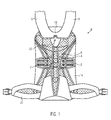
- FIG. 1 shows a backpack B with a torso length adjustment mechanism.
- the backpack B comprises a holder 2 fixedly connected to a bag 14.
- the holder 2 is sewn to the rear portion of the bag 14 and extends substantially over the entire width of the backpack B.
- the backpack comprises two shoulder straps 9, 10 and a hip belt 21.
- the load carried in the bag 14 is transferred to the shoulder straps 9,10 and the hip belt 21 in order to distribute the load on the shoulders and the hips of a user.
- the backpack B further comprises a back mesh 5 forming a supporting area for the user's back.
- the back mesh 5 extends in a longitudinal direction of the backpack B from a lower side of the backpack B where the hip belt 21 is provided to an upper side of the backpack where the upper ends of the shoulder straps 9,10 are provided.
- the backpack B comprises a shoulder strap length adjusting mechanism 7 provided between the rear side of the bag 14 and the back mesh 5.
- the shoulder strap length adjusting mechanism 7 will be described later in detail with reference to Figure 4 .
- the shoulder straps 9, 10 are connected to each other by means of a connecting portion 16 which substantially horizontally extends from one shoulder strap to the other.
- the connecting portion 16 shown in Figure 1 is arranged next to a connection or fixation portion 22 provided between end portions 9a, 10a of the shoulder straps 9, 10 and fixedly connected to the rear side of the bag 14.
- the fixation portion 22 can function as a stop and is provided in a gap defined by the connecting portion 16, end portions 9a, 10a of the shoulder straps and force transmitting element 8 described later.
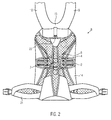
- the gap is indicated in Figure 1 with dashed lines and is also shown in Figures 2 and 4 .
- Figure 1 shows a state in which the connecting portion 16 is arranged next to the connection or fixation portion 22 and therefore the shoulder straps 9, 10 are at a position in which the size of the shoulder straps is set to small.
- Figure 2 shows the state in which the connecting portion 16 of the shoulder straps 9, 10 is arranged at a predetermined distance from the connection or fixation portion 22. Consequently, in this position, the shoulder straps 9, 10 are set at a large setting.
- FIG 3 shows a side view of the backpack B.
- the back mesh 5 is tensioned such that a certain distance is provided between the rear portion of the bag 14 and the back mesh 5.
- a space 13 is formed between the back mesh 5 and the bag 14.
- the holder 2 is fixedly mounted on the rear side of the bag 14 facing the back mesh 5. The function of the holder 2 will be explained in detail with reference to Figure 4 .
- FIG. 4 shows the shoulder strap length adjusting mechanism 7 as well as the holder 2 and a frame element 6 on which the back mesh 5 is mounted.
- the frame element 6 is fixedly connected to the holder 2.
- the shoulder strap length adjusting mechanism 7 comprises a force transmitting element 8 for transmitting a force from the holder 2 to the shoulder straps 9, 10 of the backpack.
- the force transmitting element 8 comprises an engagement portion 17 and shoulder strap attachment means 15.
- the engagement portion 17 comprises a strip with a locking profile which in the present case is a toothed profile.
- the shoulder strap attachment means 15 is a plate shaped member connected to a first end of the engagement portion 17 and extending substantially perpendicular to the extension direction of the engagement portion 17. Consequently the force transmitting element 8 comprises a T-shape.
- a gripping portion 18 is provided at an end of the engagement portion 17 opposite to the end where the shoulder strap attachment means 15 is connected to the engagement portion. Accordingly, with respect to the overall structure of the backpack B, the shoulder strap attachment means 15 is provided at the upper end of the engagement portion 17 and the gripping portion 18 is provided at the lower end of the engagement portion 17.
- the locking mechanism 11 is fixedly mounted on the holder 2, more precisely on a plate 20 of the holder.
- the plate 20 is preferably made of hard plastic and is sewn onto the rear portion of the bag 14.
- the locking mechanism 11 comprises a latching portion engageable with the toothed profile of the engagement portion 17.
- the latching portion is rotatably mounted about a rotational axis which extends in parallel to the extension direction of the plate 20 at a predetermined distance from the plate 20 defining a space between the latching portion and the plate 20 through which the engagement portion 17, more precisely the strip comprising the toothed profile, is passed.
- the latching portion comprises a locking latch 19 which is operable from a lock condition to a release condition.
- the lock condition is achieved by pretensioning the locking latch 19 by means of a spring element (not shown) urging the locking latch towards the lock condition in which teeth formed correspondingly on the locking latch engage with the toothed profile of the strip.
- the locking latch is arranged in such a manner that a movement of the plate 20 with respect to the engagement portion 17 is allowed in the upward direction and is restricted in the downward direction. Accordingly, the locking latch 19 and the engagement portion 17 together form a ratchet type locking system allowing a movement of the holder with respect to the engagement portion 17 in one direction and restricting the movement in the opposite direction when the operating section 12 is not operated.
- the locking mechanism 11 together with the operating section 12 is provided on the plate member 20 such that the operating section 12 faces the back mesh 5 and is accessible through the space 13 provided between the back mesh 5 and the holder 2 when the backpack is worn by the user. Accordingly, the construction allows the user to easily adjust the length of the shoulder straps to his torso length while carrying the backpack.
- the user can simply operate the operating section 12 thereby releasing the locking between the engagement portion 17 and the locking latch 19 leading to a movement of the plate 20 together with the bag 14 in the downward direction corresponding to a setting of the shoulder straps 9, 10 which is the largest.
- the user can simply grab the gripping portion 18 with one hand in order to prevent a movement of the engagement portion 17 and push the bag 14 from below with his other hand leading to a movement of the bag 14 together with the plate 20 with respect to the engagement portion 17 in the upward direction, i.e. in the direction towards a small setting of the shoulder straps 9, 10.
- the user simply stops pushing the bag 14 in the upward direction and the bag 14 will rest at the desired height.
- the present invention provides the advantage that the height position of the bag 14 with respect to the users back can be easily adjusted while carrying the backpack.
- the operating section 12 of the locking mechanism 11 is easily accessible by inserting the hand in the space 13 provided between the back mesh 5 and the holder 2 and the user does not have to unnaturally rotate his wrist in order to operate the operating section 12. Accordingly, a backpack with an enhanced torso length adjustment mechanism is provided.
Landscapes
- Portable Outdoor Equipment (AREA)
- Purses, Travelling Bags, Baskets, Or Suitcases (AREA)
Priority Applications (3)
| Application Number | Priority Date | Filing Date | Title |
|---|---|---|---|
| EP14176397.9A EP2965653A1 (fr) | 2014-07-09 | 2014-07-09 | Sac à dos avec mécanisme de réglage de longueur de torse |
| US14/793,473 US9591910B2 (en) | 2014-07-09 | 2015-07-07 | Backpack with torso length adjustment mechanism |
| CN201520491160.0U CN205180690U (zh) | 2014-07-09 | 2015-07-09 | 具有躯干长度调节机构的背包 |
Applications Claiming Priority (1)
| Application Number | Priority Date | Filing Date | Title |
|---|---|---|---|
| EP14176397.9A EP2965653A1 (fr) | 2014-07-09 | 2014-07-09 | Sac à dos avec mécanisme de réglage de longueur de torse |
Publications (1)
| Publication Number | Publication Date |
|---|---|
| EP2965653A1 true EP2965653A1 (fr) | 2016-01-13 |
Family
ID=51176181
Family Applications (1)
| Application Number | Title | Priority Date | Filing Date |
|---|---|---|---|
| EP14176397.9A Withdrawn EP2965653A1 (fr) | 2014-07-09 | 2014-07-09 | Sac à dos avec mécanisme de réglage de longueur de torse |
Country Status (3)
| Country | Link |
|---|---|
| US (1) | US9591910B2 (fr) |
| EP (1) | EP2965653A1 (fr) |
| CN (1) | CN205180690U (fr) |
Cited By (2)
| Publication number | Priority date | Publication date | Assignee | Title |
|---|---|---|---|---|
| CN110678105A (zh) * | 2017-02-08 | 2020-01-10 | 诺思费斯服装公司 | 用于背包的负荷调节系统 |
| US11399619B2 (en) | 2017-06-09 | 2022-08-02 | Deuter Sport Gmbh | Backpack |
Families Citing this family (17)
| Publication number | Priority date | Publication date | Assignee | Title |
|---|---|---|---|---|
| EP2886005B1 (fr) * | 2013-12-20 | 2018-08-08 | Thule IP AB | Mécanisme de verrouillage d'un sac à dos |
| CN107708478B (zh) * | 2015-06-25 | 2019-11-05 | 星宝香港有限公司 | 具有可调节肩带的背包 |
| WO2017024246A1 (fr) * | 2015-08-05 | 2017-02-09 | Granite Gear Llc | Sac à dos réglable |
| US11584628B2 (en) | 2016-09-09 | 2023-02-21 | The Procter & Gamble Company | System and method for independently routing vehicles and delivering containers and closures to unit operation systems |
| JP6810253B2 (ja) | 2016-09-09 | 2021-01-06 | ザ プロクター アンド ギャンブル カンパニーThe Procter & Gamble Company | 要求に基づいて製品を生産するためのシステム及び方法 |
| CA3035965C (fr) | 2016-09-09 | 2022-01-11 | The Procter & Gamble Company | Systeme et procede de remplissage simultane de recipients avec differentes compositions fluides |
| US10640249B2 (en) | 2016-09-09 | 2020-05-05 | The Procter & Gamble Company | Track system for creating finished products |
| EP3509953A1 (fr) | 2016-09-09 | 2019-07-17 | The Procter and Gamble Company | Système et procédé de remplissage simultané de récipients de formes et/ou de tailles différentes |
| CN109661623A (zh) | 2016-09-09 | 2019-04-19 | 宝洁公司 | 用于在单条生产线上同时生产不同产品的方法 |
| US10996232B2 (en) | 2016-09-09 | 2021-05-04 | The Procter & Gamble Company | System and method for independently routing container-loaded vehicles to create different finished products |
| CA2960478C (fr) * | 2017-03-10 | 2025-09-16 | Sidney Piche-Rouillard | Harnais ajustable destine a des sacs a dos et methode d'utilisation associee |
| EP3622849B1 (fr) * | 2018-09-17 | 2022-11-02 | Andreas Stihl AG & Co. KG | Dispositif de support du dossier, en particulier pour un bloc-batterie |
| TWI830854B (zh) * | 2019-01-30 | 2024-02-01 | 陳金柱 | 背式載具調整系統 |
| US12102214B2 (en) | 2021-03-08 | 2024-10-01 | Under Armour, Inc. | Backpack with leveling structure |
| USD1015934S1 (en) | 2021-12-24 | 2024-02-27 | Under Armour, Inc. | Clip for a strap |
| DE102022125646A1 (de) * | 2022-10-05 | 2024-04-11 | Sudhaus Gmbh | Verstellvorrichtung für einen Rucksack oder Schulranzen |
| WO2025036562A1 (fr) * | 2023-08-17 | 2025-02-20 | Black & Decker Inc. | Sac à dos et mécanisme de réglage de hauteur |
Citations (3)
| Publication number | Priority date | Publication date | Assignee | Title |
|---|---|---|---|---|
| DE19932498A1 (de) * | 1999-07-12 | 2001-02-01 | Vaude Sport Albrecht Von Dewit | Rucksack |
| DE19932499A1 (de) * | 1999-07-12 | 2001-02-01 | Vaude Sport Albrecht Von Dewit | Rucksack mit zwei Schulter-Tragegurten |
| EP1602299A1 (fr) * | 2004-06-02 | 2005-12-07 | Berghaus Limited | Sac à dos |
Family Cites Families (18)
| Publication number | Priority date | Publication date | Assignee | Title |
|---|---|---|---|---|
| US4015759A (en) * | 1975-05-27 | 1977-04-05 | Dreissigacker Peter D | Backpack frame having shoulder and hip supports with flexible connection to hip support |
| US4479595A (en) * | 1982-09-28 | 1984-10-30 | Canadian Mountaineering Equipment Ltd. | Back pack |
| FR2633812B1 (fr) * | 1988-07-11 | 1991-05-24 | Millet | Armature de sac a dos |
| US5725139A (en) * | 1994-08-15 | 1998-03-10 | Mountainsmith, Inc. | Backpack with adjustments for body size |
| US5632429A (en) * | 1995-02-28 | 1997-05-27 | American Recreation Products, Inc. | Backpack |
| ATE207715T1 (de) * | 1996-07-30 | 2001-11-15 | Big Pack Gmbh | Rucksack |
| US5762251C1 (en) * | 1996-08-14 | 2001-12-11 | Dana Design Ltd | External frame backpack with flexible harness |
| US5904282A (en) * | 1996-08-14 | 1999-05-18 | K-2 Corporation | External frame backpack harness |
| US6626342B1 (en) * | 1999-06-07 | 2003-09-30 | Dana W. Gleason | Backpack having a modular frame |
| US6607108B2 (en) * | 2001-02-13 | 2003-08-19 | Recreational Equipment, Inc. | Load transfer and stabilization system for backpacks |
| FR2852210B1 (fr) * | 2003-03-12 | 2005-04-15 | Lafuma Sa | Dispositif de portage a dos d'une charge et de reglage de sa position |
| GB2413947A (en) * | 2004-05-11 | 2005-11-16 | Lowe Alpine Holdings Ltd | adjustable rucksack harness |
| US20080217367A1 (en) * | 2007-03-09 | 2008-09-11 | Lillie Theodore P | Fluid pack |
| US20090084821A1 (en) * | 2007-09-27 | 2009-04-02 | Marco Antonio Lenzi | Convertible backpack frame |
| US8943730B2 (en) * | 2013-01-10 | 2015-02-03 | Nelson Ascano | Tactical support device |
| US9629398B2 (en) * | 2013-01-23 | 2017-04-25 | William Goryl | Front-back pack |
| US9119460B2 (en) * | 2013-02-15 | 2015-09-01 | Oneiros Valley LLC | Backpack frame extender |
| EP2886005B1 (fr) * | 2013-12-20 | 2018-08-08 | Thule IP AB | Mécanisme de verrouillage d'un sac à dos |
-
2014
- 2014-07-09 EP EP14176397.9A patent/EP2965653A1/fr not_active Withdrawn
-
2015
- 2015-07-07 US US14/793,473 patent/US9591910B2/en not_active Expired - Fee Related
- 2015-07-09 CN CN201520491160.0U patent/CN205180690U/zh not_active Expired - Fee Related
Patent Citations (3)
| Publication number | Priority date | Publication date | Assignee | Title |
|---|---|---|---|---|
| DE19932498A1 (de) * | 1999-07-12 | 2001-02-01 | Vaude Sport Albrecht Von Dewit | Rucksack |
| DE19932499A1 (de) * | 1999-07-12 | 2001-02-01 | Vaude Sport Albrecht Von Dewit | Rucksack mit zwei Schulter-Tragegurten |
| EP1602299A1 (fr) * | 2004-06-02 | 2005-12-07 | Berghaus Limited | Sac à dos |
Cited By (2)
| Publication number | Priority date | Publication date | Assignee | Title |
|---|---|---|---|---|
| CN110678105A (zh) * | 2017-02-08 | 2020-01-10 | 诺思费斯服装公司 | 用于背包的负荷调节系统 |
| US11399619B2 (en) | 2017-06-09 | 2022-08-02 | Deuter Sport Gmbh | Backpack |
Also Published As
| Publication number | Publication date |
|---|---|
| US9591910B2 (en) | 2017-03-14 |
| US20160007720A1 (en) | 2016-01-14 |
| CN205180690U (zh) | 2016-04-27 |
Similar Documents
| Publication | Publication Date | Title |
|---|---|---|
| US9591910B2 (en) | Backpack with torso length adjustment mechanism | |
| US6626493B2 (en) | Juvenile carrier with juvenile-restraint harness adjustment mechanism | |
| AU2010232957B2 (en) | Buckle | |
| US10694833B2 (en) | Rucksack with continuous back length adjustment | |
| US6971717B1 (en) | Backrest | |
| US9370223B1 (en) | Belt adjustment system | |
| EP0628265A1 (fr) | Sac à dos | |
| AU2011207650B2 (en) | Chest strap arrangement for an attachable arrangement | |
| EP2939711B1 (fr) | Harnais pour appareil de respiration | |
| US9713968B1 (en) | Safety seat harness system | |
| US20030034371A1 (en) | Extendable waistbelt system | |
| US20150151713A1 (en) | Vehicle Seat Harness Anchoring System | |
| EP1759916A2 (fr) | Ensemble de siège de sécurité pour enfants avec un dispositif de positionnement de boucle | |
| CN113597269B (zh) | 收紧包 | |
| US20180125210A1 (en) | Pack frame | |
| EP1768621B1 (fr) | Support ou harnais pour la partie anterieure du torse | |
| KR20110126069A (ko) | 배낭 | |
| US20220015552A1 (en) | Child carrier sling | |
| US5816662A (en) | Over-the-shoulder safety harness for use with a chair | |
| WO2025174769A1 (fr) | Réglage de longueur du dos pour sacs à dos | |
| US20160311346A1 (en) | Adjustable harness for child-support device | |
| US7225477B1 (en) | Football pad securing device and method | |
| CN213308058U (zh) | 一种可调节高度的双肩包 | |
| EP3932260B1 (fr) | Porte-bébé | |
| GB2563673A (en) | Detachable baby carrier |
Legal Events
| Date | Code | Title | Description |
|---|---|---|---|
| PUAI | Public reference made under article 153(3) epc to a published international application that has entered the european phase |
Free format text: ORIGINAL CODE: 0009012 |
|
| AK | Designated contracting states |
Kind code of ref document: A1 Designated state(s): AL AT BE BG CH CY CZ DE DK EE ES FI FR GB GR HR HU IE IS IT LI LT LU LV MC MK MT NL NO PL PT RO RS SE SI SK SM TR |
|
| AX | Request for extension of the european patent |
Extension state: BA ME |
|
| STAA | Information on the status of an ep patent application or granted ep patent |
Free format text: STATUS: THE APPLICATION IS DEEMED TO BE WITHDRAWN |
|
| 18D | Application deemed to be withdrawn |
Effective date: 20160714 |
|
| P01 | Opt-out of the competence of the unified patent court (upc) registered |
Effective date: 20230528 |