EP2965736B1 - Standing frame - Google Patents
Standing frame Download PDFInfo
- Publication number
- EP2965736B1 EP2965736B1 EP15176196.2A EP15176196A EP2965736B1 EP 2965736 B1 EP2965736 B1 EP 2965736B1 EP 15176196 A EP15176196 A EP 15176196A EP 2965736 B1 EP2965736 B1 EP 2965736B1
- Authority
- EP
- European Patent Office
- Prior art keywords
- range
- user
- support member
- main member
- engagement device
- Prior art date
- Legal status (The legal status is an assumption and is not a legal conclusion. Google has not performed a legal analysis and makes no representation as to the accuracy of the status listed.)
- Active
Links
Images






Classifications
-
- A—HUMAN NECESSITIES
- A61—MEDICAL OR VETERINARY SCIENCE; HYGIENE
- A61G—TRANSPORT, PERSONAL CONVEYANCES, OR ACCOMMODATION SPECIALLY ADAPTED FOR PATIENTS OR DISABLED PERSONS; OPERATING TABLES OR CHAIRS; CHAIRS FOR DENTISTRY; FUNERAL DEVICES
- A61G7/00—Beds specially adapted for nursing; Devices for lifting patients or disabled persons
- A61G7/10—Devices for lifting patients or disabled persons, e.g. special adaptations of hoists thereto
- A61G7/1001—Devices for lifting patients or disabled persons, e.g. special adaptations of hoists thereto specially adapted for specific applications
-
- A—HUMAN NECESSITIES
- A61—MEDICAL OR VETERINARY SCIENCE; HYGIENE
- A61G—TRANSPORT, PERSONAL CONVEYANCES, OR ACCOMMODATION SPECIALLY ADAPTED FOR PATIENTS OR DISABLED PERSONS; OPERATING TABLES OR CHAIRS; CHAIRS FOR DENTISTRY; FUNERAL DEVICES
- A61G7/00—Beds specially adapted for nursing; Devices for lifting patients or disabled persons
- A61G7/002—Beds specially adapted for nursing; Devices for lifting patients or disabled persons having adjustable mattress frame
- A61G7/005—Beds specially adapted for nursing; Devices for lifting patients or disabled persons having adjustable mattress frame tiltable around transverse horizontal axis, e.g. for Trendelenburg position
-
- A—HUMAN NECESSITIES
- A61—MEDICAL OR VETERINARY SCIENCE; HYGIENE
- A61G—TRANSPORT, PERSONAL CONVEYANCES, OR ACCOMMODATION SPECIALLY ADAPTED FOR PATIENTS OR DISABLED PERSONS; OPERATING TABLES OR CHAIRS; CHAIRS FOR DENTISTRY; FUNERAL DEVICES
- A61G5/00—Chairs or personal conveyances specially adapted for patients or disabled persons, e.g. wheelchairs
-
- A—HUMAN NECESSITIES
- A61—MEDICAL OR VETERINARY SCIENCE; HYGIENE
- A61G—TRANSPORT, PERSONAL CONVEYANCES, OR ACCOMMODATION SPECIALLY ADAPTED FOR PATIENTS OR DISABLED PERSONS; OPERATING TABLES OR CHAIRS; CHAIRS FOR DENTISTRY; FUNERAL DEVICES
- A61G5/00—Chairs or personal conveyances specially adapted for patients or disabled persons, e.g. wheelchairs
- A61G5/10—Parts, details or accessories
- A61G5/1091—Cushions, seats or abduction devices
-
- A—HUMAN NECESSITIES
- A61—MEDICAL OR VETERINARY SCIENCE; HYGIENE
- A61G—TRANSPORT, PERSONAL CONVEYANCES, OR ACCOMMODATION SPECIALLY ADAPTED FOR PATIENTS OR DISABLED PERSONS; OPERATING TABLES OR CHAIRS; CHAIRS FOR DENTISTRY; FUNERAL DEVICES
- A61G5/00—Chairs or personal conveyances specially adapted for patients or disabled persons, e.g. wheelchairs
- A61G5/10—Parts, details or accessories
- A61G5/1094—Tables, working plates or trays
-
- A—HUMAN NECESSITIES
- A61—MEDICAL OR VETERINARY SCIENCE; HYGIENE
- A61G—TRANSPORT, PERSONAL CONVEYANCES, OR ACCOMMODATION SPECIALLY ADAPTED FOR PATIENTS OR DISABLED PERSONS; OPERATING TABLES OR CHAIRS; CHAIRS FOR DENTISTRY; FUNERAL DEVICES
- A61G5/00—Chairs or personal conveyances specially adapted for patients or disabled persons, e.g. wheelchairs
- A61G5/10—Parts, details or accessories
- A61G5/14—Standing-up or sitting-down aids
-
- A—HUMAN NECESSITIES
- A61—MEDICAL OR VETERINARY SCIENCE; HYGIENE
- A61G—TRANSPORT, PERSONAL CONVEYANCES, OR ACCOMMODATION SPECIALLY ADAPTED FOR PATIENTS OR DISABLED PERSONS; OPERATING TABLES OR CHAIRS; CHAIRS FOR DENTISTRY; FUNERAL DEVICES
- A61G7/00—Beds specially adapted for nursing; Devices for lifting patients or disabled persons
- A61G7/05—Parts, details or accessories of beds
- A61G7/053—Aids for getting into, or out of, bed, e.g. steps, chairs, cane-like supports
-
- A—HUMAN NECESSITIES
- A61—MEDICAL OR VETERINARY SCIENCE; HYGIENE
- A61G—TRANSPORT, PERSONAL CONVEYANCES, OR ACCOMMODATION SPECIALLY ADAPTED FOR PATIENTS OR DISABLED PERSONS; OPERATING TABLES OR CHAIRS; CHAIRS FOR DENTISTRY; FUNERAL DEVICES
- A61G13/00—Operating tables; Auxiliary appliances therefor
- A61G13/02—Adjustable operating tables; Controls therefor
- A61G13/04—Adjustable operating tables; Controls therefor tiltable around transverse or longitudinal axis
-
- A—HUMAN NECESSITIES
- A61—MEDICAL OR VETERINARY SCIENCE; HYGIENE
- A61G—TRANSPORT, PERSONAL CONVEYANCES, OR ACCOMMODATION SPECIALLY ADAPTED FOR PATIENTS OR DISABLED PERSONS; OPERATING TABLES OR CHAIRS; CHAIRS FOR DENTISTRY; FUNERAL DEVICES
- A61G2200/00—Information related to the kind of patient or his position
- A61G2200/30—Specific positions of the patient
- A61G2200/32—Specific positions of the patient lying
- A61G2200/325—Specific positions of the patient lying prone
-
- A—HUMAN NECESSITIES
- A61—MEDICAL OR VETERINARY SCIENCE; HYGIENE
- A61G—TRANSPORT, PERSONAL CONVEYANCES, OR ACCOMMODATION SPECIALLY ADAPTED FOR PATIENTS OR DISABLED PERSONS; OPERATING TABLES OR CHAIRS; CHAIRS FOR DENTISTRY; FUNERAL DEVICES
- A61G2200/00—Information related to the kind of patient or his position
- A61G2200/30—Specific positions of the patient
- A61G2200/32—Specific positions of the patient lying
- A61G2200/327—Specific positions of the patient lying supine
-
- A—HUMAN NECESSITIES
- A61—MEDICAL OR VETERINARY SCIENCE; HYGIENE
- A61G—TRANSPORT, PERSONAL CONVEYANCES, OR ACCOMMODATION SPECIALLY ADAPTED FOR PATIENTS OR DISABLED PERSONS; OPERATING TABLES OR CHAIRS; CHAIRS FOR DENTISTRY; FUNERAL DEVICES
- A61G2200/00—Information related to the kind of patient or his position
- A61G2200/30—Specific positions of the patient
- A61G2200/36—Specific positions of the patient standing
-
- G—PHYSICS
- G01—MEASURING; TESTING
- G01R—MEASURING ELECTRIC VARIABLES; MEASURING MAGNETIC VARIABLES
- G01R33/00—Arrangements or instruments for measuring magnetic variables
- G01R33/20—Arrangements or instruments for measuring magnetic variables involving magnetic resonance
- G01R33/28—Details of apparatus provided for in groups G01R33/44 - G01R33/64
- G01R33/30—Sample handling arrangements, e.g. sample cells, spinning mechanisms
-
- Y—GENERAL TAGGING OF NEW TECHNOLOGICAL DEVELOPMENTS; GENERAL TAGGING OF CROSS-SECTIONAL TECHNOLOGIES SPANNING OVER SEVERAL SECTIONS OF THE IPC; TECHNICAL SUBJECTS COVERED BY FORMER USPC CROSS-REFERENCE ART COLLECTIONS [XRACs] AND DIGESTS
- Y10—TECHNICAL SUBJECTS COVERED BY FORMER USPC
- Y10S—TECHNICAL SUBJECTS COVERED BY FORMER USPC CROSS-REFERENCE ART COLLECTIONS [XRACs] AND DIGESTS
- Y10S297/00—Chairs and seats
- Y10S297/10—Occupant-arising assist
Definitions
- Standing aides provide people with disabilities or handicaps with many health and social benefits. Nevertheless, standing in one position for extended periods of time can increase fatigue and may not be amenable to various therapies.
- a multi-position body support is disclosed in US 5,489,258 A .
- Said multi-position body support provides support for a user in an infinite number of positions between a substantial horizontal or lying position to a vertical or standing position, including the either prone, supine or vertical position.
- US 2009/021057 discloses an apparatus providing lying, sitting and standing positions for a user.
- the invention provides an apparatus as recited in claim 1 and a method of positioning a user of this apparatus as recited in claim 15. Embodiments thereof form the subject-matter of the dependent claims.
- FIGS 1A and 1B illustrate front-side and rear-side perspective views, respectively, of one embodiment of an apparatus 100 having multiple position modes.
- Exemplary apparatus 100 includes a frame 102 and a support assembly 104.
- the exemplary frame 102 includes a main member 106, a support member 108, a pivot joint 110, and a base assembly 112.
- the support member 108 can be connected to the support assembly 104, which supports a user.
- the pivot joint 110 pivotably connects the support member 108 and the main member 106 for positioning the user into various positions.
- the exemplary base assembly 112 includes a base bracket 114, base support 116, supports 118 for rear wheels 120, and supports 122 for front wheels 124.
- a base assembly 112 with wheels allows the apparatus 100 to be mobile for convenient movement of the apparatus 100 and/or user. In other embodiments, the base assembly 112 may be fixed or stationary.
- the exemplary support assembly 104 includes a support frame 130, a support post 132 for a head support 134, lower supports 136 for knee and/or leg supports 138 and a footrest carrier 140, and a body support 142.
- Support post 132 is variably positional on support frame 130 through a clamp to accommodate varying user sizes.
- Support post 132 may also include a pivot point to adjust the position of head support 134 relative to the user's head.
- Knee and/or leg supports 138 include support brackets 143 that include slots or apertures for variable positioning of the knee and/or leg supports 138.
- Footrest carrier 140 includes associated brackets 144. Footrest brackets 144 are variably positional on lower supports 136 through clamps to accommodate varying user lengths and dimensions.
- footrest carrier 140 may be variably positional on brackets 144 to also accommodate varying user dimensions.
- the head support 134, knee and/or leg supports 138, body support 142, and/or any other supports may also include cushions for user comfort and/or to minimize pressure points.
- Various other supports may also be incorporated with the support assembly 104, including, for example, an additional (opposite) body support, a body vest, body strap(s), head strap(s), other straps, restraints, belts, positioning pads, etc.
- the use of various supports to support a user may be based on several factors, including, for example, the position of the user and the physical capabilities of the user. Also, more than the illustrated number of supports (e.g., knee and/or leg) can be used.
- Apparatus 100 also includes, for example, actuator 150 to assist movement, control movement, and/or limit movement.
- Actuator 150 can be passive (manual), mechanical (e.g., spring), pneumatic (i.e., gas), hydraulic (i.e., oil), electric, a damper, a braking system, etc., or combinations thereof.
- actuator 150 may be controlled with a controller (e.g, electrically or manually).
- a force applied to an actuator controller can activate actuator 150 to assist in changing the relative position of the main member 106 and the support member 108 about the pivot joint 110, which allows the apparatus 100 to change positions throughout supine, standing, and prone modes, as described in more detail below (e.g., Figs. 2-4 ).
- the actuator 150 is releasably attached, for example, to the main member 106, base bracket 114, and/or the support member 108.
- the actuator 150 may be used to assist the relative movement of the main member 106 and the support member 108 about the pivot joint 110 for certain position ranges and not used or disconnected for other position ranges.
- the actuator 150 may act as a movement assist device and/or a locking mechanism, as described in more detail below.
- the actuator 150 may include a telescoping feature that may be held in place through apertures and a releasable detent mechanism to control the relative movement of the main member 106 and the support member 108 about the pivot joint 110.
- Apparatus 100 allows for positioning a user in a plurality of modes including, for example, a supine mode, a standing mode, a prone mode, and various other modes in between these modes or positions.
- a supine mode a standing mode
- a prone mode a mode in between these modes or positions.
- the embodiment shown in Figures 1A and 1B shows apparatus 100 as an exemplary stander, but the features of apparatus 100 may also be implemented into a tilt table and/or other medical platforms to achieve a degree of prone positioning along with supine positioning.
- apparatus 100 is a multi-positional stander that does not need to be re-configured in order for the user to be positioned in prone and supine positions.
- the user does not need to be withdrawn from the apparatus 100 for a reconfiguration of the apparatus 100 or to be moved to a different apparatus to accommodate a different position for the user.
- the re-configuration of an apparatus to switch from a supine position capability to a prone position capability or vice-versa typically involves the changeover of apparatus components to support the user in the new position and the removal of the user from the apparatus so that the user can be rotated 180° to face the opposite direction.
- the user experiences less stress, the user has greater positional ability, and the safety risk associated with re-configuring an apparatus or the user being transferred from one apparatus to another is eliminated. For a caregiver, less time and work is involved with properly positioning the user (patient) and results in better utilization of equipment.
- various surfaces of the apparatus 100 can be changed to make the apparatus 100 more suitable to the user lying generally “face-down” (prone) or “face-up” (supine), but without removing or rotating the user 180° to face the opposite direction.
- the apparatus 100 could be used as a prone stander, a supine stander, or both, with varying degrees depending on the arrangement and type of supportive upholstery pads and other options. In all cases, it is a necessary practice to secure the patient in the stander with appropriate restraints, belts, straps, or support vests.
- the anticipated therapeutic position that the user will be placed in plays a large part in the determination of the extent and specific type of support/restraint that will be employed by the therapist or other medical professional.
- the apparatus 100 is able to achieve these positions without re-configuration of the apparatus 100 or rotation of the user.
- apparatus 100 operates as a supine stander, but contains mechanical features that allow the user support system to over-range beyond the vertical (standing fully upright) position and position the user up to a certain number of degrees beyond vertical (prone). In one embodiment, the user can be positioned up to 20° past vertical in a prone position. Other embodiments may be limited to a more or less prone position.
- the base assembly 112 acts as the foundation of the apparatus 100.
- the support assembly 104 is attached to the pivot joint 110 and includes the various supports, upholstery pads, and/or other supportive accessories to provide a stable area for the user to be situated within when the user is at rest and/or during rotation about the pivot joint 110.
- the position and rotating range of the apparatus 100 and the pivot joint 110 may be controlled by various control assemblies or devices, such as, for example, actuators, guides, lock assemblies, locking mechanisms, mechanical stops, interference points, range limiters, and the like.
- the full range of the apparatus 100 and the pivot joint 110 may be controlled by one or more of these devices.
- a portion of the full range, or sub-range, of the apparatus 100 and the pivot joint 110 may be controlled by a first device and another portion of the full range may be controlled by a second device, operated separately or in combination with the first device.
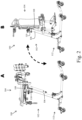
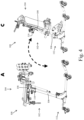
- FIG. 2 perspective views of several exemplary positions of the apparatus 100 are shown as part of exemplary operating ranges of the apparatus 100.
- the apparatus 100 is shown in position A, an exemplary supine position, and position B, an exemplary standing position.
- the dashed line shows the movement of the support member 108 of the support assembly 104 about the pivot joint 110 relative to the main member 106 of the frame 102 between positions A and B.
- the apparatus 100 is shown in position B, an exemplary standing position, and position C, an exemplary prone position.
- the dashed line shows the movement of the support member 108 of the support assembly 104 about the pivot joint 110 relative to the main member 106 of the frame 102 between positions B and C.
- Apparatus 100 can position a user in a range from a supine position (A) to a prone position (C), along with several intermediate positions in between (e.g., B), without re-configuration of the apparatus 100 or rotation of the user.
- Positions A, B, and C are exemplary; the apparatus 100 is not limited to any specific supine, standing, or prone position.
- the apparatus 100 may have a range that extends beyond a supine position that is horizontal, providing a position where the user's head is at a vertical height below the height of the user's feet.
- the apparatus 100 may have a range that extends to a further prone position, providing a position where the user's head is at a vertical height closer to the height of the user's feet.
- suitable supports and/or restraints may be employed to properly position the user in the apparatus 100.
- the apparatus 100 is able to achieve supine and prone positions without re-configuration of the apparatus 100 or rotation of the user.
- the ranges of the apparatus 100 shown in Figures 2-4 may be controlled by one or more control assemblies or devices, including the devices mentioned above.
- the range shown in Figure 2 from supine to standing, may be controlled by a first device and the range shown in Figure 3 , from standing to prone, may be controlled by a second device, operated separately or in combination with the first device.
- the full range shown in Figure 4 from supine to prone, may be controlled by one device.
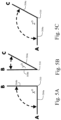
- Figures 5A-5C are drawings that represent embodiments with exemplary ranges and positions associated with the ranges and positions A, B, and C of Figures 2-4 .
- the dashed lines show the movement of a support assembly 504 about a pivot joint 510 between positions A, B, and C.
- Figure 5A shows an exemplary range associated with Figure 2 , where the support assembly 504 is shown in position A (504a), a supine position, and position B (504b), a standing position.
- the range of angular movement between positions A and B is x °. In this embodiment, the range between positions A and B is shown as approximately 90°.
- Figure 5B shows an exemplary range associated with Figure 3 , where the support assembly 504 is shown in position B (504b), a standing position, and position C (504c), a prone position.
- the dashed line shows the movement of the support assembly 504 about the pivot joint 510 between positions B and C.
- the range of angular movement between positions B and C is y°. In this embodiment, the range between positions B and C is shown as approximately 20°.
- Figure 5C shows an exemplary range associated with Figure 4 , where the support assembly 504 is shown in position A (504a), a supine position, and position C (504c), a prone position.
- the dashed line shows the movement of the support assembly 504 about the pivot joint 510 between positions A and C.
- the range of angular movement between positions A and C is z°. In this embodiment, the range between positions A and C is shown as approximately 110°.
- Support assembly 504 and pivot joint 510 represent exemplary position and range embodiments of the support assembly 104 and pivot joint 110 shown in Figures 1A and 1B .
- Various control assemblies or devices may control the movement of the support assembly 504 within its range(s). For example, one device may control the support assembly 504 within its full range ( z °), as shown in Figure 5C , from supine to prone modes. In another embodiment, one device may control the support assembly 504 within a first range ( x °), as shown in Figure 5A , from supine to standing modes, and another device may control the support assembly 504 within a second range ( y °), as shown in Figure 5B , from standing to prone modes, alone or in combination with the first device.
- positions A, B, and C may be various other positions and x, y, and z may be various other ranges.
- Figures 6A and 6B are drawings that represent embodiments with other exemplary ranges and positions. The dashed lines show the movement of a support assembly 604 about a pivot joint 610 between other positions A, B, and C.
- Figure 6A shows support assembly 604 in position A (604a), a supine position beyond horizontal, in position C (604c), a prone position, and in position B (604b), an arbitrary intermediate position, close to a standing position.
- the range of angular movement between positions A and B is x °.
- the range of angular movement between positions B and C is y °.
- Figure 6B shows exemplary support assembly 604 with position A (604a) and position C (604c) as the limits of a range of z°.
- Position B (604b) is shown with support assembly (604b 1 through 604b n ) in a range of intermediate positions B 1 through B n .
- intermediate positions B 1 through B n are a series of incremental or discreet positions.
- intermediate positions B 1 through B n are a series of infinite positions.
- Support assembly 604 and pivot joint 610 represent exemplary position and range embodiments of the support assembly 104 and pivot joint 110 shown in Figures 1A and 1B .
- the various control assemblies that control the relative position of the support assembly 104, 504, 604 to the frame 102 of the apparatus 100 may lock the support assembly 104, 504, 604 into various discreet or infinite positions within the exemplary ranges of the apparatus 100.
- the apparatus 100 may include one or more control assemblies. Each control assembly may include locking devices and/or range limiters. In some embodiments, each control assembly is associated with a positional range of the apparatus 100.
- the control assemblies typically include two or more engagement devices that can engage each other to lock the apparatus 100 into a particular position and/or limit the range of the apparatus 100, including the various positions and ranges mentioned above.
- the control assembly may be a separate device or may be incorporated into one or more of the components of the apparatus 100. For example, in some embodiments, control assemblies may be incorporated into the actuator 150 and/or the pivot joint 110.
- Figures 7A-7C show perspective views of an exemplary control assembly 700 that may be incorporated with the pivot joint 110 shown in Figures 1A and 1B , shown here as pivot joint 710.
- Control assembly 700 functions as a range limiter and a locking device.
- the pivot joint 710 pivotably connects the support member 108 and the main member 106 for positioning the user into various positions by controlling the relative angular position of the support member 108 and the main member 106.
- the control assembly 700 includes an arcuate slot 750 in one or more brackets 752, a shaft that extends through the arcuate slot 750 and the main member 106, a locking mechanism 754, and a lever 756 for actuating the locking mechanism 754.
- the locking mechanism 754 is used to lock the position of the bracket 752 about the shaft that extends through the arcuate slot 750 and the main member 106.
- the locking mechanism 754 may be any device that engages the bracket 752 with the main member 106, including, for example, a clamping mechanism passing through the arcuate slot 750 with a lever that can be released to change positions, a screw-type mechanism passing through the arcuate slot 750 that can be unscrewed to change positions, or the like.
- a guide may protrude through the arcuate slot 750 and the locking mechanism 754 may engage the bracket 752 with the main member 106 outside of the arcuate slot 750.
- the pivot joint 710 When the control assembly 700 is unengaged, the pivot joint 710 is free to rotate about a pivot shaft 758 of the pivot joint 710, changing the relative position of the support member 108 and the main member 106, which controls the position of the support assembly 104 and the user. When the control assembly 700 is engaged, the pivot joint 710 is locked into a particular relative position of the support member 108 and the main member 106.
- the control assembly 700 provides for an infinite number of positions within the range established by the characteristics of the arc in arcuate slot 750 such as, for example, its length.
- the arc's shape including, for example, curvature, can also specify the range and positions therein.
- the exemplary range established by the arcuate slot 750 extends from supine to prone positions, similar to the ranges shown in Figures 4 and 5C .
- Figure 7A shows pivot joint 710 with the control assembly 700 locked in an exemplary supine position, which may be associated with position A shown in Figures 2-5C .
- Figure 7B shows pivot joint 710 with the control assembly 700 locked in an exemplary standing position, which may be associated with position B shown in Figures 2-5C .
- Figure 7C shows pivot joint 710 with the control assembly 700 locked in an exemplary prone position, which may be associated with position C shown in Figures 2-5C .
- Figures 8A-8C show perspective views of an exemplary control assembly 800 that may be incorporated with the pivot joint 110 shown in Figures 1A and 1B , shown here as pivot joint 810.
- Control assembly 800 functions as a range limiter and a locking device.
- the pivot joint 810 pivotably connects the support member 108 and the main member 106 for positioning the user into various positions by controlling the relative angular position of the support member 108 and the main member 106.
- the control assembly 800 includes an arcuate arrangement of holes 850 in one or more brackets 852, a shaft that extends through one of the arcuate arrangement of holes 850 and the main member 106, a locking mechanism 854, and a handle 856 for inserting the locking mechanism 854 into one of the arcuate arrangement of holes 850.
- the locking mechanism 854 is used to lock the position of the bracket 852 about the shaft that extends through one of the arcuate arrangement of holes 850.
- the locking mechanism 854 may be any device that engages one of the arcuate arrangement of holes 850 in the bracket 852 with the main member 106, including, for example, a spring-loaded button attached to the main member 106 that can be depressed to change positions, a shaft that extends through one of the arcuate arrangement of holes 850 in the bracket 852 and a hole in the main member 106 that can be removed to change positions, or the like.
- the pivot joint 810 When the control assembly 800 is unengaged, the pivot joint 810 is free to rotate about a pivot shaft 858 of the pivot joint 810, changing the relative position of the support member 108 and the main member 106, which controls the position of the support assembly 104 and the user. When the control assembly 800 is engaged, the pivot joint 810 is locked into a particular relative position of the support member 108 and the main member 106.
- Figures 9A and 9B show perspective views of an exemplary control assembly 900 that is separate from the pivot joint 110.
- Control assembly 900 functions as a range limiter and a locking device.
- control assembly 900 may be incorporated with the actuator 150 shown in Figures 1A and 1B .
- the pivot joint 110 pivotably connects the support member 108 and the main member 106 and the control assembly 900 connects to the support member 108 and base bracket 114, which is connected to the main member 106. In this manner, the control assembly 900 controls positioning the user into various positions by controlling the relative angular position of the support member 108 and the main member 106.
- the control assembly 900 includes a linear arrangement of holes 950 in a first tube 952, a locking mechanism 954 that extends through one of the linear arrangement of holes 950, and a second tube 956 at least partially within the first tube 952 for supporting or engaging with the locking mechanism 954.
- the locking mechanism 954 may be any device that engages the first tube 952 with the second tube 956, including, for example, a spring-loaded button attached to the second tube 956 that can be depressed to change positions, a shaft that extends through one of the linear arrangement of holes 950 in a first tube 952 and a hole in the second tube 956 that can be removed to change positions, or the like.
- the pivot joint 110 When the control assembly 900 is unengaged, the pivot joint 110 is free to rotate about a pivot shaft of the pivot joint 110, changing the relative position of the support member 108 and the main member 106, which controls the position of the support assembly 104 and the user. As the pivot joint 110 rotates, the second tube 956 moves telescopically within the first tube 952. When the control assembly 900 is engaged, the pivot joint 110 is locked into a particular relative position of the support member 108 and the main member 106.
- control assembly 900 provides for a discrete number of positions within the range established by the length of the linear arrangement of holes 950. These holes may be evenly or unevenly spaced.
- the exemplary range established by the linear arrangement of holes 950 extends from supine to prone positions, similar to the ranges shown in Figures 4 and 5C .
- Figure 9A shows pivot joint 110 with the control assembly 900 locked in an exemplary prone position, which may be associated with position C shown in Figures 2-5C .
- Figure 9B shows a front view in the same position.
- a control assembly may be used to control movement of the apparatus 100 within a limited range or a sub-range.
- Figure 10 shows an exploded perspective view of an exemplary control assembly 1000 that may be incorporated with the pivot joint 110 shown in Figures 1A and 1B , shown here as pivot joint 1010.
- Control assembly 1000 functions as a range limiter and is shown in combination with control assembly 900 that functions as a range limiter and a locking device.
- control assembly 1000 can be used with any other control assembly, including other locking devices, such as, for example, control assemblies 700, 800.
- control assembly 1000 and/or other range limiters can be utilized without any other control assemblies.
- the pivot joint 1010 pivotably connects the support member 108 and the main member 106 and the control assembly 900 connects to the support member 108 and base bracket 114, which is connected to the main member 106.
- the control assembly 900 controls positioning the user into various positions by controlling the relative angular position of the support member 108 and the main member 106.
- the linear arrangement of holes 950 in the control assembly 900 determines the range of movement of the apparatus 100 from supine to prone modes.
- control assembly 1000 may also restrict the range of movement.
- Exemplary control assembly 1000 includes one or more bushings 1020 that include an arcuate recess or slot 1022, housing 1024, plunger 1026 with actuation lever/tab 1028 or other mechanical means of stopping or containing the degree of rotation of the pivot joint 1010, and retaining nut 1030. Actuation of the lever/tab 1028 extends the plunger 1026 into the arcuate slot 1022 of the bushing 1020.
- the control assembly 1000 is configured around pivot shaft 1040, which is secured with retaining nut 1042 and washer 1044.
- the bushings 1020 are secured around the main member 106.
- the housing 1024 is secured to the support member 108.
- the plunger 1026 is secured to and moves with the housing 1024 and the support member 108 such that, when the plunger 1026 is extended into the arcuate slot 1022 of the bushing 1020, the movement of the support member 108 is limited to the range established by the arc length of the arcuate slot 1022, which is secured with the main member 106.
- control assembly 900 has an exemplary range established by the linear arrangement of holes 950 that extends from supine to prone positions, similar to the ranges shown in Figures 4 and 5C .
- control assembly 1000 has an exemplary range established by the arc length of the arcuate slot 1022 that extends from supine to standing positions, similar to the ranges shown in Figures 2 and 5A .
- the apparatus 100 when the plunger 1026 is engaged into the arcuate slot 1022, the apparatus 100 is limited to movement from the supine to standing positions, which is not the full range of the control assembly 900; when the plunger 1026 is not engaged into the arcuate slot 1022, the apparatus 100 is limited to movement from the supine to prone positions, which is the full range of the control assembly 900.
- the plunger 1026 or other mechanical means may be controllably activated to allow the pivot joint 1010 to exceed its pre-determined angle of rotation established by the arc length of the arcuate slot 1022, thereby allowing the apparatus 100 to exceed vertical (upright standing position) and be rotated into a forward leaning, or prone position, with or without further or additional adjustments to the supports for the user, and without removing the user from the apparatus 100.
- a final position dead-stop can be employed to provide an absolute maximum angle of rotation.
- the maximum angle of rotation is controlled by the control assembly 900.
- the apparatus may be configured with a mechanical stop, such as a surface or an edge 1050 of the housing 1024 that can be designed to come into contact with the main member 106 at a certain angle of rotation of the support member 108.
- the control assembly 900 provides for a discrete number of positions within the range established by the length of the linear arrangement of holes 950 and within the sub-range established by the arc length of the arcuate slot 1022 when the plunger 1026 is engaged with the slot 1022.
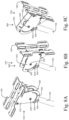
- Figure 11A shows pivot joint 1010 and the control assembly 1000 in an exemplary supine position with the plunger 1026 engaged by the tab 1028, which may be associated with position A shown in Figures 2-5C .
- Figure 11B shows pivot joint 1010 and the control assembly 1000 in an exemplary standing position with the plunger 1026 engaged by the tab 1028, which may be associated with position B shown in Figures 2-5C .
- Figures 11A and 11B demonstrate the limits of an exemplary 90° range established by the control assembly 1000 when the plunger 1026 is engaged.
- Figure 11C shows pivot joint 1010 and the control assembly 1000 in an exemplary prone position with the plunger 1026 not engaged by the tab 1028, which may be associated with position C shown in Figures 2-5C .
- the apparatus 100 may be locked into any available supine, standing, or prone position established by the linear arrangement of holes 950 in the control assembly 900.
- One or more other control assemblies, including locking assemblies may also be used to control positions and ranges, including sub-ranges of the full range.
- control assembly 1000 may be used to prevent the apparatus 100 from moving into a prone position accidentally or before the user has been properly supported.
- the tab 1028 for extending the plunger 1026 in and out of the arcuate slot 1022 of the bushing 1020 may be labeled with an appropriate warning or reminder to properly support the user before disengaging the plunger 1026 and moving the user into a prone position. While the plunger 1026 is engaged with the slot 1022, the prone position is unavailable even though the prone position is within the range of the control assembly 900.
- any combination of control assemblies may be utilized to establish various ranges and sub-ranges that have various range limits/positions, including, for example, those represented in Figures 5A-6B .
- the plunger 1026 may be engaged with the arcuate slot 1022 using various locking mechanisms in addition to the plunger 1026 with toggle style tab 1028 embodiment shown in Figures 10 and 11 .
- Figures 12 and 13 show alternative locking mechanisms for extending a plunger or the like into a slot or the like.
- Figure 12 shows an exemplary plunger 1200 with knob 1210 to push or pull plunger tip 1212 into engaged and unengaged positions.
- Figure 13 shows an exemplary plunger 1300 with knob 1310 to twist plunger tip 1312 into engaged and unengaged positions along a helical path 1314. Any style two-position plunger that extends into engaged or unengaged positions may be used.
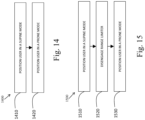
- Figure 14 is a flowchart of an exemplary embodiment of a method 1400 of operating apparatus 100.
- the user is positioned in a supine mode, which may be associated with position A shown in Figures 2-5C .
- the user is positioned in a prone mode, which may be associated with position C shown in Figures 2-5C .
- Figure 15 is another flowchart of an exemplary embodiment of a method 1500 of operating apparatus 100.
- the user is positioned in a supine mode, which may be associated with position A shown in Figures 2-5C .
- a range limiter such as, for example, the control assembly 1000 shown in Figure 10 , is disengaged to extend the range of the apparatus 100 .
- the user is positioned in a prone mode, which may be associated with position C shown in Figures 2-5C .
Landscapes
- Health & Medical Sciences (AREA)
- Public Health (AREA)
- Life Sciences & Earth Sciences (AREA)
- Animal Behavior & Ethology (AREA)
- General Health & Medical Sciences (AREA)
- Veterinary Medicine (AREA)
- Nursing (AREA)
- Rehabilitation Therapy (AREA)
- Invalid Beds And Related Equipment (AREA)
- Rehabilitation Tools (AREA)
- Accommodation For Nursing Or Treatment Tables (AREA)
- Bending Of Plates, Rods, And Pipes (AREA)
- Automatic Cycles, And Cycles In General (AREA)
- Soil Working Implements (AREA)
Applications Claiming Priority (1)
| Application Number | Priority Date | Filing Date | Title |
|---|---|---|---|
| US14/327,943 US9931257B2 (en) | 2014-07-10 | 2014-07-10 | Standing frame with multi-angle positioning while maintaining user orientation |
Publications (2)
| Publication Number | Publication Date |
|---|---|
| EP2965736A1 EP2965736A1 (en) | 2016-01-13 |
| EP2965736B1 true EP2965736B1 (en) | 2023-07-12 |
Family
ID=53716320
Family Applications (1)
| Application Number | Title | Priority Date | Filing Date |
|---|---|---|---|
| EP15176196.2A Active EP2965736B1 (en) | 2014-07-10 | 2015-07-10 | Standing frame |
Country Status (6)
| Country | Link |
|---|---|
| US (1) | US9931257B2 (da) |
| EP (1) | EP2965736B1 (da) |
| CA (1) | CA2896077C (da) |
| DK (1) | DK2965736T3 (da) |
| FI (1) | FI2965736T3 (da) |
| PL (1) | PL2965736T3 (da) |
Families Citing this family (10)
| Publication number | Priority date | Publication date | Assignee | Title |
|---|---|---|---|---|
| US9931257B2 (en) * | 2014-07-10 | 2018-04-03 | Altimate Medical, Inc. | Standing frame with multi-angle positioning while maintaining user orientation |
| ITUA20163483A1 (it) * | 2016-05-16 | 2017-11-16 | Scuola Superiore Di Studi Univ E Di Perfezionamento Santanna | Dispositivo robotico per la verticalizzazione e la mobilita' di disabili motori gravi |
| US10548793B2 (en) * | 2016-06-14 | 2020-02-04 | Allen Medical Systems, Inc. | Pinless loading for spine table |
| CN106038015A (zh) * | 2016-06-22 | 2016-10-26 | 广东省工伤康复中心 | 一种幼儿站立架 |
| US11607360B2 (en) * | 2017-08-19 | 2023-03-21 | Bala R. Vatti | Multi-function adaptable lift system |
| EP4649933A3 (en) | 2020-03-09 | 2026-01-21 | Altimate Medical, Inc. | Mobility systems and methods |
| US12016814B2 (en) * | 2020-10-05 | 2024-06-25 | Altimate Medical Holdings, Inc. | Carriable complex rehabilitation technology systems |
| CN116898679A (zh) * | 2022-04-18 | 2023-10-20 | 希尔-罗姆服务公司 | 患者俯卧表面适应 |
| US12589042B2 (en) * | 2022-04-18 | 2026-03-31 | Hill-Rom Services, Inc. | Surface adaptation for patient proning |
| CA3266063A1 (en) * | 2022-08-29 | 2024-03-07 | Altimate Medical Holdings, Inc. | MOBILE STANDING FIXER WITH IMPROVED ADJUSTMENT AND STORAGE |
Family Cites Families (9)
| Publication number | Priority date | Publication date | Assignee | Title |
|---|---|---|---|---|
| US2968843A (en) * | 1959-06-26 | 1961-01-24 | William G Fording | Folding bleachers |
| US4508387A (en) * | 1983-09-29 | 1985-04-02 | Hamilton Industries, Inc. | Leg and foot support assembly for medical examination table |
| US5489258A (en) * | 1993-05-14 | 1996-02-06 | Bissell Inc. | Multi-position body support |
| CA2170959A1 (en) * | 1996-03-04 | 1997-09-05 | Michael S. Wexler | Invalid chair with pivotal foot rest |
| US7645215B2 (en) * | 2005-08-11 | 2010-01-12 | Gordon Joel D | Exercise device |
| US7850238B2 (en) | 2007-07-16 | 2010-12-14 | Erb Scott C | Dynamic furniture |
| ITTO20070840A1 (it) * | 2007-11-23 | 2009-05-24 | Paramed Medical Systems S R L | Sistema di posizionamento per un'apparecchiatura medicale, ed apparecchiatura di imaging a risonanza magnetica comprendente un tale sistema |
| CN102791198B (zh) * | 2010-03-12 | 2016-03-02 | 株式会社岛津制作所 | 断层摄像装置 |
| US9931257B2 (en) * | 2014-07-10 | 2018-04-03 | Altimate Medical, Inc. | Standing frame with multi-angle positioning while maintaining user orientation |
-
2014
- 2014-07-10 US US14/327,943 patent/US9931257B2/en active Active
-
2015
- 2015-07-06 CA CA2896077A patent/CA2896077C/en active Active
- 2015-07-10 PL PL15176196.2T patent/PL2965736T3/pl unknown
- 2015-07-10 FI FIEP15176196.2T patent/FI2965736T3/fi active
- 2015-07-10 EP EP15176196.2A patent/EP2965736B1/en active Active
- 2015-07-10 DK DK15176196.2T patent/DK2965736T3/da active
Also Published As
| Publication number | Publication date |
|---|---|
| PL2965736T3 (pl) | 2023-10-09 |
| US9931257B2 (en) | 2018-04-03 |
| DK2965736T3 (da) | 2023-08-21 |
| EP2965736A1 (en) | 2016-01-13 |
| FI2965736T3 (fi) | 2023-08-23 |
| CA2896077C (en) | 2024-03-19 |
| CA2896077A1 (en) | 2016-01-10 |
| US20160008195A1 (en) | 2016-01-14 |
Similar Documents
| Publication | Publication Date | Title |
|---|---|---|
| EP2965736B1 (en) | Standing frame | |
| US11752027B2 (en) | Devices and methods for guiding and applying traction to a patient's leg during surgery | |
| US5487590A (en) | Chair to promulgate kinesthetic therapy: apparatus and method | |
| US7846080B2 (en) | Machine and method for head, neck and, shoulder stretching | |
| US6619747B2 (en) | Torso and forearm supporting device for chairs and workstands | |
| EP3071073B1 (en) | Stools, chairs, and methods using the same | |
| US11707136B2 (en) | Stools and chairs with translatable armrests | |
| US8167907B2 (en) | Chiropractic table with continuous passive motion | |
| CN112867890A (zh) | 正定位装置和系统 | |
| WO2001052701A1 (en) | Computer work station | |
| US7490910B1 (en) | Adjustable pneumatic armrest for a chair | |
| US20170252242A1 (en) | Medical chair | |
| WO2013003369A2 (en) | Human support system | |
| US20160084432A1 (en) | Self-positionable lifting device | |
| JP6162957B2 (ja) | 運動用器具 | |
| WO2005041721A2 (en) | Synergistic body positioning and dynamic support system | |
| CN119053297A (zh) | 外科医生用保持系统和保持外科医生的方法 | |
| US20200107978A1 (en) | Patient support device and method for adjusting the position of a patient | |
| AU2002301672B2 (en) | Torso and Forearm Supporting Device for Chairs, Workstands and the Like | |
| US12458551B1 (en) | Stowable inner leg supports | |
| EP3785570B1 (en) | Chair seat with sliding and locking mechanism | |
| CN121129456A (zh) | 一种便于调节的心内科用手术器械支持器 | |
| WO2004030597A1 (en) | Mobile medical apparatus | |
| JP5975827B2 (ja) | 医療台 | |
| KR20180136669A (ko) | 휠체어용 등받이 각도조절장치 |
Legal Events
| Date | Code | Title | Description |
|---|---|---|---|
| PUAI | Public reference made under article 153(3) epc to a published international application that has entered the european phase |
Free format text: ORIGINAL CODE: 0009012 |
|
| AK | Designated contracting states |
Kind code of ref document: A1 Designated state(s): AL AT BE BG CH CY CZ DE DK EE ES FI FR GB GR HR HU IE IS IT LI LT LU LV MC MK MT NL NO PL PT RO RS SE SI SK SM TR |
|
| AX | Request for extension of the european patent |
Extension state: BA ME |
|
| 17P | Request for examination filed |
Effective date: 20160713 |
|
| RBV | Designated contracting states (corrected) |
Designated state(s): AL AT BE BG CH CY CZ DE DK EE ES FI FR GB GR HR HU IE IS IT LI LT LU LV MC MK MT NL NO PL PT RO RS SE SI SK SM TR |
|
| R17P | Request for examination filed (corrected) |
Effective date: 20160713 |
|
| STAA | Information on the status of an ep patent application or granted ep patent |
Free format text: STATUS: EXAMINATION IS IN PROGRESS |
|
| 17Q | First examination report despatched |
Effective date: 20190424 |
|
| REG | Reference to a national code |
Ref country code: DE Ref legal event code: R079 Free format text: PREVIOUS MAIN CLASS: A61G0005140000 Ipc: A61G0007100000 Ref country code: DE Ref legal event code: R079 Ref document number: 602015084509 Country of ref document: DE Free format text: PREVIOUS MAIN CLASS: A61G0005140000 Ipc: A61G0007100000 |
|
| GRAP | Despatch of communication of intention to grant a patent |
Free format text: ORIGINAL CODE: EPIDOSNIGR1 |
|
| STAA | Information on the status of an ep patent application or granted ep patent |
Free format text: STATUS: GRANT OF PATENT IS INTENDED |
|
| RIC1 | Information provided on ipc code assigned before grant |
Ipc: A61G 7/10 19680901AFI20230105BHEP |
|
| INTG | Intention to grant announced |
Effective date: 20230126 |
|
| GRAS | Grant fee paid |
Free format text: ORIGINAL CODE: EPIDOSNIGR3 |
|
| GRAA | (expected) grant |
Free format text: ORIGINAL CODE: 0009210 |
|
| STAA | Information on the status of an ep patent application or granted ep patent |
Free format text: STATUS: THE PATENT HAS BEEN GRANTED |
|
| AK | Designated contracting states |
Kind code of ref document: B1 Designated state(s): AL AT BE BG CH CY CZ DE DK EE ES FI FR GB GR HR HU IE IS IT LI LT LU LV MC MK MT NL NO PL PT RO RS SE SI SK SM TR |
|
| REG | Reference to a national code |
Ref country code: CH Ref legal event code: EP |
|
| REG | Reference to a national code |
Ref country code: DE Ref legal event code: R096 Ref document number: 602015084509 Country of ref document: DE |
|
| REG | Reference to a national code |
Ref country code: IE Ref legal event code: FG4D |
|
| REG | Reference to a national code |
Ref country code: DK Ref legal event code: T3 Effective date: 20230815 |
|
| REG | Reference to a national code |
Ref country code: FI Ref legal event code: FGE |
|
| REG | Reference to a national code |
Ref country code: NL Ref legal event code: FP |
|
| P01 | Opt-out of the competence of the unified patent court (upc) registered |
Effective date: 20230825 |
|
| REG | Reference to a national code |
Ref country code: LT Ref legal event code: MG9D |
|
| REG | Reference to a national code |
Ref country code: AT Ref legal event code: MK05 Ref document number: 1586313 Country of ref document: AT Kind code of ref document: T Effective date: 20230712 |
|
| PG25 | Lapsed in a contracting state [announced via postgrant information from national office to epo] |
Ref country code: GR Free format text: LAPSE BECAUSE OF FAILURE TO SUBMIT A TRANSLATION OF THE DESCRIPTION OR TO PAY THE FEE WITHIN THE PRESCRIBED TIME-LIMIT Effective date: 20231013 |
|
| PG25 | Lapsed in a contracting state [announced via postgrant information from national office to epo] |
Ref country code: ES Free format text: LAPSE BECAUSE OF FAILURE TO SUBMIT A TRANSLATION OF THE DESCRIPTION OR TO PAY THE FEE WITHIN THE PRESCRIBED TIME-LIMIT Effective date: 20230712 |
|
| PG25 | Lapsed in a contracting state [announced via postgrant information from national office to epo] |
Ref country code: IS Free format text: LAPSE BECAUSE OF FAILURE TO SUBMIT A TRANSLATION OF THE DESCRIPTION OR TO PAY THE FEE WITHIN THE PRESCRIBED TIME-LIMIT Effective date: 20231112 |
|
| PG25 | Lapsed in a contracting state [announced via postgrant information from national office to epo] |
Ref country code: SE Free format text: LAPSE BECAUSE OF FAILURE TO SUBMIT A TRANSLATION OF THE DESCRIPTION OR TO PAY THE FEE WITHIN THE PRESCRIBED TIME-LIMIT Effective date: 20230712 Ref country code: RS Free format text: LAPSE BECAUSE OF FAILURE TO SUBMIT A TRANSLATION OF THE DESCRIPTION OR TO PAY THE FEE WITHIN THE PRESCRIBED TIME-LIMIT Effective date: 20230712 Ref country code: PT Free format text: LAPSE BECAUSE OF FAILURE TO SUBMIT A TRANSLATION OF THE DESCRIPTION OR TO PAY THE FEE WITHIN THE PRESCRIBED TIME-LIMIT Effective date: 20231113 Ref country code: NO Free format text: LAPSE BECAUSE OF FAILURE TO SUBMIT A TRANSLATION OF THE DESCRIPTION OR TO PAY THE FEE WITHIN THE PRESCRIBED TIME-LIMIT Effective date: 20231012 Ref country code: LV Free format text: LAPSE BECAUSE OF FAILURE TO SUBMIT A TRANSLATION OF THE DESCRIPTION OR TO PAY THE FEE WITHIN THE PRESCRIBED TIME-LIMIT Effective date: 20230712 Ref country code: LT Free format text: LAPSE BECAUSE OF FAILURE TO SUBMIT A TRANSLATION OF THE DESCRIPTION OR TO PAY THE FEE WITHIN THE PRESCRIBED TIME-LIMIT Effective date: 20230712 Ref country code: IS Free format text: LAPSE BECAUSE OF FAILURE TO SUBMIT A TRANSLATION OF THE DESCRIPTION OR TO PAY THE FEE WITHIN THE PRESCRIBED TIME-LIMIT Effective date: 20231112 Ref country code: HR Free format text: LAPSE BECAUSE OF FAILURE TO SUBMIT A TRANSLATION OF THE DESCRIPTION OR TO PAY THE FEE WITHIN THE PRESCRIBED TIME-LIMIT Effective date: 20230712 Ref country code: GR Free format text: LAPSE BECAUSE OF FAILURE TO SUBMIT A TRANSLATION OF THE DESCRIPTION OR TO PAY THE FEE WITHIN THE PRESCRIBED TIME-LIMIT Effective date: 20231013 Ref country code: ES Free format text: LAPSE BECAUSE OF FAILURE TO SUBMIT A TRANSLATION OF THE DESCRIPTION OR TO PAY THE FEE WITHIN THE PRESCRIBED TIME-LIMIT Effective date: 20230712 Ref country code: AT Free format text: LAPSE BECAUSE OF FAILURE TO SUBMIT A TRANSLATION OF THE DESCRIPTION OR TO PAY THE FEE WITHIN THE PRESCRIBED TIME-LIMIT Effective date: 20230712 |
|
| REG | Reference to a national code |
Ref country code: DE Ref legal event code: R097 Ref document number: 602015084509 Country of ref document: DE |
|
| PG25 | Lapsed in a contracting state [announced via postgrant information from national office to epo] |
Ref country code: SM Free format text: LAPSE BECAUSE OF FAILURE TO SUBMIT A TRANSLATION OF THE DESCRIPTION OR TO PAY THE FEE WITHIN THE PRESCRIBED TIME-LIMIT Effective date: 20230712 Ref country code: RO Free format text: LAPSE BECAUSE OF FAILURE TO SUBMIT A TRANSLATION OF THE DESCRIPTION OR TO PAY THE FEE WITHIN THE PRESCRIBED TIME-LIMIT Effective date: 20230712 Ref country code: EE Free format text: LAPSE BECAUSE OF FAILURE TO SUBMIT A TRANSLATION OF THE DESCRIPTION OR TO PAY THE FEE WITHIN THE PRESCRIBED TIME-LIMIT Effective date: 20230712 Ref country code: CZ Free format text: LAPSE BECAUSE OF FAILURE TO SUBMIT A TRANSLATION OF THE DESCRIPTION OR TO PAY THE FEE WITHIN THE PRESCRIBED TIME-LIMIT Effective date: 20230712 Ref country code: SK Free format text: LAPSE BECAUSE OF FAILURE TO SUBMIT A TRANSLATION OF THE DESCRIPTION OR TO PAY THE FEE WITHIN THE PRESCRIBED TIME-LIMIT Effective date: 20230712 |
|
| PLBE | No opposition filed within time limit |
Free format text: ORIGINAL CODE: 0009261 |
|
| STAA | Information on the status of an ep patent application or granted ep patent |
Free format text: STATUS: NO OPPOSITION FILED WITHIN TIME LIMIT |
|
| 26N | No opposition filed |
Effective date: 20240415 |
|
| PG25 | Lapsed in a contracting state [announced via postgrant information from national office to epo] |
Ref country code: SI Free format text: LAPSE BECAUSE OF FAILURE TO SUBMIT A TRANSLATION OF THE DESCRIPTION OR TO PAY THE FEE WITHIN THE PRESCRIBED TIME-LIMIT Effective date: 20230712 |
|
| PG25 | Lapsed in a contracting state [announced via postgrant information from national office to epo] |
Ref country code: BG Free format text: LAPSE BECAUSE OF FAILURE TO SUBMIT A TRANSLATION OF THE DESCRIPTION OR TO PAY THE FEE WITHIN THE PRESCRIBED TIME-LIMIT Effective date: 20230712 |
|
| PG25 | Lapsed in a contracting state [announced via postgrant information from national office to epo] |
Ref country code: BG Free format text: LAPSE BECAUSE OF FAILURE TO SUBMIT A TRANSLATION OF THE DESCRIPTION OR TO PAY THE FEE WITHIN THE PRESCRIBED TIME-LIMIT Effective date: 20230712 |
|
| PG25 | Lapsed in a contracting state [announced via postgrant information from national office to epo] |
Ref country code: MC Free format text: LAPSE BECAUSE OF FAILURE TO SUBMIT A TRANSLATION OF THE DESCRIPTION OR TO PAY THE FEE WITHIN THE PRESCRIBED TIME-LIMIT Effective date: 20230712 |
|
| REG | Reference to a national code |
Ref country code: CH Ref legal event code: PL |
|
| PG25 | Lapsed in a contracting state [announced via postgrant information from national office to epo] |
Ref country code: LU Free format text: LAPSE BECAUSE OF NON-PAYMENT OF DUE FEES Effective date: 20240710 |
|
| PG25 | Lapsed in a contracting state [announced via postgrant information from national office to epo] |
Ref country code: LU Free format text: LAPSE BECAUSE OF NON-PAYMENT OF DUE FEES Effective date: 20240710 |
|
| PG25 | Lapsed in a contracting state [announced via postgrant information from national office to epo] |
Ref country code: CH Free format text: LAPSE BECAUSE OF NON-PAYMENT OF DUE FEES Effective date: 20240731 Ref country code: BE Free format text: LAPSE BECAUSE OF NON-PAYMENT OF DUE FEES Effective date: 20240731 |
|
| REG | Reference to a national code |
Ref country code: BE Ref legal event code: MM Effective date: 20240731 |
|
| PG25 | Lapsed in a contracting state [announced via postgrant information from national office to epo] |
Ref country code: IE Free format text: LAPSE BECAUSE OF NON-PAYMENT OF DUE FEES Effective date: 20240710 |
|
| PGFP | Annual fee paid to national office [announced via postgrant information from national office to epo] |
Ref country code: NL Payment date: 20250726 Year of fee payment: 11 |
|
| PGFP | Annual fee paid to national office [announced via postgrant information from national office to epo] |
Ref country code: FI Payment date: 20250725 Year of fee payment: 11 |
|
| PGFP | Annual fee paid to national office [announced via postgrant information from national office to epo] |
Ref country code: DK Payment date: 20250725 Year of fee payment: 11 Ref country code: DE Payment date: 20250729 Year of fee payment: 11 |
|
| PGFP | Annual fee paid to national office [announced via postgrant information from national office to epo] |
Ref country code: TR Payment date: 20250721 Year of fee payment: 11 Ref country code: IT Payment date: 20250721 Year of fee payment: 11 Ref country code: PL Payment date: 20250721 Year of fee payment: 11 |
|
| PGFP | Annual fee paid to national office [announced via postgrant information from national office to epo] |
Ref country code: GB Payment date: 20250728 Year of fee payment: 11 |
|
| PGFP | Annual fee paid to national office [announced via postgrant information from national office to epo] |
Ref country code: FR Payment date: 20250725 Year of fee payment: 11 |
|
| PG25 | Lapsed in a contracting state [announced via postgrant information from national office to epo] |
Ref country code: CY Free format text: LAPSE BECAUSE OF FAILURE TO SUBMIT A TRANSLATION OF THE DESCRIPTION OR TO PAY THE FEE WITHIN THE PRESCRIBED TIME-LIMIT; INVALID AB INITIO Effective date: 20150710 |
|
| PG25 | Lapsed in a contracting state [announced via postgrant information from national office to epo] |
Ref country code: HU Free format text: LAPSE BECAUSE OF FAILURE TO SUBMIT A TRANSLATION OF THE DESCRIPTION OR TO PAY THE FEE WITHIN THE PRESCRIBED TIME-LIMIT; INVALID AB INITIO Effective date: 20150710 |