EP2966128A1 - Procédé de régénération de compositions d'asphalte recyclées et compositions d'huile destinées à être utilisées dans le procédé - Google Patents
Procédé de régénération de compositions d'asphalte recyclées et compositions d'huile destinées à être utilisées dans le procédé Download PDFInfo
- Publication number
- EP2966128A1 EP2966128A1 EP14175914.2A EP14175914A EP2966128A1 EP 2966128 A1 EP2966128 A1 EP 2966128A1 EP 14175914 A EP14175914 A EP 14175914A EP 2966128 A1 EP2966128 A1 EP 2966128A1
- Authority
- EP
- European Patent Office
- Prior art keywords
- oil
- rejuvenating
- surfactant
- oils
- composition
- Prior art date
- Legal status (The legal status is an assumption and is not a legal conclusion. Google has not performed a legal analysis and makes no representation as to the accuracy of the status listed.)
- Withdrawn
Links
Images

Classifications
-
- C—CHEMISTRY; METALLURGY
- C08—ORGANIC MACROMOLECULAR COMPOUNDS; THEIR PREPARATION OR CHEMICAL WORKING-UP; COMPOSITIONS BASED THEREON
- C08L—COMPOSITIONS OF MACROMOLECULAR COMPOUNDS
- C08L95/00—Compositions of bituminous materials, e.g. asphalt, tar, pitch
-
- C—CHEMISTRY; METALLURGY
- C08—ORGANIC MACROMOLECULAR COMPOUNDS; THEIR PREPARATION OR CHEMICAL WORKING-UP; COMPOSITIONS BASED THEREON
- C08K—Use of inorganic or non-macromolecular organic substances as compounding ingredients
- C08K5/00—Use of organic ingredients
- C08K5/54—Silicon-containing compounds
- C08K5/544—Silicon-containing compounds containing nitrogen
-
- C—CHEMISTRY; METALLURGY
- C08—ORGANIC MACROMOLECULAR COMPOUNDS; THEIR PREPARATION OR CHEMICAL WORKING-UP; COMPOSITIONS BASED THEREON
- C08L—COMPOSITIONS OF MACROMOLECULAR COMPOUNDS
- C08L91/00—Compositions of oils, fats or waxes; Compositions of derivatives thereof
-
- C—CHEMISTRY; METALLURGY
- C08—ORGANIC MACROMOLECULAR COMPOUNDS; THEIR PREPARATION OR CHEMICAL WORKING-UP; COMPOSITIONS BASED THEREON
- C08L—COMPOSITIONS OF MACROMOLECULAR COMPOUNDS
- C08L2555/00—Characteristics of bituminous mixtures
- C08L2555/40—Mixtures based upon bitumen or asphalt containing functional additives
- C08L2555/60—Organic non-macromolecular ingredients, e.g. oil, fat, wax or natural dye
Definitions
- This invention relates to methods of rejuvenating recycled asphalt materials comprising recycled asphalt pavement and/or recycled asphalt shingle materials, wherein the products made by the methods have improved softening and improved aging properties.
- This invention also relates to oil compositions for use in such methods.
- recycled asphalt pavement is increasing in Canada and the United States driven by benefits in material costs, energy costs and the preservation of natural resources.
- RAP recycled asphalt pavement
- Crushed recycled asphalt pavement material has attached to it aged binder used in the preparation of the original asphalt pavement. This aged binder can be hard, which prevents good mixing in a recycled asphalt composition.
- rejuvenating or recycling oils to soften the aged asphalt binder that is attached to the crushed RAP to facilitate its incorporation into new asphalt mixes. Recycling oils can be petroleum based or derived from renewable sources, such as natural fats and oils, and their derivatives.
- the rejuvenators may work: by softening the RAP binder, by facilitating the blending of the RAP and virgin binders, and by restoring some of the asphalt components lost during aging. Potentially some rejuvenators may reduce further asphalt oxidation or maintain viscosity reduction by dispersion of asphaltenes.
- Rejuvenators can be used with RAP in asphalt mixtures with or without virgin asphalt binder.
- RAP mixtures particularly those with higher percentages of RAP, have shown poorer performance in terms of fatigue and transverse cracking in comparison with virgin mixtures, in part due to incomplete mixing of the RAP binder, and perhaps ineffective rejuvenation.
- Some workers in the field have questioned whether RAP and RAS (recycled asphalt shingles) can be rejuvenated, and if mixtures containing highly oxidized RAP or RAS age more quickly.
- US 2010/0170417 discloses the use of extenders in cutback asphalt compositions (asphalt and solvents) wherein the extenders comprise renewable materials and particularly tall oil products.
- US 2013/053882 discloses a method of improving the incorporation of recycled bituminous products by using at least one surfactant as an alternative to the known rejuvenating oils, for the preparation of asphalt mixes containing recycled bituminous products.
- US 2014/003951 discloses the use of a fatty acid ester obtained from esterified plant oil to reuse bitumen in construction materials.
- a method of preparing a recycled asphalt product for use in pavement comprises providing a quantity of recycled asphalt material, and mixing the recycled asphalt material with a rejuvenating composition comprising a portion of rejuvenating oil and a portion of an alkoxylated fatty amine surfactant, the resulting product being suitable for use in the manufacture of asphalt pavement.
- the recycled asphalt and the rejuvenating composition is in contact for a period of time sufficient to allow the rejuvenating composition to penetrate through at least some aged binder that is present on the recycled asphalt material.
- the invention further provides a composition for use in the manufacture of pavement comprising recycled asphalt and, the composition comprising a portion of a rejuvenating oil and a portion of an alkoxylated fatty amine surfactant.
- the rejuvenating oil can be selected from either petroleum based oils or sustainable oils, with sustainable oils being preferred. Suitable oils include naphthenic oils, paraffin oils, fatty acid esters, and organic oils such as tall oil, palm oil, soybean oil, cashew nut shell oil and organic oil pitch, and mixtures thereof.
- the alkoxylated fatty amine can be selected from ethoxylated, propoxylated, and butoxylated amines, and mixtures thereof. Ethoxylated fatty amines are preferred.
- the invention relates to a method of preparing an asphalt pavement product from a recycled asphalt material.
- the recycled asphalt material can comprise recycled asphalt pavement (RAP), recycled asphalt shingles (RAS), or a mixture thereof.
- RAP recycled asphalt pavement
- RAS recycled asphalt shingles
- the recycled asphalt material can be crushed for use in a paving mix that optionally can include a portion of virgin asphalt.
- the recycled asphalt material may include aged binder that remains on the recycled asphalt. It is known to use rejuvenating oils to soften the aged binder, but rejuvenating oils alone do not prevent further aging of the aged binder on the recycled asphalt material. This aged binder can impair the performance properties of pavement made from the recycled asphalt material.
- the recycled asphalt material is mixed with a rejuvenating composition comprising rejuvenating oil and an alkoxylated fatty amine surfactant.
- the rejuvenating oil can be a petroleum based oil, such as naphthenic oils.
- the rejuvenating oil can be sustainably sourced oil such as a vegetable-based oil.
- Suitable plant oils can include tall oil, corn oil, canola oil, soy oil, biodiesel oils, nut oils, nut shell oils, nut shell liquids, and nut shell liquid pitch. Cashew nut shell liquid and cashew nut shell liquid pitch may be particularly suited to the present invention.
- the foregoing petroleum based oils and sustainable oils can be used alone or in any combination.
- the rejuvenating oil is used in conjunction with a surfactant that comprises an alkoxylated fatty amine.
- fatty amine as used herein includes amines, diamines, and polyamines.
- the fatty amine can be an ethoxylated fatty amine, a propoxylated fatty amine, a butoxylated fatty amine, and mixtures of any of the foregoing.
- a surfactant can include different alkylene oxide monomers; for example, a single surfactant molecule can include both ethylene oxide and propylene oxide monomers.
- ethoxylated fatty amines Preferred surfactants for use in the present invention exhibit good asphaltene dispersant properties.
- the rejuvenating composition comprising oil and surfactant preferably is present at about 0.1 - 2.5% w/w, preferably about 0.2 - 1.0% w/w, based on the total amount of recycled asphalt pavement and recycled asphalt shingle material.
- the surfactant can be present in the rejuvenator composition at a concentration of about 10-30% w/w, preferably at a concentration of about 18-22% w/w, and more preferably at a concentration of about 20% w/w of the rejuvenating oil.
- the inventive rejuvenating composition can be mixed with an amount of virgin asphalt binder, which binder mixture is then added to an asphalt mixture containing at least a portion of recycled asphalt material.
- One method to qualify asphalt additives for hot in place recycling uses the penetration test and the modified rolling thin film oven test; this method has been adopted by the Illinois Department of Transportation (IDOT).
- IDOT Illinois Department of Transportation
- a simulated RAP binder is prepared using an extended RTFO (rolling thin film oven) procedure.
- the binder properties are restored by adding a rejuvenator, and then the rejuvenator-binder mixture is aged again in the RTFO.
- the properties of the aged rejuvenator-binder mixture are then tested using the penetration test.
- This method provides a way to compare rejuvenating compositions both in terms of their softening ability and in terms of their ability to maintain the softening after further aging.
- Other studies Zaumanis, M, Mallick, RB, Frank, R.
- FTIR Fourier-transform infrared spectrometer
- Samples were prepared as per Illinois DOT procedure which includes the following steps:
- rejuvenating oil used alone or with a surfactant, as set forth for each Example.
- the softening efficiency of the rejuvenators is calculated from the penetration of the aged binder blended with rejuvenator (step 5 above) and penetration of the neat aged binder (step 3 above).
- the softening efficiency is the difference in the penetration of the aged binder-rejuvenator mixture and the penetration of neat aged binder divided by the rejuvenator dosage in percent.
- the penetration was measured by ASTM D5. Samples were tested at 25°C.
- the concentration of the rejuvenators with respect to the asphalt binder weight was constant.
- the rejuvenators were 10% of the asphalt binder weight; while 9% rejuvenator was used based on the binder weight in the Examples of Table 2, 3, and 4.
- the surfactants were blended with the recycling oils in a 20:80 ratio by weight. The same total amount of rejuvenator was used for the oils and the oil-surfactant blends.
- the asphalt binder used herein was a PG58-28.
- the recycling oils used include tall oil fatty acids, a biosolvent, a soy based biodiesel, cashew nut shell derivatives, a commercial bio-based rejuvenator and a naphthenic hydrocarbon oil.
- the surfactants tested include two amine based cationic surfactants and one cationic-nonionic surfactant blend. In addition, one wax-based additive was tested.
- the infrared spectra were recorded with a Thermo Nicolet Nexus 670 spectrometer equipped with a Harrick FastIR Attenuated Total Reflectance (ATR) accessory with ZnSe crystal.
- the FTIR samples were prepared by pouring the asphalt binders onto silicone wafers to create a flat surface on the bottom of the sample and pressing each with a SEM (scanning electron microscope) pin stub mount for handling. Using the mount, the samples were peeled from the silicone and transferred to the surface of the ZnSe crystal. The samples were pressed down onto the crystal to ensure good contact with the crystal. Fifty scans were collected at 4 cm -1 resolution.
- hydrocarbon oil data set was analyzed by FTIR and the samples were analyzed in triplicate. This dataset was chosen because the hydrocarbon oil had less interfering absorbance in the carbonyl region of the FTIR spectrum than the bio-based oils, thus allowing for better quantification of oxidized species.
- the test results are shown in Table 1 for neat and treated samples.
- Surfactant 1 is an ethoxylated fatty amine.
- the neat binder is significantly aged and hardened. The penetration is reduced from 136 dmm to 33- 35 dmm and the DSR results show that the upper PG has changed from PG58 to PG82. This result is in the upper PG range for an extracted RAP binder, which generally ranges from PG76 to PG94.
- Table 1 shows the penetration value of the aged binder after the addition of 10 weight% of the additive.
- the aged penetration column shows the penetration after addition of the additive and after the second aging step.
- the aged penetration retention is calculated as described in the method section.
- the softening efficiency column in Table 1 one can compare the ability of rejuvenating additives to raise the penetration of the aged binder from the first aging step (penetration 33-35) in terms of change in penetration for the dosage of the rejuvenator. Based on the softening efficiencies, the distilled cashew nut shell liquid (CNSL), biodiesel and Surfactant 1 with biodiesel softened the aged binder most effectively. Some additives softened the aged binder well, but the softening was not maintained after the second aging step, as shown by the aged penetration retention. For example, biodiesel worked well at softening the aged binder to a penetration 183 dmm, but had a low penetration (26 dmm) after the second aging step. Some of the rejuvenating oils show weight loss under standard RFTO conditions, and part of the hardening after the second aging step could result from loss of volatiles.
- the rejuvenators are listed in order of effectiveness based on aged penetration retention, from most to least effective. Based on the aged penetration retention, which measures the penetration retained after treatment with rejuvenator and the second aging step, the most effective rejuvenator is the blend of CNSL with Surfactant 1. Clearly, the CNSL oil itself has a strong influence on rejuvenation since the aged penetration value for the CNSL is already high, but the addition of the surfactant enhances the effect. The same trend is seen with the other oils.
- a batch of the neat aged binder was re-aged without a rejuvenator (neat aged-aged binder).
- the penetration was reduced to 22 dmm from 33 dmm.
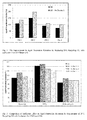
- Figure 1 shows the aged penetration retentions for the PG58 asphalt binder modified with 4 different recycling oils and also modified with blends of the recycling oils in which 20% of the oil was replaced with surfactant 1.
- the dosage of recycling oil and recycling oil blends was 10 weight % based on the aged asphalt binder.
- Oil 1 is a biosolvent
- oil 2 is distilled cashew nut shell liquid
- oil 3 is cashew nut shell liquid pitch
- oil 4 is biodiesel.
- the aged penetration retentions were 20-33% higher for the modified binders with the recycling oil-surfactant blends compared to the binders modified with recycling oil alone.
- Table 2 shows the data for the three different surfactant oil blends using a commercial bio-based solvent.
- Surfactants 2 and 3 contain polyamine condensates typical of those used in asphalt adhesion promoters. The total dosage of the rejuvenating oil and the rejuvenating oil-surfactant blends was 9% based on the asphalt binder weight for all samples in these experiments.
- Surfactant 1 comprising an ethoxylated fatty amine was found to improve the aged penetration ratio more than the other two surfactants in this recycling oil, where the other two surfactants did not contain an ethoxylated fatty amine.
- Table 2 Comparison of Surfactant- Rejuvenator Test Results, Softening Efficiency and Aged Penetration Retention, follow-up study with Biosolvent as Rejuvenating Oil Base.
- Table 3 shows the data for the three surfactant oil blends using cashew nut shell liquid as the oil base.
- Surfactant 1 was found to improve the aged penetration retention more than the other two surfactants in this oil as well. Note that although CNSL on its own softened the binder more than the blend with Surfactant 1 (softening efficiency) the aged penetration retention was highest for the blend with Surfactant 1 present.
- Table 3 Comparison of Surfactant-Rejuvenator Test Results, Softening Efficiency and Aged Penetration Retention, follow-up study with CNSL distillate as oil base.
- Table 4 shows the data for the three surfactant oil blends using a commercial hydrocarbon recycling oil.
- Surfactant 1 improved the aged penetration retention more than the other two surfactants in this oil too. This oil had the lowest softening efficiency of the three oils tested. Part of the reason it was selected for testing was because it has a low absorbance in the regions of interest in the FTIR spectrum.
- Table 4 Comparison of Surfactant-Rejuvenator Test Results, Softening Efficiency and Aged Penetration Retention, follow-up study with Hydrocarbon Oil as Rejuvenating Oil Base. Ex.
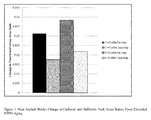
- Figure 2 compares the aged penetration retentions for the three follow-up studies with the oil and surfactant blends in Tables 2-4.
- the aged penetration retentions were improved most when blended with Surfactant 1.
- Surfactants 1 and 2 showed an improvement over the oil alone, but Surfactant 1 showed an increase of 20% while Surfactant 2 showed a 6% increase.
- Surfactant 1 improved the aged penetration retention over the oil alone, by 4%.
- all three surfactants improved the aged penetration retention over the oil alone.
- Surfactant 1 gave a 21% increase, while the other two surfactants gave an 11% increase. So, of all the rejuvenators tested, Surfactant 1 consistently outperformed the other surfactants and also enhanced the performance of all the oils tested.
- Figure 3 shows the change in the carbonyl and sulfoxide functional indices with extended aging in the RTFO. While the concentration of both groups increased during each of the aging steps, the rate of aging was slower for the second aging step. This is consistent with the change in penetration for the neat binder shown in Table 1.
- Figure 4 shows the change in the carbonyl peak area ratio from the second aging step for the series of tests with the hydrocarbon oil with and without surfactants.
- the blends with Surfactants 2 and 3 had a larger increase in the carbonyl index upon aging than the blend with Surfactant 1, the neat binder and the hydrocarbon oil alone.
- the Surfactant 1 blend had the smallest change in carbonyl index of the set.
- Oxidation of asphalt binder reduces the concentration of the lighter fractions in asphalt and increases the amount of heavier components including the asphaltenes.
- the FTIR data do not evidence significant reduction in oxidation, which suggests that the mechanism may be due to a dispersion effect rather than an oxidative one.
- the data do show that surfactants have different effects on the formation of carbonyl species during asphalt binder aging.
- amine surfactants may be dispersing the asphaltenes and thereby limiting some of the resultant increase in viscosity in the aged binder.
- surfactants and rejuvenating oils that find utility in the present invention are based on renewable materials.
Landscapes
- Chemical & Material Sciences (AREA)
- Health & Medical Sciences (AREA)
- Chemical Kinetics & Catalysis (AREA)
- Medicinal Chemistry (AREA)
- Polymers & Plastics (AREA)
- Organic Chemistry (AREA)
- Engineering & Computer Science (AREA)
- Civil Engineering (AREA)
- Materials Engineering (AREA)
- Structural Engineering (AREA)
- Oil, Petroleum & Natural Gas (AREA)
- Road Paving Structures (AREA)
- Compositions Of Macromolecular Compounds (AREA)
Priority Applications (1)
| Application Number | Priority Date | Filing Date | Title |
|---|---|---|---|
| EP14175914.2A EP2966128A1 (fr) | 2014-07-07 | 2014-07-07 | Procédé de régénération de compositions d'asphalte recyclées et compositions d'huile destinées à être utilisées dans le procédé |
Applications Claiming Priority (1)
| Application Number | Priority Date | Filing Date | Title |
|---|---|---|---|
| EP14175914.2A EP2966128A1 (fr) | 2014-07-07 | 2014-07-07 | Procédé de régénération de compositions d'asphalte recyclées et compositions d'huile destinées à être utilisées dans le procédé |
Publications (1)
| Publication Number | Publication Date |
|---|---|
| EP2966128A1 true EP2966128A1 (fr) | 2016-01-13 |
Family
ID=51062722
Family Applications (1)
| Application Number | Title | Priority Date | Filing Date |
|---|---|---|---|
| EP14175914.2A Withdrawn EP2966128A1 (fr) | 2014-07-07 | 2014-07-07 | Procédé de régénération de compositions d'asphalte recyclées et compositions d'huile destinées à être utilisées dans le procédé |
Country Status (1)
| Country | Link |
|---|---|
| EP (1) | EP2966128A1 (fr) |
Cited By (7)
| Publication number | Priority date | Publication date | Assignee | Title |
|---|---|---|---|---|
| EP3469025A1 (fr) * | 2016-06-10 | 2019-04-17 | A.L.M. Holding Company | Stérol brut utilisé comme additif dans un liant d'asphalte |
| CN111626529A (zh) * | 2019-02-27 | 2020-09-04 | 长沙理工大学 | 一种再生沥青混合料中rap分散程度评价方法 |
| US11124926B2 (en) | 2018-02-02 | 2021-09-21 | Kraton Polymers Llc | Pavement repair method and system thereof |
| US11634875B2 (en) | 2018-02-02 | 2023-04-25 | Iemulsions Corporation | Pavement repair method and system thereof |
| CN116162359A (zh) * | 2023-03-03 | 2023-05-26 | 江苏瑞文戴尔交通科技有限公司 | 一种具有深度再生和抗老化能力的下渗再生剂及其制备方法 |
| US12163294B2 (en) | 2017-02-02 | 2024-12-10 | A.I.M. Holding Company | Sterol additive in asphalt pavement |
| US12234189B2 (en) | 2016-08-09 | 2025-02-25 | A.L.M. Holding Company | Sterol blends as an additive in asphalt binder |
Citations (8)
| Publication number | Priority date | Publication date | Assignee | Title |
|---|---|---|---|---|
| WO1987003682A1 (fr) * | 1985-12-03 | 1987-06-18 | Hoffmann's Stärkefabriken Ag | Produit de soins pour la lessive |
| US6214103B1 (en) * | 1998-04-28 | 2001-04-10 | Hikarigiken Co., Ltd. | Asphalt paving mix for paving at ambient temperatures and a process for making the same |
| WO2009013328A1 (fr) * | 2007-07-26 | 2009-01-29 | Akzo Nobel N.V. | Modificateurs d'adhérence et de cohésion pour asphalte |
| EP2062943A1 (fr) * | 2007-11-14 | 2009-05-27 | Akzo Nobel N.V. | Modificateurs d'asphalte pour des applications de mélanges chauds comprenant un promoteur d'adhésion |
| US20100170417A1 (en) | 2009-01-08 | 2010-07-08 | De Sil Va Resources, Llc A Texas Corporation | Cutback asphalt compositions and products comprising an extender derived from tall oil, and methods for making and using same |
| US20130053882A1 (en) | 2010-04-13 | 2013-02-28 | Access Point Technologies, Inc. | Embolic material excision trapping device |
| WO2013053882A1 (fr) * | 2011-10-12 | 2013-04-18 | Ceca S.A. | Additif pour mélanges d'asphalte contenant des produits bitumineux recyclés |
| US20140003951A1 (en) | 2012-07-02 | 2014-01-02 | Ronald R. Soucy | Super polish masking of integrally bladed rotor |
-
2014
- 2014-07-07 EP EP14175914.2A patent/EP2966128A1/fr not_active Withdrawn
Patent Citations (8)
| Publication number | Priority date | Publication date | Assignee | Title |
|---|---|---|---|---|
| WO1987003682A1 (fr) * | 1985-12-03 | 1987-06-18 | Hoffmann's Stärkefabriken Ag | Produit de soins pour la lessive |
| US6214103B1 (en) * | 1998-04-28 | 2001-04-10 | Hikarigiken Co., Ltd. | Asphalt paving mix for paving at ambient temperatures and a process for making the same |
| WO2009013328A1 (fr) * | 2007-07-26 | 2009-01-29 | Akzo Nobel N.V. | Modificateurs d'adhérence et de cohésion pour asphalte |
| EP2062943A1 (fr) * | 2007-11-14 | 2009-05-27 | Akzo Nobel N.V. | Modificateurs d'asphalte pour des applications de mélanges chauds comprenant un promoteur d'adhésion |
| US20100170417A1 (en) | 2009-01-08 | 2010-07-08 | De Sil Va Resources, Llc A Texas Corporation | Cutback asphalt compositions and products comprising an extender derived from tall oil, and methods for making and using same |
| US20130053882A1 (en) | 2010-04-13 | 2013-02-28 | Access Point Technologies, Inc. | Embolic material excision trapping device |
| WO2013053882A1 (fr) * | 2011-10-12 | 2013-04-18 | Ceca S.A. | Additif pour mélanges d'asphalte contenant des produits bitumineux recyclés |
| US20140003951A1 (en) | 2012-07-02 | 2014-01-02 | Ronald R. Soucy | Super polish masking of integrally bladed rotor |
Non-Patent Citations (1)
| Title |
|---|
| ZAUMANIS, M; MALLICK, RB; FRANK, R.: "Evaluation of Rejuvenator's Effectiveness with Conventional Mix testing for 100% RAP Mixtures", 92ND ANNUAL MEETING OF THE TRANSPORTATION RESEARCH BOARD, 2013 |
Cited By (9)
| Publication number | Priority date | Publication date | Assignee | Title |
|---|---|---|---|---|
| EP3469025A1 (fr) * | 2016-06-10 | 2019-04-17 | A.L.M. Holding Company | Stérol brut utilisé comme additif dans un liant d'asphalte |
| EP3469025B1 (fr) * | 2016-06-10 | 2026-03-18 | A.L.M. Holding Company | Stérol brut utilisé comme additif dans un liant d'asphalte |
| US12234189B2 (en) | 2016-08-09 | 2025-02-25 | A.L.M. Holding Company | Sterol blends as an additive in asphalt binder |
| US12163294B2 (en) | 2017-02-02 | 2024-12-10 | A.I.M. Holding Company | Sterol additive in asphalt pavement |
| US11124926B2 (en) | 2018-02-02 | 2021-09-21 | Kraton Polymers Llc | Pavement repair method and system thereof |
| US11634875B2 (en) | 2018-02-02 | 2023-04-25 | Iemulsions Corporation | Pavement repair method and system thereof |
| CN111626529A (zh) * | 2019-02-27 | 2020-09-04 | 长沙理工大学 | 一种再生沥青混合料中rap分散程度评价方法 |
| CN111626529B (zh) * | 2019-02-27 | 2023-07-25 | 长沙理工大学 | 一种再生沥青混合料中rap分散程度评价方法 |
| CN116162359A (zh) * | 2023-03-03 | 2023-05-26 | 江苏瑞文戴尔交通科技有限公司 | 一种具有深度再生和抗老化能力的下渗再生剂及其制备方法 |
Similar Documents
| Publication | Publication Date | Title |
|---|---|---|
| EP2966128A1 (fr) | Procédé de régénération de compositions d'asphalte recyclées et compositions d'huile destinées à être utilisées dans le procédé | |
| EP3262083B1 (fr) | Huiles polymérisées et leur procédés de fabrication | |
| Yan et al. | Use of tung oil as a rejuvenating agent in aged asphalt: Laboratory evaluations | |
| Yu et al. | Rheological and chemical characteristics of rubberized binders with non-foaming warm mix additives | |
| US20110196073A1 (en) | Polymer-modified asphalt with a crosslinking agent and methods of preparing | |
| KR101743628B1 (ko) | 역청 함유 조성물을 복원시키는 방법 | |
| EP1235768B1 (fr) | Composition hydrocarbonee contenant des agents de suppression d'odeur | |
| CN109535747B (zh) | 一种30号硬质道路沥青及其制备方法 | |
| WO2015040432A1 (fr) | Composition de pavage à base d'asphalte modifié | |
| US20170152384A1 (en) | Process for preparing a polymerized cashew nut shell liquid and its use for the preparation of a bitumen composition | |
| CA2822153A1 (fr) | Melange d'asphalte sans bitume pur a base de materiaux recycles | |
| CN115505412B (zh) | 一种道路沥青及其制备方法 | |
| FR2910477A1 (fr) | Fluxant et ses applications. | |
| Ren et al. | Do different chemical and rheological properties act as effective and critical indicators for efficiency evaluation of rejuvenated bitumen? | |
| US7708876B2 (en) | Heavy fuel oil | |
| US8664302B2 (en) | Process of polymer modified asphalt preparation | |
| EP4028493B1 (fr) | Composition d'essence à synergie d'octane | |
| CN114426778B (zh) | 一种沥青组合物及其制备方法 | |
| JP4739944B2 (ja) | 舗装用アスファルトの製造方法およびそれにより得られる舗装用アスファルト | |
| US20240076498A1 (en) | Asphalt binders and related methods and uses | |
| CN110437630B (zh) | 一种聚合物改性沥青及其制备方法 | |
| US20160017149A1 (en) | Process for the production of polymer modified bitumen using nitrogen rich polycyclic aromatic hydrocarbon | |
| CA2896451A1 (fr) | Additif servant a reduire la viscosite du petrole brut lourd | |
| RU2154665C1 (ru) | Топливная композиция | |
| CN101668817A (zh) | 制备柏油的方法 |
Legal Events
| Date | Code | Title | Description |
|---|---|---|---|
| PUAI | Public reference made under article 153(3) epc to a published international application that has entered the european phase |
Free format text: ORIGINAL CODE: 0009012 |
|
| AK | Designated contracting states |
Kind code of ref document: A1 Designated state(s): AL AT BE BG CH CY CZ DE DK EE ES FI FR GB GR HR HU IE IS IT LI LT LU LV MC MK MT NL NO PL PT RO RS SE SI SK SM TR |
|
| AX | Request for extension of the european patent |
Extension state: BA ME |
|
| RAP3 | Party data changed (applicant data changed or rights of an application transferred) |
Owner name: AKZO NOBEL CHEMICALS INTERNATIONAL B.V. |
|
| STAA | Information on the status of an ep patent application or granted ep patent |
Free format text: STATUS: THE APPLICATION IS DEEMED TO BE WITHDRAWN |
|
| 18D | Application deemed to be withdrawn |
Effective date: 20160714 |