EP2966850A1 - Procede de calcul de couleurs de remplacement pour couleurs speciales - Google Patents
Procede de calcul de couleurs de remplacement pour couleurs speciales Download PDFInfo
- Publication number
- EP2966850A1 EP2966850A1 EP15171586.9A EP15171586A EP2966850A1 EP 2966850 A1 EP2966850 A1 EP 2966850A1 EP 15171586 A EP15171586 A EP 15171586A EP 2966850 A1 EP2966850 A1 EP 2966850A1
- Authority
- EP
- European Patent Office
- Prior art keywords
- color
- colors
- characterization data
- printing
- replacement
- Prior art date
- Legal status (The legal status is an assumption and is not a legal conclusion. Google has not performed a legal analysis and makes no representation as to the accuracy of the status listed.)
- Granted
Links
Images

Classifications
-
- H—ELECTRICITY
- H04—ELECTRIC COMMUNICATION TECHNIQUE
- H04N—PICTORIAL COMMUNICATION, e.g. TELEVISION
- H04N1/00—Scanning, transmission or reproduction of documents or the like, e.g. facsimile transmission; Details thereof
- H04N1/46—Colour picture communication systems
- H04N1/54—Conversion of colour picture signals to a plurality of signals some of which represent particular mixed colours, e.g. for textile printing
-
- G—PHYSICS
- G06—COMPUTING OR CALCULATING; COUNTING
- G06K—GRAPHICAL DATA READING; PRESENTATION OF DATA; RECORD CARRIERS; HANDLING RECORD CARRIERS
- G06K15/00—Arrangements for producing a permanent visual presentation of the output data, e.g. computer output printers
- G06K15/02—Arrangements for producing a permanent visual presentation of the output data, e.g. computer output printers using printers
- G06K15/18—Conditioning data for presenting it to the physical printing elements
- G06K15/1801—Input data handling means
- G06K15/1822—Analysing the received data before processing
-
- G—PHYSICS
- G06—COMPUTING OR CALCULATING; COUNTING
- G06F—ELECTRIC DIGITAL DATA PROCESSING
- G06F3/00—Input arrangements for transferring data to be processed into a form capable of being handled by the computer; Output arrangements for transferring data from processing unit to output unit, e.g. interface arrangements
- G06F3/12—Digital output to print unit, e.g. line printer, chain printer
- G06F3/1201—Dedicated interfaces to print systems
- G06F3/1202—Dedicated interfaces to print systems specifically adapted to achieve a particular effect
- G06F3/1218—Reducing or saving of used resources, e.g. avoiding waste of consumables or improving usage of hardware resources
- G06F3/122—Reducing or saving of used resources, e.g. avoiding waste of consumables or improving usage of hardware resources with regard to computing resources, e.g. memory, CPU
-
- G—PHYSICS
- G06—COMPUTING OR CALCULATING; COUNTING
- G06F—ELECTRIC DIGITAL DATA PROCESSING
- G06F3/00—Input arrangements for transferring data to be processed into a form capable of being handled by the computer; Output arrangements for transferring data from processing unit to output unit, e.g. interface arrangements
- G06F3/12—Digital output to print unit, e.g. line printer, chain printer
- G06F3/1201—Dedicated interfaces to print systems
- G06F3/1223—Dedicated interfaces to print systems specifically adapted to use a particular technique
- G06F3/1237—Print job management
- G06F3/1253—Configuration of print job parameters, e.g. using UI at the client
- G06F3/1254—Automatic configuration, e.g. by driver
-
- G—PHYSICS
- G06—COMPUTING OR CALCULATING; COUNTING
- G06F—ELECTRIC DIGITAL DATA PROCESSING
- G06F3/00—Input arrangements for transferring data to be processed into a form capable of being handled by the computer; Output arrangements for transferring data from processing unit to output unit, e.g. interface arrangements
- G06F3/12—Digital output to print unit, e.g. line printer, chain printer
- G06F3/1201—Dedicated interfaces to print systems
- G06F3/1223—Dedicated interfaces to print systems specifically adapted to use a particular technique
- G06F3/1275—Print workflow management, e.g. defining or changing a workflow, cross publishing
- G06F3/1276—Print workflow management, e.g. defining or changing a workflow, cross publishing within a printer driver, e.g. driver resides either on a server or on a client
-
- G—PHYSICS
- G06—COMPUTING OR CALCULATING; COUNTING
- G06K—GRAPHICAL DATA READING; PRESENTATION OF DATA; RECORD CARRIERS; HANDLING RECORD CARRIERS
- G06K15/00—Arrangements for producing a permanent visual presentation of the output data, e.g. computer output printers
- G06K15/02—Arrangements for producing a permanent visual presentation of the output data, e.g. computer output printers using printers
- G06K15/027—Test patterns and calibration
-
- G—PHYSICS
- G06—COMPUTING OR CALCULATING; COUNTING
- G06K—GRAPHICAL DATA READING; PRESENTATION OF DATA; RECORD CARRIERS; HANDLING RECORD CARRIERS
- G06K15/00—Arrangements for producing a permanent visual presentation of the output data, e.g. computer output printers
- G06K15/02—Arrangements for producing a permanent visual presentation of the output data, e.g. computer output printers using printers
- G06K15/18—Conditioning data for presenting it to the physical printing elements
- G06K15/1867—Post-processing of the composed and rasterized print image
- G06K15/1872—Image enhancement
- G06K15/1878—Adjusting colours
-
- H—ELECTRICITY
- H04—ELECTRIC COMMUNICATION TECHNIQUE
- H04N—PICTORIAL COMMUNICATION, e.g. TELEVISION
- H04N1/00—Scanning, transmission or reproduction of documents or the like, e.g. facsimile transmission; Details thereof
- H04N1/46—Colour picture communication systems
- H04N1/56—Processing of colour picture signals
- H04N1/60—Colour correction or control
- H04N1/6016—Conversion to subtractive colour signals
- H04N1/6022—Generating a fourth subtractive colour signal, e.g. under colour removal, black masking
Definitions
- the present invention relates to a method for calculating replacement colors for special colors.
- the invention lies in the technical field of electronic reproduction technology.
- print templates are created for printed pages containing all the elements to be printed, such as text, graphics and images.
- a separate print template is created for each ink, containing all the elements printed in each color.
- these are the inks Cyan (C), Magenta (M), Yellow (Y), and Black (K).
- C Cyan
- M Magenta
- Y Yellow
- K Black
- the printed originals separated by printing inks are also called color separations.
- the artwork is exposed on plates in special exposure equipment or transferred directly to a digital press as digital data. There, the print data are then exposed to printing plates, for example, with an integrated into the printing unit exposure unit before immediately after the pad printing begins.
- digital printing machines which do not require printing plates because they are e.g. operate on the electrophotographic printing principle or with ink jet printing.
- the artwork is electronically reproduced. Images are scanned in a color scanner and stored in the form of digital data. Texts are created with word processing programs and graphics with drawing programs. With a layout program the picture, text and graphic elements are put together to a printed page. The data of several printed pages are combined with the data of further elements, such as registration marks, crop marks and folding marks as well as print control fields, to print templates for a printed sheet.
- PostScript and PDF Portable Document Format
- the PostScript or PDF data is recorded before recording
- print templates in a raster image processor (RIP) are converted into color separation values for the color separations C, M, Y and K.
- the color separation values are a measure of the color densities with which the four printing colors cyan, magenta, yellow and black are printed on the substrate. In special cases where more than four colors are printed, each pixel is described by as many color separation values as there are inks.
- the color separation values can be stored, for example, with 8 bits per pixel and printing color as data value, whereby the value range from 0% to 100% is subdivided into 256 tone value levels.
- the colors of the elements of a print page are usually not defined in the same way in the CMYK color system of the inks, but usually in a different color system.
- the images in a scanner are separated by color filters into the color components red, green and blue (RGB), ie into the components of a three-dimensional color space.
- RGB red, green and blue
- the image data must therefore be transformed before the recording of the artwork on color separation films or printing plates from the RGB color space of the scanner in the CMYK color space of the printing process to be used. The same applies to the digitally photographed images.
- Such color spaces are, for example, the CIE 1931 XYZ color space (abbreviated to XYZ color space) or the CIE 1976 L * a * b * color space (abbreviated to Lab color space) defined by the CIE (Commission Internationale d'Eclairage) the lab color space in engineering has prevailed more. If one wants to know whether two colors are perceived as the same or different by the human eye, then the measurement of the XYZ or Lab color components is sufficient.
- the Lab color components form a three-dimensional color space with a brightness axis (L) and two color axes (a, b), which can be imagined in the plane of a color circle, through the center of which runs the brightness axis.
- the Lab color components are related to the XYZ color components through non-linear conversion equations.
- a device or color-processing process can be characterized in terms of its color properties by assigning all possible value combinations of the associated device-dependent color space (tonal values) to the Lab color components (color values) that a human sees in the colors produced with these tone value combinations.
- the different CMYK tone combinations each produce a different printed color.
- a colorimeter you can determine the Lab components of the printed colors and assign them to the CMYK tone combinations.
- Such an association which relates the device-dependent colors generated with a device or process to a device-independent color space (XYZ or Lab), is also referred to as a color profile, in the case of a printing process as an output color profile.
- the definition and data formats for color profiles have been standardized by the International Color Consortium (ICC.1 2006-05) and standardized by the ISO (ISO ISO 15076-1: 2005).
- the assignment defined with a color profile can be realized with the aid of a table memory. For example, if the Lab color values are to be assigned to the CMYK tonal values of a print process, the table memory for each possible value combination of the CMYK tonal values must have a memory location in which the associated Lab color values are stored. However, this simple allocation method has the disadvantage that the table memory can become very large.
- the table memory must therefore have 4,294,967,296 memory cells each with 3 bytes or 6 bytes of word length (one byte or two bytes each for L, a, b).
- a combination of table memory and interpolation method is used to describe a color profile and to realize a corresponding color space transformation. Only the associated Lab components for a coarser, regular grid of interpolation points in the CMYK color space are stored in the table memory. For CMYK tonal values that lie between the grid points, the Lab color values to be assigned are interpolated from the stored Lab color values of the adjacent sample points.
- ICC color profiles are used for the color separation, in which additional process-related boundary conditions such as, for example, the color build-up (areal coverage, maximum black, black buildup) and the mapping of non-printable color values (gamut mapping) are incorporated. While printing tables for CMYK systems can be well calculated using conventional colorimetric methods, this becomes easily unwieldy and expensive for systems with spot colors and multicolor systems.
- the print tables are calculated from the characterization data of a printing process.
- Characterization data is the determination of a clear relationship between digital tonal values and measured color values in the print (tonal values CMYK / color values CIEXYZ or CIELAB). In particular, in this case the measured color values can be stored as spectra.
- the characterization data could also be used for process control and calibration.
- CMYK systems are determined in the prior art using a test element according to ISO 12642-2: 2006 or using corresponding manufacturer-specific test elements; This is especially necessary for multi-color systems.
- test charts are to be printed and measured (one for CMYK, 2 each for each special color, 2 for each combination of 2 spot colors, and 2 for all three spot colors together) .
- test panels are measured several times and then averaged, which increases the effort again
- a test element which provides spectral actual data.
- these actual data are tonal or Tonagonistzu fortunekurven, parameters of a model of the printing process of determining spectra of overprinted inks (CMYK) and adapted inputs (C b M b Y b K b) corrected taking into account the Tononnezuwachses for the determination of Tonal values (C'M'Y'K ') or derer spectra determined in a calculation device according to the model.
- Tonal values C'M'Y'K '
- derer spectra determined in a calculation device according to the model.
- To calculate characterization data only a few color patches are required. However, this method is not suitable for the use of spot colors.
- Spot colors are used in print when color design features such as corporate colors, logos, and graphics need to be printed with high fidelity.
- replacement colors can be assembled manually, but are also tabulated for some spot color systems (PANTONE®) for four-color printing (CMYK) and for multi-color printing with six inks (PANTONE Hexachrome: CMYK, Orange, Green). These replacement colors are used but little because they are applicable only for a few and very special printing processes and are usually composed of more than two colors and black. The results are unsatisfactory and will only be used if no other information is available. There are also applications in which the corresponding replacement colors are calculated from the existing print profiles (ICC profiles) during the print preparation in the workflow system (for example, Heidelberg PRINECT®). Again, the replacement colors are usually composed of more than two colors and black and there is no possibility of influencing the results of the conversion.
- ICC profiles existing print profiles
- the replacement colors are usually composed of more than two colors and black and there is no possibility of influencing the results of the conversion.
- the replacement color representation usually refers to a reference printing material.
- the object of the present invention is thus to present a convenient method for the calculation of replacement colors for special colors for color control of a printing process of a printing press, which is more efficient and less expensive than the previously known methods.
- a preferred development is that already existing, standardized characterization data records are used for the calculation of the replacement colors, which are adapted to the current printing process.
- a further preferred development is that already existing, standardized ICC profiles are used for the calculation of the replacement colors, which are adapted to the current printing process.
- the replacement colors can also be obtained using ICC profiles.
- Several tables are embedded in these, including a table with color values of a characterization data set. This table can be extracted from an ICC profile and reduced to a characterization record.
- missing color values are calculated by means of multilinear interpolation for the calculation of the replacement colors. Since ICC profiles and standardized characterization data sets usually do not contain all the necessary color values, the missing values must be supplemented by using multilinear interpolation methods.
- characterization data are to be determined by means of evaluation of printed test elements according to ISO 12642-2 with 1617 color fields.
- the use of printed test elements lends itself to the generation of the set of characterization data. For the purpose of calculating replacement colors, these must of course also contain the special colors to be replaced.
- characterization data are to be determined by evaluating minimized, printed test elements, wherein the missing color values are calculated by means of segmented spectral Neugebauer equations.
- Another approach to simplifying the method is to use minimal printed test elements, which results in less effort since less
- a multi-color profile is derived from the characterization data, from which then the replacement colors with several boundary conditions can be calculated.
- multi-color profiles are appropriate.
- a preferred development is that the determined replacement colors are stored for use in a workflow system in a table. Once the tone value combinations of the determined replacement colors have been calculated, it is useful to store them in a table for later, new use.
- the workflow system is a software system that controls the entire printing process, usually from prepress to postpress.
- An example of a workflow system is the Heidelberg Prinect® workflow system. This development applies both to the disclosed method for 4-color printing processes and to the disclosed method for multicolor printing processes.
- a further preferred development is that the method is integrated as part of a workflow system. For reasons of efficient processing of the printing process it makes sense to integrate the disclosed method as part of the workflow system into the software of the same. This development is also applicable to both disclosed methods.
- the preferred embodiment of the disclosed method is based on the algorithms of the Prinect Color Toolbox for generating multicolor profiles with which a set of non-standardized characterization data is converted into a forward model. From this forward model, suitable characterization data can be obtained.
- the course of the method in its preferred embodiment as shown schematically in FIG. 5 is divided into several process steps:
- the characterization data according to ISO 12642-2 is required.
- the digital tonal values are usually available as process colors CMYK.
- process colors CMYK.
- one or more process colors can be used against other product-specific colors, ie special colors, must be exchanged.
- the process color magenta can be exchanged for a red special ink.
- the printed color values depend on the printing process (sheet-fed offset printing, web offset printing), the process standard (coloring of the solid tones, tonal increase of the process colors) and on the materials used (substrate, printing ink).
- the digital tonal values (raster percentages) and the associated color values (CIELAB, CIEXYZ and / or spectra) then give the characterization data.
- color profiles for the separation of images and graphics as well as standard values for process calibration and process control are obtained.
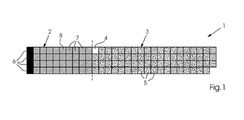
- Characterization data sets are determined using test elements. Known is the test element according to ISO 12642-2, shown in simplified form FIG. 1 , which consists of defined color patches of the process colors CMYK. In addition to this standard test element, there may be other manufacturer-specific test elements and further developments of ISO 12642-2 for general application with even finer sampling of the color space.
- the tonal values of ISO 12642-2 form a regular grid.
- CMY tone values 0%, 10%, 20%, 30%, 40%, 55%, 70%, 85% and 100%.
- this regular grid intermediate values for arbitrary tone value combinations can be determined by simple interpolation methods (tetrahedral interpolation, trilinear interpolation). Higher accuracies can be achieved, if necessary, with the segmented Neugebauer equations or spectral color values with the spectral segmented Neugebauer equations.
- characterization data sets for defined pressure conditions were determined for process standards common in America and Germany.
- the data sets refer to a defined paper with a specific paper white value. In practice, papers with other paper white values are frequently used.
- a Adjustment of the characterization data can be achieved by known methods with good approximation. One method is described in ISO standard ISO 13655, another method in ISO standard 15076. Both methods are suitable provided that the paper white values and paper properties are not very different. Otherwise, specific characterization data must be generated.
- the characterization data can be generated directly from ICC color profiles.
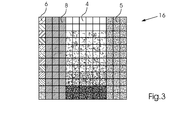
- a simplified scheme of such an ICC profile is in FIG. 3 displayed.
- Several tables are also embedded in the ICC color profile, including a table with interpolated color values of a characterization data set. This table can be extracted from a profile and reduced to a characterization record.
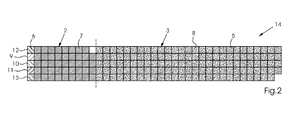
- the characterization data are obtained by means of a minimal, optimized test element. From this test element, standardized characterization data sets can be calculated using the modified and segmented spectral Neugebauer equations. These datasets are characterized by the fact that spectra of the individual color values are available and the spectra of arbitrary tone value combinations can be calculated. In particular, the spectra of the substitute colors of the spot colors can also be calculated. For printing processes with more than four printing inks, corresponding optimized test elements can be generated, in particular also optimized test elements with a smaller number of color fields. In DE 10 2004 001 937 A1 is a method described that manages with comparable few color fields. Here one of the colorful printing inks CMY is replaced by a complementary printing ink.
- DE 10 2010 007 858 A1 This procedure can be followed by analogy with the minimized test element DE 10 2010 007 858 A1 apply.
- DE 10 2010 007 858 A1 In FIG. 2 is such a minimized test element shown with four colors and a special color, which manages with a very small number of color fields.
- Multilinear interpolation is a weighted interpolation of the color values of the vertices of the surrounding cube around the sought tone value.
- Each cube corner point is assigned a linear combination a (CMY) of the coefficients Ck, Mk, Yk and 1-Ck, 1-Mk, 1-Yk and the values of the vertices are multiplied by these combinations and summed.
- the next process step now consists of determining the color combination of the replacement color to be found.
- Special colors are described colorimetrically by a CIE 1976 L * a * b * (CIELAB) color value. It is now the task to find matching color value combinations of the replacement color for this color value. If more than three colors are used in printing, the result is no longer unique. For example, for dark spot colors for a range of black tones, there are matching combinations of CMY that result in the same color value. It is known that a high proportion of black leads to a stabilization in printing, since the result is less susceptible to variations in the color of the individual printing units. At the same time, a high proportion of black reduces the total amount of ink used.
- the replacement color with the highest proportion of black and the highest proportion of the suitable color space-expanding process color is now to be found.
- the problem is equivalent to removing the colored color C, M, Y with the least amount of color from the replacement color.
- a further boundary condition is that the color difference between the spot color and the replacement color remains below a defined threshold or in the event that the spot color is outside the reproducible color space is minimal.
- the search for an optimal tone value combination for the replacement color is achieved by a search method with boundary conditions in the characterization data or in the forward model of the multicolor profile. The procedure is over DE 10 2011 012 806 A1 already known and expanded for this application.
- Boundary conditions in 4-color printing are e.g. a defined solid black (K), a maximum black with minimum color difference between special color and replacement color or a defined solid color (C, M or Y) which can also be zero.
- Boundary conditions in printing with more than 4 colors are e.g. a defined solid black (K), a maximum color space-expanding process color orange, green or blue or two defined solid colors from C, M or Y, which can also be zero.
- the minimum chromatic color of C, M and Y should be minimized (to zero). This automatically maximizes black (K).
- the minimum color is generally the ink complementary to the spot color. For a special color from the range of red shades, this is the printing ink cyan (C), for blue shades the printing ink is yellow (Y) and for green shades the printing ink is magenta (M). If this first decision can not be made beyond doubt (in the case of a yellow hue, cyan or magenta can become minimal or zero), additional boundary conditions such as the minimum color spacing must be used.
- black is maximized so that one of the bright colors C, M, Y becomes zero.
- this is the color component C, M, Y with the smallest value.
- This value, e.g. Y, is set to zero.
- the additional process color, here O is kept constant.
- this first step we take the remaining tonal values of M, C and K as the starting point. These tone values are used to calculate the associated color value from the characterization data or the forward model of the multicolor profile and the color difference from the value of the spot color.
- one of the components, e.g. M varies by a defined amount (e.g., + 2% and -2%) and the color differences to the value of the spot color are calculated.
- the new value for M is the value corresponding to the smallest color difference.
- This procedure is then performed for C and K. This second step is repeated until M, C and K do not change anymore. Then the defined amount is halved to + 1% and -1% and the procedure of step two is repeated. The amount is halved until a lower bound of e.g. 0.05% is fallen below.
- the resulting values of MCK are the intermediate result sought, the substitute color of the spot color in this characterization data set.
- black (K) is kept constant, as well as the process color Y from the above step.
- the value of the process color O is now successively increased by an amount, eg + 2%.
- a new value combination M, C is sought for which the error between the color value of the spot color and the calculated color becomes minimal and at the same time not greater than the error at the beginning of the calculation. If the error is greater 2% will be deducted and the procedure will continue with the halved percentage, here + 1%. This procedure is continued until the percentage is below a threshold, eg 0.05%.
- this replacement color is used to control the color of a printing process in a press.
- the printing press is usually controlled by a workflow software system. Therefore, it is obvious to have the detected replacement colors stored and managed by this workflow system.
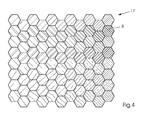
- the disclosed method for determining replacement colors for spot colors in the workflow software system is integrated so far meaningful. It is implemented in detail as follows: Spot colors are generally summarized in tables. An example are the Pantone tables such as "PANTONE Solid Coated®" with several hundred special colors. Another example of such a color table is shown schematically in FIG FIG. 4 displayed. For all these colorimetric, eg by a CIELAB value defined spot colors can now be calculated in advance a replacement table for a particular paper.
- the workflow software system looks in this table to see if a spot color is to be replaced. Customer-defined spot colors that are not in tables must then be calculated by the workflow system on-the-fly if necessary. Also, you can proceed so that only for the existing in a document special colors replacement colors are calculated. This is done, for example, in the Heidelberg Prinect® workflow system.
- the area coverage of the four printing inks is 199.9%.
- the area coverage of the four printing inks is 180.0%.
Landscapes
- Engineering & Computer Science (AREA)
- Theoretical Computer Science (AREA)
- Physics & Mathematics (AREA)
- General Engineering & Computer Science (AREA)
- General Physics & Mathematics (AREA)
- Multimedia (AREA)
- Signal Processing (AREA)
- Human Computer Interaction (AREA)
- Textile Engineering (AREA)
- Mathematical Physics (AREA)
- Color Image Communication Systems (AREA)
- Facsimile Image Signal Circuits (AREA)
Applications Claiming Priority (1)
| Application Number | Priority Date | Filing Date | Title |
|---|---|---|---|
| DE102014010061.8A DE102014010061A1 (de) | 2014-07-07 | 2014-07-07 | Verfahren zur Berechung von Ersatzfarben für Sonderfarben |
Publications (2)
| Publication Number | Publication Date |
|---|---|
| EP2966850A1 true EP2966850A1 (fr) | 2016-01-13 |
| EP2966850B1 EP2966850B1 (fr) | 2021-01-13 |
Family
ID=53488143
Family Applications (1)
| Application Number | Title | Priority Date | Filing Date |
|---|---|---|---|
| EP15171586.9A Active EP2966850B1 (fr) | 2014-07-07 | 2015-06-11 | Procede de calcul de couleurs de remplacement pour couleurs speciales |
Country Status (4)
| Country | Link |
|---|---|
| US (1) | US20160004941A1 (fr) |
| EP (1) | EP2966850B1 (fr) |
| JP (1) | JP2016019288A (fr) |
| DE (1) | DE102014010061A1 (fr) |
Families Citing this family (4)
| Publication number | Priority date | Publication date | Assignee | Title |
|---|---|---|---|---|
| EP3599448B1 (fr) * | 2018-07-27 | 2023-06-14 | hubergroup Deutschland GmbH | Procédé et dispositif de traitement de données pour déterminer une recette de couleur |
| DE102021104841A1 (de) * | 2020-03-19 | 2021-09-23 | Heidelberger Druckmaschinen Aktiengesellschaft | Sonderfarbenersatz |
| EP4094944B1 (fr) * | 2021-05-23 | 2025-07-16 | GMG GmbH & Co. KG | Procédé de détermination d'un facteur de correspondance concernant la correspondance des couleurs d'un produit d'impression créé avec des valeurs prédéterminées pour les couleurs |
| DE102022101631B3 (de) | 2022-01-25 | 2023-01-05 | Heidelberger Druckmaschinen Aktiengesellschaft | Verfahren zur Anpassung eines Lab-Sollfarbwertes mehrfarbiger Druckprodukte |
Citations (9)
| Publication number | Priority date | Publication date | Assignee | Title |
|---|---|---|---|---|
| DE102004001937A1 (de) | 2004-01-14 | 2005-08-25 | Heidelberger Druckmaschinen Ag | Verfahren zur Reproduktion von Sonderfarben mit Primärdruckfarben und Sekundärdruckfarben |
| US20080043271A1 (en) * | 2006-08-21 | 2008-02-21 | Xerox Corporation | Spot color control system and method |
| US20090015888A1 (en) * | 2007-07-13 | 2009-01-15 | Xerox Corporation | Color reproduction error minimization method and device |
| US20090161125A1 (en) * | 2007-12-19 | 2009-06-25 | Xerox Corporation | Method for classifying a printer gamut into subgamuts for improved spot color accuracy |
| US20090296113A1 (en) * | 2008-05-27 | 2009-12-03 | Xerox Corporation | Methods and systems to produce consistent spot colors for multi-color print engines |
| US20110090548A1 (en) * | 2009-10-19 | 2011-04-21 | Xerox Corporation | Reducing noise induced by color mixing spot color recipe search |
| DE102010007858A1 (de) | 2010-02-12 | 2011-08-18 | Heidelberger Druckmaschinen AG, 69115 | Verfahren zur Bestimmung von Charakterisierungsdaten eines Druckprozesses |
| DE102011012806A1 (de) | 2010-03-24 | 2011-09-29 | Heidelberger Druckmaschinen Ag | Graubalancekorrektur eines Druckverfahrens |
| US20120086959A1 (en) * | 2010-10-12 | 2012-04-12 | Xerox Corporation | Optimal spot color recipes using variable gcr profiles |
Family Cites Families (10)
| Publication number | Priority date | Publication date | Assignee | Title |
|---|---|---|---|---|
| JP2554366B2 (ja) * | 1988-09-22 | 1996-11-13 | コニカ株式会社 | カラーパッチを用いた色再現特性の推定方法 |
| GB2275584B (en) * | 1993-02-25 | 1997-05-14 | Quantel Ltd | An image processing system |
| JP3843611B2 (ja) * | 1998-07-10 | 2006-11-08 | コニカミノルタホールディングス株式会社 | 色分解画像修正方法および色分解画像修正装置 |
| US6456395B1 (en) * | 1999-08-30 | 2002-09-24 | Microsoft Corporation | Method for separating colors of encapsulated postscript images |
| JP4882374B2 (ja) * | 2003-06-12 | 2012-02-22 | 株式会社ニコン | 画像処理方法、画像処理プログラム、画像処理装置 |
| JP5539035B2 (ja) * | 2010-06-01 | 2014-07-02 | キヤノン株式会社 | プロファイル調整装置、プロファイル調整方法およびプログラム |
| WO2012105970A1 (fr) * | 2011-02-02 | 2012-08-09 | Hewlett-Packard Development Company, L.P. | Mise en place d'une structure de données de correspondance à utiliser lors de la génération d'une épreuve |
| JP5316581B2 (ja) * | 2011-05-23 | 2013-10-16 | コニカミノルタ株式会社 | 画像処理装置、画像処理方法及びプログラム |
| JP5220174B2 (ja) * | 2011-10-05 | 2013-06-26 | キヤノン株式会社 | 画像形成装置 |
| JP5987587B2 (ja) * | 2012-09-21 | 2016-09-07 | 凸版印刷株式会社 | 色予測装置、色予測方法およびプログラム |
-
2014
- 2014-07-07 DE DE102014010061.8A patent/DE102014010061A1/de not_active Withdrawn
-
2015
- 2015-06-11 EP EP15171586.9A patent/EP2966850B1/fr active Active
- 2015-07-07 US US14/792,784 patent/US20160004941A1/en not_active Abandoned
- 2015-07-07 JP JP2015136461A patent/JP2016019288A/ja active Pending
Patent Citations (9)
| Publication number | Priority date | Publication date | Assignee | Title |
|---|---|---|---|---|
| DE102004001937A1 (de) | 2004-01-14 | 2005-08-25 | Heidelberger Druckmaschinen Ag | Verfahren zur Reproduktion von Sonderfarben mit Primärdruckfarben und Sekundärdruckfarben |
| US20080043271A1 (en) * | 2006-08-21 | 2008-02-21 | Xerox Corporation | Spot color control system and method |
| US20090015888A1 (en) * | 2007-07-13 | 2009-01-15 | Xerox Corporation | Color reproduction error minimization method and device |
| US20090161125A1 (en) * | 2007-12-19 | 2009-06-25 | Xerox Corporation | Method for classifying a printer gamut into subgamuts for improved spot color accuracy |
| US20090296113A1 (en) * | 2008-05-27 | 2009-12-03 | Xerox Corporation | Methods and systems to produce consistent spot colors for multi-color print engines |
| US20110090548A1 (en) * | 2009-10-19 | 2011-04-21 | Xerox Corporation | Reducing noise induced by color mixing spot color recipe search |
| DE102010007858A1 (de) | 2010-02-12 | 2011-08-18 | Heidelberger Druckmaschinen AG, 69115 | Verfahren zur Bestimmung von Charakterisierungsdaten eines Druckprozesses |
| DE102011012806A1 (de) | 2010-03-24 | 2011-09-29 | Heidelberger Druckmaschinen Ag | Graubalancekorrektur eines Druckverfahrens |
| US20120086959A1 (en) * | 2010-10-12 | 2012-04-12 | Xerox Corporation | Optimal spot color recipes using variable gcr profiles |
Also Published As
| Publication number | Publication date |
|---|---|
| US20160004941A1 (en) | 2016-01-07 |
| JP2016019288A (ja) | 2016-02-01 |
| DE102014010061A1 (de) | 2016-01-07 |
| EP2966850B1 (fr) | 2021-01-13 |
Similar Documents
| Publication | Publication Date | Title |
|---|---|---|
| DE102004001937B4 (de) | Verfahren zur Reproduktion von Sonderfarben mit Primärdruckfarben und Sekundärdruckfarben | |
| EP2362633B1 (fr) | Procédé de détermination de données de caractérisation d'un processus d'impression | |
| DE69510710T2 (de) | Farbdruck mit erweitertem Dichteumfang | |
| EP2506559B1 (fr) | Procédé de correction de la balance des gris d'un processus d'impression | |
| DE69615728T2 (de) | Verfahren zur Erzeugung von mindestens fünf Farbauszügen für einen Mehrfarbendrucker | |
| DE69806153T2 (de) | Anordnung und verfahren zur hochgenauen kolorimetrischen charakterisierung von anzeigevorrichtungen | |
| DE10359322B4 (de) | Verfahren und Vorrichtung zur Korrektur von nicht angepassten Druckdaten anhand eines farbmetrisch vermessenen Referenzbogens | |
| DE19856574C2 (de) | Verfahren zum Optimieren von Druckerfarbpaletten | |
| DE102004003300B4 (de) | Verfahren zur Herstellung eines Prüfdrucks für einen Druckprozess mit mehr als vier Druckfarben | |
| EP1237355B1 (fr) | Procédé de détermination d'un profil de couleurs pour l'impression au moyen de plus que trois encres d'impression colorées | |
| DE102008031735B4 (de) | Graubalancekorrektur eines Druckverfahrens | |
| DE102011012806B4 (de) | Graubalancekorrektur eines Druckverfahrens | |
| EP2966850B1 (fr) | Procede de calcul de couleurs de remplacement pour couleurs speciales | |
| DE602004008979T2 (de) | Verfahren zum Farbeinstellen in einem Korrekturabzug | |
| DE10205476A1 (de) | Verfahren zur Druckprozesstransformation des Farbdrucks für Schwarzweiß-Bilder | |
| EP4125264B1 (fr) | Procédé de transformation des espaces chromatiques | |
| EP1989874A1 (fr) | Procede et dispositif pour la conversion de donnees d'entree descriptives de couleurs appropriees a l'edition graphique a l'aide d'un appareil d'edition en donnees de sortie adaptees descriptives de couleurs | |
| DE102015204956B4 (de) | Verfahren zur Berechnung von Multicolor-Profilen | |
| DE10201918B4 (de) | Verfahren zur Bestimmung der Flächendeckung von Druckplatten | |
| EP4325831B1 (fr) | Procédé pour effectuer des transformations de données de couleur avec une prescription de transformation | |
| EP3070924A1 (fr) | Procede d'optimisation de mire de couleur | |
| DE102004044647A1 (de) | Verfahren und Vorrichtung zum Umwandeln von Quellbilddaten in Zielbilddaten | |
| DE69930679T2 (de) | Verfahren und Vorrichtung zur Korrektur von Luminanz- und Chrominanzwerten in digitalen Farbbildern | |
| EP4325830A1 (fr) | Procédé de réalisation de transformations d'espace colorimétrique à l'aide de tables de transformation | |
| DE69318778T2 (de) | Gerät und Verfahren zum Drucken mit mehr als fünf Farben |
Legal Events
| Date | Code | Title | Description |
|---|---|---|---|
| PUAI | Public reference made under article 153(3) epc to a published international application that has entered the european phase |
Free format text: ORIGINAL CODE: 0009012 |
|
| AK | Designated contracting states |
Kind code of ref document: A1 Designated state(s): AL AT BE BG CH CY CZ DE DK EE ES FI FR GB GR HR HU IE IS IT LI LT LU LV MC MK MT NL NO PL PT RO RS SE SI SK SM TR |
|
| AX | Request for extension of the european patent |
Extension state: BA ME |
|
| 17P | Request for examination filed |
Effective date: 20160713 |
|
| RBV | Designated contracting states (corrected) |
Designated state(s): AL AT BE BG CH CY CZ DE DK EE ES FI FR GB GR HR HU IE IS IT LI LT LU LV MC MK MT NL NO PL PT RO RS SE SI SK SM TR |
|
| 17Q | First examination report despatched |
Effective date: 20160829 |
|
| STAA | Information on the status of an ep patent application or granted ep patent |
Free format text: STATUS: EXAMINATION IS IN PROGRESS |
|
| RAP1 | Party data changed (applicant data changed or rights of an application transferred) |
Owner name: HEIDELBERGER DRUCKMASCHINEN AG |
|
| GRAP | Despatch of communication of intention to grant a patent |
Free format text: ORIGINAL CODE: EPIDOSNIGR1 |
|
| STAA | Information on the status of an ep patent application or granted ep patent |
Free format text: STATUS: GRANT OF PATENT IS INTENDED |
|
| INTG | Intention to grant announced |
Effective date: 20201007 |
|
| GRAS | Grant fee paid |
Free format text: ORIGINAL CODE: EPIDOSNIGR3 |
|
| GRAA | (expected) grant |
Free format text: ORIGINAL CODE: 0009210 |
|
| STAA | Information on the status of an ep patent application or granted ep patent |
Free format text: STATUS: THE PATENT HAS BEEN GRANTED |
|
| AK | Designated contracting states |
Kind code of ref document: B1 Designated state(s): AL AT BE BG CH CY CZ DE DK EE ES FI FR GB GR HR HU IE IS IT LI LT LU LV MC MK MT NL NO PL PT RO RS SE SI SK SM TR |
|
| REG | Reference to a national code |
Ref country code: GB Ref legal event code: FG4D Free format text: NOT ENGLISH |
|
| REG | Reference to a national code |
Ref country code: CH Ref legal event code: EP |
|
| REG | Reference to a national code |
Ref country code: DE Ref legal event code: R096 Ref document number: 502015014138 Country of ref document: DE |
|
| REG | Reference to a national code |
Ref country code: IE Ref legal event code: FG4D Free format text: LANGUAGE OF EP DOCUMENT: GERMAN |
|
| REG | Reference to a national code |
Ref country code: AT Ref legal event code: REF Ref document number: 1355406 Country of ref document: AT Kind code of ref document: T Effective date: 20210215 |
|
| REG | Reference to a national code |
Ref country code: NL Ref legal event code: MP Effective date: 20210113 |
|
| REG | Reference to a national code |
Ref country code: LT Ref legal event code: MG9D |
|
| PG25 | Lapsed in a contracting state [announced via postgrant information from national office to epo] |
Ref country code: PT Free format text: LAPSE BECAUSE OF FAILURE TO SUBMIT A TRANSLATION OF THE DESCRIPTION OR TO PAY THE FEE WITHIN THE PRESCRIBED TIME-LIMIT Effective date: 20210513 Ref country code: LT Free format text: LAPSE BECAUSE OF FAILURE TO SUBMIT A TRANSLATION OF THE DESCRIPTION OR TO PAY THE FEE WITHIN THE PRESCRIBED TIME-LIMIT Effective date: 20210113 Ref country code: GR Free format text: LAPSE BECAUSE OF FAILURE TO SUBMIT A TRANSLATION OF THE DESCRIPTION OR TO PAY THE FEE WITHIN THE PRESCRIBED TIME-LIMIT Effective date: 20210414 Ref country code: FI Free format text: LAPSE BECAUSE OF FAILURE TO SUBMIT A TRANSLATION OF THE DESCRIPTION OR TO PAY THE FEE WITHIN THE PRESCRIBED TIME-LIMIT Effective date: 20210113 Ref country code: HR Free format text: LAPSE BECAUSE OF FAILURE TO SUBMIT A TRANSLATION OF THE DESCRIPTION OR TO PAY THE FEE WITHIN THE PRESCRIBED TIME-LIMIT Effective date: 20210113 Ref country code: BG Free format text: LAPSE BECAUSE OF FAILURE TO SUBMIT A TRANSLATION OF THE DESCRIPTION OR TO PAY THE FEE WITHIN THE PRESCRIBED TIME-LIMIT Effective date: 20210413 Ref country code: NL Free format text: LAPSE BECAUSE OF FAILURE TO SUBMIT A TRANSLATION OF THE DESCRIPTION OR TO PAY THE FEE WITHIN THE PRESCRIBED TIME-LIMIT Effective date: 20210113 Ref country code: NO Free format text: LAPSE BECAUSE OF FAILURE TO SUBMIT A TRANSLATION OF THE DESCRIPTION OR TO PAY THE FEE WITHIN THE PRESCRIBED TIME-LIMIT Effective date: 20210413 |
|
| PG25 | Lapsed in a contracting state [announced via postgrant information from national office to epo] |
Ref country code: RS Free format text: LAPSE BECAUSE OF FAILURE TO SUBMIT A TRANSLATION OF THE DESCRIPTION OR TO PAY THE FEE WITHIN THE PRESCRIBED TIME-LIMIT Effective date: 20210113 Ref country code: LV Free format text: LAPSE BECAUSE OF FAILURE TO SUBMIT A TRANSLATION OF THE DESCRIPTION OR TO PAY THE FEE WITHIN THE PRESCRIBED TIME-LIMIT Effective date: 20210113 Ref country code: PL Free format text: LAPSE BECAUSE OF FAILURE TO SUBMIT A TRANSLATION OF THE DESCRIPTION OR TO PAY THE FEE WITHIN THE PRESCRIBED TIME-LIMIT Effective date: 20210113 Ref country code: SE Free format text: LAPSE BECAUSE OF FAILURE TO SUBMIT A TRANSLATION OF THE DESCRIPTION OR TO PAY THE FEE WITHIN THE PRESCRIBED TIME-LIMIT Effective date: 20210113 |
|
| PG25 | Lapsed in a contracting state [announced via postgrant information from national office to epo] |
Ref country code: IS Free format text: LAPSE BECAUSE OF FAILURE TO SUBMIT A TRANSLATION OF THE DESCRIPTION OR TO PAY THE FEE WITHIN THE PRESCRIBED TIME-LIMIT Effective date: 20210513 |
|
| REG | Reference to a national code |
Ref country code: DE Ref legal event code: R097 Ref document number: 502015014138 Country of ref document: DE |
|
| PG25 | Lapsed in a contracting state [announced via postgrant information from national office to epo] |
Ref country code: EE Free format text: LAPSE BECAUSE OF FAILURE TO SUBMIT A TRANSLATION OF THE DESCRIPTION OR TO PAY THE FEE WITHIN THE PRESCRIBED TIME-LIMIT Effective date: 20210113 Ref country code: CZ Free format text: LAPSE BECAUSE OF FAILURE TO SUBMIT A TRANSLATION OF THE DESCRIPTION OR TO PAY THE FEE WITHIN THE PRESCRIBED TIME-LIMIT Effective date: 20210113 Ref country code: SM Free format text: LAPSE BECAUSE OF FAILURE TO SUBMIT A TRANSLATION OF THE DESCRIPTION OR TO PAY THE FEE WITHIN THE PRESCRIBED TIME-LIMIT Effective date: 20210113 |
|
| PLBE | No opposition filed within time limit |
Free format text: ORIGINAL CODE: 0009261 |
|
| STAA | Information on the status of an ep patent application or granted ep patent |
Free format text: STATUS: NO OPPOSITION FILED WITHIN TIME LIMIT |
|
| PG25 | Lapsed in a contracting state [announced via postgrant information from national office to epo] |
Ref country code: DK Free format text: LAPSE BECAUSE OF FAILURE TO SUBMIT A TRANSLATION OF THE DESCRIPTION OR TO PAY THE FEE WITHIN THE PRESCRIBED TIME-LIMIT Effective date: 20210113 Ref country code: ES Free format text: LAPSE BECAUSE OF FAILURE TO SUBMIT A TRANSLATION OF THE DESCRIPTION OR TO PAY THE FEE WITHIN THE PRESCRIBED TIME-LIMIT Effective date: 20210113 Ref country code: SK Free format text: LAPSE BECAUSE OF FAILURE TO SUBMIT A TRANSLATION OF THE DESCRIPTION OR TO PAY THE FEE WITHIN THE PRESCRIBED TIME-LIMIT Effective date: 20210113 Ref country code: RO Free format text: LAPSE BECAUSE OF FAILURE TO SUBMIT A TRANSLATION OF THE DESCRIPTION OR TO PAY THE FEE WITHIN THE PRESCRIBED TIME-LIMIT Effective date: 20210113 |
|
| 26N | No opposition filed |
Effective date: 20211014 |
|
| PG25 | Lapsed in a contracting state [announced via postgrant information from national office to epo] |
Ref country code: AL Free format text: LAPSE BECAUSE OF FAILURE TO SUBMIT A TRANSLATION OF THE DESCRIPTION OR TO PAY THE FEE WITHIN THE PRESCRIBED TIME-LIMIT Effective date: 20210113 Ref country code: MC Free format text: LAPSE BECAUSE OF FAILURE TO SUBMIT A TRANSLATION OF THE DESCRIPTION OR TO PAY THE FEE WITHIN THE PRESCRIBED TIME-LIMIT Effective date: 20210113 |
|
| REG | Reference to a national code |
Ref country code: CH Ref legal event code: PL |
|
| GBPC | Gb: european patent ceased through non-payment of renewal fee |
Effective date: 20210611 |
|
| PG25 | Lapsed in a contracting state [announced via postgrant information from national office to epo] |
Ref country code: SI Free format text: LAPSE BECAUSE OF FAILURE TO SUBMIT A TRANSLATION OF THE DESCRIPTION OR TO PAY THE FEE WITHIN THE PRESCRIBED TIME-LIMIT Effective date: 20210113 |
|
| REG | Reference to a national code |
Ref country code: BE Ref legal event code: MM Effective date: 20210630 |
|
| PG25 | Lapsed in a contracting state [announced via postgrant information from national office to epo] |
Ref country code: LU Free format text: LAPSE BECAUSE OF NON-PAYMENT OF DUE FEES Effective date: 20210611 |
|
| PG25 | Lapsed in a contracting state [announced via postgrant information from national office to epo] |
Ref country code: LI Free format text: LAPSE BECAUSE OF NON-PAYMENT OF DUE FEES Effective date: 20210630 Ref country code: IT Free format text: LAPSE BECAUSE OF FAILURE TO SUBMIT A TRANSLATION OF THE DESCRIPTION OR TO PAY THE FEE WITHIN THE PRESCRIBED TIME-LIMIT Effective date: 20210113 Ref country code: IE Free format text: LAPSE BECAUSE OF NON-PAYMENT OF DUE FEES Effective date: 20210611 Ref country code: GB Free format text: LAPSE BECAUSE OF NON-PAYMENT OF DUE FEES Effective date: 20210611 Ref country code: CH Free format text: LAPSE BECAUSE OF NON-PAYMENT OF DUE FEES Effective date: 20210630 |
|
| PG25 | Lapsed in a contracting state [announced via postgrant information from national office to epo] |
Ref country code: IS Free format text: LAPSE BECAUSE OF FAILURE TO SUBMIT A TRANSLATION OF THE DESCRIPTION OR TO PAY THE FEE WITHIN THE PRESCRIBED TIME-LIMIT Effective date: 20210513 Ref country code: FR Free format text: LAPSE BECAUSE OF NON-PAYMENT OF DUE FEES Effective date: 20210630 |
|
| PG25 | Lapsed in a contracting state [announced via postgrant information from national office to epo] |
Ref country code: BE Free format text: LAPSE BECAUSE OF NON-PAYMENT OF DUE FEES Effective date: 20210630 |
|
| REG | Reference to a national code |
Ref country code: AT Ref legal event code: MM01 Ref document number: 1355406 Country of ref document: AT Kind code of ref document: T Effective date: 20210611 |
|
| PG25 | Lapsed in a contracting state [announced via postgrant information from national office to epo] |
Ref country code: AT Free format text: LAPSE BECAUSE OF NON-PAYMENT OF DUE FEES Effective date: 20210611 |
|
| PG25 | Lapsed in a contracting state [announced via postgrant information from national office to epo] |
Ref country code: HU Free format text: LAPSE BECAUSE OF FAILURE TO SUBMIT A TRANSLATION OF THE DESCRIPTION OR TO PAY THE FEE WITHIN THE PRESCRIBED TIME-LIMIT; INVALID AB INITIO Effective date: 20150611 |
|
| P01 | Opt-out of the competence of the unified patent court (upc) registered |
Effective date: 20230427 |
|
| PG25 | Lapsed in a contracting state [announced via postgrant information from national office to epo] |
Ref country code: CY Free format text: LAPSE BECAUSE OF FAILURE TO SUBMIT A TRANSLATION OF THE DESCRIPTION OR TO PAY THE FEE WITHIN THE PRESCRIBED TIME-LIMIT Effective date: 20210113 |
|
| PG25 | Lapsed in a contracting state [announced via postgrant information from national office to epo] |
Ref country code: MK Free format text: LAPSE BECAUSE OF FAILURE TO SUBMIT A TRANSLATION OF THE DESCRIPTION OR TO PAY THE FEE WITHIN THE PRESCRIBED TIME-LIMIT Effective date: 20210113 |
|
| PG25 | Lapsed in a contracting state [announced via postgrant information from national office to epo] |
Ref country code: TR Free format text: LAPSE BECAUSE OF FAILURE TO SUBMIT A TRANSLATION OF THE DESCRIPTION OR TO PAY THE FEE WITHIN THE PRESCRIBED TIME-LIMIT Effective date: 20210113 |
|
| PG25 | Lapsed in a contracting state [announced via postgrant information from national office to epo] |
Ref country code: MT Free format text: LAPSE BECAUSE OF FAILURE TO SUBMIT A TRANSLATION OF THE DESCRIPTION OR TO PAY THE FEE WITHIN THE PRESCRIBED TIME-LIMIT Effective date: 20210113 |
|
| PGFP | Annual fee paid to national office [announced via postgrant information from national office to epo] |
Ref country code: DE Payment date: 20260630 Year of fee payment: 12 |