EP2966868A2 - Procédé pour la prédiction et l'héritage des informations de mouvement en codage vidéo - Google Patents
Procédé pour la prédiction et l'héritage des informations de mouvement en codage vidéo Download PDFInfo
- Publication number
- EP2966868A2 EP2966868A2 EP15173571.9A EP15173571A EP2966868A2 EP 2966868 A2 EP2966868 A2 EP 2966868A2 EP 15173571 A EP15173571 A EP 15173571A EP 2966868 A2 EP2966868 A2 EP 2966868A2
- Authority
- EP
- European Patent Office
- Prior art keywords
- reference picture
- block
- motion
- motion information
- current
- Prior art date
- Legal status (The legal status is an assumption and is not a legal conclusion. Google has not performed a legal analysis and makes no representation as to the accuracy of the status listed.)
- Granted
Links
Images



Classifications
-
- H—ELECTRICITY
- H04—ELECTRIC COMMUNICATION TECHNIQUE
- H04N—PICTORIAL COMMUNICATION, e.g. TELEVISION
- H04N19/00—Methods or arrangements for coding, decoding, compressing or decompressing digital video signals
- H04N19/50—Methods or arrangements for coding, decoding, compressing or decompressing digital video signals using predictive coding
- H04N19/597—Methods or arrangements for coding, decoding, compressing or decompressing digital video signals using predictive coding specially adapted for multi-view video sequence encoding
-
- H—ELECTRICITY
- H04—ELECTRIC COMMUNICATION TECHNIQUE
- H04N—PICTORIAL COMMUNICATION, e.g. TELEVISION
- H04N19/00—Methods or arrangements for coding, decoding, compressing or decompressing digital video signals
- H04N19/30—Methods or arrangements for coding, decoding, compressing or decompressing digital video signals using hierarchical techniques, e.g. scalability
-
- H—ELECTRICITY
- H04—ELECTRIC COMMUNICATION TECHNIQUE
- H04N—PICTORIAL COMMUNICATION, e.g. TELEVISION
- H04N19/00—Methods or arrangements for coding, decoding, compressing or decompressing digital video signals
- H04N19/30—Methods or arrangements for coding, decoding, compressing or decompressing digital video signals using hierarchical techniques, e.g. scalability
- H04N19/34—Scalability techniques involving progressive bit-plane based encoding of the enhancement layer, e.g. fine granular scalability [FGS]
-
- H—ELECTRICITY
- H04—ELECTRIC COMMUNICATION TECHNIQUE
- H04N—PICTORIAL COMMUNICATION, e.g. TELEVISION
- H04N19/00—Methods or arrangements for coding, decoding, compressing or decompressing digital video signals
- H04N19/50—Methods or arrangements for coding, decoding, compressing or decompressing digital video signals using predictive coding
- H04N19/503—Methods or arrangements for coding, decoding, compressing or decompressing digital video signals using predictive coding involving temporal prediction
- H04N19/51—Motion estimation or motion compensation
- H04N19/513—Processing of motion vectors
- H04N19/517—Processing of motion vectors by encoding
- H04N19/52—Processing of motion vectors by encoding by predictive encoding
Definitions
- the present invention relates to three-dimensional, multi-dimensional and scalable video coding.
- the present invention relates to video coding using motion information associated with a reference view, a reference layer or other component.
- Three-dimensional (3D) television has been a technology trend in recent years that intends to bring viewers sensational viewing experience.
- Various technologies have been developed to enable 3D viewing.
- the multi-view video is a key technology for 3DTV application among others.
- the traditional video is a two-dimensional (2D) medium that only provides viewers a single view of a scene from the perspective of the camera.
- the multi-view video is capable of offering arbitrary viewpoints of dynamic scenes and provides viewers the sensation of realism.
- 3D video formats may also include depth maps associated with corresponding texture pictures. The depth maps also have to be coded to rendering three-dimensional view or multiview.
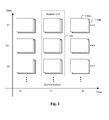
- MCP is also referred as Inter picture prediction that uses previously coded pictures of the same view in a different access unit (AU), while DCP refers to an Inter picture prediction that uses already coded pictures of other views in the same access unit, as shown in Fig. 1 .
- the vector used for DCP is termed as disparity vector (DV), which is analog to the motion vector (MV) used in MCP.
- the video pictures (110A) and depth maps (110B) corresponding to a particular camera position are indicated by a view identifier (viewID). For example, video pictures and depth maps associated with three views (i.e., V0, V1 and V2) are shown in Fig. 1 . All video pictures and depth maps that belong to the same camera position are associated with the same viewID.
- the video pictures and, when present, the depth maps are coded access unit by access unit, as shown in Fig. 1 .
- An AU (120) includes all video pictures and depth maps corresponding to the same time instant.
- the motion data compression is performed for each picture after all the pictures (both texture and depth) within the same AU are coded. In this case, for each AU, the reconstruction process for pictures within the AU can rely on full-resolution motion data associated with the current AU.
- the motion data compression will only affect the reconstruction process of other AUs that refer the compressed motion data associated with the current AU.
- 3D-HEVC version 4.0 Inter mode, Merge and Skip mode are used for texture and depth coding.
- 3D-HEVC a hybrid block-based motion-compensated DCT-like transform coding architecture is utilized.
- the basic unit for compression termed as coding unit (CU), is a 2Nx2N square block.
- CU The basic unit for compression, termed as coding unit (CU), is a 2Nx2N square block.
- Each CU can be recursively split into four smaller CUs until a pre-defined minimum size is reached.
- Each CU contains one or multiple prediction units (PUs).
- the PU size can be 2Nx2N, 2NxN, Nx2N, or NxN.
- the PU size can also be 2NxnU, 2NxnD, nLx2N or nRx2N.
- the inter-view motion prediction is employed. For deriving candidate motion parameters for a current block in a dependent view, a DV for current block is firstly derived, and then the prediction block in the already coded picture in the reference view is located by adding the DV to the location of current block. If the prediction block is coded using MCP, the associated motion parameters can be used as candidate motion parameters for the current block in the current view. The derived DV can also be directly used as a candidate DV for DCP.
- motion parameter inheritance MPI
- the motion vectors of the video signal have quarter-sample accuracy, whereas for the depth map signal only full-sample accuracy is used, in the inheritance process the motion vectors are quantized to their nearest full-sample position. It can be adaptively decided for each block of the depth map, whether the motion data is inherited from the collocated block of the video signal or if new motion data are transmitted.
- the Merge/Skip mode syntax is used for signaling the MPI coding mode.
- the list of possible Merge candidates has been extended in a way that, for depth map coding, the first Merge candidate refers to enabling the MPI coding mode to inherent motion and CU/PU splitting structure from the associated video signal. Since the motion data along with the CU/PU splitting structure of the texture is re-used by the depth, the MPI scheme introduces additional buffer to store the inter-dir (used to indicate the prediction direction) and split flag (used to indicate the data splitting) information.
- Fig. 2 illustrates an example of MPI for depth coding in 3D-HEVC.
- Texture picture 212 corresponds to a current picture and texture picture 210 corresponds to a picture at a reference time instance. Both texture pictures 210 and 212 are in the same view.
- Block 250 e.g., a PUCU as indicated by a thick lined box
- Motion vectors 232 and 234 are associated with sub-blocks 252 and 254.
- Depth block 260 is collocated with texture block 250 and may inherit motion parameters from texture block 250. Accordingly, sub-blocks 262 and 264 may inherit motion parameters (e.g., motion vectors 232' and 234') from respective sub-blocks 252 and 254.
- Block 270 in current picture 212 is partitioned into four sub-blocks.
- Motion vector 236 is associated with sub-block 272.
- Depth block 280 is collocated with texture block 270.
- Depth sub-block 282 does not inherit motion information from texture collocated sub-block.
- a separate motion vector 246 is transmitted for the corresponding depth sub-block 282.
- the Merge/Skip mode syntax is used for signaling the MPI coding mode.
- the list of possible Merge candidates has been extended for depth map coding so that the first Merge candidate refers to using of MPI coding mode, i.e., inheriting motion parameters and CU/PU structure of the corresponding block of the associated video signal in this case.
- the MPI mode can be used in any level of the hierarchical coding-tree block of the depth map. If the MPI mode is indicated at a higher level of the depth map coding tree, the depth data in this higher level unit can inherit the CU/PU subdivision as well as the corresponding motion data from the video signal. This higher level unit may be larger than the CU size for the video signal. Accordingly, it is possible to specify MPI mode for a whole tree-block, typically corresponding to 64 ⁇ 64 image samples, and the whole tree-block of the depth map is partitioned into CUs and PUs by inheriting the CU and PU partitioning of the corresponding block of the video signal.
- the MPI mode is indicated at a level of the coding tree that is smaller than or the same size as the corresponding CU size of the video signal, only the motion data are inherited from the video signal.
- the MPI mode is used, not only the partitioning and the motion vectors, but also the reference picture indices are inherited from the video signal. Therefore, it has to be ensured that the depth maps corresponding to the video reference pictures are also available in the reference picture buffer for the depth signal.
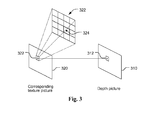
- the motion information of the depth block (312) in a depth map (310) re-uses or derives the motion information of a texture collocated block (322) of a texture picture (320) as shown in Fig. 3 .
- the texture collocated block (322) may contain multiple sets of motion information.
- the motion information of the texture collocated block (322) may be selected from any location (or can be called sub-block) within or neighboring to the texture collocated block (322). For example, the location may correspond to a sub-block located at a lower right location of a center point of the texture collocated block (322).
- the motion information may include motion vector, reference picture index and reference list.
- the texture merging candidate can be placed in any position of the merging candidate list. For example, if the texture merging candidate is available, it can be placed in the first position before the candidate corresponding to the left spatial neighboring block.
- inter-view motion vector prediction is applied for the Merge/Skip mode.
- the same motion parameters as for a neighboring block are used.
- a candidate list of motion parameters is derived, which includes the motion parameters of spatially neighboring blocks as well as motion parameters that are calculated based on the motion parameters of the co-located block in a temporal reference picture.
- the chosen motion parameters are signaled by transmitting an index in the candidate list.
- a corresponding block in a view component at the same time instant as the current view component is utilized. The corresponding block is determined by shifting the position of the current block using the disparity vector derived.
- Fig. 4 illustrates an example of inter-view candidate derivation based on 3D-HEVC version 4.0.
- Block 420 represents a current block in a view (i.e., V1 in Fig. 4 ) and the corresponding block (410) in the base view (i.e., V0) can be located according to disparity associated with the current block.
- the corresponding block (410) has an MV (412) pointing to an inter-view block in list0 refidx0 of V0 in this example.
- the collocated reference ColRef i.e., L0 Ref0 of V0
- the MV (422) for block 420 can re-use motion information from V0 as inter-view candidate of L0 for V1.
- the same derivation is applied to L1 refidx1 of V0.
- the MV (414) associated with list1 refidx1 of V0 can be re-used for V1 as inter-view candidate MV (424).
- ARP Advanced residual prediction
- Vm a target reference view
- V0 a target reference view
- V0 a target reference view
- the corresponding block (510) in the picture of the reference view within the same access unit is then located by the disparity vector.
- the motion information of the current block is re-used to derive the motion information for the reference block.
- current block 520 has motion vector 522 pointing to list0 refidx0 in V1.
- the motion information can be reused by the corresponding block (510).
- Motion compensation can be applied to the corresponding block (510) based on the same motion vector (i.e., 522) of current block and derived reference picture in the reference view for the reference block, to derive residue block 512.
- the reference picture in the reference view (V0) which has the same POC (Picture Order Count) value as the reference picture in the current view (Vm) is selected as the reference picture of the corresponding block to form a residue block.
- a weighting factor is then applied to the residue block to obtain a weighted residue block and the weighted residue block is added to the predicted samples. Similar process can be applied for motion vector 524 pointing to a reference picture in list1 of Vlto obtain residue block 514.
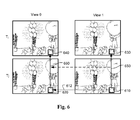
- Block 610 represents the current block in the current view (i.e., view 1)
- block 620 and block 630 denote the representation of current block 610 in the reference view (view 0) at time Tj and temporal prediction of current block 610 from the same view (view 1) at time Ti respectively.
- Motion vector 650 denotes the motion from current block 610 to block 630 at time Ti from the same view. Since current block 610 in view 1 and corresponding block 620 in view 0 are actually projections of the same object in two different views, these two blocks should share the same motion information.
- temporal prediction block 640 in view 0 at time Ti of corresponding block 620 in view 0 at time Tj can be located from corresponding block 620 in view 0 by applying the motion information of motion vector 650.
- the residue (i.e., 640) of corresponding block 620 is then multiplied by a weighting factor and is used as along with the corresponding block (i.e., 620) to form the predictor for current block (i.e., 610).
- SVC Scalable Video Coding
- SVC uses the multi-layer coding structure to realize three dimensions of scalability.
- the concept of SVC is to generate one scalable bitstream that can be easily and rapidly adapted without transcoding or reencoding to fit the bit-rate of various transmission channels, diverse display capabilities, and different computational resources.
- An important feature of SVC design is that the scalability is provided at a bitstream level. Bitstreams for a reduced spatial and/or temporal resolution can be simply obtained by discarding NAL units (or network packets) from a scalable bitstream that are not required for decoding the target resolution.
- NAL units for quality refinement can be additionally truncated in order to reduce the bit-rate and the associated video quality.
- the inter-layer motion prediction is employed.
- motion parameter derivation for a current block in an enhancement layer may use the motion parameter of a collocated prediction block in previously coded picture in the reference layer.
- the reference picture index is in the current reference picture list or the picture order count (POC) of the reference picture of the reference block in the picture used to derive motion parameter is in the current reference picture list.
- the reference picture index or the picture order count (POC) of the reference picture of the reference block in the picture used to derive motion parameter may not in the current reference picture list. In this case, the predicted or inherited motion parameters will be invalid. It is desirable to overcome this issue.
- a method and apparatus for motion information prediction and inheritance in a three-dimensional, multi-view or scalable video coding system are disclosed.
- the method or apparatus first receives input data associated with a current block of a current picture in a given view, component (texture or depth) or layer, and identifies a corresponding block in a corresponding picture in a reference view, component or layer.
- Embodiments of the present invention re-use at least a portion of motion information of the corresponding block for the motion information of the current block if a corresponding reference picture corresponding to a reference picture pointed by the corresponding block is in a current reference picture list of the current block.
- the motion information of the current block is determined using an alternative process, where at least a portion of the motion information, which was used in the previous case, is not re-used for the current block according to the alternative process.
- the motion information of the corresponding block that can be re-used for the case of the corresponding reference picture in the current reference picture list may comprise a motion vector, reference picture index, or prediction direction of the corresponding block, or any combination thereof.
- the motion information of the corresponding block to be re-used comprises a motion vector, reference picture index and prediction direction of the corresponding block.
- the motion information of the corresponding block that can be reused for the case of the corresponding reference picture in the current reference picture list only includes the motion vector of the corresponding block, and reference picture index of the current block is inferred or pre-defined, or is signaled in a bitstream.
- the alternative process sets the motion information of the current block as unavailable in a prediction direction if the corresponding reference picture is not in the current reference picture list of the current block in the prediction direction. If the current block is in a B slice and the corresponding reference picture is available in the current reference picture list of the current block only for one prediction direction, the alternative process sets the motion information of the current block to said one prediction direction. If the current block is in the B slice and the corresponding reference picture is not in the current reference picture list of the current block in both prediction directions (L0 and L1), the alternative process sets the motion information of the current block as unavailable for both the prediction directions.
- the motion vector of the corresponding block can be scaled to a scaled motion vector according to a POC distance between the current picture and a target reference picture and a POC distance between the corresponding picture and the reference picture.
- the alternative process can then use the scaled motion vector for the current block.
- the target reference picture corresponds to the first reference picture in the current reference picture list in a prediction direction, and the reference picture index of the current block is set to 0.
- the target reference picture may also set to the reference picture of a spatial neighboring block of the current block and the reference picture index of the current block is set to the reference picture index of the spatial neighboring block.
- the target reference picture is identified by reference picture index of the current block and the reference picture index of the current block is signaled in the bitstream, or the reference picture index of the current block is inferred or pre-defined.
- the alternative process may also set the motion information of the current block to pre-defined parameters.
- the motion vector of the current block can be set to (0,0) and reference picture index of the current block can be set to 0 in a prediction direction.
- MPI motion parameter inheritance
- the alternative process may set motion vector of the current block to (0,0), set reference picture index of the current block to 0, and set prediction direction of the current block to first prediction direction indicated by slice type if the motion information of the corresponding block is undefined or unclear.
- the corresponding reference picture and the reference picture pointed by the corresponding block are pictures taken at the same time instance, for example, these two pictures have the same picture order count (POC).
- the corresponding reference picture and the reference picture pointed by the corresponding block may have the same view index or layer index.
- embodiments of the present invention re-use at least a portion of first motion information of the current block for second motion information of the corresponding block if a corresponding reference picture corresponding to a reference picture pointed by the current block is in a corresponding reference picture list of the corresponding block. If the corresponding reference picture is not in the corresponding reference picture list of the corresponding block, third motion information of the corresponding block is determined. The second or third motion information is used in residual prediction according to whether the corresponding reference picture is in the corresponding reference picture list of the corresponding block. In this case, corresponding reference picture may have the same picture order count (POC) as the reference picture pointed by the current block.
- POC picture order count
- the reference picture index is in the current reference picture list or the picture order count (POC) of the reference picture pointed by the corresponding block in the corresponding picture is in the current reference picture list, where the corresponding block is used to derive the motion parameters.
- the reference picture index or the picture order count (POC) of the reference picture pointed by the corresponding block may not be in the current reference picture list.
- the predicted or inherited motion parameters will be invalid.
- the present invention incorporates various embodiments to overcome the reference picture index issue associated with motion parameter prediction or inheritance for the inter-view, inter-component and inter-layer motion parameter prediction/inheritance.
- the inter-component prediction refers to prediction for one component based on another component. For example, the depth component can be used to derive prediction for the texture component, or vice versa.
- the motion parameters such as motion vector (MV), reference picture index, prediction direction (L0, L1 or Bi-prediction) are all re-used.
- POC picture order count
- the prediction direction list0 or list1
- an exception handler process can be used to overcome the reference picture index issue.
- the motion parameter is set as unavailable in the prediction direction (list0 or list1).
- the prediction direction for current block is set to L0 or L1 according to which one is available. Otherwise, if the motion parameters of both lists are unavailable, the motion predictor is set as unavailable.
- the MV of the reference block is scaled according to the POC distance between the current picture and a target reference picture and the POC distance between the corresponding picture used to derive motion parameter and the reference picture.
- the target reference picture can be the first reference picture of the reference picture list of the prediction direction (list0 or list1) and the reference picture index for the current block can be set to 0.
- ARP advanced residual prediction
- the MV of the current block is scaled according to the POC distance between the current picture and the reference picture and the POC distance between the corresponding picture and a target reference picture.
- the target reference picture can be the first reference picture of the reference picture list and the reference picture index for the corresponding block can be set to 0.
- the target reference picture may also be set to any reference picture in the reference picture list or the reference picture index.
- the MV of the reference block is scaled according to the POC distance between the current picture and the target reference picture and the POC distance between the corresponding picture used to derive motion parameter and the reference picture.
- the target reference picture is set as the one used by a spatial neighboring block in the prediction direction (list0 or list1) and the reference picture index for the current block is set to that used by the spatial neighboring block.
- the motion parameters are set to pre-defined parameters.
- the pre-defined MV can be set to (0,0) and the pre-defined reference picture index can be set to 0 in the prediction direction (list0 or list1).
- Exception Handler Process 5 The motion vector is set to (0,0), reference picture index is set to 0, and the prediction type (uni-prediction or bi-prediction) is set to the slice type.
- the reference picture index is signaled in the bitstream.
- POC picture order count
- an exception handler process can be used to overcome the reference picture index issue.
- Exception Handler Process 1 The motion parameter is set as unavailable in the prediction direction (list0 or list1).
- the MV of the corresponding block is scaled according to the POC distance between the current picture and a target reference picture and the POC distance between the corresponding picture used to derive motion parameter and the reference picture.
- the MV of the current block is scaled according to the POC distance between the current picture and the reference picture and the POC distance between the corresponding picture and a target reference picture.
- the target reference picture is the picture pointed by the transmitted reference picture index for the current block or corresponding block.
- the motion parameters are set to pre-defined parameters.
- the pre-defined MV can be set to (0,0) and the pre-defined reference picture index can be set to 0 in the prediction direction (list0 or list1).
- Exception Handler Process 4 The motion vector is set to (0,0), reference index is set to the target index, and the prediction type (uni-prediction or bi-prediction) is set to the given prediction type.
- Exception Handler Process 5 The motion vector is set to (0,0), reference picture index is set to the target index, and the prediction type (uni-prediction or bi-prediction) is set to the slice type.
- the reference picture index is inferred or pre-defined (e.g. the reference picture index being 0).
- POC picture order count
- the reference picture index of current block or any reference picture in the reference picture list of the prediction direction (list0 or list1) of the current block or when the POC of the reference picture of the current block used to derive motion parameters does not match any reference picture in the reference picture list of the corresponding block, an exception handler process can be used to overcome the reference picture index issue.
- the motion parameter is set as unavailable in the prediction direction (list0 or list1).
- the prediction direction for current block is set to L0 or L1 according to which one is available. Otherwise, if the motion parameters of both lists are unavailable, the motion predictor is set as unavailable.
- the MV of the corresponding block is scaled according to the POC distance between the current picture and a target reference picture and the POC distance between the corresponding picture used to derive motion parameter and the corresponding reference picture.
- the MV of the current block is scaled according to the POC distance between the current picture and the reference picture and the POC distance between the corresponding picture and a target reference picture.
- the target reference picture is the picture pointed by the inferred or predetermined reference picture index for the current block or corresponding block.
- the motion parameters are set to pre-defined parameters.
- the pre-defined MV can be set to (0,0) and the pre-defined reference picture index can be set to 0 in the prediction direction (list0 or list1).
- Exception Handler Process 4 The motion vector is set to (0,0), reference index is set to the target index, and the prediction type (uni-prediction or bi-prediction) is set to the given prediction type.
- Exception Handler Process 5 The motion vector is set to (0,0), reference index is set to the target index, and the prediction type (uni-prediction or bi-prediction) is set to the slice type.
- the MPI mode is only possible, if the whole region of the video signal that the motion data and partitioning are to be inherited from, is coded using Inter prediction and the reference indices inherited from the video signal are also available in the reference picture buffer for the depth map coding.
- the encoder can still signal the MPI mode ON, even though partial region is coded using Intra prediction or the reference pictures are unavailable in the reference picture buffer.
- inconsistency of MPI may occur due to different implementation between an encoder and a decoder. As the result, a mismatch may happen in the decoded pictures. Therefore, there is a risk that a decoder may encounter unexpected behavior by using undefined (e.g., Intra prediction) or unclear motion values (e.g., the reference pictures unavailable in the reference picture buffer).
- embodiments of the present invention use pre-determined motion data for the Intra coded region or the region with unavailable reference picture to eliminate undefined decoder behavior.
- the region with undefined or unclear motion data is filled up with motion vector equal to (0,0), reference index equal to 0, and prediction type (uni-prediction or bi-prediction) equal to the slice type.
- prediction type uni-prediction or bi-prediction
- the motion parameter is set as unavailable in the prediction direction (list0 or list1).
- the prediction direction for current block is set to L0 or L1 according to which one is available.
- the MV of the corresponding block is scaled according to the POC distance between the current picture and a target reference picture and the POC distance between the corresponding picture used to derive motion parameter and the corresponding reference picture.
- the target reference picture can be the first reference picture of the reference picture list of the prediction direction (list0 or list1) and the reference picture index for the current block can be set to 0.
- the target reference picture can also be set to any reference picture in the reference picture list or the reference picture index.
- the MV of the corresponding block is scaled according to the POC distance between the current picture and the target reference picture and the POC distance between the corresponding picture used to derive motion parameter and the corresponding reference picture.
- the target reference picture is set as the reference picture used by a spatial neighboring block of the prediction direction (list0 or list1) and the reference picture index for current block is set to that used by the spatial neighboring block.
- the motion parameters are set to pre-defined parameters.
- the pre-defined MV can be set to (0,0) and the pre-defined reference picture index can be set to 0 in the prediction direction (list0 or list1).
- Exception Handler Process 5 The motion vector is set to (0,0), reference index is set to 0, and the prediction type (uni-prediction or bi-prediction) is set to the slice type.
- the corresponding reference picture has the same picture order count (POC) as the reference picture pointed by the corresponding block, so POC of the reference picture is checked with the reference picture list of the current block to determine if the corresponding reference picture is in the reference picture list or reference picture buffer.
- POC picture order count
- view index i.e. view id
- layer index i.e. layer id
- scalable video coding system can also be checked.
- Fig. 7 illustrates an exemplary flowchart for a three-dimensional, multi-view or scalable video coding system according to an embodiment of the present invention.
- the system receives input data associated with a current block of a current picture in a given view, component or layer in step 710.
- the input data may correspond to un-coded or coded texture data, depth data, or associated motion information.
- the input data may be retrieved from storage such as a computer memory, buffer (RAM or DRAM) or other media.
- the input data may also be received from a processor such as a controller, a central processing unit, a digital signal processor or electronic circuits that derives the input data.
- a corresponding block in a corresponding picture in a reference view, component or layer is identified as shown in step 720.
- At least one first portion of first motion information of the corresponding block is re-used as second motion information of the current block if a corresponding reference picture corresponding to a reference picture pointed by the corresponding block is in a current reference picture list of the current block as shown in step 730.
- the third motion information of the current block is determined using an alternative process if the corresponding reference picture corresponding to the reference picture pointed by the corresponding block is not in the current reference picture list of the current block as shown in step 740. Encoding or decoding is then applied to the input data associated with the current block using the second motion information or the third motion information according to whether the corresponding reference picture is in the current reference picture list of the current block as shown in step 750.
- step 730 may be modified so that at least one first portion of first motion information of the current block is re-used as second motion information of the corresponding block if a corresponding reference picture corresponding to a reference picture pointed by the corresponding block is in a current reference picture list of the current block; and step 740 may be modified so that the third motion information of the corresponding block is determined using an alternative process if the corresponding reference picture corresponding to the reference picture pointed by the corresponding block is not in the current reference picture list of the current block.
- Embodiment of the present invention as described above may be implemented in various hardware, software codes, or a combination of both.
- an embodiment of the present invention can be a circuit integrated into a video compression chip or program code integrated into video compression software to perform the processing described herein.
- An embodiment of the present invention may also be program code to be executed on a Digital Signal Processor (DSP) to perform the processing described herein.
- DSP Digital Signal Processor
- the invention may also involve a number of functions to be performed by a computer processor, a digital signal processor, a microprocessor, or field programmable gate array (FPGA). These processors can be configured to perform particular tasks according to the invention, by executing machine-readable software code or firmware code that defines the particular methods embodied by the invention.
- the software code or firmware code may be developed in different programming languages and different formats or styles.
- the software code may also be compiled for different target platforms.
- different code formats, styles and languages of software codes and other means of configuring code to perform the tasks in accordance with the invention will not depart from the spirit and scope of the invention.
Landscapes
- Engineering & Computer Science (AREA)
- Multimedia (AREA)
- Signal Processing (AREA)
- Compression Or Coding Systems Of Tv Signals (AREA)
Applications Claiming Priority (3)
| Application Number | Priority Date | Filing Date | Title |
|---|---|---|---|
| US201261711328P | 2012-10-09 | 2012-10-09 | |
| PCT/CN2013/084839 WO2014056423A1 (fr) | 2012-10-09 | 2013-10-08 | Procédé et appareil pour une prédiction et un héritage d'informations de mouvement dans un codage vidéo |
| EP13845977.1A EP2907311A4 (fr) | 2012-10-09 | 2013-10-08 | Procédé et appareil pour une prédiction et un héritage d'informations de mouvement dans un codage vidéo |
Related Parent Applications (2)
| Application Number | Title | Priority Date | Filing Date |
|---|---|---|---|
| EP13845977.1A Division EP2907311A4 (fr) | 2012-10-09 | 2013-10-08 | Procédé et appareil pour une prédiction et un héritage d'informations de mouvement dans un codage vidéo |
| EP13845977.1A Division-Into EP2907311A4 (fr) | 2012-10-09 | 2013-10-08 | Procédé et appareil pour une prédiction et un héritage d'informations de mouvement dans un codage vidéo |
Publications (3)
| Publication Number | Publication Date |
|---|---|
| EP2966868A2 true EP2966868A2 (fr) | 2016-01-13 |
| EP2966868A3 EP2966868A3 (fr) | 2016-05-04 |
| EP2966868B1 EP2966868B1 (fr) | 2018-07-18 |
Family
ID=50476947
Family Applications (2)
| Application Number | Title | Priority Date | Filing Date |
|---|---|---|---|
| EP13845977.1A Withdrawn EP2907311A4 (fr) | 2012-10-09 | 2013-10-08 | Procédé et appareil pour une prédiction et un héritage d'informations de mouvement dans un codage vidéo |
| EP15173571.9A Active EP2966868B1 (fr) | 2012-10-09 | 2013-10-08 | Procédé pour la prédiction et l'héritage des informations de mouvement en codage vidéo |
Family Applications Before (1)
| Application Number | Title | Priority Date | Filing Date |
|---|---|---|---|
| EP13845977.1A Withdrawn EP2907311A4 (fr) | 2012-10-09 | 2013-10-08 | Procédé et appareil pour une prédiction et un héritage d'informations de mouvement dans un codage vidéo |
Country Status (5)
| Country | Link |
|---|---|
| US (1) | US9894383B2 (fr) |
| EP (2) | EP2907311A4 (fr) |
| AU (1) | AU2013330031B2 (fr) |
| CA (1) | CA2887452C (fr) |
| WO (1) | WO2014056423A1 (fr) |
Families Citing this family (16)
| Publication number | Priority date | Publication date | Assignee | Title |
|---|---|---|---|---|
| EA201492099A1 (ru) * | 2012-05-14 | 2015-04-30 | Лука Россато | Разложение остаточных данных при кодировании, декодировании и реконструкции сигнала в многоуровневой иерархии |
| JP6196372B2 (ja) * | 2013-04-11 | 2017-09-13 | エルジー エレクトロニクス インコーポレイティド | ビデオ信号処理方法及び装置 |
| CN105103558B (zh) * | 2013-04-12 | 2018-09-11 | 瑞典爱立信有限公司 | 构建层间参考图像列表 |
| US9288507B2 (en) * | 2013-06-21 | 2016-03-15 | Qualcomm Incorporated | More accurate advanced residual prediction (ARP) for texture coding |
| EP3078195A4 (fr) * | 2013-12-02 | 2017-08-09 | Nokia Technologies OY | Codage et décodage vidéo |
| CN110572643B (zh) * | 2014-01-29 | 2021-11-16 | 联发科技股份有限公司 | 利用自适应运动向量精度的方法和装置 |
| US10432928B2 (en) | 2014-03-21 | 2019-10-01 | Qualcomm Incorporated | Using a current picture as a reference for video coding |
| KR102260146B1 (ko) | 2014-03-31 | 2021-06-03 | 인텔렉추얼디스커버리 주식회사 | 시점 간 움직임 병합 후보 유도 방법 및 장치 |
| CN105393535B (zh) * | 2014-06-24 | 2018-10-12 | 寰发股份有限公司 | 3d视频编码中的视图间先进残差预测方法 |
| WO2015196364A1 (fr) * | 2014-06-24 | 2015-12-30 | Mediatek Singapore Pte. Ltd. | Procédés de prédiction inter-image avancée résiduelle |
| US10812822B2 (en) * | 2015-10-02 | 2020-10-20 | Qualcomm Incorporated | Intra block copy merge mode and padding of unavailable IBC reference region |
| US10939099B2 (en) * | 2016-04-22 | 2021-03-02 | Lg Electronics Inc. | Inter prediction mode-based image processing method and device therefor |
| US20180109814A1 (en) * | 2016-10-14 | 2018-04-19 | Mediatek Inc. | Method And Apparatus Of Coding Unit Information Inheritance |
| US10528366B2 (en) | 2017-06-05 | 2020-01-07 | International Business Machines Corporation | Facilitating multi-inheritance within a single inheritance container-based environment |
| CN109005412B (zh) * | 2017-06-06 | 2022-06-07 | 北京三星通信技术研究有限公司 | 运动矢量获取的方法及设备 |
| WO2019144908A1 (fr) | 2018-01-26 | 2019-08-01 | Mediatek Inc. | Procédé et appareil de prédiction inter affine pour un système de codage vidéo |
Family Cites Families (12)
| Publication number | Priority date | Publication date | Assignee | Title |
|---|---|---|---|---|
| KR100823287B1 (ko) * | 2007-01-03 | 2008-04-21 | 삼성전자주식회사 | 전역 차이 벡터를 이용한 다시점 영상의 부호화, 복호화방법 및 장치 |
| KR20090129412A (ko) | 2007-03-02 | 2009-12-16 | 엘지전자 주식회사 | 비디오 신호 디코딩/인코딩 방법 및 장치 |
| CN101119493B (zh) | 2007-08-30 | 2010-12-01 | 威盛电子股份有限公司 | 区块式数字编码图像的译码方法及装置 |
| US8594200B2 (en) * | 2009-11-11 | 2013-11-26 | Mediatek Inc. | Method of storing motion vector information and video decoding apparatus |
| CN101917619B (zh) * | 2010-08-20 | 2012-05-09 | 浙江大学 | 一种多视点视频编码快速运动估计方法 |
| US8824558B2 (en) * | 2010-11-23 | 2014-09-02 | Mediatek Inc. | Method and apparatus of spatial motion vector prediction |
| US8755437B2 (en) | 2011-03-17 | 2014-06-17 | Mediatek Inc. | Method and apparatus for derivation of spatial motion vector candidate and motion vector prediction candidate |
| US9319716B2 (en) * | 2011-01-27 | 2016-04-19 | Qualcomm Incorporated | Performing motion vector prediction for video coding |
| JP5747559B2 (ja) * | 2011-03-01 | 2015-07-15 | 富士通株式会社 | 動画像復号方法、動画像符号化方法、動画像復号装置、及び動画像復号プログラム |
| US9247249B2 (en) * | 2011-04-20 | 2016-01-26 | Qualcomm Incorporated | Motion vector prediction in video coding |
| JP6421931B2 (ja) * | 2012-03-06 | 2018-11-14 | サン パテント トラスト | 動画像符号化方法及び動画像符号化装置 |
| US20130336406A1 (en) * | 2012-06-14 | 2013-12-19 | Qualcomm Incorporated | Redundancy removal for merge/skip mode motion information candidate list construction |
-
2013
- 2013-10-08 US US14/434,258 patent/US9894383B2/en active Active
- 2013-10-08 WO PCT/CN2013/084839 patent/WO2014056423A1/fr not_active Ceased
- 2013-10-08 EP EP13845977.1A patent/EP2907311A4/fr not_active Withdrawn
- 2013-10-08 AU AU2013330031A patent/AU2013330031B2/en active Active
- 2013-10-08 CA CA2887452A patent/CA2887452C/fr active Active
- 2013-10-08 EP EP15173571.9A patent/EP2966868B1/fr active Active
Non-Patent Citations (1)
| Title |
|---|
| None |
Also Published As
| Publication number | Publication date |
|---|---|
| US20150296222A1 (en) | 2015-10-15 |
| CA2887452C (fr) | 2018-11-20 |
| EP2907311A4 (fr) | 2016-08-24 |
| AU2013330031B2 (en) | 2016-06-30 |
| AU2013330031A1 (en) | 2015-05-14 |
| EP2966868B1 (fr) | 2018-07-18 |
| WO2014056423A1 (fr) | 2014-04-17 |
| US9894383B2 (en) | 2018-02-13 |
| EP2907311A1 (fr) | 2015-08-19 |
| EP2966868A3 (fr) | 2016-05-04 |
| CA2887452A1 (fr) | 2014-04-17 |
Similar Documents
| Publication | Publication Date | Title |
|---|---|---|
| EP2966868B1 (fr) | Procédé pour la prédiction et l'héritage des informations de mouvement en codage vidéo | |
| US9819959B2 (en) | Method and apparatus for residual prediction in three-dimensional video coding | |
| US9998755B2 (en) | Method and apparatus for motion information inheritance in three-dimensional video coding | |
| US10110915B2 (en) | Method and apparatus for inter-component motion prediction in three-dimensional video coding | |
| KR101749437B1 (ko) | 디스패리티 벡터 유도 | |
| CA2896905C (fr) | Procede et appareil de synthese predictive de vue en codage video 3d | |
| CA2920413C (fr) | Procede de derivation de vecteur de disparite par defaut en 3d et codage video multi-vues | |
| US20150201215A1 (en) | Method of constrain disparity vector derivation in 3d video coding | |
| CA2904424C (fr) | Procede et appareil de signalisation de parametres de camera lors d'un codage video 3d | |
| JPWO2014103529A1 (ja) | 画像復号装置、およびデータ構造 | |
| US20150304681A1 (en) | Method and apparatus of inter-view motion vector prediction and disparity vector prediction in 3d video coding | |
| CA2896805A1 (fr) | Procede et appareil de derivation de vecteur de disparite dans un codage video 3d | |
| US20160330467A1 (en) | Method and device for inducing motion information between temporal points of sub prediction unit | |
| JP2016034050A (ja) | 画像復号装置、画像符号化装置および、データ構造 | |
| JP2015015626A (ja) | 画像復号装置および画像符号化装置 | |
| KR20150010249A (ko) | 제한적인 움직임 정보 유도를 통한 메모리 효율성을 향상시키는 방법 및 장치 | |
| KR20160002194A (ko) | 적응적 병합후보 선택방법 및 장치 | |
| HK1217843A1 (zh) | 运动图像解码装置 |
Legal Events
| Date | Code | Title | Description |
|---|---|---|---|
| PUAI | Public reference made under article 153(3) epc to a published international application that has entered the european phase |
Free format text: ORIGINAL CODE: 0009012 |
|
| AC | Divisional application: reference to earlier application |
Ref document number: 2907311 Country of ref document: EP Kind code of ref document: P |
|
| AK | Designated contracting states |
Kind code of ref document: A2 Designated state(s): AL AT BE BG CH CY CZ DE DK EE ES FI FR GB GR HR HU IE IS IT LI LT LU LV MC MK MT NL NO PL PT RO RS SE SI SK SM TR |
|
| AX | Request for extension of the european patent |
Extension state: BA ME |
|
| PUAL | Search report despatched |
Free format text: ORIGINAL CODE: 0009013 |
|
| AK | Designated contracting states |
Kind code of ref document: A3 Designated state(s): AL AT BE BG CH CY CZ DE DK EE ES FI FR GB GR HR HU IE IS IT LI LT LU LV MC MK MT NL NO PL PT RO RS SE SI SK SM TR |
|
| AX | Request for extension of the european patent |
Extension state: BA ME |
|
| RIC1 | Information provided on ipc code assigned before grant |
Ipc: H04N 19/52 20140101ALI20160331BHEP Ipc: H04N 19/597 20140101AFI20160331BHEP Ipc: H04N 19/30 20140101ALI20160331BHEP |
|
| RAP1 | Party data changed (applicant data changed or rights of an application transferred) |
Owner name: HFI INNOVATION INC. |
|
| 17P | Request for examination filed |
Effective date: 20161104 |
|
| RBV | Designated contracting states (corrected) |
Designated state(s): AL AT BE BG CH CY CZ DE DK EE ES FI FR GB GR HR HU IE IS IT LI LT LU LV MC MK MT NL NO PL PT RO RS SE SI SK SM TR |
|
| 17Q | First examination report despatched |
Effective date: 20170327 |
|
| GRAP | Despatch of communication of intention to grant a patent |
Free format text: ORIGINAL CODE: EPIDOSNIGR1 |
|
| INTG | Intention to grant announced |
Effective date: 20180206 |
|
| GRAS | Grant fee paid |
Free format text: ORIGINAL CODE: EPIDOSNIGR3 |
|
| GRAA | (expected) grant |
Free format text: ORIGINAL CODE: 0009210 |
|
| AC | Divisional application: reference to earlier application |
Ref document number: 2907311 Country of ref document: EP Kind code of ref document: P |
|
| AK | Designated contracting states |
Kind code of ref document: B1 Designated state(s): AL AT BE BG CH CY CZ DE DK EE ES FI FR GB GR HR HU IE IS IT LI LT LU LV MC MK MT NL NO PL PT RO RS SE SI SK SM TR |
|
| REG | Reference to a national code |
Ref country code: GB Ref legal event code: FG4D |
|
| REG | Reference to a national code |
Ref country code: CH Ref legal event code: EP |
|
| REG | Reference to a national code |
Ref country code: IE Ref legal event code: FG4D |
|
| REG | Reference to a national code |
Ref country code: AT Ref legal event code: REF Ref document number: 1020630 Country of ref document: AT Kind code of ref document: T Effective date: 20180815 |
|
| REG | Reference to a national code |
Ref country code: DE Ref legal event code: R096 Ref document number: 602013040694 Country of ref document: DE |
|
| REG | Reference to a national code |
Ref country code: NL Ref legal event code: MP Effective date: 20180718 |
|
| REG | Reference to a national code |
Ref country code: LT Ref legal event code: MG4D |
|
| REG | Reference to a national code |
Ref country code: AT Ref legal event code: MK05 Ref document number: 1020630 Country of ref document: AT Kind code of ref document: T Effective date: 20180718 |
|
| PG25 | Lapsed in a contracting state [announced via postgrant information from national office to epo] |
Ref country code: NL Free format text: LAPSE BECAUSE OF FAILURE TO SUBMIT A TRANSLATION OF THE DESCRIPTION OR TO PAY THE FEE WITHIN THE PRESCRIBED TIME-LIMIT Effective date: 20180718 |
|
| PG25 | Lapsed in a contracting state [announced via postgrant information from national office to epo] |
Ref country code: FI Free format text: LAPSE BECAUSE OF FAILURE TO SUBMIT A TRANSLATION OF THE DESCRIPTION OR TO PAY THE FEE WITHIN THE PRESCRIBED TIME-LIMIT Effective date: 20180718 Ref country code: IS Free format text: LAPSE BECAUSE OF FAILURE TO SUBMIT A TRANSLATION OF THE DESCRIPTION OR TO PAY THE FEE WITHIN THE PRESCRIBED TIME-LIMIT Effective date: 20181118 Ref country code: RS Free format text: LAPSE BECAUSE OF FAILURE TO SUBMIT A TRANSLATION OF THE DESCRIPTION OR TO PAY THE FEE WITHIN THE PRESCRIBED TIME-LIMIT Effective date: 20180718 Ref country code: GR Free format text: LAPSE BECAUSE OF FAILURE TO SUBMIT A TRANSLATION OF THE DESCRIPTION OR TO PAY THE FEE WITHIN THE PRESCRIBED TIME-LIMIT Effective date: 20181019 Ref country code: NO Free format text: LAPSE BECAUSE OF FAILURE TO SUBMIT A TRANSLATION OF THE DESCRIPTION OR TO PAY THE FEE WITHIN THE PRESCRIBED TIME-LIMIT Effective date: 20181018 Ref country code: BG Free format text: LAPSE BECAUSE OF FAILURE TO SUBMIT A TRANSLATION OF THE DESCRIPTION OR TO PAY THE FEE WITHIN THE PRESCRIBED TIME-LIMIT Effective date: 20181018 Ref country code: SE Free format text: LAPSE BECAUSE OF FAILURE TO SUBMIT A TRANSLATION OF THE DESCRIPTION OR TO PAY THE FEE WITHIN THE PRESCRIBED TIME-LIMIT Effective date: 20180718 Ref country code: AT Free format text: LAPSE BECAUSE OF FAILURE TO SUBMIT A TRANSLATION OF THE DESCRIPTION OR TO PAY THE FEE WITHIN THE PRESCRIBED TIME-LIMIT Effective date: 20180718 Ref country code: PL Free format text: LAPSE BECAUSE OF FAILURE TO SUBMIT A TRANSLATION OF THE DESCRIPTION OR TO PAY THE FEE WITHIN THE PRESCRIBED TIME-LIMIT Effective date: 20180718 Ref country code: LT Free format text: LAPSE BECAUSE OF FAILURE TO SUBMIT A TRANSLATION OF THE DESCRIPTION OR TO PAY THE FEE WITHIN THE PRESCRIBED TIME-LIMIT Effective date: 20180718 |
|
| PG25 | Lapsed in a contracting state [announced via postgrant information from national office to epo] |
Ref country code: HR Free format text: LAPSE BECAUSE OF FAILURE TO SUBMIT A TRANSLATION OF THE DESCRIPTION OR TO PAY THE FEE WITHIN THE PRESCRIBED TIME-LIMIT Effective date: 20180718 Ref country code: LV Free format text: LAPSE BECAUSE OF FAILURE TO SUBMIT A TRANSLATION OF THE DESCRIPTION OR TO PAY THE FEE WITHIN THE PRESCRIBED TIME-LIMIT Effective date: 20180718 Ref country code: AL Free format text: LAPSE BECAUSE OF FAILURE TO SUBMIT A TRANSLATION OF THE DESCRIPTION OR TO PAY THE FEE WITHIN THE PRESCRIBED TIME-LIMIT Effective date: 20180718 |
|
| REG | Reference to a national code |
Ref country code: DE Ref legal event code: R097 Ref document number: 602013040694 Country of ref document: DE |
|
| PG25 | Lapsed in a contracting state [announced via postgrant information from national office to epo] |
Ref country code: RO Free format text: LAPSE BECAUSE OF FAILURE TO SUBMIT A TRANSLATION OF THE DESCRIPTION OR TO PAY THE FEE WITHIN THE PRESCRIBED TIME-LIMIT Effective date: 20180718 Ref country code: CZ Free format text: LAPSE BECAUSE OF FAILURE TO SUBMIT A TRANSLATION OF THE DESCRIPTION OR TO PAY THE FEE WITHIN THE PRESCRIBED TIME-LIMIT Effective date: 20180718 Ref country code: ES Free format text: LAPSE BECAUSE OF FAILURE TO SUBMIT A TRANSLATION OF THE DESCRIPTION OR TO PAY THE FEE WITHIN THE PRESCRIBED TIME-LIMIT Effective date: 20180718 Ref country code: EE Free format text: LAPSE BECAUSE OF FAILURE TO SUBMIT A TRANSLATION OF THE DESCRIPTION OR TO PAY THE FEE WITHIN THE PRESCRIBED TIME-LIMIT Effective date: 20180718 Ref country code: IT Free format text: LAPSE BECAUSE OF FAILURE TO SUBMIT A TRANSLATION OF THE DESCRIPTION OR TO PAY THE FEE WITHIN THE PRESCRIBED TIME-LIMIT Effective date: 20180718 |
|
| PLBE | No opposition filed within time limit |
Free format text: ORIGINAL CODE: 0009261 |
|
| STAA | Information on the status of an ep patent application or granted ep patent |
Free format text: STATUS: NO OPPOSITION FILED WITHIN TIME LIMIT |
|
| PG25 | Lapsed in a contracting state [announced via postgrant information from national office to epo] |
Ref country code: SM Free format text: LAPSE BECAUSE OF FAILURE TO SUBMIT A TRANSLATION OF THE DESCRIPTION OR TO PAY THE FEE WITHIN THE PRESCRIBED TIME-LIMIT Effective date: 20180718 Ref country code: DK Free format text: LAPSE BECAUSE OF FAILURE TO SUBMIT A TRANSLATION OF THE DESCRIPTION OR TO PAY THE FEE WITHIN THE PRESCRIBED TIME-LIMIT Effective date: 20180718 Ref country code: SK Free format text: LAPSE BECAUSE OF FAILURE TO SUBMIT A TRANSLATION OF THE DESCRIPTION OR TO PAY THE FEE WITHIN THE PRESCRIBED TIME-LIMIT Effective date: 20180718 |
|
| REG | Reference to a national code |
Ref country code: CH Ref legal event code: PL |
|
| 26N | No opposition filed |
Effective date: 20190423 |
|
| GBPC | Gb: european patent ceased through non-payment of renewal fee |
Effective date: 20181018 |
|
| REG | Reference to a national code |
Ref country code: BE Ref legal event code: MM Effective date: 20181031 |
|
| PG25 | Lapsed in a contracting state [announced via postgrant information from national office to epo] |
Ref country code: MC Free format text: LAPSE BECAUSE OF FAILURE TO SUBMIT A TRANSLATION OF THE DESCRIPTION OR TO PAY THE FEE WITHIN THE PRESCRIBED TIME-LIMIT Effective date: 20180718 Ref country code: LU Free format text: LAPSE BECAUSE OF NON-PAYMENT OF DUE FEES Effective date: 20181008 |
|
| REG | Reference to a national code |
Ref country code: IE Ref legal event code: MM4A |
|
| PG25 | Lapsed in a contracting state [announced via postgrant information from national office to epo] |
Ref country code: FR Free format text: LAPSE BECAUSE OF NON-PAYMENT OF DUE FEES Effective date: 20181031 Ref country code: SI Free format text: LAPSE BECAUSE OF FAILURE TO SUBMIT A TRANSLATION OF THE DESCRIPTION OR TO PAY THE FEE WITHIN THE PRESCRIBED TIME-LIMIT Effective date: 20180718 Ref country code: CH Free format text: LAPSE BECAUSE OF NON-PAYMENT OF DUE FEES Effective date: 20181031 Ref country code: LI Free format text: LAPSE BECAUSE OF NON-PAYMENT OF DUE FEES Effective date: 20181031 Ref country code: BE Free format text: LAPSE BECAUSE OF NON-PAYMENT OF DUE FEES Effective date: 20181031 |
|
| PG25 | Lapsed in a contracting state [announced via postgrant information from national office to epo] |
Ref country code: GB Free format text: LAPSE BECAUSE OF NON-PAYMENT OF DUE FEES Effective date: 20181018 Ref country code: IE Free format text: LAPSE BECAUSE OF NON-PAYMENT OF DUE FEES Effective date: 20181008 |
|
| PG25 | Lapsed in a contracting state [announced via postgrant information from national office to epo] |
Ref country code: MT Free format text: LAPSE BECAUSE OF NON-PAYMENT OF DUE FEES Effective date: 20181008 |
|
| PG25 | Lapsed in a contracting state [announced via postgrant information from national office to epo] |
Ref country code: TR Free format text: LAPSE BECAUSE OF FAILURE TO SUBMIT A TRANSLATION OF THE DESCRIPTION OR TO PAY THE FEE WITHIN THE PRESCRIBED TIME-LIMIT Effective date: 20180718 |
|
| PG25 | Lapsed in a contracting state [announced via postgrant information from national office to epo] |
Ref country code: PT Free format text: LAPSE BECAUSE OF FAILURE TO SUBMIT A TRANSLATION OF THE DESCRIPTION OR TO PAY THE FEE WITHIN THE PRESCRIBED TIME-LIMIT Effective date: 20180718 |
|
| PG25 | Lapsed in a contracting state [announced via postgrant information from national office to epo] |
Ref country code: HU Free format text: LAPSE BECAUSE OF FAILURE TO SUBMIT A TRANSLATION OF THE DESCRIPTION OR TO PAY THE FEE WITHIN THE PRESCRIBED TIME-LIMIT; INVALID AB INITIO Effective date: 20131008 Ref country code: MK Free format text: LAPSE BECAUSE OF NON-PAYMENT OF DUE FEES Effective date: 20180718 Ref country code: CY Free format text: LAPSE BECAUSE OF FAILURE TO SUBMIT A TRANSLATION OF THE DESCRIPTION OR TO PAY THE FEE WITHIN THE PRESCRIBED TIME-LIMIT Effective date: 20180718 |
|
| PGFP | Annual fee paid to national office [announced via postgrant information from national office to epo] |
Ref country code: DE Payment date: 20250813 Year of fee payment: 13 |