EP2967676B1 - Fixation de dispositifs orthopédiques - Google Patents
Fixation de dispositifs orthopédiques Download PDFInfo
- Publication number
- EP2967676B1 EP2967676B1 EP14768586.1A EP14768586A EP2967676B1 EP 2967676 B1 EP2967676 B1 EP 2967676B1 EP 14768586 A EP14768586 A EP 14768586A EP 2967676 B1 EP2967676 B1 EP 2967676B1
- Authority
- EP
- European Patent Office
- Prior art keywords
- fixation material
- orthopaedic implant
- base device
- bone
- fixation
- Prior art date
- Legal status (The legal status is an assumption and is not a legal conclusion. Google has not performed a legal analysis and makes no representation as to the accuracy of the status listed.)
- Active
Links
Images


Classifications
-
- A—HUMAN NECESSITIES
- A61—MEDICAL OR VETERINARY SCIENCE; HYGIENE
- A61L—METHODS OR APPARATUS FOR STERILISING MATERIALS OR OBJECTS IN GENERAL; DISINFECTION, STERILISATION OR DEODORISATION OF AIR; CHEMICAL ASPECTS OF BANDAGES, DRESSINGS, ABSORBENT PADS OR SURGICAL ARTICLES; MATERIALS FOR BANDAGES, DRESSINGS, ABSORBENT PADS OR SURGICAL ARTICLES
- A61L31/00—Materials for other surgical articles, e.g. stents, stent-grafts, shunts, surgical drapes, guide wires, materials for adhesion prevention, occluding devices, surgical gloves, tissue fixation devices
- A61L31/14—Materials characterised by their function or physical properties, e.g. injectable or lubricating compositions, shape-memory materials, surface modified materials
- A61L31/146—Porous materials, e.g. foams or sponges
-
- A—HUMAN NECESSITIES
- A61—MEDICAL OR VETERINARY SCIENCE; HYGIENE
- A61B—DIAGNOSIS; SURGERY; IDENTIFICATION
- A61B17/00—Surgical instruments, devices or methods
- A61B17/56—Surgical instruments or methods for treatment of bones or joints; Devices specially adapted therefor
- A61B17/58—Surgical instruments or methods for treatment of bones or joints; Devices specially adapted therefor for osteosynthesis, e.g. bone plates, screws or setting implements
- A61B17/68—Internal fixation devices, including fasteners and spinal fixators, even if a part thereof projects from the skin
- A61B17/70—Spinal positioners or stabilisers, e.g. stabilisers comprising fluid filler in an implant
- A61B17/7097—Stabilisers comprising fluid filler in an implant, e.g. balloon; devices for inserting or filling such implants
- A61B17/7098—Stabilisers comprising fluid filler in an implant, e.g. balloon; devices for inserting or filling such implants wherein the implant is permeable or has openings, e.g. fenestrated screw
-
- A—HUMAN NECESSITIES
- A61—MEDICAL OR VETERINARY SCIENCE; HYGIENE
- A61B—DIAGNOSIS; SURGERY; IDENTIFICATION
- A61B17/00—Surgical instruments, devices or methods
- A61B17/56—Surgical instruments or methods for treatment of bones or joints; Devices specially adapted therefor
- A61B17/58—Surgical instruments or methods for treatment of bones or joints; Devices specially adapted therefor for osteosynthesis, e.g. bone plates, screws or setting implements
- A61B17/68—Internal fixation devices, including fasteners and spinal fixators, even if a part thereof projects from the skin
- A61B17/80—Cortical plates, i.e. bone plates; Instruments for holding or positioning cortical plates, or for compressing bones attached to cortical plates
- A61B17/8028—Cushions, i.e. elements forming interface between bone plate and bone
-
- A—HUMAN NECESSITIES
- A61—MEDICAL OR VETERINARY SCIENCE; HYGIENE
- A61B—DIAGNOSIS; SURGERY; IDENTIFICATION
- A61B17/00—Surgical instruments, devices or methods
- A61B17/56—Surgical instruments or methods for treatment of bones or joints; Devices specially adapted therefor
- A61B17/58—Surgical instruments or methods for treatment of bones or joints; Devices specially adapted therefor for osteosynthesis, e.g. bone plates, screws or setting implements
- A61B17/68—Internal fixation devices, including fasteners and spinal fixators, even if a part thereof projects from the skin
- A61B17/84—Fasteners therefor or fasteners being internal fixation devices
- A61B17/846—Nails or pins, i.e. anchors without movable parts, holding by friction only, with or without structured surface
-
- A—HUMAN NECESSITIES
- A61—MEDICAL OR VETERINARY SCIENCE; HYGIENE
- A61B—DIAGNOSIS; SURGERY; IDENTIFICATION
- A61B17/00—Surgical instruments, devices or methods
- A61B17/56—Surgical instruments or methods for treatment of bones or joints; Devices specially adapted therefor
- A61B17/58—Surgical instruments or methods for treatment of bones or joints; Devices specially adapted therefor for osteosynthesis, e.g. bone plates, screws or setting implements
- A61B17/68—Internal fixation devices, including fasteners and spinal fixators, even if a part thereof projects from the skin
- A61B17/84—Fasteners therefor or fasteners being internal fixation devices
- A61B17/86—Pins or screws or threaded wires; nuts therefor
- A61B17/8625—Shanks, i.e. parts contacting bone tissue
-
- A—HUMAN NECESSITIES
- A61—MEDICAL OR VETERINARY SCIENCE; HYGIENE
- A61L—METHODS OR APPARATUS FOR STERILISING MATERIALS OR OBJECTS IN GENERAL; DISINFECTION, STERILISATION OR DEODORISATION OF AIR; CHEMICAL ASPECTS OF BANDAGES, DRESSINGS, ABSORBENT PADS OR SURGICAL ARTICLES; MATERIALS FOR BANDAGES, DRESSINGS, ABSORBENT PADS OR SURGICAL ARTICLES
- A61L31/00—Materials for other surgical articles, e.g. stents, stent-grafts, shunts, surgical drapes, guide wires, materials for adhesion prevention, occluding devices, surgical gloves, tissue fixation devices
- A61L31/02—Inorganic materials
- A61L31/022—Metals or alloys
-
- A—HUMAN NECESSITIES
- A61—MEDICAL OR VETERINARY SCIENCE; HYGIENE
- A61L—METHODS OR APPARATUS FOR STERILISING MATERIALS OR OBJECTS IN GENERAL; DISINFECTION, STERILISATION OR DEODORISATION OF AIR; CHEMICAL ASPECTS OF BANDAGES, DRESSINGS, ABSORBENT PADS OR SURGICAL ARTICLES; MATERIALS FOR BANDAGES, DRESSINGS, ABSORBENT PADS OR SURGICAL ARTICLES
- A61L31/00—Materials for other surgical articles, e.g. stents, stent-grafts, shunts, surgical drapes, guide wires, materials for adhesion prevention, occluding devices, surgical gloves, tissue fixation devices
- A61L31/04—Macromolecular materials
- A61L31/06—Macromolecular materials obtained otherwise than by reactions only involving carbon-to-carbon unsaturated bonds
-
- A—HUMAN NECESSITIES
- A61—MEDICAL OR VETERINARY SCIENCE; HYGIENE
- A61L—METHODS OR APPARATUS FOR STERILISING MATERIALS OR OBJECTS IN GENERAL; DISINFECTION, STERILISATION OR DEODORISATION OF AIR; CHEMICAL ASPECTS OF BANDAGES, DRESSINGS, ABSORBENT PADS OR SURGICAL ARTICLES; MATERIALS FOR BANDAGES, DRESSINGS, ABSORBENT PADS OR SURGICAL ARTICLES
- A61L31/00—Materials for other surgical articles, e.g. stents, stent-grafts, shunts, surgical drapes, guide wires, materials for adhesion prevention, occluding devices, surgical gloves, tissue fixation devices
- A61L31/14—Materials characterised by their function or physical properties, e.g. injectable or lubricating compositions, shape-memory materials, surface modified materials
- A61L31/16—Biologically active materials, e.g. therapeutic substances
-
- A—HUMAN NECESSITIES
- A61—MEDICAL OR VETERINARY SCIENCE; HYGIENE
- A61B—DIAGNOSIS; SURGERY; IDENTIFICATION
- A61B17/00—Surgical instruments, devices or methods
- A61B17/56—Surgical instruments or methods for treatment of bones or joints; Devices specially adapted therefor
- A61B17/58—Surgical instruments or methods for treatment of bones or joints; Devices specially adapted therefor for osteosynthesis, e.g. bone plates, screws or setting implements
- A61B17/68—Internal fixation devices, including fasteners and spinal fixators, even if a part thereof projects from the skin
- A61B17/84—Fasteners therefor or fasteners being internal fixation devices
- A61B17/86—Pins or screws or threaded wires; nuts therefor
- A61B2017/8655—Pins or screws or threaded wires; nuts therefor with special features for locking in the bone
-
- A—HUMAN NECESSITIES
- A61—MEDICAL OR VETERINARY SCIENCE; HYGIENE
- A61L—METHODS OR APPARATUS FOR STERILISING MATERIALS OR OBJECTS IN GENERAL; DISINFECTION, STERILISATION OR DEODORISATION OF AIR; CHEMICAL ASPECTS OF BANDAGES, DRESSINGS, ABSORBENT PADS OR SURGICAL ARTICLES; MATERIALS FOR BANDAGES, DRESSINGS, ABSORBENT PADS OR SURGICAL ARTICLES
- A61L2300/00—Biologically active materials used in bandages, wound dressings, absorbent pads or medical devices
- A61L2300/40—Biologically active materials used in bandages, wound dressings, absorbent pads or medical devices characterised by a specific therapeutic activity or mode of action
- A61L2300/404—Biocides, antimicrobial agents, antiseptic agents
-
- A—HUMAN NECESSITIES
- A61—MEDICAL OR VETERINARY SCIENCE; HYGIENE
- A61L—METHODS OR APPARATUS FOR STERILISING MATERIALS OR OBJECTS IN GENERAL; DISINFECTION, STERILISATION OR DEODORISATION OF AIR; CHEMICAL ASPECTS OF BANDAGES, DRESSINGS, ABSORBENT PADS OR SURGICAL ARTICLES; MATERIALS FOR BANDAGES, DRESSINGS, ABSORBENT PADS OR SURGICAL ARTICLES
- A61L2300/00—Biologically active materials used in bandages, wound dressings, absorbent pads or medical devices
- A61L2300/40—Biologically active materials used in bandages, wound dressings, absorbent pads or medical devices characterised by a specific therapeutic activity or mode of action
- A61L2300/41—Anti-inflammatory agents, e.g. NSAIDs
-
- A—HUMAN NECESSITIES
- A61—MEDICAL OR VETERINARY SCIENCE; HYGIENE
- A61L—METHODS OR APPARATUS FOR STERILISING MATERIALS OR OBJECTS IN GENERAL; DISINFECTION, STERILISATION OR DEODORISATION OF AIR; CHEMICAL ASPECTS OF BANDAGES, DRESSINGS, ABSORBENT PADS OR SURGICAL ARTICLES; MATERIALS FOR BANDAGES, DRESSINGS, ABSORBENT PADS OR SURGICAL ARTICLES
- A61L2300/00—Biologically active materials used in bandages, wound dressings, absorbent pads or medical devices
- A61L2300/40—Biologically active materials used in bandages, wound dressings, absorbent pads or medical devices characterised by a specific therapeutic activity or mode of action
- A61L2300/412—Tissue-regenerating or healing or proliferative agents
- A61L2300/414—Growth factors
-
- A—HUMAN NECESSITIES
- A61—MEDICAL OR VETERINARY SCIENCE; HYGIENE
- A61L—METHODS OR APPARATUS FOR STERILISING MATERIALS OR OBJECTS IN GENERAL; DISINFECTION, STERILISATION OR DEODORISATION OF AIR; CHEMICAL ASPECTS OF BANDAGES, DRESSINGS, ABSORBENT PADS OR SURGICAL ARTICLES; MATERIALS FOR BANDAGES, DRESSINGS, ABSORBENT PADS OR SURGICAL ARTICLES
- A61L2400/00—Materials characterised by their function or physical properties
- A61L2400/18—Modification of implant surfaces in order to improve biocompatibility, cell growth, fixation of biomolecules, e.g. plasma treatment
Definitions
- the present invention relates to orthopaedic implants.
- Orthopaedic implants are known that are implanted into the body to achieve various surgical objectives. Such implants include bone pins, bone screws and bone plates.
- the implantation period of the implant can vary from a short period, such as a couple of days, to the end of a patient's life. During the implantation period, the implant will experience natural forces caused by surrounding anatomy structures due to static and dynamic conditions of the anatomy structures. These natural forces can cause the implant to either loosen from the implantation site or, worse, ultimately detach from the implant site.
- the implant is usually fixated to the implantation site by bone screws, which must be screwed into the implantation site.
- the implant can also be bonded to the implantation site with an adhesive, such as bone cement, or materials can be attached to the implant that encourage natural ingrowth of tissue onto or into the implant. Natural tissue ingrowth will help to fixate the implant in place and can form a strong bond with the implant.
- WO 2010/019781 discloses non permanent implants such as nails, plates and external fixation devices allowing drug delivery.
- a porous member providing adhesion is mentioned in relation to permanent implants such as hip prosthesis or knee prosthesis.
- US 2010/003640 A1 discloses dental implants having a porous portion to improve osseointegration, initial stability.
- the porous region (fixation material) is not part of the metallic implant but include between 2 parts of the implant.
- US 2004/267263 discloses a pin to secure bone or bone graft, the device has surface structures thread, roughened regions, hooks, barbs to maintain the pin after implantation.. The pin can further present holes aimed to allow delivery of active ingredients.
- the present invention provides an orthopaedic implant with a fixation material attached to the implant that is configured to provide a minimally sufficient adhesive force to resist natural pull out of the implant caused by forces acting on the implant during implantation and bone ingrowth.
- the invention in one form is directed to an orthopaedic implant including a base device with a device surface and a fixation material attached to the base device.
- the fixation material is attached to at least one portion of the device surface and is configured to provide a minimally sufficient adhesive force to resist natural pull out caused by forces acting on the base device after implantation and bone ingrowth
- the method includes providing a base device that has a surface area and determining a minimally sufficient adhesive force to resist natural pull out caused by forces acting on the base device after implantation and bone ingrowth. A proper amount of a fixation material sufficient to provide an adhesive force equal to the determined minimally sufficient adhesive force is determined and the fixation material is applied to the device surface. When the proper amount of the fixation material is applied to the device surface, application of the fixation material is stopped.
- the method includes providing an orthopaedic implant having a device surface and a fixation material attached to the device surface.
- the fixation material is configured to provide a minimally sufficient adhesive force to resist natural pull out caused by forces acting on the base device after implantation and bone ingrowth.
- the orthopaedic implant is implanted at an implantation site within a patient.
- the implantation of the orthopaedic implant is revised by applying a revisionary force to the orthopaedic implant that is slightly greater than the minimally sufficient adhesive force.
- An advantage of the present invention is that it provides an orthopaedic implant that can withstand natural pull out forces when implanted within a patient while not requiring excessive force to remove, if necessary.
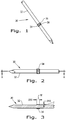
- an orthopaedic implant 30 which generally includes a base device 32 and a fixation material 34 attached to the base device 32.
- the base device 32 shown is a bone pin that can reside within a patient for a short period of time.
- the base device 32 can be constructed of metals commonly used in orthopaedic implants such as titanium, cobalt chrome and stainless steel.
- the base device can be constructed of biocompatible polymers such as polyether ether ketone (PEEK), polylactic acid (PLA), polyglycolic acid (PGA), polyethylene (PE) and blends thereof.
- the fixation material 34 attached to the base device 32 is shaped as a thin band wrapped around the circumference of the base device 32.
- the fixation material 34 can be a porous polymer or metal that has a roughened surface 36 to provide immediate fixation of the device 30 due to frictional forces and to encourage quick tissue ingrowth into the fixation material 34.
- the roughened surface 36 can have customized surface properties for a specific tissue type and desired tissue ingrowth amount or rate. Such surface properties can include a surface energy density, wettability and electrostatic charge.
- Polymers and metals that can act as the fixation material 34 include PEEK, PLA, PGA, PE, titanium, cobalt chrome and stainless steel.
- Pores 38 of the fixation material 34 can be sized to allow or prevent ingrowth of tissue into the fixation material 34. Additionally, biologically active substances can be included in the pores 38 to encourage or limit tissue ingrowth into the fixation material 34, as well as provide other useful properties such as antimicrobial activity to reduce the risk of infection.
- the orthopaedic implant 30 is a small diameter bone pin that will likely be removed within a few weeks of implantation, a strong interface between surrounding tissue and the orthopaedic implant 30 is undesirable as it will cause removal of the orthopaedic implant 30 to be unnecessarily difficult.
- a relatively small band of fixation material 34 is necessary to provide a minimally sufficient adhesive force that will resist pull out of the orthopaedic implant 30 while it is implanted in a patient while not causing excessive adhesive force that could make the device 30 difficult to remove.
- the fixation material 34 has a relatively low thickness T (0.010") and a width W ("0.050”) significantly greater than the thickness T.
- a thickness T range of about 0.005" to 0.015" and a width W range of about 0.020" to 0.125" can be appropriate dimensions for the fixation material 34 shaped as a band to provide the minimally sufficient adhesive force. It is also contemplated that there can be multiple fixation materials attached to the base device 32, which would alter the dimensions of each fixation material region. An additional design consideration when shaping and placing the fixation material 34 on a small diameter pin is that the pin won't provide much leverage to apply torque and overcome the adhesive force provided by the fixation material 34.
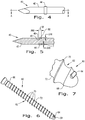
- an orthopaedic implant 40 which includes a base device 42, shown here as a large diameter pin, with a fixation material 44 attached to the pin 42.
- the fixation material 44 can be the same as the fixation material 34 described previously.
- the fixation material 44 can be shaped as a band around the circumference of the pin 42, similar to the previously described small diameter pin 32.
- the band of fixation material 44 can have a thickness T ranging from about 0.015" to 0.050" and a width W ranging from about 0.020" to 0.125".
- the pin 42 can also have a groove 46 formed on the outer surface 48 of the pin 42 where the fixation material 44 attaches to the pin 42.
- the groove 46 can have a varying depth that changes how proud an outer surface 50 of the fixation material 44 is relative to the outer surface 48 of the pin 42.
- the fixation material 44 has a thickness T of 0.020", but the outer surface 50 only elevates 0.010" relative to the outer surface 48 of the pin 42.
- Having the groove 46 in the pin 42 allows for a thicker fixation material 44, which will increase the potential bone ingrowth and adhesive force, with a smaller increase in the overall diameter of the device 40.
- the groove 46 also provides more surface area of the pin 42 to utilize for attachment to the fixation material 44.
- a large diameter pin can have a larger minimally sufficient adhesive force but still be easily removed because the large diameter pin 42 provides more leverage to apply torque and overcome the adhesive force provided by the fixation material 44.
- an orthopaedic implant 60 which includes a base device 62, shown as a bone screw, and a fixation material 64 attached to the bone screw 62.
- the bone screw 62 can be constructed of biocompatible metals and polymers, similar to previously described base devices, and the fixation material 64 can be made of a material similar to that of previously described fixation materials.
- the bone screw 62 has a head end 66, a distal end 68 and a plurality of threads 70 formed on a surface 72 of the bone screw 62.
- the fixation material 64 forms a small patch on the distal end 68 of the bone screw 62.
- the threads 70 of the bone screw 62 will provide some adhesive force to keep the bone screw 62 in place during implantation, so the fixation material patch 64 acts to provide additional adhesive force at the distal end 68, if necessary, to resist natural pull out of the bone screw 62.
- an orthopaedic implant 80 which includes a bone screw 62 similar to that shown in Figs. 6 and 7 having a fixation material 82 attached to the distal end 68 of the bone screw 62.
- the fixation material 82 can be formed from any fixation material previously described.
- the fixation material 82 is formed as a "dot" of material on the distal end 68 of the bone screw 62 to provide additional adhesive force to the bone screw 62.
- an orthopaedic implant 90 which includes a bone screw 92 similar to that shown in Figs. 6, 7 and 8 having a fixation material 94 attached to a surface 96 of the bone screw 92 between threads 98 formed on the surface 96 of the bone screw 92.
- the fixation material 94 can be formed from any fixation material previously described.
- the fixation material 94 has a helical shape that wraps around the circumference of the bone screw 92 between the threads 98. In this configuration, the fixation material 94 provides a substantial amount of adhesive force to resist natural pull out of the device 90.
- Such a configuration may be desirable for bone screws that are intended to have a longer implantation period, where additional fixation of the bone screw is desirable.
- an orthopaedic implant 100 which includes a bone screw 101 similar to that shown in Figs. 6, 7 , 8 and 9 having a fixation material 102 attached near a distal end 103 of the bone screw 101 between the distal end 103 and threads 104 and 106.
- the fixation material 102 can be formed from any fixation material previously described. This configuration allows for the fixation material 102 to provide less fixation force than orthopaedic implant 90, previously described. Such a configuration is better suited for bone screws that are intended to have shorter implantation periods, where too much additional fixation of the bone screw would make removal unnecessarily difficult.
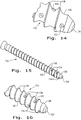
- an orthopaedic implant 110 which includes a base device 112, shown as a bone screw, with holes 114 formed through a surface 116 of the bone screw 112 between threads 118.
- the holes 114 are located axially in valleys 120 between the threads 118 and go through to the centerline of the screw 112.
- the holes 114 can be placed along the full length of the screw 112.
- the screw 112 is a cannulated screw having an inner chamber 120 that has a fixation material 122 bonded inside the inner chamber 120.
- a wall thickness(not shown) between the minor diameter of the bone screw 112 and the inner wall of the inner chamber 120 should be in a range of approximately 1 mm to 1.5 mm. Studies have shown that bone will bridge a gap of approximately 1 mm to 1.5 mm to grow into a porous material, such as the fixation material 122.
- Figs. 15 and 16 show a similar embodiment, with fewer holes 114 formed through the bone screw 112 and the holes 114 being concentrated near a distal end 126 of the bone screw 112.
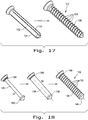
- a base device 130 is shown before and after being prepared into an orthopaedic implant 132 of the present invention.
- the base device 130 is a screw blank that has had elongated pockets 134 machined within. These elongated pockets 134 are filled with a fixation material 136, which can be any fixation material previously described. Following filling of the elongated pockets 134 with the fixation material 136, threads 138 can be cut into the base device 130 and fixation material 136 to form the completed orthopaedic implant 132.
- the threads 138 will be composed of approximately half fixation material 136 and half material of the base device 130, giving the orthopaedic implant 132 a substantial amount of fixation material 136 to provide adhesive force during implantation and also placing the fixation material 136 into intimate contact with surrounding anatomy structures during implantation.
- Such a configuration can be particularly useful when the orthopaedic implant 132 is intended to be a long-term implant.
- a base device 140 is shown before and after being prepared into an orthopaedic implant 142.
- the base device 140 is a screw blank with a minor diameter d1 between a head end 144 and a distal end 146.
- a fixation material 148 which can be any fixation material previously described, is bonded to a section of the base device 140 having minor diameter d1 to create a diameter d2 similar to that of the head end 146 and distal end 148. Threads 150 are then formed into the fixation material 148 to create the completed orthopaedic implant 142.
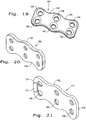
- an orthopaedic implant 160 that includes a base device 162, shown as a bone plate, and a fixation material 164 attached to the bone plate 162.
- the bone plate 162 has a bare surface 166 and multiple openings 168 that are sized to allow bone screws (not shown) to be passed through.
- the openings 168 are shaped so that when the bone screws are driven into a bone, they will hold the bone plate 162 in place.
- the bone plate 162 can be made of biocompatible metals such as titanium, cobalt chrome and stainless steel, but can also be made of a biocompatible polymer such as PEEK.
- a polymer bone plate 162 could offer advantages over more common metal bone plates, such as higher compression and adjustable stiffening.
- the fixation material 164 is attached to a bottom surface (not shown) that is opposed to the bare surface 166 and will be in contact with the bone during implantation.
- the fixation material 164 can be any fixation material previously described.
- the fixation material 164 forms a layer on the bottom surface of the bone plate 162. Since bone screws will be going through the openings 168, the fixation material 164 does not cover the openings 168. If the bone plate 162 had a bare bottom surface, the only fixation that the bone plate 162 would have when implanted would be provided by friction from the bone screws implanted in the bone.
- the bone plate 162 By attaching the fixation material 164 to the bottom surface of the bone plate 162, the bone plate 162 is provided with adhesive force of its own: initially from the roughness of the fixation material and later from bone ingrowth into the fixation material 164. Although the fixation material 164 is shown covering the entire bottom surface of the bone plate 162, the amount of fixation material 164 could be altered to provide a desired amount of adhesive force to the bone plate.
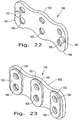
- an orthopaedic implant 170 that includes the bone plate 162 of Figs. 19 and 20 with a fixation material 172 attached at one end 174 of the bone plate 162.
- the fixation material 172 is shaped as a patch and can be any fixation material previously described. By attaching the fixation material 172 to only one end 174 of the bone plate 162, bone ingrowth and fixation will only occur at the end 174 of the plate with the fixation material 172, allowing an opposite end 176 to float to whatever degree the attached bone screws allow. Such a configuration allows for a dynamic bone plate 170.
- an orthopaedic implant 180 that includes the bone plate 162 of Figs. 19, 20 and 21 with two regions of a fixation material 182 attached at both ends 184, 186 of the bone plate 162.
- the regions of fixation material 182 are shaped as dots of material and can be any fixation material previously described. Attaching the fixation material 182 to both ends 184, 186 of the bone plate 162 provides bone ingrowth, and therefore fixation, at both ends 184, 186 of the bone plate 162.
- an orthopaedic implant 190 is shown that includes the bone plate 162 of Figs. 19, 20, 21 and 22 with three regions of a fixation material 192 surrounding the openings 168 of the bone plate 162.
- the fixation material 192 can be any fixation material previously described. Bone ingrowth into the fixation material 192 around the openings 168 provide additional fixation to the bone plate 162 in those regions. Such a configuration could be desirable if the bone screws are to be removed after implantation or do not provide enough fixation of the bone plate 162 on their own.
Landscapes
- Health & Medical Sciences (AREA)
- Orthopedic Medicine & Surgery (AREA)
- Life Sciences & Earth Sciences (AREA)
- Surgery (AREA)
- Heart & Thoracic Surgery (AREA)
- Animal Behavior & Ethology (AREA)
- General Health & Medical Sciences (AREA)
- Public Health (AREA)
- Veterinary Medicine (AREA)
- Molecular Biology (AREA)
- Biomedical Technology (AREA)
- Engineering & Computer Science (AREA)
- Neurology (AREA)
- Chemical & Material Sciences (AREA)
- Epidemiology (AREA)
- Vascular Medicine (AREA)
- Nuclear Medicine, Radiotherapy & Molecular Imaging (AREA)
- Medical Informatics (AREA)
- Medicinal Chemistry (AREA)
- Inorganic Chemistry (AREA)
- Dispersion Chemistry (AREA)
- Chemical Kinetics & Catalysis (AREA)
- Prostheses (AREA)
- Surgical Instruments (AREA)
- Materials For Medical Uses (AREA)
- Polymers & Plastics (AREA)
- Organic Chemistry (AREA)
Claims (9)
- Implant orthopédique (30, 40, 100), comprenant :1.1 un dispositif de base (32, 42, 92, 112), ayant une forme allongée d'une cheville (42) ou d'une vis à os (112) ;
caractérisé par1.2 un matériau de fixation (34, 44, 94, 102), attaché au dispositif de base ;1.3 le matériau de fixation a la forme d'une bande fine enveloppée autour de la circonférence du dispositif de base ;1.4 le matériau de fixation est configuré de manière à assurer une force d'adhérence suffisante minimale pour résister à une traction naturelle agissant sur le dispositif de base après implantation mais nécessitant une force de révision qui est plus grande que la force d'adhérence. - Implant orthopédique selon la revendication 1, dans lequel ledit matériau de fixation est au moins l'un parmi le titane, le cobalt-chrome et la polyéther éther cétone (PEEK).
- Implant orthopédique selon la revendication 2, dans lequel ledit matériau de fixation comporte une substance biologiquement active ménagée au sein d'une pluralité de pores,
dans lequel ladite substance biologiquement active est au moins l'un d'un facteur de croissance, d'un agent antibactérien, d'un anti-inflammatoire, d'un promoteur de croissance osseuse et d'un inhibiteur de croissance osseuse. - Implant orthopédique selon la revendication 1, dans lequel le dispositif de base comporte une pluralité d'ouvertures formées sur la surface du dispositif de base.
- Implant orthopédique selon la revendication 4, dans lequel le dispositif de base inclut un réservoir en communication fluidique avec au moins l'une de la pluralité d'ouvertures.
- Implant orthopédique selon la revendication 5, dans lequel ledit réservoir est au moins partiellement rempli d'une substance de traitement, dans lequel la substance de traitement est de préférence au moins l'un d'un facteur de croissance, d'un agent antibactérien, d'un anti-inflammatoire, d'un promoteur de croissance osseuse et d'un inhibiteur de croissance osseuse.
- Implant orthopédique selon la revendication 2, dans lequel le dispositif de base est composé de PEEK.
- Implant orthopédique selon la revendication 1, caractérisé en ce que le dispositif de base est une vis à os (92) et en ce que le matériau de fixation (94) est une bande enveloppée autour de la surface (96) de la vis à os (92) enveloppée autour de la vis à os (92) entre ses filets (98).
- Implant orthopédique (110) incluant un dispositif de base (112) ayant la forme d'une vis à os, avec des trous (114) formés à travers une surface (116) de la vis à os (112) entre des filets (118), caractérisé en ce que les trous (114) sont localisés axialement dans des vallées (120) entre les filets (118) et traversent la ligne centrale de matériau de fixation (122) lié à l'intérieur de la chambre interne (120), de sorte que le tissu sera chimio-attiré vers le matériau de fixation (122) et remplira les trous (114).
Applications Claiming Priority (3)
| Application Number | Priority Date | Filing Date | Title |
|---|---|---|---|
| US201361787507P | 2013-03-15 | 2013-03-15 | |
| US14/204,129 US20140277183A1 (en) | 2013-03-15 | 2014-03-11 | Fixation of orthopaedic devices |
| PCT/US2014/024498 WO2014150904A1 (fr) | 2013-03-15 | 2014-03-12 | Fixation de dispositifs orthopédiques |
Publications (3)
| Publication Number | Publication Date |
|---|---|
| EP2967676A1 EP2967676A1 (fr) | 2016-01-20 |
| EP2967676A4 EP2967676A4 (fr) | 2016-11-16 |
| EP2967676B1 true EP2967676B1 (fr) | 2019-09-18 |
Family
ID=51531152
Family Applications (1)
| Application Number | Title | Priority Date | Filing Date |
|---|---|---|---|
| EP14768586.1A Active EP2967676B1 (fr) | 2013-03-15 | 2014-03-12 | Fixation de dispositifs orthopédiques |
Country Status (6)
| Country | Link |
|---|---|
| US (3) | US20140277183A1 (fr) |
| EP (1) | EP2967676B1 (fr) |
| JP (2) | JP2016513535A (fr) |
| CA (1) | CA2896778C (fr) |
| ES (1) | ES2749121T3 (fr) |
| WO (1) | WO2014150904A1 (fr) |
Families Citing this family (14)
| Publication number | Priority date | Publication date | Assignee | Title |
|---|---|---|---|---|
| US10045801B2 (en) * | 2012-07-30 | 2018-08-14 | The Governing Council Of The University Of Toronto | Bone stabilization device and method of production |
| US20140277183A1 (en) * | 2013-03-15 | 2014-09-18 | Smed-Ta/Td, Llc | Fixation of orthopaedic devices |
| US20220151664A1 (en) * | 2015-04-16 | 2022-05-19 | Texas Tech University System | Ankle (Tibio-Talar) Fusion Nail |
| CN105596065A (zh) * | 2016-02-22 | 2016-05-25 | 运怡(北京)医疗器械有限公司 | 一种防护骨针 |
| JP6755301B2 (ja) * | 2016-02-29 | 2020-09-16 | メドトロニックソファモアダネック株式会社 | 抗菌性生体内埋込用器具用セットスクリュー |
| WO2017150537A1 (fr) * | 2016-02-29 | 2017-09-08 | メドトロニックソファモアダネック株式会社 | Appareil antibactérien pour implantation in vivo |
| JP7083832B2 (ja) | 2017-01-09 | 2022-06-13 | ジンマー,インコーポレイティド | 多軸固定ポスト |
| IT201700002652A1 (it) * | 2017-01-12 | 2018-07-12 | 2B1 S R L | Placca perfezionata per la sintesi di una frattura ossea e kit incorporante tale placca. |
| WO2018152529A1 (fr) | 2017-02-20 | 2018-08-23 | Paragon 28, Inc. | Implants, dispositifs, instruments, systèmes et procédés de formation et d'implantation |
| WO2018165676A1 (fr) | 2017-03-10 | 2018-09-13 | Paragon 28, Inc. | Dispositifs d'implant osseux, instruments et procédés d'utilisation |
| FR3074028A1 (fr) * | 2017-11-24 | 2019-05-31 | Jean-Marc Valiadis | Procede d'evaluation de la resistance maximale a l'arrachement d'une vis d'ancrage implantee dans une vertebre |
| ES2947945T3 (es) * | 2018-03-26 | 2023-08-24 | Link Waldemar Gmbh Co | Dispositivo de aplicación de principio activo para un implante de articulación e implante de articulación con un dispositivo de aplicación de principio activo |
| US10405889B2 (en) * | 2018-06-14 | 2019-09-10 | New Standard Device, LLC | Cold forged cutting tip for orthopedic wires and pins |
| WO2021097491A1 (fr) | 2019-11-15 | 2021-05-20 | Paragon 28, Inc. | Instruments, systèmes et procédés d'utilisation |
Family Cites Families (19)
| Publication number | Priority date | Publication date | Assignee | Title |
|---|---|---|---|---|
| ATE309752T1 (de) * | 1997-02-11 | 2005-12-15 | Michelson Gary K | System für die vorder-verplattung der halswirbelsäule |
| US20020169507A1 (en) * | 2000-12-14 | 2002-11-14 | David Malone | Interbody spine fusion cage |
| US6740186B2 (en) * | 2002-02-20 | 2004-05-25 | Zimmer Technology, Inc. | Method of making an orthopeadic implant having a porous metal surface |
| US7300439B2 (en) * | 2003-06-24 | 2007-11-27 | Depuy Mitek, Inc. | Porous resorbable graft fixation pin |
| US8062270B2 (en) * | 2003-07-15 | 2011-11-22 | Spinal Generations, Llc | Method and device for delivering medicine to bone |
| US7749259B2 (en) * | 2005-04-08 | 2010-07-06 | Warsaw Orthopedic, Inc. | Slotted screw for use with a vertebral member |
| US20060276788A1 (en) * | 2005-05-26 | 2006-12-07 | Amedica Corporation | Osteoconductive spinal fixation system |
| US7850717B2 (en) * | 2006-03-01 | 2010-12-14 | Warsaw Orthopedic, Inc. | Bone anchors having two or more portions exhibiting different performance characteristics and method of forming the same |
| US8372126B2 (en) * | 2006-04-21 | 2013-02-12 | Warsaw Orthopedic, Inc. | Surgical fasteners with mechanical and osteogenic fixation means |
| US8899982B2 (en) * | 2008-07-02 | 2014-12-02 | Zimmer Dental, Inc. | Implant with structure for securing a porous portion |
| ES2647919T3 (es) | 2008-08-13 | 2017-12-27 | Smed-Ta/Td, Llc | Implantes de suministro de fármaco |
| JP2012500056A (ja) * | 2008-08-13 | 2012-01-05 | スメド−ティーエイ/ティーディー・エルエルシー | 薬物送達インプラント |
| US9616205B2 (en) | 2008-08-13 | 2017-04-11 | Smed-Ta/Td, Llc | Drug delivery implants |
| WO2010019781A1 (fr) * | 2008-08-13 | 2010-02-18 | Smed-Ta/Td, Llc | Implants permettant la délivrance de médicament |
| US20100100135A1 (en) * | 2008-10-21 | 2010-04-22 | Phan Christopher U | Bone fixation device having an expandable anchor |
| ES2406366T3 (es) * | 2009-10-30 | 2013-06-06 | Depuy Products, Inc. | Prótesis con componente compuesto |
| US8602782B2 (en) * | 2009-11-24 | 2013-12-10 | Zimmer Dental, Inc. | Porous implant device with improved core |
| JP5563290B2 (ja) * | 2009-12-25 | 2014-07-30 | 株式会社ハイレックスコーポレーション | インプラント材 |
| US20140277183A1 (en) * | 2013-03-15 | 2014-09-18 | Smed-Ta/Td, Llc | Fixation of orthopaedic devices |
-
2014
- 2014-03-11 US US14/204,129 patent/US20140277183A1/en not_active Abandoned
- 2014-03-12 CA CA2896778A patent/CA2896778C/fr active Active
- 2014-03-12 EP EP14768586.1A patent/EP2967676B1/fr active Active
- 2014-03-12 ES ES14768586T patent/ES2749121T3/es active Active
- 2014-03-12 JP JP2016501553A patent/JP2016513535A/ja active Pending
- 2014-03-12 WO PCT/US2014/024498 patent/WO2014150904A1/fr not_active Ceased
-
2017
- 2017-05-23 US US15/602,778 patent/US10350332B2/en active Active
-
2018
- 2018-04-11 JP JP2018075875A patent/JP2018149309A/ja active Pending
-
2019
- 2019-07-15 US US16/511,175 patent/US20190336656A1/en not_active Abandoned
Non-Patent Citations (1)
| Title |
|---|
| None * |
Also Published As
| Publication number | Publication date |
|---|---|
| CA2896778C (fr) | 2022-03-01 |
| ES2749121T3 (es) | 2020-03-19 |
| WO2014150904A1 (fr) | 2014-09-25 |
| EP2967676A1 (fr) | 2016-01-20 |
| US10350332B2 (en) | 2019-07-16 |
| EP2967676A4 (fr) | 2016-11-16 |
| JP2018149309A (ja) | 2018-09-27 |
| US20190336656A1 (en) | 2019-11-07 |
| US20170252492A1 (en) | 2017-09-07 |
| US20140277183A1 (en) | 2014-09-18 |
| JP2016513535A (ja) | 2016-05-16 |
| CA2896778A1 (fr) | 2014-09-25 |
Similar Documents
| Publication | Publication Date | Title |
|---|---|---|
| US10350332B2 (en) | Fixation of orthopaedic devices | |
| US11051865B2 (en) | Fixation of bone implants | |
| JP6381936B2 (ja) | 脛骨補強部材を有する整形外科用脛骨プロテーゼ | |
| JP7090673B2 (ja) | 溝パターンと軟組織結合機構とを含むインプラント | |
| EP4023179B1 (fr) | Système comprenant une structure en mousse et un dispositif de fixation chirurgical | |
| WO2010025378A2 (fr) | Implants d’administration de médicament | |
| KR20130067251A (ko) | 인공보철물 | |
| WO2014044574A1 (fr) | Implant d'articulation | |
| EP2911618B1 (fr) | Implant percutané | |
| EP3838217B1 (fr) | Implant dentaire comportant un matériau de croissance poreux | |
| US20210275307A1 (en) | Surgical implant | |
| WO2012079618A1 (fr) | Implant orthopédique et système d'implant orthopédique incorporant celui-ci |
Legal Events
| Date | Code | Title | Description |
|---|---|---|---|
| PUAI | Public reference made under article 153(3) epc to a published international application that has entered the european phase |
Free format text: ORIGINAL CODE: 0009012 |
|
| 17P | Request for examination filed |
Effective date: 20150629 |
|
| AK | Designated contracting states |
Kind code of ref document: A1 Designated state(s): AL AT BE BG CH CY CZ DE DK EE ES FI FR GB GR HR HU IE IS IT LI LT LU LV MC MK MT NL NO PL PT RO RS SE SI SK SM TR |
|
| AX | Request for extension of the european patent |
Extension state: BA ME |
|
| DAX | Request for extension of the european patent (deleted) | ||
| A4 | Supplementary search report drawn up and despatched |
Effective date: 20161013 |
|
| RIC1 | Information provided on ipc code assigned before grant |
Ipc: A61B 17/58 20060101ALI20161007BHEP Ipc: A61B 17/80 20060101ALI20161007BHEP Ipc: A61B 17/68 20060101AFI20161007BHEP Ipc: A61L 27/14 20060101ALI20161007BHEP Ipc: A61L 27/04 20060101ALI20161007BHEP Ipc: A61B 17/86 20060101ALI20161007BHEP Ipc: A61L 27/54 20060101ALI20161007BHEP |
|
| STAA | Information on the status of an ep patent application or granted ep patent |
Free format text: STATUS: EXAMINATION IS IN PROGRESS |
|
| 17Q | First examination report despatched |
Effective date: 20171113 |
|
| GRAP | Despatch of communication of intention to grant a patent |
Free format text: ORIGINAL CODE: EPIDOSNIGR1 |
|
| STAA | Information on the status of an ep patent application or granted ep patent |
Free format text: STATUS: GRANT OF PATENT IS INTENDED |
|
| INTG | Intention to grant announced |
Effective date: 20190517 |
|
| GRAS | Grant fee paid |
Free format text: ORIGINAL CODE: EPIDOSNIGR3 |
|
| GRAA | (expected) grant |
Free format text: ORIGINAL CODE: 0009210 |
|
| STAA | Information on the status of an ep patent application or granted ep patent |
Free format text: STATUS: THE PATENT HAS BEEN GRANTED |
|
| AK | Designated contracting states |
Kind code of ref document: B1 Designated state(s): AL AT BE BG CH CY CZ DE DK EE ES FI FR GB GR HR HU IE IS IT LI LT LU LV MC MK MT NL NO PL PT RO RS SE SI SK SM TR |
|
| REG | Reference to a national code |
Ref country code: GB Ref legal event code: FG4D |
|
| REG | Reference to a national code |
Ref country code: CH Ref legal event code: EP |
|
| REG | Reference to a national code |
Ref country code: DE Ref legal event code: R096 Ref document number: 602014053895 Country of ref document: DE |
|
| REG | Reference to a national code |
Ref country code: AT Ref legal event code: REF Ref document number: 1180384 Country of ref document: AT Kind code of ref document: T Effective date: 20191015 |
|
| REG | Reference to a national code |
Ref country code: IE Ref legal event code: FG4D |
|
| REG | Reference to a national code |
Ref country code: NL Ref legal event code: MP Effective date: 20190918 |
|
| PG25 | Lapsed in a contracting state [announced via postgrant information from national office to epo] |
Ref country code: FI Free format text: LAPSE BECAUSE OF FAILURE TO SUBMIT A TRANSLATION OF THE DESCRIPTION OR TO PAY THE FEE WITHIN THE PRESCRIBED TIME-LIMIT Effective date: 20190918 Ref country code: NO Free format text: LAPSE BECAUSE OF FAILURE TO SUBMIT A TRANSLATION OF THE DESCRIPTION OR TO PAY THE FEE WITHIN THE PRESCRIBED TIME-LIMIT Effective date: 20191218 Ref country code: BG Free format text: LAPSE BECAUSE OF FAILURE TO SUBMIT A TRANSLATION OF THE DESCRIPTION OR TO PAY THE FEE WITHIN THE PRESCRIBED TIME-LIMIT Effective date: 20191218 Ref country code: SE Free format text: LAPSE BECAUSE OF FAILURE TO SUBMIT A TRANSLATION OF THE DESCRIPTION OR TO PAY THE FEE WITHIN THE PRESCRIBED TIME-LIMIT Effective date: 20190918 Ref country code: LT Free format text: LAPSE BECAUSE OF FAILURE TO SUBMIT A TRANSLATION OF THE DESCRIPTION OR TO PAY THE FEE WITHIN THE PRESCRIBED TIME-LIMIT Effective date: 20190918 Ref country code: HR Free format text: LAPSE BECAUSE OF FAILURE TO SUBMIT A TRANSLATION OF THE DESCRIPTION OR TO PAY THE FEE WITHIN THE PRESCRIBED TIME-LIMIT Effective date: 20190918 |
|
| REG | Reference to a national code |
Ref country code: LT Ref legal event code: MG4D |
|
| PG25 | Lapsed in a contracting state [announced via postgrant information from national office to epo] |
Ref country code: RS Free format text: LAPSE BECAUSE OF FAILURE TO SUBMIT A TRANSLATION OF THE DESCRIPTION OR TO PAY THE FEE WITHIN THE PRESCRIBED TIME-LIMIT Effective date: 20190918 Ref country code: AL Free format text: LAPSE BECAUSE OF FAILURE TO SUBMIT A TRANSLATION OF THE DESCRIPTION OR TO PAY THE FEE WITHIN THE PRESCRIBED TIME-LIMIT Effective date: 20190918 Ref country code: LV Free format text: LAPSE BECAUSE OF FAILURE TO SUBMIT A TRANSLATION OF THE DESCRIPTION OR TO PAY THE FEE WITHIN THE PRESCRIBED TIME-LIMIT Effective date: 20190918 Ref country code: GR Free format text: LAPSE BECAUSE OF FAILURE TO SUBMIT A TRANSLATION OF THE DESCRIPTION OR TO PAY THE FEE WITHIN THE PRESCRIBED TIME-LIMIT Effective date: 20191219 |
|
| REG | Reference to a national code |
Ref country code: ES Ref legal event code: FG2A Ref document number: 2749121 Country of ref document: ES Kind code of ref document: T3 Effective date: 20200319 |
|
| REG | Reference to a national code |
Ref country code: AT Ref legal event code: MK05 Ref document number: 1180384 Country of ref document: AT Kind code of ref document: T Effective date: 20190918 |
|
| PG25 | Lapsed in a contracting state [announced via postgrant information from national office to epo] |
Ref country code: EE Free format text: LAPSE BECAUSE OF FAILURE TO SUBMIT A TRANSLATION OF THE DESCRIPTION OR TO PAY THE FEE WITHIN THE PRESCRIBED TIME-LIMIT Effective date: 20190918 Ref country code: PL Free format text: LAPSE BECAUSE OF FAILURE TO SUBMIT A TRANSLATION OF THE DESCRIPTION OR TO PAY THE FEE WITHIN THE PRESCRIBED TIME-LIMIT Effective date: 20190918 Ref country code: PT Free format text: LAPSE BECAUSE OF FAILURE TO SUBMIT A TRANSLATION OF THE DESCRIPTION OR TO PAY THE FEE WITHIN THE PRESCRIBED TIME-LIMIT Effective date: 20200120 Ref country code: AT Free format text: LAPSE BECAUSE OF FAILURE TO SUBMIT A TRANSLATION OF THE DESCRIPTION OR TO PAY THE FEE WITHIN THE PRESCRIBED TIME-LIMIT Effective date: 20190918 Ref country code: RO Free format text: LAPSE BECAUSE OF FAILURE TO SUBMIT A TRANSLATION OF THE DESCRIPTION OR TO PAY THE FEE WITHIN THE PRESCRIBED TIME-LIMIT Effective date: 20190918 Ref country code: NL Free format text: LAPSE BECAUSE OF FAILURE TO SUBMIT A TRANSLATION OF THE DESCRIPTION OR TO PAY THE FEE WITHIN THE PRESCRIBED TIME-LIMIT Effective date: 20190918 |
|
| PG25 | Lapsed in a contracting state [announced via postgrant information from national office to epo] |
Ref country code: SK Free format text: LAPSE BECAUSE OF FAILURE TO SUBMIT A TRANSLATION OF THE DESCRIPTION OR TO PAY THE FEE WITHIN THE PRESCRIBED TIME-LIMIT Effective date: 20190918 Ref country code: SM Free format text: LAPSE BECAUSE OF FAILURE TO SUBMIT A TRANSLATION OF THE DESCRIPTION OR TO PAY THE FEE WITHIN THE PRESCRIBED TIME-LIMIT Effective date: 20190918 Ref country code: CZ Free format text: LAPSE BECAUSE OF FAILURE TO SUBMIT A TRANSLATION OF THE DESCRIPTION OR TO PAY THE FEE WITHIN THE PRESCRIBED TIME-LIMIT Effective date: 20190918 Ref country code: IS Free format text: LAPSE BECAUSE OF FAILURE TO SUBMIT A TRANSLATION OF THE DESCRIPTION OR TO PAY THE FEE WITHIN THE PRESCRIBED TIME-LIMIT Effective date: 20200224 |
|
| REG | Reference to a national code |
Ref country code: DE Ref legal event code: R097 Ref document number: 602014053895 Country of ref document: DE |
|
| PLBE | No opposition filed within time limit |
Free format text: ORIGINAL CODE: 0009261 |
|
| STAA | Information on the status of an ep patent application or granted ep patent |
Free format text: STATUS: NO OPPOSITION FILED WITHIN TIME LIMIT |
|
| PG2D | Information on lapse in contracting state deleted |
Ref country code: IS |
|
| PG25 | Lapsed in a contracting state [announced via postgrant information from national office to epo] |
Ref country code: DK Free format text: LAPSE BECAUSE OF FAILURE TO SUBMIT A TRANSLATION OF THE DESCRIPTION OR TO PAY THE FEE WITHIN THE PRESCRIBED TIME-LIMIT Effective date: 20190918 Ref country code: IS Free format text: LAPSE BECAUSE OF FAILURE TO SUBMIT A TRANSLATION OF THE DESCRIPTION OR TO PAY THE FEE WITHIN THE PRESCRIBED TIME-LIMIT Effective date: 20200119 |
|
| 26N | No opposition filed |
Effective date: 20200619 |
|
| PG25 | Lapsed in a contracting state [announced via postgrant information from national office to epo] |
Ref country code: SI Free format text: LAPSE BECAUSE OF FAILURE TO SUBMIT A TRANSLATION OF THE DESCRIPTION OR TO PAY THE FEE WITHIN THE PRESCRIBED TIME-LIMIT Effective date: 20190918 |
|
| PG25 | Lapsed in a contracting state [announced via postgrant information from national office to epo] |
Ref country code: MC Free format text: LAPSE BECAUSE OF FAILURE TO SUBMIT A TRANSLATION OF THE DESCRIPTION OR TO PAY THE FEE WITHIN THE PRESCRIBED TIME-LIMIT Effective date: 20190918 |
|
| REG | Reference to a national code |
Ref country code: CH Ref legal event code: PL |
|
| REG | Reference to a national code |
Ref country code: BE Ref legal event code: MM Effective date: 20200331 |
|
| PG25 | Lapsed in a contracting state [announced via postgrant information from national office to epo] |
Ref country code: LU Free format text: LAPSE BECAUSE OF NON-PAYMENT OF DUE FEES Effective date: 20200312 |
|
| PG25 | Lapsed in a contracting state [announced via postgrant information from national office to epo] |
Ref country code: LI Free format text: LAPSE BECAUSE OF NON-PAYMENT OF DUE FEES Effective date: 20200331 Ref country code: CH Free format text: LAPSE BECAUSE OF NON-PAYMENT OF DUE FEES Effective date: 20200331 Ref country code: IE Free format text: LAPSE BECAUSE OF NON-PAYMENT OF DUE FEES Effective date: 20200312 |
|
| PG25 | Lapsed in a contracting state [announced via postgrant information from national office to epo] |
Ref country code: BE Free format text: LAPSE BECAUSE OF NON-PAYMENT OF DUE FEES Effective date: 20200331 |
|
| PG25 | Lapsed in a contracting state [announced via postgrant information from national office to epo] |
Ref country code: TR Free format text: LAPSE BECAUSE OF FAILURE TO SUBMIT A TRANSLATION OF THE DESCRIPTION OR TO PAY THE FEE WITHIN THE PRESCRIBED TIME-LIMIT Effective date: 20190918 Ref country code: MT Free format text: LAPSE BECAUSE OF FAILURE TO SUBMIT A TRANSLATION OF THE DESCRIPTION OR TO PAY THE FEE WITHIN THE PRESCRIBED TIME-LIMIT Effective date: 20190918 Ref country code: CY Free format text: LAPSE BECAUSE OF FAILURE TO SUBMIT A TRANSLATION OF THE DESCRIPTION OR TO PAY THE FEE WITHIN THE PRESCRIBED TIME-LIMIT Effective date: 20190918 |
|
| PG25 | Lapsed in a contracting state [announced via postgrant information from national office to epo] |
Ref country code: MK Free format text: LAPSE BECAUSE OF FAILURE TO SUBMIT A TRANSLATION OF THE DESCRIPTION OR TO PAY THE FEE WITHIN THE PRESCRIBED TIME-LIMIT Effective date: 20190918 |
|
| PGFP | Annual fee paid to national office [announced via postgrant information from national office to epo] |
Ref country code: ES Payment date: 20250401 Year of fee payment: 12 |
|
| PGFP | Annual fee paid to national office [announced via postgrant information from national office to epo] |
Ref country code: GB Payment date: 20260327 Year of fee payment: 13 |
|
| PGFP | Annual fee paid to national office [announced via postgrant information from national office to epo] |
Ref country code: DE Payment date: 20260327 Year of fee payment: 13 |
|
| PGFP | Annual fee paid to national office [announced via postgrant information from national office to epo] |
Ref country code: IT Payment date: 20260319 Year of fee payment: 13 |
|
| PGFP | Annual fee paid to national office [announced via postgrant information from national office to epo] |
Ref country code: FR Payment date: 20260325 Year of fee payment: 13 |