EP2970030B1 - Schmelzinfiltrationsvorrichtung und verfahren für metallschmelzekontrolle - Google Patents
Schmelzinfiltrationsvorrichtung und verfahren für metallschmelzekontrolle Download PDFInfo
- Publication number
- EP2970030B1 EP2970030B1 EP14718242.2A EP14718242A EP2970030B1 EP 2970030 B1 EP2970030 B1 EP 2970030B1 EP 14718242 A EP14718242 A EP 14718242A EP 2970030 B1 EP2970030 B1 EP 2970030B1
- Authority
- EP
- European Patent Office
- Prior art keywords
- infiltrant
- component
- barrier
- source
- melting point
- Prior art date
- Legal status (The legal status is an assumption and is not a legal conclusion. Google has not performed a legal analysis and makes no representation as to the accuracy of the status listed.)
- Active
Links
Images




Classifications
-
- C—CHEMISTRY; METALLURGY
- C04—CEMENTS; CONCRETE; ARTIFICIAL STONE; CERAMICS; REFRACTORIES
- C04B—LIME, MAGNESIA; SLAG; CEMENTS; COMPOSITIONS THEREOF, e.g. MORTARS, CONCRETE OR LIKE BUILDING MATERIALS; ARTIFICIAL STONE; CERAMICS; REFRACTORIES; TREATMENT OF NATURAL STONE
- C04B35/00—Shaped ceramic products characterised by their composition; Ceramics compositions; Processing powders of inorganic compounds preparatory to the manufacturing of ceramic products
- C04B35/71—Ceramic products containing macroscopic reinforcing agents
- C04B35/78—Ceramic products containing macroscopic reinforcing agents containing non-metallic materials
- C04B35/80—Fibres, filaments, whiskers, platelets, or the like
-
- C—CHEMISTRY; METALLURGY
- C04—CEMENTS; CONCRETE; ARTIFICIAL STONE; CERAMICS; REFRACTORIES
- C04B—LIME, MAGNESIA; SLAG; CEMENTS; COMPOSITIONS THEREOF, e.g. MORTARS, CONCRETE OR LIKE BUILDING MATERIALS; ARTIFICIAL STONE; CERAMICS; REFRACTORIES; TREATMENT OF NATURAL STONE
- C04B35/00—Shaped ceramic products characterised by their composition; Ceramics compositions; Processing powders of inorganic compounds preparatory to the manufacturing of ceramic products
- C04B35/515—Shaped ceramic products characterised by their composition; Ceramics compositions; Processing powders of inorganic compounds preparatory to the manufacturing of ceramic products based on non-oxide ceramics
- C04B35/56—Shaped ceramic products characterised by their composition; Ceramics compositions; Processing powders of inorganic compounds preparatory to the manufacturing of ceramic products based on non-oxide ceramics based on carbides or oxycarbides
- C04B35/565—Shaped ceramic products characterised by their composition; Ceramics compositions; Processing powders of inorganic compounds preparatory to the manufacturing of ceramic products based on non-oxide ceramics based on carbides or oxycarbides based on silicon carbide
- C04B35/573—Shaped ceramic products characterised by their composition; Ceramics compositions; Processing powders of inorganic compounds preparatory to the manufacturing of ceramic products based on non-oxide ceramics based on carbides or oxycarbides based on silicon carbide obtained by reaction sintering or recrystallisation
-
- C—CHEMISTRY; METALLURGY
- C04—CEMENTS; CONCRETE; ARTIFICIAL STONE; CERAMICS; REFRACTORIES
- C04B—LIME, MAGNESIA; SLAG; CEMENTS; COMPOSITIONS THEREOF, e.g. MORTARS, CONCRETE OR LIKE BUILDING MATERIALS; ARTIFICIAL STONE; CERAMICS; REFRACTORIES; TREATMENT OF NATURAL STONE
- C04B35/00—Shaped ceramic products characterised by their composition; Ceramics compositions; Processing powders of inorganic compounds preparatory to the manufacturing of ceramic products
- C04B35/622—Forming processes; Processing powders of inorganic compounds preparatory to the manufacturing of ceramic products
- C04B35/626—Preparing or treating the powders individually or as batches ; preparing or treating macroscopic reinforcing agents for ceramic products, e.g. fibres; mechanical aspects section B
- C04B35/628—Coating the powders or the macroscopic reinforcing agents
- C04B35/62844—Coating fibres
- C04B35/62857—Coating fibres with non-oxide ceramics
- C04B35/6286—Carbides
- C04B35/62863—Silicon carbide
-
- C—CHEMISTRY; METALLURGY
- C04—CEMENTS; CONCRETE; ARTIFICIAL STONE; CERAMICS; REFRACTORIES
- C04B—LIME, MAGNESIA; SLAG; CEMENTS; COMPOSITIONS THEREOF, e.g. MORTARS, CONCRETE OR LIKE BUILDING MATERIALS; ARTIFICIAL STONE; CERAMICS; REFRACTORIES; TREATMENT OF NATURAL STONE
- C04B35/00—Shaped ceramic products characterised by their composition; Ceramics compositions; Processing powders of inorganic compounds preparatory to the manufacturing of ceramic products
- C04B35/622—Forming processes; Processing powders of inorganic compounds preparatory to the manufacturing of ceramic products
- C04B35/626—Preparing or treating the powders individually or as batches ; preparing or treating macroscopic reinforcing agents for ceramic products, e.g. fibres; mechanical aspects section B
- C04B35/628—Coating the powders or the macroscopic reinforcing agents
- C04B35/62844—Coating fibres
- C04B35/62857—Coating fibres with non-oxide ceramics
- C04B35/62865—Nitrides
- C04B35/62868—Boron nitride
-
- C—CHEMISTRY; METALLURGY
- C04—CEMENTS; CONCRETE; ARTIFICIAL STONE; CERAMICS; REFRACTORIES
- C04B—LIME, MAGNESIA; SLAG; CEMENTS; COMPOSITIONS THEREOF, e.g. MORTARS, CONCRETE OR LIKE BUILDING MATERIALS; ARTIFICIAL STONE; CERAMICS; REFRACTORIES; TREATMENT OF NATURAL STONE
- C04B35/00—Shaped ceramic products characterised by their composition; Ceramics compositions; Processing powders of inorganic compounds preparatory to the manufacturing of ceramic products
- C04B35/622—Forming processes; Processing powders of inorganic compounds preparatory to the manufacturing of ceramic products
- C04B35/626—Preparing or treating the powders individually or as batches ; preparing or treating macroscopic reinforcing agents for ceramic products, e.g. fibres; mechanical aspects section B
- C04B35/628—Coating the powders or the macroscopic reinforcing agents
- C04B35/62844—Coating fibres
- C04B35/62857—Coating fibres with non-oxide ceramics
- C04B35/62873—Carbon
-
- C—CHEMISTRY; METALLURGY
- C04—CEMENTS; CONCRETE; ARTIFICIAL STONE; CERAMICS; REFRACTORIES
- C04B—LIME, MAGNESIA; SLAG; CEMENTS; COMPOSITIONS THEREOF, e.g. MORTARS, CONCRETE OR LIKE BUILDING MATERIALS; ARTIFICIAL STONE; CERAMICS; REFRACTORIES; TREATMENT OF NATURAL STONE
- C04B41/00—After-treatment of mortars, concrete, artificial stone or ceramics; Treatment of natural stone
- C04B41/0018—Coating or impregnating "in situ", e.g. impregnating of artificial stone by subsequent melting of a compound added to the artificial stone composition
-
- C—CHEMISTRY; METALLURGY
- C04—CEMENTS; CONCRETE; ARTIFICIAL STONE; CERAMICS; REFRACTORIES
- C04B—LIME, MAGNESIA; SLAG; CEMENTS; COMPOSITIONS THEREOF, e.g. MORTARS, CONCRETE OR LIKE BUILDING MATERIALS; ARTIFICIAL STONE; CERAMICS; REFRACTORIES; TREATMENT OF NATURAL STONE
- C04B41/00—After-treatment of mortars, concrete, artificial stone or ceramics; Treatment of natural stone
- C04B41/009—After-treatment of mortars, concrete, artificial stone or ceramics; Treatment of natural stone characterised by the material treated
-
- C—CHEMISTRY; METALLURGY
- C04—CEMENTS; CONCRETE; ARTIFICIAL STONE; CERAMICS; REFRACTORIES
- C04B—LIME, MAGNESIA; SLAG; CEMENTS; COMPOSITIONS THEREOF, e.g. MORTARS, CONCRETE OR LIKE BUILDING MATERIALS; ARTIFICIAL STONE; CERAMICS; REFRACTORIES; TREATMENT OF NATURAL STONE
- C04B41/00—After-treatment of mortars, concrete, artificial stone or ceramics; Treatment of natural stone
- C04B41/45—Coating or impregnating, e.g. injection in masonry, partial coating of green or fired ceramics, organic coating compositions for adhering together two concrete elements
- C04B41/50—Coating or impregnating, e.g. injection in masonry, partial coating of green or fired ceramics, organic coating compositions for adhering together two concrete elements with inorganic materials
- C04B41/5093—Coating or impregnating, e.g. injection in masonry, partial coating of green or fired ceramics, organic coating compositions for adhering together two concrete elements with inorganic materials with elements other than metals or carbon
- C04B41/5096—Silicon
-
- C—CHEMISTRY; METALLURGY
- C04—CEMENTS; CONCRETE; ARTIFICIAL STONE; CERAMICS; REFRACTORIES
- C04B—LIME, MAGNESIA; SLAG; CEMENTS; COMPOSITIONS THEREOF, e.g. MORTARS, CONCRETE OR LIKE BUILDING MATERIALS; ARTIFICIAL STONE; CERAMICS; REFRACTORIES; TREATMENT OF NATURAL STONE
- C04B41/00—After-treatment of mortars, concrete, artificial stone or ceramics; Treatment of natural stone
- C04B41/45—Coating or impregnating, e.g. injection in masonry, partial coating of green or fired ceramics, organic coating compositions for adhering together two concrete elements
- C04B41/50—Coating or impregnating, e.g. injection in masonry, partial coating of green or fired ceramics, organic coating compositions for adhering together two concrete elements with inorganic materials
- C04B41/51—Metallising, e.g. infiltration of sintered ceramic preforms with molten metal
- C04B41/5133—Metallising, e.g. infiltration of sintered ceramic preforms with molten metal with a composition mainly composed of one or more of the refractory metals
-
- C—CHEMISTRY; METALLURGY
- C04—CEMENTS; CONCRETE; ARTIFICIAL STONE; CERAMICS; REFRACTORIES
- C04B—LIME, MAGNESIA; SLAG; CEMENTS; COMPOSITIONS THEREOF, e.g. MORTARS, CONCRETE OR LIKE BUILDING MATERIALS; ARTIFICIAL STONE; CERAMICS; REFRACTORIES; TREATMENT OF NATURAL STONE
- C04B41/00—After-treatment of mortars, concrete, artificial stone or ceramics; Treatment of natural stone
- C04B41/45—Coating or impregnating, e.g. injection in masonry, partial coating of green or fired ceramics, organic coating compositions for adhering together two concrete elements
- C04B41/50—Coating or impregnating, e.g. injection in masonry, partial coating of green or fired ceramics, organic coating compositions for adhering together two concrete elements with inorganic materials
- C04B41/51—Metallising, e.g. infiltration of sintered ceramic preforms with molten metal
- C04B41/5177—Metallising, e.g. infiltration of sintered ceramic preforms with molten metal characterised by the non-metallic part of the metallising composition
-
- C—CHEMISTRY; METALLURGY
- C04—CEMENTS; CONCRETE; ARTIFICIAL STONE; CERAMICS; REFRACTORIES
- C04B—LIME, MAGNESIA; SLAG; CEMENTS; COMPOSITIONS THEREOF, e.g. MORTARS, CONCRETE OR LIKE BUILDING MATERIALS; ARTIFICIAL STONE; CERAMICS; REFRACTORIES; TREATMENT OF NATURAL STONE
- C04B41/00—After-treatment of mortars, concrete, artificial stone or ceramics; Treatment of natural stone
- C04B41/80—After-treatment of mortars, concrete, artificial stone or ceramics; Treatment of natural stone of only ceramics
- C04B41/81—Coating or impregnation
- C04B41/85—Coating or impregnation with inorganic materials
-
- C—CHEMISTRY; METALLURGY
- C04—CEMENTS; CONCRETE; ARTIFICIAL STONE; CERAMICS; REFRACTORIES
- C04B—LIME, MAGNESIA; SLAG; CEMENTS; COMPOSITIONS THEREOF, e.g. MORTARS, CONCRETE OR LIKE BUILDING MATERIALS; ARTIFICIAL STONE; CERAMICS; REFRACTORIES; TREATMENT OF NATURAL STONE
- C04B41/00—After-treatment of mortars, concrete, artificial stone or ceramics; Treatment of natural stone
- C04B41/80—After-treatment of mortars, concrete, artificial stone or ceramics; Treatment of natural stone of only ceramics
- C04B41/81—Coating or impregnation
- C04B41/85—Coating or impregnation with inorganic materials
- C04B41/88—Metals
-
- C—CHEMISTRY; METALLURGY
- C22—METALLURGY; FERROUS OR NON-FERROUS ALLOYS; TREATMENT OF ALLOYS OR NON-FERROUS METALS
- C22C—ALLOYS
- C22C1/00—Making non-ferrous alloys
- C22C1/10—Alloys containing non-metals
- C22C1/1036—Alloys containing non-metals starting from a melt
-
- B—PERFORMING OPERATIONS; TRANSPORTING
- B22—CASTING; POWDER METALLURGY
- B22F—WORKING METALLIC POWDER; MANUFACTURE OF ARTICLES FROM METALLIC POWDER; MAKING METALLIC POWDER; APPARATUS OR DEVICES SPECIALLY ADAPTED FOR METALLIC POWDER
- B22F2999/00—Aspects linked to processes or compositions used in powder metallurgy
-
- C—CHEMISTRY; METALLURGY
- C04—CEMENTS; CONCRETE; ARTIFICIAL STONE; CERAMICS; REFRACTORIES
- C04B—LIME, MAGNESIA; SLAG; CEMENTS; COMPOSITIONS THEREOF, e.g. MORTARS, CONCRETE OR LIKE BUILDING MATERIALS; ARTIFICIAL STONE; CERAMICS; REFRACTORIES; TREATMENT OF NATURAL STONE
- C04B2235/00—Aspects relating to ceramic starting mixtures or sintered ceramic products
- C04B2235/02—Composition of constituents of the starting material or of secondary phases of the final product
- C04B2235/30—Constituents and secondary phases not being of a fibrous nature
- C04B2235/38—Non-oxide ceramic constituents or additives
- C04B2235/3817—Carbides
- C04B2235/3826—Silicon carbides
-
- C—CHEMISTRY; METALLURGY
- C04—CEMENTS; CONCRETE; ARTIFICIAL STONE; CERAMICS; REFRACTORIES
- C04B—LIME, MAGNESIA; SLAG; CEMENTS; COMPOSITIONS THEREOF, e.g. MORTARS, CONCRETE OR LIKE BUILDING MATERIALS; ARTIFICIAL STONE; CERAMICS; REFRACTORIES; TREATMENT OF NATURAL STONE
- C04B2235/00—Aspects relating to ceramic starting mixtures or sintered ceramic products
- C04B2235/02—Composition of constituents of the starting material or of secondary phases of the final product
- C04B2235/50—Constituents or additives of the starting mixture chosen for their shape or used because of their shape or their physical appearance
- C04B2235/52—Constituents or additives characterised by their shapes
- C04B2235/5208—Fibers
- C04B2235/5216—Inorganic
- C04B2235/524—Non-oxidic, e.g. borides, carbides, silicides or nitrides
- C04B2235/5244—Silicon carbide
-
- C—CHEMISTRY; METALLURGY
- C04—CEMENTS; CONCRETE; ARTIFICIAL STONE; CERAMICS; REFRACTORIES
- C04B—LIME, MAGNESIA; SLAG; CEMENTS; COMPOSITIONS THEREOF, e.g. MORTARS, CONCRETE OR LIKE BUILDING MATERIALS; ARTIFICIAL STONE; CERAMICS; REFRACTORIES; TREATMENT OF NATURAL STONE
- C04B2235/00—Aspects relating to ceramic starting mixtures or sintered ceramic products
- C04B2235/02—Composition of constituents of the starting material or of secondary phases of the final product
- C04B2235/50—Constituents or additives of the starting mixture chosen for their shape or used because of their shape or their physical appearance
- C04B2235/52—Constituents or additives characterised by their shapes
- C04B2235/5208—Fibers
- C04B2235/5216—Inorganic
- C04B2235/524—Non-oxidic, e.g. borides, carbides, silicides or nitrides
- C04B2235/5248—Carbon, e.g. graphite
-
- C—CHEMISTRY; METALLURGY
- C04—CEMENTS; CONCRETE; ARTIFICIAL STONE; CERAMICS; REFRACTORIES
- C04B—LIME, MAGNESIA; SLAG; CEMENTS; COMPOSITIONS THEREOF, e.g. MORTARS, CONCRETE OR LIKE BUILDING MATERIALS; ARTIFICIAL STONE; CERAMICS; REFRACTORIES; TREATMENT OF NATURAL STONE
- C04B2235/00—Aspects relating to ceramic starting mixtures or sintered ceramic products
- C04B2235/60—Aspects relating to the preparation, properties or mechanical treatment of green bodies or pre-forms
- C04B2235/616—Liquid infiltration of green bodies or pre-forms
-
- F—MECHANICAL ENGINEERING; LIGHTING; HEATING; WEAPONS; BLASTING
- F05—INDEXING SCHEMES RELATING TO ENGINES OR PUMPS IN VARIOUS SUBCLASSES OF CLASSES F01-F04
- F05D—INDEXING SCHEME FOR ASPECTS RELATING TO NON-POSITIVE-DISPLACEMENT MACHINES OR ENGINES, GAS-TURBINES OR JET-PROPULSION PLANTS
- F05D2300/00—Materials; Properties thereof
- F05D2300/60—Properties or characteristics given to material by treatment or manufacturing
- F05D2300/603—Composites; e.g. fibre-reinforced
- F05D2300/6033—Ceramic matrix composites [CMC]
Definitions
- the present disclosure relates generally to ceramic matrix composites, and more specifically to melt infiltration.
- Ceramic Matrix Composites are materials that include ceramic fibers embedded in a ceramic matrix. CMCs typically exhibit desirable mechanical, chemical and physical properties at high temperatures. For example, CMCs are typically more resistant to oxidation at high temperatures than are metals. CMCs are generally tougher than monolithic ceramics and exhibit damage tolerance. Accordingly, CMCs are suitable for a number of high temperature applications, such as for example and without limitation use in producing components of gas turbine engines. Gas turbine engines illustratively are used to power aircraft, watercraft, power generators, and the like. CMC components illustratively may operate at much higher temperatures than other components, including for example superalloy metal components.
- the manufacture of CMCs typically includes introducing a melt infiltrant to the ceramic matrix or composite body. Infiltration may be accomplished through a wick.
- the wick typically is disposed between the source of the infiltrant and the composite body on a generally flat surface.
- the component may comprise a ceramic matrix composite.
- the infiltrant may be received by a melt reservoir such as for example a crucible.
- a method of infiltrating a material into a component is defined in the appended claim 7.
- the method includes choosing the barrier to control the parameters of the infiltration. For example, the time of infiltration and/or the temperature may be controlled.
- the component may comprise a ceramic matrix composite.
- an infiltration apparatus comprising: an infiltrant source having spaced-apart side walls defining a infiltrant well including a discharge conduit, the infiltrant well adapted to receive therein an infiltrant having a first melting point; a component; and means for controlling fluid communications between the infiltrant source and the component.
- the method and apparatus illustratively provide for improved component infiltration leading to higher density, higher proportional limit and longer component life.
- the method and apparatus illustratively provide the ability to control molten metal contact time with the composite body resulting in limited degradation of the composite body.
- the method and apparatus illustratively provide for improved uniformity of the microstructure resulting from the reaction of infiltrant and elements in the composite body.
- the method and apparatus illustratively provide for improved ability to monitor the process if coupled with thermal imaging or other technique because a major change will happen once the barrier is breached and Si begins to flow. This will support accurate process timing to produce more consistent components.
- an illustrative apparatus 10 and method for controlling melt transfer related to the manufacture of a ceramic matrix composite (CMC) and/or metal matrix composite is depicted and disclosed.
- the illustrative apparatus may temporarily restrict the flow of molten metal or molten metalloid to a ceramic (CMC) or metal matrix composite 30.
- FIG. 1 an illustrative apparatus for practicing a method of manufacturing a CMC or metal matrix composite, for example a component is shown.
- the illustrative apparatus generally comprises an infiltrant source or vessel 20, which illustratively may comprise a crucible 20, a transport conduit 26, which comprises a wick 26, and an article of manufacture 30, which comprises a component 30 or a composite 30 as depicted diagrammatically in the Figures.
- the component 30 is a porous body 30.
- the crucible 20 illustratively includes a pair of spaced apart side walls 23 that define an infiltrant well 25 therebetween.
- the well 25 is configured to receive therein a first material or infiltrant 12.
- a discharge conduit 24 or drain 24 in fluid communication with the well 25 and the wick 26 and illustratively disposed therebetween.
- infiltrant 12 may be deposited in the well 25 for melting, may be melted elsewhere and deposited in the well in molten form, or may be melted elsewhere and deposited in the wick directly or locally.
- the crucible 20 could be bypassed, or even dispensed with completely if desired, in the illustrative embodiments of Fig. 2-3 as will be further explained.
- the infiltrant source 20 will be any suitable delivery device other than the crucible.
- the apparatus 10 illustratively is supported or carried by a suitable support structure such as for example and without limitation base plate 28 or other suitable support structure. It will be appreciated that a combination of support structures may also be used as depicted for example in Figs. 5-9 . While the illustrative embodiments shown in Figs. 5-9 each uses an illustrative base plate 28 (e.g., Figs. 5 , 5A , 7, 8 and 9 ) to support the component(s) 30, 30A, they each illustratively also use the component 30 as the support for the infiltrant 12, for example in the crucible 20. Further illustratively, Fig.
- FIG. 6 shows an illustrative embodiment where a base plate 28 supports the component 30 and an elevated pedestal 32 support structure to support the crucible 20 and the wick 26.
- the higher melting temperature plug or barrier 14 is received within the drain or discharge 24 of the crucible or infiltrant source 20 holding the infiltrating metal or infiltrant 12.
- Barrier 14 is a high purity metal where infiltrant 12 is an alloy with a lower melting temperature than the barrier. The differential in melting points may be tailored to achieve the desired result.
- the plug 14 may be machined and fit into the crucible with adhesive. The plug may also be cast into the crucible.
- the plug 14 may be used to improve the seal or the angle between the crucible and the plug and may be tailored to minimize or eliminate any stresses.
- the plug 14 reaches its melting point it mixes with the infiltrant 12 and allows the infiltrant 12 to flow into the wick 26 and subsequently the composite body.
- the melting of the plug 14 opens drain 24 to provide fluid communication between the infiltrant well 25 and the wick 26.
- wick 26 is filled with the higher melting temperature or temporary dissolving barrier 14 material placed between the infiltrant source or crucible 20 and the component 30.
- the barrier 14 could be directly under the crucible.
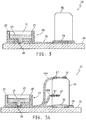
- Figure 3 illustrates an exemplary apparatus for and method of infiltration where the higher melting temperature or temporary dissolving barrier 14 material is applied to the composite body or component 30 and makes contact with the wick 26.
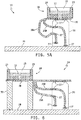
- Figure 3A illustrates an exemplary apparatus for and method of infiltration where the higher melting temperature or temporary dissolving barrier 14 material is applied to the composite body or component 30 and makes contact with a wick 26 having multiple branches or prongs 26, 26A, 26B.
- Figure 4 illustrates a method employing a sheet of the higher melting temperature or temporary dissolving barrier material 14 placed under the crucible or infiltrant source 20.
- Fig. 4 shows in phantom additional wick prongs or branches 26A, 26B.
- These additional branches 26A, 26B illustratively operate in the same manner as the main wick 26 in that they allow the infiltrant to flow into the component when the barrier 14 dissolves. It will be appreciated, however, that in an illustrative embodiment wherein the branches 26A, 26B are in a direct line in fluid communications between the component and the infiltrant source, the infiltrant 12 could be directed to the component 30 at different times and temperatures. For example, referring to Fig.
- a dissolving barrier (not shown) could be disposed over the top of the component 30, which would allow infiltrant moving through branch wicks 26A and 26B to infiltrate prior to the infiltrant moving through the wick 26 at the top that must first melt or dissolve the barrier.
- an exemplary apparatus for and method of infiltration 10 where the infiltrant source 20 is supported directly on the component 30 with the higher melting temperature or temporary dissolving barrier 14 material is applied across and in contact with the entire width of the wick 26, which is disposed across the entire width of the top of the composite body or component 30.
- Figs. 5A through 10 depict illustrative embodiments 10 showing alternative wick arrangements and connections. While the barrier 14 is not shown in these Figs., these illustrative embodiments may all be adapted for use with the apparatus and method 10 disclosed herein. In addition, with respect to the continuous weld 29 of Fig. 3A , it could be a third material with yet a higher melting point relative to the infiltrant 12, such that it could be used in conjunction with or in lieu of a barrier 14.
- any combination of the foregoing barrier 14 placements and wicks 26, 26A-F shown in the Figs. could be used to control the infiltration as desired.
- multiple barriers 14 could be used in a single apparatus 10.
- any suitable infiltrant and barrier material and combinations thereof may be used.
- a material such as for example an alloy 14 with a higher melting temperature or a material that requires time in contact with the molten metal to dissolve into solution is employed between the component 30 and the infiltrating metal or metalloid infiltrant 12.
- This ensures that the component 30 to be infiltrated is uniformly above the melting point of the infiltrant 12.
- this process and apparatus 10 may be used for reactive melt infiltration processes wherein the reaction may restrict liquid flow so if a portion of the component is below the melting point local freezing of the metal may delay infiltration and during the delay the reaction may create restrictions to the infiltration that would proceed once the required temperature is achieved.
- EXAMPLE 1--SiC/SiC CMC In an illustrative example, a Hi-Nicalon preform is constructed at 36% fiber volume and assembled in tooling for Chemical Vapor Infiltration (CVI). A boron nitride (BN) interface coating is applied at 0.5 ⁇ m. A silicon-carbide (SiC) coating of about 2 ⁇ m is applied by CVI. The CMC matrix is completed through slurry and melt infiltration 10. The slurry contains elements that react with the silicon to form ceramic compositions. Illustratively, the melt infiltration process is performed using a graphite crucible 20 or other suitable infiltrant source to hold an alloy of for example Si/C/B. As best seen in Fig.
- an illustrative barrier 14 comprising a plug of pure silicon (Si) is cast or otherwise disposed into a hole, drain or discharge 24 in the bottom of the infiltrant source or crucible 20.
- the crucible 20 is placed on top of an illustrative carbon fiber wick 26 that illustratively is bonded to the preform or composite body 30.
- the component 30 may be for example and without limitation a preform for a nozzle guide vane for a turbine engine produced from a silicon carbide fiber.
- the entire assembly or apparatus 10 is heated in a vacuum furnace to a temperature of about 1470° C and held for about one (1) hour then cooled to room temperature.
- the resulting composite has uniform infiltration and microstructure.
- the melt infiltration process is performed at a pressure of about 0.1 torr and a temperature between about 1400 ° C and about 1500 ° C using Si that is at least approximately 99%pure.
- EXAMPLE 2--C/SiC CMC In another illustrative example, a T-300 carbon fiber preform is constructed at 36% fiber volume and assembled in tooling for Chemical Vapor Infiltration (CVI). A pyrocarbon interface coating is applied at 0.5 ⁇ m. A SiC coating of 8 ⁇ m is applied by CVI. The CMC matrix or component 30 is completed through slurry and melt infiltration using the illustrative method and apparatus 10. The slurry contains elements that react with the silicon to form ceramic compositions. The melt infiltration process is performed by applying a Zr/Si alloy to a carbon wick 26. Referring to Fig.
- the center of the barrier 14 has been cast across the entire width of the component 30, which may be for example a component for use in a gas turbine engine, with a rectangle of pure Zr.
- the entire assembly or apparatus 10 is heated in a vacuum furnace to a temperature of 1570° C.
- the Zr dissolves into the melt and slightly changes the composition.
- the furnace is held at temperature for one (1) hour then cooled to room temperature.
- the resulting composite has uniform infiltration and microstructure.
- a CMC may be made with pre-coated fiber (aka "prepreg" process).
- the ability to control the infiltration process as described and claimed herein illustratively results in a CMC component 30 that demonstrates improved mechanical performance. Further illustratively, the apparatus and method 10 may produce a CMC component 30 with a longer operational life, a reduced weight, and at a lower cost.
Landscapes
- Chemical & Material Sciences (AREA)
- Engineering & Computer Science (AREA)
- Ceramic Engineering (AREA)
- Organic Chemistry (AREA)
- Materials Engineering (AREA)
- Structural Engineering (AREA)
- Inorganic Chemistry (AREA)
- Manufacturing & Machinery (AREA)
- Chemical Kinetics & Catalysis (AREA)
- Mechanical Engineering (AREA)
- Metallurgy (AREA)
- Ceramic Products (AREA)
- Turbine Rotor Nozzle Sealing (AREA)
- Physics & Mathematics (AREA)
- Plasma & Fusion (AREA)
Claims (15)
- Infiltrationsvorrichtung, umfassend:eine Infiltratquelle, die ausgelegt ist, um ein Infiltratmaterial, das einen ersten Schmelzpunkt aufweist, aufzunehmen;eine Barriere, die einen zweiten Schmelzpunkt aufweist;ein Bauteil; undeinen Docht in Fluidverbindung mit der Infiltratquelle und dem Bauteil; wobei- der zweite Schmelzpunkt höher als der erste Schmelzpunkt ist;- das Infiltratmaterial eine Legierung ist;- die Barriere ein hochreines Metall ist und- die Barriere zwischen der Infiltratquelle und dem Bauteil angeordnet ist.
- Infiltrationsvorrichtung nach Anspruch 1, wobei die Infiltratquelle einen Infiltratbehälter umfasst.
- Infiltrationsvorrichtung nach Anspruch 1, wobei die Barriere von jeder, der Infiltratquelle und dem Bauteil, weg versetzt ist.
- Infiltrationsvorrichtung nach Anspruch 1, wobei die Infiltratquelle ausgelegt ist, eine Legierung aufzunehmen, die ausgewählt ist aus der Gruppe von Materialien, bestehend aus Si/C/B, Zr/Si und Ti/6Al/4V.
- Infiltrationsvorrichtung nach Anspruch 1, wobei das hochreine Metall ausgewählt ist aus der Gruppe von Materialien, bestehend aus Si, Zr und Ti.
- Infiltrationsvorrichtung nach Anspruch 1, wobei das Bauteil ein poröser Körper ist, vorzugsweise eine Vorform für eine Düsenleitschaufel für einen Turbinenmotor, hergestellt aus einer Siliziumkarbidfaser, oder ein Bauteil zur Verwendung in einem Gasturbinenmotor.
- Verfahren zum Infiltrieren eines Materials in ein Bauteil, wobei das Verfahren die folgenden Schritte umfasst:Bereitstellen einer Infiltratquelle, die darin enthalten ein Infiltratmaterial mit einem ersten Schmelzpunkt aufweist, wobei das Infiltratmaterial eine Legierung ist;Bereitstellen eines Bauteils in Fluidverbindung mit der Infiltratquelle;Bereitstellen eines Dochts in Fluidverbindung mit der Infiltratquelle und dem Bauteil; undBereitstellen einer Barriere, die einen zweiten Schmelzpunkt aufweist;wobei die Barriere ein hochreines Metall ist und zwischen der Infiltratquelle und dem Bauteil angeordnet ist;Erwärmen der Infiltratquelle, des Infiltrats, des Bauteils und der Barriere, die zwischen der Infiltratquelle und dem Bauteil angeordnet ist;Auflösen der Barriere, wobei die Barriere einen höheren Schmelzpunkt als das Infiltrat aufweist,undInfundieren des Infiltratmaterials in das Bauteil.
- Verfahren nach Anspruch 7, ferner umfassend den Schritt des Auswählens der Legierung aus der Gruppe von Materialien, bestehend aus Si/C/B, Zr/Si und Ti/6Al/4V.
- Verfahren nach Anspruch 7, ferner umfassend den Schritt des Auswählens des hochreinen Materials aus der Gruppe von Materialien, bestehend aus Si, Zr und Ti.
- Verfahren nach Anspruch 7, wobei das Bauteil ein poröser Körper ist, vorzugsweise eine Vorform für eine Düsenleitschaufel für einen Turbinenmotor, hergestellt aus einer Siliziumkarbidfaser, oder ein Bauteil zur Verwendung in einem Gasturbinenmotor.
- Verfahren nach Anspruch 7, wobei die Barriere unter dem Infiltratbehälter angeordnet ist, der in der Infiltratquelle enthalten ist.
- Verfahren nach Anspruch 7, wobei die Infiltratquelle einen Ablauf in Fluidverbindung mit dem Docht umfasst.
- Verfahren nach Anspruch 12, wobei die Barriere innerhalb des Ablaufs aufgenommen wird.
- Verfahren nach Anspruch 7, wobei die Barriere quer über einem unteren Abschnitt des Bauteils angeordnet ist.
- Verfahren nach Anspruch 7, wobei die Barriere quer über einem oberen Abschnitt des Bauteils angeordnet ist.
Applications Claiming Priority (2)
| Application Number | Priority Date | Filing Date | Title |
|---|---|---|---|
| US201361799486P | 2013-03-15 | 2013-03-15 | |
| PCT/US2014/024595 WO2014150936A1 (en) | 2013-03-15 | 2014-03-12 | Melt infiltration apparatus and method for molten metal control |
Publications (2)
| Publication Number | Publication Date |
|---|---|
| EP2970030A1 EP2970030A1 (de) | 2016-01-20 |
| EP2970030B1 true EP2970030B1 (de) | 2019-12-25 |
Family
ID=50513457
Family Applications (1)
| Application Number | Title | Priority Date | Filing Date |
|---|---|---|---|
| EP14718242.2A Active EP2970030B1 (de) | 2013-03-15 | 2014-03-12 | Schmelzinfiltrationsvorrichtung und verfahren für metallschmelzekontrolle |
Country Status (3)
| Country | Link |
|---|---|
| US (2) | US9573853B2 (de) |
| EP (1) | EP2970030B1 (de) |
| WO (1) | WO2014150936A1 (de) |
Families Citing this family (7)
| Publication number | Priority date | Publication date | Assignee | Title |
|---|---|---|---|---|
| US11555706B1 (en) | 2017-09-27 | 2023-01-17 | Apple Inc. | Processing graph representations of tactical maps using neural networks |
| US11243532B1 (en) | 2017-09-27 | 2022-02-08 | Apple Inc. | Evaluating varying-sized action spaces using reinforcement learning |
| FR3074173B1 (fr) * | 2017-11-30 | 2020-11-20 | Safran Ceram | Densification d'une piece en cmc et outillage adapte |
| JP2019156683A (ja) * | 2018-03-13 | 2019-09-19 | イビデン株式会社 | ハニカム構造体の製造方法 |
| US11969962B2 (en) | 2020-09-25 | 2024-04-30 | General Electric Company | Method for repairing composite components and associated infiltration systems and methods |
| JP2024082633A (ja) * | 2022-12-08 | 2024-06-20 | 日本碍子株式会社 | 焼成用治具、及び金属含浸セラミックス焼成体の製造方法 |
| US12606497B2 (en) * | 2024-04-17 | 2026-04-21 | General Electric Company | Systems and methods for limiting void formation in ceramic matrix composite components |
Family Cites Families (42)
| Publication number | Priority date | Publication date | Assignee | Title |
|---|---|---|---|---|
| US1184523A (en) | 1916-01-19 | 1916-05-23 | Herbert Edwin Field | Process for casting molten materials. |
| US3310427A (en) | 1963-01-29 | 1967-03-21 | Sylvania Electric Prod | Method and apparatus for infiltrating porous bodies |
| NL7400271A (nl) | 1973-04-24 | 1974-10-28 | Gen Electric | Werkwijze voor het bereiden van een met silicium samengesteld voorwerp, alsmede aldus bereid voorwerp |
| FR2234089B1 (de) | 1973-06-20 | 1978-10-27 | Gennevilliers Acieries | |
| CH595160A5 (de) | 1975-07-18 | 1978-01-31 | Concast Ag | |
| US4120731A (en) | 1976-02-23 | 1978-10-17 | General Electric Company | Method of making molten silicon infiltration reaction products and products made thereby |
| US4220455A (en) | 1978-10-24 | 1980-09-02 | General Electric Company | Polycrystalline diamond and/or cubic boron nitride body and process for making said body |
| US4238433A (en) | 1978-12-15 | 1980-12-09 | General Electric Company | Method of making molten silicon infiltration reaction products |
| US4247304A (en) | 1978-12-29 | 1981-01-27 | General Electric Company | Process for producing a composite of polycrystalline diamond and/or cubic boron nitride body and substrate phases |
| US4242106A (en) | 1979-01-02 | 1980-12-30 | General Electric Company | Composite of polycrystalline diamond and/or cubic boron nitride body/silicon carbide substrate |
| US4353953A (en) | 1978-12-29 | 1982-10-12 | General Electric Company | Integral composite of polycrystalline diamond and/or cubic boron nitride body phase and substrate phase |
| US4240835A (en) | 1979-12-05 | 1980-12-23 | General Electric Company | Method of making a shaped silicon carbide-silicon matrix composite and articles made thereby |
| DE3211831C2 (de) | 1982-03-31 | 1984-01-12 | Elektro-Thermit Gmbh, 4300 Essen | Selbstöffnender Verscchluß für bei aluminothermischen Reaktionen verwendete Gießtiegel |
| US4626516A (en) * | 1985-07-31 | 1986-12-02 | General Electric Company | Infiltration of Mo-containing material with silicon |
| US4793859A (en) | 1985-07-31 | 1988-12-27 | General Electric Company | Infiltration of mo-containing material with silicon |
| US5198167A (en) * | 1988-10-31 | 1993-03-30 | Honda Giken Kogyo Kabushiki Kaisha | Process for producing fiber molding for fiber-reinforced composite materials |
| GB8929193D0 (en) | 1989-12-27 | 1990-02-28 | Brown Charles D | Ceramic fibre joint & applicator |
| US5390723A (en) | 1992-03-09 | 1995-02-21 | Mohla; Prem P. | Method of treating casting metals |
| US5205970A (en) * | 1992-04-03 | 1993-04-27 | General Electric Company | Method of infiltration forming a silicon carbide body with improved surface finish |
| JP2950122B2 (ja) | 1993-07-29 | 1999-09-20 | 信越化学工業株式会社 | セラミックスと金属との複合体の製造方法及び製造装置 |
| GB9418291D0 (en) | 1994-09-10 | 1994-10-26 | Foseco Int | Improvements in molten metal handling vessels |
| FR2741063B1 (fr) | 1995-11-14 | 1998-02-13 | Europ Propulsion | Procede pour l'introduction dans des substrats poreux d'une composition en fusion a base de silicium |
| US6235379B1 (en) | 1996-08-20 | 2001-05-22 | Kabushiki Kaisha Toshiba | Ceramic matrix composite and method of manufacturing the same |
| EP0914889A1 (de) | 1997-10-31 | 1999-05-12 | Elektro-Thermit GmbH | Automatischer Tiegelstöpsel |
| US6148899A (en) | 1998-01-29 | 2000-11-21 | Metal Matrix Cast Composites, Inc. | Methods of high throughput pressure infiltration casting |
| AT408153B (de) * | 1998-09-02 | 2001-09-25 | Electrovac | Metall-matrix-composite- (mmc-) bauteil |
| EP1084778A1 (de) * | 1999-09-16 | 2001-03-21 | Caterpillar Inc. | Giessform und Verfahren zum Druckgiessen von Material mit hohem Schmelzpunkt |
| US6223937B1 (en) | 1999-11-17 | 2001-05-01 | Kevin Schmidt | Portable dispensing bottle with dissolvable wax plug at inlet |
| US6719948B2 (en) * | 2000-05-22 | 2004-04-13 | Massachusetts Institute Of Technology | Techniques for infiltration of a powder metal skeleton by a similar alloy with melting point depressed |
| CA2409728A1 (en) * | 2000-05-22 | 2001-11-29 | Massachusetts Institute Of Technology | Infiltration of a powder metal skeleton of similar materials uning melting point depressant |
| DE10212043B4 (de) | 2002-03-19 | 2005-05-25 | Sgl Carbon Ag | Verfahren zur Infiltration von porösen Kohlenstoffverbundkörpern, Dochte aus Kohlenstoffmaterial und ihre Verwendung |
| US6939490B2 (en) * | 2002-12-11 | 2005-09-06 | Honeywell International Inc. | Process for unidirectional infiltration of preform with molten resin or pitch |
| FR2869609B1 (fr) | 2004-05-03 | 2006-07-28 | Snecma Propulsion Solide Sa | Procede de fabrication d'une piece en materiau composite thermostructural |
| FR2872072B1 (fr) | 2004-06-24 | 2006-09-29 | Snecma Propulsion Solide Sa | Procede de brasage de pieces en materiau composite thermostructural siliciure |
| US8132904B2 (en) | 2005-12-21 | 2012-03-13 | Lexmark International, Inc. | Filter/wicking structure for micro-fluid ejection head |
| DE102007044122A1 (de) | 2007-09-15 | 2009-03-19 | Audi Ag | Verfahren zum Einbringen von Füllstoffen in flüssiger Form in poröse Körper |
| EP2276592B1 (de) | 2008-04-14 | 2016-07-13 | Rolls-Royce Corporation | Kontrolle von flüssigmetall unter verwendung von schwimmenden pfropfen |
| US9663404B2 (en) * | 2012-01-03 | 2017-05-30 | General Electric Company | Method of forming a ceramic matrix composite and a ceramic matrix component |
| US20150364667A1 (en) * | 2013-01-18 | 2015-12-17 | United Technologies Corporation | Combined ceramic matrix composite and thermoelectric structure for electric power generation |
| EP2970016B1 (de) * | 2013-03-15 | 2020-06-24 | Rolls-Royce Corporation | Keramikmatrixverbundwerkstoff und verfahren zur dessen herstellung |
| EP2789444B1 (de) * | 2013-04-11 | 2017-05-31 | Airbus Operations GmbH | Verfahren und Vorrichtung zur Herstellung eines faserverstärkten Kunststoffgussteils |
| DE102014007869B4 (de) * | 2014-06-03 | 2016-02-11 | Airbus Defence and Space GmbH | Vorrichtung und Verfahren zum Infiltrieren von Fasermaterial mit Harz zur Herstellung eines Faserverbundbauteils |
-
2014
- 2014-03-12 EP EP14718242.2A patent/EP2970030B1/de active Active
- 2014-03-12 US US14/207,001 patent/US9573853B2/en not_active Expired - Fee Related
- 2014-03-12 WO PCT/US2014/024595 patent/WO2014150936A1/en not_active Ceased
-
2017
- 2017-01-09 US US15/401,501 patent/US9884789B2/en not_active Expired - Fee Related
Non-Patent Citations (1)
| Title |
|---|
| None * |
Also Published As
| Publication number | Publication date |
|---|---|
| US20140363577A1 (en) | 2014-12-11 |
| WO2014150936A1 (en) | 2014-09-25 |
| US9573853B2 (en) | 2017-02-21 |
| US9884789B2 (en) | 2018-02-06 |
| EP2970030A1 (de) | 2016-01-20 |
| US20170166487A1 (en) | 2017-06-15 |
Similar Documents
| Publication | Publication Date | Title |
|---|---|---|
| US9884789B2 (en) | Melt infiltration apparatus and method for molten metal control | |
| EP2970022B1 (de) | Befestigung eines schmelzinfiltrationsdochtes | |
| US9896954B2 (en) | Dual-walled ceramic matrix composite (CMC) component with integral cooling and method of making a CMC component with integral cooling | |
| EP2578556B1 (de) | Verfahren und keramische Komponente | |
| US10150708B2 (en) | Surface-aided melt infiltration for producing a ceramic matrix composite | |
| EP3392034B1 (de) | Verfahren zur verarbeitung eines keramikmatrixverbundwerkstoffs (cmc) mit einer keramischen schutzschicht | |
| US11472747B2 (en) | Assembly for chemical vapor infiltration of a fiber preform and method of infiltrating a fiber preform | |
| AU722864B2 (en) | Silicon carbide reinforced silicon carbide composite | |
| US10906842B2 (en) | Method of processing a ceramic matrix composite (CMC) component | |
| JP2010229025A (ja) | ケイ素含有セラミック物品の接合方法及び製品 | |
| JP2015533768A (ja) | Cmc製部品の製造方法 | |
| US11046620B2 (en) | Method of processing a ceramic matrix composite (CMC) component | |
| US12338182B2 (en) | Through thickness reinforcement | |
| US20190071364A1 (en) | Ceramic matrix composite component and method of producing the same | |
| US11607725B2 (en) | Siphon delivery method for consistent melt infiltration | |
| US20180312442A1 (en) | Discrete solidification of melt infiltration | |
| US10752556B2 (en) | Method of processing a ceramic matrix composite (CMC) component | |
| US11760699B2 (en) | Method of altering a surface of a ceramic matrix composite to aid in nodule removal | |
| CN1173896C (zh) | SiC基复合材料与复合材料或金属材料的粘接方法 | |
| US20240279128A1 (en) | Methods for Joining Composite Components to Form a Unitary Composite Component | |
| US20240279125A1 (en) | Unitary ceramic components and methods of forming the same | |
| JP2006027946A (ja) | 炭化ケイ素系接合構造体、炭化ケイ素系接合構造体の製造方法および炭化ケイ素系接合構造体の製造装置 | |
| US20210114942A1 (en) | Method to produce a ceramic matrix composite by tape melt infiltration | |
| JP2012006820A (ja) | セラミックス接合体およびその製造方法 |
Legal Events
| Date | Code | Title | Description |
|---|---|---|---|
| PUAI | Public reference made under article 153(3) epc to a published international application that has entered the european phase |
Free format text: ORIGINAL CODE: 0009012 |
|
| 17P | Request for examination filed |
Effective date: 20150814 |
|
| AK | Designated contracting states |
Kind code of ref document: A1 Designated state(s): AL AT BE BG CH CY CZ DE DK EE ES FI FR GB GR HR HU IE IS IT LI LT LU LV MC MK MT NL NO PL PT RO RS SE SI SK SM TR |
|
| AX | Request for extension of the european patent |
Extension state: BA ME |
|
| DAX | Request for extension of the european patent (deleted) | ||
| STAA | Information on the status of an ep patent application or granted ep patent |
Free format text: STATUS: EXAMINATION IS IN PROGRESS |
|
| 17Q | First examination report despatched |
Effective date: 20170413 |
|
| REG | Reference to a national code |
Ref country code: DE Ref legal event code: R079 Ref document number: 602014058889 Country of ref document: DE Free format text: PREVIOUS MAIN CLASS: C04B0041450000 Ipc: C04B0035573000 |
|
| RIC1 | Information provided on ipc code assigned before grant |
Ipc: C04B 41/51 20060101ALI20190613BHEP Ipc: C04B 41/88 20060101ALI20190613BHEP Ipc: C04B 35/80 20060101ALI20190613BHEP Ipc: C04B 35/628 20060101ALI20190613BHEP Ipc: C04B 41/50 20060101ALI20190613BHEP Ipc: C04B 41/85 20060101ALI20190613BHEP Ipc: C04B 41/00 20060101ALI20190613BHEP Ipc: C22C 1/10 20060101ALI20190613BHEP Ipc: C04B 35/573 20060101AFI20190613BHEP |
|
| GRAP | Despatch of communication of intention to grant a patent |
Free format text: ORIGINAL CODE: EPIDOSNIGR1 |
|
| STAA | Information on the status of an ep patent application or granted ep patent |
Free format text: STATUS: GRANT OF PATENT IS INTENDED |
|
| INTG | Intention to grant announced |
Effective date: 20190729 |
|
| GRAS | Grant fee paid |
Free format text: ORIGINAL CODE: EPIDOSNIGR3 |
|
| GRAA | (expected) grant |
Free format text: ORIGINAL CODE: 0009210 |
|
| STAA | Information on the status of an ep patent application or granted ep patent |
Free format text: STATUS: THE PATENT HAS BEEN GRANTED |
|
| AK | Designated contracting states |
Kind code of ref document: B1 Designated state(s): AL AT BE BG CH CY CZ DE DK EE ES FI FR GB GR HR HU IE IS IT LI LT LU LV MC MK MT NL NO PL PT RO RS SE SI SK SM TR |
|
| REG | Reference to a national code |
Ref country code: GB Ref legal event code: FG4D |
|
| REG | Reference to a national code |
Ref country code: CH Ref legal event code: EP |
|
| REG | Reference to a national code |
Ref country code: DE Ref legal event code: R096 Ref document number: 602014058889 Country of ref document: DE |
|
| REG | Reference to a national code |
Ref country code: AT Ref legal event code: REF Ref document number: 1216949 Country of ref document: AT Kind code of ref document: T Effective date: 20200115 |
|
| REG | Reference to a national code |
Ref country code: IE Ref legal event code: FG4D |
|
| REG | Reference to a national code |
Ref country code: NL Ref legal event code: MP Effective date: 20191225 |
|
| PG25 | Lapsed in a contracting state [announced via postgrant information from national office to epo] |
Ref country code: SE Free format text: LAPSE BECAUSE OF FAILURE TO SUBMIT A TRANSLATION OF THE DESCRIPTION OR TO PAY THE FEE WITHIN THE PRESCRIBED TIME-LIMIT Effective date: 20191225 Ref country code: LV Free format text: LAPSE BECAUSE OF FAILURE TO SUBMIT A TRANSLATION OF THE DESCRIPTION OR TO PAY THE FEE WITHIN THE PRESCRIBED TIME-LIMIT Effective date: 20191225 Ref country code: FI Free format text: LAPSE BECAUSE OF FAILURE TO SUBMIT A TRANSLATION OF THE DESCRIPTION OR TO PAY THE FEE WITHIN THE PRESCRIBED TIME-LIMIT Effective date: 20191225 Ref country code: BG Free format text: LAPSE BECAUSE OF FAILURE TO SUBMIT A TRANSLATION OF THE DESCRIPTION OR TO PAY THE FEE WITHIN THE PRESCRIBED TIME-LIMIT Effective date: 20200325 Ref country code: NO Free format text: LAPSE BECAUSE OF FAILURE TO SUBMIT A TRANSLATION OF THE DESCRIPTION OR TO PAY THE FEE WITHIN THE PRESCRIBED TIME-LIMIT Effective date: 20200325 Ref country code: GR Free format text: LAPSE BECAUSE OF FAILURE TO SUBMIT A TRANSLATION OF THE DESCRIPTION OR TO PAY THE FEE WITHIN THE PRESCRIBED TIME-LIMIT Effective date: 20200326 Ref country code: LT Free format text: LAPSE BECAUSE OF FAILURE TO SUBMIT A TRANSLATION OF THE DESCRIPTION OR TO PAY THE FEE WITHIN THE PRESCRIBED TIME-LIMIT Effective date: 20191225 |
|
| REG | Reference to a national code |
Ref country code: LT Ref legal event code: MG4D |
|
| PG25 | Lapsed in a contracting state [announced via postgrant information from national office to epo] |
Ref country code: HR Free format text: LAPSE BECAUSE OF FAILURE TO SUBMIT A TRANSLATION OF THE DESCRIPTION OR TO PAY THE FEE WITHIN THE PRESCRIBED TIME-LIMIT Effective date: 20191225 Ref country code: RS Free format text: LAPSE BECAUSE OF FAILURE TO SUBMIT A TRANSLATION OF THE DESCRIPTION OR TO PAY THE FEE WITHIN THE PRESCRIBED TIME-LIMIT Effective date: 20191225 |
|
| PG25 | Lapsed in a contracting state [announced via postgrant information from national office to epo] |
Ref country code: AL Free format text: LAPSE BECAUSE OF FAILURE TO SUBMIT A TRANSLATION OF THE DESCRIPTION OR TO PAY THE FEE WITHIN THE PRESCRIBED TIME-LIMIT Effective date: 20191225 |
|
| PG25 | Lapsed in a contracting state [announced via postgrant information from national office to epo] |
Ref country code: CZ Free format text: LAPSE BECAUSE OF FAILURE TO SUBMIT A TRANSLATION OF THE DESCRIPTION OR TO PAY THE FEE WITHIN THE PRESCRIBED TIME-LIMIT Effective date: 20191225 Ref country code: NL Free format text: LAPSE BECAUSE OF FAILURE TO SUBMIT A TRANSLATION OF THE DESCRIPTION OR TO PAY THE FEE WITHIN THE PRESCRIBED TIME-LIMIT Effective date: 20191225 Ref country code: EE Free format text: LAPSE BECAUSE OF FAILURE TO SUBMIT A TRANSLATION OF THE DESCRIPTION OR TO PAY THE FEE WITHIN THE PRESCRIBED TIME-LIMIT Effective date: 20191225 Ref country code: PT Free format text: LAPSE BECAUSE OF FAILURE TO SUBMIT A TRANSLATION OF THE DESCRIPTION OR TO PAY THE FEE WITHIN THE PRESCRIBED TIME-LIMIT Effective date: 20200520 Ref country code: RO Free format text: LAPSE BECAUSE OF FAILURE TO SUBMIT A TRANSLATION OF THE DESCRIPTION OR TO PAY THE FEE WITHIN THE PRESCRIBED TIME-LIMIT Effective date: 20191225 |
|
| PG25 | Lapsed in a contracting state [announced via postgrant information from national office to epo] |
Ref country code: SM Free format text: LAPSE BECAUSE OF FAILURE TO SUBMIT A TRANSLATION OF THE DESCRIPTION OR TO PAY THE FEE WITHIN THE PRESCRIBED TIME-LIMIT Effective date: 20191225 Ref country code: IS Free format text: LAPSE BECAUSE OF FAILURE TO SUBMIT A TRANSLATION OF THE DESCRIPTION OR TO PAY THE FEE WITHIN THE PRESCRIBED TIME-LIMIT Effective date: 20200425 Ref country code: SK Free format text: LAPSE BECAUSE OF FAILURE TO SUBMIT A TRANSLATION OF THE DESCRIPTION OR TO PAY THE FEE WITHIN THE PRESCRIBED TIME-LIMIT Effective date: 20191225 |
|
| REG | Reference to a national code |
Ref country code: DE Ref legal event code: R097 Ref document number: 602014058889 Country of ref document: DE |
|
| REG | Reference to a national code |
Ref country code: DE Ref legal event code: R119 Ref document number: 602014058889 Country of ref document: DE |
|
| PG25 | Lapsed in a contracting state [announced via postgrant information from national office to epo] |
Ref country code: MC Free format text: LAPSE BECAUSE OF FAILURE TO SUBMIT A TRANSLATION OF THE DESCRIPTION OR TO PAY THE FEE WITHIN THE PRESCRIBED TIME-LIMIT Effective date: 20191225 Ref country code: DK Free format text: LAPSE BECAUSE OF FAILURE TO SUBMIT A TRANSLATION OF THE DESCRIPTION OR TO PAY THE FEE WITHIN THE PRESCRIBED TIME-LIMIT Effective date: 20191225 Ref country code: ES Free format text: LAPSE BECAUSE OF FAILURE TO SUBMIT A TRANSLATION OF THE DESCRIPTION OR TO PAY THE FEE WITHIN THE PRESCRIBED TIME-LIMIT Effective date: 20191225 |
|
| PLBE | No opposition filed within time limit |
Free format text: ORIGINAL CODE: 0009261 |
|
| REG | Reference to a national code |
Ref country code: CH Ref legal event code: PL |
|
| STAA | Information on the status of an ep patent application or granted ep patent |
Free format text: STATUS: NO OPPOSITION FILED WITHIN TIME LIMIT |
|
| REG | Reference to a national code |
Ref country code: AT Ref legal event code: MK05 Ref document number: 1216949 Country of ref document: AT Kind code of ref document: T Effective date: 20191225 |
|
| PG25 | Lapsed in a contracting state [announced via postgrant information from national office to epo] |
Ref country code: SI Free format text: LAPSE BECAUSE OF FAILURE TO SUBMIT A TRANSLATION OF THE DESCRIPTION OR TO PAY THE FEE WITHIN THE PRESCRIBED TIME-LIMIT Effective date: 20191225 |
|
| 26N | No opposition filed |
Effective date: 20200928 |
|
| REG | Reference to a national code |
Ref country code: BE Ref legal event code: MM Effective date: 20200331 |
|
| PG25 | Lapsed in a contracting state [announced via postgrant information from national office to epo] |
Ref country code: LU Free format text: LAPSE BECAUSE OF NON-PAYMENT OF DUE FEES Effective date: 20200312 |
|
| PG25 | Lapsed in a contracting state [announced via postgrant information from national office to epo] |
Ref country code: LI Free format text: LAPSE BECAUSE OF NON-PAYMENT OF DUE FEES Effective date: 20200331 Ref country code: DE Free format text: LAPSE BECAUSE OF NON-PAYMENT OF DUE FEES Effective date: 20201001 Ref country code: IT Free format text: LAPSE BECAUSE OF FAILURE TO SUBMIT A TRANSLATION OF THE DESCRIPTION OR TO PAY THE FEE WITHIN THE PRESCRIBED TIME-LIMIT Effective date: 20191225 Ref country code: AT Free format text: LAPSE BECAUSE OF FAILURE TO SUBMIT A TRANSLATION OF THE DESCRIPTION OR TO PAY THE FEE WITHIN THE PRESCRIBED TIME-LIMIT Effective date: 20191225 Ref country code: FR Free format text: LAPSE BECAUSE OF NON-PAYMENT OF DUE FEES Effective date: 20200331 Ref country code: IE Free format text: LAPSE BECAUSE OF NON-PAYMENT OF DUE FEES Effective date: 20200312 Ref country code: CH Free format text: LAPSE BECAUSE OF NON-PAYMENT OF DUE FEES Effective date: 20200331 |
|
| PG25 | Lapsed in a contracting state [announced via postgrant information from national office to epo] |
Ref country code: PL Free format text: LAPSE BECAUSE OF FAILURE TO SUBMIT A TRANSLATION OF THE DESCRIPTION OR TO PAY THE FEE WITHIN THE PRESCRIBED TIME-LIMIT Effective date: 20191225 Ref country code: BE Free format text: LAPSE BECAUSE OF NON-PAYMENT OF DUE FEES Effective date: 20200331 |
|
| GBPC | Gb: european patent ceased through non-payment of renewal fee |
Effective date: 20200325 |
|
| PG25 | Lapsed in a contracting state [announced via postgrant information from national office to epo] |
Ref country code: GB Free format text: LAPSE BECAUSE OF NON-PAYMENT OF DUE FEES Effective date: 20200325 |
|
| PG25 | Lapsed in a contracting state [announced via postgrant information from national office to epo] |
Ref country code: TR Free format text: LAPSE BECAUSE OF FAILURE TO SUBMIT A TRANSLATION OF THE DESCRIPTION OR TO PAY THE FEE WITHIN THE PRESCRIBED TIME-LIMIT Effective date: 20191225 Ref country code: MT Free format text: LAPSE BECAUSE OF FAILURE TO SUBMIT A TRANSLATION OF THE DESCRIPTION OR TO PAY THE FEE WITHIN THE PRESCRIBED TIME-LIMIT Effective date: 20191225 Ref country code: CY Free format text: LAPSE BECAUSE OF FAILURE TO SUBMIT A TRANSLATION OF THE DESCRIPTION OR TO PAY THE FEE WITHIN THE PRESCRIBED TIME-LIMIT Effective date: 20191225 |
|
| PG25 | Lapsed in a contracting state [announced via postgrant information from national office to epo] |
Ref country code: MK Free format text: LAPSE BECAUSE OF FAILURE TO SUBMIT A TRANSLATION OF THE DESCRIPTION OR TO PAY THE FEE WITHIN THE PRESCRIBED TIME-LIMIT Effective date: 20191225 |