EP2970577B1 - Processus interfaciaux permettant de préparer des additifs photoactifs - Google Patents
Processus interfaciaux permettant de préparer des additifs photoactifs Download PDFInfo
- Publication number
- EP2970577B1 EP2970577B1 EP14716734.0A EP14716734A EP2970577B1 EP 2970577 B1 EP2970577 B1 EP 2970577B1 EP 14716734 A EP14716734 A EP 14716734A EP 2970577 B1 EP2970577 B1 EP 2970577B1
- Authority
- EP
- European Patent Office
- Prior art keywords
- time period
- capping agent
- mole
- dihydroxybenzophenone
- reactor
- Prior art date
- Legal status (The legal status is an assumption and is not a legal conclusion. Google has not performed a legal analysis and makes no representation as to the accuracy of the status listed.)
- Not-in-force
Links
- 0 C*(*c1cccc(O)c1)(C=C)O[Si](C)(*)Oc1cc(O)ccc1 Chemical compound C*(*c1cccc(O)c1)(C=C)O[Si](C)(*)Oc1cc(O)ccc1 0.000 description 3
- KGUWURDOHZQXNK-UHFFFAOYSA-N CC(c(cc1)ccc1O)(C(C=C1)=CCC1O)C(C=C1)=CCC1O Chemical compound CC(c(cc1)ccc1O)(C(C=C1)=CCC1O)C(C=C1)=CCC1O KGUWURDOHZQXNK-UHFFFAOYSA-N 0.000 description 1
Images



Classifications
-
- C—CHEMISTRY; METALLURGY
- C08—ORGANIC MACROMOLECULAR COMPOUNDS; THEIR PREPARATION OR CHEMICAL WORKING-UP; COMPOSITIONS BASED THEREON
- C08G—MACROMOLECULAR COMPOUNDS OBTAINED OTHERWISE THAN BY REACTIONS ONLY INVOLVING UNSATURATED CARBON-TO-CARBON BONDS
- C08G64/00—Macromolecular compounds obtained by reactions forming a carbonic ester link in the main chain of the macromolecule
- C08G64/20—General preparatory processes
- C08G64/22—General preparatory processes using carbonyl halides
- C08G64/24—General preparatory processes using carbonyl halides and phenols
-
- C—CHEMISTRY; METALLURGY
- C08—ORGANIC MACROMOLECULAR COMPOUNDS; THEIR PREPARATION OR CHEMICAL WORKING-UP; COMPOSITIONS BASED THEREON
- C08G—MACROMOLECULAR COMPOUNDS OBTAINED OTHERWISE THAN BY REACTIONS ONLY INVOLVING UNSATURATED CARBON-TO-CARBON BONDS
- C08G64/00—Macromolecular compounds obtained by reactions forming a carbonic ester link in the main chain of the macromolecule
- C08G64/04—Aromatic polycarbonates
- C08G64/06—Aromatic polycarbonates not containing aliphatic unsaturation
- C08G64/14—Aromatic polycarbonates not containing aliphatic unsaturation containing a chain-terminating or -crosslinking agent
-
- C—CHEMISTRY; METALLURGY
- C08—ORGANIC MACROMOLECULAR COMPOUNDS; THEIR PREPARATION OR CHEMICAL WORKING-UP; COMPOSITIONS BASED THEREON
- C08G—MACROMOLECULAR COMPOUNDS OBTAINED OTHERWISE THAN BY REACTIONS ONLY INVOLVING UNSATURATED CARBON-TO-CARBON BONDS
- C08G64/00—Macromolecular compounds obtained by reactions forming a carbonic ester link in the main chain of the macromolecule
- C08G64/20—General preparatory processes
- C08G64/205—General preparatory processes characterised by the apparatus used
Definitions
- EP0001577 discloses thermoplastic aromatic polycarbonates based on diphenols, a process for their preparation and the modification of these polycarbonates.
- the resulting photoactive additive has a MFR of 1 to 40 g/10 min measured according to ASTM D1238 at 300°C/1.2 kg/360 sec dwell.
- compositions or processes as “consisting of' and “consisting essentially of' the enumerated ingredients/steps, which allows the presence of only the named ingredients/steps, along with any impurities that might result therefrom, and excludes other ingredients/steps.
- alkyl refers to a radical composed entirely of carbon atoms and hydrogen atoms which is fully saturated.
- the alkyl radical may be linear, branched, or cyclic.
- heteroaryl refers to an aromatic radical having a ring system that is composed of carbon, hydrogen, and at least one heteroatom.
- exemplary heteroaryl groups include pyridyl, furanyl, and thienyl. Note that “heteroaryl” is a subset of aromatic, and is exclusive of “aryl”.
- halogen refers to fluorine, chlorine, bromine, and iodine.
- alkylaryl refers to an alkyl radical which is attached to an aryl radical, with the alkyl radical being appended to the parent molecular moiety through the aryl radical, e.g. tolyl (-C 6 H 4 -CH 3 ).
- the glass transition temperatures (Tg) described herein are measures of heat resistance of, for example, polycarbonate, and polycarbonate blends.
- the Tg can be determined by differential scanning calorimetry.
- the calorimetry method may use a TA Instruments Q1000 instrument, for example, with setting of 20 °C/min ramp rate and 40 °C start temperature and 200 °C end temperature.
- halo means that the substituent to which the prefix is attached is substituted with one or more independently selected halogen radicals.
- C 1 -C 6 haloalkyl means a C 1 -C 6 alkyl substituent wherein one or more hydrogen atoms are replaced with independently selected halogen radicals.
- Non-limiting examples of C 1 -C 6 haloalkyl include chloromethyl, 1-bromoethyl, fluoromethyl, difluoromethyl, trifluoromethyl, and 1,1,1-trifluoroethyl. It should be recognized that if a substituent is substituted by more than one halogen radical, those halogen radicals may be identical or different (unless otherwise stated),
- Percent transmission or “% transmission” refers to the ratio of transmitted light to incident light, and may be measured according to ASTM D 1003-07.
- the photoactive additives (PAA) of the present disclosure include photoactive moieties that are covalently linked together through a first linker moiety and possibly a secondary linker moiety.
- the photoactive moieties contain a photoactive ketone group that, when exposed to the appropriate wavelength(s) of ultraviolet light, will form a stable covalent bond between the PAA and the polymeric resin.
- the PAA should be stable at conventional blending, forming, and processing temperatures (i.e. stable at 350°C or above).
- the PAA also should not induce the degradation of the polymeric resin with which it is blended.
- photoactive moiety refers to a moiety that, when exposed to ultraviolet light of the appropriate wavelength, crosslinks with another molecule.
- the bisphenol-A monomer in a bisphenol-A homopolycarbonate would not be considered a photoactive moiety, even though photo-Fries rearrangement can occur upon exposure to light, because the atoms do not participate in crosslinking but merely in rearrangement of the polymer backbone.
- the photoactive moiety is reacted with one or more linker moieties.
- At least one of the linker moieties comprises a plurality of functional groups that can react with a phenolic group of the photoactive moiety.
- functional groups include a carboxylic acid (and anhydrides thereof), an acyl halide, an alkyl ester, and an aryl ester. These functional groups are illustrated below in general formula (A): where Y is hydroxyl, halogen, alkoxy, or aryloxy.
- the functional groups can be joined to an aliphatic group or an aromatic group which serves as a "backbone" for the linker moiety.
- the linker moiety can have two, three, four, or even more functional groups.
- bisphenol compounds that may be represented by Formula (B) include 1,1-bis(4-hydroxyphenyl) methane, 1,1-bis(4-hydroxyphenyl) ethane, 2,2-bis(4-hydroxyphenyl) propane (hereinafter "bisphenol-A” or "BPA"), 2,2-bis(4-hydroxyphenyl) butane, 2,2-bis(4-hydroxyphenyl) octane, 1,1-bis(4-hydroxyphenyl) propane, 1,1-bis(4-hydroxyphenyl) n-butane, 2,2-bis(4-hydroxy-1-methylphenyl) propane, and 1,1-bis(4hydroxy-t-butylphenyl) propane.
- bisphenol-A 2,2-bis(4-hydroxyphenyl) propane
- BPA 2,2-bis(4-hydroxyphenyl) propane
- BPA 2,2-bis(4-hydroxyphenyl) propane
- BPA 2,2-bis(4-hydroxyphenyl) propane
- BPA 2,2-bis(4-hydroxyphen
- a third exemplary chain extender is a bisphenolpolydiorganosiloxane of Formula (D-1) or (D-2): wherein each Ar is independently aryl; each R is independently alkyl, alkoxy, alkenyl, alkenyloxy, aryl, aryloxy, arylalkyl, or alkylaryl; each R 6 is independently a divalent C 1 -C 30 organic group such as a C 1 -C 30 alkyl, C 1 -C 30 aryl, or C 1 -C 30 alkylaryl; and D and E are an average value of 2 to 1000, specifically 2 to 500, or 10 to 200, or more specifically 10 to 75.
- each Ar is independently aryl
- each R is independently alkyl, alkoxy, alkenyl, alkenyloxy, aryl, aryloxy, arylalkyl, or alkylaryl
- each R 6 is independently a divalent C 1 -C 30 organic group such as a C 1
- Aliphatic diols include 1,4:3,6-dianhydro-D glucitol; 1,4:3,6-dianhydro-D mannitol; and 1,4:3,6-dianhydro-L iditol; and any combination thereof.
- Isosorbides are available commercially from various chemical suppliers including Cargill, Roquette, and Shanxi.
- the isosorbide-bisphenol may have a pKa of between 8 and 11.
- the secondary linker moiety can be an oligomer, made from an epoxidized novolac monomer. These oligomers can permit the desired number of functional groups to be provided. Such oligomers are generalized by the structure of Formula (49): wherein E is hydrogen or an endcapping agent; and t is an integer from 1 to 20.
- the polyester unit of a polyester-polycarbonate may be derived from the reaction of a combination of isophthalic and terephthalic diacids (or derivatives thereof) with resorcinol.
- the polyester unit of a polyester-polycarbonate may be derived from the reaction of a combination of isophthalic acid and terephthalic acid with bisphenol-A.
- the polycarbonate units may be derived from bisphenol-A.
- the polycarbonate units may be derived from resorcinol and bisphenol-A in a molar ratio of resorcinol carbonate units to bisphenol-A carbonate units of 1:99 to 99:1.
- oligomers are more likely to rise to the surface of the product.
- Long chain aliphatic diols (C 6 or higher) can also be used for this purpose. This may increase the concentration of the additive at the surface, and thus increase the crosslinking density at the surface upon exposure to UV light as well.
- the cross-linkable polycarbonates of the present disclosure contain from 0.5 mole% to 50 mole% of the dihydroxybenzophenone monomer (i.e. repeating units derived from the dihydroxybenzophenone monomer). In more specific embodiments, the polymers contain from 1 mole% to about 3 mole%, or from 1 mole% to 6 mole%, from 10 mole% to 25 mole%, or from 0.5 mole% to 25 mole% of the dihydroxybenzophenone monomer.
- the cross-linkable polycarbonates of the present disclosure may have a glass transition temperature (Tg) of greater than 120 °C, 125 °C, 130 °C, 135 °C, 140 °C, 145 °C, 150 °C, 155 °C, 160 °C, 165 °C, 170 °C, 175 °C, 180 °C, 185 °C, 190 °C, 200 °C, 210 °C, 220 °C, 230 °C, 240 °C, 250 °C, 260 °C, 270 °C, 280 °C, 290 °C, or 300 °C, as measured using a differential scanning calorimetry method.
- Tg glass transition temperature
- the polycarbonates have glass transition temperatures ranging from 120°C to 230 °C, 140 °C to 160 °C, 145 °C to 155 °C, 148 °C to 152 °C, or 149 °C to 151 °C.
- the dihydroxybenzophenone is the photoactive moiety previously described.
- the dihydroxybenzophenone can have the structure of any one of Formulas (16)-(21), or (26)-(29). If desired, more than one dihydroxybenzophenone can be used.
- the dihydroxybenzophenone is 4,4'-dihydroxybenzophenone of Formula (17).
- the dihydroxybenzophenone, diol chain extender, tertiary amine catalyst, water, and water-immiscible solvent are combined in a vessel to form a reaction mixture.
- the total charge of the carbonate precursor is then added to this reaction mixture in the vessel over a total time period, while the base is co-added to regulate the pH.
- the carbonate precursor is first added to the reaction mixture along with the base to regulate the pH for a first time period. After the first time period ends, the end-capping agent is added in a controlled manner to the reaction mixture, also referred to as programmed addition.
- the addition of the end-capping agent occurs for a second time period after the first time period, rather than as a bolus at the beginning of the reaction (as in the upfront process).
- the carbonate precursor and the base are also added concurrently with the end-capping agent during the second time period. After the second time period ends, the remainder of the carbonate precursor continues uninterrupted for a third time period until the total charge is reached.
- the base is also co-added during the third time period to regulate the reaction pH.
- the end-capping agent is not added during either the first time period or the third time period.
- the photoactive additive is thus obtained.
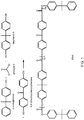
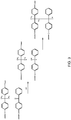
- the first process (comparative) and second process (invention) are illustrated in FIG. 4 using 4,4'-hydroxybenzophenone, bisphenol-A, p-cumylphenol, and phosgene. The main difference is in the addition of the end-capping agent over time.
- the reaction mixture comprises the dihydroxybenzophenone, diol chain extender, tertiary amine catalyst, water, and water-immiscible solvent.
- the dihydroxybenzophenone is 4,4'-hydroxybenzophenone
- the diol chain extender is bisphenol-A
- the water-immiscible solvent is methylene chloride.
- the pH of the reaction mixture is usually from 8.5 to 10, and can be maintained by using a basic solution (e.g. aqueous NaOH, made from the base).
- the reaction mixture is then charged with the carbonate precursor, which is usually phosgene.
- the carbonate precursor is added to the reaction mixture over a total time period, which may be for example from 15 minutes to about 45 minutes.
- the total time period is the duration needed to add the total charge of the carbonate precursor (measured either by weight or by moles) to the reaction mixture.
- the pH is also maintained in the range of 8.5 to 10, again by addition of a basic solution as needed. It is contemplated that the carbonate precursor is added at a constant rate over the total time period.
- the total time period for the reaction is the sum of the first time period, the second time period, and the third time period.
- the second time period in which the solution containing the end-capping agent is added to the reaction mixture begins at a point between 10% to 40% of the total time period.
- the first time period is 10% of the total time period.
- the resulting photoactive additive (e.g. the cross-linkable polycarbonate) contains only a small amount of low-molecular-weight components.
- the lows percentage can be 2 wt% or less, including from 1.0 wt% to 1,5 wt%.
- the resulting photoactive additive does not contain any residual pyridine.
- the additives when used, can improve the chemical resistance of the final product. It is contemplated that products can be of any desired shape (e.g. molded article, film, sheet, etc.) and be used in many different applications, for example in the medical, automotive, and consumer electronics fields.
- the PAAs are suitable for blending with a variety of resins. Such blends can still be sufficiently cross-linked to provide compositions that exhibit one or more of UL94 5VA compliance, extreme chemical resistance, tear resistance, impact strength, ductility, hydrolytic stability, and weatherability.
- the PAAs are suitable for blending with polycarbonate homopolymers, polycarbonate copolymers, and polycarbonate blends. They are also suitable for blending with polyesters, polyarylates, polyestercarbonates, and polyetherimides.
- One advantage of using the PAAs with polymeric resins is that polymers with relatively higher Mw's generally retain their mechanical properties better, while polymers with relatively lower Mw's generally have better flow properties.
- the product where the enhanced properties are needed should be exposed with a substantially uniform dose of UV light.
- the exposure can be accomplished using standard methods known in the art.
- the UV light can come from any source of UV light such as, but not limited to, those lamps powered by microwave, HID lamps, and mercury vapor lamps.
- the product is exposed by using natural sunlight.
- the exposure time will be dependent on the application and color of material. It can range from a few minutes to several days.
- the crosslinking can be accomplished by using a UV-emitting light source such as a mercury vapor, High-Intensity Discharge (HID), or various UV lamps.
- a UV-emitting light source such as a mercury vapor, High-Intensity Discharge (HID), or various UV lamps.
- commercial UV lamps are sold for UV curing from manufacturers such as Hereaus Noblelight Fusion UV.
- Non-limiting examples of UV-emitting light bulbs include mercury bulbs (H bulbs), or metal halide doped mercury bulbs (D bulbs, H+ bulbs, and V bulbs). Other combinations of metal halides to create a UV light source are also contemplated. Exemplary bulbs could also be produced by assembling the lamp out of UV-absorbing materials and considered as a filtered UV source. An undoped mercury arc lamp is not used for irradiation.
- An H bulb has strong output in the range of 200 nm to 320 nm.
- the D bulb has strong output in the 320 nm to 400 nm range.
- the V bulb has strong output in the 400 nm to 420 nm range.
- Sample A3 was made using solution program addition to obtain a crosslinkable polycarbonate resin containing 10.1 mole% of 4,4'-dihydroxybenzophenone (DHBP).
- DHBP 4,4'-dihydroxybenzophenone
- the p-tert-butylphenol (PTBP) solution was placed in an addition pot connected to the reactor via a dosing pump.
- Phosgene vapor flow to the reactor was initiated (80 g/min flow rate) by the DCS and an initial amount (240 grams, 2.4 moles) was added.
- the pH of the reaction was maintained at a target of 10.0 by DCS-controlled addition of 33% aqueous NaOH.
- Sample A10 was made according to the same procedure as Sample A9.
- the resin solution was transferred to the precipitation feed tank.
- the resin was isolated as a white powder by steam precipitation followed by drying in a cone shaped vessel using heated nitrogen (210 F). Powder yield 2263 grams.
- the amount of excess phosgene used in the batch was 57 %,
- the resins were copolymers of bisphenol-A and 4,4'-dihydroxybenzophenone (DHBP), and used PCP endcaps.
- the first resin contained 5 mole% DHBP and had a target Mw of about 21,000.
- the second resin contained 5 mole% DHBP and had a target Mw of about 26,000.
- the third resin contained 10 mole% DHBP and had a target Mw of about 21,000.
- the fourth resin contained 10 mole% DHBP and had a target Mw of about 26,000.
- the fifth resin contained 20 mole% DHBP and had a target Mw of about 21,000. Compositions were made and tested.
- the polycarbonates were produced as powder and then pelletized. The pellets were then extruded to form tensile bars, which were exposed to 36 J/cm 2 UVA of filtered UV light in the Loctite system, The molecular weights were measured after each step. The average gel thickness of the tensile bars was measured as well,
Landscapes
- Chemical & Material Sciences (AREA)
- Health & Medical Sciences (AREA)
- Chemical Kinetics & Catalysis (AREA)
- Medicinal Chemistry (AREA)
- Polymers & Plastics (AREA)
- Organic Chemistry (AREA)
- Polyesters Or Polycarbonates (AREA)
Claims (15)
- Procédé pour préparer un additif photoactif à partir d'une dihydroxybenzophénone, d'un agent d'allongement de chaîne de type diol, d'un agent de coiffage en bout, d'un précurseur de carbonate, d'une base, d'un catalyseur de type amine tertiaire, d'eau, et d'un solvant organique non miscible avec l'eau, comprenant :la combinaison de la dihydroxybenzophénone, de l'agent d'allongement de chaîne de type diol, du catalyseur de type amine tertiaire, de l'eau et du solvant non miscible avec l'eau pour former un mélange réactionnel ;l'addition du précurseur de carbonate au mélange réactionnel sur une première période de temps cependant que la base est co-ajoutée pour réguler le pH réactionnel ;l'addition de l'agent de coiffage en bout du mélange réactionnel sur une deuxième période de temps cependant que l'addition du précurseur de carbonate et de la base est poursuivie ; etla poursuite de l'addition du précurseur de carbonate et de la base au mélange réactionnel sur une troisième période de temps une fois que l'addition de l'agent de coiffage en bout est terminée pour que soit obtenu l'additif photoactif.
- Procédé selon la revendication 1, dans lequel le précurseur de carbonate est le phosgène, l'agent d'allongement de chaîne de type diol est le bisphénol A, la base est un hydroxyde de métal alcalin, et le solvant organique non miscible avec l'eau est le chlorure de méthylène.
- Procédé selon la revendication 1 ou la revendication 2, dans lequel la dihydroxybenzophénone est la 4,4'-dihydroxybenzophénone.
- Procédé selon l'une quelconque ou plusieurs des revendications 1 à 3, dans lequel l'agent de coiffage en bout est dissous dans un solvant avant d'être ajouté au mélange réactionnel, le solvant étant soit le solvant organique non miscible avec l'eau, soit de l'eau contenant une base.
- Procédé selon la revendication 4, dans lequel l'agent de coiffage en bout est dissous dans une solution aqueuse diluée d'hydroxyde de sodium.
- Procédé selon la revendication 5, dans lequel la solution contient de 1 à 2 moles de NaOH par mole de l'agent de coiffage en bout, et contient de 5 % en poids à 20 % en poids du composé agent de coiffage en bout.
- Procédé selon l'une quelconque ou plusieurs des revendications 1 à 6, dans lequel la période de temps totale est définie par la somme de la première période de temps, de la deuxième période de temps et de la troisième période de temps ; et la deuxième période de temps, dans laquelle l'agent de coiffage en bout est ajouté au mélange réactionnel, commence en un point allant de 10 % à 40 % de la période de temps totale.
- Procédé selon l'une quelconque ou plusieurs des revendications 1 à 7, dans lequel le pH réactionnel est régulé pour rester entre 8,5 et 10.
- Procédé selon l'une quelconque ou plusieurs des revendications 1 à 8, dans lequel l'agent de coiffage en bout est choisi dans le groupe constitué par le phénol, le p-t-butylphénol, le p-cumylphénol, l'octylphénol, et le p-cyanophénol.
- Procédé selon l'une quelconque ou plusieurs des revendications 1 à 9, dans lequel l'additif photoactif résultant contient moins de 2 % de molécules de faible masse moléculaire.
- Procédé selon l'une quelconque ou plusieurs des revendications 1 à 10, dans lequel l'additif photoréactif résultant comprend de 0,5 % en moles à 50 % en moles de la dihydroxybenzophénone.
- Procédé selon l'une quelconque ou plusieurs des revendications 1 à 11, dans lequel l'additif photoactif résultant a une masse moléculaire moyenne en masse comprise entre 17 000 et 80 000 daltons, telle que mesurée par GPC utilisant un détecteur UV et des étalons de masse moléculaire en polycarbonate.
- Procédé selon l'une quelconque ou plusieurs des revendications 1 à 12, dans lequel le rapport du PDI mesuré au moyen d'un détecteur UV au PDI mesuré au moyen d'un détecteur RI est de 1,4 ou moins lors de l'utilisation d'un procédé GPC et d'étalons de masse moléculaire en polycarbonate.
- Procédé selon l'une quelconque ou plusieurs des revendications 1 à 13, dans lequel l'additif photoactif résultant a un MFR de 1 à 40 g/10 min, mesuré conformément à la norme ASTM D1238 à 300°C/1,2 kg/360 s de temps d'arrêt.
- Procédé selon l'une quelconque ou plusieurs des revendications 1 à 4, dans lequel l'additif photoactif résultant conserve un PDI compris entre 2,0 et 3,5 lorsqu'il est mis sous forme de poudre, de pastille, ou de barre de traction.
Applications Claiming Priority (2)
| Application Number | Priority Date | Filing Date | Title |
|---|---|---|---|
| US201361791886P | 2013-03-15 | 2013-03-15 | |
| PCT/US2014/028141 WO2014143948A1 (fr) | 2013-03-15 | 2014-03-14 | Processus interfaciaux permettant de préparer des additifs photoactifs |
Publications (2)
| Publication Number | Publication Date |
|---|---|
| EP2970577A1 EP2970577A1 (fr) | 2016-01-20 |
| EP2970577B1 true EP2970577B1 (fr) | 2018-12-12 |
Family
ID=50478620
Family Applications (1)
| Application Number | Title | Priority Date | Filing Date |
|---|---|---|---|
| EP14716734.0A Not-in-force EP2970577B1 (fr) | 2013-03-15 | 2014-03-14 | Processus interfaciaux permettant de préparer des additifs photoactifs |
Country Status (4)
| Country | Link |
|---|---|
| US (1) | US9181390B2 (fr) |
| EP (1) | EP2970577B1 (fr) |
| CN (1) | CN105051090B (fr) |
| WO (1) | WO2014143948A1 (fr) |
Families Citing this family (6)
| Publication number | Priority date | Publication date | Assignee | Title |
|---|---|---|---|---|
| US9260561B2 (en) * | 2008-11-21 | 2016-02-16 | Sabic Global Technologies B.V. | Polyestercarbonate copolymers with high scratch resistance |
| US9023973B2 (en) * | 2012-12-20 | 2015-05-05 | Sabic Global Technologies B.V. | Cross-linked polycarbonate resin with improved chemical and flame resistance |
| WO2015193859A1 (fr) | 2014-06-19 | 2015-12-23 | Sabic Global Technologies B.V. | Compositions de polycarbonate réticulable bromé |
| DE202015009117U1 (de) * | 2014-06-20 | 2016-10-24 | Google Inc. | Integration von Online-Navigationsdaten mit gecachten Navigationsdaten während der aktiven Navigation |
| EP3157979A1 (fr) | 2014-06-20 | 2017-04-26 | SABIC Global Technologies B.V. | Procédés de conception de polycarbonates réticulables et articles formés à partir de ceux-ci |
| US10017622B2 (en) | 2014-09-17 | 2018-07-10 | Sabic Global Technologies B.V. | Colored cross-linkable polycarbonate compositions |
Family Cites Families (9)
| Publication number | Priority date | Publication date | Assignee | Title |
|---|---|---|---|---|
| US3516968A (en) | 1969-03-17 | 1970-06-23 | Sun Oil Co | Polycarbonates from adamantyl bisphenols |
| DE2746141A1 (de) | 1977-10-13 | 1979-04-19 | Bayer Ag | Aromatische ketogruppen enthaltende thermoplastische polycarbonate und ihre verwendung zur herstellung von modifizierten polycarbonaten |
| DE2829256A1 (de) | 1978-07-04 | 1980-01-17 | Bayer Ag | Polycarbonate mit uv-licht-vernetzbaren doppelbindungen enthaltenden endgruppen |
| DE2930787A1 (de) | 1979-07-28 | 1981-02-12 | Bayer Ag | Vernetzbare polycarbonat-elastomere, ein verfahren zu ihrer herstellung und ihre verwendung fuer medizinische verpackungen nach erfolgter vernetzung |
| US5034496A (en) | 1987-04-15 | 1991-07-23 | The Dow Chemical Company | Polycarbonate compositions |
| US7112644B2 (en) | 2002-01-23 | 2006-09-26 | Idemitsu Kosan Co., Ltd. | Aromatic polycarbonate resin, process for producing the same, optical-part molding material, and optical part |
| DE60333218D1 (de) | 2002-11-14 | 2010-08-12 | Teijin Chemicals Ltd | Polycarbonatcopolymer, harzzusammensetzung und formkörper |
| JP4620657B2 (ja) * | 2003-02-21 | 2011-01-26 | サビック・イノベーティブ・プラスチックス・アイピー・ベスローテン・フェンノートシャップ | 透明耐熱性ポリカーボネート−ポリシロキサン共重合体、そのポリカーボネートとの透明ブレンド及び製造方法 |
| EP2970579B1 (fr) * | 2013-03-13 | 2018-01-10 | SABIC Global Technologies B.V. | Additifs photoactifs avec monomères photoactifs et protection d'extrémité |
-
2014
- 2014-03-14 EP EP14716734.0A patent/EP2970577B1/fr not_active Not-in-force
- 2014-03-14 CN CN201480015493.4A patent/CN105051090B/zh not_active Expired - Fee Related
- 2014-03-14 US US14/213,381 patent/US9181390B2/en not_active Expired - Fee Related
- 2014-03-14 WO PCT/US2014/028141 patent/WO2014143948A1/fr not_active Ceased
Non-Patent Citations (1)
| Title |
|---|
| None * |
Also Published As
| Publication number | Publication date |
|---|---|
| CN105051090B (zh) | 2017-06-16 |
| US9181390B2 (en) | 2015-11-10 |
| EP2970577A1 (fr) | 2016-01-20 |
| US20140275449A1 (en) | 2014-09-18 |
| WO2014143948A1 (fr) | 2014-09-18 |
| CN105051090A (zh) | 2015-11-11 |
Similar Documents
| Publication | Publication Date | Title |
|---|---|---|
| EP2970579B1 (fr) | Additifs photoactifs avec monomères photoactifs et protection d'extrémité | |
| US9023912B2 (en) | Blends containing photoactive additive | |
| US10000636B2 (en) | Methods for improving chemical and flame resistance with multi-functional photoactive additives | |
| US9758616B2 (en) | Processes for enhancing flame retardance and chemical resistance of polymers | |
| US10087286B2 (en) | Crosslinkable polycarbonate resins | |
| US9303163B2 (en) | Photoactive additives containing siloxane | |
| US9587078B2 (en) | Processes for enhancing flame retardance and chemical resistance of polymers | |
| US10131742B2 (en) | Melt reaction process for crosslinkable polycarbonates | |
| US9181390B2 (en) | Interfacial processes for preparing photoactive additives | |
| US20150259472A1 (en) | Interfacial processes for preparing photoactive additives | |
| US10370492B2 (en) | UV-curable film compositions with improved scratch resistance |
Legal Events
| Date | Code | Title | Description |
|---|---|---|---|
| PUAI | Public reference made under article 153(3) epc to a published international application that has entered the european phase |
Free format text: ORIGINAL CODE: 0009012 |
|
| 17P | Request for examination filed |
Effective date: 20151007 |
|
| AK | Designated contracting states |
Kind code of ref document: A1 Designated state(s): AL AT BE BG CH CY CZ DE DK EE ES FI FR GB GR HR HU IE IS IT LI LT LU LV MC MK MT NL NO PL PT RO RS SE SI SK SM TR |
|
| AX | Request for extension of the european patent |
Extension state: BA ME |
|
| RIN1 | Information on inventor provided before grant (corrected) |
Inventor name: SYBERT, PAUL DEAN Inventor name: HOOVER, JAMES FRANKLIN Inventor name: LAKE, DEREK Inventor name: MORIZUR, JEAN-FRANCOIS |
|
| DAX | Request for extension of the european patent (deleted) | ||
| 17Q | First examination report despatched |
Effective date: 20160801 |
|
| STAA | Information on the status of an ep patent application or granted ep patent |
Free format text: STATUS: EXAMINATION IS IN PROGRESS |
|
| RAP3 | Party data changed (applicant data changed or rights of an application transferred) |
Owner name: SABIC GLOBAL TECHNOLOGIES B.V. |
|
| GRAP | Despatch of communication of intention to grant a patent |
Free format text: ORIGINAL CODE: EPIDOSNIGR1 |
|
| STAA | Information on the status of an ep patent application or granted ep patent |
Free format text: STATUS: GRANT OF PATENT IS INTENDED |
|
| INTG | Intention to grant announced |
Effective date: 20180618 |
|
| GRAS | Grant fee paid |
Free format text: ORIGINAL CODE: EPIDOSNIGR3 |
|
| GRAA | (expected) grant |
Free format text: ORIGINAL CODE: 0009210 |
|
| STAA | Information on the status of an ep patent application or granted ep patent |
Free format text: STATUS: THE PATENT HAS BEEN GRANTED |
|
| AK | Designated contracting states |
Kind code of ref document: B1 Designated state(s): AL AT BE BG CH CY CZ DE DK EE ES FI FR GB GR HR HU IE IS IT LI LT LU LV MC MK MT NL NO PL PT RO RS SE SI SK SM TR |
|
| REG | Reference to a national code |
Ref country code: GB Ref legal event code: FG4D |
|
| REG | Reference to a national code |
Ref country code: CH Ref legal event code: EP |
|
| REG | Reference to a national code |
Ref country code: AT Ref legal event code: REF Ref document number: 1075891 Country of ref document: AT Kind code of ref document: T Effective date: 20181215 |
|
| REG | Reference to a national code |
Ref country code: DE Ref legal event code: R096 Ref document number: 602014037802 Country of ref document: DE |
|
| REG | Reference to a national code |
Ref country code: IE Ref legal event code: FG4D |
|
| REG | Reference to a national code |
Ref country code: NL Ref legal event code: MP Effective date: 20181212 |
|
| REG | Reference to a national code |
Ref country code: LT Ref legal event code: MG4D |
|
| PG25 | Lapsed in a contracting state [announced via postgrant information from national office to epo] |
Ref country code: BG Free format text: LAPSE BECAUSE OF FAILURE TO SUBMIT A TRANSLATION OF THE DESCRIPTION OR TO PAY THE FEE WITHIN THE PRESCRIBED TIME-LIMIT Effective date: 20190312 Ref country code: NO Free format text: LAPSE BECAUSE OF FAILURE TO SUBMIT A TRANSLATION OF THE DESCRIPTION OR TO PAY THE FEE WITHIN THE PRESCRIBED TIME-LIMIT Effective date: 20190312 Ref country code: HR Free format text: LAPSE BECAUSE OF FAILURE TO SUBMIT A TRANSLATION OF THE DESCRIPTION OR TO PAY THE FEE WITHIN THE PRESCRIBED TIME-LIMIT Effective date: 20181212 Ref country code: ES Free format text: LAPSE BECAUSE OF FAILURE TO SUBMIT A TRANSLATION OF THE DESCRIPTION OR TO PAY THE FEE WITHIN THE PRESCRIBED TIME-LIMIT Effective date: 20181212 Ref country code: LT Free format text: LAPSE BECAUSE OF FAILURE TO SUBMIT A TRANSLATION OF THE DESCRIPTION OR TO PAY THE FEE WITHIN THE PRESCRIBED TIME-LIMIT Effective date: 20181212 Ref country code: LV Free format text: LAPSE BECAUSE OF FAILURE TO SUBMIT A TRANSLATION OF THE DESCRIPTION OR TO PAY THE FEE WITHIN THE PRESCRIBED TIME-LIMIT Effective date: 20181212 Ref country code: FI Free format text: LAPSE BECAUSE OF FAILURE TO SUBMIT A TRANSLATION OF THE DESCRIPTION OR TO PAY THE FEE WITHIN THE PRESCRIBED TIME-LIMIT Effective date: 20181212 |
|
| PGFP | Annual fee paid to national office [announced via postgrant information from national office to epo] |
Ref country code: DE Payment date: 20190226 Year of fee payment: 6 |
|
| REG | Reference to a national code |
Ref country code: AT Ref legal event code: MK05 Ref document number: 1075891 Country of ref document: AT Kind code of ref document: T Effective date: 20181212 |
|
| PG25 | Lapsed in a contracting state [announced via postgrant information from national office to epo] |
Ref country code: AL Free format text: LAPSE BECAUSE OF FAILURE TO SUBMIT A TRANSLATION OF THE DESCRIPTION OR TO PAY THE FEE WITHIN THE PRESCRIBED TIME-LIMIT Effective date: 20181212 Ref country code: RS Free format text: LAPSE BECAUSE OF FAILURE TO SUBMIT A TRANSLATION OF THE DESCRIPTION OR TO PAY THE FEE WITHIN THE PRESCRIBED TIME-LIMIT Effective date: 20181212 Ref country code: SE Free format text: LAPSE BECAUSE OF FAILURE TO SUBMIT A TRANSLATION OF THE DESCRIPTION OR TO PAY THE FEE WITHIN THE PRESCRIBED TIME-LIMIT Effective date: 20181212 Ref country code: GR Free format text: LAPSE BECAUSE OF FAILURE TO SUBMIT A TRANSLATION OF THE DESCRIPTION OR TO PAY THE FEE WITHIN THE PRESCRIBED TIME-LIMIT Effective date: 20190313 |
|
| PGFP | Annual fee paid to national office [announced via postgrant information from national office to epo] |
Ref country code: FR Payment date: 20190213 Year of fee payment: 6 |
|
| PG25 | Lapsed in a contracting state [announced via postgrant information from national office to epo] |
Ref country code: NL Free format text: LAPSE BECAUSE OF FAILURE TO SUBMIT A TRANSLATION OF THE DESCRIPTION OR TO PAY THE FEE WITHIN THE PRESCRIBED TIME-LIMIT Effective date: 20181212 |
|
| PG25 | Lapsed in a contracting state [announced via postgrant information from national office to epo] |
Ref country code: IT Free format text: LAPSE BECAUSE OF FAILURE TO SUBMIT A TRANSLATION OF THE DESCRIPTION OR TO PAY THE FEE WITHIN THE PRESCRIBED TIME-LIMIT Effective date: 20181212 Ref country code: PL Free format text: LAPSE BECAUSE OF FAILURE TO SUBMIT A TRANSLATION OF THE DESCRIPTION OR TO PAY THE FEE WITHIN THE PRESCRIBED TIME-LIMIT Effective date: 20181212 Ref country code: CZ Free format text: LAPSE BECAUSE OF FAILURE TO SUBMIT A TRANSLATION OF THE DESCRIPTION OR TO PAY THE FEE WITHIN THE PRESCRIBED TIME-LIMIT Effective date: 20181212 Ref country code: PT Free format text: LAPSE BECAUSE OF FAILURE TO SUBMIT A TRANSLATION OF THE DESCRIPTION OR TO PAY THE FEE WITHIN THE PRESCRIBED TIME-LIMIT Effective date: 20190412 |
|
| PG25 | Lapsed in a contracting state [announced via postgrant information from national office to epo] |
Ref country code: SK Free format text: LAPSE BECAUSE OF FAILURE TO SUBMIT A TRANSLATION OF THE DESCRIPTION OR TO PAY THE FEE WITHIN THE PRESCRIBED TIME-LIMIT Effective date: 20181212 Ref country code: RO Free format text: LAPSE BECAUSE OF FAILURE TO SUBMIT A TRANSLATION OF THE DESCRIPTION OR TO PAY THE FEE WITHIN THE PRESCRIBED TIME-LIMIT Effective date: 20181212 Ref country code: IS Free format text: LAPSE BECAUSE OF FAILURE TO SUBMIT A TRANSLATION OF THE DESCRIPTION OR TO PAY THE FEE WITHIN THE PRESCRIBED TIME-LIMIT Effective date: 20190412 Ref country code: EE Free format text: LAPSE BECAUSE OF FAILURE TO SUBMIT A TRANSLATION OF THE DESCRIPTION OR TO PAY THE FEE WITHIN THE PRESCRIBED TIME-LIMIT Effective date: 20181212 Ref country code: SM Free format text: LAPSE BECAUSE OF FAILURE TO SUBMIT A TRANSLATION OF THE DESCRIPTION OR TO PAY THE FEE WITHIN THE PRESCRIBED TIME-LIMIT Effective date: 20181212 |
|
| REG | Reference to a national code |
Ref country code: DE Ref legal event code: R097 Ref document number: 602014037802 Country of ref document: DE |
|
| PLBE | No opposition filed within time limit |
Free format text: ORIGINAL CODE: 0009261 |
|
| STAA | Information on the status of an ep patent application or granted ep patent |
Free format text: STATUS: NO OPPOSITION FILED WITHIN TIME LIMIT |
|
| PG25 | Lapsed in a contracting state [announced via postgrant information from national office to epo] |
Ref country code: AT Free format text: LAPSE BECAUSE OF FAILURE TO SUBMIT A TRANSLATION OF THE DESCRIPTION OR TO PAY THE FEE WITHIN THE PRESCRIBED TIME-LIMIT Effective date: 20181212 Ref country code: DK Free format text: LAPSE BECAUSE OF FAILURE TO SUBMIT A TRANSLATION OF THE DESCRIPTION OR TO PAY THE FEE WITHIN THE PRESCRIBED TIME-LIMIT Effective date: 20181212 Ref country code: SI Free format text: LAPSE BECAUSE OF FAILURE TO SUBMIT A TRANSLATION OF THE DESCRIPTION OR TO PAY THE FEE WITHIN THE PRESCRIBED TIME-LIMIT Effective date: 20181212 Ref country code: MC Free format text: LAPSE BECAUSE OF FAILURE TO SUBMIT A TRANSLATION OF THE DESCRIPTION OR TO PAY THE FEE WITHIN THE PRESCRIBED TIME-LIMIT Effective date: 20181212 |
|
| REG | Reference to a national code |
Ref country code: CH Ref legal event code: PL |
|
| 26N | No opposition filed |
Effective date: 20190913 |
|
| GBPC | Gb: european patent ceased through non-payment of renewal fee |
Effective date: 20190314 |
|
| PG25 | Lapsed in a contracting state [announced via postgrant information from national office to epo] |
Ref country code: LU Free format text: LAPSE BECAUSE OF NON-PAYMENT OF DUE FEES Effective date: 20190314 |
|
| REG | Reference to a national code |
Ref country code: BE Ref legal event code: MM Effective date: 20190331 |
|
| PG25 | Lapsed in a contracting state [announced via postgrant information from national office to epo] |
Ref country code: CH Free format text: LAPSE BECAUSE OF NON-PAYMENT OF DUE FEES Effective date: 20190331 Ref country code: LI Free format text: LAPSE BECAUSE OF NON-PAYMENT OF DUE FEES Effective date: 20190331 Ref country code: IE Free format text: LAPSE BECAUSE OF NON-PAYMENT OF DUE FEES Effective date: 20190314 Ref country code: GB Free format text: LAPSE BECAUSE OF NON-PAYMENT OF DUE FEES Effective date: 20190314 |
|
| PG25 | Lapsed in a contracting state [announced via postgrant information from national office to epo] |
Ref country code: BE Free format text: LAPSE BECAUSE OF NON-PAYMENT OF DUE FEES Effective date: 20190331 |
|
| PG25 | Lapsed in a contracting state [announced via postgrant information from national office to epo] |
Ref country code: TR Free format text: LAPSE BECAUSE OF FAILURE TO SUBMIT A TRANSLATION OF THE DESCRIPTION OR TO PAY THE FEE WITHIN THE PRESCRIBED TIME-LIMIT Effective date: 20181212 |
|
| PG25 | Lapsed in a contracting state [announced via postgrant information from national office to epo] |
Ref country code: MT Free format text: LAPSE BECAUSE OF NON-PAYMENT OF DUE FEES Effective date: 20190314 |
|
| REG | Reference to a national code |
Ref country code: DE Ref legal event code: R119 Ref document number: 602014037802 Country of ref document: DE |
|
| PG25 | Lapsed in a contracting state [announced via postgrant information from national office to epo] |
Ref country code: FR Free format text: LAPSE BECAUSE OF NON-PAYMENT OF DUE FEES Effective date: 20200331 Ref country code: DE Free format text: LAPSE BECAUSE OF NON-PAYMENT OF DUE FEES Effective date: 20201001 |
|
| PG25 | Lapsed in a contracting state [announced via postgrant information from national office to epo] |
Ref country code: CY Free format text: LAPSE BECAUSE OF FAILURE TO SUBMIT A TRANSLATION OF THE DESCRIPTION OR TO PAY THE FEE WITHIN THE PRESCRIBED TIME-LIMIT Effective date: 20181212 |
|
| PG25 | Lapsed in a contracting state [announced via postgrant information from national office to epo] |
Ref country code: HU Free format text: LAPSE BECAUSE OF FAILURE TO SUBMIT A TRANSLATION OF THE DESCRIPTION OR TO PAY THE FEE WITHIN THE PRESCRIBED TIME-LIMIT; INVALID AB INITIO Effective date: 20140314 |
|
| PG25 | Lapsed in a contracting state [announced via postgrant information from national office to epo] |
Ref country code: MK Free format text: LAPSE BECAUSE OF FAILURE TO SUBMIT A TRANSLATION OF THE DESCRIPTION OR TO PAY THE FEE WITHIN THE PRESCRIBED TIME-LIMIT Effective date: 20181212 |