EP2970864B1 - Procédés de régulation du métabolisme azoté pour la production d'éthanol à partir de maïs par des souches de levure modifiées de façon métabolique - Google Patents
Procédés de régulation du métabolisme azoté pour la production d'éthanol à partir de maïs par des souches de levure modifiées de façon métabolique Download PDFInfo
- Publication number
- EP2970864B1 EP2970864B1 EP14725932.9A EP14725932A EP2970864B1 EP 2970864 B1 EP2970864 B1 EP 2970864B1 EP 14725932 A EP14725932 A EP 14725932A EP 2970864 B1 EP2970864 B1 EP 2970864B1
- Authority
- EP
- European Patent Office
- Prior art keywords
- regulated
- polypeptide sequence
- enzyme
- gpd1
- recombinant yeast
- Prior art date
- Legal status (The legal status is an assumption and is not a legal conclusion. Google has not performed a legal analysis and makes no representation as to the accuracy of the status listed.)
- Active
Links
Images



























Classifications
-
- C—CHEMISTRY; METALLURGY
- C12—BIOCHEMISTRY; BEER; SPIRITS; WINE; VINEGAR; MICROBIOLOGY; ENZYMOLOGY; MUTATION OR GENETIC ENGINEERING
- C12N—MICROORGANISMS OR ENZYMES; COMPOSITIONS THEREOF; PROPAGATING, PRESERVING, OR MAINTAINING MICROORGANISMS; MUTATION OR GENETIC ENGINEERING; CULTURE MEDIA
- C12N9/00—Enzymes; Proenzymes; Compositions thereof; Processes for preparing, activating, inhibiting, separating or purifying enzymes
- C12N9/0004—Oxidoreductases (1.)
-
- C—CHEMISTRY; METALLURGY
- C12—BIOCHEMISTRY; BEER; SPIRITS; WINE; VINEGAR; MICROBIOLOGY; ENZYMOLOGY; MUTATION OR GENETIC ENGINEERING
- C12P—FERMENTATION OR ENZYME-USING PROCESSES TO SYNTHESISE A DESIRED CHEMICAL COMPOUND OR COMPOSITION OR TO SEPARATE OPTICAL ISOMERS FROM A RACEMIC MIXTURE
- C12P7/00—Preparation of oxygen-containing organic compounds
- C12P7/02—Preparation of oxygen-containing organic compounds containing a hydroxy group
- C12P7/04—Preparation of oxygen-containing organic compounds containing a hydroxy group acyclic
- C12P7/06—Ethanol, i.e. non-beverage
-
- C—CHEMISTRY; METALLURGY
- C12—BIOCHEMISTRY; BEER; SPIRITS; WINE; VINEGAR; MICROBIOLOGY; ENZYMOLOGY; MUTATION OR GENETIC ENGINEERING
- C12N—MICROORGANISMS OR ENZYMES; COMPOSITIONS THEREOF; PROPAGATING, PRESERVING, OR MAINTAINING MICROORGANISMS; MUTATION OR GENETIC ENGINEERING; CULTURE MEDIA
- C12N15/00—Mutation or genetic engineering; DNA or RNA concerning genetic engineering, vectors, e.g. plasmids, or their isolation, preparation or purification; Use of hosts therefor
- C12N15/09—Recombinant DNA-technology
- C12N15/11—DNA or RNA fragments; Modified forms thereof; Non-coding nucleic acids having a biological activity
- C12N15/52—Genes encoding for enzymes or proenzymes
-
- C—CHEMISTRY; METALLURGY
- C12—BIOCHEMISTRY; BEER; SPIRITS; WINE; VINEGAR; MICROBIOLOGY; ENZYMOLOGY; MUTATION OR GENETIC ENGINEERING
- C12N—MICROORGANISMS OR ENZYMES; COMPOSITIONS THEREOF; PROPAGATING, PRESERVING, OR MAINTAINING MICROORGANISMS; MUTATION OR GENETIC ENGINEERING; CULTURE MEDIA
- C12N9/00—Enzymes; Proenzymes; Compositions thereof; Processes for preparing, activating, inhibiting, separating or purifying enzymes
- C12N9/0004—Oxidoreductases (1.)
- C12N9/0006—Oxidoreductases (1.) acting on CH-OH groups as donors (1.1)
-
- C—CHEMISTRY; METALLURGY
- C12—BIOCHEMISTRY; BEER; SPIRITS; WINE; VINEGAR; MICROBIOLOGY; ENZYMOLOGY; MUTATION OR GENETIC ENGINEERING
- C12N—MICROORGANISMS OR ENZYMES; COMPOSITIONS THEREOF; PROPAGATING, PRESERVING, OR MAINTAINING MICROORGANISMS; MUTATION OR GENETIC ENGINEERING; CULTURE MEDIA
- C12N9/00—Enzymes; Proenzymes; Compositions thereof; Processes for preparing, activating, inhibiting, separating or purifying enzymes
- C12N9/0004—Oxidoreductases (1.)
- C12N9/0008—Oxidoreductases (1.) acting on the aldehyde or oxo group of donors (1.2)
-
- C—CHEMISTRY; METALLURGY
- C12—BIOCHEMISTRY; BEER; SPIRITS; WINE; VINEGAR; MICROBIOLOGY; ENZYMOLOGY; MUTATION OR GENETIC ENGINEERING
- C12N—MICROORGANISMS OR ENZYMES; COMPOSITIONS THEREOF; PROPAGATING, PRESERVING, OR MAINTAINING MICROORGANISMS; MUTATION OR GENETIC ENGINEERING; CULTURE MEDIA
- C12N9/00—Enzymes; Proenzymes; Compositions thereof; Processes for preparing, activating, inhibiting, separating or purifying enzymes
- C12N9/0004—Oxidoreductases (1.)
- C12N9/0012—Oxidoreductases (1.) acting on nitrogen containing compounds as donors (1.4, 1.5, 1.6, 1.7)
- C12N9/0014—Oxidoreductases (1.) acting on nitrogen containing compounds as donors (1.4, 1.5, 1.6, 1.7) acting on the CH-NH2 group of donors (1.4)
- C12N9/0016—Oxidoreductases (1.) acting on nitrogen containing compounds as donors (1.4, 1.5, 1.6, 1.7) acting on the CH-NH2 group of donors (1.4) with NAD or NADP as acceptor (1.4.1)
-
- C—CHEMISTRY; METALLURGY
- C12—BIOCHEMISTRY; BEER; SPIRITS; WINE; VINEGAR; MICROBIOLOGY; ENZYMOLOGY; MUTATION OR GENETIC ENGINEERING
- C12N—MICROORGANISMS OR ENZYMES; COMPOSITIONS THEREOF; PROPAGATING, PRESERVING, OR MAINTAINING MICROORGANISMS; MUTATION OR GENETIC ENGINEERING; CULTURE MEDIA
- C12N9/00—Enzymes; Proenzymes; Compositions thereof; Processes for preparing, activating, inhibiting, separating or purifying enzymes
- C12N9/10—Transferases (2.)
- C12N9/1025—Acyltransferases (2.3)
- C12N9/1029—Acyltransferases (2.3) transferring groups other than amino-acyl groups (2.3.1)
-
- C—CHEMISTRY; METALLURGY
- C12—BIOCHEMISTRY; BEER; SPIRITS; WINE; VINEGAR; MICROBIOLOGY; ENZYMOLOGY; MUTATION OR GENETIC ENGINEERING
- C12N—MICROORGANISMS OR ENZYMES; COMPOSITIONS THEREOF; PROPAGATING, PRESERVING, OR MAINTAINING MICROORGANISMS; MUTATION OR GENETIC ENGINEERING; CULTURE MEDIA
- C12N9/00—Enzymes; Proenzymes; Compositions thereof; Processes for preparing, activating, inhibiting, separating or purifying enzymes
- C12N9/14—Hydrolases (3)
- C12N9/24—Hydrolases (3) acting on glycosyl compounds (3.2)
- C12N9/2402—Hydrolases (3) acting on glycosyl compounds (3.2) hydrolysing O- and S- glycosyl compounds (3.2.1)
- C12N9/2405—Glucanases
- C12N9/2408—Glucanases acting on alpha -1,4-glucosidic bonds
- C12N9/2411—Amylases
- C12N9/2428—Glucan 1,4-alpha-glucosidase (3.2.1.3), i.e. glucoamylase
-
- C—CHEMISTRY; METALLURGY
- C12—BIOCHEMISTRY; BEER; SPIRITS; WINE; VINEGAR; MICROBIOLOGY; ENZYMOLOGY; MUTATION OR GENETIC ENGINEERING
- C12N—MICROORGANISMS OR ENZYMES; COMPOSITIONS THEREOF; PROPAGATING, PRESERVING, OR MAINTAINING MICROORGANISMS; MUTATION OR GENETIC ENGINEERING; CULTURE MEDIA
- C12N9/00—Enzymes; Proenzymes; Compositions thereof; Processes for preparing, activating, inhibiting, separating or purifying enzymes
- C12N9/14—Hydrolases (3)
- C12N9/48—Hydrolases (3) acting on peptide bonds (3.4)
- C12N9/50—Proteinases, e.g. Endopeptidases (3.4.21-3.4.25)
-
- C—CHEMISTRY; METALLURGY
- C12—BIOCHEMISTRY; BEER; SPIRITS; WINE; VINEGAR; MICROBIOLOGY; ENZYMOLOGY; MUTATION OR GENETIC ENGINEERING
- C12N—MICROORGANISMS OR ENZYMES; COMPOSITIONS THEREOF; PROPAGATING, PRESERVING, OR MAINTAINING MICROORGANISMS; MUTATION OR GENETIC ENGINEERING; CULTURE MEDIA
- C12N9/00—Enzymes; Proenzymes; Compositions thereof; Processes for preparing, activating, inhibiting, separating or purifying enzymes
- C12N9/14—Hydrolases (3)
- C12N9/48—Hydrolases (3) acting on peptide bonds (3.4)
- C12N9/50—Proteinases, e.g. Endopeptidases (3.4.21-3.4.25)
- C12N9/58—Proteinases, e.g. Endopeptidases (3.4.21-3.4.25) derived from fungi
- C12N9/60—Proteinases, e.g. Endopeptidases (3.4.21-3.4.25) derived from fungi from yeast
-
- C—CHEMISTRY; METALLURGY
- C12—BIOCHEMISTRY; BEER; SPIRITS; WINE; VINEGAR; MICROBIOLOGY; ENZYMOLOGY; MUTATION OR GENETIC ENGINEERING
- C12N—MICROORGANISMS OR ENZYMES; COMPOSITIONS THEREOF; PROPAGATING, PRESERVING, OR MAINTAINING MICROORGANISMS; MUTATION OR GENETIC ENGINEERING; CULTURE MEDIA
- C12N9/00—Enzymes; Proenzymes; Compositions thereof; Processes for preparing, activating, inhibiting, separating or purifying enzymes
- C12N9/93—Ligases (6)
-
- C—CHEMISTRY; METALLURGY
- C12—BIOCHEMISTRY; BEER; SPIRITS; WINE; VINEGAR; MICROBIOLOGY; ENZYMOLOGY; MUTATION OR GENETIC ENGINEERING
- C12Y—ENZYMES
- C12Y104/00—Oxidoreductases acting on the CH-NH2 group of donors (1.4)
- C12Y104/01—Oxidoreductases acting on the CH-NH2 group of donors (1.4) with NAD+ or NADP+ as acceptor (1.4.1)
- C12Y104/01002—Glutamate dehydrogenase (1.4.1.2)
-
- C—CHEMISTRY; METALLURGY
- C12—BIOCHEMISTRY; BEER; SPIRITS; WINE; VINEGAR; MICROBIOLOGY; ENZYMOLOGY; MUTATION OR GENETIC ENGINEERING
- C12Y—ENZYMES
- C12Y104/00—Oxidoreductases acting on the CH-NH2 group of donors (1.4)
- C12Y104/01—Oxidoreductases acting on the CH-NH2 group of donors (1.4) with NAD+ or NADP+ as acceptor (1.4.1)
- C12Y104/01004—Glutamate dehydrogenase (NADP+) (1.4.1.4)
-
- C—CHEMISTRY; METALLURGY
- C12—BIOCHEMISTRY; BEER; SPIRITS; WINE; VINEGAR; MICROBIOLOGY; ENZYMOLOGY; MUTATION OR GENETIC ENGINEERING
- C12Y—ENZYMES
- C12Y104/00—Oxidoreductases acting on the CH-NH2 group of donors (1.4)
- C12Y104/01—Oxidoreductases acting on the CH-NH2 group of donors (1.4) with NAD+ or NADP+ as acceptor (1.4.1)
- C12Y104/01014—Glutamate synthase (NADH) (1.4.1.14)
-
- C—CHEMISTRY; METALLURGY
- C12—BIOCHEMISTRY; BEER; SPIRITS; WINE; VINEGAR; MICROBIOLOGY; ENZYMOLOGY; MUTATION OR GENETIC ENGINEERING
- C12Y—ENZYMES
- C12Y603/00—Ligases forming carbon-nitrogen bonds (6.3)
- C12Y603/01—Acid-ammonia (or amine)ligases (amide synthases)(6.3.1)
- C12Y603/01002—Glutamate-ammonia ligase (6.3.1.2)
-
- C—CHEMISTRY; METALLURGY
- C12—BIOCHEMISTRY; BEER; SPIRITS; WINE; VINEGAR; MICROBIOLOGY; ENZYMOLOGY; MUTATION OR GENETIC ENGINEERING
- C12Y—ENZYMES
- C12Y603/00—Ligases forming carbon-nitrogen bonds (6.3)
- C12Y603/04—Other carbon-nitrogen ligases (6.3.4)
- C12Y603/04006—Urea carboxylase (6.3.4.6)
-
- C—CHEMISTRY; METALLURGY
- C12—BIOCHEMISTRY; BEER; SPIRITS; WINE; VINEGAR; MICROBIOLOGY; ENZYMOLOGY; MUTATION OR GENETIC ENGINEERING
- C12P—FERMENTATION OR ENZYME-USING PROCESSES TO SYNTHESISE A DESIRED CHEMICAL COMPOUND OR COMPOSITION OR TO SEPARATE OPTICAL ISOMERS FROM A RACEMIC MIXTURE
- C12P7/00—Preparation of oxygen-containing organic compounds
- C12P7/02—Preparation of oxygen-containing organic compounds containing a hydroxy group
- C12P7/04—Preparation of oxygen-containing organic compounds containing a hydroxy group acyclic
- C12P7/06—Ethanol, i.e. non-beverage
- C12P7/08—Ethanol, i.e. non-beverage produced as by-product or from waste or cellulosic material substrate
- C12P7/10—Ethanol, i.e. non-beverage produced as by-product or from waste or cellulosic material substrate substrate containing cellulosic material
-
- C—CHEMISTRY; METALLURGY
- C12—BIOCHEMISTRY; BEER; SPIRITS; WINE; VINEGAR; MICROBIOLOGY; ENZYMOLOGY; MUTATION OR GENETIC ENGINEERING
- C12Y—ENZYMES
- C12Y101/00—Oxidoreductases acting on the CH-OH group of donors (1.1)
- C12Y101/01—Oxidoreductases acting on the CH-OH group of donors (1.1) with NAD+ or NADP+ as acceptor (1.1.1)
- C12Y101/01001—Alcohol dehydrogenase (1.1.1.1)
-
- C—CHEMISTRY; METALLURGY
- C12—BIOCHEMISTRY; BEER; SPIRITS; WINE; VINEGAR; MICROBIOLOGY; ENZYMOLOGY; MUTATION OR GENETIC ENGINEERING
- C12Y—ENZYMES
- C12Y101/00—Oxidoreductases acting on the CH-OH group of donors (1.1)
- C12Y101/01—Oxidoreductases acting on the CH-OH group of donors (1.1) with NAD+ or NADP+ as acceptor (1.1.1)
- C12Y101/01002—Alcohol dehydrogenase (NADP+) (1.1.1.2), i.e. aldehyde reductase
-
- C—CHEMISTRY; METALLURGY
- C12—BIOCHEMISTRY; BEER; SPIRITS; WINE; VINEGAR; MICROBIOLOGY; ENZYMOLOGY; MUTATION OR GENETIC ENGINEERING
- C12Y—ENZYMES
- C12Y102/00—Oxidoreductases acting on the aldehyde or oxo group of donors (1.2)
- C12Y102/01—Oxidoreductases acting on the aldehyde or oxo group of donors (1.2) with NAD+ or NADP+ as acceptor (1.2.1)
- C12Y102/0101—Acetaldehyde dehydrogenase (acetylating) (1.2.1.10)
-
- C—CHEMISTRY; METALLURGY
- C12—BIOCHEMISTRY; BEER; SPIRITS; WINE; VINEGAR; MICROBIOLOGY; ENZYMOLOGY; MUTATION OR GENETIC ENGINEERING
- C12Y—ENZYMES
- C12Y197/00—Other oxidoreductases (1.97)
- C12Y197/01—Other oxidoreductases (1.97) other oxidoreductases (1.97.1)
- C12Y197/01004—[Formate-C-acetyltransferase]-activating enzyme (1.97.1.4)
-
- C—CHEMISTRY; METALLURGY
- C12—BIOCHEMISTRY; BEER; SPIRITS; WINE; VINEGAR; MICROBIOLOGY; ENZYMOLOGY; MUTATION OR GENETIC ENGINEERING
- C12Y—ENZYMES
- C12Y203/00—Acyltransferases (2.3)
- C12Y203/01—Acyltransferases (2.3) transferring groups other than amino-acyl groups (2.3.1)
- C12Y203/01054—Formate C-acetyltransferase (2.3.1.54), i.e. pyruvate formate-lyase or PFL
-
- C—CHEMISTRY; METALLURGY
- C12—BIOCHEMISTRY; BEER; SPIRITS; WINE; VINEGAR; MICROBIOLOGY; ENZYMOLOGY; MUTATION OR GENETIC ENGINEERING
- C12Y—ENZYMES
- C12Y302/00—Hydrolases acting on glycosyl compounds, i.e. glycosylases (3.2)
- C12Y302/01—Glycosidases, i.e. enzymes hydrolysing O- and S-glycosyl compounds (3.2.1)
- C12Y302/01003—Glucan 1,4-alpha-glucosidase (3.2.1.3), i.e. glucoamylase
-
- C—CHEMISTRY; METALLURGY
- C12—BIOCHEMISTRY; BEER; SPIRITS; WINE; VINEGAR; MICROBIOLOGY; ENZYMOLOGY; MUTATION OR GENETIC ENGINEERING
- C12Y—ENZYMES
- C12Y304/00—Hydrolases acting on peptide bonds, i.e. peptidases (3.4)
- C12Y304/23—Aspartic endopeptidases (3.4.23)
- C12Y304/23041—Yapsin 1 (3.4.23.41)
-
- Y—GENERAL TAGGING OF NEW TECHNOLOGICAL DEVELOPMENTS; GENERAL TAGGING OF CROSS-SECTIONAL TECHNOLOGIES SPANNING OVER SEVERAL SECTIONS OF THE IPC; TECHNICAL SUBJECTS COVERED BY FORMER USPC CROSS-REFERENCE ART COLLECTIONS [XRACs] AND DIGESTS
- Y02—TECHNOLOGIES OR APPLICATIONS FOR MITIGATION OR ADAPTATION AGAINST CLIMATE CHANGE
- Y02E—REDUCTION OF GREENHOUSE GAS [GHG] EMISSIONS, RELATED TO ENERGY GENERATION, TRANSMISSION OR DISTRIBUTION
- Y02E50/00—Technologies for the production of fuel of non-fossil origin
- Y02E50/10—Biofuels, e.g. bio-diesel
Definitions
- biomass both grain-based biomass and lignocellulosic biomass (collectively “biomass”) are well-suited for energy applications.
- biomass lignocellulosic biomass
- Each feedstock has advantages and disadvantages. For example, because of its large-scale availability, low cost, and environmentally benign production lignocellulosic biomass has gained attention as a viable feed source for biofuel production. In particular, many energy production and utilization cycles based on cellulosic biomass have near-zero greenhouse gas emissions on a life-cycle basis.
- grain-based feed stocks are more readily converted to fuels by existing microorganisms, although grain-based feed stock is more expensive than lignocellulosic feed stock and conversion to fuel competes with alternative uses for the grain.
- Biomass processing schemes involving enzymatic or microbial hydrolysis commonly involve four biologically mediated transformations: (1) the production of saccharolytic enzymes (cellulases and hemicellulases); (2) the hydrolysis of carbohydrate components present in pretreated biomass to sugars; (3) the fermentation of hexose sugars ( e.g ., glucose, mannose, and galactose); and (4) the fermentation of pentose sugars (e.g ., xylose and arabinose).
- saccharolytic enzymes cellulases and hemicellulases
- carbohydrate components present in pretreated biomass to sugars
- hexose sugars e.g ., glucose, mannose, and galactose
- pentose sugars e.g ., xylose and arabinose
- CBP consolidated bioprocessing
- CBP offers the potential for lower cost and higher efficiency than processes featuring dedicated cellulase production.
- the benefits result in part from avoided capital costs, substrate and other raw materials, and utilities associated with cellulase production.
- several factors support the realization of higher rates of hydrolysis, and hence reduced reactor volume and capital investment using CBP, including enzyme-microbe synergy and the use of thermophilic organisms and/or complexed cellulase systems.
- cellulose-adherent cellulolytic microorganisms are likely to compete successfully for products of cellulose hydrolysis with non-adhered microbes, e.g ., contaminants.
- Successful competition of desirable microbes increases the stability of industrial processes based on microbial cellulose utilization.
- One way to meet the demand for ethanol production is to convert sugars found in biomass, i.e ., materials such as agricultural wastes, com hulls, corncobs, cellulosic materials, and the like to produce ethanol.
- Efficient biomass conversion in large-scale industrial applications requires a microorganism that is able to tolerate high concentrations of sugar and ethanol, and which is able to ferment more than one sugar simultaneously.
- Bakers' yeast Saccharomyces cerevisiae is the preferred microorganism for the production of ethanol ( Hahn-Hägerdal, B., et al., Adv. Biochem. Eng. Biotechnol. 73, 53-84 (2001 )). Attributes in favor of this microbe are (i) high productivity at close to theoretical yields (0.51 g ethanol produced/g glucose used), (ii) high osmo- and ethanol tolerance, (iii) natural robustness in industrial processes, also (iv) being generally regarded as safe (GRAS) due to its long association with wine and bread making, and beer brewing. Furthermore, S .
- cerevisiae exhibits tolerance to inhibitors commonly found in hydrolysates resulting from biomass pretreatment. Exemplary metabolic pathways for the production of ethanol are depicted in Figure 1 . However, S . cerevisiae does not naturally break down components of cellulose, nor does it efficiently use pentose sugars.
- Glycerol is a metabolic end-product of native yeast ethanolic fermentation ( Figure 1 ). During anaerobic growth on carbohydrates, production of ethanol and carbon dioxide is redox neutral, while the reactions that create cell biomass and associated carbon dioxide are more oxidized relative to carbohydrates. The production of glycerol, which is more reduced relative to carbohydrates, functions as an electron sink to off-set cell biomass formation, so that overall redox neutrality is conserved. This is essential from a theoretical consideration of conservation of mass, and in practice strains unable to produce glycerol are unable (or only very poorly able) to grow under anaerobic conditions.
- a nother strategy contained a deletion of GDH1, and over-expression of glutamate synthase (GLT1) and glutamine synthase (GLN1), which also resulted in reduced glycerol formation.
- GLT1 glutamate synthase
- GLN1 glutamine synthase
- GDH1 was the only deletion, and that there are no heterologous DNA sequences in the genome. Additionally, the maximum reduction in glycerol production seen was 12.04%, and the technology was not demonstrated on an industrially relevant substrate ( U.S. Patent No. 7,935,514 ). Most glycerol reduction strategies either only partially reduce the requirement for glycerol formation, or create a by-product other than ethanol. The present invention overcomes the shortcomings of these other strategies.
- Corn mash contains free amino nitrogen. However the amount is too low to enable yeast biomass formation sufficient to meet the needs of the process.
- Nitrogen is added to industrial com ethanol fermentations to promote yeast growth, most commonly in the form of urea and ammonia. Excess nitrogen can improve the fermentation kinetics of conventional yeasts; however ethanol yields are often lower due to excess biomass and glycerol formation.
- urea is added to industrial com fermentations in concentrations that range from 500ppm to 1000ppm.
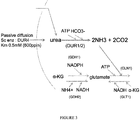
- Yeast take up and assimilate ammonium as its preferred nitrogen source, followed by amino acids, and finally urea ( Figures 2-4 ) (extensively reviewed by Lungdhal et al., Genetics 190: 885-929 (2012 )).
- NCR nitrogen catabolite repression
- the mechanism of nitrogen catabolite repression (NCR) control is established by transcription factors which control the expression of ammonium, amino acid and urea transporters. These transcription factors also control expression of proteins responsible for degradation and assimilation of nitrogen containing molecules. It has been shown that de-repression of non-preferred nitrogen source assimilation pathways can improve fermentation kinetics ( Salmon, J. M., and Barre, P., Appl. Environ. Microbiol. 64:3831-3837 (1998 )); however, effects on ethanol productivity were not measured.
- S. cerevisiae contains three known ammonium transporters, MEP1, MEP2 and MEP3.
- MEP1 and MEP2 are high affinity transporters while MEP3 is a low affinity transporter.
- S . corevisiae breaks down urea through the enzymatic action of a urea-amido lyase (EC 6.3.4.6). This activity is encoded by the enzyme DUR1/2 in S. cerevisiae ( Figures 2-4 ). Overexpression of DUR1/2 in wine yeasts has been shown to enhance urea degradation rates during fermentation of grape must ( Coulon, J., et al., Am. J. Enol. Vitic. 57:2 (2006 )). There are two known urea transporters in S .
- Industrial com mash substrates contain as much as 3% protein (w/v); however, much of the amino acid content contained in these proteins is unavailable to S . cerevisiae. Expression of one or more proteases would release amino acids that could serve as a nitrogen source for yeast. Additionally, the use of amino acids as a nitrogen source for S . cereviviae in corn ethanol fermentations would improve yield through a reduction in the surplus NADH generated from in vivo amino acid synthesis during anaerobic growth.
- Guo et al. engineered S. cerevisiae to express a heterologous protease for the purpose of improving ethanol yield Guo, Z-p, et al., Enzyme and Microbial Technology 48: 148-154 (2011 )
- the work was conducted in a wild type yeast background that had not been previously engineered for reduced glycerol formation, and the activity of the expressed endoprotease primarily breaks protein into short polypeptides which are not transported by S . cerevisiae.
- com kernel protein is primarily a class of storage proteins known as zeins. Zeins have been shown to be recalcitrant to hydrolysis by many proteases and it is possible that expression of zein specific proteases would result in improved proteolysis.
- another aspect of the present invention relates to expressing zein-specific proteases to improve corn protein hydrolysis and amino acid utilization by the yeast.
- Amino acids are transported by a large family of amino acid permeases.
- One aspect of this invention relates to deregulation or over-expression of a specific or general amino acid permease to complement protease expression or metabolic engineering by improving the uptake rate of free amino acids released during proteolysis.
- expression of the general amino acid permease GAP1 is negatively regulated by AUA1.
- One aspect of this invention relates to the deletion of ADA1 or over expression of GAPI that could result in improved amino acid uptake rates.
- PCT/US2012/032443 teaches a method of eliminating glycerol formation through the production of formate.
- the formate production pathway can also be combined with strains engineered for reduced activity of the native glycerol production pathway. These combinations can be designed such that strains are built with different degrees of glycerol reduction as shown in Figure 5 .
- Several embodiments of the current invention relate to a combination of those or related genetic modifications described in PCT/US2012/032443 , with additional genetic modifications that are designed to alter nitrogen transport and assimilation.
- One aspect of this invention relates to strains of S. cerevisiae with reduced glycerol production that get a kinetic benefit from higher nitrogen concentration without sacrificing ethanol yield
- a second aspect of the invention relates to metabolic modifications resulting in altered transport and/or intracellular metabolism of nitrogen sources present in com mash.
- thermophilic or mesophilic microorganism provides a genetically modified thermophilic or mesophilic microorganism, wherein a first native gene is partially, substantially, or completely deleted, silenced, inactivated, or down-regulated, which first native gene encodes a first native enzyme involved in the metabolic production of an organic acid or a salt thereof, thereby increasing the native ability of said thermophilic or mesophilic microorganism to produce lactate or acetate as a fermentation product.
- EP2277989 provides a recombinant yeast cell lacking or having reduced enzymatic activity needed for the NADH-dependent glycerol synthesis compared with the corresponding wild-type yeast cell, the yeast cell having one or more sequences encoding an NAD+ dependent acetylating acetaldehyde dehydrogenase [EC 1.2.1.10] activity.
- the invention provides a recombinant yeast comprising: at least one engineered genetic modification that leads to the up-regulation of one or more heterologous enzymes that function in one or more ethanol production pathways; at least one engineered genetic modification that leads to the down-regulation of an enzyme in a glycerol-production pathway; and at least one engineered genetic modification that leads to the upregulation or down-regulation of an enzyme in a nitrogen-assimilation pathway, wherein wherein the up-regulated enzyme that acts in an ethanol production pathway is pyruvate formate lyase (EC 2.3.1.54), pyruvate formate lyase activating enzyme (EC 1.91.1.4), and/or bifunctional acetaldehyde-alcohol dehydrogenase selected from a group of enzymes having both of the following Enzyme Commission Numbers: EC 1.2.1.10 and 1.1.1.1; wherein the down-regulated enzyme that acts in the glycerol production pathway is at least one enzyme selected from the group consisting
- the up-regulated enzyme that acts in the ethanol. production pathway is an NADPH-dependent bifunctional acetaldehyde-alcohol dehydrogenase selected from a group of enzymes having both of the following Enzyme Commission Numbers: EC 1.2.1.10 and 1.1.1.2.
- the microorganism further comprises a down-regulation in one or more native enzymes encoded by formate dehydrogenase enzyme selected from the group consisting of: EC 1.2.1.43 and EC 1.2.1.2.
- the recombinant microorganism further comprises a heterologous GPD1 polynucleotide operably linked to a native GPD2 promoter. In some embodiments of the invention, the recombinant microorganism further comprises a heterologous GPD2 polynucleotide operably linked to a. native GPD! promoter.
- the microorganism further comprises an up-regulation or down-regulation of a regulatory element.
- the regulatory element is selected from the group consisting of Ure2 and Aual.
- the microorganism further comprises at least one additional up-regulated enzyme.
- the additional up-regulated enzyme is a glucoamylase enzyme with EC number 3.2.1.3.
- the additional up-regulated enzyme is a permease.
- the additional up-regulated enzyme is a protease with EC number: 3.4.23.41.
- the up-regulated or down-regulated enzymes are under the control of a heterologous promoter
- the heterologous promoter is selected from a group consisting of: TEF2 (SEQ ID NO: 58), HXT7 (SEQ ID NO: 59), ADH1 (SEQ ID NO: 60), and TPI (SEQ ID NO: 61).
- the microorganism is a yeast. In some embodiments, the yeast is from the genus Saccharomyces. In some embodiments, the yeast is Saccharomyces cerevisiae. In some embodiments, the microorganism produces ethanol at higher yield than an otherwise identical microorganism lacking the generic modifications. In some embodiments, the microorganism produces an ethanol titer about 1% to about 10% more than an otherwise identical microorganism lacking the genetic modifications. In some embodiments, the microorganism produces an ethanol titer of at least about 125 g/L.
- the microorganism produces glycerol at a lower yield than an otherwise identical microorganism lacking the genetic modifications. In some embodiments, the microorganism produces a glycerol titer of about 10 to about 100% less than an otherwise identical microorganism lacking the genetic modifications.
- the invention relates to a composition
- a composition comprising a recombinant yeast, and a carbon-containing feedstock.
- the invention provides a method of producing a fermentation product comprising: providing the composition of the second aspect; contacting the composition with carbon containing feedstock, wherein the recombinant yeast, is capable of fermenting the carbon containing feedstock to yield the fermentation product; and, optionally recovering the fermentation production.
- the invention provides -a method of producing ethanol comprising; providing the recombinant yeast of the first aspect; culturing the recombinant yeast in the presence of carbon containing feedstock for sufficient time to produce ethanol; and, optionally, extracting the ethanol.
- the invention provides a co-culture comprising at least two host cells, wherein one of the host cells comprises a .recombinant yeast according to the first aspect; and another host cell that is genetically distinct from the recombinant yeast.
- Some embodiments of the invention are directed to a recombinant microorganism comprising: down-regulated Gpd1, down-regulated Gpd2, down-regulated Fdh1, down- regulated Fdh2, down-regulated Gdhl, up-regulated AdhE, up-regulated pyruvate formate lyase, an up-regulated pyruvate formate lyase-activating enzyme, GPD1 under the control of the GPD2 promoter, GPD2 under the control of the GPD1 promoter, and up-regulated Gdh2.
- Some embodiments of the invention are directed to a recombinant microorganism comprising; down-regulated Gpd1, down-regulated Gpd2,. down-regulated Fdh1, down- regulated Fdh2, down-regulated Gdhl, up-regulated AdhE. up-regulated pyruvate formate lyase, an up-regulated pyruvate formate lyase-activating enzyme, GPD1 under the control of the GPD1 promoter, GPD2 under the control of the GPD1 promoter, up-regulated Glt1 and up-regulated Gln1.
- Some embodiments of the invention are directed to a recombinant microorganism comprising: down-regulated Gpd1, down-regulated Fdh1, down-regulated Fdh2, down-regulated Gdhl, up-regulated AdhE, up-regulated pyruvate formate lyase, an up-regulated pyruvate formate lyase-activated enzyme, GPD1 under the control of the GPB2 promoter, GPD2 under the control of the GPD1 promoter, up-regulated Glt1 and up- regulated Gln1.
- Some embodiments of the invention are directed to a recombinant microorganism comprising: down-regulated Gpd2, down-regulated Fdh1. Down-regulated Fdh2, down-regulated Gdhl, up-regulated AdhE, up-regulated pyruvate formate lyase, and an up- regulated pyruvate formate lyase-acti vating enzyme.
- Some embodiments of the invention are directed to a recombinant microorganism comprising; down-regulated Gpd1, down-regulated Fdh1 down-regulated Fdh2, down-regulated Ghdl, up-regulated AdhE, up-regulated pyruvate formate lyase, an up-regulated pyruvate formate lyase-activating enzyme, and GPD2 under the control of the GPD1 promoter.
- Some embodiments of the invention are directed to a recombinant microorganism comprising: down-regulated Gpd1, down-regulated Fdh1, down-regulated Fdb.2, down-regulated Gdhl, up-regulated AdhE, up-regulated pyruvate formate lyase, and an up-regulated pyruvate formate lyase-activating enzyme.
- Some embodiments of the invention are directed to a recombinant microorganism comprising: down-regulated Gpd1, down-regulated Fdh1, down-regulated Fdh2, up-regulated AdhE, up-regulated pyruvate formate lyase, an up-regulated pyruvate formate lyase-activating enzyme, up-regulated-DUR/12, and GPD2 under the control of the GPD1 promoter.
- Some embodiments of the invention are directed to a recombinant microorganism comprising: down-regulated Gpd1, down-regulated Fdh1, down-regulated Fdh2, up- regulated AdhE, up-regulated pyruvate formate lyase, an up-regulated pyruvate formate lyase-activating enzyme, and up-regulated-DUR/12.
- Some embodiments of the invention are directed to a recombinant microorganism comprising: down-regulated Gpd1, down-regulated Gpd2, down-regulated Fdh1, down-regulated Fdh2, down-regulated Ure2, up-regulated AdhE, up-regulated pyruvate formate lyase, an up-regulated pyruvate formate lyase-activating enzyme, GPD1 under the control of the GDP2 promoter, and GPD2 under the control of the GPD1 promoter.
- Some embodiments of the invention are directed to a recombinant microorganism comprising: down-regulated Gpd1, down-regulated Gpd2, down-regulated Fdh1, down- regulated Fdh2, up-regulated AdhE, up-regulated pyruvate formate lyase, an up-regulated pyruvate formate lyase-activating enzyme, up-regulated GDH2, GPD1 under the control of the GPD2 promoter, and GPD2 under the control of the GPD1 promoter.
- Suitable nucleic acid sequences or fragments thereof encode polypeptides that are at least about 70% to 75% identical to the amino acid sequences disclosed herein, at least about 80%, at least about 85%, or at least about 90% identical to the amino acid sequences disclosed herein, or at least about 95%, at least about 96%, at least about 97%, at least about 98%, at least about 99%, or at least about 100% identical to the amino acid sequences disclosed herein.
- Suitable nucleic acid fragments are at least about 70%, at least about 75%, or at least about 80% identical to the nucleic acid sequences disclosed herein, at least about 80%, at least about 85%, or at least about 90% identical to the nucleic acid sequences disclosed herein, or at least about 95%, at least about 96%, at least about 97%, at least about 98%, at least about 99%, or at least about 100% identical to the nucleic acid sequences disclosed herein.
- Suitable nucleic acid fragments not only have the above identities/similarities but typically encode a polypeptide having at least about 50 amino acids, at least about 100 amino acids, at least about 150 amino acids, at least about 200 amino acids, or at least about 250 amino acids.
- exogenous genes may be codon-optimized in order to express the polypeptide they encode most efficiently in the host cell.
- Methods of codon optimization are well known in the art. ( See, e.g. Welch et al. "Designing genes for successful protein expression.” Methods Enzymol. 2011. 498:43-66 .)
- CAI codon adaptation index
- a codon optimized sequence may be further modified for expression in a particular organism, depending on that organism's biological constraints. For example, large runs of "As" or “Ts” (e.g. , runs greater than 3, 4, 5, 6, 7, 8, 9, or 10 consecutive bases) can effect transcription negatively. Therefore, it can be useful to remove a run by, for example, replacing at least one nucleotide in the run with another nucleotide.
- specific restriction enzyme sites may be removed for molecular cloning purposes by replacing at least one nucleotide in the restriction site with another nucleotide. Examples of such restriction enzyme sites include PacI, AscI, BamHI, BglII, EcoRI and XhoI.
- the DNA sequence can be checked for direct repeats, inverted repeats and mirror repeats with lengths of about 5, 6, 7, 8, 9 or 10 bases or longer, R uns of "As” or Ts", restriction sites and/or repeats can be modified by replacing at least one codon within the sequence with the "second best" codons, i.e. , the codon that occurs at the second highest frequency for a particular amino acid within the particular organism for which the sequence is being optimized.
- Deviations in the nucleotide sequence that comprise the codons encoding the amino acids of any polypeptide chain allow for variations in the sequence coding for the gene. Since each codon consists of three nucleotides, and the nucleotides comprising DNA are restricted to four specific bases, there are 64 pos sible combinations of nucleotides, 61 of which encode amino acids (the remaining three codons encode signals ending translation).
- the "genetic code" which shows which codons encode which amino acids is reproduced herein as Table 1. As a result, many amino acids are designated by more than one codon.
- amino acids alanine and proline are coded for by four triplets, serine and arginine by six triplets each, whereas tryptophan and methionine are coded for by just one triplet.
- This degeneracy allows for DNA base composition to vary over a wide range without altering the amino acid sequence of the proteins encoded by the DNA.
- Codon preference or codon bias differences in codon usage between organisms, is afforded by degeneracy of the genetic code, and is well documented among many organisms. Codon bias often correlates with the efficiency of translation of messenger RNA (mRNA), which is in turn believed to be dependent on, inter alia, the properties of the codons being translated and the availability of particular transfer RNA (tRNA) molecules.
- mRNA messenger RNA
- tRNA transfer RNA
- the predominance of selected tRNAs in a cell is generally a reflection of the codons used most frequently in peptide synthesis. Accordingly, genes can be tailored for optimal gene expression in a given organism based on codon optimization.
- the host cell is a eukaryotic microorganism. In some embodiments, the host cell is a yeast. In some embodiments, the host cell is able to digest and ferment cellulose. In some embodiments, the host cell is from the genus Saccharomyces. In some embodiments, the host cell is Saccharomyces cerevisiae.
- the host cells of the invention are cultured at a temperature above about 20°C, above about 25°C, above about 27°C, above about 30°C, above about 33°C, above about 35°C, above about 37°C, above about 40°C, above about 43°C, above about 45°C, or above about 47°C.
- the host cells of the invention contain genetic constructs that lead to the down-regulation of one or more genes encoding a polypeptide at least about 80%, at least about 85%, at least about 90%, at least about 95%, at least about 96%, at least about 97%, at least about 98%, at least about 99%, or about 100% identical to one or more of the polypeptides encoded SEQ ID NOs: 2, 5, 7, 25, 31, 55, 57, 159 and 161, and the polynucleotide sequence encoded by SEQ ID NO: 3.
- the host cells of the invention contain genetic constructs that lead to the expression or up-regulation of a polypeptide encoding the activity associated with EC Nos.: 1.1.1.8, 3.1.3.21, 1.2.1.43, 1.2.1.2, 1.4.1.2, and 1.4.1.4,
- the host cells of the invention contain genetic constructs that lead to the expression or up-regulation of one or more genes encoding a polypeptide at least about 80%, at least about 85%, at least about 90%, at least about 95%, at least about 96%, at least about 97%, at least about 98%, at least about 99%, or about 100% identical to one or more of the polypeptides encoded by SEQ ID NOs: 9, 11, 13, 15, 17, 19, 21, 23, 27, 33, 35, 37, 39, 41, 41, 45, 47, 49, 51, 53, 157, and 163.
- the host cells of the invention contain genetic constructs that lead to the expression or up-regulation of a polypeptide encoding the activity associated with EC Nos.: 1.1.1.1, 1.1.1.2, 1.2.1.3, 1.2.1.4, 1.2.1.10, 2.3.1.54, 1.97.1.4, 1.4.1.2, 1.4.1.4, 1.1.1.14, 1.4.1.13, 6.3.1.2, 6.3.4,6, and 3.2.1.3.
- bifunctional acetaldehyde-alcohol dehydrogenase is up-regulated.
- the up-regulated bifunctional acetaldehyde-alcohol dehydrogenase is from an enzyme that corresponds to an EC number selected from the group consisting of: EC 1.2.1.0 and 1.1.1.1.
- the bifunctional acetaldehyde-alcohol dehydrogenase is a NADPH dependent bifunctional acetaldehyde-alcohol dehydrogenase selected from a group of enzymes having the following Enzyme Commission Numbers: EC 1.2.1.10 and 1.1.1.2.
- the bifunctional acetaldehyde-alcohol dehydrogenase corresponds to a polypeptide selected from the group consisting of SEQ ID NOs: 13, 15, and 17. In some embodiments, the bifunctional acetaldehyde-alcohol dehydrogenase is adhE.
- pyruvate formate lyase is up-regulated. In some embodiments, the up-regulated pyruvate formate lyase is from an enzyme that corresponds to EC 2.3.1.54. In some embodiments, the pyruvate formate lyase corresponds to a polypeptide encoded by SEQ ID NO: 2. In some embodiments, pyruvate formate lyase activating enzyme is up-regulated. In some embodiments, the up-regulated pyruvate formate lyase activating enzyme is from an enzyme that corresponds to EC 1.97.1.4. In some embodiments, the pyruvate formate lyase activating enzyme corresponds to a polynucleotide encoded by SEQ ID NO: 3.
- glutamate dehydrogenase is up-regulated. In some embodiments, the glutamate dehydrogenase that is up-regulated is NADH-dependent. In some embodiments, the up-regulated glutamate dehydrogenase corresponds to EC 1.4.1.2. In some embodiments, glutamate dehydrogenase from S . cerevisiae is up-regulated. In some embodiments, the glutamate dehydrogenase that is up-regulated is from S. cerevisiae is GDH2 and corresponds to a polypeptide corresponding to SEQ ID NO: 29. In some embodiments, glutamate synthase is up-regutated.
- the up-regulated glutamate synthase corresponds to EC 1.4.1.14. In some embodiments, glutamate synthase from S. cerevisiae is up-regulated. In some embodiments, the glutamate dehydrogenase that is up-regulated is from S. cerevisiae is GLT1 and corresponds to a polypeptide corresponding to SEQ ID NO: 33. In some embodiments, glutamine synthase is up-regulated. In some embodiments, the up-regulated glutamine synthase corresponds to EC 6.3.1.2. In some embodiments, glutamine synthase from S. cerevisiae is up-regulated. In some embodiments, the glutamine dehydrogenase that is up-regulated is from S. cerevisiae is GLN1 and corresponds to a polypeptide corresponding to SEQ ID NO: 35.
- a urea-amido lyase is up-regulated. In some embodiments, the up-regulated urea-amido lyase corresponds to EC 6.3.4.6. In some embodiments, urea-amido lyase from S. cerevisiae is up-regulated. In some embodiments, the urea-amido lyase that is up-regulated is from S . cerevisiae is DUR1/2 and corresponds to a polypeptide corresponding to SEQ ID NO: 37.
- a protease is up-regulated. In some embodiments, the up-regulated protease corresponds to EC 3.4.23.41. In some embodiments, the protease is an endoprotease. In some embodiments, the protease is an exoprotease. In some embodiments, a protease from Z. mays, N. crassa, P. anserine, or M. oryzae is up-regulated. In some embodiments, the protease that is up-regulated corresponds to a polypeptide corresponding to SEQ ID NOs: 41, 43, 45, 47, 49 or 51. In some embodiments, a permease is up-regulated. In some embodiments, a permease from S . cerevisiae is up-regulated. In some embodiments, the permease that is up-regulated is GAP1 and corresponds to a polypeptide corresponding to SEQ ID NO: 53.
- a glucoamylase is up-regulated. In some embodiments, the up-regulated glucoamylase corresponds to EC 3.2.1.3. In some embodiments, a glucoamylase from S. fibuligera is up-regulated. In some embodiments, the glucoamylase from S . fibuligera that is up-regulated corresponds to a polypeptide corresponding to SEQ ID NO: 163.
- an ammonium transporter is up-regulated. In some embodiments, an ammonium transporter from S. cerevisiae is up-regulated. In some embodiments, the ammonium transporter that is up-regulated is MEP1, MEP2, or MEP3 from S. cerevisiae and corresponds to a polypeptide corresponding to SEQ ID NOs: 19, 21, and 23. In some embodiments, a urea transporter is up-regulated. In some embodiments, a urea transporter from is from S. cerevisiae. In some embodiments, the urea transporter that is up-regulated is DUR3 or DUR4 from S. cerevisiae and corresponds to a polypeptide corresponding to SEQ ID NOs: 39.
- glycerol-3-phosphate dehydrogenase is down-regulated.
- the down-regulated Gpd is from an enzyme that corresponds to EC 1.1.1.8.
- the glycerol-3-phosphate dehydrogenase is selected from the group consisting of glycerol-3-phosphate dehydrogenase 1 ("Gpd1"), glycerol-3-phosphate dehydrogenase 2 (“Gpd2”), and combinations thereof.
- Gpd1 is from S. cerevisiae and corresponds to a polypeptide encoded by SEQ ID NO: 5.
- the Gpd2 is from S .
- formate dehydrogenase is down-regulated.
- the down-regulated formate dehydrogenase corresponds to an EC number selected from the group consisting of EC 1.2.1.43 and EC 1.2.1.2.
- formate dehydrogenase from S . cerevisiae is down-regulated.
- the formate dehydrogenase from S. cerevisiae corresponds to a polypeptide corresponding to SEQ ID NO: 2 or a polynucleotide corresponding to SEQ ID NO: 3.
- glycerol-3-phosphate phosphatase is down-regulated. In some embodiments, the down-regulated glycerol-3-phosphate phosphatase corresponds to EC 3.1.3.21. In some embodiments, the down-regulated glycerol-3-phosphate phosphatase corresponds to a polynucleotide corresponding to SEQ ID NOs 158 or 160 or a polypeptide corresponding to SEQ ID NOs 159 or 161.
- glutamate dehydrogenase is down-regulated. In some embodiments, the glutamate dehydrogenase that is down-regulated is NADPH-dependent. In some embodiments, the down-regulated glutamate dehydrogenase corresponds to EC 1.4.1.4. In some embodiments, glutamate dehydrogenase that is down-regulated is from S. cerevisiae. In some embodiments, the glutamate dehydrogenase is from S. cerevisiae is GDH1 and corresponds to a polypeptide corresponding to SEQ ID NO: 25.
- a regulatory element is down-regulated.
- the regulatory element that is down-regulated is from S . cerevisiae.
- the regulatory element from S. cerevisiae is Ure2 and corresponds to a polypeptide corresponding to SEQ ID NO: 55.
- the regulatory element from S . cerevisiae is Aua1 and corresponds to a polypeptide corresponding to SEQ ID NO: 57.
- bifunctional acetaldehyde-alcohol dehydrogenase (AdhE), B. adolescentis pyruvate formate lyase, and B adolescentis pyruvate formate lyase activating enzyme are up-regulated, and Gpd1 and Gpd2 are down-regulated.
- AdhE, B. adolescentis pyruvate formate lyase, and B adolescentis pyruvate formate lyase activating enzyme are up-regulated, and Gpd1, Gpd2, Fdh1 and Fdh2 are down-regulated.
- AdhE, B .
- adolescentis pyruvate formate lyase and B adolescentis pyruvate formate lyase activating enzyme are up-regulated, Gpd1, Gpd2, Fdh1 and Fdh2 are down-regulated, GPD1 is expressed under the control of the GPD2 promoter, and GPD2 is expressed under the control of the GPD1 promoter.
- AdhE, B is up-regulated, Gpd1, Gpd2, Fdh1 and Fdh2 are down-regulated, GPD1 is expressed under the control of the GPD2 promoter, and GPD2 is expressed under the control of the GPD1 promoter.
- adolescentis pyruvate formate lyase and B adolescentis pyruvate formate lyase activating enzyme are up-regulated, Gpd1, Gpd2, Fdh1, Fdh2, Gdh1 are down-regulated, GPD1 is expressed under the control of the GPD2 promoter, and GPD2 is expressed under the control of the GPD1 promoter.
- AdhE, B is expressed under the control of the GPD1 promoter.
- Glt1 are up-regulated
- Gpd1, Gpd2, Fdh1, Fdh2, Gdh1 are down-regulated
- GPD1 is expressed under the control of the GPD2 promoter
- GPD2 is expressed under the control of the GPD1 promoter.
- AdhE, B is expressed under the control of the GPD1 promoter.
- AdhE, B . adolescentis pyruvate formate lyase, and B adolescentis pyruvate formate lyase activating enzyme, Gln1 and Glt1 are up-regulated.
- Gpd1, Gpd2, Fdh1, Fdh2, Gdh1 are down-regulated, GPD1 is expressed under the control of the GPD2 promoter, and GPD2 is expressed under the control of the GPD1 promoter.
- the regulatory element Ure2 is down-regulated.
- the regulatory element Aua1 is down-regulated.
- Gln3 is up-regulated.
- AdhE, B. adolescentis pyruvate formate lyase, and B adolescentis pyruvate formate lyase activating enzyme are up-regulated, and Gpd2, Fdh1, and Fdh2 are down-regulated.
- AdhE, B. adolescentis pyruvate formate lyase, and B adolescentis pyruvate formate lyase activating enzyme are up-regulated, and Gpd2, Fdh1, Fdh2, and Gdh1 are down-regulated.
- adolescentis pyruvate formate lyase, and B adolescentis pyruvate formate lyase activating enzyme are up-regulated, and Gpd1, Fdh1, and Fdh2 are down-related.
- AdhE, B. adolescentis pyruvate formate lyase, and B adolescentis pyruvate formate lyase activating enzyme are up-regulated, and Gpd1, Fdh1, Fdh2, and Gdh1 are down-regulated.
- Dur1/2 is additionally expressed. In some embodiments, Dur1/2 is expressed from the TEF2 promoter.
- Dur1/2 is expressed from the HXT7 promoter. In some embodiments, Dur1/2 is expressed from the GPM1 promoter. In some embodiments, Dur1/2 is expressed from the ADH1 promoter. In some embodiments, Dur1/2 is expressed from the HXT7 / TEF2 promoters. In some embodiments, Gln3 is up-regulated. In some embodiments, GPD1 is expressed from the GPD2 promoter. In some embodiments, GPD2 is expressed from a GPD1 promoter. Ethanol Production
- the only product produced is ethanol.
- Extra products lead to a reduction in product yield and an increase in capital and operating costs, particularly if the extra products have little or no value. Extra products also require additional capital and operating costs to separate these products from ethanol.
- Ethanol production can be measured using any method known in the art. For example, the quantity of ethanol in fermentation samples can be assessed using HPLC analysis. Additionally, many ethanol assay kits are commercially available, for example, alcohol oxidase enzyme based assays. Methods of determining ethanol production are within the scope of those skilled in the art from the teachings herein.
- the ethanol output can be improved by growth-coupled selection.
- continuous culture or serial dilution cultures can be performed to select for cells that grow faster and/or produce ethanol (or any desired product) more efficiently on a desired feedstock.
- One embodiment of the present invention relates to a method of producing ethanol using a microorganism described herein wherein the microorganism is cultured in the presence of a carbon containing feedstock for sufficient time to produce ethanol and, optionally, extracting the ethanol.
- nitrogen is added to the culture containing the recombinant microorganism and the feedstock.
- Ethanol may be extracted by methods known in the art. ( See , e.g ., U.S. Appl. Pub. No. 2011/0171709 )
- Another embodiment of the present invention relates to a method of producing ethanol using a co-culture composed of at least two microorganisms in which at least one of the organisms is an organism described herein, and at least one of the organisms is a genetically distinct microorganism.
- the genetically distinct microorganism is a yeast or bacterium.
- the genetically distinct microorganism is any organism from the genus Issatchenkia, Pichia, Clavispora, Candida, Hansemila, Kluyveromyces, Saccharomyces, Trichoderma, Thermoascus, Escherichia, Clostridium, Caldicellulosiruptor, Thermoanaerobacter and Thermoanaerobacterium.
- the recombinant microorganism produces about 2% to about 3% higher ethanol titer than a wildtype, non-recombinant organism; at least about 1% to at least about 2% higher ethanol titer than a wildtype, non-recombinant organism; at least about 1% to at least about 5% higher ethanol titer than a wildtype, non-recombinant organism; at least about 1% to at least about 7% higher ethanol titer than a wildtype, non-recombinant organism; at least about 1% to at least about 10% higher ethanol titer than a wildtype, non-recombinant organism; at least about 1% to at least about 15% higher ethanol titer than a wildtype, non-recombinant organism; at least about 1% to at least about 20% higher ethanol titer than a wildtype, non-recombinant organism; at least about 1% to at least about 30% higher ethanol titer than a wildtype
- the recombinant microorganism produces at least about 0.5g/L ethanol to at least about 2 g/L ethanol, at least about 0.5g/L ethanol to at least about 3 g/L ethanol, at least about 0.5g/L ethanol to at least about 5 g/L ethanol, at least about 0.5g/L ethanol to at least about 7 g/L ethanol, at least about 0.5g/L ethanol to at least about 10 g/L ethanol, at least about 0.5g/L ethanol to at least about 15 g/L ethanol, at least about 0.5g/L ethanol to at least about 20 g/L ethanol, at least about 0.5g/L ethanol to at least about 30 g/L ethanol, at least about 0.5g/L ethanol to at least about 40 g/L ethanol, at least about 0.5g/L ethanol to at least about 50 g/L ethanol, at least about 0.5g/L ethanol to at least about 75 g/L
- the recombinant microorganism produces ethanol at least about 55% to at least about 75% of theoretical yield, at least about 50% to at least about 80% of theoretical yield, at least about 45% to at least about 85% of theoretical yield, at least about 40% to at least about 90% of theoretical yield, at least about 35% to at least about 95% of theoretical yield, at least about 30% to at least about 99% of theoretical yield, or at least about 25% to at least about 99% of theoretical yield.
- methods of producing ethanol can comprise contacting a biomass feedstock with a host cell or co-culture of the invention and additionally contacting the biomass feedstock with externally produced saccharolytic enzymes.
- the host cells are genetically engineered (e.g ., transduced, transformed, or transfected) with the polynucleotides encoding saccharolytic enzymes.
- amylolytic enzyme can be any enzyme involved in amylase digestion, metabolism and/or hydrolysis.
- the term “amylase” refers to an enzyme that breaks starch down into sugar. Amylase is present in human saliva, where it begins the chemical process of digestion. Foods that contain much starch but little sugar, such as rice and potato, taste slightly sweet as they are chewed because amylase turns some of their starch into sugar in the mouth. The pancreas also makes amylase ( ⁇ -amylase) to hydrolyse dietary starch into disaccharides and trisaccharides which are converted by other enzymes to glucose to supply the body with energy. Plants and some bacteria also produce amylase.
- amylases are glycoside hydrolases and act on ⁇ -1,4-glycosidic bonds. Some amylases, such as ⁇ -amylase (glucoamylase), also act on ⁇ -1,6-glycosidic bonds.
- Amylase enzymes include ⁇ -amylase (EC 3.2.1.1), ⁇ -amylase (EC 3.2.1.2), and ⁇ -amylase (EC 3.2.1.3).
- the ⁇ -amylases are calcium metalloenzymes, unable to function in the absence of calcium.
- ⁇ -amylase By acting at random locations along the starch chain, ⁇ -amylase breaks down long-chain carbohydrates, ultimately yielding maltotriose and maltose from amylose, or maltose, glucose and "limit dextrin" from amylopectin, Because it can act anywhere on the substrate, ⁇ -amylase tends to be faster-acting than ⁇ -amylase. In animals, it is a major digestive enzyme and its optimum pH is about 6.7-7.0. Another form of amylase, ⁇ -amylase is also synthesized by bacteria, fungi, and plants.
- ⁇ -amylase catalyzes the hydrolysis of the second ⁇ -1,4 glycosidic bond, cleaving off two glucose units (maltose) at a time. Many microbes produce amylase to degrade extracellular starches. In addition to cleaving the last ⁇ (1-4) glycosidic linkages at the nonreducing end of amylose and amylopectin, yielding glucose, ⁇ -amylase will cleave ⁇ (1-6) glycosidic linkages.
- amylolytic enzyme is alpha-glucosidase that acts on maltose and other short malto-oligosaccharides produced by alpha-, beta-, and gamma-amylases, converting them to glucose.
- Another amylolytic enzyme is pullulanase.
- Pullulanase is a specific kind of glucanase, an amylolytic exoenzyme, that degrades pullulan.
- Pullulan is regarded as a chain of maltotriose units linked by alpha-1,6-glycosidic bonds.
- Pullulanase (EC 3.2.1.41) is also known as pullulan-6-glucanohydrolase (debranching enzyme).
- amylolytic enzyme isopullulanase
- hydrolyses pullulan to isopanose (6-alpha-maltosylglucose).
- Isopullulanase (EC 3.2.1.57) is also known as pullulan 4-glucanohydrolase.
- An "amylase” can be any enzyme involved in amylase digestion metabolism and/or hydrolysis, including ⁇ -amylase, ⁇ -amylase, glucoamylase, pullulanase, isopullulanase, and alpha-glucosidase.
- the recombinant microorganisms of the invention further comprise one or more native and/or heterologous enzymes which encodes a saccharolytic enzyme, including amylases, cellulases, hemicellulases, cellulolytic and amylolytic accessory enzymes, inulinases, levanases, and pentose sugar utilizing enzymes.
- the saccharolytic enzyme is an amylase, where the amylase is selected from H . grisea, T. aurantiacus, T. emersonii, T. reesei, C. lacteus, C formosanus, N. takasagoensis, C .
- the saccharolytic enzyme is a glucoamylase (glu-0111-CO) from S . fibuligera.
- xylanolytic activity is intended to include the ability to hydrolyze glycosidic linkages in oligopentoses and polypentoses.
- xylanase is the name given to a class of enzymes which degrade the linear polysaccharide beta-1,4-xylan into xylose, thus breaking down hemicellulose, one of the major components of plant cell walls. A s such, it plays a major role in micro-organisms thriving on plant sources (mammals, conversely, do not produce xylanase). Additionally, xylanases are present in fungi for the degradation of plant matter into usable nutrients. Xylanases include those enzymes that correspond to E.C.
- a "xylose metabolizing enzyme” can be any enzyme involved in xylose digestion, metabolism and/or hydrolysis, including a xylose isomerase, xylulokinase, xylose reductase, xylose dehydrogenase, xylitol dehydrogenase, xylonate dehydratase, xylose transketolase, and a xylose transaldolase protein.
- pectinase is a general term for enzymes, such as pectolyase, pectozyme and polygalacturonase, commonly referred to in brewing as pectic enzymes. These enzymes break down pectin, a polysaccharide substrate that is found in the cell walls of plants.
- pectinases are commonly used in processes involving the degradation of plant materials, such as speeding up the extraction of fruit juice from fruit, including apples and sapota. Pectinases have also been used in wine production since the 1960s.
- a “saccharolytic enzyme” can be any enzyme involved in carbohydrate digestion, metabolism and/or hydrolysis, including amylases, cellulases, hemicellulases, cellulolytic and amylolytic accessory enzymes, inulinases, levanases, and pentose sugar utilizing enzymes.
- a "pentose sugar utilizing enzyme” can be any enzyme involved in pentose sugar digestion, metabolism and/or hydrolysis, including xylanase, arabinase, arabinoxylanase, arabinosidase, arabinofuranosidase, arabinoxylanase, arabinosidase, and arabinofuranosidase, arabinose isomerase, ribulose-5-phosphate 4-epimerase, xylose isomerase, xylulokinase, xylose reductase, xylose dehydrogenase, xylitol dehydrogenase, xylonate dehydratase, xylose transketolase, and/or xylose transaldolase.
- the glycerol output can be decreased by growth-coupled selection.
- continuous culture or serial dilution cultures can be performed to select for cells that produce less glycerol on a desired feedstock.
- Glycerol can be measured, for example, by HPLC analysis of metabolite concentrations.
- the recombinant microorganism produces at least about 20% to at least about 30% less glycerol than a wildtype, non-recombinant organism; at least about 30% to at least about 50% less glycerol than a wildtype, non-recombinant organism; at least about 40% to at least about 60% less glycerol than a wildtype, non-recombinant organism; at least about 50% to at least about 70% less glycerol than a wildtype, non-recombinant organism; at least about 60% to at least about 80% less glycerol than a wildtype, non-recombinant organism; at least about 70% to at least about 90% less glycerol than a wildtype, non-recombinant organism; at least about 75% to at least about 95% less glycerol than a wildtype, non-recombinant organism; at least about 70% to at least about 99% less glycerol than a wildtype, non-recombinant organism; at least about
- the recombinant microorganism produces no glycerol.
- the recombinant microorganism has a growth rate at least about 1/2 to at least about equal to the growth rate of a wildtype, non-recombinant organism, at least about 1/4 to at least about equal to the growth rate of a wildtype, non-recombinant organism, at least about 1/8 to at least about equal to the growth rate of a wildtype, non-recombinant organism, at least about 1/10 to at least about equal to the growth rate of a wildtype, non-recombinant organism, at least about 1/25 to at least about equal to the growth rate of a wildtype, non-recombinant organism, at least about 1/50 to at least about equal to the growth rate of a wildtype, non-recombinant organism or at least about 1/100th to at least about equal to the growth rate of a wildtype, non-recombinant organism.
- a wildtype-non-recombinant organism produces glycerol at a rate of at least about 8-11 mM glycerol per gram dry cell weight (DCW) during anaerobic growth. In some embodiments, glycerol production is reduced to a rate of between 1-10 mM glycerol per gram dry cell weight during anaerobic growth.
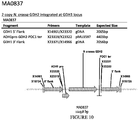
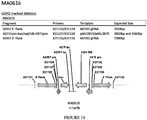
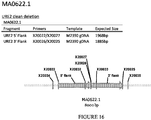
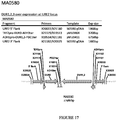
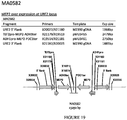
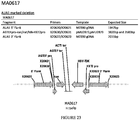
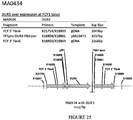
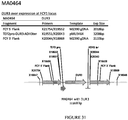
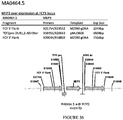
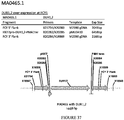
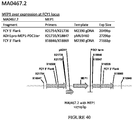
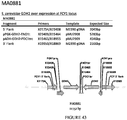
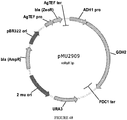
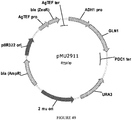
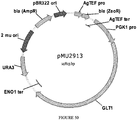
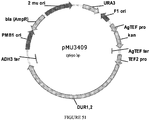
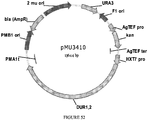
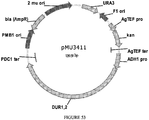
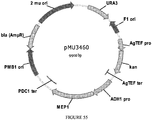
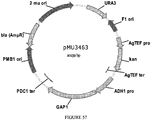
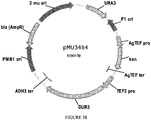
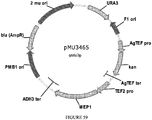
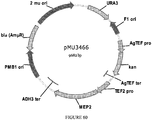
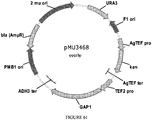
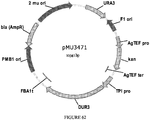
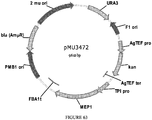
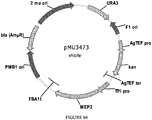
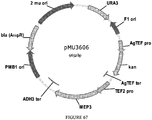
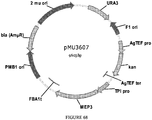
- Strains used in the following examples were created using Mascoma Assemblies ("MAs"). Schematic diagrams of the MAs can be seen in Figures 6-44 . Plasmids used to make the MAs can be seen in Figures 45-68 and Table 2. Primers used to create the MAs can be seen in Table 3 below and in SEQ ID NOs: 66-155. Strains used in the invention can be seen in Table 4 below. For a general description of molecular methods that could be used to create the strains, see U.S. Application No 61/728,450 , which is incorporated herein by reference. Table 2 . Plasmids used to make the MAs.
- GDH2-PDC1 ter pMU2911 ADH1 pro-GLN1-PDC1 ter pMU2913 PGK1 pro-GLT1-ENO1 ter pMU3409 TEF2 pro-DUR1,2-ADH3 ter pMU3410 HXT7 pro-DUR1,2-PMA1t pMU3411 ADH1 pro-DUR1,2-PDC1 ter pMU3459 ADH1 pro-DUR3-PDC1 ter pMU3460 ADH1 pro-MEP1-PDC1 ter pMU3461 ADH1 pro-MEP2-PDC1 ter pMU3463 ADH1 pro-GAP1-PDC1 ter pMU3464 TEF2 pro-DUR3-ADH3 ter pMU3465 TEF2 pro-MEP1-ADH3 ter pMU3466 TEF2 pro-MEP2-ADH3 ter pMU3468 TEF2 pro-GAP1-A
- M3624 ( ⁇ gpd1:: GPD2 -B.adolescentis pflA/pFIB/adhE ⁇ gpd2 ::GPD1 -B. adolescentis pflA/pflB/adhE ⁇ fdh1 ⁇ fdh2::B.adolescentis pflA/pflB/adhE) has an approximately 85% reduction in glycerol formation when grown on > 30% solids corn mash. However, the strain is unable to complete the fermentation even after extended incubation periods. Two modifications of the ammonium assimilation pathway were constructed in M3624 and evaluated for fermentation performance.
- the modifications were a deletion of GDH1 and over-expression of Gdh2, resulting in strain M4117 (M3634 Gdh2; ⁇ gdh1 ).
- the second modification was a deletion of GDH1 and overexpression of GLT1 and GLN1, resulting in strain M4118 (M3634 Glt1; Gln1; ⁇ gdh1 ).
- An industrial corn mash was prepared to a final solids concentration of 31% supplemented with penicillin (0.006mg/mL) and urea (0.5 g/l).
- Glucoamylase was added at a concentration of 0.6 AGU/gTS. Fermentation was stopped by addition of each strain to an final starting concentration of 0.1 g/l.
- Vials were capped with a rubber stopper and sealed. A 23-gauge needle was inserted through the stopper to vent and for the safety of the experiment. Vials were incubated at 35°C with shaking at 125rpm. At the termination of the experiment samples were prepared for HPLC analysis of ethanol and residual sugars.
- M3465 ( ⁇ gpd2::B.adolescentis pflA/pflB/adhE ⁇ fdh1 ⁇ fdh2::B.adolescentis pflA/pflB/adhE), M3467 ( ⁇ fdh1 ⁇ fdh2::PFK-pro-adhE-HXT-ter ENO1-pro-pflB-ENO1-ter ADH1-pro-adhE-PDC10-ter TPI-pro-pflA-FBA-ter ⁇ gpd1::GPD2::PFK-pro-adhE-HXT-ter ENO1-pro-pflB-ENO1-ter ADH1-pro-adhE-PDC10-ter TPI-pro-pflA-FBA-ter) and M3469 ( ⁇ gpd1::B.adolescentis pflA/pflB/adhE fdh1 ⁇
- SEQ ID NO: 58 S. cerevisiae HXT7 promoter: SEQ ID NO: 59, S. cerevisiae, S. cerevisiae ADH1 promoter: SEQ ID NO: 60, S. cerevisiae TP1 promoter: SEQ ID NO: 61, S. cerevisiae FBA1 terminator: SEQ ID NO: 62, S. cerevisiae PDC1 terminator: SEQ ID NO: 63, S. cerevisiae PMA1 terminator: SEQ IS NO: 64, and S. cerevisiae ADH3 terminator: SEQ ID NO: 65. Table 5.
- Preferred nitrogen sources generally repress transcription of genes required to utilize non-preferred nitrogen sources.
- Urea is added as a supplemental nitrogen source in corn mash fermentation; however, there are significant quantities of amino acids and ammonia, both of which are preferred nitrogen sources over urea.
- Expression of the urea transporter (Dur3) and the urea:amido lyase responsible for intracellular degradation (Dur1/2) may be repressed in the presence amino acids and ammonia as part of a phenomenon referred to as Nitrogen Catabolite Repression (NCR). This repression could slow the rate of urea uptake or require larger quantities to be added. It would be an economic benefit to a corn ethanol producer if constitutive expression of Dur3 and Dur1,2 allowed them to either reduce the amount of urea needed or accelerate fermentation rate.
- the NCR is controlled by Ure2 and four transcription factors known as Gln3, Gat1, Dal80, and Gzf3.
- Ure2 participates in repressing gene expression in the presence of non-preferred nitrogen source. It has been observed that deletion of URE2 activates the expression of genes involved in the uptake of non-preferred nitrogen sources. Inactivation of Ure2 results in dephosphorylation and nuclear localization of the transcription factor Gln3.
- a deletion of Ure2 is constructed as in Example 4.
- a deletion of URE2 will be constructed in M3624 (Example 1). Strains in which URE2 is deleted show a nuclear localization of Gln3, and an activation of NCR sensitive genes, including Dur3 and Dur1/2.
- Gln3 SEQ ID NOs: 156 and 157
- Strains in which Gln3 is overexpressed show an activation of NCR sensitive genes, including Dur3 and Dur1/2.
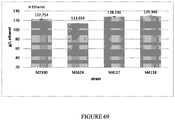
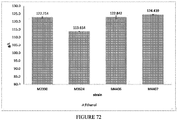
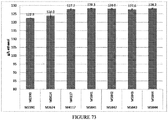
- strain M3624 (Example 1) was able to reach a slightly higher titer than strain M2390 (WT), producing 1.5 g/l more ethanol ( Figure 73 ).
- strain M4117 M3634 Gdh2; ⁇ gdh1
- the GDH1 gene was deleted and replaced with 4 copies of the S. cerevisiae GDH2 gene expression cassette.
- the results in figure 73 below demonstrate that when compared to M3624, M4117 had a clear improvement of 3.7 g/l more ethanol.
- the data shown in Figure 74 shows that M3624 makes 1.3 g/l glycerol which is 87% less than the wild type strain M2390, which made 10 g/l.
- strains in Table 6 were inoculated in vials containing 4ml industrial com mash (mini-vials). The fermentation was allowed to proceed for 68hrs and samples were run on an HPLC to obtain ethanol and glycerol values.
Landscapes
- Chemical & Material Sciences (AREA)
- Life Sciences & Earth Sciences (AREA)
- Health & Medical Sciences (AREA)
- Organic Chemistry (AREA)
- Genetics & Genomics (AREA)
- Engineering & Computer Science (AREA)
- Zoology (AREA)
- Wood Science & Technology (AREA)
- Bioinformatics & Cheminformatics (AREA)
- General Engineering & Computer Science (AREA)
- Biochemistry (AREA)
- General Health & Medical Sciences (AREA)
- Biomedical Technology (AREA)
- Biotechnology (AREA)
- Molecular Biology (AREA)
- Microbiology (AREA)
- Medicinal Chemistry (AREA)
- Mycology (AREA)
- Physics & Mathematics (AREA)
- Biophysics (AREA)
- Plant Pathology (AREA)
- Chemical Kinetics & Catalysis (AREA)
- General Chemical & Material Sciences (AREA)
- Micro-Organisms Or Cultivation Processes Thereof (AREA)
- Preparation Of Compounds By Using Micro-Organisms (AREA)
Claims (23)
- Levure recombinante comprenant :a. au moins une modification génétique par génie génétique qui conduit à la régulation à la hausse d'une ou de plusieurs enzyme(s) hétérologue(s) qui fonctionne/fonctionnent dans une ou plusieurs voie(s) de production d'éthanol ;b. au moins une modification génétique par génie génétique qui conduit à la régulation à la baisse d'une enzyme dans une voie de production de glycérol ; et,c. au moins une modification génétique par génie génétique qui conduit à la régulation à la hausse ou à la régulation à la baisse d'une enzyme dans une voie d'assimilation de l'azote.dans laquelle l'enzyme régulée à la hausse qui agit dans une voie de production d'éthanol est la pyruvate formate lyase (EC 2.3.1.54), une enzyme activant la pyruvate formate lyase (EC 1.91.1.4) et/ou l'acétaldéhyde-alcool déshydrogénase bifonctionnelle choisie dans un groupe d'enzymes ayant les deux Numéros de la Commission des Enzymes suivants : EC 1.2.1.10 et 1.1.1.1 ;
dans laquelle l'enzyme régulée à la baisse qui agit dans la voie de production de glycérol est au moins une enzyme choisie dans le groupe constitué par : un polynucléotide de glycérol-3-phosphate déshydrogénase 1 (GPD1) (EC 1.1.1.8), un polypeptide de glycérol-3-phosphate déshydrogénase 1 (Gpd1) (EC 1.1.1.8), un polynucléotide de glycérol-3-phosphate déshydrogénase 2 (GPD2) (EC 1.1.1.8), un polypeptide de glycérol-3-phosphate déshydrogénase 2 (Gpd2) (EC 1.1.1.8), un polynucléotide de glycérol-3-phosphate phosphatase I (GPP1) (EC 3.1.3.21), un polypeptide de glycérol-3-phosphate phosphatase I (Gpp1) (EC 3.1.3.21), un polynucléotide de glycérol-3-phosphate phosphatase 2 (GPP2) (EC 3.1.3.21) et un polypeptide de glycérol-3-phosphate phosphatase 2 (Gpp2) (EC 3.1.3.21) ; et
dans laquelle l'enzyme régulée à la baisse qui agit dans la voie d'assimilation de l'azote est la glutamate déshydrogénase (Gdh) (EC 1.4.1.4) et dans laquelle l'enzyme régulée à la hausse dans la voie d'assimilation de l'azote est au moins une enzyme choisie dans le groupe constitué par la glutamate déshydrogénase (Gdh) (EC 1.4.1.2), la glutamate synthase (Glt) (EC 1.4.1.14) et la glutamine synthase (Gln) (EC 6.3.1.2), un transporteur d'ammonium, une urée-amido lyase (EC 6.3.4.6) et un transporteur d'urée. - Levure recombinante de la revendication 1, dans laquelle l'enzyme régulée à la hausse dans la voie d'assimilation de l'azote est Gdh2 isolée d'un organisme d'un genre choisi dans le groupe constitué par Saccharomyces et Neurospora (Gdh2) ; Glt1 isolée d'un organisme du genre Saccharomyces (G1t1) ; Gln1 isolée d'un organisme du genre Saccharomyces (Gln1') ; une protéine MEP choisie dans le groupe constitué par ; Mep1, Mep2 et Mep3 et isolée d'un organisme d'un genre choisi dans le genre Saccharomyces ; une urée-amido lyase isolée d'un organisme du genre Saccharomyces ; Dur3 ou Dur4 isolé d'un organisme du genre Saccharomyces ; ou Gln3 isolé du genre Saccharomyces.
- Levure recombinante de la revendication 1, dans laquelle l'enzyme régulée à la baisse dans la voie d'assimilation de l'azote est une séquence polypeptidique identique à au moins environ 80%, 90%, 95 ou 100% à une séquence polypeptidique choisie dans le groupe constitué par : SEQ ID NO : 25 et 31 (Gdh1 et Gdh3 de S. cerevisiae).
- Levure recombinante de l'une quelconque des revendications 1 et 2, dans laquelle l'enzyme régulée à la hausse dans la voie d'assimilation de l'azote est une séquence polypeptidique identique à au moins environ 80%, 90%, 95% ou 100% à une séquence polypeptidique choisie dans le groupe constitué par : SEQ ID NO : 27 et 29 (Gdh2) ; une séquence polypeptidique identique à au moins environ 80%, 90%, 95% ou 100% à une séquence polypeptidique SEQ ID NO : 33 (G1t1) ; une séquence polypeptidique identique à au moins environ 80%, 90%, 95% ou 100% à une séquence polypeptidique SEQ ID NO : 35 (Gln1) ; une séquence polypeptidique identique à au moins environ 80%, 90%, 95% ou 100% à une séquence polypeptidique SEQ ID NO : 19 (Mep1) ; une séquence polypeptidique identique à au moins environ 80%, 90%, 95% ou 100% à une séquence polypeptidique SEQ ID NO : 21 (Mep2) ; une séquence polypeptidique identique à au moins environ 80%, 90%, 95% ou 100% à une séquence polypeptidique SEQ ID NO : 23 (Mep3) ; une séquence polypeptidique identique à au moins environ 80%, 90%, 95% ou 100% à une séquence polypeptidique SEQ ID NO 37 (Dur1/2) ; une séquence polypeptidique identique à au moins environ 80%, 90%, 95% ou 100% à une séquence polypeptidique : SEQ ID NO : 39 (Dur3) ; ou une séquence polypeptidique identique à au moins environ 80%, 90%, 95% ou 100% à une séquence polypeptidique SEQ ID NO : 156 (Gln3).
- Levure recombinante de la revendication 1, dans laquelle l'enzyme dans la voie de production de glycérol est une séquence polypeptidique identique à au moins environ 80%, 90%, 95% ou 100% à la séquence polypeptidique : SEQ ID NO : 5 (Gpd1) ; une séquence polypeptidique identique à au moins environ 80%, 90%, 95% ou 100% à la séquence polypeptidique : SEQ ID NO : 7 (Gpd2) ; une séquence polypeptidique identique à au moins environ 80%, 90%, 95% ou 100% à la séquence polypeptidique : SEQ ID NO : 159 (Gpp1) ; ou une séquence polypeptidique identique à au moins environ 80%, 90%, 95% ou 100% à la séquence polypeptidique : SEQ ID NO : 161 (Gpp2).
- Levure recombinante de l'une quelconque des revendications 1 à 5, dans laquelle l'enzyme régulée à la hausse qui agit dans une voie de production d'éthanol est une acétaldéhyde-alcool déshydrogénase bifonctionnelle dépendante du NADPH, choisie dans un groupe d'enzymes ayant les deux Numéros de la Commission des Enzymes suivants ; EC 1.2.1.10 et 1.1.1.2 isolées de préférence d'un genre choisi dans le groupe constitué par Leuconostoc et Oenococcus.
- Levure recombinante de l'une quelconque des revendications 1 à 6, dans laquelle l'enzyme qui agit dans la voie de production d'éthanol est une séquence polypeptidique identique à au moins environ 80%, 90%, 95% ou 100% à la séquence polypeptidique SEQ ID NO : 9 (Pf1 de B. adolescentis) ; une séquence polypeptidique identique à au moins environ 80%, 90%, 95% ou 100% à la séquence polypeptidique SEQ ID NO : 11 (enzyme activant Pf1 de B. adolescentis) ; une séquence polypeptidique identique à au moins environ 80%, 90%, 95% ou 100% à la séquence polypeptidique SEQ ID NO : 13 (AdhE de B. adolescentis) ; ou une séquence polypeptidique identique à au moins environ 80%, 90%, 95% ou 100% à une séquence polypeptidique choisie dans un groupe constitué par SEQ ID NO : 15 et 17.
- Levure recombinante de l'une quelconque des revendications 1 à 7, dans laquelle la levure comprend en outre une régulation à la baisse dans une ou plusieurs enzyme(s) formate déshydrogénase native(s) choisie(s) dans le groupe constitué par : EC 1.2.1.43 et EC 1.2.1.2 et/ou un polynucléotide de GPD1 hétérologue lié de manière fonctionnelle à un promoteur de GPD2 natif et/ou un polynucléotide de GPD2 hétérologue lié de manière fonctionnelle à un promoteur de GPD1 natif et/ou une régulation à la hausse ou une régulation à la baisse d'un élément régulateur.
- Levure recombinante de la revendication 8, dans laquelle l'enzyme régulée à la baisse est une séquence polypeptidique identique à au moins environ 80%, 90%, 95% ou 100% à une séquence polypeptidique SEQ ID NO : 2 (Fdh1) ; ou une séquence polypeptidique identique à au moins environ 80%, 90%, 95% ou 100% à une séquence polypeptidique codée par la séquence polynucléotidique de SEQ ID NO : 3 (Fdh2).
- Levure recombinante de la revendication 8, dans laquelle l'élément régulateur est choisi dans le groupe constitué par Ure2 et Aua1, plus préférablement l'élément régulateur est une séquence polypeptidique identique à au moins environ 80%, 90%, 95% ou 100% à une séquence polypeptidique de SEQ ID NO : 55 (Ure2), plus préférablement l'élément régulateur est une séquence polypeptidique identique à au moins environ 80%, 90%, 95% ou 100% à une séquence polypeptidique de SEQ ID NO : 57 (Aua1).
- Levure recombinante de l'une quelconque des revendications 1 à 10, dans laquelle la levure comprend en outre au moins une enzyme régulée à la hausse supplémentaire de préférence une enzyme glucoamylase avec un numéro EC 3.2.1.3 de préférence isolée du genre Saccharomycopsis ; une perméase de préférence isolée du genre Saccharomyces (perméase) ; ou une protéase avec le numéro EC : 3.4.23.41 de préférence isolée d'un genre choisi dans le groupe constitué par : Zea, Neurospora, Podospora et Magnaporthe (protéase).
- Levure recombinante de la revendication 11, dans laquelle l'enzyme régulée à la hausse est une séquence polypeptidique identique à au moins environ 80%, 90%, 95% ou 100% à une séquence polypeptidique de SEQ ID NO : 163 (glucoamylase) ; une séquence polypeptidique identique à au moins environ 80%, 90%, 95% ou 100% à une séquence polypeptidique de SEQ ID NO : 53 (Gap) ; ou une séquence polypeptidique identique à au moins environ 80%, 90%, 95% ou 100% à une séquence polypeptidique choisie dans un groupe constitué par SEQ ID NO : 41, 43, 45, 47, 49 et 51 (protéase).
- Levure recombinante de l'une quelconque des revendications 1 à 12, dans laquelle les enzymes régulées à la hausse ou régulées à la baisse sont sous le contrôle d'un promoteur hétérologue, de préférence le promoteur hétérologue est choisi dans un groupe constitué par : TEF2 (SEQ ID NO : 58), HXT7 (SEQ ID NO : 59), ADH1 (SEQ ID NO : 60) et TP1 (SEQ ID NO : 61).
- Levure recombinante de l'une quelconque des revendications 1 à 13, dans laquelle la levure produit de l'éthanol à un rendement plus élevé qu'une levure autrement identique dépourvue des modifications génétiques, de préférence la levure recombinante produit un titre en éthanol supérieur d'environ 1% à environ 10% à celui d'une levure autrement identique dépourvue des modifications génétiques, plus préférablement la levure recombinante produit un titre en éthanol d'au moins environ 125 g/L, de préférence la levure produit du glycérol à un rendement plus faible qu'une levure autrement identique dépourvue des modifications génétiques, idéalement la levure produit un titre en glycérol inférieur d'environ 10 à environ 100% à celui d'une levure autrement identique dépourvue des modifications génétiques.
- Levure recombinante de l'une quelconque des revendications 1 à 14, dans laquelle les enzymes sont : Gpd1 régulée à la baisse, Gpd2 régulée à la baisse, Fdh1 régulée à la baisse, Fdh2 régulée à la baisse, AdhE régulée à la hausse, la pyruvate formate lyase régulée à la hausse, et une enzyme activant la pyruvate formate lyase régulée à la hausse, de préférence Gdh1 est régulée à la baisse, de préférence Glt1 est régulée à la hausse, de préférence Gln1 est régulée à la hausse, de préférence Aua1 est régulé à la baisse ou de préférence Ure1 est régulé à la baisse, idéalement la levure recombinante comprenant en outre Dur1/2 et/ou une enzyme régulée à la hausse choisie dans le groupe constitué par : Dur3 et Dur4 et/ou une enzyme régulée à la hausse choisie dans le groupe constitué par : Mep1, Mep2 et Mep3 et/ou Gln3 régulée à la hausse et/ou GPD1 exprimée à partir d'un promoteur de GPD2 et/ou GPD2 exprimée à partir d'un promoteur de GPD1.
- Levure recombinante de l'une quelconque des revendications 1 à 15, dans laquelle les enzymes sont Gpd1 régulée à la baisse, Fdh1 régulée à la baisse, Fdh2 régulée à la baisse, AdhE régulée à la hausse, la pyruvate formate lyase régulée à la hausse et une enzyme activant la pyruvate formate lyase régulée à la hausse, de préférence Gdh1 est régulée à la baisse, de préférence Glt1 est régulée à la hausse, de préférence Gln1 est régulée à la hausse, de préférence Aua1 est régulé à la baisse ou de préférence Ure1 est régulé à la baisse, idéalement la levure recombinante comprenant en outre une ou plusieurs enzyme(s) native(s) et/ou hétérologue(s) où les enzymes sont Dur1/2 et/ou une enzyme régulée à la hausse choisie dans le groupe constitué par : Dur3 et Dur4 et/ou une enzyme régulée à la hausse choisie dans le groupe constitué par : Mep1, Mep2 et Mep3 et/ou Gln3 régulée à la hausse et/ou GPD1 exprimée à partir d'un promoteur de GPD2 et/ou GPP2 exprimée à partir d'un promoteur de GPD1.
- Levure recombinante de l'une quelconque des revendications 1 à 16, dans laquelle les enzymes sont : Gpd2 régulée à la baisse, Fdh1 régulée à la baisse, Fdh2 régulée à la baisse, AdhE régulée à la hausse, la pyruvate formate lyase régulée à la hausse et une enzyme activant la pyruvate formate lyase régulée à la hausse, de préférence Gdh1 est régulée à la baisse, de préférence Gtl1 est régulée à la hausse, de préférence Gln1 est régulée à la hausse, de préférence Aua1 est régulé à la baisse ou de préférence Ure1 est régulé à la baisse, idéalement la levure recombinante comprenant en outre une ou plusieurs enzyme(s) native(s) et/ou hétérologue(s) où les enzymes sont Dur1/2 et/ou une enzyme régulée à la hausse choisie dans le groupe constitué par : Dur3 et Dur4 et/ou une enzyme régulée à la hausse choisie dans le groupe constitué par : Mep1, Mep2 et Mep3 et/ou Gln3 régulée à la hausse et/ou GPD1 exprimée à partir d'un promoteur de GPD2 et/ou GPD2 exprimée à partir d'un promoteur de GPD1.
- Levure recombinante de l'une quelconque des revendications 1 à 17, dans laquelle les enzymes sont : Gpd1 régulée à la baisse, Gpd2 régulée à la baisse, Fdh1 régulée à la baisse, Fdh2 régulée à la baisse, Gdh1 régulée à la baisse, AdhE régulée à la baisse, la pyruvate formate lyase régulée à la hausse, une enzyme activant la pyruvate formate lyase régulée à la hausse, GPD1 sous le contrôle du promoteur de GPD2, GPD2 sous le contrôle du promoteur de GPD1, et Gdh2 régulée à la hausse ; ou une levure recombinante comprenant une ou plusieurs enzyme(s) native(s) et/ou hétérologue(s) où les enzymes sont : Gpd1 régulée à la baisse, Gpd2 régulée à la baisse, Fdh1 régulée à la baisse, Fdh2 régulée à la baisse, Gdh1 régulée à la baisse, AdhE régulée à la hausse, la pyruvate formate lyase régulée à la hausse, une enzyme activant la pyruvate formate lyase régulée à la hausse, GPD1 sous le contrôle du promoteur de GPD2, GPD2 sous le contrôle du promoteur de GPD1, Glt1 régulée à la hausse et Gln1 régulée à la hausse ; ou une levure recombinante comprenant une ou plusieurs enzyme(s) native(s) et/ou hétérologue(s) où les enzymes sont : Gpd1 régulée à la baisse, Fdh1 régulée à la baisse, Fdh2 régulée à la baisse, Gdh1 régulée à la baisse, AdhE régulée à la hausse, la pyruvate formate lyase régulée à la hausse, une enzyme activant la pyruvate formate lyase régulée à la hausse, GPD1 sous le contrôle du promoteur de GPD2, GPD2 sous le contrôle du promoteur de GPD1, Glt1 régulée à la hausse et Gln1 régulée à la hausse ; ou une levure recombinante comprenant une ou plusieurs enzyme(s) native(s) et/ou hétérologue(s) où les enzymes sont : Gpd2 régulée à la baisse, Fdh1 régulée à la baisse, Fdh2 régulée à la baisse, Gdh1 régulée à la baisse, AdhE régulée à la hausse, la pyruvate formate lyase régulée à la hausse, et une enzyme activant la pyruvate formate lyase régulée à la hausse ; ou une levure recombinante comprenant une ou plusieurs enzyme(s) native(s) et/ou hétérologue(s) où les enzymes sont : Gpd1 régulée à la baisse, Fdh1 régulée à la baisse, Fdh2 régulée à la baisse, Gdh1 régulée à la baisse, AdhE régulée à la hausse, la pyruvate formate lyase régulée à la hausse, une enzyme activant la pyruvate formate lyase régulée à la hausse et GPD2 sous le contrôle du promoteur de GPD1 ; une levure recombinante comprenant une ou plusieurs enzyme(s) native(s) et/ou hétérologue(s) où les enzymes sont : Gpd1 régulée à la baisse, Fdh1 régulée à la baisse, Fdh2 régulée à la baisse, Gdh1 régulée à la baisse, AdhE régulée à la hausse, la pyruvate formate lyase régulée à la hausse, et une enzyme activant la pyruvate formate lyase régulée à la hausse ; ou une levure recombinante comprenant une ou plusieurs enzyme(s) native(s) et/ou hétérologue(s) où les enzymes sont : Gpd1 régulée à la baisse, Fdh1 régulée à la baisse, Fdh2 régulée à la baisse, AdhE régulée à la hausse, la pyruvate formate lyase régulée à la hausse, une enzyme activant la pyruvate formate lyase régulée à la hausse, Dur1/2 régulé à la hausse et GPD2 sous le contrôle du promoteur de GPD1 ; ou une levure recombinante comprenant une ou plusieurs enzyme(s) native(s) et/ou hétérologue(s) où les enzymes sont : Gpd1 régulée à la baisse, Fdh1 régulée à la baisse, Fdh2 régulée à la baisse, AdhE régulée à la hausse, la pyruvate formate lyase régulée à la hausse, une enzyme activant la pyruvate formate lyase régulée à la hausse, Dur1/2 régulé à la hausse, de préférence DUR1/2 est régi par un promoteur de TEF2, un promoteur de HXT7, un promoteur d'ADH1 ou un promoteur de HXT7/TEF2 ; ou une levure recombinante comprenant une ou plusieurs enzyme(s) native(s) et/ou hétérologue(s) où les enzymes sont : Gpd1 régulée à la baisse, Gpd2 régulée à la baisse, Fdh1 régulée à la baisse, Fdh2 régulée à la baisse, Ure2 régulé à la baisse, AdhE régulée à la hausse, la pyruvate formate lyase régulée à la hausse, une enzyme activant la pyruvate formate lyase régulée à la hausse, GPD1 sous le contrôle du promoteur de GPD2, et GPD2 sous le contrôle du promoteur de GPD1, de préférence la levure recombinante comprend en outre DUR3 régulé à la hausse et/ou DUR1/2 et/ou Gln3 ; ou une levure recombinante comprenant une ou plusieurs enzyme(s) native(s) et/ou hétérologue(s) où les enzymes sont : Gpd1 régulée à la baisse, Gpd2 régulée à la baisse, Fdh1 régulée à la baisse, Fdh2 régulée à la baisse, AdhE régulée à la hausse, la pyruvate formate lyase régulée à la hausse, une enzyme activant la pyruvate formate lyase régulée à la hausse, GDH2 régulée à la hausse, GPD1 sous le contrôle du promoteur de GPD2, et GPD2 sous le contrôle du promoteur de GPD1.
- Composition comprenant une levure recombinante de l'une quelconque des revendications 1 à 18 et une matière première contenant du carbone, de préférence la matière première est choisie dans le groupe constitué par la biomasse ligneuse, les herbes, les résidus de transformation du sucre, les déchets ménagers, les déchets agricoles ou toute combinaison de ceux-ci, plus préférablement la matière première comprend la fibre de pâte de bois recyclée, la sciure, du bois dur, du bois tendre, la paille de riz, les balles de riz, la paille d'orge, les épis de maïs, la paille de céréales, la paille de blé, la paille de canola, la paille d'avoine, les balles d'avoine, la fibre de maïs, le fourrage, les succulentes, l'agave, la bagasse de canne à sucre, le panic érigé, le miscanthus, la boue de papier, les déchets ménagers ou toute combinaison de ceux-ci.
- Procédé de production d'un produit de fermentation comprenant le fait : a) de fournir la composition de la revendication 19 ; b) de mettre en contact la composition avec une matière première contenant du carbone, où la levure recombinante est capable de fermenter la matière première contenant du carbone pour donner le produit de fermentation ; et, c) de récupérer facultativement la production de fermentation, de préférence la production de glycérol est réduite par rapport à une levure autrement identique dépourvue des modifications génétiques, et où le titre en éthanol a augmenté d'au moins environ 1 à environ 10% lorsque la levure recombinante est mise en culture en présence d'une matière première contenant du carbone pendant un temps suffisant pour produire de l'éthanol, plus préférablement de l'azote est ajouté à la culture contenant la levure recombinante et la matière première.
- Procédé de production d'éthanol comprenant le fait : a) de fournir la levure recombinante, de l'une quelconque des revendications 1 à 18 ; b) de mettre en culture la levure recombinante en présence d'une matière première contenant du carbone pendant un temps suffisant pour produire de l'éthanol ; et, facultativement, c) d'extraire l'éthanol, de préférence la production de glycérol est réduite par rapport à une levure autrement identique dépourvue des modifications génétiques, et où le titre en éthanol a augmenté d'au moins environ 1 à environ 10% lorsque la levure recombinante est mise en culture en présence d'une matière première contenant du carbone pendant un temps suffisant pour produire de l'éthanol, plus préférablement de l'azote est ajouté à la culture contenant la levure recombinante et la matière première.
- Procédé de réduction de la production de glycérol comprenant le fait de fournir une levure recombinante de l'une quelconque des revendications 1 à 18, dans lequel le titre en glycérol est inférieur d'environ 10 à environ 100% au taux par rapport à une levure autrement identique dépourvue des modifications génétiques, de préférence la production de glycérol est réduite par rapport à une levure autrement identique dépourvue des modifications génétiques, et où le titre en éthanol a augmenté d'au moins environ 1 à environ 10% lorsque la levure recombinante est mise en culture en présence d'une matière première contenant du carbone pendant un temps suffisant pour produire de l'éthanol, plus préférablement de l'azote est ajouté à la culture contenant la levure recombinante et la matière première.
- Coculture comprenant au moins deux cellules hôtes dans laquelle a) l'une des cellules hôtes comprend une levure recombinante de l'une quelconque des revendications 1 à 18 ; et, b) une autre cellule hôte qui est génétiquement distincte de (a), de préférence la cellule hôte génétiquement distincte est une levure ou une bactérie, idéalement la cellule hôte génétiquement distincte est tout organisme du genre Saccharomyces, Issatchenkia, Pichia, Clavispora, Candida, Hansenula, Kluyveromyces, Trichoderma, Thermoascus, Escherichia, Clostridium, Caldicellulosiruptor, Zymomonas, Thermoanaerobacter ou Thermoanaerobacterium.
Applications Claiming Priority (2)
| Application Number | Priority Date | Filing Date | Title |
|---|---|---|---|
| US201361800323P | 2013-03-15 | 2013-03-15 | |
| PCT/US2014/025460 WO2014151318A2 (fr) | 2013-03-15 | 2014-03-13 | Procédés de régulation du métabolisme azoté pour la production d'éthanol à partir de maïs par des souches de levure modifiées de façon métabolique |
Publications (2)
| Publication Number | Publication Date |
|---|---|
| EP2970864A2 EP2970864A2 (fr) | 2016-01-20 |
| EP2970864B1 true EP2970864B1 (fr) | 2020-10-28 |
Family
ID=50774844
Family Applications (1)
| Application Number | Title | Priority Date | Filing Date |
|---|---|---|---|
| EP14725932.9A Active EP2970864B1 (fr) | 2013-03-15 | 2014-03-13 | Procédés de régulation du métabolisme azoté pour la production d'éthanol à partir de maïs par des souches de levure modifiées de façon métabolique |
Country Status (7)
| Country | Link |
|---|---|
| US (4) | US10604772B2 (fr) |
| EP (1) | EP2970864B1 (fr) |
| CN (1) | CN105209600A (fr) |
| BR (1) | BR112015023433A2 (fr) |
| CA (1) | CA2905133C (fr) |
| DK (1) | DK2970864T3 (fr) |
| WO (1) | WO2014151318A2 (fr) |
Families Citing this family (10)
| Publication number | Priority date | Publication date | Assignee | Title |
|---|---|---|---|---|
| EP2970864B1 (fr) * | 2013-03-15 | 2020-10-28 | Lallemand Hungary Liquidity Management LLC | Procédés de régulation du métabolisme azoté pour la production d'éthanol à partir de maïs par des souches de levure modifiées de façon métabolique |
| CN105985969B (zh) * | 2015-02-15 | 2019-11-12 | 安琪酵母股份有限公司 | 具有糖化功能的基因工程酵母及其制法和应用 |
| EP3265567B1 (fr) * | 2015-03-02 | 2020-07-29 | Conagen Inc. | Éléments de régulation provenant de micro-organismes labyrinthulomycetes |
| CN105861348B (zh) * | 2016-06-14 | 2019-04-23 | 江南大学 | 一株低产尿素的酿酒酵母及其在食品生产中的应用 |
| CN105861345B (zh) * | 2016-06-14 | 2019-05-17 | 江南大学 | 一株低产尿素、产风味的库德里阿兹威毕赤酵母及其在食品发酵中的应用 |
| US10633454B2 (en) | 2016-11-01 | 2020-04-28 | Conagen Inc. | Expression of modified glycoproteins and glycopeptides |
| CN110088288B (zh) * | 2016-12-20 | 2023-08-29 | 帝斯曼知识产权资产管理有限公司 | 用于乙醇生产的改良酵母菌株 |
| BR112019016021A2 (pt) * | 2017-02-02 | 2020-05-26 | Lallemand Hungary Liquidity Management Llc | Expressão de protease heteróloga para aperfeiçoar a fermentação alcoólica |
| CN107739086B (zh) * | 2017-03-31 | 2020-04-28 | 青岛锦龙弘业环保有限公司 | 一种高盐度废水的脱氮方法 |
| US20230374443A1 (en) * | 2020-10-05 | 2023-11-23 | Dsm Ip Assets B.V. | Saccharomyces yeast cell and fermentation process using such |
Family Cites Families (10)
| Publication number | Priority date | Publication date | Assignee | Title |
|---|---|---|---|---|
| DE69931162T2 (de) | 1998-07-10 | 2007-03-29 | Fluxome Sciences As | Metabolisch veränderte mikrobiellen zelle mit veränderten metabolitherstellung |
| SE0400816D0 (sv) * | 2004-03-26 | 2004-03-26 | Forskarpatent I Syd Ab | Mutated xylose reductase in xylose-fermentation by S. Cerevisiae |
| CA2703085A1 (fr) | 2007-11-01 | 2009-05-07 | Mascoma Corporation | Recuperation de produit a partir de la fermentation de biomasse lignocellulosique |
| CA2641003C (fr) | 2008-03-20 | 2012-01-03 | Greenfield Ethanol Inc. | Souche de levure genetiquement modifiee |
| CL2009000898A1 (es) | 2008-04-14 | 2010-06-18 | Univ British Columbia | Cepa de levadura transformada que tiene alterado el transportador de urea; metodo para modificar dicha levadura; util para producir una bebida o producto alimenticio fermentado, asi como el producto producido con dicha levadura. |
| EP2277989A1 (fr) * | 2009-07-24 | 2011-01-26 | Technische Universiteit Delft | Production d'éthanol dépourvu de glycérol par fermentation |
| WO2011140386A2 (fr) * | 2010-05-05 | 2011-11-10 | Mascoma Corporation | Détoxification d'acétate dérivé de biomasse par conversion métabolique en éthanol, acétone, isopropanol ou acétate d'éthyle |
| EP3483279A1 (fr) | 2011-04-05 | 2019-05-15 | Lallemand Hungary Liquidity Management LLC | Procédés pour l'amélioration du rendement et de la production de produit dans un microorganisme par l'addition d'accepteurs d'électrons alternatifs |
| US9988650B2 (en) | 2012-11-20 | 2018-06-05 | Lallenmend Hungary Liquidity Management LLC | Electron consuming ethanol production pathway to displace glycerol formation in S. cerevisiae |
| EP2970864B1 (fr) * | 2013-03-15 | 2020-10-28 | Lallemand Hungary Liquidity Management LLC | Procédés de régulation du métabolisme azoté pour la production d'éthanol à partir de maïs par des souches de levure modifiées de façon métabolique |
-
2014
- 2014-03-13 EP EP14725932.9A patent/EP2970864B1/fr active Active
- 2014-03-13 BR BR112015023433A patent/BR112015023433A2/pt active Search and Examination
- 2014-03-13 DK DK14725932.9T patent/DK2970864T3/da active
- 2014-03-13 CA CA2905133A patent/CA2905133C/fr active Active
- 2014-03-13 US US14/771,831 patent/US10604772B2/en active Active
- 2014-03-13 WO PCT/US2014/025460 patent/WO2014151318A2/fr not_active Ceased
- 2014-03-13 CN CN201480028538.1A patent/CN105209600A/zh active Pending
-
2019
- 2019-09-13 US US16/570,881 patent/US11274319B2/en active Active
-
2022
- 2022-02-04 US US17/592,915 patent/US11946089B2/en active Active
-
2024
- 2024-02-15 US US18/443,045 patent/US20240360484A1/en not_active Abandoned
Non-Patent Citations (1)
| Title |
|---|
| P. O. LJUNGDAHL ET AL: "Regulation of Amino Acid, Nucleotide, and Phosphate Metabolism in Saccharomyces cerevisiae", GENETICS, vol. 190, no. 3, 1 March 2012 (2012-03-01), pages 885 - 929, XP055138445, ISSN: 0016-6731, DOI: 10.1534/genetics.111.133306 * |
Also Published As
| Publication number | Publication date |
|---|---|
| CN105209600A (zh) | 2015-12-30 |
| BR112015023433A2 (pt) | 2017-11-28 |
| US20220177930A1 (en) | 2022-06-09 |
| US20240360484A1 (en) | 2024-10-31 |
| US11274319B2 (en) | 2022-03-15 |
| DK2970864T3 (da) | 2021-02-01 |
| EP2970864A2 (fr) | 2016-01-20 |
| WO2014151318A2 (fr) | 2014-09-25 |
| US10604772B2 (en) | 2020-03-31 |
| CA2905133A1 (fr) | 2014-09-25 |
| CA3187926A1 (fr) | 2014-09-25 |
| US20160017377A1 (en) | 2016-01-21 |
| US11946089B2 (en) | 2024-04-02 |
| CA2905133C (fr) | 2024-03-05 |
| WO2014151318A3 (fr) | 2014-11-20 |
| US20200157578A1 (en) | 2020-05-21 |
Similar Documents
| Publication | Publication Date | Title |
|---|---|---|
| US11655484B2 (en) | Electron consuming ethanol production pathway to displace glycerol formation in S. cerevisiae | |
| US11946089B2 (en) | Methods for regulating nitrogen metabolism during the production of ethanol from corn by metabolically engineered yeast strains | |
| EP3033413B2 (fr) | Procédés pour l'amélioration du rendement de production et de la production dans un micro-organisme par recyclage de glycérol | |
| US9546385B2 (en) | Genetically modified clostridium thermocellum engineered to ferment xylose | |
| CA2881772C (fr) | Expression d'enzymes dans une levure pour biotraitement consolide d'oligomeres derives de lignocellulose | |
| US9803221B2 (en) | Engineering microorganisms to increase ethanol production by metabolic redirection | |
| WO2013071112A1 (fr) | Souche génétiquement modifiée de s. cerevisiae conçue pour fermenter le xylose et l'arabinose | |
| US10767196B2 (en) | Engineering an increase in ethanol production by altering cofactor specificity | |
| CA3119634A1 (fr) | Modulation de l'oxydation de formiate par une cellule hote de levure recombinante pendant la fermentation | |
| WO2026049933A1 (fr) | Levure génétiquement modifiée et procédés de fermentation pour la production d'éthanol |
Legal Events
| Date | Code | Title | Description |
|---|---|---|---|
| PUAI | Public reference made under article 153(3) epc to a published international application that has entered the european phase |
Free format text: ORIGINAL CODE: 0009012 |
|
| 17P | Request for examination filed |
Effective date: 20151014 |
|
| AK | Designated contracting states |
Kind code of ref document: A2 Designated state(s): AL AT BE BG CH CY CZ DE DK EE ES FI FR GB GR HR HU IE IS IT LI LT LU LV MC MK MT NL NO PL PT RO RS SE SI SK SM TR |
|
| AX | Request for extension of the european patent |
Extension state: BA ME |
|
| DAX | Request for extension of the european patent (deleted) | ||
| STAA | Information on the status of an ep patent application or granted ep patent |
Free format text: STATUS: EXAMINATION IS IN PROGRESS |
|
| RAP1 | Party data changed (applicant data changed or rights of an application transferred) |
Owner name: LALLEMAND HUNGARY LIQUIDITY MANAGEMENT LLC |
|
| 17Q | First examination report despatched |
Effective date: 20170621 |
|
| GRAP | Despatch of communication of intention to grant a patent |
Free format text: ORIGINAL CODE: EPIDOSNIGR1 |
|
| STAA | Information on the status of an ep patent application or granted ep patent |
Free format text: STATUS: GRANT OF PATENT IS INTENDED |
|
| INTG | Intention to grant announced |
Effective date: 20200512 |
|
| GRAS | Grant fee paid |
Free format text: ORIGINAL CODE: EPIDOSNIGR3 |
|
| GRAA | (expected) grant |
Free format text: ORIGINAL CODE: 0009210 |
|
| STAA | Information on the status of an ep patent application or granted ep patent |
Free format text: STATUS: THE PATENT HAS BEEN GRANTED |
|
| AK | Designated contracting states |
Kind code of ref document: B1 Designated state(s): AL AT BE BG CH CY CZ DE DK EE ES FI FR GB GR HR HU IE IS IT LI LT LU LV MC MK MT NL NO PL PT RO RS SE SI SK SM TR |
|
| REG | Reference to a national code |
Ref country code: GB Ref legal event code: FG4D |
|
| REG | Reference to a national code |
Ref country code: CH Ref legal event code: EP |
|
| REG | Reference to a national code |
Ref country code: AT Ref legal event code: REF Ref document number: 1328236 Country of ref document: AT Kind code of ref document: T Effective date: 20201115 |
|
| REG | Reference to a national code |
Ref country code: DE Ref legal event code: R096 Ref document number: 602014071678 Country of ref document: DE |
|
| REG | Reference to a national code |
Ref country code: IE Ref legal event code: FG4D |
|
| REG | Reference to a national code |
Ref country code: NL Ref legal event code: FP |
|
| REG | Reference to a national code |
Ref country code: DK Ref legal event code: T3 Effective date: 20210126 |
|
| REG | Reference to a national code |
Ref country code: AT Ref legal event code: MK05 Ref document number: 1328236 Country of ref document: AT Kind code of ref document: T Effective date: 20201028 |
|
| PG25 | Lapsed in a contracting state [announced via postgrant information from national office to epo] |
Ref country code: GR Free format text: LAPSE BECAUSE OF FAILURE TO SUBMIT A TRANSLATION OF THE DESCRIPTION OR TO PAY THE FEE WITHIN THE PRESCRIBED TIME-LIMIT Effective date: 20210129 Ref country code: PT Free format text: LAPSE BECAUSE OF FAILURE TO SUBMIT A TRANSLATION OF THE DESCRIPTION OR TO PAY THE FEE WITHIN THE PRESCRIBED TIME-LIMIT Effective date: 20210301 Ref country code: NO Free format text: LAPSE BECAUSE OF FAILURE TO SUBMIT A TRANSLATION OF THE DESCRIPTION OR TO PAY THE FEE WITHIN THE PRESCRIBED TIME-LIMIT Effective date: 20210128 Ref country code: FI Free format text: LAPSE BECAUSE OF FAILURE TO SUBMIT A TRANSLATION OF THE DESCRIPTION OR TO PAY THE FEE WITHIN THE PRESCRIBED TIME-LIMIT Effective date: 20201028 Ref country code: RS Free format text: LAPSE BECAUSE OF FAILURE TO SUBMIT A TRANSLATION OF THE DESCRIPTION OR TO PAY THE FEE WITHIN THE PRESCRIBED TIME-LIMIT Effective date: 20201028 |
|
| REG | Reference to a national code |
Ref country code: LT Ref legal event code: MG4D |
|
| PG25 | Lapsed in a contracting state [announced via postgrant information from national office to epo] |
Ref country code: BG Free format text: LAPSE BECAUSE OF FAILURE TO SUBMIT A TRANSLATION OF THE DESCRIPTION OR TO PAY THE FEE WITHIN THE PRESCRIBED TIME-LIMIT Effective date: 20210128 Ref country code: AT Free format text: LAPSE BECAUSE OF FAILURE TO SUBMIT A TRANSLATION OF THE DESCRIPTION OR TO PAY THE FEE WITHIN THE PRESCRIBED TIME-LIMIT Effective date: 20201028 Ref country code: ES Free format text: LAPSE BECAUSE OF FAILURE TO SUBMIT A TRANSLATION OF THE DESCRIPTION OR TO PAY THE FEE WITHIN THE PRESCRIBED TIME-LIMIT Effective date: 20201028 Ref country code: PL Free format text: LAPSE BECAUSE OF FAILURE TO SUBMIT A TRANSLATION OF THE DESCRIPTION OR TO PAY THE FEE WITHIN THE PRESCRIBED TIME-LIMIT Effective date: 20201028 Ref country code: LV Free format text: LAPSE BECAUSE OF FAILURE TO SUBMIT A TRANSLATION OF THE DESCRIPTION OR TO PAY THE FEE WITHIN THE PRESCRIBED TIME-LIMIT Effective date: 20201028 Ref country code: IS Free format text: LAPSE BECAUSE OF FAILURE TO SUBMIT A TRANSLATION OF THE DESCRIPTION OR TO PAY THE FEE WITHIN THE PRESCRIBED TIME-LIMIT Effective date: 20210228 Ref country code: SE Free format text: LAPSE BECAUSE OF FAILURE TO SUBMIT A TRANSLATION OF THE DESCRIPTION OR TO PAY THE FEE WITHIN THE PRESCRIBED TIME-LIMIT Effective date: 20201028 |
|
| PG25 | Lapsed in a contracting state [announced via postgrant information from national office to epo] |
Ref country code: HR Free format text: LAPSE BECAUSE OF FAILURE TO SUBMIT A TRANSLATION OF THE DESCRIPTION OR TO PAY THE FEE WITHIN THE PRESCRIBED TIME-LIMIT Effective date: 20201028 |
|
| REG | Reference to a national code |
Ref country code: DE Ref legal event code: R097 Ref document number: 602014071678 Country of ref document: DE |
|
| PG25 | Lapsed in a contracting state [announced via postgrant information from national office to epo] |
Ref country code: CZ Free format text: LAPSE BECAUSE OF FAILURE TO SUBMIT A TRANSLATION OF THE DESCRIPTION OR TO PAY THE FEE WITHIN THE PRESCRIBED TIME-LIMIT Effective date: 20201028 Ref country code: EE Free format text: LAPSE BECAUSE OF FAILURE TO SUBMIT A TRANSLATION OF THE DESCRIPTION OR TO PAY THE FEE WITHIN THE PRESCRIBED TIME-LIMIT Effective date: 20201028 Ref country code: SM Free format text: LAPSE BECAUSE OF FAILURE TO SUBMIT A TRANSLATION OF THE DESCRIPTION OR TO PAY THE FEE WITHIN THE PRESCRIBED TIME-LIMIT Effective date: 20201028 Ref country code: LT Free format text: LAPSE BECAUSE OF FAILURE TO SUBMIT A TRANSLATION OF THE DESCRIPTION OR TO PAY THE FEE WITHIN THE PRESCRIBED TIME-LIMIT Effective date: 20201028 Ref country code: RO Free format text: LAPSE BECAUSE OF FAILURE TO SUBMIT A TRANSLATION OF THE DESCRIPTION OR TO PAY THE FEE WITHIN THE PRESCRIBED TIME-LIMIT Effective date: 20201028 Ref country code: SK Free format text: LAPSE BECAUSE OF FAILURE TO SUBMIT A TRANSLATION OF THE DESCRIPTION OR TO PAY THE FEE WITHIN THE PRESCRIBED TIME-LIMIT Effective date: 20201028 |
|
| PLBE | No opposition filed within time limit |
Free format text: ORIGINAL CODE: 0009261 |
|
| STAA | Information on the status of an ep patent application or granted ep patent |
Free format text: STATUS: NO OPPOSITION FILED WITHIN TIME LIMIT |
|
| REG | Reference to a national code |
Ref country code: DE Ref legal event code: R119 Ref document number: 602014071678 Country of ref document: DE |
|
| 26N | No opposition filed |
Effective date: 20210729 |
|
| PG25 | Lapsed in a contracting state [announced via postgrant information from national office to epo] |
Ref country code: AL Free format text: LAPSE BECAUSE OF FAILURE TO SUBMIT A TRANSLATION OF THE DESCRIPTION OR TO PAY THE FEE WITHIN THE PRESCRIBED TIME-LIMIT Effective date: 20201028 Ref country code: MC Free format text: LAPSE BECAUSE OF FAILURE TO SUBMIT A TRANSLATION OF THE DESCRIPTION OR TO PAY THE FEE WITHIN THE PRESCRIBED TIME-LIMIT Effective date: 20201028 Ref country code: IT Free format text: LAPSE BECAUSE OF FAILURE TO SUBMIT A TRANSLATION OF THE DESCRIPTION OR TO PAY THE FEE WITHIN THE PRESCRIBED TIME-LIMIT Effective date: 20201028 |
|
| REG | Reference to a national code |
Ref country code: CH Ref legal event code: PL |
|
| GBPC | Gb: european patent ceased through non-payment of renewal fee |
Effective date: 20210313 |
|
| PG25 | Lapsed in a contracting state [announced via postgrant information from national office to epo] |
Ref country code: SI Free format text: LAPSE BECAUSE OF FAILURE TO SUBMIT A TRANSLATION OF THE DESCRIPTION OR TO PAY THE FEE WITHIN THE PRESCRIBED TIME-LIMIT Effective date: 20201028 |
|
| REG | Reference to a national code |
Ref country code: BE Ref legal event code: MM Effective date: 20210331 |
|
| PG25 | Lapsed in a contracting state [announced via postgrant information from national office to epo] |
Ref country code: LU Free format text: LAPSE BECAUSE OF NON-PAYMENT OF DUE FEES Effective date: 20210313 Ref country code: LI Free format text: LAPSE BECAUSE OF NON-PAYMENT OF DUE FEES Effective date: 20210331 Ref country code: CH Free format text: LAPSE BECAUSE OF NON-PAYMENT OF DUE FEES Effective date: 20210331 Ref country code: IE Free format text: LAPSE BECAUSE OF NON-PAYMENT OF DUE FEES Effective date: 20210313 Ref country code: GB Free format text: LAPSE BECAUSE OF NON-PAYMENT OF DUE FEES Effective date: 20210313 Ref country code: DE Free format text: LAPSE BECAUSE OF NON-PAYMENT OF DUE FEES Effective date: 20211001 |
|
| PG25 | Lapsed in a contracting state [announced via postgrant information from national office to epo] |
Ref country code: IS Free format text: LAPSE BECAUSE OF FAILURE TO SUBMIT A TRANSLATION OF THE DESCRIPTION OR TO PAY THE FEE WITHIN THE PRESCRIBED TIME-LIMIT Effective date: 20210228 |
|
| PG25 | Lapsed in a contracting state [announced via postgrant information from national office to epo] |
Ref country code: BE Free format text: LAPSE BECAUSE OF NON-PAYMENT OF DUE FEES Effective date: 20210331 |
|
| PG25 | Lapsed in a contracting state [announced via postgrant information from national office to epo] |
Ref country code: HU Free format text: LAPSE BECAUSE OF FAILURE TO SUBMIT A TRANSLATION OF THE DESCRIPTION OR TO PAY THE FEE WITHIN THE PRESCRIBED TIME-LIMIT; INVALID AB INITIO Effective date: 20140313 |
|
| P01 | Opt-out of the competence of the unified patent court (upc) registered |
Effective date: 20230426 |
|
| PG25 | Lapsed in a contracting state [announced via postgrant information from national office to epo] |
Ref country code: CY Free format text: LAPSE BECAUSE OF FAILURE TO SUBMIT A TRANSLATION OF THE DESCRIPTION OR TO PAY THE FEE WITHIN THE PRESCRIBED TIME-LIMIT Effective date: 20201028 |
|
| PG25 | Lapsed in a contracting state [announced via postgrant information from national office to epo] |
Ref country code: MK Free format text: LAPSE BECAUSE OF FAILURE TO SUBMIT A TRANSLATION OF THE DESCRIPTION OR TO PAY THE FEE WITHIN THE PRESCRIBED TIME-LIMIT Effective date: 20201028 |
|
| REG | Reference to a national code |
Ref country code: NL Ref legal event code: PD Owner name: DANSTAR FERMENT AG; CH Free format text: DETAILS ASSIGNMENT: CHANGE OF OWNER(S), ASSIGNMENT; FORMER OWNER NAME: LALLEMAND HUNGARY LIQUIDITY MANAGEMENT LLC Effective date: 20240624 |
|
| PG25 | Lapsed in a contracting state [announced via postgrant information from national office to epo] |
Ref country code: MT Free format text: LAPSE BECAUSE OF FAILURE TO SUBMIT A TRANSLATION OF THE DESCRIPTION OR TO PAY THE FEE WITHIN THE PRESCRIBED TIME-LIMIT Effective date: 20201028 |
|
| PGFP | Annual fee paid to national office [announced via postgrant information from national office to epo] |
Ref country code: FR Payment date: 20241231 Year of fee payment: 12 |
|
| PGFP | Annual fee paid to national office [announced via postgrant information from national office to epo] |
Ref country code: NL Payment date: 20250107 Year of fee payment: 12 |
|
| PGFP | Annual fee paid to national office [announced via postgrant information from national office to epo] |
Ref country code: DK Payment date: 20250317 Year of fee payment: 12 |
|
| PG25 | Lapsed in a contracting state [announced via postgrant information from national office to epo] |
Ref country code: TR Free format text: LAPSE BECAUSE OF FAILURE TO SUBMIT A TRANSLATION OF THE DESCRIPTION OR TO PAY THE FEE WITHIN THE PRESCRIBED TIME-LIMIT Effective date: 20201028 |