EP2973648B1 - Procédé amélioré de commande dépendante de données - Google Patents
Procédé amélioré de commande dépendante de données Download PDFInfo
- Publication number
- EP2973648B1 EP2973648B1 EP14711844.2A EP14711844A EP2973648B1 EP 2973648 B1 EP2973648 B1 EP 2973648B1 EP 14711844 A EP14711844 A EP 14711844A EP 2973648 B1 EP2973648 B1 EP 2973648B1
- Authority
- EP
- European Patent Office
- Prior art keywords
- data
- attenuation
- mass
- ion
- time
- Prior art date
- Legal status (The legal status is an assumption and is not a legal conclusion. Google has not performed a legal analysis and makes no representation as to the accuracy of the status listed.)
- Active
Links
Images
Classifications
-
- H—ELECTRICITY
- H01—ELECTRIC ELEMENTS
- H01J—ELECTRIC DISCHARGE TUBES OR DISCHARGE LAMPS
- H01J49/00—Particle spectrometers or separator tubes
- H01J49/0027—Methods for using particle spectrometers
- H01J49/0036—Step by step routines describing the handling of the data generated during a measurement
-
- H—ELECTRICITY
- H01—ELECTRIC ELEMENTS
- H01J—ELECTRIC DISCHARGE TUBES OR DISCHARGE LAMPS
- H01J49/00—Particle spectrometers or separator tubes
- H01J49/02—Details
- H01J49/025—Detectors specially adapted to particle spectrometers
-
- G—PHYSICS
- G06—COMPUTING OR CALCULATING; COUNTING
- G06F—ELECTRIC DIGITAL DATA PROCESSING
- G06F17/00—Digital computing or data processing equipment or methods, specially adapted for specific functions
- G06F17/10—Complex mathematical operations
- G06F17/18—Complex mathematical operations for evaluating statistical data, e.g. average values, frequency distributions, probability functions, regression analysis
-
- H—ELECTRICITY
- H01—ELECTRIC ELEMENTS
- H01J—ELECTRIC DISCHARGE TUBES OR DISCHARGE LAMPS
- H01J49/00—Particle spectrometers or separator tubes
- H01J49/02—Details
- H01J49/06—Electron- or ion-optical arrangements
- H01J49/061—Ion deflecting means, e.g. ion gates
-
- H—ELECTRICITY
- H01—ELECTRIC ELEMENTS
- H01J—ELECTRIC DISCHARGE TUBES OR DISCHARGE LAMPS
- H01J49/00—Particle spectrometers or separator tubes
- H01J49/26—Mass spectrometers or separator tubes
- H01J49/34—Dynamic spectrometers
- H01J49/42—Stability-of-path spectrometers, e.g. monopole, quadrupole, multipole, farvitrons
- H01J49/426—Methods for controlling ions
- H01J49/4265—Controlling the number of trapped ions; preventing space charge effects
Definitions
- the present invention relates to a method of mass spectrometry and a mass spectrometer.
- a known method of controlling the intensity of an ion signal is to adjust the transmission or sensitivity of the mass spectrometer or the gain of an electron multiplier (attenuation) to keep the largest ion within a specific mass to charge ratio range within the dynamic range of the ion detection system. This may be the base peak within a whole spectrum or a specific mass to charge ratio value in a targeted analysis. In this case it may not matter that signals from other mass to charge ratio values exceed the dynamic range of the detection system as long as they are separated from the target of interest.
- a current spectrum (which may be in the form of a short pre-scan) may be used to judge the amount by which a subsequent spectrum should be attenuated. It is assumed that the charge density of the ion beam generated by the ion source will be unchanged in the time period between recording and interrogating the current data and recording a subsequent data set. Therefore, it is assumed that the intensity of a target signal in a subsequent spectrum will be substantially the same as the intensity of the current spectrum.
- US-7047144 discloses a method where the gain of an electron multiplier is adjusted based on a current spectrum to ensure that the intensity of a target peak is within defined limits.
- GB-1484742 discloses a method where the system sensitivity is adjusted based on the predicted intensity of the next mass to be sought in the contracted mass spectrum of the target compound.
- US-5572022 discloses a method of controlling the ion population in an ion trap using data from a current scan.
- US-6627876 (Hagar ) and US-6987261 (Horning ) describe different approaches to generating a current scan but only use data from the current scan to predict the amount of attenuation for a subsequent scan.
- the fill time of an ion trap is used to attenuate the signal in a final mass spectrum.
- US 2012/046872 discloses a database-supported online de novo method of sequencing biopolymers.
- the mass to charge ratio of fragment ions is determined and the mass differences ⁇ m between the fragment ions is presented in a matrix as shown in Fig. 6.
- a database is interrogated and the database may include previously calculated measurement data including mass differences between monopolymers and polymers of the biopolymers.
- the disclosed method in relation to unelucidated sequence parts determines precursor ions for further fragmentation.
- WO 2013/081581 discloses a method of automatically checking and adjusting the calibration of a mass spectrometer.
- a calibration check 311 may be performed wherein the collision energy of a collision cell Q2 is reduced to zero and parent ions are mass analysed without being subjected to fragmentation.
- a determination 318 is then made as to whether the peak centroid position and peak width etc. are within expectations based upon a previous calibration. If drift from expected values is not negligible then the method passes to a step 324 wherein a data quality score is calculated.
- a step 326 a determination is made as to whether the mass calibration or resolution has drifted to such an extent that a recalibration procedure is necessary. If immediate re-calibration is not necessary then the degree of deviation of measured results from the expected values may be used in a step 326 to monitor or provide a record of the degree of deviation over time to predict when in the future recalibration or system cleaning will be necessary.
- GB-2489110 discloses with reference to Fig. 2 an arrangement comprising an ion mobility separation device, an attenuation device and a Time of Flight mass analyser. Ions are subjected to a two dimensional separation and ions having a particular ion mobility and a particular mass to charge ratio are selectively attenuated.
- US 2006/020400 discloses a detector assembly having a current measuring device with a saturation threshold level.
- GB-1484742 discloses a method wherein a mass spectrometer analyses a sample by using a quadrupole mass analyser to perform a mass scan sweep about a mass first mass peak in a contracted target spectrum, and then performs further sweeps using an adjusted gain value.
- GB-2297191 discloses a method wherein an ion generation rate detected in a pre-scan is used to control the ion generation rate subsequently used to fill an ion trap for an analytical scan, so that the mass-resolution required for ejecting the undesired ions is not disturbed by space-charge effects.
- the present invention is not limited to obtaining just first and second data and predicting a rate of change solely from just first and second data.
- Embodiments of the present invention are contemplated wherein in addition to first and second data, third, fourth, fifth, sixth, seventh, eighth, ninth, tenth or further data are preferably obtained and the third, fourth, fifth, sixth, seventh, eighth, ninth, tenth or further data are preferably used in addition to the first and second data in order to predict a rate of change in the data.
- the method adapts to changes in the rate of change of intensity of the signal delivered to a mass spectrometer. This provides more appropriate control of the attenuation device compared to known arrangements where it is assumed that the intensity will not change significantly from the intensity measured in the current data set in the time required to acquire a subsequent data set. However, this is not the case particularly when the signal intensity is rising rapidly with respect to the frequency of the spectral acquisition rate.
- the preferred embodiment provides an improved method of determining the attenuation value required by using information from previously acquired data, which may or may not include the current data, to predict the intensity which is expected in a subsequent spectra and hence to set an attenuation value appropriate for the predicted intensity prior to the data being acquired.
- an analyte elutes from a chromatographic column or from an ion mobility spectrometer or separator ("IMS") drift tube
- IMS ion mobility spectrometer or separator
- the rate of change of intensity over a number of previously acquired data points may be used to predict the subsequent intensity at a future time. This may be by means of a simple linear extrapolation or a more complex function based on the known characteristics of the mass spectrometer or chromatographic technique.
- the preferred method provides a more accurate determination of the attenuation factor required than conventional methods which do not attempt to predict a future trend in a measurement e.g. the rate at which the intensity of analyte ions of interest are increasing with time.
- the method according to the preferred embodiment results in less likelihood of over attenuation of the data which would result in reducing sensitivity unnecessarily.
- the preferred method also allows the control system to adapt to different rates of change thereby reducing the likelihood of under attenuation causing corruption of data.
- Under attenuation may occur when the rate of change of the charge density in the ion beam is such that the intensity in a subsequently recorded scan is significantly higher than the intensity in the current scan.
- the method according to the preferred embodiment has the advantage that it adapts to the different rates of change of intensity which occur in mass spectrometry.
- US 2012/046872 discloses predicting unelucidated parts of a sequence but this should not be construed as predicting a rate of change from first and second data within the meaning of the present invention. Furthermore, US 2012/046872 (Kühn ) does not disclose adjusting an attenuation factor of an attenuation device in response to the predicted future trend or rate of change in the data so as to maintain operation of a detector within the dynamic range of the detector and/or to prevent saturation of the detector.
- WO 2013/081581 discloses comparing observed and expected performance but this should not be construed as predicting a rate of change in first and second data within the meaning of the present invention. Furthermore, WO 2013/081581 (Olney ) does not disclose adjusting an attenuation factor of an attenuation device in response to the predicted future trend or rate of change in the data so as to maintain operation of a detector within the dynamic range of the detector and/or to prevent saturation of the detector.
- the first and second data preferably comprise mass spectral data.
- the first and second data preferably comprise multi-dimensional data.
- the first and second data preferably relate to two or more physico-chemical properties of ions.
- the two or more physico-chemical properties preferably comprise mass, mass to charge ratio, time of flight, ion mobility, differential ion mobility, retention time, liquid chromatography retention time, gas chromatography retention time or capillary electrophoresis retention time.
- the step of adjusting an attenuation factor of an attenuation device preferably comprises repeatedly switching an attenuation device between a first mode of operation for a time period ⁇ T 1 wherein the ion transmission is substantially 0% and a second mode of operation for a time period ⁇ T 2 wherein the ion transmission is > 0%.
- the step of adjusting the attenuation factor of the attenuation device preferably comprises adjusting the mark space ratio ⁇ T 2 / ⁇ T 1 in order to adjust or vary the transmission or attenuation of the attenuation device.
- the method preferably further comprises switching between the first mode of operation and the second mode of operation with a frequency of: (i) ⁇ 1 Hz; (ii) 1-10 Hz; (iii) 10-50 Hz; (iv) 50-100 Hz; (v) 100-200 Hz; (vi) 200-300 Hz; (vii) 300-400 Hz; (viii) 400-500 Hz; (ix) 500-600 Hz; (x) 600-700 Hz; (xi) 700-800 Hz; (xii) 800-900 Hz; (xiii) 900-1000 Hz; (xiv) 1-2 kHz; (xv) 2-3 kHz; (xvi) 3-4 kHz; (xvii) 4-5 kHz; (xviii) 5-6 kHz; (xix) 6-7 kHz; (xx) 7-8 kHz; (xxi) 8-9 kHz; (xxii) 9-10 kHz; (xxiii) 10-15 kHz; (
- ⁇ T 1 > ⁇ T 2 .
- ⁇ T 1 ⁇ ⁇ T 2 .
- the time period ⁇ T is preferably selected from the group consisting of: (i) ⁇ 0.1 ⁇ s; (ii) 0.1-0.5 ⁇ s; (iii) 0.5-1 ⁇ s; (iv) 1-50 ⁇ s; (v) 50-100 ⁇ s; (vi) 100-150 ⁇ s; (vii) 150-200 ⁇ s; (viii) 200-250 ⁇ s; (ix) 250-300 ⁇ s; (x) 300-350 ⁇ s; (xi) 350-400 ⁇ s; (xii) 400-450 ⁇ s; (xiii) 450-500 ⁇ s; (xiv) 500-550 ⁇ s; (xv) 550-600; (xvi) 600-650 ⁇ s; (xvii) 650-700 ⁇ s; (xviii) 700-750 ⁇ s; (xix) 750-800 ⁇ s; (xx) 800-850 ⁇ s; (xxi) 850-900 ⁇ s; (xxii)
- the time period ⁇ T 2 is preferably selected from the group consisting of: (i) ⁇ 0.1 ⁇ s; (ii) 0.1-0.5 ⁇ s; (iii) 0.5-1 ⁇ s; (iv) 1-50 ⁇ s; (v) 50-100 ⁇ s; (vi) 100-150 ⁇ s; (vii) 150-200 ⁇ s; (viii) 200-250 ⁇ s; (ix) 250-300 ⁇ s; (x) 300-350 ⁇ s; (xi) 350-400 ⁇ s; (xii) 400-450 ⁇ s; (xiii) 450-500 ⁇ s; (xiv) 500-550 ⁇ s; (xv) 550-600; (xvi) 600-650 ⁇ s; (xvii) 650-700 ⁇ s; (xviii) 700-750 ⁇ s; (xix) 750-800 ⁇ s; (xx) 800-850 ⁇ s; (xxi) 850-900 ⁇ s; (xxii
- the attenuation device preferably comprises one or more electrostatic lenses.
- a voltage is preferably applied to one or more electrodes of the attenuation device, wherein the voltage causes an electric field to be generated which acts to retard and/or deflect and/or reflect and/or divert a beam of ions.
- the step of adjusting the attenuation factor of the attenuation device preferably comprises controlling the intensity of ions which are onwardly transmitted by the attenuation device by repeatedly switching the attenuation device ON and OFF, wherein the duty cycle of the attenuation device may be varied in order to control the degree of attenuation of the ions.
- the mass spectrometer may further comprise either:
- the mass spectrometer further comprises a device arranged and adapted to supply an AC or RF voltage to the electrodes.
- the AC or RF voltage preferably has an amplitude selected from the group consisting of: (i) ⁇ 50 V peak to peak; (ii) 50-100 V peak to peak; (iii) 100-150 V peak to peak; (iv) 150-200 V peak to peak; (v) 200-250 V peak to peak; (vi) 250-300 V peak to peak; (vii) 300-350 V peak to peak; (viii) 350-400 V peak to peak; (ix) 400-450 V peak to peak; (x) 450-500 V peak to peak; and (xi) > 500 V peak to peak.
- the AC or RF voltage preferably has a frequency selected from the group consisting of: (i) ⁇ 100 kHz; (ii) 100-200 kHz; (iii) 200-300 kHz; (iv) 300-400 kHz; (v) 400-500 kHz; (vi) 0.5-1.0 MHz; (vii) 1.0-1.5 MHz; (viii) 1.5-2.0 MHz; (ix) 2.0-2.5 MHz; (x) 2.5-3.0 MHz; (xi) 3.0-3.5 MHz; (xii) 3.5-4.0 MHz; (xiii) 4.0-4.5 MHz; (xiv) 4.5-5.0 MHz; (xv) 5.0-5.5 MHz; (xvi) 5.5-6.0 MHz; (xvii) 6.0-6.5 MHz; (xviii) 6.5-7.0 MHz; (xix) 7.0-7.5 MHz; (xx) 7.5-8.0 MHz; (xxi) 8.0-8.5 MHz; (xxii) 8.5
- the mass spectrometer may also comprise a chromatography or other separation device upstream of an ion source.
- the chromatography separation device comprises a liquid chromatography or gas chromatography device.
- the separation device may comprise: (i) a Capillary Electrophoresis (“CE”) separation device; (ii) a Capillary Electrochromatography (“CEC”) separation device; (iii) a substantially rigid ceramic-based multilayer microfluidic substrate (“ceramic tile”) separation device; or (iv) a supercritical fluid chromatography separation device.
- the ion guide is preferably maintained at a pressure selected from the group consisting of: (i) ⁇ 0.0001 mbar; (ii) 0.0001-0.001 mbar; (iii) 0.001-0.01 mbar; (iv) 0.01-0.1 mbar; (v) 0.1-1 mbar; (vi) 1-10 mbar; (vii) 10-100 mbar; (viii) 100-1000 mbar; and (ix) > 1000 mbar.
- the preferred embodiment relates to a method used to control the intensity of a target region of data such that the intensity does not exceed a predefined level and cause saturation of an ion detector or an ion detection system.
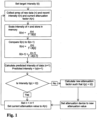
- Fig. 1 shows a flow chart illustrating a preferred embodiment of the present invention. It is assumed in this flow diagram that at least two data sets have been recorded.
- a target intensity value I(t) is set. This is preferably a fixed percentage lower than a maximum value of intensity which can be accommodated. For example, if an Analogue to Digital ("ADC") recording system has a maximum intensity which can be recorded without saturation of X, then I(t) may be set to 0.7X. This ensures that most of the recorded data is below the maximum allowable intensity. Similarly, if the limit of the maximum number of charges to be introduced into an ion trap is Y, then I(t) may be set to 0.7Y. Other ratios may be chosen.
- ADC Analogue to Digital
- An array of data is then recorded.
- This data is preferably given an index number (n).
- the intensity I(n) or charge density within a specific range of the data set or ranges is then preferably recorded or measured.
- the value of the current attenuation factor is also recorded.
- the previous data may have been attenuated to 20% of its unattenuated value by an attenuation device.
- the attenuation factor is 0.8. This may correspond to attenuation in transmission, a drop in the ion detector gain or a change in the fill time of an ion trap from a maximum value.
- This value is also preferably stored in memory so that it can be used subsequently within a feedback routine.
- This comparison is preferably used to calculate a predicted intensity for a subsequent array of data which has not yet been recorded.
- the current data set (n) and a previous data set (n-1) are used to predict a value for a subsequent data set (n+1).
- the predicted intensity is Ip(n+1).
- the simplest method to predict a subsequent intensity is to perform a linear extrapolation using S(n) and S(n-1) and the times at which they were recorded and the time at which the next data array will be recorded. This assumes that the intensity will change in a linear fashion over the local region of data (n-1) to (n+1). More complex prediction methods may be used depending on the nature of the data.
- S(n-2) and S(n-1) may be used to predict S(n+1).
- more than two scaled intensity values can be used to predict a subsequent intensity value.
- the attenuation device is then preferably altered so that this value of attenuation is achieved.
- the method described above preferably calculates a precise predicted value of attenuation to apply. It is more preferable to choose a limited array of allowed attenuation values to use. This restricts the minimum amount that the attenuation device will be changed and restricts the minimum attenuation value which can be applied. This will prevent very small changes in the attenuation value being made between every data point and can improve the stability of the preferred embodiment to fluctuation due to statistical variation or noise.
- the index can be reset such that the next set of data to be acquired at the new attenuation value becomes I(n) and the new attenuation value set becomes A(n).
- the procedure then preferably repeats until the end of the acquisition.
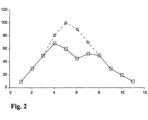
- Fig. 2 shows an example of the method shown in Fig. 1 applied to an example set of data.
- Fig. 2 shows a plot of intensity I(n) versus scan number (n).
- the threshold I(t) was set at an intensity of 60 to control the signal below an intensity of 72. In this case I(t) was set to 80% of the maximum allowable intensity.
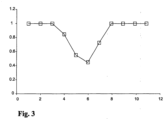
- Attenuation values were limited to integer percentage values i.e. 99%, 98% ... 1%.
- a linear extrapolation based on the scaled intensity values was used to calculate the predicted intensity.
- the dashed line shows the data after rescaling. This is identical to the input data used.
- the solid line shows the attenuated data before rescaling. It is apparent that the preferred method controls the signal within the limits specified.
- Fig. 3 shows a plot of attenuation factor versus scan number for the example shown in Fig. 2 .
- the method of attenuation may require the relationship between the attenuation factor and the magnitude of the operating parameter adjusted to be calibrated. This relationship can be used in the calculation of required adjustment.
- the detector voltage typically has a non linear relationship to detector gain and therefore this relationship must be calculated and used during any extrapolation.
- the method may be used to control the intensity of a targeted region of multi dimensional data sets such as ion mobility-mass spectrometry ("IMS-MS”) data.
- IMS-MS ion mobility-mass spectrometry
- the method of data dependent control may be used to control intensity for other reasons than the dynamic range or saturation characteristics of the detection system.
- the present invention limits space charge effects in ion traps and ion mobility separation ("IMS") devices, controls maximum data rates through downstream high speed electronics, or controls the build-up of contamination or 'ion burn' on lens elements of the mass spectrometer which require routine cleaning to ensure optimum performance and hence extending the operational lifetime of a system.
- IMS ion traps and ion mobility separation
- the preferred embodiment as described above is concerned with intensity variations with time, such as in chromatographic applications, other embodiments are contemplated wherein the intensity variation is in space.
- MALDI Matrix Assisted Laser Desorption Ionisation
- a particular region of a target surface may contain a high concentration of analyte or give a very high ion response. It may be desirable to control the intensity of the signal produced in these regions by attenuating the ion beam in a similar manner to that described.
- the intensity may be recorded at laser or target positions in (x,y) coordinates.
- Two or more data points in a local area may be used to predict the expected intensity of and hence the attenuation required for a target position or target positions not yet acquired.
- this type of imaging produces a two dimensional map of the target surface methods which use prediction in both dimensions simultaneously may be appropriate.
- the data used to predict a subsequent data point may not be acquired sequentially in time.
Landscapes
- Engineering & Computer Science (AREA)
- Analytical Chemistry (AREA)
- Chemical & Material Sciences (AREA)
- Physics & Mathematics (AREA)
- Data Mining & Analysis (AREA)
- General Physics & Mathematics (AREA)
- Mathematical Optimization (AREA)
- Theoretical Computer Science (AREA)
- Mathematical Physics (AREA)
- Computational Mathematics (AREA)
- Pure & Applied Mathematics (AREA)
- Mathematical Analysis (AREA)
- Bioinformatics & Computational Biology (AREA)
- Operations Research (AREA)
- Probability & Statistics with Applications (AREA)
- Evolutionary Biology (AREA)
- Algebra (AREA)
- Bioinformatics & Cheminformatics (AREA)
- Databases & Information Systems (AREA)
- Software Systems (AREA)
- General Engineering & Computer Science (AREA)
- Life Sciences & Earth Sciences (AREA)
- Other Investigation Or Analysis Of Materials By Electrical Means (AREA)
- Electron Tubes For Measurement (AREA)
Claims (13)
- Procédé de spectrométrie de masse comprenant les étapes consistant à :(i) obtenir des premières données à un premier instant et des secondes données à un second instant ultérieur ;(ii) prédire un taux de modification desdites données à partir desdites premières et secondes données ;(iii) ajuster la transmission d'ions en ajustant un facteur d'atténuation d'un dispositif d'atténuation en réponse audit taux de modification prédit desdites données s'il est déterminé que ledit taux de modification prédit conduit à un fonctionnement d'un détecteur en dehors de la plage dynamique dudit détecteur et/ou provoque une saturation dudit détecteur ; et(iv) répéter les étapes (i)-(iii) tout au long d'un cycle d'acquisition.
- Procédé selon la revendication 1, dans lequel lesdites premières et secondes données comprennent des données de spectres de masse.
- Procédé selon les revendications 1-2, dans lequel lesdites premières et secondes données comprennent des données multidimensionnelles.
- Procédé selon la revendication 3, dans lequel lesdites premières et secondes données se rapportent à au moins deux propriétés physico-chimiques d'ions.
- Procédé selon la revendication 4, dans lequel lesdites au moins deux propriétés physico-chimiques comprennent la masse, le rapport masse sur charge, le temps de vol, la mobilité ionique, la mobilité ionique différentielle, le temps de rétention, le temps de rétention en chromatographie en phase liquide, le temps de rétention en chromatographie en phase gazeuse ou le temps de rétention en électrophorèse capillaire.
- Procédé selon l'une quelconque des revendications 1-5, dans lequel l'étape d'ajustement dudit facteur d'atténuation comprend l'utilisation d'un facteur d'utilisation parmi un nombre limité de facteurs d'atténuation autorisés.
- Procédé selon l'une quelconque des revendications 1-6, dans lequel l'étape d'ajustement dudit facteur d'atténuation comprend la limitation de l'amplitude maximale de modification dudit facteur d'atténuation.
- Procédé selon l'une quelconque des revendications précédentes, dans lequel l'étape d'ajustement dudit facteur d'atténuation dudit dispositif d'atténuation comprend :la commutation répétée dudit dispositif d'atténuation entre un premier mode de fonctionnement pendant une première durée dans lequel la transmission d'ions est sensiblement nulle et un second mode de fonctionnement pendant une seconde durée dans lequel la transmission d'ions est supérieure à une transmission sensiblement nulle ; etl'ajustement du rapport cyclique afin d'ajuster ou de faire varier la transmission ou l'atténuation du dispositif d'atténuation, dans lequel ledit rapport cyclique est le rapport de ladite seconde durée à ladite première durée.
- Spectromètre de masse comprenant :un dispositif d'atténuation ;un système de commande agencé et adapté pour :(i) obtenir des premières données à un premier instant et des secondes données à un second instant ultérieur ;(ii) prédire un taux de modification desdites données à partir desdites premières et secondes données ;(iii) ajuster la transmission d'ions en ajustant un facteur d'atténuation d'un dispositif d'atténuation en réponse audit taux de modification prédit desdites données s'il est déterminé que ledit taux de modification prédit conduit à un fonctionnement d'un détecteur en dehors de la plage dynamique dudit détecteur et/ou provoque une saturation dudit détecteur ; et(iv) répéter les étapes (i)-(iii) tout au long d'un cycle d'acquisition.
- Spectromètre de masse selon la revendication 9, dans lequel lesdites premières et secondes données comprennent des données de spectres de masse.
- Spectromètre de masse selon les revendications 9 ou 10, dans lequel lesdites premières et secondes données comprennent des données multidimensionnelles.
- Spectromètre de masse selon la revendication 11, dans lequel lesdites premières et secondes données se rapportent à au moins deux propriétés physico-chimiques d'ions.
- Spectromètre de masse selon la revendication 12, dans lequel lesdites au moins deux propriétés physico-chimiques comprennent la masse, le rapport masse sur charge, le temps de vol, la mobilité ionique, la mobilité ionique différentielle, le temps de rétention, le temps de rétention en chromatographie en phase liquide, le temps de rétention en chromatographie en phase gazeuse ou le temps de rétention en électrophorèse capillaire.
Priority Applications (2)
| Application Number | Priority Date | Filing Date | Title |
|---|---|---|---|
| EP22193975.4A EP4123684A3 (fr) | 2013-03-14 | 2014-03-14 | Procédé amélioré de commande dépendante de données |
| EP14711844.2A EP2973648B1 (fr) | 2013-03-14 | 2014-03-14 | Procédé amélioré de commande dépendante de données |
Applications Claiming Priority (4)
| Application Number | Priority Date | Filing Date | Title |
|---|---|---|---|
| GBGB1304588.5A GB201304588D0 (en) | 2013-03-14 | 2013-03-14 | Improved method of data dependent control |
| EP13159167 | 2013-03-14 | ||
| PCT/GB2014/050802 WO2014140622A1 (fr) | 2013-03-14 | 2014-03-14 | Procédé amélioré de commande dépendante de données |
| EP14711844.2A EP2973648B1 (fr) | 2013-03-14 | 2014-03-14 | Procédé amélioré de commande dépendante de données |
Related Child Applications (2)
| Application Number | Title | Priority Date | Filing Date |
|---|---|---|---|
| EP22193975.4A Division-Into EP4123684A3 (fr) | 2013-03-14 | 2014-03-14 | Procédé amélioré de commande dépendante de données |
| EP22193975.4A Division EP4123684A3 (fr) | 2013-03-14 | 2014-03-14 | Procédé amélioré de commande dépendante de données |
Publications (2)
| Publication Number | Publication Date |
|---|---|
| EP2973648A1 EP2973648A1 (fr) | 2016-01-20 |
| EP2973648B1 true EP2973648B1 (fr) | 2024-01-24 |
Family
ID=50343806
Family Applications (2)
| Application Number | Title | Priority Date | Filing Date |
|---|---|---|---|
| EP14711844.2A Active EP2973648B1 (fr) | 2013-03-14 | 2014-03-14 | Procédé amélioré de commande dépendante de données |
| EP22193975.4A Pending EP4123684A3 (fr) | 2013-03-14 | 2014-03-14 | Procédé amélioré de commande dépendante de données |
Family Applications After (1)
| Application Number | Title | Priority Date | Filing Date |
|---|---|---|---|
| EP22193975.4A Pending EP4123684A3 (fr) | 2013-03-14 | 2014-03-14 | Procédé amélioré de commande dépendante de données |
Country Status (5)
| Country | Link |
|---|---|
| US (1) | US10832898B2 (fr) |
| EP (2) | EP2973648B1 (fr) |
| JP (2) | JP2016516266A (fr) |
| CA (1) | CA2905317C (fr) |
| WO (1) | WO2014140622A1 (fr) |
Families Citing this family (3)
| Publication number | Priority date | Publication date | Assignee | Title |
|---|---|---|---|---|
| GB201410470D0 (en) * | 2014-06-12 | 2014-07-30 | Micromass Ltd | Self-calibration of spectra using differences in molecular weight from known charge states |
| GB2561378B (en) * | 2017-04-12 | 2022-10-12 | Micromass Ltd | Optimised targeted analysis |
| CN111954918B (zh) * | 2018-04-10 | 2025-05-09 | Dh科技发展私人贸易有限公司 | 在tof质量分析仪的提取区域中动态集中离子包 |
Citations (5)
| Publication number | Priority date | Publication date | Assignee | Title |
|---|---|---|---|---|
| GB1484742A (en) * | 1974-05-16 | 1977-09-01 | Universal Monitor Corp | Mass spectrometric system for rapid automatic and specific identification and quantification of compounds |
| GB2297191A (en) * | 1995-01-21 | 1996-07-24 | Bruker Franzen Analytik Gmbh | Method for controlling the ion generation rate for mass selective loading of ions in ion traps |
| US5559325A (en) * | 1993-08-07 | 1996-09-24 | Bruker-Franzen Analytik Gmbh | Method of automatically controlling the space charge in ion traps |
| EP1770754A1 (fr) * | 2004-04-05 | 2007-04-04 | Micromass UK Limited | Spectromètre de masse |
| WO2012013354A1 (fr) * | 2010-07-30 | 2012-02-02 | Ion-Tof Technologies Gmbh | Procédé et spectromètre de masse et applications associées pour la détection d'ions ou de particules neutres ultérieurement ionisées à partir d'échantillons |
Family Cites Families (18)
| Publication number | Priority date | Publication date | Assignee | Title |
|---|---|---|---|---|
| DE3430984A1 (de) * | 1984-08-23 | 1986-03-06 | Leybold-Heraeus GmbH, 5000 Köln | Verfahren und vorrichtung zur registrierung von teilchen oder quanten mit hilfe eines detektors |
| JPS6159246U (fr) * | 1984-09-20 | 1986-04-21 | ||
| JP2585616B2 (ja) * | 1987-08-12 | 1997-02-26 | 株式会社日立製作所 | 二次イオン質量分析計方法 |
| US5572022A (en) | 1995-03-03 | 1996-11-05 | Finnigan Corporation | Method and apparatus of increasing dynamic range and sensitivity of a mass spectrometer |
| DE19709086B4 (de) * | 1997-03-06 | 2007-03-15 | Bruker Daltonik Gmbh | Verfahren der Raumladungsregelung von Tochterionen in Ionenfallen |
| WO2003019614A2 (fr) * | 2001-08-30 | 2003-03-06 | Mds Inc., Doing Busness As Mds Sciex | Procede de reduction de la charge d'espace dans un spectrometre de masse lineaire de piegeage d'ions |
| EP1586104A2 (fr) | 2003-01-24 | 2005-10-19 | Thermo Finnigan LLC | Regulation de populations d'ions dans un analyseur de masse |
| JP2005025946A (ja) | 2003-06-30 | 2005-01-27 | Mitsubishi Heavy Ind Ltd | 飛行時間型質量分析装置 |
| US7238936B2 (en) * | 2004-07-02 | 2007-07-03 | Thermo Finnigan Llc | Detector with increased dynamic range |
| US7323682B2 (en) * | 2004-07-02 | 2008-01-29 | Thermo Finnigan Llc | Pulsed ion source for quadrupole mass spectrometer and method |
| US7047144B2 (en) | 2004-10-13 | 2006-05-16 | Varian, Inc. | Ion detection in mass spectrometry with extended dynamic range |
| WO2006116564A2 (fr) * | 2005-04-25 | 2006-11-02 | Griffin Analytical Technologies, L.L.C. | Instruments, appareils et procedes d'analyse |
| US7391016B2 (en) * | 2005-05-12 | 2008-06-24 | Analiza, Inc. | Method for quantitative analysis of mixtures of compounds |
| US8399827B1 (en) * | 2007-09-10 | 2013-03-19 | Cedars-Sinai Medical Center | Mass spectrometry systems |
| US9818588B2 (en) | 2008-04-28 | 2017-11-14 | Thermo Fisher Scientific (Bremen) Gmbh | Method and arrangement for the control of measuring systems, corresponding computer program and corresponding computer-readable storage medium |
| GB201104292D0 (en) * | 2011-03-15 | 2011-04-27 | Micromass Ltd | M/z targets attenuation on time of flight instruments |
| EP2786399B1 (fr) * | 2011-11-29 | 2019-10-09 | Thermo Finnigan LLC | Procédé pour le contrôle et le réglage automatiques de l'étalonnage d'un spectromètre de masse |
| GB201304588D0 (en) * | 2013-03-14 | 2013-05-01 | Micromass Ltd | Improved method of data dependent control |
-
2014
- 2014-03-14 JP JP2015562324A patent/JP2016516266A/ja active Pending
- 2014-03-14 US US14/774,820 patent/US10832898B2/en active Active
- 2014-03-14 CA CA2905317A patent/CA2905317C/fr active Active
- 2014-03-14 WO PCT/GB2014/050802 patent/WO2014140622A1/fr not_active Ceased
- 2014-03-14 EP EP14711844.2A patent/EP2973648B1/fr active Active
- 2014-03-14 EP EP22193975.4A patent/EP4123684A3/fr active Pending
-
2019
- 2019-01-18 JP JP2019007283A patent/JP6972045B2/ja active Active
Patent Citations (5)
| Publication number | Priority date | Publication date | Assignee | Title |
|---|---|---|---|---|
| GB1484742A (en) * | 1974-05-16 | 1977-09-01 | Universal Monitor Corp | Mass spectrometric system for rapid automatic and specific identification and quantification of compounds |
| US5559325A (en) * | 1993-08-07 | 1996-09-24 | Bruker-Franzen Analytik Gmbh | Method of automatically controlling the space charge in ion traps |
| GB2297191A (en) * | 1995-01-21 | 1996-07-24 | Bruker Franzen Analytik Gmbh | Method for controlling the ion generation rate for mass selective loading of ions in ion traps |
| EP1770754A1 (fr) * | 2004-04-05 | 2007-04-04 | Micromass UK Limited | Spectromètre de masse |
| WO2012013354A1 (fr) * | 2010-07-30 | 2012-02-02 | Ion-Tof Technologies Gmbh | Procédé et spectromètre de masse et applications associées pour la détection d'ions ou de particules neutres ultérieurement ionisées à partir d'échantillons |
Also Published As
| Publication number | Publication date |
|---|---|
| US10832898B2 (en) | 2020-11-10 |
| WO2014140622A1 (fr) | 2014-09-18 |
| JP2019095456A (ja) | 2019-06-20 |
| JP6972045B2 (ja) | 2021-11-24 |
| US20160027628A1 (en) | 2016-01-28 |
| CA2905317C (fr) | 2022-10-04 |
| EP2973648A1 (fr) | 2016-01-20 |
| JP2016516266A (ja) | 2016-06-02 |
| CA2905317A1 (fr) | 2014-09-18 |
| EP4123684A3 (fr) | 2023-08-16 |
| EP4123684A2 (fr) | 2023-01-25 |
Similar Documents
| Publication | Publication Date | Title |
|---|---|---|
| US9711337B2 (en) | Data dependent control of the intensity of ions separated in multiple dimensions | |
| EP2380186B1 (fr) | Dispositif de régulation de la population d'ions pour spectromètre de masse | |
| US20160133450A1 (en) | Intelligent Dynamic Range Enhancement | |
| US10354849B2 (en) | Method of recording ADC saturation | |
| US9418824B2 (en) | Lock component corrections | |
| US10354848B2 (en) | Method of mass analysis using ion filtering | |
| WO2019016571A1 (fr) | Mesure de mobilité et de masse à l'aide de champs électriques variable dans le temps | |
| US11823882B2 (en) | Mass correction | |
| GB2513463A (en) | Improved lock component corrections | |
| JP6972045B2 (ja) | データ依存制御の改善方法 | |
| GB2514455A (en) | Data dependent control of the intensity of ions separated in multiple dimensions | |
| GB2547868A (en) | Improved method of data dependent control | |
| US9991106B2 (en) | Mass spectrometer with digital step attenuator | |
| CN115413362B (zh) | 分析仪器的校准 | |
| GB2518491A (en) | Method of recording ADC saturation |
Legal Events
| Date | Code | Title | Description |
|---|---|---|---|
| PUAI | Public reference made under article 153(3) epc to a published international application that has entered the european phase |
Free format text: ORIGINAL CODE: 0009012 |
|
| 17P | Request for examination filed |
Effective date: 20150918 |
|
| AK | Designated contracting states |
Kind code of ref document: A1 Designated state(s): AL AT BE BG CH CY CZ DE DK EE ES FI FR GB GR HR HU IE IS IT LI LT LU LV MC MK MT NL NO PL PT RO RS SE SI SK SM TR |
|
| AX | Request for extension of the european patent |
Extension state: BA ME |
|
| DAX | Request for extension of the european patent (deleted) | ||
| STAA | Information on the status of an ep patent application or granted ep patent |
Free format text: STATUS: EXAMINATION IS IN PROGRESS |
|
| 17Q | First examination report despatched |
Effective date: 20170619 |
|
| REG | Reference to a national code |
Ref country code: DE Free format text: PREVIOUS MAIN CLASS: H01J0049000000 Ipc: H01J0049060000 Ref country code: DE Ref legal event code: R079 Ref document number: 602014089380 Country of ref document: DE Free format text: PREVIOUS MAIN CLASS: H01J0049000000 Ipc: H01J0049060000 |
|
| GRAP | Despatch of communication of intention to grant a patent |
Free format text: ORIGINAL CODE: EPIDOSNIGR1 |
|
| STAA | Information on the status of an ep patent application or granted ep patent |
Free format text: STATUS: GRANT OF PATENT IS INTENDED |
|
| RIC1 | Information provided on ipc code assigned before grant |
Ipc: H01J 49/02 20060101ALI20230920BHEP Ipc: H01J 49/42 20060101ALI20230920BHEP Ipc: H01J 49/06 20060101AFI20230920BHEP |
|
| INTG | Intention to grant announced |
Effective date: 20231010 |
|
| GRAS | Grant fee paid |
Free format text: ORIGINAL CODE: EPIDOSNIGR3 |
|
| GRAA | (expected) grant |
Free format text: ORIGINAL CODE: 0009210 |
|
| STAA | Information on the status of an ep patent application or granted ep patent |
Free format text: STATUS: THE PATENT HAS BEEN GRANTED |
|
| AK | Designated contracting states |
Kind code of ref document: B1 Designated state(s): AL AT BE BG CH CY CZ DE DK EE ES FI FR GR HR HU IE IS IT LI LT LU LV MC MK MT NL NO PL PT RO RS SE SI SK SM TR |
|
| P01 | Opt-out of the competence of the unified patent court (upc) registered |
Effective date: 20231218 |
|
| RBV | Designated contracting states (corrected) |
Designated state(s): AL AT BE BG CH CY CZ DE DK EE ES FI FR GR HR HU IE IS IT LI LT LU LV MC MK MT NL NO PL PT RO RS SE SI SK SM TR |
|
| REG | Reference to a national code |
Ref country code: CH Ref legal event code: EP |
|
| REG | Reference to a national code |
Ref country code: DE Ref legal event code: R096 Ref document number: 602014089380 Country of ref document: DE |
|
| REG | Reference to a national code |
Ref country code: IE Ref legal event code: FG4D |
|
| REG | Reference to a national code |
Ref country code: LT Ref legal event code: MG9D |
|
| REG | Reference to a national code |
Ref country code: NL Ref legal event code: MP Effective date: 20240124 |
|
| PG25 | Lapsed in a contracting state [announced via postgrant information from national office to epo] |
Ref country code: NL Free format text: LAPSE BECAUSE OF FAILURE TO SUBMIT A TRANSLATION OF THE DESCRIPTION OR TO PAY THE FEE WITHIN THE PRESCRIBED TIME-LIMIT Effective date: 20240124 |
|
| PG25 | Lapsed in a contracting state [announced via postgrant information from national office to epo] |
Ref country code: NL Free format text: LAPSE BECAUSE OF FAILURE TO SUBMIT A TRANSLATION OF THE DESCRIPTION OR TO PAY THE FEE WITHIN THE PRESCRIBED TIME-LIMIT Effective date: 20240124 |
|
| PG25 | Lapsed in a contracting state [announced via postgrant information from national office to epo] |
Ref country code: IS Free format text: LAPSE BECAUSE OF FAILURE TO SUBMIT A TRANSLATION OF THE DESCRIPTION OR TO PAY THE FEE WITHIN THE PRESCRIBED TIME-LIMIT Effective date: 20240524 |
|
| PG25 | Lapsed in a contracting state [announced via postgrant information from national office to epo] |
Ref country code: LT Free format text: LAPSE BECAUSE OF FAILURE TO SUBMIT A TRANSLATION OF THE DESCRIPTION OR TO PAY THE FEE WITHIN THE PRESCRIBED TIME-LIMIT Effective date: 20240124 |
|
| PG25 | Lapsed in a contracting state [announced via postgrant information from national office to epo] |
Ref country code: GR Free format text: LAPSE BECAUSE OF FAILURE TO SUBMIT A TRANSLATION OF THE DESCRIPTION OR TO PAY THE FEE WITHIN THE PRESCRIBED TIME-LIMIT Effective date: 20240425 |
|
| REG | Reference to a national code |
Ref country code: AT Ref legal event code: MK05 Ref document number: 1652864 Country of ref document: AT Kind code of ref document: T Effective date: 20240124 |
|
| PG25 | Lapsed in a contracting state [announced via postgrant information from national office to epo] |
Ref country code: RS Free format text: LAPSE BECAUSE OF FAILURE TO SUBMIT A TRANSLATION OF THE DESCRIPTION OR TO PAY THE FEE WITHIN THE PRESCRIBED TIME-LIMIT Effective date: 20240424 Ref country code: HR Free format text: LAPSE BECAUSE OF FAILURE TO SUBMIT A TRANSLATION OF THE DESCRIPTION OR TO PAY THE FEE WITHIN THE PRESCRIBED TIME-LIMIT Effective date: 20240124 |
|
| PG25 | Lapsed in a contracting state [announced via postgrant information from national office to epo] |
Ref country code: ES Free format text: LAPSE BECAUSE OF FAILURE TO SUBMIT A TRANSLATION OF THE DESCRIPTION OR TO PAY THE FEE WITHIN THE PRESCRIBED TIME-LIMIT Effective date: 20240124 |
|
| PG25 | Lapsed in a contracting state [announced via postgrant information from national office to epo] |
Ref country code: AT Free format text: LAPSE BECAUSE OF FAILURE TO SUBMIT A TRANSLATION OF THE DESCRIPTION OR TO PAY THE FEE WITHIN THE PRESCRIBED TIME-LIMIT Effective date: 20240124 |
|
| PG25 | Lapsed in a contracting state [announced via postgrant information from national office to epo] |
Ref country code: RS Free format text: LAPSE BECAUSE OF FAILURE TO SUBMIT A TRANSLATION OF THE DESCRIPTION OR TO PAY THE FEE WITHIN THE PRESCRIBED TIME-LIMIT Effective date: 20240424 Ref country code: NO Free format text: LAPSE BECAUSE OF FAILURE TO SUBMIT A TRANSLATION OF THE DESCRIPTION OR TO PAY THE FEE WITHIN THE PRESCRIBED TIME-LIMIT Effective date: 20240424 Ref country code: LT Free format text: LAPSE BECAUSE OF FAILURE TO SUBMIT A TRANSLATION OF THE DESCRIPTION OR TO PAY THE FEE WITHIN THE PRESCRIBED TIME-LIMIT Effective date: 20240124 Ref country code: IS Free format text: LAPSE BECAUSE OF FAILURE TO SUBMIT A TRANSLATION OF THE DESCRIPTION OR TO PAY THE FEE WITHIN THE PRESCRIBED TIME-LIMIT Effective date: 20240524 Ref country code: HR Free format text: LAPSE BECAUSE OF FAILURE TO SUBMIT A TRANSLATION OF THE DESCRIPTION OR TO PAY THE FEE WITHIN THE PRESCRIBED TIME-LIMIT Effective date: 20240124 Ref country code: GR Free format text: LAPSE BECAUSE OF FAILURE TO SUBMIT A TRANSLATION OF THE DESCRIPTION OR TO PAY THE FEE WITHIN THE PRESCRIBED TIME-LIMIT Effective date: 20240425 Ref country code: FI Free format text: LAPSE BECAUSE OF FAILURE TO SUBMIT A TRANSLATION OF THE DESCRIPTION OR TO PAY THE FEE WITHIN THE PRESCRIBED TIME-LIMIT Effective date: 20240124 Ref country code: ES Free format text: LAPSE BECAUSE OF FAILURE TO SUBMIT A TRANSLATION OF THE DESCRIPTION OR TO PAY THE FEE WITHIN THE PRESCRIBED TIME-LIMIT Effective date: 20240124 Ref country code: BG Free format text: LAPSE BECAUSE OF FAILURE TO SUBMIT A TRANSLATION OF THE DESCRIPTION OR TO PAY THE FEE WITHIN THE PRESCRIBED TIME-LIMIT Effective date: 20240124 Ref country code: AT Free format text: LAPSE BECAUSE OF FAILURE TO SUBMIT A TRANSLATION OF THE DESCRIPTION OR TO PAY THE FEE WITHIN THE PRESCRIBED TIME-LIMIT Effective date: 20240124 |
|
| PG25 | Lapsed in a contracting state [announced via postgrant information from national office to epo] |
Ref country code: PT Free format text: LAPSE BECAUSE OF FAILURE TO SUBMIT A TRANSLATION OF THE DESCRIPTION OR TO PAY THE FEE WITHIN THE PRESCRIBED TIME-LIMIT Effective date: 20240524 Ref country code: PL Free format text: LAPSE BECAUSE OF FAILURE TO SUBMIT A TRANSLATION OF THE DESCRIPTION OR TO PAY THE FEE WITHIN THE PRESCRIBED TIME-LIMIT Effective date: 20240124 |
|
| PG25 | Lapsed in a contracting state [announced via postgrant information from national office to epo] |
Ref country code: SE Free format text: LAPSE BECAUSE OF FAILURE TO SUBMIT A TRANSLATION OF THE DESCRIPTION OR TO PAY THE FEE WITHIN THE PRESCRIBED TIME-LIMIT Effective date: 20240124 Ref country code: PT Free format text: LAPSE BECAUSE OF FAILURE TO SUBMIT A TRANSLATION OF THE DESCRIPTION OR TO PAY THE FEE WITHIN THE PRESCRIBED TIME-LIMIT Effective date: 20240524 Ref country code: PL Free format text: LAPSE BECAUSE OF FAILURE TO SUBMIT A TRANSLATION OF THE DESCRIPTION OR TO PAY THE FEE WITHIN THE PRESCRIBED TIME-LIMIT Effective date: 20240124 Ref country code: LV Free format text: LAPSE BECAUSE OF FAILURE TO SUBMIT A TRANSLATION OF THE DESCRIPTION OR TO PAY THE FEE WITHIN THE PRESCRIBED TIME-LIMIT Effective date: 20240124 |
|
| PG25 | Lapsed in a contracting state [announced via postgrant information from national office to epo] |
Ref country code: DK Free format text: LAPSE BECAUSE OF FAILURE TO SUBMIT A TRANSLATION OF THE DESCRIPTION OR TO PAY THE FEE WITHIN THE PRESCRIBED TIME-LIMIT Effective date: 20240124 |
|
| PG25 | Lapsed in a contracting state [announced via postgrant information from national office to epo] |
Ref country code: SM Free format text: LAPSE BECAUSE OF FAILURE TO SUBMIT A TRANSLATION OF THE DESCRIPTION OR TO PAY THE FEE WITHIN THE PRESCRIBED TIME-LIMIT Effective date: 20240124 |
|
| PG25 | Lapsed in a contracting state [announced via postgrant information from national office to epo] |
Ref country code: EE Free format text: LAPSE BECAUSE OF FAILURE TO SUBMIT A TRANSLATION OF THE DESCRIPTION OR TO PAY THE FEE WITHIN THE PRESCRIBED TIME-LIMIT Effective date: 20240124 Ref country code: CZ Free format text: LAPSE BECAUSE OF FAILURE TO SUBMIT A TRANSLATION OF THE DESCRIPTION OR TO PAY THE FEE WITHIN THE PRESCRIBED TIME-LIMIT Effective date: 20240124 |
|
| REG | Reference to a national code |
Ref country code: DE Ref legal event code: R097 Ref document number: 602014089380 Country of ref document: DE |
|
| PG25 | Lapsed in a contracting state [announced via postgrant information from national office to epo] |
Ref country code: SK Free format text: LAPSE BECAUSE OF FAILURE TO SUBMIT A TRANSLATION OF THE DESCRIPTION OR TO PAY THE FEE WITHIN THE PRESCRIBED TIME-LIMIT Effective date: 20240124 |
|
| PG25 | Lapsed in a contracting state [announced via postgrant information from national office to epo] |
Ref country code: SM Free format text: LAPSE BECAUSE OF FAILURE TO SUBMIT A TRANSLATION OF THE DESCRIPTION OR TO PAY THE FEE WITHIN THE PRESCRIBED TIME-LIMIT Effective date: 20240124 Ref country code: SK Free format text: LAPSE BECAUSE OF FAILURE TO SUBMIT A TRANSLATION OF THE DESCRIPTION OR TO PAY THE FEE WITHIN THE PRESCRIBED TIME-LIMIT Effective date: 20240124 Ref country code: RO Free format text: LAPSE BECAUSE OF FAILURE TO SUBMIT A TRANSLATION OF THE DESCRIPTION OR TO PAY THE FEE WITHIN THE PRESCRIBED TIME-LIMIT Effective date: 20240124 Ref country code: EE Free format text: LAPSE BECAUSE OF FAILURE TO SUBMIT A TRANSLATION OF THE DESCRIPTION OR TO PAY THE FEE WITHIN THE PRESCRIBED TIME-LIMIT Effective date: 20240124 Ref country code: DK Free format text: LAPSE BECAUSE OF FAILURE TO SUBMIT A TRANSLATION OF THE DESCRIPTION OR TO PAY THE FEE WITHIN THE PRESCRIBED TIME-LIMIT Effective date: 20240124 Ref country code: CZ Free format text: LAPSE BECAUSE OF FAILURE TO SUBMIT A TRANSLATION OF THE DESCRIPTION OR TO PAY THE FEE WITHIN THE PRESCRIBED TIME-LIMIT Effective date: 20240124 |
|
| REG | Reference to a national code |
Ref country code: CH Ref legal event code: PL |
|
| PG25 | Lapsed in a contracting state [announced via postgrant information from national office to epo] |
Ref country code: LU Free format text: LAPSE BECAUSE OF NON-PAYMENT OF DUE FEES Effective date: 20240314 |
|
| PG25 | Lapsed in a contracting state [announced via postgrant information from national office to epo] |
Ref country code: MC Free format text: LAPSE BECAUSE OF FAILURE TO SUBMIT A TRANSLATION OF THE DESCRIPTION OR TO PAY THE FEE WITHIN THE PRESCRIBED TIME-LIMIT Effective date: 20240124 |
|
| PG25 | Lapsed in a contracting state [announced via postgrant information from national office to epo] |
Ref country code: MC Free format text: LAPSE BECAUSE OF FAILURE TO SUBMIT A TRANSLATION OF THE DESCRIPTION OR TO PAY THE FEE WITHIN THE PRESCRIBED TIME-LIMIT Effective date: 20240124 Ref country code: LU Free format text: LAPSE BECAUSE OF NON-PAYMENT OF DUE FEES Effective date: 20240314 |
|
| PLBE | No opposition filed within time limit |
Free format text: ORIGINAL CODE: 0009261 |
|
| STAA | Information on the status of an ep patent application or granted ep patent |
Free format text: STATUS: NO OPPOSITION FILED WITHIN TIME LIMIT |
|
| PG25 | Lapsed in a contracting state [announced via postgrant information from national office to epo] |
Ref country code: IT Free format text: LAPSE BECAUSE OF FAILURE TO SUBMIT A TRANSLATION OF THE DESCRIPTION OR TO PAY THE FEE WITHIN THE PRESCRIBED TIME-LIMIT Effective date: 20240124 |
|
| REG | Reference to a national code |
Ref country code: BE Ref legal event code: MM Effective date: 20240331 |
|
| PG25 | Lapsed in a contracting state [announced via postgrant information from national office to epo] |
Ref country code: IT Free format text: LAPSE BECAUSE OF FAILURE TO SUBMIT A TRANSLATION OF THE DESCRIPTION OR TO PAY THE FEE WITHIN THE PRESCRIBED TIME-LIMIT Effective date: 20240124 |
|
| 26N | No opposition filed |
Effective date: 20241025 |
|
| PG25 | Lapsed in a contracting state [announced via postgrant information from national office to epo] |
Ref country code: BE Free format text: LAPSE BECAUSE OF NON-PAYMENT OF DUE FEES Effective date: 20240331 |
|
| PG25 | Lapsed in a contracting state [announced via postgrant information from national office to epo] |
Ref country code: FR Free format text: LAPSE BECAUSE OF NON-PAYMENT OF DUE FEES Effective date: 20240324 |
|
| PG25 | Lapsed in a contracting state [announced via postgrant information from national office to epo] |
Ref country code: IE Free format text: LAPSE BECAUSE OF NON-PAYMENT OF DUE FEES Effective date: 20240314 |
|
| PG25 | Lapsed in a contracting state [announced via postgrant information from national office to epo] |
Ref country code: IE Free format text: LAPSE BECAUSE OF NON-PAYMENT OF DUE FEES Effective date: 20240314 Ref country code: FR Free format text: LAPSE BECAUSE OF NON-PAYMENT OF DUE FEES Effective date: 20240324 Ref country code: BE Free format text: LAPSE BECAUSE OF NON-PAYMENT OF DUE FEES Effective date: 20240331 Ref country code: CH Free format text: LAPSE BECAUSE OF NON-PAYMENT OF DUE FEES Effective date: 20240331 |
|
| PG25 | Lapsed in a contracting state [announced via postgrant information from national office to epo] |
Ref country code: SI Free format text: LAPSE BECAUSE OF FAILURE TO SUBMIT A TRANSLATION OF THE DESCRIPTION OR TO PAY THE FEE WITHIN THE PRESCRIBED TIME-LIMIT Effective date: 20240124 |
|
| PG25 | Lapsed in a contracting state [announced via postgrant information from national office to epo] |
Ref country code: CY Free format text: LAPSE BECAUSE OF FAILURE TO SUBMIT A TRANSLATION OF THE DESCRIPTION OR TO PAY THE FEE WITHIN THE PRESCRIBED TIME-LIMIT; INVALID AB INITIO Effective date: 20140314 |
|
| PG25 | Lapsed in a contracting state [announced via postgrant information from national office to epo] |
Ref country code: HU Free format text: LAPSE BECAUSE OF FAILURE TO SUBMIT A TRANSLATION OF THE DESCRIPTION OR TO PAY THE FEE WITHIN THE PRESCRIBED TIME-LIMIT; INVALID AB INITIO Effective date: 20140314 |
|
| PG25 | Lapsed in a contracting state [announced via postgrant information from national office to epo] |
Ref country code: TR Free format text: LAPSE BECAUSE OF FAILURE TO SUBMIT A TRANSLATION OF THE DESCRIPTION OR TO PAY THE FEE WITHIN THE PRESCRIBED TIME-LIMIT Effective date: 20240124 |
|
| PGFP | Annual fee paid to national office [announced via postgrant information from national office to epo] |
Ref country code: DE Payment date: 20260219 Year of fee payment: 13 |