EP2974313B1 - Mise à l'échelle de vecteur de mouvement inter-couche pour un codage vidéo gradué - Google Patents
Mise à l'échelle de vecteur de mouvement inter-couche pour un codage vidéo gradué Download PDFInfo
- Publication number
- EP2974313B1 EP2974313B1 EP14764414.0A EP14764414A EP2974313B1 EP 2974313 B1 EP2974313 B1 EP 2974313B1 EP 14764414 A EP14764414 A EP 14764414A EP 2974313 B1 EP2974313 B1 EP 2974313B1
- Authority
- EP
- European Patent Office
- Prior art keywords
- picture
- layer
- inter
- mapping
- cropped
- Prior art date
- Legal status (The legal status is an assumption and is not a legal conclusion. Google has not performed a legal analysis and makes no representation as to the accuracy of the status listed.)
- Active
Links
Images


Classifications
-
- H—ELECTRICITY
- H04—ELECTRIC COMMUNICATION TECHNIQUE
- H04N—PICTORIAL COMMUNICATION, e.g. TELEVISION
- H04N19/00—Methods or arrangements for coding, decoding, compressing or decompressing digital video signals
- H04N19/30—Methods or arrangements for coding, decoding, compressing or decompressing digital video signals using hierarchical techniques, e.g. scalability
- H04N19/33—Methods or arrangements for coding, decoding, compressing or decompressing digital video signals using hierarchical techniques, e.g. scalability in the spatial domain
-
- H—ELECTRICITY
- H04—ELECTRIC COMMUNICATION TECHNIQUE
- H04N—PICTORIAL COMMUNICATION, e.g. TELEVISION
- H04N19/00—Methods or arrangements for coding, decoding, compressing or decompressing digital video signals
- H04N19/30—Methods or arrangements for coding, decoding, compressing or decompressing digital video signals using hierarchical techniques, e.g. scalability
- H04N19/39—Methods or arrangements for coding, decoding, compressing or decompressing digital video signals using hierarchical techniques, e.g. scalability involving multiple description coding [MDC], i.e. with separate layers being structured as independently decodable descriptions of input picture data
-
- H—ELECTRICITY
- H04—ELECTRIC COMMUNICATION TECHNIQUE
- H04N—PICTORIAL COMMUNICATION, e.g. TELEVISION
- H04N19/00—Methods or arrangements for coding, decoding, compressing or decompressing digital video signals
- H04N19/50—Methods or arrangements for coding, decoding, compressing or decompressing digital video signals using predictive coding
- H04N19/503—Methods or arrangements for coding, decoding, compressing or decompressing digital video signals using predictive coding involving temporal prediction
-
- H—ELECTRICITY
- H04—ELECTRIC COMMUNICATION TECHNIQUE
- H04N—PICTORIAL COMMUNICATION, e.g. TELEVISION
- H04N19/00—Methods or arrangements for coding, decoding, compressing or decompressing digital video signals
- H04N19/50—Methods or arrangements for coding, decoding, compressing or decompressing digital video signals using predictive coding
- H04N19/503—Methods or arrangements for coding, decoding, compressing or decompressing digital video signals using predictive coding involving temporal prediction
- H04N19/51—Motion estimation or motion compensation
- H04N19/513—Processing of motion vectors
-
- H—ELECTRICITY
- H04—ELECTRIC COMMUNICATION TECHNIQUE
- H04N—PICTORIAL COMMUNICATION, e.g. TELEVISION
- H04N19/00—Methods or arrangements for coding, decoding, compressing or decompressing digital video signals
- H04N19/50—Methods or arrangements for coding, decoding, compressing or decompressing digital video signals using predictive coding
- H04N19/503—Methods or arrangements for coding, decoding, compressing or decompressing digital video signals using predictive coding involving temporal prediction
- H04N19/51—Motion estimation or motion compensation
- H04N19/53—Multi-resolution motion estimation; Hierarchical motion estimation
-
- H—ELECTRICITY
- H04—ELECTRIC COMMUNICATION TECHNIQUE
- H04N—PICTORIAL COMMUNICATION, e.g. TELEVISION
- H04N19/00—Methods or arrangements for coding, decoding, compressing or decompressing digital video signals
- H04N19/60—Methods or arrangements for coding, decoding, compressing or decompressing digital video signals using transform coding
- H04N19/61—Methods or arrangements for coding, decoding, compressing or decompressing digital video signals using transform coding in combination with predictive coding
Definitions
- the present invention relates to scalable video coding.
- the present invention relates to inter-layer motion vector scaling and inter-layer pixel position mapping.
- Compressed digital video has been widely used in various applications such as video streaming over digital networks and video transmission over digital channels.
- a single video content may be delivered over networks with different characteristics.
- a live sport event may be carried in a high-bandwidth streaming format over broadband networks for premium video service.
- the compressed video usually preserves high resolution and high quality so that the video content is suited for high-definition devices such as an HDTV or a high resolution LCD display.
- the same content may also be carried through cellular data network so that the content can be watch on a portable device such as a smart phone or a network-connected portable media device.
- the video content usually is compressed into lower resolution and lower bitrates. Therefore, for different network environment and for different applications, the video resolution and video quality requirements are quite different. Even for the same type of network, users may experience different available bandwidths due to different network infrastructure and network traffic condition. Therefore, a user may desire to receive the video at higher quality when the available bandwidth is high and receive a lower-quality, but smooth, video when the network congestion occurs.
- a high-end media player can handle high-resolution and high bitrate compressed video while a low-cost media player is only capable of handling low-resolution and low bitrate compressed video due to limited computational resources. Accordingly, it is desirable to construct the compressed video in a scalable manner so that videos at different spatial-temporal resolution and/or quality can be derived from the same compressed bitstream.
- H.264/AVC SVC Scalable Video Coding
- An H.264/AVC SVC bitstream can contain video information from low frame-rate, low resolution, and low quality to high frame rate, high definition, and high quality.
- This single bitstream can be adapted to various applications and displayed on devices with different configurations.
- H.264/AVC SVC is suitable for various video applications such as video broadcasting, video streaming, and video surveillance to adapt to network infrastructure, traffic condition, user preference, and etc.
- SVC three types of scalabilities, i.e., temporal scalability, spatial scalability, and quality scalability, are provided.
- SVC uses multi-layer coding structure to realize the three dimensions of scalability.
- a main goal of SVC is to generate one scalable bitstream that can be easily and rapidly adapted to the bit-rate requirement associated with various transmission channels, diverse display capabilities, and different computational resources without trans-coding or re-encoding.
- An important feature of the SVC design is that the scalability is provided at a bitstream level.
- bitstreams for deriving video with a reduced spatial and/or temporal resolution can be simply obtained by extracting Network Abstraction Layer (NAL) units (or network packets) from a scalable bitstream that are required for decoding the intended video.
- NAL units for quality refinement can be additionally truncated in order to reduce the bit-rate and the associated video quality.
- SVC Network Abstraction Layer
- temporal scalability is provided by using the hierarchical B-pictures coding structure.
- SNR scalability is realized by coding higher quality Enhancement Layers (ELs) which comprise refinement coefficients.
- ELs Enhancement Layers
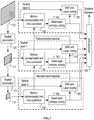
- SVC spatial scalability is supported based on the pyramid coding scheme as shown in Fig. 1 .
- the video sequence is first down-sampled to obtain smaller pictures at different spatial resolutions (layers).
- picture 110 at the original resolution can be processed by spatial decimation 120 to obtain resolution-reduced picture 111.
- the resolution-reduced picture 111 can be further processed by spatial decimation 121 to obtain further resolution-reduced picture 112 as shown in Fig. 1 .
- SVC also supports arbitrary resolution ratios, which is called extended spatial scalability (ESS).
- ESS extended spatial scalability
- layer 0 corresponds to the pictures with lowest spatial resolution and layer 2 corresponds to the pictures with the highest resolution.
- the layer-0 pictures are coded without reference to other layers, i.e., single-layer coding.
- the lowest layer picture 112 is coded using motion-compensated and Intra prediction 130.
- the motion-compensated and Intra prediction 130 will generate syntax elements as well as coding related information such as motion information for further entropy coding 140.
- Fig. 1 actually illustrates a combined SVC system that provides spatial scalability as well as quality scalability (also called SNR (Signal to Noise Ratio) scalability). The system may also provide temporal scalability, which is not explicitly shown.
- the residual coding errors can be refined using SNR enhancement layer coding 150.
- the SNR enhancement layer in Fig. 1 may provide multiple quality levels (quality scalability). Each supported resolution layer can be coded by respective single-layer motion-compensated and Intra prediction like a non-scalable coding system.
- Each higher spatial layer may also be coded using inter-layer coding based on one or more lower spatial layers.
- layer 1 video can be adaptively coded using inter-layer prediction based on layer 0 video or a single-layer coding on a macroblock by macroblock basis or other block unit.
- layer 2 video can be adaptively coded using inter-layer prediction based on reconstructed layer 1 video or a single-layer coding.
- layer-1 pictures 111 can be coded by motion-compensated and Intra prediction 131, base layer entropy coding 141 and SNR enhancement layer coding 151.
- Fig. 1 layer-1 pictures 111 can be coded by motion-compensated and Intra prediction 131, base layer entropy coding 141 and SNR enhancement layer coding 151.
- the reconstructed base layer (BL) video data is also utilized by motion-compensated and Intra prediction 131, where a coding block in spatial layer 1 may use the reconstructed BL video data as an additional Intra prediction data (i.e., no motion compensation is involved).
- layer-2 pictures 110 can be coded by motion-compensated and Intra prediction 132, base layer entropy coding 142 and SNR enhancement layer coding 152.
- the BL bitstreams and SNR enhancement layer bitstreams from all spatial layers are multiplexed by multiplexer 160 to generate a scalable bitstream.
- the coding efficiency can be improved due to inter-layer coding.
- the information required to code spatial layer 1 may depend on reconstructed layer 0 (inter-layer prediction).
- a higher layer in an SVC system is referred as an enhancement layer.
- the H.264 SVC provides three types of inter-layer prediction tools: inter-layer motion prediction, inter-layer texture prediction (or so-called inter-layer Intra prediction), and inter-layer residual
- the enhancement layer can reuse the motion information in the base layer (BL) to reduce the inter-layer motion data redundancy.
- the EL macroblock coding may use a flag, such as base_mode_flag before mb_type is determined to indicate whether the EL motion information is directly derived from the BL. If base_mode_flag is equal to 1, the partitioning data of the EL macroblock along with the associated reference indexes and motion vectors are derived from the corresponding data of the collocated 8x8 block in the BL. The reference picture index of the BL is directly used in the EL.
- the motion vectors of the EL are scaled from the data associated with the BL. Besides, the scaled BL motion vector can be used as an additional motion vector predictor for the EL.
- Inter-layer residual prediction uses the up-sampled BL residual information to reduce the information required for coding the EL residuals.
- the collocated residual of the BL can be block-wise up-sampled using a bilinear filter and can be used as prediction for the residual of a corresponding macroblock in the EL.
- the up-sampling of the reference layer residual is done on transform block basis in order to ensure that no filtering is applied across transform block boundaries.
- the inter-layer texture prediction reduces the redundant texture information of EL.
- the prediction in the EL is generated by block-wise up-sampling the collocated BL reconstruction signal.
- 4-tap and 2-tap FIR filters are applied for luma and chroma components, respectively.
- filtering for the inter-layer Intra prediction is always performed across sub-block boundaries.
- inter-layer Intra prediction can be applied only to the intra-coded macroblocks in the BL.
- the motion information of a block in the EL may use the motion information within the corresponding block in the BL.
- the motion information associated with locations a-h in the collocated block in the BL as shown in Fig. 2 can be used to derive inter-layer prediction.
- block 210 corresponds to a current block in the EL and block 220 is the corresponding block in the BL.
- the motion information at a, b, g, and h in the BL are the corresponding motion information of A, B, G, and H in the EL.
- the c, d, e, f are the corresponding motion information of C, D, E, and F in the EL.
- Locations A, B, G, and H are the four corner pixels of the current block in the EL and locations C, D, E, and F are the four center pixels of the current block in the EL.
- the motion information of the corresponding block in the BL can be utilized as inter-layer candidates for the EL to include in the Merge/AMVP candidate list.
- the neighboring candidates in the BL including t (bottom-right), a0 (bottom-left), a1 (left), b0 (upper-right), b1 (top), and b2 (upper-left) neighboring BL blocks, can be used as a candidate for the EL to include in the Merge/AMVP candidate derivation.
- the collocated EL neighboring blocks correspond to T (bottom-right), A0 (bottom-left), A1 (left), B0 (upper-right), B1 (top), and B2 (upper-left) neighboring EL blocks respectively.
- High-Efficiency Video Coding is a new international video coding standard being developed by the Joint Collaborative Team on Video Coding (JCT-VC).
- JCT-VC Joint Collaborative Team on Video Coding
- SHVC Joint Collaborative Team on Video Coding
- motion information of neighboring blocks in the spatial and temporal domains is used to derive the Merge and MVP (motion vector prediction) candidates.
- the motion information includes Inter prediction direction (inter_pred_idc), reference indexes (refldx), motion vectors (MVs), motion vector predictors (MVPs), MVP indexes, Merge indexes, Merge candidates, etc.
- the MVP can be derived from the MV pointing to the same reference picture as the target reference picture, or from the MV pointing to different reference pictures.
- the MV is scaled to the target reference picture and used as the final MVP.
- the division is required to scale the motion vector.
- the scaling factor is calculated based on the ratio of the distance between current picture and the target reference picture and the distance between the collocated picture and the reference picture for the collocated block.
- the scaling factor for spatial MVP derivation is derived similarly.
- / td , and ScalingFactor clip ⁇ 4096, 4095, tb ⁇ X + 32 > > 6 .
- ScaledMV sign ScalingFactor ⁇ MV ⁇ abs ScalingFactor ⁇ MV + 127 > > 8
- the inter-layer texture prediction can be implemented in two schemes.
- the first scheme uses CU-level signaling to indicate whether the predictor of this CU is from the up-sampled BL texture or not, where Intra_BL mode is used for signaling the selection.
- the second scheme incorporates the up-sampled BL texture into reference frame list.
- the reference picture associated with the up-sampled BL texture is assigned a reference picture index, i.e., Refldx. This scheme is referred to as Refldx mode.
- Motion information associated with a reference picture is also stored and used for Inter prediction. Accordingly, for the up-scaled BL reference, the associated MVs have to be up-scaled as well.
- Refldx mode has least impact on the existing HEVC syntax.
- the center MV of the corresponding block in the BL i.e., the MV at position "f' in Fig. 2
- the MV scaling process for inter-layer Merge candidate is different from the MV scaling process in HEVC.
- the base layer (BL) MV is scaled based on the ratio of video resolution between enhancement layer (EL) and BL.
- the BL pixel position of the reference pixel in the BL is outputted in unit of 1/16-th sample.
- the derivation of the BL pixel position in unit of 1/16-th sample is illustrated as follows.
- xBL16 xEL ⁇ picBL _ W ⁇ 16 + picEL _ W / 2 / picEL _ W .
- variable yBL16 is derived as follows:
- the decoded BL picture is up-sampled and incorporated into the long-term reference pictures list as the inter-layer reference picture.
- the inter-layer reference picture not only the texture is up-sampled from BL picture, but also the motion field is up-sampled and mapped from BL picture according to the spatial ratio of EL and BL.
- Fig. 3 shows an example of the motion field mapping with 1.5X spatial scalability.
- four smallest PUs (SPUs) in the BL i.e., b0-b3
- SPUs four smallest PUs
- EL i.e., e0-e8.
- the motion fields of the nine PUs in the EL can be derived from the motion fields of the BL.
- the motion field in the EL is compressed with the unit size of 16x16 block after the motion mapping.
- the center motion vector (as indicated by C) of a 16x16 block is used to represent the motion vector of this 16x16 block after compression, as shown in Fig. 4 .
- the motion vector scaling involves quite a few operations for each motion vector. Among them, the division operation is most time consuming or most complicated. The situation is the same for inter-layer pixel position mapping as shown in equations (7) and (8). Therefore, it is desirable to develop methods to simplify motion vector scaling and pixel position mapping for inter-layer coding.
- a method of inter-layer motion vector scaling for scalable video coding where the motion vector scaling uses an inter-layer MV scaling factor to reduce computational complexity.
- the video sequence data is configured into a Base Layer (BL) and an Enhancement Layer (EL) and wherein the EL picture has higher spatial resolution than the BL picture.
- Embodiments according to the present invention receive image size information regarding the EL picture and the BL picture of the video sequence, and determine an inter-layer motion vector (MV) scaling factor based on the image size information regarding the EL picture and the BL picture.
- BL motion vectors (MVs) associated with the BL picture are received.
- Scaled MVs are determined based on the BL MVs and the inter-layer MV scaling factor, and are provided for inter-layer predictive coding of the EL picture.
- the inter-layer MV scaling factor is related to cropped EL picture resolution of the EL picture and cropped BL picture resolution of the BL picture.
- the inter-layer MV scaling factor can be determined from a ratio of biased-pre-scaled cropped EL picture resolution to the cropped BL picture resolution, wherein the biased-pre-scaled cropped EL picture resolution is obtained by adding a bias value to pre-scaled cropped EL picture resolution, and wherein the pre-scaled cropped EL picture resolution is derived by applying arithmetic left shift by K bits to the cropped EL picture resolution and K is a non-negative integer.
- the ratio can be further clipped to a range having a floor value and a ceiling value.
- individual inter-layer MV scaling factors are determined for horizontal direction and vertical direction.
- the individual inter-layer MV scaling factors for the horizontal direction and the vertical direction can be signaled in a sequence level, a picture level or a slice level.
- the individual inter-layer MV scaling factors for the horizontal direction and the vertical direction are signaled in sequence parameter set (SPS), picture parameter set (PPS), slice header, SPS extension, PPS extension, or slice segment header extension.
- SPS sequence parameter set
- PPS picture parameter set
- slice header SPS extension
- PPS extension picture parameter set
- slice segment header extension SPS extension
- a flag can be used to indicate whether the individual inter-layer MV scaling factors are equal or not.
- the inter-layer MV scaling factor is determined once for an EL image unit and all blocks in the EL image unit share the inter-layer MV scaling factor, wherein the image unit corresponds to one video sequence, one picture, one slice, one coding tree unit (CTU), one coding tree block (CTB), one coding unit (CU) or one prediction unit (PU).
- an inter-layer position-mapping scaling factor is determined based on the inter-layer MV scaling factor, wherein the inter-layer position-mapping scaling factor is used to determine BL mapping positions corresponding to EL pixel positions, and wherein the BL mapping positions are determined based on the EL pixel positions and the inter-layer position-mapping scaling factor.
- a method of inter-layer position-mapping for scalable video coding where pixel position mapping uses an inter-layer position-mapping scaling factor to reduce computational complexity.
- Embodiments according to the present invention receive image size information regarding the EL picture and the BL picture of the video sequence, and determine the inter-layer position-mapping scaling factor based on the image size information regarding the EL picture and the BL picture.
- BL mapping positions corresponding to EL pixel positions are determined based on the EL pixel positions and the inter-layer position-mapping scaling factor, and are provided for inter-layer predictive coding of the EL picture.
- the inter-layer position-mapping scaling factor is related to cropped BL picture resolution of the BL picture and cropped EL picture resolution of the EL picture.
- the inter-layer position-mapping scaling factor can be determined from a ratio of biased-pre-scaled cropped BL picture resolution to the cropped EL picture resolution, wherein the biased-pre-scaled cropped BL picture resolution is obtained by adding a bias value to pre-scaled cropped BL picture resolution, and wherein the pre-scaled cropped BL picture resolution is derived by applying arithmetic left shift by N bits to the cropped BL picture resolution and N is a non-negative integer.
- the BL mapping position for a given EL pixel position can be determined by adding a first offset term to a first product, wherein the first offset term corresponds to BL picture cropping starting position, the first product is obtained by multiplying the inter-layer position-mapping scaling factor by a first distance from the given EL pixel position to the EL picture cropping starting position.
- the first product can be further processed by adding a bias value to obtain a biased first product and applying arithmetic right shift by N bits to the biased first product, and N is a non-negative integer.
- the BL mapping position for the given EL pixel position can be determined by adding a second offset term to the first offset term and the first product, wherein the second offset term corresponds to a phase shift related to up-sampling and down-sampling applied to the EL picture and the BL picture.
- the EL pixel position and the BL pixel positions can be clipped to a range.
- an inter-layer motion vector (MV) scaling factor is determined based on the inter-layer position-mapping scaling factor, wherein the inter-layer MV scaling factor is used to determine scaled MVs based on the BL MVs and the inter-layer MV scaling factor.
- the processing involves moderate amount of computation for motion vector scaling and inter-layer pixel position mapping.
- SVC AVC/H.264
- SHVC HEVC
- equations (5) and (6) the division has to be performed for every inter-layer MV even when the picture resolution ratio of the EL to the BL is a fixed value.
- equations (5) and (6) do not take into consideration of the frame cropping issue.
- Embodiments of the present invention disclose inter-layer motion information derivation for SHVC to reduce the required computation complexity.
- two inter-layer motion vector (MV) scaling factors are derived for inter-layer MV scaling first.
- the MV scaling process in HEVC as shown the equation (4) is re-used.
- One scaling factor is used for the horizontal direction (MV_x), and the other is used for the vertical direction (MV_y).
- MV_x horizontal direction
- MV_y vertical direction
- the cropping factors are also considered.
- the EL picture is cropped on the left side by picELCropLeftOffset pixels and on the right side by picELCropRightOffset pixels.
- offset1_x can be 0 or can be derived as (picBLCropWidth) >>1 or ((picBLCropWidth) >>1)-1.
- K1 is an integer and K1 can be 8 as an example.
- scaling factor, ILScalingFactor_x is related to the ratio of cropped EL picture width (i.e. picELCropWidth) to cropped BL picture width (i.e., picBLCropWidth), and ILScalingFactor x is represented as an integer.
- picELCropWidth is pre-scaled by applying arithmetic left shift by K1 bits.
- a bias value i.e., offset1_x
- the bias-added, pre-scaled picELCropWidth is then divided by picBLCropWidth to obtain ILScalingFactor_x.
- the EL picture is cropped on the top side by picELCropTopOffset pixels and on the bottom side by picELCropBottomOffset pixels.
- offset1_y can be 0 or can be derived as (picBLCropHeight) >>1 or ((picBLCropHeight) >>1)-1.
- scaling factor, ILScalingFactor_y is related to the ratio of cropped EL picture height (i.e. picELCropHeight) to cropped BL picture height (i.e., picBLCropHeight), and ILScalingFactor_y is represented as an integer.
- picELCropHeight is pre-scaled by applying arithmetic left shift by K1 bits.
- a bias value i.e., offset1_y
- the bias-added, pre-scaled picELCropHeight is then divided by picBLCropHeight to obtain ILScalingFactor_y.
- picELCropLeftOffset and picELCropTopOffset are referred as EL picture first edge in this disclosure.
- picBLCropLeftOffset and picBLCropTopOffset are referred as BL picture first edge in this disclosure.
- K1 is used for ILScalingFactor x and ILScalingFactor_y derivation as shown in equations (9) and (10), two different parameters may also be used. If the EL picture is not cropped horizontally, both picELCropLeftOffset and picELCropRightOffset will be 0. If the BL picture is not cropped horizontally, both picBLCropLeftOffset and picBLCropRightOffset will be 0. If the EL picture is not cropped vertically, both picELCropTopOffset and picELCropBottomOffset will be 0. If the BL picture is not cropped vertically, both picBLCropTopOffset and picBLCropBottomOffset will be 0.
- the inter-layer MV scaling factors can be further clipped within a certain range.
- clip_floor1_xand clip_floor1_y can be -(2 ⁇ O1) or 0, clip_ceiling1_x and clip_ceiling1_y can be (2 ⁇ P1-1), where O1 and P1 are integers. For example, O1 and P1 can be 14.
- O1 and P1 can be 14.
- clip_floor1_x and clip_floor1_y use the same value, they may also have different floor values.
- clip_ceiling1_x and clip_ceiling1_y use the same value, they may also have different floor values.
- parameters picELCropLeftOffset, picELCropRightOffset, picELCropTopOffset and picELCropBottomOffset specify the samples of the cropped EL pictures in the coded video sequence.
- the samples of the EL pictures are generated from the decoding process and the samples of the cropped EL pictures are specified in a rectangular region by the four offset quantities around the cropped EL picture.
- parameters picBLCropLeftOffset, picBLCropRightOffset, picBLCropTopOffset and picBLCropBottomOffset specify the samples of the cropped BL pictures in the coded video sequence.
- the samples of the cropped BL pictures are generated from the decoding process and the samples of the BL pictures are specified in a rectangular region by the offset quantities around the cropped BL picture.
- the scaled MV can be further clipped within a certain range.
- the inter-layer MV scaling method-1 as described above can be simplified.
- the sign part can be determined from mvBL_X and mvBL_Y respectively.
- mvEL _ X clip ( clip _ floor 2 _ x , clip _ ceiling 2 _ x , sign mvBL _ X ⁇ ⁇ abs ILScalingFactor _ x ⁇ mvBL _ X + add 2 _ x > > K 2 )
- mvEL _ Y clip ( clip _ floor 2 _ y , clip _ ceiling 2 _ y , sign mvBL _ Y ⁇ abs ILScalingFactor _ y ⁇ mvBL _ Y + add 2 _ y > > K 2 )
- mvEL _ Y clip ( clip _ floor 2 _ y , clip _ ceiling 2 _ y , sign mvBL _ Y ⁇ abs ILScalingFactor _ y ⁇ mvBL _ Y + add 2 _ y > > K 2 )
- ILScalingFactor_x and ILScalingFactor_y will be the same for all coding blocks. Therefore, the computation of ILScalingFactor_x and ILScalingFactor_y can be executed once and the results can be reused for all coding blocks in the EL. Accordingly, embodiments as disclosed above can reduce computation complexity of MV scaling in the EL when the MVs in BL are scaled.
- the ILScalingFactor x and ILScalingFactor_y can be signaled in sequence/picture/slice-level.
- the ILScalingFactor_x and ILScalingFactor_y can be signaled in SPS (sequence parameter set), PPS (picture parameter set), slice header, SPS extension, PPS extension or slice segment header extension.
- SPS sequence parameter set
- PPS picture parameter set
- slice header SPS extension
- PPS extension or slice segment header extension One flag can be sent to indicate whether ILScalingFactor_x and ILScalingFactor_y are the same. If ILScalingFactor x is equal to ILScalingFactor_y, only one of them needs to be signaled.
- equations (7) and (8) the division has to be performed for every inter-layer pixel position mapping even when the picture resolution ratio of the EL to the BL is a fixed value.
- equations (7) and (8) do not take into consideration of the frame cropping issue.
- Embodiments of the present invention disclose inter-layer BL pixel position mapping for SHVC to reduce the required computation complexity.
- inter-layer position mapping scaling factors are derived first for inter-layer pixel position mapping.
- the scaling factors are then reused to derive the reference pixel position in the BL.
- One scaling factor is used for the horizontal position (x-direction), and the other is used for the vertical position (y-direction).
- the cropping factors are also considered.
- offset_x can be 0 or derived as (picELCropWidth) >>1 or ((picELCropWidth) >>1) - 1.
- N1 is an integer.
- N1 can be 8, 10, 12, 14 or 16.
- scaling factor, ILPosScalingFactor x is related to the ratio of cropped BL picture width (i.e. picBLCropWidth) to cropped EL picture width (i.e., picELCropWidth), and ILPosScalingFactor x is represented as an integer.
- picBLCropWidth is pre-scaled by applying arithmetic left shift by N1 bits.
- a bias value i.e., offset_x
- the bias-added, pre-scaled picBLCropWidth is then divided by picELCropWidth to obtain ILPosScalingFactor_x.
- offset_y can be 0 or derived as (picELCropHeight) >>1 or ((picELCropHeight)>>1) - 1.
- scaling factor, ILPosScalingFactor_y is related to the ratio of cropped BL picture height (i.e. picBLCropHeight) to cropped EL picture width (i.e., picELCropHeight), and ILPosScalingFactor_y is represented as an integer.
- picBLCropHeight is pre-scaled by applying arithmetic left shift by N1 bits.
- a bias value i.e., offset_y
- the bias-added, pre-scaled picBLCropHeight is then divided by picELCropHeight to obtain ILPosScalingFactor_y.
- N1 is used for both ILPosScalingFactor_x and ILPosScalingFactor_y derivation, different parameters may also be used.
- parameters picELCropLeftOffset, picELCropRightOffset, picELCropTopOffset and picELCropBottomOffset specify the samples of the cropped EL pictures in the coded video sequence.
- the samples of the cropped EL pictures are generated from the decoding process and the samples of the EL picture are specified in a rectangular region by the four offset quantities around the cropped EL picture.
- parameters picBLCropLeftOffset, picBLCropRightOffset, picBLCropTopOffset and picBLCropBottomOffset specify the samples of the cropped BL pictures in the coded video sequence.
- the samples of the BL pictures are generated from the decoding process and the samples of the BL pictures are specified in a rectangular region by the four offset quantities around the cropped BL picture.
- picELCropLeftOffset, picELCropRightOffset, picELCropTopOffset and picELCropBottomOffset will be 0.
- picBLCropLeftOffset, picBLCropRightOffset, picBLCropTopOffset and picBLCropBottomOffset will be 0.
- the term (xEL-picELCropLeftOffset) corresponds to the horizontal distance between the current EL pixel position (i.e., xEL) and the EL picture first edge in the x direction.
- the horizontal distance is then multiplied by ILPosScalingFactor x to obtain a first product term.
- a bias i.e., add3_x
- the result is then pre-scaled by applying arithmetic right shifted by N1 bits.
- the BL mapping position in the x direction is determined by adding picBLCropLeftOffset to the pre-scaled result.
- the BL mapping position in the y direction is determined similarly as shown in equation (24).
- the up-sampling and down-sampling filters use different phases. Since the BL picture is derived from an original high resolution picture by using down-sampling. For inter-layer prediction, a BL picture has to be up-sampled to match the resolution of an EL picture. If the down-sampling filtering and up-sampling filter is not properly done, phase shift may occur in the up-sampled or down-sampled data.
- the (xEL, yEL) and the (xBL, yBL) can be clipped into a valid range before or after pixel mapping.
- the (xEL, yEL) and the (xBL, yBL) can be clipped to be within a picture frame.
- the (xEL, yEL) can be clipped before inter-layer pixel position mapping.
- ILPosScalingFactor_x and ILPosScalingFactor_y will be the same for all pixels. Therefore the computation of ILPosScalingFactor_x and ILPosScalingFactor_y can be performed once and the results can be reused for all pixels in the EL. Accordingly, embodiments of the present invention can substantially reduce the computation complexity for inter-layer pixel position mapping.
- the ILPosScalingFactor_x and ILPosScalingFactor_y can be signaled in sequence, picture or slice-level.
- the ILPosScalingFactor_x and ILPosScalingFactor_y can be signaled in SPS, PPS, or slice header.
- One flag can be sent to indicate whether ILPosScalingFactor_x and ILPosScalingFactor_y are the same. If ILPosScalingFactor x is equal to ILPosScalingFactor_y, only one of them needs to be signaled.
- ILPosScalingFactor_x and ILPosScalingFactor_y can be derived from ILScalingFactor_x and ILScalingFactor_y, respectively, if ILScalingFactor x and ILScalingFactor_y already exist.
- M2 is used for both ILPosScalingFactor_x and ILPosScalingFactor_y derivation, different parameters may also be used.
- N2 is used for both ILPosScalingFactor_x and ILPosScalingFactor_y derivation, different parameters may also be used.
- ILScalingFactor_x can be derived from ILPosScalingFactor_x
- ILScalingFactor_y can be derived from ILPosScalingFactor_y, when ILPosScalingFactor_x and ILPosScalingFactor_y already exist.
- the factors, N3 and M3 can be dependent on the information of picture size of the EL, picture size of the BL, cropped picture size of the EL, cropped picture size of the BL, level index/information of the EL, level index/information of the BL.
- 13 can be 14, J3 can be 6, K3 can be -4096 or 0, and L3 can be 4095.
- Factor _ Y 2 ⁇ I 3 +
- factor_EL_x can be derived from the information of picELCropLeftOffset, picELCropRightOffset, horizontal phase shift of EL, color format of EL, or color component of EL.
- Factor_BL_x can be derived from the information of picBLCropLeftOffset, picBLCropRightOffset, horizontal phase shift of BL, color format of BL, or color component of BL.
- Factor_EL_y can be derived from the information of picELCropTopOffset, picELCropBottomOffset, vertical phase shift of EL, color format of EL, or color component of EL.
- Factor_BL_y can be derived from the information of picBLCropTopOffset, picBLCropBottomOffset, vertical phase shift of BL, color format of BL, or color component of BL. While the same parameter, N4 is used for xBL and yBL derivation, different parameters may also be used.
- the base layer pixel position is derived in the units of 1/M5 pixel.
- the ILPosScalingFactor_x and ILPosScalingFactor_y can be replaced as ILPosScalingFactor_x*M5 and ILPosScalingFactor_y*M5 for deriving the collocated BL pixel position.
- the factor_BL_x, factor_BL_y, factor EL_x, factor_EL_y can be changed accordingly with the value of M4.
- xBL _ M 5 xEL + factor _ EL _ x ⁇ ILPosScalingFactor _ x * M 5 + add 6 _ x > > N 5 + factor _ BL _ x
- xBL _ M 5 yEL + factor _ EL _ y ⁇ ILPosScalingFactor _ y * M 5 + add 6 _ y > > N 5 + factor _ BL _ y
- add6_x, add6_y, M5 and N5 are integers. While the same parameter, M5 is used for xBL and yBL derivation, different parameters may also be used. Similarly, the same parameter, N5 is used for xBL and yBL derivation, different parameters may also be used.
- the texture up-sampled pixel position takes into consideration of the phase shift between samples in the EL and BL.
- variable yBL_M6 is derived as follows:
- xBL_M5 xEL ⁇ ILPosScalingFactor _ x + add 6 _ x > > N 5 ⁇ BL _ phase _ offset _ x
- ILPosScalingFactorM _ y picBL _ H ⁇ picBLCropLeftOffset ⁇ picBLCropRightOffset ⁇ ⁇ N 5 + offset _ y / picEL _ H ⁇ picELCropLeftOffset ⁇ picELCropRightOffset , where offset_y can be 0, ((picEL_H - picELCropTopOffset - picELCropBottomOffset) >>1) or ((picEL_H - picELCropTopOffset - picELCropBottomOffset>>1) -1.
- xBL_M5 xEL ⁇ ILPosScalingFactor _ x + add 6 _ x > > N 5 ⁇ Ceil Log 2 M 5 ⁇ BL _ phase _ offset _ x
- the factor N (i.e., N4-N6 in equations (39)-(55)) can be dependent on the information of picture size of EL, picture size of BL, cropped picture size of EL, cropped picture size of BL, level index/information of EL, or level index/information of BL.
- TMVP temporal MVP
- the MV of the bottom-right PU is used for motion field mapping.
- the bottom-right motion vector of a 16x16 block (the MV that belongs to the bottom-right pixel of a 16x16 block) is used to represent the motion vector of this 16x16 block after motion mapping.
- the collocated BL MV of the center point of a 16x16 block is used to represent the motion vector of the 16x16 block.
- the BL motion field is compressed with the unit of 16x16 block.
- the upper-left MV of a 16x16 block is used to represent the motion vector of this 16x16 block. Since in the BL motion field is compressed, the derived BL MV may not be the best MV.
- Fig. 5 illustrates an example of the scenario that the derived BL MV may not be the best MV, where the MV of point P is mapped to the MV of block 1. However, since the MV of block 4 is closer to the MV of point P, block 4 should provide a better MV for point P.
- another embodiment of the present invention rounds the BL pixel position mapping to get the closest MV.
- the collocated pixel position in BL xBL, yBL
- the inter-layer collocated MV derivation a rounding offset is added to the (xBL, yBL) to obtain the closest compressed BL MV. Accordingly, (N/2 - 1) offset is added for (xBL, yBL) if the motion field is compressed with the unit of NxN.
- the N equals to 16. Therefore, a (7, 7) offset is added to the (xBL, yBL) for inter-layer collocated MV derivation.
- an up-sampled BL picture of current frame is inserted into the reference frame list.
- another embodiment of the present invention inserts another differential inter-layer reference picture (DIRP) into the reference picture list.
- DIRP is generated by adding the up-sampled BL picture of the current frame (frame C) with one of the EL reference frame (frame B), and subtracting by the up-sampled BL picture of the one of the EL reference frame (frame D).
- DIRP differential inter-layer reference picture
- DIRP(x,y) clip (pixel_min_value, pixel_max_value, (B(x,y)+C(x,y)-D(x,y))) (56) where DIRP(x,y) is the pixel value at point (x,y) in DIRP, B(x,y) is the pixel value of point (x,y) in one of the EL reference frame, C(x,y) is the pixel value at point (x,y) of the up-sampled BL picture of current frame, D(x,y) is the pixel value at point (x,y) of the up-sampled BL picture of the one of the EL reference frame.
- This DIRP can be inserted as the last of the reference frame list.
- Fig. 6 illustrates an exemplary flowchart of a scalable video coding system incorporating an inter-layer motion vector (MV) scaling factor according to an embodiment of the present invention.
- the video data is configured into a Base Layer (BL) and an Enhancement Layer (EL), where the EL video data has higher spatial resolution than the BL video data.
- the system receives image size information regarding the EL picture and the BL picture of the video sequence as shown in step 610.
- the image size information may be determined by the encoder.
- the image size information may be determined from the coded bitstream.
- An inter-layer motion vector (MV) scaling factor is determined based on the image size information regarding the EL picture and the BL picture as shown in step 620.
- BL motion vectors (MVs) associated with the BL picture are then determined as shown in step 630.
- the BL MVs may be determined using motion estimation and the derived BL MVs may be incorporated in the bitstream.
- the BL MVs may be determined from the coded bitstream.
- Scaled MVs are determined based on the BL MVs and the inter-layer MV scaling factor and the scaled MVs are provided for inter-layer coding of the EL picture as shown in steps 640 and 650.
- Fig. 7 illustrates an exemplary flowchart of a scalable video coding system incorporating an inter-layer position-mapping scaling factor according to an embodiment of the present invention.
- the system receives image size information regarding the EL picture and the BL picture of the video sequence as shown in step 710.
- the inter-layer position-mapping scaling factor is determined based on the image size information regarding the EL picture and the BL picture as shown in step 720.
- BL mapping positions corresponding to EL pixel positions are determined based on the EL pixel positions and the inter-layer position-mapping scaling factor as shown in step 730.
- the up-sampled BL picture at the BL mapping positions is then provided for inter-layer coding of the EL picture as shown in step 740.
- Embodiment of the present invention as described above may be implemented in various hardware, software codes, or a combination of both.
- an embodiment of the present invention can be a circuit integrated into a video compression chip or program code integrated into video compression software to perform the processing described herein.
- An embodiment of the present invention may also be program code to be executed on a Digital Signal Processor (DSP) to perform the processing described herein.
- DSP Digital Signal Processor
- the invention may also involve a number of functions to be performed by a computer processor, a digital signal processor, a microprocessor, or field programmable gate array (FPGA). These processors can be configured to perform particular tasks according to the invention, by executing machine-readable software code or firmware code that defines the particular methods embodied by the invention.
- the software code or firmware code may be developed in different programming languages and different formats or styles.
- the software code may also be compiled for different target platforms.
- different code formats, styles and languages of software codes and other means of configuring code to perform the tasks in accordance with the invention will not depart from the spirit and scope of the invention.
Landscapes
- Engineering & Computer Science (AREA)
- Multimedia (AREA)
- Signal Processing (AREA)
- Compression Or Coding Systems Of Tv Signals (AREA)
Claims (11)
- Procédé de prédiction inter-couche pour codage vidéo gradué, dans lequel des données de séquence vidéo sont configurées en une couche de base, BL, et une couche d'amélioration, EL, et dans lequel une image d'EL dans l'EL a une résolution spatiale supérieure à celle d'une image de BL dans la BL, le procédé comprenant :la réception d'informations de taille d'image concernant l'image d'EL et l'image de BL de la séquence vidéo (610) ;la détermination d'un facteur d'échelle de vecteur de mouvement inter-couche, MV, pour la direction horizontale et d'un facteur d'échelle de MV pour la direction verticale, appelés collectivement des facteurs d'échelle de MV inter-couche (620) ;la détermination de vecteurs de mouvement, MV, de BL associés à l'image de BL (630) ;la détermination de MV mis à l'échelle en appliquant les facteurs d'échelle de MV inter-couche aux MV de BL (640) ; etla fourniture des MV mis à l'échelle pour le codage inter-couche de l'image d'EL (650),caractérisé en ce que le procédé comprend en outre :la détermination du facteur d'échelle de MV inter-couche pour la direction horizontale à partir d'un rapport entre la largeur d'image d'EL recadrée pré-échelonnée et polarisée et la largeur d'image de BL recadrée, dans lequel la largeur d'image d'EL recadrée, pré-échelonnée et polarisée est obtenue en ajoutant une valeur de polarisation à la largeur d'image d'EL recadrée pré-échelonnée, et dans lequel la largeur d'image d'EL recadrée pré-échelonnée est déduite en appliquant un décalage arithmétique gauche de K bits à la largeur d'image d'EL recadrée, et K est un entier non négatif, etla détermination du facteur d'échelle de MV inter-couche pour la direction verticale à partir d'un rapport entre la hauteur d'image d'EL recadrée pré-échelonnée et polarisée et la hauteur d'image de BL recadrée, dans lequel la hauteur d'image d'EL recadrée pré-échelonnée et polarisée est obtenue en ajoutant une valeur de polarisation à la hauteur d'image d'EL recadrée pré-échelonnée, etdans lequel la hauteur d'image d'EL recadrée pré-échelonnée est déduite en appliquant un décalage arithmétique gauche de K bits à la hauteur d'image d'EL recadrée, et K est un nombre entier non négatif ; etla détermination des facteurs d'échelle de MV inter-couche une fois pour une unité d'image d'EL et le partage des facteurs d'échelle de MV inter-couche parmi tous les blocs dans l'unité d'image d'EL, dans lequel l'unité d'image correspond à une séquence vidéo, une image, une tranche, un unité d'arborescence de codage, CTU, un bloc d'arborescence de codage, CTB, une unité de codage, CU, ou une unité de prédiction, PU.
- Procédé de la revendication 1, dans lequel les rapports déterminés pour les facteurs d'échelle de MV inter-couche pour la direction horizontale et la direction verticale, respectivement, sont en outre fixés dans une plage ayant une valeur plancher et une valeur plafond.
- Procédé selon la revendication 1 ou 2, dans lequel les facteurs d'échelle de MV inter-couche individuels pour la direction horizontale et la direction verticale sont signalés dans un niveau de séquence, un niveau d'image ou un niveau de tranche ; et
dans lequel un indicateur est utilisé pour indiquer si les facteurs d'échelle de MV inter-couche individuels sont égaux ou non. - Procédé selon la revendication 1 ou 2, comprenant en outre la détermination d'un facteur d'échelle pour la cartographie de positions de pixels inter-couches pour la direction horizontale et d'un facteur d'échelle pour la cartographie de positions de pixels inter-couches pour la direction verticale, désignés collectivement comme facteurs d'échelle de cartographie de positions de pixels inter-couches, sur la base du facteur d'échelle de MV inter-couche,
dans lequel les facteurs d'échelle de cartographie de positions inter-couches sont utilisés pour déterminer des positions de cartographie de BL correspondant à des positions de pixels d'EL, et dans les positions de cartographie de BL sont déterminées en appliquant les facteurs d'échelle de cartographie de positions inter-couches aux positions de pixels d'EL. - Procédé de prédiction inter-couche pour codage vidéo gradué, dans lequel des données de séquence vidéo sont configurées en une couche de base, BL, et une couche d'amélioration, EL, et dans lequel une image d'EL dans l'EL a une résolution spatiale supérieure à celle d'une image de BL dans la BL, le procédé comprenant :la réception d'informations de taille d'image concernant l'image d'EL et l'image de BL de la séquence vidéo (710) ;la détermination d'un facteur d'échelle pour une cartographie de positions de pixels inter-couches pour une direction horizontale et d'un facteur d'échelle pour une cartographie de positions de pixels inter-couches pour une direction verticale, appelés collectivement des facteurs d'échelle de cartographie de positions de pixels inter-couches ;la détermination de positions de cartographie de BL correspondant à des positions de pixels d'EL en appliquant les facteurs d'échelle de cartographie de positions de pixels inter-couches aux positions de pixels d'EL (730) ; etla fourniture d'une image de BL échantillonnée en croissance au niveau des positions de cartographie de BL pour le codage inter-couche de l'image d'EL (740),caractérisé par le procédé qui comprend en outre :la détermination du facteur d''échelle de cartographie de positions de pixels inter-couches pour une direction horizontale à partir d'un rapport de largeur d'image de BL recadrée pré-échelonnée et polarisée à la largeur d'image d'EL recadrée, dans lequel la largeur d'image de BL recadrée pré-échelonnée et polarisée est obtenue en ajoutant une valeur de polarisation à la largeur d'image de BL recadrée pré-échelonnée, et dans lequel la largeur d'image de BL recadrée pré-échelonnée est déduite en appliquant un décalage arithmétique gauche de N bits à la largeur d'image de BL recadrée, et N est un nombre entier non négatif, etdéterminer le facteur d'échelle de cartographie de positions de pixels inter-couches pour la direction verticale à partir d'un rapport de hauteur d'image de BL recadrée, pré-échelonnée et polarisée à la hauteur d'image d'EL recadrée, dans lequel la hauteur d'image recadrée, pré-échelonnée et polarisée est obtenue en ajoutant une valeur de polarisation à la hauteur d'image de BL recadrée et pré-échelonnée, et dans lequel la largeur d'image de BL recadrée et pré-échelonnée est déduite en appliquant un décalage arithmétique gauche de N bits à la hauteur d'image de BL recadrée, et N est un entier non négatif ;la détermination des facteurs d'échelle de cartographie de positions de pixels inter-couches une fois pour une unité d'image d'EL et le partage des facteurs d'échelle de cartographie de positions de pixels inter-couches parmi tous les blocs dans l'unité d'image EL, dans lequel l'unité d'image correspond à une séquence vidéo, une image, une tranche, un unité d'arborescence de codage, CTU, un bloc d'arborescence de codage, CTB, une unité de codage, CU, ou une unité de prédiction, PU.
- Procédé selon la revendication 5, dans lequel la position de cartographie de BL pour une position de pixel d'EL donnée est déterminée en ajoutant un premier terme de décalage à un premier produit, dans lequel le premier terme de décalage correspond au premier bord d'image de BL, le premier produit est obtenu en multipliant le facteur d'échelle de cartographie de positions de pixels inter-couches par une première distance à partir de la position de pixel d'EL donnée jusqu'au premier bord d'image d'EL pour la direction horizontale et la direction verticale, respectivement.
- Procédé selon la revendication 6, dans lequel le premier produit est en outre traité en ajoutant une valeur de polarisation pour obtenir un premier produit polarisé et en appliquant un décalage arithmétique droit de N bits au premier produit polarisé, et N est un nombre entier non négatif ; et
dans lequel la position de cartographie de BL pour la position de pixel d'EL donnée est déterminée en ajoutant un second terme de décalage au premier terme de décalage et au premier produit, dans lequel le second terme de décalage correspond à un déphasage lié à un échantillonnage en croissance et un échantillonnage en décroissance appliqués à l'image de EL et l'image de BL. - Procédé selon la revendication 5, dans lequel les positions de pixels d'EL sont fixés à une plage liée à la taille d'image d'EL ou à la taille d'image d'EL recadrée de l'image d'EL avant ladite détermination des positions de cartographie de BL correspondant aux positions de pixels d'EL.
- Procédé selon la revendication 5, dans lequel les positions de pixels de mappage BL sont limitées à une plage liée à la taille d'image BL ou à la taille d'image BL recadrée de l'image BL après avoir déterminé les positions de mappage BL correspondant aux positions de pixel EL.
- Procédé selon la revendication 5, dans lequel les facteurs d'échelle de cartographie de positions de pixels inter-couches individuels pour la direction horizontale et la direction verticale sont signalés dans un niveau de séquence, un niveau d'image ou un niveau de tranche ; et
dans lequel un indicateur est utilisé pour indiquer si les facteurs d'échelle de cartographie de positions de pixels inter-couches individuels sont égaux ou non. - Procédé selon la revendication 5, comprenant en outre la détermination d'un facteur d'échelle de vecteur de mouvement inter-couche, MV, sur la base du facteur d'échelle de cartographie de positions de pixels inter-couches,
dans lequel le facteur d'échelle de MV inter-couche est utilisé pour déterminer des MV mis à l'échelle en appliquant le facteur d'échelle de MV inter-couche aux MV de BL.
Applications Claiming Priority (5)
| Application Number | Priority Date | Filing Date | Title |
|---|---|---|---|
| US201361777250P | 2013-03-12 | 2013-03-12 | |
| US201361803222P | 2013-03-19 | 2013-03-19 | |
| US201361814591P | 2013-04-22 | 2013-04-22 | |
| US201361846128P | 2013-07-15 | 2013-07-15 | |
| PCT/CN2014/073311 WO2014139431A1 (fr) | 2013-03-12 | 2014-03-12 | Mise à l'échelle de vecteur de mouvement inter-couche pour un codage vidéo gradué |
Publications (3)
| Publication Number | Publication Date |
|---|---|
| EP2974313A1 EP2974313A1 (fr) | 2016-01-20 |
| EP2974313A4 EP2974313A4 (fr) | 2016-07-27 |
| EP2974313B1 true EP2974313B1 (fr) | 2018-07-11 |
Family
ID=51535874
Family Applications (1)
| Application Number | Title | Priority Date | Filing Date |
|---|---|---|---|
| EP14764414.0A Active EP2974313B1 (fr) | 2013-03-12 | 2014-03-12 | Mise à l'échelle de vecteur de mouvement inter-couche pour un codage vidéo gradué |
Country Status (5)
| Country | Link |
|---|---|
| US (1) | US9756350B2 (fr) |
| EP (1) | EP2974313B1 (fr) |
| CN (1) | CN105052144B (fr) |
| AU (2) | AU2014231403A1 (fr) |
| WO (1) | WO2014139431A1 (fr) |
Families Citing this family (14)
| Publication number | Priority date | Publication date | Assignee | Title |
|---|---|---|---|---|
| US9743097B2 (en) * | 2013-03-01 | 2017-08-22 | Qualcomm Incorporated | Spatial motion vector scaling for scalable video coding |
| GB2512829B (en) * | 2013-04-05 | 2015-05-27 | Canon Kk | Method and apparatus for encoding or decoding an image with inter layer motion information prediction according to motion information compression scheme |
| WO2015103032A1 (fr) * | 2014-01-02 | 2015-07-09 | Vid Scale, Inc. | Procédés et systèmes pour le codage vidéo échelonnable utilisant un entrelacement mixte et un contenu progressif |
| US10250884B2 (en) | 2014-06-20 | 2019-04-02 | Qualcomm Incorporated | Systems and methods for signaling information for layer sets in a parameter set |
| US20170105006A1 (en) * | 2015-10-13 | 2017-04-13 | Mediatek Inc. | Method and Apparatus for Video Coding Using Master-Slave Prediction Structure |
| KR20170059718A (ko) * | 2015-11-23 | 2017-05-31 | 삼성전자주식회사 | 디코딩 장치 및 그 방법 |
| KR20180085714A (ko) * | 2015-12-17 | 2018-07-27 | 삼성전자주식회사 | 머지 후보 리스트를 이용한 비디오 복호화 방법 및 비디오 복호화 장치 |
| WO2017154604A1 (fr) * | 2016-03-10 | 2017-09-14 | ソニー株式会社 | Dispositif et procédé de traitement d'image |
| US10291923B2 (en) * | 2016-05-24 | 2019-05-14 | Qualcomm Incorporated | Mapping of tile grouping and samples in HEVC and L-HEVC file formats |
| WO2019073112A1 (fr) | 2017-10-09 | 2019-04-18 | Nokia Technologies Oy | Appareil, procédé, et programme informatique pour un codage et un décodage vidéo |
| EP3831067A1 (fr) * | 2018-08-03 | 2021-06-09 | V-Nova International Limited | Sur-échantillonnage pour codage d'amélioration de signal |
| CN113196771B (zh) | 2018-12-21 | 2023-12-22 | 北京字节跳动网络技术有限公司 | 基于运动矢量精度的运动矢量范围 |
| US11635408B2 (en) * | 2019-09-24 | 2023-04-25 | The Boeing Company | Method for tracking location of two-dimensional non-destructive inspection scanner on target object using scanned structural features |
| EP4443874A1 (fr) | 2023-04-03 | 2024-10-09 | Axis AB | Codage de flux vidéo pendant le changement de champ de vision de caméra |
Family Cites Families (6)
| Publication number | Priority date | Publication date | Assignee | Title |
|---|---|---|---|---|
| KR20060063613A (ko) * | 2004-12-06 | 2006-06-12 | 엘지전자 주식회사 | 영상 신호의 스케일러블 인코딩 및 디코딩 방법 |
| US7961963B2 (en) * | 2005-03-18 | 2011-06-14 | Sharp Laboratories Of America, Inc. | Methods and systems for extended spatial scalability with picture-level adaptation |
| CN104822062B (zh) * | 2007-01-08 | 2018-11-30 | 诺基亚公司 | 用于视频编码中扩展空间可分级性的改进层间预测 |
| CN101198064A (zh) * | 2007-12-10 | 2008-06-11 | 武汉大学 | 一种分辨率分层技术中的运动矢量预测方法 |
| CN101873484B (zh) * | 2009-08-13 | 2012-05-30 | 杭州海康威视软件有限公司 | 分层视频编码中编码模式选择方法及装置 |
| CN102740078B (zh) | 2012-07-12 | 2014-10-22 | 北方工业大学 | 基于hevc标准的自适应空间可伸缩编码 |
-
2014
- 2014-03-12 EP EP14764414.0A patent/EP2974313B1/fr active Active
- 2014-03-12 AU AU2014231403A patent/AU2014231403A1/en not_active Abandoned
- 2014-03-12 CN CN201480014067.9A patent/CN105052144B/zh active Active
- 2014-03-12 US US14/767,469 patent/US9756350B2/en active Active
- 2014-03-12 WO PCT/CN2014/073311 patent/WO2014139431A1/fr not_active Ceased
-
2016
- 2016-10-04 AU AU2016238829A patent/AU2016238829B2/en active Active
Non-Patent Citations (1)
| Title |
|---|
| None * |
Also Published As
| Publication number | Publication date |
|---|---|
| EP2974313A4 (fr) | 2016-07-27 |
| WO2014139431A1 (fr) | 2014-09-18 |
| CN105052144B (zh) | 2019-01-01 |
| EP2974313A1 (fr) | 2016-01-20 |
| US9756350B2 (en) | 2017-09-05 |
| AU2016238829B2 (en) | 2018-02-22 |
| AU2014231403A1 (en) | 2015-07-16 |
| AU2016238829A1 (en) | 2016-10-27 |
| US20150381999A1 (en) | 2015-12-31 |
| CN105052144A (zh) | 2015-11-11 |
Similar Documents
| Publication | Publication Date | Title |
|---|---|---|
| EP2974313B1 (fr) | Mise à l'échelle de vecteur de mouvement inter-couche pour un codage vidéo gradué | |
| US11223837B2 (en) | Inter-layer texture coding with adaptive transform and multiple inter-layer motion candidates | |
| EP2813079B1 (fr) | Procédé et appareil de prédiction intercouche pour codage vidéo évolutif | |
| US20210297697A1 (en) | Method, an apparatus and a computer program product for coding a 360-degree panoramic video | |
| US10178410B2 (en) | Method and apparatus of motion information management in video coding | |
| WO2017158236A2 (fr) | Procédé, appareil et produit programme d'ordinateur permettant de coder des images panoramiques à 360 degrés et une vidéo | |
| WO2015104456A1 (fr) | Appareil, procédé et programme d'ordinateur pour un codage vidéo et un décodage vidéo | |
| CN105556965A (zh) | 用于视频编码和解码的方法、装置和计算机程序产品 | |
| CN104604223A (zh) | 用于视频编码和解码的装置、方法和计算机程序 | |
| AU2013305370B2 (en) | Method and apparatus of interlayer texture prediction |
Legal Events
| Date | Code | Title | Description |
|---|---|---|---|
| PUAI | Public reference made under article 153(3) epc to a published international application that has entered the european phase |
Free format text: ORIGINAL CODE: 0009012 |
|
| 17P | Request for examination filed |
Effective date: 20150817 |
|
| AK | Designated contracting states |
Kind code of ref document: A1 Designated state(s): AL AT BE BG CH CY CZ DE DK EE ES FI FR GB GR HR HU IE IS IT LI LT LU LV MC MK MT NL NO PL PT RO RS SE SI SK SM TR |
|
| AX | Request for extension of the european patent |
Extension state: BA ME |
|
| DAX | Request for extension of the european patent (deleted) | ||
| A4 | Supplementary search report drawn up and despatched |
Effective date: 20160627 |
|
| RIC1 | Information provided on ipc code assigned before grant |
Ipc: H04N 19/33 20140101AFI20160621BHEP Ipc: H04N 19/503 20140101ALI20160621BHEP Ipc: H04N 19/53 20140101ALI20160621BHEP Ipc: H04N 19/513 20140101ALI20160621BHEP Ipc: H04N 19/39 20140101ALI20160621BHEP Ipc: H04N 19/61 20140101ALI20160621BHEP |
|
| RAP1 | Party data changed (applicant data changed or rights of an application transferred) |
Owner name: HFI INNOVATION INC. |
|
| STAA | Information on the status of an ep patent application or granted ep patent |
Free format text: STATUS: EXAMINATION IS IN PROGRESS |
|
| 17Q | First examination report despatched |
Effective date: 20170426 |
|
| GRAP | Despatch of communication of intention to grant a patent |
Free format text: ORIGINAL CODE: EPIDOSNIGR1 |
|
| STAA | Information on the status of an ep patent application or granted ep patent |
Free format text: STATUS: GRANT OF PATENT IS INTENDED |
|
| INTG | Intention to grant announced |
Effective date: 20180202 |
|
| GRAS | Grant fee paid |
Free format text: ORIGINAL CODE: EPIDOSNIGR3 |
|
| GRAA | (expected) grant |
Free format text: ORIGINAL CODE: 0009210 |
|
| STAA | Information on the status of an ep patent application or granted ep patent |
Free format text: STATUS: THE PATENT HAS BEEN GRANTED |
|
| AK | Designated contracting states |
Kind code of ref document: B1 Designated state(s): AL AT BE BG CH CY CZ DE DK EE ES FI FR GB GR HR HU IE IS IT LI LT LU LV MC MK MT NL NO PL PT RO RS SE SI SK SM TR |
|
| REG | Reference to a national code |
Ref country code: GB Ref legal event code: FG4D |
|
| REG | Reference to a national code |
Ref country code: CH Ref legal event code: EP |
|
| REG | Reference to a national code |
Ref country code: AT Ref legal event code: REF Ref document number: 1018174 Country of ref document: AT Kind code of ref document: T Effective date: 20180715 |
|
| REG | Reference to a national code |
Ref country code: IE Ref legal event code: FG4D |
|
| REG | Reference to a national code |
Ref country code: DE Ref legal event code: R096 Ref document number: 602014028346 Country of ref document: DE |
|
| REG | Reference to a national code |
Ref country code: NL Ref legal event code: MP Effective date: 20180711 |
|
| REG | Reference to a national code |
Ref country code: LT Ref legal event code: MG4D |
|
| REG | Reference to a national code |
Ref country code: AT Ref legal event code: MK05 Ref document number: 1018174 Country of ref document: AT Kind code of ref document: T Effective date: 20180711 |
|
| PG25 | Lapsed in a contracting state [announced via postgrant information from national office to epo] |
Ref country code: NL Free format text: LAPSE BECAUSE OF FAILURE TO SUBMIT A TRANSLATION OF THE DESCRIPTION OR TO PAY THE FEE WITHIN THE PRESCRIBED TIME-LIMIT Effective date: 20180711 |
|
| PG25 | Lapsed in a contracting state [announced via postgrant information from national office to epo] |
Ref country code: NO Free format text: LAPSE BECAUSE OF FAILURE TO SUBMIT A TRANSLATION OF THE DESCRIPTION OR TO PAY THE FEE WITHIN THE PRESCRIBED TIME-LIMIT Effective date: 20181011 Ref country code: BG Free format text: LAPSE BECAUSE OF FAILURE TO SUBMIT A TRANSLATION OF THE DESCRIPTION OR TO PAY THE FEE WITHIN THE PRESCRIBED TIME-LIMIT Effective date: 20181011 Ref country code: SE Free format text: LAPSE BECAUSE OF FAILURE TO SUBMIT A TRANSLATION OF THE DESCRIPTION OR TO PAY THE FEE WITHIN THE PRESCRIBED TIME-LIMIT Effective date: 20180711 Ref country code: GR Free format text: LAPSE BECAUSE OF FAILURE TO SUBMIT A TRANSLATION OF THE DESCRIPTION OR TO PAY THE FEE WITHIN THE PRESCRIBED TIME-LIMIT Effective date: 20181012 Ref country code: LT Free format text: LAPSE BECAUSE OF FAILURE TO SUBMIT A TRANSLATION OF THE DESCRIPTION OR TO PAY THE FEE WITHIN THE PRESCRIBED TIME-LIMIT Effective date: 20180711 Ref country code: PL Free format text: LAPSE BECAUSE OF FAILURE TO SUBMIT A TRANSLATION OF THE DESCRIPTION OR TO PAY THE FEE WITHIN THE PRESCRIBED TIME-LIMIT Effective date: 20180711 Ref country code: FI Free format text: LAPSE BECAUSE OF FAILURE TO SUBMIT A TRANSLATION OF THE DESCRIPTION OR TO PAY THE FEE WITHIN THE PRESCRIBED TIME-LIMIT Effective date: 20180711 Ref country code: RS Free format text: LAPSE BECAUSE OF FAILURE TO SUBMIT A TRANSLATION OF THE DESCRIPTION OR TO PAY THE FEE WITHIN THE PRESCRIBED TIME-LIMIT Effective date: 20180711 Ref country code: IS Free format text: LAPSE BECAUSE OF FAILURE TO SUBMIT A TRANSLATION OF THE DESCRIPTION OR TO PAY THE FEE WITHIN THE PRESCRIBED TIME-LIMIT Effective date: 20181111 Ref country code: AT Free format text: LAPSE BECAUSE OF FAILURE TO SUBMIT A TRANSLATION OF THE DESCRIPTION OR TO PAY THE FEE WITHIN THE PRESCRIBED TIME-LIMIT Effective date: 20180711 |
|
| PG25 | Lapsed in a contracting state [announced via postgrant information from national office to epo] |
Ref country code: AL Free format text: LAPSE BECAUSE OF FAILURE TO SUBMIT A TRANSLATION OF THE DESCRIPTION OR TO PAY THE FEE WITHIN THE PRESCRIBED TIME-LIMIT Effective date: 20180711 Ref country code: LV Free format text: LAPSE BECAUSE OF FAILURE TO SUBMIT A TRANSLATION OF THE DESCRIPTION OR TO PAY THE FEE WITHIN THE PRESCRIBED TIME-LIMIT Effective date: 20180711 Ref country code: HR Free format text: LAPSE BECAUSE OF FAILURE TO SUBMIT A TRANSLATION OF THE DESCRIPTION OR TO PAY THE FEE WITHIN THE PRESCRIBED TIME-LIMIT Effective date: 20180711 Ref country code: ES Free format text: LAPSE BECAUSE OF FAILURE TO SUBMIT A TRANSLATION OF THE DESCRIPTION OR TO PAY THE FEE WITHIN THE PRESCRIBED TIME-LIMIT Effective date: 20180711 |
|
| REG | Reference to a national code |
Ref country code: DE Ref legal event code: R097 Ref document number: 602014028346 Country of ref document: DE |
|
| PG25 | Lapsed in a contracting state [announced via postgrant information from national office to epo] |
Ref country code: CZ Free format text: LAPSE BECAUSE OF FAILURE TO SUBMIT A TRANSLATION OF THE DESCRIPTION OR TO PAY THE FEE WITHIN THE PRESCRIBED TIME-LIMIT Effective date: 20180711 Ref country code: IT Free format text: LAPSE BECAUSE OF FAILURE TO SUBMIT A TRANSLATION OF THE DESCRIPTION OR TO PAY THE FEE WITHIN THE PRESCRIBED TIME-LIMIT Effective date: 20180711 Ref country code: RO Free format text: LAPSE BECAUSE OF FAILURE TO SUBMIT A TRANSLATION OF THE DESCRIPTION OR TO PAY THE FEE WITHIN THE PRESCRIBED TIME-LIMIT Effective date: 20180711 Ref country code: EE Free format text: LAPSE BECAUSE OF FAILURE TO SUBMIT A TRANSLATION OF THE DESCRIPTION OR TO PAY THE FEE WITHIN THE PRESCRIBED TIME-LIMIT Effective date: 20180711 |
|
| PLBE | No opposition filed within time limit |
Free format text: ORIGINAL CODE: 0009261 |
|
| STAA | Information on the status of an ep patent application or granted ep patent |
Free format text: STATUS: NO OPPOSITION FILED WITHIN TIME LIMIT |
|
| PG25 | Lapsed in a contracting state [announced via postgrant information from national office to epo] |
Ref country code: SK Free format text: LAPSE BECAUSE OF FAILURE TO SUBMIT A TRANSLATION OF THE DESCRIPTION OR TO PAY THE FEE WITHIN THE PRESCRIBED TIME-LIMIT Effective date: 20180711 Ref country code: DK Free format text: LAPSE BECAUSE OF FAILURE TO SUBMIT A TRANSLATION OF THE DESCRIPTION OR TO PAY THE FEE WITHIN THE PRESCRIBED TIME-LIMIT Effective date: 20180711 Ref country code: SM Free format text: LAPSE BECAUSE OF FAILURE TO SUBMIT A TRANSLATION OF THE DESCRIPTION OR TO PAY THE FEE WITHIN THE PRESCRIBED TIME-LIMIT Effective date: 20180711 |
|
| 26N | No opposition filed |
Effective date: 20190412 |
|
| PG25 | Lapsed in a contracting state [announced via postgrant information from national office to epo] |
Ref country code: SI Free format text: LAPSE BECAUSE OF FAILURE TO SUBMIT A TRANSLATION OF THE DESCRIPTION OR TO PAY THE FEE WITHIN THE PRESCRIBED TIME-LIMIT Effective date: 20180711 |
|
| PG25 | Lapsed in a contracting state [announced via postgrant information from national office to epo] |
Ref country code: MC Free format text: LAPSE BECAUSE OF FAILURE TO SUBMIT A TRANSLATION OF THE DESCRIPTION OR TO PAY THE FEE WITHIN THE PRESCRIBED TIME-LIMIT Effective date: 20180711 |
|
| REG | Reference to a national code |
Ref country code: CH Ref legal event code: PL |
|
| GBPC | Gb: european patent ceased through non-payment of renewal fee |
Effective date: 20190312 |
|
| PG25 | Lapsed in a contracting state [announced via postgrant information from national office to epo] |
Ref country code: LU Free format text: LAPSE BECAUSE OF NON-PAYMENT OF DUE FEES Effective date: 20190312 |
|
| REG | Reference to a national code |
Ref country code: BE Ref legal event code: MM Effective date: 20190331 |
|
| PG25 | Lapsed in a contracting state [announced via postgrant information from national office to epo] |
Ref country code: IE Free format text: LAPSE BECAUSE OF NON-PAYMENT OF DUE FEES Effective date: 20190312 Ref country code: GB Free format text: LAPSE BECAUSE OF NON-PAYMENT OF DUE FEES Effective date: 20190312 Ref country code: LI Free format text: LAPSE BECAUSE OF NON-PAYMENT OF DUE FEES Effective date: 20190331 Ref country code: CH Free format text: LAPSE BECAUSE OF NON-PAYMENT OF DUE FEES Effective date: 20190331 |
|
| PG25 | Lapsed in a contracting state [announced via postgrant information from national office to epo] |
Ref country code: FR Free format text: LAPSE BECAUSE OF NON-PAYMENT OF DUE FEES Effective date: 20190331 Ref country code: BE Free format text: LAPSE BECAUSE OF NON-PAYMENT OF DUE FEES Effective date: 20190331 |
|
| PG25 | Lapsed in a contracting state [announced via postgrant information from national office to epo] |
Ref country code: TR Free format text: LAPSE BECAUSE OF FAILURE TO SUBMIT A TRANSLATION OF THE DESCRIPTION OR TO PAY THE FEE WITHIN THE PRESCRIBED TIME-LIMIT Effective date: 20180711 |
|
| PG25 | Lapsed in a contracting state [announced via postgrant information from national office to epo] |
Ref country code: MT Free format text: LAPSE BECAUSE OF NON-PAYMENT OF DUE FEES Effective date: 20190312 Ref country code: PT Free format text: LAPSE BECAUSE OF FAILURE TO SUBMIT A TRANSLATION OF THE DESCRIPTION OR TO PAY THE FEE WITHIN THE PRESCRIBED TIME-LIMIT Effective date: 20181111 |
|
| PG25 | Lapsed in a contracting state [announced via postgrant information from national office to epo] |
Ref country code: CY Free format text: LAPSE BECAUSE OF FAILURE TO SUBMIT A TRANSLATION OF THE DESCRIPTION OR TO PAY THE FEE WITHIN THE PRESCRIBED TIME-LIMIT Effective date: 20180711 |
|
| PG25 | Lapsed in a contracting state [announced via postgrant information from national office to epo] |
Ref country code: HU Free format text: LAPSE BECAUSE OF FAILURE TO SUBMIT A TRANSLATION OF THE DESCRIPTION OR TO PAY THE FEE WITHIN THE PRESCRIBED TIME-LIMIT; INVALID AB INITIO Effective date: 20140312 |
|
| PG25 | Lapsed in a contracting state [announced via postgrant information from national office to epo] |
Ref country code: MK Free format text: LAPSE BECAUSE OF FAILURE TO SUBMIT A TRANSLATION OF THE DESCRIPTION OR TO PAY THE FEE WITHIN THE PRESCRIBED TIME-LIMIT Effective date: 20180711 |
|
| PGFP | Annual fee paid to national office [announced via postgrant information from national office to epo] |
Ref country code: DE Payment date: 20260102 Year of fee payment: 13 |