EP2974791A1 - Catalyseur d'oxydation et dispositif de purification de gaz d'échappement l'utilisant - Google Patents
Catalyseur d'oxydation et dispositif de purification de gaz d'échappement l'utilisant Download PDFInfo
- Publication number
- EP2974791A1 EP2974791A1 EP14764123.7A EP14764123A EP2974791A1 EP 2974791 A1 EP2974791 A1 EP 2974791A1 EP 14764123 A EP14764123 A EP 14764123A EP 2974791 A1 EP2974791 A1 EP 2974791A1
- Authority
- EP
- European Patent Office
- Prior art keywords
- oxidation catalyst
- alumina
- diesel fuel
- exhaust gas
- catalyst
- Prior art date
- Legal status (The legal status is an assumption and is not a legal conclusion. Google has not performed a legal analysis and makes no representation as to the accuracy of the status listed.)
- Withdrawn
Links
Images


Classifications
-
- B—PERFORMING OPERATIONS; TRANSPORTING
- B01—PHYSICAL OR CHEMICAL PROCESSES OR APPARATUS IN GENERAL
- B01J—CHEMICAL OR PHYSICAL PROCESSES, e.g. CATALYSIS OR COLLOID CHEMISTRY; THEIR RELEVANT APPARATUS
- B01J37/00—Processes, in general, for preparing catalysts; Processes, in general, for activation of catalysts
- B01J37/02—Impregnation, coating or precipitation
- B01J37/03—Precipitation; Co-precipitation
- B01J37/038—Precipitation; Co-precipitation to form slurries or suspensions, e.g. a washcoat
-
- F—MECHANICAL ENGINEERING; LIGHTING; HEATING; WEAPONS; BLASTING
- F01—MACHINES OR ENGINES IN GENERAL; ENGINE PLANTS IN GENERAL; STEAM ENGINES
- F01N—GAS-FLOW SILENCERS OR EXHAUST APPARATUS FOR MACHINES OR ENGINES IN GENERAL; GAS-FLOW SILENCERS OR EXHAUST APPARATUS FOR INTERNAL-COMBUSTION ENGINES
- F01N3/00—Exhaust or silencing apparatus having means for purifying, rendering innocuous, or otherwise treating exhaust
- F01N3/08—Exhaust or silencing apparatus having means for purifying, rendering innocuous, or otherwise treating exhaust for rendering innocuous
- F01N3/10—Exhaust or silencing apparatus having means for purifying, rendering innocuous, or otherwise treating exhaust for rendering innocuous by thermal or catalytic conversion of noxious components of exhaust
- F01N3/105—General auxiliary catalysts, e.g. upstream or downstream of the main catalyst
- F01N3/106—Auxiliary oxidation catalysts
-
- B—PERFORMING OPERATIONS; TRANSPORTING
- B01—PHYSICAL OR CHEMICAL PROCESSES OR APPARATUS IN GENERAL
- B01D—SEPARATION
- B01D53/00—Separation of gases or vapours; Recovering vapours of volatile solvents from gases; Chemical or biological purification of waste gases, e.g. engine exhaust gases, smoke, fumes, flue gases, aerosols
- B01D53/34—Chemical or biological purification of waste gases
- B01D53/92—Chemical or biological purification of waste gases of engine exhaust gases
- B01D53/94—Chemical or biological purification of waste gases of engine exhaust gases by catalytic processes
- B01D53/944—Simultaneously removing carbon monoxide, hydrocarbons or carbon making use of oxidation catalysts
-
- B—PERFORMING OPERATIONS; TRANSPORTING
- B01—PHYSICAL OR CHEMICAL PROCESSES OR APPARATUS IN GENERAL
- B01J—CHEMICAL OR PHYSICAL PROCESSES, e.g. CATALYSIS OR COLLOID CHEMISTRY; THEIR RELEVANT APPARATUS
- B01J23/00—Catalysts comprising metals or metal oxides or hydroxides, not provided for in group B01J21/00
- B01J23/38—Catalysts comprising metals or metal oxides or hydroxides, not provided for in group B01J21/00 of noble metals
- B01J23/40—Catalysts comprising metals or metal oxides or hydroxides, not provided for in group B01J21/00 of noble metals of the platinum group metals
- B01J23/44—Palladium
-
- B—PERFORMING OPERATIONS; TRANSPORTING
- B01—PHYSICAL OR CHEMICAL PROCESSES OR APPARATUS IN GENERAL
- B01J—CHEMICAL OR PHYSICAL PROCESSES, e.g. CATALYSIS OR COLLOID CHEMISTRY; THEIR RELEVANT APPARATUS
- B01J23/00—Catalysts comprising metals or metal oxides or hydroxides, not provided for in group B01J21/00
- B01J23/38—Catalysts comprising metals or metal oxides or hydroxides, not provided for in group B01J21/00 of noble metals
- B01J23/54—Catalysts comprising metals or metal oxides or hydroxides, not provided for in group B01J21/00 of noble metals combined with metals, oxides or hydroxides provided for in groups B01J23/02 - B01J23/36
- B01J23/56—Platinum group metals
- B01J23/63—Platinum group metals with rare earths or actinides
-
- B—PERFORMING OPERATIONS; TRANSPORTING
- B01—PHYSICAL OR CHEMICAL PROCESSES OR APPARATUS IN GENERAL
- B01J—CHEMICAL OR PHYSICAL PROCESSES, e.g. CATALYSIS OR COLLOID CHEMISTRY; THEIR RELEVANT APPARATUS
- B01J35/00—Catalysts, in general, characterised by their form or physical properties
- B01J35/30—Catalysts, in general, characterised by their form or physical properties characterised by their physical properties
-
- B—PERFORMING OPERATIONS; TRANSPORTING
- B01—PHYSICAL OR CHEMICAL PROCESSES OR APPARATUS IN GENERAL
- B01J—CHEMICAL OR PHYSICAL PROCESSES, e.g. CATALYSIS OR COLLOID CHEMISTRY; THEIR RELEVANT APPARATUS
- B01J35/00—Catalysts, in general, characterised by their form or physical properties
- B01J35/60—Catalysts, in general, characterised by their form or physical properties characterised by their surface properties or porosity
- B01J35/61—Surface area
- B01J35/615—100-500 m2/g
-
- B—PERFORMING OPERATIONS; TRANSPORTING
- B01—PHYSICAL OR CHEMICAL PROCESSES OR APPARATUS IN GENERAL
- B01J—CHEMICAL OR PHYSICAL PROCESSES, e.g. CATALYSIS OR COLLOID CHEMISTRY; THEIR RELEVANT APPARATUS
- B01J35/00—Catalysts, in general, characterised by their form or physical properties
- B01J35/60—Catalysts, in general, characterised by their form or physical properties characterised by their surface properties or porosity
- B01J35/63—Pore volume
- B01J35/635—0.5-1.0 ml/g
-
- B—PERFORMING OPERATIONS; TRANSPORTING
- B01—PHYSICAL OR CHEMICAL PROCESSES OR APPARATUS IN GENERAL
- B01J—CHEMICAL OR PHYSICAL PROCESSES, e.g. CATALYSIS OR COLLOID CHEMISTRY; THEIR RELEVANT APPARATUS
- B01J35/00—Catalysts, in general, characterised by their form or physical properties
- B01J35/60—Catalysts, in general, characterised by their form or physical properties characterised by their surface properties or porosity
- B01J35/64—Pore diameter
- B01J35/647—2-50 nm
-
- B—PERFORMING OPERATIONS; TRANSPORTING
- B01—PHYSICAL OR CHEMICAL PROCESSES OR APPARATUS IN GENERAL
- B01J—CHEMICAL OR PHYSICAL PROCESSES, e.g. CATALYSIS OR COLLOID CHEMISTRY; THEIR RELEVANT APPARATUS
- B01J37/00—Processes, in general, for preparing catalysts; Processes, in general, for activation of catalysts
- B01J37/02—Impregnation, coating or precipitation
- B01J37/0201—Impregnation
-
- B—PERFORMING OPERATIONS; TRANSPORTING
- B01—PHYSICAL OR CHEMICAL PROCESSES OR APPARATUS IN GENERAL
- B01J—CHEMICAL OR PHYSICAL PROCESSES, e.g. CATALYSIS OR COLLOID CHEMISTRY; THEIR RELEVANT APPARATUS
- B01J37/00—Processes, in general, for preparing catalysts; Processes, in general, for activation of catalysts
- B01J37/02—Impregnation, coating or precipitation
- B01J37/024—Multiple impregnation or coating
- B01J37/0244—Coatings comprising several layers
-
- F—MECHANICAL ENGINEERING; LIGHTING; HEATING; WEAPONS; BLASTING
- F01—MACHINES OR ENGINES IN GENERAL; ENGINE PLANTS IN GENERAL; STEAM ENGINES
- F01N—GAS-FLOW SILENCERS OR EXHAUST APPARATUS FOR MACHINES OR ENGINES IN GENERAL; GAS-FLOW SILENCERS OR EXHAUST APPARATUS FOR INTERNAL-COMBUSTION ENGINES
- F01N3/00—Exhaust or silencing apparatus having means for purifying, rendering innocuous, or otherwise treating exhaust
- F01N3/08—Exhaust or silencing apparatus having means for purifying, rendering innocuous, or otherwise treating exhaust for rendering innocuous
- F01N3/0807—Exhaust or silencing apparatus having means for purifying, rendering innocuous, or otherwise treating exhaust for rendering innocuous by using absorbents or adsorbents
- F01N3/0821—Exhaust or silencing apparatus having means for purifying, rendering innocuous, or otherwise treating exhaust for rendering innocuous by using absorbents or adsorbents combined with particulate filter
-
- B—PERFORMING OPERATIONS; TRANSPORTING
- B01—PHYSICAL OR CHEMICAL PROCESSES OR APPARATUS IN GENERAL
- B01D—SEPARATION
- B01D2255/00—Catalysts
- B01D2255/10—Noble metals or compounds thereof
- B01D2255/102—Platinum group metals
- B01D2255/1021—Platinum
-
- B—PERFORMING OPERATIONS; TRANSPORTING
- B01—PHYSICAL OR CHEMICAL PROCESSES OR APPARATUS IN GENERAL
- B01D—SEPARATION
- B01D2255/00—Catalysts
- B01D2255/10—Noble metals or compounds thereof
- B01D2255/102—Platinum group metals
- B01D2255/1023—Palladium
-
- B—PERFORMING OPERATIONS; TRANSPORTING
- B01—PHYSICAL OR CHEMICAL PROCESSES OR APPARATUS IN GENERAL
- B01D—SEPARATION
- B01D2255/00—Catalysts
- B01D2255/20—Metals or compounds thereof
- B01D2255/206—Rare earth metals
-
- B—PERFORMING OPERATIONS; TRANSPORTING
- B01—PHYSICAL OR CHEMICAL PROCESSES OR APPARATUS IN GENERAL
- B01D—SEPARATION
- B01D2255/00—Catalysts
- B01D2255/20—Metals or compounds thereof
- B01D2255/209—Other metals
- B01D2255/2092—Aluminium
-
- B—PERFORMING OPERATIONS; TRANSPORTING
- B01—PHYSICAL OR CHEMICAL PROCESSES OR APPARATUS IN GENERAL
- B01J—CHEMICAL OR PHYSICAL PROCESSES, e.g. CATALYSIS OR COLLOID CHEMISTRY; THEIR RELEVANT APPARATUS
- B01J35/00—Catalysts, in general, characterised by their form or physical properties
- B01J35/19—Catalysts containing parts with different compositions
-
- B—PERFORMING OPERATIONS; TRANSPORTING
- B01—PHYSICAL OR CHEMICAL PROCESSES OR APPARATUS IN GENERAL
- B01J—CHEMICAL OR PHYSICAL PROCESSES, e.g. CATALYSIS OR COLLOID CHEMISTRY; THEIR RELEVANT APPARATUS
- B01J35/00—Catalysts, in general, characterised by their form or physical properties
- B01J35/50—Catalysts, in general, characterised by their form or physical properties characterised by their shape or configuration
- B01J35/56—Foraminous structures having flow-through passages or channels, e.g. grids or three-dimensional [3D] monoliths
Definitions
- the invention relates to an oxidation catalyst and an exhaust gas purification device using the same, and more particularly, to an oxidation catalyst having an excellent ability to combust diesel fuel intermittently sprayed from a nozzle disposed in an exhaust pipe, the oxidation catalyst being incorporated into an exhaust gas purification device having a diesel particulate filter (DPF) or a catalyst soot filter (CSF) for collecting particulate matter in an exhaust gas from a diesel engine, and an exhaust gas purification device using the same.
- DPF diesel particulate filter
- CSF catalyst soot filter
- particulate matter diesel particulates
- 'SOF' soot and soluble organic fraction
- a configuration of collecting the particulate matter by a diesel particulate filter (hereinafter, referred to as 'DPF') provided in an exhaust passage is effective.
- 'DPF' diesel particulate filter
- a pressure drop in the system increases, so that an engine trouble is caused. Therefore, in order to solve the clogging, it is necessary to regenerate the DPF by removing the collected particulate matter.
- NO contained in the diesel exhaust gas is oxidized to NO 2 by an upstream-side oxidation catalyst (Diesel Oxidation Catalyst, hereinafter, referred to as 'DOC') and carbon collected in the downstream-side DPF or catalyzed DPF (Catalyzed Soot Filter, hereinafter referred to as 'CSF') is reacted with NO 2 in accordance with a following reaction and is combusted at relatively low temperatures (for example, 225 to 300°C) (refer to PTLs 1 to 4).
- the fuel such as diesel fuel is sprayed and supplied into the exhaust gas, which is then combusted by the oxidation catalyst (DOC) and becomes a high-temperature gas, and thereby, the particulate matter deposited in the DPF or CSF is combusted.
- DOC oxidation catalyst
- the method of spraying and supplying the fuel such as diesel fuel into the exhaust gas there are a method (exhaust pipe spraying) of disposing a nozzle in an exhaust pipe between an exhaust opening of an engine and the oxidation catalyst and spraying the fuel such as diesel fuel and a method (post spraying) of additionally spraying the fuel into a combustion chamber of an internal combustion engine after a combustion stroke.
- the respective methods are appropriately used depending on a size of the engine and a structure of an exhaust gas purification device.
- the oxidation catalyst of the related art when the exhaust gas temperature is low, since the oxidation catalyst is not activated and the diesel fuel is oxidized and combusted, the oxidation catalyst is exhausted, as it is, and the filter is not regenerated. For this reason, a method of providing a heating means such as an electric heater at an upstream side of the oxidation catalyst and increasing the exhaust gas temperature to be supplied to the oxidation catalyst has been suggested (for example, refer to PTLs 5 to 9).
- the method is not favorable in terms of the cost.
- the method is efficient for a diesel engine to be mounted on a vehicle.
- it is needed to improve the low-temperature activation of the diesel fuel combustion performance of the oxidation catalyst itself.
- the applicant suggested the catalyst in which platinum is carried on a ⁇ -Al 2 O 3 /La 2 O 3 mixed carrier (refer to PTL 10), and the catalyst in which palladium is carried on the platinum-carried ⁇ -Al 2 O 3 /La 2 O 3 mixed carrier and which contains ⁇ -type zeolite ion-exchanged with cerium (refer to PTL 11).
- a matrix consisting of an inorganic oxide and the like on which an active component such as precious metal is carried plays an important role of determining whether the catalyst performance is good or bad. This is because the number of activation points of the active component and the durability performance are highly influenced not only by various properties of a material becoming the matrix such as a surface area (for example, BET specific surface area) of, a pore diameter, a pore volume and the like but also by a type, a number, an amount and the like of an additive having a function of assisting the material.
- a surface area for example, BET specific surface area
- DPF diesel particulate filter
- CSF catalyst soot filter
- the inventors have found, after having extensively studied to achieve the above object, that regarding the oxidation catalyst in which precious metal is carried on the inorganic oxide, magnitudes of the generally known property values of the inorganic oxide such as a BET specific surface area, an average pore diameter, a pore volume and the like are not directly related to the diesel fuel combustion performance of the oxidation catalyst and that when an inorganic oxide of which the activation energy of diesel fuel combustion performance is 72 kJ/mol or less is used, it is possible to securely increase the diesel fuel combustion performance by the diesel engine, and achieved the present invention.
- the inventors have found that when the inorganic oxide satisfies the above condition and is made as slurry due to a relation of a volume density, if a viscosity abnormality or precipitation abnormality occurs, the diesel fuel combustion performance can be further improved by adding a separate inorganic oxide satisfying the above condition and having a different volume density relieving a property abnormality of the slurry.
- an oxidation catalyst for exhaust gas purification in which a precious metal component is carried on an inorganic matrix, wherein the inorganic matrix is one or more inorganic oxides selected from the group consisting of alumina, titania, zirconia, silica, and silica-alumina, the oxidation catalyst being characterized in the use of a material in which the activation energy of diesel fuel combustion performance is 72 kJ/mol or less.
- a mixing ratio of an inorganic oxide of which the activation energy of diesel fuel combustion performance exceeds 72 kJ/mol to the inorganic matrix is 15% by weight or less.
- the inorganic oxide consists of two or more inorganic oxides having different volume densities.
- the precious metal component is platinum (Pt) and/or palladium (Pd).
- the alumina consists of one or more alumina selected from the group consisting of ⁇ -alumina, 5-alumina and ⁇ -alumina.
- the inorganic oxide further contains a rare earth oxide.
- the rare earth oxide is a lanthanum oxide.
- an amount of the rare earth oxide contained in the inorganic oxide is 1 to 20% by weight.
- an amount of the silica contained in the alumina is 1 to 20% by weight.
- the oxidation catalyst is coated on an integral structure-type carrier, as one or more catalyst layers.
- a coating amount of the catalyst layer is 50 to 300 g/L.
- a total amount of the precious metal to be carried is 0.5 to 4.0 g/L in metal equivalent.
- an exhaust gas purification device in which the oxidation catalyst according to any one of the first to twelfth inventions is accommodated in an exhaust gas path of a diesel engine together with a diesel particulate filter (DPF) or a catalyst soot filter (CSF) including the precious metal component and is disposed upstream of the combustion filter (DPF or CSF).
- DPF diesel particulate filter
- CSF catalyst soot filter
- an exhaust gas purification method of using the exhaust gas purification device according to the thirteenth invention and intermittently spraying diesel fuel from a nozzle disposed in an exhaust pipe disposed upstream of the combustion filter (DPF or CSF) or additionally spraying the diesel fuel into a combustion chamber of an internal combustion engine after a combustion stroke to combust and remove diesel particulate matter.
- DPF or CSF combustion filter
- the oxidation catalyst of the present invention has the excellent ability to combust the diesel fuel intermittently sprayed from the nozzle so as to increase the exhaust gas temperature when treating the particulate matter such as HC, CO, NOx, soot and the like in the exhaust gas emitted from the diesel engine.
- the present invention it is possible to easily determine whether the diesel fuel combustibility as the oxidation catalyst is good or bad, based on the good or bad of the activation energy necessary for the combustion performance of the inorganic matrix itself. Therefore, it is not necessary to manufacture a large capacity of catalyst and to perform the evaluation with a diesel engine having a large displacement, so that it is possible to realize the low facility/low cost and to remarkably save the time necessary for the catalyst searching.
- the oxidation catalyst and exhaust gas purification device of the present invention will be described in detail when they are applied to a diesel vehicle.
- the present invention can also be effective for a diesel engine that is used for a variety of stationary power sources such as a power generator.
- the oxidation catalyst (DOC) of the present invention is an oxidation catalyst in which a precious metal component for oxidizing NO, HC and CO in the exhaust gas and unburned fuel such as diesel fuel is carried on a specific inorganic matrix.
- a precious metal component for oxidizing NO, HC and CO in the exhaust gas and unburned fuel such as diesel fuel is carried on a specific inorganic matrix.
- the precious metal component at least a platinum component having excellent oxidation activity is contained, and as the inorganic matrix, an inorganic oxide selected from the group consisting of alumina, titania, zirconia, silica and silica-alumina and having the activation energy of diesel fuel combustion performance of 72 kJ/mol or less is used.
- the platinum component is generally used as the precious metal component.
- a palladium component may be used.
- the Pd component is likely to be poisoned by a sulfur component in the heavy or diesel fuel, which is the fuel of the diesel engine, so that it may be deactivated due to the prolonged use.
- Pd has the above demerits, it is more inexpensive than Pt and may exhibit the higher oxidation activity than Pt, depending on HC species and atmosphere of the exhaust gas. Therefore, it is possible to find out an optimal condition in terms of performance and cost by appropriately distributing a carrying ratio of Pt and Pd.
- a ratio of Pt and Pd is preferably 1:1 to 11:2, and more preferably 3:2 to 11:2.
- the ratio is smaller than 1:1, a content rate of platinum is reduced, so that the oxidation activity of HC, CO, NO and the like and the heat generation ability of the exhaust gas by the combustion of the unburned diesel fuel and the like are highly lowered.
- the ratio is greater than 11:2, the content rate of platinum is increased, so that there is no merit in terms of the cost.
- the oxidation catalyst may obtain the sufficient low-temperature activity in terms of the diesel fuel combustion performance.
- the oxidation catalyst is required to have an oxidation function of oxidizing and removing CO and HC in the exhaust gas and oxidizing NO to NO 2 at the low temperatures.
- the catalyst of the present invention is excellent in the low-temperature oxidation reaction of CO, HC, NO and the like.
- ceria, ceria-zirconia, various zeolites, neodymium, a rare earth oxide such as a lanthanum oxide, zirconia and the like may be used as a promoter component.
- the ceria, ceria-zirconia and the like are supplied with oxygen to contribute to promotion of the low-temperature oxidation reaction of CO, HC, NO and the like by platinum, palladium and the like.
- the various zeolites absorb HC at low temperatures and emit the same at high temperatures, thereby supporting the oxidation reaction by platinum and palladium to contribute to the purification reaction of HC at low temperatures.
- the neodymium, rare earth oxide such as lanthanum oxide, and zirconia are particulate matter and are carried around platinum and palladium to suppress platinum and palladium from being moved and agglomerated on the matrix due to the heat.
- Content rates of the promoters are respectively different depending on functions.
- the content rates of the ceria, ceria-zirconia and the like are preferably 70% by weight or less of a weight of the inorganic oxide forming the matrix on which the precious metal is carried, and more preferably 50% by weight or less.
- the content rates of the various zeolites are 100% by weight or less of the weight of the inorganic oxide, and more preferably 70% by weight or less.
- the content rates of the neodymium, rare earth oxide such as lanthanum oxide, and zirconia are preferably 500% by weight or less of the content rate of the precious metal such as platinum and the like, and more preferably 300% by weight or less.
- the promoters when the content rates of the ceria and the like are excessively high, the heat resistance of the catalyst is lowered, when the content rates of the various zeolites are excessively high, a pressure drop is increased as an opening rate in cells is decreased, and when the content rates of the rare earth oxide and the like are excessively high, the pores of the matrix are blocked, so that the activity is lowered and the performance of the oxidation catalyst is thus lowered.
- the precious metal component and the promoter component are carried on the inorganic oxide (inorganic matrix), are mixed with other catalyst components, as required, and are coated on an integral structure-type carrier, as a catalyst composition.
- the inorganic oxide serving as the inorganic matrix carrying thereon the precious metal component a catalyst material well known in the field of the exhaust gas purification catalyst can be used.
- a porous inorganic oxide having high heat resistance and capable of stably dispersing the precious metal component due to the large BET specific surface area value thereof is preferably used.
- the activation energy of the diesel fuel combustion performance of the inorganic oxide itself is 72 kJ/mol or less.
- the activation energy of the diesel fuel combustion performance of the inorganic oxide itself is calculated from a Kissinger plot described in the below.
- the activation energy (Ea) is calculated from a gradient (-Ea/R) obtained from a plot in which ln( ⁇ /T 2 ) at a point (T) at which the change rate of the DTA curve is greatest is a vertical axis and 1/T is a horizontal axis.
- the plot at the point at which the change rate is greatest is referred to as a Kissinger plot.
- the diesel fuel is added to the inorganic oxide (sample) such as alumina powder and the DTA measurement is performed while changing the rate of temperature increase ( ⁇ ) (5 to 30 K/min) by a TG-DTA measurement device (refer to Fig. 1 ). Then, ln( ⁇ /T 2 ) and 1/T at a peak (a point T at which the change rate is greatest) of the obtained temperature rise curve are plotted (Kissinger plot) (refer to Fig. 2 ) and the activation energy (Ea) is obtained from a gradient thereof. The same processing is performed for the other samples, so that the activation energies (Ea) are obtained. The results are compared later.
- the activation energy of the diesel fuel combustion performance of the inorganic oxide itself should be 72 kJ/mol or less, more preferably 71 kJ/mol or less, and particularly preferably 70 kJ/mol or less.
- activation energy of the diesel fuel combustion performance of the inorganic oxide exceeds 72 kJ/mol, the low-temperature diesel fuel combustion performance of the oxidation catalyst in which the precious metal is carried on the inorganic oxide configured as the matrix is lowered, as described later.
- inorganic oxide alumina, titania, zirconia, silica, silica-alumina and the like may be exemplified.
- One may be individually used or two or more inorganic oxides may be combined.
- alumina is described as the inorganic oxide (inorganic matrix) for carrying thereon the precious metal and promoter.
- the other inorganic oxides are also the same.
- alumina ⁇ -alumina, 5-alumina, ⁇ -alumina and the like having a large BET specific surface area value may be enumerated.
- a key of the present invention is that only a magnitude of the activation energy of the diesel fuel combustion performance of the inorganic oxide itself can be used to determine the good or bad of the low-temperature diesel fuel combustion performance of the oxidation catalyst in which the precious metal is carried on the inorganic oxide configured as the matrix.
- the rare earth oxide such as lanthanum, the silica, the zirconia and the like are preferably added to the alumina.
- the alumina having lanthanum added thereto has the excellent heat resistance, and when the precious metal component such as platinum component and palladium component is carried thereon, the high catalyst activity is maintained even at high temperatures (refer to JP-A-2004-290827 ).
- the rare earth oxide such as lanthanum, the silica, the zirconia and the like, which increase the durability of the alumina, are preferably added to the alumina so that upon the combustion of the sprayed diesel fuel, even when the diesel fuel is non-uniformly sprayed due to abnormality of a sprayer, for example, and a part of the oxidation catalyst is exposed to abnormal high temperatures, a crystalline structure of the alumina is maintained.
- the content rates of the rare earth oxide such as lanthanum, the silica, the zirconia and the like in the alumina are preferably 1 to 20% by weight, more preferably 2 to 15% by weight.
- the content rates of the rare earth oxide such as lanthanum, the silica, the zirconia and the like are less than 1% by weight, the influence of the additives on the durability performance of the alumina is too low.
- the additives may have a bad influence on the properties (BET specific surface area, pore diameter, pore volume and the like) of the alumina, or an interaction between the additives and the precious metal becomes too strong, so that the low-temperature combustion performance of the diesel fuel may be badly influenced.
- the titania includes an anatase type, a rutile type, a brookite type and the like.
- the anatase type titania is preferably used because it has a large BET specific surface area capable of highly dispersing the precious metal.
- the anatase type titania is heated to 900°C or higher, it transitions to the rutile type titania, and when the brookite type titania is heated to 650°C or higher, it transitions to the rutile type titania.
- the titania once transitions to the rutile type, the titania does not return to the original anatase type or brookite type.
- the using condition of the catalyst is 800°C or lower, it is not preferably to use the rutile type titania having a small BET specific surface area and the brookite type titania that may thermally phase-transition.
- the zirconia has a crystalline structure of monoclinic system at room temperatures.
- the zirconia phase-transitions to a tetragonal crystal system and a cubic crystal system.
- the phase transition causes a volume change, so that a sintered body of zirconia may be fractured when the temperature is repeatedly increased and decreased.
- a calcium oxide, a magnesium oxide or a rare earth oxide such as a yttrium oxide and the like is dissolved as a solid solution in the zirconia, oxygen vacancies are formed in the structure and the cubic crystal system and tetragonal crystal system are stabilized even at the room temperatures, so that the fracture due to the repeated increase and decrease of the temperature is suppressed.
- the oxide is also referred to as a stabilized zirconia or partially stabilized zirconia and is preferably used in the present invention.
- the silica is distinguished into an amorphous type, a glass type and a colloid type, in addition to a variety of crystalline silica different phase transformations, is generally known to have a larger BET specific surface area than the alumina and can be expected to highly disperse the precious metal.
- the silica-alumina is classified into a crystalline type and a non-crystalline type and Si/Al ratios are also diverse. It is possible to select the silica-alumina having an appropriate Si/Al ratio, in conformity to the uses.
- a variety of types of the crystalline zeolite are known depending on the pore structure. However, ZSM, ⁇ -type and the like are used for the NOx removal catalyst.
- the inorganic oxides may be individually used, second and third components are preferably added so as to increase the heat resistance, like the alumina.
- the titania of which a surface is coated with the silica may be used, for example.
- the inorganic oxides and the inorganic oxide compounds thereof are not particularly limited in terms of compositions, structures and manufacturing methods.
- a starting material having a form of nitrate, sulfate, carbonate, acetate, chloride and the like including the elements is dissolved and mixed in an aqueous solution, which is then precipitated as precipitates by pH adjustment and the like or evaporated to dryness. Then, the resultant solid material may be calcined.
- the plurality of metal salts may be solubilized at one time and then the above processing may be performed. Alternatively, the processing may be performed for the single or multiple metal salts to form the oxides and then the remaining metal salts may be carried at one time or sequentially.
- the activation energy of the diesel fuel combustion performance of the inorganic oxide itself is 72 kJ/mol or less.
- the inorganic oxide is not particularly limited by the BET specific surface area, the pore diameter, the pore volume and the like.
- the low-temperature activity of the diesel fuel combustion performance is most important and the oxidation performance of NO, CO, HC and the like is also preferably excellent. Therefore, the BET specific surface area, pore diameter and pore volume of the inorganic oxide are also preferably within ranges in which the precious metal component and the promoter can be sufficiently dispersed.
- the alumina is described below.
- the other inorganic oxides are also the same.
- the BET specific surface area value (obtained by a BET method; the same shall apply hereinafter) is preferably 50 to 300 m 2 /g, and more preferably 80 to 250 m 2 /g.
- the BET specific surface area value of the alumina is greater than 300 m 2 /g, the pore diameter is relatively reduced, so that the gas diffusion may be deteriorated or the pores may be blocked.
- the BET specific surface area value is smaller than 50 m 2 /g, the dispersibility of the precious metal and promoter may be deteriorated.
- the pore diameter (diameter value by a BJH method; the same shall apply hereinafter) is preferably 10 to 60 nm, more preferably 12 to 50 nm, and most preferably 15 to 40 nm.
- the pore diameter of the alumina is smaller than 10 nm, the gas diffusion in the pores becomes slow and the pores may be blocked due to the soot.
- the pore diameter is greater than 60 nm, the BET specific surface area is relatively reduced, so that the dispersibility of the precious metal and promoter is deteriorated.
- the pore volume of the alumina is preferably 0.3 to 2.0 cm 3 /g, and more preferably 0.5 to 1.5 cm 3 /g.
- the pore volume of the alumina is greater than 2.0 cm 3 /g, the pore diameter is relatively reduced, so that the gas diffusion may be deteriorated or the pores may be blocked.
- the pore volume of the alumina is smaller than 0.3 cm 3 /g, the dispersibility of the precious metal and promoter may be deteriorated.
- one or more inorganic oxides of which the activation energy (Ea) of the diesel fuel combustion performance is 72 kJ/mol or less are selected and used.
- the activation energies (Ea) of all the inorganic oxides should be 72 kJ/mol or less.
- an ethanolamine solution of hexahydroxoplatinic(IV) acid, tetraammineplatinum(II) acetate, tetraammineplatinum(II) carbonate, tetraammineplatinum(II) nitrate, a nitric acid solution of hexahydroxoplatinic (IV) acid, platinum nitrate, diamminedinitroplatinum nitrate, hexachloroplatinic(IV) acid and the like can be used.
- tetraamminepalladium(II) acetate tetraamminepalladium(II) carbonate, tetraamminepalladium(II) nitrate, diamminedinitropalladium, palladium nitrate, palladium chloride and the like can be used.
- the preferable one as the starting salt of platinum is the ethanolamine solution of hexahydroxoplatinic(IV) acid, platinum nitrate, diamminedinitroplatinum nitrate, tetraammineplatinum (II) nitrate, or the like, and the one in which components other than the precious metal easily volatilize by heat treatment upon catalyst preparation is preferable.
- the catalyst activity may be badly influenced due to remaining of chlorine, depending on a manufacturing method.
- the mixture After mixing an aqueous solution of the metal salt and the inorganic matrix, the mixture can be appropriately dried and calcined by a known method.
- the starting salts may be individually carried, respectively. However, in the present invention, in order to expect the synergetic effect of platinum and palladium and to bring platinum and palladium close to each other, it is preferably to match property (acidity, alkalinity) of aqueous solution of each starting salt of platinum and palladium.
- the platinum particle and the palladium particle are present each in a mixed state and can be easily close to each other, even after they are carried on the inorganic matrix.
- a carrier having an integral-type structure that is, a honeycomb structure (hereafter may also be referred to as a honeycomb carrier) is used.
- the honeycomb structure is a honeycomb-shaped structure in which many through-holes are concentrated.
- stainless steel, silica, alumina, silicon carbide, cordierite and the like may be used.
- the honeycomb structure made of any of these materials can be used.
- An overall shape of the honeycomb carrier may be selected as appropriate from a column-type, a square pole-type, a hexagonal cylinder-type and the like, depending on a structure of an exhaust system to be applied. Further, as for a pore number of the opening part, an appropriate pore number is determined in consideration of a kind of the exhaust gas to be treated, a gas flow rate, a pressure drop, removal efficiency and the like. Usually, about 50 to 900 pores per one inch 2 (6.45 cm 2 ) is preferable, and 100 to 600 pores are more preferable for application of exhaust gas purification of a diesel vehicle.
- a cell density of 50 pores or more per one inch 2 (6.45 cm 2 ) can obtain a contact area between the exhaust gas and the catalyst and provide a sufficient exhaust gas purification function.
- the cell density of 900 pores or less per one inch 2 (6.45 cm 2 ) does not lead to a significant pressure drop of the exhaust gas and does not deteriorate performance of an internal combustion engine.
- a thickness of a cell wall of the honeycomb carrier is preferably 2 to 15 mil (milli inch) (0.05 to 0.4 mm), and more preferably 3 to 12 mil (0.076 to 0.3 mm).
- a carrying amount of the precious metal component is preferably 0.5 to 4.0 g/L, and more preferably 0.8 to 3.0 g/L, in metal equivalent, per a unit volume of the integral structure-type carrier.
- the amount of the precious metal component is too small, it is not possible to sufficiently obtain the HC and CO oxidation removal performance, the NO oxidation performance, the combustibility of the unburned fuel such as diesel fuel.
- the amount of the precious metal component is too large, the merits in terms of the cost may not be obtained.
- a coating amount of a catalyst layer is preferably 50 to 300 g/L, and more preferably 70 to 250 g/L.
- the coating amount of the catalyst layer is below 50 g/L, the dispersibility of the precious metal such as platinum to be carried is deteriorated to decrease the oxidation activity.
- the coating amount of the catalyst layer exceeds 300 g/L, an inside of the cell is narrowed to increase the pressure drop.
- DOC oxidation catalyst
- the catalyst material including the inorganic oxide having the specific activation energy (Ea) and the honeycomb carrier are provided.
- the catalyst material is prepared by mixing an additive such as a binder or a surfactant, as needed, with water or a solvent, in which a water-soluble organic solvent is added to water, to make a slurry-like mixture, applying the mixture onto the honeycomb carrier and then drying and calcining the same. That is, the catalyst material is mixed with water or a solvent, in which a water-soluble organic solvent (aqueous medium) is added to water, in a predetermined ratio, so that the slurry-like mixture is obtained.
- the aqueous medium is preferably used in an amount with which each catalyst component can be uniformly dispersed in the slurry.
- the catalyst material includes the precious metal component including at least platinum, as the inorganic matrix.
- the precious metal component may be carried in advance on the inorganic matrix.
- the metal catalyst component and the inorganic matrix are mixed in the aqueous medium to prepare the slurry.
- a compound such as nitrate, carbonate, acetate and chloride specifically, an ethanolamine solution of hexahydroxoplatinic (IV) acid, tetraammineplatinum(II) acetate, tetraammineplatinum (II) carbonate, tetraammineplatinum (II) nitrate, a nitric acid solution of hexahydroxoplatinic (IV) acid, platinum nitrate, diamminedinitroplatinum nitrate, hexachloroplatinic (IV) acid and the like are prepared, and as a starting salt of palladium, tetraamminepalladium(II) acetate, tetraamminepalladium(II) carbonate, tetraamminepalladium(II) nitrate, diamminedinitropalladium, palladium nitrate, palladium chlor
- a known catalyst material may be blended, as a binder and the like, in addition to the above components.
- alumina, silica, titania, zirconia, silica-alumina, ceria, an alkali metal material, an alkaline earth metal material, a transition metal material, a rare earth metal material and the like may be exemplified.
- a dispersing agent and a pH adjuster may be used in combination, as required.
- a viscosity is preferably 100 to 10,000 mPa ⁇ s.
- the viscosity of the slurry is equal to or smaller than 100 mPa ⁇ s, the catalyst material precipitates fast in the slurry and it is difficult to apply a predetermined amount of the slurry to the honeycomb carrier one time, so that the application should be performed several times, which causes a problem in terms of the cost.
- the viscosity of the slurry exceeds 10,000 mPa ⁇ s, the cells of the honeycomb carrier are blocked by the slurry, so that the clogging is caused.
- the catalyst material is likely to peel off from the honeycomb carrier.
- the preferable viscosity is 500 to 2,000 mPa ⁇ s.
- a volume density of the inorganic oxide may be exemplified.
- the various problems such as clogging, peeling off, inclination of the catalyst layer in the cell, increase in the number of coating times, and the like may be caused.
- the volume density of the inorganic oxide is also very important.
- the alumina is described.
- the other inorganic oxides are also the same.
- the volume density is preferably 0.25 to 0.40 g/cm 3 .
- the volume density is greater than 0.40 g/cm 3 , the precipitation in the slurry occurs fast, so that the alumina is separated from water.
- the volume density is less than 0.25 g/cm 3 , the water absorbability is high, so that a ratio of the solid content should be considerably reduced so as to make the normal slurry. Thereby, it is difficult to apply a predetermined amount of the slurry to the honeycomb carrier one time, so that the application should be performed several times, which causes a problem in terms of the cost.
- the inorganic oxide of which the activation energy of the diesel fuel combustion performance is 72 kJ/mol or less which is found out by the present invention, has the volume density within the above-described range, there is no problem even when the slurry is made.
- the volume density deviates from the above-described range, it is preferably to take following measures.
- the volume density of the inorganic oxide exceeds the upper limit, an inorganic oxide having a low volume density is mixed, and when the volume density of the inorganic oxide is less than the lower limit, an inorganic oxide having a high volume density is mixed.
- the volume density after the mixing is made to be appropriate, so that it is possible to appropriately make the properties of the slurry.
- both the inorganic oxides having different volume densities have the activation energy of the diesel fuel combustion performance of 72 kJ/mol or less.
- a mixing ratio thereof is preferably 15% by weight or less, more preferably 10% by weight or less, and particularly preferably 5% by weight or less.
- a drying temperature is preferably 100 to 300°C, and more preferably 100 to 200°C.
- a calcining temperature is preferably 300 to 600°C, and particularly preferably 400 to 600°C.
- a drying time period is preferably 0.5 to 2 hours and a calcining time period is preferably 1 to 3 hours.
- the heating may be performed using a known heating means such as an electric furnace, or a gas furnace.
- the catalyst composition may be coated on the honeycomb carrier, as one layer or two or more layers.
- a coating amount of the catalyst layer is preferably 50 to 300 g/L. Also, a total carrying amount of the precious metal is preferably 0.5 to 4.0 g/L in metal equivalent.
- the carrying ratio of the precious metal is changed in the upper and lower layers.
- the carrying amount is preferably 50% by weight or more of the total amount of the precious metal, and more preferably 60% by weight or more.
- the coating amount of the catalyst layer the coating ratio is changed in the upper and lower layers.
- the coating amount is preferably less than 50% by weight of the total coating amount, and more preferably less than 40% by weight. In this way, the particulate matter of the sprayed diesel fuel can easily contact the precious metal, so that the combustion reaction is likely to occur.
- the upper layer may be coated only at an upstream side of the exhaust gas.
- a range of the upper layer to be coated is preferably 75% or less of the upstream side of the honeycomb carrier, more preferably 50% or less, and most preferably 25% or less. In this way, the particulate matter of the sprayed diesel fuel can easily contact the precious metal, so that the combustion reaction is likely to occur.
- a range to carry the precious metal is preferably 75% or less of the upstream side of the honeycomb carrier, more preferably 50% or less, and most preferably 25% or less. In this range, the particulate matter of the sprayed diesel fuel can easily contact the precious metal, so that the combustion reaction is likely to occur.
- the configuration of the various layers is considered as the oxidation catalyst. However, it is determined whether the layer is configured as one layer or two upper and lower layers, whether the two upper and lower layers are configured as the two simple layers, whether the range of the upper layer to be coated is inclined at the upstream side and whether the carrying area of the precious metal is inclined at the upstream side, in consideration of the various factors such as a regulated value of the exhaust gas in a corresponding region, a type and a quality of the fuel to be used such as diesel fuel, an engine displacement of the diesel engine, a disposal position of the oxidation catalyst, cost permitted for an exhaust gas purification system, and the like.
- the oxidation catalyst (DOC) is accommodated in an exhaust gas path of a diesel engine together with the diesel particulate filter (DPF) or the catalyst soot filter (CSF) including the precious metal component and is disposed upstream of the combustion filter (DPF or CSF).
- DPF diesel particulate filter
- CSF catalyst soot filter
- the diesel particulate filter is configured to collect particulate matter (diesel particulate) such as soot in the exhaust gas emitted from the diesel engine, and the catalyst soot filter (CSF) is a combustion filter in which the precious metal component is carried and catalyzed on the DPF.
- a nozzle configured to intermittently spray the diesel fuel may be disposed in an exhaust pipe in front of the DPF or CSF.
- An exhaust gas purification method of the present invention is a method of intermittently spraying the diesel fuel from the nozzle disposed in the exhaust pipe in front of the oxidation catalyst or additionally spraying the diesel fuel into a combustion chamber of the internal combustion engine after a combustion stroke, by using the above device.
- the diesel fuel spraying the diesel fuel is combusted on the oxidation catalyst, so that the high-temperature exhaust gas is generated and at least a part of the particulate matter deposited on the combustion filter (DPF or CSF) is forcibly combusted and removed by the high-temperature exhaust gas.
- the combustion filter DPF or CSF
- the activation energy of the diesel fuel combustion performance, the BET specific surface area, the pore diameter, the pore volume and the volume density were measured by methods described below, respectively.
- the various alumina powders of 10 g were respectively weighted, which were then calcined at 700°C for 20 hours in the electric furnace. After the cooling, the alumina powder was taken out from the electric furnace and 10 mg was separated therefrom, and 1 mg of the commercially available diesel fuel was added to the heat-treated alumina powders. After that, the powder was filled in a sample pipe of the TG-DTA measurement device, and the DTA measurement was performed using Thermo Plus TG-8120 (Rigaku Corporation) while changing the rate of temperature increase ( ⁇ ) to 5, 10, 15, 20 and 30 K/min.
- the activation energy was calculated from the slope of the plot (Kissinger plot) in which ln ( ⁇ /T 2 ) at a point (T) at which the change rate of the DTA curve was greatest is a vertical axis and 1/T is a horizontal axis.
- the BET specific surface areas of the various alumina powders were measured by a BET method in which N 2 was used as adsorption molecules by TriStar 3000 (Micromeritics).
- the pore diameters (mode diameters) and pore volumes of the various alumina powders were measured by a BJH method in which N 2 was used as adsorption molecules by TriStar 3000 (Micromeritics).
- the volume densities of the various alumina powders were measured in accordance with APPIE (Association of Powder Process Industry and Engineering, Japan) Standard SAP 01-79.
- the viscosities of the various slurries were measured by a B-type viscometer (Model BII DIGITAL VISCOMETER) (TOKIMEC).
- the converter was mounted to an exhaust opening of the diesel engine, and the diesel fuel spraying test was implemented to perform the engine evaluation of the catalyst in accordance with following procedures.
- the heat treatment was performed at 650°C for 50 hours (for a diesel engine having a displacement of 2L) by the electric furnace.
- the heat treatment was performed at 600°C for 50 hours (for a diesel engine having a displacement of 5L) by the electric furnace in Examples 2 and 4, and the heat treatment was performed at 650°C for 50 hours (for a diesel engine having a displacement of 3L) by the electric furnace in Example 5 and Comparative Example 3.
- the rotation number of the diesel engine was set to 2, 000 rpm, the exhaust gas temperature was fixed to 220°C with a thermocouple disposed in front of a catalyst entry, the commercially available diesel fuel was ON/OFF sprayed in an amount of 10 mL/minute at an interval of 3 minutes from a spray pipe disposed in front of the catalyst entry, and the temperature of the exhaust gas was measured with a thermocouple disposed at the rear of a catalyst exit.
- a difference between the highest reaching temperature of the exhaust gas at the catalyst exit during the diesel fuel spraying and the lowest reaching temperature of the exhaust gas at the catalyst exit during the stop of the diesel fuel spraying was set as a rise amount of the exhaust gas temperature (refer to below ⁇ T (°C)).
- ⁇ T °C (the highest reaching temperature of the exhaust gas at the catalyst exit during the diesel fuel spraying ) - ( the lower reaching temperature of the exhaust gas at the catalyst exit during the stop of the diesel fuel spraying )
- the same test as the diesel fuel spraying test in the diesel engine having a displacement of 2L was performed except that the rotation number of the diesel engine was set to 1,500 rpm, the exhaust gas temperature was fixed to 210°C with the thermocouple disposed in front of the catalyst entry and the diesel fuel was sprayed in an amount of 20 mL/minute.
- the Pt-Pd-carried ⁇ -alumina powder a 920.75 g, the Pt-Pd-carried ⁇ -alumina powder b 186.75 g and water were put in a ball mill and were ball-milled until a predetermined particle size was attained, so that the slurry ⁇ was obtained.
- the viscosity of the slurry was measured and indicated in Table 1.
- an integral-type carrier that is, a honeycomb flow-through-type cordierite carrier (300 cells/inch 2 (465 k/m 2 ), thickness of 8 mil (0.2 mm), diameter of 143.8 mm ⁇ length of 76.2 mm, 1.238L) was immersed into the slurry ⁇ , which was then coated by the wash-coat method so that a carrying amount of the Pt-Pd-carried alumina per unit volume was 110.75 g/L, and then dried at 150°C for 1 hour and calcined at 500°C for 2 hours under atmosphere to obtain a base layer of the diesel fuel combustibility oxidation catalyst (1).
- a honeycomb flow-through-type cordierite carrier 300 cells/inch 2 (465 k/m 2 ), thickness of 8 mil (0.2 mm), diameter of 143.8 mm ⁇ length of 76.2 mm, 1.238L
- the Pt-Pd-carried ⁇ -alumina powder c 756.25 g, the Pt-Pd-carried ⁇ -alumina powder d 156.25 g and water were put in the ball mill and were ball-milled until a predetermined particle size was attained, so that the slurry ⁇ was obtained.
- the viscosity of the slurry was measured and indicated in Table 1.
- the obtained diesel fuel combustibility oxidation catalyst (1) was calcined at 650°C for 50 hours under air atmosphere in the electric furnace, which was then filled in the converter.
- the converter was connected to the exhaust opening of the diesel engine (displacement: 2L), the diesel fuel was pulse-sprayed thereto, and the change of the exhaust gas temperature at the catalyst exit over time was measured and indicated in Table 1 and Fig. 7 .
- the obtained diesel fuel combustibility oxidation catalyst (2) was calcined at 650°C for 50 hours under air atmosphere in the electric furnace, which was then filled in the converter.
- the converter was connected to the exhaust opening of the 2L diesel engine (displacement: 2L), the diesel fuel was pulse-sprayed thereto, and the change of the exhaust gas temperature at the catalyst exit over time was measured and indicated in Table 1 and Fig. 7 .
- a carrier 300 cells/inch 2 (465 k/m 2 ), thickness of 8 mil (0.2 mm), diameter of 190.5 mm ⁇ length of 76.2 mm, 2.172L).
- the obtained diesel fuel combustibility oxidation catalyst (3) was calcined at 600°C for 50 hours under air atmosphere in the electric furnace, which was then filled in the converter.
- the converter was connected to the exhaust opening of the 5L diesel engine (displacement: 5L), the diesel fuel was pulse-sprayed thereto, and the change of the exhaust gas temperature at the catalyst exit over time was measured and indicated in Table 2 and Fig. 8 .
- the obtained diesel fuel combustibility oxidation catalyst (4) was calcined at 650°C for 50 hours under air atmosphere in the electric furnace, which was then filled in the converter.
- the converter was connected to the exhaust opening of the 2L diesel engine (displacement: 2L), the diesel fuel was pulse-sprayed thereto, and the change of the exhaust gas temperature at the catalyst exit over time was measured and indicated in Table 1 and Fig. 7 .
- honeycomb flow-through-type cordierite carrier was replaced with a carrier (300 cells/inch 2 (465 k/m 2 ), thickness of 8 mil (0.2 mm), diameter of 190.5 mm ⁇ length of 76.2 mm, 2.172L). Also, the viscosities of the slurries for the lower layer and the upper layer were measured and indicated in Table 2.
- the obtained diesel fuel combustibility oxidation catalyst (5) was calcined at 600°C for 50 hours under air atmosphere in the electric furnace, which was then filled in the converter.
- the converter was connected to the exhaust opening of the 5L diesel engine (displacement: 5L), the diesel fuel was pulse-sprayed thereto, and the change of the exhaust gas temperature at the catalyst exit over time was measured and indicated in Table 2 and Fig. 8 .
- the Pt-Pd-carried ⁇ -alumina powder e 927 g, the Pt-Pd-carried ⁇ -alumina powder f 193 g and water were put in the ball mill and were ball-milled until a predetermined particle size was attained, so that the slurry ⁇ was obtained.
- the viscosity of the slurry was measured and indicated in Table 1.
- the obtained diesel fuel combustibility oxidation catalyst (6) was calcined at 650°C for 50 hours under air atmosphere in the electric furnace, which was then filled in the converter.
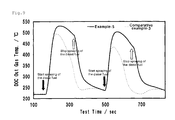
- the converter was connected to the exhaust opening of the 3L diesel engine (displacement: 3L), the diesel fuel was pulse-sprayed thereto, and the change of the exhaust gas temperature at the catalyst exit over time was measured and indicated in Table 3 and Fig. 9 .
- the obtained diesel fuel combustibility oxidation catalyst (7) was calcined at 650°C for 50 hours under air atmosphere in the electric furnace, which was then filled in the converter.
- the converter was connected to the exhaust opening of the 2L diesel engine (displacement: 2L), the diesel fuel was pulse-sprayed thereto, and the change of the exhaust gas temperature at the catalyst exit over time was measured and indicated in Table 1 and Fig. 7 .
- the obtained diesel fuel combustibility oxidation catalyst (8) was calcined at 650°C for 50 hours under air atmosphere in the electric furnace, which was then filled in the converter.
- the converter was connected to the exhaust opening of the 2L diesel engine (displacement: 2L), the diesel fuel was pulse-sprayed thereto, and the change of the exhaust gas temperature at the catalyst exit over time was measured and indicated in Table 1 and Fig. 7 .
- the obtained diesel fuel combustibility oxidation catalyst (9) was calcined at 650°C for 50 hours under air atmosphere in the electric furnace, which was then filled in the converter.
- the converter was connected to the exhaust opening of the 3L diesel engine (displacement: 3L), the diesel fuel was pulse-sprayed thereto, and the change of the exhaust gas temperature at the catalyst exit over time was measured and indicated in Table 3 and Fig. 9 .
- Example 1 (alumina A (69.2 kJ/mol) + alumina B (69.5 kJ/mol)), Example 2 (alumina A (69.2 kJ/mol) + alumina C (62.3 kJ/mol)) and Example 3 (alumina A (69.2 kJ/mol) + alumina D (69.7 kJ/mol)), in which two types of alumina of which the activation energy of the diesel fuel combustion performance is 72 kJ/mol or less were combined as the inorganic matrix, exhibited the more excellent diesel fuel combustion performance than the comparative example 1 (alumina A (69.2 kJ/mol, 83.3% by weight) + alumina F (73.3 kJ/mol, 16.7% by weight)) and the comparative example 2 (alumina A (69.2 kJ/mol, 83.3% by weight) + alumina F (74.3 kJ/mol, 16.7% by weight)), in which
- Example 4 (alumina A (69.2 kJ/mol) + alumina E (65.6 kJ/mol)), in which two types of alumina of which the activation energy of the diesel fuel combustion performance is 72 kJ/mol or less were combined as the inorganic matrix, exhibited the equivalent diesel fuel combustion performance to Example 2 (alumina A (69.2 kJ/mol) + alumina C (62.3 kJ/mol)) even at 200°C further lowered by 20°C from the exhaust gas temperature at the catalyst entry.
- Example 5 (alumina A (69.2 kJ/mol, 91.7% by weight) + alumina C (62.3 kJ/mol, 18.3% by weight)), in which the two types of alumina of which the activation energy of the diesel fuel combustion performance is 72 kJ/mol or less were combined as the inorganic matrix, exhibited the more excellent diesel fuel combustion performance than the comparative example 3 (alumina A (69.2 kJ/mol, 91.7% by weight) + alumina F (74.3 kJ/mol, 18.3% by weight)), in which the alumina of which the activation energy of the diesel fuel combustion performance exceeds 72 kJ/mol was contained in an amount above 15% by weight, as the inorganic matrix.
- ⁇ -type used for the alumina B, C and E
- ⁇ -type used for the alumina A, D, F and G
- La 2 O 3 content rate: 4% by weight, used for the alumina B, C, D and F
- SiO 2 content rate: 10% by weight, used for the alumina E
- the like can be used inasmuch as the amount thereof is 20% by weight or less.
- the slurry viscosity is improved to 600 to 1, 400 mPa ⁇ s and the slurry appropriate to the application of the catalyst can be made.
- the good or bad of the diesel fuel combustion performance of the oxidation catalyst upon the diesel fuel spraying using an actual diesel engine depends on only the magnitude of the activation energy of the diesel fuel combustion performance of the alumina itself used as the inorganic matrix of the oxidation catalyst.
- the activation energy of the diesel fuel combustion performance of the inorganic matrix itself used for the oxidation catalyst has only to be measured.
- the value is 72 kJ/mol or less
- the corresponding inorganic oxide is used in an amount of 90% by weight or more, as the inorganic matrix, so that the high performance oxidation catalyst for diesel fuel combustion can be obtained.
- the slurry in which the alumina is solely used and the viscosity abnormality/precipitation abnormality is thus caused is made, when the two or more types of the alumina having different volume densities are used, the properties of the slurry are improved, so that the catalyst can be stably applied.
- the oxidation catalyst and exhaust gas purification device of the present invention can be used for a diesel vehicle, a moving object such as a ship, a stationary device such as a power generator, and the like, and is particularly useful for the diesel vehicle.
Landscapes
- Chemical & Material Sciences (AREA)
- Engineering & Computer Science (AREA)
- Chemical Kinetics & Catalysis (AREA)
- Materials Engineering (AREA)
- Organic Chemistry (AREA)
- Combustion & Propulsion (AREA)
- Health & Medical Sciences (AREA)
- General Engineering & Computer Science (AREA)
- Mechanical Engineering (AREA)
- General Chemical & Material Sciences (AREA)
- Analytical Chemistry (AREA)
- Oil, Petroleum & Natural Gas (AREA)
- Environmental & Geological Engineering (AREA)
- Biomedical Technology (AREA)
- Toxicology (AREA)
- Catalysts (AREA)
- Exhaust Gas After Treatment (AREA)
- Exhaust Gas Treatment By Means Of Catalyst (AREA)
- Processes For Solid Components From Exhaust (AREA)
- Nanotechnology (AREA)
Applications Claiming Priority (2)
| Application Number | Priority Date | Filing Date | Title |
|---|---|---|---|
| JP2013052660 | 2013-03-15 | ||
| PCT/JP2014/055046 WO2014141903A1 (fr) | 2013-03-15 | 2014-02-28 | Catalyseur d'oxydation et dispositif de purification de gaz d'échappement l'utilisant |
Publications (2)
| Publication Number | Publication Date |
|---|---|
| EP2974791A1 true EP2974791A1 (fr) | 2016-01-20 |
| EP2974791A4 EP2974791A4 (fr) | 2016-12-14 |
Family
ID=51536576
Family Applications (1)
| Application Number | Title | Priority Date | Filing Date |
|---|---|---|---|
| EP14764123.7A Withdrawn EP2974791A4 (fr) | 2013-03-15 | 2014-02-28 | Catalyseur d'oxydation et dispositif de purification de gaz d'échappement l'utilisant |
Country Status (4)
| Country | Link |
|---|---|
| US (1) | US10030559B2 (fr) |
| EP (1) | EP2974791A4 (fr) |
| JP (1) | JP6378169B2 (fr) |
| WO (1) | WO2014141903A1 (fr) |
Families Citing this family (8)
| Publication number | Priority date | Publication date | Assignee | Title |
|---|---|---|---|---|
| JP6353376B2 (ja) * | 2015-01-28 | 2018-07-04 | 株式会社Ihi | Han系推進薬分解触媒及びその製造方法並びにそれを用いた一液スラスタ |
| KR101716174B1 (ko) * | 2015-12-03 | 2017-03-14 | 희성촉매 주식회사 | 디젤엔진 백연 방출 억제를 위한 촉매조성물 |
| CN107297206A (zh) * | 2016-04-14 | 2017-10-27 | 巴斯夫公司 | 用于稀燃压缩天然气发动机的氧化催化剂 |
| WO2017187344A1 (fr) * | 2016-04-26 | 2017-11-02 | Basf Corporation | Configuration en zones pour combinaisons de catalyseurs d'oxydation |
| CN108295649B (zh) * | 2018-01-11 | 2020-12-11 | 湖南美源环保科技有限公司 | 一种有机废气净化方法 |
| JP6990606B2 (ja) * | 2018-03-05 | 2022-01-12 | エヌ・イーケムキャット株式会社 | 排ガス処理部材 |
| WO2021105253A1 (fr) * | 2019-11-29 | 2021-06-03 | Rhodia Operations | Alumine présentant un profil poreux particulier |
| WO2022065188A1 (fr) * | 2020-09-25 | 2022-03-31 | エヌ・イーケムキャット株式会社 | Catalyseur d'oxydation de méthane, catalyseur multicouche d'oxydation de méthane, système de purification de gaz d'échappement utilisant ledit catalyseur d'oxydation de méthane ou ledit catalyseur multicouche d'oxydation de méthane, et procédé pour produire le catalyseur d'oxydation de méthane |
Family Cites Families (30)
| Publication number | Priority date | Publication date | Assignee | Title |
|---|---|---|---|---|
| JPS5926335B2 (ja) * | 1978-02-03 | 1984-06-26 | 日揮ユニバ−サル株式会社 | 白金族酸化触媒及びその製造法 |
| US4301037A (en) | 1980-04-01 | 1981-11-17 | W. R. Grace & Co. | Extruded alumina catalyst support having controlled distribution of pore sizes |
| JPS58500180A (ja) | 1981-02-19 | 1983-02-03 | ロ−ベルト ボツシユ ゲゼルシヤフト ミツト ベシユレンクテル ハフツング | 内燃機関における燃焼過程の不安定性の検出方法及びこの方法を実施する装置 |
| ATE190241T1 (de) | 1991-11-26 | 2000-03-15 | Engelhard Corp | Ceroxid-aluminiumoxid enthaltender oxidationskatalysator und verfahren zur anwendung. |
| JPH0842325A (ja) | 1994-07-28 | 1996-02-13 | Nippon Soken Inc | 内燃機関の排気微粒子浄化装置 |
| JPH09222009A (ja) | 1996-02-15 | 1997-08-26 | Nippon Soken Inc | 内燃機関の排気微粒子浄化装置 |
| JPH09317440A (ja) | 1996-05-24 | 1997-12-09 | Nippon Soken Inc | 内燃機関の排気微粒子浄化装置 |
| JPH10194733A (ja) | 1996-11-14 | 1998-07-28 | Sumitomo Chem Co Ltd | 耐熱性遷移アルミナ及びその製造方法 |
| JP3770998B2 (ja) | 1997-03-31 | 2006-04-26 | 新東工業株式会社 | ガス処理装置 |
| US6110862A (en) * | 1998-05-07 | 2000-08-29 | Engelhard Corporation | Catalytic material having improved conversion performance |
| JP2001263051A (ja) | 2000-03-17 | 2001-09-26 | Nissan Diesel Motor Co Ltd | ディーゼルエンジンの排気浄化装置 |
| JP2002030924A (ja) | 2000-07-17 | 2002-01-31 | Nissan Diesel Motor Co Ltd | ディーゼルエンジンの排気浄化装置 |
| JP4075292B2 (ja) | 2000-07-24 | 2008-04-16 | トヨタ自動車株式会社 | パティキュレート浄化触媒 |
| JP3598961B2 (ja) | 2000-09-26 | 2004-12-08 | 日産自動車株式会社 | 内燃機関の排気浄化装置 |
| JP4122849B2 (ja) * | 2001-06-22 | 2008-07-23 | 株式会社デンソー | 触媒劣化検出装置 |
| JP3844350B2 (ja) * | 2003-03-27 | 2006-11-08 | エヌ・イーケムキャット株式会社 | 軽油燃焼用酸化触媒 |
| JP4276472B2 (ja) * | 2003-05-30 | 2009-06-10 | トヨタ自動車株式会社 | 内燃機関の触媒劣化判定装置 |
| EP1703979B1 (fr) * | 2003-12-18 | 2011-05-25 | Chiyoda Corporation | Catalyseur pour la fabrication d'un gaz de synthese et procede de fabrication d'un gaz de synthese au moyen dudit catalyseur |
| JP2005262162A (ja) * | 2004-03-22 | 2005-09-29 | Ne Chemcat Corp | 炭化水素ガス酸化除去用触媒 |
| JP4681922B2 (ja) * | 2005-04-01 | 2011-05-11 | エヌ・イーケムキャット株式会社 | 排気ガス浄化用酸化触媒、及びそれを用いた排気ガス浄化システム |
| JP4695962B2 (ja) * | 2005-10-20 | 2011-06-08 | エヌ・イーケムキャット株式会社 | 排気ガス浄化用酸化触媒、それを用いた一体構造型酸化触媒及び排気ガス浄化方法 |
| US7981834B2 (en) * | 2006-03-16 | 2011-07-19 | Ict Co., Ltd. | Adsorbent for hydrocarbons, catalyst for exhaust gas purification and method for exhaust gas purification |
| JP4982241B2 (ja) | 2007-04-27 | 2012-07-25 | エヌ・イーケムキャット株式会社 | 自動車用排気ガス浄化触媒、排気ガス浄化触媒系、および排気ガスの浄化方法 |
| US8099229B2 (en) * | 2008-03-03 | 2012-01-17 | GM Global Technology Operations LLC | Method and apparatus for limiting wheel slip |
| US8329607B2 (en) * | 2009-01-16 | 2012-12-11 | Basf Corporation | Layered diesel oxidation catalyst composites |
| US8513153B2 (en) * | 2009-04-22 | 2013-08-20 | Uto Environmental Products Limited | Fuel additive |
| EP2606971B1 (fr) | 2010-08-20 | 2017-03-29 | Mitsui Mining and Smelting Co., Ltd. | Catalyseur d'oxydation approprié pour la combustion d'un composant huile légère |
| WO2012147376A1 (fr) * | 2011-04-28 | 2012-11-01 | エヌ・イー ケムキャット株式会社 | Dispositif de purification de gaz de dégagement |
| US8888973B2 (en) | 2011-07-29 | 2014-11-18 | Roche Diagnostics Operations, Inc. | Encoded biosensors and methods of manufacture and use thereof |
| JP6040232B2 (ja) * | 2012-05-14 | 2016-12-07 | エヌ・イーケムキャット株式会社 | 排気ガス浄化装置 |
-
2014
- 2014-02-28 JP JP2015505392A patent/JP6378169B2/ja active Active
- 2014-02-28 EP EP14764123.7A patent/EP2974791A4/fr not_active Withdrawn
- 2014-02-28 WO PCT/JP2014/055046 patent/WO2014141903A1/fr not_active Ceased
- 2014-02-28 US US14/771,718 patent/US10030559B2/en active Active
Also Published As
| Publication number | Publication date |
|---|---|
| JPWO2014141903A1 (ja) | 2017-02-16 |
| EP2974791A4 (fr) | 2016-12-14 |
| US10030559B2 (en) | 2018-07-24 |
| US20160003118A1 (en) | 2016-01-07 |
| WO2014141903A1 (fr) | 2014-09-18 |
| JP6378169B2 (ja) | 2018-08-22 |
Similar Documents
| Publication | Publication Date | Title |
|---|---|---|
| US10030559B2 (en) | Oxidation catalyst and exhaust gas purification device using same | |
| KR102483435B1 (ko) | 배기 시스템용 아산화질소 제거 촉매 | |
| EP2692437B1 (fr) | Catalyseur d'oxydation de l'ammoniac, dispositif de purification de gaz d'échappement l'utilisant et procédé de purification de gaz d'échappement | |
| EP2703077B1 (fr) | Dispositif de purification de gaz de dégagement | |
| JP5110954B2 (ja) | 選択還元型触媒を用いた排気ガス浄化触媒装置並びに排気ガス浄化方法 | |
| JP5806131B2 (ja) | NOx吸蔵脱硝触媒 | |
| EP1985353B1 (fr) | Catalyseur de purification de gaz d'échappement pour automobile, système catalytique pour la purification de gaz d'échappement et processus de purification de gaz d'échappement | |
| JP6007248B2 (ja) | 排気ガス浄化用触媒組成物および自動車用排気ガス浄化用触媒 | |
| JP6906624B2 (ja) | 酸素吸放出材料、触媒、排ガス浄化システム、および排ガス処理方法 | |
| EP3476480B1 (fr) | Catalyseur pour melange pauvre | |
| JP2020528348A (ja) | リーン/リッチシステムのための自動車排気からのn2o除去 | |
| JP2018528847A (ja) | 排気システム用の亜酸化窒素除去触媒 | |
| JP7187654B2 (ja) | 排ガス用浄化触媒組成物、及び自動車用排ガス浄化触媒 | |
| CN102281946A (zh) | 用于机动车辆的紧耦合位置中的氮氧化物储存催化剂 | |
| EP3466535B1 (fr) | Catalyseur à trois voies pour purification de gaz d'échappement de moteur à essence | |
| CN103459017A (zh) | 废气净化用氧化催化剂、其制备方法以及使用该催化剂的废气净化方法 | |
| JP2024501748A (ja) | 貴金属が単独原子状態で担持された三元触媒、その調製方法及び使用 | |
| JP6087362B2 (ja) | 白金系酸化触媒、及びそれを用いた排気ガス浄化方法 | |
| CN101410179B (zh) | 废气净化用催化剂及其制造方法 | |
| CN101351267A (zh) | 催化剂载体颗粒、废气净化催化剂及它们的制造方法 | |
| EP3202495B1 (fr) | Catalyseur de purification de gaz d'échappement | |
| US20160279610A1 (en) | Zoned diesel oxidation catalyst | |
| JP5806157B2 (ja) | 排気ガス浄化用触媒組成物 | |
| EP2659968A1 (fr) | Catalyseur de combustion particulaire, procédé de production de celui-ci, filtre particulaire et procédé de production de celui-ci | |
| JP4665458B2 (ja) | 排ガス浄化触媒及びその製造方法 |
Legal Events
| Date | Code | Title | Description |
|---|---|---|---|
| PUAI | Public reference made under article 153(3) epc to a published international application that has entered the european phase |
Free format text: ORIGINAL CODE: 0009012 |
|
| 17P | Request for examination filed |
Effective date: 20150916 |
|
| AK | Designated contracting states |
Kind code of ref document: A1 Designated state(s): AL AT BE BG CH CY CZ DE DK EE ES FI FR GB GR HR HU IE IS IT LI LT LU LV MC MK MT NL NO PL PT RO RS SE SI SK SM TR |
|
| AX | Request for extension of the european patent |
Extension state: BA ME |
|
| DAX | Request for extension of the european patent (deleted) | ||
| A4 | Supplementary search report drawn up and despatched |
Effective date: 20161111 |
|
| RIC1 | Information provided on ipc code assigned before grant |
Ipc: F01N 3/10 20060101ALI20161107BHEP Ipc: B01J 23/56 20060101AFI20161107BHEP Ipc: B01D 53/94 20060101ALI20161107BHEP Ipc: B01J 23/63 20060101ALI20161107BHEP Ipc: F01N 3/36 20060101ALI20161107BHEP |
|
| STAA | Information on the status of an ep patent application or granted ep patent |
Free format text: STATUS: EXAMINATION IS IN PROGRESS |
|
| 17Q | First examination report despatched |
Effective date: 20210621 |
|
| STAA | Information on the status of an ep patent application or granted ep patent |
Free format text: STATUS: THE APPLICATION IS DEEMED TO BE WITHDRAWN |
|
| 18D | Application deemed to be withdrawn |
Effective date: 20211103 |