EP2974855A2 - Materiaux composites comprenant des noyaux en nids d'abeilles a base de non-tissé filé-lié de fibres synthetiques thermoplastiques - Google Patents
Materiaux composites comprenant des noyaux en nids d'abeilles a base de non-tissé filé-lié de fibres synthetiques thermoplastiques Download PDFInfo
- Publication number
- EP2974855A2 EP2974855A2 EP15176270.5A EP15176270A EP2974855A2 EP 2974855 A2 EP2974855 A2 EP 2974855A2 EP 15176270 A EP15176270 A EP 15176270A EP 2974855 A2 EP2974855 A2 EP 2974855A2
- Authority
- EP
- European Patent Office
- Prior art keywords
- woven fabric
- spunbonded non
- honeycomb core
- binder
- honeycomb
- Prior art date
- Legal status (The legal status is an assumption and is not a legal conclusion. Google has not performed a legal analysis and makes no representation as to the accuracy of the status listed.)
- Granted
Links
Images
Classifications
-
- D—TEXTILES; PAPER
- D04—BRAIDING; LACE-MAKING; KNITTING; TRIMMINGS; NON-WOVEN FABRICS
- D04H—MAKING TEXTILE FABRICS, e.g. FROM FIBRES OR FILAMENTARY MATERIAL; FABRICS MADE BY SUCH PROCESSES OR APPARATUS, e.g. FELTS, NON-WOVEN FABRICS; COTTON-WOOL; WADDING ; NON-WOVEN FABRICS FROM STAPLE FIBRES, FILAMENTS OR YARNS, BONDED WITH AT LEAST ONE WEB-LIKE MATERIAL DURING THEIR CONSOLIDATION
- D04H3/00—Non-woven fabrics formed wholly or mainly of yarns or like filamentary material of substantial length
- D04H3/08—Non-woven fabrics formed wholly or mainly of yarns or like filamentary material of substantial length characterised by the method of strengthening or consolidating
- D04H3/16—Non-woven fabrics formed wholly or mainly of yarns or like filamentary material of substantial length characterised by the method of strengthening or consolidating with bonds between thermoplastic filaments produced in association with filament formation, e.g. immediately following extrusion
-
- B—PERFORMING OPERATIONS; TRANSPORTING
- B29—WORKING OF PLASTICS; WORKING OF SUBSTANCES IN A PLASTIC STATE IN GENERAL
- B29D—PRODUCING PARTICULAR ARTICLES FROM PLASTICS OR FROM SUBSTANCES IN A PLASTIC STATE
- B29D24/00—Producing articles with hollow walls
- B29D24/002—Producing articles with hollow walls formed with structures, e.g. cores placed between two plates or sheets, e.g. partially filled
-
- B—PERFORMING OPERATIONS; TRANSPORTING
- B29—WORKING OF PLASTICS; WORKING OF SUBSTANCES IN A PLASTIC STATE IN GENERAL
- B29D—PRODUCING PARTICULAR ARTICLES FROM PLASTICS OR FROM SUBSTANCES IN A PLASTIC STATE
- B29D99/00—Subject matter not provided for in other groups of this subclass
- B29D99/0089—Producing honeycomb structures
-
- B—PERFORMING OPERATIONS; TRANSPORTING
- B32—LAYERED PRODUCTS
- B32B—LAYERED PRODUCTS, i.e. PRODUCTS BUILT-UP OF STRATA OF FLAT OR NON-FLAT, e.g. CELLULAR OR HONEYCOMB, FORM
- B32B3/00—Layered products comprising a layer with external or internal discontinuities or unevennesses, or a layer of non-planar shape; Layered products comprising a layer having particular features of form
- B32B3/10—Layered products comprising a layer with external or internal discontinuities or unevennesses, or a layer of non-planar shape; Layered products comprising a layer having particular features of form characterised by a discontinuous layer, i.e. formed of separate pieces of material
- B32B3/12—Layered products comprising a layer with external or internal discontinuities or unevennesses, or a layer of non-planar shape; Layered products comprising a layer having particular features of form characterised by a discontinuous layer, i.e. formed of separate pieces of material characterised by a layer of regularly- arranged cells, e.g. a honeycomb structure
-
- B—PERFORMING OPERATIONS; TRANSPORTING
- B32—LAYERED PRODUCTS
- B32B—LAYERED PRODUCTS, i.e. PRODUCTS BUILT-UP OF STRATA OF FLAT OR NON-FLAT, e.g. CELLULAR OR HONEYCOMB, FORM
- B32B5/00—Layered products characterised by the non- homogeneity or physical structure, i.e. comprising a fibrous, filamentary, particulate or foam layer; Layered products characterised by having a layer differing constitutionally or physically in different parts
- B32B5/02—Layered products characterised by the non- homogeneity or physical structure, i.e. comprising a fibrous, filamentary, particulate or foam layer; Layered products characterised by having a layer differing constitutionally or physically in different parts characterised by structural features of a fibrous or filamentary layer
- B32B5/022—Non-woven fabric
-
- D—TEXTILES; PAPER
- D04—BRAIDING; LACE-MAKING; KNITTING; TRIMMINGS; NON-WOVEN FABRICS
- D04H—MAKING TEXTILE FABRICS, e.g. FROM FIBRES OR FILAMENTARY MATERIAL; FABRICS MADE BY SUCH PROCESSES OR APPARATUS, e.g. FELTS, NON-WOVEN FABRICS; COTTON-WOOL; WADDING ; NON-WOVEN FABRICS FROM STAPLE FIBRES, FILAMENTS OR YARNS, BONDED WITH AT LEAST ONE WEB-LIKE MATERIAL DURING THEIR CONSOLIDATION
- D04H3/00—Non-woven fabrics formed wholly or mainly of yarns or like filamentary material of substantial length
- D04H3/08—Non-woven fabrics formed wholly or mainly of yarns or like filamentary material of substantial length characterised by the method of strengthening or consolidating
- D04H3/14—Non-woven fabrics formed wholly or mainly of yarns or like filamentary material of substantial length characterised by the method of strengthening or consolidating with bonds between thermoplastic yarns or filaments produced by welding
-
- B—PERFORMING OPERATIONS; TRANSPORTING
- B32—LAYERED PRODUCTS
- B32B—LAYERED PRODUCTS, i.e. PRODUCTS BUILT-UP OF STRATA OF FLAT OR NON-FLAT, e.g. CELLULAR OR HONEYCOMB, FORM
- B32B2250/00—Layers arrangement
- B32B2250/40—Symmetrical or sandwich layers, e.g. ABA, ABCBA, ABCCBA
-
- B—PERFORMING OPERATIONS; TRANSPORTING
- B32—LAYERED PRODUCTS
- B32B—LAYERED PRODUCTS, i.e. PRODUCTS BUILT-UP OF STRATA OF FLAT OR NON-FLAT, e.g. CELLULAR OR HONEYCOMB, FORM
- B32B2262/00—Composition or structural features of fibres which form a fibrous or filamentary layer or are present as additives
- B32B2262/02—Synthetic macromolecular fibres
- B32B2262/0261—Polyamide fibres
-
- B—PERFORMING OPERATIONS; TRANSPORTING
- B32—LAYERED PRODUCTS
- B32B—LAYERED PRODUCTS, i.e. PRODUCTS BUILT-UP OF STRATA OF FLAT OR NON-FLAT, e.g. CELLULAR OR HONEYCOMB, FORM
- B32B2262/00—Composition or structural features of fibres which form a fibrous or filamentary layer or are present as additives
- B32B2262/02—Synthetic macromolecular fibres
- B32B2262/0276—Polyester fibres
-
- B—PERFORMING OPERATIONS; TRANSPORTING
- B32—LAYERED PRODUCTS
- B32B—LAYERED PRODUCTS, i.e. PRODUCTS BUILT-UP OF STRATA OF FLAT OR NON-FLAT, e.g. CELLULAR OR HONEYCOMB, FORM
- B32B2307/00—Properties of the layers or laminate
- B32B2307/70—Other properties
- B32B2307/724—Permeability to gases, adsorption
-
- D—TEXTILES; PAPER
- D10—INDEXING SCHEME ASSOCIATED WITH SUBLASSES OF SECTION D, RELATING TO TEXTILES
- D10B—INDEXING SCHEME ASSOCIATED WITH SUBLASSES OF SECTION D, RELATING TO TEXTILES
- D10B2331/00—Fibres made from polymers obtained otherwise than by reactions only involving carbon-to-carbon unsaturated bonds, e.g. polycondensation products
- D10B2331/04—Fibres made from polymers obtained otherwise than by reactions only involving carbon-to-carbon unsaturated bonds, e.g. polycondensation products polyesters, e.g. polyethylene terephthalate [PET]
Definitions
- the invention concerns honeycomb cores based on thermoplastic synthetic fiber non-wovens, a method for manufacturing the honeycomb cores, as well as composite materials containing such honeycomb cores.
- honeycomb core materials resp. elements with a predominantly hexagonal honeycomb structure are used in many cases and increasingly in many applications. Due to the high pressure resistance and high stiffness of such structures, they can be used, along with their low weight, for example in the lightweight construction industry.
- the honeycomb cores usually form the core material of a sandwich-like compound consisting of two planar materials.
- Sandwich-like honeycomb core-composite materials with a supporting honeycomb core of paper or cardboard can be equipped resp. designed in such a way that they can bear several tons per m 2 .
- the planar materials, which form the covering layers of the sandwich-like compound can be made of different materials depending on the application.
- honeycomb materials are also known for consolidation of grounds.
- honeycomb materials are placed onto the underground and the honeycomb cells are filled with earthenware or another suitable material.
- the filled honeycomb materials thereby reach a pressure resistance, which comes close to the pressure resistance of concrete, so that the load-carrying capacity of the ground is clearly increased.
- This procedure is applied among others in road construction. Compared with concrete, these materials have the advantage that the honeycomb material is water permeable, so that a good draining can be obtained.
- the honeycomb core materials have honeycomb cells of different diameters, so that, for example, filling of a construction material or introduction of a filler material is facilitated.
- the honeycomb cells of the honeycomb core materials are filled with coarser materials, diameters of a few centimeters to 50 cm, in some cases even more, proved unpractical.
- the honeycomb material must be relatively solid. A comparable requirement also results in the already mentioned lightweight construction, since the honeycomb core material usually forms the core material of the sandwich-like compound and both planar materials, which form the external sides of the sandwich-like compound must be bound to the core.
- honeycomb core materials For manufacturing the honeycomb core materials, relatively thick textile surfaces were used to date and several layers of the textile surface were bound together by means of a complex sewing process. Subsequently, the sewed compound was pulled to form the honeycomb body to be achieved. Instead of the sewing processes, the individual layers can be glued, as is described in EP-A-0,512,433 , or welded, as is described in WO 2006/026971 . Subsequently, the multi-layer compound is pulled apart to form the honeycomb core material. The opened honeycomb core material must subsequently be fixed, so that the honeycomb structure, usually a predominantly hexagonal structure, is consolidated.
- the honeycomb core material can also be manufactured through combination of several trapezoidally deformed textile fabrics, respectively, such as is described in WO 89/10258 .
- honeycomb cores consisting of synthetic textile surface materials
- honeycomb cores consisting of cellulose-based materials are also known, which already deliver good mechanical values; it is, however, disadvantageous that they are not thermally formable and tend to degradation in humid environments.
- honeycomb cores consisting of extruded polyolefin-material (e.g. polypropylene) are likewise already known. They exhibit in a humid environment a better failure behavior and are, in addition, thermally formable. However, the maximum temperature is relatively low both when using and also in the thermal forming process, whereby the usefulness of these honeycombs is restricted for some applications.
- the extruded materials are not porous, whereby neither a pressure compensation within the production process nor impregnation with resins is possible.
- extruded honeycomb cores have a higher weight.
- honeycomb cores can be formed are metallic alloys, for example based on aluminium, which are formable and moisture resistant.
- metallic alloys for example based on aluminium, which are formable and moisture resistant.
- cover layers on the thin edges of the inert, non porous metallic materials is more difficult, and as a result of the economical analysis of the high quality alloys, their use is not interesting for many applications.
- honeycomb cores based on thermoplastic synthetic fiber non-wovens
- a known problem consists in the fact that for binding the outer cover layer to the honeycomb core, pressure exchange must be guaranteed with the surrounding air during the grouting process, so that binding of the cover layer can take place uniformly and the working speed allows economical manufacturing.
- sufficient mechanical stability with the lowest possible weight must be achieved.
- the material forming the honeycomb cores must have a good edge stiffness as well as ensure connection of the cover layer to a good compound between the cover layer and the core material.
- the core material should have a good temperature resistance, thermal formability, flexural stiffness and sufficient failure behavior in a humid environment.
- it is advantageous if the honeycomb core material allows for filling, in particular subsequent filling of the honeycomb structure in the finished sandwich-like composite material.
- the object of the present invention is the use of a spunbonded non-woven fabric based on thermoplastic organic synthetic fibers for manufacturing honeycomb core materials, characterized in that
- honeycomb core materials means in the framework of this application low-viscosity reactive systems, which harden by chemical reaction.
- the use according to the invention in the manufacturing of honeycomb core materials allows on the one hand the pressure compensation between the individual honeycomb cells of the honeycomb core material and fulfills on the other hand the requirements towards honeycomb core materials as mentioned at the beginning, in particular in the manufacturing of sandwich-like composite materials.
- the spunbonded non-woven fabric used according to the invention allows the manufacturing of honeycomb core materials with high edge stiffness, good binding to both cover layers in the case of sandwich-like composite materials, a good absorption of liquid binder systems, good temperature resistance, good thermal formability, high flexural stiffness and a good failure behavior in a humid environment. Due to the semi-structural property of the spunbonded non-woven fabric used according to the invention, different manufacturing processes can be used for the formation of the honeycomb structures.
- thermoplastic organic synthetic fibers are to be understood in its widest meaning.
- the spunbonded non-woven fabric used according to the invention only comprises fibers made of thermoplastic organic polymers.
- Spunbonded non-wovens are also referred to as so-called spunbonds, which are manufactured by random deposition of newly melt-spun filaments. They consist of continuous synthetic fibers composed of melt-spinnable, thermoplastic, organic polymer materials. Suitable polymer materials are, e.g., polyamides such as, e.g., polyhexamethylene diadipamide, polycaprolactam, aromatic or partially aromatic polyamides ("aramids”), aliphatic polyamides such as, e.g., nylon, partially aromatic or fully aromatic polyesters, polyphenylene sulfide (PPS), polymers with ether and keto groups such as, e.g., polyetherketones (PEK) and polyetheretherketone (PEEK) or polybenzimidazoles.
- polyamides such as, e.g., polyhexamethylene diadipamide, polycaprolactam, aromatic or partially aromatic polyamides (“aramids”)
- aliphatic polyamides such as, e
- melt-spinnable thermoplastic, organic polymer materials have a melting point of at least 180°C, preferably of at least 200°C.
- the spunbonded non-woven fabrics consist of melt-spinnable polyesters.
- the polyester materials can, in principle, be any known type suitable for fiber production.
- Such polyesters consist predominantly of components derived from aromatic dicarboxylic acids and from aliphatic diols.
- aromatic dicarboxylic acid components are the bivalent radicals of benzenedicarboxylic acids, especially of the terephthalic acid and the isophthalic acid; commonly used diols have 2 to 4 carbon atoms, wherein ethylene glycol is particularly suitable.
- Spunbonded fabrics which consist of at least 85 mol% of polyethylene terephthalate are particularly advantageous.
- dicarboxylic acid units and glycol units which act as so-called modifiers and allow the person skilled in the art to targetedly influence the physical and chemical properties of the produced filaments.
- dicarboxylic acid units are radicals of isophthalic acid or aliphatic dicarboxylic acid, such as glutaric acid, adipic acid, sebacic acid;
- modifying diol radicals are those composed of longer-chain diols, e.g. propane diol or butane diol, of diethylene or triethylene glycol or, if present in small quantities, of polyglycol with a molecular weight of about 500 to 2000.
- Polyesters containing at least 95 mol% of polyethylene terephthalate (PET) are particularly preferred, especially those composed of unmodified PET.
- the spunbonded non-woven fabrics used according to the invention should additionally have a flame-retardant action, it is advantageous if they were spun from polyesters modified in a flame-retardant manner.
- Such flame-retardantly modified polyesters are known. They contain additives of halogen compounds, particularly bromine compounds or, which is particularly advantageous, they contain phosphonic compounds that are condensed into the polyester chain.
- the spunbonded non-woven fabrics contain flame-retardantly modified polyesters containing in the chain modules with the formula (I) wherein R is alkylene or polymethylene with 2 to 6 C atoms or phenyl and R 1 is alkyl with 1 to 6 C atoms, aryl or aralkyl, that are condensed into it.
- R means ethylene and R 1 methyl, ethyl, phenyl or o-, m- or p-methylphenyl, particularly methyl.
- Such spunbonded non-woven fabrics are, for example, described in DE-A-39 40 713 .
- the polyesters contained in the spunbonded non-woven fabrics preferably have a molecular weight corresponding to an intrinsic viscosity (IV) of 0.6 to 1.4, measured in a solution of 1 g polymer in 100 ml dichloroacetic acid at 25 °C.
- the single titers of the fibers of the spunbonded non-woven fabric are between 1.0 and 20 dtex, preferably 1.5 to 10 dtex.
- the spunbonded non-woven fabric used has a weight per unit area between 50 and 500 g/m 2 , preferably 100 and 300 g/m 2 , wherein the preceding information refers to a spunbonded non-woven fabric without any chemical binders and other additives.
- the spunbonded non-woven fabric used according to the invention is essential free of chemical binders, i.e. it contains between 0 and up to 5% by weight (with reference to the textile fabric) of chemical binders resp. substances, which are equivalent or comparable chemical binders but, however, can originate from Aviagen or the like.
- chemical binders i.e. it contains between 0 and up to 5% by weight (with reference to the textile fabric) of chemical binders resp. substances, which are equivalent or comparable chemical binders but, however, can originate from Aviagen or the like.
- spunbonded non-woven fabrics are used, which have no addition of chemical binders.
- spunbonded non-woven fabrics are used, which are exclusively pre-consolidated mechanically and/or by means of thermoplastic binders.
- the polymer fibers forming the spunbonded non-woven fabrics can have a practically round cross-section or also other forms such as dumbbell-shaped, kidney-shaped, triangular or tri-lobed or multi-lobed cross-sections.
- the spunbonded non-woven fabrics can have a single-layer or multi-layer structure.
- the fibers forming the spunbonded non-woven fabric can be modified by customary additives, e.g., by antistatic agents such as carbon black.
- the spunbonded non-woven fabric used according to the invention has an air permeability in the range of 5 - 2000 l/m 2 sec, preferably 100 - 300 l/m 2 sec @ 200 Pa measured according to EN-ISO 9237.
- the spunbonded non-woven fabric used according to the invention preferably has a maximum tractive force (in the longitudinal direction) of at least 100 N/5 cm, particularly preferably at least 200 N/5 cm, measured according to DIN 29073, Part 3 (1992).
- the spunbonded non-woven fabric used according to the invention preferably has a maximum tractive force (in the transverse direction) of at least 50 N/5 cm, particularly preferably at least 100 N/5 cm, measured according to DIN 29073, Part 3 (1992).
- a spunbonded non-woven fabric which has a combination of the above-mentioned parameters of air permeability, maximum tractive force (in the longitudinal and/or transverse direction).
- the latter contains at least one thermoplastic binder, the melting point of which is at least 10°C, preferably at least 20°C below the melting point of the fiber according to b), however at least 170°C.
- the thermoplastic binder can be introduced in the form of a separate binder fiber, powder and/or granulate into the spunbonded non-woven fabric.
- the thermoplastic binder can also be available in the form of the low-melting component of a bi-component fiber.
- thermoplastic binder is 10 - 50 % by weight, preferably 10 - 30 % by weight, each with reference to the total weight of the spunbonded non-woven fabric.
- thermoplastic binder is introduced in the form of a separate binder fiber, a granulate or in the form of the low-melting component of a bi-component fiber, one speaks of a fusible binder-consolidated spunbonded non-woven fabric.
- the fusible binder-consolidated spunbonded non-woven fabric therefore comprises carrier and hot melt adhesive fibers and/or bi-component fibers with a carrier and binder component.
- the carrier and hot-melt adhesive fibers resp. components can be derived from any thermoplastic, filament-forming polymers. Additionally, carrier fibers can also be derived from non-fusing filament-forming polymers.
- Such fusible binder-consolidated spunbonded fabrics are fundamentally described, for example, in EP-A 0,446,822 and EP-A 0,590,629 .
- polymers from which the carrier fibers resp. the carrier fiber components can be derived are polyacrylonitrile, essentially aliphatic polyamides, such as nylon 6.6, primarily aromatic polyamides (aramids), such as poly-(p-phenylene terephthalate) or copolymers containing a content of aromatic m-diamine units to improve the solubility, or poly-(m-phenylene isophthalate), essentially aromatic polyesters, such as poly-(p-hydroxybenzoate), or preferably essentially aliphatic polyesters, such as polyethylene terephthalate.
- polyacrylonitrile essentially aliphatic polyamides, such as nylon 6.6, primarily aromatic polyamides (aramids), such as poly-(p-phenylene terephthalate) or copolymers containing a content of aromatic m-diamine units to improve the solubility, or poly-(m-phenylene isophthalate), essentially aromatic polyesters, such as poly-(p-hydroxybenzo
- the relative proportion of the two fiber types may be selected within wide limits, whilst making sure that the proportion of the hot melt adhesive fibers does not exceed the above mentioned proportion of thermoplastic binder.
- the proportion of the hot-melt derived from the hot-melt fiber in the spunbonded non-woven fabric is usually 10 - 50 % by weight, preferably 10 - 30 % by weight (based upon the total weight of the non-woven fabric).
- Hot melt polymers from the group of the polymers having a melting point decreased by 10 to 50 °C, preferably 30 to 50 °C compared to the raw material of the non-woven fabric are suitable as hot melt adhesive.
- hot melt adhesives are polybutylene terephthalate, or polyethylene terephthalate modified by the condensation of longer-chain diols and/or isophthalic acid or aliphatic dicarboxylic acid.
- the hot melt adhesives are preferably introduced in the form of fibers as staple fibers or endless yarns into the spunbonded non-woven fabric or in the form of so-called bi-component fibers, wherein the above-mentioned materials for the carrier fibers form the mechanical strength and the above-mentioned materials for the hot melt adhesive fibers form the second component of the bi-component fiber, which are used for the consolidation.
- the carrier fibers and hot melt adhesive fibers are preferably made up of one class of polymers. This implies that all of the fibers used are selected from one class of substances, so that these can readily be recycled after usage.
- the carrier fibers consist of polyester, for example, the hot melt adhesive fibers will likewise be of polyester, e.g. PBT, or selected as sheath from a mixture of polyesters, e.g. in the form of bi-component fibers with PET in the core and a polyethylene terephthalate copolymer having a low melting point.
- bi-component fibers which are made up of different polymers are also possible. Examples of these are bi-component fibers of polyester and polyamide (core/sheath).
- the monofilament titer of the carrier fibers and the hot melt adhesive fibers may be selected within said limits.
- the manufacturing of the spunbonded non-woven fabric used according to the invention takes place by means of individual measures and devices known per se.
- the melted polymer is extruded through a plurality of spinneret rows behind one another or groups of spinneret rows and the spun polymer streams are stretched in a known manner, and are laid on a conveyor belt, e.g., by using a rotating baffle plate in dispersion texture.
- the optional consolidation is also implemented by means of known method, in particular by mechanical methods, in particular by means of calendering and optionally through needling.
- the calendering takes place preferably with a line pressure of more than 35 daN/cm, preferably more than 45 daN/cm and a temperature above the softening temperature of the binder system.
- the nonwoven fabric can be consolidated with an embossing roller, which has geometric embossed structures, preferably fine-meshed geometric embossed structures (e.g. screen embossing).
- the calender can likewise have a smooth structure.
- the consolidation of the spunbonded non-woven fabric can also be carried out by the laminating installation, subsequent calender rolls or double-band presses, wherein the interaction of exerting pressure and temperature is equivalent to the above-mentioned consolidation step.
- the surface temperature of the calender roll resp. the equivalent laminating installation, calender rolls or double-band pressing is by at least 10°C, preferably at least 20°C higher than the melting temperature of the thermoplastic binder.
- the surface temperature of the pressure exerting top surface is preferably between 180 and 260°C, in particular between 225 and 250°C.
- the air permeability / porosity of the nonwoven fabric is determined as well as the edge stiffness.
- the spunbonded non-woven fabrics according to the invention show in particular a high edge stiffness and are therefore particularly well suited for manufacturing of honeycomb cores.
- the spunbonded non-woven fabric suggested according to the invention are bonded by thermal welding or ultrasound-welding in accordance with EP 1792014 .
- the spunbonded non-woven fabric suggested according to the invention are fed into a welding device, usually at room temperature, in the form of webs.
- a welding device usually at room temperature
- Two web sections arranged opposite to each other are melted section by section with supply of heat, the melts are then combined and cooled down.
- the cooling can be supported by cold air supply.
- the web sections form in the melted and then cooled down areas a monolithic block, which is macroscopically homogeneous.
- the welded web sections are then connected with a further web section in the same manner, wherein the "weld seams" are arranged in the longitudinal direction of the webs offset with respect to the already available weld seams.
- the preferred welding method used is based upon the principle of external heating and/or the principle of the internal heating.
- heat is introduced by means of heating elements from the outside into the web section until both web sections have reached the melting temperature.
- the heat is conducted through the web section until the surfaces facing each other are sufficiently heated.
- the heat can in this process only be formed by a web section, but it is also possible to heat both web sections to be bonded.
- a heating element is in contrast placed between the web sections to be bonded.
- the web sections are therefore heated merely on the sides, which are to be bonded together later.
- honeycomb core materials with large honeycomb elements and and high weight per unit area, it is meaningful to heat the web sections from the outside and from the inside. The heat then reliably reaches all fibers.
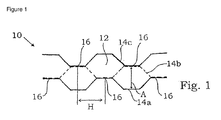
- Figure 1 shows in a simplified basic representation a section from a honeycomb core material (10).
- the latter has in the present exemplary embodiment hexagonal cells (12).
- the honeycomb core material (10) is formed from a spunbonded non-woven fabric (14), i.e. (14 a), (14 b), (14 c) proposed according to the invention, and has sections (14 a) that are bound to one another.
- the sections (14 a), (14 b), (14 c) are bound section by section via connecting sections (16) with one another, wherein the connecting sections (16) are offset from a web section to another web section by an amount H.
- H is the distance from center of composite to center of composite.
- Figure 1 shows a cell division A, which quasi designates the height of a cell (12).
- the cell division A is preferably more than 5 mm.
- the welded compound joined together is fanned-apart.
- the honeycomb core material can be cut beforehand in thinner fabric webs and subsequently fanned-apart are.
- thermoplastic binder e.g. of the fusible binder fibers (lower limit) and at least 10°C below the melting temperature of the carrier fibers (upper limit).
- the heating can be done for example in a hot air furnace.
- the temperature of the hot air blown into the hot air furnace is minimally near the melting temperature of the thermoplastic binder resp. of the fusible binder fibers (lower limit) and at least 10°C below the melting temperature of the carrier fibers (upper limit).
- the hot air furnaces used according to the invention are known to those skilled in the art.
- IR heating systems can also be used.
- the heated, previously welded spunbonded non-woven fabric webs are subsequently pulled apart mechanically in such a manner that the honeycomb cells open and the desired honeycomb core material forms after cooling down.
- the latter can be brought to suitable dimensions with suitable methods; for example, fanned-apart sections can be cut off the strand that forms.
- the method according to the invention for manufacturing the honeycomb core material according to the invention therefore has the following steps:
- fanning of the previously welded spunbonded non-woven fabric can also take place in cold conditions, i.e. they are pulled apart mechanically without prior heating, so that the honeycomb cells open.
- chemical binders are added before or during fanning, which chemical binders subsequently harden through chemical reaction, e.g. self-cross-linking binders.
- a further method for manufacturing the honeycomb core material according to the invention thus has the following steps:
- Cut-off of the honeycomb core carriers can be carried out prior to or after mounting.
- the cut-off operation that determines the honeycomb height preferably takes place prior to pulling apart the spunbonded non-woven fabrics. Pulling apart of the spunbonded non-woven fabric or stands can be carried out directly after welding of the spunbonded non-woven fabric or in a separate process step to a later point in time.
- the honeycomb structure can, as an alternative to thermal fixing of the honeycombs (pulling apart with heat and subsequent cooling), also be realized through pulling apart and fixing by means of chemical binders without the influence of temperature.
- the hardening can be accelerated by supply of heat (hot air) or thermal radiation (IR radiation).
- the honeycomb cores manufactured according to the invention have a good edge stiffness.
- the edge stiffness can be determined by means of measurement of the specific edge crushing resistance (see measurement methods).
- the honeycomb cores according to the invention reach in this process values of > 1, preferably >1.1, in particular >1.2.
- the honeycomb cores manufactured according to the invention have in the area of spunbonded non-woven fabrics, which form the non-welded areas of the honeycomb cell an almost unchanged air permeability in the range of 5 - 2000 l/m 2 sec, preferably 100 - 300 l/m 2 sec @ 200 Pa measured according to EN-ISO 9237.
- the honeycomb cores manufactured according to the invention have an operating temperature resistance of >110°C and, for a typical volume weight of 20 - 70 kg/m 3 (without additional binder or filling) a pressure resistance of >0.8 MPa.
- the pressure resistance can be determined by means of usual measurement methods.
- the honeycomb core manufactured according to the invention can be used in so-called thermal forming processes.
- the honeycomb core manufactured according to the invention are heated over the softening point up to the melting point of the thermoplastic binder, e.g. through infrared radiator or contact heating, and then transformed in the cold mold.
- complex sandwich structures are thus possible and a decorative top surface, e.g. textile, film etc., can be applied with or as a constituent element of the cover layer.
- the honeycomb cores according to the invention are applied a cover layer on both sides and bonded. Manufacturing of the composite material can take place continuously right after manufacturing of the honeycomb cores or in a separate subsequent step.
- the honeycomb cores are provided with a binder.
- thermoplastic and/or chemical binders are suitable as binders.
- Further suitable binders in the sense of the present invention are also mixtures of monomer and/or oligomer compounds, which react to thermoplastic polymers, for example through polymerization or condensation. Due to the monomer resp. oligomer character, such mixtures can be applied in the form of low-viscosity liquids, whereby allowing effective wetting of the honeycomb cores. Subsequently, there is the formation of the thermoplastic polymer based on the monomers resp. oligomers. Due to the low-viscosity behavior, such binders are also well suited and are also an object of the present invention.
- the honeycomb core carrier is led through a binder bath or provided with the binder by means of suitable measures.
- the binders are chemical binder, i.e. self-cross-linking binders, which completely react through chemically without any additive of a catalyst.
- the cross-linking is preferably induced thermally.
- Aqueous polymer dispersions, polymer dispersions of vinyl acetate and ethylene, or similar self-cross-linking, in particular thermally self-cross-linking binders are among others suitable.
- Particularly suitable are binders based on acrylates, polyesters or epoxy.
- the chemical binders are preferably used in the form of dispersions, emulsions or as resins. A too strong decrease of the air permeability can be avoided through adequate dilution of the chemical binder.
- the honeycomb core carriers are wetted only in the areas with binder, which are in direct contact with both cover layers.
- the bath through which the honeycomb core carrier is conducted, can also have a mixture of monomer and/or oligomer compounds, which are converted into thermoplastic polymer by means of polymerization resp. polycondensation.
- honeycomb core provided with a binder are precious intermediate products in the manufacturing of the sandwich-like composite materials.
- Another object of the present invention is thus a honeycomb core material, characterized in that the honeycombs are made of a spunbonded non-woven fabric consolidated with a thermoplastic binder and
- the cover layer can also contain thermoplastic binders or have a coating with chemical binders resp. thermoplastic binders, which allow bonding with the honeycomb core.
- thermoplastic binders for this purpose are polymers, the melting temperature of which is not above, preferably at least 5°C below, in particular at least 10°C below the melting temperature of the thermoplastic binder of the spunbonded non-woven fabric.
- Suitable chemical binders are the already mentioned chemical binders, i.e. self-cross-linking binders, which harden by means of chemical reaction.
- the cover layers are applied by means of a press and optionally under the influence of temperature, depending on the binder used, onto the honeycomb core and pressed with the latter.
- the path length of the press plates is adjusted in such a manner that the edges of the honeycomb core material come into contact with both cover layers. Due to the high edge stiffness and the temperature resistance of the spunbonded non-woven fabric, the exerting pressure and, optionally, heat does not lead to damage of the honeycomb core material. Due to the high air permeability of the honeycomb cores, extraordinarily uniform composite material are possible - in particular at high process speeds.
- thermoplastic systems a pure polyester resp. PET composite material can be produced (recyclable), which material can be used at operating temperatures >90°. Exceptionally high resistance to shearing forces are achieved through good and consistent adhesion, which allows high mechanical loads.
- honeycomb cores according to the invention have, after equipment with a binder for a typical volume weight of 50 - 150 kg/m 3 (with reference to a honeycomb cell size of 11 mm), a pressure resistance of >5Mpa.
- honeycomb cores can reach operating temperatures >200°.
- the preceding information refers to honeycomb cores without cover layers.
- the properties of the honeycomb cores according to the invention are advantageous in sandwich structures with duroplastic binder systems, since the porosity allows a simple and autonomous impregnation through binder systems. Due to the porosity, only a small quantity of binder is required in order to nevertheless obtain a high saponification. This saves material, costs and weight.
- the cover layer consisting e.g. of reinforcement materials such as glass fiber, carbon fiber, high modulus fibers, e.g. aramid like Kevlar ® , Nomex ® etc., organic material, wood, aluminium etc.
- the honeycomb core and bonded which additionally optimizes the shear strength / flexural stiffness.
- sandwich-like composite materials comprising the following are also subject matter of the present invention:
- honeycomb core according to the invention can stand orthogonal to both top surfaces or horizontal on both top surfaces.
- the honeycomb core is orthogonal to both top surfaces.
- Binding of the honeycomb core and the cover layers is carried out by means of a binder.
- Suitable binders for this purpose are both thermoplastic binders and chemical binders. Further suitable binders in the sense of the present invention are also mixtures of monomer and/or oligomer compounds, which react to thermoplastic polymers, for example through polymerization or condensation.
- the binder is a thermoplastic binder from the non-woven fabric.
- the binders can be introduced into the honeycomb core or be available as coating onto the top surfaces or as constituent element of the top surfaces.
- the sandwich-like composite material according to the invention can be used in many ranges of application, such as in this case the use in acoustic ceiling boards and partition walls, in lightweight construction panels for the construction of caravans, in furniture construction, in the interior of cars e.g. as moisture resistant replacement part for paper honeycombs and likewise for increasing the lightweight construction potential in the exterior of cars, e.g. in the underbody.
- the construction sector e.g. scaffolding
- the lightweight construction potential and the increase of the life cycle of the material is mentioned by the material according to the invention.
- the lightweight construction potential can also be used in the public transport sector (e.g. train, bus, plane).
- thermal isolation material e.g. foams or other materials with a low thermal conduction
- the air permeability is determined in accordance with DIN EN ISO 9237 (1995-12).
- the weight per unit area is determined in accordance with DIN EN ISO 29073-1 (1992).
- the fiber diameter is determined in accordance with DIN EN ISO 1973 (As of: 1995).
- the tractive force is measured according to DIN 29073, Part 3 (1992)
- the edge stiffness is determined based on the determination of the edge crushing resistance of paper for corrugated paperboard applications (see Corrugated Crush test CCT: Tappi T-824, Scan P42). To do so, a special test setup was selected.
- the measurement is performed by means of a stamp, which generates with a defined speed (50 mm/min) a surface pressure onto the free upper edge of the non-woven material available in waves.
- the appropriate value corresponds to the edge pressure resp. the edge stiffness.
- the specific edge stiffness can be computed from the edge pressure [N] and the weight per unit area [g / m 2 ] of the sample.
- Honeycomb cores according to the invention are manufactured from a thermally consolidated polyester spunbonded non-woven fabric (Evalith® 478/235 of the company Johns Manville Sales GmbH), which comprises no chemical binder.
- the polyester spunbonded non-woven fabric used has a weight per unit area of 235 g/m 2 and was additionally reinforced by means of screen embossing.
- the air permeability is equal to 180 l/m2*s@200Pa according to DIN EN ISO 9237 and the maximum tractive force according to DIN EN 29073-3 is equal to 750 N/5cm (in the longitudinal direction) and 630 N/5cm (in the transverse direction).
- the thickness of the polyester spunbonded non-woven fabric used is equal to approx. 0.6 mm (according to DIN EN ISO 9073-2).
- the specific stiffness values of the honeycomb cores determined by means of an edge stiffness test amount to 1.28 (at 300 N min.).
- honeycomb pressure test values of 0.83 MPa at 25 mm height and 0.98 MPa at 0.5 mm height were achieved.
- the volume weight of the honeycomb panel is equal to 50 kg/m 3 .
- Honeycomb cores according to the invention are manufactured from a thermally consolidated polyester spunbonded non-woven fabric (SpunFil® 040/253 of the company Johns Manville, Denver), which comprises no chemical binder.
- the polyester spunbonded non-woven fabric used is composed of bi-component fibers (core shell) with a low-melting component in the shell and has a weight per unit area of 250 g/m 2 .
- the non-woven fabric was additionally consolidated mechanically by means of needling.
- the air permeability is equal to 457 l/m2*s@200Pa according to DIN EN ISO 9237 and the maximum tractive force according to DIN EN 29073-3 is equal to 850 N/5cm (in the longitudinal direction) and 750 N/5cm (in the transverse direction).
- the thickness of the polyester spunbonded non-woven fabric used is equal to approx. 0.5 mm (according to DIN EN ISO 9073-2).
- the specific stiffness values of the honeycomb cores determined by means of an edge stiffness test amount to 1.58 (at 400 N min.).
Landscapes
- Engineering & Computer Science (AREA)
- Textile Engineering (AREA)
- Mechanical Engineering (AREA)
- Nonwoven Fabrics (AREA)
- Laminated Bodies (AREA)
Applications Claiming Priority (1)
| Application Number | Priority Date | Filing Date | Title |
|---|---|---|---|
| DE102014010332.3A DE102014010332A1 (de) | 2014-07-14 | 2014-07-14 | Verbundwerkstoffe umfassend Wabenkerne auf Basis von thermoplastischen Synthesefaservliesen |
Publications (3)
| Publication Number | Publication Date |
|---|---|
| EP2974855A2 true EP2974855A2 (fr) | 2016-01-20 |
| EP2974855A3 EP2974855A3 (fr) | 2016-04-06 |
| EP2974855B1 EP2974855B1 (fr) | 2019-02-20 |
Family
ID=53776308
Family Applications (1)
| Application Number | Title | Priority Date | Filing Date |
|---|---|---|---|
| EP15176270.5A Active EP2974855B1 (fr) | 2014-07-14 | 2015-07-10 | Materiaux composites comprenant des noyaux en nids d'abeilles a base de non-tissé filé-lié de fibres synthetiques thermoplastiques |
Country Status (3)
| Country | Link |
|---|---|
| US (1) | US20160010251A1 (fr) |
| EP (1) | EP2974855B1 (fr) |
| DE (1) | DE102014010332A1 (fr) |
Families Citing this family (6)
| Publication number | Priority date | Publication date | Assignee | Title |
|---|---|---|---|---|
| EP3348393B1 (fr) * | 2016-04-14 | 2023-06-21 | Sefar AG | Membrane composite et procédé de fabrication d'une membrane composite |
| CN108997711B (zh) * | 2017-06-07 | 2023-04-07 | 洛阳尖端技术研究院 | 一种吸波浸渍胶液和吸波蜂窝及其制备方法 |
| DE102019111088B4 (de) * | 2019-04-30 | 2023-04-20 | Deutsches Zentrum für Luft- und Raumfahrt e.V. | Sandwichpaneel mit angepasstem Schalldämmmaß und dessen Verwendung |
| JP7033684B2 (ja) * | 2020-04-09 | 2022-03-10 | 花王株式会社 | 不織布 |
| CN114454569A (zh) * | 2022-04-08 | 2022-05-10 | 保定惠东航空机械设备有限公司 | 一种可回收的环保型蜂窝夹芯板 |
| CN116176001B (zh) * | 2022-12-30 | 2025-07-22 | 南京航空航天大学 | 一种连续纤维增强热塑性复合材料蜂窝夹层结构、制备装置及制备方法 |
Citations (6)
| Publication number | Priority date | Publication date | Assignee | Title |
|---|---|---|---|---|
| WO1989010258A1 (fr) | 1988-04-29 | 1989-11-02 | Fell Barry M | Structure en nid d'abeilles thermoplastique renforcee |
| DE3940713A1 (de) | 1989-12-09 | 1991-06-13 | Hoechst Ag | Flammhemmendes vlies mit bindefilamenten |
| EP0446822A1 (fr) | 1990-03-14 | 1991-09-18 | Hoechst Aktiengesellschaft | Voile support pour travées de sous-pente de toiture |
| EP0512433A1 (fr) | 1991-05-04 | 1992-11-11 | Hoechst Aktiengesellschaft | Nid d'abeilles poreux, procédé pour sa fabrication et son application |
| EP0590629A2 (fr) | 1992-10-02 | 1994-04-06 | Hoechst Aktiengesellschaft | Membrane bitumineuse de sous-toiture et voile de support |
| WO2006026971A2 (fr) | 2004-09-10 | 2006-03-16 | Michels Bernard J | Materiau alveolaire compose de materiau thermofusible |
Family Cites Families (7)
| Publication number | Priority date | Publication date | Assignee | Title |
|---|---|---|---|---|
| US3919382A (en) * | 1971-12-29 | 1975-11-11 | Union Carbide Corp | Expanding process with non-aligned molds |
| EP0601969A1 (fr) * | 1992-12-02 | 1994-06-15 | Ciba-Geigy Ag | Procédé de fabrication d'un noyau thermoplastique en nid d'abeilles, un adhésif utilisé à cet effet et le noyau ainsi obtenu |
| US5879780A (en) * | 1996-09-20 | 1999-03-09 | Hexcel Corporation | Lightweight self-sustaining anisotropic honeycomb material |
| JP2000006279A (ja) * | 1998-06-26 | 2000-01-11 | Miki Tokushu Seishi Kk | ハニカムコア用基材およびその製造方法 |
| JP2010083079A (ja) * | 2008-10-01 | 2010-04-15 | Nippon Zeon Co Ltd | ハニカムコアの製造方法 |
| JP2010126573A (ja) * | 2008-11-26 | 2010-06-10 | Nippon Zeon Co Ltd | ハニカムコアの製造方法 |
| US20140263033A1 (en) * | 2013-03-13 | 2014-09-18 | 2266170 Ontario Inc. | Process For Forming A Three-Dimensional Non-Woven Structure |
-
2014
- 2014-07-14 DE DE102014010332.3A patent/DE102014010332A1/de not_active Withdrawn
-
2015
- 2015-07-01 US US14/788,962 patent/US20160010251A1/en not_active Abandoned
- 2015-07-10 EP EP15176270.5A patent/EP2974855B1/fr active Active
Patent Citations (7)
| Publication number | Priority date | Publication date | Assignee | Title |
|---|---|---|---|---|
| WO1989010258A1 (fr) | 1988-04-29 | 1989-11-02 | Fell Barry M | Structure en nid d'abeilles thermoplastique renforcee |
| DE3940713A1 (de) | 1989-12-09 | 1991-06-13 | Hoechst Ag | Flammhemmendes vlies mit bindefilamenten |
| EP0446822A1 (fr) | 1990-03-14 | 1991-09-18 | Hoechst Aktiengesellschaft | Voile support pour travées de sous-pente de toiture |
| EP0512433A1 (fr) | 1991-05-04 | 1992-11-11 | Hoechst Aktiengesellschaft | Nid d'abeilles poreux, procédé pour sa fabrication et son application |
| EP0590629A2 (fr) | 1992-10-02 | 1994-04-06 | Hoechst Aktiengesellschaft | Membrane bitumineuse de sous-toiture et voile de support |
| WO2006026971A2 (fr) | 2004-09-10 | 2006-03-16 | Michels Bernard J | Materiau alveolaire compose de materiau thermofusible |
| EP1792014A2 (fr) | 2004-09-10 | 2007-06-06 | Heinz Schmidt | Materiau alveolaire compose de materiau thermofusible |
Also Published As
| Publication number | Publication date |
|---|---|
| EP2974855A3 (fr) | 2016-04-06 |
| US20160010251A1 (en) | 2016-01-14 |
| EP2974855B1 (fr) | 2019-02-20 |
| DE102014010332A1 (de) | 2016-01-14 |
Similar Documents
| Publication | Publication Date | Title |
|---|---|---|
| EP2974855B1 (fr) | Materiaux composites comprenant des noyaux en nids d'abeilles a base de non-tissé filé-lié de fibres synthetiques thermoplastiques | |
| EP1200659B1 (fr) | Composite lamine non tisse | |
| JP3260482B2 (ja) | ウェブ部材および堆積部材を有するラミネート体 | |
| RU2456393C2 (ru) | Несущий слой, способ его изготовления и его применение | |
| JP2024023227A (ja) | 1つ以上のメッシュ層を備えた多層アセンブリ | |
| JP6525882B2 (ja) | フリムを含む物品およびそれらを用いる方法 | |
| CN101163827A (zh) | 具有改进的吸声性能的热塑性复合材料 | |
| US10272595B2 (en) | Moldable uncured nonwoven composite and molded cured composite | |
| EP2154281B1 (fr) | Base interlining and coated roofing membranes | |
| EP2309046B1 (fr) | Matériaux de tissu multicouche pour applications de toiture | |
| EP1304409B1 (fr) | Stratifié en deux couches | |
| DK2604322T3 (en) | Multilayer filter medium | |
| US10239234B2 (en) | Moldable uncured nonwoven composite and molded cured composite | |
| US20170341273A1 (en) | Moldable uncured nonwoven composite and molded cured composite | |
| EP1200660B1 (fr) | Bandes de supports liees par voie hydrodynamique et utilisation de ces bandes | |
| US11084251B2 (en) | Method for producing laminate composite materials | |
| WO2025103962A1 (fr) | Non-tissé avec nouveau liant thermoplastique | |
| CA3042768C (fr) | Procédé de fabrication de matériaux composites stratifiés | |
| TW581837B (en) | Method for producing bounded non-woven carriers | |
| WO2024008660A1 (fr) | Matériau non tissé présentant un meilleur rapport md/cd, procédé pour sa fabrication et son utilisation |
Legal Events
| Date | Code | Title | Description |
|---|---|---|---|
| PUAI | Public reference made under article 153(3) epc to a published international application that has entered the european phase |
Free format text: ORIGINAL CODE: 0009012 |
|
| AK | Designated contracting states |
Kind code of ref document: A2 Designated state(s): AL AT BE BG CH CY CZ DE DK EE ES FI FR GB GR HR HU IE IS IT LI LT LU LV MC MK MT NL NO PL PT RO RS SE SI SK SM TR |
|
| AX | Request for extension of the european patent |
Extension state: BA ME |
|
| PUAL | Search report despatched |
Free format text: ORIGINAL CODE: 0009013 |
|
| AK | Designated contracting states |
Kind code of ref document: A3 Designated state(s): AL AT BE BG CH CY CZ DE DK EE ES FI FR GB GR HR HU IE IS IT LI LT LU LV MC MK MT NL NO PL PT RO RS SE SI SK SM TR |
|
| AX | Request for extension of the european patent |
Extension state: BA ME |
|
| RIC1 | Information provided on ipc code assigned before grant |
Ipc: D04H 3/16 20060101ALI20160302BHEP Ipc: B32B 5/02 20060101ALI20160302BHEP Ipc: B29D 99/00 20100101AFI20160302BHEP Ipc: B32B 3/12 20060101ALI20160302BHEP Ipc: B32B 37/14 20060101ALI20160302BHEP |
|
| 17P | Request for examination filed |
Effective date: 20160919 |
|
| RBV | Designated contracting states (corrected) |
Designated state(s): AL AT BE BG CH CY CZ DE DK EE ES FI FR GB GR HR HU IE IS IT LI LT LU LV MC MK MT NL NO PL PT RO RS SE SI SK SM TR |
|
| STAA | Information on the status of an ep patent application or granted ep patent |
Free format text: STATUS: EXAMINATION IS IN PROGRESS |
|
| 17Q | First examination report despatched |
Effective date: 20180316 |
|
| GRAP | Despatch of communication of intention to grant a patent |
Free format text: ORIGINAL CODE: EPIDOSNIGR1 |
|
| STAA | Information on the status of an ep patent application or granted ep patent |
Free format text: STATUS: GRANT OF PATENT IS INTENDED |
|
| RIC1 | Information provided on ipc code assigned before grant |
Ipc: B29D 24/00 20060101ALI20180725BHEP Ipc: D04H 3/14 20120101ALI20180725BHEP Ipc: B32B 3/12 20060101ALI20180725BHEP Ipc: B29D 99/00 20100101AFI20180725BHEP Ipc: B32B 37/14 20060101ALI20180725BHEP Ipc: D04H 3/16 20060101ALI20180725BHEP Ipc: B32B 5/02 20060101ALI20180725BHEP |
|
| INTG | Intention to grant announced |
Effective date: 20180828 |
|
| GRAS | Grant fee paid |
Free format text: ORIGINAL CODE: EPIDOSNIGR3 |
|
| GRAA | (expected) grant |
Free format text: ORIGINAL CODE: 0009210 |
|
| STAA | Information on the status of an ep patent application or granted ep patent |
Free format text: STATUS: THE PATENT HAS BEEN GRANTED |
|
| AK | Designated contracting states |
Kind code of ref document: B1 Designated state(s): AL AT BE BG CH CY CZ DE DK EE ES FI FR GB GR HR HU IE IS IT LI LT LU LV MC MK MT NL NO PL PT RO RS SE SI SK SM TR |
|
| REG | Reference to a national code |
Ref country code: GB Ref legal event code: FG4D |
|
| REG | Reference to a national code |
Ref country code: CH Ref legal event code: EP |
|
| REG | Reference to a national code |
Ref country code: DE Ref legal event code: R096 Ref document number: 602015024750 Country of ref document: DE |
|
| REG | Reference to a national code |
Ref country code: AT Ref legal event code: REF Ref document number: 1097638 Country of ref document: AT Kind code of ref document: T Effective date: 20190315 |
|
| REG | Reference to a national code |
Ref country code: IE Ref legal event code: FG4D |
|
| REG | Reference to a national code |
Ref country code: NL Ref legal event code: FP |
|
| REG | Reference to a national code |
Ref country code: LT Ref legal event code: MG4D |
|
| PG25 | Lapsed in a contracting state [announced via postgrant information from national office to epo] |
Ref country code: LT Free format text: LAPSE BECAUSE OF FAILURE TO SUBMIT A TRANSLATION OF THE DESCRIPTION OR TO PAY THE FEE WITHIN THE PRESCRIBED TIME-LIMIT Effective date: 20190220 Ref country code: SE Free format text: LAPSE BECAUSE OF FAILURE TO SUBMIT A TRANSLATION OF THE DESCRIPTION OR TO PAY THE FEE WITHIN THE PRESCRIBED TIME-LIMIT Effective date: 20190220 Ref country code: PT Free format text: LAPSE BECAUSE OF FAILURE TO SUBMIT A TRANSLATION OF THE DESCRIPTION OR TO PAY THE FEE WITHIN THE PRESCRIBED TIME-LIMIT Effective date: 20190620 Ref country code: NO Free format text: LAPSE BECAUSE OF FAILURE TO SUBMIT A TRANSLATION OF THE DESCRIPTION OR TO PAY THE FEE WITHIN THE PRESCRIBED TIME-LIMIT Effective date: 20190520 Ref country code: FI Free format text: LAPSE BECAUSE OF FAILURE TO SUBMIT A TRANSLATION OF THE DESCRIPTION OR TO PAY THE FEE WITHIN THE PRESCRIBED TIME-LIMIT Effective date: 20190220 |
|
| PG25 | Lapsed in a contracting state [announced via postgrant information from national office to epo] |
Ref country code: HR Free format text: LAPSE BECAUSE OF FAILURE TO SUBMIT A TRANSLATION OF THE DESCRIPTION OR TO PAY THE FEE WITHIN THE PRESCRIBED TIME-LIMIT Effective date: 20190220 Ref country code: RS Free format text: LAPSE BECAUSE OF FAILURE TO SUBMIT A TRANSLATION OF THE DESCRIPTION OR TO PAY THE FEE WITHIN THE PRESCRIBED TIME-LIMIT Effective date: 20190220 Ref country code: LV Free format text: LAPSE BECAUSE OF FAILURE TO SUBMIT A TRANSLATION OF THE DESCRIPTION OR TO PAY THE FEE WITHIN THE PRESCRIBED TIME-LIMIT Effective date: 20190220 Ref country code: GR Free format text: LAPSE BECAUSE OF FAILURE TO SUBMIT A TRANSLATION OF THE DESCRIPTION OR TO PAY THE FEE WITHIN THE PRESCRIBED TIME-LIMIT Effective date: 20190521 Ref country code: BG Free format text: LAPSE BECAUSE OF FAILURE TO SUBMIT A TRANSLATION OF THE DESCRIPTION OR TO PAY THE FEE WITHIN THE PRESCRIBED TIME-LIMIT Effective date: 20190520 Ref country code: IS Free format text: LAPSE BECAUSE OF FAILURE TO SUBMIT A TRANSLATION OF THE DESCRIPTION OR TO PAY THE FEE WITHIN THE PRESCRIBED TIME-LIMIT Effective date: 20190620 |
|
| PG25 | Lapsed in a contracting state [announced via postgrant information from national office to epo] |
Ref country code: SK Free format text: LAPSE BECAUSE OF FAILURE TO SUBMIT A TRANSLATION OF THE DESCRIPTION OR TO PAY THE FEE WITHIN THE PRESCRIBED TIME-LIMIT Effective date: 20190220 Ref country code: AL Free format text: LAPSE BECAUSE OF FAILURE TO SUBMIT A TRANSLATION OF THE DESCRIPTION OR TO PAY THE FEE WITHIN THE PRESCRIBED TIME-LIMIT Effective date: 20190220 Ref country code: CZ Free format text: LAPSE BECAUSE OF FAILURE TO SUBMIT A TRANSLATION OF THE DESCRIPTION OR TO PAY THE FEE WITHIN THE PRESCRIBED TIME-LIMIT Effective date: 20190220 Ref country code: ES Free format text: LAPSE BECAUSE OF FAILURE TO SUBMIT A TRANSLATION OF THE DESCRIPTION OR TO PAY THE FEE WITHIN THE PRESCRIBED TIME-LIMIT Effective date: 20190220 Ref country code: RO Free format text: LAPSE BECAUSE OF FAILURE TO SUBMIT A TRANSLATION OF THE DESCRIPTION OR TO PAY THE FEE WITHIN THE PRESCRIBED TIME-LIMIT Effective date: 20190220 Ref country code: DK Free format text: LAPSE BECAUSE OF FAILURE TO SUBMIT A TRANSLATION OF THE DESCRIPTION OR TO PAY THE FEE WITHIN THE PRESCRIBED TIME-LIMIT Effective date: 20190220 Ref country code: EE Free format text: LAPSE BECAUSE OF FAILURE TO SUBMIT A TRANSLATION OF THE DESCRIPTION OR TO PAY THE FEE WITHIN THE PRESCRIBED TIME-LIMIT Effective date: 20190220 |
|
| REG | Reference to a national code |
Ref country code: DE Ref legal event code: R097 Ref document number: 602015024750 Country of ref document: DE |
|
| PG25 | Lapsed in a contracting state [announced via postgrant information from national office to epo] |
Ref country code: SM Free format text: LAPSE BECAUSE OF FAILURE TO SUBMIT A TRANSLATION OF THE DESCRIPTION OR TO PAY THE FEE WITHIN THE PRESCRIBED TIME-LIMIT Effective date: 20190220 Ref country code: PL Free format text: LAPSE BECAUSE OF FAILURE TO SUBMIT A TRANSLATION OF THE DESCRIPTION OR TO PAY THE FEE WITHIN THE PRESCRIBED TIME-LIMIT Effective date: 20190220 |
|
| PLBE | No opposition filed within time limit |
Free format text: ORIGINAL CODE: 0009261 |
|
| STAA | Information on the status of an ep patent application or granted ep patent |
Free format text: STATUS: NO OPPOSITION FILED WITHIN TIME LIMIT |
|
| 26N | No opposition filed |
Effective date: 20191121 |
|
| PG25 | Lapsed in a contracting state [announced via postgrant information from national office to epo] |
Ref country code: MC Free format text: LAPSE BECAUSE OF FAILURE TO SUBMIT A TRANSLATION OF THE DESCRIPTION OR TO PAY THE FEE WITHIN THE PRESCRIBED TIME-LIMIT Effective date: 20190220 Ref country code: SI Free format text: LAPSE BECAUSE OF FAILURE TO SUBMIT A TRANSLATION OF THE DESCRIPTION OR TO PAY THE FEE WITHIN THE PRESCRIBED TIME-LIMIT Effective date: 20190220 |
|
| REG | Reference to a national code |
Ref country code: CH Ref legal event code: PL |
|
| REG | Reference to a national code |
Ref country code: AT Ref legal event code: UEP Ref document number: 1097638 Country of ref document: AT Kind code of ref document: T Effective date: 20190220 |
|
| GBPC | Gb: european patent ceased through non-payment of renewal fee |
Effective date: 20190710 |
|
| REG | Reference to a national code |
Ref country code: DE Ref legal event code: R082 Ref document number: 602015024750 Country of ref document: DE |
|
| PG25 | Lapsed in a contracting state [announced via postgrant information from national office to epo] |
Ref country code: TR Free format text: LAPSE BECAUSE OF FAILURE TO SUBMIT A TRANSLATION OF THE DESCRIPTION OR TO PAY THE FEE WITHIN THE PRESCRIBED TIME-LIMIT Effective date: 20190220 |
|
| PG25 | Lapsed in a contracting state [announced via postgrant information from national office to epo] |
Ref country code: GB Free format text: LAPSE BECAUSE OF NON-PAYMENT OF DUE FEES Effective date: 20190710 |
|
| PG25 | Lapsed in a contracting state [announced via postgrant information from national office to epo] |
Ref country code: CH Free format text: LAPSE BECAUSE OF NON-PAYMENT OF DUE FEES Effective date: 20190731 Ref country code: LI Free format text: LAPSE BECAUSE OF NON-PAYMENT OF DUE FEES Effective date: 20190731 Ref country code: LU Free format text: LAPSE BECAUSE OF NON-PAYMENT OF DUE FEES Effective date: 20190710 |
|
| PG25 | Lapsed in a contracting state [announced via postgrant information from national office to epo] |
Ref country code: IE Free format text: LAPSE BECAUSE OF NON-PAYMENT OF DUE FEES Effective date: 20190710 |
|
| PG25 | Lapsed in a contracting state [announced via postgrant information from national office to epo] |
Ref country code: CY Free format text: LAPSE BECAUSE OF FAILURE TO SUBMIT A TRANSLATION OF THE DESCRIPTION OR TO PAY THE FEE WITHIN THE PRESCRIBED TIME-LIMIT Effective date: 20190220 |
|
| PG25 | Lapsed in a contracting state [announced via postgrant information from national office to epo] |
Ref country code: HU Free format text: LAPSE BECAUSE OF FAILURE TO SUBMIT A TRANSLATION OF THE DESCRIPTION OR TO PAY THE FEE WITHIN THE PRESCRIBED TIME-LIMIT; INVALID AB INITIO Effective date: 20150710 Ref country code: MT Free format text: LAPSE BECAUSE OF FAILURE TO SUBMIT A TRANSLATION OF THE DESCRIPTION OR TO PAY THE FEE WITHIN THE PRESCRIBED TIME-LIMIT Effective date: 20190220 |
|
| PG25 | Lapsed in a contracting state [announced via postgrant information from national office to epo] |
Ref country code: MK Free format text: LAPSE BECAUSE OF FAILURE TO SUBMIT A TRANSLATION OF THE DESCRIPTION OR TO PAY THE FEE WITHIN THE PRESCRIBED TIME-LIMIT Effective date: 20190220 |
|
| PGFP | Annual fee paid to national office [announced via postgrant information from national office to epo] |
Ref country code: NL Payment date: 20250726 Year of fee payment: 11 |
|
| PGFP | Annual fee paid to national office [announced via postgrant information from national office to epo] |
Ref country code: DE Payment date: 20250729 Year of fee payment: 11 |
|
| PGFP | Annual fee paid to national office [announced via postgrant information from national office to epo] |
Ref country code: IT Payment date: 20250721 Year of fee payment: 11 |
|
| PGFP | Annual fee paid to national office [announced via postgrant information from national office to epo] |
Ref country code: BE Payment date: 20250728 Year of fee payment: 11 |
|
| PGFP | Annual fee paid to national office [announced via postgrant information from national office to epo] |
Ref country code: AT Payment date: 20250620 Year of fee payment: 11 Ref country code: FR Payment date: 20250725 Year of fee payment: 11 |