EP2975009A1 - Procédé de traitement et d'évaluation de poussières de dérivation et gaz de dérivation provenant d'une installation industrielle - Google Patents
Procédé de traitement et d'évaluation de poussières de dérivation et gaz de dérivation provenant d'une installation industrielle Download PDFInfo
- Publication number
- EP2975009A1 EP2975009A1 EP14176880.4A EP14176880A EP2975009A1 EP 2975009 A1 EP2975009 A1 EP 2975009A1 EP 14176880 A EP14176880 A EP 14176880A EP 2975009 A1 EP2975009 A1 EP 2975009A1
- Authority
- EP
- European Patent Office
- Prior art keywords
- bypass
- rotary kiln
- aqueous solution
- water
- aqueous phase
- Prior art date
- Legal status (The legal status is an assumption and is not a legal conclusion. Google has not performed a legal analysis and makes no representation as to the accuracy of the status listed.)
- Withdrawn
Links
- 238000000034 method Methods 0.000 title claims abstract description 78
- 239000007789 gas Substances 0.000 title claims abstract description 64
- 239000000428 dust Substances 0.000 title description 55
- 238000004519 manufacturing process Methods 0.000 claims abstract description 53
- 239000004568 cement Substances 0.000 claims abstract description 46
- 239000008346 aqueous phase Substances 0.000 claims description 73
- 239000007864 aqueous solution Substances 0.000 claims description 70
- 239000000470 constituent Substances 0.000 claims description 52
- 239000007787 solid Substances 0.000 claims description 17
- XLYOFNOQVPJJNP-UHFFFAOYSA-N water Chemical compound O XLYOFNOQVPJJNP-UHFFFAOYSA-N 0.000 claims description 15
- 238000005245 sintering Methods 0.000 claims description 10
- 230000015572 biosynthetic process Effects 0.000 claims description 4
- 239000007921 spray Substances 0.000 claims description 4
- 238000004064 recycling Methods 0.000 abstract description 2
- 239000000126 substance Substances 0.000 description 29
- 238000001816 cooling Methods 0.000 description 19
- 150000001805 chlorine compounds Chemical class 0.000 description 18
- 230000008569 process Effects 0.000 description 17
- 150000003839 salts Chemical class 0.000 description 17
- VEXZGXHMUGYJMC-UHFFFAOYSA-M Chloride anion Chemical compound [Cl-] VEXZGXHMUGYJMC-UHFFFAOYSA-M 0.000 description 15
- 229910052784 alkaline earth metal Inorganic materials 0.000 description 14
- 229910001385 heavy metal Inorganic materials 0.000 description 14
- 239000000047 product Substances 0.000 description 14
- 238000000926 separation method Methods 0.000 description 13
- 239000000243 solution Substances 0.000 description 12
- 239000000446 fuel Substances 0.000 description 11
- 239000011449 brick Substances 0.000 description 10
- 238000001704 evaporation Methods 0.000 description 10
- 230000008020 evaporation Effects 0.000 description 10
- 238000001914 filtration Methods 0.000 description 8
- -1 HCl Chemical class 0.000 description 7
- 239000012071 phase Substances 0.000 description 7
- 239000007858 starting material Substances 0.000 description 7
- 239000002699 waste material Substances 0.000 description 7
- FAPWRFPIFSIZLT-UHFFFAOYSA-M Sodium chloride Chemical compound [Na+].[Cl-] FAPWRFPIFSIZLT-UHFFFAOYSA-M 0.000 description 6
- 239000002253 acid Substances 0.000 description 6
- 150000007513 acids Chemical class 0.000 description 6
- 239000003513 alkali Substances 0.000 description 6
- 150000001342 alkaline earth metals Chemical class 0.000 description 6
- 229910052790 beryllium Inorganic materials 0.000 description 6
- 229910052793 cadmium Inorganic materials 0.000 description 6
- 229910052804 chromium Inorganic materials 0.000 description 6
- 238000000605 extraction Methods 0.000 description 6
- 229910052745 lead Inorganic materials 0.000 description 6
- 229910052751 metal Inorganic materials 0.000 description 6
- 239000002184 metal Substances 0.000 description 6
- 150000002739 metals Chemical class 0.000 description 6
- 229910052759 nickel Inorganic materials 0.000 description 6
- 150000003467 sulfuric acid derivatives Chemical class 0.000 description 6
- 150000003568 thioethers Chemical class 0.000 description 6
- 229910052785 arsenic Inorganic materials 0.000 description 5
- 239000000460 chlorine Substances 0.000 description 5
- 239000012065 filter cake Substances 0.000 description 5
- 239000002002 slurry Substances 0.000 description 5
- 238000012546 transfer Methods 0.000 description 5
- ZAMOUSCENKQFHK-UHFFFAOYSA-N Chlorine atom Chemical compound [Cl] ZAMOUSCENKQFHK-UHFFFAOYSA-N 0.000 description 4
- 229910000831 Steel Inorganic materials 0.000 description 4
- 229910052787 antimony Inorganic materials 0.000 description 4
- JHLNERQLKQQLRZ-UHFFFAOYSA-N calcium silicate Chemical compound [Ca+2].[Ca+2].[O-][Si]([O-])([O-])[O-] JHLNERQLKQQLRZ-UHFFFAOYSA-N 0.000 description 4
- 229910052918 calcium silicate Inorganic materials 0.000 description 4
- 235000012241 calcium silicate Nutrition 0.000 description 4
- 229910052801 chlorine Inorganic materials 0.000 description 4
- 229910052802 copper Inorganic materials 0.000 description 4
- 238000005260 corrosion Methods 0.000 description 4
- 230000007797 corrosion Effects 0.000 description 4
- 238000002425 crystallisation Methods 0.000 description 4
- 230000008025 crystallization Effects 0.000 description 4
- 238000001640 fractional crystallisation Methods 0.000 description 4
- 239000000395 magnesium oxide Substances 0.000 description 4
- CPLXHLVBOLITMK-UHFFFAOYSA-N magnesium oxide Inorganic materials [Mg]=O CPLXHLVBOLITMK-UHFFFAOYSA-N 0.000 description 4
- AXZKOIWUVFPNLO-UHFFFAOYSA-N magnesium;oxygen(2-) Chemical compound [O-2].[Mg+2] AXZKOIWUVFPNLO-UHFFFAOYSA-N 0.000 description 4
- 229910052748 manganese Inorganic materials 0.000 description 4
- 235000012054 meals Nutrition 0.000 description 4
- 229910052753 mercury Inorganic materials 0.000 description 4
- 150000002823 nitrates Chemical class 0.000 description 4
- 229920001021 polysulfide Polymers 0.000 description 4
- 239000005077 polysulfide Substances 0.000 description 4
- 150000008117 polysulfides Polymers 0.000 description 4
- 230000009467 reduction Effects 0.000 description 4
- 239000010959 steel Substances 0.000 description 4
- 229910052718 tin Inorganic materials 0.000 description 4
- 229910052720 vanadium Inorganic materials 0.000 description 4
- QTBSBXVTEAMEQO-UHFFFAOYSA-N Acetic acid Chemical compound CC(O)=O QTBSBXVTEAMEQO-UHFFFAOYSA-N 0.000 description 3
- QGZKDVFQNNGYKY-UHFFFAOYSA-O Ammonium Chemical compound [NH4+] QGZKDVFQNNGYKY-UHFFFAOYSA-O 0.000 description 3
- KCXVZYZYPLLWCC-UHFFFAOYSA-N EDTA Chemical compound OC(=O)CN(CC(O)=O)CCN(CC(O)=O)CC(O)=O KCXVZYZYPLLWCC-UHFFFAOYSA-N 0.000 description 3
- VEXZGXHMUGYJMC-UHFFFAOYSA-N Hydrochloric acid Chemical group Cl VEXZGXHMUGYJMC-UHFFFAOYSA-N 0.000 description 3
- KWYUFKZDYYNOTN-UHFFFAOYSA-M Potassium hydroxide Chemical compound [OH-].[K+] KWYUFKZDYYNOTN-UHFFFAOYSA-M 0.000 description 3
- HEMHJVSKTPXQMS-UHFFFAOYSA-M Sodium hydroxide Chemical compound [OH-].[Na+] HEMHJVSKTPXQMS-UHFFFAOYSA-M 0.000 description 3
- UCKMPCXJQFINFW-UHFFFAOYSA-N Sulphide Chemical compound [S-2] UCKMPCXJQFINFW-UHFFFAOYSA-N 0.000 description 3
- RTAQQCXQSZGOHL-UHFFFAOYSA-N Titanium Chemical compound [Ti] RTAQQCXQSZGOHL-UHFFFAOYSA-N 0.000 description 3
- ZMANZCXQSJIPKH-UHFFFAOYSA-N Triethylamine Chemical compound CCN(CC)CC ZMANZCXQSJIPKH-UHFFFAOYSA-N 0.000 description 3
- 238000009825 accumulation Methods 0.000 description 3
- 150000001340 alkali metals Chemical class 0.000 description 3
- 238000004364 calculation method Methods 0.000 description 3
- 238000005119 centrifugation Methods 0.000 description 3
- BCAARMUWIRURQS-UHFFFAOYSA-N dicalcium;oxocalcium;silicate Chemical compound [Ca+2].[Ca+2].[Ca]=O.[O-][Si]([O-])([O-])[O-] BCAARMUWIRURQS-UHFFFAOYSA-N 0.000 description 3
- 230000000694 effects Effects 0.000 description 3
- 239000012467 final product Substances 0.000 description 3
- 239000004615 ingredient Substances 0.000 description 3
- 239000003456 ion exchange resin Substances 0.000 description 3
- 229920003303 ion-exchange polymer Polymers 0.000 description 3
- 239000007788 liquid Substances 0.000 description 3
- 239000000463 material Substances 0.000 description 3
- 239000000203 mixture Substances 0.000 description 3
- 239000012452 mother liquor Substances 0.000 description 3
- 238000001556 precipitation Methods 0.000 description 3
- 238000000746 purification Methods 0.000 description 3
- 239000002994 raw material Substances 0.000 description 3
- 239000011780 sodium chloride Substances 0.000 description 3
- 239000002904 solvent Substances 0.000 description 3
- 239000010936 titanium Substances 0.000 description 3
- 229910052719 titanium Inorganic materials 0.000 description 3
- 229910021534 tricalcium silicate Inorganic materials 0.000 description 3
- 235000019976 tricalcium silicate Nutrition 0.000 description 3
- 238000010626 work up procedure Methods 0.000 description 3
- RNFJDJUURJAICM-UHFFFAOYSA-N 2,2,4,4,6,6-hexaphenoxy-1,3,5-triaza-2$l^{5},4$l^{5},6$l^{5}-triphosphacyclohexa-1,3,5-triene Chemical compound N=1P(OC=2C=CC=CC=2)(OC=2C=CC=CC=2)=NP(OC=2C=CC=CC=2)(OC=2C=CC=CC=2)=NP=1(OC=1C=CC=CC=1)OC1=CC=CC=C1 RNFJDJUURJAICM-UHFFFAOYSA-N 0.000 description 2
- WMFOQBRAJBCJND-UHFFFAOYSA-M Lithium hydroxide Chemical compound [Li+].[OH-] WMFOQBRAJBCJND-UHFFFAOYSA-M 0.000 description 2
- WCUXLLCKKVVCTQ-UHFFFAOYSA-M Potassium chloride Chemical compound [Cl-].[K+] WCUXLLCKKVVCTQ-UHFFFAOYSA-M 0.000 description 2
- JUJWROOIHBZHMG-UHFFFAOYSA-N Pyridine Chemical compound C1=CC=NC=C1 JUJWROOIHBZHMG-UHFFFAOYSA-N 0.000 description 2
- 229910052783 alkali metal Inorganic materials 0.000 description 2
- 238000004458 analytical method Methods 0.000 description 2
- 238000013459 approach Methods 0.000 description 2
- 238000010923 batch production Methods 0.000 description 2
- 230000008901 benefit Effects 0.000 description 2
- 229910052794 bromium Inorganic materials 0.000 description 2
- 239000000919 ceramic Substances 0.000 description 2
- 239000003245 coal Substances 0.000 description 2
- 238000010924 continuous production Methods 0.000 description 2
- 238000011161 development Methods 0.000 description 2
- 239000003651 drinking water Substances 0.000 description 2
- 235000020188 drinking water Nutrition 0.000 description 2
- 238000005868 electrolysis reaction Methods 0.000 description 2
- 238000005265 energy consumption Methods 0.000 description 2
- 239000003337 fertilizer Substances 0.000 description 2
- 239000000835 fiber Substances 0.000 description 2
- 239000000706 filtrate Substances 0.000 description 2
- 239000003063 flame retardant Substances 0.000 description 2
- 229910052731 fluorine Inorganic materials 0.000 description 2
- 239000011521 glass Substances 0.000 description 2
- 238000010438 heat treatment Methods 0.000 description 2
- 238000009434 installation Methods 0.000 description 2
- VNWKTOKETHGBQD-UHFFFAOYSA-N methane Chemical compound C VNWKTOKETHGBQD-UHFFFAOYSA-N 0.000 description 2
- BDAGIHXWWSANSR-UHFFFAOYSA-N methanoic acid Natural products OC=O BDAGIHXWWSANSR-UHFFFAOYSA-N 0.000 description 2
- 238000011084 recovery Methods 0.000 description 2
- 229920006395 saturated elastomer Polymers 0.000 description 2
- 239000011734 sodium Substances 0.000 description 2
- VWDWKYIASSYTQR-UHFFFAOYSA-N sodium nitrate Chemical compound [Na+].[O-][N+]([O-])=O VWDWKYIASSYTQR-UHFFFAOYSA-N 0.000 description 2
- 239000008399 tap water Substances 0.000 description 2
- 235000020679 tap water Nutrition 0.000 description 2
- 229910052716 thallium Inorganic materials 0.000 description 2
- 238000005406 washing Methods 0.000 description 2
- 229910052725 zinc Inorganic materials 0.000 description 2
- UTLQFNPZWCRAIP-UHFFFAOYSA-N 3-(diethylamino)propyl 2-phenylheptanoate;hydrochloride Chemical compound [Cl-].CC[NH+](CC)CCCOC(=O)C(CCCCC)C1=CC=CC=C1 UTLQFNPZWCRAIP-UHFFFAOYSA-N 0.000 description 1
- OSWFIVFLDKOXQC-UHFFFAOYSA-N 4-(3-methoxyphenyl)aniline Chemical compound COC1=CC=CC(C=2C=CC(N)=CC=2)=C1 OSWFIVFLDKOXQC-UHFFFAOYSA-N 0.000 description 1
- BVKZGUZCCUSVTD-UHFFFAOYSA-M Bicarbonate Chemical class OC([O-])=O BVKZGUZCCUSVTD-UHFFFAOYSA-M 0.000 description 1
- UGFAIRIUMAVXCW-UHFFFAOYSA-N Carbon monoxide Chemical compound [O+]#[C-] UGFAIRIUMAVXCW-UHFFFAOYSA-N 0.000 description 1
- 229910002651 NO3 Inorganic materials 0.000 description 1
- NHNBFGGVMKEFGY-UHFFFAOYSA-N Nitrate Chemical compound [O-][N+]([O-])=O NHNBFGGVMKEFGY-UHFFFAOYSA-N 0.000 description 1
- QAOWNCQODCNURD-UHFFFAOYSA-L Sulfate Chemical compound [O-]S([O-])(=O)=O QAOWNCQODCNURD-UHFFFAOYSA-L 0.000 description 1
- NINIDFKCEFEMDL-UHFFFAOYSA-N Sulfur Chemical compound [S] NINIDFKCEFEMDL-UHFFFAOYSA-N 0.000 description 1
- JVDHTESGCJVOTF-UHFFFAOYSA-N [Pb].[Cl-].[NH4+] Chemical compound [Pb].[Cl-].[NH4+] JVDHTESGCJVOTF-UHFFFAOYSA-N 0.000 description 1
- 238000010521 absorption reaction Methods 0.000 description 1
- 230000009471 action Effects 0.000 description 1
- 229910001514 alkali metal chloride Inorganic materials 0.000 description 1
- 150000008044 alkali metal hydroxides Chemical class 0.000 description 1
- 229910001617 alkaline earth metal chloride Inorganic materials 0.000 description 1
- 239000000956 alloy Substances 0.000 description 1
- 229910045601 alloy Inorganic materials 0.000 description 1
- 229910052925 anhydrite Inorganic materials 0.000 description 1
- 150000001450 anions Chemical class 0.000 description 1
- 239000002585 base Substances 0.000 description 1
- 230000009286 beneficial effect Effects 0.000 description 1
- 238000009835 boiling Methods 0.000 description 1
- 239000012267 brine Substances 0.000 description 1
- 239000011575 calcium Substances 0.000 description 1
- BRPQOXSCLDDYGP-UHFFFAOYSA-N calcium oxide Chemical compound [O-2].[Ca+2] BRPQOXSCLDDYGP-UHFFFAOYSA-N 0.000 description 1
- 239000000292 calcium oxide Substances 0.000 description 1
- ODINCKMPIJJUCX-UHFFFAOYSA-N calcium oxide Inorganic materials [Ca]=O ODINCKMPIJJUCX-UHFFFAOYSA-N 0.000 description 1
- OSGAYBCDTDRGGQ-UHFFFAOYSA-L calcium sulfate Chemical compound [Ca+2].[O-]S([O-])(=O)=O OSGAYBCDTDRGGQ-UHFFFAOYSA-L 0.000 description 1
- 150000004649 carbonic acid derivatives Chemical class 0.000 description 1
- 125000003178 carboxy group Chemical group [H]OC(*)=O 0.000 description 1
- 229920001429 chelating resin Polymers 0.000 description 1
- 238000006243 chemical reaction Methods 0.000 description 1
- 239000007795 chemical reaction product Substances 0.000 description 1
- 238000004140 cleaning Methods 0.000 description 1
- 238000002485 combustion reaction Methods 0.000 description 1
- 238000009833 condensation Methods 0.000 description 1
- 230000005494 condensation Effects 0.000 description 1
- 238000007796 conventional method Methods 0.000 description 1
- 230000008021 deposition Effects 0.000 description 1
- 238000004090 dissolution Methods 0.000 description 1
- 230000007613 environmental effect Effects 0.000 description 1
- 238000010304 firing Methods 0.000 description 1
- 239000003546 flue gas Substances 0.000 description 1
- 235000019253 formic acid Nutrition 0.000 description 1
- 239000002803 fossil fuel Substances 0.000 description 1
- 239000013505 freshwater Substances 0.000 description 1
- 229910052602 gypsum Inorganic materials 0.000 description 1
- 239000010440 gypsum Substances 0.000 description 1
- 150000004820 halides Chemical class 0.000 description 1
- 230000036571 hydration Effects 0.000 description 1
- 238000006703 hydration reaction Methods 0.000 description 1
- 150000007529 inorganic bases Chemical class 0.000 description 1
- 229910052500 inorganic mineral Inorganic materials 0.000 description 1
- 150000002500 ions Chemical class 0.000 description 1
- 238000002386 leaching Methods 0.000 description 1
- 239000003077 lignite Substances 0.000 description 1
- 238000012423 maintenance Methods 0.000 description 1
- 235000010755 mineral Nutrition 0.000 description 1
- 239000011707 mineral Substances 0.000 description 1
- 238000012986 modification Methods 0.000 description 1
- 230000004048 modification Effects 0.000 description 1
- 239000003345 natural gas Substances 0.000 description 1
- 229910052757 nitrogen Inorganic materials 0.000 description 1
- 239000003921 oil Substances 0.000 description 1
- 150000007524 organic acids Chemical class 0.000 description 1
- 235000005985 organic acids Nutrition 0.000 description 1
- 150000007530 organic bases Chemical class 0.000 description 1
- 229910052760 oxygen Inorganic materials 0.000 description 1
- 239000004033 plastic Substances 0.000 description 1
- 229920003023 plastic Polymers 0.000 description 1
- 229920001467 poly(styrenesulfonates) Polymers 0.000 description 1
- 239000001103 potassium chloride Substances 0.000 description 1
- 235000011164 potassium chloride Nutrition 0.000 description 1
- 239000002244 precipitate Substances 0.000 description 1
- 239000012716 precipitator Substances 0.000 description 1
- UMJSCPRVCHMLSP-UHFFFAOYSA-N pyridine Natural products COC1=CC=CN=C1 UMJSCPRVCHMLSP-UHFFFAOYSA-N 0.000 description 1
- 230000005855 radiation Effects 0.000 description 1
- 239000003473 refuse derived fuel Substances 0.000 description 1
- 230000008439 repair process Effects 0.000 description 1
- 239000011347 resin Substances 0.000 description 1
- 229920005989 resin Polymers 0.000 description 1
- 230000000630 rising effect Effects 0.000 description 1
- 238000007086 side reaction Methods 0.000 description 1
- 238000010583 slow cooling Methods 0.000 description 1
- 239000010802 sludge Substances 0.000 description 1
- 239000004317 sodium nitrate Substances 0.000 description 1
- 235000010344 sodium nitrate Nutrition 0.000 description 1
- HPALAKNZSZLMCH-UHFFFAOYSA-M sodium;chloride;hydrate Chemical compound O.[Na+].[Cl-] HPALAKNZSZLMCH-UHFFFAOYSA-M 0.000 description 1
- 238000007711 solidification Methods 0.000 description 1
- 230000008023 solidification Effects 0.000 description 1
- 238000005507 spraying Methods 0.000 description 1
- 239000010935 stainless steel Substances 0.000 description 1
- 229910001220 stainless steel Inorganic materials 0.000 description 1
- 125000000542 sulfonic acid group Chemical group 0.000 description 1
- 239000011593 sulfur Substances 0.000 description 1
- 229910052717 sulfur Inorganic materials 0.000 description 1
- 238000009827 uniform distribution Methods 0.000 description 1
- 239000003039 volatile agent Substances 0.000 description 1
- 239000002918 waste heat Substances 0.000 description 1
- 239000002351 wastewater Substances 0.000 description 1
Images

Classifications
-
- C—CHEMISTRY; METALLURGY
- C04—CEMENTS; CONCRETE; ARTIFICIAL STONE; CERAMICS; REFRACTORIES
- C04B—LIME, MAGNESIA; SLAG; CEMENTS; COMPOSITIONS THEREOF, e.g. MORTARS, CONCRETE OR LIKE BUILDING MATERIALS; ARTIFICIAL STONE; CERAMICS; REFRACTORIES; TREATMENT OF NATURAL STONE
- C04B7/00—Hydraulic cements
- C04B7/36—Manufacture of hydraulic cements in general
- C04B7/60—Methods for eliminating alkali metals or compounds thereof, e.g. from the raw materials or during the burning process; methods for eliminating other harmful components
-
- C—CHEMISTRY; METALLURGY
- C04—CEMENTS; CONCRETE; ARTIFICIAL STONE; CERAMICS; REFRACTORIES
- C04B—LIME, MAGNESIA; SLAG; CEMENTS; COMPOSITIONS THEREOF, e.g. MORTARS, CONCRETE OR LIKE BUILDING MATERIALS; ARTIFICIAL STONE; CERAMICS; REFRACTORIES; TREATMENT OF NATURAL STONE
- C04B7/00—Hydraulic cements
- C04B7/36—Manufacture of hydraulic cements in general
- C04B7/364—Avoiding environmental pollution during cement-manufacturing
-
- C—CHEMISTRY; METALLURGY
- C04—CEMENTS; CONCRETE; ARTIFICIAL STONE; CERAMICS; REFRACTORIES
- C04B—LIME, MAGNESIA; SLAG; CEMENTS; COMPOSITIONS THEREOF, e.g. MORTARS, CONCRETE OR LIKE BUILDING MATERIALS; ARTIFICIAL STONE; CERAMICS; REFRACTORIES; TREATMENT OF NATURAL STONE
- C04B7/00—Hydraulic cements
- C04B7/36—Manufacture of hydraulic cements in general
- C04B7/43—Heat treatment, e.g. precalcining, burning, melting; Cooling
- C04B7/436—Special arrangements for treating part or all of the cement kiln dust
-
- C—CHEMISTRY; METALLURGY
- C04—CEMENTS; CONCRETE; ARTIFICIAL STONE; CERAMICS; REFRACTORIES
- C04B—LIME, MAGNESIA; SLAG; CEMENTS; COMPOSITIONS THEREOF, e.g. MORTARS, CONCRETE OR LIKE BUILDING MATERIALS; ARTIFICIAL STONE; CERAMICS; REFRACTORIES; TREATMENT OF NATURAL STONE
- C04B7/00—Hydraulic cements
- C04B7/36—Manufacture of hydraulic cements in general
- C04B7/43—Heat treatment, e.g. precalcining, burning, melting; Cooling
- C04B7/47—Cooling ; Waste heat management
- C04B7/475—Cooling ; Waste heat management using the waste heat, e.g. of the cooled clinker, in an other way than by simple heat exchange in the cement production line, e.g. for generating steam
-
- Y—GENERAL TAGGING OF NEW TECHNOLOGICAL DEVELOPMENTS; GENERAL TAGGING OF CROSS-SECTIONAL TECHNOLOGIES SPANNING OVER SEVERAL SECTIONS OF THE IPC; TECHNICAL SUBJECTS COVERED BY FORMER USPC CROSS-REFERENCE ART COLLECTIONS [XRACs] AND DIGESTS
- Y02—TECHNOLOGIES OR APPLICATIONS FOR MITIGATION OR ADAPTATION AGAINST CLIMATE CHANGE
- Y02P—CLIMATE CHANGE MITIGATION TECHNOLOGIES IN THE PRODUCTION OR PROCESSING OF GOODS
- Y02P40/00—Technologies relating to the processing of minerals
- Y02P40/10—Production of cement, e.g. improving or optimising the production methods; Cement grinding
- Y02P40/121—Energy efficiency measures, e.g. improving or optimising the production methods
Definitions
- the present invention relates to a method for the treatment and utilization of bypass dusts and bypass gases from an industrial plant comprising at least one rotary kiln.
- the industrial plant may be, for example, a cement production plant or a clinker production plant.
- the volatile constituents usually evaporate, for example, the chlorides contained in the starting material and the substitute fuels. If heat is removed from the hot bypass dusts (eg by means of a downstream heat exchanger), the chlorides condense again, eg in the heat exchanger. Especially heat exchangers with and without calciner are affected by this problem. Thus, the chlorides form a cycle that leads to an accumulation in the furnace / heat exchanger system, which is disadvantageous for the above reasons.
- the volatile constituents such as, for example, chlorides
- a bypass causes a partial flow of the furnace gas with the dust contained therein and the fully or partially condensed components is discharged before entering the preheater.
- a hot gas bypass When it is hot dedusted, it is called a hot gas bypass.
- a disadvantage of this method is the heat loss of the system.
- the filtered hot gas can either be discharged through its own chimney or fed back into the main exhaust gas stream.
- the proportion of the bypass gas in the total furnace gas flow is generally 3 - 15%.
- Reduction levels of about 80% of the chlorine, ⁇ 10% SO 3 , ⁇ 15% K 2 O and ⁇ 5% N 2 O are usually achieved here (see “Gas Bypass Systems for Controlling Chloride Circuits in the Cement Plant ", H. Schöffmann, available online at the websites of Montanuniverstician Loeben).
- patent EP 1 923 366 B1 discloses a method of treating bypass dusts and by-pass gases from brick, cement or clinker manufacture comprising contacting the by-pass dust / gas with an aqueous phase. Subsequently, solid or insoluble matter is separated by filtration or centrifugation, and the resulting aqueous phase may be boiled after a step of separating unwanted metals to recover the solutes.
- WO 2012/142638 A1 also describes a method for treating and recycling bypass dusts from the cement production process.
- the resulting brine is treated accordingly to separate the heavy metals present and, then, subjected to a fractional crystallization.
- the fractionated crystallization waste heat from the cement production process in particular from the preheater or the Klinkenkühler can be used.
- the composition and thus the calorific value of the substitute fuels is quite subject to high fluctuations. Therefore, in order for the process temperature to be maintained in the predetermined range, it is necessary that the rotary kiln be cooled in case of an undesirable temperature rise. For example, in cement production care should be taken to reduce the content of tricalcium silicate, which is the major constituent of cement clinker, by too long a sintering time at temperatures above 1350 ° C. This temperature should therefore not be exceeded in the process for too long times.
- the outer surface of the tube furnace below the sintering zone is usually cooled by means of air cooling.
- air cooling For a sufficient air cooling is the use strong air blowers necessary, but this causes additional operating costs due to their high power consumption and leads to considerable noise pollution during production.
- the present invention has two objects.
- One of them provides a method for treating bypass dusts and bypass gases from an industrial plant comprising at least one rotary kiln, with which efficient removal of the volatile constituents such as chlorides from bypass gases and bypass dusts can be achieved.
- This allows for increased use of low cost refuse derived fuels (such as waste plastics and solvents) that result in increased volatiles such as chlorides.
- the present invention addresses the problem of designing the corresponding method so that a more efficient heat input is achieved and the use of air cooling and thus the noise pollution during production is largely avoided.
- illustration 1 schematically illustrates a preferred embodiment of step b) of the method according to the invention.
- the aqueous solution 2 is applied to the outer surface of the rotary kiln 1 by means of a spraying device 3.
- the water-soluble constituents 4 of the aqueous solution 2 deposit on the outer surface of the rotary kiln 1 and are then mechanically separated.
- the water vapor 5 formed in step b) is collected by means of a take-off device 6 and can, for example, be condensed and used as the aqueous phase in step a).
- the solid salt which consists essentially of water-soluble components of the aqueous solution adheres to the rotary tube surface and is mechanically separated with a fixed scraper 7, which is mounted on the lower top of the rotary kiln 1, from the outer surface of the rotary kiln 1 and falls into the transport device 8 arranged underneath.
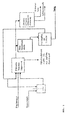
- FIG. 2 is a flow chart showing another possible embodiment of the method according to the invention.
- the bypass dust from the clinker, brick or cement production process is discharged, introduced into an aqueous phase, this is then filtered and pressed to obtain a filter cake with a Cl content of less than 10% of the starting material (the bypass dust).
- the resulting aqueous solution may be subjected to wastewater purification to remove heavy metals, and crystallization may be performed to recover the salts (eg, NaCl) dissolved in the filtrate.
- the resulting filter cake may possibly be returned to the clinker, tile or cement production process.
- the resulting aqueous solution ie filtrate or mother liquor
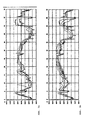
- Figures 3a and 3b illustrate a typical surface temperature profile on the outer surface of a rotary kiln.
- Figure 3a shows the surface temperature profile of a rotary kiln, which is air-cooled over the entire kiln length.
- Figure 3b illustrates a corresponding surface temperature profile without air cooling over the entire furnace surface.
- the inventive method for treating bypass dusts and bypass gases is basically suitable for use in all industrial plants comprising at least one rotary kiln.
- Rotary kilns may, for example, be directly heated rotary kilns into which the product of the industrial plant is in direct contact with the flue gas produced.
- these may be indirectly heated rotary kilns in which the heat is transferred from outside the reaction chamber via the rotary tube wall.
- it is preferred to use the method according to the invention in industrial plants with one or more directly heated rotary kilns, in particular in plants for cement production, brick production or clinker production.
- bypass dust and "bypass gas” as used herein include all dust and gas streams that are separated from the main stream in an industrial plant comprising at least one rotary kiln.
- the components of the cement, brick, or clinker are separated from the main stream. They can then be returned to the main stream, at the same or different location, if necessary after a work-up or removal of certain constituents. Alternatively, they can be discarded.
- bypass line designates a line which branches off from the main stream of the industrial plant, for example from the main stream of starting materials required for brick, cement or clinker production. If necessary, the bypass line can then lead back to the main stream of starting materials required for brick, cement or clinker production.
- the bypass dust or the bypass gas is brought into contact with an aqueous phase in step a).
- This can be achieved, for example, by introducing the bypass dust or the bypass gas, according to the principle of a gas washing bottle, through a tube into the aqueous phase.
- the bypass gas / bypass dust may be brought into contact with the aqueous solution by means of a spray pipe or a sprinkler composed of a plurality of spray pipes become. This can be done in cocurrent or countercurrent.
- the resulting aqueous solution containing the soluble constituents in dissolved form and the water-insoluble constituents of the bypass gas or dust (ie the slurry formed) is collected in this case, optionally freed of water-insoluble (solid) substances and subjected to the further treatment described below ,
- the aqueous phase used in step a) may be water, for example demineralised water, tap water, drinking water or service water (i.e., water that is not of drinking water quality).
- the use of process water is economically advantageous.
- the water vapor from step b) obtained in the evaporation of the aqueous solution can be collected by means of a draw-off device, condensed and used as the aqueous phase.
- the mother liquor obtained thereby can also be used as the aqueous phase.
- the temperature during the fractionated crystallization is lower than the temperature during the step a), so that an efficient dissolution of the water-soluble constituents in the aqueous phase can be ensured.
- the aqueous phase may contain one or more auxiliary substances in order to favor the treatment of bypass dusts and bypass gases and to assist the cleaning action or the absorption of volatile constituents.
- auxiliary substances which consist of inorganic substances (preferably chlorides, nitrates, sulfides and sulfates of the alkali metals and alkaline earth metals as well as ammonium polysulfide) and organic substances (preferably salts of chelating acids, such as Na 2 -EDTA).
- the organic and inorganic substances also include acids, such as mineral acids (such as HCl, H 2 SO 4 , H 3 PO 4 , etc.) and / or organic acids (such as formic acid, acetic acid), and bases, such as inorganic bases (eg, NaOH, KOH, LiOH, Ca (OH) 2 ) and / or organic bases (eg, nitrogen-containing organic bases such as triethylamine and pyridine).
- acids such as mineral acids (such as HCl, H 2 SO 4 , H 3 PO 4 , etc.) and / or organic acids (such as formic acid, acetic acid)
- bases such as inorganic bases (eg, NaOH, KOH, LiOH, Ca (OH) 2 ) and / or organic bases (eg, nitrogen-containing organic bases such as triethylamine and pyridine).
- acids such as mineral acids (such as HCl, H 2 SO 4 , H 3 PO 4 , etc.) and / or organic acids (such as
- inorganic substances can influence the solubility of the constituents of the bypass gas / bypass dust in the aqueous phase.
- solubility of sodium chloride can be reduced.
- metals such as As, Be, Br, Cd, Cr, F, Hg, I, Ni, Pb, Tl, V and Zn to facilitate, since these then precipitate as sparingly soluble salts (eg as sulfides).
- organic salts or acids can exert a solubility-improving effect on metals, since these are then complexed in solution and thus removed from the bypass gas / bypass dust.
- This can be done in the case of a possible return of the separated non-volatile constituents in the manufacturing process in the industrial plant, for example in the cement, clinker or Be advantageous tile production process, since these metals are then or not in the amount contained in the recycled non-volatile components (and thus in the final product, such as the brick, the cement or the clinker).
- This can also be beneficial for reducing the heavy metal load if the non-volatile components are not recycled, but disposed of.
- the concentration of these organic and / or inorganic substances in the aqueous phase is preferably 0.01-10% by weight, more preferably 0.1-5% by weight, and most preferably 0.5-3% by weight.
- water tap water
- an aqueous phase containing one or more of the above-mentioned Contains auxiliary substances, from the o.g. may be preferred for better leaching of the soluble substances or removal of undesirable matter (e.g., precipitation as heavy metal sulfides) prior to possible reuse or disposal of the aqueous phase.
- Suitable auxiliary substances may be, for example, inorganic substances, in particular salts such as chlorides, nitrates, sulfides or sulfates of the alkali metals and alkaline earth metals, or else ammonium polysulfide.
- the aqueous phase may also contain organic substances such as chelating acids such as EDTA. The latter increase the solubility of the heavy metal ions in the aqueous solution and thus promote their separation from water-insoluble constituents.
- water-soluble constituents refers to inorganic or organic substances which are dissolved in the aqueous phase in step a) and thus constituents of the aqueous Solution.
- water-insoluble constituents are amorphous or crystalline solids which, after step a), can be separated from the aqueous solution by filtration.
- Water-soluble constituents and water-insoluble constituents may, for example, be components of the bypass dusts or bypass gases. However, the water-soluble components and the water-insoluble components may also contain chemical reaction products of the bypass dusts and bypass gases with the aqueous phase.
- the water-soluble components dissolve in the aqueous phase.
- the water-insoluble components are preferably separated from the slurry formed, for example by filtration or by centrifugation.
- the water-insoluble constituents separated off in this case (eg the resulting filter cake) have a significantly reduced concentration of undesired alkali and alkaline earth salts (such as chlorides, sulfates, etc.) as well as unwanted heavy metals such as As, Be, Cd, Co, Cr, Cu, Hg, Mn, Ni, Pb, Sb, Sn, Te, Tl, V on.
- the separated water-insoluble constituents may optionally be incorporated into the process carried out in the industrial plant, e.g. B. in the cement or Klinkerher einsvon be attributed without this leads to the accumulation of the product of the industrial plant of the resulting cement or clinker with these undesirable substances.
- the separated water-insoluble constituents can also be subjected to a more intensive purification, for example by extraction of the filter cake in the case of filtration in order to further reduce the content of undesired constituents. On a small scale such extraction can be carried out eg by Soxleth extraction. Large-scale can be perform such an extraction eg with a mixer-settler.
- the water-soluble components whose presence in the industrial plant, eg. B. during cement or clinker production are undesirable, and in step a) in the aqueous phase dissolve herein, are composed essentially of chlorides and other volatile components, such as sulfates (or SO 3 ), but can also contain other ingredients such as heavy metals or nitrates. If the water-insoluble constituents of the bypass dust are brought back into the raw meal after being brought into contact with the aqueous phase in step a) and separated off (eg by filtration), a substantial reduction of the chloride content can be achieved.
- the chloride content of the water-insoluble constituents is less than 20% by weight, more preferably less than 10% by weight, still more preferably less than 5% Wt .-%, and most preferably less than 2 wt .-% of the chloride content of the gas / the dust before the introduction through the aqueous phase (wt .-%), ie the chloride content of the starting materials.
- the process according to the invention can be conducted in a continuous or batchwise manner. This applies both to the contacting of the bypass dust or gas with the aqueous phase in step a) and the workup of the resulting aqueous solution (of the slurry formed).
- either a stream of bypass gas or dust may be contacted with a charge (fresh or treated) aqueous phase, or both bypass gas respectively. dust as well as the (fresh or treated) aqueous phase are fed continuously.
- the stream of bypass dust or gas may, if desired, be brought into contact with the charge of the aqueous phase until the charge of the aqueous phase with soluble constituents is saturated, for example by introduction herein.
- the ratio of the aqueous phase charge to the bypass dust / bypass gas flow rate is preferably in the range of 0.5 to 100 hours, more preferably in the range of 1 to 50 hours, still more preferably in the range of 1.5 to 20 hours , most preferably in the range of 2 to 12 hours, expressed as [weight of aqueous phase charge / kg]: [Bypass gas / bypass dust mass flow / kg h -1 ].
- the bypass dust or the gas and the aqueous phase are supplied in a continuous manner in step a).
- the ratio of the flow rate of the aqueous phase to the flow rate of the bypass dust or the gas is preferably in the range 0.5-100, more preferably in the range of 0.8-50, more preferably in the range of 1.0-20 , and most preferably in the range of 1.2-6, expressed as [aqueous phase mass flow rate / kg h -1 ]: [Bypass gas / bypass dust mass flow / kg h -1 ].
- the aqueous phase can be continuously brought via a sprinkler or one or more Sprchanohe in contact with the flow of the bypass gas / the bypass dust. This is preferably done in a bypass line.
- the weight of the mass flow of the bypass dust / gas is by weight the solid at room temperature components, ie the constituents of the starting material.
- the bypass dust or gas is first collected to then bring a charge of the bypass dust into contact with the aqueous phase
- the weight ratio of the aqueous phase to the collected bypass dust ie, the ratio of the weight of the aqueous phase batch / kg: [the weight of the collected by-pass dust gas / kg] is preferably in the range of 0, 1-10, more preferably 0.8-8, and still more preferably 1-2.5 if a batch of the aqueous phase is used.
- the collected bypass dust may also be introduced into, or brought into contact with, the aqueous phase until saturation.
- the aqueous phase may then optionally be replaced with fresh aqueous phase, if desired. Also, continuously or at intervals, fresh or treated aqueous phase may be added to the charge of collected bypass dust or gas, while spent aqueous phase is eventually removed from the contacting region.
- the slurry obtained from the continuous or discontinuous contacting of the bypass dust with the aqueous phase, including the water-insoluble solid components, can be worked up either continuously or discontinuously, preferably separating the water-insoluble components, and optionally obtaining the resulting aqueous solution the water-soluble constituents contained therein are further treated in step b).
- the further treatment of the aqueous solution after step a) may also comprise a plurality of steps, for example a separation from the above-mentioned heavy metals (As, Be, Cd, Co, Cr, Cu, Hg, Mn, Ni, Pb, Sb, Sn, Te, Tl, V) before step b), eg by means of sulphide precipitation, so that during and / or water-soluble constituents obtained after step b) have a reduced content of these metals.
- the heavy metals can be separated and recovered from the aqueous solution by means of suitable ion exchange resins.
- ion exchange resins suitable for this purpose are known to the person skilled in the art and include, inter alia, resins with carboxyl groups or sulfonic acid groups.
- Appropriate ion exchange resins are, for example, under trade names Lewatit ® (Lanxess), Dowex ® (Dow Chemicals) and Amberlite ® (Rohm and Haas) are commercially available.
- the non-volatile (ie solid or liquid at the temperature in the bypass) components of the bypass dust / the bypass gas before being introduced into the aqueous phase in step b) can be separated.
- This can be achieved by conventional techniques, such as by using a mass-flow, filtering and electrical precipitator. Details of the separators usable herein are known to those skilled in the art; In addition, reference may be made to FW Locher, "Cement: Basics of Production and Use", Verl. Bau undtechnik, Dusseldorf 2000.
- the separation of the non-volatile constituents from contacting with the aqueous phase has the advantage that the sludge formation in the aqueous phase can be suppressed or reduced, which facilitates the workup and further use of the aqueous solution. Furthermore, the separated non-volatile constituents have a chloride content which is reduced compared to the starting substance (eg the raw meal) and can thus be returned to the starting substance (eg the raw meal) or the firing process without the chloride content of the final product disadvantageously, since at the temperatures in the bypass, the chlorides are substantially in the gas phase.
- the solid (non-volatile) components separated prior to contacting the bypass dust or gas with the aqueous phase may also be subjected to additional purification (eg, by washing or by extraction) to determine the content undesirable substances before a possible return to the manufacturing process in the industrial plant, for example, in the cement production process on.
- bypass dust or bypass gas is introduced into the aqueous phase or brought into contact with the aqueous phase (for example, by sprinkling), and thereby the water-soluble components dissolve in the aqueous phase.
- Bypass dust / gas can be introduced until the solubility limit of the water-soluble constituents has been reached.
- the water-soluble constituents then crystallize out (if appropriate after cooling) as salts from the saturated or supersaturated aqueous solution.
- Heavy metals are separated from the resulting aqueous solution.
- step a) It is preferred to filter the aqueous solution after contacting with the bypass gas / bypass dust in step a) and before any crystallization of the salts, or to separate off the water-insoluble components in another way (for example by centrifuging).
- the separated water-insoluble constituents contain less unwanted components (such as chlorides) and can therefore be subsequently fed back to the combustion or production process in the industrial plant.
- the process of the present invention allows the use of higher chloride (ie, greater than 1 wt%) wastes as a substitute fuel in the industrial plant, especially in the cement, clinker, or brick making process, since the chlorides contained herein are substantially ( ie, greater than 80%, preferably greater than 90%, more preferably greater than 95%, and most preferably greater than 98%, and thus not found again in the final product.
- the aqueous solution is applied to an outer surface of the rotary kiln, wherein the aqueous solution is preferably abandoned distributed in the upper part of the rotary kiln.
- the preferred position of the outer surface to which the aqueous solution is applied is case-by-case and may be selected by one of ordinary skill in the art based on his expertise and experience.
- the sintering zone is the hottest part of the rotary kiln, while the aqueous solution is heated during and / or after step b) particularly fast and, at least partially, evaporated.
- the outer surface of the rotary kiln, to which the aqueous Solution is applied below the sintering zone.
- This embodiment allows a particularly efficient and rapid cooling of the product of the industrial plant, so that undesirable side reactions that might otherwise occur during a slower cooling, are efficiently suppressed.
- cement having a particularly low proportion of dicalcium silicate can be produced.
- a rapid cooling causes more magnesium oxide is incorporated into the clinker fibers, so that there is less driving in the curing of the resulting cement by free magnesium oxide.
- Industrial plants which comprise at least one rotary kiln and which are set up for the method according to the invention have several advantages over comparable industrial plants with air cooling.
- By heating and at least partial evaporation of the aqueous solution on the outer surface of the rotary kiln its surface is efficiently cooled.
- the use of air blowers, which is usually required for cooling the sintering zone can be reduced or eliminated. This leads to a significant reduction of the operating noise and the energy consumption by the cooling fans.
- the industrial plant is less susceptible to fuel fluctuations by the inventive method. Due to the improved approach conditions, both the refractory lining of the rotary kiln and the furnace shell are exposed to lower thermal and mechanical loads.
- the outer surface of the rotary kiln, to which the aqueous solution is applied has a sufficiently high surface temperature.
- the surface temperature at each point of the outer surface of the Rotary kiln to which the aqueous solution is applied at least 40 ° C, more preferably at least 60 ° C, particularly preferably at least 80 ° C. This ensures that a comparatively small rotary kiln length is needed for step b).
- the otherwise required and noisy air cooling can be partially or completely omitted.
- the exact surface temperature profile on the outer surface of the rotary kiln depends on the structure and purpose of the industrial plant. Based on his experience, the skilled artisan will be able to analyze the surface temperature profile in each specific case and to determine the appropriate position of the outer surface to which the aqueous solution is applied.
- the aqueous solution evaporates during and / or after step b) at least partially on the outer surface of the rotary kiln so that the water-soluble constituents of the aqueous solution adhere to the outer surface of the rotary kiln as solids. These can then be removed, for example by means of a mechanical device, such as a scraper, from the outer surface of the rotary kiln.
- the corresponding device can be mounted in the lower region of the outer surface of the rotary kiln, so that the residence time of the aqueous solution on the outer surface of the rotary kiln for a substantially complete evaporation of the water from the aqueous solution is sufficient.
- the solid water-soluble components thus obtained that is, the salt residues after evaporation, are separated from the outer surface of the rotary kiln and may be collected, for example, in an underlying conveyor.
- the aqueous solution is applied to the outer surface of the rotary kiln so that it comes only to a partial evaporation.
- the aqueous solution may be evaporated to about 70% of the volume prior to step b), preferably to about 50% of the volume prior to step b), more preferably to about 30% of the volume prior to step b).
- the concentrated aqueous solution thus obtained can then be cooled, resulting in a fractional crystallization of the water-soluble constituents. Consequently, the isolated crystalline water-soluble components have a particularly high purity and are therefore more economically valuable.
- the resulting mother liquor can then be reused in step a) as an aqueous phase.
- the application of the aqueous solution to the outer surface of the rotary kiln in step b) can be carried out by means of one or more devices which ensure a sufficiently uniform distribution of the aqueous solution over the outer surface of the rotary kiln.
- sprayers are well suited for this purpose.
- the aqueous solution in step b) has a sufficiently high temperature, so that its subsequent evaporation or evaporation is ensured on the outer surface of the rotary kiln.
- the temperature of the aqueous solution in step b) is at least 40 ° C, more preferably at least 60 ° C, particularly preferably at least 80 ° C.
- the temperature of the aqueous solution in step b) at not more than 70 ° C, more preferably not more than 50 ° C, or even not more than 30 ° C.
- the water vapor which is formed during and / or after step b) is preferably collected by means of a suitable extraction device. This can then be used together with the clinker cooler exhaust air from any Salt dust to be cleaned. After condensation and, if appropriate, cooling, the resulting water is suitable for use as the aqueous phase in step a).
- a corresponding use of the steam allows an additional reduction of the water consumption of the industrial plant.
- the exact composition of the aqueous solution applied to the outer surface of the rotary kiln in step b) depends on the process performed in the industrial plant.
- the aqueous solution halides of alkali and alkaline earth metals such as sodium chloride or potassium chloride. So that the corrosion of the outer surface of the rotary kiln, to which the aqueous solution is applied in step b), can be avoided, it is advantageous to provide these with a corresponding corrosion protection layer.
- the outer surface of the rotary kiln can be completely or partially lined with a sheet, wherein the material of the sheet can be adapted to the composition of the aqueous solution and the temperature of the outer surface of the rotary kiln accordingly.
- the sheet may be made of titanium for this purpose.
- a titanium sheet suitable for this purpose can, due to the strength of the material, be made comparatively thin. As a result, little material is consumed, so that the appropriate titanium corrosion protection layer can be applied with a low cost.
- the plate may be made of steel, eg of normal steel (eg boiler plate) or of stainless steel.
- steel grades such as 1.4571 or 1.4539 can be used for temperatures below 60 ° C. These have a sufficiently high corrosion stability at lower temperatures. For outside surface temperatures above 60 0 ° C, however, it makes sense to use steel grades such as 1.4561 (Alloy 31) to ensure adequate jacket protection.
- Figures 3a and 3b show a typical surface temperature profile on a rotary kiln with or without air cooling over the entire kiln length.
- the comparison of the two figures shows that the surface temperature can be effectively reduced by the development and installation of the furnace shell cooling.
- the rotary kiln plants are less susceptible to fuel fluctuations, which is particularly relevant when using substitute fuels. Due to the improved approach conditions both the refractory lining and the furnace shell of the rotary kiln are exposed to lower loads. This extends the life of the rotary kiln and reduces the frequency of repairs and maintenance. Regardless of the fact that rotary kilns, irrespective of their intended use, are generally operated 24 hours a day, 7 days a week and constitute a high-quality capital asset, this is of great importance.
- the salts obtained by the process according to the invention which consist essentially of isolated water-soluble constituents, are generally akali and alkaline earth metal salts, in particular corresponding chlorides. These can then be supplied to various uses. Possible uses include use as road salt, lickstones, raw materials for electrolysis for chlorine and / or alkali metal hydroxide, flame retardant, Dustbinder, as fertilizer component or for glass or ceramic production.
- the aqueous solution to be rejected must not contain unauthorized concentrations of foreign components such as Be, Br, Cd, Cr, F, Hg, I, Ni, Pb, Tl, V and Zn.
- the heat transfer conditions in the process according to the invention were investigated by means of heat transfer calculation.
- the evaporation of the aqueous solution affects the heat transfer (heat loss) and especially the refractory internal temperature only slightly.
- the use of the method according to the invention does not lead to a significant increase in the fuel input.
Landscapes
- Chemical & Material Sciences (AREA)
- Engineering & Computer Science (AREA)
- Ceramic Engineering (AREA)
- Materials Engineering (AREA)
- Structural Engineering (AREA)
- Organic Chemistry (AREA)
- Thermal Sciences (AREA)
- Environmental & Geological Engineering (AREA)
- Public Health (AREA)
- Health & Medical Sciences (AREA)
- Physics & Mathematics (AREA)
- Toxicology (AREA)
- Life Sciences & Earth Sciences (AREA)
- Biodiversity & Conservation Biology (AREA)
- Ecology (AREA)
- Environmental Sciences (AREA)
- Processing Of Solid Wastes (AREA)
Priority Applications (1)
| Application Number | Priority Date | Filing Date | Title |
|---|---|---|---|
| EP14176880.4A EP2975009A1 (fr) | 2014-07-14 | 2014-07-14 | Procédé de traitement et d'évaluation de poussières de dérivation et gaz de dérivation provenant d'une installation industrielle |
Applications Claiming Priority (1)
| Application Number | Priority Date | Filing Date | Title |
|---|---|---|---|
| EP14176880.4A EP2975009A1 (fr) | 2014-07-14 | 2014-07-14 | Procédé de traitement et d'évaluation de poussières de dérivation et gaz de dérivation provenant d'une installation industrielle |
Publications (1)
| Publication Number | Publication Date |
|---|---|
| EP2975009A1 true EP2975009A1 (fr) | 2016-01-20 |
Family
ID=51176225
Family Applications (1)
| Application Number | Title | Priority Date | Filing Date |
|---|---|---|---|
| EP14176880.4A Withdrawn EP2975009A1 (fr) | 2014-07-14 | 2014-07-14 | Procédé de traitement et d'évaluation de poussières de dérivation et gaz de dérivation provenant d'une installation industrielle |
Country Status (1)
| Country | Link |
|---|---|
| EP (1) | EP2975009A1 (fr) |
Cited By (1)
| Publication number | Priority date | Publication date | Assignee | Title |
|---|---|---|---|---|
| EP4296231A1 (fr) * | 2022-06-20 | 2023-12-27 | amaTEQ Holding GmbH | Procédé de traitement des poussières salines |
Citations (5)
| Publication number | Priority date | Publication date | Assignee | Title |
|---|---|---|---|---|
| DE4442563A1 (de) * | 1994-11-30 | 1996-06-05 | Nordcement Ag | Verfahren zur Behandlung und Verwertung von Bypass-Stäuben aus dem Zementherstellungsprozeß |
| WO2007057512A2 (fr) * | 2005-11-21 | 2007-05-24 | Andritz Oy | Procede et appareil de traitement de boue de chaux |
| WO2012142638A1 (fr) | 2011-04-21 | 2012-10-26 | Holcim Technology Ltd | Procédé pour le traitement et l'utilisation de poussières de dérivation provenant du processus de production de ciment |
| EP2604586A1 (fr) * | 2010-08-10 | 2013-06-19 | Taiheiyo Cement Corporation | Procédé et dispositif pour le traitement de la poussière de dérivation du chlore et de gaz d'échappement |
| EP1923366B1 (fr) | 2006-11-15 | 2013-09-18 | Alexander Kehrmann | Procédé de recyclage des poussières de dérivation et des produits recueillis |
-
2014
- 2014-07-14 EP EP14176880.4A patent/EP2975009A1/fr not_active Withdrawn
Patent Citations (5)
| Publication number | Priority date | Publication date | Assignee | Title |
|---|---|---|---|---|
| DE4442563A1 (de) * | 1994-11-30 | 1996-06-05 | Nordcement Ag | Verfahren zur Behandlung und Verwertung von Bypass-Stäuben aus dem Zementherstellungsprozeß |
| WO2007057512A2 (fr) * | 2005-11-21 | 2007-05-24 | Andritz Oy | Procede et appareil de traitement de boue de chaux |
| EP1923366B1 (fr) | 2006-11-15 | 2013-09-18 | Alexander Kehrmann | Procédé de recyclage des poussières de dérivation et des produits recueillis |
| EP2604586A1 (fr) * | 2010-08-10 | 2013-06-19 | Taiheiyo Cement Corporation | Procédé et dispositif pour le traitement de la poussière de dérivation du chlore et de gaz d'échappement |
| WO2012142638A1 (fr) | 2011-04-21 | 2012-10-26 | Holcim Technology Ltd | Procédé pour le traitement et l'utilisation de poussières de dérivation provenant du processus de production de ciment |
Non-Patent Citations (3)
| Title |
|---|
| ANTONIO C CAPUTO ET AL: "Performance modeling of radiant heat recovery exchangers for rotary kilns", APPLIED THERMAL ENGINEERING, PERGAMON, OXFORD, GB, vol. 31, no. 14, 12 April 2011 (2011-04-12), pages 2578 - 2589, XP028246809, ISSN: 1359-4311, [retrieved on 20110423], DOI: 10.1016/J.APPLTHERMALENG.2011.04.024 * |
| F. W. LOCHER: "Zement: Grundlagen der Herstellung und Verwendung", VERL. BAU UND TECHNIK, 2000 |
| S. DIENER ET AL: "Waste heat recovery from cement production for faecal sludge drying", 1 January 2012 (2012-01-01), pages 1 - 11, XP055160441, Retrieved from the Internet <URL:http://www.eawag.ch/forschung/sandec/publikationen/ewm/dl/FaME_Waste_heat_recovery.pdf> [retrieved on 20150108] * |
Cited By (2)
| Publication number | Priority date | Publication date | Assignee | Title |
|---|---|---|---|---|
| EP4296231A1 (fr) * | 2022-06-20 | 2023-12-27 | amaTEQ Holding GmbH | Procédé de traitement des poussières salines |
| WO2023247251A1 (fr) * | 2022-06-20 | 2023-12-28 | Amateq Holding Gmbh | Méthode de traitement de poussières contenant du sel |
Similar Documents
| Publication | Publication Date | Title |
|---|---|---|
| CN113105138B (zh) | 垃圾焚烧飞灰水洗脱氯和水洗液蒸发分质结晶的处理方法及系统 | |
| EP2375153B1 (fr) | Traitement de cendres volantes | |
| EP1923366B1 (fr) | Procédé de recyclage des poussières de dérivation et des produits recueillis | |
| EP0111802B1 (fr) | Procédé pour la purification de l'acide phosphorique obtenu par voie humide | |
| EP2519476B1 (fr) | Procédé de valorisation de combustibles de substitution phosphorés lors de la fabrication du ciment | |
| EP2975009A1 (fr) | Procédé de traitement et d'évaluation de poussières de dérivation et gaz de dérivation provenant d'une installation industrielle | |
| EP0393402B2 (fr) | Procédé de purification de gaz d'échappement contentant des métaux lourds et à haute teneur en chlorure | |
| DE102021204224A1 (de) | Verfahren zur Gewinnung von Alkalimetallchloriden aus Bypassstäuben | |
| WO2008064790A1 (fr) | Procédé et installation de production de verre soluble avec récupération de chaleur | |
| DE4109044C2 (de) | Verfahren zur gemeinsamen Entsorgung von Reststoffen aus der Müllverbrennung | |
| EP0839892B1 (fr) | Procédé pour l'application complète et sans émissions d'un gaz brut de synthèse par recyclage à haute température et par conversion matériau-spécifique | |
| DE4442563A1 (de) | Verfahren zur Behandlung und Verwertung von Bypass-Stäuben aus dem Zementherstellungsprozeß | |
| DE3938915C1 (fr) | ||
| DE69710308T2 (de) | Entsorgung zinkhaltiger metallurgischer Reststoffe durch kontinuierliche elektro-nasschemische Aufarbeitung in basischer Umgebung | |
| DE2748133C2 (de) | Verfahren zur Herstellung von hochreinem Magnesiumoxid | |
| EP4540180B1 (fr) | Procédé de traitement des poussières salines | |
| DE102024101188B3 (de) | Verfahren zum Behandeln von Rauchgas | |
| EP2292559B1 (fr) | Préparation de poussière de ciment | |
| DE4403840C2 (de) | Verfahren zur Rückgewinnung von Schwefelsäure aus metallsulfathaltigen Gebrauchtsäuren | |
| DE2258918C3 (de) | Verfahren zur Verarbeitung von bei der Bleigewinnung anfallendem Staub | |
| DE658952C (de) | Verfahren zur Verarbeitung von Kalisalzen auf gleichmaessiges Korn | |
| DE2825766A1 (de) | Verfahren zur herstellung von hochreinem magnesiumoxid | |
| DE19502067C2 (de) | Verfahren zur Reinigung eines hydratbildenden Salzes | |
| WO2023143672A1 (fr) | Procédé et dispositif de récupération de ressources d'eau de mer | |
| DE102020109697A1 (de) | Verfahren und Anlage zur prozessintegrierten Behandlung und Verwertung von Bypassstaub |
Legal Events
| Date | Code | Title | Description |
|---|---|---|---|
| PUAI | Public reference made under article 153(3) epc to a published international application that has entered the european phase |
Free format text: ORIGINAL CODE: 0009012 |
|
| AK | Designated contracting states |
Kind code of ref document: A1 Designated state(s): AL AT BE BG CH CY CZ DE DK EE ES FI FR GB GR HR HU IE IS IT LI LT LU LV MC MK MT NL NO PL PT RO RS SE SI SK SM TR |
|
| AX | Request for extension of the european patent |
Extension state: BA ME |
|
| 17P | Request for examination filed |
Effective date: 20160620 |
|
| RBV | Designated contracting states (corrected) |
Designated state(s): AL AT BE BG CH CY CZ DE DK EE ES FI FR GB GR HR HU IE IS IT LI LT LU LV MC MK MT NL NO PL PT RO RS SE SI SK SM TR |
|
| STAA | Information on the status of an ep patent application or granted ep patent |
Free format text: STATUS: THE APPLICATION IS DEEMED TO BE WITHDRAWN |
|
| 18D | Application deemed to be withdrawn |
Effective date: 20160721 |