EP2977697A2 - Wärmetauscher und wärmetauschsystem - Google Patents
Wärmetauscher und wärmetauschsystem Download PDFInfo
- Publication number
- EP2977697A2 EP2977697A2 EP15167869.5A EP15167869A EP2977697A2 EP 2977697 A2 EP2977697 A2 EP 2977697A2 EP 15167869 A EP15167869 A EP 15167869A EP 2977697 A2 EP2977697 A2 EP 2977697A2
- Authority
- EP
- European Patent Office
- Prior art keywords
- heat exchanger
- flow path
- plate member
- exchanger tubes
- bonding portion
- Prior art date
- Legal status (The legal status is an assumption and is not a legal conclusion. Google has not performed a legal analysis and makes no representation as to the accuracy of the status listed.)
- Withdrawn
Links
- 239000012530 fluid Substances 0.000 claims abstract description 130
- 238000011144 upstream manufacturing Methods 0.000 claims description 20
- 238000000926 separation method Methods 0.000 description 16
- 230000008859 change Effects 0.000 description 7
- 230000009467 reduction Effects 0.000 description 7
- 230000008901 benefit Effects 0.000 description 6
- 239000000463 material Substances 0.000 description 5
- 238000005516 engineering process Methods 0.000 description 4
- 238000005219 brazing Methods 0.000 description 3
- 239000002826 coolant Substances 0.000 description 3
- 238000004519 manufacturing process Methods 0.000 description 3
- 229910052751 metal Inorganic materials 0.000 description 3
- 239000002184 metal Substances 0.000 description 3
- 238000004378 air conditioning Methods 0.000 description 2
- 238000005452 bending Methods 0.000 description 2
- 238000005192 partition Methods 0.000 description 2
- 229910000838 Al alloy Inorganic materials 0.000 description 1
- 229910052782 aluminium Inorganic materials 0.000 description 1
- XAGFODPZIPBFFR-UHFFFAOYSA-N aluminium Chemical compound [Al] XAGFODPZIPBFFR-UHFFFAOYSA-N 0.000 description 1
- 230000009286 beneficial effect Effects 0.000 description 1
- 238000005253 cladding Methods 0.000 description 1
- 238000001816 cooling Methods 0.000 description 1
- 230000003247 decreasing effect Effects 0.000 description 1
- 238000003475 lamination Methods 0.000 description 1
- 238000000034 method Methods 0.000 description 1
- 239000011347 resin Substances 0.000 description 1
- 229920005989 resin Polymers 0.000 description 1
- 239000010935 stainless steel Substances 0.000 description 1
- 229910001220 stainless steel Inorganic materials 0.000 description 1
- XLYOFNOQVPJJNP-UHFFFAOYSA-N water Substances O XLYOFNOQVPJJNP-UHFFFAOYSA-N 0.000 description 1
Images










Classifications
-
- F—MECHANICAL ENGINEERING; LIGHTING; HEATING; WEAPONS; BLASTING
- F28—HEAT EXCHANGE IN GENERAL
- F28D—HEAT-EXCHANGE APPARATUS, NOT PROVIDED FOR IN ANOTHER SUBCLASS, IN WHICH THE HEAT-EXCHANGE MEDIA DO NOT COME INTO DIRECT CONTACT
- F28D9/00—Heat-exchange apparatus having stationary plate-like or laminated conduit assemblies for both heat-exchange media, the media being in contact with different sides of a conduit wall
- F28D9/0093—Multi-circuit heat-exchangers, e.g. integrating different heat exchange sections in the same unit or heat-exchangers for more than two fluids
-
- F—MECHANICAL ENGINEERING; LIGHTING; HEATING; WEAPONS; BLASTING
- F28—HEAT EXCHANGE IN GENERAL
- F28D—HEAT-EXCHANGE APPARATUS, NOT PROVIDED FOR IN ANOTHER SUBCLASS, IN WHICH THE HEAT-EXCHANGE MEDIA DO NOT COME INTO DIRECT CONTACT
- F28D1/00—Heat-exchange apparatus having stationary conduit assemblies for one heat-exchange medium only, the media being in contact with different sides of the conduit wall, in which the other heat-exchange medium is a large body of fluid, e.g. domestic or motor car radiators
- F28D1/02—Heat-exchange apparatus having stationary conduit assemblies for one heat-exchange medium only, the media being in contact with different sides of the conduit wall, in which the other heat-exchange medium is a large body of fluid, e.g. domestic or motor car radiators with heat-exchange conduits immersed in the body of fluid
- F28D1/03—Heat-exchange apparatus having stationary conduit assemblies for one heat-exchange medium only, the media being in contact with different sides of the conduit wall, in which the other heat-exchange medium is a large body of fluid, e.g. domestic or motor car radiators with heat-exchange conduits immersed in the body of fluid with plate-like or laminated conduits
- F28D1/0308—Heat-exchange apparatus having stationary conduit assemblies for one heat-exchange medium only, the media being in contact with different sides of the conduit wall, in which the other heat-exchange medium is a large body of fluid, e.g. domestic or motor car radiators with heat-exchange conduits immersed in the body of fluid with plate-like or laminated conduits the conduits being formed by paired plates touching each other
- F28D1/0325—Heat-exchange apparatus having stationary conduit assemblies for one heat-exchange medium only, the media being in contact with different sides of the conduit wall, in which the other heat-exchange medium is a large body of fluid, e.g. domestic or motor car radiators with heat-exchange conduits immersed in the body of fluid with plate-like or laminated conduits the conduits being formed by paired plates touching each other the plates having lateral openings therein for circulation of the heat-exchange medium from one conduit to another
- F28D1/0333—Heat-exchange apparatus having stationary conduit assemblies for one heat-exchange medium only, the media being in contact with different sides of the conduit wall, in which the other heat-exchange medium is a large body of fluid, e.g. domestic or motor car radiators with heat-exchange conduits immersed in the body of fluid with plate-like or laminated conduits the conduits being formed by paired plates touching each other the plates having lateral openings therein for circulation of the heat-exchange medium from one conduit to another the plates having integrated connecting members
-
- F—MECHANICAL ENGINEERING; LIGHTING; HEATING; WEAPONS; BLASTING
- F28—HEAT EXCHANGE IN GENERAL
- F28D—HEAT-EXCHANGE APPARATUS, NOT PROVIDED FOR IN ANOTHER SUBCLASS, IN WHICH THE HEAT-EXCHANGE MEDIA DO NOT COME INTO DIRECT CONTACT
- F28D1/00—Heat-exchange apparatus having stationary conduit assemblies for one heat-exchange medium only, the media being in contact with different sides of the conduit wall, in which the other heat-exchange medium is a large body of fluid, e.g. domestic or motor car radiators
- F28D1/02—Heat-exchange apparatus having stationary conduit assemblies for one heat-exchange medium only, the media being in contact with different sides of the conduit wall, in which the other heat-exchange medium is a large body of fluid, e.g. domestic or motor car radiators with heat-exchange conduits immersed in the body of fluid
- F28D1/04—Heat-exchange apparatus having stationary conduit assemblies for one heat-exchange medium only, the media being in contact with different sides of the conduit wall, in which the other heat-exchange medium is a large body of fluid, e.g. domestic or motor car radiators with heat-exchange conduits immersed in the body of fluid with tubular conduits
- F28D1/053—Heat-exchange apparatus having stationary conduit assemblies for one heat-exchange medium only, the media being in contact with different sides of the conduit wall, in which the other heat-exchange medium is a large body of fluid, e.g. domestic or motor car radiators with heat-exchange conduits immersed in the body of fluid with tubular conduits the conduits being straight
- F28D1/0535—Heat-exchange apparatus having stationary conduit assemblies for one heat-exchange medium only, the media being in contact with different sides of the conduit wall, in which the other heat-exchange medium is a large body of fluid, e.g. domestic or motor car radiators with heat-exchange conduits immersed in the body of fluid with tubular conduits the conduits being straight the conduits having a non-circular cross-section
- F28D1/05358—Assemblies of conduits connected side by side or with individual headers, e.g. section type radiators
Definitions
- the present disclosure relates to a heat exchanger and a heat exchanging unit.
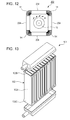
- Japanese Unexamined Patent Application Publication No. 2008-39322 discloses a heat exchanger 101 that has a plurality of heat exchanger tubes 102, as illustrated in Fig. 13 .
- Each heat exchanger tube 102 is formed by bending a single plate material; the heat exchanger tube 102 has a middle portion 102A and open flared portions 102B and 102C.
- the middle portion 102A is a flat tube.
- the open flared portions 102B and 102C are about two to four times as thick as the middle portion 102A and are open at both ends of the heat exchanger tube 102.
- An external flow path is formed between each two adjacent heat exchanger tubes 102. It is described in Japanese Unexamined Patent Application Publication No. 2008-39322 that the heat exchanger tube 102 may have a meandering coolant path and that the meandering coolant path may be space-separated.
- One non-limiting and exemplary embodiment provides a technology that improves the performance of a heat exchanger formed with heat exchanger tubes.
- a heat exchanger includes a plurality of flat heat exchanger tubes, each of which includes a first plate member and a second plate member, a part of the first plate member and a part of the second plate member being bonded together, the first plate member and the second plate member constituting an internal flow path through which a first fluid flows, wherein an external flow path is located between each two adjacent heat exchanger tubes, a second fluid that flows through the external flow path, and that exchanges heat with the first fluid, each two adjacent heat exchanger tubes of the plurality of heat exchanger tubes are bonded together at inlets and outlets in the internal flow paths in the two heat exchanger tubes; one of each two adjacent heat exchanger tubes is offset with respect to the other of each two adjacent heat exchanger tube in a direction perpendicular to an arrangement direction in which the plurality of heat exchanger tubes are arranged, the first plate member has a first inlet bonding portion positioned on a first main plane, which is an external surface of the first plate member, and a first outlet bond
- the above technology can improve the performance of a heat exchanger formed with heat exchanger tubes.
- a heat exchanger includes a plurality of flat heat exchanger tubes, each of which has an internal flow path through which a first fluid flows, and a plurality of external flow paths, each of which is disposed between each two adjacent heat exchanger tubes, and through each of which a second fluid that exchanges heat with the first fluid flows; each two adjacent heat exchanger tubes of the plurality of heat exchanger tubes are bonded together at inlets and outlets in the internal flow paths in the two heat exchanger tubes; one of each two adjacent heat exchanger tubes is offset with respect to the other heat exchanger tube in a direction perpendicular to an arrangement direction in which the plurality of heat exchanger tubes are arranged; the heat exchanger tube includes a first plate member and a second plate member, which are bonded together; the first plate member has a first inlet bonding portion positioned on a first main plane, which is an external surface of the first plate member, and a first outlet bonding portion positioned on the first main plane, as portions at which the heat exchanger tube and its adjacent
- the first aspect it is possible to align the inflow direction of the second fluid and the flow direction of the second fluid in the external flow path or to narrow an angle formed by these directions.
- the flow direction of the second fluid does not much change at positions before and after the inlet plane of the heat exchangers. In this case, the flow separation of the second fluid is suppressed and a large pressure loss is hard to occur. Accordingly, the performance of the heat exchanger can be fully derived.
- the heat exchanger tube includes a first plate member and a second plate member, which are bonded together. Therefore, the thickness of the heat exchanger tube can be reduced, which is advantageous in that the heat exchanger can be made compact.
- the first plate member has a first inlet bonding portion positioned on the first main plane and a first outlet bonding portion positioned on the first main plane, as portions at which the heat exchanger tube and its adjacent heat exchanger tube are bonded together;
- the second plate member has a second inlet bonding portion positioned on the second main plane and a second outlet bonding portion positioned on the second main plane, as portions at which the heat exchanger tube and its adjacent heat exchanger tube are bonded together; and the first inlet bonding portion and first outlet bonding portion are located at positions relatively close to the edge of the heat exchanger tubes, and the second inlet bonding portion and second outlet bonding portion are located at positions relatively distant from the edge of the heat exchanger tubes.
- the plurality of heat exchanger tubes in the heat exchanger according to the first aspect may include a plurality of first heat exchanger tubes and a plurality of second heat exchanger tubes; the structure of the first heat exchanger tube may differ from the structure of the second heat exchanger tube; and the first heat exchanger tube and second heat exchanger tube may be adjacent to each other in the arrangement direction. Even if an amount of offset, the extent of the external flow path, and other dimensions are strictly restricted, when the first heat exchanger tube and second heat exchanger tube are used in combination, an oblique angle of the inlet plane of the heat exchangers can be easily adjusted to an optimum angle. That is, in the second aspect, the heat exchanger can be designed with increased freedom.
- the first heat exchanger tube in the heat exchanger according to the second aspect may have a first plate member and a second plate member, which are bonded together;
- the first plate member may have a first inlet bonding portion positioned on a first main plane, which is an external surface of the first plate member, and a first outlet bonding portion positioned on the first main plane, as portions at which the heat exchanger tube and its adjacent heat exchanger tube are bonded together;
- the second plate member may have a second inlet bonding portion positioned on a second main plane, which is an external surface of the second plate member, and a second outlet bonding portion positioned on the second main plane, as portions at which the heat exchanger tube and its adjacent heat exchanger tube are bonded together;
- the first inlet bonding portion and first outlet bonding portion may be located at positions relatively close to the edge of the first heat exchanger tubes, and the second inlet bonding portion and second outlet bonding portion may be located at positions relatively distant from the edge of the first heat exchanger tubes;
- the third plate member in the heat exchanger according to the first aspect may have the same shape as the fourth plate member. According to the fifth aspect, since the number of parts is reduced, cost reduction can be expected.
- At least one of the third plate member and fourth plate member in the third or fourth aspect may have the same shape as the first plate member or second plate member. According to the sixth aspect, since the number of parts is reduced, cost reduction can be expected.
- the internal flow path of the heat exchanger in any one of the first to fifth aspects may include a plurality of segments extending in a particular row direction of the heat exchanger tube;
- the heat exchanger tube may further include a plurality of flow path portions, each of which protrudes toward both ends of the heat exchanger tube in its thickness direction and determines one segment in the internal flow path, and may also include thin portions, each of which is positioned between two flow path portions adjacent in a width direction perpendicular to the row direction and separates two adjacent segments along the internal flow path; on a cross section perpendicular to the row direction, the flow path portion in one of two adjacent heat exchanger tubes may face the thin portion of the other heat exchanger tube with the external flow path intervening between them, and the flow path portion in the other heat exchanger tube may face the thin portion of the one heat exchanger tube with the external flow path intervening between them; and the plurality of flow path portions in the one heat exchanger tube and the plurality of flow path portions in the other heat exchanger tube may be
- the extent of the external flow path in the thickness direction of the heat exchanger tube is kept substantially constant in the width direction of the heat exchanger tube (flow direction of the second fluid).
- the pressure loss of the second fluid in the external flow path can be reduced.
- the heat transfer area per unit volume can be enlarged.
- an effective heat transfer area is enlarged.
- a heat exchanging unit includes a blower that has a rotational axis and an impeller secured to the rotational axis, the blower delivering a second fluid in the circumferential direction of the rotational axis due to rotation of the impeller, and heat exchangers described in any one of the first to sixth aspects, the heat exchangers being disposed around the blower in a plane perpendicular to the rotational axis; each of the plurality of external flow paths is disposed so that the downstream end of the external flow path is at a more forward position in the rotational direction of the rotational axis than the upstream end of the external flow path when viewed from the rotational axis.
- the heat exchanger tubes can be optimally placed with respect to a spiral flow coming from a centrifugal blower. This reduces a pressure loss and improves heat exchange efficiency.
- the seventh aspect is suitable to a ceiling cassette type of indoor unit.
- a heat exchanger includes a plurality of flat heat exchanger tubes, each of which has an internal flow path through which a first fluid flows, and a plurality of external flow paths, each of which is disposed between each two adjacent heat exchanger tubes, and through each of which a second fluid that exchanges heat with the first fluid flows; each two adjacent heat exchanger tubes of the plurality of heat exchanger tubes are bonded together at inlets and outlets in the internal flow paths in the two heat exchanger tubes; one of each two adjacent heat exchanger tubes is offset with respect to the other heat exchanger tube in a direction perpendicular to an arrangement direction in which the plurality of heat exchanger tubes are arranged; the heat exchanger tube includes a first plate member and a second plate member, which are bonded together; the first plate member has a first bonding portion provided on a first main plane, which is an external surface of the first plate member, as a portion at which the heat exchanger tube and its adjacent heat exchanger tube are bonded together; the second plate member has a second bond
- the eighth aspect it is possible to align the inflow direction of the second fluid and the flow direction of the second fluid in the external flow path or to narrow an angle formed by these directions.
- the flow direction of the second fluid does not much change at positions before and after the inlet plane of the heat exchangers. In this case, the flow separation of the second fluid is suppressed and a large pressure loss is hard to occur. Accordingly, the performance of the heat exchanger can be fully derived.
- the heat exchanger tube includes a first plate member and a second plate member, which are bonded together. Therefore, the thickness of the heat exchanger tube can be reduced, which is advantageous in that the heat exchanger can be made compact.
- the first plate member has a first bonding portion provided on a first main plane, which is an external surface of the first plate member, as a portion at which the heat exchanger tube and its adjacent heat exchanger tube are bonded together;
- the second plate member has a second bonding portion positioned on a second main plane, which is an external surface of the second plate member, as a portion at which the heat exchanger tube and its adjacent heat exchanger tube are bonded together;
- a bonding plane on which the first bonding portion and second bonding portion are bonded together is inclined with respect to a direction perpendicular to the arrangement direction of the plurality of heat exchanger tubes; and the axis of the first bonding portion and the axis of the second bonding portion are inclined with respect to the arrangement direction of the plurality of heat exchanger tubes. Therefore, the plurality of heat exchanger tubes can be mutually offset in their width direction.
- the internal flow path of the heat exchanger in the eighth aspect may include a plurality of segments extending in a particular row direction of the heat exchanger tube;
- the heat exchanger tube may further include a plurality of flow path portions, each of which protrudes toward both ends of the heat exchanger tube in its thickness direction and determines one segment in the internal flow path, and may also include thin portions, each of which is positioned between two flow path portions adjacent in a width direction perpendicular to the row direction and separates two adjacent segments along the internal flow path; on a cross section perpendicular to the row direction, the flow path portion in one of two adjacent heat exchanger tubes may face the thin portion of the other heat exchanger tube with the external flow path intervening between them, and the flow path portion in the other heat exchanger tube may face the thin portion of the one heat exchanger tube with the external flow path intervening between them; and the plurality of flow path portions in the one heat exchanger tube and the plurality of flow path portions in the other heat exchanger tube may be placed in a sta
- the extent of the external flow path in the thickness direction of the heat exchanger tube is kept substantially constant in the width direction of the heat exchanger tube (flow direction of the second fluid).
- the pressure loss of the second fluid in the external flow path can be reduced.
- the heat transfer area per unit volume can be enlarged.
- an effective heat transfer area is enlarged.
- a heat exchanging unit includes a blower that has a rotational axis and an impeller secured to the rotational axis, the blower delivering a second fluid in the circumferential direction of the rotational axis due to rotation of the impeller, and heat exchangers described in the eighth or ninth aspect, the heat exchangers being disposed around the blower in a plane perpendicular to the rotational axis; each of the plurality of external flow paths is disposed so that the downstream end of the external flow path is at a more forward position in the rotational direction of the rotational axis than the upstream end of the external flow path when viewed from the rotational axis.
- the heat exchanger tubes can be optimally placed with respect to a spiral flow coming from a centrifugal blower. This reduces a pressure loss and improves heat exchange efficiency.
- the tenth aspect is suitable to a ceiling cassette type of indoor unit.
- the heat exchanger according to the eleventh aspect of the present disclosure includes a plurality of flat heat exchanger tubes, each of which has an internal flow path through which a first fluid flows, and a plurality of external flow paths, each of which is disposed between each two adjacent heat exchanger tubes, and through each of which a second fluid that exchanges heat with the first fluid flows; each two adjacent heat exchanger tubes of the plurality of heat exchanger tubes are bonded together at inlets and outlets in the internal flow paths in the two heat exchanger tubes; one of each two adjacent heat exchanger tubes is offset with respect to the other heat exchanger tube in a direction perpendicular to an arrangement direction in which the plurality of heat exchanger tubes are arranged; the plurality of heat exchanger tubes are arranged in a fan shape; the plurality of external flow paths extend radially.
- the eleventh aspect it is possible to align the inflow direction of the second fluid and the flow direction of the second fluid in the external flow path or to narrow an angle formed by these directions.
- the flow direction of the second fluid does not much change at positions before and after the inlet plane of the heat exchangers. In this case, the flow separation of the second fluid is suppressed and a large pressure loss is hard to occur. Accordingly, the performance of the heat exchanger can be fully derived.
- the plurality of heat exchanger tubes are arranged in a fan shape and the plurality of external flow paths extend radially. If, for example, heat exchangers having external flow paths oriented in a fixed direction are placed around a blower (centrifugal blower), a space is left between each two adjacent heat exchangers. The heat exchanger according to the eleventh aspect can be placed in this space. Since the external flow paths extend radially, the second fluid expelled from the blower easily flows into the external flow paths. This reduces the pressure loss of the second fluid. Furthermore, since flow separation of the second fluid can be suppressed, the effective heat transfer area is expanded.
- the heat exchanger tube in the heat exchanger according to the eleventh aspect may include one set of plate members that are bonded together; the inlet and outlet of the internal flow path may be open in their main planes; to mutually bond each two adjacent heat exchanger tubes at the inlets or outlets of their internal flow paths, the heat exchanger may further include a linking member disposed between the inlets of the internal flow paths of the two adjacent heat exchanger tubes or between the outlets of the internal flow paths of the two adjacent heat exchanger tubes; the linking member may be a flat ring-shaped member; and the thickness of the linking member may be continuously increased from the upstream side of the external flow path toward its downstream side.
- the heat exchanger in the eleventh aspect can be easily implemented.
- the linking member in the heat exchanger in the twelfth aspect may have a wedge-shaped cross section.
- the heat exchanger in the eleventh aspect can be easily implemented.
- a linking plane between the linking member and one of two adjacent heat exchanger tubes, in the heat exchanger according to the twelfth or thirteenth aspect, between which the linking member is placed is defined as a first linking plane and a linking plane between the linking member and the other of the two adjacent heat exchanger tubes is defined as a second linking plane
- the first linking plane may be inclined with respect to the second linking plane.
- An angle formed by the first linking plane and second surface can be determined by the linking member. That is, the extent of the external flow path can be adjusted by the linking member.
- the linking member in any one of the twelfth to fourteenth aspects may have a plate-like protrusion that protrudes toward the downstream side of the external flow path.
- the protrusion functions as a partition that divides the external flow path. Since the flow of the second fluid is corrected so that the flow proceeds along the surfaces of the heat exchanger tube, the effective heat transfer area is expanded.
- the protrusion itself functions as a fin and contributes to the expansion of the heat transfer surfaces, heat exchanging performance is further improved.
- a laminated body formed with a plurality of linking members may be placed between two adjacent heat exchanger tubes in any one of the twelfth to fifteenth aspects.
- the external flow path can be more expanded. That is, the heat exchanger can be designed with increased freedom.
- the heat exchanger may further include a second linking member that has a different shape from the first linking member. According to the seventeenth aspect, the extent of the external flow path can be freely adjusted.
- the internal flow path of the heat exchanger in any one of the first to seventeenth aspects may include a plurality of segments extending in a particular row direction of the heat exchanger tube and may be a meandering flow path in which the flow direction of the first fluid is reversed at intermediate points between the inlet and the outlet.
- a temperature gradient is created on the surfaces of the heat exchanger tube from the upstream end of the external flow path to its downstream end.
- the heat exchanger tube in the heat exchanger according to one of the first to eighteenth aspect may further have a hindering structure, disposed between each two adjacent segments, that hinders heat transfer between the two adjacent segments.
- the temperature gradient on the surfaces of the heat exchanger tube is increased in the flow direction of the second fluid, so temperature efficiency and heat exchange efficiency of the heat exchanger are further improved.
- a heat exchanging unit includes a blower that has a rotational axis and an impeller secured to the rotational axis, the blower delivering a second fluid in the circumferential direction of the rotational axis due to rotation of the impeller, and heat exchangers described in any one of the first to nineteenth aspects, the heat exchangers being disposed around the blower in a plane perpendicular to the rotational axis; each of the plurality of external flow paths is disposed so that the downstream end of the external flow path is at a more forward position in the rotational direction of the rotational axis than the upstream end of the external flow path when viewed from the rotational axis.
- the heat exchanger tubes can be optimally placed with respect to a spiral flow coming from a centrifugal blower. This reduces a pressure loss and improves heat exchange efficiency.
- the twentieth aspect is suitable to a ceiling cassette type of indoor unit.
- a heat exchanger is a heat exchanger used in a heat exchanging unit that includes a blower that has a rotational axis and an impeller secured to the rotational axis, the blower delivering a second fluid in the circumferential direction of the rotational axis due to rotation of the impeller, and heat exchangers disposed around the blower in a plane perpendicular to the rotational axis;
- the heat exchanger includes a plurality of flat heat exchanger tubes, each of which has an internal flow path through which a first fluid flows, and a plurality of external flow paths, each of which is disposed between each two adjacent heat exchanger tubes, and through each of which a second fluid that exchanges heat with the first fluid flows;
- the heat exchanger tube includes a first plate member and a second plate member, which are bonded together; the first plate member has a first inlet bonding portion positioned on a first main plane, which is an external surface of the first plate member, and a first outlet bonding
- a heat exchanger is a heat exchanger used in a heat exchanging unit that includes a blower that has a rotational axis and an impeller secured to the rotational axis, the blower delivering a second fluid in the circumferential direction of the rotational axis due to rotation of the impeller, and heat exchangers disposed around the blower in a plane perpendicular to the rotational axis;
- the heat exchanger includes a plurality of flat heat exchanger tubes, each of which has an internal flow path through which a first fluid flows, and a plurality of external flow paths, each of which is disposed between each two adjacent heat exchanger tubes, and through each of which a second fluid that exchanges heat with the first fluid flows;
- the heat exchanger tube includes a first plate member and a second plate member, which are bonded together; the first plate member has a first inlet bonding portion positioned on a first main plane, which is an external surface of the first plate member, and
- a heat exchanger is a heat exchanger used in a heat exchanging unit that includes a blower that has a rotational axis and an impeller secured to the rotational axis, the blower delivering a second fluid in the circumferential direction of the rotational axis due to rotation of the impeller, and heat exchangers disposed around the blower in a plane perpendicular to the rotational axis;
- the heat exchanger includes a plurality of flat heat exchanger tubes, each of which has an internal flow path through which a first fluid flows, and a plurality of external flow paths, each of which is disposed between each two adjacent heat exchanger tubes, and through each of which a second fluid that exchanges heat with the first fluid flows;
- the heat exchanger tube includes a first plate member and a second plate member, which are bonded together; the first plate member has a first inlet bonding portion positioned on a first main plane, which is an external surface of the first plate member, and a first outlet bonding
- each of the plurality of external flow paths in the heat exchanger according to the twenty-third aspect is disposed so that the downstream end of the external flow path is at a more forward position in the rotational direction of the rotational axis than the upstream end of the external flow path when viewed from the rotational axis; the plurality of heat exchanger tubes are arranged in a fan shape.
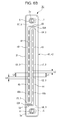
- a heat exchanger 1 includes a plurality of flat heat exchanger tubes 2, an inlet header 10A, and an outlet header 10B.
- Each of the plurality of heat exchanger tubes 2 has a rectangular shape in a plan view.
- a first fluid (coolant, for example) flows in the plurality of heat exchanger tubes 2.
- the plurality of heat exchanger tubes 2 are arranged so that flow paths of a second fluid (air, for example) that exchanges heat with the first fluid are externally formed. Specifically, one flow path of the second fluid is formed between each two adjacent heat exchanger tubes 2.
- the inlet header 10A and outlet header 10B are attached to a heat exchanger tube 2 that forms an end face of the heat exchanger 1 in an arrangement direction in which the heat exchanger tubes 2 are arranged.
- the heat exchanger tube 2 has an internal flow path 3, through which the first fluid flows.
- the inlet header 10A is a tube through which the first fluid is supplied to the inlet 3a of the internal flow path 3.
- the outlet header 10B is a tube through which the first fluid is discharged from the outlet 3b of the internal flow path 3.
- the inlet header 10A and outlet header 10B can be connected to an external device (not illustrated).
- the first fluid is supplied from the inlet header 10A into the internal flow paths 3 of the heat exchanger tubes 2.
- the first fluid is discharged from the outlet header 10B into the external device, as indicated by the arrow B in Fig. 1 .
- the second fluid flow passes through spaces (a plurality of external flow paths 8), each of which is formed between each two adjacent heat exchanger tubes 2, in a direction parallel to the width direction of the heat exchanger tubes 2, as illustrated by the arrow C in Fig. 1 .
- the width direction of the heat exchanger tube 2 is perpendicular to both the arrangement direction of the plurality of heat exchanger tubes 2 and the longitudinal direction of the heat exchanger tubes 2.
- the width direction of the heat exchanger tube 2 corresponds to the X direction
- the arrangement direction of the plurality of heat exchanger tubes 2 corresponds to the Y direction
- the longitudinal direction of the heat exchanger tube 2 corresponds to the Z axis.
- the arrangement direction (lamination direction) of the heat exchanger tubes 2 is parallel to the thickness direction of the heat exchanger tube 2.
- the second fluid flows in parallel to the width direction (X direction) of the heat exchanger tube 2.
- the heat exchanger tube 2 is formed with one set of a first plate member 11 and a second plate member 12, which are bonded together. At least one of the one set of the plate members 11 and 12 has a recess that forms the internal flow path 3. Specifically, the heat exchanger tube 2 is formed with the first plate member 11 and second plate member 12. The first plate member 11 and second plate member 12 each have a recess that forms the internal flow path 3. The internal flow path 3 is formed by bonding the first plate member 11 and second plate member 12 together. With this structure, the heat exchanger tube 2 can be thinned, which is advantageous in that the heat exchanger 1 can be made compact. Since the heat exchanger tube 2 is formed by bonding the first plate member 11 and second plate member 12 together, it is relatively easy to use a jig and perform brazing.
- the plate members 11 and 12 are made of aluminum, an aluminum alloy, stainless steel, or another metal.
- the plate members 11 and 12 are obtained by stamping a metal plate so that a desired shape is formed.
- the plate members 11 and 12 are bonded together by, for example, brazing.
- the heat exchanger 1 in this embodiment is formed only with a plurality of heat exchanger tubes 2, except the inlet header 10A and outlet header 10B.
- the heat exchanger tube 2 is a simple part formed with one set of the plate members 11 and 12. Stamping to obtain the plate members 11 and 12 is also easy.
- the heat exchanger 1 is advantageous in that, for example, it can be easily manufactured and condensed water is less likely to stay on the surface of the heat exchanger 1 when compared with a fin-tube heat exchanger.
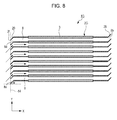
- each two adjacent heat exchanger tubes 2 are bonded together at the inlets 3a and outlets 3b of the internal flow paths 3 in the two heat exchanger tubes 2.
- One of each two adjacent heat exchanger tubes 2 is offset with respect to the other heat exchanger tube in a direction (X direction) perpendicular to the arrangement direction of the plurality of heat exchanger tubes 2.
- the plurality of heat exchanger tubes 2 are mutually offset in their width direction.
- a structure is formed that is stepped from one end in the arrangement direction (Y direction) of the plurality of heat exchanger tubes 2 toward the other end.
- the inlet plane 14 of the heat exchangers 1 is inclined with respect to the arrangement direction (Y direction) of the plurality of heat exchanger tubes 2.
- the inlet plane 14 is a plane that includes the front edges 2f of the plurality of heat exchanger tubes 2.
- the external shape of the heat exchanger 1 is a parallelogram when the heat exchanger 1 is viewed in a plan view from a direction (Z direction) parallel to the longitudinal direction of the heat exchanger tube 2.
- the heat exchanger 1 having this structure is beneficial as described below.
- the front edge 2f of the heat exchanger tube 2 is an edge, of the heat exchanger tube 2, that is positioned on the upstream side of an external flow path 8 in the flow direction of the second fluid.
- a conventional heat exchanging unit 104 includes a plurality of heat exchangers 101 (see Fig. 13 ) and a blower 16.
- the plurality of heat exchangers 101 are placed around the blower 16.
- most of the second fluid is supplied into the inlet plane 102 of the heat exchangers 101 from an oblique direction.
- the second fluid flows into the external flow paths of the heat exchanger 101 while changing the flow direction.
- the second fluid is likely to cause flow separation and produce a large pressure loss.
- the performance of the heat exchanger 101 can be fully derived.
- a capacity demanded for the heat exchanging unit 104, and the like it is not easy to change the position, size, orientation, and other parameters of the heat exchanger 101.
- a heat exchanging unit 200 includes a plurality of heat exchangers 1 and the blower 16.
- the blower 16 is, for example, a centrifugal blower.
- the blower 16 includes a rotational axis and an impeller secured to the rotational axis.
- the blower 16 delivers the second fluid in the circumferential direction of the rotational axis due to rotation of the impeller.
- the blower 16 delivers the second fluid toward the circumferential direction of a virtual circle tangent to the outer edge of the impeller when the rotation of the impeller is viewed from the axial direction of the rotational axis.
- the plurality of heat exchangers 1 are disposed around the blower 16 in a plane perpendicular to the rotational axis of the blower 16.
- the external flow paths 8 (indicated by oblique lines) on the heat exchanger 1 extend in an oblique direction with respect to the inlet plane 14 of the heat exchangers 1.
- Each of the plurality of external flow paths 8 is disposed so that the downstream end of the external flow path 8 is at a more forward position in the rotational direction of the rotational axis than the upstream end of the external flow path 8 when viewed from the rotational axis of the blower 16.
- the flow direction of the second fluid in the external flow path 8 on the heat exchanger 1 is substantially parallel to the inflow direction in which the second fluid flows into the heat exchanger 1.
- the heat exchanger 1 it is possible to align the inflow direction of the second fluid with the flow direction of the second fluid in the external flow paths 8 or to narrow an angle formed by these directions.
- the flow direction of the second fluid does not much change at positions before and after the inlet plane 14 of the heat exchangers 1.
- the flow separation of the second fluid is suppressed and a large pressure loss is hard to occur when compared with the heat exchanging unit 104 in which the conventional heat exchangers 101 are used. Accordingly, the performance of the heat exchanger 1 can be fully derived.
- a large design change for a case used to secure the heat exchangers1 is not demanded.
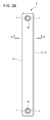
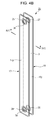
- the external surface of the first plate member 11 will be defined as a first main plane 11 p and the external surface of the second plate member 12 will be defined as a second main plane 12p, as illustrated in Figs. 2A to 2C .
- the inlet 3a and outlet 3b of the internal flow path 3 are open in both the first main plane 11 p and second main plane 12p.
- the inlet 3a is positioned at one end of the longitudinal direction of the heat exchanger tube 2, and the outlet 3b is positioned at the other end.
- the first plate member 11 has a first inlet bonding portion 4 and a first outlet bonding portion 5.
- the first inlet bonding portion 4 is formed on the first main plane 11 p as a portion at which two adjacent heat exchanger tubes 2 are bonded together at the inlets 3a of their internal flow paths 3.
- the first outlet bonding portion 5 is formed on the first main plane 11 p as a portion at which the two adjacent heat exchanger tubes 2 are bonded together at the outlets 3b of their internal flow paths 3.
- the second plate member 12 has a second inlet bonding portion 6 and a second outlet bonding portion 7.
- the second inlet bonding portion 6 is formed on the second main plane 12p as a portion at which the two adjacent heat exchanger tubes 2 are bonded together at the inlets 3a of their internal flow paths 3.
- the second outlet bonding portion 7 is formed on the second main plane 12p as a portion at which the two adjacent heat exchanger tubes 2 are bonded together at the outlets 3b of their internal flow paths 3. Since the two adjacent heat exchanger tubes 2 are bonded together by the bonding portions 4 to 7 formed in the plate members 11 and 12, special bonding parts are not needed. Parts needed to manufacture the heat exchanger 1 are only the plate members 11 and 12. Therefore, since the number of parts is reduced, cost reduction and a simplified manufacturing process can be expected.
- the inlet bonding portions 4 and 6 are each a ring-shaped protrusion that slightly protrudes around the inlet 3a of the internal flow path 3 in the thickness direction of the heat exchanger tube 2.
- the outlet bonding portions 5 and 7 are each a ring-shaped protrusion that slightly protrudes around the outlet 3b of the internal flow path 3 in the thickness direction of the heat exchanger tube 2.
- the first inlet bonding portions 4 and first outlet bonding portion 5 are located at positions relatively close to the front edge 2f of the heat exchanger tubes 2.
- the second bonding portions 6 and second outlet bonding portion 7 are located at positions relatively distant from the front edge 2f of the heat exchanger tubes 2.
- the first inlet bonding portion 4 is bonded to the second inlet bonding portion 6 of the adjacent heat exchanger tube 2.
- the first outlet bonding portion 5 is bonded to the second outlet bonding portion 7 of the adjacent heat exchanger tube 2.
- the plurality of heat exchanger tubes 2 can be mutually offset in their width direction.
- the bonding portions 4 to 7 can be used not only to form an offset structure of the plurality of heat exchanger tubes 2 but also to determine the extent of the external flow path 8.
- the first inlet bonding portion 4 is bonded directly to the second inlet bonding portion 6 of the adjacent heat exchanger tube 2 and the first outlet bonding portion 5 is bonded directly to the second outlet bonding portion 7 of the adjacent heat exchanger tube 2. Therefore, the internal flow paths 3 of each two adjacent heat exchanger tubes 2 communicate with each other.
- a linking member may be provided between the bonding portions 4 and 6 and they may be bonded indirectly, as in a third embodiment described later. When the linking member is used, the extent of the external flow path 8 can be determined by the linking member, so the bonding portions 4 and 6 can be eliminated. This is also true for the bonding portions 5 and 7.
- the amount of offset between two adjacent heat exchanger tubes 2 is equal the amount of offset between the first inlet bonding portion 4 and second inlet bonding portion 6.
- the inclination angle of the inlet plane 14 of the heat exchangers 1 with respect to the width direction of the heat exchanger tube 2 can be adjusted by adjusting the amount of offset.
- the amount of offset is constant. However, this is not a requisite.
- the amount of offset between two adjacent heat exchanger tubes 2 may differ from the amount of offset between another two adjacent heat exchanger tubes 2.
- all heat exchanger tubes 2 have the same structure, so each heat exchanger tube 2 is offset from its adjacent heat exchanger tube 2.
- a non-offset structure may be partially included as in a fifth embodiment described later.
- the first plate member 11 may have the same shape as the second plate member 12.
- the heat exchanger tube 2 illustrated in Figs. 2A to 2C can be manufactured by bonding two first bonding members 11. Then, since the number of parts is reduced, cost reduction can be expected.
- a plurality of heat exchanger tubes include a plurality of first heat exchanger tubes 2A and a plurality of second heat exchanger tubes 2B, as illustrated in Fig. 4A .
- the first heat exchanger tube 2A has a different structure from the second heat exchanger tube 2B.
- the first heat exchanger tube 2A and second heat exchanger tube 2B are adjacent to each other in the arrangement direction. Specifically, the first heat exchanger tubes 2A and second heat exchanger tubes 2B are alternately placed in the arrangement direction.
- the inclination angle of the inlet plane 14 of the heat exchangers 1A can be easily adjusted to an optimum angle. That is, in this variation, the heat exchanger 1A can be designed with increased freedom.
- the first heat exchanger tube 2A is the same as the heat exchanger tube 2, which has been described with reference to Figs. 2A to 2C . Therefore, the description of the first heat exchanger tube 2A will be omitted.
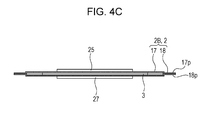
- the second heat exchanger tube 2B includes a third plate member 17 and a fourth plate member 18, which are bonded together.
- the external surface of the third plate member 17 will be defined as a third main plane 17p and the external surface of the fourth plate member 18 will be defined as a fourth main plane 18p.
- the inlet 3a and outlet 3b of the internal flow path 3 are open in both the third main plane 17p and fourth main plane 18p.
- the third plate member 17 has a third inlet bonding portion 24 and a third outlet bonding portion 25.
- the third inlet bonding portion 24 and third outlet bonding portion 25 are each formed on the third main plane 17p as a portion at which two adjacent heat exchanger tubes 2 (first heat exchanger tube 2A and second heat exchanger tube 2B) are bonded together.
- the fourth plate member 18 has a fourth inlet bonding portion 26 and a fourth outlet bonding portion 27.
- the fourth inlet bonding portion 26 and fourth outlet bonding portion 27 are each formed on the fourth main plane 18p as a portion at which two adjacent heat exchanger tubes 2 (first heat exchanger tube 2A and second heat exchanger tube 2B) are bonded together.
- the inlet bonding portions 24 and 26 are each a ring-shaped protrusion that slightly protrudes around the inlet 3a of the internal flow path 3 in the thickness direction of the heat exchanger tube 2B.
- the output bonding portions 25 and 27 are each a ring-shaped protrusion that slightly protrudes around the outlet 3b of the internal flow path 3 in the thickness direction of the heat exchanger tube 2B.
- the position of the third inlet bonding portion 24 matches the position of the fourth inlet bonding portion 26 and the position of the third outlet bonding portion 25 matches the position of the fourth outlet bonding portion 27.
- the bonding portions 24 to 27 are projected to a plane perpendicular to the thickness direction of the heat exchanger tube 2B, the projected image of the third inlet bonding portion 24 matches the projected image of the fourth inlet bonding portion 26, and the projected image of the third outlet bonding portion 25 matches the projected image of the fourth outlet bonding portion 27.
- the bonding portions 24 to 27 can be used not only to form an offset structure of the plurality of heat exchanger tubes 2A and 2B but also to determine the extent of the external flow path 8.
- the third plate member 17 has the same shape as the fourth plate member 18.
- the third plate member 17 completely matches the fourth plate member 18. In this case, since the number of parts is reduced, cost reduction can be expected.
- the first plate member 11 has a different structure from the second plate member 12
- at least one of the third plate member 17 and fourth plate member 18 may have the same shape as the first plate member 11 or second plate member 12. In this case as well, since the number of parts is reduced, cost reduction can be expected.
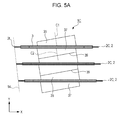
- a heat exchanger 1 C according to a second variation is formed with a plurality of heat exchanger tubes 2C as illustrated in Figs. 5A and 5B .
- Each heat exchanger tube 2C includes a first plate member 21 and a second plate member 22, which are bonded together.
- the external surface of the first plate member 21 will be defined as a first main plane 21 p and the external surface of the second plate member 22 will be defined as a second main plane 22p.
- the first plate member 21 has a first inlet bonding portion 34 and a first outlet bonding portion 35.
- the first inlet bonding portion 34 and first outlet bonding portion 35 are each formed on the first main plane 21 p as a portion at which two adjacent heat exchanger tubes 2C are bonded together.
- the second plate member 22 has a second inlet bonding portion 36 and a second outlet bonding portion 37.
- the second inlet bonding portion 36 and second outlet bonding portion 37 are each formed on the second main plane 22p as a portion at which two adjacent heat exchanger tubes 2C are bonded together.
- the inlet bonding portions 34 and 36 are each a ring-shaped protrusion that slightly protrudes around the inlet 3a of the internal flow path 3 in the thickness direction of the heat exchanger tube 2C.
- the bonding portions 35 and 37 are each a ring-shaped protrusion that slightly protrudes around the outlet 3b of the internal flow path 3 in the thickness direction of the heat exchanger tube 2C.
- the heights of the protrusions of the bonding portions 34 to 37 are continuously increased or decreased in the width direction of the heat exchanger tube 2C.
- a bonding plane 38 is formed between the first inlet bonding portion 34 of a heat exchanger tube 2C and the second inlet bonding portion 36 of the adjacent heat exchanger tube 2C.
- a bonding plane 39 is formed between the first outlet bonding portion 35 of a heat exchanger tube 2C and the second outlet bonding portion 37 of the adjacent heat exchanger tube 2C.
- the bonding planes 38 and 39 are inclined with respect to a direction perpendicular to the arrangement direction (Y direction) of the plurality of heat exchanger tubes 2C.
- the bonding planes 38 and 39 are ring-shaped in a plan view.
- the bonding planes 38 and 39 are inclined with respect to the width direction (X direction) of the heat exchanger tube 2C and also inclined with respect to the arrangement direction (Y direction) of the plurality of heat exchanger tubes 2C.
- the inclination angle of the bonding plane 38 is equal to the inclination angle of the bonding plane 39.
- the axis C1 of the first outlet bonding portion 35 and the axis C2 of the second outlet bonding portion 37 are perpendicular to the bonding plane 39.
- the axis of the first inlet bonding portion 34 and the axis of the second inlet bonding portion 36 are perpendicular to the bonding plane 38. That is, the axis of each bonding portion is inclined with respect to the arrangement direction (Y direction) of the plurality of heat exchanger tubes 2C and also inclined with respect to the width direction (X direction) of the heat exchanger tube 2C.
- the axis of each bonding portion is an axis that passes through the center of the bonding portion, which has a cylindrical side surface.
- the bonding portions 34 to 37 enable the plurality of heat exchanger tubes 2C to be mutually offset in their width direction.
- the bonding portions 34 to 37 have the role of forming an offset structure of the plurality of heat exchanger tubes 2C and the role of determining the extent of the external flow path 8.
- the inclination angle of the inlet plane 14 of the heat exchangers 1C with respect to the width direction of the heat exchanger tube 2C (X direction) can be adjusted by adjusting amounts by which the bonding portions 34 to 37 protrude. In this variation, the inclination angle of the inlet plane 14 can be adjusted without restrictions on a pitch at which heat exchanger tubes 2C are stacked, an amount by which they are offset, and other parameters.
- the first plate member 21 may have the same structure as the second plate member 22.
- the internal flow path 3 is meandering, as illustrated in Figs. 6A and 6B .
- the internal flow path 3 may be meandering.
- the heat exchanger tube 2D is formed with a first plate member 41 and a second plate member 42, which are bonded together so that the internal flow path 3 is formed.
- the internal flow path 3 is a meandering flow path in which the flow direction of the first fluid is reversed at intermediate points between the inlet 3a and the outlet 3b. In this variation, the flow direction of the first fluid is reversed a plurality of times (twice).
- the internal flow path 3 includes an odd number of segments extending in a row direction parallel to the longitudinal direction of the heat exchanger tube 2D. In this variation, the internal flow path 3 has three segments, which are mutually parallel.
- the inner diameters of the inlet header 10A and outlet header 10B can be enlarged, so a pressure loss in the inlet header 10A and outlet header 10B can be reduced.
- the length of the heat exchanger tube 2D can be shortened in its width direction, the heat exchanger 1 D can be made compact.
- the internal flow path 3 has a plurality of segments extending in a particular row direction of the heat exchanger tube 2D.
- the internal flow path 3 has a first segment 51, a second segment 52, a third segment 53, a first bent segment 54, a second bent segment 55, an upstream-end segment 56, and a downstream-end segment 57.
- the heat exchanger tube 2D includes a plurality of flow path forming portions 46, 47, and 48, which protrude on both sides of the heat exchanger tube 2D in its thickness direction and respectively form the segments 51, 52, and 53 of the internal flow path 3.
- the plurality of flow path forming portions 46, 47, and 48 include a first flow path forming portion 46, a second flow path forming portion 47, and a third flow path forming portion 48.
- the first segment 51 extends from the inlet 3a along the longitudinal direction of the heat exchanger tube 2D.
- the second segment 52 extends so that the first fluid flows in a direction opposite to the direction in which the first fluid flows in the first segment 51.
- the third segment 53 extends so that the first fluid flows in a direction opposite to the direction in which the first fluid flows in the second segment 52.
- the first bent segment 54 links the first segment 51 to the second segment 52.
- the second bent segment 55 links the second segment 52 to the third segment 53.
- the upstream-end segment 56 is formed upstream of the first segment 51 and around the inlet 3a.
- the downstream-end segment 57 is formed downstream of the third segment 53 and around the outlet 3b. While meandering, the first fluid flows through the inlet 3a, upstream-end segment 56, first segment 51, first bent segment 54, second segment 52, second bent segment 55, third segment 53, downstream-end segment 57, and outlet 3b in that order.
- the heat exchanger tube 2D has a first thin portion 44 and a second thin portion 45.
- the first thin portion 44 is positioned between the first flow path forming portion 46 and second flow path forming portion 47, which are adjacent to each other in the width direction of the heat exchanger tube 2D, to separate the first segment 51 and second segment 52 from each other along the row direction.
- the second thin portion 45 is positioned between the second flow path forming portion 47 and third flow path forming portion 48, which are adjacent to each other in the width direction of the heat exchanger tube 2D, to separate the second segment 52 and third segment 53 from each other along the row direction.
- the first thin portion 44 and second thin portion 45 are each a bonding portion between the first plate member 41 and the second plate member 42.
- the flow path forming portions 46 and 47 in one of two adjacent heat exchanger tubes 2D respectively face the thin portions 44 and 45 in the other heat exchanger tube 2D with the external flow path 8 intervening therebetween.
- the flow path forming portions 47 and 48 in the other of the two adjacent heat exchanger tubes 2D respectively face the thin portions 44 and 45 in the one heat exchanger tube 2D with the external flow path 8 intervening therebetween.
- the plurality of flow path forming portions 46 to 48 in the one heat exchanger tube 2D and the flow path forming portions 46 to 48 in the other heat exchanger tube 2D are placed in a staggered arrangement in the width direction (X direction).
- the extent of the external flow path 8 in the thickness direction of the heat exchanger tube 2D is kept substantially constant in the width direction of the heat exchanger tube 2D (flow direction of the second fluid).
- the pressure loss of the second fluid in the external flow path 8 can be reduced.
- the heat exchanger tubes 2D are stacked at a small pitch, the heat transfer area per unit volume can be enlarged.
- an effective heat transfer area is enlarged.
- the heat exchanger tube 2D further has hindering structures, each of which is disposed between each two adjacent segments to hinder heat transfer between the two adjacent segments (specifically, heat transfer between the first fluid flowing through one of the two segments and the first fluid flowing through the other).
- a plurality of first through-holes 44h are formed in the first thin portion 44 and a plurality of second through-holes 45h are formed in the second thin portion 45.
- the first through-holes 44h function as a hindering structure that hinders heat transfer between the first segment 51 and the second segment 52.
- the second through-holes 45h function as a hindering structure that hinders heat transfer between the second segment 52 and the third segment 53.
- a temperature gradient is created on the surfaces of the heat exchanger tube 2D from the upstream end of the external flow path 8 to its downstream end.
- the temperature gradient on the surfaces of the heat exchanger tube 2D is increased in the width direction of the heat exchanger tube 2D (flow direction of the second fluid), so temperature efficiency and heat exchange efficiency of the heat exchanger 1 D are further improved.
- the hindering structures are the through-holes 44h and 45h, each two adjacent segments are space-separated. Therefore, the above heat transfer is reliably hindered.
- each first through-hole 44h is a through-hole (specifically, a slit) that passes through the first thin portion 44 in the thickness direction of the first plate member 41 and second plate member 42.
- the first through-hole 44h is formed at the center of the first thin portion 44 in its width direction and has a rectangular shape in a plan view.
- Each second through-hole 45h is a through-hole (specifically, a slit) that passes through the second thin portion 45 in the thickness direction of the first plate member 41 and second plate member 42.
- the second through-hole 45h is formed at the center of the second thin portion 45 in its width direction and has a rectangular shape in a plan view.
- the plurality of first through-holes 44h are spaced at a prescribed interval in the longitudinal direction of the first thin portion 44.
- the plurality of second through-holes 45h are spaced at a prescribed interval in the longitudinal direction of the second thin portion 45.
- the cross-sectional area (total cross-sectional area) of the first through-hole 44h is larger than half the cross-sectional area of the first thin portion 44.
- the length L1 of the first through-hole 44h in its longitudinal direction is longer than an interval L2 between each two adjacent first through-holes 44h.
- the cross-sectional area of the second through-hole 45h is larger than half the cross-sectional area of the second thin portion 45.
- the length L3 of the second through-hole 45h in its longitudinal direction is longer than an interval L4 between each two adjacent second through-holes 45h.
- the length L3 of the second through-hole 45h in its longitudinal direction is equal to the length L1 of the first through-hole 44h in its longitudinal direction.
- the interval L4 between each two adjacent second through-holes 45h is equal to the interval L2 between each two adjacent first through-holes 44h.
- the shape of the first through-hole 44h may be circular, polygonal, elliptical, or the like. Only one first through-hole 44h may be formed in the first thin portion 44. If, however, a plurality of first through-holes 44h are formed in the first thin portion 44 at a prescribed interval as in this variation, heat transfer between the first segment 51 and the second segment 52 can be efficiently hindered while a drop in the strength of the first thin portion 44 is suppressed. This is also true for the second through-hole 45h.
- the heat exchanger tube 2D further includes an upstream-end thin portion 63, which separates the second bent segment 55 and upstream-end segment 56 from each other, and a third through-hole 63h formed in the upstream-end thin portion 63.
- the upstream-end thin portion 63 is formed when the first plate member 41 and second plate member 42 are bonded together.
- the third through-hole 63h functions as an upstream hindering structure that hinders heat transfer between the second bent segment 55 and the upstream-end segment 56.
- the third through-hole 63h is formed closest to the inlet 3a.
- the third through-hole 63h is a through-hole (specifically, a slit) that passes through the upstream-end thin portion 63 in the thickness direction of the first plate member 41 and second plate member 42.
- the third through-hole 63h is formed at the center of the upstream-end thin portion 63 and has a rectangular shape in a plan view. With this structure, heat transfer between the second bent segment 55 and the upstream-end segment 56 can be hindered efficiently and reliably.
- the heat exchanger tube 2D further includes a down-end thin portion 65, which separates the first bent segment 54 and downstream-end segment 57 from each other, and a fourth through-hole 65h formed in the down-end thin portion 65.
- the down-end thin portion 65 is formed when the first plate member 41 and second plate member 42 are bonded together.
- the fourth through-hole 65h functions as a downstream hindering structure that hinders heat transfer between the first bent segment 54 and the downstream-end segment 57.
- the fourth through-hole 65h is formed closest to the outlet 3b.
- the fourth through-hole 65h is a through-hole (specifically, a slit) that passes through the down-end thin portion 65 in the thickness direction of the first plate member 41 and second plate member 42.
- the fourth through-hole 65h is formed at the center of the down-end thin portion 65 and has a rectangular shape in a plan view. With this structure, heat transfer between the first bent segment 54 and the downstream-end segment 57 can be hindered efficiently and reliably. As with the first through-hole 44h, there are no particular limitations to the shapes, placements, quantities, cross-sectional areas, and other parameters of the third through-hole 63h and fourth through-hole 65h.
- the hindering structure that hinders heat transfer is not limited to a though-hole.
- the thin portions 44, 45, 63, and 65 may be made of a material having a relatively low thermal conductivity (for example, a resin) and portions other than the thin portions 44, 45, 63, and 65 may be made of a material having a relatively high thermal conductivity (for example, a metal).
- part or the whole of the surfaces of the flow path forming portions 46 to 48 extend from the thin portions 44 and 45 toward a direction inclined with respect to both the thickness direction and width direction of the heat exchanger tube 2D.
- a heat exchanger tube 2E used in a heat exchanger 1 E according to a fourth variation differs from the heat exchanger tube 2D used in the heat exchanger 1 D in the third variation in that five segments are included in the internal flow path 3.
- a heat exchanger tube 1 F is formed with a plurality of heat exchanger tube groups 20. Two adjacent heat exchanger tube groups 20 are offset from each other in their width direction (X direction).
- the heat exchanger tube group 20 is formed with a plurality of heat exchanger tubes 2D and 2F.
- the heat exchanger tube group 20 includes a heat exchanger tube 2D and heat exchanger tubes 2F.
- the heat exchanger tube 2D is the heat exchanger tube used in the heat exchanger 1 D in the third variation.
- the heat exchanger tube 2F is a variation of the heat exchanger tube 2D.
- the inlet bonding portion and outlet bonding portion formed in the first plate member are not respectively offset from the inlet bonding portion and outlet bonding portion formed in the second plate member.
- the heat exchanger tube 2D is not offset from the heat exchanger tube 2F.
- the cross section of the internal flow path 3 may have a streamline shape, an aerofoil shape, or another curved shape. All or part of the corners of the cross section of the internal flow path 3 may have a round shape or another curved shape.
- a plate-like protrusion may be provided that protrudes from a flow path forming portion in the internal flow path 3 in the width direction.
- This plate-like protrusion restricts the flow direction of the second fluid and suppresses its flow separation. Accordingly, the effective heat transfer area of the heat exchanger tube is enlarged. Since the plate-like protrusion itself plays the role of a fin, the surfaces of the plate-like protrusion increase the entire heat transfer surface. Therefore, the heat exchanger can be made compact by providing a plate-like protrusion in the heat exchanger tube.
- a heat exchanger according to another embodiment will be described below. Elements common to the heat exchanger described in the first embodiment and the heat exchanger in the other embodiment are assigned the same reference characters and descriptions of these common elements may be omitted. That is, the description in the first embodiment can also be applied to the embodiment below as long as the description has no technical contradiction.
- a heat exchanger 1 G includes a plurality of heat exchanger tubes 2G, each of which has the internal flow path 3.
- the plurality of heat exchanger tubes 2G are arranged so that one flow path 8, through which the second fluid flows, is formed between each two adjacent heat exchanger tubes 2G.
- the plurality of heat exchanger tubes 2G are not mutually offset.
- the positions of the plurality of heat exchanger tubes 2G are the same in the longitudinal direction (Z direction) and width direction (X direction).
- the second embodiment differs from the first embodiment in this point.
- the second embodiment is the same as in the first embodiment in other points.
- Each heat exchanger tube 2G has a plate-like protrusion 29 at both ends in its width direction (flow direction of the second fluid). Each two adjacent protrusions 29 form an inlet portion 8a and output portion 8b in the external flow path 8. The protrusion 29 contributes to the expansion of the heat transfer area of the heat exchanger tube 2G.
- the inlet portion 8a of the external flow path 8 extends in a direction inclined with respect to the inlet plane 14 of the heat exchangers 1 G so that the flow direction of the second fluid at the inlet portion 8a of the external flow path 8 comes close to a direction parallel to the flow direction of the second fluid in which it flows from the blower 16 (see Fig. 3G) to the heat exchanger 1 G.
- the angle of the protrusion 29 can be adjusted in consideration of an angle at which the second fluid flows into the inlet portion 8a of the external flow path 8. Accordingly, the pressure loss of the second fluid can be reduced and its flow separation can be suppressed.
- the protrusion 29 is the front edge (or rear edge) of the heat exchanger tube 2G and is inclined with respect to the arrangement direction (Y direction) of the plurality of heat exchanger tubes 2G and the width direction (X direction) of the protrusion 29.
- the protrusion 29 can be formed by bending an end of a plate member that is part of the heat exchanger tube 2G.
- the inclination angle ⁇ of the protrusion 29 with respect to its width direction is constant in the arrangement direction (Y direction) of the heat exchanger tubes 2G.
- the inclination angle ⁇ is constant.
- the inclination angle ⁇ can be changed according to the inflow angle of the second fluid. That is, in the heat exchanger 1 G, protrusions 29 with different inclination angles ⁇ may be formed.
- a heat exchanger 1 H includes a plurality of heat exchanger tubes 2H, each of which has the internal flow path 3.
- the plurality of heat exchanger tubes 2H are arranged in a fan shape so that one flow path 8 is formed between each two adjacent heat exchanger tubes 2H.
- the width direction of the heat exchanger tube 2H matches a radial direction of the fan.
- a plurality of external flow paths 8 extend radially. The second fluid flows from the inner circumference toward the outer circumference.
- heat exchanger 204 having external flow paths oriented to a constant direction
- a conventional heat exchanger may be used.
- the heat exchanger described in the first embodiment or second embodiment may be used.
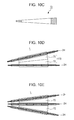
- the heat exchanger 1 H further includes a plurality of linking members 70.
- two linking members 70 are placed between each two adjacent heat exchanger tubes 2H.
- the heat exchanger tube 2H includes one set of plate members 71, which are bonded together.
- the inlet 3a and outlet 3b of the internal flow path 3 are open in the main planes of the plate members 71.
- One of the two linking members 70 is placed between the inlets 3a of two adjacent heat exchanger tubes 2H to bond the two heat exchanger tubes 2H together at the inlets 3a of the internal flow paths 3.
- the other of the two linking members 70 is placed between the outlets 3b of the two adjacent heat exchanger tubes 2H to bond the two heat exchanger tubes 2H together at the outlets 3b of the internal flow paths 3.
- the internal flow paths 3 in the two adjacent heat exchanger tubes 2H mutually communicate through the linking members 70.
- the linking member 70 is a flat ring-shaped member.
- the inner diameter of the linking member 70 is equal to the diameter of the opening at the inlet 3a and outlet 3b of the internal flow path 3.
- the thickness of the linking member 70 is continuously increased from the upstream side of the external flow path 8 toward its downstream side.
- a linking plane between the linking member 70 and one of two adjacent heat exchanger tubes 2H between which the linking member 70 is placed is defined as a first linking plane 71 p
- a linking plane between the linking member 70 and the other of the two adjacent heat exchanger tubes 2H is defined as a second linking plane 71 q.
- the first linking plane 71 p is inclined with respect to the second linking plane 71 q.
- An angle formed by the first linking plane 71 p and second surface 71 q can be determined. That is, the extent of the external flow path 8 can be adjusted by the linking member 70.
- the linking member 70 is a circular member having a wedge-shaped cross section.
- the heat exchanger 1 H which has the structure illustrated in Fig. 9 , can be easily implemented. Since the extent of the external flow path 8 can be determined by the linking member 70, the heat exchanger tube 2H does not need to have an inlet bonding portion and an outlet bonding portion. Of course, the heat exchanger tube 2H may have an inlet bonding portion and outlet bonding portion as described in the first and second embodiments.
- a laminated body 170 formed with a plurality of linking members 70 may be placed between two adjacent heat exchanger tubes 2H.
- the laminated body 170 formed with two linking members 70 can be placed between two heat exchanger tubes 2H.
- the external flow path 8 can be more expanded. That is, the heat exchanger 1 H can be designed with increased freedom.
- a plurality of linking members 70 and 72 that have different shapes may be used in the heat exchanger 1 H.
- the linking member 70 which has been described with reference to Fig. 10C
- the heat exchanger 1 H may further include a second linking member 72 that has a different shape from the first linking member 70.
- the first linking member 70 and second linking member 72 are alternately placed along a circumferential direction. With this structure, the extent of the external flow path 8 can be freely adjusted.
- a laminated body formed with the first linking member 70 and second linking member 72 may be placed between two adjacent heat exchanger tubes 2H, as described with reference to Fig. 10D .
- one of two adjacent heat exchanger tubes 2H may be offset with respect to the other heat exchanger tube 2H in a direction perpendicular to the arrangement direction of a plurality of heat exchanger tubes 2H.
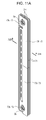
- a heat exchanger 1J according to a sixth variation includes linking members 73, each of which has a plate-like protrusion 73t, as illustrated in Figs. 11A to 11C .
- the protrusion 73t protrudes toward the downstream side of the external flow path 8.
- the protrusion 73t protrudes toward the outside in a radial direction of the heat exchanger 1J.
- the heat exchanger 1J in the sixth variation has the same structure as the heat exchanger 1 H in the third embodiment except that the linking member 73 has a different structure.
- the linking member 73 has a ring-shaped main body 73s besides the plate-like protrusion 73t.
- the main body 73s has the same structure as the linking member 70 described in the third embodiment and is placed between the inlets 3a (or outlets 3b) of the internal flow paths 3 of the two adjacent heat exchanger tubes 2H.
- the protrusion 73t is attached to the outer circumferential surface of the main body 73s; the protrusion 73t has a rectangular shape in a plan view.
- the protrusion 73t is a plate-like portion that is about one-fourth the size of the heat exchanger tube 2H.
- the protrusion 73t functions as a partition that divides the external flow path 8. Since the flow of the second fluid is corrected so that the flow proceeds along the surfaces of a heat exchanger tube 2J, the effective heat transfer area is expanded.
- the protrusion 73t itself functions as a fin and contributes to the expansion of the heat transfer surfaces, heat exchanging performance is further improved.
- linking member 70 in the third embodiment and the linking member 73 in this variation may be alternately placed along the circumferential direction.
- the technology disclosed in this description is effective for air conditioning apparatuses, cooling apparatuses for computers, household electric appliances, and the like.
Landscapes
- Engineering & Computer Science (AREA)
- Physics & Mathematics (AREA)
- Thermal Sciences (AREA)
- Mechanical Engineering (AREA)
- General Engineering & Computer Science (AREA)
- Heat-Exchange Devices With Radiators And Conduit Assemblies (AREA)
- Details Of Heat-Exchange And Heat-Transfer (AREA)
Applications Claiming Priority (1)
| Application Number | Priority Date | Filing Date | Title |
|---|---|---|---|
| JP2014102391 | 2014-05-16 |
Publications (2)
| Publication Number | Publication Date |
|---|---|
| EP2977697A2 true EP2977697A2 (de) | 2016-01-27 |
| EP2977697A3 EP2977697A3 (de) | 2016-04-27 |
Family
ID=53177252
Family Applications (1)
| Application Number | Title | Priority Date | Filing Date |
|---|---|---|---|
| EP15167869.5A Withdrawn EP2977697A3 (de) | 2014-05-16 | 2015-05-15 | Wärmetauscher und wärmetauschsystem |
Country Status (4)
| Country | Link |
|---|---|
| US (1) | US20150330713A1 (de) |
| EP (1) | EP2977697A3 (de) |
| JP (1) | JP2015232435A (de) |
| CN (1) | CN105091630A (de) |
Families Citing this family (7)
| Publication number | Priority date | Publication date | Assignee | Title |
|---|---|---|---|---|
| CN106196742A (zh) * | 2016-08-15 | 2016-12-07 | 安徽天祥空调科技有限公司 | 一种风冷型蒸发器 |
| WO2018074342A1 (ja) * | 2016-10-21 | 2018-04-26 | パナソニックIpマネジメント株式会社 | 熱交換器およびそれを用いた冷凍システム |
| JP7596664B2 (ja) * | 2019-08-08 | 2024-12-10 | 株式会社デンソー | 熱交換器 |
| JP7641478B2 (ja) * | 2020-10-27 | 2025-03-07 | 有限会社和氣製作所 | 熱交換器 |
| CN114543578B (zh) * | 2020-11-25 | 2024-11-26 | 广州华凌制冷设备有限公司 | 热交换器及其翅片和换热设备及空调器 |
| JP7668433B2 (ja) | 2021-06-18 | 2025-04-25 | パナソニックIpマネジメント株式会社 | プレートフィン積層型熱交換器およびそれを用いた冷凍システム |
| CN115342041A (zh) * | 2022-09-14 | 2022-11-15 | 广东鑫钻节能科技股份有限公司 | 智慧节能空压站 |
Citations (1)
| Publication number | Priority date | Publication date | Assignee | Title |
|---|---|---|---|---|
| JP2008039322A (ja) | 2006-08-08 | 2008-02-21 | Univ Of Tokyo | 熱交換器およびこれを備える熱交換装置 |
Family Cites Families (18)
| Publication number | Priority date | Publication date | Assignee | Title |
|---|---|---|---|---|
| US5172752A (en) * | 1990-06-12 | 1992-12-22 | Goetz Jr Edward E | Curved heat exchanger with low frontal area tube passes |
| PL328065A1 (en) * | 1996-02-01 | 1999-01-04 | Northern Res & Eng | Plate-and-ribs heat exchanger of unitary construction |
| JP3268279B2 (ja) * | 1999-01-18 | 2002-03-25 | 三菱電機株式会社 | 空気調和機 |
| JP4451981B2 (ja) * | 2000-11-21 | 2010-04-14 | 三菱重工業株式会社 | 熱交換チューブ及びフィンレス熱交換器 |
| CA2389119A1 (en) * | 2002-06-04 | 2003-12-04 | Christopher R. Shore | Lateral plate finned heat exchanger |
| US7278472B2 (en) * | 2002-09-20 | 2007-10-09 | Modine Manufacturing Company | Internally mounted radial flow intercooler for a combustion air changer |
| US7267162B2 (en) * | 2005-06-10 | 2007-09-11 | Delphi Technologies, Inc. | Laminated evaporator with optimally configured plates to align incident flow |
| FR2902183A1 (fr) * | 2006-06-13 | 2007-12-14 | Technologies De L Echange Ther | Echangeurs thermiques a ailettes metalliques creuses |
| CN100523471C (zh) * | 2006-07-14 | 2009-08-05 | 株式会社电装 | 废热回收装置 |
| JP2008039373A (ja) * | 2006-07-14 | 2008-02-21 | Denso Corp | 排気熱回収器 |
| JP2008116102A (ja) * | 2006-11-02 | 2008-05-22 | Denso Corp | 冷却用熱交換器 |
| US20090000774A1 (en) * | 2007-06-29 | 2009-01-01 | Macdonald Mark | Integrated heat exchanger and diffuser |
| WO2009015235A1 (en) * | 2007-07-23 | 2009-01-29 | Amerigon Incorporated | Radial thermoelectric device assembly |
| US20100116481A1 (en) * | 2008-11-12 | 2010-05-13 | Evans Timothy V | Heat Exchanger |
| US20110030932A1 (en) * | 2009-08-07 | 2011-02-10 | Johnson Controls Technology Company | Multichannel heat exchanger fins |
| US20140008046A1 (en) * | 2012-07-05 | 2014-01-09 | Airec Ab | Plate for heat exchanger, heat exchanger and air cooler comprising a heat exchanger |
| US20140048238A1 (en) * | 2012-08-14 | 2014-02-20 | Caterpillar Inc. | Frameless Heat Exchanger |
| CN104755869B (zh) * | 2012-10-31 | 2017-03-08 | 达纳加拿大公司 | 具有单块板设计的堆叠板式换热器 |
-
2015
- 2015-04-10 CN CN201510169406.7A patent/CN105091630A/zh active Pending
- 2015-04-28 JP JP2015091712A patent/JP2015232435A/ja not_active Withdrawn
- 2015-05-01 US US14/702,214 patent/US20150330713A1/en not_active Abandoned
- 2015-05-15 EP EP15167869.5A patent/EP2977697A3/de not_active Withdrawn
Patent Citations (1)
| Publication number | Priority date | Publication date | Assignee | Title |
|---|---|---|---|---|
| JP2008039322A (ja) | 2006-08-08 | 2008-02-21 | Univ Of Tokyo | 熱交換器およびこれを備える熱交換装置 |
Also Published As
| Publication number | Publication date |
|---|---|
| CN105091630A (zh) | 2015-11-25 |
| US20150330713A1 (en) | 2015-11-19 |
| JP2015232435A (ja) | 2015-12-24 |
| EP2977697A3 (de) | 2016-04-27 |
Similar Documents
| Publication | Publication Date | Title |
|---|---|---|
| US20150330713A1 (en) | Heat exchanger and heat exchanging unit | |
| US20230077459A1 (en) | Spiral tube heat exchanger | |
| US9714794B2 (en) | Heat exchanger tube having fins with varying louver inclination angle | |
| CN110274504B (zh) | 换热器翅片 | |
| US10514046B2 (en) | Air management system for the outdoor unit of a residential air conditioner or heat pump | |
| CA2960943A1 (en) | Heat exchanger | |
| EP2530331B1 (de) | Axiallüfterbaugruppe für ein Fahrzeugkühlsystem | |
| JP2002153931A (ja) | 熱交換チューブ及びフィンレス熱交換器 | |
| EP3280967B1 (de) | Integrierter ventilatorwärmetauscher | |
| CN106338162A (zh) | 一种微通道换热器及其在系统中的应用 | |
| JP2005214545A (ja) | 熱交換器 | |
| CN118776381B (zh) | 一种新型翅片及包括翅片的换热器 | |
| CN107709915A (zh) | 微型管热交换器 | |
| KR101414309B1 (ko) | 열 교환기 핀, 조립체 및 방법 | |
| CN106323041B (zh) | 一种微通道换热器 | |
| CN103574774B (zh) | 空调机 | |
| EP3575728B1 (de) | Kern eines wärmetauschers mit gewellten rippen | |
| WO2020184315A1 (ja) | 熱交換器 | |
| JP3099621U (ja) | フィン・チューブ型の熱交換機 | |
| JP5589860B2 (ja) | 熱交換器 | |
| CN215261362U (zh) | 用于换热器的铜管、换热器和空调器 | |
| JP5835907B2 (ja) | 熱交換器 | |
| JP2011174638A (ja) | 遠心ファンに用いられる熱交換器およびその製造方法 | |
| JP6755338B2 (ja) | 熱交換器 | |
| JP2016075450A (ja) | 熱交換器及びこれを用いた空気調和機 |
Legal Events
| Date | Code | Title | Description |
|---|---|---|---|
| PUAI | Public reference made under article 153(3) epc to a published international application that has entered the european phase |
Free format text: ORIGINAL CODE: 0009012 |
|
| AK | Designated contracting states |
Kind code of ref document: A2 Designated state(s): AL AT BE BG CH CY CZ DE DK EE ES FI FR GB GR HR HU IE IS IT LI LT LU LV MC MK MT NL NO PL PT RO RS SE SI SK SM TR |
|
| AX | Request for extension of the european patent |
Extension state: BA ME |
|
| PUAL | Search report despatched |
Free format text: ORIGINAL CODE: 0009013 |
|
| AK | Designated contracting states |
Kind code of ref document: A3 Designated state(s): AL AT BE BG CH CY CZ DE DK EE ES FI FR GB GR HR HU IE IS IT LI LT LU LV MC MK MT NL NO PL PT RO RS SE SI SK SM TR |
|
| AX | Request for extension of the european patent |
Extension state: BA ME |
|
| RIC1 | Information provided on ipc code assigned before grant |
Ipc: F28D 1/053 20060101ALI20160323BHEP Ipc: F28D 1/03 20060101AFI20160323BHEP |
|
| 17P | Request for examination filed |
Effective date: 20161027 |
|
| RBV | Designated contracting states (corrected) |
Designated state(s): AL AT BE BG CH CY CZ DE DK EE ES FI FR GB GR HR HU IE IS IT LI LT LU LV MC MK MT NL NO PL PT RO RS SE SI SK SM TR |
|
| STAA | Information on the status of an ep patent application or granted ep patent |
Free format text: STATUS: THE APPLICATION HAS BEEN WITHDRAWN |
|
| 18W | Application withdrawn |
Effective date: 20181206 |