EP2977851A1 - Vorrichtung und verfahren zum authentifizieren eines dokuments - Google Patents
Vorrichtung und verfahren zum authentifizieren eines dokuments Download PDFInfo
- Publication number
- EP2977851A1 EP2977851A1 EP15177632.5A EP15177632A EP2977851A1 EP 2977851 A1 EP2977851 A1 EP 2977851A1 EP 15177632 A EP15177632 A EP 15177632A EP 2977851 A1 EP2977851 A1 EP 2977851A1
- Authority
- EP
- European Patent Office
- Prior art keywords
- document
- image
- imager
- user
- light source
- Prior art date
- Legal status (The legal status is an assumption and is not a legal conclusion. Google has not performed a legal analysis and makes no representation as to the accuracy of the status listed.)
- Withdrawn
Links
Images


Classifications
-
- H—ELECTRICITY
- H04—ELECTRIC COMMUNICATION TECHNIQUE
- H04W—WIRELESS COMMUNICATION NETWORKS
- H04W12/00—Security arrangements; Authentication; Protecting privacy or anonymity
- H04W12/30—Security of mobile devices; Security of mobile applications
- H04W12/33—Security of mobile devices; Security of mobile applications using wearable devices, e.g. using a smartwatch or smart-glasses
-
- B—PERFORMING OPERATIONS; TRANSPORTING
- B42—BOOKBINDING; ALBUMS; FILES; SPECIAL PRINTED MATTER
- B42D—BOOKS; BOOK COVERS; LOOSE LEAVES; PRINTED MATTER CHARACTERISED BY IDENTIFICATION OR SECURITY FEATURES; PRINTED MATTER OF SPECIAL FORMAT OR STYLE NOT OTHERWISE PROVIDED FOR; DEVICES FOR USE THEREWITH AND NOT OTHERWISE PROVIDED FOR; MOVABLE-STRIP WRITING OR READING APPARATUS
- B42D25/00—Information-bearing cards or sheet-like structures characterised by identification or security features; Manufacture thereof
-
- G—PHYSICS
- G02—OPTICS
- G02B—OPTICAL ELEMENTS, SYSTEMS OR APPARATUS
- G02B27/00—Optical systems or apparatus not provided for by any of the groups G02B1/00 - G02B26/00, G02B30/00
- G02B27/01—Head-up displays
- G02B27/017—Head mounted
-
- G—PHYSICS
- G02—OPTICS
- G02B—OPTICAL ELEMENTS, SYSTEMS OR APPARATUS
- G02B27/00—Optical systems or apparatus not provided for by any of the groups G02B1/00 - G02B26/00, G02B30/00
- G02B27/01—Head-up displays
- G02B27/017—Head mounted
- G02B27/0172—Head mounted characterised by optical features
-
- G—PHYSICS
- G06—COMPUTING OR CALCULATING; COUNTING
- G06F—ELECTRIC DIGITAL DATA PROCESSING
- G06F21/00—Security arrangements for protecting computers, components thereof, programs or data against unauthorised activity
- G06F21/30—Authentication, i.e. establishing the identity or authorisation of security principals
- G06F21/31—User authentication
- G06F21/34—User authentication involving the use of external additional devices, e.g. dongles or smart cards
-
- G—PHYSICS
- G06—COMPUTING OR CALCULATING; COUNTING
- G06F—ELECTRIC DIGITAL DATA PROCESSING
- G06F3/00—Input arrangements for transferring data to be processed into a form capable of being handled by the computer; Output arrangements for transferring data from processing unit to output unit, e.g. interface arrangements
- G06F3/01—Input arrangements or combined input and output arrangements for interaction between user and computer
- G06F3/011—Arrangements for interaction with the human body, e.g. for user immersion in virtual reality
- G06F3/012—Head tracking input arrangements
-
- G—PHYSICS
- G06—COMPUTING OR CALCULATING; COUNTING
- G06F—ELECTRIC DIGITAL DATA PROCESSING
- G06F3/00—Input arrangements for transferring data to be processed into a form capable of being handled by the computer; Output arrangements for transferring data from processing unit to output unit, e.g. interface arrangements
- G06F3/01—Input arrangements or combined input and output arrangements for interaction between user and computer
- G06F3/03—Arrangements for converting the position or the displacement of a member into a coded form
- G06F3/0304—Detection arrangements using opto-electronic means
- G06F3/0317—Detection arrangements using opto-electronic means in co-operation with a patterned surface, e.g. absolute position or relative movement detection for an optical mouse or pen positioned with respect to a coded surface
-
- G—PHYSICS
- G06—COMPUTING OR CALCULATING; COUNTING
- G06K—GRAPHICAL DATA READING; PRESENTATION OF DATA; RECORD CARRIERS; HANDLING RECORD CARRIERS
- G06K7/00—Methods or arrangements for sensing record carriers, e.g. for reading patterns
- G06K7/10—Methods or arrangements for sensing record carriers, e.g. for reading patterns by electromagnetic radiation, e.g. optical sensing; by corpuscular radiation
- G06K7/10544—Methods or arrangements for sensing record carriers, e.g. for reading patterns by electromagnetic radiation, e.g. optical sensing; by corpuscular radiation by scanning of the records by radiation in the optical part of the electromagnetic spectrum
- G06K7/10821—Methods or arrangements for sensing record carriers, e.g. for reading patterns by electromagnetic radiation, e.g. optical sensing; by corpuscular radiation by scanning of the records by radiation in the optical part of the electromagnetic spectrum further details of bar or optical code scanning devices
-
- G—PHYSICS
- G07—CHECKING-DEVICES
- G07D—HANDLING OF COINS OR VALUABLE PAPERS, e.g. TESTING, SORTING BY DENOMINATIONS, COUNTING, DISPENSING, CHANGING OR DEPOSITING
- G07D7/00—Testing specially adapted to determine the identity or genuineness of valuable papers or for segregating those which are unacceptable, e.g. banknotes that are alien to a currency
- G07D7/06—Testing specially adapted to determine the identity or genuineness of valuable papers or for segregating those which are unacceptable, e.g. banknotes that are alien to a currency using wave or particle radiation
- G07D7/12—Visible light, infrared or ultraviolet radiation
-
- G—PHYSICS
- G07—CHECKING-DEVICES
- G07D—HANDLING OF COINS OR VALUABLE PAPERS, e.g. TESTING, SORTING BY DENOMINATIONS, COUNTING, DISPENSING, CHANGING OR DEPOSITING
- G07D7/00—Testing specially adapted to determine the identity or genuineness of valuable papers or for segregating those which are unacceptable, e.g. banknotes that are alien to a currency
- G07D7/20—Testing patterns thereon
-
- H—ELECTRICITY
- H04—ELECTRIC COMMUNICATION TECHNIQUE
- H04W—WIRELESS COMMUNICATION NETWORKS
- H04W12/00—Security arrangements; Authentication; Protecting privacy or anonymity
- H04W12/10—Integrity
- H04W12/108—Source integrity
-
- G—PHYSICS
- G02—OPTICS
- G02B—OPTICAL ELEMENTS, SYSTEMS OR APPARATUS
- G02B27/00—Optical systems or apparatus not provided for by any of the groups G02B1/00 - G02B26/00, G02B30/00
- G02B27/01—Head-up displays
- G02B27/0101—Head-up displays characterised by optical features
- G02B2027/0138—Head-up displays characterised by optical features comprising image capture systems, e.g. camera
-
- G—PHYSICS
- G02—OPTICS
- G02B—OPTICAL ELEMENTS, SYSTEMS OR APPARATUS
- G02B27/00—Optical systems or apparatus not provided for by any of the groups G02B1/00 - G02B26/00, G02B30/00
- G02B27/01—Head-up displays
- G02B27/0101—Head-up displays characterised by optical features
- G02B2027/014—Head-up displays characterised by optical features comprising information/image processing systems
-
- G—PHYSICS
- G02—OPTICS
- G02B—OPTICAL ELEMENTS, SYSTEMS OR APPARATUS
- G02B27/00—Optical systems or apparatus not provided for by any of the groups G02B1/00 - G02B26/00, G02B30/00
- G02B27/01—Head-up displays
- G02B27/017—Head mounted
- G02B2027/0178—Eyeglass type
-
- H—ELECTRICITY
- H04—ELECTRIC COMMUNICATION TECHNIQUE
- H04W—WIRELESS COMMUNICATION NETWORKS
- H04W12/00—Security arrangements; Authentication; Protecting privacy or anonymity
- H04W12/40—Security arrangements using identity modules
- H04W12/47—Security arrangements using identity modules using near field communication [NFC] or radio frequency identification [RFID] modules
Definitions
- the present invention relates to the acquisition and authentication of a secure document, such as an identity document, a passport or a driving license.
- many documents have at least one automatic reading zone provided with data having a predetermined and standardized configuration, known to the electronic reader and allowing it to extract said predetermined and standardized data.
- a predetermined and standardized configuration known to the electronic reader and allowing it to extract said predetermined and standardized data.
- Such a configuration can be found in documents as diverse as movie tickets, access to a sports meeting or a concert, but also on train, plane or bank tickets.
- An automatic reading zone has alphanumeric characters arranged according to a predetermined and standardized configuration known to the electronic reader and allowing this one to extract the data present in this sequence of alphanumeric characters.
- the automatic reading area consists of two rows of 44 characters each.
- the first character is a letter indicating the type of document, in this case P for a passport.
- the second character indicates the type of passport.
- the third, fourth, and fifth characters encode the issuing country or organization.
- the following 39 characters indicate the names and surnames of the passport holder.
- the second line begins with nine characters constituting the passport number, the tenth character constituting a verification digit. Characters 11 to 13 are letters indicating the holder's nationality. Characters 14 to 19 are numbers indicating the date of birth of the holder.
- a reader reading the automatic reading zone is able to extract the information which is contained, and which make it possible to inform the essential data characterizing the documents such as the data relating to the identity of the document holder of a document. identity, without human intervention.
- the secure document may contain self-scanning security elements that can be read and verified by specific automatic reading devices (document readers). This type of element is used to authenticate a travel or identity document by detecting or measuring specific physical properties that have elements or structures of the document and also authenticates the document holder.
- the invention aims to remedy at least in part these disadvantages and preferably all, proposing to combine the visual inspection performed by the operator with the extraction of information and the authentication of the document by a machine.
- the invention also relates to a computer program product comprising program code instructions recorded on a medium that can be used in a computer for performing the steps of the method according to the invention when said program is executed on a computer.
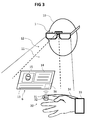
- the device 1 for acquiring and authenticating information contained in a document comprises at least one imager 2 configured to acquire at least one image of an acquisition field 11.
- the device is adapted to be mounted on the head of a user so that the acquisition field of the imager 2 covers at least part of the field of view 12 of the user 10.
- the device may comprise a mount 7 adapted to hold the device on the head of the user 10 by cooperation with said head, or include mounting means 8 for mounting the device 1 on a spectacle frame 7 intended to be placed on the head of the user 10, these mounting means 8 may for example take the form of an elastic casing system.
- the device has elastic mechanical mounting means 8 fixed on an eyeglass frame 7.
- the device 1 is here shown disposed between the two circles holding the glasses at the upper bar thereof, above the bridge linking.
- This is of course an example of other types of frames can be used, such as monocles or binocles, and glasses may be absent.
- a set of authentication information contained in a document comprises the device 1 and computer processing means 5, which can be integrated in the device 1 or be separate.
- the pair of spectacles 7 on which the device is mounted comprises the computer processing means 5 and / or head-up display means 9 intended to be arranged in the user's field of vision, such as smart glasses more commonly known as “smart glasses", and the device 1 is configured to be able to communicate with the computer processing means 5 of these smart glasses, which can then be deported from the device 1 as shown in FIG. figure 1 .
- the computer processing means 5 of the device 1 may be those of the smart glasses, it is then computer processing means shared, because not dedicated to the device 1.
- the device may comprise a mount adapted to hold the device on the head of the user by cooperation with said head, as is the case when the device 1 takes the form of a pair of glasses, as for example illustrated by the figure 2 .
- the computer processing means 5 of the device 1 may be computer processing means dedicated to the device 1, which may be incorporated in a box containing other elements such as the imager 2, or may be deported in such a way that similar to computer processing means 5 illustrated by the figure 1 .
- the device 1 may comprise head-up display means 9 intended to be arranged in the field of view of the user.
- the head-up display means 9 may comprise a transparent glass allowing the user 10 to have a direct vision of his environment, and a transparent mirror disposed between the lens and the user on which the images are projected. 'infinite.
- the device 1 can then take the form of smart glasses mentioned above.
- the acquisition field 11 of the imager 2 is such that any document 6 disposed in the field of view 12 of the user 10 for reading by it is in the field of acquisition 11 of the imager 2.
- the device 1 is configured so that the acquisition field 11 of the imager 1 covers at least the central portion of the field of view 12 of the user 10.
- the acquisition field 11 matches as closely as possible the field of vision 12 of the user.
- Document 6 is a secure document whose authentication is required. In the example presented, it includes a photograph 15 of the holder of the document 6, a visual inspection zone 14 including the designation of the document, the personal data of the document holder and the data relating to the issue and validity of the document. document 6. Document 6 may also include an automatic reading area 13.
- the device 1 comprises at least one light source 3, 4. This is configured to emit in the acquisition field 11 of the imager 1 light at least one non-visible wavelength, that is to say say out of the visible spectrum.
- the visible spectrum is generally defined by wavelengths between 400 nm and 780 nm.
- a light with at least one non-visible wavelength is a light whose spectral power density is maximum for a wavelength less than 400 nm or greater than 780 nm.
- this non-visible wavelength belongs to the infrared or ultraviolet range.
- the light source 3, 4 is configured to emit in the infrared or ultraviolet range.
- at least one light source 3, 4 emits in the ultraviolet.
- UV ultraviolet
- Doubtful or discolored documents may be examined under UV exposure for more clarity and resolution. Many inks change appearance when they react to the electromagnetic waves of light (fluorescent ink). Fluorescent security fibers can react brilliant way. In addition, when such fibers are altered by the attempt to erase a forger, it can be seen under UV.
- the light source 3, 4 emitting in the ultraviolet can for example emit light in the wavelengths of 365/366 nm (UV long wavelength), 313 nm (UV of average wavelength ) and 254 nm (UV of short wavelength).
- the device comprises two light sources 3, 4, which are each configured to emit light at at least one non-visible wavelength different from the other.
- One can emit light in the infrared, for example at a wavelength of 870 nm, and the other can emit in the ultraviolet, for example at a wavelength of 365 nm.
- these light sources 3, 4 are electroluminescent diodes.
- the light source or sources 3, 4 can be arranged near the imager 2, as is the case on the figure 1 , or be removed from it, as is the case in the figure 2 , where the imager 2 is arranged on a branch of the frame 7 while the light sources 3, 4 are arranged on the other branch of the frame 7.
- the light source (s) 3, 4 are oriented similarly to the imager 2, that is to say in the direction of the field of view 12 of the user 10 when the device 1 is mounted on the head of the user 10, to emit light in the opposite direction to the head of the user 10, in particular in the direction of a document 6 presented to the user 10 in the acquisition field 11 of the imager 2.
- the imager 2 is adapted to allow image acquisition at a wavelength emitted by the light source 3, 4 and thus make it possible to acquire at this wavelength an image of a document 6 presented to the user in the acquisition field 11 of the imager 2.
- the imager 2 can for example acquire an image in a spectrum of wavelength covering the infrared, the visible light and the ultraviolet, thus covering the emission wavelengths of the light source or sources 3, 4
- the imager 2 can also acquire an ultraviolet image emitted by a first light source 3, and another in the infrared emitted by the second light source 4.
- the illumination by the light source 3, 4 can be controlled via the dedicated computer processing means 5 of the device 1 or those shared by the device 1, or by the action of the user on a device control member such as than a push button.
- the device may comprise an accelerometer and / or a gyroscope whose measurements are taken into account for the control of the imager 2 and / or the light source 3, 4.
- the device 1 is configured to implement the method according to the invention.
- a document 6 is presented in the field of view of the user 10 (step S1), in an area thereof covered by the acquisition field of the imager 2.
- At least one light source 3, 4 emits in the acquisition field 11 of the imager 2 a light at least one non-visible wavelength (step S2), for example in the infra-red or ultraviolet, or both. This light is emitted in the opposite direction to that of the user 10, in the direction of the document 6.
- the emission of light in a wavelength not visible by the light source 3, 4 can be conditioned by a condition relating to the document 6, as detailed below, or by a command from the user, for example the pressing a button, or even by a position of the head of the user 10 on which the device 1 is arranged, for example when the head is down. In the latter case, it is the measurements of the accelerometer and / or the gyroscope that are taken into account to control the lighting. It should be noted that these measurements can also be taken into account to prevent lighting in a wavelength not visible by the light source 3, 4. Taking into account the position of the head of the user 10 allows to prevent the emission of light, especially ultraviolet light, towards the document holder 6.
- the imager 2 acquires (step S3) at least one image of the document 6 illuminated by the light source 3, 4 and sends the image to the computer processing means 5, which can be dedicated to the device 1, or those shared with smart glasses. It should be noted that the imager 2 can acquire images periodically, filming, but that the light in a non-visible wavelength is emitted only punctually. The authentication processing then only relates to the image or images acquired during or immediately after this illumination.
- a first light source 3 can emit light at least once. wavelength not visible
- the imager 2 acquiring a first image of the document 6 lit by this first light source 3, then a second light source 4 can emit light at least one non-visible wavelength, different from that of the first light source 3, and the imager 2 acquires a second image of the document 6 lit by this second light source 4.
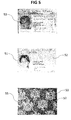
- the figure 5 illustrates an example of differences in the visible elements of a document as a function of different wavelengths of light. This is a driver's license from the state of New York.
- the first image 50 shows this permit in visible light. This first image is therefore representative of what a user sees considering this document in normal light.
- the second image 51 shows the same license under infrared light.
- a security thread 52 while some printed patterns have disappeared.
- These may be patterns made in metameric colors, which are chemically distinct color pairs that can barely be distinguished under a specific type of lighting, usually in normal light, such as in daylight, but which form a clearly visible color contrast when observed under another type of light, often in the infrared.
- An example of a particular metameric effect is invisibility in the infrared, where visible ink ceases to be in a given part of the infrared spectrum.
- the third image 55 shows the ultraviolet-sensitive safety features of the driver's license.
- An ultraviolet-sensitive security element is a pattern printed by fluorescent ink, which can be visible in normal light and react with ultraviolet light. The fluorescence reaction is a very short emission of light, which stops shining almost immediately - within 10 -8 seconds - after the extinction of the light source.
- the UV-sensitive security element may also be a pattern printed by fluorescent overprint, invisible in normal light.
- the security thread 52 which may be a thin strip made of plastic, metal or other material, integrated or partially integrated with the support during the process of manufacturing the paper support.
- lighting with a light with at least one wavelength out of the visible spectrum of a document 6 can highlight the presence of at least one security element, its absence, or its alteration.
- the computer processing means proceeds on the image to the detection of a security element (step S4) in an area of the image in the minus one wavelength out of the visible spectrum, for example in the ultraviolet or infrared.
- the document is then authenticated or not based on the detection or not of the security element (step S6).
- each secure document such as passport or driver's license
- the method uses the reading of the automatic reading zone MRZ 13 of the document 6.
- An automatic reading zone 13 is thus detected (step S8), either on the image acquired during illumination by the light source 3, 4 emitting light at at least one non-visible wavelength, or on a light source. previously acquired image (step S7). It is also possible that the detection of this automatic reading zone 13 in an image of the previously acquired document 6 can be used to trigger the emission of light by the light source 3, 4 emitting light in a non-light area. visible (step S2). Thus, the emission of light in a wavelength not visible by the light source 3, 4 can be conditioned by the detection of an automatic reading zone 13 or by the information contained therein.
- the computer processing means 5 are configured to extract data relating to the document 6 having a predetermined configuration in the document 6, especially in the case where the data having a predetermined configuration are in alphanumeric form in the document.
- the information contained in said automatic reading zone 13 can be used to determine the type of document presented, and thus make it possible to identify the zone of the image to be extracted, the security element likely to be contained therein, and the reference element in a database.
- the information contained in said automatic reading area 13 may also include data on the holder of the document 6, such as the name of the holder, and / or his date of birth, which may be immediately available. to inform electronic files such as forms.
- the information contained in the automatic reading area 13 can be used to retrieve data (step S10) in a database, said data being a function of the information contained in the automatic reading area 13. These data can then be displayed in the field of view 12 of the user 10 by the head-up display means 9 (step S11).
- the photograph displayed may also be the photograph shown on the document 6. This may be other data, such as for example search notices or special notifications.
- the information authentication device 1 can also be used to acquire, by means of the imager 2, a photograph of the holder of the document 6, more precisely of his face, in order to proceed with facial recognition (also called facial recognition). ) by comparison one or more reference (s).
- these references may be constituted by other photographs from a database in which they are associated with the identity of the document holder 6, or a template or a list of biometric markers.
- the recognition of the face is preferably implemented by the processing means 5. This implementation of a face recognition makes it possible to ensure that the holder of the document 6 is indeed the derivative holder, despite possible evolutions. physical, for example due to age or changes in hair or haircuts.
- the acquisition and processing of the image of the document 6 does not, however, make it possible to exploit the possible presence of a chip, that is to say a secure electronic medium consisting of an integrated circuit intended to store and process data, for example embedded in passports, identity cards and biometric residence permits.
- the chip may contain personal data: the name, place and date of birth, the issuing authority and the digitization of the holder's face.
- the chip can be a contact chip or a contactless chip.
- a contact chip In the case of a contact chip, in order to read the information that is contained in an identity card with a contact chip, the chip must be able to come into contact with electrical connectors.
- a contactless chip is a contactless integrated circuit. The chip (invisible on most documents) is connected to an antenna to communicate with the card reader by means of electromagnetic waves. The reader must be close enough for the transmission to begin. The protected content of the chip can be read at a distance of 0 to 10 cm.
- Biometric passports or ePassports include a contactless (or proximity) chip.
- This chip can be integrated into the travel document in different ways. It can be integrated in a transparent thick security film, in the cover of the document, or in a special polycarbonate page.
- Basic Access Control (BAC) is often used: the contactless chip can only be read by the appropriate reader after being unlocked by means of a valid PIN code.
- EAC Extended Access Control
- a digital signature for example using the public key infrastructure (PKI) cryptographic protocol, protects the authenticity and integrity of the stored data.
- PKI public key infrastructure
- the information authentication device may also include a chip reader support adapted to be mounted on the hand of a user.
- This support may for example take the form of a glove or a ring provided with a chip reader.
- the chip reader may be a contact chip reader or preferably a contactless chip reader.
- the support 30 may comprise a mount 31 here taking the form of a ring, a radio frequency antenna type NFC (English “Near Field Communication "for near-field communication), a chip reader 32, and a wired or wireless communication interface, and a power supply.
- the power supply is made by a battery.
- the communication interface is preferably a radio communication interface of the Bluetooth type.
- the medium may comprise a microcontroller.
- the microcontroller and the battery can be deported in a housing 33 for example mounted on the wrist of the user.
- a wire 34 connects this housing 33 to the mount 31, for conveying the information between the chip reader 32 and the microcontroller of the housing 33, as well as for supplying said chip reader 32 from the battery of the housing 33.
- the chip reader support 30 is connected to the computer processing means 5 to which the images acquired by the imager 2 are sent, and these computer processing means 5 are also configured to process the information from the reading of the chip.
- the link between the chip reader support 30 and the computer processing means 5 may be wired but is preferably a radio frequency link made by a Bluetooth type interface.
- the latter places the chip reader support 32 near the chip 16 of the document 6.
- the reader 32 is placed at the level of a finger of the user, the latter places his finger close to the chip 16.
- the mount 31 which carries the reader 32 is preferably placed at a level of the hand which is intended to come close to the chip 16 when the user holds the document 6 in his hand.
- the reader 32 is placed at the index or thumb of the user's hand.
- the natural gripping of the document 6 by the hand of the user 10 brings the reader 32 close to the chip 16, so that a radio frequency communication is established between the reader 32 and the chip 16.
- access to the information of the chip 16 may however be restricted by a key or a code.
- PACE the English acronym for "Password Authenticated Connection Establishment” for establishing a password-authenticated connection
- PACE uses data from the Autoplay Zone for authentication.
- Additional optional data - the card access code - that is printed in the visual inspection area of the biographical data page - can also be used for authentication.
- step S9 The extraction of information from the automatic reading zone (step S9) or the reading of the data by optical character recognition, can fill in the key needed to read the chip 16.
- the computer processing means 5 can decode the information contained therein and calculate the key enabling the chip 16 to be read.
- the computer processing means 5 send this key to the chip reader 32. This reads the chip 16 and the information read is sent, for example via the wired link 34 and the radio frequency interface of the support 30 to the computer processing means 5.
- the information read from chip 16 may include photographs of the face of the document holder 6 and / or fingerprints, or any other data such as biometric data.
- the computer processing means can then compare the information read in the chip 16 to those extracted in the automatic reading zone or that extracted from other parts of the document 6 as the photograph.
- An information display using the head-up display means 9 can be performed, for example by displaying the result of the aforementioned comparison or the juxtaposition of data such as photographs.
Landscapes
- Engineering & Computer Science (AREA)
- Physics & Mathematics (AREA)
- General Physics & Mathematics (AREA)
- Theoretical Computer Science (AREA)
- Computer Security & Cryptography (AREA)
- General Engineering & Computer Science (AREA)
- General Health & Medical Sciences (AREA)
- Health & Medical Sciences (AREA)
- Toxicology (AREA)
- Electromagnetism (AREA)
- Human Computer Interaction (AREA)
- Signal Processing (AREA)
- Computer Networks & Wireless Communication (AREA)
- Optics & Photonics (AREA)
- Artificial Intelligence (AREA)
- Computer Vision & Pattern Recognition (AREA)
- Computer Hardware Design (AREA)
- Software Systems (AREA)
- Image Input (AREA)
Applications Claiming Priority (1)
| Application Number | Priority Date | Filing Date | Title |
|---|---|---|---|
| FR1456998A FR3024003B1 (fr) | 2014-07-21 | 2014-07-21 | Dispositif et procede d'authentification de document |
Publications (1)
| Publication Number | Publication Date |
|---|---|
| EP2977851A1 true EP2977851A1 (de) | 2016-01-27 |
Family
ID=51519099
Family Applications (1)
| Application Number | Title | Priority Date | Filing Date |
|---|---|---|---|
| EP15177632.5A Withdrawn EP2977851A1 (de) | 2014-07-21 | 2015-07-21 | Vorrichtung und verfahren zum authentifizieren eines dokuments |
Country Status (3)
| Country | Link |
|---|---|
| US (1) | US9983410B2 (de) |
| EP (1) | EP2977851A1 (de) |
| FR (1) | FR3024003B1 (de) |
Families Citing this family (4)
| Publication number | Priority date | Publication date | Assignee | Title |
|---|---|---|---|---|
| WO2016061292A1 (en) * | 2014-10-17 | 2016-04-21 | SimonComputing, Inc. | Method and system for imaging documents in mobile applications |
| WO2019014284A1 (en) * | 2017-07-13 | 2019-01-17 | Optical Wavefront Laboratories | SYSTEM AND METHOD FOR OPTICAL AUTHENTICATION OF PHYSICAL OBJECTS |
| US11461244B2 (en) * | 2018-12-20 | 2022-10-04 | Intel Corporation | Co-existence of trust domain architecture with multi-key total memory encryption technology in servers |
| US20220138445A1 (en) | 2020-11-04 | 2022-05-05 | Verifyme, Inc. | Remote infrared ink reader and authenticator |
Citations (6)
| Publication number | Priority date | Publication date | Assignee | Title |
|---|---|---|---|---|
| US6172657B1 (en) * | 1996-02-26 | 2001-01-09 | Seiko Epson Corporation | Body mount-type information display apparatus and display method using the same |
| US20120200601A1 (en) * | 2010-02-28 | 2012-08-09 | Osterhout Group, Inc. | Ar glasses with state triggered eye control interaction with advertising facility |
| US20120235785A1 (en) * | 2011-03-17 | 2012-09-20 | Motorola Mobility, Inc. | Wireless communication device and method with intelligent authentication |
| US20130069985A1 (en) * | 2011-09-21 | 2013-03-21 | Google Inc. | Wearable Computer with Superimposed Controls and Instructions for External Device |
| US20140125558A1 (en) * | 2012-11-06 | 2014-05-08 | Sony Corporation | Image display device, image display method, and computer program |
| WO2014198945A1 (en) * | 2013-06-14 | 2014-12-18 | Sita Information Networking Computing Ireland Limited | Portable user control system and method therefor |
-
2014
- 2014-07-21 FR FR1456998A patent/FR3024003B1/fr active Active
-
2015
- 2015-07-21 US US14/805,369 patent/US9983410B2/en active Active
- 2015-07-21 EP EP15177632.5A patent/EP2977851A1/de not_active Withdrawn
Patent Citations (6)
| Publication number | Priority date | Publication date | Assignee | Title |
|---|---|---|---|---|
| US6172657B1 (en) * | 1996-02-26 | 2001-01-09 | Seiko Epson Corporation | Body mount-type information display apparatus and display method using the same |
| US20120200601A1 (en) * | 2010-02-28 | 2012-08-09 | Osterhout Group, Inc. | Ar glasses with state triggered eye control interaction with advertising facility |
| US20120235785A1 (en) * | 2011-03-17 | 2012-09-20 | Motorola Mobility, Inc. | Wireless communication device and method with intelligent authentication |
| US20130069985A1 (en) * | 2011-09-21 | 2013-03-21 | Google Inc. | Wearable Computer with Superimposed Controls and Instructions for External Device |
| US20140125558A1 (en) * | 2012-11-06 | 2014-05-08 | Sony Corporation | Image display device, image display method, and computer program |
| WO2014198945A1 (en) * | 2013-06-14 | 2014-12-18 | Sita Information Networking Computing Ireland Limited | Portable user control system and method therefor |
Also Published As
| Publication number | Publication date |
|---|---|
| FR3024003A1 (fr) | 2016-01-22 |
| FR3024003B1 (fr) | 2018-10-19 |
| US9983410B2 (en) | 2018-05-29 |
| US20160018656A1 (en) | 2016-01-21 |
Similar Documents
| Publication | Publication Date | Title |
|---|---|---|
| EP3690686B1 (de) | Authentifizierungsverfahren, server und elektronische identitätsvorrichtung | |
| FR2812740A1 (fr) | Dispositif de controle d'un document d'identite ou analogue | |
| EP2991832B1 (de) | Drucksystem und verfahren zum aufbringen eines designs auf mindestens einer fingernagel-/fussnageloberfläche | |
| FR2895125A1 (fr) | Procede d'authentification de documents et dispositif de lecture desdits documents a des fins d'enregistrement pour preuve | |
| WO2007125258A1 (fr) | Système de lecture d'au moins un code a barres | |
| FR2997528A1 (fr) | Identification biometrique | |
| EP2977851A1 (de) | Vorrichtung und verfahren zum authentifizieren eines dokuments | |
| WO2006042980A1 (fr) | Systeme et procede d’authentification d’un objet | |
| EP3686761B1 (de) | Gesichertes markierungselement und kodierungs- und authentifizierungsverfahren dieses markierungselements | |
| EP2499000A2 (de) | Ausweisdokumente mit mustergesichertem ausweisfoto | |
| EP2489016B1 (de) | Verfahren und vorrichtung zur überprüfung eines gesicherten dokuments | |
| FR2988871A1 (fr) | Lecteur de controle biometrique multifonctions | |
| WO2010007479A2 (fr) | Appareil et procédé de génération d'un titre sécurisé à partir d'un titre officiel | |
| EP4032023B1 (de) | Klebeetikett | |
| CA3205344A1 (fr) | Procede de controle d'individus a authentification simplifiee | |
| EP3895108A1 (de) | Vorrichtung und verfahren zur sicherung sicherer daten für eine bankbezahlkarte | |
| EP0707728B1 (de) | Verfahren zur markierung von produkten oder dokumenten, produkt auf diese weise markiert und mitteln zur durchführung dieses verfahrens und eine fehlerprüfungsvorrichtung | |
| EP4193283B1 (de) | Verfahren zur erzeugung eines sicheren digitalen dokuments, das auf einem mobilen endgerät gespeichert ist und mit einer digitalen identität assoziiert ist | |
| EP4120104B1 (de) | Verfahren zur erzeugung eines digitalen identitätsdokuments einer person aus einem physischen amtlichen identitätsdokument | |
| FR2861482A1 (fr) | Procede de securisation d'une donnee biometrique d'authentification et procede d'authentification d'un utilisateur a partir d'une donnee biometrique d'authentification | |
| FR2672246A1 (fr) | Procede et moyens pour rendre inviolable un moyen de paiement scriptural. | |
| EP2073175A1 (de) | Datenträger für die gesicherte Identifikation und Sicherungsverfahren eines solchen Datenträgers | |
| FR3064790B1 (fr) | Machine et procede de fonctionnement pour identifier un recepisse de pari frauduleux | |
| FR3059122A1 (fr) | Document de securite pourvu d'une antenne | |
| WO2015132185A1 (fr) | Procédé d'authentification d'un porteur de carte |
Legal Events
| Date | Code | Title | Description |
|---|---|---|---|
| PUAI | Public reference made under article 153(3) epc to a published international application that has entered the european phase |
Free format text: ORIGINAL CODE: 0009012 |
|
| 17P | Request for examination filed |
Effective date: 20150721 |
|
| AK | Designated contracting states |
Kind code of ref document: A1 Designated state(s): AL AT BE BG CH CY CZ DE DK EE ES FI FR GB GR HR HU IE IS IT LI LT LU LV MC MK MT NL NO PL PT RO RS SE SI SK SM TR |
|
| AX | Request for extension of the european patent |
Extension state: BA ME |
|
| RAP1 | Party data changed (applicant data changed or rights of an application transferred) |
Owner name: IDEMIA IDENTITY & SECURITY FRANCE |
|
| 17Q | First examination report despatched |
Effective date: 20190918 |
|
| STAA | Information on the status of an ep patent application or granted ep patent |
Free format text: STATUS: THE APPLICATION IS DEEMED TO BE WITHDRAWN |
|
| 18D | Application deemed to be withdrawn |
Effective date: 20201204 |