EP2977936A2 - Procédé et appareil de formation de réseau neuronal et appareil de traitement de données - Google Patents
Procédé et appareil de formation de réseau neuronal et appareil de traitement de données Download PDFInfo
- Publication number
- EP2977936A2 EP2977936A2 EP15176946.0A EP15176946A EP2977936A2 EP 2977936 A2 EP2977936 A2 EP 2977936A2 EP 15176946 A EP15176946 A EP 15176946A EP 2977936 A2 EP2977936 A2 EP 2977936A2
- Authority
- EP
- European Patent Office
- Prior art keywords
- neural network
- training
- hidden
- data
- nodes
- Prior art date
- Legal status (The legal status is an assumption and is not a legal conclusion. Google has not performed a legal analysis and makes no representation as to the accuracy of the status listed.)
- Ceased
Links
Images




Classifications
-
- G—PHYSICS
- G06—COMPUTING OR CALCULATING; COUNTING
- G06N—COMPUTING ARRANGEMENTS BASED ON SPECIFIC COMPUTATIONAL MODELS
- G06N3/00—Computing arrangements based on biological models
- G06N3/02—Neural networks
- G06N3/08—Learning methods
- G06N3/082—Learning methods modifying the architecture, e.g. adding, deleting or silencing nodes or connections
-
- G—PHYSICS
- G06—COMPUTING OR CALCULATING; COUNTING
- G06N—COMPUTING ARRANGEMENTS BASED ON SPECIFIC COMPUTATIONAL MODELS
- G06N3/00—Computing arrangements based on biological models
- G06N3/02—Neural networks
- G06N3/08—Learning methods
-
- G—PHYSICS
- G06—COMPUTING OR CALCULATING; COUNTING
- G06N—COMPUTING ARRANGEMENTS BASED ON SPECIFIC COMPUTATIONAL MODELS
- G06N3/00—Computing arrangements based on biological models
- G06N3/02—Neural networks
- G06N3/08—Learning methods
- G06N3/09—Supervised learning
-
- G—PHYSICS
- G06—COMPUTING OR CALCULATING; COUNTING
- G06N—COMPUTING ARRANGEMENTS BASED ON SPECIFIC COMPUTATIONAL MODELS
- G06N3/00—Computing arrangements based on biological models
- G06N3/02—Neural networks
- G06N3/04—Architecture, e.g. interconnection topology
- G06N3/044—Recurrent networks, e.g. Hopfield networks
Definitions
- the following description relates to a neural network training method, a neural network training apparatus, and a data processing apparatus.
- an artificial neural network obtained by modeling biological characteristics of a human nerve cell through a mathematical expression.
- the artificial neural network may use an algorithm constructed based on a human ability to learn. Based on the algorithm, the artificial neural network may generate a map between an input pattern and an output pattern, and the generating may indicate that the artificial neural network has a learning ability. Also, the artificial neural network may have a generalization ability and thus, may generate a relatively correct output with respect to an input pattern unused in a learning process based on a result of learning.
- a neural network training method based on training data, the method including receiving training data including sequential data, selecting a reference hidden node from hidden nodes in a neural network, and training the neural network based on remaining hidden nodes obtained by excluding the reference hidden node from the hidden nodes, and based on the training data, the remaining hidden nodes being connected with hidden nodes in a different time interval, and a connection between the reference hidden node and the hidden nodes in the different time interval being ignored.
- the reference hidden node may be excluded during the training of the neural network based on an item of the sequential data.
- the selecting may include randomly selecting the reference hidden node from the hidden nodes.
- the selecting may include randomly selecting another reference hidden node from the hidden nodes in response the training of the neural network based on an item of the sequential data being terminated, and the training may include training the neural network based on another item of the sequential data, and based on remaining hidden nodes obtained by excluding the other reference hidden node from the hidden nodes.
- the sequential data may include any one or any combination of voice data, image data, biometric data, and handwriting data.
- the method may further include updating a connection weight applied to the neural network based on a result of the training.
- the training may include controlling the neural network to repetitively learn the training data based on a predetermined number of repetitions.
- the neural network may be a recurrent neural network, and may include hidden layers.
- a non-transitory computer-readable storage medium may include a program including instructions to cause a computer to perform the method.
- a neural network training method based on training data, the method including receiving training data including sequential data, selecting a reference hidden node from hidden nodes in a neural network, and training the neural network by excluding the reference hidden node from the hidden nodes during the training of the neural network based on an item of the sequential data.
- Remaining hidden nodes obtained by excluding the reference hidden node from the hidden nodes may be connected with hidden nodes in a different time interval, and a connection between the reference hidden node and the hidden nodes in the different time interval may be ignored.
- the selecting may include randomly selecting another reference hidden node from the hidden nodes in response the training of the neural network based on the item of the sequential data being terminated, and the training may include training the neural network based on another item of the sequential data, and based on remaining hidden nodes obtained by excluding the other reference hidden node from the hidden nodes.
- a neural network training apparatus based on training data
- the apparatus including a training data storage configured to store training data including sequential data, and a neural network trainer configured to train a neural network by excluding a reference hidden node from hidden nodes in the neural network during the training of the neural network based on an item of the sequential data.
- the neural network training unit may be configured to train the neural network by excluding another reference hidden node from the hidden nodes during the training of the neural network based on another item of the sequential data, in response to the training of the neural network based on the item of the sequential data being terminated.
- a data processing apparatus including a trainer configured to train a neural network by excluding a reference hidden node from hidden nodes in the neural network during the training of the neural network based on an item of sequential data.
- Connections between the reference hidden node and nodes in a subsequent time interval may be ignored.
- the trainer may be configured to train the neural network by excluding an identical reference hidden node from hidden nodes in each time interval during the training of the neural network based on the item of the sequential data.
- FIG. 1 is a diagram illustrating an example of a neural network training apparatus 100.
- the neural network training apparatus 100 trains a neural network or an artificial neural network.
- the neural network may be a recognition model implemented through software or hardware imitating a computing ability of a biological system by using numerous artificial neurons connected through a connection line.
- the recognition model of the neural network may recognize sequential data, and be used in fields of, for example, voice recognition, image recognition, body state recognition, and handwriting recognition.
- the sequential data may refer to data having a temporality or a sequence such as voice data, image data, biometric data, handwriting data, and/or other types of data.
- the recognition model of the neural network may recognize contents in input voice data or a figure appearing in an image.
- the recognition model of the neural network may recognize a body state of a user by analyzing a biometric signal such as an electrocardiogram (ECG), an electroencephalogram (EEG), and/or another type of signal, and recognize a handwriting input by analyzing a gesture of the user.
- ECG electrocardiogram
- EEG electroencephalogram
- the recognition model of the neural model may be used to estimate an appropriate deoxyribonucleic acid (DNA) sequence based on an observed signal in a DNA sequencing device.
- DNA deoxyribonucleic acid
- Artificial neurons having simplified biological functions of a neuron may be used in the neural network, and may be mutually connected through a connection line having a connection weight.
- the connection weight may be a predetermined value of the connection line, and may also be expressed as connection strength.
- the neural network may perform a human cognitive function or a training process using the artificial neurons.
- An artificial neuron may also be referred to as a node.
- the neural network may include a plurality of layers.
- the neural network may include an input layer, a hidden layer, and an output layer.
- the input layer may receive an input to perform training, and transfer the received input to the hidden layer.
- the output layer may generate an output of the neural network based on a signal received from nodes of the hidden layer.
- the hidden layer may be disposed between the input layer and the output layer to change training data transferred through the input layer to an easily predicted value. Nodes included in the input layer and the hidden layer may be mutually connected through a connection line having a connection weight, and nodes included in the hidden layer and the output layer may be mutually connected through a connection line having a connection weight.
- Each of the input layer, the hidden layer, and the output layer may include a plurality of nodes.
- the neural network may include a plurality of hidden layers.
- the neural network including the plurality of hidden layers may be referred to as a deep neural network, and training of the deep neural network may be referred to as a deep learning.
- a node included in the hidden layer may be referred to as a hidden node.
- An output of a hidden node in a previous time interval may be connected with hidden nodes of a current time interval.
- an output of the hidden node in the current time interval may be connected with hidden nodes of a subsequent time interval.
- a neural network having a recurrent connection among hidden nodes of different time intervals may be referred to as a recurrent neural network.
- the neural network training apparatus 100 may train the neural network through a supervised learning.
- the supervised learning may be a method of inputting training data and output data corresponding to the training data to the neural network, and updating connection weights of connection lines, thereby outputting the output data corresponding to the training data.
- the neural network training apparatus 100 may update a connection weight among artificial neurons through backpropagation learning, a delta rule, and/or other methods known to one of ordinary skill in the art.
- the backpropagation learning may be a method of estimating an error by performing forward computation on training data, and propagating the estimated error by inversely proceeding in a direction from an output layer through a hidden layer to an input layer, thereby updating a connection weight to reduce the error.
- a neural network processing may be performed in a direction from an input layer through a hidden layer to an output layer.
- a connection weight update may be performed in a direction from an output layer through a hidden layer to an input layer.
- the neural network training apparatus 100 may define an objective function to measure a closeness to an optimization for currently set connection weights, change the connection weights based on a result of the objective function, and perform training repetitively.
- the objective function may be an error function for computing an error between an expectation value corresponding to a desired output and an actual output value output by the neural network based on training data.
- the neural network training apparatus 100 may update the connection weights to reduce a value of the error function.
- the neural network training apparatus 100 includes a training data storage 100 and a neural network trainer 120.
- the training data storage 110 stores training data.
- the training data may include sequential data, for example, voice data, image data, biometric data, and/or handwriting data.
- the biometric data may include an EEG, an ECG, an electromyogram (EMG), an electrooculogram (EOG), a pulse, and/or other biometric data known to one of ordinary skill in the art.
- the training data storage 110 may store training data received from an external source, and provide the stored training data to the neural network trainer 120.
- the neural network trainer 120 trains the neural network based on the training data.
- the neural network trainer 120 may detect a feature value from the training data. For example, the neural network trainer 120 may extract a relative variation varying based on a time, as the feature value. The neural network trainer 120 may sufficiently acquire feature values from the training data, and train the neural network based on the acquired feature values.
- the training data storage 110 may store voice data corresponding to "volume-up", “volume-down", and "back to previous channel”.
- the neural network trainer 120 may extract feature values from the voice data, and train the neural network based on the extracted feature values.
- the voice data may be divided based on a unit of a predetermined time, and the divided voice data may be sequentially input to the neural network.
- the neural network trainer 120 may train the neural network based on a training pattern excluding at least one reference hidden node among a plurality of hidden nodes.
- the training pattern may be continuously settled during a training process of one item of sequential data, i.e., the training of the neural network based on the one item of the sequential data.
- the neural network may be a recurrent neural network having a connection among hidden nodes of different time intervals, and may include a plurality of hidden layers. In consecutive time intervals, an output value output from a hidden layer of a current time interval may be input to a hidden layer of a subsequent time interval.
- the neural network trainer 120 may train the neural network based on remaining hidden nodes obtained by excluding the reference hidden node from the hidden nodes included in the hidden layer of the neural network.
- the identical reference hidden node may be continuously excluded during the training process of the one item of the sequential data.
- the neural network trainer 120 may randomly select the reference hidden node from the hidden nodes.
- the training pattern excluding the reference hidden node may be identically maintained during the training process of the one item of the sequential data.
- the neural network trainer 120 may randomly change the training pattern each time the sequential data input as a training target is changed.
- the reference hidden node may be a hidden node excluded during the training process of the sequential data.
- a connection between the reference hidden node and nodes in an upper layer, and a connection between the reference hidden node and hidden nodes in a different time interval, may be ignored.
- the upper layer may include an output layer or a different hidden layer disposed in an upper position of a hidden layer including the reference hidden node.
- an output of the reference hidden node may not be input to the other node in practice, and the reference hidden node may output a value of 0 as the output to the other node.
- the other node may include a node of the upper layer or a hidden node of the different time interval. The remaining hidden nodes obtained by excluding the reference hidden node from the hidden nodes included in the hidden layer may be connected with the hidden nodes of the different time interval.
- the neural network trainer 120 may change the training pattern, and initiate a training process of another item of the sequential data.
- the neural network trainer 120 may randomly re-select a reference hidden node from the hidden nodes included in the neural network, and train the neural network based on remaining hidden nodes obtained by excluding the re-selected reference hidden node.
- the neural network trainer 120 may select a reference hidden node to be excluded from the hidden nodes included in the neural network, and train the neural network to learn "volume-up" of the voice data based on remaining hidden nodes obtained by excluding the selected reference hidden node. While the neural network is training to learn "volume-up" of the voice data, the selected reference hidden node may be continuously ignored.
- the neural network trainer 120 may re-select a reference hidden node to be excluded during the training process, from the hidden nodes. Subsequently, the neural network trainer 120 may perform the training process of "volume-down" of the voice data while continuously ignoring the re-selected reference hidden node.
- the neural network trainer 120 may adjust a connection weight applied to the neural network based on a result of the training of the sequential data.
- the neural network trainer 120 may compute an error by comparing a desired expectation value for the training data and an output value generated from the output layer of the neural network, and may adjust the connection weight applied to the recognition model of the neural network to reduce the error.
- the neural network trainer 120 may control the neural network to repetitively learn all items of the sequential data included in the training data based on a preset number of repetitions.
- the neural network trainer 120 may train the neural network, using a portion of hidden nodes in lieu of all of the hidden nodes, thereby effectively alleviating an issue of overfitting.
- the overfitting may indicate a phenomenon in which the recognition model of the neural network is excessively adapted to the training data such that a recognition rate for a target to be actually recognized is reduced.
- the neural network trainer 120 may prevent a co-adaptation such that connection weights of the hidden nodes are not similar to one another as a result of the training.
- the trained neural network may be used to recognize the sequential data.
- the recognition model of the neural network may extract a feature value from the sequential data in response to an input of the sequential data, and input the extracted feature value to a classifier so as to output a classification result or a recognition result of the input sequential data.
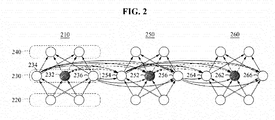
- FIGS. 2 and 3 are diagrams illustrating examples of training a neural network based on sequential data in a neural network training apparatus.
- FIG. 2 shows operations of the neural network trained to learn a predetermined item of the sequential data.
- the sequential data When the sequential data is input as a training target, the sequential data may be divided based on a unit of a predetermined time.
- a single neural network model may be used when the neural network training apparatus trains the neural network.
- the divided sequential data may be input to a neural network A in a time sequence for training.
- each of a training pattern 210, a training pattern 250, and a training pattern 260 indicates a training pattern of a predetermined neural network for a respective timestamp.
- the training pattern 210 is a training pattern of a previous time interval T - 1
- the training pattern 250 is a training pattern of a current time interval T
- the training pattern 260 is a training pattern of a subsequent time interval T + 1.
- a single neural network structure is used for training during the previous time interval, the current time interval, and the subsequent time interval.
- the neural network includes an input layer 220, a hidden layer, 230, and an output layer 240.
- a lowest layer is the input layer 220 to which the sequential data is input as the training data
- a layer between the input layer 220 and the output layer 240 is the hidden layer 230
- a highest layer is the output layer 240.
- Each of the input layer 220, the hidden layer 230, and the output layer 240 includes a plurality of nodes. Nodes 232, 234, and 236 included in the hidden layer 230 may be referred to as hidden nodes.
- the neural network is connected in a direction from the input layer 220 through the hidden layer 230 to the output layer 240.
- the training data is input to each node of the input layer 220, the training data is transferred to the hidden layer 230 through a conversion performed in each node of the input layer 220, and an output is generated in the output layer 240.
- the hidden layer 230 is shown in FIGS. 2 and 3 for increased clarity and conciseness, the neural network may also include a plurality of hidden layers including the hidden layer 230.
- the neural network training apparatus inputs the sequential data to the input layer 220 of the neural network, and trains the neural network such that a result of classifying the sequential data is output from the output layer 240 of the neural network.
- the neural network trained by the neural network training apparatus is a recurrent neural network having a connection among hidden nodes of different time intervals.
- each hidden node included in the hidden layer 230 is connected with hidden nodes of the current time interval.
- An output value of each hidden node in the previous time interval may be input to the hidden nodes of the current time interval.
- the neural network training apparatus may train the neural network based on a training pattern excluding a portion of hidden nodes in lieu of all of the hidden nodes.
- the neural network training apparatus may randomly select a reference hidden node to be excluded or ignored from the hidden nodes in the process of training.
- the hidden node 232 disposed between the hidden node 234 and the hidden node 236 is selected as a reference hidden node from the hidden nodes 232, 234, and 236 included in the hidden layer 230. Connections between the reference hidden node, for example, the hidden node 232, and nodes included in an upper layer, for example, the output layer 240, are ignored. In addition, connections between the reference hidden node, for example, the hidden node 232, and hidden nodes 252, 254, and 256 of the current time interval are ignored.
- connections between a reference hidden node, for example, the hidden node 252, of the current time interval and nodes of an upper layer are ignored, and connections between the reference hidden node, for example, the hidden node 252, and hidden nodes 262, 264, and 266 of the subsequent time interval are ignored.
- a connection indicated by a solid line represents a normal connection between nodes
- a connection indicated by a dotted line represents a connection ignored between nodes.
- the hidden nodes 234 and 236 correspond to remaining hidden nodes obtained by excluding the reference hidden node corresponding to the hidden node 232 from the hidden nodes 232, 234, and 236.
- the remaining hidden nodes are connected with the nodes included in the upper layer corresponding to the output layer 240 and the hidden nodes 252, 254, 256 of the current time interval.
- an output generated by each of the remaining hidden nodes in the previous time interval may be input to the nodes in the upper layer corresponding to the output layer 240 and the hidden nodes 252, 254, and 256 of the current time interval.
- remaining hidden nodes corresponding to the hidden nodes 254 and 256 obtained by excluding the reference hidden node corresponding to the hidden node 252 are connected with the hidden nodes 262, 264, and 266 of the subsequent time interval.
- the training pattern excluding the reference hidden node in each time interval may be continuously maintained.
- the neural network training apparatus may perform training of the corresponding voice data based on the training pattern continuously excluding the reference hidden node.
- the hidden node 232 selected as the reference hidden node of the training pattern 210 in the previous time interval corresponds to the hidden node 252 selected as the reference hidden node of the training pattern 250 in the current time interval and the hidden node 262 selected as the reference hidden node of the training pattern 260 in the subsequent time interval.
- the training of the sequential data may be performed based on the remaining hidden nodes while the reference hidden node is being excluded.
- the neural network training apparatus may compare a desired expectation value and an output value generated from the output layer 240 in each time interval, and may adjust a connection weight of the nodes to reduce a difference between the output value and the expectation value.
- the neural network training apparatus may train the neural network through the adjustment of the connection weight.
- the output value may be generated from the output layer 240 through a process in which the training data input to the input layer 220 is multiplied by and added to the connection weight while passing through the hidden layer 230.
- the generated output value may differ from the desired expectation value, and thus, the neural network training apparatus may update the connection weight to minimize the difference between the generated output value and the desired expectation value.
- FIG. 3 illustrates operations of the neural network training apparatus performing a training of another item of the sequential data.
- the neural network training apparatus may train the neural network by randomly determining a training pattern for each item of the sequential data.
- a reference hidden node excluded from a training process may be determined for each item of the sequential data.
- the determined reference hidden node may be continuously selected as the reference hidden node during a training process of corresponding sequential data.
- a reference hidden node A may be continuously ignored during a training process of "volume-up" of voice data
- a reference hidden node B may be continuously ignored during a training process of "volume-down" of the voice data.
- the reference hidden node B may be different from the reference hidden node A. Since the reference hidden node to be excluded from the training process may be randomly selected for each item of the sequential data, an identical reference hidden node may be selected despite a difference in the sequential data.
- the neural network training apparatus may change the training pattern.
- the neural network training apparatus may randomly re-select a reference hidden node to be excluded in a training process, from a plurality of hidden nodes included in a hidden layer.
- FIG. 3 illustrates training patterns of the neural network trained to learn the other item of the sequential data.
- a training pattern 310 is a training pattern of a previous time interval
- a training pattern 350 is a training pattern of a current time interval
- a training pattern 360 is a training pattern of a subsequent time interval.
- a single neural network structure is used to train during the previous time interval, the current time interval, and the subsequent time interval. Also, all items of the sequential data may be learned by the single neural network structure.
- the neural network includes an input layer 320, a hidden layer 330, and an output layer 340.
- Nodes included in the hidden layer 330 may be referred to as hidden nodes 332, 334, and 336.
- the hidden nodes 332 and 334 are selected as reference hidden nodes from the hidden nodes 332, 334, and 336 of the hidden layer 330.
- the hidden nodes 332 and 334 may correspond to the reference hidden nodes of the previous time interval. Connections between the reference hidden nodes of the previous time interval and nodes included in an upper layer, for example, the output layer 340, are ignored. Connections between the reference hidden nodes of the previous time interval and hidden nodes 352, 354, and 356 of the current time interval are also ignored. Similar to FIG. 2 , in FIG. 3 , a connection indicated by a solid line represents a normal connection between nodes, and a connection indicated by a dotted line represents a connection ignored between nodes.
- the hidden nodes 352 and 354 are selected as reference hidden nodes from the hidden nodes 352, 354, and 356.
- the hidden nodes 352 and 354 may correspond to the reference hidden nodes of the current time interval. Connections between the reference hidden nodes of the current time interval and nodes included in an upper layer are ignored. Connections between the reference hidden nodes of the current time interval and hidden nodes 362, 364, and 366 of the subsequent time interval are also ignored.
- a remaining hidden node for example, the hidden node 336, obtained by excluding the reference hidden nodes from the hidden nodes 332, 334, and 336, are connected with the nodes included in the upper layer, for example, the output layer 340, and the hidden nodes 352, 354, and 356 of the current time interval.
- a remaining hidden node for example, the hidden node 356, obtained by excluding the reference hidden nodes from the hidden nodes 352, 354, and 356, are connected with the nodes included in the upper layer and the hidden nodes 362, 364, and 366 of the subsequent time interval.
- the neural network training apparatus may select a reference hidden node for each item of sequential data.
- the selected reference hidden node may be continuously ignored during a time interval in which corresponding sequential data is being used for a training process.
- the training may be performed on the neural network in a state of ignoring connections between the reference hidden node and hidden nodes of a subsequent time interval as well as a connection between the reference hidden node and a node included in an upper layer.
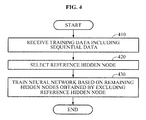
- FIG. 4 is a flowchart illustrating an example of a neural network training method.
- the neural network training apparatus receives training data including a plurality of items of sequential data.
- the sequential data may include, for example, voice data, image data, biometric data, handwriting data, and/or other types of data.
- the neural network training apparatus may store the training data received from an external source, and detect a feature value from the stored training data.
- the neural network training apparatus may sufficiently acquire feature values from the training data, and train a neural network based on the feature values.
- the neural network training apparatus selects at least one reference hidden node from a plurality of hidden nodes included in the neural network.
- the neural network training apparatus may randomly select the reference hidden node.
- the neural network training apparatus trains the neural network based on remaining hidden nodes obtained by excluding the reference hidden node from the hidden nodes, and based on the training data.
- a training pattern excluding the reference hidden node may be continuously used during a training process of one item of the sequential data, i.e., the training of the neural network based on the one item of the sequential data.
- the identical reference hidden node may be continuously excluded.
- the neural network training apparatus may randomly change the training pattern excluding the reference hidden node, each time the sequential data input as a training target is changed. Connections between the reference hidden node and nodes in an upper layer, and connections between the reference hidden node and hidden nodes in a different time interval may be ignored. The remaining hidden nodes obtained by excluding the reference hidden node from the hidden nodes included in the hidden layer may be connected with the hidden nodes of the different time interval.
- the neural network training apparatus may randomly re-select a reference hidden node from all of the hidden nodes included in the neural network. Subsequently, the neural network training apparatus may train the neural network to learn another item of the sequential data based on remaining hidden nodes obtained by excluding the re-selected reference hidden node from the hidden nodes.
- the neural network training apparatus may adjust a connection weight applied to the neural network based on a result of the training process of the sequential data.
- the neural network training apparatus may compare a desired expectation value and an output value generated from an output layer of the neural network, and may update the connection weight to reduce a difference between the output value and the expectation value.
- the neural network training apparatus may repetitively train the neural network to learn all of the items of the sequential data included in the training data based on a preset number of repetitions.
- FIG. 5 is a flowchart illustrating another example of a neural network training method.
- a neural network training apparatus receives training data.
- the training data may include, for example, voice data, image data, biometric data, handwriting data, and/or other types of data.
- the neural network training apparatus detects a feature value from the training data.
- the neural network training apparatus may detect feature vectors from the training data, and train the neural network based on the detected feature vectors.
- the neural network training apparatus selects first training data to be initially used for training, from the training data.
- the training data may be classified into the first training data through N th training data, N being a natural number greater than 2, based on a training sequence.
- Each item of the training data may be independent sequential data.
- the first training data may be voice data corresponding to "volume-up”
- second training data may be voice data corresponding to "volume-down”
- third training data may be voice data corresponding to "back to previous channel”.
- the neural network training apparatus randomly selects a reference hidden node to be excluded in a training process, from a plurality of hidden nodes included in the neural network. For example, each of the hidden nodes may be selected to be the reference hidden node at a probability of 50%. A connection between the reference hidden node and nodes in an upper layer and a connection between the reference hidden node and hidden nodes in a different time interval may be ignored.
- the neural network training apparatus trains the neural network based on remaining hidden nodes obtained by excluding the reference hidden node from the hidden nodes, and based on the training data.
- a training process of one item e.g., the training of the neural network based on the first training data
- a training pattern excluding the reference hidden node may be identically maintained.
- the neural network training apparatus may update a connection weight applied to the neural network based on result of the training process of the sequential data.
- the neural network training apparatus may also increment a number of repetitions of the method.
- the neural network training apparatus determines whether training for all items of the training data is performed. When the training for all of the items of the training data is determined to be not performed, the neural network training apparatus continues in operation 570. When the training for all of the items of the training data is determined to be performed, the neural network training apparatus continues in operation 580.
- the neural network training apparatus selects subsequent training data from the training data.
- the second training data may be selected as the subsequent training data of the first training data.
- the neural network training apparatus randomly selects a reference hidden node from the hidden nodes in operation 540, and trains the neural network based on the second training data as an input in operation 550.
- the neural network training apparatus determines whether a preset number of repetitions are satisfied, e.g., is equal to the incremented number of repetitions of the method. When the preset number of repetitions is determined to be not satisfied, the neural network training apparatus returns to operation 530. When the preset number of repetitions is determined to be satisfied, the neural network training apparatus terminates the training of the neural network.
- FIG. 6 is a diagram illustrating an example of a data processing apparatus 600.
- the data processing apparatus 600 recognizes sequential data such as image data, biometric data, handwriting data, and/or other types of data, using a recognition model of a neural network.
- sequential data such as image data, biometric data, handwriting data, and/or other types of data
- the data processing apparatus 600 performs training of the sequential data.
- the data processing apparatus 600 may continuously improve a recognition performance by continuously performing training of sequential data failing to be recognized.
- the data processing apparatus 600 may be an electronic device for recognizing sequential data and performing a corresponding operation.
- the data processing apparatus 600 may be, for example, a digital television (TV), a desktop computer, a laptop computer, a set-top box, a digital versatile disc (DVD)/ Blu-ray disc (BD) player, a DVD recorder, a smartphone, a tablet personal computer (PC), and/or a smart TV.
- the data processing apparatus 600 includes a recognizer 610, a trainer 620, a controller 630, and a user interface 640.
- the recognizer 610 recognizes sequential data such as voice data, image data, biometric data, handwriting data, and/or other types of data.
- the recognizer 610 may recognize voice data input through a microphone and/or image data acquired through a camera.
- the recognizer 610 includes a recognition model of a neural network, and the neural network may be a recurrent neural network including a plurality of hidden layers.
- the recognizer 610 may determine contents included in the sequential data, using the recognition model of the neural network, in response to an input of the sequential data.
- the recognizer 610 may analyze the voice data, and output a voice recognition result.
- the recognizer 610 may divide "back to previous channel” of the voice data into a plurality of frames, and estimate content included in the divided frames based on the recognition model of the neural network.
- the recognizer 610 may extract feature values by quantifying the input voice data, and compare each of the extracted feature values to a feature value of a voice recognition target.
- the recognizer 610 may output a final recognition result based on a recognition result for each frame. Based on the voice recognition result, the recognizer 610 may output a recognition result corresponding to "back to previous channel", or output an inappropriate recognition result.
- the trainer 620 trains the recognition model of the neural network in response to a control of the controller 630.
- the controller 630 controls the trainer 620 to perform training of the sequential data.
- the controller 630 may control the trainer 620 to perform the training of the sequential data in a case in which the recognizer 610 recognizes the sequential data as well as in a case in which the recognizer 610 fails to recognize the sequential data.
- the trainer 620 trains the recognition model while ignoring a portion of hidden nodes included in the neural network.
- a hidden node ignored in the training process among the hidden nodes included in a hidden layer of the neural network may be defined as a reference hidden node.
- the trainer 620 may randomly select the reference hidden node from the hidden nodes, and performs the training while continuously ignoring the selected reference hidden node in a time interval during which training of one item of the sequential data is performed, i.e., the training of the neural network based on the one item of the sequential data.
- the neural network is trained while a connection between the reference hidden node and hidden nodes of a subsequent time interval and a connection between the reference hidden node and nodes included in an upper layer are ignored.
- remaining hidden nodes obtained by excluding the reference hidden node from the hidden nodes are connected with the hidden nodes of the subsequent time interval as well as the nodes included in the upper layer.
- the controller 630 controls the recognizer 610 to recognize the sequential data corresponding to a recognition target.
- the controller 630 may perform a predetermined operation corresponding to a recognition result. For example, when the voice data input to the data processing apparatus 600 is "back to previous channel", and when the recognizer 610 recognizes the corresponding voice data, the data processing apparatus 600 may change a displayed channel from a current channel to a previous channel.
- the user interface 640 receives, from a user, a feedback indicating whether the recognition succeeds. That is, the user interface 640 may receive, from the user, an input indicating whether the sequential data is recognized or not. For example, when the user presses a key indicating the recognition fails or an input is not delivered from the user in response to a voice input or an image acquirement, the data processing apparatus 600 may determine that the recognition fails.
- a hardware component may be, for example, a physical device that physically performs one or more operations, but is not limited thereto.
- hardware components include microphones, amplifiers, low-pass filters, high-pass filters, band-pass filters, analog-to-digital converters, digital-to-analog converters, and processing devices.
- a software component may be implemented, for example, by a processing device controlled by software or instructions to perform one or more operations, but is not limited thereto.
- a computer, controller, or other control device may cause the processing device to run the software or execute the instructions.
- One software component may be implemented by one processing device, or two or more software components may be implemented by one processing device, or one software component may be implemented by two or more processing devices, or two or more software components may be implemented by two or more processing devices.
- a processing device may be implemented using one or more general-purpose or special-purpose computers, such as, for example, a processor, a controller and an arithmetic logic unit, a digital signal processor, a microcomputer, a field-programmable array, a programmable logic unit, a microprocessor, or any other device capable of running software or executing instructions.
- the processing device may run an operating system (OS), and may run one or more software applications that operate under the OS.
- the processing device may access, store, manipulate, process, and create data when running the software or executing the instructions.
- OS operating system
- the singular term "processing device" may be used in the description, but one of ordinary skill in the art will appreciate that a processing device may include multiple processing elements and multiple types of processing elements.
- a processing device may include one or more processors, or one or more processors and one or more controllers.
- different processing configurations are possible, such as parallel processors or multi-core processors.
- a processing device configured to implement a software component to perform an operation A may include a processor programmed to run software or execute instructions to control the processor to perform operation A.
- a processing device configured to implement a software component to perform an operation A, an operation B, and an operation C may have various configurations, such as, for example, a processor configured to implement a software component to perform operations A, B, and C; a first processor configured to implement a software component to perform operation A, and a second processor configured to implement a software component to perform operations B and C; a first processor configured to implement a software component to perform operations A and B, and a second processor configured to implement a software component to perform operation C; a first processor configured to implement a software component to perform operation A, a second processor configured to implement a software component to perform operation B, and a third processor configured to implement a software component to perform operation C; a first processor configured to implement a software component to perform operations A, B, and C, and a second processor configured to implement a software component to perform operations A, B
- Software or instructions for controlling a processing device to implement a software component may include a computer program, a piece of code, an instruction, or some combination thereof, for independently or collectively instructing or configuring the processing device to perform one or more desired operations.
- the software or instructions may include machine code that may be directly executed by the processing device, such as machine code produced by a compiler, and/or higher-level code that may be executed by the processing device using an interpreter.
- the software or instructions and any associated data, data files, and data structures may be embodied permanently or temporarily in any type of machine, component, physical or virtual equipment, computer storage medium or device, or a propagated signal wave capable of providing instructions or data to or being interpreted by the processing device.
- the software or instructions and any associated data, data files, and data structures also may be distributed over network-coupled computer systems so that the software or instructions and any associated data, data files, and data structures are stored and executed in a distributed fashion.
- the software or instructions and any associated data, data files, and data structures may be recorded, stored, or fixed in one or more non-transitory computer-readable storage media.
- a non-transitory computer-readable storage medium may be any data storage device that is capable of storing the software or instructions and any associated data, data files, and data structures so that they can be read by a computer system or processing device.
- Examples of a non-transitory computer-readable storage medium include read-only memory (ROM), random-access memory (RAM), flash memory, CD-ROMs, CD-Rs, CD+Rs, CD-RWs, CD+RWs, DVD-ROMs, DVD-Rs, DVD+Rs, DVD-RWs, DVD+RWs, DVD-RAMs, BD-ROMs, BD-Rs, BD-R LTHs, BD-REs, magnetic tapes, floppy disks, magnetooptical data storage devices, optical data storage devices, hard disks, solid-state disks, or any other non-transitory computer-readable storage medium known to one of ordinary skill in the art.
- ROM read-only memory
- RAM random-access memory
- flash memory CD-ROMs, CD-Rs, CD+Rs, CD-RWs, CD+RWs, DVD-ROMs, DVD-Rs, DVD+Rs, DVD-RWs, DVD+RWs, DVD-RAMs
Landscapes
- Engineering & Computer Science (AREA)
- Theoretical Computer Science (AREA)
- Physics & Mathematics (AREA)
- General Health & Medical Sciences (AREA)
- Computing Systems (AREA)
- Biomedical Technology (AREA)
- Biophysics (AREA)
- Computational Linguistics (AREA)
- Data Mining & Analysis (AREA)
- Evolutionary Computation (AREA)
- Life Sciences & Earth Sciences (AREA)
- Molecular Biology (AREA)
- Artificial Intelligence (AREA)
- General Engineering & Computer Science (AREA)
- General Physics & Mathematics (AREA)
- Mathematical Physics (AREA)
- Software Systems (AREA)
- Health & Medical Sciences (AREA)
- Image Analysis (AREA)
- Feedback Control In General (AREA)
Applications Claiming Priority (1)
| Application Number | Priority Date | Filing Date | Title |
|---|---|---|---|
| KR1020140094108A KR102239714B1 (ko) | 2014-07-24 | 2014-07-24 | 신경망 학습 방법 및 장치, 데이터 처리 장치 |
Publications (2)
| Publication Number | Publication Date |
|---|---|
| EP2977936A2 true EP2977936A2 (fr) | 2016-01-27 |
| EP2977936A3 EP2977936A3 (fr) | 2017-01-11 |
Family
ID=53719654
Family Applications (1)
| Application Number | Title | Priority Date | Filing Date |
|---|---|---|---|
| EP15176946.0A Ceased EP2977936A3 (fr) | 2014-07-24 | 2015-07-16 | Procédé et appareil de formation de réseau neuronal et appareil de traitement de données |
Country Status (5)
| Country | Link |
|---|---|
| US (1) | US10853723B2 (fr) |
| EP (1) | EP2977936A3 (fr) |
| JP (1) | JP6606349B2 (fr) |
| KR (1) | KR102239714B1 (fr) |
| CN (1) | CN105320986A (fr) |
Cited By (1)
| Publication number | Priority date | Publication date | Assignee | Title |
|---|---|---|---|---|
| CN108446506A (zh) * | 2018-03-26 | 2018-08-24 | 东北大学 | 一种基于区间反馈神经网络的不确定系统建模方法 |
Families Citing this family (53)
| Publication number | Priority date | Publication date | Assignee | Title |
|---|---|---|---|---|
| US10063667B2 (en) * | 2015-12-09 | 2018-08-28 | Audio-Technica, U.S., Inc. | Plug-on networked audio adapter |
| CN105590623B (zh) * | 2016-02-24 | 2019-07-30 | 百度在线网络技术(北京)有限公司 | 基于人工智能的字母音素转换模型生成方法及装置 |
| KR101937018B1 (ko) * | 2016-03-24 | 2019-01-09 | 울산대학교 산학협력단 | 딥러닝을 이용한 혈관내 초음파 영상에서의 혈관내외경 자동 분할 방법 및 장치 |
| CN106407874A (zh) * | 2016-03-25 | 2017-02-15 | 东南大学 | 基于笔迹坐标序列的手写识别方法 |
| CN105976027A (zh) * | 2016-04-29 | 2016-09-28 | 北京比特大陆科技有限公司 | 数据处理方法和装置、芯片 |
| US11288573B2 (en) * | 2016-05-05 | 2022-03-29 | Baidu Usa Llc | Method and system for training and neural network models for large number of discrete features for information rertieval |
| CN106327251A (zh) * | 2016-08-22 | 2017-01-11 | 北京小米移动软件有限公司 | 模型训练系统和方法 |
| US10776170B2 (en) | 2016-10-21 | 2020-09-15 | Fujitsu Limited | Software service execution apparatus, system, and method |
| JP6805765B2 (ja) | 2016-10-21 | 2020-12-23 | 富士通株式会社 | ソフトウェアサービスの実行のためのシステム、方法、及びプログラム |
| EP3312724B1 (fr) | 2016-10-21 | 2019-10-30 | Fujitsu Limited | Appareil de traitement de données basé sur des microservices, procédé et programme |
| JP7100422B2 (ja) | 2016-10-21 | 2022-07-13 | 富士通株式会社 | データプロパティ認識のための装置、プログラム、及び方法 |
| EP3312722A1 (fr) | 2016-10-21 | 2018-04-25 | Fujitsu Limited | Appareil de traitement de données, procédé et programme |
| KR102450374B1 (ko) * | 2016-11-17 | 2022-10-04 | 삼성전자주식회사 | 데이터 인식 및 트레이닝 장치 및 방법 |
| KR102876305B1 (ko) | 2016-12-14 | 2025-10-24 | 삼성전자주식회사 | 순환 모델에 기초한 인식 및 순환 모델을 트레이닝하는 방법과 장치 |
| KR101955583B1 (ko) * | 2016-12-28 | 2019-07-31 | (주)뮤테이션 | 뇌전도 신호와 가상현실을 이용한 학습 보조 장치 및 그 방법 |
| KR101980688B1 (ko) | 2017-01-11 | 2019-05-22 | 주식회사 투엔 | 빅 데이터 분석을 통한 배송인 추천방법 |
| KR101987889B1 (ko) | 2017-01-11 | 2019-06-12 | 주식회사 투엔 | 빅 데이터 분석을 통한 배송 의뢰 정보 제공 방법 |
| KR102490916B1 (ko) * | 2017-02-21 | 2023-01-20 | 삼성전자주식회사 | 전자 장치, 이의 제어 방법 및 비일시적인 컴퓨터 판독가능 기록매체 |
| KR101891778B1 (ko) | 2017-04-07 | 2018-08-24 | 네이버 주식회사 | 음원의 하이라이트 구간을 결정하는 방법, 장치 및 컴퓨터 프로그램 |
| US11107189B2 (en) * | 2017-04-07 | 2021-08-31 | Intel Corporation | Methods and systems using improved convolutional neural networks for image processing |
| US11392827B1 (en) * | 2017-07-19 | 2022-07-19 | United States Of America As Represented By The Secretary Of The Navy | Deeper learning from the real-time transformative correction of and reasoning from neural network outputs |
| KR102342143B1 (ko) * | 2017-08-08 | 2021-12-23 | 주식회사 만도모빌리티솔루션즈 | 딥 러닝 기반 자율 주행 차량, 딥 러닝 기반 자율 주행 제어 장치 및 딥 러닝 기반 자율 주행 제어 방법 |
| US11741354B2 (en) | 2017-08-25 | 2023-08-29 | Ford Global Technologies, Llc | Shared processing with deep neural networks |
| WO2019060298A1 (fr) | 2017-09-19 | 2019-03-28 | Neuroenhancement Lab, LLC | Procédé et appareil de neuro-activation |
| KR102424514B1 (ko) * | 2017-12-04 | 2022-07-25 | 삼성전자주식회사 | 언어 처리 방법 및 장치 |
| US11717686B2 (en) | 2017-12-04 | 2023-08-08 | Neuroenhancement Lab, LLC | Method and apparatus for neuroenhancement to facilitate learning and performance |
| KR101855360B1 (ko) * | 2017-12-13 | 2018-05-09 | 한국과학기술정보연구원 | 신경망의 학습 최적화를 위한 신경망 구성 방법 및 장치 |
| KR101864412B1 (ko) * | 2017-12-28 | 2018-06-04 | (주)휴톰 | 학습용 데이터 관리방법, 장치 및 프로그램 |
| KR101880246B1 (ko) * | 2017-12-28 | 2018-07-19 | (주)휴톰 | 수술영상 재생제어 방법, 장치 및 프로그램 |
| US11478603B2 (en) | 2017-12-31 | 2022-10-25 | Neuroenhancement Lab, LLC | Method and apparatus for neuroenhancement to enhance emotional response |
| US12280219B2 (en) | 2017-12-31 | 2025-04-22 | NeuroLight, Inc. | Method and apparatus for neuroenhancement to enhance emotional response |
| US11556799B2 (en) * | 2018-01-02 | 2023-01-17 | Nokia Technologies Oy | Channel modelling in a data transmission system |
| US10769701B1 (en) * | 2018-02-27 | 2020-09-08 | Amazon Technologies, Inc. | Sensory-based delivery of content |
| KR102097442B1 (ko) * | 2018-03-27 | 2020-04-06 | 주식회사 제니스텍 | 전력 계통 운용을 위한 상호작용형 실시간 제어 및 진단 시스템 업데이트 방법 및 장치 |
| US11669746B2 (en) | 2018-04-11 | 2023-06-06 | Samsung Electronics Co., Ltd. | System and method for active machine learning |
| CN108717178A (zh) * | 2018-04-12 | 2018-10-30 | 福州瑞芯微电子股份有限公司 | 一种基于神经网络的声源定位方法和装置 |
| US11364361B2 (en) | 2018-04-20 | 2022-06-21 | Neuroenhancement Lab, LLC | System and method for inducing sleep by transplanting mental states |
| KR102788532B1 (ko) * | 2018-05-30 | 2025-03-31 | 삼성전자주식회사 | 뉴럴 네트워크 시스템, 이를 포함하는 어플리케이션 프로세서 및 뉴럴 네트워크 시스템의 동작방법 |
| KR102270954B1 (ko) * | 2018-08-03 | 2021-06-30 | 주식회사 엔씨소프트 | 심층 신경망 및 순환 신경망의 복층 구조에 기반한 음성 검출 장치 및 방법. |
| US11452839B2 (en) | 2018-09-14 | 2022-09-27 | Neuroenhancement Lab, LLC | System and method of improving sleep |
| CN113366508B (zh) * | 2019-01-04 | 2025-03-21 | 蒂普爱可斯有限公司 | 执行电子设备特定功能的训练模型创建方法、执行相同功能的学习模型、专用芯片及其操作方法及电子设备和系统 |
| JP7188182B2 (ja) * | 2019-02-26 | 2022-12-13 | 日本電信電話株式会社 | データ変換学習装置、データ変換装置、方法、及びプログラム |
| KR102782971B1 (ko) | 2019-05-08 | 2025-03-18 | 삼성전자주식회사 | 인공 신경망 모델을 트레이닝하는 컴퓨팅 장치, 인공 신경망 모델을 트레이닝하는 방법 및 이를 저장하는 메모리 시스템 |
| US11786694B2 (en) | 2019-05-24 | 2023-10-17 | NeuroLight, Inc. | Device, method, and app for facilitating sleep |
| US11948292B2 (en) | 2019-07-02 | 2024-04-02 | MakinaRocks Co., Ltd. | Systems and methods for detecting flaws on panels using images of the panels |
| CN114390907B (zh) * | 2019-09-06 | 2026-03-17 | 卡尔蔡司医疗技术公司 | 用于创建结构导出的视场先验的机器学习方法 |
| KR102111002B1 (ko) | 2019-10-21 | 2020-05-14 | 옴니스랩스 주식회사 | 컨텐츠 처리 방법 |
| KR102299530B1 (ko) | 2020-02-10 | 2021-09-09 | 울산대학교 산학협력단 | 의료 도구 제어 장치의 동작을 결정하기 위한 기계 학습 모델을 트레이닝하는 방법 및 장치 |
| CN113496282B (zh) * | 2020-04-02 | 2024-06-28 | 北京金山数字娱乐科技有限公司 | 一种模型训练方法及装置 |
| US12327184B2 (en) * | 2020-07-08 | 2025-06-10 | International Business Machines Corporation | Continual learning using cross connections |
| CN112669167B (zh) * | 2020-12-15 | 2024-06-28 | 中国农业大学 | 一种预测商品猪生产性能的方法及其应用 |
| KR102844429B1 (ko) | 2023-11-15 | 2025-08-11 | 주식회사 메디컬에이아이 | 대조 학습을 위한 심전도 데이터를 포함하는 학습 데이터를 생성하는 방법, 장치 및 프로그램 |
| KR20250091140A (ko) | 2023-12-13 | 2025-06-20 | 주식회사 메디컬에이아이 | 심전도 데이터 기반의 질병을 예측하는 신경망 모델을 획득하는 방법, 장치 및 컴퓨터 프로그램 |
Family Cites Families (16)
| Publication number | Priority date | Publication date | Assignee | Title |
|---|---|---|---|---|
| KR100274579B1 (ko) | 1997-09-24 | 2000-12-15 | 최종욱 | 신경망 모형 기법을 통한 차종 인식방법 |
| KR20020017110A (ko) | 2000-08-28 | 2002-03-07 | 신대진 | 진화전략과 쌍선형 회귀성 신경망을 이용한 태풍 예측시스템 |
| KR20020085900A (ko) | 2001-05-07 | 2002-11-18 | 주식회사 씨노드 | 결정 귀환 재귀 신경망 등화기의 가중치 제어방법 |
| US20030065632A1 (en) * | 2001-05-30 | 2003-04-03 | Haci-Murat Hubey | Scalable, parallelizable, fuzzy logic, boolean algebra, and multiplicative neural network based classifier, datamining, association rule finder and visualization software tool |
| KR100442434B1 (ko) | 2002-03-07 | 2004-07-30 | 엘지전자 주식회사 | 학습된 신경망 설계를 위한 어레이 구조 연산 방법 |
| JP2006511850A (ja) | 2002-04-19 | 2006-04-06 | コンピュータ アソシエイツ シンク,インコーポレイテッド | データマイニングのためのニューラルネットワークの使用 |
| JP2007280054A (ja) | 2006-04-06 | 2007-10-25 | Sony Corp | 学習装置および学習方法、並びにプログラム |
| KR100820723B1 (ko) | 2006-05-19 | 2008-04-10 | 인하대학교 산학협력단 | 은닉노드 목표값을 가진 2 개층 신경망을 이용한 분리 학습시스템 및 방법 |
| US7647284B2 (en) | 2007-01-12 | 2010-01-12 | Toyota Motor Engineering & Manufacturing North America, Inc. | Fixed-weight recurrent neural network controller with fixed long-term and adaptive short-term memory |
| US7835999B2 (en) | 2007-06-27 | 2010-11-16 | Microsoft Corporation | Recognizing input gestures using a multi-touch input device, calculated graphs, and a neural network with link weights |
| EP2543006A1 (fr) | 2010-04-14 | 2013-01-09 | Siemens Aktiengesellschaft | Procédé d'apprentissage assisté par ordinateur d'un réseau neuronal récurrent pour la modélisation d'un système dynamique |
| KR101210380B1 (ko) | 2010-12-22 | 2012-12-10 | 한국과학기술원 | 유한 상태 자동기계를 동정화하기에 알맞은 새로운 회귀 신경망 |
| JP2013120465A (ja) | 2011-12-07 | 2013-06-17 | Sony Corp | 情報処理装置、情報処理方法、及び、プログラム |
| KR20140025702A (ko) | 2012-08-22 | 2014-03-05 | 국민대학교산학협력단 | 동적신경망을 이용한 이산화탄소 농도 기반 재실인원 추정 시스템 |
| US9406017B2 (en) * | 2012-12-24 | 2016-08-02 | Google Inc. | System and method for addressing overfitting in a neural network |
| US9627532B2 (en) * | 2014-06-18 | 2017-04-18 | Nuance Communications, Inc. | Methods and apparatus for training an artificial neural network for use in speech recognition |
-
2014
- 2014-07-24 KR KR1020140094108A patent/KR102239714B1/ko active Active
-
2015
- 2015-03-03 US US14/636,684 patent/US10853723B2/en active Active
- 2015-05-13 CN CN201510242301.XA patent/CN105320986A/zh active Pending
- 2015-05-19 JP JP2015101540A patent/JP6606349B2/ja active Active
- 2015-07-16 EP EP15176946.0A patent/EP2977936A3/fr not_active Ceased
Non-Patent Citations (1)
| Title |
|---|
| None |
Cited By (2)
| Publication number | Priority date | Publication date | Assignee | Title |
|---|---|---|---|---|
| CN108446506A (zh) * | 2018-03-26 | 2018-08-24 | 东北大学 | 一种基于区间反馈神经网络的不确定系统建模方法 |
| CN108446506B (zh) * | 2018-03-26 | 2021-06-08 | 东北大学 | 一种基于区间反馈神经网络的不确定系统建模方法 |
Also Published As
| Publication number | Publication date |
|---|---|
| US20160026913A1 (en) | 2016-01-28 |
| JP2016024812A (ja) | 2016-02-08 |
| JP6606349B2 (ja) | 2019-11-13 |
| US10853723B2 (en) | 2020-12-01 |
| KR102239714B1 (ko) | 2021-04-13 |
| KR20160012537A (ko) | 2016-02-03 |
| EP2977936A3 (fr) | 2017-01-11 |
| CN105320986A (zh) | 2016-02-10 |
Similar Documents
| Publication | Publication Date | Title |
|---|---|---|
| US10853723B2 (en) | Neural network training method and apparatus, and data processing apparatus | |
| JP7230736B2 (ja) | ニューラルネットワークアーキテクチャ探索装置と方法及びコンピュータ可読記憶媒体 | |
| US10832138B2 (en) | Method and apparatus for extending neural network | |
| de Abril et al. | Connectivity inference from neural recording data: Challenges, mathematical bases and research directions | |
| US12048528B2 (en) | Annotation method, annotation device, storage medium, and identification system | |
| US10691971B2 (en) | Method and apparatus for recognizing object | |
| Tabar et al. | A novel deep learning approach for classification of EEG motor imagery signals | |
| Sun et al. | A review of adaptive feature extraction and classification methods for EEG-based brain-computer interfaces | |
| Koklu et al. | The classification of eye state by using kNN and MLP classification models according to the EEG signals | |
| US11109812B2 (en) | Electrocardiogram (ECG) signal based authentication apparatus and method | |
| KR102288280B1 (ko) | 영상 학습 모델을 이용한 영상 생성 방법 및 장치 | |
| EP3059699A2 (fr) | Procédé de formation de réseau neuronal et appareil et procédé et appareil de reconnaissance | |
| Tavakolan et al. | Classifying three imaginary states of the same upper extremity using time-domain features | |
| US20180157892A1 (en) | Eye detection method and apparatus | |
| Cecotti | A time–frequency convolutional neural network for the offline classification of steady-state visual evoked potential responses | |
| US20200057937A1 (en) | Electronic apparatus and controlling method thereof | |
| Ghorbanzadeh et al. | DGAFF: Deep genetic algorithm fitness Formation for EEG Bio-Signal channel selection | |
| Sadras et al. | A point-process matched filter for event detection and decoding from population spike trains | |
| US20210026453A1 (en) | Method and apparatus for processing sensor data | |
| Siddiqi et al. | Estimation of continuous thumb angle and force using electromyogram classification | |
| EP3026600A2 (fr) | Procédé et appareil d'extension d'un réseau neuronal | |
| Nienhold et al. | Effects of weight initialization in a feedforward neural network for classification using a modified genetic algorithm | |
| Akewar | Classification of EEG signals utilizing DWT for feature extraction and evolutionary algorithms for feature selection | |
| Darlan et al. | Recognizing social touch gestures using optimized class-weighted CNN-LSTM networks | |
| Le et al. | Quantifying covariate shift and improving electromyography driven gesture recognition with calibration and sample selection |
Legal Events
| Date | Code | Title | Description |
|---|---|---|---|
| PUAI | Public reference made under article 153(3) epc to a published international application that has entered the european phase |
Free format text: ORIGINAL CODE: 0009012 |
|
| AK | Designated contracting states |
Kind code of ref document: A2 Designated state(s): AL AT BE BG CH CY CZ DE DK EE ES FI FR GB GR HR HU IE IS IT LI LT LU LV MC MK MT NL NO PL PT RO RS SE SI SK SM TR |
|
| AX | Request for extension of the european patent |
Extension state: BA ME |
|
| PUAL | Search report despatched |
Free format text: ORIGINAL CODE: 0009013 |
|
| AK | Designated contracting states |
Kind code of ref document: A3 Designated state(s): AL AT BE BG CH CY CZ DE DK EE ES FI FR GB GR HR HU IE IS IT LI LT LU LV MC MK MT NL NO PL PT RO RS SE SI SK SM TR |
|
| AX | Request for extension of the european patent |
Extension state: BA ME |
|
| RIC1 | Information provided on ipc code assigned before grant |
Ipc: G06N 3/04 20060101ALN20161207BHEP Ipc: G06N 3/08 20060101AFI20161207BHEP |
|
| 17P | Request for examination filed |
Effective date: 20170705 |
|
| RBV | Designated contracting states (corrected) |
Designated state(s): AL AT BE BG CH CY CZ DE DK EE ES FI FR GB GR HR HU IE IS IT LI LT LU LV MC MK MT NL NO PL PT RO RS SE SI SK SM TR |
|
| 17Q | First examination report despatched |
Effective date: 20180206 |
|
| STAA | Information on the status of an ep patent application or granted ep patent |
Free format text: STATUS: THE APPLICATION HAS BEEN REFUSED |
|
| 18R | Application refused |
Effective date: 20200207 |