EP2978720B1 - Composition sous forme de poudre pouvant être rapidement mise en suspension - Google Patents
Composition sous forme de poudre pouvant être rapidement mise en suspension Download PDFInfo
- Publication number
- EP2978720B1 EP2978720B1 EP14714626.0A EP14714626A EP2978720B1 EP 2978720 B1 EP2978720 B1 EP 2978720B1 EP 14714626 A EP14714626 A EP 14714626A EP 2978720 B1 EP2978720 B1 EP 2978720B1
- Authority
- EP
- European Patent Office
- Prior art keywords
- copolymer
- pulverulent composition
- composition according
- liquid component
- radical
- Prior art date
- Legal status (The legal status is an assumption and is not a legal conclusion. Google has not performed a legal analysis and makes no representation as to the accuracy of the status listed.)
- Active
Links
- 0 CC(**C(F)(F)F)=** Chemical compound CC(**C(F)(F)F)=** 0.000 description 1
Classifications
-
- C—CHEMISTRY; METALLURGY
- C09—DYES; PAINTS; POLISHES; NATURAL RESINS; ADHESIVES; COMPOSITIONS NOT OTHERWISE PROVIDED FOR; APPLICATIONS OF MATERIALS NOT OTHERWISE PROVIDED FOR
- C09C—TREATMENT OF INORGANIC MATERIALS, OTHER THAN FIBROUS FILLERS, TO ENHANCE THEIR PIGMENTING OR FILLING PROPERTIES ; PREPARATION OF CARBON BLACK ; PREPARATION OF INORGANIC MATERIALS WHICH ARE NO SINGLE CHEMICAL COMPOUNDS AND WHICH ARE MAINLY USED AS PIGMENTS OR FILLERS
- C09C3/00—Treatment in general of inorganic materials, other than fibrous fillers, to enhance their pigmenting or filling properties
- C09C3/10—Treatment with macromolecular organic compounds
-
- C—CHEMISTRY; METALLURGY
- C04—CEMENTS; CONCRETE; ARTIFICIAL STONE; CERAMICS; REFRACTORIES
- C04B—LIME, MAGNESIA; SLAG; CEMENTS; COMPOSITIONS THEREOF, e.g. MORTARS, CONCRETE OR LIKE BUILDING MATERIALS; ARTIFICIAL STONE; CERAMICS; REFRACTORIES; TREATMENT OF NATURAL STONE
- C04B20/00—Use of materials as fillers for mortars, concrete or artificial stone according to more than one of groups C04B14/00 - C04B18/00 and characterised by shape or grain distribution; Treatment of materials according to more than one of the groups C04B14/00 - C04B18/00 specially adapted to enhance their filling properties in mortars, concrete or artificial stone; Expanding or defibrillating materials
- C04B20/10—Coating or impregnating
- C04B20/1018—Coating or impregnating with organic materials
- C04B20/1029—Macromolecular compounds
- C04B20/1033—Macromolecular compounds obtained by reactions only involving carbon-to-carbon unsaturated bonds
-
- C—CHEMISTRY; METALLURGY
- C04—CEMENTS; CONCRETE; ARTIFICIAL STONE; CERAMICS; REFRACTORIES
- C04B—LIME, MAGNESIA; SLAG; CEMENTS; COMPOSITIONS THEREOF, e.g. MORTARS, CONCRETE OR LIKE BUILDING MATERIALS; ARTIFICIAL STONE; CERAMICS; REFRACTORIES; TREATMENT OF NATURAL STONE
- C04B28/00—Compositions of mortars, concrete or artificial stone, containing inorganic binders or the reaction product of an inorganic and an organic binder, e.g. polycarboxylate cements
- C04B28/02—Compositions of mortars, concrete or artificial stone, containing inorganic binders or the reaction product of an inorganic and an organic binder, e.g. polycarboxylate cements containing hydraulic cements other than calcium sulfates
- C04B28/021—Ash cements, e.g. fly ash cements ; Cements based on incineration residues, e.g. alkali-activated slags from waste incineration ; Kiln dust cements
-
- C—CHEMISTRY; METALLURGY
- C04—CEMENTS; CONCRETE; ARTIFICIAL STONE; CERAMICS; REFRACTORIES
- C04B—LIME, MAGNESIA; SLAG; CEMENTS; COMPOSITIONS THEREOF, e.g. MORTARS, CONCRETE OR LIKE BUILDING MATERIALS; ARTIFICIAL STONE; CERAMICS; REFRACTORIES; TREATMENT OF NATURAL STONE
- C04B28/00—Compositions of mortars, concrete or artificial stone, containing inorganic binders or the reaction product of an inorganic and an organic binder, e.g. polycarboxylate cements
- C04B28/02—Compositions of mortars, concrete or artificial stone, containing inorganic binders or the reaction product of an inorganic and an organic binder, e.g. polycarboxylate cements containing hydraulic cements other than calcium sulfates
- C04B28/04—Portland cements
-
- C—CHEMISTRY; METALLURGY
- C04—CEMENTS; CONCRETE; ARTIFICIAL STONE; CERAMICS; REFRACTORIES
- C04B—LIME, MAGNESIA; SLAG; CEMENTS; COMPOSITIONS THEREOF, e.g. MORTARS, CONCRETE OR LIKE BUILDING MATERIALS; ARTIFICIAL STONE; CERAMICS; REFRACTORIES; TREATMENT OF NATURAL STONE
- C04B28/00—Compositions of mortars, concrete or artificial stone, containing inorganic binders or the reaction product of an inorganic and an organic binder, e.g. polycarboxylate cements
- C04B28/02—Compositions of mortars, concrete or artificial stone, containing inorganic binders or the reaction product of an inorganic and an organic binder, e.g. polycarboxylate cements containing hydraulic cements other than calcium sulfates
- C04B28/06—Aluminous cements
-
- C—CHEMISTRY; METALLURGY
- C04—CEMENTS; CONCRETE; ARTIFICIAL STONE; CERAMICS; REFRACTORIES
- C04B—LIME, MAGNESIA; SLAG; CEMENTS; COMPOSITIONS THEREOF, e.g. MORTARS, CONCRETE OR LIKE BUILDING MATERIALS; ARTIFICIAL STONE; CERAMICS; REFRACTORIES; TREATMENT OF NATURAL STONE
- C04B28/00—Compositions of mortars, concrete or artificial stone, containing inorganic binders or the reaction product of an inorganic and an organic binder, e.g. polycarboxylate cements
- C04B28/02—Compositions of mortars, concrete or artificial stone, containing inorganic binders or the reaction product of an inorganic and an organic binder, e.g. polycarboxylate cements containing hydraulic cements other than calcium sulfates
- C04B28/06—Aluminous cements
- C04B28/065—Calcium aluminosulfate cements, e.g. cements hydrating into ettringite
-
- C—CHEMISTRY; METALLURGY
- C04—CEMENTS; CONCRETE; ARTIFICIAL STONE; CERAMICS; REFRACTORIES
- C04B—LIME, MAGNESIA; SLAG; CEMENTS; COMPOSITIONS THEREOF, e.g. MORTARS, CONCRETE OR LIKE BUILDING MATERIALS; ARTIFICIAL STONE; CERAMICS; REFRACTORIES; TREATMENT OF NATURAL STONE
- C04B28/00—Compositions of mortars, concrete or artificial stone, containing inorganic binders or the reaction product of an inorganic and an organic binder, e.g. polycarboxylate cements
- C04B28/02—Compositions of mortars, concrete or artificial stone, containing inorganic binders or the reaction product of an inorganic and an organic binder, e.g. polycarboxylate cements containing hydraulic cements other than calcium sulfates
- C04B28/08—Slag cements
-
- C—CHEMISTRY; METALLURGY
- C04—CEMENTS; CONCRETE; ARTIFICIAL STONE; CERAMICS; REFRACTORIES
- C04B—LIME, MAGNESIA; SLAG; CEMENTS; COMPOSITIONS THEREOF, e.g. MORTARS, CONCRETE OR LIKE BUILDING MATERIALS; ARTIFICIAL STONE; CERAMICS; REFRACTORIES; TREATMENT OF NATURAL STONE
- C04B28/00—Compositions of mortars, concrete or artificial stone, containing inorganic binders or the reaction product of an inorganic and an organic binder, e.g. polycarboxylate cements
- C04B28/14—Compositions of mortars, concrete or artificial stone, containing inorganic binders or the reaction product of an inorganic and an organic binder, e.g. polycarboxylate cements containing calcium sulfate cements
-
- C—CHEMISTRY; METALLURGY
- C09—DYES; PAINTS; POLISHES; NATURAL RESINS; ADHESIVES; COMPOSITIONS NOT OTHERWISE PROVIDED FOR; APPLICATIONS OF MATERIALS NOT OTHERWISE PROVIDED FOR
- C09C—TREATMENT OF INORGANIC MATERIALS, OTHER THAN FIBROUS FILLERS, TO ENHANCE THEIR PIGMENTING OR FILLING PROPERTIES ; PREPARATION OF CARBON BLACK ; PREPARATION OF INORGANIC MATERIALS WHICH ARE NO SINGLE CHEMICAL COMPOUNDS AND WHICH ARE MAINLY USED AS PIGMENTS OR FILLERS
- C09C1/00—Treatment of specific inorganic materials other than fibrous fillers; Preparation of carbon black
- C09C1/02—Compounds of alkaline earth metals or magnesium
- C09C1/021—Calcium carbonates
-
- C—CHEMISTRY; METALLURGY
- C09—DYES; PAINTS; POLISHES; NATURAL RESINS; ADHESIVES; COMPOSITIONS NOT OTHERWISE PROVIDED FOR; APPLICATIONS OF MATERIALS NOT OTHERWISE PROVIDED FOR
- C09C—TREATMENT OF INORGANIC MATERIALS, OTHER THAN FIBROUS FILLERS, TO ENHANCE THEIR PIGMENTING OR FILLING PROPERTIES ; PREPARATION OF CARBON BLACK ; PREPARATION OF INORGANIC MATERIALS WHICH ARE NO SINGLE CHEMICAL COMPOUNDS AND WHICH ARE MAINLY USED AS PIGMENTS OR FILLERS
- C09C1/00—Treatment of specific inorganic materials other than fibrous fillers; Preparation of carbon black
- C09C1/36—Compounds of titanium
- C09C1/3607—Titanium dioxide
- C09C1/3676—Treatment with macro-molecular organic compounds
-
- C—CHEMISTRY; METALLURGY
- C01—INORGANIC CHEMISTRY
- C01P—INDEXING SCHEME RELATING TO STRUCTURAL AND PHYSICAL ASPECTS OF SOLID INORGANIC COMPOUNDS
- C01P2006/00—Physical properties of inorganic compounds
- C01P2006/22—Rheological behaviour as dispersion, e.g. viscosity, sedimentation stability
-
- C—CHEMISTRY; METALLURGY
- C04—CEMENTS; CONCRETE; ARTIFICIAL STONE; CERAMICS; REFRACTORIES
- C04B—LIME, MAGNESIA; SLAG; CEMENTS; COMPOSITIONS THEREOF, e.g. MORTARS, CONCRETE OR LIKE BUILDING MATERIALS; ARTIFICIAL STONE; CERAMICS; REFRACTORIES; TREATMENT OF NATURAL STONE
- C04B2111/00—Mortars, concrete or artificial stone or mixtures to prepare them, characterised by specific function, property or use
- C04B2111/00474—Uses not provided for elsewhere in C04B2111/00
- C04B2111/00482—Coating or impregnation materials
- C04B2111/00517—Coating or impregnation materials for masonry
-
- C—CHEMISTRY; METALLURGY
- C04—CEMENTS; CONCRETE; ARTIFICIAL STONE; CERAMICS; REFRACTORIES
- C04B—LIME, MAGNESIA; SLAG; CEMENTS; COMPOSITIONS THEREOF, e.g. MORTARS, CONCRETE OR LIKE BUILDING MATERIALS; ARTIFICIAL STONE; CERAMICS; REFRACTORIES; TREATMENT OF NATURAL STONE
- C04B2111/00—Mortars, concrete or artificial stone or mixtures to prepare them, characterised by specific function, property or use
- C04B2111/00474—Uses not provided for elsewhere in C04B2111/00
- C04B2111/00637—Uses not provided for elsewhere in C04B2111/00 as glue or binder for uniting building or structural materials
-
- C—CHEMISTRY; METALLURGY
- C04—CEMENTS; CONCRETE; ARTIFICIAL STONE; CERAMICS; REFRACTORIES
- C04B—LIME, MAGNESIA; SLAG; CEMENTS; COMPOSITIONS THEREOF, e.g. MORTARS, CONCRETE OR LIKE BUILDING MATERIALS; ARTIFICIAL STONE; CERAMICS; REFRACTORIES; TREATMENT OF NATURAL STONE
- C04B2111/00—Mortars, concrete or artificial stone or mixtures to prepare them, characterised by specific function, property or use
- C04B2111/00474—Uses not provided for elsewhere in C04B2111/00
- C04B2111/00663—Uses not provided for elsewhere in C04B2111/00 as filling material for cavities or the like
- C04B2111/00672—Pointing or jointing materials
-
- C—CHEMISTRY; METALLURGY
- C04—CEMENTS; CONCRETE; ARTIFICIAL STONE; CERAMICS; REFRACTORIES
- C04B—LIME, MAGNESIA; SLAG; CEMENTS; COMPOSITIONS THEREOF, e.g. MORTARS, CONCRETE OR LIKE BUILDING MATERIALS; ARTIFICIAL STONE; CERAMICS; REFRACTORIES; TREATMENT OF NATURAL STONE
- C04B2111/00—Mortars, concrete or artificial stone or mixtures to prepare them, characterised by specific function, property or use
- C04B2111/60—Flooring materials
-
- C—CHEMISTRY; METALLURGY
- C04—CEMENTS; CONCRETE; ARTIFICIAL STONE; CERAMICS; REFRACTORIES
- C04B—LIME, MAGNESIA; SLAG; CEMENTS; COMPOSITIONS THEREOF, e.g. MORTARS, CONCRETE OR LIKE BUILDING MATERIALS; ARTIFICIAL STONE; CERAMICS; REFRACTORIES; TREATMENT OF NATURAL STONE
- C04B2111/00—Mortars, concrete or artificial stone or mixtures to prepare them, characterised by specific function, property or use
- C04B2111/70—Grouts, e.g. injection mixtures for cables for prestressed concrete
-
- C—CHEMISTRY; METALLURGY
- C04—CEMENTS; CONCRETE; ARTIFICIAL STONE; CERAMICS; REFRACTORIES
- C04B—LIME, MAGNESIA; SLAG; CEMENTS; COMPOSITIONS THEREOF, e.g. MORTARS, CONCRETE OR LIKE BUILDING MATERIALS; ARTIFICIAL STONE; CERAMICS; REFRACTORIES; TREATMENT OF NATURAL STONE
- C04B2111/00—Mortars, concrete or artificial stone or mixtures to prepare them, characterised by specific function, property or use
- C04B2111/72—Repairing or restoring existing buildings or building materials
-
- C—CHEMISTRY; METALLURGY
- C04—CEMENTS; CONCRETE; ARTIFICIAL STONE; CERAMICS; REFRACTORIES
- C04B—LIME, MAGNESIA; SLAG; CEMENTS; COMPOSITIONS THEREOF, e.g. MORTARS, CONCRETE OR LIKE BUILDING MATERIALS; ARTIFICIAL STONE; CERAMICS; REFRACTORIES; TREATMENT OF NATURAL STONE
- C04B2111/00—Mortars, concrete or artificial stone or mixtures to prepare them, characterised by specific function, property or use
- C04B2111/80—Optical properties, e.g. transparency or reflexibility
- C04B2111/802—White cement
Definitions
- the invention relates to a rapidly suspendable pulverulent composition which is preparable by contacting a powder with a liquid component comprising at least one copolymer and an organic solvent, the powder that is contacted with the liquid component comprising no inorganic binder. Further disclosed is a binder composition comprising the pulverulent composition of the invention.
- the inorganic suspensions of solids generally further comprise fillers, more particularly aggregate consisting of, for example, calcium carbonate, quartz, or other natural rocks in different granular sizes and granular morphologies, and also further inorganic and/or organic additives (admixtures) for the targeted influencing of properties of chemical-based construction products, such as hydration kinetics, rheology, or air content, for example. Additionally it is possible for organic binders to be present, such as latex powders, for example.
- admixtures are used which within the construction chemicals segment are generally referred to as water reducers or plasticizers.
- Known such admixtures include, in particular, polycondensation products based on naphthalenesulfonic or alkylnaphthalenesulfonic acids, or melamine-formaldehyde resins containing sulfonic acid groups.
- DE 3530258 describes the use of water-soluble sodium naphthalenesulfonic acid-formaldehyde condensates as admixtures for inorganic binders and building materials. These admixtures are described for improving the flowability of the binders such as cement, anhydrite, or gypsum, for example, and also the building materials produced using them.
- DE 2948698 describes hydraulic mortars for screeds that comprise plasticizers based on melamine-formaldehyde condensation products, and/or sulfonated formaldehyde-naphthalene condensates and/or lignosulfonate, and comprising, as binders, Portland cement, clay-containing lime marl, clay clinker, and soft-fired clinker.
- plasticizers which comprise essentially carboxylic acid groups and sulfonic acid groups
- a more recent group of plasticizers described comprises weakly anionic comb polymers, which typically carry anionic charges on the main chain and include nonionic polyalkylene oxide side chains.
- WO 01/96007 describes these weakly anionic plasticizers and grinding assistants for aqueous mineral suspensions which are prepared by radical polymerization of monomers containing vinyl groups and which include polyalkylene oxide groups as a main component.
- the aim of adding plasticizers in the construction industry is either to increase the plasticity of the binder system or to reduce the amount of water required under given processing conditions.
- plasticizers based on lignosulfonate, melaminesulfonate, and polynaphthalenesulfonate are significantly inferior in their activity to the weakly anionic, polyalkylene oxide-containing copolymers.
- These copolymers are also referred to as polycarboxylate ethers (PCEs).
- PCEs polycarboxylate ethers
- Polycarboxylate ethers not only disperse the inorganic particles via electrostatic charging, owing to the anionic groups (carboxylate groups, sulfonate groups) present on the main chain, but also, furthermore, stabilize the dispersed particles by steric effects, owing to the polyalkylene oxide side chains, which by absorbing water molecules form a stabilizing protective layer around the particles.
- the addition of the polycarboxylate ethers reduces the plasticity of the wet building material mixture to such an extent that it is possible to produce self-compacting concrete or self-compacting mortar with low water/cement ratios.
- the use of the polycarboxylate ethers also makes it possible to produce ready-mixed concrete or ready-mixed mortar that remains pumpable for lengthy periods of time, or to produce high-strength concretes or high-strength mortars through the formulation of a low water/cement ratio.
- polycarboxylate esters In addition to the polycarboxylate ethers described, a series of derivatives with a modified activity profile have also since become known.
- US 2009312460 describes polycarboxylate esters, the ester function being hydrolyzed, following introduction into an aqueous, cementitious mixture, and a polycarboxylate ether being formed accordingly.
- An advantage of polycarboxylate esters is that they develop their activity in the cementitious mixture only after a certain time, and consequently the dispersing effect can be maintained over a lengthy period of time.
- DE 199 05 488 discloses pulverulent polymer compositions based on polyether carboxylates, comprising 5 to 95 wt% of the water-soluble polymer and 5 to 95 wt% of a finely divided mineral carrier material.
- the products are produced by contacting the mineral carrier material with a melt or an aqueous solution of the polymer.
- Advantages advocated for this product in comparison to spray-dried products include a significantly enhanced resistance toward sticking and accretion.
- WO 2006/027363 discloses a method for producing a coated base material for a hydraulic composition. Disclosures in the examples include the coating of a Portland cement with 1% of an aqueous polycarboxylate ether solution, based on the binder weight.
- WO 2006/027363 relates to a method for producing a coated basic material for a hydraulic composition
- the basic material can consist of several sub-groups and at least one hydraulic binding agent.
- the basic material Prior to the mixing of the hydraulic composition, the basic material is at least partially coated, for example fly ash or silica fume is coated with an additive, for instance a dispersing agent on the basis of a polycarboxylate.
- the additive can be mixed with a solvent, which is preferably water, whereby such solvent evaporates following addition. The use of an organic solvent is not described.
- US 2004/0209979 discloses a gypsum composition suitable for use in the manufacture of gypsum products.
- the gypsum composition includes gypsum, water, and a solid dispersant comprising a supported acrylic/polyether comb-branched copolymer.
- the dispersants is made by first preparing a copolymer composition, which is then dissolved or dispersed in a liquid carrier and then converting the liquid in a manner to allow the dispersant copolymer to be utilized in a solid-flowable form.
- the use of an organic solvent as liquid carrier is not described.
- EP 1052232 relates to a process for producing a powdery dispersant for preparing hydraulic compositions, which process includes adding an reducing agent to a solution predominantly containing a polycarboxylate polymer compound having a polyalkylene glycol chain, drying the resultant mixture, and pulverizing the dried product.
- an inorganic powder may further be incorporated into the powdery dispersant after drying. Mixing of a liquid dispersant with an inorganic powder is not disclosed.
- Dispersants based on polycarboxylate ethers and derivatives thereof are available either as solids in powder form or as aqueous solutions.
- Polycarboxylate ethers in powder form can be admixed to a factory dry-mix mortar, for example, in the course of its production. When the factory dry-mix mortar is batched with water, the polycarboxylate ethers dissolve and are able subsequently to develop their effect.
- polycarboxylate ethers or derivatives thereof may be added to the inorganic suspension of solids in dissolved form.
- the dispersant may more particularly be metered directly into the mixing water.
- This object has been achieved by means of a pulverulent composition preparable by contacting a powder with 0.01 to 50 wt%, more particularly 0.01 to 25 wt%, preferably 0.5 to 15 wt%, especially preferably 0.5 to 4 wt%, based on the overall mass of the composition, of a liquid component comprising at least one copolymer obtainable by polymerizing a mixture of monomers comprising
- the pulverulent composition exhibits excellent working properties in addition to the outstanding dispersibility at the same time. More particularly it has been possible to observe a marked reduction in dusting during handling of the pulverulent composition.
- the powder is coated with the liquid component.
- the pulverulent composition of the invention displays a very rapid development of the dispersing effect of the copolymer over time following addition of mixing water, and this is greatly advantageous, for example, for the dispersing of pigments.
- the dispersing of a pulverulent mixture comprising the pulverulent composition of the invention leads to a marked acceleration in the development of the dispersing effect of the copolymer over time following addition of mixing water, as compared with the addition of the copolymer in the mixing water or in the form of a powder.
- the pulverulent composition of the invention is therefore also suitable in particular for inorganic binder composition, where first of all a selected component of the binder composition, a filler, for example, is contacted with the copolymer of the invention, and subsequently the inorganic binder and any other components are mixed in.
- copolymers in accordance with the present invention comprise at least two monomer units. It may, though, also be advantageous to use copolymers having three or more monomer units.
- the ethylenically unsaturated monomer (I) is represented by at least one of the following general formulae from the group (la), (lb), and (Ic):
- R 1 and R 2 independently of one another are hydrogen or an aliphatic hydrocarbon radical having 1 to 20 C atoms, preferably a methyl group.
- Y is H, -COOM a , -CO-O(C q H 2q O) r -R 3 , or -CO-NH-(C q H 2q O) r -R 3 .
- Organic amine radicals used are preferably substituted ammonium groups deriving from primary, secondary, or tertiary C 1-20 alkylamines, C 1-20 alkanolamines, C 5-8 cycloalkylamines, and C 6-14 arylamines.
- amines in question are methylamine, dimethylamine, trimethylamine, ethanolamine, diethanolamine, triethanolamine, methyldiethanolamine, cyclohexylamine, dicyclohexylamine, phenylamine, and diphenylamine in the protonated (ammonium) form.
- the aliphatic hydrocarbons here may be linear or branched and also saturated or unsaturated.
- Preferred cycloalkyl radicals are considered to be cyclopentyl or cyclohexyl radicals, and preferred aryl radicals are considered to be phenyl or naphthyl radicals, which in particular may also be substituted by hydroxyl, carboxyl, or sulfonic acid groups.
- R 4 and R 5 independently of one another are hydrogen or an aliphatic hydrocarbon radical having 1 to 20 C atoms, a cycloaliphatic hydrocarbon radical having 5 to 8 C atoms, or an optionally substituted aryl radical having 6 to 14 C atoms.
- Q may be identical or different and is represented by NH, NR 3 , or O, with R 3 possessing the definition stated above.
- R 7 is H, -COOM a , -CO-O(C q H 2q O) r -R 3 , or -CO-NH-(C q H 2q O) r -R 3 , where M a , R 3 , q, and r possess the definitions stated above.
- R 8 is hydrogen, an aliphatic hydrocarbon radical having 1 to 10 C atoms, a cycloaliphatic hydrocarbon radical having 5 to 8 C atoms, or an optionally substituted aryl radical having 6 to 14 C atoms.
- the ethylenically unsaturated monomer (II) is represented by the following general formula: where p is an integer between 0 and 6, y is 0 or 1, v is an integer between 3 and 500, and w independently at each occurrence for each (C w H 2w O) unit is identical or different and is an integer between 2 and 18, and also T is oxygen or a chemical bond.
- R 1 , R 2 , and R 3 possess the definition stated above.
- p is an integer between 0 and 4
- v is an integer between 5 and 250
- w independently at each occurrence for each (C w H 2w O) unit is identical or different and is 2 or 3.
- p is 4, v is an integer between 10 and 120, and w independently at each occurrence for each (C w H 2w O) unit is identical or different and is 2 or 3, T is oxygen, and y is 0.
- at least one subregion to be formed by a random ethylene oxide/propylene oxide copolymer and for the molar fraction of propylene oxide units to be preferably 10 to 30 mol%, based on the sum of the ethylene oxide units and propylene oxide units in the random ethylene oxide/propylene oxide copolymer or in the corresponding subregion.
- the at least one ethylenically unsaturated monomer having a polyalkylene oxide radical (II) may be a compound of the formula (III).
- the block A consists of a polyethylene oxide unit, with n preferably representing a number from 20 to 30.
- the block B consists of a random ethylene oxide/propylene oxide copolymer unit, with k preferably representing a number from 5 to 10 and I preferably representing a number from 20 to 35.
- the ethylenically unsaturated monomer (II) comprises at least one compound of the general formulae (IV), (V), (VI), and (VII), where
- the polyalkoxy side chains (AO) a of the polyether macromonomers are very preferably pure polyethoxy side chains, although there may preferably also be mixed polyalkoxy side chains present, more particularly those which contain both propoxy groups and ethoxy groups.
- alkoxylated isoprenol i.e., alkoxylated 3-methyl-3-buten-1-ol
- alkoxylated hydroxybutyl vinyl ether and/or alkoxylated (meth)allyl alcohol with allyl alcohol being preferred over methallyl alcohol, having normally in each case an arithmetically mean number of oxyalkylene groups of 4 to 350.
- alkoxylated hydroxybutyl vinyl ether is particularly preferred.
- the copolymer of the invention comprises no styrene or derivatives of styrene as monomers.
- the molar fraction of the monomers (I) and (II) in the copolymer of the invention may be selected freely within wide ranges. It has proven particularly advantageous if the fraction of the monomer (I) in the copolymer is 5 to 95 mol%, preferably 30 to 95 mol%, and more particularly 55 to 95 mol%. In a further preferred embodiment, the fraction of the monomer (II) in the copolymer is 1 to 89 mol%, more particularly 1 to 55 mol%, and more preferably 1 to 30 mol%.
- the monomer (II) it is considered preferable here for the monomer (II) to have a molecular weight of 500 to 10 000 g/mol.
- the copolymer of the invention possesses a molecular weight of 12 000 to 75 000 g/mol, determined by gel permeation chromatography against polyethylene glycol standards.
- serving as organic solvent may be, preferably, all organic solvents in which the copolymer of the invention has a good solubility. With more particular preference at least 1 wt%, preferably at least 25 wt%, and more particularly at least 40 wt% of the copolymer ought to dissolve in the organic solvent, based on the overall mass of solvent and copolymer.
- the solubility of the copolymer is dependent on the monomers selected specifically and on the proportions of the monomers employed, and may be ascertained by means of simple experiments.
- the solvent in question is at least one solvent from the series ethyl acetate, n-butyl acetate, 1-methoxy-2-propyl acetate, ethanol, isopropanol, n-butanol, 2-ethylhexanol, 1-methoxy-2-propanol, ethylene glycol, propylene glycol, acetone, butanone, pentanone, hexanone, methyl ethyl ketone, ethyl acetate, butyl acetate, amyl acetate, tetrahydrofuran, diethyl ether, toluene, xylene, or higher-boiling alkylbenzenes.
- the solvent may further be polyethylene glycol ethers or polypropylene glycol ethers or random ethylene oxide/propylene oxide copolymers having an average molar mass of 200 to 2000 g/mol, mono-, di-, or triethylene glycol, mono-, di-, or tripropylene glycol, methyl, ethyl, propyl, butyl, or higher alkyl polyalkylene glycol ethers having 1, 2, 3, or more ethylene glycol and/or propylene glycol units, as for example methoxypropanol, dipropylene glycol monomethyl ether, tripropylene glycol monomethyl ether, ethylene glycol monobutyl ether, diethylene glycol monobutyl ether, butyl polyethylene glycol ether, propyl polyethylene glycol ether, ethyl polyethylene glycol ether, methyl polyethylene glycol ether, dimethyl polyethylene glycol ether, dimethyl polypropylene glycol ether, glycerol ethoxy
- the solvent comes from alkyl polyalkylene glycol ethers and more preferably methyl polyethylene glycol ether and also polyethylene glycol ethers, polypropylene glycol ethers, and random ethylene oxide/propylene oxide copolymers having an average molar mass of 200 to 2000 g/mol.
- solvents based on carbonates more particularly ethylene carbonate, propylene carbonate, and glycerol carbonate.
- the liquid component of the invention may also comprise water.
- a high water content in the liquid component may lead to a deterioration in the shelf life of the pulverulent composition, depending on the ingredients of the pulverulent composition and particularly in the case of the subsequent admixing of inorganic binders.
- the water content is ⁇ 10 wt%, more particularly ⁇ 2.5 wt%.
- the water content may in particular be between 30 and 0.01 wt%, preferably between 10 and 0.01 wt%, and more preferably between 2 and 0.1 wt% of the liquid component.
- the use of water scavengers may be advantageous.
- water scavengers either bind water into their crystal structure, or consume the water by other mechanisms before the binder can react with it and before an adverse effect on product quality is caused.
- the scavenger in question may more particularly comprise molecular sieve or salts which bind water rapidly, such as CaO, for example.
- Water scavengers can lead to high water tolerance on the part of the pulverulent composition of the invention, particularly in the case of the subsequent admixing of inorganic binders, and in that case no deterioration is observed in the shelf life of the pulverulent composition of the invention.
- the monomer (I) or (II) comprises a random ethylene oxide/propylene oxide copolymer having a molecular weight of 160 to 10 000 g/mol, more particularly of 500 to 6000 g/mol, where the molar fraction of propylene oxide units is preferably 10% to 30%, based on the sum of the ethylene oxide and propylene oxide units.
- the organic solvent with more particular preference comprises alkyl polyalkylene glycol ethers and very preferably methyl polyethylene glycol ether, and also polyethylene glycol ethers, polypropylene glycol ethers, and random ethylene oxide/propylene oxide copolymers having an average molar mass of between 200 and 2000 g/mol.
- the at least one copolymer of the invention is present in the liquid component in a fraction of at least 50 wt%, preferably at least 80 wt%, and more preferably at least 99 wt% in dissolved form. More particularly the copolymer is present in solution in the liquid component.
- the contacting of the powder with the liquid component comprising the copolymer of the invention may be done in any manner known for such a purpose to the skilled person. It has proven particularly appropriate for the liquid component to be contacted with the powder by spraying or atomizing, with the process preferably encompassing a mixing step. In this way it is simple to ensure homogenous application in conjunction with effective adhesion, including initial adhesion.
- the contacting of the powder with the liquid component may also, of course, take place in any other suitable way. Options here also include, in particular, blending or stirring in, although there is a distinct preference for spray application, since it represents the most simple and most economically attractive form of application.
- the pulverulent composition according to the invention comprises the powder and the liquid component. It has to be clear that, in this preferred embodiment, the preparation of the pulverulent composition comprises no physical drying step, after the addition of the liquid component.
- the liquid component may more particularly comprise 0.5 to 69 wt% of at least one further additive, based on the overall mixture.
- the liquid component consists of a solution of the copolymer of the invention in an organic solvent.
- the pulverulent composition ought preferably to be in dry form, this meaning that it has a Karl-Fischer water content of less than 10 wt%, preferably less than 5 wt%, and more preferably of less than 2 wt%.
- the powder which is contacted with the liquid component prefferably has an average particle size of between 0.1 and 1000 ⁇ m, more preferably between 1 and 200 ⁇ m.
- the particle size here is determined by means of laser diffractometry.
- the pulverulent composition of the invention comprises at least one compound of series silica sand, finely ground quartz, limestone, heavy spar, calcite, aragonite, vaterite, dolomite, talc, kaolin, mica, chalk, titanium dioxide, rutile, anatase, aluminum hydroxide, aluminum oxide, magnesium hydroxide, and brucite.
- the powder which is contacted with the liquid component may consist to an extent of at least 50 wt%, more particularly at least 90 wt%, and very preferably at least 98 wt% of at least one compound from the series silica sand, finely ground quartz, limestone, heavy spar, calcite, aragonite, vaterite, dolomite, talc, kaolin, mica, chalk, titanium dioxide, rutile, anatase, aluminum hydroxide, aluminum oxide, magnesium hydroxide, and brucite. More particularly, therefore, the powder which is contacted with the liquid component may be a compound suitable as filler for an inorganic binder composition.
- the present invention additionally provides a binder composition comprising a pulverulent composition of the invention and an inorganic binder.
- the inorganic binder is preferably at least one from the series cement based on Portland cement, white cement, calcium aluminate cement, calcium sulfoaluminate cement, calcium sulfate n-hydrate, and latent hydraulic and/or pozzolanic binder.
- the binder composition is preferably a dry mortar.
- mortars for a wide variety of uses in the construction sector are nowadays virtually no longer mixed together on the site itself from the starting materials. This function is nowadays largely carried out at the factory in the construction materials industry, and the ready-to-use mixtures are supplied in the form of what are called factory dry-mix mortars.
- factory dry-mix mortars Completed mixtures which can be made workable on site exclusively by addition of water and commixing are referred to according to DIN 18557 as factory mortars, more particularly as factory dry-mix mortars.
- Mortar systems of this kind may fulfill any of a very wide variety of physical construction objectives.
- the binder which may comprise cement and/or lime and/or calcium sulfate, for example, is admixed with further additives or admixtures in order to adapt the factory dry-mix mortar to the specific application.
- the additives and admixtures in question may include, for example, shrinkage reducers, expansion agents, accelerators, retardants, dispersants, thickeners, defoamers, air entrainers, and corrosion inhibitors.
- the factory dry-mix mortar of the invention may more particularly comprise masonry mortars, render mortars, mortars for thermal insulation composite systems, renovating renders, jointing mortars, tile adhesives, thin-bed mortars, screed mortars, casting mortars, injection mortars, filling compounds, grouts, or lining mortars (e.g., for pipes for drinking water).
- the factory dry-mix mortar of the invention may also be a self-leveling underlayment composition. This is particularly advantageous since pulverulent compositions of this kind, for low layer thicknesses, are generally very fine and their mixing up with water is therefore comparatively slow.
- factory mortars which when produced on the building site may be provided not only with water but also with further components, more particularly liquid and/or pulverulent additives and/or with aggregates (two-component systems).
- the present invention additionally provides a method for producing a binder composition of the invention, where a pulverulent composition of the invention is mixed with an inorganic binder and optionally further additives.
- the binder may in particular also be a binder mixture.
- the pulverulent composition of the invention in one preferred embodiment comprises at least one organic and/or inorganic pigment, suitable more particularly for the production of paints, inks, and plastics, and also printer-inks.
- the powder of the invention is preferably an inorganic pigment.
- the pulverulent composition of the invention may in this case preferably comprise at least one compound from the series titanium dioxides, zinc sulfides, zinc oxides, iron oxides, magnetites, manganese iron oxides, chromium oxides, ultramarine, nickel antimony titanium oxides, chromium antimony titanium oxides, manganese titanium rutiles, cobalt oxides, mixed oxides of cobalt and aluminum, rutile mixed phase pigments, sulfides of the rare earths, spinels of cobalt with nickel and zinc, spinels based on iron and chromium with copper, zinc, and manganese, bismuth vanadates, and also extender pigments.
- the pulverulent composition of the invention may comprise the Colour Index pigments Pigment Yellow 184, Pigment Yellow 53, Pigment Yellow 42, Pigment Yellow Brown 24, Pigment Red 101, Pigment Blue 28, Pigment Blue 36, Pigment Green 50, Pigment Green 17, Pigment Black 11, Pigment Black 33, and Pigment White 6. Also preferred are mixtures of inorganic pigments. Mixtures of organic with inorganic pigments may likewise be employed.
- the compositions of the invention on such a basis are suitable for producing pigment dispersions which can be employed as tinting pastes, pigment slurries, pigment dispersions, or pigment preparations in the paint and varnish industry, in the ceramics industry and, among others, in the textile and leather industries.
- compositions of the invention based on transparent iron oxide pigments that can be used to produce transparent aqueous or solvent borne varnishes for wood coating.
- the pulverulent composition of the invention is used in aqueous emulsion paints.
- the pulverulent composition of the invention is based preferably on a powder based on white pigment, more particularly titanium dioxide, barium sulfate, and zinc sulfite and/or on chromatic pigment, more particularly iron oxide pigments, chromium dioxide, and cobalt spinel pigments and/or natural or precipitated calcium carbonate, talc, kaolin, finely ground quartz, and other mineral pigments.
- the powder which is contacted with the liquid component may more particularly consist to an extent of at least 50 wt%, more particularly at least 90 wt%, and very preferably at least 98 wt% of at least one organic and/or inorganic pigment.
- the present invention further describes a method for producing a liquid component comprising at least 30 wt% of an organic solvent, not more than 30 wt% of water, more particularly less than 10 wt% and more preferably less than 2.5 wt% of water, and also a copolymer obtained by polymerizing a mixture of monomers comprising
- the removal of the water may be carried out by all of the techniques known for this purpose to the skilled person.
- thin-film evaporators have proven particularly suitable.
- the monomer (I) comprises the aforementioned compounds of the formula (la), (lb), and (Ic), and the monomer (II) comprises the aforementioned compound of the formula (II).
- Suitable solvent when preparing the copolymers of the invention is more particularly water.
- the organic solvent is concerned, the organic solvents already identified above, in particular, are considered to be particularly suitable.
- the polymerization reaction takes place preferably in the temperature range between 0 and 180°C, more preferably between 10 and 100°C, and also under atmospheric pressure or under elevated or reduced pressure.
- the polymerization may optionally also be performed under an inert gas atmosphere, preferably under nitrogen.
- azo initiators such as organic peroxides, examples being benzoyl peroxide, tert-butyl hydroperoxide, methyl ethyl ketone peroxide, cumoyl peroxide, dilauroyl peroxide, or azo initiators, such as azodiisobutyronitrile, azobisamidopropyl hydrochloride, and 2,2'-azobis(2-methylbutyronitrile), for example.
- organic peroxides examples being benzoyl peroxide, tert-butyl hydroperoxide, methyl ethyl ketone peroxide, cumoyl peroxide, dilauroyl peroxide, or azo initiators, such as azodiisobutyronitrile, azobisamidopropyl hydrochloride, and 2,2'-azobis(2-methylbutyronitrile), for example.
- inorganic peroxy compounds such as ammonium peroxodisulfate, potassium peroxodisulfate, or hydrogen peroxide
- reducing agents e.g., sodium hydrogensulfite, ascorbic acid, iron(II) sulfate
- redox systems which as reducing component comprise an aliphatic or aromatic sulfonic acid (e.g., benzenesulfonic acid, toluenesulfonic acid).
- reducing agents e.g., sodium hydrogensulfite, ascorbic acid, iron(II) sulfate
- redox systems which as reducing component comprise an aliphatic or aromatic sulfonic acid (e.g., benzenesulfonic acid, toluenesulfonic acid).
- reducing component comprise an aliphatic or aromatic sulfonic acid (e.g., benzenesulfonic acid, toluenesulfonic acid).
- Chain transfer agents used, which regulate the molecular weight, are the customary compounds. Suitable known such agents are, for example, alcohols, such as methanol, ethanol, propanol, isopropanol, n-butanol, sec-butanol.
- aldehydes ketones
- alkylthiols such as dodecylthiol and tert-dodecylthiol
- thioglycolic acid isooctyl thioglycolate
- 2-mercaptoethanol 2-mercaptopropionic acid
- 3-mercaptopropionic acid and some halogen compounds, such as carbon tetrachloride, chloroform, and methylene chloride, for example.
- halogen compounds such as carbon tetrachloride, chloroform, and methylene chloride, for example.
- the process for preparing the copolymers of the invention may also be carried out in an organic solvent or in a mixture of two or more organic solvents.
- organic solvents already identified earlier on above are considered to be particularly suitable.
- the present invention further provides the use of a liquid component comprising at least 30 wt%, preferably between 98 and 30 wt%, more particularly between 90 and 30 wt%, and more preferably between 75 and 40 wt% of an organic solvent and at least 1 wt%, preferably between 5 and 70 wt%, more particularly between 25 and 60 wt%, of at least one copolymer obtainable by polymerizing a mixture of monomers comprising
- the monomer (I) comprises the aforementioned compounds of the formula (la), (lb), (Ic), and the monomer (II) comprises the aforementioned compound of the formula (II).
- Sample preparation for determination of the molar weight was carried out by dissolving copolymer solution in the GPC eluent, giving a polymer concentration in the GPC eluent of 0.5 wt%. Thereafter this solution was filtered through a syringe filter with polyethersulfone membrane and a pore size of 0.45 ⁇ m. The injection volume of this filtrate was 50-100 ⁇ l.
- the molecular weights of the copolymers were determined relative to polyethylene glycol standards from the company PSS Polymer Standards Service GmbH.
- the molecular weight distribution curves of the polyethylene glycol standards were determined by means of light scattering.
- the masses of the polyethylene glycol standards were 682 000, 164 000, 114 000, 57 100, 40 000, 26 100, 22 100, 12 300, 6240, 3120, 2010, 970, 430, 194, and 106 g/mol.
- the abbreviation VOBPEPG-3000 stands for vinyloxybutyl-polyethylene/propylene glycol of blockwise construction. Block A contains only polyethylene glycol; block B is a random mixture of ethylene glycol and propylene glycol. The molar mass is 3000 g/mol.
- the structure corresponds to formula (III) with n ⁇ 23, k ⁇ 13, I ⁇ 28.
- a 2000 ml round-bottom flask is charged with a 51% strength aqueous solution of the copolymer.
- Methyl polyethylene glycol 500 (Pluriol® A 500 E from BASF SE) is added.
- the water is then stripped off at 70°C and 40 mbar on a rotary evaporator. At a water content of below 1 wt%, stripping is discontinued and the batch is cooled.
- the resulting solution is slightly opalescent and has an active ingredient content of 50 wt%.
- a Grindomix GM 200 (Retsch GmbH) is charged with finely ground limestone (Omyacarb 20 BG from Omya GmbH). The liquid component is then added by pipette. Homogenization takes place at 5000 revolutions/minute for 5 minutes. The product is a readily free-flowing, finely ground limestone coated with the liquid component.
- Table 3 Example Liquid component Finely ground limestone 4 (inventive) 20 g (50% strength solution) from example 2 180 g 5 (inventive) 20 g (50% strength solution) from example 3 180 g 6 (comparative) 25 g (40% strength aqueous solution) copolymer A 190 g
- 285 g of self-leveling filling compound (see tables 4 and 5) and 285 g of cement mortar (see tables 4 and 6) are each admixed with 0.25 wt% of copolymer, based on the overall mass.
- the copolymer is weighed in as spray-dried polymer powder.
- a finely ground, copolymer-coated limestone from example 6 is added to the self-leveling filling compound (copolymer is applied to the limestone in the form of an aqueous solution).
- the self-leveling filling compound is treated beforehand with a 40% strength solution of the copolymer and is then homogenized together with the finely ground limestone.
- Binder composition self-leveling filling compound and cement mortar
Landscapes
- Chemical & Material Sciences (AREA)
- Engineering & Computer Science (AREA)
- Ceramic Engineering (AREA)
- Organic Chemistry (AREA)
- Materials Engineering (AREA)
- Structural Engineering (AREA)
- Inorganic Chemistry (AREA)
- Chemical Kinetics & Catalysis (AREA)
- Combustion & Propulsion (AREA)
- Civil Engineering (AREA)
- Curing Cements, Concrete, And Artificial Stone (AREA)
- Adhesives Or Adhesive Processes (AREA)
- Compositions Of Macromolecular Compounds (AREA)
- Dispersion Chemistry (AREA)
Claims (14)
- Composition pulvérulente pouvant être préparée par mise en contact d'une poudre avec 0,01 à 50 % en poids, sur la base de la masse globale de la composition, d'un composant liquide comprenant au moins un copolymère qui peut être obtenu par polymérisation d'un mélange de monomères comprenant(I) au moins un monomère éthyléniquement insaturé qui comprend au moins un radical de la série acide carboxylique, sel carboxylique, ester carboxylique, amide carboxylique, anhydride carboxylique, et imide carboxylique
et(II) au moins un monomère éthyléniquement insaturé possédant un radical poly(oxyde d'alkylène),le composant liquide comprenant au moins 1 % en poids de l'au moins un copolymère et au moins 30 % en poids d'un solvant organique, et la poudre qui est mise en contact avec le composant liquide ne comprenant pas de liant inorganique, la poudre étant revêtue avec le composant liquide. - Composition pulvérulente selon la revendication 1, la composition pulvérulente comprenant au moins un composé de la série formée par le sable de silice, le quartz finement broyé, le calcaire, le longeron lourd, la calcite, l'aragonite, la vatérite, la dolomite, le talc, le kaolin, le mica, la craie, le dioxyde de titane, le rutile, l'anatase, l'hydroxyde d'aluminium, l'oxyde d'aluminium, l'hydroxyde de magnésium, et la brucite.
- Composition pulvérulente selon la revendication 1, la composition pulvérulente comprenant au moins un pigment organique et/ou pigment inorganique.
- Composition pulvérulente selon l'une quelconque des revendications 1 à 3, le monomère éthyléniquement insaturé (I) étant représenté par au moins l'une des formules générales suivantes du groupe (Ia), (Ib), et (Ic)
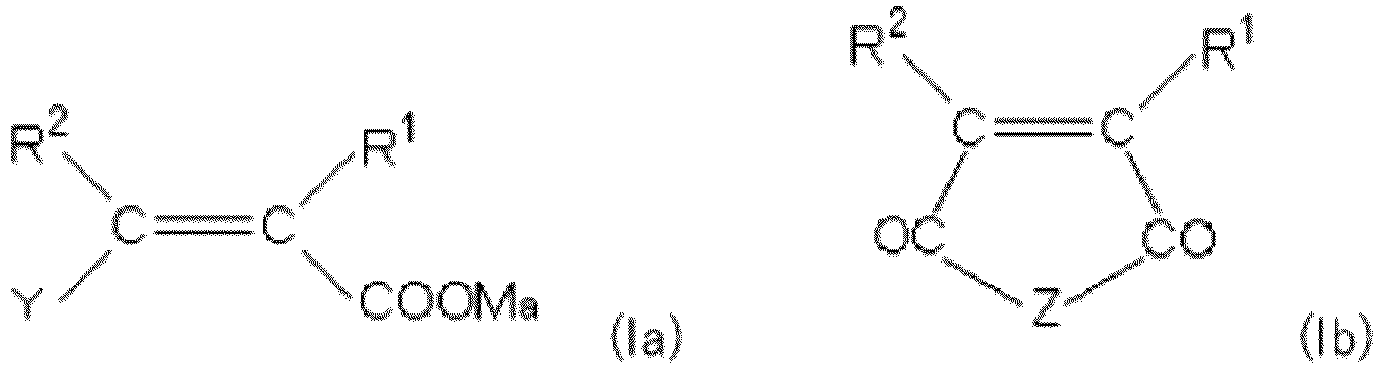 R1 et R2 sont indépendamment l'un de l'autre hydrogène ou un radical hydrocarboné aliphatique possédant 1 à 20 atomes de C,Y est H, -COOMa, -CO-O(CqH2qO)r-R3, ou -CO-NH-(CqH2qO)r-R3,M est hydrogène, un cation métallique monovalent ou divalent, un ion ammonium ou un radical amine organique,a est ½ ou 1,R3 est hydrogène, un radical hydrocarboné aliphatique possédant 1 à 20 atomes de C, un radical hydrocarboné cycloaliphatique possédant 5 à 8 atomes de C, ou un radical aryle éventuellement substitué possédant 6 à 14 atomes de C,q est, indépendamment en chaque occurrence, identique ou différent pour chaque motif (CqH2qO) et est 2, 3 ou 4,r est 0 à 200, etZ est O ou NR3,
 R4 et R5 sont indépendamment l'un de l'autre hydrogène ou un radical hydrocarboné aliphatique possédant 1 à 20 atomes de C, un radical hydrocarboné cycloaliphatique possédant 5 à 8 atomes de C, ou un radical aryle éventuellement substitué possédant 6 à 14 atomes de C,Q est identique ou différent et est également représenté par NH, NR3, ou O ; où R3 possède la définition mentionnée ci-dessus,R6 est identique ou différent et est également représenté par (CnH2n)-SO3H avec n = 0, 1, 2, 3 ou 4, (CnH2n)-OH avec n = 0, 1, 2, 3 ou 4 ; (CnH2n)-PO3H2 avec n = 0, 1, 2, 3 ou 4, (CnH2n)-OPO3H2 avec n = 0, 1, 2, 3 ou 4, (C6H4)-SO3H, (C6H4)-PO3H2, (C6H4)-OPO3H2, et (CnH2n)-NR8 b avec n = 0, 1, 2, 3 ou 4, et b = 2 ou 3,R7 est H, -COOMa, -CO-O(CqH2qO)r-R3, ou -CO-NH-(CqH2qO)r-R3, où Ma, R3, q, et r possèdent des définitions mentionnées ci-dessus,R8 est hydrogène, un radical hydrocarboné aliphatique possédant 1 à 10 atomes de C, un radical hydrocarboné cycloaliphatique possédant 5 à 8 atomes de C, ou un radical aryle éventuellement substitué possédant 6 à 14 atomes de C.
 - Composition pulvérulente selon l'une quelconque des revendications 1 à 4, le monomère éthyléniquement insaturé (II) étant représenté par la formule générale suivante
 p est un entier compris entre 0 et 6,y est 0 ou 1,v est un entier compris entre 3 et 500,w est, indépendamment en chaque occurrence, identique ou différent pour chaque motif (CwH2wO) et est un entier compris entre 2 et 18,T est oxygène ou une liaison chimique,et R1, R2, et R3 possédant la définition mentionnée ci-dessus.
 - Composition pulvérulente selon l'une quelconque des revendications 1 à 5, la fraction du monomère (I) dans le copolymère étant de 5 à 95 % en moles.
- Composition pulvérulente selon l'une quelconque des revendications 1 à 6, la fraction du monomère (II) dans le copolymère étant de 1 à 89 % en moles.
- Composition pulvérulente selon l'une quelconque des revendications 1 à 7, le solvant organique étant au moins l'un de la série formée par l'acétate d'éthyle, l'acétate de n-butyle, l'acétate de 1-méthoxy-2-propyle, l'éthanol, l'isopropanol, le n-butanol, le 2-éthylhexanol, le 1-méthoxy-2-propanol, l'éthylène glycol, le propylène glycol, l'acétone, la butanone, la pentanone, l'hexanone, la méthyléthylcétone, l'acétate d'éthyle, l'acétate de butyle, l'acétate d'amyle, le tétrahydrofuranne, le diéthyléther, le toluène, un xylène, ou des alkylbenzènes dotés d'un point d'ébullition élevé, des éthers de polyéthylèneglycol ou des éthers de polypropylèneglycol ou des copolymères statistiques d'oxyde d'éthylène/oxyde de propylène possédant une masse molaire moyenne de 200 à 2 000 g/mole, le monoéthylèneglycol, le diéthylèneglycol, ou le triéthylèneglycol, le monopropylèneglycol, le dipropylèneglycol, ou le tripropylèneglycol, des éthers de méthyle, d'éthyle, de propyle, de butyle, ou d'alkyle supérieur de polyalkylèneglycol possédant 1, 2, 3 motifs éthylène glycol et/ou propylène glycol ou plus, des éthoxylates de glycérol possédant un poids moléculaire de 200 à 20 000 g/mole, des alcoxylates de pentaérythritol, le carbonate d'éthylène, le carbonate de propylène, le carbonate de glycérol, le formal de glycérol, et le 2,3-O-isopropylidèneglycérol.
- Composition pulvérulente selon l'une quelconque des revendications 1 à 8, l'au moins un copolymère étant présent dans le composant liquide en une fraction d'au moins 50 % en poids sous forme dissoute.
- Composition pulvérulente selon l'une quelconque des revendications 1 à 9, le monomère (I) ou (II) comprenant un copolymère statistique d'oxyde d'éthylène/oxyde de propylène possédant un poids moléculaire de 160 à 10 000 g/mole.
- Composition de liant comprenant une composition pulvérulente selon l'une quelconque des revendications 1 à 10 et un liant inorganique.
- Composition de liant selon la revendication 11, le liant inorganique étant au moins l'un de la série formée par un ciment à base de ciment Portland, un ciment blanc, un ciment d'aluminate de calcium, un ciment de sulfoaluminate de calcium, un n-hydrate de sulfate de calcium, et un liant hydraulique latent et/ou pouzzolanique.
- Procédé pour la production d'une composition de liant selon la revendication 11 ou 12, dans lequel une composition pulvérulente selon l'une quelconque des revendications 1 à 11 est mélangée avec un liant inorganique et éventuellement des additifs supplémentaires.
- Utilisation d'un composant liquide comprenant au moins 30 % en poids d'un solvant organique et au moins 1 % en poids d'un copolymère qui peut être obtenu par polymérisation d'un mélange de monomères comprenant(I) au moins un monomère éthyléniquement insaturé qui comprend au moins un radical de la série acide carboxylique, sel carboxylique, ester carboxylique, amide carboxylique, anhydride carboxylique, et imide carboxylique
et(II) au moins un monomère éthyléniquement insaturé possédant un radical polyalkylène éther,pour le traitement d'une poudre qui ne comprend pas de liant inorganique,
la poudre étant revêtue avec le composant liquide,
pour l'accélération du développement de l'effet dispersant du copolymère dans le temps suivant l'ajout d'eau de mélange, dans laquelle 0,01 à 50 % en poids du composant liquide est utilisé, sur la base de la masse globale de la poudre traitée, et dans laquelle la poudre traitée est éventuellement mélangée avec un liant inorganique avant que l'eau de mélange ne soit ajoutée.
Priority Applications (1)
| Application Number | Priority Date | Filing Date | Title |
|---|---|---|---|
| EP14714626.0A EP2978720B1 (fr) | 2013-03-26 | 2014-03-24 | Composition sous forme de poudre pouvant être rapidement mise en suspension |
Applications Claiming Priority (3)
| Application Number | Priority Date | Filing Date | Title |
|---|---|---|---|
| EP13161133.7A EP2784036A1 (fr) | 2013-03-26 | 2013-03-26 | Composition sous forme de poudre pouvant être rapidement mise en suspension |
| PCT/EP2014/055782 WO2014154601A1 (fr) | 2013-03-26 | 2014-03-24 | Composition pulvérulente à suspension rapide |
| EP14714626.0A EP2978720B1 (fr) | 2013-03-26 | 2014-03-24 | Composition sous forme de poudre pouvant être rapidement mise en suspension |
Publications (2)
| Publication Number | Publication Date |
|---|---|
| EP2978720A1 EP2978720A1 (fr) | 2016-02-03 |
| EP2978720B1 true EP2978720B1 (fr) | 2021-08-18 |
Family
ID=47997142
Family Applications (2)
| Application Number | Title | Priority Date | Filing Date |
|---|---|---|---|
| EP13161133.7A Withdrawn EP2784036A1 (fr) | 2013-03-26 | 2013-03-26 | Composition sous forme de poudre pouvant être rapidement mise en suspension |
| EP14714626.0A Active EP2978720B1 (fr) | 2013-03-26 | 2014-03-24 | Composition sous forme de poudre pouvant être rapidement mise en suspension |
Family Applications Before (1)
| Application Number | Title | Priority Date | Filing Date |
|---|---|---|---|
| EP13161133.7A Withdrawn EP2784036A1 (fr) | 2013-03-26 | 2013-03-26 | Composition sous forme de poudre pouvant être rapidement mise en suspension |
Country Status (6)
| Country | Link |
|---|---|
| US (1) | US10266700B2 (fr) |
| EP (2) | EP2784036A1 (fr) |
| JP (1) | JP6436969B2 (fr) |
| CN (1) | CN105073677B (fr) |
| CA (1) | CA2902267C (fr) |
| WO (1) | WO2014154601A1 (fr) |
Families Citing this family (10)
| Publication number | Priority date | Publication date | Assignee | Title |
|---|---|---|---|---|
| US9890054B2 (en) | 2016-02-04 | 2018-02-13 | Martin Marietta Magnesia Specialties, Llc | Process for producing a stabilized magnesium hydroxide slurry |
| CN104608230A (zh) * | 2015-01-12 | 2015-05-13 | 信阳美丽真好秸秆新材科技有限公司 | 非木质纤维阻燃人造板及其制造方法 |
| CN104552488A (zh) * | 2015-01-12 | 2015-04-29 | 信阳美丽真好秸秆新材科技有限公司 | 阻燃复合板及其制造方法 |
| CN105218803B (zh) * | 2015-09-01 | 2017-03-08 | 南京大学 | 一种连续化合成聚碳酸亚丙酯多元醇的装置及方法 |
| US10759697B1 (en) | 2019-06-11 | 2020-09-01 | MSB Global, Inc. | Curable formulations for structural and non-structural applications |
| EP3835279A1 (fr) * | 2019-12-09 | 2021-06-16 | Hilti Aktiengesellschaft | Mélange de charge pour systèmes de fixation chimiques et leur utilisation |
| CN115190921A (zh) * | 2020-03-06 | 2022-10-14 | 巴斯夫欧洲公司 | 使用聚羧酸化物醚抑制剂的电镀 |
| CN113511866A (zh) * | 2021-08-02 | 2021-10-19 | 四川快马重工机械有限公司 | 一种沥青路面薄层水性修补胶浆及施工工艺 |
| CN114644490B (zh) * | 2022-03-22 | 2023-04-11 | 南京兴佑交通科技有限公司 | 一种道路加固与修复用注浆材料 |
| CN119954466B (zh) * | 2025-02-05 | 2026-04-03 | 广西交科集团有限公司 | 一种道路修复用固废基注浆材料及其制备方法 |
Family Cites Families (31)
| Publication number | Priority date | Publication date | Assignee | Title |
|---|---|---|---|---|
| DE2862369D1 (en) | 1977-07-12 | 1984-03-08 | Ici Plc | Linear or branched ester-ether block copolymers and their use as surfactants either alone or in blends with conventional surfactants |
| DE2948698A1 (de) | 1979-12-04 | 1981-06-11 | Cempro Ag, Vaduz | Hydraulischer estrichmoertel |
| GB8309275D0 (en) | 1983-04-06 | 1983-05-11 | Allied Colloids Ltd | Dissolution of water soluble polymers in water |
| DE3530258A1 (de) | 1985-08-23 | 1987-02-26 | Lentia Gmbh | Verwendung von salzen wasserloeslicher naphtalinsulfonsaeure-formaldehydkondensate als zusatzmittel fuer anorganische bindemittel und baustoff |
| JPS62148352A (ja) * | 1985-12-23 | 1987-07-02 | 藤倉化成株式会社 | 有機溶剤型セメント系下地調整材 |
| EP0287138B1 (fr) * | 1987-03-26 | 1991-08-28 | Akzo N.V. | Noir de carbone conducteur d'électricité et ne donnant pas de poussière, procédé de préparation et compositions synthétiques en contenant |
| JP2669761B2 (ja) * | 1993-02-15 | 1997-10-29 | 電気化学工業株式会社 | 粉状セメント分散剤及びその製造方法 |
| DE19513126A1 (de) | 1995-04-07 | 1996-10-10 | Sueddeutsche Kalkstickstoff | Copolymere auf Basis von Oxyalkylenglykol-Alkenylethern und ungesättigten Dicarbonsäure-Derivaten |
| DE19834173A1 (de) | 1997-08-01 | 1999-02-04 | Sueddeutsche Kalkstickstoff | Copolymere auf Basis von ungesättigten Dicarbonsäure-Derivaten und Oxyalkylenglykol-Alkenylethern |
| DE19914367A1 (de) * | 1998-04-17 | 1999-10-21 | Henkel Kgaa | Wasserbeständige hydraulisch abbindende Zusammensetzungen |
| JP4159678B2 (ja) * | 1998-11-30 | 2008-10-01 | 太平洋セメント株式会社 | 粉末状セメント分散剤及びその製造方法並びにセメント混合物 |
| CA2318090A1 (fr) * | 1998-11-30 | 2000-06-08 | Kenjiro Makino | Procede de production d'un dispersant pour composition hydraulique en poudre |
| DE19905488A1 (de) | 1999-02-10 | 2000-08-17 | Sueddeutsche Kalkstickstoff | Pulverförmige Polymerzusammensetzungen auf der Basis von Polyethercarboxylaten |
| WO2001042162A1 (fr) | 1999-12-10 | 2001-06-14 | Mbt Holding Ag | Demousseurs solubilises pour compositions a base de ciment |
| DE1136508T1 (de) * | 2000-03-22 | 2002-04-18 | Sika Ag, Vormals Kaspar Winkler & Co | Zementmischung mit verlängerter Verarbeitungszeit |
| EP1138696A1 (fr) * | 2000-03-29 | 2001-10-04 | Sika AG, vorm. Kaspar Winkler & Co. | Polymères pour compositions dispersantes pour ciment |
| FR2810261B1 (fr) | 2000-06-15 | 2002-08-30 | Coatex Sa | Utilisation de copolymeres faiblement anioniques comme agent dispersant et/ou d'aide au broyage de suspension aqueuse de matieres minerales, suspensions aqueuses obtenues et leurs utilisations |
| JP4664526B2 (ja) * | 2001-05-23 | 2011-04-06 | 太平洋セメント株式会社 | 粉末状セメント分散剤の製造方法 |
| US6869988B2 (en) * | 2003-04-16 | 2005-03-22 | Arco Chemical Technology, L.P. | Solid supported comb-branched copolymers as an additive for gypsum compositions |
| EP1577327A1 (fr) | 2004-03-19 | 2005-09-21 | Sika Technology AG | Polymère comportant des groupes amide et ester, sa préparation et son utlisation |
| KR20070101224A (ko) | 2004-09-06 | 2007-10-16 | 시카 테크놀러지 아게 | 수경 조성물을 위한 코팅된 기초재료의 제조방법, 수경조성물을 위한 코팅된 기초재료, 수경 조성물용 첨가제 및수경 조성물의 제조방법 |
| DE102005005998A1 (de) | 2005-02-09 | 2006-08-10 | Henkel Kgaa | Verwendung von aliphatischen Kohlenwasserstoffen und Kohlenwasserstoffgemischen in pulverförmigen bauchemischen Produkten |
| JP4579772B2 (ja) * | 2005-06-06 | 2010-11-10 | 太平洋マテリアル株式会社 | セメント混和材及び超速硬セメント |
| DE102006027035A1 (de) | 2005-06-14 | 2007-01-11 | Basf Construction Polymers Gmbh | Polyether-haltiges Copolymer |
| US8349979B2 (en) | 2005-06-14 | 2013-01-08 | Basf Construction Polymers Gmbh | Liquid admixture composition |
| DE602006006825D1 (de) | 2006-08-17 | 2009-06-25 | Rhodia Operations | Blockcopolymere, Verfahren zu deren Herstellung und ihre Verwendung in Emulsionen |
| EP2020422A1 (fr) | 2007-07-31 | 2009-02-04 | Sika Technology AG | Polymères émulsifiants et leur utilisation |
| US7973110B2 (en) | 2008-06-16 | 2011-07-05 | Construction Research & Technology Gmbh | Copolymer synthesis process |
| CN101962273A (zh) | 2010-09-27 | 2011-02-02 | 上海三瑞化学有限公司 | 一种粉状聚羧酸超分散剂的制备方法 |
| CN102329096B (zh) * | 2011-07-05 | 2013-02-06 | 武汉理工大学 | 一种用于混凝土的高早强矿物外加剂 |
| CN102924004A (zh) * | 2012-11-15 | 2013-02-13 | 上海台界化工有限公司 | 一种干粉砂浆的生产方法 |
-
2013
- 2013-03-26 EP EP13161133.7A patent/EP2784036A1/fr not_active Withdrawn
-
2014
- 2014-03-24 JP JP2016504599A patent/JP6436969B2/ja active Active
- 2014-03-24 EP EP14714626.0A patent/EP2978720B1/fr active Active
- 2014-03-24 WO PCT/EP2014/055782 patent/WO2014154601A1/fr not_active Ceased
- 2014-03-24 CA CA2902267A patent/CA2902267C/fr active Active
- 2014-03-24 CN CN201480017978.7A patent/CN105073677B/zh active Active
- 2014-03-24 US US14/762,274 patent/US10266700B2/en active Active
Non-Patent Citations (1)
| Title |
|---|
| None * |
Also Published As
| Publication number | Publication date |
|---|---|
| JP6436969B2 (ja) | 2018-12-12 |
| CN105073677A (zh) | 2015-11-18 |
| JP2016515505A (ja) | 2016-05-30 |
| US20160002472A1 (en) | 2016-01-07 |
| WO2014154601A1 (fr) | 2014-10-02 |
| EP2978720A1 (fr) | 2016-02-03 |
| CN105073677B (zh) | 2019-08-16 |
| CA2902267C (fr) | 2021-03-23 |
| EP2784036A1 (fr) | 2014-10-01 |
| CA2902267A1 (fr) | 2014-10-02 |
| US10266700B2 (en) | 2019-04-23 |
Similar Documents
| Publication | Publication Date | Title |
|---|---|---|
| US10266700B2 (en) | Rapidly suspendable pulverulent composition | |
| JP6029672B2 (ja) | 素早く懸濁可能な粉末状組成物 | |
| US10065891B2 (en) | Polymer having polyether side chains | |
| EP2978725B1 (fr) | Matière pouvant s'écouler sur des suppléments | |
| AU2009335186B2 (en) | Dispersing agent containing copolymer mixture | |
| EP2978719B1 (fr) | Composition pulvérulente pouvant rapidement être mises en suspension | |
| JP2005272173A (ja) | 自己流動性水硬性組成物 |
Legal Events
| Date | Code | Title | Description |
|---|---|---|---|
| PUAI | Public reference made under article 153(3) epc to a published international application that has entered the european phase |
Free format text: ORIGINAL CODE: 0009012 |
|
| 17P | Request for examination filed |
Effective date: 20151026 |
|
| AK | Designated contracting states |
Kind code of ref document: A1 Designated state(s): AL AT BE BG CH CY CZ DE DK EE ES FI FR GB GR HR HU IE IS IT LI LT LU LV MC MK MT NL NO PL PT RO RS SE SI SK SM TR |
|
| AX | Request for extension of the european patent |
Extension state: BA ME |
|
| DAX | Request for extension of the european patent (deleted) | ||
| STAA | Information on the status of an ep patent application or granted ep patent |
Free format text: STATUS: EXAMINATION IS IN PROGRESS |
|
| 17Q | First examination report despatched |
Effective date: 20190716 |
|
| GRAP | Despatch of communication of intention to grant a patent |
Free format text: ORIGINAL CODE: EPIDOSNIGR1 |
|
| STAA | Information on the status of an ep patent application or granted ep patent |
Free format text: STATUS: GRANT OF PATENT IS INTENDED |
|
| INTG | Intention to grant announced |
Effective date: 20210406 |
|
| GRAS | Grant fee paid |
Free format text: ORIGINAL CODE: EPIDOSNIGR3 |
|
| GRAA | (expected) grant |
Free format text: ORIGINAL CODE: 0009210 |
|
| STAA | Information on the status of an ep patent application or granted ep patent |
Free format text: STATUS: THE PATENT HAS BEEN GRANTED |
|
| AK | Designated contracting states |
Kind code of ref document: B1 Designated state(s): AL AT BE BG CH CY CZ DE DK EE ES FI FR GB GR HR HU IE IS IT LI LT LU LV MC MK MT NL NO PL PT RO RS SE SI SK SM TR |
|
| REG | Reference to a national code |
Ref country code: GB Ref legal event code: FG4D |
|
| REG | Reference to a national code |
Ref country code: CH Ref legal event code: EP |
|
| REG | Reference to a national code |
Ref country code: DE Ref legal event code: R096 Ref document number: 602014079515 Country of ref document: DE |
|
| REG | Reference to a national code |
Ref country code: IE Ref legal event code: FG4D Ref country code: AT Ref legal event code: REF Ref document number: 1421503 Country of ref document: AT Kind code of ref document: T Effective date: 20210915 |
|
| REG | Reference to a national code |
Ref country code: LT Ref legal event code: MG9D |
|
| REG | Reference to a national code |
Ref country code: NL Ref legal event code: MP Effective date: 20210818 |
|
| REG | Reference to a national code |
Ref country code: AT Ref legal event code: MK05 Ref document number: 1421503 Country of ref document: AT Kind code of ref document: T Effective date: 20210818 |
|
| PG25 | Lapsed in a contracting state [announced via postgrant information from national office to epo] |
Ref country code: ES Free format text: LAPSE BECAUSE OF FAILURE TO SUBMIT A TRANSLATION OF THE DESCRIPTION OR TO PAY THE FEE WITHIN THE PRESCRIBED TIME-LIMIT Effective date: 20210818 Ref country code: FI Free format text: LAPSE BECAUSE OF FAILURE TO SUBMIT A TRANSLATION OF THE DESCRIPTION OR TO PAY THE FEE WITHIN THE PRESCRIBED TIME-LIMIT Effective date: 20210818 Ref country code: NO Free format text: LAPSE BECAUSE OF FAILURE TO SUBMIT A TRANSLATION OF THE DESCRIPTION OR TO PAY THE FEE WITHIN THE PRESCRIBED TIME-LIMIT Effective date: 20211118 Ref country code: PT Free format text: LAPSE BECAUSE OF FAILURE TO SUBMIT A TRANSLATION OF THE DESCRIPTION OR TO PAY THE FEE WITHIN THE PRESCRIBED TIME-LIMIT Effective date: 20211220 Ref country code: LT Free format text: LAPSE BECAUSE OF FAILURE TO SUBMIT A TRANSLATION OF THE DESCRIPTION OR TO PAY THE FEE WITHIN THE PRESCRIBED TIME-LIMIT Effective date: 20210818 Ref country code: AT Free format text: LAPSE BECAUSE OF FAILURE TO SUBMIT A TRANSLATION OF THE DESCRIPTION OR TO PAY THE FEE WITHIN THE PRESCRIBED TIME-LIMIT Effective date: 20210818 Ref country code: BG Free format text: LAPSE BECAUSE OF FAILURE TO SUBMIT A TRANSLATION OF THE DESCRIPTION OR TO PAY THE FEE WITHIN THE PRESCRIBED TIME-LIMIT Effective date: 20211118 Ref country code: SE Free format text: LAPSE BECAUSE OF FAILURE TO SUBMIT A TRANSLATION OF THE DESCRIPTION OR TO PAY THE FEE WITHIN THE PRESCRIBED TIME-LIMIT Effective date: 20210818 Ref country code: RS Free format text: LAPSE BECAUSE OF FAILURE TO SUBMIT A TRANSLATION OF THE DESCRIPTION OR TO PAY THE FEE WITHIN THE PRESCRIBED TIME-LIMIT Effective date: 20210818 Ref country code: HR Free format text: LAPSE BECAUSE OF FAILURE TO SUBMIT A TRANSLATION OF THE DESCRIPTION OR TO PAY THE FEE WITHIN THE PRESCRIBED TIME-LIMIT Effective date: 20210818 |
|
| PG25 | Lapsed in a contracting state [announced via postgrant information from national office to epo] |
Ref country code: PL Free format text: LAPSE BECAUSE OF FAILURE TO SUBMIT A TRANSLATION OF THE DESCRIPTION OR TO PAY THE FEE WITHIN THE PRESCRIBED TIME-LIMIT Effective date: 20210818 Ref country code: LV Free format text: LAPSE BECAUSE OF FAILURE TO SUBMIT A TRANSLATION OF THE DESCRIPTION OR TO PAY THE FEE WITHIN THE PRESCRIBED TIME-LIMIT Effective date: 20210818 Ref country code: GR Free format text: LAPSE BECAUSE OF FAILURE TO SUBMIT A TRANSLATION OF THE DESCRIPTION OR TO PAY THE FEE WITHIN THE PRESCRIBED TIME-LIMIT Effective date: 20211119 |
|
| PG25 | Lapsed in a contracting state [announced via postgrant information from national office to epo] |
Ref country code: NL Free format text: LAPSE BECAUSE OF FAILURE TO SUBMIT A TRANSLATION OF THE DESCRIPTION OR TO PAY THE FEE WITHIN THE PRESCRIBED TIME-LIMIT Effective date: 20210818 |
|
| PG25 | Lapsed in a contracting state [announced via postgrant information from national office to epo] |
Ref country code: DK Free format text: LAPSE BECAUSE OF FAILURE TO SUBMIT A TRANSLATION OF THE DESCRIPTION OR TO PAY THE FEE WITHIN THE PRESCRIBED TIME-LIMIT Effective date: 20210818 |
|
| REG | Reference to a national code |
Ref country code: DE Ref legal event code: R097 Ref document number: 602014079515 Country of ref document: DE |
|
| PG25 | Lapsed in a contracting state [announced via postgrant information from national office to epo] |
Ref country code: SM Free format text: LAPSE BECAUSE OF FAILURE TO SUBMIT A TRANSLATION OF THE DESCRIPTION OR TO PAY THE FEE WITHIN THE PRESCRIBED TIME-LIMIT Effective date: 20210818 Ref country code: SK Free format text: LAPSE BECAUSE OF FAILURE TO SUBMIT A TRANSLATION OF THE DESCRIPTION OR TO PAY THE FEE WITHIN THE PRESCRIBED TIME-LIMIT Effective date: 20210818 Ref country code: RO Free format text: LAPSE BECAUSE OF FAILURE TO SUBMIT A TRANSLATION OF THE DESCRIPTION OR TO PAY THE FEE WITHIN THE PRESCRIBED TIME-LIMIT Effective date: 20210818 Ref country code: EE Free format text: LAPSE BECAUSE OF FAILURE TO SUBMIT A TRANSLATION OF THE DESCRIPTION OR TO PAY THE FEE WITHIN THE PRESCRIBED TIME-LIMIT Effective date: 20210818 Ref country code: CZ Free format text: LAPSE BECAUSE OF FAILURE TO SUBMIT A TRANSLATION OF THE DESCRIPTION OR TO PAY THE FEE WITHIN THE PRESCRIBED TIME-LIMIT Effective date: 20210818 Ref country code: AL Free format text: LAPSE BECAUSE OF FAILURE TO SUBMIT A TRANSLATION OF THE DESCRIPTION OR TO PAY THE FEE WITHIN THE PRESCRIBED TIME-LIMIT Effective date: 20210818 |
|
| PLBE | No opposition filed within time limit |
Free format text: ORIGINAL CODE: 0009261 |
|
| STAA | Information on the status of an ep patent application or granted ep patent |
Free format text: STATUS: NO OPPOSITION FILED WITHIN TIME LIMIT |
|
| 26N | No opposition filed |
Effective date: 20220519 |
|
| PG25 | Lapsed in a contracting state [announced via postgrant information from national office to epo] |
Ref country code: SI Free format text: LAPSE BECAUSE OF FAILURE TO SUBMIT A TRANSLATION OF THE DESCRIPTION OR TO PAY THE FEE WITHIN THE PRESCRIBED TIME-LIMIT Effective date: 20210818 |
|
| PG25 | Lapsed in a contracting state [announced via postgrant information from national office to epo] |
Ref country code: MC Free format text: LAPSE BECAUSE OF FAILURE TO SUBMIT A TRANSLATION OF THE DESCRIPTION OR TO PAY THE FEE WITHIN THE PRESCRIBED TIME-LIMIT Effective date: 20210818 |
|
| GBPC | Gb: european patent ceased through non-payment of renewal fee |
Effective date: 20220324 |
|
| REG | Reference to a national code |
Ref country code: BE Ref legal event code: MM Effective date: 20220331 |
|
| PG25 | Lapsed in a contracting state [announced via postgrant information from national office to epo] |
Ref country code: LU Free format text: LAPSE BECAUSE OF NON-PAYMENT OF DUE FEES Effective date: 20220324 Ref country code: IE Free format text: LAPSE BECAUSE OF NON-PAYMENT OF DUE FEES Effective date: 20220324 Ref country code: GB Free format text: LAPSE BECAUSE OF NON-PAYMENT OF DUE FEES Effective date: 20220324 |
|
| PG25 | Lapsed in a contracting state [announced via postgrant information from national office to epo] |
Ref country code: BE Free format text: LAPSE BECAUSE OF NON-PAYMENT OF DUE FEES Effective date: 20220331 |
|
| PG25 | Lapsed in a contracting state [announced via postgrant information from national office to epo] |
Ref country code: HU Free format text: LAPSE BECAUSE OF FAILURE TO SUBMIT A TRANSLATION OF THE DESCRIPTION OR TO PAY THE FEE WITHIN THE PRESCRIBED TIME-LIMIT; INVALID AB INITIO Effective date: 20140324 |
|
| PG25 | Lapsed in a contracting state [announced via postgrant information from national office to epo] |
Ref country code: MK Free format text: LAPSE BECAUSE OF FAILURE TO SUBMIT A TRANSLATION OF THE DESCRIPTION OR TO PAY THE FEE WITHIN THE PRESCRIBED TIME-LIMIT Effective date: 20210818 Ref country code: CY Free format text: LAPSE BECAUSE OF FAILURE TO SUBMIT A TRANSLATION OF THE DESCRIPTION OR TO PAY THE FEE WITHIN THE PRESCRIBED TIME-LIMIT Effective date: 20210818 |
|
| PG25 | Lapsed in a contracting state [announced via postgrant information from national office to epo] |
Ref country code: MT Free format text: LAPSE BECAUSE OF FAILURE TO SUBMIT A TRANSLATION OF THE DESCRIPTION OR TO PAY THE FEE WITHIN THE PRESCRIBED TIME-LIMIT Effective date: 20210818 |
|
| PGFP | Annual fee paid to national office [announced via postgrant information from national office to epo] |
Ref country code: CH Payment date: 20250401 Year of fee payment: 12 |
|
| PG25 | Lapsed in a contracting state [announced via postgrant information from national office to epo] |
Ref country code: TR Free format text: LAPSE BECAUSE OF FAILURE TO SUBMIT A TRANSLATION OF THE DESCRIPTION OR TO PAY THE FEE WITHIN THE PRESCRIBED TIME-LIMIT Effective date: 20210818 |
|
| REG | Reference to a national code |
Ref country code: CH Ref legal event code: U11 Free format text: ST27 STATUS EVENT CODE: U-0-0-U10-U11 (AS PROVIDED BY THE NATIONAL OFFICE) Effective date: 20260401 |
|
| PGFP | Annual fee paid to national office [announced via postgrant information from national office to epo] |
Ref country code: DE Payment date: 20260320 Year of fee payment: 13 |
|
| PGFP | Annual fee paid to national office [announced via postgrant information from national office to epo] |
Ref country code: IT Payment date: 20260320 Year of fee payment: 13 |
|
| PGFP | Annual fee paid to national office [announced via postgrant information from national office to epo] |
Ref country code: FR Payment date: 20260323 Year of fee payment: 13 |