EP2979392B1 - Procédé question-réponse, et dispositif client associé - Google Patents
Procédé question-réponse, et dispositif client associé Download PDFInfo
- Publication number
- EP2979392B1 EP2979392B1 EP13880463.8A EP13880463A EP2979392B1 EP 2979392 B1 EP2979392 B1 EP 2979392B1 EP 13880463 A EP13880463 A EP 13880463A EP 2979392 B1 EP2979392 B1 EP 2979392B1
- Authority
- EP
- European Patent Office
- Prior art keywords
- nonce
- audio content
- challenge
- module
- client device
- Prior art date
- Legal status (The legal status is an assumption and is not a legal conclusion. Google has not performed a legal analysis and makes no representation as to the accuracy of the status listed.)
- Active
Links
Images

Classifications
-
- H—ELECTRICITY
- H04—ELECTRIC COMMUNICATION TECHNIQUE
- H04L—TRANSMISSION OF DIGITAL INFORMATION, e.g. TELEGRAPHIC COMMUNICATION
- H04L9/00—Cryptographic mechanisms or cryptographic arrangements for secret or secure communications; Network security protocols
- H04L9/32—Cryptographic mechanisms or cryptographic arrangements for secret or secure communications; Network security protocols including means for verifying the identity or authority of a user of the system or for message authentication, e.g. authorization, entity authentication, data integrity or data verification, non-repudiation, key authentication or verification of credentials
- H04L9/3271—Cryptographic mechanisms or cryptographic arrangements for secret or secure communications; Network security protocols including means for verifying the identity or authority of a user of the system or for message authentication, e.g. authorization, entity authentication, data integrity or data verification, non-repudiation, key authentication or verification of credentials using challenge-response
-
- H—ELECTRICITY
- H04—ELECTRIC COMMUNICATION TECHNIQUE
- H04L—TRANSMISSION OF DIGITAL INFORMATION, e.g. TELEGRAPHIC COMMUNICATION
- H04L9/00—Cryptographic mechanisms or cryptographic arrangements for secret or secure communications; Network security protocols
- H04L9/08—Key distribution or management, e.g. generation, sharing or updating, of cryptographic keys or passwords
- H04L9/0816—Key establishment, i.e. cryptographic processes or cryptographic protocols whereby a shared secret becomes available to two or more parties, for subsequent use
-
- H—ELECTRICITY
- H04—ELECTRIC COMMUNICATION TECHNIQUE
- H04L—TRANSMISSION OF DIGITAL INFORMATION, e.g. TELEGRAPHIC COMMUNICATION
- H04L2209/00—Additional information or applications relating to cryptographic mechanisms or cryptographic arrangements for secret or secure communication H04L9/00
- H04L2209/24—Key scheduling, i.e. generating round keys or sub-keys for block encryption
-
- H—ELECTRICITY
- H04—ELECTRIC COMMUNICATION TECHNIQUE
- H04L—TRANSMISSION OF DIGITAL INFORMATION, e.g. TELEGRAPHIC COMMUNICATION
- H04L2209/00—Additional information or applications relating to cryptographic mechanisms or cryptographic arrangements for secret or secure communication H04L9/00
- H04L2209/60—Digital content management, e.g. content distribution
-
- H—ELECTRICITY
- H04—ELECTRIC COMMUNICATION TECHNIQUE
- H04L—TRANSMISSION OF DIGITAL INFORMATION, e.g. TELEGRAPHIC COMMUNICATION
- H04L2209/00—Additional information or applications relating to cryptographic mechanisms or cryptographic arrangements for secret or secure communication H04L9/00
- H04L2209/60—Digital content management, e.g. content distribution
- H04L2209/603—Digital right managament [DRM]
Definitions
- the present invention relates to a challenge-response method for a client device, and a client device for implementing a challenge-response method.
- the challenge-response method of the present invention may be used in node locking (i.e. hardware anchoring) applications for client devices.
- Application software also known as an application or an app, is computer software designed to help the user to perform specific tasks. Examples include enterprise software, accounting software, office suites, graphics software and media players.
- the abbreviation "app” has specifically come to mean application software written for mobile devices.
- Application software applies the power of a particular computing platform or system software to a particular purpose. In other words, applications make use of the operation system of a computing device to gain access to the hardware resources. Applications also require access to a graphics environment for interaction with the end user.
- These software applications (often called native applications) use a hardware execution engine such as a Central Processing Unit (CPU).
- CPU Central Processing Unit
- An application's dependency upon existing resources in a specific computing device means that the software provider may need to provide different versions of the application for execution on different device platforms.
- a virtual machine execution model enables a software provider to distribute a single application for execution on multiple different device platforms.
- Scripting languages in combination with a graphics environment are an alternative for a virtual machine execution model, providing similar multi-platform benefits. This approach has been adopted for web applications and in the HTML-5 W3C recommendation.
- node locking (or “hardware anchoring”) technologies provide a software application with a hardware dependent function for integration into its execution path (see, for example EP2506174 and EP2506175 ). This provides a mechanism to lock the execution of the application to a specific end user device.
- the node locking function also enables an application to generate a message demonstrating that the application is operating on a particular end user device. This can be used for authentication purposes.
- These node locking applications describe a challenge-response function that is specific for a particular hardware circuit.
- a challenge-response methodology generally relies on a secret in a hardware device. Knowledge of the secret enables the generation of challenge-response pairs which enable an application to verify that the application is executing on the intended platform.
- EP2506174 and EP2506175 describe systems and methods for using a node locking function (a challenge-response function) in combination with secured software applications.
- EP2506175 achieves this by leveraging a specific function of a standard Subscriber Identity Module (SIM), e.g. in a mobile telephone.
- SIM Subscriber Identity Module
- the Operating System generally does not expose the SIM functionality to applications executing on the device, the SIM locking mechanism of EP2506175 requires modifications to the Operating System of the device.
- this challenge-response solution is undesirable in some circumstances.
- EP2506174 requires specific hardware features in a device, which makes this challenge-response solution unsuitable for use with an existing device infrastructure.
- the present invention seeks to provide a challenge-response technique which overcomes some of the problems with existing solutions.
- US 7,111,167 B1 involves receiving remotely originating data (ROD) and creating a customized identification (CID) which is at least partially created through encrypting the ROD as a function of a platform key (PK) and a random number (RN) of a computer system receiving the ROD. Further, content is received which includes at least one watermark in which at least part of the CID is embedded. Authentication comparison data (ACD) is created which is at least partially created through decrypting data embedded in the watermark.
- ROD remotely originating data
- CID customized identification
- PK platform key
- RN random number
- a challenge-response method for a client device.
- the method comprises steps of: (a) receiving challenge data, wherein the challenge data is audio content encrypted using an encryption key, the audio content including a nonce; (b) using a secured module of the client device to access the audio content by decrypting the challenge data using a decryption key of the secured module, the decryption key corresponding to the encryption key; (c) using the secured module to output an audible version of the audio content via a speaker of the client device; (d) receiving the audible version of the audio content using a microphone of the client device; (e) processing the audible version of the audio content received by the microphone so as to obtain the nonce; and (f) providing the nonce as a response.
- the nonce may be encoded with an error correcting code, and the processing step further comprises decoding the error correction encoded nonce.
- the nonce may be included in the audio content as a digital watermark.
- the nonce may be included in the audio content using a modulation encoding technique.
- the decryption key is unique to the secured module.
- a client device for implementing a challenge-response method.
- the client device comprises an input module, a secured module, a speaker, a microphone, a processor, and an output module.
- the input module is for receiving challenge data.
- the challenge data is audio content encrypted using an encryption key.
- the audio content includes a nonce.
- the secured module is arranged to access the audio content by decrypting the challenge data using a decryption key of the secured module.
- the decryption key corresponds to the encryption key.
- the speaker is arranged to provide an audible version of the audio content output by the secured module.
- the microphone is arranged to receive the audible version of the audio content.
- the processor is arranged to process the audible version of the audio content received by the microphone so as to obtain the nonce.
- the output module is arranged to provide the nonce as a response.
- the nonce is encoded with an error correcting code
- the processor comprises an error correction module arranged to decode the error correction encoded nonce.
- the input module forms part of the secured module such that the secured module is itself operable to receive the challenge data.
- a computer program which, when executed by a processor, causes the processor to carry out a method according to the first aspect.
- a computer readable medium storing a computer program according to the third aspect.
- a protected content file comprises an encrypted content part and a usage rules part.
- the client DRM system first processes the usage rules to generate a content decryption key that is used to decrypt the content part.
- the usage rules part typically includes encrypted elements.
- the DRM implementation in the end user device is implemented in a tamper resistant way, in order to defend against attacks against the implementation.
- DRM Systems are generally used by movie and music rights holders in order to protect their video and audio content against unauthorised distribution.
- DRM systems that have been integrated for use in different end user devices (such as tablets, music players, mobile phones, game consoles, and even PCs).
- These DRM systems are typically implemented in a tamper resistant manner, making it difficult for an attacker to obtain the sensitive information needed to strip the DRM protection or to emulate the DRM client implementation.
- the present invention relates to a DRM implementation of a challenge-response node locking function in a client device (i.e. an end user device).
- the "challenge" is DRM protected content which includes a nonce.
- a client device is able to use its own DRM system to extract the nonce from the challenge so as to provide the nonce as a response.
- the challenge data could be any content encrypted using an encryption key, the content including a nonce.
- the challenge data is DRM protected audio content (e.g. a DRM protected audio file, or streamed DRM protected audio content).
- the generation of the DRM protected audio content is shown schematically in Figure 1 .
- the system 10 of Figure 1 includes a random number generator 12, an error protection module 14, an audio data insertion module 16 and a secured DRM module 18.
- the random number generator 12 (which may be a pseudo-random number generator) is operable (or arranged) to generate a nonce. It should be noted that, for some applications, the nonce may contain non-random information.
- the error protection module 14 is operable to encode the nonce with an error correcting code (ECC) in order to protect against data distortions in the nonce recovery process.
- ECC error correcting code
- the error protection module 14 is used to add redundancy to the nonce such that the nonce may be recovered by the client device even in cases of incomplete data transmission, for example. Whilst it is advantageous to add error protection to the nonce, it is not essential. Thus, the error protection module 14 is an optional element of the system.
- Audio content e.g. an audio file
- the ECC protected nonce are provided as inputs to the audio data insertion module 16.
- the audio data insertion module 16 is operable to insert the ECC protected nonce into the audio content.
- the ECC protected nonce may be embedded into the audio content.
- the ECC protected nonce may be added as an audio watermark to the audio content (NB a video watermark could be used for video content).
- the ECC protected nonce is included in the content using a modulation encoding technique.
- the ECC protected nonce may be encoded/embedded using audio frequency-shift keying (AFSK) or similar modulation encoding formats. Embedding the ECC protected nonce as an audio watermark produces a more pleasant audio output than embedding using AFSK or the like, but may need a longer audio fragment to embed the ECC protected nonce.
- the output of the audio data insertion module 16 is plaintext/cleartext (i.e. non-encrypted) audio content (i.e. a plaintext audio file).
- the secured DRM module 18 is operable to generate a DRM protected version of the audio content for a particular client device having a particular "DRM client ID".
- the "DRM client ID" is associated with a secured DRM module of the particular client device.
- the secured DRM module 18 of Figure 1 is operable to process the plaintext audio content using the DRM client ID so as to generate a DRM protected version of the audio content that is suitable for playback on the identified client device.
- the secured DRM module 18 achieves this using encryption based on one or more encryption keys for the identified client device (i.e. keys associated with the secured DRM module of the client device).
- the encryption keys and encryption algorithms are known to the DRM system only.
- the encryption keys may be known only to the secured DRM module 18, and the corresponding decryption keys may be known only to the secured DRM module of the particular client device. It will be understood that there are many cryptographic techniques suitable for use in such a DRM system, and these will not be further described here.
- the DRM protected audio content 20 is output by the secured DRM module 18.
- FIG. 2 schematically illustrates a client device 30 for implementing the present challenge-response methodology.
- the client device 30 may be a mobile phone or a tablet computer, for example.
- the client device 30 includes an input module 32, a secured DRM module 34, an audio decoder 36, a speaker 38, a microphone 40, an audio recorder 42, a processor 44, and an output module 48. Together, these elements of the client device 30 perform the node locking function (schematically shown by the dashed line 52 in Figure 2 ).
- the client device may include other modules/elements relating to other functionality of the client device 30. Some modules/elements (including some of those shown in Figure 2 ) may be shared by multiple functional blocks of the client device 30. Therefore, Figure 2 is only a schematic depiction of some elements of the client device 30.
- the DRM protected audio content 20 output by the secured DRM module 18 of Figure 1 forms the "challenge" (or challenge data) in the present challenge-response methodology.
- the input module 32 is operable to receive the challenge data 20 and to pass it to the secured DRM module 34 of the client device 30.
- the input module 32 may send the challenge data with a rendering request to the secured DRM module 34.
- a secured DRM module API (not shown) may be used to activate the secured DRM module 34.
- the input module 32 may be separate from the secured DRM module 34 (as shown schematically in Figure 2 ), or may form part of the secured DRM module 34 such that the secured DRM module 34 itself receives the challenge data 20.
- the secured DRM module 34 is operable to decrypt the challenge data 20 using a decryption key of the secured DRM module 34.
- the secured DRM module parses the DRM encoded usage rules associated with the DRM protected audio content 20, and then decrypts the DRM protected audio content 20 in accordance with these rules.
- the decryption key is a private key of the secured DRM module 34 and the encryption key is a public key of the secured DRM module 34.
- the decryption key is the same as the encryption key, the encryption key being a symmetric secret key shared by both the secured DRM module 34 of the client device and the secured DRM module 18 used to encrypt the audio content to form the challenge data 20.
- the decrypted audio content is transferred to the audio decoder 36 using a secured data channel.
- a secured data channel is advantageous since it prevents other applications from accessing the decrypted audio content.
- the audio decoder 36 produces an audible output using the speaker 38 of the client device 30.
- the secured DRM module effectively outputs an audible version of the audio content by means of the audio decoder 36 and the speaker 38.
- the microphone 40 of the client device 30 is operable to receive the audible version of the audio content output by the speaker 38.
- the audio recorder 42 is operable to record the sound captured by the microphone 40 so as to provide a recording of the audio content.
- Such a recording of the audio content will be imperfect such that the recording is a modified version of the original audio content (as output by the audio decoder 36 and the speaker 38).
- the quality of the speaker 38 and the microphone 40 will affect the recording (particularly in certain frequency bands).
- the recording will also capture environmental noise.
- the audible version of the audio content received by the microphone 40 (and recorded by the audio recorder 42) will generally be slightly different from the audible version of the audio content output by the speaker 38.
- the processor 44 is operable to process the recording to obtain the nonce.
- the processor includes an audio data extraction module 45 and an error correction module 46.
- the audio data extraction module 45 is operable to access the recording of the audio content made by the audio recorder 42.
- the audio data extraction module 45 is further operable to recover the ECC protected nonce from the recording using signal processing techniques.
- the audio data extraction module 45 is operable to use signal processing techniques to extract the nonce from the version of the audio content received by the microphone 40.
- the signal processing techniques used by the audio data extraction module 45 will depend on the way in which the nonce has been included in the audio content (e.g. as an audio watermark or using a modulation encoding technique). Such techniques will be familiar to a person skilled in the art.
- the embodiment of the invention shown in Figure 2 is one example of an embodiment in which the decrypted content is obtained by capturing an analogue output (i.e. by recording the playback of an audio file) and processing the captured analogue output of the content to extract an embedded data signal.
- the audio data extraction module 45 passes the ECC protected nonce to the error correction module 46.
- the error correction module 46 is operable to decode the ECC protected nonce to provide the original nonce.
- the error correction module 46 is an optional element of the system. It is not required if the nonce does not have added redundancy for error protection purposes.
- the output module 48 is operable to receive the nonce from the error correction module 46 of the processor 44 and to provide the nonce as an output of the node locking function 52.
- the nonce may be considered as the "response" in the present challenge-response methodology.
- the DRM protected audio content 20 is used in the client device 30 as a challenge input to a node locking function 52 in order to obtain a response 50.
- the response 50 should be equal to the nonce (see above) and will only be obtainable by the particular client device 30 containing the particular secured DRM module 34 having the relevant decryption keys.
- the decryption key used will be unique to (i.e. known only to) the particular secured DRM module 34 such that all other client secured DRM modules are unable to decrypt the challenge data 20.
- the decryption key used will be unique to (i.e. known only to) a group of client secured DRM modules such that only secured DRM modules in the group are able to decrypt the challenge data 20 and secured DRM modules not in the group are unable to decrypt the challenge data 20.
- the present DRM-based challenge-response methodology may be used for node locking in software applications.
- the methodology described above with respect to Figures 1 and 2 provides a node-locking technique for software applications that plays a short DRM protected audio fragment (i.e. the challenge) containing an identifying data pattern (or nonce), records the rendered audio, processes the recorded audio content stream to extract the identifying pattern (i.e. the response), and uses it in further calculations.
- the DRM protected file is configured for a specific end-user device, the audio file cannot be played on other end-user devices.
- the hardware based implementation of the DRM client thus links the identifying pattern (or nonce) to the specific end-user device.
- This node-locking function is available to native applications.
- the increasing support for audio input in web browsers e.g. the Android 3.0 browser
- the widely available browser support for playback of (DRM protected) audio files enable the invention to provide node-locking functions for web applications.
- a software application may contain some personalization data which includes the DRM protected audio content that is targeted for a specific end-user device 30.
- the DRM protected audio content can be seen as a challenge 20.
- the application presents this challenge 20 to a DRM-protected audio playback module (i.e. the node locking function of Figure 2 ) and obtains the corresponding response 50 from the signal processing of the recording of the rendered audio content, as described above.
- the application may have several challenges 20 stored in the personalization data so as to avoid replay attacks.
- a reply attack involves successfully executing the personalized application on an end-user device other than the intended end user device 30 (i.e. other than the device for which the application has been personalized).
- Preventing replay attacks may also be achieved by setting appropriate usage rules for the DRM protected audio content (e.g. play once).
- the present DRM-based challenge-response methodology may be used for authentication of client devices in software applications such as web applications.
- the web application executing on a client device 30 receives the challenge 20 (i.e. the DRM protected audio content) from a remote web server 10, which is used to generate the challenge 20.
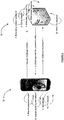
- This authentication implementation is schematically illustrated by means of sequential steps 1 to 12 in Figure 3 .
- the client device 30 shown in Figure 3 is a mobile phone.
- step 1 the application (executing on the mobile phone 30) sends a request for a challenge.
- This request includes the DRM identity of the mobile phone (i.e. the request includes DRM client ID of the secured DRM module 34 of the mobile phone).
- step 2 the server 10 generates a (random) number (i.e. a nonce) using a random number generator 12.
- step 3 the server 10 optionally adds error protection to the nonce using an error protection module 14.
- an audio data insertion module 16 of the server 10 embeds the (error-protected) nonce into some audio content. As previously described, this may be done using AFSK modulation or audio watermarking, for example.
- a secured DRM module 18 of the server 10 DRM protects the audio content.
- the server 10 may request an external DRM server system to DRM protect the generated audio content.
- the DRM protected audio content forms the challenge 20.
- step 6 the server 10 sends the challenge to the web application executing on the mobile phone 30, as requested in step 1.
- step 7 the application receives and decrypts the challenge (using the input module 32 and the secured DRM module 34 respectively) before playing the DRM protected audio content using the audio decoder 36 and the speaker 38 of the mobile phone 30.
- step 8 the mobile phone uses a microphone 40 to record the sound during playback.
- step 9 the recording is demodulated using an audio data extraction module 45 in the processor 44 of the mobile phone 30 so as to obtain the ECC protected nonce.
- an error correction module 46 in the processor 44 of the mobile phone 30 is used to obtain the nonce from the ECC protected nonce.
- the processor 44 is used in steps 9 and 10 to signal process the recording to obtain the nonce.
- the nonce is output by the output module 48 as a response (50, R').
- the response is returned sent to the server 10 to demonstrate that the application is executing on the intended platform 30. This approach can be used for authentication.
- the response may be used by the client device in the execution of the application.
- the response may be used within the application to at least partially enable the continued execution of the application on the end user device 30.
- the described challenge-response methodology aims to prevent the execution of copies of secured applications on another client device (i.e. a client device other than that for which the secured application is intended).
- This present methodology achieves this for a fairly broad range of existing devices and for a broad range of applications (native code, virtual machine code, scripts, web applications, etc.).
- multi-factor authentication requires that a user (i.e. a particular client device) has multiple methods of validating themselves to a server.
- An example of this is the RSA SecurlD authentication mechanism that makes use of a "token” - either hardware (e.g. a USB dongle) or software (a soft token) - which is assigned to a computer user and which generates an authentication code at fixed intervals (usually 60 seconds) using a built-in clock and the card's factory-encoded random key (known as the "seed").
- the seed is different for each token, and is loaded into the corresponding RSA SecurlD server as the tokens are purchased.
- a user When using the RSA SecurlD authentication mechanism, a user generally requires both a password and the authentication code generated by the token in order to log into a website, for example.
- the authentication code provides the server with proof that the user is in possession of the RSA token.
- the secured DRM module 34 in the client device 30 may be used to replace the RSA token as the physical factor of authentication.
- Another application of the present methodology concerns authentication of a client device by software running on the device, as described above.
- a software application can check if it is running on a device for which it is authorised to run by executing the steps outlined above. This could be used for several applications including software copy protection or protection of sensitive data or software.
- the entire program and data may be stored in an encrypted form. Then, on start up, the application can execute the present challenge-response methodology, and if the correct response is returned then the rest of the software can be unlocked.
- the software can perform the present challenge-response methodology, and then the software may only continue to execute if the appropriate response is returned. This enables the software to verify that it is executing on the allowed device.
- embodiments of the invention may be implemented using a variety of different information processing systems.
- the figures and the discussion thereof provide an exemplary computing system and methods, these are presented merely to provide a useful reference in discussing various aspects of the invention.
- Embodiments of the invention may be carried out on any suitable data processing device, such as a personal computer, laptop, personal digital assistant, mobile telephone, set top box, television, server computer, etc.
- any suitable data processing device such as a personal computer, laptop, personal digital assistant, mobile telephone, set top box, television, server computer, etc.
- the description of the systems and methods has been simplified for purposes of discussion, and they are just one of many different types of system and method that may be used for embodiments of the invention.
- the boundaries between logic blocks e.g. the input module 32 and the secured module 34
- alternative embodiments may merge logic blocks or elements, or may impose an alternate decomposition of functionality upon various logic blocks or elements.
- the above-mentioned functionality may be implemented as one or more corresponding modules as hardware and/or software.
- the above-mentioned functionality may be implemented as one or more software components for execution by a processor of the system.
- the above-mentioned functionality may be implemented as hardware, such as on one or more field-programmable-gate-arrays (FPGAs), and/or one or more application-specific-integrated-circuits (ASICs), and/or one or more digital-signal-processors (DSPs), and/or other hardware arrangements.
- FPGAs field-programmable-gate-arrays
- ASICs application-specific-integrated-circuits
- DSPs digital-signal-processors
- the computer program may have one or more program instructions, or program code, which, when executed by a computer carries out an embodiment of the invention.
- program may be a sequence of instructions designed for execution on a computer system, and may include a subroutine, a function, a procedure, a module, an object method, an object implementation, an executable application, an applet, a servlet, source code, object code, a shared library, a dynamic linked library, and/or other sequences of instructions designed for execution on a computer system.
- the storage medium may be a magnetic disc (such as a hard drive or a floppy disc), an optical disc (such as a CD-ROM, a DVD-ROM or a BluRay disc), or a memory (such as a ROM, a RAM, EEPROM, EPROM, Flash memory or a portable/removable memory device), etc.
- the transmission medium may be a communications signal, a data broadcast, a communications link between two or more computers, etc.
Landscapes
- Engineering & Computer Science (AREA)
- Computer Security & Cryptography (AREA)
- Computer Networks & Wireless Communication (AREA)
- Signal Processing (AREA)
- Storage Device Security (AREA)
Claims (10)
- Procédé de défi-réponse pour un dispositif client (30), le procédé comprenant les étapes consistant à :recevoir des données de défi (20), où les données de défi est un contenu audio crypté en utilisant une clé de cryptage, le contenu audio comportant un nonce ;utiliser un module sécurisé (34) du dispositif client pour accéder au contenu audio en décryptant les données de défi en utilisant une clé de décryptage du module sécurisé, la clé de décryptage correspondant à la clé de cryptage ;utiliser le module sécurisé pour délivrer en sortie une version audible du contenu audio par l'intermédiaire d'un haut-parleur (38) du dispositif client ;recevoir la version audible du contenu audio en utilisant un microphone (40) du dispositif client :traiter la version audible du contenu audio reçue par le microphone afin d'obtenir le nonce ; etfournir le nonce en tant que réponse (50).
- Procédé de défi-réponse de la revendication 1, dans lequel le nonce est codé avec un code de correction d'erreur, et l'étape de traitement comprend en outre le décodage du nonce codé par correction d'erreur.
- Procédé de défi-réponse de la revendication 1 ou 2, dans lequel le nonce est inclus dans le contenu audio en tant que filigrane numérique.
- Procédé de défi-réponse de la revendication 1 ou 2, dans lequel le nonce est inclus dans le contenu audio en utilisant une technique de codage par modulation.
- Procédé de défi-réponse de l'une des revendications précédentes, dans lequel la clé de cryptage est unique pour le module sécurisé.
- Dispositif client (30) pour la mise en oeuvre d'un procédé de défi-réponse, le dispositif client comprenant :un module d'entrée (32) destiné à recevoir des données de défi (20), où les données de défi sont un contenu audio crypté en utilisant une clé de cryptage, le contenu audio comportant un nonce ;un module sécurisé (34) agencé pour accéder au contenu audio en décryptant les données de défi en utilisant une clé de décryptage du module sécurisé, la clé de décryptage correspondant à la clé de cryptage ;un haut-parleur (38) agencé pour fournir une version audible du contenu audio délivrée en sortie par le module sécurisé ; etun microphone (40) agencé pour recevoir la version audible du contenu audio ;un processeur (44) agencé pour traiter la version audible du contenu audio reçue par le microphone de manière à obtenir le nonce ; etun module de sortie (48) agencé pour fournir le nonce en tant que réponse (50).
- Dispositif client de la revendication 6, dans lequel le nonce est codé avec un code de correction d'erreur, et dans lequel le processeur comprend un module de correction d'erreur (46) agencé pour décoder le nonce codé par correction d'erreur.
- Dispositif client de la revendication 6 ou 7, dans lequel le module d'entrée fait partie du module sécurisé de sorte que le module sécurisé puisse lui-même fonctionner pour recevoir les données de défi.
- Programme informatique qui, lorsqu'il est exécuté par un processeur, amène le processeur à mettre en oeuvre un procédé selon l'une quelconque des revendications 1 à 5.
- Support lisible par ordinateur stockant un programme informatique selon la revendication 9.
Applications Claiming Priority (1)
| Application Number | Priority Date | Filing Date | Title |
|---|---|---|---|
| PCT/CN2013/073241 WO2014153728A1 (fr) | 2013-03-27 | 2013-03-27 | Procédé question-réponse, et dispositif client associé |
Publications (3)
| Publication Number | Publication Date |
|---|---|
| EP2979392A1 EP2979392A1 (fr) | 2016-02-03 |
| EP2979392A4 EP2979392A4 (fr) | 2016-11-23 |
| EP2979392B1 true EP2979392B1 (fr) | 2019-08-14 |
Family
ID=51622366
Family Applications (1)
| Application Number | Title | Priority Date | Filing Date |
|---|---|---|---|
| EP13880463.8A Active EP2979392B1 (fr) | 2013-03-27 | 2013-03-27 | Procédé question-réponse, et dispositif client associé |
Country Status (4)
| Country | Link |
|---|---|
| US (1) | US9787479B2 (fr) |
| EP (1) | EP2979392B1 (fr) |
| CN (1) | CN105075176B (fr) |
| WO (1) | WO2014153728A1 (fr) |
Families Citing this family (9)
| Publication number | Priority date | Publication date | Assignee | Title |
|---|---|---|---|---|
| EP3198498B1 (fr) * | 2014-09-26 | 2021-04-14 | Irdeto B.V. | Procédé de défi-réponse et dispositif informatique associé |
| GB201505438D0 (en) | 2015-03-30 | 2015-05-13 | Irdeto Bv | Accessing content at a device |
| TWI602076B (zh) * | 2016-05-13 | 2017-10-11 | 矽統科技股份有限公司 | 音訊處理編碼鎖定方法與收音裝置 |
| EP3282738A1 (fr) * | 2016-08-11 | 2018-02-14 | Gemalto Sa | Procédé de liaison d'une application de terminal à un élément de sécurité et élément de protection correspondant, application de terminal et serveur |
| DK3334186T3 (da) * | 2016-12-08 | 2021-06-07 | Gn Hearing As | Høresystem og fremgangsmåde til hentning af høreapparatdata |
| KR102719304B1 (ko) * | 2016-12-22 | 2024-10-21 | 삼성전자주식회사 | 전자 장치, 그 제어 방법 및 컴퓨터 판독가능 기록 매체 |
| US10728230B2 (en) * | 2018-07-05 | 2020-07-28 | Dell Products L.P. | Proximity-based authorization for encryption and decryption services |
| CN112347481B (zh) * | 2019-08-06 | 2024-04-23 | 华为技术有限公司 | 安全启动方法、控制器和控制系统 |
| CN112997462B (zh) * | 2019-10-15 | 2022-11-22 | 谷歌有限责任公司 | 用于保护数据的系统和方法 |
Family Cites Families (16)
| Publication number | Priority date | Publication date | Assignee | Title |
|---|---|---|---|---|
| TW333630B (en) | 1996-05-22 | 1998-06-11 | Matsushita Electric Industrial Co Ltd | An encryption apparatus for ensuring security in communication between devices |
| US5889868A (en) * | 1996-07-02 | 1999-03-30 | The Dice Company | Optimization methods for the insertion, protection, and detection of digital watermarks in digitized data |
| DE69724947T2 (de) * | 1997-07-31 | 2004-05-19 | Siemens Ag | Rechnersystem und Verfahren zur Sicherung einer Datei |
| AU2001275506A1 (en) * | 2000-06-08 | 2001-12-17 | Curriculum Corporation | A method and system for securely displaying and confirming request to perform operation on host |
| US7111167B1 (en) * | 2000-06-30 | 2006-09-19 | Intel Corporation | Digital watermarks with values derived from remote platforms |
| CN1401171A (zh) * | 2000-10-18 | 2003-03-05 | 皇家菲利浦电子有限公司 | 公共加密密钥的产生 |
| CN1503953A (zh) * | 2000-12-08 | 2004-06-09 | ���µ�����ҵ��ʽ���� | 分配装置、终端装置以及其中所用的程序和方法 |
| US20020152393A1 (en) * | 2001-01-09 | 2002-10-17 | Johannes Thoma | Secure extensible computing environment |
| GB2398713B (en) * | 2003-02-22 | 2005-11-30 | Hewlett Packard Development Co | Limiting service provision to group members |
| GB0312774D0 (en) * | 2003-06-04 | 2003-07-09 | Hewlett Packard Development Co | Image data transfer |
| US8103004B2 (en) * | 2003-10-03 | 2012-01-24 | Sony Corporation | Method, apparatus and system for use in distributed and parallel decryption |
| KR101162333B1 (ko) * | 2007-08-21 | 2012-07-04 | 삼성전자주식회사 | 도전 응답 기반의 rtt 검사 방법, 장치 및 그 방법을기록한 컴퓨터로 읽을 수 있는 기록매체 |
| WO2012126077A1 (fr) | 2011-03-21 | 2012-09-27 | Irdeto Canada Corporation | Système et procédé d'exécution de programme à liaison et à blocage de noeud sécurisés pour un signataire autorisé de confiance |
| EP3495974B1 (fr) | 2011-03-30 | 2022-02-16 | Irdeto B.V. | Activation d'une application logicielle à exécuter sur une station mobile |
| EP3518128B1 (fr) | 2011-03-30 | 2021-04-28 | Irdeto B.V. | Activation d'une application logicielle à exécuter sur un dispositif matériel |
| AU2011363943A1 (en) | 2011-03-31 | 2013-10-24 | Irdeto B.V. | Method of securing non-native code |
-
2013
- 2013-03-27 US US14/778,860 patent/US9787479B2/en active Active
- 2013-03-27 CN CN201380075102.3A patent/CN105075176B/zh active Active
- 2013-03-27 WO PCT/CN2013/073241 patent/WO2014153728A1/fr not_active Ceased
- 2013-03-27 EP EP13880463.8A patent/EP2979392B1/fr active Active
Non-Patent Citations (1)
| Title |
|---|
| None * |
Also Published As
| Publication number | Publication date |
|---|---|
| US20160043872A1 (en) | 2016-02-11 |
| CN105075176B (zh) | 2019-08-16 |
| CN105075176A (zh) | 2015-11-18 |
| WO2014153728A1 (fr) | 2014-10-02 |
| EP2979392A1 (fr) | 2016-02-03 |
| US9787479B2 (en) | 2017-10-10 |
| EP2979392A4 (fr) | 2016-11-23 |
Similar Documents
| Publication | Publication Date | Title |
|---|---|---|
| EP2979392B1 (fr) | Procédé question-réponse, et dispositif client associé | |
| EP3198498B1 (fr) | Procédé de défi-réponse et dispositif informatique associé | |
| US7596812B2 (en) | System and method for protected data transfer | |
| RU2504005C2 (ru) | Устройство и способ управления цифровыми правами | |
| JP5200204B2 (ja) | 高信頼性システムを含む連合型デジタル権限管理機構 | |
| EP2491510B1 (fr) | Système et procédé de distribution pour distribuer des informations numériques | |
| US9252957B2 (en) | Method for preventing laundering and repackaging of multimedia content in content distribution systems | |
| US20070256141A1 (en) | Content distribution system | |
| US9866535B2 (en) | Content reproduction system, information processing terminal, media server, secure device, and server secure device | |
| JP2004193843A (ja) | コンテンツ配信装置、コンテンツ配信方法、コンテンツ配信プログラムおよびコンテンツ再生装置、コンテンツ再生方法、コンテンツ再生プログラム | |
| JP2004532495A5 (fr) | ||
| CN107145769B (zh) | 一种数字版权管理drm方法、设备及系统 | |
| US10103884B2 (en) | Information processing device and information processing method | |
| KR20090064698A (ko) | 신뢰 플랫폼 모듈을 이용한 drm 방법 및 시스템 | |
| CN105721903A (zh) | 在线播放视频的方法和系统 | |
| CN118740517B (zh) | 适用于视频数据的加密传输方法、装置、设备及介质 | |
| CN103237010B (zh) | 以加密方式提供数字内容的服务器端 | |
| CN103237011B (zh) | 数字内容加密传送方法以及服务器端 | |
| CN109640175A (zh) | 一种基于视频文件的区块链加解密方法 | |
| TW201811064A (zh) | 用於加浮水印於數位內容之使用者單元,用於傳送及用於加浮水印於內容之方法,及用於檢測至少一個浮水印之方法 | |
| KR20090062443A (ko) | 디지털 컨텐츠 제공 방법 및 방법 프로그램을 저장한기록매체, 디지털 컨텐츠 제공 시스템 및 가입자 단말 장치 | |
| CN121078283B (zh) | 支持多级密钥管理的影视数字资产版权保护方法及系统 | |
| JP4947616B2 (ja) | 復号処理装置、端末装置、復号処理方法及び復号処理プログラム | |
| CN103227944B (zh) | 解密预置资源的处理方法和装置 |
Legal Events
| Date | Code | Title | Description |
|---|---|---|---|
| PUAI | Public reference made under article 153(3) epc to a published international application that has entered the european phase |
Free format text: ORIGINAL CODE: 0009012 |
|
| 17P | Request for examination filed |
Effective date: 20150925 |
|
| AK | Designated contracting states |
Kind code of ref document: A1 Designated state(s): AL AT BE BG CH CY CZ DE DK EE ES FI FR GB GR HR HU IE IS IT LI LT LU LV MC MK MT NL NO PL PT RO RS SE SI SK SM TR |
|
| AX | Request for extension of the european patent |
Extension state: BA ME |
|
| DAX | Request for extension of the european patent (deleted) | ||
| A4 | Supplementary search report drawn up and despatched |
Effective date: 20161026 |
|
| RIC1 | Information provided on ipc code assigned before grant |
Ipc: H04L 9/08 20060101AFI20161020BHEP Ipc: H04L 9/32 20060101ALI20161020BHEP |
|
| REG | Reference to a national code |
Ref country code: DE Ref legal event code: R079 Ref document number: 602013059324 Country of ref document: DE Free format text: PREVIOUS MAIN CLASS: H04L0009320000 Ipc: H04L0009080000 |
|
| GRAP | Despatch of communication of intention to grant a patent |
Free format text: ORIGINAL CODE: EPIDOSNIGR1 |
|
| STAA | Information on the status of an ep patent application or granted ep patent |
Free format text: STATUS: GRANT OF PATENT IS INTENDED |
|
| RIC1 | Information provided on ipc code assigned before grant |
Ipc: H04L 9/08 20060101AFI20190215BHEP Ipc: H04L 9/32 20060101ALI20190215BHEP |
|
| INTG | Intention to grant announced |
Effective date: 20190305 |
|
| GRAS | Grant fee paid |
Free format text: ORIGINAL CODE: EPIDOSNIGR3 |
|
| GRAA | (expected) grant |
Free format text: ORIGINAL CODE: 0009210 |
|
| STAA | Information on the status of an ep patent application or granted ep patent |
Free format text: STATUS: THE PATENT HAS BEEN GRANTED |
|
| AK | Designated contracting states |
Kind code of ref document: B1 Designated state(s): AL AT BE BG CH CY CZ DE DK EE ES FI FR GB GR HR HU IE IS IT LI LT LU LV MC MK MT NL NO PL PT RO RS SE SI SK SM TR |
|
| REG | Reference to a national code |
Ref country code: GB Ref legal event code: FG4D |
|
| REG | Reference to a national code |
Ref country code: CH Ref legal event code: EP Ref country code: AT Ref legal event code: REF Ref document number: 1168301 Country of ref document: AT Kind code of ref document: T Effective date: 20190815 |
|
| REG | Reference to a national code |
Ref country code: IE Ref legal event code: FG4D |
|
| REG | Reference to a national code |
Ref country code: DE Ref legal event code: R096 Ref document number: 602013059324 Country of ref document: DE |
|
| REG | Reference to a national code |
Ref country code: NL Ref legal event code: FP |
|
| REG | Reference to a national code |
Ref country code: LT Ref legal event code: MG4D |
|
| PG25 | Lapsed in a contracting state [announced via postgrant information from national office to epo] |
Ref country code: PT Free format text: LAPSE BECAUSE OF FAILURE TO SUBMIT A TRANSLATION OF THE DESCRIPTION OR TO PAY THE FEE WITHIN THE PRESCRIBED TIME-LIMIT Effective date: 20191216 Ref country code: BG Free format text: LAPSE BECAUSE OF FAILURE TO SUBMIT A TRANSLATION OF THE DESCRIPTION OR TO PAY THE FEE WITHIN THE PRESCRIBED TIME-LIMIT Effective date: 20191114 Ref country code: LT Free format text: LAPSE BECAUSE OF FAILURE TO SUBMIT A TRANSLATION OF THE DESCRIPTION OR TO PAY THE FEE WITHIN THE PRESCRIBED TIME-LIMIT Effective date: 20190814 Ref country code: SE Free format text: LAPSE BECAUSE OF FAILURE TO SUBMIT A TRANSLATION OF THE DESCRIPTION OR TO PAY THE FEE WITHIN THE PRESCRIBED TIME-LIMIT Effective date: 20190814 Ref country code: HR Free format text: LAPSE BECAUSE OF FAILURE TO SUBMIT A TRANSLATION OF THE DESCRIPTION OR TO PAY THE FEE WITHIN THE PRESCRIBED TIME-LIMIT Effective date: 20190814 Ref country code: NO Free format text: LAPSE BECAUSE OF FAILURE TO SUBMIT A TRANSLATION OF THE DESCRIPTION OR TO PAY THE FEE WITHIN THE PRESCRIBED TIME-LIMIT Effective date: 20191114 Ref country code: FI Free format text: LAPSE BECAUSE OF FAILURE TO SUBMIT A TRANSLATION OF THE DESCRIPTION OR TO PAY THE FEE WITHIN THE PRESCRIBED TIME-LIMIT Effective date: 20190814 |
|
| REG | Reference to a national code |
Ref country code: AT Ref legal event code: MK05 Ref document number: 1168301 Country of ref document: AT Kind code of ref document: T Effective date: 20190814 |
|
| PG25 | Lapsed in a contracting state [announced via postgrant information from national office to epo] |
Ref country code: IS Free format text: LAPSE BECAUSE OF FAILURE TO SUBMIT A TRANSLATION OF THE DESCRIPTION OR TO PAY THE FEE WITHIN THE PRESCRIBED TIME-LIMIT Effective date: 20191214 Ref country code: ES Free format text: LAPSE BECAUSE OF FAILURE TO SUBMIT A TRANSLATION OF THE DESCRIPTION OR TO PAY THE FEE WITHIN THE PRESCRIBED TIME-LIMIT Effective date: 20190814 Ref country code: RS Free format text: LAPSE BECAUSE OF FAILURE TO SUBMIT A TRANSLATION OF THE DESCRIPTION OR TO PAY THE FEE WITHIN THE PRESCRIBED TIME-LIMIT Effective date: 20190814 Ref country code: GR Free format text: LAPSE BECAUSE OF FAILURE TO SUBMIT A TRANSLATION OF THE DESCRIPTION OR TO PAY THE FEE WITHIN THE PRESCRIBED TIME-LIMIT Effective date: 20191115 Ref country code: AL Free format text: LAPSE BECAUSE OF FAILURE TO SUBMIT A TRANSLATION OF THE DESCRIPTION OR TO PAY THE FEE WITHIN THE PRESCRIBED TIME-LIMIT Effective date: 20190814 Ref country code: LV Free format text: LAPSE BECAUSE OF FAILURE TO SUBMIT A TRANSLATION OF THE DESCRIPTION OR TO PAY THE FEE WITHIN THE PRESCRIBED TIME-LIMIT Effective date: 20190814 |
|
| PG25 | Lapsed in a contracting state [announced via postgrant information from national office to epo] |
Ref country code: TR Free format text: LAPSE BECAUSE OF FAILURE TO SUBMIT A TRANSLATION OF THE DESCRIPTION OR TO PAY THE FEE WITHIN THE PRESCRIBED TIME-LIMIT Effective date: 20190814 |
|
| PG25 | Lapsed in a contracting state [announced via postgrant information from national office to epo] |
Ref country code: RO Free format text: LAPSE BECAUSE OF FAILURE TO SUBMIT A TRANSLATION OF THE DESCRIPTION OR TO PAY THE FEE WITHIN THE PRESCRIBED TIME-LIMIT Effective date: 20190814 Ref country code: EE Free format text: LAPSE BECAUSE OF FAILURE TO SUBMIT A TRANSLATION OF THE DESCRIPTION OR TO PAY THE FEE WITHIN THE PRESCRIBED TIME-LIMIT Effective date: 20190814 Ref country code: DK Free format text: LAPSE BECAUSE OF FAILURE TO SUBMIT A TRANSLATION OF THE DESCRIPTION OR TO PAY THE FEE WITHIN THE PRESCRIBED TIME-LIMIT Effective date: 20190814 Ref country code: AT Free format text: LAPSE BECAUSE OF FAILURE TO SUBMIT A TRANSLATION OF THE DESCRIPTION OR TO PAY THE FEE WITHIN THE PRESCRIBED TIME-LIMIT Effective date: 20190814 Ref country code: IT Free format text: LAPSE BECAUSE OF FAILURE TO SUBMIT A TRANSLATION OF THE DESCRIPTION OR TO PAY THE FEE WITHIN THE PRESCRIBED TIME-LIMIT Effective date: 20190814 Ref country code: PL Free format text: LAPSE BECAUSE OF FAILURE TO SUBMIT A TRANSLATION OF THE DESCRIPTION OR TO PAY THE FEE WITHIN THE PRESCRIBED TIME-LIMIT Effective date: 20190814 |
|
| PG25 | Lapsed in a contracting state [announced via postgrant information from national office to epo] |
Ref country code: CZ Free format text: LAPSE BECAUSE OF FAILURE TO SUBMIT A TRANSLATION OF THE DESCRIPTION OR TO PAY THE FEE WITHIN THE PRESCRIBED TIME-LIMIT Effective date: 20190814 Ref country code: SK Free format text: LAPSE BECAUSE OF FAILURE TO SUBMIT A TRANSLATION OF THE DESCRIPTION OR TO PAY THE FEE WITHIN THE PRESCRIBED TIME-LIMIT Effective date: 20190814 Ref country code: IS Free format text: LAPSE BECAUSE OF FAILURE TO SUBMIT A TRANSLATION OF THE DESCRIPTION OR TO PAY THE FEE WITHIN THE PRESCRIBED TIME-LIMIT Effective date: 20200224 Ref country code: SM Free format text: LAPSE BECAUSE OF FAILURE TO SUBMIT A TRANSLATION OF THE DESCRIPTION OR TO PAY THE FEE WITHIN THE PRESCRIBED TIME-LIMIT Effective date: 20190814 |
|
| REG | Reference to a national code |
Ref country code: DE Ref legal event code: R097 Ref document number: 602013059324 Country of ref document: DE |
|
| PLBE | No opposition filed within time limit |
Free format text: ORIGINAL CODE: 0009261 |
|
| STAA | Information on the status of an ep patent application or granted ep patent |
Free format text: STATUS: NO OPPOSITION FILED WITHIN TIME LIMIT |
|
| PG2D | Information on lapse in contracting state deleted |
Ref country code: IS |
|
| 26N | No opposition filed |
Effective date: 20200603 |
|
| PG25 | Lapsed in a contracting state [announced via postgrant information from national office to epo] |
Ref country code: SI Free format text: LAPSE BECAUSE OF FAILURE TO SUBMIT A TRANSLATION OF THE DESCRIPTION OR TO PAY THE FEE WITHIN THE PRESCRIBED TIME-LIMIT Effective date: 20190814 |
|
| PG25 | Lapsed in a contracting state [announced via postgrant information from national office to epo] |
Ref country code: MC Free format text: LAPSE BECAUSE OF FAILURE TO SUBMIT A TRANSLATION OF THE DESCRIPTION OR TO PAY THE FEE WITHIN THE PRESCRIBED TIME-LIMIT Effective date: 20190814 |
|
| REG | Reference to a national code |
Ref country code: CH Ref legal event code: PL |
|
| REG | Reference to a national code |
Ref country code: BE Ref legal event code: MM Effective date: 20200331 |
|
| PG25 | Lapsed in a contracting state [announced via postgrant information from national office to epo] |
Ref country code: LU Free format text: LAPSE BECAUSE OF NON-PAYMENT OF DUE FEES Effective date: 20200327 |
|
| PG25 | Lapsed in a contracting state [announced via postgrant information from national office to epo] |
Ref country code: CH Free format text: LAPSE BECAUSE OF NON-PAYMENT OF DUE FEES Effective date: 20200331 Ref country code: LI Free format text: LAPSE BECAUSE OF NON-PAYMENT OF DUE FEES Effective date: 20200331 Ref country code: FR Free format text: LAPSE BECAUSE OF NON-PAYMENT OF DUE FEES Effective date: 20200331 Ref country code: IE Free format text: LAPSE BECAUSE OF NON-PAYMENT OF DUE FEES Effective date: 20200327 |
|
| PG25 | Lapsed in a contracting state [announced via postgrant information from national office to epo] |
Ref country code: BE Free format text: LAPSE BECAUSE OF NON-PAYMENT OF DUE FEES Effective date: 20200331 |
|
| GBPC | Gb: european patent ceased through non-payment of renewal fee |
Effective date: 20200327 |
|
| PG25 | Lapsed in a contracting state [announced via postgrant information from national office to epo] |
Ref country code: GB Free format text: LAPSE BECAUSE OF NON-PAYMENT OF DUE FEES Effective date: 20200327 |
|
| PG25 | Lapsed in a contracting state [announced via postgrant information from national office to epo] |
Ref country code: MT Free format text: LAPSE BECAUSE OF FAILURE TO SUBMIT A TRANSLATION OF THE DESCRIPTION OR TO PAY THE FEE WITHIN THE PRESCRIBED TIME-LIMIT Effective date: 20190814 Ref country code: CY Free format text: LAPSE BECAUSE OF FAILURE TO SUBMIT A TRANSLATION OF THE DESCRIPTION OR TO PAY THE FEE WITHIN THE PRESCRIBED TIME-LIMIT Effective date: 20190814 |
|
| PG25 | Lapsed in a contracting state [announced via postgrant information from national office to epo] |
Ref country code: MK Free format text: LAPSE BECAUSE OF FAILURE TO SUBMIT A TRANSLATION OF THE DESCRIPTION OR TO PAY THE FEE WITHIN THE PRESCRIBED TIME-LIMIT Effective date: 20190814 |
|
| PGFP | Annual fee paid to national office [announced via postgrant information from national office to epo] |
Ref country code: DE Payment date: 20260320 Year of fee payment: 14 |
|
| PGFP | Annual fee paid to national office [announced via postgrant information from national office to epo] |
Ref country code: NL Payment date: 20260323 Year of fee payment: 14 |