EP2979505B1 - Recherche de personnes dans des réseaux mobiles utilisant des cellules de recherche de personnes et des cellules d'accès indépendantes - Google Patents
Recherche de personnes dans des réseaux mobiles utilisant des cellules de recherche de personnes et des cellules d'accès indépendantes Download PDFInfo
- Publication number
- EP2979505B1 EP2979505B1 EP14733685.3A EP14733685A EP2979505B1 EP 2979505 B1 EP2979505 B1 EP 2979505B1 EP 14733685 A EP14733685 A EP 14733685A EP 2979505 B1 EP2979505 B1 EP 2979505B1
- Authority
- EP
- European Patent Office
- Prior art keywords
- paging
- cell
- cells
- access
- network
- Prior art date
- Legal status (The legal status is an assumption and is not a legal conclusion. Google has not performed a legal analysis and makes no representation as to the accuracy of the status listed.)
- Active
Links
Images

Classifications
-
- H—ELECTRICITY
- H04—ELECTRIC COMMUNICATION TECHNIQUE
- H04W—WIRELESS COMMUNICATION NETWORKS
- H04W68/00—User notification, e.g. alerting and paging, for incoming communication, change of service or the like
- H04W68/02—Arrangements for increasing efficiency of notification or paging channel
-
- H—ELECTRICITY
- H04—ELECTRIC COMMUNICATION TECHNIQUE
- H04W—WIRELESS COMMUNICATION NETWORKS
- H04W48/00—Access restriction; Network selection; Access point selection
- H04W48/16—Discovering, processing access restriction or access information
-
- H—ELECTRICITY
- H04—ELECTRIC COMMUNICATION TECHNIQUE
- H04W—WIRELESS COMMUNICATION NETWORKS
- H04W76/00—Connection management
- H04W76/10—Connection setup
-
- H—ELECTRICITY
- H04—ELECTRIC COMMUNICATION TECHNIQUE
- H04W—WIRELESS COMMUNICATION NETWORKS
- H04W84/00—Network topologies
- H04W84/02—Hierarchically pre-organised networks, e.g. paging networks, cellular networks, WLAN [Wireless Local Area Network] or WLL [Wireless Local Loop]
- H04W84/04—Large scale networks; Deep hierarchical networks
- H04W84/042—Public Land Mobile systems, e.g. cellular systems
- H04W84/045—Public Land Mobile systems, e.g. cellular systems using private Base Stations, e.g. femto Base Stations, home Node B
-
- H—ELECTRICITY
- H04—ELECTRIC COMMUNICATION TECHNIQUE
- H04W—WIRELESS COMMUNICATION NETWORKS
- H04W88/00—Devices specially adapted for wireless communication networks, e.g. terminals, base stations or access point devices
- H04W88/02—Terminal devices
- H04W88/06—Terminal devices adapted for operation in multiple networks or having at least two operational modes, e.g. multi-mode terminals
Definitions
- the present invention relates to the field of mobile communications and, in particular, to the field of mobility management in a hierarchical cellular mobile telecommunications network.
- location updates are used to enable the network to register information designating a particular region where the UE can be reached.
- the registered information designates a group of one or more cells covering the UE's location at the time when the location update was performed.
- the expression "location area” (LA) shall be used to designate such a region/group of cells
- the expression "location area identifier" (LAI) shall be used to designate a code or identifier that identifies a location area.
- the cells of a given location area have the same LAI. It will be understood that the invention can be used advantageously without limit to the network technology, such that the expression "location area” and “LAI” cover any comparable region and its identifier irrespective of the nomenclature ("tracking area", etc.) used in the technology concerned.
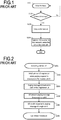
- Fig.1 illustrates steps in a typical location update procedure
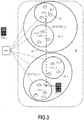
- Fig.2 illustrates steps in a typical paging procedure.
- step S101 of Fig.1 it is assumed that the UE enters an idle state at the end of a communications session. In this idle state the UE is camped on the cell which was handling communication with the UE at the time when the UE's last session ended. In the idle state, at certain times the UE monitors the radio transmissions being made by transceivers in its vicinity. This monitoring process detects different cells which could handle communications for this UE and monitors properties of the various cells including, but not limited to, signal strength. In step S102 illustrated in Fig.1 the UE determines, based on its monitoring, whether or not the UE has entered a location area having a new LAI compared to the cell on which the UE has been camped.
- step S101 If the UE determines that there has not been a change of LAI then the processing returns to step S101. Alternatively, if the UE determines in step S102 that the UE has entered a location area having a new LAI then the process moves to step S103.
- step S103 the UE makes a determination of which would be the best cell to camp on from now on.
- the UE's assessment of which cell is "best” may be performed by any convenient metric. For example, the UE may assign a rank to each potential cell with which it could communicate, basing the rank on one or more criteria such as signal strength, interference in the cell, and so on.
- the UE When the UE has selected the "best" cell the UE camps on that cell and may perform various steps including tuning to the control channel of the new cell.
- the UE communicates with the network infrastructure to register the LAI of the cell on which it is newly camped.
- the UE performs the location update by signalling to the new cell so that a radio channel can be assigned and the UE can send a request, through the new cell, for the updated LAI to be registered by the network.
- the updated LAI may be registered by different components in the network.
- the LAI will be registered by a controller that manages mobility of UEs in a section of the mobile network that includes the new cell.
- the present description shall refer to controllers which manage mobility of UEs using the expression Mobility Management Entities (MMEs) using the same expression as is used in the LTE standard.
- MMEs Mobility Management Entities
- the LAI and/or the MME where the UE is registered will also be registered in a network component which constitutes a home server or home register in respect of the subscriber who owns the relevant UE.
- the registered LAI information is used so as to determine where to broadcast a paging message that may be detected by the relevant UE.
- the steps in a typical paging procedure are illustrated in Fig.2 .
- step S201 illustrated in Fig.2 the network infrastructure has determined that a call is being made to a specific UE and the home server or home register for that UE is consulted so as to determine the MME where the UE in question is currently registered.
- the MME where the UE is currently registered transmits a paging request to transceivers in cells of the location area whose LAI is currently registered for this UE.
- the transceivers covering the cells of the location area identified by the relevant LAI broadcast paging messages.
- step S204 of Fig.2 the UE detects a paging message broadcast by a cell C of the location area and determines that the paging message is directed at itself.
- step S205 the UE sends a response to cell C.
- Various messages are then exchanged between the UE and cell C and between cell C and the network infrastructure so as to set up the subsequent call between the UE and the calling party through cell C (step S206 in Fig.2 ).
- femtocells are installed to improve network coverage, for example: in locations where there is a high density of users, or within a building, or at rural locations where signal coverage would be poor otherwise.
- cell is generally used to designate an access node of the radio access network portion of a mobile network, or to designate the region of radio coverage of an access node.
- macrocells include a component designated eNB or eNodeB (which stands for “E-UTRAN Node B” or “Evolved Node B”) which is connected to the core network and handles radio communications with the UEs in its locality.
- eNB E-UTRAN Node B
- eNodeB Evolved Node B
- Networks according to other technologies have comparable elements: NodeB in UMTS, base station transceiver/radio network controller in GSM, and so on.
- the corresponding element in an LTE femtocell is designated an HeNB (which stands for "Home eNodeB").
- a femtocell will connect to the core network using a residential DSL (Digital Subscriber Line), cable broadband connection, optical fibre, wireless last-mile technology, or other connection using Internet Protocol connection and so on, in association with a gateway to the core network.
- Femtocells operate at frequencies that are licensed to specific telecommunications companies and so, in the same way as access network components, they handle voice and/or data calls for subscribers with the relevant company.
- Many femtocells are configured so that only specified UEs are allowed to communicate via the femtocell in question. For example, when a femtocell is installed in a home setting, the femtocell may be configured so only mobile phones belonging to family members may access the femtocell.
- CSG closed subscriber group
- Femtocells are small and are often located in clusters, for example in urban environments. Accordingly, when a UE moves about in such an environment, the UE may move rapidly through a relatively large number of femtocells and macrocells and these may be assigned different LAIs. In such circumstances, based on the methods used in conventional mobile cellular telecommunications networks, the UE will make frequent location updates. This is undesirable because the UE uses power to send location updates and so frequent updates lead to a need to recharge the UE's battery more often. Also, location updates involve the transmission of messages between the UE and the network infrastructure, as well as messages between components in the network infrastructure, so that frequent location updates use up bandwidth and reduce the network's capacity to handle calls.
- femtocells which belong to different organisations or households generally are assigned different LAIs from one another, and macrocells are assigned different LAIs from femtocells. Accordingly, as a UE moves between two such femtocells, or between a femtocell and a macrocell, frequent location updates will still be needed. This problem will now be discussed with reference to Fig.3 .
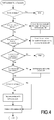
- Fig.3 is a diagram illustrating, in simplified form, an example of a region R of a mobile cellular telecommunications network in which there are two macrocells designated MACRO_1 and MACRO_2, as well as four groups of femtocells, designated CSG_0, CSG_1, CSG_2 and CSG_3.
- the four groups of femtocells correspond to four respective closed subscriber groups. As illustrated in Fig.3 , there are three femtocells for each of the closed subscriber groups.
- the femtocells of groups CSG_0 and CSG_1 are all located within the coverage region of macrocell MACRO_1.
- the femtocells of groups CSG_2 and CSG_3 are all located within the coverage region of macrocell MACRO_2.
- a network component designated MME in Fig.3 , manages the mobility of UEs in the region R.
- a first UE identified by a unique identifier (designated IMSI_1 in Fig.3 ) is connected to the mobile cellular telecommunications network but is not located in region R, whereas a second UE, identified by its own unique identifier (designated IMSI_2 in Fig.3 ) is located in region R and moves around within region R.
- IMSI_1 unique identifier
- IMSI_2 unique identifier
- a single location area is assigned to the two macrocells MACRO_1 and MACRO_2 and so these macrocells both have the same LAI, designated LA_1 in Fig.3 .
- a single location area is assigned to the femtocells of groups CSG_0 and CSG_1 and so the femtocells of groups CSG_0 and CSG_1 all have the same LAI, designated LA_2 in Fig.3 . It will be noticed that the femtocells of groups CSG_0 and CSG_1 are not assigned to the same location area as the macrocell MACRO_1 even though femtocells of groups CSG_0 and CSG_1 are located within the coverage region of macrocell MACRO_1.
- a single location area is assigned to the femtocells of groups CSG_2 and CSG_3 and so the femtocells of groups CSG_2 and CSG_3 all have the same LAI, designated LA_3 in Fig.3 .
- the femtocells of groups CSG_2 and CSG_3 are not assigned to the same location area as the macrocell MACRO_2 even though the femtocells of groups CSG_2 and CSG_3 are located within the coverage region of macrocell MACRO_2.
- IMSI_2 is initially located at the position marked 1 in Fig.3 and moves along a path indicated by the dashed arrow A in Fig.3 to the position marked 2 in Fig.3 .
- the last communication session IMSI_2 engaged in has terminated with IMSI_2 attached to a femtocell of group CSG_3.
- the mobility management entity MME of the network has LA_3 registered to identify the location area of IMSI_2.
- IMSI_2 is camped on one of the femtocells of group CSG_3 but can detect transmissions from the other femtocells of CSG_3 and from the macrocell MACRO_2.
- IMSI_2 When IMSI_2 moves out of range of the femtocells of CSG_3 travelling along path A, it enters an area where IMSI_2 is only reachable by MACRO_2. IMSI_2 chooses to camp on cell MACRO_2 and detects that the LAI for MACRO_2 is different from the LAI of the cell on which IMSI_2 was previously camped. Accordingly, IMSI_2 communicates with MACRO_2 to request performance of a location update that will register the LAI of MACRO_2 (i.e. LA_1) to the applicable mobility management entity MME.
- LA_1 the LAI of MACRO_2
- IMSI_2 As IMSI_2 continues to move along path A it enters an area covered by the femtocells of CSG_2 and determines that it should camp on a femtocell of CSG_2. IMSI_2 detects that the LAI of the chosen CSG_2 femtocell is different from the LAI of the cell on which IMSI_2 was previously camped, and so communicates with the chosen CSG_2 femtocell to request performance of a second location update, this time to register LA_3 to the MME.
- IMSI_2 When IMSI_2 moves out of range of the femtocells of CSG_2 travelling along path A, it enters an area where, once again, IMSI_2 is only reachable by MACRO_2. IMSI_2 chooses to camp on cell MACRO_2, detects that the LAI for MACRO_2 is different from the LAI of the cell on which IMSI_2 was previously camped and communicates with MACRO_2 to request performance of a third location update, on this occasion to register LA_1 to the mobility management entity MME. As IMSI_2 continues to move along path A it enters an area where IMSI_2 is only reachable by MACRO_1.
- IMSI_2 chooses to camp on cell MACRO_1, but detects that the LAI for MACRO_1 is the same as the LAI for the previous cell on which IMSI_2 was camped and so no location update is required. Accordingly IMSI_2 does not send a location update request at this time.
- IMSI_2 As IMSI_2 continues to move along path A it enters an area covered by the femtocells of CSG_1 and determines that it should camp on a femtocell of CSG_1. IMSI_2 detects that the LAI of the chosen CSG_1 femtocell is different from the LAI of the cell on which IMSI_2 was previously camped, and so communicates with the chosen CSG_1 femtocell to request performance of a fourth location update, this time to register LA_3 to the MME. When IMSI_2 moves out of range of the femtocells of CSG_1 travelling along path A, it enters an area where, once again, IMSI_2 is only reachable by MACRO_1.
- IMSI_2 chooses to camp on cell MACRO_1 and detects that the LAI for MACRO_1 is different from the LAI of the cell on which IMSI_2 was previously camped. Accordingly, IMSI_2 contacts MACRO_1 to request performance of a fifth location update, to register the LAI of MACRO_1 (i.e. LA_1) to the mobility management entity MME. As IMSI_2 continues to move along path A it enters an area covered by the femtocells of CSG_0 and determines that it should camp on a femtocell of CSG_0.
- IMSI_2 detects that the LAI of the chosen CSG_0 femtocell is different from the LAI of the cell on which IMSI_2 was previously camped, and so contacts the chosen CSG_0 femtocell to request performance of a sixth location update, this time to register LA_2 to the MME.
- IMSI_2 performs 6 location updates as it moves along path A from location 1 to location 2.
- the MME has LA_2 registered as the identifier of the location area for IMSI_2 and so directs a paging request to the radio access network components covering the cells having the location area identifier LA_2.
- the femtocells of CSG_0 and CSG_1 are the cells having the location area identified LA_2 and so they respond to the paging request from the MME by broadcasting paging messages which include an identifier of IMSI_2.
- IMSI_2 is camped on a femtocell FC of CSG_0 and detects a paging message identifying IMSI_2, broadcast by femtocell FC.
- IMSI_2 sends its response to femtocell FC and a session connecting IMSI_1 to IMSI_2 is then established through femtocell FC.
- the MME sends requests for paging messages to be broadcast to IMSI_2 from six femtocells, that is the femtocells of CSG_0 and CSG_1.
- femtocells that is the femtocells of CSG_0 and CSG_1.
- closed subscriber group femtocells it is possible to obtain a reduction in the number of femtocells broadcasting paging messages by taking into account which CSGs the called UE belongs to.
- paging overhead may be reduced by making sure that paging messages are broadcast only in femtocelfs which, as well as having the appropriate LAI, also belong to a CSG that IMSI_2 is authorized to access.
- the MME could request paging messages to be broadcast to IMSI_2 from only the three femtocells of CSG_1 because, although the femtocells of CSG_0 are in the appropriate location area, IMSI_2 is not authorized to access CSG_0.
- a single location area includes a large number of macrocells or femtocells this can reduce the number of location updates that are performed but, conversely, a large number of cells may need to broadcast paging messages when a call is directed to a UE in this location area.
- a single location area includes only a small number of macrocells or femtocells then, although this can reduce the paging load, there is an increased requirement for frequent location updates.
- the present invention has been conceived in the light of the above problems.
- the dynamic cell selection that is performed by UEs is a selection of a single cell that serves both to define the location area that will be registered for this UE (and in which this UE will be paged) and serves to define the cell this UE will access when it seeks to communicate with the network.
- the present inventor has realized that advantages can be obtained by breaking the link between the cell that is used for paging a UE and the cell that the UE employs for accessing the network.
- the UEs monitor transmissions from available cells and select a cell to camp on by considering which cell offers the best access capabilities, notably in terms of the communications quality offered by the cell. For example, the UE may measure properties of transmissions made by the available cells (e.g. transmissions made on a control channel) and select a cell which offers the best power or signal-to-noise ratio at the UE, or the least interference, and so on. As another example the UE may base its assessment of cell access capabilities or cell quality on a parameter that is calculated by a cell and transmitted to the mobile device (for example the cell may measure or compute a quality parameter based on the characteristics - signal strength, and so on - of a signal transmitted by the mobile device).
- the UE may measure properties of transmissions made by the available cells (e.g. transmissions made on a control channel) and select a cell which offers the best power or signal-to-noise ratio at the UE, or the least interference, and so on.
- the UE may base its assessment of cell access capabilities or
- the location area of the selected cell will be registered to the network and the network will page the UE in the registered location area. Furthermore, when the UE accesses the network (notably to request a location update or respond to a paging message), the UE will access the same selected cell.
- WO2009/097015 describes a system in which a different cell may be used for paging a mobile terminal compared to the cell that is used by the mobile terminal for accessing the network (e.g. implementing a telephone call).
- the mobile terminal may measure properties of transmissions made by the available cells and select a cell which offers the best power or signal-to-noise ratio as the paging cell, and select as the access cell a cell which offers good services, e.g. low path loss, better scheduling, higher throughput, without reference to whether the cell is a macrocell or femtocell,
- the present invention provides a method of managing a paging procedure in a cellular mobile network comprising different areas where mobile devices may be located, each location area of the network including at least one cell and the cellular mobile network comprising macrocells and femtocells, the method being performed by a mobile device connected to said network, the method comprising the acts of:
- a mobile device which implements paging-procedure management methods may well select a paging cell that is different from the selected access cell, and this paging cell is selected taking into account the paging capabilities of the detected cells, and whether they are macrocells or femtocells, instead of being chosen based on the access capabilities of the available cells as it was in conventional networks, Accordingly, because the paging cell is selected based specifically on paging capabilities, in a manner that favours selection of macrocells, the efficiency of the paging procedure is increased. Moreover, this improvement in paging efficiency is not detrimental to the quality of the access the mobile device obtains to the network because the access cell is selected separately from the paging cell and the selection thereof is based on the access capabilities of the detected cells.
- the quality of the connections between the mobile device and the cells which page it or that it accesses is assured by selecting the paging cell and access cell from among detected cells that are associated with a certain minimum value of the access-capability parameter. Furthermore, by basing the choice of paging cell and access cell on the values of respective parameters which quantify paging capabilities and access capabilities of the available cells, and consider the nature of the cell (macrocell or femtocell), an optimal choice of paging cell and access cell is likely to be made.
- the particular metric that is used to evaluate paging capabilities may be set according to the network designer's objectives. For example, when the network designer seeks to reduce the battery consumption in the UE he may configure the method so that paging capabilities are assessed based on a parameter that enables the number of location updates to be reduced, for example because it favours preferential selection of cells that cover large geographical regions.
- the associating step associates a higher paging-capability parameter value to macrocells than to femtocells and associates a cell-quality value to cells as said access-capability parameter value
- the selecting step selects as the paging cell the macrocell having best paging capabilities or having highest quality among the macrocells in said group or, if no macrocell is in said group, selects the femtocell having highest quality out of the femtocells in said group.
- location-update and paging that is based preferentially on macrocells is likely to entail a smaller number of location-updates than location-updating/paging based on femtocells, because of the greater dimensions of the macrocells.
- the methods of the invention select the paging cell without being obliged to select the cell that has best access capabilities (e.g. best quality), it becomes possible to select macrocells for paging even in circumstances where femtocells are available that offer better quality (provided that the macrocell quality meets a minimum quality standard).
- the cells broadcast information quantifying their paging capabilities and the mobile device takes this broadcast information into account when associating a paging-capability parameter value to detected cells.
- the paging capabilities of cells tend to depend on parameters such as the geographical extent of the cells' location areas, the geometry of the cellular network, and other network-side factors. Accordingly, the choice of paging cell is likely to be optimized in cases when it is based on information sent by the cells to indicate their paging capabilities.
- the mobile devices when the mobile devices associate an access-capability parameter value to detected cells the mobile devices take into account parameters indicative of the communications quality of the detected cells.
- the communications quality offered by a cell is one of the main factors which determine how good a choice this cell is for a mobile device to use to connect to the network and existing mobile devices are already configured to assess communications quality (e.g. by measuring the signal to noise ratio of each cell).
- the invention is not limited to methods in which access capabilities are assessed in terms of communications quality of the cells; other factors may be taken into account, for example the existing load due to traffic in the cell.
- a node of the cellular mobile network may perform a method comprising the acts of: receiving a paging response message sent by a mobile device, determining that the paging response message received from the mobile device is not a response to a paging message sent by this node, and reacting, to a paging response message that is determined not to be a response to a paging message sent by this node, by initiating a call set-up procedure for the mobile device through this node.
- a network node By configuring a network node not to reject a paging response message in the case where that paging response message does not reply to a paging message sent by this node, it becomes possible to set an access cell for a mobile device that is different from the cell which determines where the mobile device is paged. This enables the choice of paging cell and access cell to be optimized.
- a given node In certain paging procedure management methods performed by a node of the cellular mobile network, a given node generally does not have sufficient information to be able to set up a call for a mobile device as a reaction to receipt of a paging response message from the mobile device if this node did not send the paging message to which the paging response message replies. Accordingly, it can be beneficial to configure the node so that it reacts to such a paging response message by contacting other components in the network in order to obtain the necessary missing information.
- the present invention further provides a mobile device configured to be connectable to a cellular mobile network comprising different areas where mobile devices may be located, each location area of the network including at least one cell and the cellular mobile network comprising macrocells and femtocells, the mobile device comprising:
- a mobile device configured as indicated above can make independent choices of its paging cell and access cell, taking into account whether the cells are macrocells or femtocells. Accordingly, both the paging cell and access cell can be chosen optimized for its specific function.
- a node in a cellular mobile network may comprise: a transmitter module for sending paging messages, a receiver module for receiving a paging response message sent by a mobile device, and a processor for determining whether a paging response message received from a mobile device is a response to a paging message sent by this node, wherein the processor is configured to react to a paging response message that is determined not to be a response to a paging message sent by this node by initiating a procedure for setting up a call for the mobile device through this node.
- a network node When a network node can react to a paging response message received from a mobile device to which it did not send the paging message, it becomes possible to set a different paging cell and access cell for mobile devices, enabling the cell choices to be optimized to the individual functions.
- a cellular mobile network may include at least one network node configured to react to a paging response message received from a mobile device and determined not to be a response to a paging message sent by this node by initiating a procedure for setting up a call for the mobile device through this node.
- the paging cells for the mobile devices can be chosen independently of the choice of access cells, increasing the efficiency of the paging process without sacrificing access characteristics when the mobile device access the network.
- Computer programs may comprise instructions for performing the above-mentioned methods, and recording media storing the computer programs.
- a cellular mobile communications network that includes macrocells and femtocells.
- the invention is not limited to networks including macrocells and femtocells. Indeed, application of the present invention can provide advantages in cellular mobile networks that include cells of only one size class (or, even, cells of uniform size).
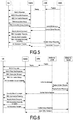
- Fig.4 is a flow chart illustrating steps a method according to one embodiment of the invention.
- the UE is configured to select two types of cells in its cell selection or reselection procedure.
- One of the selected cells is termed the paging cell, the other is termed the access cell.
- the UE selects a paging cell based on considering the paging capabilities of the different available cells.
- the UE selects the access cell based on a consideration of the access capabilities of the different available cells.
- paging cost a parameter designated "paging cost": a low paging cost means that this cell has good paging capabilities whereas a high paging cost means that this cell has poor paging capabilities.
- the method illustrated by Fig.4 focuses on enabling a UE in idle mode to camp on a cell that is determined as having the minimum paging cost as long as it is available.
- the invention is not limited to the case where paging capabilities are assessed by considering a paging cost.
- Other approaches may be used. For example, cells can be ranked in different classes based on their paging capabilities and a UE may then select as its paging cell the available cell that is ranked in the highest class.
- a parameter quantifying the paging capabilities of the available cells may be computed by the UE.
- information quantifying the paging capabilities of cells is transmitted by the cells themselves (for example in a broadcast channel).
- the parameter that quantifies paging capabilities may be set manually, for example based on the configuration of the network.
- the invention is not limited to manual setting of the paging-capability parameter: in certain cases the paging capability parameter may be set dynamically, for example based on current conditions in the network.
- the invention is not limited to the case where a single parameter is used to quantify paging capabilities of cells: in suitable cases an overall ranking, in terms of paging performance, may be derived based on a plurality of different parameters relating to paging capability.
- the assessment of the access capabilities of the cells is based on measurements the UE makes on signals transmitted by the various available cells.
- the invention is not limited to the case where access capabilities are assessed based on signal measurements made by the UE: for example the cells may broadcast information quantifying their current access capabilities, for example taking into account the load in the cell at that time.
- the paging cell and access cell are selected from a cell candidate set detected by the UE.
- the candidate set is composed of the cells that can be potentially chosen for serving the UE (because they offer a communications quality equal to or exceeding a minimum acceptable standard).
- the paging cell is the cell that the UE will camp on and wait for a paging message, while the access cell is where the UE is to transmit data and establish a session.
- the location area of the paging cell is always used as the registered location area for the UE.
- a first level of paging cost is associated with using macrocells as paging cells and this first level of paging cost is lower than a second level of paging costs that is associated with using femtocells as paging cells.
- the lower level of paging cost that is associated with macrocells in this example reflects the fact that, in general, fewer location updates are required when a UE's location is tracked in terms of macrocells compared to the number of location updates required when the UE's location is tracked in terms of femtocells.
- the UE selects a macrocell as paging cell even in the presence of an available femtocell offering better communication quality (provided that the communications quality offered by the macrocell is at least equal to a minimum standard).
- different paging costs are associated with different macrocells (although all the macrocells have paging costs that are lower than the paging costs associated with femtocells in this example). For instance, different paging costs may be associated with different macrocells based on size differences between the macrocells. When the paging cell is being selected in a case where plural macrocells are available then, in the Fig.4 example, the macrocell having the lowest paging cost is chosen to be the paging cell. In the event of a tie or draw between plural macrocells having the lowest paging cost, any convenient criterion may be used to decide which of these macrocells to set as the paging cell.
- femtocells are considered to have better access capabilities than macrocells, so a femtocell will be selected as access cell unless none of the available femtocells that the UE is authorized to access offer sufficiently-good signal quality. If no suitable femtocells are available but a paging cell has been selected, then the paging cell is set as the access cell also. If plural authorized femtocells of sufficient signal quality are available the highest-ranking femtocell in terms of access-capabilities is chosen to be the access cell.
- the example method illustrated by Fig.4 can be implemented in a simple manner by configuring the UEs to recognize whether cells are macrocells or femtocells and, based on the recognized cell type, to assign a higher paging-capability to macro-cells than to femtocells.
- the UEs may then be configured to choose the paging cell preferentially from the available macrocells, rather than from available femtocells (provided that any macrocell is available that offers the minimum acceptable quality standard).
- the macrocell having best quality may be selected as paging cell if all the macrocells have been assigned the same paging-capability value. If no macrocell is available then the highest quality femtocell may be selected as paging cell.
- the UEs may be further configured to assign a higher access-capability to femtocells than to macrocells, based on recognition of the cell type, and to choose the access cell preferentially from among the femtocells (provided that any femtocell is available that offers the minimum acceptable quality standard).
- the femtocell having best quality may be selected as access cell. If no femtocell is available then the highest quality macrocell may be selected as the access cell (and, in general, this highest-quality macrocell will have been selected as the paging cell).
- a UE can determine whether a cell is a macrocell or a femtocell and any convenient method can be employed in this implementation example. For instance, the UE may determine the cell type based on the fact that the value of the cell identity is selected out of different ranges for macrocells and femtocells according to existing network specifications.
- Fig.4 illustrates a combined selection procedure which serves to make (or verify/refresh) the selection of the paging cell and the access cell.
- the invention is not limited to the case where a single combined procedure selects the paging cell and the access cell: separate procedures may be used to make/update the selection of the paging cell and the access cell and, in particular, the individual selection procedures do not need to be run at the same times or with the same frequency.
- the procedure(s) for selecting (or updating the choice of) the paging cell and access cell may be triggered in various ways including but not limited to the following examples: the selection/update may be run at intervals (e.g. run every 10 minutes, run every time the mobile has completed a specified process in idle mode, and so on), and/or the selection process could be triggered by an event (for instance, detection of power-up of the mobile device, detection of a change in cell quality, and so on).
- an event for instance, detection of power-up of the mobile device, detection of a change in cell quality, and so on.
- the UE when the location update mentioned above is performed the UE contacts the base station of the femtocell that has been selected as its access cell, to request registration of the LAI of the macrocell where the UE is residing (i.e. the LAI of the macrocell that has been selected as the paging cell).
- the network will request broadcast of paging messages by transceivers in the location area identified by the registered LAI, that is, the transceivers in the same location area as the selected paging cell.
- the UE Upon the receipt of the paging message the UE establishes the session in the femtocell that has been selected as its access cell (provided that the latter femtocell is still available).
- Figs.5 and 6 make reference to some processes that take place during paging according to the current LTE specification, but these processes are modified here because the UE is configured to respond to a paging message through its selected access cell rather than through the paging cell which actually sent out the paging message.
- the skilled person will readily understand the corresponding modifications that should be made to paging processes according to technologies other than LTE.
- HeNB refers to the small base station for a femtocell and eNB represents the base station for a macrocell.
- the mobile device UE has selected the femtocell served by HeNB as its access cell and has selected the macrocell served by eNB as its paging cell. It is further assumed that UE has registered the LAI of its selected paging cell eNB with the network (notably, with the MME serving eNB). Accordingly, when the MME for eNB is notified of an incoming call directed to UE, the MME transmits a paging request to eNB, and eNB broadcasts an appropriate paging message.
- Fig.5 illustrates a first scenario in which the eNB and HeNB both connect to the same mobility management entity MME.
- Fig.6 illustrates a second scenario in which the eNB and HeNB connect to different MMEs.
- the UE receives the paging message transmitted by eNB and responds through its selected access cell HeNB.
- HeNB is configured not to reject the paging response received from UE even though HeNB did not transmit the paging message that prompted UE's transmission of the paging response. Accordingly, HeNB exchanges certain initial messages with UE, notably to setup a radio channel RRC.
- RRC radio channel
- HeNB lacks certain of the information elements that normally would be possessed by a node which broadcasts a paging message to UE (for example, information relating to security settings, information necessary for context setup to be performed). Accordingly, in order to continue with call setup HeNB contacts its MME, via a message designated "Initial UE Message" providing MME with sufficient information to identify the called UE.
- HeNB's MME also connects to the paging cell eNB which paged UE, this MME has the information necessary for call setup to the paged UE. Accordingly, MME sends to HeNB a "Context Setup Request" message which notifies HeNB of parameters/information required so that HeNB can accomplish subsequent steps in the call setup procedure. For example MME may provide HeNB with encryption keys and algorithm details so that HeNB can transmit an appropriate Security Mode Command to the UE, and MME may provide HeNB with parameters and information that enable HeNB to make any appropriate changes to the configurations of the logical, transport and physical channels via a RRC Connection Reconfiguration command. When the necessary context setup operations have been completed HeNB informs MME and call setup continues as normal.
- the access cell HeNB selected by UE is configured to communicate with UE even when UE sends HeNB a paging response in a case where HeNB did not send the paging message.
- MME Mobility Management Entity
- MME for HeNB sends a Paging Context Request to MME for eNB in order to acquire from MME for eNB the information necessary for generating a Context Setup Request.
- MME for eNB sends the context of the paging request that it had issued to eNB to MME for HeNB in a message designated Paging Context Response.
- MME for HeNB can now send to HeNB the information HeNB requires in order to proceed with call setup.
- the paging processes illustrated in Fig. 6 enable the session between the called UE and the caller to be established through the called UE's selected access cell HeNB even when the MME for HeNB actually doesn't broadcast the paging request.
- Fig.7A illustrates the configuration of a portion of a network that includes a mix of macrocells and femtocells as in Fig.3 .
- the UE designated IMSI_2 initially resides in the area LA_3 which is covered both by macrocell MACRO_2 and the femtocells of CSG_3.
- the LAI of MACRO_2 is LA_1
- the LAI of CSG_3 is LA_3.
- IMSI_2 chooses MACRO_2 as its paging cell (based on an assessment method that assigns lower paging cost to macrocells compared to femtocells) IMSI_2 registers LA_1 in a location update, registering LA_1 to MME through MACRO_2. However a suitable femtocell of CSG_3 is chosen as the access cell by IMSI_2 because the femtocells of CSG_3 are assessed to have better access capabilities than MACRO_2.
- IMSI_2 stills sends the location update request through MACRO_2, to avoid the possibility of the network infrastructure registering the LAI of CSG_3 to identify the location area where IMSI_2 should be paged.
- IMSI_2 moves to CSG_1, it crosses the femtocells of CSG_2, CSG_1 and CSG_0 sequentially.
- IMSI_2 does not launch a location update because, where MACRO_2 and MACRO_1 are chosen as the paging cell of IMSI_2, IMSI_2 still camps on the location area designated by LA_1
- IMSI_2 resides in the area both covered by CSG_0 and MACRO_1. At this location IMSI_2 selects CSG_0 as its access cell based on its good access capabilities.
- IMSI_1 When a UE designated IMSI_1 issues a calling request to MME to call IMSI_2, because MME knows that the location area designated LA_1 is registered for IMSI_2, the MME forwards a paging request to MACRO_1 and MACRO_2. The paging request is finally received by IMSI_2 in MACRO_1. However, IMSI_2 sends back the paging response through CSG_0 because this cell is chosen as the access cell. MME then establishes the session from IMSI_1 to IMSI_2 through CSG_0.
- a variant of the latter processes may be performed in a network portion configured as in Figs.7B , in which the femtocells connect to MME through a gateway designated Femtocell-GW.
- MME establishes the session from IMSI_1 to IMSI_2 through CSG_0 which is connected to the network by the Femtocell-GW.
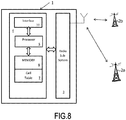
- Fig.8 is a simplified diagram illustrating some of the components in a user device 1 according to an embodiment of the present invention, configured to perform certain of the above-described paging-procedure management methods.
- the user device 1 is configured to communicate with transceivers 2a and 2b of a mobile network.
- Transceivers 2a may be relatively long-range radio equipment of a macrocell, whereas transceivers 2b may be relatively short-range equipment of femtocells.
- the UE 1 includes a radio sub-system 3 configured to handle communications between the UE and the transceivers 2a, 2b, as well as including a baseband sub-system 4.
- the radio sub-system 3 may be configured to provide the functions of acting as a receiver configured to detect transmissions from cells available to handle communications with the mobile device, and acting as a transmitter sub-system for transmitting various signals to the network, including transmissions of requests to register area identifiers as the location of the mobile device within the mobile network.
- the baseband sub-system 4 includes a processor 5 as well as associated components which may include a memory 6 and one or more interfaces 10 (for example, an interface to device elements (not shown) such as a keyboard, touchscreen, and so on that may be operated by a user, an interface to a loudspeaker (not shown), and other interfaces).
- a processor 5 may be programmed to create a cell table 7 in the memory 6 and to hold in memory an indication (not shown) of the currently-selected paging cell and of the currently-selected access cell.
- the cell table 7 associates with each available cell that the radio sub-system 3 has detected a ranking or score representing this cell's paging capabilities and a ranking or score representing this cell's access capabilities.
- the ranking or score representing the cell's access capabilities relate to cell quality and may, for example, be based on one factor or a combination of factors such as signal strength detected for the cell, the cell's remaining capacity for handling traffic, and so on.
- the processor 5 is configured to update the rankings in the cell table 7 in a dynamic manner based on measurements made on the different available cells and/or based on paging-capability information and/or access-capability information transmitted by the cells, and to update the selection of the paging cell and access cell based on the changing values in the cell table 7.
- user equipment according to the present invention is not limited to devices which create an explicit cell ranking table in memory.
Landscapes
- Engineering & Computer Science (AREA)
- Computer Networks & Wireless Communication (AREA)
- Signal Processing (AREA)
- Computer Security & Cryptography (AREA)
- Mobile Radio Communication Systems (AREA)
Claims (5)
- Procédé de gestion d'une procédure de radiomessagerie dans un réseau mobile cellulaire comprenant différentes zones dans lesquelles des dispositifs mobiles peuvent être situés, chaque zone de localisation du réseau comprenant au moins une cellule, et le réseau mobile cellulaire comprenant des macrocellules et des femtocellules, le procédé étant mis en oeuvre par un dispositif mobile connecté audit réseau, le procédé comprenant les actions de :détecter des cellules disponibles du réseau,sélectionner une première cellule du réseau en tant que cellule de radiomessagerie dont la zone de localisation est à enregistrer dans le réseau en tant que zone de radiomessagerie à utiliser par le réseau lors de la radiomessagerie du dispositif mobile, etindépendamment de la sélection de la cellule de radiomessagerie, sélectionner, en tant que cellule d'accès à laquelle le dispositif mobile accède lors de la connexion au réseau, d'une seconde cellule du réseau,le dispositif mobile étant configuré pour sélectionner la cellule de radiomessagerie sur la base des capacités de radiomessagerie des cellules détectées et pour sélectionner la cellule d'accès sur la base des capacités d'accès des cellules détectées, etle dispositif mobile étant configuré pour répondre à un message de radiomessagerie reçu par l'intermédiaire de la cellule de radiomessagerie sélectionnée par la mise en contact du réseau par l'intermédiaire de la cellule d'accès sélectionnée ;caractérisé en ce que le procédé comprend en outre la réalisation par le dispositif mobile des actions de :reconnaître si les cellules disponibles détectées sont des macrocellules ou des femtocellules,associer une valeur de paramètre de capacité de radiomessagerie et une valeur de paramètre de capacité d'accès à chaque cellule détectée :en associant, à des cellules disponibles détectées qui sont reconnues en tant que macrocellules, une valeur de paramètre de capacité de radiomessagerie relativement plus élevée par comparaison avec une valeur de paramètre de capacité de radiomessagerie associée à des cellules disponibles détectées qui sont reconnues en tant que femtocellules,en associant, à des cellules disponibles détectées qui sont reconnues en tant que femtocellules, une valeur de paramètre de capacité d'accès plus élevée par rapport à une valeur de paramètre de capacité d'accès attribuée à des cellules disponibles détectées qui sont reconnues en tant que macrocellules ;sélectionner la cellule de radiomessagerie et la cellule d'accès parmi un groupe de cellules détectées ayant une qualité supérieure à un niveau de seuil ; etsélectionner, en tant que cellule de radiomessagerie, la cellule ayant la valeur la plus élevée de paramètre de capacité de radiomessagerie parmi les cellules dudit groupe, etsélectionner, en tant que cellule d'accès, la cellule ayant la valeur la plus élevée d'un paramètre de capacité d'accès parmi les cellules dudit groupe.
- Procédé selon la revendication 1,
l'association associant une valeur de qualité de cellule à des cellules en tant que valeur de paramètre de capacité d'accès, et
la sélection sélectionnant en tant que cellule de radiomessagerie la macrocellule ayant les meilleures capacités de radiomessagerie ou la meilleure qualité parmi les macrocellules dans ledit groupe ou, si aucune macrocellule n'est dans ledit groupe, sélectionnant la femtocellule ayant les meilleures capacités de radiomessagerie ou la meilleure qualité parmi les femtocellules dans ledit groupe. - Procédé selon la revendication 1, dans lequel, lors de l'association d'une valeur de paramètre de capacité d'accès à des cellules détectées, le dispositif mobile se réfère à des paramètres indiquant la qualité de communication des cellules détectées.
- Dispositif mobile (1) configuré pour être connecté à un réseau mobile cellulaire comprenant différentes zones dans lesquelles des dispositifs mobiles peuvent être situés, chaque zone de localisation du réseau comprenant au moins une cellule et le réseau mobile cellulaire comprenant des macrocellules et des femtocellules, le dispositif mobile comprenant :un récepteur (3) configuré pour détecter des transmissions à partir de cellules disponibles pour gérer des communications avec le dispositif mobile ; etun processeur (5) configuré :pour sélectionner une première cellule du réseau en tant que cellule de radiomessagerie dont la zone de localisation est à enregistrer dans le réseau en tant que zone de radiomessagerie à utiliser par le réseau lors de la radiomessagerie du dispositif mobile, etindépendamment de la sélection de la cellule de radiomessagerie, pour sélectionner, en tant que cellule d'accès à laquelle accède le dispositif mobile lors de la connexion au réseau, une seconde cellule du réseau,le processeur étant configuré pour sélectionner la cellule de radiomessagerie sur la base des capacités de radiomessagerie des cellules détectées et pour sélectionner la cellule d'accès sur la base des capacités d'accès des cellules détectées ;le dispositif mobile (1) étant configuré pour répondre à un message de radiomessagerie reçu par l'intermédiaire de la cellule de radiomessagerie sélectionné par le processeur par mise en contact du réseau par l'intermédiaire de la cellule d'accès sélectionnée par le processeur ;caractérisé en ce que le processeur (5) est en outre configuré :pour reconnaître si des cellules disponibles détectées sont des macrocellules ou des femtocellules,pour associer une valeur de paramètre de capacité de radiomessagerie et une valeur de paramètre de capacité d'accès à chaque cellule détectée :en associant à des cellules disponibles détectées qui sont reconnues en tant que macrocellules une valeur de paramètre de capacité de radiomessagerie relativement plus élevée par comparaison avec une valeur de paramètre de capacité de radiomessagerie associée à des cellules disponibles détectées qui sont reconnues en tant que femtocellules,en associant à des cellules disponibles détectées qui sont reconnues en tant que femtocellules une valeur de paramètre de capacité d'accès relativement plus élevée par comparaison avec une valeur de paramètre de capacité d'accès attribuée à des cellules disponibles détectées qui sont reconnues en tant que macrocellules ;pour sélectionner la cellule de radiomessagerie et la cellule d'accès parmi un groupe de cellules détectées ayant une qualité supérieure à un niveau seuil ;pour sélectionner, en tant que cellule de radiomessagerie, la cellule ayant la valeur la plus élevée de paramètre de capacité de radiomessagerie parmi les cellules dudit groupe ; etpour sélectionner, en tant que cellule d'accès, la cellule ayant la valeur la plus élevée de paramètre de capacité d'accès parmi les cellules dudit groupe.
- Dispositif mobile (1) selon la revendication 4, le processeur (5) étant configuré pour déterminer la qualité des macrocellules et des femtocellules détectées par le récepteur (3), et pour sélectionner en tant que cellule de radiomessagerie, parmi les macrocellules détectées ayant une qualité supérieure à un niveau seuil, la macrocellule ayant les meilleures capacités de radiomessagerie de meilleure qualité ou, si aucune macrocellule n'est détectée ayant une qualité au-dessus du niveau de seuil, pour sélectionner la femtocellule détectée de qualité la plus élevée.
Applications Claiming Priority (2)
| Application Number | Priority Date | Filing Date | Title |
|---|---|---|---|
| PCT/CN2013/000359 WO2014153683A1 (fr) | 2013-03-28 | 2013-03-28 | Radiomessagerie dans des réseaux mobiles utilisant des cellules de radiomessagerie et des cellules d'accès indépendantes |
| PCT/IB2014/000659 WO2014155201A2 (fr) | 2013-03-28 | 2014-03-28 | Recherche de personnes dans des réseaux mobiles utilisant des cellules de recherche de personnes et des cellules d'accès indépendantes |
Publications (2)
| Publication Number | Publication Date |
|---|---|
| EP2979505A2 EP2979505A2 (fr) | 2016-02-03 |
| EP2979505B1 true EP2979505B1 (fr) | 2018-10-31 |
Family
ID=51022900
Family Applications (1)
| Application Number | Title | Priority Date | Filing Date |
|---|---|---|---|
| EP14733685.3A Active EP2979505B1 (fr) | 2013-03-28 | 2014-03-28 | Recherche de personnes dans des réseaux mobiles utilisant des cellules de recherche de personnes et des cellules d'accès indépendantes |
Country Status (3)
| Country | Link |
|---|---|
| US (1) | US9918298B2 (fr) |
| EP (1) | EP2979505B1 (fr) |
| WO (2) | WO2014153683A1 (fr) |
Families Citing this family (9)
| Publication number | Priority date | Publication date | Assignee | Title |
|---|---|---|---|---|
| US10149217B2 (en) | 2015-09-01 | 2018-12-04 | Qualcomm Incorporated | Service-based, separated access and paging cell selection and reselection |
| FR3067546A1 (fr) * | 2017-06-19 | 2018-12-14 | Orange | Procedes d’identification operateur de trames a emettre, et de verification d’appartenance operateur, un dispositif de communication et une passerelle de communication |
| US10785748B2 (en) * | 2018-07-26 | 2020-09-22 | T-Mobile Usa, Inc. | Mobile device assisted selection of paging location area in a wireless communication network |
| US10785708B2 (en) | 2018-09-12 | 2020-09-22 | Trespass Tracker Ltd. | System and method of tracking a mobile device |
| US10856256B2 (en) | 2018-09-26 | 2020-12-01 | Charter Communications Operating, Llc | Paging related methods and apparatus |
| US10764864B2 (en) * | 2018-09-26 | 2020-09-01 | Charter Communcations Operating, LLC | Paging related methods and apparatus |
| US10694495B2 (en) * | 2018-09-26 | 2020-06-23 | Charter Communications Operation, LLC | Paging related methods and apparatus |
| CN109327855B (zh) * | 2018-11-28 | 2021-07-16 | 重庆邮电大学 | 一种多模终端测量小区选择方法 |
| WO2021046650A1 (fr) | 2019-09-12 | 2021-03-18 | Trespass Tracker Ltd. | Système et procédé de suivi d'un dispositif mobile |
Family Cites Families (11)
| Publication number | Priority date | Publication date | Assignee | Title |
|---|---|---|---|---|
| CN100418323C (zh) * | 2002-08-22 | 2008-09-10 | 松下电器产业株式会社 | 位置管理服务器和移动通信系统 |
| ATE352175T1 (de) * | 2003-04-11 | 2007-02-15 | Ericsson Telefon Ab L M | Verbindungsaufbau mit mehrfachzugang |
| US8849316B2 (en) * | 2008-01-31 | 2014-09-30 | Qualcomm Incorporated | Paging and access via different nodes |
| CN101686467B (zh) | 2008-09-28 | 2013-08-07 | 华为技术有限公司 | 寻呼区的分配方法及装置 |
| US8971912B2 (en) * | 2008-12-24 | 2015-03-03 | Industrial Technology Research Institute | Paging process in a home cellular network |
| CN101938814B (zh) * | 2009-06-29 | 2013-11-06 | 华为技术有限公司 | 移动终端寻呼方法和移动呼叫中心设备 |
| CN102149194B (zh) * | 2011-03-21 | 2013-07-24 | 大唐移动通信设备有限公司 | 一种跟踪区列表的确定方法及装置 |
| EP2525614A1 (fr) * | 2011-05-20 | 2012-11-21 | TELEFONAKTIEBOLAGET LM ERICSSON (publ) | Pagination sélective d'équipements d'utilisateur dans des réseaux mobiles cellulaires |
| CN102413569A (zh) * | 2011-11-17 | 2012-04-11 | 电信科学技术研究院 | 一种寻呼方法及装置 |
| US9913207B2 (en) * | 2012-03-12 | 2018-03-06 | Qualcomm Incorporated | Methods and apparatuses for paging in heterogeneous networks |
| TWI469599B (zh) * | 2012-06-08 | 2015-01-11 | Arcadyan Technology Corp | 無線行動通訊方法 |
-
2013
- 2013-03-28 WO PCT/CN2013/000359 patent/WO2014153683A1/fr not_active Ceased
-
2014
- 2014-03-28 US US14/778,572 patent/US9918298B2/en active Active
- 2014-03-28 WO PCT/IB2014/000659 patent/WO2014155201A2/fr not_active Ceased
- 2014-03-28 EP EP14733685.3A patent/EP2979505B1/fr active Active
Non-Patent Citations (1)
| Title |
|---|
| None * |
Also Published As
| Publication number | Publication date |
|---|---|
| US20160286523A1 (en) | 2016-09-29 |
| WO2014153683A1 (fr) | 2014-10-02 |
| EP2979505A2 (fr) | 2016-02-03 |
| WO2014155201A3 (fr) | 2015-03-05 |
| US9918298B2 (en) | 2018-03-13 |
| WO2014155201A2 (fr) | 2014-10-02 |
Similar Documents
| Publication | Publication Date | Title |
|---|---|---|
| EP2979505B1 (fr) | Recherche de personnes dans des réseaux mobiles utilisant des cellules de recherche de personnes et des cellules d'accès indépendantes | |
| KR102837011B1 (ko) | 네트워크 슬라이스 인식 셀 선택 | |
| US8219101B2 (en) | Cell management method and mobile telecommunication system for the same | |
| EP2196059B1 (fr) | Commande d'accès pendant de relocalisation d'équipment utilisateur dans une femtostation de base | |
| TWI520650B (zh) | 家用b節點服務支援方法及裝置 | |
| KR101440832B1 (ko) | 공존하는 무선 통신 시스템들에서 모바일 디바이스들에 대한 효율적 주파수 할당 | |
| EP2369869B1 (fr) | Appareils et procédé de rapport de mesure dans un système de communications sans fil | |
| US8494525B2 (en) | Methods for managing co-located macro and femto base station deployments and methods for initiating mobile station handoff | |
| CN102598799B (zh) | 用于在无线通信系统中检测csg小区的方法及其设备 | |
| US8897775B2 (en) | Method and system for searching femtocell access points | |
| JP2011010149A (ja) | 移動通信方法、移動局及び無線基地局 | |
| KR20120000811A (ko) | 통합펨토셀 내에서 핸드오버수행방법 | |
| CN101340701A (zh) | 毫微微小区的接入控制方法及基站 | |
| US8559958B2 (en) | Methods and apparatus for handover between macro base station and home base station | |
| US8559911B2 (en) | Method and system for a home NodeB of hybrid access mode to obtain the access mode of a user equipment | |
| CN101552954B (zh) | 一种连接状态下用户终端接入封闭用户组小区的控制方法 | |
| US8929879B2 (en) | Method and apparatus for controlling operation mode of femtocell base station | |
| KR101680107B1 (ko) | 무선 통신 시스템에서 소스 기지국이 타겟 기지국의 설정 정보를 획득하는 방법과 장치 및 그 시스템 | |
| WO2014155202A1 (fr) | Mise à jour de localisation et téléavertissement basés sur le niveau hiérarchique de cellules au sein d'un réseau mobile | |
| CN101616424A (zh) | 测量控制的方法、终端、网络侧设备及网络系统 | |
| US9374742B1 (en) | Methods and systems for establishing a circuit-switched fallback scan-list | |
| US8787914B2 (en) | Method of operating closed-mode base station and non-subscriber terminal | |
| CN102378224B (zh) | 一种功率自优化的方法、系统和设备 | |
| CN105493590A (zh) | 使用独立的寻呼小区和接入小区在移动网络中进行寻呼 | |
| CN101990276A (zh) | 测量间隔的取消方法以及用户设备 |
Legal Events
| Date | Code | Title | Description |
|---|---|---|---|
| PUAI | Public reference made under article 153(3) epc to a published international application that has entered the european phase |
Free format text: ORIGINAL CODE: 0009012 |
|
| 17P | Request for examination filed |
Effective date: 20151021 |
|
| AK | Designated contracting states |
Kind code of ref document: A2 Designated state(s): AL AT BE BG CH CY CZ DE DK EE ES FI FR GB GR HR HU IE IS IT LI LT LU LV MC MK MT NL NO PL PT RO RS SE SI SK SM TR |
|
| AX | Request for extension of the european patent |
Extension state: BA ME |
|
| DAX | Request for extension of the european patent (deleted) | ||
| STAA | Information on the status of an ep patent application or granted ep patent |
Free format text: STATUS: EXAMINATION IS IN PROGRESS |
|
| 17Q | First examination report despatched |
Effective date: 20171110 |
|
| GRAP | Despatch of communication of intention to grant a patent |
Free format text: ORIGINAL CODE: EPIDOSNIGR1 |
|
| STAA | Information on the status of an ep patent application or granted ep patent |
Free format text: STATUS: GRANT OF PATENT IS INTENDED |
|
| INTG | Intention to grant announced |
Effective date: 20180522 |
|
| GRAS | Grant fee paid |
Free format text: ORIGINAL CODE: EPIDOSNIGR3 |
|
| GRAA | (expected) grant |
Free format text: ORIGINAL CODE: 0009210 |
|
| STAA | Information on the status of an ep patent application or granted ep patent |
Free format text: STATUS: THE PATENT HAS BEEN GRANTED |
|
| AK | Designated contracting states |
Kind code of ref document: B1 Designated state(s): AL AT BE BG CH CY CZ DE DK EE ES FI FR GB GR HR HU IE IS IT LI LT LU LV MC MK MT NL NO PL PT RO RS SE SI SK SM TR |
|
| REG | Reference to a national code |
Ref country code: CH Ref legal event code: EP Ref country code: GB Ref legal event code: FG4D |
|
| REG | Reference to a national code |
Ref country code: AT Ref legal event code: REF Ref document number: 1060925 Country of ref document: AT Kind code of ref document: T Effective date: 20181115 |
|
| REG | Reference to a national code |
Ref country code: DE Ref legal event code: R096 Ref document number: 602014035101 Country of ref document: DE |
|
| REG | Reference to a national code |
Ref country code: IE Ref legal event code: FG4D |
|
| REG | Reference to a national code |
Ref country code: NL Ref legal event code: MP Effective date: 20181031 |
|
| REG | Reference to a national code |
Ref country code: LT Ref legal event code: MG4D |
|
| REG | Reference to a national code |
Ref country code: AT Ref legal event code: MK05 Ref document number: 1060925 Country of ref document: AT Kind code of ref document: T Effective date: 20181031 |
|
| PG25 | Lapsed in a contracting state [announced via postgrant information from national office to epo] |
Ref country code: AT Free format text: LAPSE BECAUSE OF FAILURE TO SUBMIT A TRANSLATION OF THE DESCRIPTION OR TO PAY THE FEE WITHIN THE PRESCRIBED TIME-LIMIT Effective date: 20181031 Ref country code: LV Free format text: LAPSE BECAUSE OF FAILURE TO SUBMIT A TRANSLATION OF THE DESCRIPTION OR TO PAY THE FEE WITHIN THE PRESCRIBED TIME-LIMIT Effective date: 20181031 Ref country code: IS Free format text: LAPSE BECAUSE OF FAILURE TO SUBMIT A TRANSLATION OF THE DESCRIPTION OR TO PAY THE FEE WITHIN THE PRESCRIBED TIME-LIMIT Effective date: 20190228 Ref country code: ES Free format text: LAPSE BECAUSE OF FAILURE TO SUBMIT A TRANSLATION OF THE DESCRIPTION OR TO PAY THE FEE WITHIN THE PRESCRIBED TIME-LIMIT Effective date: 20181031 Ref country code: LT Free format text: LAPSE BECAUSE OF FAILURE TO SUBMIT A TRANSLATION OF THE DESCRIPTION OR TO PAY THE FEE WITHIN THE PRESCRIBED TIME-LIMIT Effective date: 20181031 Ref country code: NO Free format text: LAPSE BECAUSE OF FAILURE TO SUBMIT A TRANSLATION OF THE DESCRIPTION OR TO PAY THE FEE WITHIN THE PRESCRIBED TIME-LIMIT Effective date: 20190131 Ref country code: FI Free format text: LAPSE BECAUSE OF FAILURE TO SUBMIT A TRANSLATION OF THE DESCRIPTION OR TO PAY THE FEE WITHIN THE PRESCRIBED TIME-LIMIT Effective date: 20181031 Ref country code: BG Free format text: LAPSE BECAUSE OF FAILURE TO SUBMIT A TRANSLATION OF THE DESCRIPTION OR TO PAY THE FEE WITHIN THE PRESCRIBED TIME-LIMIT Effective date: 20190131 Ref country code: PL Free format text: LAPSE BECAUSE OF FAILURE TO SUBMIT A TRANSLATION OF THE DESCRIPTION OR TO PAY THE FEE WITHIN THE PRESCRIBED TIME-LIMIT Effective date: 20181031 Ref country code: HR Free format text: LAPSE BECAUSE OF FAILURE TO SUBMIT A TRANSLATION OF THE DESCRIPTION OR TO PAY THE FEE WITHIN THE PRESCRIBED TIME-LIMIT Effective date: 20181031 |
|
| PG25 | Lapsed in a contracting state [announced via postgrant information from national office to epo] |
Ref country code: PT Free format text: LAPSE BECAUSE OF FAILURE TO SUBMIT A TRANSLATION OF THE DESCRIPTION OR TO PAY THE FEE WITHIN THE PRESCRIBED TIME-LIMIT Effective date: 20190301 Ref country code: RS Free format text: LAPSE BECAUSE OF FAILURE TO SUBMIT A TRANSLATION OF THE DESCRIPTION OR TO PAY THE FEE WITHIN THE PRESCRIBED TIME-LIMIT Effective date: 20181031 Ref country code: SE Free format text: LAPSE BECAUSE OF FAILURE TO SUBMIT A TRANSLATION OF THE DESCRIPTION OR TO PAY THE FEE WITHIN THE PRESCRIBED TIME-LIMIT Effective date: 20181031 Ref country code: GR Free format text: LAPSE BECAUSE OF FAILURE TO SUBMIT A TRANSLATION OF THE DESCRIPTION OR TO PAY THE FEE WITHIN THE PRESCRIBED TIME-LIMIT Effective date: 20190201 Ref country code: AL Free format text: LAPSE BECAUSE OF FAILURE TO SUBMIT A TRANSLATION OF THE DESCRIPTION OR TO PAY THE FEE WITHIN THE PRESCRIBED TIME-LIMIT Effective date: 20181031 Ref country code: NL Free format text: LAPSE BECAUSE OF FAILURE TO SUBMIT A TRANSLATION OF THE DESCRIPTION OR TO PAY THE FEE WITHIN THE PRESCRIBED TIME-LIMIT Effective date: 20181031 |
|
| PG25 | Lapsed in a contracting state [announced via postgrant information from national office to epo] |
Ref country code: DK Free format text: LAPSE BECAUSE OF FAILURE TO SUBMIT A TRANSLATION OF THE DESCRIPTION OR TO PAY THE FEE WITHIN THE PRESCRIBED TIME-LIMIT Effective date: 20181031 Ref country code: CZ Free format text: LAPSE BECAUSE OF FAILURE TO SUBMIT A TRANSLATION OF THE DESCRIPTION OR TO PAY THE FEE WITHIN THE PRESCRIBED TIME-LIMIT Effective date: 20181031 Ref country code: IT Free format text: LAPSE BECAUSE OF FAILURE TO SUBMIT A TRANSLATION OF THE DESCRIPTION OR TO PAY THE FEE WITHIN THE PRESCRIBED TIME-LIMIT Effective date: 20181031 |
|
| REG | Reference to a national code |
Ref country code: DE Ref legal event code: R097 Ref document number: 602014035101 Country of ref document: DE |
|
| PG25 | Lapsed in a contracting state [announced via postgrant information from national office to epo] |
Ref country code: RO Free format text: LAPSE BECAUSE OF FAILURE TO SUBMIT A TRANSLATION OF THE DESCRIPTION OR TO PAY THE FEE WITHIN THE PRESCRIBED TIME-LIMIT Effective date: 20181031 Ref country code: EE Free format text: LAPSE BECAUSE OF FAILURE TO SUBMIT A TRANSLATION OF THE DESCRIPTION OR TO PAY THE FEE WITHIN THE PRESCRIBED TIME-LIMIT Effective date: 20181031 Ref country code: SM Free format text: LAPSE BECAUSE OF FAILURE TO SUBMIT A TRANSLATION OF THE DESCRIPTION OR TO PAY THE FEE WITHIN THE PRESCRIBED TIME-LIMIT Effective date: 20181031 Ref country code: SK Free format text: LAPSE BECAUSE OF FAILURE TO SUBMIT A TRANSLATION OF THE DESCRIPTION OR TO PAY THE FEE WITHIN THE PRESCRIBED TIME-LIMIT Effective date: 20181031 |
|
| PLBE | No opposition filed within time limit |
Free format text: ORIGINAL CODE: 0009261 |
|
| STAA | Information on the status of an ep patent application or granted ep patent |
Free format text: STATUS: NO OPPOSITION FILED WITHIN TIME LIMIT |
|
| 26N | No opposition filed |
Effective date: 20190801 |
|
| PG25 | Lapsed in a contracting state [announced via postgrant information from national office to epo] |
Ref country code: MC Free format text: LAPSE BECAUSE OF FAILURE TO SUBMIT A TRANSLATION OF THE DESCRIPTION OR TO PAY THE FEE WITHIN THE PRESCRIBED TIME-LIMIT Effective date: 20181031 Ref country code: SI Free format text: LAPSE BECAUSE OF FAILURE TO SUBMIT A TRANSLATION OF THE DESCRIPTION OR TO PAY THE FEE WITHIN THE PRESCRIBED TIME-LIMIT Effective date: 20181031 |
|
| REG | Reference to a national code |
Ref country code: CH Ref legal event code: PL |
|
| PG25 | Lapsed in a contracting state [announced via postgrant information from national office to epo] |
Ref country code: LU Free format text: LAPSE BECAUSE OF NON-PAYMENT OF DUE FEES Effective date: 20190328 |
|
| REG | Reference to a national code |
Ref country code: BE Ref legal event code: MM Effective date: 20190331 |
|
| PG25 | Lapsed in a contracting state [announced via postgrant information from national office to epo] |
Ref country code: LI Free format text: LAPSE BECAUSE OF NON-PAYMENT OF DUE FEES Effective date: 20190331 Ref country code: CH Free format text: LAPSE BECAUSE OF NON-PAYMENT OF DUE FEES Effective date: 20190331 Ref country code: IE Free format text: LAPSE BECAUSE OF NON-PAYMENT OF DUE FEES Effective date: 20190328 |
|
| PG25 | Lapsed in a contracting state [announced via postgrant information from national office to epo] |
Ref country code: BE Free format text: LAPSE BECAUSE OF NON-PAYMENT OF DUE FEES Effective date: 20190331 |
|
| PG25 | Lapsed in a contracting state [announced via postgrant information from national office to epo] |
Ref country code: TR Free format text: LAPSE BECAUSE OF FAILURE TO SUBMIT A TRANSLATION OF THE DESCRIPTION OR TO PAY THE FEE WITHIN THE PRESCRIBED TIME-LIMIT Effective date: 20181031 |
|
| PG25 | Lapsed in a contracting state [announced via postgrant information from national office to epo] |
Ref country code: MT Free format text: LAPSE BECAUSE OF NON-PAYMENT OF DUE FEES Effective date: 20190328 |
|
| PG25 | Lapsed in a contracting state [announced via postgrant information from national office to epo] |
Ref country code: CY Free format text: LAPSE BECAUSE OF FAILURE TO SUBMIT A TRANSLATION OF THE DESCRIPTION OR TO PAY THE FEE WITHIN THE PRESCRIBED TIME-LIMIT Effective date: 20181031 |
|
| PG25 | Lapsed in a contracting state [announced via postgrant information from national office to epo] |
Ref country code: HU Free format text: LAPSE BECAUSE OF FAILURE TO SUBMIT A TRANSLATION OF THE DESCRIPTION OR TO PAY THE FEE WITHIN THE PRESCRIBED TIME-LIMIT; INVALID AB INITIO Effective date: 20140328 |
|
| PG25 | Lapsed in a contracting state [announced via postgrant information from national office to epo] |
Ref country code: MK Free format text: LAPSE BECAUSE OF FAILURE TO SUBMIT A TRANSLATION OF THE DESCRIPTION OR TO PAY THE FEE WITHIN THE PRESCRIBED TIME-LIMIT Effective date: 20181031 |
|
| PGFP | Annual fee paid to national office [announced via postgrant information from national office to epo] |
Ref country code: GB Payment date: 20260219 Year of fee payment: 13 |
|
| PGFP | Annual fee paid to national office [announced via postgrant information from national office to epo] |
Ref country code: DE Payment date: 20260219 Year of fee payment: 13 |
|
| PGFP | Annual fee paid to national office [announced via postgrant information from national office to epo] |
Ref country code: FR Payment date: 20260220 Year of fee payment: 13 |