EP2979632B1 - Neurogene baroreflex-empfindlichkeitsmessvorrichtung, neurogenes baroreflex-empfindlichkeitsmessprogramm und neurogenes baroreflex-empfindlichkeitsmessverfahren - Google Patents
Neurogene baroreflex-empfindlichkeitsmessvorrichtung, neurogenes baroreflex-empfindlichkeitsmessprogramm und neurogenes baroreflex-empfindlichkeitsmessverfahren Download PDFInfo
- Publication number
- EP2979632B1 EP2979632B1 EP14773453.7A EP14773453A EP2979632B1 EP 2979632 B1 EP2979632 B1 EP 2979632B1 EP 14773453 A EP14773453 A EP 14773453A EP 2979632 B1 EP2979632 B1 EP 2979632B1
- Authority
- EP
- European Patent Office
- Prior art keywords
- baroreflex
- neurogenic
- pulse
- sensitivity
- normalized
- Prior art date
- Legal status (The legal status is an assumption and is not a legal conclusion. Google has not performed a legal analysis and makes no representation as to the accuracy of the status listed.)
- Active
Links
- 230000035581 baroreflex Effects 0.000 title claims description 174
- 230000035945 sensitivity Effects 0.000 title claims description 125
- 230000001272 neurogenic effect Effects 0.000 title claims description 112
- 238000005259 measurement Methods 0.000 title claims description 28
- 238000000691 measurement method Methods 0.000 title claims description 13
- 210000001367 artery Anatomy 0.000 claims description 26
- 230000007423 decrease Effects 0.000 claims description 13
- 238000011156 evaluation Methods 0.000 claims description 7
- 238000000034 method Methods 0.000 description 27
- 210000004204 blood vessel Anatomy 0.000 description 20
- 230000006870 function Effects 0.000 description 20
- 230000036772 blood pressure Effects 0.000 description 15
- 238000010586 diagram Methods 0.000 description 12
- 230000008859 change Effects 0.000 description 11
- 210000002820 sympathetic nervous system Anatomy 0.000 description 11
- 238000012545 processing Methods 0.000 description 10
- 230000010349 pulsation Effects 0.000 description 8
- 230000000694 effects Effects 0.000 description 7
- 238000001514 detection method Methods 0.000 description 5
- 230000000630 rising effect Effects 0.000 description 5
- 230000000541 pulsatile effect Effects 0.000 description 4
- 206010007558 Cardiac failure chronic Diseases 0.000 description 3
- 239000008280 blood Substances 0.000 description 3
- 210000004369 blood Anatomy 0.000 description 3
- MYSWGUAQZAJSOK-UHFFFAOYSA-N ciprofloxacin Chemical compound C12=CC(N3CCNCC3)=C(F)C=C2C(=O)C(C(=O)O)=CN1C1CC1 MYSWGUAQZAJSOK-UHFFFAOYSA-N 0.000 description 3
- 239000007788 liquid Substances 0.000 description 3
- 239000000243 solution Substances 0.000 description 3
- 230000035488 systolic blood pressure Effects 0.000 description 3
- 206010020772 Hypertension Diseases 0.000 description 2
- 210000002376 aorta thoracic Anatomy 0.000 description 2
- 108091008698 baroreceptors Proteins 0.000 description 2
- 239000000470 constituent Substances 0.000 description 2
- 230000006866 deterioration Effects 0.000 description 2
- 201000010099 disease Diseases 0.000 description 2
- 208000037265 diseases, disorders, signs and symptoms Diseases 0.000 description 2
- 238000002474 experimental method Methods 0.000 description 2
- 210000001774 pressoreceptor Anatomy 0.000 description 2
- 239000000523 sample Substances 0.000 description 2
- 230000004083 survival effect Effects 0.000 description 2
- 230000002792 vascular Effects 0.000 description 2
- 210000000707 wrist Anatomy 0.000 description 2
- 206010005746 Blood pressure fluctuation Diseases 0.000 description 1
- 241000167880 Hirundinidae Species 0.000 description 1
- 208000001089 Multiple system atrophy Diseases 0.000 description 1
- 206010031127 Orthostatic hypotension Diseases 0.000 description 1
- 238000010521 absorption reaction Methods 0.000 description 1
- 230000009471 action Effects 0.000 description 1
- 210000000467 autonomic pathway Anatomy 0.000 description 1
- 238000010009 beating Methods 0.000 description 1
- 238000009530 blood pressure measurement Methods 0.000 description 1
- 230000036541 health Effects 0.000 description 1
- 238000010253 intravenous injection Methods 0.000 description 1
- 230000031700 light absorption Effects 0.000 description 1
- 230000007774 longterm Effects 0.000 description 1
- 230000007246 mechanism Effects 0.000 description 1
- 230000001537 neural effect Effects 0.000 description 1
- 210000005037 parasympathetic nerve Anatomy 0.000 description 1
- 210000001002 parasympathetic nervous system Anatomy 0.000 description 1
- 230000002093 peripheral effect Effects 0.000 description 1
- 238000011002 quantification Methods 0.000 description 1
- 230000009467 reduction Effects 0.000 description 1
- 238000011160 research Methods 0.000 description 1
- 210000003296 saliva Anatomy 0.000 description 1
- 238000012216 screening Methods 0.000 description 1
- 230000007480 spreading Effects 0.000 description 1
- 230000002889 sympathetic effect Effects 0.000 description 1
- 230000001515 vagal effect Effects 0.000 description 1
- 230000006442 vascular tone Effects 0.000 description 1
- 210000003462 vein Anatomy 0.000 description 1
Images



Classifications
-
- A—HUMAN NECESSITIES
- A61—MEDICAL OR VETERINARY SCIENCE; HYGIENE
- A61B—DIAGNOSIS; SURGERY; IDENTIFICATION
- A61B5/00—Measuring for diagnostic purposes; Identification of persons
- A61B5/02—Detecting, measuring or recording for evaluating the cardiovascular system, e.g. pulse, heart rate, blood pressure or blood flow
- A61B5/021—Measuring pressure in heart or blood vessels
- A61B5/02108—Measuring pressure in heart or blood vessels from analysis of pulse wave characteristics
- A61B5/02125—Measuring pressure in heart or blood vessels from analysis of pulse wave characteristics of pulse wave propagation time
-
- A—HUMAN NECESSITIES
- A61—MEDICAL OR VETERINARY SCIENCE; HYGIENE
- A61B—DIAGNOSIS; SURGERY; IDENTIFICATION
- A61B5/00—Measuring for diagnostic purposes; Identification of persons
- A61B5/72—Signal processing specially adapted for physiological signals or for diagnostic purposes
- A61B5/7271—Specific aspects of physiological measurement analysis
- A61B5/7278—Artificial waveform generation or derivation, e.g. synthesizing signals from measured signals
-
- A—HUMAN NECESSITIES
- A61—MEDICAL OR VETERINARY SCIENCE; HYGIENE
- A61B—DIAGNOSIS; SURGERY; IDENTIFICATION
- A61B5/00—Measuring for diagnostic purposes; Identification of persons
- A61B5/02—Detecting, measuring or recording for evaluating the cardiovascular system, e.g. pulse, heart rate, blood pressure or blood flow
- A61B5/024—Measuring pulse rate or heart rate
- A61B5/02416—Measuring pulse rate or heart rate using photoplethysmograph signals, e.g. generated by infrared radiation
-
- A—HUMAN NECESSITIES
- A61—MEDICAL OR VETERINARY SCIENCE; HYGIENE
- A61B—DIAGNOSIS; SURGERY; IDENTIFICATION
- A61B5/00—Measuring for diagnostic purposes; Identification of persons
- A61B5/02—Detecting, measuring or recording for evaluating the cardiovascular system, e.g. pulse, heart rate, blood pressure or blood flow
- A61B5/026—Measuring blood flow
- A61B5/0261—Measuring blood flow using optical means, e.g. infrared light
-
- A—HUMAN NECESSITIES
- A61—MEDICAL OR VETERINARY SCIENCE; HYGIENE
- A61B—DIAGNOSIS; SURGERY; IDENTIFICATION
- A61B5/00—Measuring for diagnostic purposes; Identification of persons
- A61B5/40—Detecting, measuring or recording for evaluating the nervous system
- A61B5/4029—Detecting, measuring or recording for evaluating the nervous system for evaluating the peripheral nervous systems
- A61B5/4035—Evaluating the autonomic nervous system
-
- A—HUMAN NECESSITIES
- A61—MEDICAL OR VETERINARY SCIENCE; HYGIENE
- A61B—DIAGNOSIS; SURGERY; IDENTIFICATION
- A61B5/00—Measuring for diagnostic purposes; Identification of persons
- A61B5/72—Signal processing specially adapted for physiological signals or for diagnostic purposes
- A61B5/7235—Details of waveform analysis
- A61B5/7246—Details of waveform analysis using correlation, e.g. template matching or determination of similarity
-
- A—HUMAN NECESSITIES
- A61—MEDICAL OR VETERINARY SCIENCE; HYGIENE
- A61B—DIAGNOSIS; SURGERY; IDENTIFICATION
- A61B2562/00—Details of sensors; Constructional details of sensor housings or probes; Accessories for sensors
- A61B2562/02—Details of sensors specially adapted for in-vivo measurements
- A61B2562/0233—Special features of optical sensors or probes classified in A61B5/00
- A61B2562/0238—Optical sensor arrangements for performing transmission measurements on body tissue
-
- A—HUMAN NECESSITIES
- A61—MEDICAL OR VETERINARY SCIENCE; HYGIENE
- A61B—DIAGNOSIS; SURGERY; IDENTIFICATION
- A61B5/00—Measuring for diagnostic purposes; Identification of persons
- A61B5/72—Signal processing specially adapted for physiological signals or for diagnostic purposes
- A61B5/7235—Details of waveform analysis
- A61B5/7264—Classification of physiological signals or data, e.g. using neural networks, statistical classifiers, expert systems or fuzzy systems
-
- A—HUMAN NECESSITIES
- A61—MEDICAL OR VETERINARY SCIENCE; HYGIENE
- A61B—DIAGNOSIS; SURGERY; IDENTIFICATION
- A61B5/00—Measuring for diagnostic purposes; Identification of persons
- A61B5/72—Signal processing specially adapted for physiological signals or for diagnostic purposes
- A61B5/7271—Specific aspects of physiological measurement analysis
- A61B5/7275—Determining trends in physiological measurement data; Predicting development of a medical condition based on physiological measurements, e.g. determining a risk factor
Definitions
- the present invention relates to a technique for measuring the sensitivity of a baroreflex function for keeping a blood pressure in a normal range and, more particularly, to a neurogenic baroreflex sensitivity measurement device, a neurogenic baroreflex sensitivity measurement program and a neurogenic baroreflex sensitivity measurement method suitable for measuring neurogenic baroreflex sensitivity that does not depend on the hardness of a blood vessel.
- the aortic arch and the carotid baroreceptor serving as a base of the baroreflex function has a characteristic that the aortic arch and the carotid baroreceptor emit impulses according to stretch of a blood vessel wall. Therefore, as explained above, there is a problem in that the baroreflex sensitivity measured using the blood pressure depends on vascular stiffness and is not accurately measured. That is, there is a problem in that the baroreflex sensitivity calculated from the blood pressure is a result better than an actual value as the blood vessel is softer and is a result worse than the actual value as the blood vessel is harder.
- Non Patent Literature 1 hereinafter referred to as "echo method”
- echo method a method of measuring the baroreflex sensitivity on the basis of a correspondence relation of a heartbeat interval confirming a change in the blood vessel diameter by tracking and measuring a pulsation change of a blood vessel diameter in the carotid using an ultrasonic echo without using a blood pressure
- Patent Literature 1 Japanese Patent Application Laid-Open No. 2008-86568
- the echo method when the pulsation change of the blood vessel diameter in the carotid is measured, a patient needs to rest for a while in a state in which an ultrasonic probe is fixed to the neck of the patient. Therefore, for example, if the patient swallows saliva to move the throat even a little during a measurement, the measurement has to be performed again. It is difficult to measure an accurate pulsation change. Therefore, there is a problem in that the echo method is extremely unsuitable for clinical practice.
- the present invention which is defined by the appended claims, has been devised in order to solve such problems and it is an object of the present invention to provide a neurogenic baroreflex sensitivity measurement device, a neurogenic baroreflex sensitivity measurement program and a neurogenic baroreflex sensitivity measurement method that can simply and objectively measure, without using a blood pressure and a pulsation change of a blood vessel diameter in a carotid, neurogenic baroreflex sensitivity that does not depend on the hardness of a blood vessel.
- a neurogenic baroreflex sensitivity measurement device includes: a pulse-wave-data acquiring unit that acquires pulse wave data of an artery; a normalized-pulse-volume calculating unit that calculates, on the basis of the pulse wave data, a normalized pulse volume obtained by dividing the amplitude of an alternating-current component of a pulse wave by an average of a direct-current component of the pulse wave at the same time; a beat-interval acquiring unit that acquires a beat interval corresponding to the pulse wave data; a baroreflex-series detecting unit that detects a baroreflex series in which both of the normalized pulse volume and the beat interval continuously increase or decrease for three beats or more; and a neurogenic-baroreflex-sensitivity calculating unit that calculates, as neurogenic baroreflex sensitivity that is an index indicating a neurogenic baroreflex function, a slope of a regression line indicating a correlation between the normalized pulse volume and the beat interval in the baroreflex series.
- a neurogenic baroreflex sensitivity measurement program causes a computer to function as: a pulse-wave-data acquiring unit that acquires pulse wave data of an artery; a normalized-pulse-volume calculating unit that calculates, on the basis of the pulse wave data, a normalized pulse volume obtained by dividing the amplitude of an alternating-current component of a pulse wave by an average of a direct-current component of the pulse wave at the same time; a beat-interval acquiring unit that acquires a beat interval corresponding to the pulse wave data; a baroreflex-series detecting unit that detects a baroreflex series in which both of the normalized pulse volume and the beat interval continuously increase or decrease for three beats or more; and a neurogenic-baroreflex-sensitivity calculating unit that calculates, as neurogenic baroreflex sensitivity that is an index indicating a neurogenic baroreflex function, a slope of a regression line indicating a correlation between the normalized pulse volume and the beat interval in the
- a neurogenic baroreflex sensitivity measurement method includes: a pulse-wave-data acquiring step for acquiring pulse wave data of an artery; a normalized-pulse-volume calculating step for calculating, on the basis of the pulse wave data, a normalized pulse volume obtained by dividing the amplitude of an alternating-current component of a pulse wave by an average of a direct-current component of the pulse wave at the same time; a beat-interval acquiring step for acquiring a beat interval corresponding to the pulse wave data; a baroreflex-series detecting step for detecting a baroreflex series in which both of the normalized pulse volume and the beat interval continuously increase or decrease for three beats or more; and a neurogenic-baroreflex-sensitivity calculating step for calculating, as neurogenic baroreflex sensitivity that is an index indicating a neurogenic baroreflex function, a slope of a regression line indicating a correlation between the normalized pulse volume and the beat interval in the baroreflex series.
- the present invention it is possible to simply and objectively measure, without using a blood pressure and a pulsation change of a blood vessel diameter in a carotid, neurogenic baroreflex sensitivity that does not depend on the hardness of a blood vessel.
- a neurogenic baroreflex sensitivity measurement device, a neurogenic baroreflex sensitivity measurement program and a neurogenic baroreflex sensitivity measurement method according to the present invention are suitable for measuring neurogenic baroreflex sensitivity (nBRS), which is baroreflex sensitivity that does not depend on the hardness of a blood vessel.
- nBRS neurogenic baroreflex sensitivity
- NPV normalized pulse volume
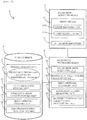
- a neurogenic baroreflex sensitivity measurement device 1 in this embodiment mainly includes pulse-wave detecting means 2 for detecting a pulse wave of an artery, storing means 3 for storing a neurogenic baroreflex sensitivity measurement program 1a in this embodiment and various data, and arithmetic processing means 4 for controlling these constituent means, acquiring various data, and executing arithmetic processing.
- the constituent means are explained below in detail.
- the pulse-wave detecting means 2 detects a volume pulse wave indicating a volume change in the artery.
- the pulse-wave detecting means 2 includes a photo-sensor 21 that detects a light amount and a pulse wave amplifier 22 that amplifies an output signal from the photo-sensor 21 and outputs the output signal as pulse wave data.
- the photo-sensor 21 includes a light emitting unit 21a such as an LED (Light Emitting Diode) fixed to a nail of a finger and a light receiving unit 21b such as a photodiode disposed on the ball side of the finger in a position opposed to the light emitting unit 21a.
- the photo-sensor 21 detects, with the light receiving unit 21b, an amount of light emitted from the light emitting unit 21a and transmitted through the finger.
- the pulse wave amplifier 22 outputs the amplified pulse wave data in time series.
- photoplethysmogram data is detected as the pulse wave data.
- the finger artery is used as a detection target region of the pulse wave data.
- the detection target region is not limited to this. That is, the ear, the nose, the palm, the wrist, the neck, the arm, the foot, and the like can be set as the detection target region as long as a pulse wave of an artery can be detected by the pulse-wave detecting means 2 in the region.
- the pulse-wave detecting means 2 is not limited to the configuration explained above and only has to be means that can detect a pulse wave of an artery.
- the pulse-wave detecting means 2 may be a wearable pulse wave sensor such as an earphone/earring type attachable to the ear, a bracelet type attachable to the wrist, the upper arm, or the like, or a ring type attachable to the finger. If such pulse-wave detecting means 2 is used, a burden in wearing the pulse-wave detecting means 2 is small. Further, detection in daily life is also possible.
- the storing means 3 stores various data and functions as a working area when the arithmetic processing means 4 performs the arithmetic processing.
- the storing means 3 is configured by a hard disk, a ROM (Read Only Memory), a RAM (Random Access Memory), a flash memory, and the like.
- the storing means 3 includes a program storing unit 31 that stores the neurogenic baroreflex sensitivity measurement program 1a in this embodiment, a pulse-wave-data storing unit 32, a normalized-pulse-volume storing unit 33, a beat-interval storing unit 34, and an electrocardiogram-data storing unit 35.
- the neurogenic baroreflex sensitivity measurement program 1a in this embodiment is installed.
- the neurogenic baroreflex sensitivity measurement program 1a is executed by the arithmetic processing means 4, whereby a computer such as a personal computer or a smart phone is caused to function as components explained below.
- the neurogenic baroreflex sensitivity measurement program 1a may be stored in a computer-readable recording medium such as a CD-ROM or a DVD-ROM, directly read out from the recording medium, and executed.
- the neurogenic baroreflex sensitivity measurement program 1a may be used from an external server or the like in an ASP (Application Service Provider) system or a cloud computing system.
- ASP Application Service Provider
- the pulse-wave-data storing unit 32 stores the pulse wave data detected by the pulse-wave detecting means 2.
- the normalized-pulse-volume storing unit 33 stores a normalized pulse volume calculated by a normalized-pulse-volume calculating unit 42 explained below.
- the beat-interval storing unit 34 stores a beat interval acquired by a beat-interval acquiring unit 43 explained below.
- the electrocardiogram-data storing unit 35 stores electrocardiogram data obtained by electrocardiogram acquiring means (not shown in the figure) such as an electrocardiograph.
- the arithmetic processing means 4 is configured from a CPU (Central Processing Unit) and the like.
- the arithmetic processing means 4 executes the neurogenic baroreflex sensitivity measurement program 1a to thereby function as a pulse-wave-data acquiring unit 41, a normalized-pulse-volume calculating unit 42, a beat-interval acquiring unit 43, a baroreflex-series detecting unit 44, and a neurogenic-baroreflex-sensitivity calculating unit 45.
- the components are explained more in detail below.
- the pulse-wave-data acquiring unit 41 acquires the pulse wave data of the artery detected by the pulse-wave detecting means 2 and stores the pulse wave data in the pulse-wave-data storing unit 32 in time series. Note that, in this embodiment, the pulse-wave-data acquiring unit 41 directly acquires the pulse wave data from the pulse-wave detecting means 2. However, the pulse-wave-data acquiring unit 41 is not limited to this configuration. For example, the pulse-wave-data acquiring unit 41 may download pulse wave data measured by another device via the Internet or may capture pulse wave data into the pulse-wave-data storing unit 32 from a recording medium such as a USB memory.
- the normalized-pulse-volume calculating unit 42 calculates the normalized pulse volume (NPV) explained above. Whereas the normalized pulse volume is evaluated by ⁇ I/I, a transmitted light amount ( ⁇ I) equivalent to a pulsation change is determined by the amplitude of an alternating-current component of a pulse wave. A transmitted light amount (I) of a detection target region (a tissue + blood) of the pulse wave is determined by an average of a direct-current component of the pulse wave at the same time.
- the normalized-pulse-volume calculating unit 42 divides, on the basis of the pulse wave data stored in the pulse-wave-data storing unit 32, the amplitude of the alternating-current component of the pulse wave by the average of the direct-current component of the pulse wave at the same time to thereby calculate the normalized pulse volume at every beat.
- the beat-interval acquiring unit 43 acquires a beat interval corresponding to pulse wave data.
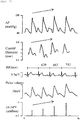
- the "beat interval” is a concept including all time intervals equivalent to one beat of a beat such as a pulse interval in the pulse wave data (an interval of a period of a black star mark in Figure 2 ), an interval of a rising portion of an alternating-current component of the pulse wave data (an interval in a period of a black circle mark in Figure 2 : hereinafter referred to as "rising interval”), and a heartbeat interval (an RR interval) in electrocardiogram data.
- the "beat interval corresponding to pulse wave data” is a concept including not only a beat interval in a period of time same as a period of time when the pulse wave data is acquired but also a beat interval later by one beat than the period of time when the pulse wave data is acquired.
- the beat interval is a heartbeat interval, as shown in Figure 2
- not only heartbeat intervals a, b, and c but also heartbeat intervals b, c, and d correspond to the "beat interval corresponding to pulse wave data" with respect to pulse waves A, B, and C.
- the beat-interval acquiring unit 43 refers to the pulse wave data stored in the pulse-wave-data storing unit 32 and acquires a pulse interval and a rising interval corresponding to the pulse wave data in time series. Note that, in this embodiment, in measurement for an aged person whose pulse interval and rising interval are less easily discriminated, electrocardiogram data is separately prepared in the electrocardiogram-data storing unit 35. In this case, the beat-interval acquiring unit 43 refers to the electrocardiogram data and acquires a heartbeat interval corresponding to the pulse wave data in time series.
- the baroreflex-series detecting unit 44 detects a baroreflex series not affected by the sympathetic nervous system of a blood vessel. Specifically, the baroreflex-series detecting unit 44 refers to the normalized pulse volume in the normalized-pulse-volume storing unit 33 and the beat interval in the beat-interval storing unit 34 and detects, as the baroreflex series, a rising series in which both of the normalized pulse volume and the beat interval continuously increase for three beats or more or a falling series in which both of the normalized pulse volume and the beat interval continuously decrease for three beats or more.
- the neurogenic-baroreflex-sensitivity calculating unit 45 calculates neurogenic baroreflex sensitivity, which is an index indicating a neurogenic baroreflex function.
- the neurogenic-baroreflex-sensitivity calculating unit 45 acquires data of the baroreflex series detected by the baroreflex-series detecting unit 44 and calculates, as the neurogenic baroreflex sensitivity, a slope of a regression line indicating a correlation between the normalized pulse volume and the beat interval in the baroreflex series.
- the neurogenic baroreflex sensitivity measurement device 1 is configured by the personal computer including the storing means 3 and the arithmetic processing means 4.
- the pulse-wave detecting means 2 is separately connected as a peripheral device.
- a device configuration is not limited to the configuration explained above.
- the pulse-wave-data acquiring unit 41 acquires pulse wave data (step S1: a pulse-wave-data acquiring step).
- the normalized-pulse-volume calculating unit 42 divides, on the basis of the pulse wave data acquired in step S1, the amplitude of an alternating-current component of a pulse wave by an average of a direct-current component of the pulse wave at the same time to thereby calculate a normalized pulse volume at every beat (step S2: a normalized-pulse-volume calculating step).
- a correct pulsation change amount ( ⁇ Va) is calculated without being affected by a difference in the tissue component. That is, since the normalized pulse volume is a dimensionless absolute amount, the normalized pulse volume has a merit that not only comparison of measurement results acquired in different date and times concerning the same subject but also comparison between individuals is possible and, moreover, an error due to the tissue component of the fingertip is excluded.
- step S3 a beat-interval acquiring step
- step S4 a baroreflex-series detecting step
- the number of continuous beats detected as the baroreflex series is set to three beats or more in order to guarantee reliability that the baroreflex series is not affected by the sympathetic nervous system.
- the neurogenic-baroreflex-sensitivity calculating unit 45 calculates, on the basis of the data of the baroreflex series detected by the baroreflex-series detecting unit 44, a slope of a regression line indicating a correlation between the normalized pulse volume and the beat interval in the baroreflex series as neurogenic baroreflex sensitivity (step S5). Consequently, the neurogenic baroreflex sensitivity is measured using the normalized pulse volume instead of the blood vessel diameter of the carotid in the echo method.
- a continuous blood pressure measurement device (device name: MUB101, manufacturer: Medisens Inc.), electrocardiogram detecting means (device name: LRR-03, manufacturer: GMS Co., Ltd.), and pulse-wave detecting means 2 (device name: MPN1001, manufacturer: Medisens Inc.) were attached to a subject (20 years old, male) to measure a blood pressure (AP), a heartbeat interval (RRI), and pulse wave data for 540 seconds in time series.
- AP blood pressure
- RRI heartbeat interval
- pulse wave data for 540 seconds in time series.
- an ultrasonic probe (device name: UNEXEF38G, manufacturer: UNEX Corporation) was fixed to the neck of the subject to measure a diameter change (Carotid Diameter) in a carotid.
- Measured data of these devices were processed by the neurogenic baroreflex sensitivity measurement device 1 in this embodiment and a UNEX EF (device name: UNEXEF38G, manufacturer: UNEX Corporation) to calculate integrated baroreflex sensitivity (Int BRS) by the conventional sequence method, neurogenic baroreflex sensitivity (nBRS (NPV)) according to the present invention, and neurogenic baroreflex sensitivity (nBRS (D)) by the conventional echo method.
- UNEX EF integrated baroreflex sensitivity
- NBRS neurogenic baroreflex sensitivity
- D neurogenic baroreflex sensitivity
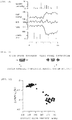
- Figure 7 is a graph of an example of a baroreflex series before and after approximately 80 seconds from a measurement start extracted from the measured data in Figure 6 .
- Figure 8 is a scatter diagram in the baroreflex series in Figure 7 , wherein Figure 8A is a diagram showing integrated baroreflex sensitivity (Int BRS) by the sequence method, Figure 8B is a diagram showing neurogenic baroreflex sensitivity (nBRS (NPV)) according to the present invention, and Figure 8C is a diagram showing neurogenic baroreflex sensitivity (nBRS (D)) by the echo method.
- Figure 8A is a diagram showing integrated baroreflex sensitivity (Int BRS) by the sequence method
- Figure 8B is a diagram showing neurogenic baroreflex sensitivity (nBRS (NPV)) according to the present invention
- Figure 8C is a diagram showing neurogenic baroreflex sensitivity (nBRS (D)) by the echo method.
- the baroreflex series according to the present invention that is, a baroreflex series in which both of a normalized pulse volume and a beat interval continuously increase or decrease for three beats or more and that is not affected by a sympathetic nervous is present.
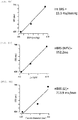
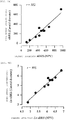
- Figure 9A is a graph showing a correlation between neurogenic baroreflex sensitivity according to the present invention and neurogenic baroreflex sensitivity by the echo method.
- Figure 9B is a graph showing a correlation between natural logarithms (Ln) of the neurogenic baroreflex sensitivity according to the present invention and natural logarithms (Ln) of the neurogenic baroreflex sensitivity by the echo method.
- a correlation coefficient r in Figure 9A was 0.952.
- the correlation coefficient r in Figure 9B was 0.976. That is, in both the graphs, a high correlation was found between the neurogenic baroreflex sensitivity according to the present invention and the neurogenic baroreflex sensitivity by the echo method.
- neurogenic baroreflex sensitivity measurement device 1 the neurogenic baroreflex sensitivity measurement program 1a, and the neurogenic baroreflex sensitivity measurement method according to the present invention are not limited to the embodiment and the examples explained above and can be changed as appropriate.
- a display table (e.g., good, fair, bad) indicating evaluations of sensitivity of a baroreflex function in association with a numerical value range of neurogenic baroreflex sensitivity may be stored in the storing means 3.
- the evaluations concerning the sensitivity of the baroreflex function may be output from display means or printing means and presented to a subject on the basis of a value of the neurogenic baroreflex sensitivity calculated by the neurogenic-baroreflex-sensitivity calculating unit 45.
- the neurogenic baroreflex sensitivity measurement device 1 As explained above, if the neurogenic baroreflex sensitivity measurement device 1 according to the present invention can be reduced in size to a portable terminal size of a smart phone and the like, the neurogenic baroreflex sensitivity measurement device 1 is considered to be widely spread for home use and personal use as health devices that can be easily handled by everyone from children to aged people.
Landscapes
- Health & Medical Sciences (AREA)
- Life Sciences & Earth Sciences (AREA)
- Engineering & Computer Science (AREA)
- Public Health (AREA)
- Molecular Biology (AREA)
- Veterinary Medicine (AREA)
- General Health & Medical Sciences (AREA)
- Physics & Mathematics (AREA)
- Animal Behavior & Ethology (AREA)
- Biophysics (AREA)
- Pathology (AREA)
- Biomedical Technology (AREA)
- Heart & Thoracic Surgery (AREA)
- Medical Informatics (AREA)
- Physiology (AREA)
- Surgery (AREA)
- Cardiology (AREA)
- Neurology (AREA)
- Computer Vision & Pattern Recognition (AREA)
- Signal Processing (AREA)
- Artificial Intelligence (AREA)
- Psychiatry (AREA)
- Neurosurgery (AREA)
- Hematology (AREA)
- Vascular Medicine (AREA)
- Measuring Pulse, Heart Rate, Blood Pressure Or Blood Flow (AREA)
- Measurement And Recording Of Electrical Phenomena And Electrical Characteristics Of The Living Body (AREA)
Claims (7)
- Messvorrichtung für neurogene Baroreflexsensitivität, umfassend:eine Pulswellendaten-Erlangungseinheit (41), die Pulswellendaten einer Arterie erlangt;eine Berechnungseinheit für normalisiertes Pulsvolumen (42), die auf der Basis der Pulswellendaten ein normalisiertes Pulsvolumen berechnet, das durch Teilen einer Amplitude einer Wechselstromkomponente einer Pulswelle durch einen Durchschnitt einer Gleichstromkomponente der Pulswelle zur selben Zeit erhalten wird;eine Taktintervall-Erlangungseinheit (43), die ein Taktintervall entsprechend den Pulswellendaten erlangt;eine Baroreflexserien-Erfassungseinheit (44), die eine Baroreflexserie erfasst, in welcher sowohl das normalisierte Pulsvolumen als auch das Taktintervall für drei Takte oder mehr kontinuierlich größer oder kleiner werden; undeine Berechnungseinheit für neurogene Baroreflexsensitivität (45), die als neurogene Baroreflexsensitivität, die ein Index ist, der eine neurogene Baroreflexfunktion anzeigt, eine Steigung einer Regressionslinie berechnet, die eine Korrelation zwischen dem normalisierten Pulsvolumen und dem Taktintervall in der Baroreflexserie anzeigt.
- Messvorrichtung für neurogene Baroreflexsensitivität nach Anspruch 1,
wobei die Taktintervall-Erlangungseinheit (43) dazu geeignet ist, das Taktintervall basierend auf Elektrokardiogrammdaten zu erlangen. - Messvorrichtung für neurogene Baroreflexsensitivität nach Anspruch 1 oder 2, weiterhin umfassend:eine Speichereinrichtung (3) zum Speichern einer Anzeigetabelle, die Auswertungen einer Sensitivität bzw. Empfindlichkeit einer Baroreflexfunktion in Verbindung mit einem numerischen Wertebereich von neurogener Baroreflexsensitivität anzeigt, undeine Einrichtung zum Ausgeben, unter Verwendung der Anzeigetabelle, von Auswertungen einer Sensitivität bzw. Empfindlichkeit der Baroreflexfunktion basierend auf der durch die Berechnungseinheit für neurogene Baroreflexsensitivität (45) berechneten neurogenen Baroreflexsensitivität.
- Messprogramm für neurogene Baroreflexsensitivität, dass veranlasst, dass ein Computer arbeitet als:eine Pulswellendaten-Erlangungseinheit (41), die Pulswellendaten einer Arterie erlangt;eine Berechnungseinheit für normalisiertes Pulsvolumen (42), die auf der Basis der Pulswellendaten ein normalisiertes Pulsvolumen berechnet, das durch Teilen einer Amplitude einer Wechselstromkomponente einer Pulswelle durch einen Durchschnitt einer Gleichstromkomponente der Pulswelle zur selben Zeit erhalten wird;eine Taktintervall-Erlangungseinheit (43), die ein Taktintervall entsprechend den Pulswellendaten erlangt;eine Baroreflexserien-Erfassungseinheit (44), die eine Baroreflexserie erfasst, in welcher sowohl das normalisierte Pulsvolumen als auch das Taktintervall für drei Takte oder mehr kontinuierlich größer oder kleiner werden; undeine Berechnungseinheit für neurogene Baroreflexsensitivität (45), die als neurogene Baroreflexsensitivität, die ein Index ist, der eine neurogene Baroreflexfunktion anzeigt, eine Steigung einer Regressionslinie berechnet, die eine Korrelation zwischen dem normalisierten Pulsvolumen und dem Taktintervall in der Baroreflexserie anzeigt.
- Messverfahren für neurogene Baroreflexsensitivität, das durch eine Vorrichtung nach Anspruch 1 durchgeführt wird, umfassend:einen Pulswellendaten-Erlangungsschritt (S1) zum Erlangen von Pulswellendaten einer Arterie;einen Berechnungsschritt für normalisiertes Pulsvolumen (S2) zum Berechnen eines normalisierten Pulsvolumens auf der Basis der Pulswellendaten, das durch Teilen einer Amplitude einer Wechselstromkomponente einer Pulswelle durch einen Durchschnitt einer Gleichstromkomponente der Pulswelle zur selben Zeit erhalten wird;einen Taktintervall-Erlangungsschritt (S3) zum Erlangen eines Taktintervalls entsprechend den Pulswellendaten;einen Baroreflexserien-Erfassungsschritt (S4) zum Erfassen einer Baroreflexserie, in welcher sowohl das normalisierte Pulsvolumen als auch das Taktintervall für drei Takte oder mehr kontinuierlich größer oder kleiner werden; undeinen Berechnungsschritt für neurogene Baroreflexsensitivität (S5) zum Berechnen als neurogene Baroreflexsensitivität, die ein Index ist, der eine neurogene Baroreflexfunktion anzeigt, einer Steigung einer Regressionslinie, die eine Korrelation zwischen dem normalisierten Pulsvolumen und dem Taktintervall in der Baroreflexserie anzeigt.
- Messverfahren für neurogene Baroreflexsensitivität nach Anspruch 5,
wobei beim Taktintervall-Erlangungsschritt (S3) das Taktintervall basierend auf Elektrokardiogrammdaten erlangt wird. - Messverfahren für neurogene Baroreflexsensitivität nach Anspruch 5 oder 6, weiterhin umfassend:
Verwenden einer Anzeigetabelle, die Auswertungen einer Sensitivität bzw. Empfindlichkeit einer Baroreflexfunktion in Verbindung mit einem numerischen Wertebereich von neurogener Baroreflexsensitivität anzeigt, Ausgeben von Auswertungen einer Sensitivität bzw. Empfindlichkeit der Baroreflexfunktion basierend auf der beim Berechnungsschritt für neurogene Baroreflexsensitivität (S5) berechneten neurogenen Baroreflexsensitivität.
Applications Claiming Priority (2)
| Application Number | Priority Date | Filing Date | Title |
|---|---|---|---|
| JP2013074027 | 2013-03-29 | ||
| PCT/JP2014/059081 WO2014157605A1 (ja) | 2013-03-29 | 2014-03-28 | 神経性圧反射感度測定装置、神経性圧反射感度測定プログラムおよび神経性圧反射感度測定方法 |
Publications (3)
| Publication Number | Publication Date |
|---|---|
| EP2979632A1 EP2979632A1 (de) | 2016-02-03 |
| EP2979632A4 EP2979632A4 (de) | 2016-12-07 |
| EP2979632B1 true EP2979632B1 (de) | 2020-12-16 |
Family
ID=51624561
Family Applications (1)
| Application Number | Title | Priority Date | Filing Date |
|---|---|---|---|
| EP14773453.7A Active EP2979632B1 (de) | 2013-03-29 | 2014-03-28 | Neurogene baroreflex-empfindlichkeitsmessvorrichtung, neurogenes baroreflex-empfindlichkeitsmessprogramm und neurogenes baroreflex-empfindlichkeitsmessverfahren |
Country Status (4)
| Country | Link |
|---|---|
| US (1) | US9826909B2 (de) |
| EP (1) | EP2979632B1 (de) |
| JP (1) | JP6297539B2 (de) |
| WO (1) | WO2014157605A1 (de) |
Families Citing this family (3)
| Publication number | Priority date | Publication date | Assignee | Title |
|---|---|---|---|---|
| JP6626408B2 (ja) * | 2016-05-31 | 2019-12-25 | 日本電信電話株式会社 | 血流量測定装置および血流量測定方法 |
| EP3603495B1 (de) * | 2017-03-30 | 2024-10-23 | Sapporo Medical University | Vorrichtung zum nachweis von vaskulärer baroreflex-sympathikusaktivität, programm zunachweis von vaskulärer baroreflex-sympathikusaktivität und verfahren zum nachweis von vaskulärer baroreflex-sympathikusaktivität |
| US20210393188A1 (en) * | 2020-06-19 | 2021-12-23 | The Regents Of The University Of Michigan | Quantification of intermittent function of baroreflex from continuous arterial pressure data |
Family Cites Families (8)
| Publication number | Priority date | Publication date | Assignee | Title |
|---|---|---|---|---|
| US6616613B1 (en) * | 2000-04-27 | 2003-09-09 | Vitalsines International, Inc. | Physiological signal monitoring system |
| JP3632014B2 (ja) | 2002-05-14 | 2005-03-23 | コーリンメディカルテクノロジー株式会社 | 血管内皮機能評価装置 |
| US8672852B2 (en) * | 2002-12-13 | 2014-03-18 | Intercure Ltd. | Apparatus and method for beneficial modification of biorhythmic activity |
| AU2004203059A1 (en) * | 2004-06-08 | 2005-12-22 | The Government Of The United States Of America As Represented By The Secretary Of The Department Of Health And Human Services, Centers For Disease Control And Prevention | Apparatus and method for assessing peripheral circulation to evaluate a physiological condition |
| JP4789203B2 (ja) | 2006-10-02 | 2011-10-12 | フクダ電子株式会社 | 血圧反射機能測定装置 |
| DE602008004315D1 (de) * | 2007-02-28 | 2011-02-17 | Univ Sapporo Medical | Programm zur messung der elastizität der fingerarterie, vorrichtung zur messung der elastizität der fingerarterie und verfahren zur messung der elastizität der fingerarterie |
| US20090124914A1 (en) * | 2007-11-08 | 2009-05-14 | Kuo Terry B J | Analysis system and a method for pulse diagnosis in chinese medicine |
| JP5504477B2 (ja) * | 2010-03-16 | 2014-05-28 | 国立大学法人富山大学 | 指尖脈波解析装置及びこれを用いた血管内皮機能評価システム |
-
2014
- 2014-03-28 EP EP14773453.7A patent/EP2979632B1/de active Active
- 2014-03-28 US US14/775,827 patent/US9826909B2/en active Active
- 2014-03-28 WO PCT/JP2014/059081 patent/WO2014157605A1/ja not_active Ceased
- 2014-03-28 JP JP2015508749A patent/JP6297539B2/ja active Active
Non-Patent Citations (1)
| Title |
|---|
| None * |
Also Published As
| Publication number | Publication date |
|---|---|
| EP2979632A1 (de) | 2016-02-03 |
| JPWO2014157605A1 (ja) | 2017-02-16 |
| WO2014157605A1 (ja) | 2014-10-02 |
| JP6297539B2 (ja) | 2018-03-20 |
| US20160029909A1 (en) | 2016-02-04 |
| US9826909B2 (en) | 2017-11-28 |
| EP2979632A4 (de) | 2016-12-07 |
Similar Documents
| Publication | Publication Date | Title |
|---|---|---|
| EP3440995B1 (de) | Vorrichtung, system und programm zur analyse biologischer informationen | |
| JP6130474B2 (ja) | 体重計装置及び脈波速度取得方法 | |
| JP4645259B2 (ja) | 血圧測定装置 | |
| US20180199824A1 (en) | Device for measuring biological signals | |
| US20160270708A1 (en) | Bio-information measurement device and method therefor | |
| CN112272534B (zh) | 用于估计血压替代物趋势的方法和装置 | |
| WO2021188878A1 (en) | Methods and systems for non-invasive cuff-less blood pressure monitoring | |
| CN107466222A (zh) | 生命体征监测系统 | |
| JP6203737B2 (ja) | 指細小動脈拡張能検査方法、指細小動脈拡張能検査装置および指細小動脈拡張能検査プログラム | |
| JP7462572B2 (ja) | ストレスおよび/または疼痛レベルを決定するための装置、システム、該システムの作動方法、該システムの作動方法を実行するコンピュータ可読コードを有するコンピュータ可読媒体 | |
| Di Rienzo et al. | Multi-site pulse transit times, beat-to-beat blood pressure, and isovolumic contraction time at rest and under stressors | |
| US20140316291A1 (en) | Measurement device, evaluating method, and evaluation program | |
| EP2979632B1 (de) | Neurogene baroreflex-empfindlichkeitsmessvorrichtung, neurogenes baroreflex-empfindlichkeitsmessprogramm und neurogenes baroreflex-empfindlichkeitsmessverfahren | |
| WO2009147597A1 (en) | Detection of impending syncope of a patient | |
| US11517207B2 (en) | Baroreflex vascular sympathetic nervous activity detection device, baroreflex vascular sympathetic nervous activity detection program, and baroreflex vascular sympathetic nervous activity detection method | |
| JP7261491B2 (ja) | 生体情報測定装置 | |
| US12364405B1 (en) | Hemodynamic determination of arterial stiffness, arterial age, arterial deposits and HBA1C | |
| JP7675335B2 (ja) | 血行動態推定方法 | |
| JP2018068556A (ja) | 胸腔内圧推定装置 | |
| US20140243691A1 (en) | Measurement device, index calculating method, and index calculating program | |
| JP4453431B2 (ja) | 生体情報測定装置 | |
| WO2017171802A1 (en) | Aortic stenosis screening |
Legal Events
| Date | Code | Title | Description |
|---|---|---|---|
| PUAI | Public reference made under article 153(3) epc to a published international application that has entered the european phase |
Free format text: ORIGINAL CODE: 0009012 |
|
| 17P | Request for examination filed |
Effective date: 20151029 |
|
| AK | Designated contracting states |
Kind code of ref document: A1 Designated state(s): AL AT BE BG CH CY CZ DE DK EE ES FI FR GB GR HR HU IE IS IT LI LT LU LV MC MK MT NL NO PL PT RO RS SE SI SK SM TR |
|
| AX | Request for extension of the european patent |
Extension state: BA ME |
|
| RIN1 | Information on inventor provided before grant (corrected) |
Inventor name: KATO, YUICHI |
|
| DAX | Request for extension of the european patent (deleted) | ||
| A4 | Supplementary search report drawn up and despatched |
Effective date: 20161108 |
|
| RIC1 | Information provided on ipc code assigned before grant |
Ipc: A61B 10/00 20060101ALI20161102BHEP Ipc: A61B 5/0245 20060101AFI20161102BHEP Ipc: A61B 5/026 20060101ALI20161102BHEP Ipc: A61B 5/00 20060101ALI20161102BHEP Ipc: A61B 5/024 20060101ALI20161102BHEP |
|
| GRAP | Despatch of communication of intention to grant a patent |
Free format text: ORIGINAL CODE: EPIDOSNIGR1 |
|
| STAA | Information on the status of an ep patent application or granted ep patent |
Free format text: STATUS: GRANT OF PATENT IS INTENDED |
|
| INTG | Intention to grant announced |
Effective date: 20200709 |
|
| GRAS | Grant fee paid |
Free format text: ORIGINAL CODE: EPIDOSNIGR3 |
|
| GRAA | (expected) grant |
Free format text: ORIGINAL CODE: 0009210 |
|
| STAA | Information on the status of an ep patent application or granted ep patent |
Free format text: STATUS: THE PATENT HAS BEEN GRANTED |
|
| AK | Designated contracting states |
Kind code of ref document: B1 Designated state(s): AL AT BE BG CH CY CZ DE DK EE ES FI FR GB GR HR HU IE IS IT LI LT LU LV MC MK MT NL NO PL PT RO RS SE SI SK SM TR |
|
| REG | Reference to a national code |
Ref country code: GB Ref legal event code: FG4D |
|
| REG | Reference to a national code |
Ref country code: DE Ref legal event code: R096 Ref document number: 602014073405 Country of ref document: DE |
|
| REG | Reference to a national code |
Ref country code: IE Ref legal event code: FG4D |
|
| REG | Reference to a national code |
Ref country code: AT Ref legal event code: REF Ref document number: 1344819 Country of ref document: AT Kind code of ref document: T Effective date: 20210115 |
|
| PG25 | Lapsed in a contracting state [announced via postgrant information from national office to epo] |
Ref country code: FI Free format text: LAPSE BECAUSE OF FAILURE TO SUBMIT A TRANSLATION OF THE DESCRIPTION OR TO PAY THE FEE WITHIN THE PRESCRIBED TIME-LIMIT Effective date: 20201216 Ref country code: RS Free format text: LAPSE BECAUSE OF FAILURE TO SUBMIT A TRANSLATION OF THE DESCRIPTION OR TO PAY THE FEE WITHIN THE PRESCRIBED TIME-LIMIT Effective date: 20201216 Ref country code: NO Free format text: LAPSE BECAUSE OF FAILURE TO SUBMIT A TRANSLATION OF THE DESCRIPTION OR TO PAY THE FEE WITHIN THE PRESCRIBED TIME-LIMIT Effective date: 20210316 Ref country code: GR Free format text: LAPSE BECAUSE OF FAILURE TO SUBMIT A TRANSLATION OF THE DESCRIPTION OR TO PAY THE FEE WITHIN THE PRESCRIBED TIME-LIMIT Effective date: 20210317 |
|
| REG | Reference to a national code |
Ref country code: AT Ref legal event code: MK05 Ref document number: 1344819 Country of ref document: AT Kind code of ref document: T Effective date: 20201216 |
|
| REG | Reference to a national code |
Ref country code: NL Ref legal event code: MP Effective date: 20201216 |
|
| PG25 | Lapsed in a contracting state [announced via postgrant information from national office to epo] |
Ref country code: LV Free format text: LAPSE BECAUSE OF FAILURE TO SUBMIT A TRANSLATION OF THE DESCRIPTION OR TO PAY THE FEE WITHIN THE PRESCRIBED TIME-LIMIT Effective date: 20201216 Ref country code: SE Free format text: LAPSE BECAUSE OF FAILURE TO SUBMIT A TRANSLATION OF THE DESCRIPTION OR TO PAY THE FEE WITHIN THE PRESCRIBED TIME-LIMIT Effective date: 20201216 Ref country code: BG Free format text: LAPSE BECAUSE OF FAILURE TO SUBMIT A TRANSLATION OF THE DESCRIPTION OR TO PAY THE FEE WITHIN THE PRESCRIBED TIME-LIMIT Effective date: 20210316 |
|
| PG25 | Lapsed in a contracting state [announced via postgrant information from national office to epo] |
Ref country code: NL Free format text: LAPSE BECAUSE OF FAILURE TO SUBMIT A TRANSLATION OF THE DESCRIPTION OR TO PAY THE FEE WITHIN THE PRESCRIBED TIME-LIMIT Effective date: 20201216 Ref country code: HR Free format text: LAPSE BECAUSE OF FAILURE TO SUBMIT A TRANSLATION OF THE DESCRIPTION OR TO PAY THE FEE WITHIN THE PRESCRIBED TIME-LIMIT Effective date: 20201216 |
|
| REG | Reference to a national code |
Ref country code: LT Ref legal event code: MG9D |
|
| PG25 | Lapsed in a contracting state [announced via postgrant information from national office to epo] |
Ref country code: SM Free format text: LAPSE BECAUSE OF FAILURE TO SUBMIT A TRANSLATION OF THE DESCRIPTION OR TO PAY THE FEE WITHIN THE PRESCRIBED TIME-LIMIT Effective date: 20201216 Ref country code: CZ Free format text: LAPSE BECAUSE OF FAILURE TO SUBMIT A TRANSLATION OF THE DESCRIPTION OR TO PAY THE FEE WITHIN THE PRESCRIBED TIME-LIMIT Effective date: 20201216 Ref country code: EE Free format text: LAPSE BECAUSE OF FAILURE TO SUBMIT A TRANSLATION OF THE DESCRIPTION OR TO PAY THE FEE WITHIN THE PRESCRIBED TIME-LIMIT Effective date: 20201216 Ref country code: PT Free format text: LAPSE BECAUSE OF FAILURE TO SUBMIT A TRANSLATION OF THE DESCRIPTION OR TO PAY THE FEE WITHIN THE PRESCRIBED TIME-LIMIT Effective date: 20210416 Ref country code: RO Free format text: LAPSE BECAUSE OF FAILURE TO SUBMIT A TRANSLATION OF THE DESCRIPTION OR TO PAY THE FEE WITHIN THE PRESCRIBED TIME-LIMIT Effective date: 20201216 Ref country code: SK Free format text: LAPSE BECAUSE OF FAILURE TO SUBMIT A TRANSLATION OF THE DESCRIPTION OR TO PAY THE FEE WITHIN THE PRESCRIBED TIME-LIMIT Effective date: 20201216 Ref country code: LT Free format text: LAPSE BECAUSE OF FAILURE TO SUBMIT A TRANSLATION OF THE DESCRIPTION OR TO PAY THE FEE WITHIN THE PRESCRIBED TIME-LIMIT Effective date: 20201216 |
|
| PG25 | Lapsed in a contracting state [announced via postgrant information from national office to epo] |
Ref country code: PL Free format text: LAPSE BECAUSE OF FAILURE TO SUBMIT A TRANSLATION OF THE DESCRIPTION OR TO PAY THE FEE WITHIN THE PRESCRIBED TIME-LIMIT Effective date: 20201216 Ref country code: AT Free format text: LAPSE BECAUSE OF FAILURE TO SUBMIT A TRANSLATION OF THE DESCRIPTION OR TO PAY THE FEE WITHIN THE PRESCRIBED TIME-LIMIT Effective date: 20201216 |
|
| REG | Reference to a national code |
Ref country code: DE Ref legal event code: R097 Ref document number: 602014073405 Country of ref document: DE |
|
| PG25 | Lapsed in a contracting state [announced via postgrant information from national office to epo] |
Ref country code: IS Free format text: LAPSE BECAUSE OF FAILURE TO SUBMIT A TRANSLATION OF THE DESCRIPTION OR TO PAY THE FEE WITHIN THE PRESCRIBED TIME-LIMIT Effective date: 20210416 |
|
| PLBE | No opposition filed within time limit |
Free format text: ORIGINAL CODE: 0009261 |
|
| STAA | Information on the status of an ep patent application or granted ep patent |
Free format text: STATUS: NO OPPOSITION FILED WITHIN TIME LIMIT |
|
| PG25 | Lapsed in a contracting state [announced via postgrant information from national office to epo] |
Ref country code: AL Free format text: LAPSE BECAUSE OF FAILURE TO SUBMIT A TRANSLATION OF THE DESCRIPTION OR TO PAY THE FEE WITHIN THE PRESCRIBED TIME-LIMIT Effective date: 20201216 Ref country code: MC Free format text: LAPSE BECAUSE OF FAILURE TO SUBMIT A TRANSLATION OF THE DESCRIPTION OR TO PAY THE FEE WITHIN THE PRESCRIBED TIME-LIMIT Effective date: 20201216 Ref country code: IT Free format text: LAPSE BECAUSE OF FAILURE TO SUBMIT A TRANSLATION OF THE DESCRIPTION OR TO PAY THE FEE WITHIN THE PRESCRIBED TIME-LIMIT Effective date: 20201216 |
|
| REG | Reference to a national code |
Ref country code: CH Ref legal event code: PL |
|
| 26N | No opposition filed |
Effective date: 20210917 |
|
| PG25 | Lapsed in a contracting state [announced via postgrant information from national office to epo] |
Ref country code: DK Free format text: LAPSE BECAUSE OF FAILURE TO SUBMIT A TRANSLATION OF THE DESCRIPTION OR TO PAY THE FEE WITHIN THE PRESCRIBED TIME-LIMIT Effective date: 20201216 Ref country code: ES Free format text: LAPSE BECAUSE OF FAILURE TO SUBMIT A TRANSLATION OF THE DESCRIPTION OR TO PAY THE FEE WITHIN THE PRESCRIBED TIME-LIMIT Effective date: 20201216 |
|
| REG | Reference to a national code |
Ref country code: BE Ref legal event code: MM Effective date: 20210331 |
|
| PG25 | Lapsed in a contracting state [announced via postgrant information from national office to epo] |
Ref country code: LI Free format text: LAPSE BECAUSE OF NON-PAYMENT OF DUE FEES Effective date: 20210331 Ref country code: LU Free format text: LAPSE BECAUSE OF NON-PAYMENT OF DUE FEES Effective date: 20210328 Ref country code: CH Free format text: LAPSE BECAUSE OF NON-PAYMENT OF DUE FEES Effective date: 20210331 Ref country code: IE Free format text: LAPSE BECAUSE OF NON-PAYMENT OF DUE FEES Effective date: 20210328 Ref country code: FR Free format text: LAPSE BECAUSE OF NON-PAYMENT OF DUE FEES Effective date: 20210331 |
|
| PG25 | Lapsed in a contracting state [announced via postgrant information from national office to epo] |
Ref country code: SI Free format text: LAPSE BECAUSE OF FAILURE TO SUBMIT A TRANSLATION OF THE DESCRIPTION OR TO PAY THE FEE WITHIN THE PRESCRIBED TIME-LIMIT Effective date: 20201216 |
|
| PG25 | Lapsed in a contracting state [announced via postgrant information from national office to epo] |
Ref country code: IS Free format text: LAPSE BECAUSE OF FAILURE TO SUBMIT A TRANSLATION OF THE DESCRIPTION OR TO PAY THE FEE WITHIN THE PRESCRIBED TIME-LIMIT Effective date: 20210416 |
|
| PG25 | Lapsed in a contracting state [announced via postgrant information from national office to epo] |
Ref country code: BE Free format text: LAPSE BECAUSE OF NON-PAYMENT OF DUE FEES Effective date: 20210331 |
|
| PG25 | Lapsed in a contracting state [announced via postgrant information from national office to epo] |
Ref country code: HU Free format text: LAPSE BECAUSE OF FAILURE TO SUBMIT A TRANSLATION OF THE DESCRIPTION OR TO PAY THE FEE WITHIN THE PRESCRIBED TIME-LIMIT; INVALID AB INITIO Effective date: 20140328 |
|
| PG25 | Lapsed in a contracting state [announced via postgrant information from national office to epo] |
Ref country code: CY Free format text: LAPSE BECAUSE OF FAILURE TO SUBMIT A TRANSLATION OF THE DESCRIPTION OR TO PAY THE FEE WITHIN THE PRESCRIBED TIME-LIMIT Effective date: 20201216 |
|
| PG25 | Lapsed in a contracting state [announced via postgrant information from national office to epo] |
Ref country code: MK Free format text: LAPSE BECAUSE OF FAILURE TO SUBMIT A TRANSLATION OF THE DESCRIPTION OR TO PAY THE FEE WITHIN THE PRESCRIBED TIME-LIMIT Effective date: 20201216 |
|
| PG25 | Lapsed in a contracting state [announced via postgrant information from national office to epo] |
Ref country code: TR Free format text: LAPSE BECAUSE OF FAILURE TO SUBMIT A TRANSLATION OF THE DESCRIPTION OR TO PAY THE FEE WITHIN THE PRESCRIBED TIME-LIMIT Effective date: 20201216 |
|
| PG25 | Lapsed in a contracting state [announced via postgrant information from national office to epo] |
Ref country code: MT Free format text: LAPSE BECAUSE OF FAILURE TO SUBMIT A TRANSLATION OF THE DESCRIPTION OR TO PAY THE FEE WITHIN THE PRESCRIBED TIME-LIMIT Effective date: 20201216 |
|
| PGFP | Annual fee paid to national office [announced via postgrant information from national office to epo] |
Ref country code: DE Payment date: 20250319 Year of fee payment: 12 |
|
| PGFP | Annual fee paid to national office [announced via postgrant information from national office to epo] |
Ref country code: GB Payment date: 20250321 Year of fee payment: 12 |