EP2980570A1 - Blutauswertungsvorrichtung, blutauswertungssystem, blutauswertungsverfahren und programm - Google Patents
Blutauswertungsvorrichtung, blutauswertungssystem, blutauswertungsverfahren und programm Download PDFInfo
- Publication number
- EP2980570A1 EP2980570A1 EP14773633.4A EP14773633A EP2980570A1 EP 2980570 A1 EP2980570 A1 EP 2980570A1 EP 14773633 A EP14773633 A EP 14773633A EP 2980570 A1 EP2980570 A1 EP 2980570A1
- Authority
- EP
- European Patent Office
- Prior art keywords
- blood
- electrical characteristic
- evaluation
- state
- state evaluation
- Prior art date
- Legal status (The legal status is an assumption and is not a legal conclusion. Google has not performed a legal analysis and makes no representation as to the accuracy of the status listed.)
- Granted
Links
Images



Classifications
-
- G—PHYSICS
- G01—MEASURING; TESTING
- G01N—INVESTIGATING OR ANALYSING MATERIALS BY DETERMINING THEIR CHEMICAL OR PHYSICAL PROPERTIES
- G01N33/00—Investigating or analysing materials by specific methods not covered by groups G01N1/00 - G01N31/00
- G01N33/48—Biological material, e.g. blood, urine; Haemocytometers
- G01N33/50—Chemical analysis of biological material, e.g. blood, urine; Testing involving biospecific ligand binding methods; Immunological testing
- G01N33/86—Chemical analysis of biological material, e.g. blood, urine; Testing involving biospecific ligand binding methods; Immunological testing involving blood coagulating time or factors, or their receptors
-
- G—PHYSICS
- G01—MEASURING; TESTING
- G01N—INVESTIGATING OR ANALYSING MATERIALS BY DETERMINING THEIR CHEMICAL OR PHYSICAL PROPERTIES
- G01N27/00—Investigating or analysing materials by the use of electric, electrochemical, or magnetic means
- G01N27/02—Investigating or analysing materials by the use of electric, electrochemical, or magnetic means by investigating impedance
- G01N27/026—Dielectric impedance spectroscopy
-
- G—PHYSICS
- G01—MEASURING; TESTING
- G01N—INVESTIGATING OR ANALYSING MATERIALS BY DETERMINING THEIR CHEMICAL OR PHYSICAL PROPERTIES
- G01N33/00—Investigating or analysing materials by specific methods not covered by groups G01N1/00 - G01N31/00
- G01N33/48—Biological material, e.g. blood, urine; Haemocytometers
- G01N33/483—Physical analysis of biological material
- G01N33/487—Physical analysis of biological material of liquid biological material
- G01N33/49—Blood
- G01N33/4905—Determining clotting time of blood
Definitions
- the present technology relates to a blood state evaluation device, a blood state evaluation system, a blood state evaluation method, and a program. More specifically, the present technology relates to a technology for evaluating a state of blood from a chronological change in an electrical characteristic.
- Anti-platelet aggregation agents or anti-coagulant agents are prophylactically administered to patients or healthy persons who have thrombosis risks.
- patients having thrombus formation risks include patients with diabetes, arteriosclerosis, cancer, heart disease, and respiratory disease; perioperative patients; and patients taking immunosuppressants.
- healthy persons having thrombus risks include pregnant women and elderly people.
- anti-platelet aggregation agents acetylsalicylic acid and the like are used; and as the anti-coagulant agents, warfarin, heparin, activated blood coagulation factor Xa inhibitors, direct thrombin inhibitors, and the like are used.
- the prophylactic administration of anti-platelet aggregation agents and anti-coagulant agents against thrombosis has the side effect that an excessively high administered dose increases a bleeding risk.
- an administration management becomes important in which blood coagulability of an administered subject is timely evaluated, and the drug and dose to be administered are appropriately selected and determined.
- a method for a blood coagulability test for managing drug administration includes the prothrombin time-international normalized ratio (PT-INR), the activated partial thromboplastin time (APTT), and the like. Also, a method for a platelet aggregation test includes adding a substance that induces aggregation of platelet to platelet rich plasma (PRP) obtained by centrifuging blood, and measuring a change in transmitted light levels or absorbance associated with the aggregation to determine good or poor in aggregation capacity.
- PRP platelet rich plasma
- VTE venous thromboembolism
- DVT deep vein thrombosis
- CT computed tomography
- PE pulmonary embolism
- Non-Patent Literature 1 H. Watanabe, and ten others, "Predictive blood coagulation markers for early diagnosis of venous thromboembolism after total knee joint replacement", Thrombosis Research, 2011, Vol. 128, pp. 137-143 .
- known blood coagulability tests such as PT-INR and APTT substantially evaluate only the bleeding risk associated with reduction in blood coagulability caused by excess administration of anti-coagulant agents, and cannot evaluate the thrombus risk associated with enhancement in blood coagulability.
- the existing platelet aggregation test using PRP may require a centrifugation process. This may cause platelet to be activated during this process, thereby inhibiting accurate test results from being obtained. Furthermore, the operation is complicated.
- the present disclosure mainly aims to provide a blood state evaluation device, blood state evaluation system, blood state evaluation method, and program that enable evaluation of the risk of thrombosis easily and precisely.
- JP 2010-181400A and JP 2012-194087A are methods for filling a sample part with blood, the sample part being like a capacitor including a pair of electrodes and the like, and measuring changes in permittivity associated with the process of blood coagulation by applying an alternating field thereto.
- a blood specimen a blood specimen obtained by collecting blood from a vein by using citric acid, for example, as an anti-coagulant agent is used.
- citric acid for example, as an anti-coagulant agent
- an aqueous solution of calcium chloride is added so as to release the anti-coagulant function of citric acid, causing the reaction of blood coagulation to progress.
- enhancement or reduction of blood coagulability such as a blood coagulation time can be evaluated.
- VTE venous thromboembolism
- a blood state evaluation device includes at least an evaluation unit configured to evaluate a state of blood on the basis of chronological change data of an electrical characteristic of the blood in two or more frequencies or frequency bands.
- the evaluation unit may extract at least one feature point from the chronological change data of the electrical characteristic.
- the evaluation unit may also digitalize the chronological change data of the electrical characteristic.
- the evaluation unit may evaluate the state of the blood by comparing a determination value calculated from the chronological change data of the electrical characteristic with a predetermined threshold.
- the evaluation unit may evaluate the state of the blood by an increase and/or a decrease in an electrical characteristic value E in a given frequency f x on the basis of the chronological change data of the electrical characteristic.
- the electrical characteristic may be at least one kind of values selected from impedance, conductance, admittance, capacitance, permittivity, conductivity, phase angle, and a quantity obtained by conversing such a value into a quantity of electricity.
- the evaluation unit may evaluate a coagulation state of the blood.
- a measurement unit configured to chronologically measure the electrical characteristic of blood being an evaluation target, in a particular frequency or frequency band may be provided.
- a blood state evaluation system includes: an electrical characteristic measurement device including a measurement unit that chronologically measures an electrical characteristic of blood being an evaluation target, in a particular frequency or frequency band; and a blood state evaluation device including an evaluation unit that evaluates a state of the blood on the basis of chronological change data in two or more frequencies or frequency bands from among electrical characteristics measured by the electrical characteristic measurement device.
- the blood state evaluation system may further include a server including an information storage unit that stores a result of measurement in the permittivity measurement device and/or a result of evaluation in the blood state evaluation device, in which the server may be connected to the permittivity measurement device and/or the blood state evaluation device through a network.
- a blood state evaluation method includes: an electrical characteristic measurement step of chronologically measuring an electrical characteristic of blood being an evaluation target in a particular frequency or frequency band; and a blood state evaluation step of evaluating a state of the blood on the basis of chronological change data in two or more frequencies or frequency bands from among electrical characteristics measured in the electrical characteristic measurement step.
- a program according to the present disclosure is a program for causing a computer to execute an evaluation function of evaluating a state of blood on the basis of chronological change data of an electrical characteristic of the blood in two or more frequencies or frequency bands.
- the blood state is evaluated on the basis of chronological change data of an electrical characteristic, it becomes possible to evaluate the risk of thrombosis easily and precisely.
- VTE venous thromboembolism
- Examples of general risk factors of thrombosis include aging, obesity, protracted bed rest, maintenance of the same posture, and dehydration.
- Examples of risk factors relating to disease include congenital hypercoagulability, malignant tumor, inflammatory bowel disease, and nephrotic syndrome.
- risk factors such as those relating to medicine including steroid and hormone drug, and those relating to medical treatment including surgery and catheterization.
- medical treatment such as artificial knee joint replacement is known to have a high risk of thrombosis.
- VTE venous thromboembolism
- FIG. 1 is a block diagram illustrating a configuration example of the blood state evaluation device according to the present embodiment.
- a blood state evaluation device 1 according to the present embodiment includes a measurement unit 2, an evaluation unit 3, a storage unit 4, a display unit 5, and the like.
- the measurement unit 2 chronologically measures an electrical characteristic of blood, which is an evaluation target, in a particular frequency or frequency band.
- the electrical characteristic measured by the measurement unit 2 includes, for example, impedance, conductance, admittance, capacitance, permittivity, conductivity, phase angle, and a quantity obtained by converting such a value into a quantity of electricity.
- the blood state evaluation device 1 according to the present embodiment can conduct evaluation by using one of these electrical characteristics, but may also use two or more electrical characteristics.
- a configuration of the measurement unit 2 is not particularly limited, and may be appropriately determined depending on the electrical characteristic to be measured. For example, when an alternating voltage is applied between a pair of electrodes provided in a sample container to measure the impedance and permittivity of blood, an impedance analyzer and a network analyzer can also be used as the measurement unit 2.
- the measurement unit 2 may conduct measurement only in a frequency or frequency band used by the later-described evaluation unit 3, but may also measure the electrical characteristic in a wide band by changing frequencies so as to extract the frequency or frequency band used for evaluation from the obtained spectrum.
- the evaluation unit 3 evaluates the state of blood on the basis of chronological change data in two or more frequencies or two or more frequency bands from the electrical characteristic measured by the above-described measurement unit 2.
- the states of blood as the evaluation target include blood coagulation state, aggregation state, solidification state, and blood clot shrinkage state.
- Evaluation by the evaluation unit 3 may be conducted by employing a method for extracting feature points from chronological change data of the electrical characteristic, a method for digitizing chronological change data of the electrical characteristic, a method for comparing a determination value calculated from chronological change data of the electrical characteristic, with a predetermined threshold, and the like.
- the evaluation unit 3 may evaluate the state of blood by increase and/or decrease in an electrical characteristic value E in a given frequency f x on the basis of chronological change data of the electrical characteristic, for example. Note that the evaluation method in the evaluation unit 3 is not limited to the above-described methods and various methods may be employed.
- the storage unit 4 stores chronological change data of the electrical characteristic of blood, which has been measured by the measurement unit 2, the result of evaluation in the evaluation unit 3, and the like.
- the storage unit 4 is configured from a hard disk, for example.
- the display unit 5 displays chronological change data of the electrical characteristic of blood, which has been measured by the measurement unit 2, the result of evaluation in the evaluation unit 3, and the like.
- the display unit 5 may have any configuration by which these can be viewed.
- the operation of the above-described blood state evaluation device 1 that is, a method for evaluating the state of blood and predicting the thrombosis risk by using the blood state evaluation device 1 will be described.
- the electrical characteristic of blood being an evaluation target is measured chronologically in a particular frequency or frequency band.
- conditions for measuring the electrical characteristic are not limited to particular conditions, and can be set as appropriate depending on the kind of electrical characteristic as long as the blood being the evaluation target is not altered.
- the measurement may be conducted in a frequency or frequency band that is used in an evaluation step, or the electrical characteristic may be measured in a wide band including all the frequencies and frequency bands that are used.
- a frequency or frequency band used for evaluation is extracted in the evaluation unit 3.
- the state of blood being the target is evaluated in the evaluation unit 3.
- the electrical characteristic is permittivity
- the data shows values obtained by measuring impedance in a frequency region of 100 Hz to 40 MHz under a condition of temperature being 37 °C for 60 minutes with 1-minute measurement intervals.
- the features of obtained chronological change data of the electrical characteristic differ depending on the state of blood.
- the use of the features makes it possible to predict the thrombosis risk. Specifically, it is possible to evaluate the state of the blood by using increase and/or decrease in the electrical characteristic value E in the given frequency f x on the basis of chronological change data of the electrical characteristic.
- the electrical characteristic is a change in permittivity associated with blood coagulation
- increase in permittivity associated with blood coagulation becomes obvious.
- increase in permittivity may be seen due to erythrocyte rouleaux formation in about 12 minutes from the addition of an aqueous solution of calcium for blood coagulation, in a middle frequency band around 1 MHz (higher than or equal to 100 kHz and lower than 3 MHz).
- the blood positive to thrombosis has a smaller increase in permittivity associated with blood coagulation in a middle frequency band around 1 MHz than in a high frequency band around 10 MHz. Immediately after this small increase, permittivity decreases significantly, and after that, permittivity tends to be a substantially constant low value. In addition, the blood positive for thrombosis tends to have a significant decrease in permittivity associated with blood coagulation in a low frequency band of higher than or equal to 1 kHz and lower than 100 kHz.
- the blood negative for thrombosis has the following two distinctive patterns.
- a first pattern is a case where the increase in permittivity can be seen in a low frequency band, unlikely in positive blood.
- a second pattern is a case where the increase in permittivity associated with blood coagulation and the following decrease are observed separately from the increase in permittivity due to erythrocyte rouleaux formation that is seen in about 12 minutes from the addition of an aqueous solution of calcium, as described above, in a middle frequency band.
- the second pattern that is distinctive in the middle frequency band may be a distinctive change as in the blood of the healthy person.
- the blood state evaluation device 1 evaluates the thrombosis risk using this feature. Specifically, in a case where permittivity obviously increases in a high frequency band (3 to 30 MHz) and hardly changes or significantly decreases in a middle frequency band (higher than or equal to 100 kHz and lower than 3 MHz) and a low frequency band (higher than or equal to 1 kHz and lower than 100 kHz), the thrombosis risk is evaluated to be high.
- the evaluation of the blood state can alternatively be conducted by a method for extracting at least one feature point from chronological change data of the electrical characteristic.
- the evaluation may be conducted by digitalizing chronological change data of the electrical characteristic.
- the evaluation may be conducted by using a determination value p 1 calculated from the following formula 1.
- This determination value p 1 is calculated from a change amount ⁇ (f 1 ,t 1 ) in permittivity in a first frequency f 1 at a first time t 1 , a change amount ⁇ (f 2 ,t 2 ) in permittivity in a second frequency f 2 at a second time t 2 , and a change ⁇ (f 3 ,t 3 ) in permittivity in a third frequency f 3 at a third time t 3 .
- p 1 ⁇ f 1 t 1 2 ⁇ ⁇ f 2 t 2 / ⁇ f 3 t 3 2 wherein f 1 ⁇ f 2 ⁇ f 3 , t 1 ⁇ t 2 , and t 1 ⁇ t 3 .
- the evaluation can alternatively conducted using a determination value p 2 calculated from the following formula 2.
- a in the following formula 2 is a given constant.
- the following formula 2 is an formula obtained empirically. The present inventors have found that the determination value p 2 calculated from the formula 2 is valid for evaluation of pulmonary embolism (PE), which is more serious than venous thromboembolism (VTE).
- PE pulmonary embolism
- VTE venous thromboembolism
- the determination value is calculated by using three-point frequency data of the formulas 1 and 2
- the evaluation is also possible by using a determination value p 3 calculated from two-point frequency data from the following formula 3.
- p 3 ⁇ f 1 t 1 2 / ⁇ f 3 t 3 2 wherein f 1 ⁇ f 2 and t 1 ⁇ t 2 .
- the above-described blood state evaluation step can be conducted by creating and mounting, in a personal computer for example, a computer program for achieving the functions of an information processing apparatus.
- a computer program may also be stored in a recording medium such as a magnetic disk, an optical disc, a magneto-optical disk, or a flash memory, or may be distributed through a network.
- the electrical characteristic data measured by the measurement unit 2 may also be stored in the storage unit 4 and may be displayed on the display unit 5 as necessary, in addition to being evaluated by being sent to the evaluation unit 3,.
- the evaluation result obtained in the evaluation unit 3 may be stored in the storage unit 4 and may be displayed on the display unit 5 as necessary.
- the above-described electrical characteristic measurement step and blood state evaluation step are not necessarily performed consecutively.
- the evaluation may be conducted by storing data obtained by the measurement unit 2 in the storage unit 4 and by reading out the data by the evaluation unit 3 from the storage unit 4, as appropriate.
- the blood state evaluation device 1 illustrated in FIG. 1 includes the measurement unit 2, the storage unit 4, and the display unit 5, the blood state evaluation device 1 includes at least the evaluation unit 3.
- the case where the electrical characteristic is permittivity is described as an example, but the present disclosure is not limited to a method using permittivity.
- the evaluation is possible by using other electrical characteristics such as impedance, admittance, and capacitance.
- FIGS. 3A to 3D are each chronological change data of an electrical conductivity ⁇ of blood measured in a range of 100 Hz to 40 MHz.
- blood having an erythrocyte sedimentation rate in a normal range illustrated in FIGS. 3A and 3B has a low electrical conductivity ⁇ on a long-time side in association with blood coagulation.
- blood having an erythrocyte sedimentation rate in an abnormal range illustrated in FIGS. 3C and 3D has a high electrical conductivity ⁇ on a long-time side in a frequency band of 5 kHz to 1 MHz.
- the blood state evaluation device As specifically described above, in the blood state evaluation device according to the present embodiment, the blood state is evaluated on the basis of chronological change data of the electrical characteristic. Accordingly, a simple blood test enables evaluation of the thrombosis risk at a high sensitivity and a high specificity. Thus, the load on the medical site can be reduced.
- FIG. 4 is a diagram illustrating a schematic configuration of the blood state evaluation system according to the present embodiment.
- the electrical characteristic is measured and the blood state is evaluated within the device.
- the blood state can be evaluated in an information processing device connected to an electrical characteristic measurement device.
- the blood state evaluation system includes an electrical characteristic measurement device 11 and an information processing device 12.
- the blood state evaluation system according to the present embodiment may be connected to a server 13, a display device 14, and the like, as necessary.
- the electrical characteristic measurement device 11 includes a measurement unit that applies a voltage between a pair of electrodes provided in a sample container to be filled with blood being the measurement target, and to chronologically measure an electrical characteristic of the blood in a particular frequency or frequency band.
- a configuration of the electrical characteristic measurement device 11 is not particularly limited, and may be appropriately determined in accordance with the electrical characteristic to be measured. For example, when an alternating voltage is applied between a pair of electrodes to measure the impedance and permittivity of blood, an impedance analyzer and a network analyzer can also be used.
- the information processing device 12 is connected to the electrical characteristic measurement device 11, and includes an evaluation unit that evaluates the state of blood on the basis of chronological change data in two or more frequencies or frequency bands from among the electrical characteristics measured by the electrical characteristic measurement device 11. Note that a specific configuration and operation of the evaluation unit are the same as in the above-described first embodiment.
- the server 13 is connected to the information processing device 12 and the display device 14 through a network 15, and includes an information storage unit, for example. Further, the server 13 manages various kinds of data uploaded from the information processing device 12, and outputs data to the display device 14 and the information processing device 12 in response to a request.
- the display device 14 displays chronological change data of the electrical characteristic of blood, which has been measured by the electrical characteristic measurement device 11, the result of evaluation in the evaluation unit of the information processing device 12, and the like.
- the display device 14 may be provided with an information input unit so that a user can select and input data to be displayed. In this case, information inputted by the user is transmitted to the server 13 and the information processing device 12 through the network 15.
- present technology may also be configured as below.
- the thrombosis risk was evaluated using the blood state evaluation device according to the above-described first embodiment by the following method.
- dielectric measurement (impedance measurement) was performed for a blood coagulation process of the specimen blood using a dielectric coagulometry prototype machine available from Sony Corporation.
- the measurement was performed under the conditions of a measurement temperature of 37°C, a measurement frequency range of 100 Hz to 40 MHz, a measurement interval of one minute, and a measurement time of 60 minutes.
- a sample container 20 illustrated in FIG. 5 was used for the measurement. In order to reduce the influence of blood sedimentation, the measurement was performed by rotating the sample container 20 once a minute by 180°.
- VTE venous thromboembolism
- DVT deep vein thrombosis
- PE pulmonary embolism
- VTE venous thromboembolism
- VTE venous thromboembolism
- the dielectric blood coagulation time was calculated from a change in permittivity in 10 MHz.
- the dielectric blood coagulation time of blood positive for venous thromboembolism (VTE) was 23 ⁇ 5 minutes, and the dielectric blood coagulation time of blood negative for venous thromboembolism (VTE) was 20 ⁇ 4 minutes.
- Each of these values was shorter than the value of blood of a healthy person, which was 40 ⁇ 6 minutes, and accordingly was confirmed to be in a state of enhanced blood coagulability having a high thrombosis risk.
- the prediction only by the dielectric blood coagulation time as to whether venous thromboembolism (VTE) occurs in reality at a high sensitivity and a high specificity was found to be difficult.
- the determination value p 1 was calculated using the above-described formula 1.
- f 1 2.5 kHz
- f 2 1 MHz
- f 3 10 MHz
- t 1 t 3 -5 min
- t 2 18 min.
- t 3 is the dielectric blood coagulation time.
- the threshold was set to 0.765, and the determination value p 1 being smaller than this value was determined to be "positive".
- Table 1 True State Positive Negative Test Results Positive True Positive False Positive Positive Predictive Value 19 2 90% Negative False Negative True Negative Negative Predictive Value 2 7 78% Sensitivity Specificity 90% 78%
- this method enables evaluation of the thrombosis risk at a satisfactory score of a sensitivity being 90% and a specificity being 78%.
- the "sensitivity” and the “specificity” are indexes used in laboratory tests.
- the "sensitivity” is a value defined as the "possibility at which an object that is supposed to be determined to be positive is correctly determined to be positive
- the "specificity” is the "possibility at which an object that is negative is correctly determined to be negative”.
- each of these values is high, and a method by which high values are obtained for both the "sensitivity” and the “specificity” is an excellent testing method.
- the threshold is typically set in a manner that both values can be within acceptable ranges.
- this method enables evaluation of pulmonary embolism (PE) at a satisfactory score of a sensitivity being 88% and a specificity being 84%.
- the thrombus risk of specimen blood (the number of specimens was 30) was evaluated using the determination value p 3 of the above-described formula 3.
- f 1 2.5 kHz
- f 2 10 MHz
- t 1 t 2 -6min
- t 2 was the dielectric blood coagulation time.
- the threshold was set to 0.765, and the determination value p 3 being smaller than this value was determined to be "positive".
- Table 3 True State Positive Negative Test Results Positive True Positive False Positive Positive Predictive Value 18 3 86% Negative False Negative True Negative Negative Predictive Value 3 6 67% Sensitivity Specificity 86% 67%
- this method enables evaluation of the thrombosis risk at a satisfactory score of a sensitivity being 86% and a specificity being 67%.
- Example 4 measurement was performed using venous blood of a patient with diabetes and a patient with both diabetes and a collagen disease.
- a vacuum blood collection tube in which sodium citrate was treated as an anti-coagulant agent was used to collect blood.
- the temperature of the specimen blood was kept at 37°C in advance, and 0.25 M of an aqueous solution of calcium chloride was added to the specimen blood at a concentration of 85 ⁇ L per 1 mL of blood immediately before the start of measurement, to initiate a blood coagulation reaction.
- the measurement was performed under the conditions of a measurement temperature of 37°C, a measurement frequency range of 40 Hz to 110 MHz, a measurement interval of two minutes, and a measurement time of 60 minutes.
- FIG. 6 is chronological change data of permittivity (change amounts ⁇ in real parts of complex permittivity) of blood of the patient with diabetes.
- Data surrounded by a thick line in FIG. 6 was of blood of the patient with a collagen disease, and has a different pattern from other data obviously.
- permittivity rapidly increases and then decreases in a frequency band from 1 to 100 kHz in 20 minutes immediately after the start of measurement. Note that such a feature is not seen in the patient with diabetes who did not have a collagen disease or a healthy person. The use of this method was confirmed to enable evaluation as to whether a collagen disease occurred, at the blood test.
- Example 5 measurement was performed using venous blood that was collected before surgery of a patient who was supposed to undergo artificial knee joint replacement.
- a vacuum blood collection tube in which sodium citrate was treated as an anti-coagulant agent was used to collect blood.
- the temperature of the specimen blood was kept at 37°C in advance, and 0.25 M of an aqueous solution of calcium chloride was added to the specimen blood at a concentration of 85 ⁇ L per 1 mL of blood immediately before the start of measurement, to initiate a blood coagulation reaction.
- the measurement was performed under the conditions of a measurement temperature of 37°C, a measurement frequency range of 100 Hz to 40 MHz, a measurement interval of one minute, and a measurement time of 60 minutes.
- ESR erythrocyte sedimentation rate
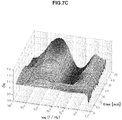
- FIGS. 7A to 7D are chronological change data of permittivity (change amounts ⁇ of real parts of complex permittivity of blood within normal values (A and B) and of blood having abnormal values (C and D).
- Erythrocyte sedimentation rates of blood specimens of FIGS. 7A to 7D are illustrated below in Table 4.
- the blood specimens within normal values and the blood specimens having abnormal values have significantly different features in a frequency band of 1 to 30 kHz.
- ⁇ is a low value on a long-time side in a frequency band of 1 to 30 kHz in association with blood coagulation.
- ⁇ is a high value on a long-time side in a frequency band of 1 to 30 kHz. The use of this method was confirmed to enable evaluation of abnormality of the erythrocyte sedimentation rate.
- Table 4 Specimen Erythrocyte Sedimentation Rate (mm/60m in) A 2 B 6 C 84 D 56
Landscapes
- Health & Medical Sciences (AREA)
- Life Sciences & Earth Sciences (AREA)
- Engineering & Computer Science (AREA)
- Chemical & Material Sciences (AREA)
- Physics & Mathematics (AREA)
- Biomedical Technology (AREA)
- Hematology (AREA)
- Immunology (AREA)
- Pathology (AREA)
- Analytical Chemistry (AREA)
- Biochemistry (AREA)
- General Health & Medical Sciences (AREA)
- General Physics & Mathematics (AREA)
- Molecular Biology (AREA)
- Urology & Nephrology (AREA)
- Food Science & Technology (AREA)
- Medicinal Chemistry (AREA)
- Spectroscopy & Molecular Physics (AREA)
- Electrochemistry (AREA)
- Chemical Kinetics & Catalysis (AREA)
- Biophysics (AREA)
- Ecology (AREA)
- Microbiology (AREA)
- Cell Biology (AREA)
- Biotechnology (AREA)
- Investigating Or Analyzing Materials By The Use Of Electric Means (AREA)
- Investigating Or Analysing Biological Materials (AREA)
Applications Claiming Priority (2)
| Application Number | Priority Date | Filing Date | Title |
|---|---|---|---|
| JP2013073508 | 2013-03-29 | ||
| PCT/JP2014/053704 WO2014156370A1 (ja) | 2013-03-29 | 2014-02-18 | 血液状態評価装置、血液状態評価システム、血液状態評価方法及びプログラム |
Publications (3)
| Publication Number | Publication Date |
|---|---|
| EP2980570A1 true EP2980570A1 (de) | 2016-02-03 |
| EP2980570A4 EP2980570A4 (de) | 2016-10-26 |
| EP2980570B1 EP2980570B1 (de) | 2020-07-22 |
Family
ID=51623371
Family Applications (1)
| Application Number | Title | Priority Date | Filing Date |
|---|---|---|---|
| EP14773633.4A Not-in-force EP2980570B1 (de) | 2013-03-29 | 2014-02-18 | Blutauswertungssystem, blutauswertungsverfahren und programm |
Country Status (6)
| Country | Link |
|---|---|
| US (2) | US10393761B2 (de) |
| EP (1) | EP2980570B1 (de) |
| JP (3) | JPWO2014156370A1 (de) |
| KR (1) | KR20150133716A (de) |
| CN (2) | CN105102969A (de) |
| WO (1) | WO2014156370A1 (de) |
Families Citing this family (13)
| Publication number | Priority date | Publication date | Assignee | Title |
|---|---|---|---|---|
| EP2950087B1 (de) | 2013-01-28 | 2020-11-04 | Sony Corporation | Impedanzmessvorrichtung für biologische proben sowie impedanzmesssystem für biologische proben |
| JP6421750B2 (ja) | 2013-03-13 | 2018-11-14 | ソニー株式会社 | 血液状態解析装置、血液状態解析システム、および血液状態解析プログラム |
| JP6421749B2 (ja) | 2013-03-15 | 2018-11-14 | ソニー株式会社 | 血液状態解析装置、血液状態解析システム、血液状態解析方法、および該方法をコンピューターに実現させるための血液状態解析プログラム |
| CN105102968B (zh) * | 2013-03-29 | 2018-11-30 | 索尼公司 | 血液状态分析装置、血液状态分析系统、血液状态分析方法、以及程序 |
| CN105102969A (zh) | 2013-03-29 | 2015-11-25 | 索尼公司 | 血液状态评估装置、血液状态评估系统、血液状态评估方法以及程序 |
| SG11201804776SA (en) * | 2015-12-08 | 2018-07-30 | Biomatrica Inc | Reduction of erythrocyte sedimentation rate |
| JP6678023B2 (ja) * | 2015-12-21 | 2020-04-08 | 日本電信電話株式会社 | 体液検出装置およびこの体液検出装置を用いた状態推定システム |
| CN108603853B (zh) * | 2016-02-10 | 2022-08-09 | 索尼公司 | 电特性测量用样本、电特性测量装置和电特性测量方法 |
| CN106361334B (zh) * | 2016-08-30 | 2019-04-12 | 苏州涵轩信息科技有限公司 | 一种检测装置及获取阻抗变化值和温度变化值的方法 |
| CN106166061B (zh) * | 2016-08-30 | 2019-01-22 | 苏州涵轩信息科技有限公司 | 一种血液状态检测装置及获取温度变化值的方法 |
| CN109363662B (zh) * | 2018-11-08 | 2020-11-27 | 山东大学 | 一种便携式血栓检测装置 |
| KR20210060963A (ko) | 2019-11-19 | 2021-05-27 | 전남대학교산학협력단 | 광단층 영상을 이용한 혈액 모니터링 시스템 및 혈액 모니터링 방법 |
| CN115633943B (zh) * | 2022-11-09 | 2024-06-28 | 东北大学 | 基于多模态连续监测信号的下肢静脉血栓预警评价系统 |
Family Cites Families (24)
| Publication number | Priority date | Publication date | Assignee | Title |
|---|---|---|---|---|
| US6046051A (en) | 1997-06-27 | 2000-04-04 | Hemosense, Inc. | Method and device for measuring blood coagulation or lysis by viscosity changes |
| US9183351B2 (en) * | 2000-05-30 | 2015-11-10 | Vladimir Shusterman | Mobile system with network-distributed data processing for biomedical applications |
| JP2004501380A (ja) | 2000-06-26 | 2004-01-15 | ボストン メディカル テクノロジーズ インコーポレイテッド | グルコース計測システム |
| US8449824B2 (en) * | 2002-09-09 | 2013-05-28 | Yizhong Sun | Sensor instrument system including method for detecting analytes in fluids |
| JP4893526B2 (ja) | 2007-08-10 | 2012-03-07 | ソニー株式会社 | 細胞の物性値測定方法及び物性測定装置 |
| JP5098817B2 (ja) | 2008-05-29 | 2012-12-12 | ソニー株式会社 | 物性測定装置及び物性測定方法 |
| JP5691168B2 (ja) * | 2009-01-08 | 2015-04-01 | ソニー株式会社 | 血液凝固系解析装置、血液凝固系解析方法及びプログラム |
| CN102460137A (zh) * | 2009-06-08 | 2012-05-16 | S.E.A.医疗系统公司 | 用于使用导纳谱法鉴定医用流体中的化合物的系统和方法 |
| US8448496B2 (en) * | 2009-10-21 | 2013-05-28 | Micropoint Bioscience Inc. | Piezoelectric coagulation sensors |
| US20110119080A1 (en) * | 2009-11-19 | 2011-05-19 | Abbott Diabetes Care Inc. | Method and system for analyte data transmission and report generation |
| EP2395353B1 (de) * | 2010-06-09 | 2018-08-22 | Apex Biotechnology Corp. | Vorrichtung und Verfahren zum Messen der Prothrombinzeit und Hämatokrit durch Analysieren der Reaktanz einer Probe |
| JP5549484B2 (ja) * | 2010-09-01 | 2014-07-16 | ソニー株式会社 | 液体試料の電気特性測定のためのサンプルカートリッジと装置 |
| EP2633310A4 (de) * | 2010-10-26 | 2016-02-24 | Abbott Diabetes Care Inc | Analytmessvorrichtungen und -systeme sowie komponenten und verfahren in zusammenhang damit |
| CN106902903B (zh) * | 2011-02-15 | 2020-03-24 | 海默索尼克斯有限公司 | 用于评估止血的装置、系统和方法 |
| JP5768422B2 (ja) | 2011-03-17 | 2015-08-26 | ソニー株式会社 | 血液凝固系解析方法および血液凝固系解析装置 |
| JP5726662B2 (ja) * | 2011-07-22 | 2015-06-03 | 学校法人上智学院 | 血液インピーダンス計測装置、人工透析装置及び血液のインピーダンスを計測する装置の作動方法 |
| KR20150108818A (ko) | 2013-01-18 | 2015-09-30 | 소니 주식회사 | 전기적 특성 측정 장치 |
| EP2950087B1 (de) | 2013-01-28 | 2020-11-04 | Sony Corporation | Impedanzmessvorrichtung für biologische proben sowie impedanzmesssystem für biologische proben |
| US9915599B2 (en) | 2013-02-08 | 2018-03-13 | Sony Corporation | Microparticle analysis apparatus and microparticle analysis system |
| JP6421750B2 (ja) | 2013-03-13 | 2018-11-14 | ソニー株式会社 | 血液状態解析装置、血液状態解析システム、および血液状態解析プログラム |
| JP6421749B2 (ja) | 2013-03-15 | 2018-11-14 | ソニー株式会社 | 血液状態解析装置、血液状態解析システム、血液状態解析方法、および該方法をコンピューターに実現させるための血液状態解析プログラム |
| JP6299749B2 (ja) | 2013-03-26 | 2018-03-28 | ソニー株式会社 | 測定装置 |
| CN105102969A (zh) | 2013-03-29 | 2015-11-25 | 索尼公司 | 血液状态评估装置、血液状态评估系统、血液状态评估方法以及程序 |
| CN105102968B (zh) | 2013-03-29 | 2018-11-30 | 索尼公司 | 血液状态分析装置、血液状态分析系统、血液状态分析方法、以及程序 |
-
2014
- 2014-02-18 CN CN201480017576.7A patent/CN105102969A/zh active Pending
- 2014-02-18 JP JP2015508169A patent/JPWO2014156370A1/ja active Pending
- 2014-02-18 KR KR1020157025315A patent/KR20150133716A/ko not_active Withdrawn
- 2014-02-18 CN CN202010134637.5A patent/CN111272820A/zh active Pending
- 2014-02-18 WO PCT/JP2014/053704 patent/WO2014156370A1/ja not_active Ceased
- 2014-02-18 US US14/778,277 patent/US10393761B2/en active Active
- 2014-02-18 EP EP14773633.4A patent/EP2980570B1/de not_active Not-in-force
-
2018
- 2018-06-27 JP JP2018121826A patent/JP2018179999A/ja active Pending
-
2019
- 2019-08-16 US US16/543,222 patent/US20200174027A1/en not_active Abandoned
- 2019-12-03 JP JP2019218885A patent/JP6883228B2/ja not_active Expired - Fee Related
Also Published As
| Publication number | Publication date |
|---|---|
| US20200174027A1 (en) | 2020-06-04 |
| CN111272820A (zh) | 2020-06-12 |
| US20160282366A1 (en) | 2016-09-29 |
| US10393761B2 (en) | 2019-08-27 |
| JP2020042042A (ja) | 2020-03-19 |
| CN105102969A (zh) | 2015-11-25 |
| WO2014156370A1 (ja) | 2014-10-02 |
| JP6883228B2 (ja) | 2021-06-09 |
| JPWO2014156370A1 (ja) | 2017-02-16 |
| EP2980570A4 (de) | 2016-10-26 |
| KR20150133716A (ko) | 2015-11-30 |
| EP2980570B1 (de) | 2020-07-22 |
| JP2018179999A (ja) | 2018-11-15 |
Similar Documents
| Publication | Publication Date | Title |
|---|---|---|
| EP2980570B1 (de) | Blutauswertungssystem, blutauswertungsverfahren und programm | |
| JP5982976B2 (ja) | 血液凝固系解析装置、血液凝固系解析方法及びそのプログラム | |
| JP5768422B2 (ja) | 血液凝固系解析方法および血液凝固系解析装置 | |
| US10948478B2 (en) | Blood state analysis device, blood state analysis system, blood state analysis method, and program | |
| JP6962338B2 (ja) | 血液凝固系解析装置、血液凝固系解析システム、血液凝固系解析方法、及び血液凝固系解析用プログラム、並びに、出血量予測装置、出血量予測システム、出血量予測方法、及び出血量予測用プログラム | |
| JP6607186B2 (ja) | 血液状態解析装置、血液状態解析システム、血液状態解析方法及びプログラム | |
| JP6604392B2 (ja) | 血液凝固系解析装置、血液凝固系解析方法及びそのプログラム | |
| RU2282855C2 (ru) | Способ оценки функционального состояния системы гемостаза | |
| US20190162690A1 (en) | Blood coagulation system analysis system, blood coagulation system analysis method, and blood coagulation system analysis program | |
| JP6750443B2 (ja) | 血小板凝集能解析方法、血小板凝集能解析装置、血小板凝集能解析用プログラム及び血小板凝集能解析システム | |
| JP6288182B2 (ja) | 血液凝固系解析装置、血液凝固系解析方法及びそのプログラム | |
| Iberahim et al. | Coagulation Status Using Clot Wave Analysis in Patients With Prolonged Immobilization | |
| Gökuç et al. | The prognostic impact of dynamic change in neutrophil to lymphocyte ratio in patients with acute pulmonary embolism | |
| JP2020190570A (ja) | 血小板凝集能解析方法、血小板凝集能解析装置、血小板凝集能解析用プログラム及び血小板凝集能解析システム |
Legal Events
| Date | Code | Title | Description |
|---|---|---|---|
| PUAI | Public reference made under article 153(3) epc to a published international application that has entered the european phase |
Free format text: ORIGINAL CODE: 0009012 |
|
| 17P | Request for examination filed |
Effective date: 20150922 |
|
| AK | Designated contracting states |
Kind code of ref document: A1 Designated state(s): AL AT BE BG CH CY CZ DE DK EE ES FI FR GB GR HR HU IE IS IT LI LT LU LV MC MK MT NL NO PL PT RO RS SE SI SK SM TR |
|
| AX | Request for extension of the european patent |
Extension state: BA ME |
|
| DAX | Request for extension of the european patent (deleted) | ||
| A4 | Supplementary search report drawn up and despatched |
Effective date: 20160928 |
|
| RIC1 | Information provided on ipc code assigned before grant |
Ipc: G01N 33/86 20060101ALI20160922BHEP Ipc: G01N 33/49 20060101ALI20160922BHEP Ipc: G01N 27/22 20060101AFI20160922BHEP Ipc: G01N 27/02 20060101ALI20160922BHEP Ipc: G01N 33/483 20060101ALI20160922BHEP |
|
| STAA | Information on the status of an ep patent application or granted ep patent |
Free format text: STATUS: EXAMINATION IS IN PROGRESS |
|
| 17Q | First examination report despatched |
Effective date: 20171208 |
|
| GRAP | Despatch of communication of intention to grant a patent |
Free format text: ORIGINAL CODE: EPIDOSNIGR1 |
|
| STAA | Information on the status of an ep patent application or granted ep patent |
Free format text: STATUS: GRANT OF PATENT IS INTENDED |
|
| INTG | Intention to grant announced |
Effective date: 20200214 |
|
| RIN1 | Information on inventor provided before grant (corrected) |
Inventor name: KATSUMOTO, YOICHI Inventor name: BRUN, MARCAURELE Inventor name: HAYASHI, YOSHIHITO |
|
| GRAS | Grant fee paid |
Free format text: ORIGINAL CODE: EPIDOSNIGR3 |
|
| GRAA | (expected) grant |
Free format text: ORIGINAL CODE: 0009210 |
|
| STAA | Information on the status of an ep patent application or granted ep patent |
Free format text: STATUS: THE PATENT HAS BEEN GRANTED |
|
| AK | Designated contracting states |
Kind code of ref document: B1 Designated state(s): AL AT BE BG CH CY CZ DE DK EE ES FI FR GB GR HR HU IE IS IT LI LT LU LV MC MK MT NL NO PL PT RO RS SE SI SK SM TR |
|
| REG | Reference to a national code |
Ref country code: GB Ref legal event code: FG4D |
|
| REG | Reference to a national code |
Ref country code: CH Ref legal event code: EP |
|
| REG | Reference to a national code |
Ref country code: DE Ref legal event code: R096 Ref document number: 602014068032 Country of ref document: DE |
|
| REG | Reference to a national code |
Ref country code: AT Ref legal event code: REF Ref document number: 1293883 Country of ref document: AT Kind code of ref document: T Effective date: 20200815 |
|
| REG | Reference to a national code |
Ref country code: IE Ref legal event code: FG4D |
|
| REG | Reference to a national code |
Ref country code: LT Ref legal event code: MG4D |
|
| REG | Reference to a national code |
Ref country code: AT Ref legal event code: MK05 Ref document number: 1293883 Country of ref document: AT Kind code of ref document: T Effective date: 20200722 |
|
| PG25 | Lapsed in a contracting state [announced via postgrant information from national office to epo] |
Ref country code: GR Free format text: LAPSE BECAUSE OF FAILURE TO SUBMIT A TRANSLATION OF THE DESCRIPTION OR TO PAY THE FEE WITHIN THE PRESCRIBED TIME-LIMIT Effective date: 20201023 Ref country code: NO Free format text: LAPSE BECAUSE OF FAILURE TO SUBMIT A TRANSLATION OF THE DESCRIPTION OR TO PAY THE FEE WITHIN THE PRESCRIBED TIME-LIMIT Effective date: 20201022 Ref country code: FI Free format text: LAPSE BECAUSE OF FAILURE TO SUBMIT A TRANSLATION OF THE DESCRIPTION OR TO PAY THE FEE WITHIN THE PRESCRIBED TIME-LIMIT Effective date: 20200722 Ref country code: LT Free format text: LAPSE BECAUSE OF FAILURE TO SUBMIT A TRANSLATION OF THE DESCRIPTION OR TO PAY THE FEE WITHIN THE PRESCRIBED TIME-LIMIT Effective date: 20200722 Ref country code: ES Free format text: LAPSE BECAUSE OF FAILURE TO SUBMIT A TRANSLATION OF THE DESCRIPTION OR TO PAY THE FEE WITHIN THE PRESCRIBED TIME-LIMIT Effective date: 20200722 Ref country code: SE Free format text: LAPSE BECAUSE OF FAILURE TO SUBMIT A TRANSLATION OF THE DESCRIPTION OR TO PAY THE FEE WITHIN THE PRESCRIBED TIME-LIMIT Effective date: 20200722 Ref country code: BG Free format text: LAPSE BECAUSE OF FAILURE TO SUBMIT A TRANSLATION OF THE DESCRIPTION OR TO PAY THE FEE WITHIN THE PRESCRIBED TIME-LIMIT Effective date: 20201022 Ref country code: HR Free format text: LAPSE BECAUSE OF FAILURE TO SUBMIT A TRANSLATION OF THE DESCRIPTION OR TO PAY THE FEE WITHIN THE PRESCRIBED TIME-LIMIT Effective date: 20200722 Ref country code: AT Free format text: LAPSE BECAUSE OF FAILURE TO SUBMIT A TRANSLATION OF THE DESCRIPTION OR TO PAY THE FEE WITHIN THE PRESCRIBED TIME-LIMIT Effective date: 20200722 Ref country code: PT Free format text: LAPSE BECAUSE OF FAILURE TO SUBMIT A TRANSLATION OF THE DESCRIPTION OR TO PAY THE FEE WITHIN THE PRESCRIBED TIME-LIMIT Effective date: 20201123 |
|
| PG25 | Lapsed in a contracting state [announced via postgrant information from national office to epo] |
Ref country code: IS Free format text: LAPSE BECAUSE OF FAILURE TO SUBMIT A TRANSLATION OF THE DESCRIPTION OR TO PAY THE FEE WITHIN THE PRESCRIBED TIME-LIMIT Effective date: 20201122 Ref country code: PL Free format text: LAPSE BECAUSE OF FAILURE TO SUBMIT A TRANSLATION OF THE DESCRIPTION OR TO PAY THE FEE WITHIN THE PRESCRIBED TIME-LIMIT Effective date: 20200722 Ref country code: RS Free format text: LAPSE BECAUSE OF FAILURE TO SUBMIT A TRANSLATION OF THE DESCRIPTION OR TO PAY THE FEE WITHIN THE PRESCRIBED TIME-LIMIT Effective date: 20200722 Ref country code: LV Free format text: LAPSE BECAUSE OF FAILURE TO SUBMIT A TRANSLATION OF THE DESCRIPTION OR TO PAY THE FEE WITHIN THE PRESCRIBED TIME-LIMIT Effective date: 20200722 |
|
| PG25 | Lapsed in a contracting state [announced via postgrant information from national office to epo] |
Ref country code: NL Free format text: LAPSE BECAUSE OF FAILURE TO SUBMIT A TRANSLATION OF THE DESCRIPTION OR TO PAY THE FEE WITHIN THE PRESCRIBED TIME-LIMIT Effective date: 20200722 |
|
| REG | Reference to a national code |
Ref country code: DE Ref legal event code: R097 Ref document number: 602014068032 Country of ref document: DE |
|
| PG25 | Lapsed in a contracting state [announced via postgrant information from national office to epo] |
Ref country code: RO Free format text: LAPSE BECAUSE OF FAILURE TO SUBMIT A TRANSLATION OF THE DESCRIPTION OR TO PAY THE FEE WITHIN THE PRESCRIBED TIME-LIMIT Effective date: 20200722 Ref country code: SM Free format text: LAPSE BECAUSE OF FAILURE TO SUBMIT A TRANSLATION OF THE DESCRIPTION OR TO PAY THE FEE WITHIN THE PRESCRIBED TIME-LIMIT Effective date: 20200722 Ref country code: IT Free format text: LAPSE BECAUSE OF FAILURE TO SUBMIT A TRANSLATION OF THE DESCRIPTION OR TO PAY THE FEE WITHIN THE PRESCRIBED TIME-LIMIT Effective date: 20200722 Ref country code: CZ Free format text: LAPSE BECAUSE OF FAILURE TO SUBMIT A TRANSLATION OF THE DESCRIPTION OR TO PAY THE FEE WITHIN THE PRESCRIBED TIME-LIMIT Effective date: 20200722 Ref country code: EE Free format text: LAPSE BECAUSE OF FAILURE TO SUBMIT A TRANSLATION OF THE DESCRIPTION OR TO PAY THE FEE WITHIN THE PRESCRIBED TIME-LIMIT Effective date: 20200722 Ref country code: DK Free format text: LAPSE BECAUSE OF FAILURE TO SUBMIT A TRANSLATION OF THE DESCRIPTION OR TO PAY THE FEE WITHIN THE PRESCRIBED TIME-LIMIT Effective date: 20200722 |
|
| PLBE | No opposition filed within time limit |
Free format text: ORIGINAL CODE: 0009261 |
|
| STAA | Information on the status of an ep patent application or granted ep patent |
Free format text: STATUS: NO OPPOSITION FILED WITHIN TIME LIMIT |
|
| PG25 | Lapsed in a contracting state [announced via postgrant information from national office to epo] |
Ref country code: AL Free format text: LAPSE BECAUSE OF FAILURE TO SUBMIT A TRANSLATION OF THE DESCRIPTION OR TO PAY THE FEE WITHIN THE PRESCRIBED TIME-LIMIT Effective date: 20200722 |
|
| 26N | No opposition filed |
Effective date: 20210423 |
|
| PG25 | Lapsed in a contracting state [announced via postgrant information from national office to epo] |
Ref country code: SK Free format text: LAPSE BECAUSE OF FAILURE TO SUBMIT A TRANSLATION OF THE DESCRIPTION OR TO PAY THE FEE WITHIN THE PRESCRIBED TIME-LIMIT Effective date: 20200722 |
|
| PG25 | Lapsed in a contracting state [announced via postgrant information from national office to epo] |
Ref country code: SI Free format text: LAPSE BECAUSE OF FAILURE TO SUBMIT A TRANSLATION OF THE DESCRIPTION OR TO PAY THE FEE WITHIN THE PRESCRIBED TIME-LIMIT Effective date: 20200722 |
|
| PG25 | Lapsed in a contracting state [announced via postgrant information from national office to epo] |
Ref country code: MC Free format text: LAPSE BECAUSE OF FAILURE TO SUBMIT A TRANSLATION OF THE DESCRIPTION OR TO PAY THE FEE WITHIN THE PRESCRIBED TIME-LIMIT Effective date: 20200722 |
|
| REG | Reference to a national code |
Ref country code: NL Ref legal event code: MP Effective date: 20200722 |
|
| GBPC | Gb: european patent ceased through non-payment of renewal fee |
Effective date: 20210218 |
|
| REG | Reference to a national code |
Ref country code: BE Ref legal event code: MM Effective date: 20210228 |
|
| PG25 | Lapsed in a contracting state [announced via postgrant information from national office to epo] |
Ref country code: CH Free format text: LAPSE BECAUSE OF NON-PAYMENT OF DUE FEES Effective date: 20210228 Ref country code: LU Free format text: LAPSE BECAUSE OF NON-PAYMENT OF DUE FEES Effective date: 20210218 Ref country code: LI Free format text: LAPSE BECAUSE OF NON-PAYMENT OF DUE FEES Effective date: 20210228 |
|
| PG25 | Lapsed in a contracting state [announced via postgrant information from national office to epo] |
Ref country code: GB Free format text: LAPSE BECAUSE OF NON-PAYMENT OF DUE FEES Effective date: 20210218 Ref country code: FR Free format text: LAPSE BECAUSE OF NON-PAYMENT OF DUE FEES Effective date: 20210228 Ref country code: IE Free format text: LAPSE BECAUSE OF NON-PAYMENT OF DUE FEES Effective date: 20210218 |
|
| PGFP | Annual fee paid to national office [announced via postgrant information from national office to epo] |
Ref country code: DE Payment date: 20220119 Year of fee payment: 9 |
|
| PG25 | Lapsed in a contracting state [announced via postgrant information from national office to epo] |
Ref country code: BE Free format text: LAPSE BECAUSE OF NON-PAYMENT OF DUE FEES Effective date: 20210228 |
|
| PG25 | Lapsed in a contracting state [announced via postgrant information from national office to epo] |
Ref country code: HU Free format text: LAPSE BECAUSE OF FAILURE TO SUBMIT A TRANSLATION OF THE DESCRIPTION OR TO PAY THE FEE WITHIN THE PRESCRIBED TIME-LIMIT; INVALID AB INITIO Effective date: 20140218 |
|
| PG25 | Lapsed in a contracting state [announced via postgrant information from national office to epo] |
Ref country code: CY Free format text: LAPSE BECAUSE OF FAILURE TO SUBMIT A TRANSLATION OF THE DESCRIPTION OR TO PAY THE FEE WITHIN THE PRESCRIBED TIME-LIMIT Effective date: 20200722 |
|
| REG | Reference to a national code |
Ref country code: DE Ref legal event code: R119 Ref document number: 602014068032 Country of ref document: DE |
|
| PG25 | Lapsed in a contracting state [announced via postgrant information from national office to epo] |
Ref country code: DE Free format text: LAPSE BECAUSE OF NON-PAYMENT OF DUE FEES Effective date: 20230901 |
|
| PG25 | Lapsed in a contracting state [announced via postgrant information from national office to epo] |
Ref country code: MK Free format text: LAPSE BECAUSE OF FAILURE TO SUBMIT A TRANSLATION OF THE DESCRIPTION OR TO PAY THE FEE WITHIN THE PRESCRIBED TIME-LIMIT Effective date: 20200722 |
|
| PG25 | Lapsed in a contracting state [announced via postgrant information from national office to epo] |
Ref country code: MT Free format text: LAPSE BECAUSE OF FAILURE TO SUBMIT A TRANSLATION OF THE DESCRIPTION OR TO PAY THE FEE WITHIN THE PRESCRIBED TIME-LIMIT Effective date: 20200722 |
|
| PG25 | Lapsed in a contracting state [announced via postgrant information from national office to epo] |
Ref country code: TR Free format text: LAPSE BECAUSE OF FAILURE TO SUBMIT A TRANSLATION OF THE DESCRIPTION OR TO PAY THE FEE WITHIN THE PRESCRIBED TIME-LIMIT Effective date: 20200722 |