EP2982074B1 - Communication en présence d'un changement de configuration de liaison montante-liaison descendante - Google Patents
Communication en présence d'un changement de configuration de liaison montante-liaison descendante Download PDFInfo
- Publication number
- EP2982074B1 EP2982074B1 EP14720023.2A EP14720023A EP2982074B1 EP 2982074 B1 EP2982074 B1 EP 2982074B1 EP 14720023 A EP14720023 A EP 14720023A EP 2982074 B1 EP2982074 B1 EP 2982074B1
- Authority
- EP
- European Patent Office
- Prior art keywords
- uplink
- downlink
- configuration
- frame
- subframe
- Prior art date
- Legal status (The legal status is an assumption and is not a legal conclusion. Google has not performed a legal analysis and makes no representation as to the accuracy of the status listed.)
- Active
Links
Images




Classifications
-
- H—ELECTRICITY
- H04—ELECTRIC COMMUNICATION TECHNIQUE
- H04W—WIRELESS COMMUNICATION NETWORKS
- H04W72/00—Local resource management
- H04W72/04—Wireless resource allocation
-
- H—ELECTRICITY
- H04—ELECTRIC COMMUNICATION TECHNIQUE
- H04L—TRANSMISSION OF DIGITAL INFORMATION, e.g. TELEGRAPHIC COMMUNICATION
- H04L5/00—Arrangements affording multiple use of the transmission path
- H04L5/003—Arrangements for allocating sub-channels of the transmission path
- H04L5/0053—Allocation of signalling, i.e. of overhead other than pilot signals
- H04L5/0055—Physical resource allocation for ACK/NACK
-
- H—ELECTRICITY
- H04—ELECTRIC COMMUNICATION TECHNIQUE
- H04L—TRANSMISSION OF DIGITAL INFORMATION, e.g. TELEGRAPHIC COMMUNICATION
- H04L5/00—Arrangements affording multiple use of the transmission path
- H04L5/0091—Signalling for the administration of the divided path, e.g. signalling of configuration information
- H04L5/0096—Indication of changes in allocation
-
- H—ELECTRICITY
- H04—ELECTRIC COMMUNICATION TECHNIQUE
- H04L—TRANSMISSION OF DIGITAL INFORMATION, e.g. TELEGRAPHIC COMMUNICATION
- H04L5/00—Arrangements affording multiple use of the transmission path
- H04L5/14—Two-way operation using the same type of signal, i.e. duplex
- H04L5/1469—Two-way operation using the same type of signal, i.e. duplex using time-sharing
Definitions
- downlink and uplink transmissions of information can be according to either a frequency division duplex (FDD) mode or a time division duplex (TDD) mode.
- FDD frequency division duplex
- TDD time division duplex
- uplink and downlink transmissions are separated in the frequency domain, by transmitting uplink data using a first carrier frequency, and transmitting downlink data using a second carrier frequency.
- both uplink and downlink transmissions occur on the same carrier frequency; however, uplink and downlink transmissions are separated in the time domain, by sending uplink and downlink transmissions in different time periods.
- different uplink-downlink configurations may be defined.
- a particular uplink-downlink configuration can specify that, within a frame, a first subset of subframes in the frame is used for uplink transmissions, and a second subset of subframes in the frame is used for downlink transmissions.
- Different uplink-downlink configurations can employ different numbers of uplink and downlink subframes.
- NEC GROUP "Reconfiguration signaling and HARQ-timing for TDD elTMA system", 3GPP DRAFT; R1-130370, vol. RAN WG1, 18 January 2013 discusses the restricted selection of configuration for TDD elMTA system, the transmission of reconfiguration signal, and the HARQ timing, and observed: 1) TDD reconfiguration may be restricted to a subset of seven TDD configurations within a period of time for the sake of HARQ-ACK feedback; 2) adaptation time scale larger than 10ms and with packet throughout almost the same as 10ms can be adopted in order to alleviate the requirement of reconfiguration signalling; 3) DCI format 1C can be used to transmit the reconfiguration signalling, and CRC bits can be virtually extended in order to reduce the probability of false positive detection; 4) reference configuration can be used to determine the HARQ-timing of all TDD configurations within a subset and thus HARQ process can be maintained between each reconfiguration as long as the reconfiguration is restricted within the same subset.
- LG ELECTRONICS "Details on full-duplex based CA with different TDD UL-DL configurations", 3GPP DRAFT; R!-123506, vol. RAN WG1, 5 August 2012 suggested more details related to PDSCH/PUSCH HARQ to support full-duplex operation based CA with different TDD UL-DL configurations for the UE supporting simultaneous Tx/Rx, and proposed: 1) PDSCH HARQ timing reference for Scell agreed for the case of self-CC scheduling is also applied to the case of cross-CC scheduling as a unified solution; 2) PUCCH resource allocation for ACK/NACK channel selection in case of cross-CC scheduling should be revisited by taking both DL grant PDCCH timing for scheduling of Scell and implicit PUCCH resource reserved in Pcell UL subframe into account; 3) UL-DL configuration of PUSCH HARQ timing reference for PUSCH (scheduled) cell in case of cross-CC scheduling considering UL throughput, complexity, and latency.
- HARQ timing (UL grant/PUSCH/PHICH) skipping operation could be applied according to combination of PDCCH/PUSCH cell and reference configuration; 4) PHICH-less operation with only UL grant based PUSCH retransmission is needed to be supported for the PUSCH cell's UL subframe whose UL grant/PHICH timing is determined to a PDCCH cell's DL subframe without PHICH resource reservation.
- a method of a user equipment (UE) according to the invention is set forth in independent claim 1.
- TDD time division duplex
- LTE Long Term Evolution
- E-UTRA Evolved Universal Terrestrial Radio Access
- An uplink-downlink configuration defines a number of uplink and downlink subframes that can be used within a frame structure.
- a frame structure is referred to as a radio frame, where the radio frame has a number of subframes.
- a subframe refers to a segment of an overall frame, where the segment has a specified time interval.
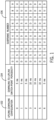
- Fig. 1 shows an example table listing seven different uplink-downlink configurations that are used for TDD communications in an LTE network.
- a first column 102 of the table shown in Fig. 1 identifies the seven different uplink-downlink configurations (0-6).
- a second column 104 refers to the corresponding downlink-to-uplink switch-point periodicity (or more simply, "switching periodicity"), which represents a period in which the same switching pattern is repeated between the uplink and the downlink.
- the switching periodicity can be 5 milliseconds (ms) or 10 ms.
- Uplink-downlink configuration 1 has a 5 ms downlink-to-uplink switch-point periodicity, for example.
- a frame is divided into 10 subframes, having subframe numbers 0-9.
- D represents a downlink subframe
- U represents an uplink subframe
- S represents a special subframe which includes three parts: a downlink pilot time slot (DwPTS), an uplink pilot time slot (UpPTS), and a guard period (GP).
- DwPTS downlink pilot time slot
- UpPTS uplink pilot time slot
- GP guard period
- PDSCH physical downlink shared channel
- the guard period (GP) of a special (S) subframe is to provide a transition interval between switching from downlink transmissions to uplink transmissions.
- a "downlink" subframe can refer to either a D subframe or an S subframe.
- uplink-downlink configuration 2 has a 5 ms switching periodicity.
- the frame for uplink-downlink configuration 2 can be divided into two halves, where a first half includes subframe numbers 0-4, and a second half includes subframe numbers 5-9.
- the first half-frame for uplink-downlink configuration 2 includes the following pattern of subframes: D, S, U, D, D.
- the same pattern repeats in the second half-frame for uplink-downlink configuration 2.
- a frame has a length of 10 ms and each subframe has a length of 1 ms.
- the switching periodicity for uplink-downlink configuration 2 is 5 ms.
- certain uplink-downlink configurations support a larger number of downlink subframes than uplink subframes, while other uplink-downlink configurations may support a larger number of uplink subframes than downlink subframes.
- Uplink-downlink configuration 5 has the largest number of downlink subframes, while uplink-downlink configuration 0 has the largest number of uplink subframes.
- the different uplink-downlink configurations provide for flexibility in terms of proportional resources assignable to uplink and downlink communications within a given assigned frequency spectrum.
- the different uplink-downlink configurations allow for distribution of radio resources unevenly between uplink and downlink communications. As a result, radio resources may be used more efficiently by selecting an appropriate uplink-downlink configuration based on traffic characteristics and interference conditions in uplink and downlink communications.
- the proportion of uplink and downlink traffic data may change relatively rapidly.
- an uplink-downlink configuration for TDD mode communication can be semi-statically assigned every 640-ms. In other words, within the 640-ms time interval, the uplink-downlink configuration assigned for communications within a particular cell stays static. However, keeping the uplink-downlink configuration static for such a relatively long time interval may not lead to efficient use of radio resources, particularly when the traffic patterns of UEs within the cell are changing relatively rapidly.
- dynamic TDD uplink-downlink reconfiguration in which uplink-downlink configurations for communications with a UE can be changed relatively frequently (more frequently than allowed by current LTE standards).
- HARQ hybrid automatic repeat request
- HARQ provides for the provision of error detection and correction information from a transmitter to a receiver in association with transmitted data to allow the receiver to detect and possibly correct errors in the data.
- the receiver can provide either a positive acknowledgement (ACK) or a negative acknowledgement (NACK) in response to receiving the data. If the transmitter receives an ACK from the receiver in response to previously sent data, then the transmitter can transmit new data to the receiver. However, if the transmitter receives a NACK, then the HARQ process of the transmitter can retransmit the previously sent data.
- ACK positive acknowledgement
- NACK negative acknowledgement
- the LTE standards provide for a timing linkage (or timing relationship) between the transmission of data (either downlink data or uplink data) and the responsive return of the acknowledgement indication (either ACK or NACK) from the receiver.
- Such timing linkage can include a downlink HARQ ACK/NACK timing linkage (for acknowledging downlink data) or an uplink HARQ ACK/NACK timing linkage (for acknowledging uplink data).
- the downlink HARQ operation (for acknowledging downlink data sent from a wireless access network node to a UE) is asynchronous, in which the receiver does not know ahead of time what is being transmitted or when. Stated differently, the receiver (more specifically the UE) does not know which HARQ process at the wireless access network node is transmitting the downlink data, and does not know ahead of time the redundancy version (RV) value of the downlink transmission.
- RV values represent different combinations of data, error detection information, and error correction information sent from a transmitter to a receiver.
- the wireless access network node can send the HARQ process identifier (for identifying an HARQ process) and the RV value in a resource allocation message that is sent on a control channel to the UE, in some examples. For example, if the downlink data is sent in the PDSCH, then the HARQ process identifier can be sent in a PDSCH resource allocation message sent on a physical downlink control channel (PDCCH).
- PDCH physical downlink control channel
- synchronous HARQ operation is performed, in which the wireless access network node knows ahead of time the HARQ process and RV value associated with uplink data to be transmitted by a UE within a particular subframe.
- An HARQ process refers to an instance of an HARQ entity that controls an HARQ operation. Multiple HARQ processes can be executed in parallel, for communicating respective blocks of data (downlink or uplink data).
- techniques or mechanisms according to some implementations are able to send acknowledgement indications of uplink or downlink data in appropriate subframes.
- FIG. 2 An example of a timing linkage issue associated with a downlink HARQ operation when a configuration change occurs from uplink-downlink configuration 4 to uplink-downlink configuration 5 is depicted in Fig. 2 .
- Fig. 2 shows two frames 202 and 204, where a first frame 202 is according to uplink-downlink configuration 4, whereas a second frame 204 immediately following the first frame 202 is according to uplink-downlink configuration 5.
- a configuration change also referred to as a reconfiguration
- the acknowledgement indication (ACK or NACK) for a downlink data transmission (on PDSCH, for example) at any of subframes 6, 7, 8, and 9 are to be transmitted on uplink subframe 3 in the next frame, as indicated by arrows 206.
- downlink data transmission at subframe 6, 7, 8, or 9 is linked to subframe 3.
- ACK or NACK the acknowledgement indication
- subframe 3 in the second frame 204 for configuration 5 is a downlink subframe, rather than an uplink subframe as would be the case for uplink-downlink configuration 4.
- subframe 3 in frame 204 according to uplink-downlink configuration 5 cannot be used to send an ACK/NACK in the uplink direction to acknowledge transmitted downlink data in subframe 6, 7, 8, or 9 in the first frame 202.
- the second frame 204 after the uplink-downlink configuration change, has an arrangement of subframes that is incompatible with the timing linkage expected by the uplink-downlink configuration prior to the configuration change.
- Fig. 3 illustrates an issue associated with transmitting an acknowledgement indication for uplink data in response to a TDD uplink-downlink configuration change, which in Fig. 3 is a change from uplink-downlink configuration 2 (for a first frame 302) to uplink-downlink configuration 1 (for a second frame 304 immediately following the first frame 302).
- the ACK/NACK for uplink data (such as uplink data sent in the physical uplink shared channel or PUSCH) at subframe 7 is supposed to be transmitted at downlink subframe 3, as indicated by arrow 306.
- subframe 3 is no longer a downlink subframe, but rather, is an uplink subframe. Accordingly, the ACK/NACK for the uplink data sent at subframe 7 in the first frame 302 cannot be sent in subframe 3 in the second frame 304.
- the uplink HARQ operation is synchronous.
- a grant timing relationship also has to be considered in response to an uplink-downlink configuration change.
- a wireless access network node sends an uplink grant to the UE, where the uplink grant identifies the next subframe in which the UE is to send uplink data.
- the next uplink data to be sent by the UE in response to the uplink grant can be a transmission of new uplink data or a retransmission of previously sent uplink data that was not received by the wireless access network node.
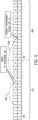
- Fig. 4 shows an example of a configuration change from uplink-downlink configuration 0 (for a first frame 402) to uplink-downlink configuration 2 (for a second frame 404 immediately following the first frame 402).
- the acknowledgement indication for the uplink data sent at subframe 2 in the first frame 402 is sent by the wireless access network node in the downlink in subframe 6 of the first frame 402.
- the acknowledgement indication sent in subframe 6 of the first frame 402 is NACK, which indicates that the uplink data sent at subframe 2 in the first frame 402 was not successfully received by the wireless access network node.
- subframe 3 in the next frame 404 is a downlink subframe, instead of an uplink subframe, so that the retransmission of the uplink data cannot occur in subframe 3 in the second frame 404.
- retransmission of the uplink data cannot occur in subframe 3 of the second frame 404, as expected by the timing relationship for configuration 0.
- continuity of the HARQ timing relationship is provided for both uplink and downlink HARQ operations after a configuration change.
- the following discusses examples relating to techniques or mechanisms provided for downlink HARQ operation in the presence of a TDD uplink-downlink configuration change, and an uplink HARQ operation in the presence of a TDD uplink-downlink configuration change.
- a TDD uplink-downlink configuration change occurs at a frame boundary (a boundary between frames).
- a UE may be informed of the configuration change before the frame boundary. Different UEs may be informed of the change at different times.
- the configuration change occurs at the boundary of frame n and frame n+1.
- the downlink HARQ ACK/NACK timing relationship can be according to Table 1 below, which is reproduced from Table 10.1.3.1-1 in 3GPP TS 36.213.
- a downlink data (e.g. PDSCH) transmission or retransmission is to be properly acknowledged after the TDD uplink-downlink configuration change.
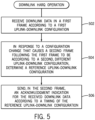
- Fig. 5 is a flow diagram of a downlink HARQ operation according to some implementations. The process of Fig. 5 can be performed by a UE, in accordance with some implementations.
- the process receives (at 502) downlink data in a first frame according to a first uplink-downlink configuration.
- the process determines (at 504) a reference uplink-downlink configuration based on at least one of the first and second uplink-downlink configurations.
- the process then sends (at 506), in the second frame, an acknowledgement indication for the received downlink data according to a timing of the reference uplink-downlink configuration.
- the determining (at 504) performed according to Fig. 5 can include selecting an uplink-downlink configuration, based on at least one rule (discussed below).
- the selected reference uplink-downlink configuration can be the same as the first or second uplink-downlink configuration, or can be different from the first and second uplink-downlink configurations.
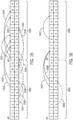
- Fig. 6 illustrates an example of a configuration change from configuration 0 (for a first frame 602) to configuration 2 (for a second frame 604 immediately following the first frame 602).
- first frame 602 downlink data transmitted in each downlink subframe, except subframe 6, of the first frame 602 can be acknowledged within the same frame 602, as indicated by arrows 606, 608, and 610.
- the downlink data sent in subframe 6 should be acknowledged (by communicating an ACK or NACK) at subframe 2 in the second frame 604 (as indicated by arrow 612).
- subframe 2 in a frame is always an uplink subframe in all seven of the uplink-downlink configurations shown in Fig. 1 .
- the reference uplink-downlink configuration is configuration 0, which is determined (at 504) based on a rule governing the case where the first frame before the configuration change is configuration 0.
- the downlink HARQ timing can be according to configuration 5 in the second frame following the configuration change, regardless of the configuration of the first frame prior to the configuration change. This is possible because configuration 5 (as shown in Fig. 1 ) has just one uplink subframe (subframe 2), while the remaining subframes are downlink subframes. Thus, the downlink HARQ timing of configuration 5 uses subframe 2 to acknowledge (by sending an ACK or NACK) all downlink data sent in an immediately preceding frame.
- the reference uplink-downlink configuration determined (at 504) in Fig. 5 is configuration 5.
- the downlink HARQ timing can follow the timing of configuration 2 regardless of the configuration of the first and second frames before and after the configuration change.
- the reference uplink-downlink configuration is configuration 2, according to a rule governing the case where the configuration change involves configurations that use the 5-ms switching periodicity (in other words, both the first and second frames before and after the configuration change use the 5-ms switching periodicity).
- a more generalized implementation for downlink HARQ operations that addresses a change from any first uplink-downlink configuration to any other uplink- downlink configuration is provided below.
- downlink data transmission in certain subframes of the first frame may be acknowledged within the same first frame (current frame n). However, at least one downlink data transmission in the current frame n has to be acknowledged in the next frame n+1 following the configuration change.
- the downlink HARQ timing (or more specifically, the PDSCH HARQ timing) can be based on the configuration of the current frame n, if the downlink data can be acknowledged within this current frame n. However, if the acknowledgement indication (ACK or NACK) has to be provided in the subsequent frame n+1, then the timing follows a reference uplink-downlink configuration (determined at 504 in Fig. 5 ), which can be determined based on the set of downlink subframes of the configuration of the current frame n and the set of subframes of the configuration of the subsequent frame n+1 following the configuration change.
- ACK or NACK acknowledgement indication
- a set DLSF can represent the set of downlink subframes (which includes the D subframes and S subframes in Fig. 1 , for example) within a specific radio frame.
- DLSF(n) represents the set of downlink subframes in frame n.
- DLSF(n+1) represents the set of downlink subframes in frame n+1.
- the reference configuration is the configuration of the current frame n, in which case the HARQ timing follows the timing of the current configuration (of frame n), which is specified as the reference configuration.
- DLSF(n) is a superset of DLSF(n+1) if each downlink subframe in DLSF(n+1) is included in DLSF(n).
- DLSF(n) is a subset of DLSF(n+1)
- the reference configuration is the configuration following the configuration change (in other words, the configuration of frame n+1).
- DLSF(n) is a subset of DLSF(n+1) if each downlink subframe in DLSF(n) is included in DLSF(n+1).
- the reference configuration is the configuration that includes downlink subframes that make up the union set of downlink subframes of the configuration before and the configuration after the configuration change.
- the reference configuration in this case is the uplink-downlink configuration having a set of downlink subframes according to DLSF(n) u DLSF(n+1).
- the reference configuration can be defined according to Case 3.
- the reference configuration to be used for HARQ timing in the presence of a configuration change is the uplink-downlink configuration that includes the union of DLSF(n) and DLSF(n+1).
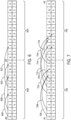
- FIG. 7 An example involving a configuration change from configuration 1 (frame 702) to configuration 3 (frame 704) is depicted in Fig. 7 .
- Downlink data transmissions in subframes 0, 1, and 4 in frame n (702) can be acknowledged within the same frame n so they follow the downlink HARQ timing of configuration 1 (see arrows 706, 708, and 710).
- Downlink data transmissions in subframes 5, 6, 9 of frame n are acknowledged in the following frame, n+1.
- the reference configuration is the uplink-downlink configuration that includes a set of subframes according to the union of DLSF(n) and DLSF(n+1). Taking the union of the DLSF(n) and DLSF(n+1) sets corresponding to configurations 1 and 3, respectively, results in the reference configuration being configuration 4. Therefore, following the downlink HARQ timing of configuration 4, subframe 5 in frame n is acknowledged at subframe 2 in frame n+1, and subframes 6 and 9 in frame n are acknowledged at subframe 3 in frame n+1 (see arrows 712, 714, and 716).
- configuration 3 can be used as a reference configuration, in which case subframe 9 in frame n is acknowledged with subframe 4 in frame n+1 (arrow 718).
- configuration 1 can be used as the reference configuration, in which case subframe 6 in frame n is acknowledged at subframe 2 in frame n+1 (arrow 720).
- Table 2 summarizes the reference configuration for cross-frame HARQ timing of all possible uplink-downlink configuration combinations, including a combination in which the original configuration is configuration 0, for use due to a configuration change. Multiple numbers in some entries represent alternative possible choices.
- An alternative mapping is also shown in Table 2 below where the destination configuration is always assumed for original uplink-downlink configuration 0 and 1 (in other words, for a configuration change where the original configuration is 0 or 1 , the reference configuration can be the destination configuration).
- Table 2 Reference configuration for cross frame PDSCH HARQ timing Original Uplink-Downlink Configuration Destination Uplink-Downlink Configuration after change 0 1 2 3 4 5 6 0 - 0 or 1 0 or 2 0 or 3 0 or 4 0 or 5 0 or 6 1 1 - 2 4 or 1 or 3 4 or 1 5 1 or 6 2 2 2 - 5 or 3 5 or 4 5 2 3 3 4 5 - 4 5 3 4 4 4 5 4 - 5 4 5 5 5 5 5 5 5 - 5 6 6 1 2 3 4 5 -
- configuration 5 can be used as the reference configuration for all reconfiguration combinations. Since, with configuration 5, all the PDSCH acknowledgement indications will be sent at subframe 2 which is always an uplink subframe, the timing linkage can be satisfied for any uplink-downlink configuration combination.
- Fig. 8 shows an example where configuration 5 is used as the reference configuration regardless of the reconfiguration combination.
- the configuration change occurs at the boundary between frames 802 and 804, and the configuration change is from configuration 1 to configuration 3.
- arrows 808, 810, and 812 downlink data in subframes 0, 1, and 4 in frame 802 can be acknowledged within the same frame 802.
- the acknowledgement indications for subframes 5 and 6 in frame 802 are acknowledged in subframe 2 in the next frame 804, as indicated by arrows 814 and 816.
- the timing linkage for the acknowledgement indications for subframes 5 and 6 in frame 802 follow the reference configuration that is selected to be configuration 5. However, according to configuration 5, an acknowledgement indication for subframe 9 in frame 802 would also have to be communicated in subframe 2 following the configuration change. However, as depicted in Fig. 8 , there is an insufficient time length between subframe 9 in frame 802 and subframe 2 in frame 804. In some examples, a minimum of 4 ms has to exist between the transmission of downlink data and the subsequent communication of the acknowledgement indication. Since subframe 2 in frame 804 following frame 802 cannot satisfy this minimum time length, a subsequent frame 806 that is after frame 804 has to be used to communicate the acknowledgement indication for the downlink data in subframe 9 of frame 802. Arrow 818 indicates that the acknowledgement indication for subframe 9 in frame 802 is transmitted in subframe 2 in frame 806 that is the second frame following frame 802.
- Fig. 9 shows an example where downlink data at subframe 9 of frame n (902) cannot be acknowledged using subframe 3 of frame n+1 (904) (arrow 906) due to the link direction change at subframe 3 in frame n+1 after the configuration change from configuration 1 to configuration 2.
- the wireless access network node instead of sending an acknowledgement indication in subframe 3 of frame n+1, can send a small (e.g. 1 resource block) HARQ retransmission of the corresponding transport block after the reconfiguration boundary at subframe 3 of frame n+1.
- the retransmitted transport block in subframe 3 in frame n+1 does not actually contain the data that was originally sent in subframe 9 in frame n.
- the retransmitted transport block is a shell or container that includes information identifying the previously sent data, without including the data.
- the UE In response to the retransmitted transport block in subframe 3 of frame n+1, the UE sends an ACK/NACK following the HARQ timing of configuration 2,. Therefore, the UE can convey the ACK/NACK at subframe 7 of frame n+1, as indicated by arrow 908. Note that the ACK/NACK at subframe 7 of frame n+1 is an acknowledgement indication for the original downlink data transmitted at subframe 9 in frame n, as indicated by arrow 910.
- NACK can be assumed by the wireless access network node.
- the wireless access network node can send a retransmission of the corresponding transport block afterward and receive an ACK/NACK in response to the retransmitted transport block.
- a wireless access network node sends downlink data to a UE in a first frame according to a first uplink-downlink configuration.
- the wireless access network node determines that a subframe in the second frame is unavailable for receiving an acknowledgement indication from the UE of the downlink data.
- the wireless access network node re-transmits a transport block corresponding to the downlink data to the UE, and the wireless access network node receives an acknowledgement indication in response to the re-transmitted transport block.
- the acknowledgement indication (ACK or NACK) for downlink data (sent in PDSCH) is transmitted either on the PUCCH or the PUSCH, depending upon whether there is simultaneous uplink data to send in the same uplink subframe.
- the ACK/NACK associated with more than one PDSCH can be mapped into a single uplink subframe.
- Two downlink HARQ acknowledgement modes are supported in TDD operation according to LTE: ACK/NACK bundling mode and ACK/NACK multiplexing mode.
- the bundling mode a logical AND operation of ACK/NACKs for multiple downlink subframes whose associated ACK/NACKs are mapped into the same uplink subframe can be performed.
- a single ACK/NACK (created by the logical AND operation) is transmitted in response to multiple downlink data transmissions whose ACK/NACKs map to the same uplink subframe.
- the ACK/NACKs that are mapped to the same uplink subframe are transmitted separately in the same uplink subframe.
- multiple ACK/NACK bits are communicated in the same uplink subframe that can be detected separately by the receiver.
- ACK/NACK bundling By using ACK/NACK bundling, fewer ACK/NACK bits have to be sent. For example, for configuration 1, data in subframes 0 and 1 are acknowledged in subframe 7. A single ACK/NACK that is a logical AND of the ACK/NACKs for downlink data transmissions in subframe 0 and 1 can be sent in the uplink subframe 7. If there is an ACK for subframe 0 and a NACK for subframe 1, then a NACK is sent as a result of the logical AND. This implies that both the downlink transmissions in subframes 0 and 1 would have to be retransmitted.
- Uplink-downlink configuration 5 supports the bundling mode, but not the multiplexing mode.
- bundling mode or multiplexing mode is to be considered when performing a configuration change, according to some implementations. If a current frame n uses the multiplexing mode, then, in some implementations, the wireless access network node is not allowed to perform a configuration change to configuration 5.
- the UE can automatically switch to using the bundling mode after the configuration change.
- the maximum number of downlink and uplink HARQ processes per serving cell for a given UE can vary with the TDD uplink-downlink configuration. According to the LTE standards, the maximum number of downlink HARQ processes per serving cell is set forth in the table below: TDD Uplink-Downlink configuration Maximum number of HARQ processes 0 4 1 7 2 10 3 9 4 12 5 15 6 6
- the number of HARQ processes per serving cell is set forth in the table below: TDD Uplink-Downlink configuration Number of HARQ processes for normal HARQ operation 0 7 1 4 2 2 3 3 4 2 5 1 6 6
- each HARQ process is an asynchronous process and each downlink grant specifies an HARQ index number (to identify an HARQ process).
- the current m downlink HARQ buffer(s) should be able to directly transfer to the first m HARQ buffer(s) of the downlink HARQ processes after reconfiguration.
- An HARQ buffer is used to buffer downlink data that may potentially have to be retransmitted if a NACK is received.
- Rate matching for PDSCH transmission is described in Section 5.1.4.1.2 of 3GPP TS 36.212.
- Rate matching uses a soft buffer, and ensures that coded bits at the output of a rate matching stage will fit in the soft buffer, as defined by the soft buffer size.
- the soft buffer size refers to the maximum number of received bits to be stored in a buffer used for HARQ packet combining for a UE.
- Rate matching creates an output bit stream having a target code rate.
- the soft buffer size for a transport block is N IR bits
- the soft buffer size for the r-th code block is N cb bits.
- M DL_HARQ is the only quantity which may vary from one TDD uplink-downlink configuration to another in the above equations.
- TDD uplink-downlink configurations 2, 3, 4, and 5 all have M DL_HARQ greater than M limit , so switching between two configurations from this subset will not result in any change to N IR and N cb .
- N IR and N cb will change as a result of the dynamic TDD reconfiguration.
- the parameter N cb can determine which coded bits are actually retained and transmitted as part of the rate matching process described at the end of Section 5.1.4.1.2 of 3GPP TS 36.212.
- Two possible approaches for dealing with this potential "resizing" of N cb due to dynamic TDD reconfiguration are as follows.
- both new data transmissions and all HARQ retransmissions would both use N cb as calculated using M DL_HARQ for the second TDD uplink-downlink configuration.
- N cb As calculated using M DL_HARQ for the second TDD uplink-downlink reconfiguration.
- HARQ retransmissions of transport blocks originating before the reconfiguration boundary would use N cb as calculated using M DL_HARQ for the first TDD uplink-downlink reconfiguration.
- an HARQ operation is synchronous.
- grant timing relationships also have to be considered in response to TDD uplink-downlink configuration changes.
- the uplink HARQ timing relationship and uplink HARQ grant timing relationship follow the timing relationship specified by the uplink-downlink configuration at the frame where the uplink transmission and uplink grant, respectively, are transmitted, with various exceptions as discussed below.
- the timing relationship follows that of the uplink-downlink configuration at the frame where the NACK is transmitted.
- the scheduling, using uplink grants, of uplink subframes in frame n+1 can raise issues under certain conditions.
- the default uplink grant timing linkage is determined by the current frame's uplink-downlink configuration.
- the timing linkage for the uplink grant is determined by the uplink-downlink configuration of the frame where the downlink subframe carrying the uplink grant is located.
- Fig. 10 shows an example of a configuration change from configuration 0 (for current frame 1002) to configuration 6 (for second frame 1004 immediately following the first frame 1002).
- Arrows 1006 and 1008 depict grant timing relationships for uplink grants sent in subframes 5 and 6, respectively, in the first frame n (1002).
- an uplink grant in subframe 5 in the current frame 1002 schedules an uplink data transmission in subframe 2 in the second frame 1004.
- the arrow 1008 specifies that an uplink grant sent in the downlink subframe 6 in the current frame 1002 schedules an uplink data transmission in subframe 3 of the second frame 1004.
- an uplink grant sent in the downlink subframe 0 in the second frame 1004 would be able to schedule an uplink data transmission in the uplink subframe 4 in the second frame 1004.
- the current LTE standards would not allow for the downlink subframe 0 in the second frame 1004 to schedule an uplink data transmission in the uplink subframe 4.
- the downlink subframe 0 in the second frame 1004 can schedule uplink data transmission in uplink subframe 7 (arrow 1010), and the downlink subframe 1 in the second frame 1004 can schedule uplink data transmission in uplink subframe 8 in the second frame 1004 (arrow 1012).
- a new uplink grant timing relationship (represented by arrow 1014) can be used, where an uplink grant sent in subframe 0 of the second frame 1004 can schedule uplink data transmission in the uplink subframe 4 in the second frame 1004.
- multiple uplink subframes (two PDSCH subframes) can be scheduled from one downlink subframe (subframe 0 in the second frame 1004) by using a UL index, where the UL index can identify subframe 4 or subframe 7 in the second frame 1004.
- Fig. 11 shows another example of an uplink grant timing in the context of a configuration change from configuration 2 (for the first frame 1102) to configuration 0 (for the second frame 1104).
- Arrows 1106, 1108, 1110, 1112, and 1114 depict grant timing relationships specified by current LTE standards.
- an uplink grant cannot schedule an uplink data transmission in subframe 3 in the second frame 1104 after the configuration change.
- a new uplink grant timing link represented by arrow 1116, is defined for allowing an uplink grant sent in the downlink subframe 9 of the first frame 1102 to schedule an uplink data transmission in the uplink subframe 3 in the second frame 1104.
- the following uplink grant timing rule can be used for scheduling uplink transmissions in uplink subframes in the presence of a configuration change.
- timing linkage for uplink grant (timing between an uplink grant and the scheduled uplink data transmission or retransmission) is determined by the uplink-downlink configuration of the frame where the downlink subframe carrying the uplink grant is located, except:
- the rule specified above indicates that, in response to a configuration change, a timing relationship between an uplink grant and a scheduled subframe of a frame for communicating uplink data is according to the uplink-downlink configuration of the frame carrying the uplink grant, unless the configuration change involves one of an enumerated set of configuration combinations (as specified in exceptions (1) and (2) above).
- the new uplink grant timing linkage is from frame n before the configuration change to a subframe in frame n+1 after the configuration change (see arrow 1116 in Fig. 11 ).
- the UE has to know the configuration change at least one subframe in advance.
- subframe 0 in frame n+1 initially only carries uplink grant for subframe 7.
- subframe 0 in frame n+1 has to carry uplink grants for two uplink subframes 4 and 7 in frame n+1.
- One way to do this is to automatically use an uplink grant received in subframe 0 in frame n+1 for uplink transmissions in both subframes 4 and 7, without using uplink index bits. This should only happen at the TDD reconfiguration boundary.
- An example of the uplink grant timing with this scenario is shown in Fig. 10 .
- the timing relationships for uplink grant, ACK/NACK and transmission/retransmission are specified in Table 3 below, which is reproduced from Table 8.2 of 3GPP TS 36.213.
- DCI downlink control information
- PHICH physical HARQ indicator channel
- the uplink HARQ operation is synchronous, various issues may arise as a result of an uplink-downlink configuration change that may not be present for the downlink HARQ operation.
- an uplink-subframe heavy configuration is changed to a downlink-subframe heavy configuration, then some uplink HARQ processes may not continue to proceed due to the lack of number of uplink subframes.
- the following rules can be used for uplink HARQ and retransmission timing during an uplink-downlink reconfiguration ( a , b ) from a current frame n (having configuration a) to the second frame n+1 (having configuration b).
- rule (a) An example of rule (a) is illustrated in Fig. 12 .
- uplink-downlink configuration 1 for frame 1202 is changed to configuration 0 (for frame 1204).
- the ACK/NACK for the uplink data at subframe 8 in frame n (1202) is supposed to be transmitted at subframe 4 in the following frame n+1 (1204).
- subframe 4 becomes an uplink subframe in frame n+1 as a result of the configuration change.
- Arrow 1206 shows a new timing relationship for the ACK/NACK for the uplink data at subframe 8 in frame n: the new timing relationship is according to configuration 0 (for frame n+1), which specifies that subframe 5 of frame n+1 is to be used for communicating the ACK/NACK for the uplink data at subframe 8 in frame n.
- Arrows 1208, 1210, and 1212 in Fig. 12 depict timing relationships for ACK/NACKs of uplink data sent in subframes 2, 3, and 7 of frame n; these timing relationships are according to configuration 1.
- Arrows 1214, 1216, 1218, and 1220 depict timing relationships for retransmissions of uplink data following respective NACKs.
- Fig. 13 shows an example of rule (b).
- uplink-downlink configuration 2 is changed to configuration 1.
- the ACK/NACK for uplink data sent at subframe 7 in frame n (1302) is supposed to be transmitted at subframe 3 in frame n+1 (1304). It is not possible since subframe 3 in frame n+1 has become an uplink subframe as a result of the configuration change.
- Arrow 1306 shows a new timing relationship for the uplink data sent at subframe 7 in frame n: the new timing relationship is according to configuration 1 (for frame n+1), which specifies that subframe 1 of frame n+1 is to be used for communicating the ACK/NACK for the uplink data at subframe 7 in frame n.
- Arrow 1308 shows a timing relationship between uplink data sent at subframe 2 in frame n and the corresponding ACK/NACK.
- Arrows 1310 and 1312 depict timing relationships for retransmissions of uplink data following respective NACKs.
- uplink-downlink configuration 3 is changed to configuration 1.
- the ACK/NACK for subframe 4 in frame n (1402) should be sent at subframe 0 of frame n+1.
- there is no PHICH resource (more generally, no HARQ resource) configured in subframe 0 in frame n+1 according to configuration 1.
- the new timing relationship is represented by arrow 1406, which specifies that subframe 1 in frame n+1 is to communicate the ACK/NACK for the uplink data in subframe 4 in frame n. If a NACK is sent in subframe 1 in frame n+1, then retransmission of the uplink data can occur in subframe 7 in frame n+1 (arrow 1408), which is according to the existing retransmission timing linkage for configuration 1.
- Arrows1410 and 1412 in Fig. 14 depict timing relationships for ACK/NACKs of uplink data sent in subframes 2 and 3 of frame n; these timing relationships are according to configuration 3. Arrows 1416 and 1418 depict timing relationships for retransmissions of uplink data following respective NACKs.
- the uplink data transmission occurs in frame n, which is before the configuration change, and the ACK/NACK occurs in the following frame n+1.
- the uplink-downlink configuration of the following frame n+1 does not have to be known in advance.
- the location of the acknowledgement subframe can be determined later but before the frame boundary, as soon as the reconfiguration information becomes available.
- Fig. 15 illustrates rule (d), which addresses reconfiguration from configuration 0 to configuration 6. Due to a smaller number of downlink subframes with configuration 0, some of the downlink subframes are responsible for communicating multiple ACK/NACKs and retransmissions. Following the uplink HARQ timing of configuration 0, ACK/NACK bits for both subframes 3 and 4 in frame n (1502) are conveyed at subframe 0 of frame n+1 (arrows 1506 and 1508, respectively, in Fig. 15 ). However, based on the uplink HARQ timing of configuration 6, there is only one retransmission linkage from subframe 0 in frame n+1 to the subframe where the retransmission is to occur. The PHICH resource provisioned at subframe 0 of frame n+1 (according to configuration 6) is only for one uplink subframe PUSCH.
- One solution is to provision the PHICH resource at the UE (discussed further below).
- Another solution is to combine the ACK/NACKs on the PHICH at subframe 0 for both subframes 4 and 7 in frame n+1. For example, if the wireless access network node does not request any retransmissions (which means that the wireless access network node has successfully received subframes 3 and 4 in frame n), then the wireless access network node sends an ACK at subframe 0 in frame n+1, and non-adaptive retransmissions do not occur at subframes 4 and 7.
- the wireless access network node wants a retransmission at subframe 4 and/or subframe 7 in frame n+1, then the wireless access network node sends a NACK at subframe 0 in frame n+1. This NACK triggers non-adaptive retransmissions at both subframes 4 and 7 in frame n+1 (arrows 1510 and 1512, respectively).
- Arrows 1514, 1516, 1518, and 1520 specify other timing relationships from corresponding uplink transmissions to respective ACK/NACKs.
- Arrows 1522, 1524, and 1526 specify other timing relationships between NACKs and respective retransmissions.
- Fig. 16 illustrates the case of reconfiguration from configuration 0 to 2. If the wireless access network node does not receive uplink data at subframe 2 in frame n (1602) correctly, the wireless access network node sends a NACK at subframe 6 in frame n (arrow 1606). In addition, the scheduler in the wireless access network node can purposely not grant the resource for the next subframe 2 in frame n+1 (1604), and leave the resource for the retransmission from the NACK at subframe 6 in frame n (arrow 1608).
- Reconfiguration combination (0, 5) can follow a similar operation as reconfiguration combination (0, 2) discussed above.
- subframes 3 and 4 in frame n both use subframe 4 in frame n+1 to send the retransmission if requested.
- the scheduler in the wireless access network node has to consider this to avoid possible conflict.
- adaptive uplink retransmission can be performed.
- the wireless access network node has no PHICH resource to convey an ACK/NACK.
- the wireless access network node sends an uplink grant instead with new data indicator (NDI) not toggled (which means that the uplink grant is requesting the retransmission of previously sent uplink data).
- NDI new data indicator
- the UE transmits the transport data in the retransmission buffer. This technique involves the reuse of the existing DCI format 0/4 or the use of an HARQ process ID in the uplink grant to make timing linkage more flexible.
- new PHICH resources can be created.
- One way is to puncture the new UE PHICH resource onto the existing control region.
- Another way is to use a special PDCCH with a special RNTI.
- the previous PHICH process may be maintained inside the special PDCCH.
- the third way is to treat ACK/NACK bits as DCI payload.
- RNTI Radio Network Temporary Identifier
- channel coding rate matching
- QPSK Quadrature Phase Shift Keying
- the above proposed scheme for provisioning PHICH resource in the control region may extend to PDSCH resource region, e.g. enhanced PDCCH (EPDCCH) region.
- EPDCCH enhanced PDCCH
- a new timing linkage can be created. This technique creates a new timing linkage to the nearest downlink subframe that has PHICH capability and is located 4 ms after the initial PUSCH transmission.
- the ACK/NACK bit may be bundled with an existing ACK/NACK bit.
- the new timing linkage may be created to the nearest uplink subframe which is located 4 ms after the subframe conveying the NACK.
- the wireless access network node can terminate the HARQ process and allow an upper protocol layer (e.g. RLC layer) to handle the resulting packet error.
- an upper protocol layer e.g. RLC layer
- the number of uplink HARQ processes also changes as the TDD uplink-downlink configuration changes.
- the uplink grant does not contain the HARQ index number.
- the uplink grant has a bit used as a new data indicator.
- the current m uplink HARQ buffer(s) can directly transfer to the first m HARQ buffer(s) of the uplink HARQ processes after reconfiguration.
- Both the wireless access network node and UE should know the mapping of HARQ number to subframe number.
- the uplink HARQ ACK/NACK timing linkage is provided in Table 8.3-1 of 3GPP TS 36.213, which is reproduced as Table 4 below.
- Table 4 indicates that the PHICH ACK/NACK received in downlink subframe i is linked with the uplink data transmission in uplink subframe i-k, with k is given in Table 4.
- Fig. 17 depicts a computing system 1700, which can be any of the UE or wireless access network node (e.g. eNB according to LTE) discussed above.
- the computing system 1700 includes machine-readable instructions 1702, which are executable on a processor (or multiple processors) 1704 to perform various tasks discussed above.
- a processor can include a microprocessor, microcontroller, processor module or subsystem, programmable integrated circuit, programmable gate array, or another control or computing device.
- the processor(s) 1704 can be coupled to a communication interface or component 1706 to perform communications.
- the communication component 1706 can perform wireless communication over an air interface, or perform wired communication over a wired connection.
- the computing system 1700 can include multiple communication components 1706 to communicate with respective different network nodes.
- the processor(s) 1704 can also be coupled to a computer-readable or machine-readable storage medium (or storage media) 1708, for storing data and instructions.
- the storage medium or storage media 1708 can include different forms of memory including semiconductor memory devices such as dynamic or static random access memories (DRAMs or SRAMs), erasable and programmable read-only memories (EPROMs), electrically erasable and programmable read-only memories (EEPROMs) and flash memories; magnetic disks such as fixed, floppy and removable disks; other magnetic media including tape; optical media such as compact disks (CDs) or digital video disks (DVDs); or other types of storage devices.
- DRAMs or SRAMs dynamic or static random access memories
- EPROMs erasable and programmable read-only memories
- EEPROMs electrically erasable and programmable read-only memories
- flash memories magnetic disks such as fixed, floppy and removable disks
- other magnetic media including tape optical media such as compact disks (CDs) or digital
- the instructions discussed above can be provided on one computer-readable or machine-readable storage medium, or alternatively, can be provided on multiple computer-readable or machine-readable storage media distributed in a large system having possibly plural nodes.
- Such computer-readable or machine-readable storage medium or media is (are) considered to be part of an article (or article of manufacture).
- An article or article of manufacture can refer to any manufactured single component or multiple components.
- the storage medium or media can be located either in the machine running the machine-readable instructions, or located at a remote site from which machine-readable instructions can be downloaded over a network for execution.
Landscapes
- Engineering & Computer Science (AREA)
- Signal Processing (AREA)
- Computer Networks & Wireless Communication (AREA)
- Mobile Radio Communication Systems (AREA)
Claims (9)
- Procédé réalisé par un équipement utilisateur, UE, comprenant :la réception (502) de données de liaison descendante, sans fil à partir d'un nœud de réseau dans une première trame selon une première configuration de liaison montante-liaison descendante ; eten réponse à un changement de configuration qui amène une deuxième trame suivant la première trame à être conforme à une deuxième configuration de liaison montante-liaison descendante différente, la détermination (504) d'une configuration de liaison montante-liaison descendante de référence en réponse au changement de configuration, en comparant l'ensemble de sous-trames de liaison descendante dans la première trame avec l'ensemble de sous-trames de liaison descendante dans la deuxième trame et, si l'ensemble de sous-trames de liaison descendante dans la première trame n'est ni un sur-ensemble ni un sous-ensemble des sous-trames de liaison descendante dans la deuxième trame, la configuration de liaison montante-liaison descendante de référence est déterminée pour inclure un ensemble de sous-trames de liaison descendante qui est une union de l'ensemble de sous-trames de liaison descendante dans la première trame et de l'ensemble de sous-trames de liaison descendante dans la deuxième trame ; etl'envoi (506), dans la deuxième trame, d'une indication d'accusé de réception pour les données de liaison descendante selon une synchronisation de la configuration de liaison montante-liaison descendante de référence.
- Procédé selon la revendication 1, dans lequel la détermination de la configuration de liaison montante-liaison descendante de référence comprend la sélection de la configuration de liaison montante-liaison descendante de référence parmi une pluralité de configurations de liaison montante-liaison descendante.
- Procédé selon la revendication 2, dans lequel la pluralité de configurations de liaison montante-liaison descendante comportent une configuration de liaison montante-liaison descendante différente des première et deuxième configurations de liaison montante-liaison descendante.
- Procédé selon la revendication 1, dans lequel la configuration de liaison montante-liaison descendante de référence est sélectionnée au moins sur la base d'un ensemble de sous-trames de liaison descendante dans la première trame et d'un ensemble de sous-trames de liaison descendante dans la deuxième trame.
- Procédé selon la revendication 1, dans lequel la configuration de liaison montante-liaison descendante de référence déterminée est une configuration de liaison montante-liaison descendante 5 selon un protocole d'évolution à long terme, LTE ; et/oudans lequel la configuration de liaison montante-liaison descendante de référence déterminée est une configuration de liaison montante-liaison descendante 2 selon un protocole LTE, en réponse à la détection du fait que les première et deuxième configurations de liaison montante-liaison descendante emploient toutes deux une périodicité de commutation spécifique ; et/oudans lequel la configuration de liaison montante-liaison descendante de référence déterminée est une configuration de liaison montante-liaison descendante 0 selon un protocole LTE, en réponse à la détection du fait que la première configuration de liaison montante-liaison descendante est une configuration de liaison montante-liaison descendante 0.
- Procédé selon la revendication 1, comprenant en outre :la réalisation d'une communication en utilisant un multiplexage ACK/NACK ; eten réponse à la détermination du fait que le changement de configuration concerne la deuxième configuration de liaison montante-liaison descendante qui ne prend pas en charge le multiplexage ACK/NACK, la commutation de l'utilisation du multiplexage ACK/NACK vers l'utilisation d'un groupage ACK/NACK.
- Procédé selon la revendication 1, comprenant en outre :la détermination du fait qu'un nombre de processus de demande de répétition automatique hybride, HARQ, pris en charge par la deuxième configuration de liaison montante-liaison descendante est inférieur à un nombre de processus HARQ pris en charge par la première configuration de liaison montante-liaison descendante ; eten réponse à la détermination, la prise de mesures pour gérer un nombre excessif de processus HARQ après le changement de configuration.
- Procédé selon la revendication 1, comprenant en outre :la modification d'un paramètre de taille de tampon après le changement de configuration ; etl'envoi d'une nouvelle transmission de données ou d'une retransmission de données en utilisant le paramètre de taille de tampon modifié.
- Support lisible par ordinateur (1708) comprenant des instructions exécutables par ordinateur (1702), qui, lorsqu'elles sont exécutées par un ordinateur, amènent l'ordinateur à réaliser le procédé de l'une quelconque des revendications 1 à 8.
Priority Applications (1)
| Application Number | Priority Date | Filing Date | Title |
|---|---|---|---|
| EP23171106.0A EP4250626A3 (fr) | 2013-04-02 | 2014-03-25 | Communication en présence d'un changement de configuration de liaison montante-liaison descendante |
Applications Claiming Priority (2)
| Application Number | Priority Date | Filing Date | Title |
|---|---|---|---|
| US13/855,201 US9179445B2 (en) | 2013-04-02 | 2013-04-02 | Communication in the presence of uplink-downlink configuration change |
| PCT/US2014/031706 WO2014165350A1 (fr) | 2013-04-02 | 2014-03-25 | Communication en présence d'un changement de configuration de liaison montante-liaison descendante |
Related Child Applications (1)
| Application Number | Title | Priority Date | Filing Date |
|---|---|---|---|
| EP23171106.0A Division EP4250626A3 (fr) | 2013-04-02 | 2014-03-25 | Communication en présence d'un changement de configuration de liaison montante-liaison descendante |
Publications (2)
| Publication Number | Publication Date |
|---|---|
| EP2982074A1 EP2982074A1 (fr) | 2016-02-10 |
| EP2982074B1 true EP2982074B1 (fr) | 2023-05-03 |
Family
ID=50588927
Family Applications (2)
| Application Number | Title | Priority Date | Filing Date |
|---|---|---|---|
| EP14720023.2A Active EP2982074B1 (fr) | 2013-04-02 | 2014-03-25 | Communication en présence d'un changement de configuration de liaison montante-liaison descendante |
| EP23171106.0A Pending EP4250626A3 (fr) | 2013-04-02 | 2014-03-25 | Communication en présence d'un changement de configuration de liaison montante-liaison descendante |
Family Applications After (1)
| Application Number | Title | Priority Date | Filing Date |
|---|---|---|---|
| EP23171106.0A Pending EP4250626A3 (fr) | 2013-04-02 | 2014-03-25 | Communication en présence d'un changement de configuration de liaison montante-liaison descendante |
Country Status (4)
| Country | Link |
|---|---|
| US (1) | US9179445B2 (fr) |
| EP (2) | EP2982074B1 (fr) |
| CA (1) | CA2908650C (fr) |
| WO (1) | WO2014165350A1 (fr) |
Families Citing this family (25)
| Publication number | Priority date | Publication date | Assignee | Title |
|---|---|---|---|---|
| US9515808B2 (en) * | 2011-07-26 | 2016-12-06 | Qualcomm Incorporated | Transmission of control information in a wireless network with carrier aggregation |
| CN103378956B (zh) * | 2012-04-12 | 2019-03-01 | 北京三星通信技术研究有限公司 | Tdd系统的处理软缓存的方法及设备 |
| US9338765B2 (en) | 2012-07-17 | 2016-05-10 | Panasonic Intellectual Property Corporation Of America | Terminal device, and buffer partitioning method |
| US9219595B2 (en) * | 2013-04-04 | 2015-12-22 | Sharp Kabushiki Kaisha | Systems and methods for configuration signaling |
| US9271279B2 (en) * | 2013-05-09 | 2016-02-23 | Sharp Laboratories Of America, Inc. | Channel state measurement and reporting |
| JP6190623B2 (ja) * | 2013-05-27 | 2017-08-30 | 株式会社Nttドコモ | ユーザ端末、無線基地局及び無線通信方法 |
| CN104349459B (zh) | 2013-07-25 | 2019-04-19 | 索尼公司 | 在无线通信系统中进行动态上行配置的方法、基站和终端 |
| AU2013397787B2 (en) * | 2013-08-08 | 2018-01-04 | Godo Kaisha Ip Bridge 1 | Resource allocation method and device |
| US9510389B2 (en) | 2013-09-26 | 2016-11-29 | Blackberry Limited | Discontinuous reception configuration |
| WO2015069065A1 (fr) * | 2013-11-07 | 2015-05-14 | 엘지전자 주식회사 | Procédé d'émission/réception de signal de liaison descendante dans un système de communication sans fil et appareil associé |
| EP3114789B1 (fr) | 2014-03-06 | 2024-05-15 | InterDigital Patent Holdings, Inc. | Fonctionnement en duplex intégral dans des systèmes sans fil |
| US9554397B2 (en) | 2014-05-05 | 2017-01-24 | Blackberry Limited | Identifying a subframe containing information relating to an uplink grant |
| WO2016179711A1 (fr) * | 2015-05-14 | 2016-11-17 | Sierra Wireless, Inc. | Procédé et appareil d'attribution de ressources pour un duplexage par répartition en fréquence en semi-duplex dans un système de communication sans fil |
| US20170077999A1 (en) * | 2015-09-10 | 2017-03-16 | Qualcomm Incorporated | Access point-controlled responses to uplink multi-user frames |
| CN109314618B (zh) * | 2016-07-04 | 2021-12-24 | 苹果公司 | 下行链路控制信息(dci)配置 |
| RU2718966C1 (ru) * | 2016-07-13 | 2020-04-15 | Бейджинг Сяоми Мобайл Софтвэр Ко., Лтд. | Способ и устройство передачи данных, компьютерная программа и носитель данных |
| WO2018058596A1 (fr) * | 2016-09-30 | 2018-04-05 | 华为技术有限公司 | Procédé et dispositif de transmission de données |
| CN107888312B (zh) | 2016-09-30 | 2019-07-19 | 华为技术有限公司 | 一种信号传输的方法及设备 |
| US9948481B1 (en) * | 2016-10-07 | 2018-04-17 | Qualcomm Incorporated | Uplink voice and video enhancements |
| CN109275192B (zh) * | 2017-07-18 | 2022-12-13 | 华为技术有限公司 | 用于传输信息的方法和设备 |
| US20200099505A1 (en) * | 2018-09-24 | 2020-03-26 | Phazr, Inc. | Methods of Data Multiplexing Using Dual Frequency Asymmetric Time Division Duplexing |
| WO2021040595A1 (fr) * | 2019-08-26 | 2021-03-04 | Telefonaktiebolaget Lm Ericsson (Publ) | Traitement de collision de transmissions de liaison montante autonomes basées sur des autorisations configurées |
| KR20240000851A (ko) * | 2022-06-24 | 2024-01-03 | 삼성전자주식회사 | 무선 통신 시스템의 st 상태에서 패킷 전송 방법 및 장치 |
| US12587215B2 (en) | 2022-09-20 | 2026-03-24 | Apple Inc. | Radio access technology (RAT) spectrum translator |
| WO2026017317A1 (fr) * | 2024-07-17 | 2026-01-22 | Nokia Technologies Oy | Collecte de données pour récepteurs basés sur un apprentissage automatique |
Family Cites Families (33)
| Publication number | Priority date | Publication date | Assignee | Title |
|---|---|---|---|---|
| KR100943619B1 (ko) * | 2006-10-02 | 2010-02-24 | 삼성전자주식회사 | 확장성 대역폭을 지원하는 셀룰러 무선통신시스템을 위한 하향링크 동기채널의 송수신 방법 및 장치 |
| CN101252422B (zh) * | 2008-03-20 | 2013-06-05 | 中兴通讯股份有限公司 | 物理混合重传指示信道的分配方法 |
| CN101753198B (zh) * | 2008-12-08 | 2013-04-17 | 华为技术有限公司 | 通信方法、中继器和通信系统 |
| US8386875B2 (en) * | 2009-08-07 | 2013-02-26 | Research In Motion Limited | Method and system for handling HARQ operations during transmission mode changes |
| CN102437904B (zh) * | 2010-09-29 | 2015-05-13 | 中兴通讯股份有限公司 | 一种时分双工系统及其中继链路的下行反馈方法 |
| US9295037B2 (en) * | 2010-10-08 | 2016-03-22 | Panasonic Intellectual Property Corporation Of America | Base station, terminal, transmission method, and reception method |
| CN102480775B (zh) * | 2010-11-22 | 2014-01-08 | 大唐移动通信设备有限公司 | 物理上行控制信道的功率控制方法及设备 |
| WO2012106840A1 (fr) | 2011-02-10 | 2012-08-16 | Renesas Mobile Corporation | Affectation de ressources pour configurer en souplesse le duplexage temporel |
| WO2012110493A1 (fr) * | 2011-02-14 | 2012-08-23 | Nokia Siemens Networks Oy | Multiplexage d'informations ack / nack et d'état de canal sur un canal de commande de liaison montante |
| EP2679068B1 (fr) | 2011-02-21 | 2017-04-05 | Broadcom Corporation | Configuration dynamique de liaison montante/descendante pour le duplexage par répartition temporelle |
| KR20120103400A (ko) * | 2011-03-11 | 2012-09-19 | 삼성전자주식회사 | 통신시스템에서 하이브리드 자동재전송요구 지원 방법 및 장치 |
| US9407390B2 (en) | 2011-03-23 | 2016-08-02 | Lg Electronics Inc. | Retransmission method for dynamic subframe setting in wireless communication system and apparatus for same |
| KR102032846B1 (ko) * | 2011-03-24 | 2019-10-16 | 엘지전자 주식회사 | 신호 송수신 방법 및 이를 위한 장치 |
| CN102752089B (zh) * | 2011-04-22 | 2017-02-08 | 北京三星通信技术研究有限公司 | 反馈ack/nack的方法 |
| KR101961807B1 (ko) * | 2011-05-31 | 2019-07-18 | 삼성전자 주식회사 | 반송파 결합을 지원하는 tdd 통신 시스템에서 물리채널의 송수신 타이밍 및 자원 할당을 정의하는 방법 및 장치 |
| CN102255718B (zh) * | 2011-07-11 | 2013-09-11 | 电信科学技术研究院 | 一种载波聚合系统中的数据传输方法及装置 |
| US9515808B2 (en) * | 2011-07-26 | 2016-12-06 | Qualcomm Incorporated | Transmission of control information in a wireless network with carrier aggregation |
| CN103024820B (zh) * | 2011-09-20 | 2018-03-23 | 北京三星通信技术研究有限公司 | 软缓存处理的方法及设备 |
| KR20130069284A (ko) * | 2011-12-16 | 2013-06-26 | 주식회사 팬택 | 송수신 포인트, 송수신 포인트의 타이밍 설정 방법, 단말, 및 단말의 pdsch a/n 전송 방법 |
| CN108111290B (zh) * | 2012-01-20 | 2021-02-02 | 北京三星通信技术研究有限公司 | 一种pusch的传输方法和设备 |
| US9602251B2 (en) * | 2012-01-27 | 2017-03-21 | Sharp Kabushiki Kaisha | Devices for reconfiguring uplink and downlink allocations in time domain duplexing wireless systems |
| KR102217646B1 (ko) * | 2012-05-24 | 2021-02-19 | 삼성전자 주식회사 | 이동 통신 시스템 및 그 이동 통신 시스템에서 채널 송수신 방법 |
| US9526091B2 (en) * | 2012-03-16 | 2016-12-20 | Intel Corporation | Method and apparatus for coordination of self-optimization functions in a wireless network |
| US9521669B2 (en) | 2012-04-16 | 2016-12-13 | Blackberry Limited | HARQ for dynamic change of the TDD UL/DL configuration in LTE TDD systems |
| US9635645B2 (en) * | 2012-05-02 | 2017-04-25 | Industrial Technology Research Institute | Method of handling resource allocation in TDD system and related communication device |
| US9185564B2 (en) * | 2012-05-11 | 2015-11-10 | Sharp Kabushiki Kaisha | Devices for sending and receiving feedback information |
| US8953635B2 (en) * | 2012-05-17 | 2015-02-10 | Sharp Kabushiki Kaisha | Devices for sending and receiving feedback information |
| US9749094B2 (en) * | 2012-06-14 | 2017-08-29 | Sharp Kabushiki Kaisha | Devices for sending and receiving feedback information |
| US10397942B2 (en) * | 2012-08-10 | 2019-08-27 | Industrial Technology Research Institute | Method of handling communication operation in TDD system and related apparatus |
| CA3067371C (fr) * | 2012-09-26 | 2023-01-10 | Interdigital Patent Holdings, Inc. | Procedes pour configuration de liaison montante/liaison descendante tdd dynamique |
| US9794803B2 (en) * | 2013-01-18 | 2017-10-17 | Mediatek Inc. | System and methods of dynamic TDD configurations |
| US9246663B2 (en) * | 2013-03-15 | 2016-01-26 | Sharp Kabushiki Kaisha | Systems and methods for feedback reporting |
| US9331759B2 (en) * | 2013-03-29 | 2016-05-03 | Intel IP Corporation | HARQ timing design for a TDD system |
-
2013
- 2013-04-02 US US13/855,201 patent/US9179445B2/en active Active
-
2014
- 2014-03-25 CA CA2908650A patent/CA2908650C/fr active Active
- 2014-03-25 EP EP14720023.2A patent/EP2982074B1/fr active Active
- 2014-03-25 WO PCT/US2014/031706 patent/WO2014165350A1/fr not_active Ceased
- 2014-03-25 EP EP23171106.0A patent/EP4250626A3/fr active Pending
Non-Patent Citations (1)
| Title |
|---|
| LG ELECTRONICS: "Details on full-duplex based CA with different TDD UL-DL configurations", vol. RAN WG1, no. Qingdao; 20120813 - 20120817, 5 August 2012 (2012-08-05), XP050661385, Retrieved from the Internet <URL:http://www.3gpp.org/ftp/tsg_ran/WG1_RL1/TSGR1_70/Docs/> [retrieved on 20120805] * |
Also Published As
| Publication number | Publication date |
|---|---|
| WO2014165350A1 (fr) | 2014-10-09 |
| CA2908650A1 (fr) | 2014-10-09 |
| EP4250626A2 (fr) | 2023-09-27 |
| US9179445B2 (en) | 2015-11-03 |
| EP2982074A1 (fr) | 2016-02-10 |
| EP4250626A3 (fr) | 2023-11-08 |
| US20140293883A1 (en) | 2014-10-02 |
| CA2908650C (fr) | 2021-11-16 |
Similar Documents
| Publication | Publication Date | Title |
|---|---|---|
| EP2982074B1 (fr) | Communication en présence d'un changement de configuration de liaison montante-liaison descendante | |
| CN108270539B (zh) | 数据传输的方法及设备 | |
| US8325669B2 (en) | Method for retransmitting data in the multi-carrier system | |
| US9723627B2 (en) | Method and device for transmitting uplink data in support of multi-subframe scheduling | |
| KR101855502B1 (ko) | Ack/nack 응답 메시지의 매핑 방법 및 단말 | |
| CN102025467B (zh) | 一种反馈信息的传输方法及传输装置 | |
| CN105634691B (zh) | 数据传输方法、装置及系统 | |
| KR101702397B1 (ko) | 의도되지 않은 다운링크 서브-프레임들에 대한 harq-ack 핸들링 | |
| CN102017504B (zh) | 具有捆绑窗口中的所指配数据分组的信令的电信系统中的方法和装置 | |
| US20150282130A1 (en) | Telecommunications apparatus and methods | |
| US9553685B2 (en) | PHICH-less operation for uplink-downlink configuration zero | |
| WO2012088874A1 (fr) | Procédé et équipement utilisateur pour envoyer un message d'accusé de réception de demande automatique de répétition hybride | |
| CN101939939A (zh) | 有关下行链路指配的方法和装置 | |
| WO2012128558A2 (fr) | Procédé et dispositif pour l'exécution d'une harq dans un système de communication sans fil basé sur le tdd | |
| TW201841535A (zh) | 用於無線通訊系統的高可靠性低等待時間配置 | |
| CN103036657A (zh) | 一种数据传输方法和装置 | |
| EP2164202A1 (fr) | Procédé pour l'opération d'une requête de répétition automatique, agencement d'émetteur-récepteur et programme informatique | |
| CN104601301A (zh) | 业务流量自适应系统中上行harq过程的实现方法及设备 | |
| HK1246049A1 (en) | Method for effectively transmitting control signal in wireless communication system |
Legal Events
| Date | Code | Title | Description |
|---|---|---|---|
| PUAI | Public reference made under article 153(3) epc to a published international application that has entered the european phase |
Free format text: ORIGINAL CODE: 0009012 |
|
| 17P | Request for examination filed |
Effective date: 20150928 |
|
| AK | Designated contracting states |
Kind code of ref document: A1 Designated state(s): AL AT BE BG CH CY CZ DE DK EE ES FI FR GB GR HR HU IE IS IT LI LT LU LV MC MK MT NL NO PL PT RO RS SE SI SK SM TR |
|
| AX | Request for extension of the european patent |
Extension state: BA ME |
|
| DAX | Request for extension of the european patent (deleted) | ||
| STAA | Information on the status of an ep patent application or granted ep patent |
Free format text: STATUS: EXAMINATION IS IN PROGRESS |
|
| 17Q | First examination report despatched |
Effective date: 20181130 |
|
| GRAP | Despatch of communication of intention to grant a patent |
Free format text: ORIGINAL CODE: EPIDOSNIGR1 |
|
| STAA | Information on the status of an ep patent application or granted ep patent |
Free format text: STATUS: GRANT OF PATENT IS INTENDED |
|
| RIC1 | Information provided on ipc code assigned before grant |
Ipc: H04L 5/14 20060101ALI20221024BHEP Ipc: H04L 5/00 20060101AFI20221024BHEP |
|
| INTG | Intention to grant announced |
Effective date: 20221108 |
|
| GRAS | Grant fee paid |
Free format text: ORIGINAL CODE: EPIDOSNIGR3 |
|
| GRAA | (expected) grant |
Free format text: ORIGINAL CODE: 0009210 |
|
| STAA | Information on the status of an ep patent application or granted ep patent |
Free format text: STATUS: THE PATENT HAS BEEN GRANTED |
|
| AK | Designated contracting states |
Kind code of ref document: B1 Designated state(s): AL AT BE BG CH CY CZ DE DK EE ES FI FR GB GR HR HU IE IS IT LI LT LU LV MC MK MT NL NO PL PT RO RS SE SI SK SM TR |
|
| REG | Reference to a national code |
Ref country code: GB Ref legal event code: FG4D |
|
| REG | Reference to a national code |
Ref country code: DE Ref legal event code: R096 Ref document number: 602014086827 Country of ref document: DE |
|
| REG | Reference to a national code |
Ref country code: AT Ref legal event code: REF Ref document number: 1565592 Country of ref document: AT Kind code of ref document: T Effective date: 20230515 Ref country code: CH Ref legal event code: EP |
|
| REG | Reference to a national code |
Ref country code: IE Ref legal event code: FG4D |
|
| REG | Reference to a national code |
Ref country code: LT Ref legal event code: MG9D |
|
| REG | Reference to a national code |
Ref country code: NL Ref legal event code: MP Effective date: 20230503 |
|
| REG | Reference to a national code |
Ref country code: AT Ref legal event code: MK05 Ref document number: 1565592 Country of ref document: AT Kind code of ref document: T Effective date: 20230503 |
|
| PG25 | Lapsed in a contracting state [announced via postgrant information from national office to epo] |
Ref country code: SE Free format text: LAPSE BECAUSE OF FAILURE TO SUBMIT A TRANSLATION OF THE DESCRIPTION OR TO PAY THE FEE WITHIN THE PRESCRIBED TIME-LIMIT Effective date: 20230503 Ref country code: PT Free format text: LAPSE BECAUSE OF FAILURE TO SUBMIT A TRANSLATION OF THE DESCRIPTION OR TO PAY THE FEE WITHIN THE PRESCRIBED TIME-LIMIT Effective date: 20230904 Ref country code: NO Free format text: LAPSE BECAUSE OF FAILURE TO SUBMIT A TRANSLATION OF THE DESCRIPTION OR TO PAY THE FEE WITHIN THE PRESCRIBED TIME-LIMIT Effective date: 20230803 Ref country code: NL Free format text: LAPSE BECAUSE OF FAILURE TO SUBMIT A TRANSLATION OF THE DESCRIPTION OR TO PAY THE FEE WITHIN THE PRESCRIBED TIME-LIMIT Effective date: 20230503 Ref country code: ES Free format text: LAPSE BECAUSE OF FAILURE TO SUBMIT A TRANSLATION OF THE DESCRIPTION OR TO PAY THE FEE WITHIN THE PRESCRIBED TIME-LIMIT Effective date: 20230503 Ref country code: AT Free format text: LAPSE BECAUSE OF FAILURE TO SUBMIT A TRANSLATION OF THE DESCRIPTION OR TO PAY THE FEE WITHIN THE PRESCRIBED TIME-LIMIT Effective date: 20230503 |
|
| PG25 | Lapsed in a contracting state [announced via postgrant information from national office to epo] |
Ref country code: RS Free format text: LAPSE BECAUSE OF FAILURE TO SUBMIT A TRANSLATION OF THE DESCRIPTION OR TO PAY THE FEE WITHIN THE PRESCRIBED TIME-LIMIT Effective date: 20230503 Ref country code: PL Free format text: LAPSE BECAUSE OF FAILURE TO SUBMIT A TRANSLATION OF THE DESCRIPTION OR TO PAY THE FEE WITHIN THE PRESCRIBED TIME-LIMIT Effective date: 20230503 Ref country code: LV Free format text: LAPSE BECAUSE OF FAILURE TO SUBMIT A TRANSLATION OF THE DESCRIPTION OR TO PAY THE FEE WITHIN THE PRESCRIBED TIME-LIMIT Effective date: 20230503 Ref country code: LT Free format text: LAPSE BECAUSE OF FAILURE TO SUBMIT A TRANSLATION OF THE DESCRIPTION OR TO PAY THE FEE WITHIN THE PRESCRIBED TIME-LIMIT Effective date: 20230503 Ref country code: IS Free format text: LAPSE BECAUSE OF FAILURE TO SUBMIT A TRANSLATION OF THE DESCRIPTION OR TO PAY THE FEE WITHIN THE PRESCRIBED TIME-LIMIT Effective date: 20230903 Ref country code: HR Free format text: LAPSE BECAUSE OF FAILURE TO SUBMIT A TRANSLATION OF THE DESCRIPTION OR TO PAY THE FEE WITHIN THE PRESCRIBED TIME-LIMIT Effective date: 20230503 Ref country code: GR Free format text: LAPSE BECAUSE OF FAILURE TO SUBMIT A TRANSLATION OF THE DESCRIPTION OR TO PAY THE FEE WITHIN THE PRESCRIBED TIME-LIMIT Effective date: 20230804 |
|
| PG25 | Lapsed in a contracting state [announced via postgrant information from national office to epo] |
Ref country code: FI Free format text: LAPSE BECAUSE OF FAILURE TO SUBMIT A TRANSLATION OF THE DESCRIPTION OR TO PAY THE FEE WITHIN THE PRESCRIBED TIME-LIMIT Effective date: 20230503 |
|
| PG25 | Lapsed in a contracting state [announced via postgrant information from national office to epo] |
Ref country code: SK Free format text: LAPSE BECAUSE OF FAILURE TO SUBMIT A TRANSLATION OF THE DESCRIPTION OR TO PAY THE FEE WITHIN THE PRESCRIBED TIME-LIMIT Effective date: 20230503 |
|
| PG25 | Lapsed in a contracting state [announced via postgrant information from national office to epo] |
Ref country code: SM Free format text: LAPSE BECAUSE OF FAILURE TO SUBMIT A TRANSLATION OF THE DESCRIPTION OR TO PAY THE FEE WITHIN THE PRESCRIBED TIME-LIMIT Effective date: 20230503 Ref country code: SK Free format text: LAPSE BECAUSE OF FAILURE TO SUBMIT A TRANSLATION OF THE DESCRIPTION OR TO PAY THE FEE WITHIN THE PRESCRIBED TIME-LIMIT Effective date: 20230503 Ref country code: RO Free format text: LAPSE BECAUSE OF FAILURE TO SUBMIT A TRANSLATION OF THE DESCRIPTION OR TO PAY THE FEE WITHIN THE PRESCRIBED TIME-LIMIT Effective date: 20230503 Ref country code: EE Free format text: LAPSE BECAUSE OF FAILURE TO SUBMIT A TRANSLATION OF THE DESCRIPTION OR TO PAY THE FEE WITHIN THE PRESCRIBED TIME-LIMIT Effective date: 20230503 Ref country code: DK Free format text: LAPSE BECAUSE OF FAILURE TO SUBMIT A TRANSLATION OF THE DESCRIPTION OR TO PAY THE FEE WITHIN THE PRESCRIBED TIME-LIMIT Effective date: 20230503 Ref country code: CZ Free format text: LAPSE BECAUSE OF FAILURE TO SUBMIT A TRANSLATION OF THE DESCRIPTION OR TO PAY THE FEE WITHIN THE PRESCRIBED TIME-LIMIT Effective date: 20230503 |
|
| REG | Reference to a national code |
Ref country code: DE Ref legal event code: R097 Ref document number: 602014086827 Country of ref document: DE |
|
| PLBE | No opposition filed within time limit |
Free format text: ORIGINAL CODE: 0009261 |
|
| STAA | Information on the status of an ep patent application or granted ep patent |
Free format text: STATUS: NO OPPOSITION FILED WITHIN TIME LIMIT |
|
| 26N | No opposition filed |
Effective date: 20240206 |
|
| REG | Reference to a national code |
Ref country code: DE Ref legal event code: R081 Ref document number: 602014086827 Country of ref document: DE Owner name: MALIKIE INNOVATIONS LTD., IE Free format text: FORMER OWNER: BLACKBERRY LIMITED, WATERLOO, ON, CA |
|
| PG25 | Lapsed in a contracting state [announced via postgrant information from national office to epo] |
Ref country code: SI Free format text: LAPSE BECAUSE OF FAILURE TO SUBMIT A TRANSLATION OF THE DESCRIPTION OR TO PAY THE FEE WITHIN THE PRESCRIBED TIME-LIMIT Effective date: 20230503 |
|
| PG25 | Lapsed in a contracting state [announced via postgrant information from national office to epo] |
Ref country code: SI Free format text: LAPSE BECAUSE OF FAILURE TO SUBMIT A TRANSLATION OF THE DESCRIPTION OR TO PAY THE FEE WITHIN THE PRESCRIBED TIME-LIMIT Effective date: 20230503 Ref country code: IT Free format text: LAPSE BECAUSE OF FAILURE TO SUBMIT A TRANSLATION OF THE DESCRIPTION OR TO PAY THE FEE WITHIN THE PRESCRIBED TIME-LIMIT Effective date: 20230503 |
|
| REG | Reference to a national code |
Ref country code: GB Ref legal event code: 732E Free format text: REGISTERED BETWEEN 20240530 AND 20240605 |
|
| REG | Reference to a national code |
Ref country code: CH Ref legal event code: PL |
|
| PG25 | Lapsed in a contracting state [announced via postgrant information from national office to epo] |
Ref country code: BG Free format text: LAPSE BECAUSE OF FAILURE TO SUBMIT A TRANSLATION OF THE DESCRIPTION OR TO PAY THE FEE WITHIN THE PRESCRIBED TIME-LIMIT Effective date: 20230503 |
|
| PG25 | Lapsed in a contracting state [announced via postgrant information from national office to epo] |
Ref country code: LU Free format text: LAPSE BECAUSE OF NON-PAYMENT OF DUE FEES Effective date: 20240325 |
|
| PG25 | Lapsed in a contracting state [announced via postgrant information from national office to epo] |
Ref country code: MC Free format text: LAPSE BECAUSE OF FAILURE TO SUBMIT A TRANSLATION OF THE DESCRIPTION OR TO PAY THE FEE WITHIN THE PRESCRIBED TIME-LIMIT Effective date: 20230503 |
|
| PG25 | Lapsed in a contracting state [announced via postgrant information from national office to epo] |
Ref country code: MC Free format text: LAPSE BECAUSE OF FAILURE TO SUBMIT A TRANSLATION OF THE DESCRIPTION OR TO PAY THE FEE WITHIN THE PRESCRIBED TIME-LIMIT Effective date: 20230503 Ref country code: LU Free format text: LAPSE BECAUSE OF NON-PAYMENT OF DUE FEES Effective date: 20240325 Ref country code: BG Free format text: LAPSE BECAUSE OF FAILURE TO SUBMIT A TRANSLATION OF THE DESCRIPTION OR TO PAY THE FEE WITHIN THE PRESCRIBED TIME-LIMIT Effective date: 20230503 |
|
| REG | Reference to a national code |
Ref country code: BE Ref legal event code: MM Effective date: 20240331 |
|
| PG25 | Lapsed in a contracting state [announced via postgrant information from national office to epo] |
Ref country code: BE Free format text: LAPSE BECAUSE OF NON-PAYMENT OF DUE FEES Effective date: 20240331 |
|
| PG25 | Lapsed in a contracting state [announced via postgrant information from national office to epo] |
Ref country code: IE Free format text: LAPSE BECAUSE OF NON-PAYMENT OF DUE FEES Effective date: 20240325 |
|
| PG25 | Lapsed in a contracting state [announced via postgrant information from national office to epo] |
Ref country code: IE Free format text: LAPSE BECAUSE OF NON-PAYMENT OF DUE FEES Effective date: 20240325 Ref country code: BE Free format text: LAPSE BECAUSE OF NON-PAYMENT OF DUE FEES Effective date: 20240331 Ref country code: CH Free format text: LAPSE BECAUSE OF NON-PAYMENT OF DUE FEES Effective date: 20240331 |
|
| PG25 | Lapsed in a contracting state [announced via postgrant information from national office to epo] |
Ref country code: CY Free format text: LAPSE BECAUSE OF FAILURE TO SUBMIT A TRANSLATION OF THE DESCRIPTION OR TO PAY THE FEE WITHIN THE PRESCRIBED TIME-LIMIT; INVALID AB INITIO Effective date: 20140325 |
|
| PG25 | Lapsed in a contracting state [announced via postgrant information from national office to epo] |
Ref country code: HU Free format text: LAPSE BECAUSE OF FAILURE TO SUBMIT A TRANSLATION OF THE DESCRIPTION OR TO PAY THE FEE WITHIN THE PRESCRIBED TIME-LIMIT; INVALID AB INITIO Effective date: 20140325 |
|
| PG25 | Lapsed in a contracting state [announced via postgrant information from national office to epo] |
Ref country code: TR Free format text: LAPSE BECAUSE OF FAILURE TO SUBMIT A TRANSLATION OF THE DESCRIPTION OR TO PAY THE FEE WITHIN THE PRESCRIBED TIME-LIMIT Effective date: 20230503 |
|
| PGFP | Annual fee paid to national office [announced via postgrant information from national office to epo] |
Ref country code: GB Payment date: 20260319 Year of fee payment: 13 |
|
| PGFP | Annual fee paid to national office [announced via postgrant information from national office to epo] |
Ref country code: DE Payment date: 20260320 Year of fee payment: 13 |
|
| PGFP | Annual fee paid to national office [announced via postgrant information from national office to epo] |
Ref country code: FR Payment date: 20260323 Year of fee payment: 13 |