EP2982525A1 - Pneu de maintenance d'air - Google Patents
Pneu de maintenance d'air Download PDFInfo
- Publication number
- EP2982525A1 EP2982525A1 EP15179489.8A EP15179489A EP2982525A1 EP 2982525 A1 EP2982525 A1 EP 2982525A1 EP 15179489 A EP15179489 A EP 15179489A EP 2982525 A1 EP2982525 A1 EP 2982525A1
- Authority
- EP
- European Patent Office
- Prior art keywords
- tire
- filter
- valve assembly
- assembly
- Prior art date
- Legal status (The legal status is an assumption and is not a legal conclusion. Google has not performed a legal analysis and makes no representation as to the accuracy of the status listed.)
- Granted
Links
Images



Classifications
-
- B—PERFORMING OPERATIONS; TRANSPORTING
- B60—VEHICLES IN GENERAL
- B60C—VEHICLE TYRES; TYRE INFLATION; TYRE CHANGING; CONNECTING VALVES TO INFLATABLE ELASTIC BODIES IN GENERAL; DEVICES OR ARRANGEMENTS RELATED TO TYRES
- B60C23/00—Devices for measuring, signalling, controlling, or distributing tyre pressure or temperature, specially adapted for mounting on vehicles; Arrangement of tyre inflating devices on vehicles, e.g. of pumps or of tanks; Tyre cooling arrangements
- B60C23/10—Arrangement of tyre-inflating pumps mounted on vehicles
- B60C23/12—Arrangement of tyre-inflating pumps mounted on vehicles operated by a running wheel
- B60C23/121—Arrangement of tyre-inflating pumps mounted on vehicles operated by a running wheel the pumps being mounted on the tyres
- B60C23/123—Elongate peristaltic pumps
-
- B—PERFORMING OPERATIONS; TRANSPORTING
- B60—VEHICLES IN GENERAL
- B60C—VEHICLE TYRES; TYRE INFLATION; TYRE CHANGING; CONNECTING VALVES TO INFLATABLE ELASTIC BODIES IN GENERAL; DEVICES OR ARRANGEMENTS RELATED TO TYRES
- B60C23/00—Devices for measuring, signalling, controlling, or distributing tyre pressure or temperature, specially adapted for mounting on vehicles; Arrangement of tyre inflating devices on vehicles, e.g. of pumps or of tanks; Tyre cooling arrangements
- B60C23/001—Devices for manually or automatically controlling or distributing tyre pressure whilst the vehicle is moving
-
- B—PERFORMING OPERATIONS; TRANSPORTING
- B60—VEHICLES IN GENERAL
- B60C—VEHICLE TYRES; TYRE INFLATION; TYRE CHANGING; CONNECTING VALVES TO INFLATABLE ELASTIC BODIES IN GENERAL; DEVICES OR ARRANGEMENTS RELATED TO TYRES
- B60C23/00—Devices for measuring, signalling, controlling, or distributing tyre pressure or temperature, specially adapted for mounting on vehicles; Arrangement of tyre inflating devices on vehicles, e.g. of pumps or of tanks; Tyre cooling arrangements
- B60C23/10—Arrangement of tyre-inflating pumps mounted on vehicles
- B60C23/12—Arrangement of tyre-inflating pumps mounted on vehicles operated by a running wheel
- B60C23/135—Arrangement of tyre-inflating pumps mounted on vehicles operated by a running wheel activated due to tyre deformation
Definitions
- the invention relates generally to tires and more specifically, to an air maintenance assembly for a tire.
- the present invention is directed to a tire in accordance with claim 1.
- the tire has a tread portion and a pair of sidewalls extending radially inward from the tread portion to join with a respective bead; a supporting carcass for the tread portion and sidewalls; a pump passageway positioned within a bending region of the tire, the pump passageway being operative to open and close as the tire rotates; a valve assembly in fluid communication with the pump passageway; a pocket formed in the tire; a filter assembly mounted in the pocket, said filter assembly being in air flow communication with the valve assembly, wherein the pocket has an area larger than the area of the filter housing wherein the valve assembly has an inlet, wherein the filter assembly has an outlet, wherein a tube connects the filter outlet assembly to the inlet of the valve assembly; wherein the tube is made of a rubber composition having a shore D hardness greater than 40 as measured by ASTM-D2240.
- a tire assembly having: a tire having a tread portion and a pair of sidewalls extending radially inward from the tread portion to join with a respective bead; a supporting carcass for the tread portion and sidewalls; a pump passageway positioned within a bending region of the tire, the pump passageway being operative to open and close as the tire rotates; a valve assembly in fluid communication with the pump passageway; a pocket formed in the tire; a filter assembly mounted in the pocket, said filter assembly being in air flow communication with the valve assembly, wherein the pocket has an area larger than the area of the filter housing wherein the valve assembly has an inlet, wherein the filter assembly has an outlet, wherein a tube connects the filter outlet assembly to the inlet of the valve assembly; wherein the tube is made of a rubber composition having a shore D hardness greater than 40 as measured by ASTM-D2240.
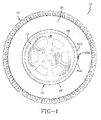
- a tire assembly 10 includes a tire 12 and a pump assembly 14.
- the tire mounts in a conventional fashion to a wheel 16 having outer rim flanges 26.
- An annular rim body 28 joins the rim flanges 26 and supports the tire assembly as shown.
- the tire is of conventional construction, having a pair of sidewalls 32 extending from opposite bead areas 34 to a crown or tire tread region 38. The tire and rim enclose an interior tire cavity 40 which is filled with air.
- the tire assembly includes a pump assembly 14 having a pump passageway 42 that is mounted or located in the tire in a channel 44, preferably near the bead region 34 of the sidewall.
- the pump passageway 42 may be formed of a discrete tube made of a resilient, flexible material such as plastic, elastomer or rubber compounds, and is capable of withstanding repeated deformation cycles when the tube is deformed into a flattened condition subject to external force and, upon removal of such force, returns to an original condition.
- the tube is of a diameter sufficient to operatively pass a volume of air sufficient for the purposes described herein and allowing a positioning of the tube in an operable location within the tire assembly as will be described.
- the tube has an elliptical cross-sectional shape, although other shapes such as round may be utilized.
- the pump passageway itself may also be integrally formed or molded into the sidewall of the tire during vulcanization, eliminating the need for an inserted tube.
- An integrally formed pump passageway is preferably made by building into a selected green tire component such as a chafer, a removable strip made of wire or silicone. The component is built into the tire and cured. The removable strip is then removed post cure to form a molded in or integrally formed pump air passageway.
- pump passageway refers either to installed tubes or an integrally molded in passageway.
- the location selected for the pump passageway within the tire may be within a tire component residing within a high flex region of the tire, sufficient to progressively collapse the internal hollow air passageway as the tire rotates under load thereby conveying air along the air passageway from the inlet to the pump outlet.
- the pump air passageway 42 has an inlet end 42a and an outlet end 42b joined together by a valve system 200, as shown in Figures 1 , 6 .
- a valve system 200 as shown in Figures 1 , 6 .
- Examples of pressure regulators or valve systems suitable for use with the invention are disclosed US-A-2013/0048176 , US-A-2013/0048177 und US-A-2013/0048178 and are hereby incorporated by reference.
- the inlet end 42a and the outlet end 42b are spaced apart approximately 360 degrees forming an annular pump assembly. However, the inlet and outlet ends may be spaced apart 90°, 180° or at another angle.
- the valve assembly 200 is preferably affixed to the inside of the tire, near the bead area.
- the valve assembly 200 has an inlet port 202 that is in fluid communication with a central air conduit 204.
- the central air conduit 204 is in fluid communication with an air filter assembly 300, as shown in Figures 6-8 .
- the central air conduit is preferably a flexible tube or passageway that extends from a filter housing to the inlet port 202 of the valve assembly 200.
- the valve assembly 200 is operable to control the amount of inlet air to the pump system 42. If the tire cavity pressure 40 falls below a set trigger pressure, the valve device allows air to enter the valve assembly 200 through inlet port 202, and then through to the pump passageway 42.
- the valve assembly 200 may allow airflow into the pump system through an air inlet port 210.
- the valve assembly 200 also may control the flow of air from the pump into the tire cavity, as well as prevent cavity air from back flowing into the pump passageways.
- the air filter assembly 300 is preferably positioned on the outer sidewall of the tire, in the vicinity of the pump passageways, as shown in Figures 6-8 . However, other locations may be used.
- the air filter assembly filters the outside air and communicates the filtered air to the inlet port 202 of the valve assembly 200.
- the air filter assembly 300 has a housing 304, and a cover 306 which assemble together to form an internal cavity 308.
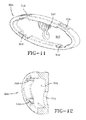
- the filter housing 304 is shown in Figures 7 , 10 , 11 and 12 .
- the filter housing 304 is also preferably elliptical in shape, with the minor axis aligned with the radial direction of the tire.
- the bottom surface 310 of the filter housing has a hole 312 for reception of a first end of the central air conduit 204.
- the filter housing preferably has a sidewall 314 having cutouts 316.
- tabular ends 320 of the cover 306 are received in the cutouts 316 to attach the cover to the filter housing.
- the front face of the cover has one or more holes 322.
- the filter housing 304 and cover 306 may be made of hard plastic or metal.
- the filter media may be a woven or nonwoven fiber, foam, spun fiberglass, charcoal, or other materials known to those skilled the art.
- a membrane such as PTFE GoreTex may be used, alone or in combination with the filter media.
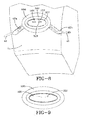
- the air filter assembly 300 is mounted in a pocket 400 formed on the outer surface of the tire, typically in the sidewall area near the pump passageways.
- the pocket 400 is shown in Figures 4-6 .
- the pocket may be molded in the tire (not shown), or formed in a vulcanized tire, post cure by laser cutting.
- the general shape of the pocket 400 is preferably curved, with no corners to eliminate stress concentrations. It is preferred that the pocket is also elliptical in shape, with the minor axis of the ellipse aligned with the radial direction of the tire.
- the pocket may also be round.
- the depth of the pocket is 5-15 mm, and the major axis width is 20-40 mm, minor axis width is 8-15 mm.
- the pocket has a bottom surface 402 having a hole 404 that is connected to the passageway 406 formed through the tire to the tire cavity, so that fluid may communicate from the hole 404 in the pocket to the passageway exit 408.
- An optional central air conduit 204 is positioned in the passageway 406 to communicate filtered air to the valve assembly 200. Alternatively, the passageway 406 may be used to communicate fluid to the cavity from the pocket.
- the bottom surface 402 of the pocket may further optionally include molded in attachment knobs 416 as shown in Figure 10 .
- the attachment knobs 416 may be used to secure a filter housing to the pocket.
- the bottom of the filter housing may have recesses 418 which allow the knobs 416 to snap inside, as shown in Figure 10 .
- the filter housing may have knobs (not shown) which are secured into recesses of the pocket (not shown).
- the pocket 400 further includes a sidewall 410.
- the sidewall 410 is surrounded by a first and second ledge 412, 414 joined together.
- a flexible collar 500 has an interior hole 502 wherein the interior hole is positioned around the outer circumferential edge 307 of the cover 306.
- the flexible collar 500 has a second end positioned on the first ledge 412. Alternatively, the second end may be positioned in a slot 510 formed in the sidewall of the pocket, as shown in Figure 10 .
- the cross-sectional profile 512 of the flexible collar may be U shaped.
- the flexible collar allows for the +/- 10% sidewall strain seen in tire service while protecting the filter media from flexing.
- the flexible collar 500 is made from a flexible material such as rubber.
- a green (unvulcanized) rubber ring 600 has an inner hole that is positioned about the outer circumference of the flexible collar 500 and wherein the outer portion of the rubber ring is positioned on the second, outer ledge 414.
- the green rubber ring 600 has an inner side which is preferably coated with a suitable adhesive as described below. The green rubber ring 600 is then cured over the flexible collar and affixed to the sidewall of the tire. The green rubber ring 600 may be cured by heat.
- the filter housing major axis dimension and minor axis dimension is preferably smaller than the pocket internal cavity 308, such that there is a gap surrounding the filter housing.
- the spatial gap can be in the range of 2mm to 8 mm.
- the filter housing major axis dimension may be in the range of 10% to 50% smaller than the pocket major axis dimension, and more preferably, 20-30% smaller than the pocket major axis dimension.
- the bottom of the filter housing is attached to the pocket bottom surface 402 by using one or more strips of green unvulcanized rubber which are coated with a suitable adhesive on both sides.
- the adhesive may be heat cured or cured at room temperature.
- One suitable adhesive is Fast Dry Self-vulcanizing Cement made by the Rubber Patch Company.
- Pump tubes 702, 703 Adjacent the pocket are two holes 704, 706 as shown in Figures 5 and 6 .
- the holes 704, 706 extend through the sidewall of the tire and are in fluid communication with aligned holes 708, 710 of the regulator.
- Pump tubes 702, 703 have a first end 705, 707 that are inserted through holes 704, 706 and into regulator holes 708, 710.
- Pump tubes 702, 703 preferably have quick connect ends such as barbs, etc so that the system may be easily assembly.
- Pump tubes have a second end that are bent about 90°. The second ends are inserted into slots 716, 718 formed adjacent the pocket. The second ends of the pump tubes connect to a continuous pump passageway 42.
- the pump passageway is connected to the second ends of the pump tubes, and then the pump passageway is inserted into channel 44.
- the pump passageway is coated with rubber cement and then inserted into the pump passageway.
- a green cover strip of rubber having an inner surface is first coated with rubber cement and then is placed over the pump passageway in the annular channel. Heat may be used to cure the rubber cement.
- the pump tubes and central air conduit are formed from a rubber composition having a shore D hardness of at least 40 as measured by ASTM-D2240. In one embodiment, the shore D hardness of the rubber composition is at least 45. In one embodiment, the shore D hardness of the rubber composition is at least 50.
- the rubber composition includes at least one diene based rubber.
- Representative synthetic polymers are the homopolymerization products of butadiene and its homologues and derivatives, for example, methylbutadiene, dimethylbutadiene and pentadiene as well as copolymers such as those formed from butadiene or its homologues or derivatives with other unsaturated monomers.
- acetylenes for example, vinyl acetylene
- olefins for example, isobutylene, which copolymerizes with isoprene to form butyl rubber
- vinyl compounds for example, acrylic acid, acrylonitrile (which polymerize with butadiene to form NBR), methacrylic acid and styrene, the latter compound polymerizing with butadiene to form SBR, as well as vinyl esters and various unsaturated aldehydes, ketones and ethers, e.g., acrolein, methyl isopropenyl ketone and vinylethyl ether.
- synthetic rubbers include neoprene (polychloroprene), polybutadiene (including cis-1,4-polybutadiene), polyisoprene (including cis-1,4-polyisoprene), butyl rubber, halobutyl rubber such as chlorobutyl rubber or bromobutyl rubber, styrene/isoprene/butadiene rubber, copolymers of 1,3-butadiene or isoprene with monomers such as styrene, acrylonitrile and methyl methacrylate, as well as ethylene/propylene terpolymers, also known as ethylene/propylene/diene monomer (EPDM), and in particular, ethylene/propylene/ dicyclopentadiene terpolymers.
- neoprene polychloroprene
- polybutadiene including cis-1,4-polybutadiene
- rubbers which may be used include alkoxy-silyl end functionalized solution polymerized polymers (SBR, PBR, IBR and SIBR), silicon-coupled and tin-coupled star-branched polymers.
- SBR alkoxy-silyl end functionalized solution polymerized polymers
- PBR polybutadiene
- SIBR silicon-coupled and tin-coupled star-branched polymers.
- the preferred rubber or elastomers are natural rubber, synthetic polyisoprene, polybutadiene and SBR.
- the rubber is preferably of at least two of diene based rubbers.
- a combination of two or more rubbers is preferred such as cis 1,4-polyisoprene rubber (natural or synthetic, although natural is preferred), 3,4-polyisoprene rubber, styrene/isoprene/butadiene rubber, emulsion and solution polymerization derived styrene/butadiene rubbers, cis 1,4-polybutadiene rubbers and emulsion polymerization prepared butadiene/acrylonitrile copolymers.
- an emulsion polymerization derived styrene/butadiene might be used having a relatively conventional styrene content of 20 to 28 percent bound styrene or, for some applications, an E-SBR having a medium to relatively high bound styrene content, namely, a bound styrene content of 30 to 45 percent.
- E-SBR emulsion polymerization prepared E-SBR
- styrene and 1,3-butadiene are copolymerized as an aqueous emulsion.
- the bound styrene content can vary, for example, from 5 to 50 percent.
- the E-SBR may also contain acrylonitrile to form a terpolymer rubber, as E-SBAR, in amounts, for example, of 2 to 30 weight percent bound acrylonitrile in the terpolymer.
- Emulsion polymerization prepared styrene/butadiene/acrylonitrile copolymer rubbers containing 2 to 40 weight percent bound acrylonitrile in the copolymer are also contemplated as diene based rubbers for use in this invention.
- S-SBR solution polymerization prepared SBR
- S-SBR typically has a bound styrene content in a range of 5 to 50, preferably 9 to 36, percent.
- the S-SBR can be conveniently prepared, for example, by organo lithium catalyzation in the presence of an organic hydrocarbon solvent.
- cis 1,4-polybutadiene rubber may be used.
- BR cis 1,4-polybutadiene rubber
- Such BR can be prepared, for example, by organic solution polymerization of 1,3-butadiene.
- the BR may be conveniently characterized, for example, by having at least a 90 percent cis 1,4-content.
- cis 1,4-polybutadiene rubber is used.
- Suitable polybutadiene rubbers may be prepared, for example, by organic solution polymerization of 1,3-butadiene.
- the BR may be conveniently characterized, for example, by having at least a 90 percent cis 1,4-content and a glass transition temperature Tg in a range of from -95 to -105oC.
- Suitable polybutadiene rubbers are available commercially, such as Budene® 1207 from Goodyear and the like.
- a synthetic or natural polyisoprene rubber may be used.
- a reference to glass transition temperature, or Tg, of an elastomer or elastomer composition represents the glass transition temperature(s) of the respective elastomer or elastomer composition in its uncured state or possibly a cured state in a case of an elastomer composition.
- a Tg can be suitably determined as a peak midpoint by a differential scanning calorimeter (DSC) at a temperature rate of increase of 10oC per minute.
- DSC differential scanning calorimeter
- the rubber composition may also include up to 70 phr of processing oil.
- Processing oil may be included in the rubber composition as extending oil typically used to extend elastomers. Processing oil may also be included in the rubber composition by addition of the oil directly during rubber compounding.
- the processing oil used may include both extending oil present in the elastomers, and process oil added during compounding.
- Suitable process oils include various oils as are known in the art, including aromatic, paraffinic, naphthenic, vegetable oils, and low PCA oils, such as MES, TDAE, SRAE and heavy naphthenic oils.
- Suitable low PCA oils include those having a polycyclic aromatic content of less than 3 percent by weight as determined by the IP346 method. Procedures for the IP346 method may be found in Standard Methods for Analysis & Testing of Petroleum and Related Products and British Standard 2000 Parts, 2003, 62nd edition, published by the Institute of Petroleum, United Kingdom .
- the rubber composition may include from 10 to 150 phr of silica. In another embodiment, from 20 to 120 phr of silica may be used.
- the commonly employed siliceous pigments which may be used in the rubber compound include conventional pyrogenic and precipitated siliceous pigments (silica).
- precipitated silica is used.
- the conventional siliceous pigments employed in this invention are precipitated silicas such as, for example, those obtained by the acidification of a soluble silicate, e.g., sodium silicate.
- silicas such as, only for example herein, and without limitation, silicas commercially available from PPG Industries under the Hi-Sil trademark with designations 210 and 243; silicas available from Rhodia, with, for example, designations of Z1165MP and Z165GR, and silicas available from Degussa AG with, for example, designations VN2 and VN3.
- Commonly employed carbon blacks can be used as a conventional filler in an amount ranging from 10 to 150 phr. In another embodiment, from 20 to 80 phr of carbon black may be used.
- Representative examples of such carbon blacks include N110, N121, N134, N220, N231, N234, N242, N293, N299, N315, N326, N330, N332, N339, N343, N347, N351, N358, N375, N539, N550, N582, N630, N642, N650, N683, N754, N762, N765, N774, N787, N907, N908, N990 and N991.
- These carbon blacks have iodine absorptions ranging from 9 to 145 g/kg and DBP number ranging from 34 to 150 cm 3 /100 g.
- fillers may be used in the rubber composition including, but not limited to, particulate fillers including ultra high molecular weight polyethylene (UHMWPE), crosslinked particulate polymer gels including but not limited to those disclosed in US-B-6,242,534 ; US-B-6,207,757 ; US-B-6,133,364 ; US-B-6,372,857 ; US-A-5,395,891 ; or US-B-6,127,488 , and plasticized starch composite filler including but not limited to that disclosed in US-A-5,672,639 .
- Such other fillers may be used in an amount ranging from 1 to 30 phr.
- the rubber composition may contain a conventional sulfur containing organosilicon compound.
- suitable sulfur containing organosilicon compounds are of the formula: Z-Alk-S n -Alk-Z in which Z is selected from the group consisting of where R 1 is an alkyl group of 1 to 4 carbon atoms, cyclohexyl or phenyl; R 2 is alkoxy of 1 to 8 carbon atoms, or cycloalkoxy of 5 to 8 carbon atoms; Alk is a divalent hydrocarbon of 1 to 18 carbon atoms and n is an integer of 2 to 8.
- the sulfur containing organosilicon compounds are the 3,3'-bis(trimethoxy or triethoxy silylpropyl) polysulfides. In one embodiment, the sulfur containing organosilicon compounds are 3,3'-bis(triethoxysilylpropyl) disulfide and/or 3,3'-bis(triethoxysilylpropyl) tetrasulfide. Therefore, as to formula I, Z may be where R 2 is an alkoxy of 2 to 4 carbon atoms, alternatively 2 carbon atoms; alk is a divalent hydrocarbon of 2 to 4 carbon atoms, alternatively with 3 carbon atoms; and n is an integer of from 2 to 5, alternatively 2 or 4.
- suitable sulfur containing organosilicon compounds include compounds disclosed in US-B-6,608,125 .
- suitable sulfur containing organosilicon compounds include those disclosed in US-A-2003/0130535 .
- the sulfur containing organosilicon compound is Si-363 from Degussa.
- the amount of the sulfur containing organosilicon compound in a rubber composition will vary depending on the level of other additives that are used. Generally speaking, the amount of the compound will range from 0.5 to 20 phr. In one embodiment, the amount will range from 1 to 10 phr.
- the rubber composition may contain an in-situ resin that is the reaction product of a methylene acceptor and a methylene donor.
- In-situ resins are formed in the rubber composition and involve the reaction of a methylene acceptor and a methylene donor.
- methylene donor is intended to mean a chemical capable of reacting with a methylene acceptor and generate the resin in-situ.
- Examples of methylene donors which are suitable for use in the present invention include hexamethylenetetramine and N-substituted oxymethylmelamines, of the general formula: wherein X is hydrogen or an alkyl having from 1 to 8 carbon atoms, R 1 , R 2 , R 3 , R 4 and R 5 are individually selected from the group consisting of hydrogen, an alkyl having from 1 to 8 carbon atoms, the group -CH 2 OX or their condensation products.
- Specific methylene donors include hexakis-(methoxymethyl)melamine, N,N',N"-trimethyl/N,N',N"-trimethylolmelamine, hexamethylolmelamine, N,N',N"-dimethylolmelamine, N-methylolmelamine, N,N'-dimethylolmelamine, N,N',N"-tris(methoxymethyl)melamine, N,N'N"-tributyl-N,N',N"-trimethylol-melamine, hexamethoxymethylmelamine, and hexaethoxymethylmelamine.
- the N-methylol derivatives of melamine are prepared by known methods.
- the amount of methylene donor in the rubber composition may vary. In one embodiment, the amount of methylene donor ranges from 0.5 to 25 phr. In another embodiment, the amount of methylene donor ranges from 1 to 15 phr.
- methylene acceptor is known to those skilled in the art and is used to describe the reactant to which the methylene donor reacts to form what is believed to be a methylol monomer.
- the condensation of the methylol monomer by the formation of a methylene bridge produces the resin.
- the initial reaction that contributes the moiety that later forms into the methylene bridge is the methylene donor wherein the other reactant is the methylene acceptor.
- Representative compounds which may be used as a methylene acceptor include but are not limited to resorcinol, resorcinolic derivatives, monohydric phenols and their derivatives, dihydric phenols and their derivatives, polyhydric phenols and their derivatives, unmodified phenol novolak resins, modified phenol novolak resin, resorcinol novolak resins and mixtures thereof.
- Examples of methylene acceptors include but are not limited to those disclosed in US-B-6,605,670 ; US-B-6,541,551 ; US-B-6,472,457 ; US-A-5,945,500 ; US-A-5,936,056 ; US-A-5,688,871 ; US-A-5,665,799 ; US-A-5,504,127 ; US-A-5,405,897 ; US-A-5,244,725 ; US-A-5,206,289 ; US-A-5,194,513 ; US-A-5,030,692 ; US-A-4,889,481 ; US-A-4,605,696 ; US-A-4,436,853 ; and US-A-4,092,455 .
- Examples of modified phenol novolak resins include but are not limited to cashew nut oil modified phenol novolak resin, tall oil modified phenol novolak resin and alkyl modified phenol novol
- methylene acceptors include activated phenols by ring substitution and a cashew nut oil modified novalak-type phenolic resin.
- activated phenols by ring substitution include resorcinol, cresols, t-butyl phenols, isopropyl phenols, ethyl phenols and mixtures thereof.
- Cashew nut oil modified novolak-type phenolic resins are commercially available from Schenectady Chemicals Inc under the designation SP6700. The modification rate of oil based on total novolak-type phenolic resin may range from 10 to 50 percent.
- various processes may be used for production of the novolak-type phenolic resin modified with cashew nut oil.
- phenols such as phenol, cresol and resorcinol may be reacted with aldehydes such as formaldehyde, paraformaldehyde and benzaldehyde using acid catalysts.
- acid catalysts include oxalic acid, hydrochloric acid, sulfuric acid and p-toluenesulfonic acid. After the catalytic reaction, the resin is modified with the oil.
- the amount of methylene acceptor in the rubber stock may vary. In one embodiment, the amount of methylene acceptor ranges from 0.5 to 25 phr. In another embodiment, the amount of methylene acceptor ranges from 1 to 15 phr.
- the rubber composition would be compounded by methods generally known in the rubber compounding art, such as mixing the various sulfur-vulcanizable constituent rubbers with various commonly used additive materials such as, for example, sulfur donors, curing aids, such as activators and retarders and processing additives, such as oils, resins including tackifying resins and plasticizers, fillers, pigments, fatty acid, zinc oxide, waxes, antioxidants and antiozonants and peptizing agents.
- additives mentioned above are selected and commonly used in conventional amounts.
- sulfur donors include elemental sulfur (free sulfur), an amine disulfide, polymeric polysulfide and sulfur olefin adducts.
- the sulfur-vulcanizing agent is elemental sulfur.
- the sulfur-vulcanizing agent may be used in an amount ranging from 0.5 to 8 phr, alternatively with a range of from 1.5 to 6 phr.
- Typical amounts of tackifier resins, if used, comprise 0.5 to 10 phr, usually 1 to 5 phr.
- processing aids comprise 1 to 50 phr.
- Typical amounts of antioxidants comprise 1 to 5 phr.
- antioxidants may be, for example, diphenyl-p-phenylenediamine and others, such as, for example, those disclosed in The Vanderbilt Rubber Handbook (1978), Pages 344 through 346 .
- Typical amounts of antiozonants comprise 1 to 5 phr.
- Typical amounts of fatty acids, if used, which can include stearic acid comprise 0.5 to 3 phr.
- Typical amounts of waxes comprise 1 to 5 phr. Often microcrystalline waxes are used.
- peptizers comprise 0.1 to 1 phr.
- Typical peptizers may be, for example, pentachlorothiophenol and dibenzamidodiphenyl disulfide.
- Accelerators are used to control the time and/or temperature required for vulcanization and to improve the properties of the vulcanizate.
- a single accelerator system may be used, i.e., primary accelerator.
- the primary accelerator(s) may be used in total amounts ranging from 0.5 to 4, alternatively 0.8 to 1.5, phr.
- combinations of a primary and a secondary accelerator might be used with the secondary accelerator being used in smaller amounts, such as from 0.05 to 3 phr, in order to activate and to improve the properties of the vulcanizate. Combinations of these accelerators might be expected to produce a synergistic effect on the final properties and are somewhat better than those produced by use of either accelerator alone.
- delayed action accelerators may be used which are not affected by normal processing temperatures but produce a satisfactory cure at ordinary vulcanization temperatures.
- Vulcanization retarders might also be used.
- Suitable types of accelerators that may be used in the present invention are amines, disulfides, guanidines, thioureas, thiazoles, thiurams, sulfenamides, dithiocarbamates and xanthates.
- the primary accelerator is a sulfenamide.
- the secondary accelerator may be a guanidine, dithiocarbamate or thiuram compound.
- Suitable guanidines include dipheynylguanidine and the like.
- Suitable thiurams include tetramethylthiuram disulfide, tetraethylthiuram disulfide, and tetrabenzylthiuram disulfide.
- the mixing of the rubber composition can be accomplished by methods known to those having skill in the rubber mixing art.
- the ingredients are typically mixed in at least two stages, namely, at least one non-productive stage followed by a productive mix stage.
- the final curatives including sulfur-vulcanizing agents are typically mixed in the final stage which is conventionally called the "productive" mix stage in which the mixing typically occurs at a temperature, or ultimate temperature, lower than the mix temperature(s) than the preceding non-productive mix stage(s).
- the rubber composition may be subjected to a thermomechanical mixing step.
- the thermomechanical mixing step generally comprises a mechanical working in a mixer or extruder for a period of time suitable in order to produce a rubber temperature between 140°C and 190°C.
- the appropriate duration of the thermomechanical working varies as a function of the operating conditions, and the volume and nature of the components.
- the thermomechanical working may be from 1 to 20 minutes.
- the rubber composition may be formed into a tubular shape using methods as are known in the art, including extrusion and the like.
- the passage tubes and central air passage may be formed with an outside diameter in cross section of 2 to 4 mm and a wall thickness of 0.5 to 1 mm.
- Vulcanization of the pneumatic tire of the present invention is generally carried out at conventional temperatures ranging from 100°C to 200°C. In one embodiment, the vulcanization is conducted at temperatures ranging from 110°C to 180°C. Any of the usual vulcanization processes may be used such as heating in a press or mold, heating with superheated steam or hot air. Such tires can be built, shaped, molded and cured by various methods which are known and will be readily apparent to those having skill in such art.
- the pneumatic tire of the present invention may be a race tire, passenger tire, aircraft tire, agricultural, earthmover, off-the-road or truck tire.
- the tire is a passenger or truck tire.
- the tire may also be a radial or bias.
- Three steel tubes were inserted through a tire into the tire bead area in the location and in the configuration needed for the regulator attachment (see e.g. Figures 4 and 6 ).
- the tubes were flush with the liner side of the tire and the passages were sealed with a tire repair patch on the inside of the tire.
- a bead durability test was run and the tire was removed from the test after the equivalent of 12176 km.
- tires were tested in a bead durability test on 120" (304.80 cm) smooth steel drums. In this test, tires are run at constant speed, maintained inflation, zero slip and camber, while the load is increased by a fixed amount at regular intervals (typically 5% of nominal load every 1200km).
- the tire was analyzed after the equivalent of 12176 km on the test.
- the steel tubes had broken at or near the ply ending. Samples showed torsion and ductile fatigue. Some sections had surface cracking.
- Polyurethane tubing was tested in two tires for higher or lower positioning of the passages in reference to the pumping groove and ply ending. Two sets of tubes were placed in each tire, with the sets of tubes in a given tire separated by 180° around the tire. The tires ran 6075 km and 2417 km on the durability test before being removed.
- a tire were prepared and tested as in Example 1, except that teflon tubing was used.
- the tire was analyzed after the equivalent of 12382 km on the test.
- the tubes looked intact in the tire section but were found to have kinks, indentations, and gouges. One of the three tubes was penetrated by a cut wire end. Black debris was found in the tubes and they were blocked.
- Rubber tubing was constructed from calendered sheet using two standard apex rubber compositions having a Shore D hardness of 50 and 30.
- Calendered rubber sheet was brushed with Nylabond III cement for better tack. The rubber was wrapped over a metal pin three times and the assembly was placed in a mold. Five assemblies fit into the mold. The rubber was cured 10 minutes at 170 °C.
- Rubber passage tubes made out of the high hardness and lower hardness materials were installed into two fully functional air maintenance tires.
- the tubes made out of the lower hardness rubber did not have air flow when installed in a tire.
- the higher hardness rubber tubes have flow when the tire is mounted and inflated.
- the tire was ODR tested to completion (144533 km).
- the ODR (outdoor resiliometer) test is an endurance test conducted on 67" (170.18 cm) smooth steel drums located outdoors to evaluate the impact of outdoor conditions on tire durability. Tires are run at constant load, constant speed, raised inflation, zero slip and zero camber. Tests are in principle run until the daily visual inspection reveals any of various standard causes for removal. Forensic analysis showed slightly elongated (oval), open tubes. All were rigid and intact.
Landscapes
- Engineering & Computer Science (AREA)
- Mechanical Engineering (AREA)
- Compositions Of Macromolecular Compounds (AREA)
- Tires In General (AREA)
Applications Claiming Priority (1)
| Application Number | Priority Date | Filing Date | Title |
|---|---|---|---|
| US14/453,986 US9387737B2 (en) | 2014-08-07 | 2014-08-07 | Passage tube for air maintenance tire |
Publications (2)
| Publication Number | Publication Date |
|---|---|
| EP2982525A1 true EP2982525A1 (fr) | 2016-02-10 |
| EP2982525B1 EP2982525B1 (fr) | 2017-03-29 |
Family
ID=53836414
Family Applications (1)
| Application Number | Title | Priority Date | Filing Date |
|---|---|---|---|
| EP15179489.8A Active EP2982525B1 (fr) | 2014-08-07 | 2015-08-03 | Pneu de maintenance d'air |
Country Status (4)
| Country | Link |
|---|---|
| US (1) | US9387737B2 (fr) |
| EP (1) | EP2982525B1 (fr) |
| CN (1) | CN105365499B (fr) |
| BR (1) | BR102015017872B1 (fr) |
Cited By (1)
| Publication number | Priority date | Publication date | Assignee | Title |
|---|---|---|---|---|
| FR3074182A1 (fr) * | 2017-11-30 | 2019-05-31 | Compagnie Generale Des Etablissements Michelin | Composition de caoutchouc a haut module comprenant un ultra-accelerateur de vulcanisation |
Families Citing this family (3)
| Publication number | Priority date | Publication date | Assignee | Title |
|---|---|---|---|---|
| US11020921B2 (en) | 2016-10-03 | 2021-06-01 | The Goodyear Tire & Rubber Company | Connecting member for an air maintenance tire and method of forming the same |
| EP3312027B1 (fr) | 2016-10-19 | 2019-08-28 | The Goodyear Tire & Rubber Company | Ensemble de connexion destiné à un système pneumatique de maintenance d'air et système pneumatique de maintenance d'air |
| JP2018083618A (ja) * | 2016-11-23 | 2018-05-31 | ザ・グッドイヤー・タイヤ・アンド・ラバー・カンパニー | エアメンテナンスタイヤの取付け部材 |
Citations (30)
| Publication number | Priority date | Publication date | Assignee | Title |
|---|---|---|---|---|
| US4092455A (en) | 1976-03-08 | 1978-05-30 | American Cyanamid Company | Use of methylenebis- and thiobisnaphthols as promoters in tire cord adhesion to rubber |
| US4436853A (en) | 1982-08-20 | 1984-03-13 | The Goodyear Tire & Rubber Company | Phenol-melamine resins for improving rubber to metal adhesion |
| US4605696A (en) | 1985-09-27 | 1986-08-12 | The Goodyear Tire & Rubber Company | Enhanced adhesion of rubber to reinforcing materials through the use of phenolic esters |
| US4889481A (en) | 1988-08-16 | 1989-12-26 | Hi-Tech Ceramics, Inc. | Dual structure infrared surface combustion burner |
| US5030692A (en) | 1988-08-10 | 1991-07-09 | Indspec Chemical Corporation | Rubber compounding resorcinolic resins and process for making the same |
| US5194513A (en) | 1990-08-28 | 1993-03-16 | The Goodyear Tire & Rubber Company | Rubber compositions containing a hydroxy aryl substituted maleamic acid |
| US5206289A (en) | 1992-01-27 | 1993-04-27 | The Goodyear Tire & Rubber Company | Rubber stock containing a polyhydric phenoxy resin |
| US5244725A (en) | 1992-02-24 | 1993-09-14 | Indspec Chemical Corporation | Hydroxyalkyl aryl ethers of di- and polyhydric phenols |
| US5395891A (en) | 1992-06-24 | 1995-03-07 | Bayer Aktiengesellschaft | Rubber mixtures containing polybutadiene gel |
| US5405897A (en) | 1993-02-09 | 1995-04-11 | The Goodyear Tire & Rubber Company | Rubber stock containing phenoxyacetic acid |
| US5504127A (en) | 1993-06-07 | 1996-04-02 | The Goodyear Tire & Rubber Company | Monoesters of rosin acid |
| US5665799A (en) | 1994-09-07 | 1997-09-09 | Sumitomo Chemical Company, Limited | Rubber composition and a vulcanizing adhesion method using the same |
| US5672639A (en) | 1996-03-12 | 1997-09-30 | The Goodyear Tire & Rubber Company | Starch composite reinforced rubber composition and tire with at least one component thereof |
| US5688871A (en) | 1994-03-18 | 1997-11-18 | Sumitomo Chemical Company, Limited | Rubber composition containing a flavan compound and a method for producing a vulcanized rubber containing same |
| US5936056A (en) | 1997-03-07 | 1999-08-10 | Indspec Chemical Corporation | Non-volatile resorcinolic resins and methods of making and using the same |
| US6127488A (en) | 1997-01-17 | 2000-10-03 | Bayer Ag | Rubber mixtures which contain SBR rubber gels |
| US6133364A (en) | 1998-08-01 | 2000-10-17 | Continental Aktiengesellschaft | Rubber composition, method of formulating the composition and vehicle tire made from the composition |
| US6207757B1 (en) | 1998-08-01 | 2001-03-27 | Continental Aktiengesellschaft | Rubber composition, method of adding and blending the composition and vehicle tire made from the composition |
| US6242534B1 (en) | 1998-08-01 | 2001-06-05 | Continental Aktiengesellschaft | Rubber composition, method of formulating and blending the same and article and tires made therefrom |
| US6372857B1 (en) | 1999-09-07 | 2002-04-16 | Bayer Aktiengesellschaft | Microgel-containing rubber mixtures with masked bi-functional mercaptans and vulcanization products produced therefrom |
| US6472457B1 (en) | 2000-12-21 | 2002-10-29 | Indspec Chemical Corporation | Nonformaldehyde, nonfuming resorcinolic resins and methods of making and using the same |
| US6541551B1 (en) | 2000-12-21 | 2003-04-01 | Indspec Chemical Corporation | Resorcinolic derivative for rubber compounds |
| US20030130535A1 (en) | 2001-08-06 | 2003-07-10 | Degussa Ag, | Organosilicon compounds |
| US6605670B1 (en) | 2001-11-06 | 2003-08-12 | Indspec Chemical Corporation | Resorcinolic derivatives and methods of making and using the same |
| US6608125B2 (en) | 1997-08-21 | 2003-08-19 | Crompton Corporation | Blocked mercaptosilane coupling agents for filled rubbers |
| US20130048177A1 (en) | 2011-08-30 | 2013-02-28 | The Goodyear Tire & Rubber Company | Self-inflating tire and pressure regulator |
| US20130048178A1 (en) | 2011-08-30 | 2013-02-28 | The Goodyear Tire & Rubber Company | Self-inflating tire |
| US20130048176A1 (en) | 2011-08-30 | 2013-02-28 | The Goodyear Tire & Rubber Company | Self-inflating tire |
| EP2740616A1 (fr) * | 2012-12-06 | 2014-06-11 | The Goodyear Tire & Rubber Company | Ensemble de pompage de maintenance d'air et pneu |
| EP2842776A1 (fr) * | 2013-08-30 | 2015-03-04 | The Goodyear Tire & Rubber Company | Ensemble de pneu et procédé de fabrication d'un ensemble de pneu |
Family Cites Families (7)
| Publication number | Priority date | Publication date | Assignee | Title |
|---|---|---|---|---|
| GB1086512A (en) * | 1964-02-24 | 1967-10-11 | Ronald Leslie Sheppard | Improvements in or relating to pneumatic tyres |
| US8042586B2 (en) * | 2009-12-21 | 2011-10-25 | The Goodyear Tire & Rubber Company | Self-inflating tire assembly |
| US8113254B2 (en) * | 2009-12-21 | 2012-02-14 | The Goodyear Tire & Rubber Company | Self-inflating tire |
| US8235081B2 (en) * | 2010-11-22 | 2012-08-07 | The Goodyear Tire & Rubber Company | In-line pumping assembly for self-inflating tire |
| US20130160927A1 (en) * | 2011-12-21 | 2013-06-27 | Daniel Paul Luc Marie Hinque | Air maintenance tire method of construction |
| US8915277B2 (en) * | 2011-12-21 | 2014-12-23 | The Goodyear Tire & Rubber Company | Air maintenance tire and connector system |
| US9242518B2 (en) * | 2012-12-20 | 2016-01-26 | The Goodyear Tire & Rubber Company | Compact valve system for self-inflating tire |
-
2014
- 2014-08-07 US US14/453,986 patent/US9387737B2/en active Active
-
2015
- 2015-07-27 BR BR102015017872-7A patent/BR102015017872B1/pt active IP Right Grant
- 2015-08-03 EP EP15179489.8A patent/EP2982525B1/fr active Active
- 2015-08-07 CN CN201510482390.5A patent/CN105365499B/zh active Active
Patent Citations (31)
| Publication number | Priority date | Publication date | Assignee | Title |
|---|---|---|---|---|
| US4092455A (en) | 1976-03-08 | 1978-05-30 | American Cyanamid Company | Use of methylenebis- and thiobisnaphthols as promoters in tire cord adhesion to rubber |
| US4436853A (en) | 1982-08-20 | 1984-03-13 | The Goodyear Tire & Rubber Company | Phenol-melamine resins for improving rubber to metal adhesion |
| US4605696A (en) | 1985-09-27 | 1986-08-12 | The Goodyear Tire & Rubber Company | Enhanced adhesion of rubber to reinforcing materials through the use of phenolic esters |
| US5030692A (en) | 1988-08-10 | 1991-07-09 | Indspec Chemical Corporation | Rubber compounding resorcinolic resins and process for making the same |
| US4889481A (en) | 1988-08-16 | 1989-12-26 | Hi-Tech Ceramics, Inc. | Dual structure infrared surface combustion burner |
| US5194513A (en) | 1990-08-28 | 1993-03-16 | The Goodyear Tire & Rubber Company | Rubber compositions containing a hydroxy aryl substituted maleamic acid |
| US5206289A (en) | 1992-01-27 | 1993-04-27 | The Goodyear Tire & Rubber Company | Rubber stock containing a polyhydric phenoxy resin |
| US5244725A (en) | 1992-02-24 | 1993-09-14 | Indspec Chemical Corporation | Hydroxyalkyl aryl ethers of di- and polyhydric phenols |
| US5395891A (en) | 1992-06-24 | 1995-03-07 | Bayer Aktiengesellschaft | Rubber mixtures containing polybutadiene gel |
| US5405897A (en) | 1993-02-09 | 1995-04-11 | The Goodyear Tire & Rubber Company | Rubber stock containing phenoxyacetic acid |
| US5504127A (en) | 1993-06-07 | 1996-04-02 | The Goodyear Tire & Rubber Company | Monoesters of rosin acid |
| US5688871A (en) | 1994-03-18 | 1997-11-18 | Sumitomo Chemical Company, Limited | Rubber composition containing a flavan compound and a method for producing a vulcanized rubber containing same |
| US5665799A (en) | 1994-09-07 | 1997-09-09 | Sumitomo Chemical Company, Limited | Rubber composition and a vulcanizing adhesion method using the same |
| US5672639A (en) | 1996-03-12 | 1997-09-30 | The Goodyear Tire & Rubber Company | Starch composite reinforced rubber composition and tire with at least one component thereof |
| US6127488A (en) | 1997-01-17 | 2000-10-03 | Bayer Ag | Rubber mixtures which contain SBR rubber gels |
| US5936056A (en) | 1997-03-07 | 1999-08-10 | Indspec Chemical Corporation | Non-volatile resorcinolic resins and methods of making and using the same |
| US5945500A (en) | 1997-03-07 | 1999-08-31 | Indspec Chemical Corp. | Non-volatile resorcinolic resins and methods of making and using the same |
| US6608125B2 (en) | 1997-08-21 | 2003-08-19 | Crompton Corporation | Blocked mercaptosilane coupling agents for filled rubbers |
| US6242534B1 (en) | 1998-08-01 | 2001-06-05 | Continental Aktiengesellschaft | Rubber composition, method of formulating and blending the same and article and tires made therefrom |
| US6207757B1 (en) | 1998-08-01 | 2001-03-27 | Continental Aktiengesellschaft | Rubber composition, method of adding and blending the composition and vehicle tire made from the composition |
| US6133364A (en) | 1998-08-01 | 2000-10-17 | Continental Aktiengesellschaft | Rubber composition, method of formulating the composition and vehicle tire made from the composition |
| US6372857B1 (en) | 1999-09-07 | 2002-04-16 | Bayer Aktiengesellschaft | Microgel-containing rubber mixtures with masked bi-functional mercaptans and vulcanization products produced therefrom |
| US6472457B1 (en) | 2000-12-21 | 2002-10-29 | Indspec Chemical Corporation | Nonformaldehyde, nonfuming resorcinolic resins and methods of making and using the same |
| US6541551B1 (en) | 2000-12-21 | 2003-04-01 | Indspec Chemical Corporation | Resorcinolic derivative for rubber compounds |
| US20030130535A1 (en) | 2001-08-06 | 2003-07-10 | Degussa Ag, | Organosilicon compounds |
| US6605670B1 (en) | 2001-11-06 | 2003-08-12 | Indspec Chemical Corporation | Resorcinolic derivatives and methods of making and using the same |
| US20130048177A1 (en) | 2011-08-30 | 2013-02-28 | The Goodyear Tire & Rubber Company | Self-inflating tire and pressure regulator |
| US20130048178A1 (en) | 2011-08-30 | 2013-02-28 | The Goodyear Tire & Rubber Company | Self-inflating tire |
| US20130048176A1 (en) | 2011-08-30 | 2013-02-28 | The Goodyear Tire & Rubber Company | Self-inflating tire |
| EP2740616A1 (fr) * | 2012-12-06 | 2014-06-11 | The Goodyear Tire & Rubber Company | Ensemble de pompage de maintenance d'air et pneu |
| EP2842776A1 (fr) * | 2013-08-30 | 2015-03-04 | The Goodyear Tire & Rubber Company | Ensemble de pneu et procédé de fabrication d'un ensemble de pneu |
Non-Patent Citations (2)
| Title |
|---|
| "Standard Methods for Analysis & Testing of Petroleum and Related Products and British Standard 2000 Parts", 2003, INSTITUTE OF PETROLEUM |
| "Vanderbilt Rubber Handbook", 1978, pages: 344 - 346 |
Cited By (4)
| Publication number | Priority date | Publication date | Assignee | Title |
|---|---|---|---|---|
| FR3074182A1 (fr) * | 2017-11-30 | 2019-05-31 | Compagnie Generale Des Etablissements Michelin | Composition de caoutchouc a haut module comprenant un ultra-accelerateur de vulcanisation |
| WO2019106294A1 (fr) * | 2017-11-30 | 2019-06-06 | Compagnie Generale Des Etablissements Michelin | Composition de caoutchouc a haut module comprenant un ultra-accelerateur de vulcanisation |
| CN111433270A (zh) * | 2017-11-30 | 2020-07-17 | 米其林集团总公司 | 包含硫化超促进剂的高模量橡胶组合物 |
| US12071545B2 (en) | 2017-11-30 | 2024-08-27 | Compagnie Generale Des Etablissements Michelin | High-modulus rubber composition comprising a vulcanization ultra-accelerator |
Also Published As
| Publication number | Publication date |
|---|---|
| EP2982525B1 (fr) | 2017-03-29 |
| US9387737B2 (en) | 2016-07-12 |
| US20160039258A1 (en) | 2016-02-11 |
| CN105365499A (zh) | 2016-03-02 |
| BR102015017872B1 (pt) | 2021-03-16 |
| BR102015017872A2 (pt) | 2016-06-28 |
| CN105365499B (zh) | 2017-12-29 |
Similar Documents
| Publication | Publication Date | Title |
|---|---|---|
| EP3323633B1 (fr) | Pneu possédant une bande de roulement à double couche | |
| EP2072283B1 (fr) | Pneu avec composant contenant des fibres d'aramide | |
| EP2565057B1 (fr) | Pneu ayant une bande de roulement à double couche | |
| US8453693B2 (en) | Pneumatic tire | |
| EP2353887A2 (fr) | Pneumatique | |
| US11834569B2 (en) | Rubber composition and a rubber product | |
| US8418737B2 (en) | Tire with component containing polybenzobisoxazole short fiber and epoxidized polyisoprene | |
| EP2982525B1 (fr) | Pneu de maintenance d'air | |
| US8261796B2 (en) | Tire with component containing polybenzobisoxazole short fiber and epoxidized palm oil | |
| EP1930184A1 (fr) | Pneu avec bourrage contenant de la résine et du caoutchouc in situ avec des groupes hydroxyles pendants | |
| EP3040212B1 (fr) | Pneumatique | |
| US20100116404A1 (en) | Tire with component containing polyketone short fiber and functionalized elastomer | |
| US20090156740A1 (en) | Tire with component containing polymeric nanofiber | |
| US7669626B1 (en) | Tire with component containing polyketone short fiber and polyethyleneimine | |
| EP2727957B1 (fr) | Composition de caoutchouc avec résine encapsulée et pneu | |
| US20200009927A1 (en) | Air maintenance tire |
Legal Events
| Date | Code | Title | Description |
|---|---|---|---|
| PUAI | Public reference made under article 153(3) epc to a published international application that has entered the european phase |
Free format text: ORIGINAL CODE: 0009012 |
|
| AK | Designated contracting states |
Kind code of ref document: A1 Designated state(s): AL AT BE BG CH CY CZ DE DK EE ES FI FR GB GR HR HU IE IS IT LI LT LU LV MC MK MT NL NO PL PT RO RS SE SI SK SM TR |
|
| AX | Request for extension of the european patent |
Extension state: BA ME |
|
| 17P | Request for examination filed |
Effective date: 20160810 |
|
| RBV | Designated contracting states (corrected) |
Designated state(s): AL AT BE BG CH CY CZ DE DK EE ES FI FR GB GR HR HU IE IS IT LI LT LU LV MC MK MT NL NO PL PT RO RS SE SI SK SM TR |
|
| GRAP | Despatch of communication of intention to grant a patent |
Free format text: ORIGINAL CODE: EPIDOSNIGR1 |
|
| INTG | Intention to grant announced |
Effective date: 20161019 |
|
| GRAS | Grant fee paid |
Free format text: ORIGINAL CODE: EPIDOSNIGR3 |
|
| GRAA | (expected) grant |
Free format text: ORIGINAL CODE: 0009210 |
|
| AK | Designated contracting states |
Kind code of ref document: B1 Designated state(s): AL AT BE BG CH CY CZ DE DK EE ES FI FR GB GR HR HU IE IS IT LI LT LU LV MC MK MT NL NO PL PT RO RS SE SI SK SM TR |
|
| REG | Reference to a national code |
Ref country code: GB Ref legal event code: FG4D |
|
| REG | Reference to a national code |
Ref country code: CH Ref legal event code: EP |
|
| REG | Reference to a national code |
Ref country code: AT Ref legal event code: REF Ref document number: 879379 Country of ref document: AT Kind code of ref document: T Effective date: 20170415 |
|
| REG | Reference to a national code |
Ref country code: IE Ref legal event code: FG4D |
|
| REG | Reference to a national code |
Ref country code: DE Ref legal event code: R096 Ref document number: 602015001999 Country of ref document: DE |
|
| REG | Reference to a national code |
Ref country code: FR Ref legal event code: PLFP Year of fee payment: 3 |
|
| PG25 | Lapsed in a contracting state [announced via postgrant information from national office to epo] |
Ref country code: NO Free format text: LAPSE BECAUSE OF FAILURE TO SUBMIT A TRANSLATION OF THE DESCRIPTION OR TO PAY THE FEE WITHIN THE PRESCRIBED TIME-LIMIT Effective date: 20170629 Ref country code: GR Free format text: LAPSE BECAUSE OF FAILURE TO SUBMIT A TRANSLATION OF THE DESCRIPTION OR TO PAY THE FEE WITHIN THE PRESCRIBED TIME-LIMIT Effective date: 20170630 Ref country code: HR Free format text: LAPSE BECAUSE OF FAILURE TO SUBMIT A TRANSLATION OF THE DESCRIPTION OR TO PAY THE FEE WITHIN THE PRESCRIBED TIME-LIMIT Effective date: 20170329 Ref country code: LT Free format text: LAPSE BECAUSE OF FAILURE TO SUBMIT A TRANSLATION OF THE DESCRIPTION OR TO PAY THE FEE WITHIN THE PRESCRIBED TIME-LIMIT Effective date: 20170329 Ref country code: FI Free format text: LAPSE BECAUSE OF FAILURE TO SUBMIT A TRANSLATION OF THE DESCRIPTION OR TO PAY THE FEE WITHIN THE PRESCRIBED TIME-LIMIT Effective date: 20170329 |
|
| REG | Reference to a national code |
Ref country code: NL Ref legal event code: MP Effective date: 20170329 |
|
| REG | Reference to a national code |
Ref country code: AT Ref legal event code: MK05 Ref document number: 879379 Country of ref document: AT Kind code of ref document: T Effective date: 20170329 |
|
| PG25 | Lapsed in a contracting state [announced via postgrant information from national office to epo] |
Ref country code: RS Free format text: LAPSE BECAUSE OF FAILURE TO SUBMIT A TRANSLATION OF THE DESCRIPTION OR TO PAY THE FEE WITHIN THE PRESCRIBED TIME-LIMIT Effective date: 20170329 Ref country code: SE Free format text: LAPSE BECAUSE OF FAILURE TO SUBMIT A TRANSLATION OF THE DESCRIPTION OR TO PAY THE FEE WITHIN THE PRESCRIBED TIME-LIMIT Effective date: 20170329 Ref country code: BG Free format text: LAPSE BECAUSE OF FAILURE TO SUBMIT A TRANSLATION OF THE DESCRIPTION OR TO PAY THE FEE WITHIN THE PRESCRIBED TIME-LIMIT Effective date: 20170629 Ref country code: LV Free format text: LAPSE BECAUSE OF FAILURE TO SUBMIT A TRANSLATION OF THE DESCRIPTION OR TO PAY THE FEE WITHIN THE PRESCRIBED TIME-LIMIT Effective date: 20170329 |
|
| PG25 | Lapsed in a contracting state [announced via postgrant information from national office to epo] |
Ref country code: NL Free format text: LAPSE BECAUSE OF FAILURE TO SUBMIT A TRANSLATION OF THE DESCRIPTION OR TO PAY THE FEE WITHIN THE PRESCRIBED TIME-LIMIT Effective date: 20170329 |
|
| PG25 | Lapsed in a contracting state [announced via postgrant information from national office to epo] |
Ref country code: EE Free format text: LAPSE BECAUSE OF FAILURE TO SUBMIT A TRANSLATION OF THE DESCRIPTION OR TO PAY THE FEE WITHIN THE PRESCRIBED TIME-LIMIT Effective date: 20170329 Ref country code: ES Free format text: LAPSE BECAUSE OF FAILURE TO SUBMIT A TRANSLATION OF THE DESCRIPTION OR TO PAY THE FEE WITHIN THE PRESCRIBED TIME-LIMIT Effective date: 20170329 Ref country code: RO Free format text: LAPSE BECAUSE OF FAILURE TO SUBMIT A TRANSLATION OF THE DESCRIPTION OR TO PAY THE FEE WITHIN THE PRESCRIBED TIME-LIMIT Effective date: 20170329 Ref country code: AT Free format text: LAPSE BECAUSE OF FAILURE TO SUBMIT A TRANSLATION OF THE DESCRIPTION OR TO PAY THE FEE WITHIN THE PRESCRIBED TIME-LIMIT Effective date: 20170329 Ref country code: SK Free format text: LAPSE BECAUSE OF FAILURE TO SUBMIT A TRANSLATION OF THE DESCRIPTION OR TO PAY THE FEE WITHIN THE PRESCRIBED TIME-LIMIT Effective date: 20170329 Ref country code: CZ Free format text: LAPSE BECAUSE OF FAILURE TO SUBMIT A TRANSLATION OF THE DESCRIPTION OR TO PAY THE FEE WITHIN THE PRESCRIBED TIME-LIMIT Effective date: 20170329 |
|
| PG25 | Lapsed in a contracting state [announced via postgrant information from national office to epo] |
Ref country code: SM Free format text: LAPSE BECAUSE OF FAILURE TO SUBMIT A TRANSLATION OF THE DESCRIPTION OR TO PAY THE FEE WITHIN THE PRESCRIBED TIME-LIMIT Effective date: 20170329 Ref country code: PL Free format text: LAPSE BECAUSE OF FAILURE TO SUBMIT A TRANSLATION OF THE DESCRIPTION OR TO PAY THE FEE WITHIN THE PRESCRIBED TIME-LIMIT Effective date: 20170329 Ref country code: IS Free format text: LAPSE BECAUSE OF FAILURE TO SUBMIT A TRANSLATION OF THE DESCRIPTION OR TO PAY THE FEE WITHIN THE PRESCRIBED TIME-LIMIT Effective date: 20170729 |
|
| REG | Reference to a national code |
Ref country code: DE Ref legal event code: R097 Ref document number: 602015001999 Country of ref document: DE |
|
| PG25 | Lapsed in a contracting state [announced via postgrant information from national office to epo] |
Ref country code: DK Free format text: LAPSE BECAUSE OF FAILURE TO SUBMIT A TRANSLATION OF THE DESCRIPTION OR TO PAY THE FEE WITHIN THE PRESCRIBED TIME-LIMIT Effective date: 20170329 |
|
| PLBE | No opposition filed within time limit |
Free format text: ORIGINAL CODE: 0009261 |
|
| STAA | Information on the status of an ep patent application or granted ep patent |
Free format text: STATUS: NO OPPOSITION FILED WITHIN TIME LIMIT |
|
| 26N | No opposition filed |
Effective date: 20180103 |
|
| PG25 | Lapsed in a contracting state [announced via postgrant information from national office to epo] |
Ref country code: MC Free format text: LAPSE BECAUSE OF FAILURE TO SUBMIT A TRANSLATION OF THE DESCRIPTION OR TO PAY THE FEE WITHIN THE PRESCRIBED TIME-LIMIT Effective date: 20170329 |
|
| REG | Reference to a national code |
Ref country code: BE Ref legal event code: MM Effective date: 20170831 |
|
| REG | Reference to a national code |
Ref country code: IE Ref legal event code: MM4A |
|
| PG25 | Lapsed in a contracting state [announced via postgrant information from national office to epo] |
Ref country code: SI Free format text: LAPSE BECAUSE OF FAILURE TO SUBMIT A TRANSLATION OF THE DESCRIPTION OR TO PAY THE FEE WITHIN THE PRESCRIBED TIME-LIMIT Effective date: 20170329 |
|
| REG | Reference to a national code |
Ref country code: FR Ref legal event code: PLFP Year of fee payment: 4 |
|
| PG25 | Lapsed in a contracting state [announced via postgrant information from national office to epo] |
Ref country code: LU Free format text: LAPSE BECAUSE OF NON-PAYMENT OF DUE FEES Effective date: 20170803 |
|
| PG25 | Lapsed in a contracting state [announced via postgrant information from national office to epo] |
Ref country code: IE Free format text: LAPSE BECAUSE OF NON-PAYMENT OF DUE FEES Effective date: 20170803 |
|
| PG25 | Lapsed in a contracting state [announced via postgrant information from national office to epo] |
Ref country code: BE Free format text: LAPSE BECAUSE OF NON-PAYMENT OF DUE FEES Effective date: 20170831 |
|
| PG25 | Lapsed in a contracting state [announced via postgrant information from national office to epo] |
Ref country code: MT Free format text: LAPSE BECAUSE OF NON-PAYMENT OF DUE FEES Effective date: 20170803 |
|
| REG | Reference to a national code |
Ref country code: CH Ref legal event code: PL |
|
| PG25 | Lapsed in a contracting state [announced via postgrant information from national office to epo] |
Ref country code: LI Free format text: LAPSE BECAUSE OF NON-PAYMENT OF DUE FEES Effective date: 20180831 Ref country code: CH Free format text: LAPSE BECAUSE OF NON-PAYMENT OF DUE FEES Effective date: 20180831 |
|
| PG25 | Lapsed in a contracting state [announced via postgrant information from national office to epo] |
Ref country code: HU Free format text: LAPSE BECAUSE OF FAILURE TO SUBMIT A TRANSLATION OF THE DESCRIPTION OR TO PAY THE FEE WITHIN THE PRESCRIBED TIME-LIMIT; INVALID AB INITIO Effective date: 20150803 |
|
| PG25 | Lapsed in a contracting state [announced via postgrant information from national office to epo] |
Ref country code: CY Free format text: LAPSE BECAUSE OF FAILURE TO SUBMIT A TRANSLATION OF THE DESCRIPTION OR TO PAY THE FEE WITHIN THE PRESCRIBED TIME-LIMIT Effective date: 20170329 |
|
| PG25 | Lapsed in a contracting state [announced via postgrant information from national office to epo] |
Ref country code: MK Free format text: LAPSE BECAUSE OF FAILURE TO SUBMIT A TRANSLATION OF THE DESCRIPTION OR TO PAY THE FEE WITHIN THE PRESCRIBED TIME-LIMIT Effective date: 20170329 |
|
| PG25 | Lapsed in a contracting state [announced via postgrant information from national office to epo] |
Ref country code: TR Free format text: LAPSE BECAUSE OF FAILURE TO SUBMIT A TRANSLATION OF THE DESCRIPTION OR TO PAY THE FEE WITHIN THE PRESCRIBED TIME-LIMIT Effective date: 20170329 |
|
| GBPC | Gb: european patent ceased through non-payment of renewal fee |
Effective date: 20190803 |
|
| PG25 | Lapsed in a contracting state [announced via postgrant information from national office to epo] |
Ref country code: PT Free format text: LAPSE BECAUSE OF FAILURE TO SUBMIT A TRANSLATION OF THE DESCRIPTION OR TO PAY THE FEE WITHIN THE PRESCRIBED TIME-LIMIT Effective date: 20170329 |
|
| PG25 | Lapsed in a contracting state [announced via postgrant information from national office to epo] |
Ref country code: AL Free format text: LAPSE BECAUSE OF FAILURE TO SUBMIT A TRANSLATION OF THE DESCRIPTION OR TO PAY THE FEE WITHIN THE PRESCRIBED TIME-LIMIT Effective date: 20170329 |
|
| PG25 | Lapsed in a contracting state [announced via postgrant information from national office to epo] |
Ref country code: GB Free format text: LAPSE BECAUSE OF NON-PAYMENT OF DUE FEES Effective date: 20190803 |
|
| PGFP | Annual fee paid to national office [announced via postgrant information from national office to epo] |
Ref country code: FR Payment date: 20240611 Year of fee payment: 10 |
|
| PGFP | Annual fee paid to national office [announced via postgrant information from national office to epo] |
Ref country code: DE Payment date: 20240612 Year of fee payment: 10 |
|
| PGFP | Annual fee paid to national office [announced via postgrant information from national office to epo] |
Ref country code: IT Payment date: 20240710 Year of fee payment: 10 |
|
| REG | Reference to a national code |
Ref country code: DE Ref legal event code: R119 Ref document number: 602015001999 Country of ref document: DE |