EP2983365A1 - Procédé de codage prédictif d'images et codeur d'images - Google Patents
Procédé de codage prédictif d'images et codeur d'images Download PDFInfo
- Publication number
- EP2983365A1 EP2983365A1 EP13883015.3A EP13883015A EP2983365A1 EP 2983365 A1 EP2983365 A1 EP 2983365A1 EP 13883015 A EP13883015 A EP 13883015A EP 2983365 A1 EP2983365 A1 EP 2983365A1
- Authority
- EP
- European Patent Office
- Prior art keywords
- tile
- frame
- current frame
- reference frame
- lcu
- Prior art date
- Legal status (The legal status is an assumption and is not a legal conclusion. Google has not performed a legal analysis and makes no representation as to the accuracy of the status listed.)
- Withdrawn
Links
- 238000000034 method Methods 0.000 title claims abstract description 55
- 239000013598 vector Substances 0.000 claims description 109
- 230000002123 temporal effect Effects 0.000 claims description 76
- 238000009795 derivation Methods 0.000 description 7
- 238000005516 engineering process Methods 0.000 description 7
- 238000010586 diagram Methods 0.000 description 6
- 238000012986 modification Methods 0.000 description 3
- 230000004048 modification Effects 0.000 description 3
- 238000013139 quantization Methods 0.000 description 3
- 230000003044 adaptive effect Effects 0.000 description 2
- 230000005540 biological transmission Effects 0.000 description 2
- 238000001914 filtration Methods 0.000 description 2
- 238000005457 optimization Methods 0.000 description 1
- 230000009466 transformation Effects 0.000 description 1
Images




Classifications
-
- H—ELECTRICITY
- H04—ELECTRIC COMMUNICATION TECHNIQUE
- H04N—PICTORIAL COMMUNICATION, e.g. TELEVISION
- H04N19/00—Methods or arrangements for coding, decoding, compressing or decompressing digital video signals
- H04N19/50—Methods or arrangements for coding, decoding, compressing or decompressing digital video signals using predictive coding
-
- H—ELECTRICITY
- H04—ELECTRIC COMMUNICATION TECHNIQUE
- H04N—PICTORIAL COMMUNICATION, e.g. TELEVISION
- H04N19/00—Methods or arrangements for coding, decoding, compressing or decompressing digital video signals
- H04N19/50—Methods or arrangements for coding, decoding, compressing or decompressing digital video signals using predictive coding
- H04N19/503—Methods or arrangements for coding, decoding, compressing or decompressing digital video signals using predictive coding involving temporal prediction
- H04N19/51—Motion estimation or motion compensation
- H04N19/513—Processing of motion vectors
- H04N19/517—Processing of motion vectors by encoding
- H04N19/52—Processing of motion vectors by encoding by predictive encoding
-
- H—ELECTRICITY
- H04—ELECTRIC COMMUNICATION TECHNIQUE
- H04N—PICTORIAL COMMUNICATION, e.g. TELEVISION
- H04N19/00—Methods or arrangements for coding, decoding, compressing or decompressing digital video signals
- H04N19/10—Methods or arrangements for coding, decoding, compressing or decompressing digital video signals using adaptive coding
- H04N19/102—Methods or arrangements for coding, decoding, compressing or decompressing digital video signals using adaptive coding characterised by the element, parameter or selection affected or controlled by the adaptive coding
- H04N19/103—Selection of coding mode or of prediction mode
- H04N19/105—Selection of the reference unit for prediction within a chosen coding or prediction mode, e.g. adaptive choice of position and number of pixels used for prediction
-
- H—ELECTRICITY
- H04—ELECTRIC COMMUNICATION TECHNIQUE
- H04N—PICTORIAL COMMUNICATION, e.g. TELEVISION
- H04N19/00—Methods or arrangements for coding, decoding, compressing or decompressing digital video signals
- H04N19/10—Methods or arrangements for coding, decoding, compressing or decompressing digital video signals using adaptive coding
- H04N19/134—Methods or arrangements for coding, decoding, compressing or decompressing digital video signals using adaptive coding characterised by the element, parameter or criterion affecting or controlling the adaptive coding
- H04N19/167—Position within a video image, e.g. region of interest [ROI]
-
- H—ELECTRICITY
- H04—ELECTRIC COMMUNICATION TECHNIQUE
- H04N—PICTORIAL COMMUNICATION, e.g. TELEVISION
- H04N19/00—Methods or arrangements for coding, decoding, compressing or decompressing digital video signals
- H04N19/10—Methods or arrangements for coding, decoding, compressing or decompressing digital video signals using adaptive coding
- H04N19/169—Methods or arrangements for coding, decoding, compressing or decompressing digital video signals using adaptive coding characterised by the coding unit, i.e. the structural portion or semantic portion of the video signal being the object or the subject of the adaptive coding
- H04N19/17—Methods or arrangements for coding, decoding, compressing or decompressing digital video signals using adaptive coding characterised by the coding unit, i.e. the structural portion or semantic portion of the video signal being the object or the subject of the adaptive coding the unit being an image region, e.g. an object
- H04N19/172—Methods or arrangements for coding, decoding, compressing or decompressing digital video signals using adaptive coding characterised by the coding unit, i.e. the structural portion or semantic portion of the video signal being the object or the subject of the adaptive coding the unit being an image region, e.g. an object the region being a picture, frame or field
-
- H—ELECTRICITY
- H04—ELECTRIC COMMUNICATION TECHNIQUE
- H04N—PICTORIAL COMMUNICATION, e.g. TELEVISION
- H04N19/00—Methods or arrangements for coding, decoding, compressing or decompressing digital video signals
- H04N19/10—Methods or arrangements for coding, decoding, compressing or decompressing digital video signals using adaptive coding
- H04N19/169—Methods or arrangements for coding, decoding, compressing or decompressing digital video signals using adaptive coding characterised by the coding unit, i.e. the structural portion or semantic portion of the video signal being the object or the subject of the adaptive coding
- H04N19/17—Methods or arrangements for coding, decoding, compressing or decompressing digital video signals using adaptive coding characterised by the coding unit, i.e. the structural portion or semantic portion of the video signal being the object or the subject of the adaptive coding the unit being an image region, e.g. an object
- H04N19/174—Methods or arrangements for coding, decoding, compressing or decompressing digital video signals using adaptive coding characterised by the coding unit, i.e. the structural portion or semantic portion of the video signal being the object or the subject of the adaptive coding the unit being an image region, e.g. an object the region being a slice, e.g. a line of blocks or a group of blocks
-
- H—ELECTRICITY
- H04—ELECTRIC COMMUNICATION TECHNIQUE
- H04N—PICTORIAL COMMUNICATION, e.g. TELEVISION
- H04N19/00—Methods or arrangements for coding, decoding, compressing or decompressing digital video signals
- H04N19/10—Methods or arrangements for coding, decoding, compressing or decompressing digital video signals using adaptive coding
- H04N19/169—Methods or arrangements for coding, decoding, compressing or decompressing digital video signals using adaptive coding characterised by the coding unit, i.e. the structural portion or semantic portion of the video signal being the object or the subject of the adaptive coding
- H04N19/182—Methods or arrangements for coding, decoding, compressing or decompressing digital video signals using adaptive coding characterised by the coding unit, i.e. the structural portion or semantic portion of the video signal being the object or the subject of the adaptive coding the unit being a pixel
-
- H—ELECTRICITY
- H04—ELECTRIC COMMUNICATION TECHNIQUE
- H04N—PICTORIAL COMMUNICATION, e.g. TELEVISION
- H04N19/00—Methods or arrangements for coding, decoding, compressing or decompressing digital video signals
- H04N19/42—Methods or arrangements for coding, decoding, compressing or decompressing digital video signals characterised by implementation details or hardware specially adapted for video compression or decompression, e.g. dedicated software implementation
- H04N19/436—Methods or arrangements for coding, decoding, compressing or decompressing digital video signals characterised by implementation details or hardware specially adapted for video compression or decompression, e.g. dedicated software implementation using parallelised computational arrangements
-
- H—ELECTRICITY
- H04—ELECTRIC COMMUNICATION TECHNIQUE
- H04N—PICTORIAL COMMUNICATION, e.g. TELEVISION
- H04N19/00—Methods or arrangements for coding, decoding, compressing or decompressing digital video signals
- H04N19/50—Methods or arrangements for coding, decoding, compressing or decompressing digital video signals using predictive coding
- H04N19/503—Methods or arrangements for coding, decoding, compressing or decompressing digital video signals using predictive coding involving temporal prediction
-
- H—ELECTRICITY
- H04—ELECTRIC COMMUNICATION TECHNIQUE
- H04N—PICTORIAL COMMUNICATION, e.g. TELEVISION
- H04N19/00—Methods or arrangements for coding, decoding, compressing or decompressing digital video signals
- H04N19/65—Methods or arrangements for coding, decoding, compressing or decompressing digital video signals using error resilience
Definitions
- the present invention relates to the field of image processing technologies, and in particular, to an image predictive coding method and an image encoder.
- the HEVC (High Efficiency Video Codec)/H.265 is a mixed video coding standard based on a combination of transformation and prediction, and introduces many optimization ideas for parallel operations, to be applicable to a chip with a high parallel operation level, where a Tile (code block) technology is a typical technology used to implement a parallel operation.
- each Tile includes LCUs (Largest Coding Unit, largest coding unit) whose quantity is an integer.
- LCUs Large Coding Unit, largest coding unit
- each LCU in the Tile is separately encoded. Because each LCU in each Tile is independently encoded, each Tile is a set of independent coding units, and a spatial dependence relationship is broken. Therefore, Tiles obtained through division in each frame are mutually independent, and several Tiles may be encoded at the same time, which implements parallel processing.
- each PU Predicting Unit, predicting unit
- each PU is an image block including several pixels.
- a reference pixel needs to be determined, and the PU is predicted by using an MV (Moving Vector, moving vector) of the reference pixel.
- an existing predictive coding method includes an intra-frame predictive coding method and an inter-frame predictive coding method. When intra-frame predictive coding is performed, due to independence between Tiles in a frame, when a PU is predicted, a selected reference pixel is only related to a Tile in which a current to-be-predictive-coded LCU is located, and is not related to another Tile.
- a pixel in any Tile of a reference frame may be used as the reference pixel.
- an image includes 4 Tiles, which are a Tile 0, a Tile 1, a Tile 2, and a Tile 3.
- Pixels in the Tile 1 and the Tile 2 may be used as reference pixels, and then an MV of a selected reference pixel is used for prediction.
- the error may be spread to the Tile 2, and a pixel in the Tile 2 may be used as a reference pixel for predicting a PU in another Tile.
- the error occurring in the Tile 1 may be spread to the entire frame of image, thereby lowering accuracy of image coding.
- a PU when a PU is predicted, and when a reference pixel is determined, the most important is to determine a PMV (Predicted Moving Vector, predicted moving vector) of the PU.
- PMV Predicted Moving Vector
- an MV of the reference pixel may be predicted according to the determined PMV. Because each MV corresponds to one reference pixel, the reference pixel may be further determined.
- a candidate temporal moving vector in another Tile may be used as the PMV of the to-be-predicted PU. For example, in FIG.
- a candidate temporal moving vector in the Tile 3 may be used as the PMV of the PU included in the to-be-predictive-coded LCU. Therefore, if an error occurs in image data of the Tile 3 in the reference frame, after inter-frame predictive coding is performed, the error may be spread to the Tile 2, and a candidate temporal moving vector in the Tile 2 may be used as a PMV for predicting a PU in another Tile. By analogy, the error occurring in the Tile 3 may be spread to the entire frame of image, thereby lowering accuracy of image coding.
- Embodiments of the present invention provide an image predictive coding method and an image encoder, to prevent an error occurring in image data of a Tile from spreading to an entire frame of image, thereby improving accuracy of image coding.
- an image predictive coding method includes:
- the selecting a reference pixel from the determined Tile of the reference frame includes:
- an image predictive coding method includes:
- the method further includes:
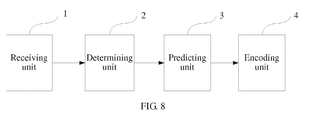
- an image encoder includes a receiving unit configured to receive a to-be-encoded image, and further includes a determining unit, a predicting unit, and an encoding unit, where:
- the predicting unit is specifically configured to:
- an image encoder includes a receiving unit configured to receive a to-be-encoded image, and further includes a determining unit, a predicting unit, and an encoding unit, where:
- the predicting unit is specifically configured to:
- a Tile of the reference frame that corresponds to a Tile of the current frame is determined, where the to-be-predictive-coded LCU is located in the Tile of the current frame, and a position of the Tile of the reference frame in the reference frame is the same as a position of the Tile of the current frame in the current frame; and a reference pixel is selected from the determined Tile of the reference frame.
- a pixel in the Tile of the reference frame that corresponds to the position of the Tile of the current frame, in the reference frame is used as the reference pixel, and a pixel in another Tile of the reference frame is not used as the reference pixel.
- the error is only limited in the Tile of the current frame, and does not affect another Tile. Therefore, an error occurring in a Tile is prevented from spreading to an entire frame of image, thereby improving accuracy of image coding.
- a Tile of the reference frame that corresponds to a Tile of the current frame is determined, where a to-be-predictive-coded LCU is located in the Tile of the current frame and a position of the Tile of the reference frame in the reference frame is the same as a position of the Tile of the current frame in the current frame; and a candidate temporal moving vector is selected from the Tile of the reference frame, as a PMV of a PU included in the to-be-predictive-coded LCU.
- a Tile of the current frame is determined first in the received current frame, where the to-be-predictive-coded LCU is located in the Tile of the current frame. Then, in a reference frame of the current frame, a Tile of the reference frame is then determined, where a position of the Tile of the reference frame is the same as a position of the Tile of the current frame in the current frame.
- a reference pixel is selected from the determined Tile of the reference frame; and when a PMV of the PU is determined, a candidate temporal moving vector is selected from the determined Tile of the reference frame, as the PMV of the PU.
- a pixel in the Tile of the reference frame that corresponds to the Tile of the current frame is referenced and used as the reference pixel during the process of encoding the LCU, where the to-be-predictive-coded LCU is located in the Tile of the current frame, and a moving vector in the Tile of the reference frame that corresponds to the Tile of the current frame is referenced and used as the PMV of the PU, where the to-be-predictive-coded LCU is located in the Tile of the current frame.
- the error is always limited in an area corresponding to the Tile in which the error occurs. Therefore, the error occurring in the Tile is prevented from spreading to an entire frame of image, thereby effectively improving accuracy of image coding.
- inter-frame predictive coding needs to be performed on an LCU in a Tile.
- the most important is to select a reference pixel of a PU in the to-be-predictive-coded LCU from a reference frame of a current frame. Then, the PU is predicted according to the selected reference pixel, and inter-frame predictive coding is performed on the LCU in the Tile according to a prediction result obtained by predicting the PU.
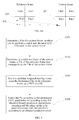
- this embodiment of the present invention provides an image predictive coding method, including:
- S101 Determine a Tile of a current frame, in which a to-be-predictive-coded LCU is located, in the current frame.
- an LCU is a basic coding unit defined in the HEVC/H.265.
- each LCU in each Tile needs to be encoded separately according to an order of Tiles, and multiple LCU obtained through encoding forms a Tile codestream for transmission.
- a Tile of a current frame in the current frame is determined in advance, where the to-be-predictive-coded LCU is located in the Tile of the current frame. Therefore, in a reference frame of the current frame, a Tile of the reference frame corresponding to the current frame can be determined, where the to-be-predictive-coded LCU is located in the Tile of the current frame.
- S102 Determine, in a reference frame of the current frame, a Tile of the reference frame that corresponds to the Tile of the current frame that is determined in S101.
- a position of the Tile of the reference frame which is selected from the reference frame, in the reference frame, is the same as a position of the Tile of the current frame in the current frame.
- the Tile technology is to use vertical and horizontal boundaries to divide each frame of image into some rows and columns, these rows and columns obtained through division form multiple rectangular areas, and each rectangular area is one Tile.
- positions of these Tiles are fixed. Therefore, in this embodiment of the present invention, when the Tile of the reference frame that corresponds to the Tile of the current frame is determined in the reference frame of the current frame, a Tile is selected from the reference frame of the current frame, as an eventually needed Tile of the reference frame according to the position of the Tile of the current frame in the current frame, where a position of the Tile is the same as a position of the Tile of the current frame in the current frame.
- the Tiles obtained through division may be sequentially numbered.
- a Tile may be selected from the reference frame of the current frame according to numbers of the Tiles, as the eventually needed Tile of the reference frame, where a position of the Tile is the same as the position of the Tile of the current frame in the current frame.
- S103 Select a reference pixel from the Tile of the reference frame that is determined in S102.
- the selection is performed in the Tile of the reference frame that is determined in S103, and is not performed in another Tile of the reference frame.
- Such selection ensures that the Tile of the current frame is related to the determined Tile of the reference frame, and is not related to another Tile of the reference frame. Therefore, independence is maintained between the Tile of the current frame and another Tile of the reference frame, to prevent an error occurring in a Tile of the reference frame from spreading to an entire frame of image, thereby effectively improving accuracy of image coding.
- S104 Predict, by using the reference pixel selected in S103, a PU included in the LCU, and perform predictive coding on the to-be-predictive-coded LCU according to an obtained prediction result.
- each LCU is divided into several PUs during an encoding process.
- a reference pixel is selected from the Tile of the reference frame for each PU included in the LCU, each PU included in the LCU is separately predicted by using the selected reference pixel.
- predictive coding is performed on the to-be-predictive-coded LCU according to the obtained prediction result
- the performing predictive coding on the to-be-predictive-coded LCU according to the prediction result obtained by predicting the PU mainly refers to that a prediction value of the PU may be obtained by predicting the PU, a difference operation is performed on the obtained prediction value and an original value of the PU, to obtain a residual of the PU; and predictive coding on the LCU can be completed by performing predictive coding on a residual of each PU.
- a Tile is determined in a reference frame of a current frame, as a Tile of the reference frame, where a position of the Tile is the same as a position of a Tile of the current frame in the current frame, where the to-be-predictive-coded LCU is located in the Tile of the current frame, and the reference pixel of the PU included in the to-be-predictive-coded LCU is selected from the determined Tile of the reference frame.
- Embodiment 2 of the present invention describes in detail the image predictive coding method in Embodiment 1.
- Embodiment 2 of the present invention describes in detail a process of selecting a reference pixel of a PU from the determined Tile of the reference frame in S103. Other steps are the same as those in Embodiment 1, and are not described herein again.
- each image frame is divided into 4 Tiles, which are a Tile 0, a Tile 1, a Tile 2, and a Tile 3.
- Each Tile includes LCUs whose quantity is an integer, and each LCU is further divided into several PUs.
- FIG. 4A when image predictive coding is performed, each PU in each LCU needs to be predicted separately, and then predictive coding is performed on each LCU in the Tile by using the PU obtained through prediction.
- description is made by using an example of performing predictive coding on an LCU 201 in the Tile 2.
- a Tile of a current frame is a Tile 2 of the current frame, where the to-be-predictive-coded LCU 201 is located in the Tile of the current frame.
- a Tile of a reference frame that corresponds to the Tile 2 of the current frame is a Tile 2 of the reference frame.
- the reference pixel when the reference pixel is selected, to improve accuracy of predictive coding, the reference pixel may be selected from the determined Tile of the reference frame according to a position of the to-be-predictive-coded LCU in the Tile of the current frame. Therefore, a position of an LCU to which the selected reference pixel belongs in the Tile of the reference frame is the same as or adjacent to the position of the to-be-predictive-coded LCU in the Tile of the current frame. For example, in FIG.
- a pixel in an LCU may be selected from the Tile 2 of the reference frame, as the reference pixel according to a position of the LCU 201 in the Tile 2 of the current frame, where a position of the LCU is the same as or adjacent to the position of the to-be-predictive-coded LCU 201. As shown in FIG.
- pixels in an LCU 202 and an LCU 203 may be selected as reference pixels, where a position of the LCU 202 in the Tile 2 of the reference frame is the same as the position of the LCU 201 in the Tile 2 of the current frame, and a position of the LCU 203 in the Tile 2 of the reference frame is adjacent to the position of the LCU 201 in the Tile 2 of the current frame.
- a reference pixel of a PU is selected from a determined Tile of a reference frame, where a position of the determined Tile of the reference frame, in the reference frame of a current frame, is the same as a position of a Tile of the current frame in the current frame.
- a pixel in the Tile of the reference frame that corresponds to the Tile of the current frame, in the reference frame, is used as the reference pixel, and a pixel in another Tile of the reference frame is not used as the reference pixel, which can prevent an error occurring in a Tile from spreading to an entire frame of image, thereby improving accuracy of image coding.
- the reference pixel when the reference pixel is selected, the reference pixel is selected from the Tile of the reference frame according to an actual situation and according to the position of the Tile of the current frame, in which the to-be-predictive-coded LCU is located, which can further accurately obtain through prediction the to-be-predictive-coded LCU, and further improve accuracy of image coding.
- Embodiment 3 of the present invention provides an image predictive coding method, including:
- the Tile of the current frame, in which the to-be-predictive-coded LCU is located, in the current frame may be determined in the received current frame by using the method in Embodiment 1, which is not described herein again.
- a position of the Tile of the reference frame which is determined in the reference frame of the current frame and corresponds to the Tile of the current frame, in the reference frame, is the same as a position of the Tile of the current frame in the current frame.
- the selection is performed in the Tile of the reference frame that is determined in S303, and is not performed in another Tile of the reference frame.
- Such selection ensures that the Tile of the current frame is related to the determined Tile of the reference frame, and is not related to another Tile in the reference frame, and maintains independence between the Tile of the current frame and another Tile of the reference frame except the Tile of the reference frame.
- an MV of the PU is obtained through prediction by using a difference between the determined PMV and a current vector
- the PU is predicted according to the MV obtained through prediction
- predictive coding is performed on the to-be-predictive-coded LCU according to a prediction result obtained by predicting the PU.
- a Tile is determined in a reference frame of a current frame, as a Tile of the reference frame, where a position of the Tile is the same as a position of a Tile of the current frame in the current frame, where a to-be-predictive-coded LCU is located in the Tile of the current frame, and a candidate temporal moving vector is selected from the determined Tile of the reference frame, as the PMV of the PU.
- the candidate temporal moving vector in the Tile of the reference frame that corresponds to the Tile of the current frame is used, where the to-be-predictive-coded LCU is located in the Tile of the current frame, and a candidate temporal moving vector in another Tile of the reference frame is not used.
- the error is always limited in an area corresponding to the Tile, and does not affect predictive coding of another Tile. Therefore, the error is not spread to an entire frame of image, thereby improving accuracy of image coding.
- Embodiment 4 of the present invention describes in detail the image predictive coding method in Embodiment 3.
- Embodiment 4 of the present invention describes in detail a process of selecting a candidate temporal moving vector from the determined Tile of the reference frame, as a PMV of a PU in S303.
- Other steps are the same as those in Embodiment 3, and are not described herein again.
- Moving vectors used during an image coding process include a candidate spatial moving vector and a candidate temporal moving vector.
- a candidate spatial moving vector may be selected from the current frame, as the PMV of the PU according to a candidate spatial moving vector of the current frame, or a candidate temporal moving vector may be selected from the reference frame, as the PMV of the PU.
- the candidate spatial moving vector indicates a spatial position of the LCU in the Tile of the current frame.
- a candidate spatial moving vector of another LCU in the Tile of the current frame may be selected as the PMV, and a candidate spatial moving vector in another Tile is not used, thereby maintaining independence between Tiles.
- the HEVC/H.265 protocol specifies that a PPS has the following parameter: enable_temporal_mvp_flag.
- a value of the parameter is set to 0.
- a candidate spatial moving vector instead of a candidate temporal moving vector is selected as the PMV of the PU.
- FIG. 6 shows an implementation process of selecting a candidate temporal moving vector from the determined Tile of the reference frame, as a PMV of a PU according to this embodiment of the present invention, including:
- a candidate temporal moving vector when a candidate temporal moving vector is selected, a candidate temporal moving vector may be randomly selected from the reference frame of the current frame. After the candidate temporal moving vector is selected, S402 is performed.
- candidate temporal moving vectors of each PU in different Tiles are different. Whether the candidate temporal moving vector selected in S401 is in the Tile of the reference frame that corresponds to the Tile of the current frame may be determined according to the candidate temporal moving vector in the Tile of the reference frame that corresponds to the Tile of the current frame, in the reference frame, where the to-be-predictive-coded PU is located in the Tile of the current frame.
- the selected candidate temporal moving vector is in the determined Tile of the reference frame that corresponds to the Tile of the current frame, where the to-be-predictive-coded LCU is located in the Tile of the current frame, and the candidate temporal moving vector selected in the S401 may be used as the PMV of the PU.
- a candidate temporal moving vector is selected from a Tile of a reference frame that corresponds to a Tile of a current frame, as the PMV of the PU, where a to-be-predictive-coded LCU is located in the Tile of the current frame, in the current frame.
- Embodiment 5 of the present invention provides an implementation method of maintaining independence between Tiles during an intra-frame predictive coding process and an inter-frame predictive coding process.
- intra-frame independence not only intra-frame independence but also inter-frame independence can be maintained between Tiles in an image obtained through predictive coding.
- the error occurring in the Tile is limited in an area corresponding to the Tile no matter intra-frame predictive coding is performed in a current frame obtained through encoding or inter-frame predictive coding is performed by using a current frame obtained through encoding as a reference frame, and does not spread to an entire frame of image, thereby improving accuracy of image coding well.
- this embodiment of the present invention provides an image encoder, where the encoder includes a receiving unit 1 configured to receive a to-be-encoded image, and further includes a determining unit 2, a predicting unit 3, and an encoding unit 4, where:
- the predicting unit 3 is specifically configured to:
- a reference pixel of a PU is selected from a determined Tile of a reference frame, where a position of the determined Tile of the reference frame, in the reference frame of a current frame, is the same as a position of a Tile of the current frame in the current frame.
- a pixel in the Tile of the reference frame that corresponds to the Tile of the current frame, in the reference frame, is used as the reference pixel, and a pixel in another Tile of the reference frame is not used as the reference pixel, which can prevent an error occurring in a Tile from spreading to an entire frame of image, thereby improving accuracy of image coding.
- the reference pixel when the reference pixel is selected, the reference pixel is selected from the Tile of the reference frame according to an actual situation and according to the position of the Tile of the current frame, in which the to-be-predictive-coded LCU is located, which can further accurately obtain through prediction the to-be-predictive-coded LCU, and further improve accuracy of image coding.
- this embodiment of the present invention provides an image encoder, where the encoder includes a receiving unit 1 configured to receive a to-be-encoded image, and further includes a determining unit 2, a predicting unit 3, and an encoding unit 4, where:
- the predicting unit 3 is specifically configured to:
- a Tile is determined in a reference frame of a current frame, as a Tile of the reference frame, where a position of the Tile is the same as a position of a Tile of the current frame in the current frame, where a to-be-predictive-coded LCU is located in the Tile of the current frame, and a candidate temporal moving vector is selected from the determined Tile of the reference frame, as the PMV of the PU.
- the candidate temporal moving vector in the Tile of the reference frame that corresponds to the Tile of the current frame, in which the to-be-predictive-coded LCU is located, in the reference frame is used, and a candidate temporal moving vector in another Tile of the reference frame is not used.
- the error is always limited in an area corresponding to the Tile, and does not affect predictive coding of another Tile. Therefore, the error is not spread to an entire frame of image, thereby improving accuracy of image coding.
Landscapes
- Engineering & Computer Science (AREA)
- Multimedia (AREA)
- Signal Processing (AREA)
- Computing Systems (AREA)
- Theoretical Computer Science (AREA)
- Compression Or Coding Systems Of Tv Signals (AREA)
- Compression, Expansion, Code Conversion, And Decoders (AREA)
Applications Claiming Priority (2)
| Application Number | Priority Date | Filing Date | Title |
|---|---|---|---|
| CN201310149199.XA CN104125463A (zh) | 2013-04-26 | 2013-04-26 | 一种图像预测编码方法及图像编码器 |
| PCT/CN2013/085426 WO2014173092A1 (fr) | 2013-04-26 | 2013-10-18 | Procédé de codage prédictif d'images et codeur d'images |
Publications (2)
| Publication Number | Publication Date |
|---|---|
| EP2983365A1 true EP2983365A1 (fr) | 2016-02-10 |
| EP2983365A4 EP2983365A4 (fr) | 2016-03-30 |
Family
ID=51770709
Family Applications (1)
| Application Number | Title | Priority Date | Filing Date |
|---|---|---|---|
| EP13883015.3A Withdrawn EP2983365A4 (fr) | 2013-04-26 | 2013-10-18 | Procédé de codage prédictif d'images et codeur d'images |
Country Status (4)
| Country | Link |
|---|---|
| US (1) | US20160044329A1 (fr) |
| EP (1) | EP2983365A4 (fr) |
| CN (1) | CN104125463A (fr) |
| WO (1) | WO2014173092A1 (fr) |
Cited By (15)
| Publication number | Priority date | Publication date | Assignee | Title |
|---|---|---|---|---|
| WO2020003266A1 (fr) * | 2018-06-29 | 2020-01-02 | Beijing Bytedance Network Technology Co., Ltd. | Réinitialisation de table de consultation par tranche/tuile/rangée de lcu |
| US10873756B2 (en) | 2018-06-29 | 2020-12-22 | Beijing Bytedance Network Technology Co., Ltd. | Interaction between LUT and AMVP |
| US20200413044A1 (en) | 2018-09-12 | 2020-12-31 | Beijing Bytedance Network Technology Co., Ltd. | Conditions for starting checking hmvp candidates depend on total number minus k |
| US11134243B2 (en) | 2018-07-02 | 2021-09-28 | Beijing Bytedance Network Technology Co., Ltd. | Rules on updating luts |
| US11134267B2 (en) | 2018-06-29 | 2021-09-28 | Beijing Bytedance Network Technology Co., Ltd. | Update of look up table: FIFO, constrained FIFO |
| US11140383B2 (en) | 2019-01-13 | 2021-10-05 | Beijing Bytedance Network Technology Co., Ltd. | Interaction between look up table and shared merge list |
| US11140385B2 (en) | 2018-06-29 | 2021-10-05 | Beijing Bytedance Network Technology Co., Ltd. | Checking order of motion candidates in LUT |
| US11146785B2 (en) | 2018-06-29 | 2021-10-12 | Beijing Bytedance Network Technology Co., Ltd. | Selection of coded motion information for LUT updating |
| US11159817B2 (en) | 2018-06-29 | 2021-10-26 | Beijing Bytedance Network Technology Co., Ltd. | Conditions for updating LUTS |
| US11159807B2 (en) | 2018-06-29 | 2021-10-26 | Beijing Bytedance Network Technology Co., Ltd. | Number of motion candidates in a look up table to be checked according to mode |
| US11528500B2 (en) | 2018-06-29 | 2022-12-13 | Beijing Bytedance Network Technology Co., Ltd. | Partial/full pruning when adding a HMVP candidate to merge/AMVP |
| US11589071B2 (en) | 2019-01-10 | 2023-02-21 | Beijing Bytedance Network Technology Co., Ltd. | Invoke of LUT updating |
| US11641483B2 (en) | 2019-03-22 | 2023-05-02 | Beijing Bytedance Network Technology Co., Ltd. | Interaction between merge list construction and other tools |
| US11895318B2 (en) | 2018-06-29 | 2024-02-06 | Beijing Bytedance Network Technology Co., Ltd | Concept of using one or multiple look up tables to store motion information of previously coded in order and use them to code following blocks |
| US11956464B2 (en) | 2019-01-16 | 2024-04-09 | Beijing Bytedance Network Technology Co., Ltd | Inserting order of motion candidates in LUT |
Families Citing this family (6)
| Publication number | Priority date | Publication date | Assignee | Title |
|---|---|---|---|---|
| US8942473B2 (en) * | 2012-07-25 | 2015-01-27 | Ko Hung Lin | Image processing method and display apparatus |
| CN105721866B (zh) * | 2016-02-01 | 2019-02-12 | 北京奇艺世纪科技有限公司 | 一种编码单元划分方法及装置 |
| CN107135397B (zh) * | 2017-04-28 | 2018-07-06 | 中国科学技术大学 | 一种全景视频编码方法和装置 |
| CN122053825A (zh) | 2018-12-25 | 2026-05-15 | Oppo广东移动通信有限公司 | 解码预测方法、装置及计算机存储介质 |
| US12354358B2 (en) * | 2020-06-10 | 2025-07-08 | Nokia Technologies Oy | System and signalling of video splitter and merger for parallel network based media processing |
| CN119788877B (zh) * | 2025-03-11 | 2025-05-30 | 浙江大华技术股份有限公司 | 一种预测编码方法、设备和存储介质 |
Family Cites Families (9)
| Publication number | Priority date | Publication date | Assignee | Title |
|---|---|---|---|---|
| JP3833585B2 (ja) * | 2002-07-24 | 2006-10-11 | Kddi株式会社 | 画像符号化装置および画像符号化方法、コンピュータプログラム |
| CN100455021C (zh) * | 2004-09-30 | 2009-01-21 | 华为技术有限公司 | 帧内预测模式的选择方法 |
| CN101605256A (zh) * | 2008-06-12 | 2009-12-16 | 华为技术有限公司 | 一种视频编解码的方法及装置 |
| JP2012151576A (ja) * | 2011-01-18 | 2012-08-09 | Hitachi Ltd | 画像符号化方法、画像符号化装置、画像復号方法及び画像復号装置 |
| CN102611885B (zh) * | 2011-01-20 | 2014-04-30 | 华为技术有限公司 | 一种编解码方法和装置 |
| US9008170B2 (en) * | 2011-05-10 | 2015-04-14 | Qualcomm Incorporated | Offset type and coefficients signaling method for sample adaptive offset |
| CN102883163B (zh) * | 2012-10-08 | 2014-05-28 | 华为技术有限公司 | 用于运动矢量预测的运动矢量列表建立的方法、装置 |
| CN103067714B (zh) * | 2013-01-09 | 2016-08-03 | 北京大学 | 一种运动矢量预测的方法 |
| US9749627B2 (en) * | 2013-04-08 | 2017-08-29 | Microsoft Technology Licensing, Llc | Control data for motion-constrained tile set |
-
2013
- 2013-04-26 CN CN201310149199.XA patent/CN104125463A/zh active Pending
- 2013-10-18 WO PCT/CN2013/085426 patent/WO2014173092A1/fr not_active Ceased
- 2013-10-18 EP EP13883015.3A patent/EP2983365A4/fr not_active Withdrawn
-
2015
- 2015-10-23 US US14/921,548 patent/US20160044329A1/en not_active Abandoned
Cited By (42)
| Publication number | Priority date | Publication date | Assignee | Title |
|---|---|---|---|---|
| US11146786B2 (en) | 2018-06-20 | 2021-10-12 | Beijing Bytedance Network Technology Co., Ltd. | Checking order of motion candidates in LUT |
| US11528500B2 (en) | 2018-06-29 | 2022-12-13 | Beijing Bytedance Network Technology Co., Ltd. | Partial/full pruning when adding a HMVP candidate to merge/AMVP |
| US11973971B2 (en) | 2018-06-29 | 2024-04-30 | Beijing Bytedance Network Technology Co., Ltd | Conditions for updating LUTs |
| US12556738B2 (en) | 2018-06-29 | 2026-02-17 | Beijing Bytedance Network Technology Co., Ltd. | Update of look up table: FIFO, constrained FIFO |
| US12549756B2 (en) | 2018-06-29 | 2026-02-10 | Beijing Bytedance Network Technology Co., Ltd. | Partial/full pruning when adding a HMVP candidate to merge/AMVP |
| US12167018B2 (en) | 2018-06-29 | 2024-12-10 | Beijing Bytedance Network Technology Co., Ltd. | Interaction between LUT and AMVP |
| US12058364B2 (en) | 2018-06-29 | 2024-08-06 | Beijing Bytedance Network Technology Co., Ltd. | Concept of using one or multiple look up tables to store motion information of previously coded in order and use them to code following blocks |
| US11134267B2 (en) | 2018-06-29 | 2021-09-28 | Beijing Bytedance Network Technology Co., Ltd. | Update of look up table: FIFO, constrained FIFO |
| US12034914B2 (en) | 2018-06-29 | 2024-07-09 | Beijing Bytedance Network Technology Co., Ltd | Checking order of motion candidates in lut |
| US11140385B2 (en) | 2018-06-29 | 2021-10-05 | Beijing Bytedance Network Technology Co., Ltd. | Checking order of motion candidates in LUT |
| US10778997B2 (en) | 2018-06-29 | 2020-09-15 | Beijing Bytedance Network Technology Co., Ltd. | Resetting of look up table per slice/tile/LCU row |
| US11146785B2 (en) | 2018-06-29 | 2021-10-12 | Beijing Bytedance Network Technology Co., Ltd. | Selection of coded motion information for LUT updating |
| US11695921B2 (en) | 2018-06-29 | 2023-07-04 | Beijing Bytedance Network Technology Co., Ltd | Selection of coded motion information for LUT updating |
| US11909989B2 (en) | 2018-06-29 | 2024-02-20 | Beijing Bytedance Network Technology Co., Ltd | Number of motion candidates in a look up table to be checked according to mode |
| US11153557B2 (en) | 2018-06-29 | 2021-10-19 | Beijing Bytedance Network Technology Co., Ltd. | Which LUT to be updated or no updating |
| US11159817B2 (en) | 2018-06-29 | 2021-10-26 | Beijing Bytedance Network Technology Co., Ltd. | Conditions for updating LUTS |
| US11895318B2 (en) | 2018-06-29 | 2024-02-06 | Beijing Bytedance Network Technology Co., Ltd | Concept of using one or multiple look up tables to store motion information of previously coded in order and use them to code following blocks |
| US11159807B2 (en) | 2018-06-29 | 2021-10-26 | Beijing Bytedance Network Technology Co., Ltd. | Number of motion candidates in a look up table to be checked according to mode |
| US11245892B2 (en) | 2018-06-29 | 2022-02-08 | Beijing Bytedance Network Technology Co., Ltd. | Checking order of motion candidates in LUT |
| US11877002B2 (en) | 2018-06-29 | 2024-01-16 | Beijing Bytedance Network Technology Co., Ltd | Update of look up table: FIFO, constrained FIFO |
| WO2020003266A1 (fr) * | 2018-06-29 | 2020-01-02 | Beijing Bytedance Network Technology Co., Ltd. | Réinitialisation de table de consultation par tranche/tuile/rangée de lcu |
| US10873756B2 (en) | 2018-06-29 | 2020-12-22 | Beijing Bytedance Network Technology Co., Ltd. | Interaction between LUT and AMVP |
| US11706406B2 (en) | 2018-06-29 | 2023-07-18 | Beijing Bytedance Network Technology Co., Ltd | Selection of coded motion information for LUT updating |
| US11528501B2 (en) | 2018-06-29 | 2022-12-13 | Beijing Bytedance Network Technology Co., Ltd. | Interaction between LUT and AMVP |
| US11153559B2 (en) | 2018-07-02 | 2021-10-19 | Beijing Bytedance Network Technology Co., Ltd. | Usage of LUTs |
| US11463685B2 (en) | 2018-07-02 | 2022-10-04 | Beijing Bytedance Network Technology Co., Ltd. | LUTS with intra prediction modes and intra mode prediction from non-adjacent blocks |
| US11153558B2 (en) | 2018-07-02 | 2021-10-19 | Beijing Bytedance Network Technology Co., Ltd. | Update of look-up tables |
| US11134243B2 (en) | 2018-07-02 | 2021-09-28 | Beijing Bytedance Network Technology Co., Ltd. | Rules on updating luts |
| US11134244B2 (en) | 2018-07-02 | 2021-09-28 | Beijing Bytedance Network Technology Co., Ltd. | Order of rounding and pruning in LAMVR |
| US11997253B2 (en) | 2018-09-12 | 2024-05-28 | Beijing Bytedance Network Technology Co., Ltd | Conditions for starting checking HMVP candidates depend on total number minus K |
| US11159787B2 (en) | 2018-09-12 | 2021-10-26 | Beijing Bytedance Network Technology Co., Ltd. | Conditions for starting checking HMVP candidates depend on total number minus K |
| US20200413044A1 (en) | 2018-09-12 | 2020-12-31 | Beijing Bytedance Network Technology Co., Ltd. | Conditions for starting checking hmvp candidates depend on total number minus k |
| US20210297659A1 (en) | 2018-09-12 | 2021-09-23 | Beijing Bytedance Network Technology Co., Ltd. | Conditions for starting checking hmvp candidates depend on total number minus k |
| US12368880B2 (en) | 2019-01-10 | 2025-07-22 | Beijing Bytedance Network Technology Co., Ltd. | Invoke of LUT updating |
| US11589071B2 (en) | 2019-01-10 | 2023-02-21 | Beijing Bytedance Network Technology Co., Ltd. | Invoke of LUT updating |
| US11140383B2 (en) | 2019-01-13 | 2021-10-05 | Beijing Bytedance Network Technology Co., Ltd. | Interaction between look up table and shared merge list |
| US11909951B2 (en) | 2019-01-13 | 2024-02-20 | Beijing Bytedance Network Technology Co., Ltd | Interaction between lut and shared merge list |
| US11962799B2 (en) | 2019-01-16 | 2024-04-16 | Beijing Bytedance Network Technology Co., Ltd | Motion candidates derivation |
| US11956464B2 (en) | 2019-01-16 | 2024-04-09 | Beijing Bytedance Network Technology Co., Ltd | Inserting order of motion candidates in LUT |
| US12604029B2 (en) | 2019-01-16 | 2026-04-14 | Beijing Bytedance Network Technology Co., Ltd. | Motion candidates derivation |
| US11641483B2 (en) | 2019-03-22 | 2023-05-02 | Beijing Bytedance Network Technology Co., Ltd. | Interaction between merge list construction and other tools |
| US12401820B2 (en) | 2019-03-22 | 2025-08-26 | Beijing Bytedance Network Technology Co., Ltd. | Interaction between merge list construction and other tools |
Also Published As
| Publication number | Publication date |
|---|---|
| US20160044329A1 (en) | 2016-02-11 |
| EP2983365A4 (fr) | 2016-03-30 |
| CN104125463A (zh) | 2014-10-29 |
| WO2014173092A1 (fr) | 2014-10-30 |
Similar Documents
| Publication | Publication Date | Title |
|---|---|---|
| US20160044329A1 (en) | Image Predictive Coding Method and Image Encoder | |
| US12425640B2 (en) | Method and apparatus for encoding/decoding image | |
| JP7417670B2 (ja) | 部分的コスト計算 | |
| KR102662462B1 (ko) | 디코더측 모션 벡터 정제에 대한 제약들 | |
| CN113170099B (zh) | 块内拷贝模式和帧间预测工具之间的交互 | |
| CN110933412B (zh) | 用于帧内块复制的基于历史的运动矢量预测值 | |
| CN113366834B (zh) | 使用切片独立约束的间预测概念 | |
| EP2699001B1 (fr) | Procédé et système de codage et de décodage de signaux vidéo avec estimation de mouvement | |
| EP3232663B1 (fr) | Procédés et dispositifs de décodage | |
| GB2588546A (en) | Interaction of asymmetric weighted merges and other coding tools | |
| KR101711568B1 (ko) | 움직임 벡터 예측을 위한 움직임 벡터 목록을 작성하는 방법 및 장치 | |
| WO2015192780A1 (fr) | Procédé et appareil de génération de candidat pour un mode d'échantillon unique dans un codage vidéo | |
| JP2015517270A (ja) | 簡易化したルマ(luma)に基づくクロマイントラ予測の方法および装置 | |
| EP4694133A3 (fr) | Bi-prédiction généralisée pour codage vidéo à complexité de codage réduite | |
| CN103168470A (zh) | 影像编码方法、影像解码方法、影像编码装置、影像解码装置及它们的程序 | |
| CN104853192A (zh) | 预测模式选择方法及装置 | |
| KR102848785B1 (ko) | 인터 프레임의 세그먼트를 부호화하기 위한 방법 및 전자 장치 | |
| CN104519362A (zh) | 一种邻帧预测深度相似性的视频编码方法 | |
| RU2015102756A (ru) | Кодирование и декодирование видеопоследовательностей, содержащих наборы опорных изображений | |
| CN104380742A (zh) | 籍助于选择性遗传的编码和解码 | |
| EP3509303A1 (fr) | Procédé et dispositif de codage prédictif inter-trames | |
| CN105812797A (zh) | 一种编码单元选择方法及装置 | |
| GB2640040A (en) | Image coding and decoding | |
| KR20240113906A (ko) | 픽처 인코딩 및 디코딩 방법 및 디바이스 | |
| CN107105240A (zh) | 一种hevc‑scc复杂度控制方法及其系统 |
Legal Events
| Date | Code | Title | Description |
|---|---|---|---|
| PUAI | Public reference made under article 153(3) epc to a published international application that has entered the european phase |
Free format text: ORIGINAL CODE: 0009012 |
|
| 17P | Request for examination filed |
Effective date: 20151104 |
|
| AK | Designated contracting states |
Kind code of ref document: A1 Designated state(s): AL AT BE BG CH CY CZ DE DK EE ES FI FR GB GR HR HU IE IS IT LI LT LU LV MC MK MT NL NO PL PT RO RS SE SI SK SM TR |
|
| AX | Request for extension of the european patent |
Extension state: BA ME |
|
| A4 | Supplementary search report drawn up and despatched |
Effective date: 20160226 |
|
| RIC1 | Information provided on ipc code assigned before grant |
Ipc: H04N 19/503 20140101ALI20160222BHEP Ipc: H04N 19/167 20140101ALI20160222BHEP Ipc: H04N 19/52 20140101ALI20160222BHEP Ipc: H04N 19/105 20140101ALI20160222BHEP Ipc: H04N 19/436 20140101ALI20160222BHEP Ipc: H04N 19/174 20140101ALI20160222BHEP Ipc: H04N 19/65 20140101ALI20160222BHEP Ipc: H04N 19/50 20140101AFI20160222BHEP |
|
| DAX | Request for extension of the european patent (deleted) | ||
| 17Q | First examination report despatched |
Effective date: 20161020 |
|
| STAA | Information on the status of an ep patent application or granted ep patent |
Free format text: STATUS: THE APPLICATION HAS BEEN WITHDRAWN |
|
| 18W | Application withdrawn |
Effective date: 20171215 |