EP2983820B1 - Procédé d'oligomérisation - Google Patents
Procédé d'oligomérisation Download PDFInfo
- Publication number
- EP2983820B1 EP2983820B1 EP14718455.0A EP14718455A EP2983820B1 EP 2983820 B1 EP2983820 B1 EP 2983820B1 EP 14718455 A EP14718455 A EP 14718455A EP 2983820 B1 EP2983820 B1 EP 2983820B1
- Authority
- EP
- European Patent Office
- Prior art keywords
- alpha
- olefins
- olefinic feedstock
- process according
- complex catalyst
- Prior art date
- Legal status (The legal status is an assumption and is not a legal conclusion. Google has not performed a legal analysis and makes no representation as to the accuracy of the status listed.)
- Active
Links
Images





Classifications
-
- B—PERFORMING OPERATIONS; TRANSPORTING
- B01—PHYSICAL OR CHEMICAL PROCESSES OR APPARATUS IN GENERAL
- B01J—CHEMICAL OR PHYSICAL PROCESSES, e.g. CATALYSIS OR COLLOID CHEMISTRY; THEIR RELEVANT APPARATUS
- B01J27/00—Catalysts comprising the elements or compounds of halogens, sulfur, selenium, tellurium, phosphorus or nitrogen; Catalysts comprising carbon compounds
- B01J27/06—Halogens; Compounds thereof
- B01J27/125—Halogens; Compounds thereof with scandium, yttrium, aluminium, gallium, indium or thallium
-
- B—PERFORMING OPERATIONS; TRANSPORTING
- B01—PHYSICAL OR CHEMICAL PROCESSES OR APPARATUS IN GENERAL
- B01J—CHEMICAL OR PHYSICAL PROCESSES, e.g. CATALYSIS OR COLLOID CHEMISTRY; THEIR RELEVANT APPARATUS
- B01J31/00—Catalysts comprising hydrides, coordination complexes or organic compounds
- B01J31/02—Catalysts comprising hydrides, coordination complexes or organic compounds containing organic compounds or metal hydrides
- B01J31/0234—Nitrogen-, phosphorus-, arsenic- or antimony-containing compounds
- B01J31/0235—Nitrogen containing compounds
- B01J31/0245—Nitrogen containing compounds being derivatives of carboxylic or carbonic acids
- B01J31/0249—Ureas (R2N-C(=O)-NR2)
-
- C—CHEMISTRY; METALLURGY
- C08—ORGANIC MACROMOLECULAR COMPOUNDS; THEIR PREPARATION OR CHEMICAL WORKING-UP; COMPOSITIONS BASED THEREON
- C08F—MACROMOLECULAR COMPOUNDS OBTAINED BY REACTIONS ONLY INVOLVING CARBON-TO-CARBON UNSATURATED BONDS
- C08F110/00—Homopolymers of unsaturated aliphatic hydrocarbons having only one carbon-to-carbon double bond
- C08F110/14—Monomers containing five or more carbon atoms
-
- B—PERFORMING OPERATIONS; TRANSPORTING
- B01—PHYSICAL OR CHEMICAL PROCESSES OR APPARATUS IN GENERAL
- B01J—CHEMICAL OR PHYSICAL PROCESSES, e.g. CATALYSIS OR COLLOID CHEMISTRY; THEIR RELEVANT APPARATUS
- B01J31/00—Catalysts comprising hydrides, coordination complexes or organic compounds
- B01J31/02—Catalysts comprising hydrides, coordination complexes or organic compounds containing organic compounds or metal hydrides
- B01J31/12—Catalysts comprising hydrides, coordination complexes or organic compounds containing organic compounds or metal hydrides containing organo-metallic compounds or metal hydrides
- B01J31/14—Catalysts comprising hydrides, coordination complexes or organic compounds containing organic compounds or metal hydrides containing organo-metallic compounds or metal hydrides of aluminium or boron
- B01J31/143—Catalysts comprising hydrides, coordination complexes or organic compounds containing organic compounds or metal hydrides containing organo-metallic compounds or metal hydrides of aluminium or boron of aluminium
-
- C—CHEMISTRY; METALLURGY
- C07—ORGANIC CHEMISTRY
- C07C—ACYCLIC OR CARBOCYCLIC COMPOUNDS
- C07C2/00—Preparation of hydrocarbons from hydrocarbons containing a smaller number of carbon atoms
- C07C2/02—Preparation of hydrocarbons from hydrocarbons containing a smaller number of carbon atoms by addition between unsaturated hydrocarbons
- C07C2/04—Preparation of hydrocarbons from hydrocarbons containing a smaller number of carbon atoms by addition between unsaturated hydrocarbons by oligomerisation of well-defined unsaturated hydrocarbons without ring formation
-
- C—CHEMISTRY; METALLURGY
- C07—ORGANIC CHEMISTRY
- C07C—ACYCLIC OR CARBOCYCLIC COMPOUNDS
- C07C2/00—Preparation of hydrocarbons from hydrocarbons containing a smaller number of carbon atoms
- C07C2/02—Preparation of hydrocarbons from hydrocarbons containing a smaller number of carbon atoms by addition between unsaturated hydrocarbons
- C07C2/04—Preparation of hydrocarbons from hydrocarbons containing a smaller number of carbon atoms by addition between unsaturated hydrocarbons by oligomerisation of well-defined unsaturated hydrocarbons without ring formation
- C07C2/06—Preparation of hydrocarbons from hydrocarbons containing a smaller number of carbon atoms by addition between unsaturated hydrocarbons by oligomerisation of well-defined unsaturated hydrocarbons without ring formation of alkenes, i.e. acyclic hydrocarbons having only one carbon-to-carbon double bond
-
- C—CHEMISTRY; METALLURGY
- C07—ORGANIC CHEMISTRY
- C07C—ACYCLIC OR CARBOCYCLIC COMPOUNDS
- C07C2/00—Preparation of hydrocarbons from hydrocarbons containing a smaller number of carbon atoms
- C07C2/02—Preparation of hydrocarbons from hydrocarbons containing a smaller number of carbon atoms by addition between unsaturated hydrocarbons
- C07C2/04—Preparation of hydrocarbons from hydrocarbons containing a smaller number of carbon atoms by addition between unsaturated hydrocarbons by oligomerisation of well-defined unsaturated hydrocarbons without ring formation
- C07C2/06—Preparation of hydrocarbons from hydrocarbons containing a smaller number of carbon atoms by addition between unsaturated hydrocarbons by oligomerisation of well-defined unsaturated hydrocarbons without ring formation of alkenes, i.e. acyclic hydrocarbons having only one carbon-to-carbon double bond
- C07C2/08—Catalytic processes
- C07C2/14—Catalytic processes with inorganic acids; with salts or anhydrides of acids
- C07C2/20—Acids of halogen; Salts thereof ; Complexes thereof with organic compounds
- C07C2/22—Metal halides; Complexes thereof with organic compounds
-
- C—CHEMISTRY; METALLURGY
- C07—ORGANIC CHEMISTRY
- C07C—ACYCLIC OR CARBOCYCLIC COMPOUNDS
- C07C2/00—Preparation of hydrocarbons from hydrocarbons containing a smaller number of carbon atoms
- C07C2/02—Preparation of hydrocarbons from hydrocarbons containing a smaller number of carbon atoms by addition between unsaturated hydrocarbons
- C07C2/04—Preparation of hydrocarbons from hydrocarbons containing a smaller number of carbon atoms by addition between unsaturated hydrocarbons by oligomerisation of well-defined unsaturated hydrocarbons without ring formation
- C07C2/06—Preparation of hydrocarbons from hydrocarbons containing a smaller number of carbon atoms by addition between unsaturated hydrocarbons by oligomerisation of well-defined unsaturated hydrocarbons without ring formation of alkenes, i.e. acyclic hydrocarbons having only one carbon-to-carbon double bond
- C07C2/08—Catalytic processes
- C07C2/26—Catalytic processes with hydrides or organic compounds
- C07C2/32—Catalytic processes with hydrides or organic compounds as complexes, e.g. acetyl-acetonates
-
- C—CHEMISTRY; METALLURGY
- C07—ORGANIC CHEMISTRY
- C07C—ACYCLIC OR CARBOCYCLIC COMPOUNDS
- C07C2/00—Preparation of hydrocarbons from hydrocarbons containing a smaller number of carbon atoms
- C07C2/02—Preparation of hydrocarbons from hydrocarbons containing a smaller number of carbon atoms by addition between unsaturated hydrocarbons
- C07C2/04—Preparation of hydrocarbons from hydrocarbons containing a smaller number of carbon atoms by addition between unsaturated hydrocarbons by oligomerisation of well-defined unsaturated hydrocarbons without ring formation
- C07C2/06—Preparation of hydrocarbons from hydrocarbons containing a smaller number of carbon atoms by addition between unsaturated hydrocarbons by oligomerisation of well-defined unsaturated hydrocarbons without ring formation of alkenes, i.e. acyclic hydrocarbons having only one carbon-to-carbon double bond
- C07C2/08—Catalytic processes
- C07C2/26—Catalytic processes with hydrides or organic compounds
- C07C2/36—Catalytic processes with hydrides or organic compounds as phosphines, arsines, stilbines or bismuthines
-
- C—CHEMISTRY; METALLURGY
- C08—ORGANIC MACROMOLECULAR COMPOUNDS; THEIR PREPARATION OR CHEMICAL WORKING-UP; COMPOSITIONS BASED THEREON
- C08F—MACROMOLECULAR COMPOUNDS OBTAINED BY REACTIONS ONLY INVOLVING CARBON-TO-CARBON UNSATURATED BONDS
- C08F10/00—Homopolymers and copolymers of unsaturated aliphatic hydrocarbons having only one carbon-to-carbon double bond
- C08F10/14—Monomers containing five or more carbon atoms
-
- C—CHEMISTRY; METALLURGY
- C08—ORGANIC MACROMOLECULAR COMPOUNDS; THEIR PREPARATION OR CHEMICAL WORKING-UP; COMPOSITIONS BASED THEREON
- C08F—MACROMOLECULAR COMPOUNDS OBTAINED BY REACTIONS ONLY INVOLVING CARBON-TO-CARBON UNSATURATED BONDS
- C08F4/00—Polymerisation catalysts
- C08F4/06—Metallic compounds other than hydrides and other than metallo-organic compounds; Boron halide or aluminium halide complexes with organic compounds containing oxygen
- C08F4/12—Metallic compounds other than hydrides and other than metallo-organic compounds; Boron halide or aluminium halide complexes with organic compounds containing oxygen of boron, aluminium, gallium, indium, thallium or rare earths
- C08F4/14—Boron halides or aluminium halides; Complexes thereof with organic compounds containing oxygen
-
- C—CHEMISTRY; METALLURGY
- C08—ORGANIC MACROMOLECULAR COMPOUNDS; THEIR PREPARATION OR CHEMICAL WORKING-UP; COMPOSITIONS BASED THEREON
- C08F—MACROMOLECULAR COMPOUNDS OBTAINED BY REACTIONS ONLY INVOLVING CARBON-TO-CARBON UNSATURATED BONDS
- C08F4/00—Polymerisation catalysts
- C08F4/42—Metals; Metal hydrides; Metallo-organic compounds; Use thereof as catalyst precursors
- C08F4/44—Metals; Metal hydrides; Metallo-organic compounds; Use thereof as catalyst precursors selected from light metals, zinc, cadmium, mercury, copper, silver, gold, boron, gallium, indium, thallium, rare earths or actinides
- C08F4/52—Metals; Metal hydrides; Metallo-organic compounds; Use thereof as catalyst precursors selected from light metals, zinc, cadmium, mercury, copper, silver, gold, boron, gallium, indium, thallium, rare earths or actinides selected from boron, aluminium, gallium, indium, thallium or rare earths
-
- C—CHEMISTRY; METALLURGY
- C10—PETROLEUM, GAS OR COKE INDUSTRIES; TECHNICAL GASES CONTAINING CARBON MONOXIDE; FUELS; LUBRICANTS; PEAT
- C10G—CRACKING HYDROCARBON OILS; PRODUCTION OF LIQUID HYDROCARBON MIXTURES, e.g. BY DESTRUCTIVE HYDROGENATION, OLIGOMERISATION, POLYMERISATION; RECOVERY OF HYDROCARBON OILS FROM OIL-SHALE, OIL-SAND, OR GASES; REFINING MIXTURES MAINLY CONSISTING OF HYDROCARBONS; REFORMING OF NAPHTHA; MINERAL WAXES
- C10G50/00—Production of liquid hydrocarbon mixtures from lower carbon number hydrocarbons, e.g. by oligomerisation
-
- C—CHEMISTRY; METALLURGY
- C10—PETROLEUM, GAS OR COKE INDUSTRIES; TECHNICAL GASES CONTAINING CARBON MONOXIDE; FUELS; LUBRICANTS; PEAT
- C10M—LUBRICATING COMPOSITIONS; USE OF CHEMICAL SUBSTANCES EITHER ALONE OR AS LUBRICATING INGREDIENTS IN A LUBRICATING COMPOSITION
- C10M105/00—Lubricating compositions characterised by the base-material being a non-macromolecular organic compound
- C10M105/02—Well-defined hydrocarbons
- C10M105/04—Well-defined hydrocarbons aliphatic
-
- C—CHEMISTRY; METALLURGY
- C10—PETROLEUM, GAS OR COKE INDUSTRIES; TECHNICAL GASES CONTAINING CARBON MONOXIDE; FUELS; LUBRICANTS; PEAT
- C10M—LUBRICATING COMPOSITIONS; USE OF CHEMICAL SUBSTANCES EITHER ALONE OR AS LUBRICATING INGREDIENTS IN A LUBRICATING COMPOSITION
- C10M107/00—Lubricating compositions characterised by the base-material being a macromolecular compound
- C10M107/02—Hydrocarbon polymers; Hydrocarbon polymers modified by oxidation
- C10M107/10—Hydrocarbon polymers; Hydrocarbon polymers modified by oxidation containing aliphatic monomer having more than 4 carbon atoms
-
- C—CHEMISTRY; METALLURGY
- C10—PETROLEUM, GAS OR COKE INDUSTRIES; TECHNICAL GASES CONTAINING CARBON MONOXIDE; FUELS; LUBRICANTS; PEAT
- C10M—LUBRICATING COMPOSITIONS; USE OF CHEMICAL SUBSTANCES EITHER ALONE OR AS LUBRICATING INGREDIENTS IN A LUBRICATING COMPOSITION
- C10M127/00—Lubricating compositions characterised by the additive being a non- macromolecular hydrocarbon
- C10M127/02—Lubricating compositions characterised by the additive being a non- macromolecular hydrocarbon well-defined aliphatic
-
- B—PERFORMING OPERATIONS; TRANSPORTING
- B01—PHYSICAL OR CHEMICAL PROCESSES OR APPARATUS IN GENERAL
- B01J—CHEMICAL OR PHYSICAL PROCESSES, e.g. CATALYSIS OR COLLOID CHEMISTRY; THEIR RELEVANT APPARATUS
- B01J2231/00—Catalytic reactions performed with catalysts classified in B01J31/00
- B01J2231/20—Olefin oligomerisation or telomerisation
-
- B—PERFORMING OPERATIONS; TRANSPORTING
- B01—PHYSICAL OR CHEMICAL PROCESSES OR APPARATUS IN GENERAL
- B01J—CHEMICAL OR PHYSICAL PROCESSES, e.g. CATALYSIS OR COLLOID CHEMISTRY; THEIR RELEVANT APPARATUS
- B01J2531/00—Additional information regarding catalytic systems classified in B01J31/00
- B01J2531/30—Complexes comprising metals of Group III (IIIA or IIIB) as the central metal
- B01J2531/31—Aluminium
-
- B—PERFORMING OPERATIONS; TRANSPORTING
- B01—PHYSICAL OR CHEMICAL PROCESSES OR APPARATUS IN GENERAL
- B01J—CHEMICAL OR PHYSICAL PROCESSES, e.g. CATALYSIS OR COLLOID CHEMISTRY; THEIR RELEVANT APPARATUS
- B01J2531/00—Additional information regarding catalytic systems classified in B01J31/00
- B01J2531/30—Complexes comprising metals of Group III (IIIA or IIIB) as the central metal
- B01J2531/32—Gallium
-
- C—CHEMISTRY; METALLURGY
- C07—ORGANIC CHEMISTRY
- C07C—ACYCLIC OR CARBOCYCLIC COMPOUNDS
- C07C2527/00—Catalysts comprising the elements or compounds of halogens, sulfur, selenium, tellurium, phosphorus or nitrogen; Catalysts comprising carbon compounds
- C07C2527/06—Halogens; Compounds thereof
- C07C2527/125—Compounds comprising a halogen and scandium, yttrium, aluminium, gallium, indium or thallium
- C07C2527/126—Aluminium chloride
-
- C—CHEMISTRY; METALLURGY
- C07—ORGANIC CHEMISTRY
- C07C—ACYCLIC OR CARBOCYCLIC COMPOUNDS
- C07C2531/00—Catalysts comprising hydrides, coordination complexes or organic compounds
- C07C2531/16—Catalysts comprising hydrides, coordination complexes or organic compounds containing coordination complexes
- C07C2531/22—Organic complexes
-
- C—CHEMISTRY; METALLURGY
- C07—ORGANIC CHEMISTRY
- C07C—ACYCLIC OR CARBOCYCLIC COMPOUNDS
- C07C2531/00—Catalysts comprising hydrides, coordination complexes or organic compounds
- C07C2531/16—Catalysts comprising hydrides, coordination complexes or organic compounds containing coordination complexes
- C07C2531/24—Phosphines
-
- C—CHEMISTRY; METALLURGY
- C10—PETROLEUM, GAS OR COKE INDUSTRIES; TECHNICAL GASES CONTAINING CARBON MONOXIDE; FUELS; LUBRICANTS; PEAT
- C10M—LUBRICATING COMPOSITIONS; USE OF CHEMICAL SUBSTANCES EITHER ALONE OR AS LUBRICATING INGREDIENTS IN A LUBRICATING COMPOSITION
- C10M2205/00—Organic macromolecular hydrocarbon compounds or fractions, whether or not modified by oxidation as ingredients in lubricant compositions
- C10M2205/02—Organic macromolecular hydrocarbon compounds or fractions, whether or not modified by oxidation as ingredients in lubricant compositions containing acyclic monomers
- C10M2205/028—Organic macromolecular hydrocarbon compounds or fractions, whether or not modified by oxidation as ingredients in lubricant compositions containing acyclic monomers containing aliphatic monomers having more than four carbon atoms
- C10M2205/0285—Organic macromolecular hydrocarbon compounds or fractions, whether or not modified by oxidation as ingredients in lubricant compositions containing acyclic monomers containing aliphatic monomers having more than four carbon atoms used as base material
-
- C—CHEMISTRY; METALLURGY
- C10—PETROLEUM, GAS OR COKE INDUSTRIES; TECHNICAL GASES CONTAINING CARBON MONOXIDE; FUELS; LUBRICANTS; PEAT
- C10N—INDEXING SCHEME ASSOCIATED WITH SUBCLASS C10M RELATING TO LUBRICATING COMPOSITIONS
- C10N2020/00—Specified physical or chemical properties or characteristics, i.e. function, of component of lubricating compositions
- C10N2020/01—Physico-chemical properties
- C10N2020/011—Cloud point
-
- C—CHEMISTRY; METALLURGY
- C10—PETROLEUM, GAS OR COKE INDUSTRIES; TECHNICAL GASES CONTAINING CARBON MONOXIDE; FUELS; LUBRICANTS; PEAT
- C10N—INDEXING SCHEME ASSOCIATED WITH SUBCLASS C10M RELATING TO LUBRICATING COMPOSITIONS
- C10N2020/00—Specified physical or chemical properties or characteristics, i.e. function, of component of lubricating compositions
- C10N2020/01—Physico-chemical properties
- C10N2020/02—Viscosity; Viscosity index
-
- C—CHEMISTRY; METALLURGY
- C10—PETROLEUM, GAS OR COKE INDUSTRIES; TECHNICAL GASES CONTAINING CARBON MONOXIDE; FUELS; LUBRICANTS; PEAT
- C10N—INDEXING SCHEME ASSOCIATED WITH SUBCLASS C10M RELATING TO LUBRICATING COMPOSITIONS
- C10N2030/00—Specified physical or chemical properties which is improved by the additive characterising the lubricating composition, e.g. multifunctional additives
- C10N2030/02—Pour-point; Viscosity index
-
- C—CHEMISTRY; METALLURGY
- C10—PETROLEUM, GAS OR COKE INDUSTRIES; TECHNICAL GASES CONTAINING CARBON MONOXIDE; FUELS; LUBRICANTS; PEAT
- C10N—INDEXING SCHEME ASSOCIATED WITH SUBCLASS C10M RELATING TO LUBRICATING COMPOSITIONS
- C10N2070/00—Specific manufacturing methods for lubricant compositions
Definitions
- This invention relates to a process for the selective oligomerisation of C 5 to C 20 alpha-olefins to produce polyalphaolefin oligomers with a molecular weight distribution that is suitable for use in lubricant base oils.
- Lubricant compositions generally comprise a base oil of lubricating viscosity together with one or more additives to deliver properties such as reduced friction and wear, improved viscosity index, detergency, and resistance to oxidation and corrosion.
- a lubricant base oil may comprise one or more sources of lubricating oil, referred to as base stocks.
- Lubricant base stocks useful in automotive engine lubricants may be obtained as higher boiling fractions from the refining as crude oil or via synthetic routes, and are classified as Group I, II, III, IV and V base stocks according to API standard 1509, " ENGINE OIL LICENSING AND CERTIFICATION SYSTEM", April 2007 version 16th edition Appendix E.
- Group IV refers to polyalphaolefin (PAO) base stocks, which are typically synthesised by oligomerisation of 1-decene. The principal component of these base stocks is decene trimer, although the dimer, tetramer and pentamer are typically also present in the various base stock blends.
- PAO polyalphaolefin
- Ziegler-Natta catalysts are a class of catalysts that comprise titanium compounds in combination with an organoaluminium compound.
- Ziegler-Natta catalysts used commercially for the polymerisation of alpha-olefins comprise a titanium complex (such as TiCl 4 ) together with an organoaluminium compound (such as triethylaluminium) on a magnesium chloride support.
- Metallocene complexes (such as dicyclopentadienylzirconium dichloride, Cp 2 ZrCl 2 ) have also been used as catalysts for the oligomerisation of alpha-olefins in combination with a methylaluminoxane activator.
- Lewis acids such as BF 3 , AlCl 3 and EtAlCl 2 can be used as catalysts for cationic polymerisation of alpha-olefins in conjunction with an alkyl halide (for instance tert -butyl chloride), alcohol or Br ⁇ nsted acid.
- alkyl halide for instance tert -butyl chloride
- ionic liquids as catalysts for the cationic polymerisation of alpha-olefins.
- Ionic liquids are a class of compounds that have been developed over the last few decades.
- the term "ionic liquid” as used herein refers to a liquid that can be obtained by melting a salt, and which is composed entirely of ions.
- the term "ionic liquid” includes compounds having both high melting points and compounds having low melting points, e.g. at or below room temperature.
- Ionic liquids having melting points below around 30 °C are commonly referred to as "room temperature ionic liquids" and are often derived from organic salts having nitrogen-containing heterocyclic cations, such as imidazolium and pyridinium-based cations.
- ionic liquid catalysts disclosed by US 7,572,944 comprise pyridinium or imidazolium cations together with chloroaluminate anions.
- the use of ionic liquids as polymerisation catalysts is known to provide certain advantages over conventional catalysts.
- ionic liquids are generally immiscible with hydrocarbons and thus can be separated from polyalphaolefin products by phase separation and recycled.
- conventional Lewis acid catalysts are generally quenched during the isolation of products.
- ionic liquid systems a disadvantage of ionic liquid systems is that the organic cations are spectator ions which play no part in the catalytic reaction, other than to moderate the melting point of the ionic liquid reaction medium.
- the organic cations commonly used in ionic liquids are generally expensive, and require additional synthetic steps to prepare the desired cation from commercially available precursors. Specifically, it is usually necessary to prepare an ionic liquid of the formula [cation] + Cl - in a first step, followed by a second step in which the chloride ionic liquid is converted to a chloroaluminate ionic liquid by reaction with AlCl 3 . It would therefore be desirable to identify new systems which may be prepared more easily and with less expense than chloroaluminate ionic liquids.
- Bio-derived feedstocks are a potential resource for the preparation of lubricants, both to meet consumer demand for "green” products and to reduce dependence of crude oil resources.
- natural fats and oils are a potential feedstock for the production of lubricants that are traditionally based on petroleum.
- Lubricant base stocks have been obtained from vegetable sources such as palm oil, corn oil, soybean oil, sunflower oil and rapeseed oil - generally as triglyceride esters of fatty acids. Free fatty acids from plant sources have also been used in the preparation of various synthetic ester lubricant base stocks.
- lubricants based on vegetable oils and synthetic esters derived from vegetable oils are useful for many purposes, they do not provide an ideal substitute for lubricant base oils derived from crude oil. Ester bonds may undergo hydrolysis in the presence of water and may be incompatible with other blending components of lubricants, for example some mineral oils. Furthermore, the rheological properties of triglyceride and synthetic ester base oils may not be appropriate for all applications. It would therefore be useful if processes could be identified for the conversion of bio-derived feedstocks to conventional base stocks, such as polyalphaolefin base stocks.
- olefins may be obtained via the deoxygenation of bio-derived fatty acids.
- PAO base stocks there remains a need for processes to convert such olefins to PAO base stocks.
- the present invention provides a process for the preparation of alpha-olefin oligomers, comprising contacting an olefinic feedstock comprising C 5 to C 20 alpha-olefins with a liquid complex catalyst comprising:
- liquid complex refers to a class of liquids that is composed of metallate cations and anions in equilibrium with neutral species. Liquid complexes are obtained by combining neutral donor molecules with Al(III) or Ga(III) halides.
- the peaks identified in the spectrum correspond to the cationic, anionic and neutral species described above.
- Liquid complexes are thus distinct from chlorometallate ionic liquids, which consist only of ions, whereas LCs are believed to comprise ionic species in equilibrium with neutral species. Furthermore, the active Lewis acidic catalytic species in chloroaluminate ionic liquids is always the [Al 2 Cl 7 ] - anion, and only its concentration in the ionic liquid can be manipulated. In contrast, in LCs, the reactivity of the system depends on the ligands selected and on the molar ratio of ligands to the metal halide salt ( ⁇ AlCl3 ). Accordingly, LCs provide much greater scope for modulating the reactivity of the system compared to chloroaluminate ionic liquids.
- liquid complexes as defined above as catalysts for the oligomerisation of C 5 to C 20 alpha-olefins provides an oligomerised product with a molecular weight distribution that is particularly suitable for use as a lubricant base stock, i.e. consisting predominantly of dimers, trimers, tetramers and pentamers, and with only low levels of undesired highly oligomerised products.
- the liquid complexes are also immiscible with the oligomeric product and thus can readily be separated from the product by phase separation.
- liquid complex systems of the present invention are non-destructive for the liquid complexes, which can therefore be recycled to the oligomerisation reaction without the need for purification or regeneration steps.
- liquid complex systems of the present invention is that cheap, widely available Lewis donor ligands such as urea, thiourea, acetamide and dimethylsulfoxide may be used to prepare the liquid complexes, thus providing a significant cost saving in comparison to the use of expensive ionic liquid cations as described above.
- the molar ratio of the at least one metal halide salt to the at least one Lewis basic donor ligand is preferably in the range of from 1:1 to 2:1.
- the molar ratio of the metal halide salt to the at least one Lewis basic donor ligand is preferably in the range of from 1:1 to 3:1.
- M represents aluminium
- X preferably represents bromine or chlorine. Most preferably, X represents chlorine.
- MX 3 is selected from AlCl 3 and GaCl 3 . Most preferably, MX 3 represents AlCl 3 .
- the metal halide salt having the formula MX 3 may optionally comprise two or more salts having the formula MX 3 .
- the at least one Lewis basic donor ligand is preferably selected from small molecule donor ligands having a molecular weight of 500 or less, preferably a molecular weight of 400 or less, more preferably a molecular weight of 300 or less, still more preferably a molecular weight of 200 or less, and most preferably a molecular weight of 100 or less.
- the at least one Lewis basic donor ligand is selected from ligands containing a donor atom selected from oxygen, sulphur, nitrogen and phosphorus, more preferably from oxygen, sulphur and phosphorus, still more preferably from oxygen and sulphur. Most preferably, the at least one Lewis basic donor ligand is selected from ligands containing an oxygen donor atom.
- the at least one Lewis basic donor ligand is selected from the group of compounds consisting of ketones, sulfoxides, phosphine-oxides, ureas, amides, ethers, thioketones, thioureas, thioamides, thioethers, amines, nitriles and phosphines. More preferably, the at least one Lewis basic donor ligand is selected from the group of compounds consisting of ketones, sulfoxides, phosphine-oxides, ureas, amides, ethers, thioketones, thioureas, thioamides and thioethers.
- the at least one Lewis basic donor ligand is selected from the group of compounds consisting of ketones, sulfoxides, phosphine oxides, ureas, amides and ethers. Still more preferably, the at least one Lewis basic donor ligand is selected from the group of compounds consisting of sulfoxides, ureas and amides. Most preferably, the at least one Lewis basic donor ligand is an amide or a urea ligand.
- the at least one Lewis basic donor ligand is selected from compounds having a formula selected from R 1 -C(O)-R 1 , R 1 -S(O)-R 1 , R 2 NH-C(O)-NHR 2 , R 2 NH-C(S)-NHR 2, R 1 -C(O)-NR 2 2 , (R 3 ) 3 P(O) and R 1 -CN wherein:
- C 1 to C 10 alkyl groups examples include methyl, ethyl, propyl, isopropyl, n-butyl, iso-butyl, sec-butyl, tert-butyl, n-pentyl, n-hexyl, n-heptyl, n-octyl, n-nonyl, n-decyl, trifluoromethyl and pentafluoroethyl.
- Preferred alkyl groups include methyl, ethyl, propyl, isopropyl, n-butyl, iso-butyl, sec-butyl, tert-butyl, n-pentyl, and n-hexyl. More preferred alkyl groups include methyl, ethyl, propyl, and isopropyl. Most preferably, the alkyl group is methyl.
- the at least one Lewis basic donor ligand is selected from compounds having a formula selected from R 1 -S(O)-R 1 , R 2 NH-C(O)-NHR 2 , R 2 NH-C(S)-NHR 2 , R 1 -C(O)-NR 2 2 and (R 3 ) 3 P(O); more preferably, the at least one Lewis basic donor ligand is selected from compounds having a formula selected from R 2 NH-C(O)-NHR 2 and R 1 -C(O)-NR 2 2 ; and most preferably the at least one Lewis basic donor ligand is a compound having the formula R 2 NH-C(O)-NHR 2 , wherein R 1 and R 2 are as defined above.
- Lewis basic donor ligands examples include urea, N , N' -dimethylurea, N , N' -dimethylthiourea, acetamide, dimethylacetamide, acetone, dimethylsulfoxide and trioctylphosphine oxide. More preferably, the at least one Lewis basic donor ligand is selected from urea and acetamide. Most preferably, the at least one Lewis basic donor ligand is urea.
- the at least one Lewis basic donor ligand may comprise a mixture of two or more Lewis basic donor ligands as described herein.
- the term "olefinic feedstock comprising C 5 to C 20 alpha-olefins” preferably refers to a hydrocarbonaceous feedstock that comprises at least one C 5 to C 20 alpha-olefin hydrocarbon.
- the olefinic feedstock comprises at least 50 wt% of one or more C 5 to C 20 alpha-olefins, more preferably at least 60 wt% of one or more C 5 to C 20 alpha-olefins, more preferably at least 70 wt% of one or more C 5 to C 20 alpha-olefins, more preferably at least 80 wt% of one or more C 5 to C 20 alpha-olefins, more preferably at least 90 wt% of one or more C 5 to C 20 alpha-olefins, and most preferably at least 95 wt% of one or more C 5 to C 20 alpha-olefins.
- the olefinic feedstock may comprise at least 98 wt% of one or more C 5 to C 20 alpha-olefins, or at least 99 wt% of one or more C 5 to C 20 alpha-olefins.
- the remainder of the olefinic feedstock may suitably be composed of other olefins, paraffins, or a mixture thereof.
- the olefinic feedstock comprises at least 50 wt% C 6 to C 18 alpha-olefins, more preferably at least 60 wt% C 6 to C 18 alpha-olefins, more preferably at least 70 wt% C 6 to C 18 alpha-olefins, still more preferably at least 80 wt% C 6 to C 18 alpha-olefins, and most preferably at least 90 wt% C 6 to C 18 alpha-olefins.
- the olefinic feedstock may comprise at least 95 wt% C 6 to C 18 alpha-olefins, at least 98 wt% C 6 to C 18 alpha-olefins or at least 99 wt% C 6 to C 18 alpha-olefins.
- the olefinic feedstock comprises at least 30 wt% C 8 to C 14 alpha-olefins, more preferably at least 50 wt% C 8 to C 14 alpha-olefins, more preferably at least 70 wt% C 8 to C 14 alpha-olefins, still more preferably at least 80 wt% C 8 to C 14 alpha-olefins, and most preferably at least 90 wt% C 8 to C 14 alpha-olefins.
- the olefinic feedstock may comprise at least 95 wt% C 8 to C 14 alpha-olefins, at least 98 wt% C 8 to C 14 alpha-olefins or at least 99 wt% C 8 to C 14 alpha-olefins.
- the olefinic feedstock comprises at least 30 wt% C 10 to C 12 alpha-olefins, more preferably at least 50 wt% C 10 to C 12 alpha-olefins, more preferably at least 70 wt% C 10 to C 12 alpha-olefins, still more preferably at least 80 wt% C 10 to C 12 alpha-olefins, and most preferably at least 90 wt% C 10 to C 12 alpha-olefins.
- the olefinic feedstock may comprise at least 95 wt% C 10 to C 12 alpha-olefins, at least 98 wt% C 10 to C 12 alpha-olefins or at least 99 wt% C 10 to C 12 alpha-olefins.
- the olefinic feedstock preferably comprises at least 30 wt% 1-decene, more preferably at least 50 wt% 1-decene, more preferably at least 70 wt% 1-decene, still more preferably at least 80 wt% 1-decene, and most preferably at least 90 wt% 1-decene.
- the olefinic feedstock may comprise at least 95 wt% 1-decene, at least 98 wt% 1-decene or at least 99 wt% 1-decene.
- the olefinic feedstock preferably comprises at least 30 wt% 1-dodecene, more preferably at least 50 wt% 1-dodecene, more preferably at least 70 wt% 1-dodecene, still more preferably at least 80 wt% 1-dodecene and most preferably at least 90 wt% 1-dodecene.
- the olefinic feedstock may comprise at least 95 wt% 1-dodecene, at least 98 wt% 1-dodecene or at least 99 wt% 1-dodecene.
- the olefinic feedstock may comprise at least 30 wt% C 16 to C 18 alpha-olefins, more preferably at least 50 wt% C 16 to C 18 alpha-olefins, more preferably at least 70 wt% C 16 to C 18 alpha-olefins, still more preferably at least 80 wt% C 16 to C 18 alpha-olefins, and most preferably at least 90 wt% C 16 to C 18 alpha-olefins.
- the olefinic feedstock may comprise at least 95 wt% C 16 to C 18 alpha-olefins, at least 98 wt% C 16 to C 18 alpha-olefins or at least 99 wt% C 16 to C 18 alpha-olefins.
- the olefinic feedstock preferably comprises at least 30 wt% 1-hexadecene, more preferably at least 50 wt% 1-hexadecene, more preferably at least 70 wt% 1-hexadecene, still more preferably at least 80 wt% 1-hexadecene, and most preferably at least 90 wt% 1-hexadecene.
- the olefinic feedstock may comprise at least 95 wt% 1-hexadecene, at least 98 wt% 1-hexadecene or at least 99 wt% 1-hexadecene.
- the olefinic feedstock preferably comprises at least 30 wt% 1-octadecene, more preferably at least 50 wt% 1-octadecene, more preferably at least 70 wt% 1-octadecene, still more preferably at least 80 wt% 1-octadecene and most preferably at least 90 wt% 1-octadecene.
- the olefinic feedstock may comprise at least 95 wt% 1-octadecene, at least 98 wt% 1-octadecene or at least 99 wt% 1-octadecene.
- the olefinic feedstock may also comprise paraffins.
- the olefinic feedstock comprises a minor amount of paraffins.
- the olefinic feedstock may optionally comprise up to 20 wt% paraffins, for instance up to 10 wt% paraffins, or up to 5 wt% paraffins.
- olefinic feedstocks comprising larger amounts of paraffins are also suitable as feedstocks for the present invention.
- olefinic feedstocks comprising up to 60 wt%, 70 wt%, 80 wt% or 90 wt% paraffins are found to be suitable feedstocks for the process of the present invention.
- the presence of a minor amount of paraffins in the olefinic feedstock is observed to suppress the formation of undesired heavy oligomers.
- Suitable paraffins include C 5 to C 20 paraffins, such as C 10 to C 12 paraffins.
- the olefinic feedstock has a ratio of carbon-14 to carbon-12 of at least 0.5 x 10 -13 , more preferably at least 0.6 x 10 -13 , more preferably at least 0.7 x 10 - 13 , more preferably at least 0.8 ⁇ 10 -13 , and most preferably at least 0.9 ⁇ 10 -13 , for example at least 0.95 x 10 -13 .
- the olefinic feedstock may suitably be contacted with the liquid complex catalyst at a temperature of from 0 °C up to the boiling point of the alpha-olefins at the reaction pressure.
- the olefinic feedstock is contacted with the liquid complex catalyst at a temperature of from 0 to 160 °C, more preferably 40 to 140 °C, more preferably 80 to 140 °C, still more preferably 100 to 140 °C, and most preferably about 120 °C.
- the formation of oligomers in accordance with the present invention is exothermic, and thus a cooling system may be used so as to maintain the desired reaction temperature.
- the olefinic feedstock may suitably be contacted with the liquid complex catalyst at a pressure of from 10 to 1000 kPa, preferably from 20 to 500 kPa, more preferably from 50 to 200 kPa, for instance from 80 to 120 kPa.
- the olefinic feedstock is contacted with the liquid complex catalyst at ambient pressure, i.e. around 100 kPa.
- the olefinic feedstock may suitably be contacted with the liquid complex catalyst for a period of from 1 minute to 10 hours, for example from 10 minutes to 1 hour.
- the reaction is preferably carried out under an inert atmosphere and substantially in the absence of moisture, defined as less than 800ppm by weight water based on the total weight of liquid complex catalyst and olefinic feedstock.
- the process of the present invention may suitably be carried out by contacting the olefinic feedstock with at least 0.01 wt% of the liquid complex catalyst, more preferably at least 0.05 wt% of the liquid complex catalyst, still more preferably at least 0.1 wt% of the liquid complex catalyst, and most preferably at least 0.2 wt% of the liquid complex catalyst, based on the total weight of the liquid complex catalyst and olefinic feedstock.
- the olefinic feedstock may suitably be contacted with from 0.01 to 5 wt% of the liquid complex catalyst, preferably from 0.05 to 2 wt% of the liquid complex catalyst, still more preferably from 0.1 to 1 wt% of the liquid complex catalyst, and still more preferably from 0.2 to 0.8 wt% of the liquid complex catalyst, based on the total weight of the liquid complex catalyst and olefinic feedstock.
- the olefinic feedstock is contacted with about 0.5 wt% of the liquid complex catalyst, based on the total weight of the liquid complex catalyst and olefinic feedstock.
- the oligomer product obtained by the present invention may be separated from the liquid complex catalyst by any suitable means, for instance by gravity separation and decantation or by centrifugation.
- the reaction may be quenched by the addition of water, optionally containing a mild base, and the organic and aqueous phases may be separated, for instance by gravity separation and decantation or by centrifugation.
- the oligomerised product obtained by the process of the present invention typically contains minor amounts of highly oligomerised products (defined herein as hexamers and higher oligomers) as well as unreacted starting material.
- the process of the invention may further comprise distillation of the oligomerised product to separate starting material and/or highly oligomerised products from the desired lower oligomers (defined herein as dimers, trimers, tetramers and pentamers).
- the catalytic oligomerisation of alpha-olefins generally provides oligomerised products that contain one remaining double bond.
- the presence of double bonds generally reduces the oxidative stability of a lubricating oil base stock.
- the process of the present invention further comprises a step in which the remaining olefinic double bonds in the oligomerised product are reduced to carbon-carbon single bonds so as to improve the oxidation stability of the product.
- the reduction of olefinic double bonds may be carried out by hydrogenation in the presence of a suitable hydrogenation catalyst, for instance a Group VIII metal such as platinum, palladium, nickel, rhodium or iridium on a solid support.
- the process may further comprise a step in which the remaining olefinic double bonds in the oligomerised product are alkylated.
- the process of the present invention is selective for the preparation of dimers, trimers and tetramers. In further preferred embodiments, the process of the present invention is selective for the preparation of dimers and trimers. As noted above, the formation of higher oligomers may be suppressed, if required, by the inclusion of paraffins in the olefinic feedstock.
- the oligomerised products produced according to the process of the present invention have a range of desirable properties.
- the oligomerised products produced according to the process of the present invention have a Kv40 of from 5 to 60 cSt, preferably from 10 to 40 cSt.
- the oligomerised products produced according to the process of the present invention have a Kv100 of from 1 to 15 cSt, preferably from 1.5 to 10 cSt, more preferably from 1.5 to 8.5 cSt (such as 2, 4, 6 or 8), still more preferably from 3.5 to 8.5 cSt (such as 4, 6 or 8), and most preferably from 3.5 to 6.5 cSt (such as 4 or 6).
- the oligomerised products produced according to the process of the present invention have a pour point of -20 °C or less, preferably of -30 °C or less (in accordance with ASTM D97-11).
- the oligomerised products produced according to the process of the present invention have a viscosity index (VI) of 100 or greater, more preferably from 120 to 160 (according to ASTM D2270)
- the present invention provides a composition comprising or consisting of alpha-olefin oligomers wherein said composition is obtainable by a process as defined above.
- the present invention provides a composition comprising or consisting of polyalphaolefin oligomers obtainable by oligomerising an olefinic feedstock comprising C 5 to C 20 alpha-olefins, wherein the ratio of carbon-14 to carbon-12 in said composition is at least 0.5 x 10 -13 .
- the ratio of carbon-14 to carbon-12 in said composition is preferably at least 0.6 ⁇ 10 -13 , more preferably at least 0.7 ⁇ 10 -13 , more preferably at least 0.8 x 10 -13 , and most preferably at least 0.9 ⁇ 10 -13 , for example at least 0.95 x 10 -13 .
- the ratio of carbon-14 to carbon-12 in the composition of the invention may also be defined relative to the ratio of carbon-14 to carbon-12 in the atmosphere.
- the ratio of carbon-14 to carbon-12 in the composition of the invention is at least 50% of the ratio of carbon-14 to carbon-12 in the atmosphere, more preferably at least 60% of the ratio of carbon-14 to carbon-12 in the atmosphere, more preferably at least 70% of the ratio of carbon-14 to carbon-12 in the atmosphere, still more preferably at least 80% of the ratio of carbon-14 to carbon-12 in the atmosphere, still more preferably at least 90% of the ratio of carbon-14 to carbon-12 in the atmosphere, and most preferably at least 95% of the ratio of carbon-14 to carbon-12 in the atmosphere.
- compositions of the present invention may be distinguished from fossil-fuel derived olefin feedstocks on the basis that bio-derived products produced by the processes of the present invention contain measurable amounts of the unstable radioisotope carbon-14.
- Carbon-14 is produced in the atmosphere by the interaction of cosmic radiation with atmospheric nitrogen. When plants absorb atmospheric carbon dioxide during photosynthesis, both carbon-12 and carbon-14 are incorporated into carbohydrates, and subsequently into fatty acids. In living organisms, the ratio of carbon-14 to carbon-12 is approximately equal to that of atmospheric carbon dioxide (about 1.0 ⁇ 10 -12 ).
- Carbon-14 has a half-life of 5730 ⁇ 40 years and is present in detectable amounts in plant-derived carbonaceous products for a period of about 60,000 years from biosynthesis. While fossil fuels are ultimately derived from organic matter, the carbon content of fossil fuels is of the order of several million years old (up to 650 million years) and therefore the amount of residual carbon-14 falls far below the limits of detection.
- the composition of the invention may be obtained by oligomerising any of the olefinic feedstocks described above, such as feedstocks having a ratio of carbon-14 to carbon-12 in the olefinic feedstock of at least 0.5 x 10 -13 , preferably at least 0.6 ⁇ 10 -13 , more preferably at least 0.7 ⁇ 10 -13 , more preferably at least 0.8 ⁇ 10 -13 , and most preferably at least 0.9 ⁇ 10 -13 , for example at least 0.95 ⁇ 10 -13 .
- feedstocks having a ratio of carbon-14 to carbon-12 in the olefinic feedstock of at least 0.5 x 10 -13 , preferably at least 0.6 ⁇ 10 -13 , more preferably at least 0.7 ⁇ 10 -13 , more preferably at least 0.8 ⁇ 10 -13 , and most preferably at least 0.9 ⁇ 10 -13 , for example at least 0.95 ⁇ 10 -13 .
- the composition of the invention comprises at least 50wt% lower oligomers, more preferably at least 60 wt% lower oligomers, still more preferably at least 70 wt% lower oligomers, and most preferably at least 80 wt% lower oligomers, wherein lower oligomers are defined as dimers, trimers, tetramers and pentamers of alpha-olefins.
- the composition of the invention has a Kv40 of from 5 to 60 cSt, preferably from 10 to 40 cSt.
- the composition of the invention has a Kv100 of from 1 to 15 cSt, preferably from 1.5 to 10 cSt, more preferably from 1.5 to 8.5 cSt (such as 2, 4, 6 or 8), still more preferably from 3.5 to 8.5 cSt (such as 4, 6 or 8), and most preferably from 3.5 to 6.5 cSt (such as 4 or 6).
- the composition of the invention has a pour point of -20 °C or less, preferably of -30 °C or less (in accordance with ASTM D97-11).
- the composition of the invention has a viscosity index (VI) of 100 or greater, more preferably from 120 to 160 (according to ASTM D2270).
- LCs having ⁇ AlCl3 values of from 0.5 to 0.67 were prepared from aluminium (III) chloride and urea by slowly adding 1 molar equivalent of urea to 1 to 2 molar equivalents of aluminium (III) chloride with stirring under an inert atmosphere. Once addition of the urea ligand was complete, the resulting mixture was stirred at 80 °C for 1 hour to provide a homogeneous, mobile, colourless liquid. The LCs were stored under an inert atmosphere until used.
- the properties of the different liquid complexes are described in Table 1.
- Oligomerisation reactions were conducted in a battery of computer-controlled reactors, each having a volume of 120 mL. Due to the corrosive nature of the catalyst, the reactors are designed for high corrosion resistance, with the sample remaining in contact only with glass, TeflonTM and HastelloyTM. Prior to the reaction, the reactor vessels and stirrer propellers are dried overnight in an oven, and subsequently cooled to ambient temperature in a desiccator containing phosphorus(V) oxide. The remaining parts are dried with a heat gun immediately before assembly.
- the liquid complex or ionic liquid is loaded into a gas-tight syringe in a glovebox.
- the syringe Prior to use, the syringe is dried overnight in an oven, cooled in a desiccator and then transferred directly to the glovebox. The tip of the needle is plunged into a small flask closed with a septum to protect it from contact with the atmosphere. Subsequently, the loaded syringe is removed from the glovebox and the needle is immediately plunged through a septum into a reactor containing the 1-decene feedstock at the required reaction temperature and stirred at 600 rpm.
- the liquid complex or ionic liquid catalyst is added drop-wise to the vigorously stirred feedstock as quickly as possible, but maintaining a substantially constant reaction temperature (i.e. avoiding exotherms greater than 10 °C). After stirring at the required reaction temperature for the specified reaction time, the reaction mixture is quenched by vigorous stirring (600 rpm, 10 min, ambient temperature) with deionised water (30 mL). Aqueous ammonia (10%, 10 mL) added and the mixture is subsequently centrifuged to fully partition the aqueous and organic phases.
- the boiling point distribution of oligomerised products was generated by simulated distillation (SimDist) according to ASTM 6352.
- Simulated distillation is a technique widely used in the petroleum industry for evaluation of hydrocarbon products in which the boiling point distribution of a mixture of hydrocarbons is calibrated to the gas chromatographic analysis of the mixture.
- Samples of SimDist analysis were dissolved in toluene (100 mg ⁇ cm -3 ), dried over magnesium sulphate and filtered prior to analysis.
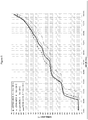
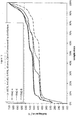
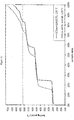
- SimDist analyses are shown as cumulative distributions with the maximum molecular weight of the oligomers suitable for use as lubricant base stocks indicated by a horizontal line at a boiling point of ca. 580 °C. Highly oligomerised products having a boiling point above 580 °C are referred to herein as "heavies".
- Kinematic viscosity (Kv) is measured at 40 °C and 100 °C using the appropriate Cannon-Fenske kinematic viscosity glassware and a dedicated, precisely-controlled heating bath. Kinematic viscosity is found by timing the gravitational flow of the sample through a capillary, with temperature maintained using a high accuracy heating bath.
- Viscosity Index was calculated from the measured Kv40 and Kv100 values according to ASTM D2270.
- Oligomerisation of 1-decene was carried out in the presence of 1.5 wt% of the ionic liquid of Reference Example 1 according to the general procedure of Example 4 with a reaction temperature of 120 °C and a reaction time of 20 minutes.
- the results of the SimDist analysis are provided in Figure 2 . While the conversion of starting materials is found to be very high, the oligomeric product obtained using this ionic liquid contains a large proportion of highly oligomerised products, with approximately 80 wt% of the products in the heavies range.
- the reactions were carried out at 120 °C for a period of 20 minutes using 1 mol% (ca. 1.8 wt%) of the LC catalyst.
- the reaction times were 1 hour for the LC containing only acetamide as a ligand and 20 minutes in all other cases.
- the reaction temperature was 80 °C for the LC containing a 1:1 mixture of acetone and urea, and the catalyst loading was 2.77 wt%. In all other cases a temperature of 100 °C and a catalyst loading of 1.85 wt% was used.
- the SimDist results are provided in Figure 6 . The result obtained at 80 °C indicates that lower temperatures provide a greater proportion of heavy oligomers.
- the reaction was carried out at 140 °C and over a period of 20 minutes in the case of 1.85 wt% catalyst loading, and over a period of 30 minutes in the case of 0.19 wt% catalyst loading.
- the SimDist results are provided in Figure 8 . No significant difference in conversion was observed.
- the reaction temperature was 140 °C and the reaction was carried out over a period of 60 minutes.
- Analysis of the product by SimDist showed 74.0% conversion of starting material and a product distribution of 57.7 wt% dimer, 35.6 wt% trimer and 6.8 wt% tetramer. The formation of higher oligomers was not observed.
- the reaction temperature was 140 °C and the reaction was carried out over a period of 20 minutes.
- Analysis of the product by SimDist showed 80.0% conversion of starting material and a product distribution of 59.0 wt% dimer and 41.0 wt% trimer.
- the presence of the paraffin decane in the reaction mixture is thus observed to suppress the formation of tetramers and higher oligomers from C 16 alpha-olefins.
- the SimDist gas chromatograms for products obtained according to Examples 16, 17 and 19 are provided as Figure 14 .
- Oligomerisation of 1-decene was carried out according to the general procedure of Example 4 in the presence of a LC catalyst prepared from AlCl 3 and urea at a range of ⁇ AlCl3 values, reaction times and catalyst loadings.
- the reaction temperature was 120 °C in each case.
- the physical properties of the oligomeric products obtained after removal of 1-decene monomer and most of the dimer are provided in Table 7.
Landscapes
- Chemical & Material Sciences (AREA)
- Organic Chemistry (AREA)
- Chemical Kinetics & Catalysis (AREA)
- Engineering & Computer Science (AREA)
- Oil, Petroleum & Natural Gas (AREA)
- Materials Engineering (AREA)
- General Chemical & Material Sciences (AREA)
- Health & Medical Sciences (AREA)
- Medicinal Chemistry (AREA)
- Polymers & Plastics (AREA)
- Inorganic Chemistry (AREA)
- Lubricants (AREA)
- Organic Low-Molecular-Weight Compounds And Preparation Thereof (AREA)
Claims (18)
- Procédé destiné à préparer des oligomères d'alpha-oléfines, comprenant la mise en contact d'une charge d'alimentation oléfinique comprenant des alpha-oléfines en C5 à C20 avec un catalyseur complexe liquide comprenant :(i) au moins un sel d'halogénure métallique de formule MX3, dans lequel M est choisi parmi l'aluminium et le gallium, et chaque X est choisi indépendamment parmi le chlore, le brome et l'iode ; et(ii) au moins un ligand donneur de type base de Lewis contenant un atome donneur choisi parmi l'oxygène, le soufre, l'azote et le phosphore et choisi parmi le groupe de composés constitué par des cétones, des sulfoxydes, des phosphine-oxydes, des urées, des amides, des éthers, des thiocétones, des thiourées, des thioamides, des thioéthers, des aminés, des nitriles et des phosphines ;
dans lequel le rapport molaire de l'au moins un sel d'halogénure métallique et du ligand donneur de type base de Lewis est dans la plage de 1/1 à 4/1, dans lequel le rapport du carbone-14 et du carbone-12 dans la charge d'alimentation oléfinique est d'au moins 0,5 × 10⁻¹³. - Procédé selon la revendication 1, dans lequel M représente l'aluminium.
- Procédé selon la revendication 2, dans lequel le rapport molaire de l'au moins un sel d'halogénure métallique et de l'au moins un ligand donneur de type base de Lewis est dans la plage de 1/1 à 2/1, facultativement, dans lequel le rapport molaire du sel d'halogénure métallique et de l'au moins un ligand donneur de type base de Lewis va de 55/45 à 65/35, et facultativement dans lequel le rapport molaire du sel d'halogénure métallique et de l'au moins un ligand donneur de type base de Lewis est 3/2.
- Procédé selon l'une quelconque des revendications précédentes, dans lequel X représente le brome ou le chlore, préférablement le chlore.
- Procédé selon la revendication 4, dans lequel MX3 représente AlCl3.
- Procédé selon la revendication 1, dans lequel l'au moins un ligand donneur de type base de Lewis est choisi parmi des composés ayant une formule choisie parmi R1-C(O)-R1, R1-S(O)-R1, R2NH-C(O)-NHR2, R2NH-C(S)-NHR2, R1-C(O)-NR2 2, (R3)3P(O) dans lequel :chaque R1 représente indépendamment un groupement alkyle en C1 à C10, préférablement un groupement alkyle en C1 à C6, plus préférablement un groupement alkyle en C1 à C3 et de manière préférée entre toutes un groupement méthyle ;R2 est choisi parmi l'hydrogène ou un groupement alkyle en C1 à C10, plus préférablement parmi l'hydrogène ou un groupement en alkyle en C1 à C6, encore plus préférablement parmi l'hydrogène ou un groupement alkyle en C1 à C3, et de manière préférée entre toutes parmi l'hydrogène ou un groupement méthyle ; etR3 représente un groupement alkyle en C4 à C10 ;dans lequel l'un quelconque de R1, R2 et R3 peut facultativement être substitué par un ou plusieurs atomes de fluor.
- Procédé selon la revendication 6, dans lequel l'au moins un ligand donneur de type base de Lewis est choisi parmi l'urée, la N,N'-diméthylurée, la N,N'-diméthylthiourée, l'acétamide, le diméthylacétamide, l'acétone, le diméthylsulfoxyde et l'oxyde de trioctylphosphine.
- Procédé selon l'une quelconque des revendications précédentes, dans lequel la charge d'alimentation oléfinique comprend au moins 50 % en poids d'une ou de plusieurs alpha-oléfines en C5 à C20 telles que des alpha-oléfines en C6 à C18, plus préférablement au moins 60 % en poids d'une ou de plusieurs alpha-oléfines en C5 à C20 telles que des alpha-oléfines en C6 à C18, plus préférablement au moins 70 % en poids d'une ou de plusieurs alpha-oléfines en C5 à C20 telles que des alpha-oléfines en C6 à C18, plus préférablement au moins 80 % en poids d'une ou de plusieurs alpha-oléfines en C5 à C20 telles que des alpha-oléfines en C6 à C18, plus préférablement au moins 90 % en poids d'une ou de plusieurs alpha-oléfines en C5 à C20 telles que des alpha-oléfines en C6 à C18, et de manière préférée entre toutes au moins 95 % en poids d'une ou de plusieurs alpha-oléfines en C5 à C20.
- Procédé selon l'une quelconque des revendications précédentes, dans lequel la charge d'alimentation oléfinique comprend au moins 30 % en poids d'alpha-oléfines en C8 à C14 telles que des alpha-oléfines en C10 à C12, préférablement au moins 50 % en poids d'alpha-oléfines en C8 à C14 telles que des alpha-oléfines en C10 à C12, plus préférablement au moins 70 % en poids d'alpha-oléfines en C8 à C14 telles que des alpha-oléfines en C10 à C12, encore plus préférablement au moins 80 % en poids d'alpha-oléfines en C8 à C14 telles que des alpha-oléfines en C10 à C12, et de manière préférée entre toutes au moins 90 % en poids d'alpha-oléfines en C8 à C14 telles que des alpha-oléfines en C10 à C12.
- Procédé selon la revendication 9, dans lequel la charge d'alimentation oléfinique comprend au moins 30 % en poids de 1-décène ou de 1-dodécène, préférablement au moins 50 % en poids de 1-décène ou de 1-dodécène, plus préférablement au moins 70 % en poids de 1-décène ou de 1-dodécène, encore plus préférablement au moins 80 % en poids de 1-décène ou de 1-dodécène, et de manière préférée entre toutes au moins 90 % en poids de 1-décène ou de 1-dodécène.
- Procédé selon l'une quelconque des revendications 1 à 8, dans lequel la charge d'alimentation oléfinique comprend au moins 30 % en poids d'alpha-oléfines en C16 à C18 telles que le 1-hexadécène ou le 1-octadécène, plus préférablement au moins 50 % en poids d'alpha-oléfines en C16 à C18 telles que le 1-hexadécène ou le 1-octadécène, plus préférablement au moins 70 % en poids d'alpha-oléfines en C16 à C18 telles que le 1-hexadécène ou le 1-octadécène, encore plus préférablement au moins 80 % en poids d'alpha-oléfines en C16 à C18 telles que le 1-hexadécène ou le 1-octadécène, et de manière préférée entre toutes au moins 90 % en poids d'alpha-oléfines en C16 à C18 telles que le 1-hexadécène ou le 1-octadécène.
- Procédé selon l'une quelconque des revendications précédentes, dans lequel la charge d'alimentation oléfinique comprend jusqu'à 20 % en poids de paraffines.
- Procédé selon l'une quelconque des revendications précédentes, dans lequel la charge d'alimentation oléfinique a un rapport de carbone-14 et de carbone-12 d'au moins 0,6 × 10⁻¹³, préférablement d'au moins 0,7 × 10⁻¹³, plus préférablement d'au moins 0,8 × 10⁻¹³, et de manière préférée entre toutes d'au moins 0,9 × 10⁻¹³, par exemple d'au moins 0,95 × 10⁻¹³, et/ou dans lequel la charge d'alimentation oléfinique a un rapport de carbone-14 et de carbone-12 qui représente au moins 50 % du rapport du carbone-14 et du carbone-12 dans l'atmosphère.
- Procédé selon l'une quelconque des revendications précédentes, dans lequel la charge d'alimentation oléfinique est mise en contact avec le catalyseur complexe liquide à une température allant de 0 à 160 °C, plus préférablement de 40 à 140 °C, plus préférablement de 80 à 140 °C, encore plus préférablement de 100 à 140 °C, et de manière préférée entre toutes de 120 °C, et/ou dans lequel la charge d'alimentation oléfinique est mise en contact avec le catalyseur complexe liquide à une pression allant de 10 à 1 000 kPa, préférablement de 20 à 500 kPa, plus préférablement de 50 à 200 kPa, encore plus préférablement de 80 à 120 kPa, et de manière préférée entre toutes de 100 kPa.
- Procédé selon l'une quelconque des revendications précédentes, dans lequel la charge d'alimentation oléfinique est mise en contact avec au moins 0,01 % en poids du catalyseur complexe liquide, plus préférablement au moins 0,05 % en poids du catalyseur complexe liquide, encore plus préférablement au moins 0,1 % en poids du catalyseur complexe liquide, et de manière préférée entre toutes au moins 0,2 % en poids du catalyseur complexe liquide, sur la base du poids total du catalyseur complexe liquide et de la charge d'alimentation oléfinique.
- Procédé selon la revendication 15, la charge d'alimentation oléfinique est mise en contact avec de 0,01 à 5 % en poids du catalyseur complexe liquide, préférablement de 0,05 à 2 % en poids du catalyseur complexe liquide, encore plus préférablement de 0,1 à 1 % en poids du catalyseur complexe liquide, et encore plus préférablement de 0,2 à 0,8 % en poids du catalyseur complexe liquide, sur la base du poids total du catalyseur complexe liquide et de la charge d'alimentation oléfinique.
- Procédé selon la revendication 16, dans lequel la charge d'alimentation oléfinique est mise en contact avec 0,5 % en poids du catalyseur complexe liquide, sur la base du poids total du catalyseur complexe liquide et de la charge d'alimentation oléfinique.
- Composition comprenant ou constituée par des oligomères d'alpha-oléfines dans laquelle ladite composition peut être obtenue par un procédé tel que défini dans l'une quelconque des revendications 1 à 17.
Applications Claiming Priority (2)
| Application Number | Priority Date | Filing Date | Title |
|---|---|---|---|
| GB1306551.1A GB2512902B (en) | 2013-04-10 | 2013-04-10 | Oligomerisation Process |
| PCT/GB2014/051114 WO2014167331A1 (fr) | 2013-04-10 | 2014-04-09 | Procédé d'oligomérisation |
Publications (2)
| Publication Number | Publication Date |
|---|---|
| EP2983820A1 EP2983820A1 (fr) | 2016-02-17 |
| EP2983820B1 true EP2983820B1 (fr) | 2020-11-11 |
Family
ID=48483720
Family Applications (1)
| Application Number | Title | Priority Date | Filing Date |
|---|---|---|---|
| EP14718455.0A Active EP2983820B1 (fr) | 2013-04-10 | 2014-04-09 | Procédé d'oligomérisation |
Country Status (4)
| Country | Link |
|---|---|
| US (1) | US10487162B2 (fr) |
| EP (1) | EP2983820B1 (fr) |
| GB (1) | GB2512902B (fr) |
| WO (1) | WO2014167331A1 (fr) |
Families Citing this family (7)
| Publication number | Priority date | Publication date | Assignee | Title |
|---|---|---|---|---|
| US20170203286A1 (en) * | 2014-07-10 | 2017-07-20 | Reliance Industries Limited | Ionic liquid, adduct and methods thereof |
| WO2017011224A1 (fr) | 2015-07-10 | 2017-01-19 | Uop Llc | Procédés d'alkylation à l'aide de catalyseurs à acide de lewis liquide |
| WO2020222171A1 (fr) * | 2019-05-01 | 2020-11-05 | Chevron U.S.A. Inc. | Huile de base provenant de nao par oligomérisation et hydroisomérisation de catalyseur ionique |
| CN113966319B (zh) * | 2019-05-01 | 2023-12-19 | 雪佛龙美国公司 | 通过离子催化剂低聚的基础油合成及低聚催化剂无水分离 |
| KR102398899B1 (ko) * | 2019-11-29 | 2022-05-17 | 디엘케미칼 주식회사 | 낮은 점도 알파-올레핀 올리고머 및 이의 제조방법 |
| CN111686816A (zh) * | 2020-07-15 | 2020-09-22 | 太原理工大学 | 一种液体配位化合物催化剂及其制备方法和应用 |
| JPWO2023157799A1 (fr) * | 2022-02-15 | 2023-08-24 |
Citations (2)
| Publication number | Priority date | Publication date | Assignee | Title |
|---|---|---|---|---|
| US20110288352A1 (en) * | 2010-05-07 | 2011-11-24 | Gevo, Inc. | Renewable jet fuel blendstock from isobutanol |
| US20110306815A1 (en) * | 2009-11-09 | 2011-12-15 | Hagadorn John R | Metathesis Catalyst and Process for Use Thereof |
Family Cites Families (14)
| Publication number | Priority date | Publication date | Assignee | Title |
|---|---|---|---|---|
| US3842134A (en) * | 1972-06-09 | 1974-10-15 | Bray Oil Co | Polymerization process |
| GB1388224A (en) * | 1972-09-08 | 1975-03-26 | Mobil Oil Corp | Aluminium halide-carboxylic acid ester catalysts |
| JPS51122002A (en) * | 1975-04-15 | 1976-10-25 | Lion Corp | Process for preparation of olefin oligomers |
| US4721771A (en) * | 1983-03-31 | 1988-01-26 | Raychem Corporation | Preparation of aromatic polymers |
| US4709007A (en) * | 1983-03-31 | 1987-11-24 | Raychem Corporation | Preparation of aromatic polymers |
| US4879366A (en) * | 1983-03-31 | 1989-11-07 | Raychem Corporation | Preparation of aromatic oligomers |
| ES8700677A1 (es) * | 1984-10-11 | 1986-11-16 | Raychem Corp | Metodo para la preparacion de un oligomero de arileno cetonao arileno sulfona |
| US6703356B1 (en) * | 2000-03-23 | 2004-03-09 | Exxonmobil Research And Engineering Company | Synthetic hydrocarbon fluids |
| CA2543018C (fr) * | 2003-10-31 | 2012-07-24 | Chevron Phillips Chemical Company Lp | Procede et systeme pour le contact entre un catalyseur ionique liquide et de l'oxygene, permettant d'ameliorer une reaction chimique |
| US7652186B2 (en) * | 2005-03-17 | 2010-01-26 | Exxonmobil Chemical Patents Inc. | Method of making low viscosity PAO |
| EP1966357B1 (fr) | 2005-12-12 | 2019-04-24 | Neste Oyj | Huile de base |
| US8168838B2 (en) * | 2009-01-21 | 2012-05-01 | Shell Oil Company | Hydrocarbon compositions useful as lubricants |
| US20110027673A1 (en) * | 2009-07-31 | 2011-02-03 | Quarius Technologies, Inc. | Solid oxide fuel cell system with integral gas turbine and thermophotovoltaic thermal energy converters |
| US8383869B2 (en) * | 2009-09-01 | 2013-02-26 | Shell Oil Company | Olefin oligomer composition |
-
2013
- 2013-04-10 GB GB1306551.1A patent/GB2512902B/en active Active
-
2014
- 2014-04-09 EP EP14718455.0A patent/EP2983820B1/fr active Active
- 2014-04-09 WO PCT/GB2014/051114 patent/WO2014167331A1/fr not_active Ceased
- 2014-04-09 US US14/783,346 patent/US10487162B2/en active Active
Patent Citations (2)
| Publication number | Priority date | Publication date | Assignee | Title |
|---|---|---|---|---|
| US20110306815A1 (en) * | 2009-11-09 | 2011-12-15 | Hagadorn John R | Metathesis Catalyst and Process for Use Thereof |
| US20110288352A1 (en) * | 2010-05-07 | 2011-11-24 | Gevo, Inc. | Renewable jet fuel blendstock from isobutanol |
Also Published As
| Publication number | Publication date |
|---|---|
| US20160068622A1 (en) | 2016-03-10 |
| GB2512902A (en) | 2014-10-15 |
| EP2983820A1 (fr) | 2016-02-17 |
| US10487162B2 (en) | 2019-11-26 |
| WO2014167331A1 (fr) | 2014-10-16 |
| GB201306551D0 (en) | 2013-05-22 |
| GB2512902B (en) | 2018-10-17 |
Similar Documents
| Publication | Publication Date | Title |
|---|---|---|
| EP2983820B1 (fr) | Procédé d'oligomérisation | |
| AU2006333300B2 (en) | Alkylation of olefins with isoparaffins in ionic liquid to make lubricant or fuel blendstock | |
| JP5345713B2 (ja) | 高品質潤滑油又は潤滑油ブレンドストックの製造方法及び組成物 | |
| US8124821B2 (en) | Oligomerization of propylene to produce base oil products using ionic liquids-based catalysis | |
| AU2010282772B2 (en) | Base oil composition comprising oligomerized olefins | |
| US7723556B2 (en) | Process to make base oil from thermally cracked waxy feed using ionic liquid catalyst | |
| US7973204B2 (en) | Process to make base oil from thermally cracked waxy feed using ionic liquid catalyst | |
| GB2528128A (en) | Oligomerisation process | |
| EP2983821B1 (fr) | Procédé d'oligomérisation | |
| CN102776022B (zh) | 一种高粘度聚α-烯烃合成油及其制备方法 | |
| CN113891929A (zh) | 通过离子催化剂低聚和加氢异构化由nao产生的基础油 | |
| EP3337876B1 (fr) | Procédé de production de polyalphaoléfines au moyen d'une oligomérisation d'oléfines catalysée par un liquide ionique | |
| US5322633A (en) | Preparation of branched chain carboxylic esters | |
| CN103525456A (zh) | 煤制a烯烃制备合成烃基础油 | |
| US11753355B2 (en) | Base oil synthesis via ionic catalyst oligomerization and waterless separation of the oligomerization catalyst |
Legal Events
| Date | Code | Title | Description |
|---|---|---|---|
| PUAI | Public reference made under article 153(3) epc to a published international application that has entered the european phase |
Free format text: ORIGINAL CODE: 0009012 |
|
| 17P | Request for examination filed |
Effective date: 20151014 |
|
| AK | Designated contracting states |
Kind code of ref document: A1 Designated state(s): AL AT BE BG CH CY CZ DE DK EE ES FI FR GB GR HR HU IE IS IT LI LT LU LV MC MK MT NL NO PL PT RO RS SE SI SK SM TR |
|
| AX | Request for extension of the european patent |
Extension state: BA ME |
|
| DAX | Request for extension of the european patent (deleted) | ||
| STAA | Information on the status of an ep patent application or granted ep patent |
Free format text: STATUS: EXAMINATION IS IN PROGRESS |
|
| 17Q | First examination report despatched |
Effective date: 20190808 |
|
| GRAP | Despatch of communication of intention to grant a patent |
Free format text: ORIGINAL CODE: EPIDOSNIGR1 |
|
| STAA | Information on the status of an ep patent application or granted ep patent |
Free format text: STATUS: GRANT OF PATENT IS INTENDED |
|
| RIC1 | Information provided on ipc code assigned before grant |
Ipc: C10N 20/00 20060101ALI20200511BHEP Ipc: C10M 107/10 20060101ALI20200511BHEP Ipc: B01J 31/02 20060101AFI20200511BHEP Ipc: C10N 70/00 20060101ALI20200511BHEP Ipc: C07C 2/36 20060101ALI20200511BHEP Ipc: C07C 2/20 20060101ALI20200511BHEP Ipc: B01J 31/14 20060101ALI20200511BHEP Ipc: C10N 30/02 20060101ALI20200511BHEP Ipc: C07C 2/32 20060101ALI20200511BHEP |
|
| INTG | Intention to grant announced |
Effective date: 20200529 |
|
| GRAS | Grant fee paid |
Free format text: ORIGINAL CODE: EPIDOSNIGR3 |
|
| GRAA | (expected) grant |
Free format text: ORIGINAL CODE: 0009210 |
|
| STAA | Information on the status of an ep patent application or granted ep patent |
Free format text: STATUS: THE PATENT HAS BEEN GRANTED |
|
| AK | Designated contracting states |
Kind code of ref document: B1 Designated state(s): AL AT BE BG CH CY CZ DE DK EE ES FI FR GB GR HR HU IE IS IT LI LT LU LV MC MK MT NL NO PL PT RO RS SE SI SK SM TR |
|
| REG | Reference to a national code |
Ref country code: GB Ref legal event code: FG4D |
|
| REG | Reference to a national code |
Ref country code: CH Ref legal event code: EP |
|
| REG | Reference to a national code |
Ref country code: AT Ref legal event code: REF Ref document number: 1332935 Country of ref document: AT Kind code of ref document: T Effective date: 20201115 |
|
| REG | Reference to a national code |
Ref country code: DE Ref legal event code: R096 Ref document number: 602014072242 Country of ref document: DE |
|
| REG | Reference to a national code |
Ref country code: IE Ref legal event code: FG4D |
|
| REG | Reference to a national code |
Ref country code: DE Ref legal event code: R082 Ref document number: 602014072242 Country of ref document: DE Representative=s name: MATHYS & SQUIRE EUROPE PATENTANWAELTE PARTNERS, DE Ref country code: DE Ref legal event code: R082 Ref document number: 602014072242 Country of ref document: DE Representative=s name: MATHYS & SQUIRE GBR, DE |
|
| REG | Reference to a national code |
Ref country code: NL Ref legal event code: MP Effective date: 20201111 |
|
| PG25 | Lapsed in a contracting state [announced via postgrant information from national office to epo] |
Ref country code: NO Free format text: LAPSE BECAUSE OF FAILURE TO SUBMIT A TRANSLATION OF THE DESCRIPTION OR TO PAY THE FEE WITHIN THE PRESCRIBED TIME-LIMIT Effective date: 20210211 Ref country code: PT Free format text: LAPSE BECAUSE OF FAILURE TO SUBMIT A TRANSLATION OF THE DESCRIPTION OR TO PAY THE FEE WITHIN THE PRESCRIBED TIME-LIMIT Effective date: 20210311 Ref country code: FI Free format text: LAPSE BECAUSE OF FAILURE TO SUBMIT A TRANSLATION OF THE DESCRIPTION OR TO PAY THE FEE WITHIN THE PRESCRIBED TIME-LIMIT Effective date: 20201111 Ref country code: RS Free format text: LAPSE BECAUSE OF FAILURE TO SUBMIT A TRANSLATION OF THE DESCRIPTION OR TO PAY THE FEE WITHIN THE PRESCRIBED TIME-LIMIT Effective date: 20201111 Ref country code: GR Free format text: LAPSE BECAUSE OF FAILURE TO SUBMIT A TRANSLATION OF THE DESCRIPTION OR TO PAY THE FEE WITHIN THE PRESCRIBED TIME-LIMIT Effective date: 20210212 |
|
| PG25 | Lapsed in a contracting state [announced via postgrant information from national office to epo] |
Ref country code: LV Free format text: LAPSE BECAUSE OF FAILURE TO SUBMIT A TRANSLATION OF THE DESCRIPTION OR TO PAY THE FEE WITHIN THE PRESCRIBED TIME-LIMIT Effective date: 20201111 Ref country code: IS Free format text: LAPSE BECAUSE OF FAILURE TO SUBMIT A TRANSLATION OF THE DESCRIPTION OR TO PAY THE FEE WITHIN THE PRESCRIBED TIME-LIMIT Effective date: 20210311 Ref country code: SE Free format text: LAPSE BECAUSE OF FAILURE TO SUBMIT A TRANSLATION OF THE DESCRIPTION OR TO PAY THE FEE WITHIN THE PRESCRIBED TIME-LIMIT Effective date: 20201111 Ref country code: PL Free format text: LAPSE BECAUSE OF FAILURE TO SUBMIT A TRANSLATION OF THE DESCRIPTION OR TO PAY THE FEE WITHIN THE PRESCRIBED TIME-LIMIT Effective date: 20201111 Ref country code: BG Free format text: LAPSE BECAUSE OF FAILURE TO SUBMIT A TRANSLATION OF THE DESCRIPTION OR TO PAY THE FEE WITHIN THE PRESCRIBED TIME-LIMIT Effective date: 20210211 |
|
| REG | Reference to a national code |
Ref country code: LT Ref legal event code: MG9D |
|
| PG25 | Lapsed in a contracting state [announced via postgrant information from national office to epo] |
Ref country code: HR Free format text: LAPSE BECAUSE OF FAILURE TO SUBMIT A TRANSLATION OF THE DESCRIPTION OR TO PAY THE FEE WITHIN THE PRESCRIBED TIME-LIMIT Effective date: 20201111 |
|
| PG25 | Lapsed in a contracting state [announced via postgrant information from national office to epo] |
Ref country code: LT Free format text: LAPSE BECAUSE OF FAILURE TO SUBMIT A TRANSLATION OF THE DESCRIPTION OR TO PAY THE FEE WITHIN THE PRESCRIBED TIME-LIMIT Effective date: 20201111 Ref country code: SK Free format text: LAPSE BECAUSE OF FAILURE TO SUBMIT A TRANSLATION OF THE DESCRIPTION OR TO PAY THE FEE WITHIN THE PRESCRIBED TIME-LIMIT Effective date: 20201111 Ref country code: RO Free format text: LAPSE BECAUSE OF FAILURE TO SUBMIT A TRANSLATION OF THE DESCRIPTION OR TO PAY THE FEE WITHIN THE PRESCRIBED TIME-LIMIT Effective date: 20201111 Ref country code: SM Free format text: LAPSE BECAUSE OF FAILURE TO SUBMIT A TRANSLATION OF THE DESCRIPTION OR TO PAY THE FEE WITHIN THE PRESCRIBED TIME-LIMIT Effective date: 20201111 Ref country code: EE Free format text: LAPSE BECAUSE OF FAILURE TO SUBMIT A TRANSLATION OF THE DESCRIPTION OR TO PAY THE FEE WITHIN THE PRESCRIBED TIME-LIMIT Effective date: 20201111 Ref country code: CZ Free format text: LAPSE BECAUSE OF FAILURE TO SUBMIT A TRANSLATION OF THE DESCRIPTION OR TO PAY THE FEE WITHIN THE PRESCRIBED TIME-LIMIT Effective date: 20201111 |
|
| REG | Reference to a national code |
Ref country code: DE Ref legal event code: R097 Ref document number: 602014072242 Country of ref document: DE |
|
| PG25 | Lapsed in a contracting state [announced via postgrant information from national office to epo] |
Ref country code: DK Free format text: LAPSE BECAUSE OF FAILURE TO SUBMIT A TRANSLATION OF THE DESCRIPTION OR TO PAY THE FEE WITHIN THE PRESCRIBED TIME-LIMIT Effective date: 20201111 |
|
| PLBE | No opposition filed within time limit |
Free format text: ORIGINAL CODE: 0009261 |
|
| STAA | Information on the status of an ep patent application or granted ep patent |
Free format text: STATUS: NO OPPOSITION FILED WITHIN TIME LIMIT |
|
| 26N | No opposition filed |
Effective date: 20210812 |
|
| PG25 | Lapsed in a contracting state [announced via postgrant information from national office to epo] |
Ref country code: AL Free format text: LAPSE BECAUSE OF FAILURE TO SUBMIT A TRANSLATION OF THE DESCRIPTION OR TO PAY THE FEE WITHIN THE PRESCRIBED TIME-LIMIT Effective date: 20201111 Ref country code: NL Free format text: LAPSE BECAUSE OF FAILURE TO SUBMIT A TRANSLATION OF THE DESCRIPTION OR TO PAY THE FEE WITHIN THE PRESCRIBED TIME-LIMIT Effective date: 20201111 |
|
| PG25 | Lapsed in a contracting state [announced via postgrant information from national office to epo] |
Ref country code: SI Free format text: LAPSE BECAUSE OF FAILURE TO SUBMIT A TRANSLATION OF THE DESCRIPTION OR TO PAY THE FEE WITHIN THE PRESCRIBED TIME-LIMIT Effective date: 20201111 Ref country code: ES Free format text: LAPSE BECAUSE OF FAILURE TO SUBMIT A TRANSLATION OF THE DESCRIPTION OR TO PAY THE FEE WITHIN THE PRESCRIBED TIME-LIMIT Effective date: 20201111 Ref country code: MC Free format text: LAPSE BECAUSE OF FAILURE TO SUBMIT A TRANSLATION OF THE DESCRIPTION OR TO PAY THE FEE WITHIN THE PRESCRIBED TIME-LIMIT Effective date: 20201111 |
|
| PG25 | Lapsed in a contracting state [announced via postgrant information from national office to epo] |
Ref country code: LU Free format text: LAPSE BECAUSE OF NON-PAYMENT OF DUE FEES Effective date: 20210409 |
|
| REG | Reference to a national code |
Ref country code: BE Ref legal event code: MM Effective date: 20210430 |
|
| PG25 | Lapsed in a contracting state [announced via postgrant information from national office to epo] |
Ref country code: CH Free format text: LAPSE BECAUSE OF NON-PAYMENT OF DUE FEES Effective date: 20210430 Ref country code: LI Free format text: LAPSE BECAUSE OF NON-PAYMENT OF DUE FEES Effective date: 20210430 |
|
| PG25 | Lapsed in a contracting state [announced via postgrant information from national office to epo] |
Ref country code: IE Free format text: LAPSE BECAUSE OF NON-PAYMENT OF DUE FEES Effective date: 20210409 |
|
| PG25 | Lapsed in a contracting state [announced via postgrant information from national office to epo] |
Ref country code: IS Free format text: LAPSE BECAUSE OF FAILURE TO SUBMIT A TRANSLATION OF THE DESCRIPTION OR TO PAY THE FEE WITHIN THE PRESCRIBED TIME-LIMIT Effective date: 20210311 |
|
| PG25 | Lapsed in a contracting state [announced via postgrant information from national office to epo] |
Ref country code: BE Free format text: LAPSE BECAUSE OF NON-PAYMENT OF DUE FEES Effective date: 20210430 |
|
| PG25 | Lapsed in a contracting state [announced via postgrant information from national office to epo] |
Ref country code: HU Free format text: LAPSE BECAUSE OF FAILURE TO SUBMIT A TRANSLATION OF THE DESCRIPTION OR TO PAY THE FEE WITHIN THE PRESCRIBED TIME-LIMIT; INVALID AB INITIO Effective date: 20140409 |
|
| PG25 | Lapsed in a contracting state [announced via postgrant information from national office to epo] |
Ref country code: CY Free format text: LAPSE BECAUSE OF FAILURE TO SUBMIT A TRANSLATION OF THE DESCRIPTION OR TO PAY THE FEE WITHIN THE PRESCRIBED TIME-LIMIT Effective date: 20201111 |
|
| REG | Reference to a national code |
Ref country code: AT Ref legal event code: UEP Ref document number: 1332935 Country of ref document: AT Kind code of ref document: T Effective date: 20201111 |
|
| PG25 | Lapsed in a contracting state [announced via postgrant information from national office to epo] |
Ref country code: MK Free format text: LAPSE BECAUSE OF FAILURE TO SUBMIT A TRANSLATION OF THE DESCRIPTION OR TO PAY THE FEE WITHIN THE PRESCRIBED TIME-LIMIT Effective date: 20201111 |
|
| PG25 | Lapsed in a contracting state [announced via postgrant information from national office to epo] |
Ref country code: TR Free format text: LAPSE BECAUSE OF FAILURE TO SUBMIT A TRANSLATION OF THE DESCRIPTION OR TO PAY THE FEE WITHIN THE PRESCRIBED TIME-LIMIT Effective date: 20201111 |
|
| PG25 | Lapsed in a contracting state [announced via postgrant information from national office to epo] |
Ref country code: MT Free format text: LAPSE BECAUSE OF FAILURE TO SUBMIT A TRANSLATION OF THE DESCRIPTION OR TO PAY THE FEE WITHIN THE PRESCRIBED TIME-LIMIT Effective date: 20201111 |
|
| PGFP | Annual fee paid to national office [announced via postgrant information from national office to epo] |
Ref country code: DE Payment date: 20250214 Year of fee payment: 12 |
|
| PGFP | Annual fee paid to national office [announced via postgrant information from national office to epo] |
Ref country code: AT Payment date: 20250325 Year of fee payment: 12 |
|
| PGFP | Annual fee paid to national office [announced via postgrant information from national office to epo] |
Ref country code: GB Payment date: 20260219 Year of fee payment: 13 |
|
| PGFP | Annual fee paid to national office [announced via postgrant information from national office to epo] |
Ref country code: IT Payment date: 20260320 Year of fee payment: 13 |
|
| PGFP | Annual fee paid to national office [announced via postgrant information from national office to epo] |
Ref country code: FR Payment date: 20260209 Year of fee payment: 13 |