EP2984014B1 - Vorrichtung zur trennung mindestens zweier zusammenhängender stränge eines materials und system mit solch einer vorrichtung - Google Patents
Vorrichtung zur trennung mindestens zweier zusammenhängender stränge eines materials und system mit solch einer vorrichtung Download PDFInfo
- Publication number
- EP2984014B1 EP2984014B1 EP14716798.5A EP14716798A EP2984014B1 EP 2984014 B1 EP2984014 B1 EP 2984014B1 EP 14716798 A EP14716798 A EP 14716798A EP 2984014 B1 EP2984014 B1 EP 2984014B1
- Authority
- EP
- European Patent Office
- Prior art keywords
- strands
- spacer
- film
- guiding means
- cylinder
- Prior art date
- Legal status (The legal status is an assumption and is not a legal conclusion. Google has not performed a legal analysis and makes no representation as to the accuracy of the status listed.)
- Active
Links
Images




Classifications
-
- B—PERFORMING OPERATIONS; TRANSPORTING
- B65—CONVEYING; PACKING; STORING; HANDLING THIN OR FILAMENTARY MATERIAL
- B65H—HANDLING THIN OR FILAMENTARY MATERIAL, e.g. SHEETS, WEBS, CABLES
- B65H23/00—Registering, tensioning, smoothing or guiding webs
- B65H23/02—Registering, tensioning, smoothing or guiding webs transversely
- B65H23/032—Controlling transverse register of web
- B65H23/038—Controlling transverse register of web by rollers
-
- H—ELECTRICITY
- H01—ELECTRIC ELEMENTS
- H01G—CAPACITORS; CAPACITORS, RECTIFIERS, DETECTORS, SWITCHING DEVICES, LIGHT-SENSITIVE OR TEMPERATURE-SENSITIVE DEVICES OF THE ELECTROLYTIC TYPE
- H01G13/00—Apparatus specially adapted for manufacturing capacitors; Processes specially adapted for manufacturing capacitors not provided for in groups H01G4/00 - H01G11/00
- H01G13/006—Apparatus or processes for applying terminals
-
- B—PERFORMING OPERATIONS; TRANSPORTING
- B65—CONVEYING; PACKING; STORING; HANDLING THIN OR FILAMENTARY MATERIAL
- B65H—HANDLING THIN OR FILAMENTARY MATERIAL, e.g. SHEETS, WEBS, CABLES
- B65H35/00—Delivering articles from cutting or line-perforating machines; Article or web delivery apparatus incorporating cutting or line-perforating devices, e.g. adhesive tape dispensers
- B65H35/02—Delivering articles from cutting or line-perforating machines; Article or web delivery apparatus incorporating cutting or line-perforating devices, e.g. adhesive tape dispensers from or with longitudinal slitters or perforators
-
- B—PERFORMING OPERATIONS; TRANSPORTING
- B65—CONVEYING; PACKING; STORING; HANDLING THIN OR FILAMENTARY MATERIAL
- B65H—HANDLING THIN OR FILAMENTARY MATERIAL, e.g. SHEETS, WEBS, CABLES
- B65H57/00—Guides for filamentary materials; Supports therefor
- B65H57/16—Guides for filamentary materials; Supports therefor formed to maintain a plurality of filaments in spaced relation
-
- H—ELECTRICITY
- H01—ELECTRIC ELEMENTS
- H01G—CAPACITORS; CAPACITORS, RECTIFIERS, DETECTORS, SWITCHING DEVICES, LIGHT-SENSITIVE OR TEMPERATURE-SENSITIVE DEVICES OF THE ELECTROLYTIC TYPE
- H01G11/00—Hybrid capacitors, i.e. capacitors having different positive and negative electrodes; Electric double-layer [EDL] capacitors; Processes for the manufacture thereof or of parts thereof
- H01G11/84—Processes for the manufacture of hybrid or EDL capacitors, or components thereof
-
- H—ELECTRICITY
- H01—ELECTRIC ELEMENTS
- H01G—CAPACITORS; CAPACITORS, RECTIFIERS, DETECTORS, SWITCHING DEVICES, LIGHT-SENSITIVE OR TEMPERATURE-SENSITIVE DEVICES OF THE ELECTROLYTIC TYPE
- H01G13/00—Apparatus specially adapted for manufacturing capacitors; Processes specially adapted for manufacturing capacitors not provided for in groups H01G4/00 - H01G11/00
- H01G13/02—Machines for winding capacitors
-
- H—ELECTRICITY
- H01—ELECTRIC ELEMENTS
- H01G—CAPACITORS; CAPACITORS, RECTIFIERS, DETECTORS, SWITCHING DEVICES, LIGHT-SENSITIVE OR TEMPERATURE-SENSITIVE DEVICES OF THE ELECTROLYTIC TYPE
- H01G4/00—Fixed capacitors; Processes of their manufacture
- H01G4/32—Wound capacitors
-
- H—ELECTRICITY
- H01—ELECTRIC ELEMENTS
- H01M—PROCESSES OR MEANS, e.g. BATTERIES, FOR THE DIRECT CONVERSION OF CHEMICAL ENERGY INTO ELECTRICAL ENERGY
- H01M10/00—Secondary cells; Manufacture thereof
- H01M10/04—Construction or manufacture in general
- H01M10/0404—Machines for assembling batteries
-
- H—ELECTRICITY
- H01—ELECTRIC ELEMENTS
- H01M—PROCESSES OR MEANS, e.g. BATTERIES, FOR THE DIRECT CONVERSION OF CHEMICAL ENERGY INTO ELECTRICAL ENERGY
- H01M4/00—Electrodes
- H01M4/02—Electrodes composed of, or comprising, active material
- H01M4/04—Processes of manufacture in general
-
- B—PERFORMING OPERATIONS; TRANSPORTING
- B65—CONVEYING; PACKING; STORING; HANDLING THIN OR FILAMENTARY MATERIAL
- B65H—HANDLING THIN OR FILAMENTARY MATERIAL, e.g. SHEETS, WEBS, CABLES
- B65H2301/00—Handling processes for sheets or webs
- B65H2301/30—Orientation, displacement, position of the handled material
- B65H2301/35—Spacing
- B65H2301/351—Spacing parallel to the direction of displacement
-
- B—PERFORMING OPERATIONS; TRANSPORTING
- B65—CONVEYING; PACKING; STORING; HANDLING THIN OR FILAMENTARY MATERIAL
- B65H—HANDLING THIN OR FILAMENTARY MATERIAL, e.g. SHEETS, WEBS, CABLES
- B65H2301/00—Handling processes for sheets or webs
- B65H2301/40—Type of handling process
- B65H2301/41—Winding, unwinding
- B65H2301/414—Winding
- B65H2301/4148—Winding slitting
-
- B—PERFORMING OPERATIONS; TRANSPORTING
- B65—CONVEYING; PACKING; STORING; HANDLING THIN OR FILAMENTARY MATERIAL
- B65H—HANDLING THIN OR FILAMENTARY MATERIAL, e.g. SHEETS, WEBS, CABLES
- B65H2404/00—Parts for transporting or guiding the handled material
- B65H2404/10—Rollers
- B65H2404/15—Roller assembly, particular roller arrangement
- B65H2404/152—Arrangement of roller on a movable frame
- B65H2404/1521—Arrangement of roller on a movable frame rotating, pivoting or oscillating around an axis, e.g. parallel to the roller axis
- B65H2404/15212—Arrangement of roller on a movable frame rotating, pivoting or oscillating around an axis, e.g. parallel to the roller axis rotating, pivoting or oscillating around an axis perpendicular to the roller axis
-
- B—PERFORMING OPERATIONS; TRANSPORTING
- B65—CONVEYING; PACKING; STORING; HANDLING THIN OR FILAMENTARY MATERIAL
- B65H—HANDLING THIN OR FILAMENTARY MATERIAL, e.g. SHEETS, WEBS, CABLES
- B65H2404/00—Parts for transporting or guiding the handled material
- B65H2404/10—Rollers
- B65H2404/15—Roller assembly, particular roller arrangement
- B65H2404/152—Arrangement of roller on a movable frame
- B65H2404/1523—Arrangement of roller on a movable frame moving in parallel to its axis
-
- B—PERFORMING OPERATIONS; TRANSPORTING
- B65—CONVEYING; PACKING; STORING; HANDLING THIN OR FILAMENTARY MATERIAL
- B65H—HANDLING THIN OR FILAMENTARY MATERIAL, e.g. SHEETS, WEBS, CABLES
- B65H2801/00—Application field
- B65H2801/72—Fuel cell manufacture
-
- Y—GENERAL TAGGING OF NEW TECHNOLOGICAL DEVELOPMENTS; GENERAL TAGGING OF CROSS-SECTIONAL TECHNOLOGIES SPANNING OVER SEVERAL SECTIONS OF THE IPC; TECHNICAL SUBJECTS COVERED BY FORMER USPC CROSS-REFERENCE ART COLLECTIONS [XRACs] AND DIGESTS
- Y02—TECHNOLOGIES OR APPLICATIONS FOR MITIGATION OR ADAPTATION AGAINST CLIMATE CHANGE
- Y02E—REDUCTION OF GREENHOUSE GAS [GHG] EMISSIONS, RELATED TO ENERGY GENERATION, TRANSMISSION OR DISTRIBUTION
- Y02E60/00—Enabling technologies; Technologies with a potential or indirect contribution to GHG emissions mitigation
- Y02E60/10—Energy storage using batteries
-
- Y—GENERAL TAGGING OF NEW TECHNOLOGICAL DEVELOPMENTS; GENERAL TAGGING OF CROSS-SECTIONAL TECHNOLOGIES SPANNING OVER SEVERAL SECTIONS OF THE IPC; TECHNICAL SUBJECTS COVERED BY FORMER USPC CROSS-REFERENCE ART COLLECTIONS [XRACs] AND DIGESTS
- Y02—TECHNOLOGIES OR APPLICATIONS FOR MITIGATION OR ADAPTATION AGAINST CLIMATE CHANGE
- Y02E—REDUCTION OF GREENHOUSE GAS [GHG] EMISSIONS, RELATED TO ENERGY GENERATION, TRANSMISSION OR DISTRIBUTION
- Y02E60/00—Enabling technologies; Technologies with a potential or indirect contribution to GHG emissions mitigation
- Y02E60/13—Energy storage using capacitors
-
- Y—GENERAL TAGGING OF NEW TECHNOLOGICAL DEVELOPMENTS; GENERAL TAGGING OF CROSS-SECTIONAL TECHNOLOGIES SPANNING OVER SEVERAL SECTIONS OF THE IPC; TECHNICAL SUBJECTS COVERED BY FORMER USPC CROSS-REFERENCE ART COLLECTIONS [XRACs] AND DIGESTS
- Y02—TECHNOLOGIES OR APPLICATIONS FOR MITIGATION OR ADAPTATION AGAINST CLIMATE CHANGE
- Y02P—CLIMATE CHANGE MITIGATION TECHNOLOGIES IN THE PRODUCTION OR PROCESSING OF GOODS
- Y02P70/00—Climate change mitigation technologies in the production process for final industrial or consumer products
- Y02P70/50—Manufacturing or production processes characterised by the final manufactured product
Definitions
- the present invention relates to the general technical field of the manufacture of electrical energy storage complex ribbons for the production of electrical energy storage assemblies.
- the term " electrical energy storage assembly” means either a capacitor (ie a passive system comprising two electrodes and an insulator) or a supercapacitor (ie a system comprising at least two electrodes). , an electrolyte and at least one separator), or a battery of the lithium battery type (ie a system comprising at least one anode, at least one cathode and an electrolyte solution between the anode and the cathode).
- a device for separating at least two strands of material from the longitudinal cutting of a strip of continuously moving material and in the field of cigarette packaging is already disclosed by EP 0 309 818 A2 according to the preamble of claim 1.
- the width of each of these films is generally about "n" times greater - n being a nonzero integer - to the width of the complex ribbon electrical energy storage that is ultimately desired.
- This cutting step has the disadvantage of requiring personnel and many manipulations of the coils, which is costly in time and resources and to reduce the yield.
- An object of the present invention is to provide a device for separating at least two strands of material to overcome at least one of the aforementioned drawbacks.
- Another object of the invention is to propose a system for manufacturing an electrical energy storage complex tape comprising such a separation device.
- the invention proposes according to claim 1 a device for separating at least two strands of material from the longitudinal cut of a strip of continuously moving material.
- the strands of material to be separated extend longitudinally. They are obtained by cutting a strip of continuously moving material.
- the separation device presented above makes it possible to space two strands of material while keeping them in one and the same scroll plane, which has the advantage of being able to assemble these spaced strands with other films such as a (or electrolyte film (s)
- the downstream guiding means make it possible to reorient the strands of material so that they run in parallel scrolling directions, thus keeping the distance separating the strands of material spaced apart by the spreader constant, in particular so as to be able to superimpose the same layer. on the strands of separated material.
- the invention it is then possible to assemble the electrolyte film with the cathode film so that the electrolyte film overflows the cathode film. This ensures an optimal insulation between the anode (which will be a posteriori added to the stack) and the cathode, avoiding any risk of contact between these two electrodes.
- only one of the two strands of material is guided in the spacer in a direction different from the main direction.
- the two strands of material are guided in the spacer in a direction different from the main direction so as to separate them from each other. The fact that the two strands of material are separated from the main direction makes it possible to obtain an operating symmetry of the separating device so that each strand of material undergoes the same mechanical stresses, less important than the stresses undergone for the same spacing. one of the two strands if he alone was deviated from the main direction.
- the invention also relates to a system for manufacturing an electrical energy storage complex tape comprising at least one strand of material, characterized in that the manufacturing system comprises a separation device as described above for spacing from each other at least two strands of material.
- complex is intended to mean a stack comprising at least two distinct layers, in particular a cathode layer and an electrolyte layer.
- An energy storage complex tape may be all or part of the element that will allow energy storage.
- the electrolyte and the cathode of a battery are assembled, the anode being added in a subsequent step, using another device.
- this tape can be used for the production of electrical energy storage assemblies containing a portion of this tape - possibly wound or folded, placed in a housing of a sealed protective envelope of said storage assembly.
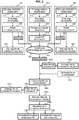
- the strip of continuously moving material is cut longitudinally. This makes it possible to obtain two strands of material (11a, 12a, 13a and 11b, 12b, 13b) from the initial material web.
- the cutting of the strip of material is for example implemented at a cutting device which will be described in more detail later.
- This cut can be made in the middle of the strip of material so as to obtain two strands of material of the same width.
- the cut can be offset from the middle of the strip so as to obtain two strands of material of different width.
- the strip of material can be cut into several regions over its width (for example three regions) so as to obtain a plurality of strands of material (for example four strands of material).
- the method also includes a step 300 of moving the strands of material drawn in parallel. More specifically, the strands of material 11a, 12a, 13a and 11b, 12b, 13b are spaced apart from each other in a spacing direction extending in a plane of travel of the strands of material.
- these strands of material once separated extend in the same plane.
- One (or more) electrolyte layer (s) 14, 15 is (are) formed (s) or applied to the spaced strands of material (step 400). This gives a complex.
- an electrolyte layer 14 is formed on a single side of the spaced apart material strands.
- a respective electrolyte layer 14, 15 is formed on each of the faces of the spaced material strands.
- the electrolyte layer (s) 14, 15 may be formed by any technique known to those skilled in the art.
- the electrolyte layer may be formed by depositing at least one electrolyte film on the two strands of material driven in parallel (ie simultaneously and synchronously) so that the electrolyte film covers the entire surface of each of the strands of material.
- the width of the electrolyte film partially overlaps the opposite ends of the two spaced strands of material without coming into contact with the collector film so as to avoid the risks of a short circuit but leaving a sufficiently accessible collector portion to allow to make an electrical connection of the cathode.
- the complex is cut longitudinally (step 500) to obtain the two electrical energy storage complex ribbons which will subsequently be used to be placed. in the energy storage elements.
- This cutting step can be carried out using a cutting device similar to that used to cut the strip of material longitudinally.
- the preparation phase 600 of the web of material comprises a step 610 of scrolling the web of material continuously.
- This scrolling step 610 can for example be obtained by unwinding the strip of material from a rotating spool.
- the preparation phase also comprises a step of longitudinal cutting 630 of the web of material so as to obtain strands of material, in particular two strands of material of simple width from a double width band. This step is carried out at a cutting device: the strip of material travels to the cutting device which divides it into two strands of material.
- the preparation phase also comprises a step 640 spacing strands of material obtained at the output of the cutting device.
- the strands of material travel to a separation device.
- This separation device spaces the strands of material in a transverse direction. This transverse direction extends in the plane of travel of the strands of material, perpendicular to their direction of travel.
- the separation device for performing this operation will be described in detail below.
- the cutting steps 630 of the strip and the spacing 640 of the strands are carried out in different scrolling planes, for example parallel.
- the strip running plane during the cutting step 630 is different from the strings running plane during the spacing step 640.
- the spaced strands of material travel to a complexing device of the system to be assembled to the electrolyte films.
- Preparation phases 700, 800 of the two electrolyte films comprise identical steps. These steps will be described only once with reference to one of the electrolyte films.
- the process may comprise a single phase of preparation of an electrolyte film in the case where a single electrolyte film is deposited on the separated strands of material.
- Each electrolyte film thus prepared then flows to the complexing device of the system to be assembled to the strands of material.
- a step of superposition of the electrolyte films to the separated strands of material is then carried out in a complexing device of the system.
- each electrolyte film 14, 15 is brought into contact with a respective face of the spaced material strands 12.
- the width of each electrolyte film is greater than the sum of the widths of the strands of material and the distance d between these strands.
- each electrolyte film protrudes from opposite edges of the spaced material strands, as shown in FIG. figure 1 (step 400).
- the electrolyte films 14, 15 and spaced material strands 12 are complexed together to form a complex.
- the complexing 900 consists of adhering the electrolyte films to the strands of material, for example by pressing the strands of material against the electrolyte films by means of compression cylinders between which the strands of separated material 12 and the films of electrolyte 14, 15. Under the effect of the pressure generated by the compression cylinders, the film (s) (respectively the electrolyte film (s)) which comprise heat-fusible polymers already locally melted by the heating step, adhere to the strands of material (respectively to the cathode film) at the point of compression between the rolls.
- a complex is obtained at the output of the complexing device.
- This complex comprises two strands of separated material interposed between two electrolyte films.
- the method may include a step of cooling the complex.
- the complex may comprise protective films on its outer faces, especially when the electrolyte films comprise protective films on their faces opposite to those which have been bonded to the spaced strands of material.
- the method may optionally comprise a step of removing 1010 from one of the protective films of one of the faces of the complex.
- the removed protective film can then be rewound and stored for subsequent reuse after redirecting out of the main track of the complex.
- the method may also comprise the unwinding steps 1030 of a separation and superposition film 1040 of the separation film on the face of the complex no longer comprising a protective film (the protective film just removed from said face at step 1010).
- This separation film makes it possible to avoid the risks of sticking the turns of the complex together when the complex is wound to form a coil.
- the separation film (which has only a function of separation) is less expensive than the protective film (which has on the one hand a function of separation and on the other hand a support function of the electrolyte film) .
- the protective film is for example polyethylene terephthalate (PET) anti-adhesion treated on one of its faces
- the release film is for example paper anti-adherence on both sides or made of less expensive and non-stick plastic, such as polyethylene (PE) or polypropylene (PP).
- the superposition step 1040 of the separation film on the complex can be carried out by complexing: the complex and the separation film pass for example between compression cylinders making it possible to co-wind the separating film on the complex.
- the complex or the separation film is not heated to avoid a lamination which would make it more difficult to subsequently separate the film and the complex.
- the protective film covering the other side of the complex can be removed 1050 and recovered 1060 on a winding station for its subsequent reuse, after redirection out of the main track of the complex. manufacture of the complex.
- the complex is then cut 1070 in the middle of the stack (as shown on figure 1 in step 500) to form two ribbons of electrical energy storage complex.
- These ribbons are separated 1080 and wound 1090 so as to form two coils of electrical energy storage complex tape.
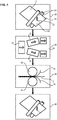
- the first cutting device 20 cuts the strip of material 12 in two (or more) two strands of material 12a, 12b.
- the guide means 21 consist for example of two cylinders between which the strip of material 12 is pressed. It will be noted that the guide means are not a priori intended to drive the strip of material. Scrolling the band is induced by the drive rollers 41, 42, also belonging to the system and located downstream of the cylinders 21, 22, described below.
- the slicing means 22 may comprise one (or more) fixed or rotating blades disposed on the path of movement of the web of material 12 so as to longitudinally cut the web of material in order to obtain two (or a plurality of) ) strands of material 12a, 12b.
- the second cutting device 50 makes it possible to cut the complex to obtain electrical energy storage complex ribbons.
- the elements constituting this second cutting device may be identical to those of the first cutting device.
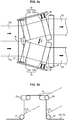
- the separation device 30, illustrated in FIGS. figures 5 and 6 makes it possible to spread the strands of material 12a, 12b cut by the first cutting device 20.
- each spacer arm 32, 33 is different from the guide direction induced by the upstream guide member 31.
- one of the spacer arms may guide a strand of material in accordance with the same guidance direction as the upstream guide element.
- the scroll plane P1 in which each strand of material 12a, 12b is located between the guide element upstream 31 and its entry into the spacer on the one hand, and the scroll plane P2 in which each strand of material 12a, 12b is found when passing through the spacer on the other hand are not the same, and more particularly form a non-zero angle, preferably are perpendicular.
- the scroll plane P2 in which each strand of material 12a, 12b is located during its passage at the spacer and the scroll plane P3 in which each strand of material 12a, 12b is located between its outlet of the spacer and the downstream guide element 34 on the other hand are not the same, and more particularly form a non-zero angle, preferably are perpendicular.
- the strands of material 12a, 12b extend in the same plane of travel during their passage at their respective spacer arm.
- Each spacer arm comprises two successive cylinders of parallel axis. These two cylinders define, for each arm, the guide direction of the corresponding material strand.
- each spacer arm 32, 33 comprises a frame making it easier to guarantee the parallelism of the axes of the rolls, and the stability of the guide direction.
- each spacer arm may be adjustable to vary the guide direction of each strand of material 12a, 12b. This makes it possible to avoid generating undesirable mechanical stresses in the strands of material 12a, 12b, in particular when the system is started. To avoid this, one can for example place the two spacer arms in parallel alignment (the value of the spacing distance induced by these cylinders being then zero and the axes of the cylinders then being parallel) during system startup and modify progressively the position of each spacer arm to arrive at the desired guiding direction for each strand of material 12a, 12b.
- the cylinders vis-à-vis the spacer arms are in contact with each other at their end.
- elastic means are interposed between the arm and the adjacent bearing (located near one end) of at least one of the cylinders to push the cylinder to the adjacent cylinder connected to the other arm.
- the upstream guide means 31 can receive the strands of material cut by the cutting device 20.
- These means comprise a scroll cylinder whose width is greater than or equal to the width of the web of material.
- downstream guide means 34 make it possible to scroll the strands of material 12a, 12b spaced apart by the spacer in the same scrolling plane, and preferably in a synchronized manner, by restoring the parallelism of the strands. 12a and 12b.
- this scroll cylinder includes a scroll cylinder.
- the dimensions of this scroll cylinder are preferably adapted to receive the strands of material spaced apart by the spacer. More precisely, the length of the scroll cylinder is greater than or equal to the sum of the widths of the spaced material strands and the distance d between these strands.
- downstream guide means could also comprise several cylinders of parallel axis of revolution.
- the spacer makes it possible to space the strands of material 12a, 12b; 12a, 12b + 12c, 12d in a transverse direction v extending in the plane of travel of the strands of material, substantially perpendicular to the direction of travel of said strands of material.
- the spacer comprises a support piece in contact with at least one of the strands of material, two strands of material to be spaced apart being placed on two separate support pieces.
- the spreader of the figure 5 more particularly comprises two adjacent support pieces, each support piece comprising spacer guiding means for respectively guiding each strand of material 12a, 12b.
- the support piece makes it possible to hold the strands of material 12a, 12b in a running plane, each strand of material being guided in its respective running direction.
- the respective scroll directions of the material strands in the spacer are different from the main scrolling direction.
- each support member comprises a frame arm and carrying two successive spacing guide cylinders 32a, 32b; 33a, 33b located in the extension of one another and parallel axis.
- the at least one of the arms of the support piece in particular the two arms, are rotatable about an axis normal to the plane of movement of the strands in the spacer. This makes it possible to ensure good film mechanical properties when the machine is started (the arms are progressively spread apart to deflect the film gradually).
- each of the arms is perpendicular to the plane of travel of the strands of material and is preferably concurrent with the middle of the width of the strand of material in the vicinity of its passage on the first cylinder associated with said arm, when this cylinder is in the parallel alignment position. In this way, it avoids the elongation of a portion of the strand due to torsional stresses and limits the risk of tearing of the strand.
- Each spaced apart guide cylinder 32a mounted on one arm is opposite a guide cylinder such as 33a mounted on the other arm so that they are adjacent, especially that their ends are in contact with each other. .
- the axes of rotation of these cylinders vis-à-vis are concurrent and contained in a plane parallel to the plane of travel of the strands of material. They form an angle ⁇ of 180 ° at start-up, when they are in parallel alignment (no spacing) and then gradually decreasing in a position of separation.
- the angle used in the application is approximately 179 ° but could be less than this value.
- Each of these cylinders is of course rotatable about its axis and guides the strands respectively in two different and divergent guide directions.
- the adjacent spacing cylinders 32a, 33a are in contact at one of their ends to prevent degradation of the material strands at their central edge, as previously indicated.
- the support piece may comprise more than two support pieces 32, 33, 35.
- the support piece comprises three support pieces 32, 33, 35 so as to space three strands of material 12a, 12b + 12c, 12d from each other.
- the axes of rotation of the spaced apart guide cylinders respectively provided on each support member form a non-zero angle between them. More specifically, the axis of rotation of a first spacer cylinder 35a located on a first support part 35 extends parallel to the axis of rotation of the upstream cylinder 31 while the axes of rotation of the other two guide cylinders adjacent spacers 32a, 33a form a non-zero angle with the axis of rotation of the first cylinder 35a. The directions of the axes of the two other cylinders 32a, 33a also form a non-zero angle between them.
- each support piece in the embodiment of the figure 6 is also different from that of the figure 5 .
- Each support piece 32, 33, 35 in fact comprises three guide cylinders spaced parallel axis. It will also be noted that the strands of material may pass over the cylinders of the spacer or at least some of these, as can be seen on the figure 6 .
- the upstream guide means 31 and downstream 34 are located at the same level (or the same height) but this might not be the case. It could for example also be possible for the upstream and downstream guide means to be each located on a separate side of the spacer.
- the cylinders 32a, 33a or 32a, 33a, 35a are in contact at one of their ends. This prevents the strands of material are damaged. It is also desired that the cylinders 32b, 33b shown on the figure 5a are in contact at their end but, the device being configured to be variable inclination, this can not be achieved easily.
- the roll has been disposed on a pin holding elastic means, in particular a compressed spring 36, 37 interposed between the arm and the bearing of the roll and making it possible to push the roll towards the opposite roll connected to the other arm.
- the complexing device makes it possible to assemble the electrolyte films to the strands of material spaced apart by the separation device.
- the laminating device makes it possible to press against pressure the electrolyte films and the strands of material so as to obtain a complex whose layers adhere.
- the complexing device comprises pressing means for superposing and assembling the electrolyte films on each of the faces of the spaced material strands.
- the pressing means comprise, for example, a support 41 and a compression cylinder 42 between which the electrolyte films 14, 15 and the spaced material strands 12a, 12b run.
- the support may itself consist of one (or more) support cylinder (s).
- the complexing is carried out by two cylinders 41, 42 movable in rotation about their axes and superimposed between which flow the electrolyte films 14, 15 and spaced strands of material 12a, 12b, an electrolyte film passing on each of cylinders.
- the rolls 41, 42 also form drive means for the web of material and strands therefrom into the system. At least one of the cylinders is therefore connected to a motor.
- the double drive can also be used by motorizing the cylinders 41 and 42.
- one of the cylinders of the complexing device (for example the compression cylinder) can be coupled to balancing means 43.
- these balancing means make it possible to apply different forces F1, F2 on the two ends 42a, 42b of the cylinder 42.This makes it possible to create a torque capable of slightly inclining the axis of rotation of the cylinder.
- the space between the two cylinders can be narrower at a first end of the cylinder (where a first strand of material flows) than at the second end (where a second strand passes).
- the casing of the cylinder is rubber, it still allows the film to pass but deforms, thus changing the driving radius of one strand relative to the other.
- the balancing means can be controlled according to data sent by a device 44 for measuring the tension of the strands of material.
- FIG. figure 8 an example of a tape manufacturing system has been illustrated for carrying out the method illustrated in FIG. figure 2 .
- the system comprises unwinders 61 to 66 on which cathode and electrolyte coils 71 to 76 are placed.
- the system comprises two unwinders 63, 64 on which are placed two coils of collector material / cathode material 73, 74.
- the system comprises two times two unwinders 61, 62 and 65, 66 on which are placed the electrolyte films and 71, 72 and 75, 76.
- Two of the unwinders 61, 62 relating to the electrolyte make it possible to deposit an electrolyte film 71, 72 on a first face of the strip of material 73, 74, and two others 65, 66 allow the deposition of an electrolyte film. 75, 76 on a second face of the web of material 73, 74.
- the system could, however, include a single coil of each of the films or only one or two coils for depositing an electrolyte film on one side of the web of material.
- the web of material 73, 74 could also comprise only a layer of cathode material, or a single cathode layer and a collector, and the electrolyte film might not be covered with one or more protective films.
- the system also comprises, for coils carrying films / strips of the same kind, a splicing device 77, 78, 79 of conventional type for hanging on an end band of one of the coils the beginning of the other of coils.
- This splicing device is optional but allows to change the coils in an optimized time.
- the system then comprises numerous tensor devices for tensioning the different films / strips unwound from the coils. These devices are conventional and will not be described further.
- the system may also include an optional preheating device (not shown) of the material web disposed at the output of the web material coils 73, 74.
- a preheating device may for example comprise heating cylinders between which the strips of material must pass.
- the system also comprises a cutting device 81 of the strip of material as described above.
- the system may also include an aligner (not shown) upstream of the cutter 81 to ensure that the cut is made in the middle of the width of the web of material.
- This aligner device can be adjustable using a measuring element and aligns the material web to a reference position. This is a device of known type that we will not detail further here.
- the system also comprises, downstream of the cutting device, the separation device 82 previously described.
- the system also comprises a measuring device 86 downstream of the separation device 82.
- This measuring device 86 makes it possible to measure the tensile forces exerted respectively on each of the two strands of material exiting the separation device.
- the system comprises a shrinkage device 91 of a protective film extending on the face of the electrolyte film intended to come into contact with the strands of material.
- the protective film is deflected and rewound on a recovery coil 92. It can subsequently be reused to be reapplied to another electrolyte film.
- the electrolyte film separated from the protective film then passes through heating rolls 93 so that the electrolyte film adheres better to the strands of material.
- the system also comprises a complexing device 94 as described above in which the two strands of material, a first film of electrolyte intended to be placed on the strands of material, and a second electrolyte film intended to be placed under the strands of material.
- a complex is obtained at the output of the complexing device.
- the system may comprise downstream of the conventional cooling cylinder complexing device comprising one or more cold cylinders on which the complex is passed.
- It also includes two withdrawal devices 96 for removing the remaining protective films on each side of the complex.
- the protective films are then deflected to reels 97 to re-wind and recover them for reuse thereafter.
- the system may also comprise a device 98 for placing the complexing film on the complex by complexing.
- This separation film prevents the complex from sticking to itself when wound on a spool.
- This device 98 may in particular comprise two simple cylinders between which the complex and the separation film scroll.
- the system also comprises a cutting device 99 such as that previously described and which makes it possible to cut longitudinally the double-width complex at its center (where the superposition does not comprise a strand of material, in the spacing space between the two strands).
- this cutting device can be associated with an alignment device with respect to a reference position so that the cutting takes place in a zone desired by the user.
- the assembly device then comprises guide cylinders 101 for deflecting the two strips of simple complex width obtained following cutting.
- One of the two single-ply complex ribbons is driven in a first path to a first spool 102 on which it is rewound while the other complex ribbon is driven in a second path, to a second spool 103 on which it is re wound.
- the complexing device may also include means for displaying the state of the finished film and means for signaling a fault if the state display means have detected such a defect.
- Such display means may comprise a camera while the signaling means comprise a label-laying device, such a device being able in particular to place a label at the beginning of the zone comprising the defect and a label at the end. of the area.
- a label-laying device such a device being able in particular to place a label at the beginning of the zone comprising the defect and a label at the end. of the area.
- Such a device can also or alternatively include writing information into an RFID chip or issuing an ink jet to signal the defect.
- the system and method described above thus make it possible to manufacture an energy storage complex strip of desired width from larger width films, automatically by limiting the number of human intervention required, which decreases the cost of manufacturing such a ribbon and increases the rate of production.
Landscapes
- Engineering & Computer Science (AREA)
- Power Engineering (AREA)
- Manufacturing & Machinery (AREA)
- Microelectronics & Electronic Packaging (AREA)
- Chemical Kinetics & Catalysis (AREA)
- General Chemical & Material Sciences (AREA)
- Electrochemistry (AREA)
- Chemical & Material Sciences (AREA)
- Secondary Cells (AREA)
- Folding Of Thin Sheet-Like Materials, Special Discharging Devices, And Others (AREA)
- Electric Double-Layer Capacitors Or The Like (AREA)
- Registering, Tensioning, Guiding Webs, And Rollers Therefor (AREA)
- Fixed Capacitors And Capacitor Manufacturing Machines (AREA)
- Controlling Rewinding, Feeding, Winding, Or Abnormalities Of Webs (AREA)
- Cell Separators (AREA)
Claims (14)
- Vorrichtung (30; 82) zur Trennung zumindest zweier Materialstränge (12a, 12b; 12a, 12b+12c, 12d) aus dem Längszuschnitt einer kontinuierlich durchlaufenden Materialbahn, umfassend:- stromaufwärtige Führungsmittel (31; 83) für die beiden Materialstränge, die sie in gleicher Richtung führen, die sogenannte Hauptrichtung,- einen Abstandshalter (32, 33; 32, 33, 35; 84) zum Beabstanden der Materialstränge in einer Richtung (v), der sich in der Laufebene der Materialstränge erstreckt, wobei der Abstandshalter Führungsmittel (32a, 32b, 33a, 33b; 32a, 32b, 32c, 33a, 33b, 33c, 35a, 35b, 35c) umfasst, die so konfiguriert sind, dass sie die Materialstränge in zwei verschiedene und getrennte Richtungen führen,- stromabwärtige Führungsmittel (34; 85) für die beiden beabstandeten Materialstränge, wobei diese sie in die gleiche Richtung führen,wobei die stromaufwärtigen Führungsmittel und der Abstandshalter so positioniert sind, dass die Laufebene (P2) der Materialstränge im Abstandshalter einen Winkel ungleich Null mit der Laufebene (P1) der Materialstränge zwischen den stromaufwärtigen Führungsmitteln und dem Abstandshalter bildet,
wobei der Abstandshalter und die stromabwärtigen Führungsmittel so positioniert sind, dass die Laufebene (P2) der Materialstränge im Abstandshalter einen Winkel ungleich Null mit der Laufebene (P3) der Materialstränge zwischen dem Abstandshalter und den stromabwärtigen Führungsmitteln bildet,
dadurch gekennzeichnet, dass der Abstandhalter zumindest zwei benachbarte Trägerteile (32, 33; 32, 33, 35) umfasst, wobei jedes Trägerteil Abstandsführungsmittel (32a, 32b, 33a, 33b; 32a, 32b, 32c, 33a, 33b, 33c, 35a, 35b, 35c) zum Führen eines der Materialstränge (12a, 12b; 12a, 12b+12c, 12d) umfasst, die Abstandsführungsmittel jedes Trägerteils zumindest zwei aufeinanderfolgende Zylinder mit paralleler Achse (32a, 32b; 33a, 33b) umfassen, die um ihre Achse drehbar beweglich sind, wobei die Drehachsen zweier zu zwei verschiedenen Trägerteilen gehörenden Zylinder einen Winkel ungleich Null zueinander bilden, zumindest zwei benachbarte Zylinder (32a, 32b, 33a, 33b; 32a, 33a, 35a), die zu getrennten Trägerteilen gehören, an einem ihrer Enden in Berührung stehen, wobei vorgespannte elastische Mittel (36, 37) zwischen einem Ende eines Führungszylinders (32b; 33b) und dem Arm, der diesen Zylinder trägt, angeordnet sind, um den Zylinder zurück zum benachbarten Zylinder (33b; 32b) zu drücken, der zu einem anderen Trägerteil gehört. - Vorrichtung nach dem vorstehenden Anspruch, wobei jedes der Trägerteile einen Arm umfasst, der die aufeinanderfolgenden Zylinder (32a, 32b; 33a, 33b) des Trägerteils miteinander verbindet und die Parallelität ihrer Achsen aufrecht erhält, wobei zumindest einer der Arme geeignet ist, relativ zum anderen Arm in eine Richtung zu schwenken, die im Wesentlichen normal zur Laufebene der Materialstränge ist.
- Vorrichtung nach Anspruch 1 oder 2, wobei die stromabwärtigen Führungsmittel zumindest einen um seine Achse drehbaren Laufzylinder (34) umfassen, wobei der oder die Laufzylinder geeignet ist/sind, die durch den Abstandshalter beabstandeten Materialstränge aufzunehmen.
- Vorrichtung nach einem der vorstehenden Ansprüche, wobei die stromaufwärtigen Führungsmittel zumindest einen um seine Achse beweglichen Laufzylinder (31) umfassen, der zur Aufnahme der längs zugeschnittenen und nebeneinander angeordneten Materialstränge geeignet ist.
- Vorrichtung nach einem der vorstehenden Ansprüche, wobei:- die stromaufwärtigen Führungsmittel und der Abstandshalter so positioniert sind, dass die Laufebene (P2) der Materialstränge im Abstandshalter im Wesentlichen senkrecht zur Laufebene (P1) der Materialstränge zwischen den stromaufwärtigen Führungsmitteln und dem Abstandhalter steht und/oder- der Abstandshalter und die stromabwärtigen Führungsmittel so positioniert sind, dass die Laufebene (P2) der Materialstränge im Abstandshalter im Wesentlichen senkrecht zur Laufebene (P3) der Materialstränge zwischen dem Abstandshalter und den stromabwärtigen Führungsmitteln steht.
- Vorrichtung nach einem der vorstehenden Ansprüche, wobei die stromabwärtigen Führungsmittel (34) so konfiguriert sind, dass die Materialstränge in der Hauptrichtung geführt werden, wobei die Führungsmittel (32a, 32b, 33a, 33b; 32a, 32b, 32c, 33a, 33b, 33c) des Abstandshalters so konfiguriert sind, dass sie zumindest einen der Materialstränge, insbesondere die beiden Stränge, in einer von der Hauptrichtung verschiedenen Richtung führen.
- System zur Herstellung eines Bandes eines elektrischen Energiespeicherkomplexes, das zumindest einen Materialstrang umfasst, dadurch gekennzeichnet, dass das Herstellungssystem eine Trennvorrichtung (30) nach einem der vorstehenden Ansprüche umfasst, um zumindest zwei Materialstränge voneinander zu beabstanden.
- System nach dem vorstehenden Anspruch, das ferner eine der Trennvorrichtung stromabwärtige Messvorrichtung (86) zum Messen der auf jeden Materialstrang ausgeübten Zugkräfte umfasst.
- System nach einem der beiden vorstehenden Ansprüche, das ferner eine der Trennvorrichtung stromabwärtige Kaschiervorrichtung (40) umfasst, um zumindest einen zusammenhängenden Film, wie beispielsweise einen Elektrolytfilm, auf den beabstandeten Materialsträngen aufzubringen.
- System nach dem vorstehenden Anspruch, wobei die Kaschiervorrichtung Pressmittel (41, 42) zum Überlagern und Verbinden des oder zumindest eines der Filme auf einer der Seiten der beabstandeten Materialstränge umfasst.
- System nach dem vorstehenden Anspruch, wobei die Pressmittel einen Träger (41) und einen Kompressionszylinder (42) umfassen, die beabstandeten Materialstränge und der oder die Film(e) zwischen dem Träger und dem Kompressionszylinder verlaufen.
- System nach dem vorstehenden Anspruch, wobei der Träger zumindest einen Trägerzylinder (41) umfasst, der dem genannten und zumindest einem Kompressionsylinder zugewandt ist.
- System nach dem vorstehenden Anspruch, wobei die Pressmittel ferner Ausgleichsmittel (43) zum Variieren der Neigung der Drehachse des Druckzylinders gegenüber dem Träger vorzugsweise in Abhängigkeit von den von der Messvorrichtung (86) gelieferten Ergebnissen umfassen.
- System nach einem der Ansprüche 7 bis 13, das ferner ein Heizelement (93) zum Erwärmen der Materialstränge und/oder des genannten oder zumindest eines der auf den Materialsträngen überlagerten Filme umfasst.
Applications Claiming Priority (2)
| Application Number | Priority Date | Filing Date | Title |
|---|---|---|---|
| FR1353166A FR3004174B1 (fr) | 2013-04-09 | 2013-04-09 | Dispositif de separation d'au moins deux brins de materiau adjacents et systeme incluant un tel dispositif |
| PCT/EP2014/057104 WO2014166973A1 (fr) | 2013-04-09 | 2014-04-09 | Dispositif de separation d'au moins deux brins de materiau adjacents et systeme incluant un tel dispositif |
Publications (2)
| Publication Number | Publication Date |
|---|---|
| EP2984014A1 EP2984014A1 (de) | 2016-02-17 |
| EP2984014B1 true EP2984014B1 (de) | 2019-01-16 |
Family
ID=48521346
Family Applications (1)
| Application Number | Title | Priority Date | Filing Date |
|---|---|---|---|
| EP14716798.5A Active EP2984014B1 (de) | 2013-04-09 | 2014-04-09 | Vorrichtung zur trennung mindestens zweier zusammenhängender stränge eines materials und system mit solch einer vorrichtung |
Country Status (13)
| Country | Link |
|---|---|
| US (1) | US10147559B2 (de) |
| EP (1) | EP2984014B1 (de) |
| JP (1) | JP6328226B2 (de) |
| KR (1) | KR102007943B1 (de) |
| CN (1) | CN105164036B (de) |
| AU (1) | AU2014253155B2 (de) |
| BR (1) | BR112015025750A8 (de) |
| CA (1) | CA2909015C (de) |
| FR (1) | FR3004174B1 (de) |
| IL (1) | IL241869B (de) |
| RU (1) | RU2651301C2 (de) |
| UA (1) | UA118671C2 (de) |
| WO (1) | WO2014166973A1 (de) |
Families Citing this family (10)
| Publication number | Priority date | Publication date | Assignee | Title |
|---|---|---|---|---|
| DE112017003813T5 (de) * | 2016-07-29 | 2019-04-11 | Panasonic Intellectual Property Management Co., Ltd. | Folienkondensator, kondensatoreinheit und verfahren zur herstellung eines folienkondensators |
| CN109720084B (zh) * | 2017-10-31 | 2024-08-20 | 天津长荣科技集团股份有限公司 | 烫金设备 |
| CN108792727B (zh) * | 2018-05-05 | 2021-02-02 | 昆山晶华兴业电子材料有限公司 | 一种用于覆膜机的薄膜牵引装置 |
| CN113200401B (zh) * | 2021-04-06 | 2022-04-19 | 浙江金通纸业有限公司 | 一种纸张对开分切装置 |
| CN114524307B (zh) * | 2021-04-06 | 2023-06-27 | 浙江金通纸业有限公司 | 一种纸张预折分切收卷装置 |
| CN113636483B (zh) * | 2021-08-19 | 2025-04-11 | 香港中文大学(深圳) | 一种双驱力平衡卷扬机 |
| KR20230123372A (ko) * | 2022-02-16 | 2023-08-23 | 주식회사 엘지에너지솔루션 | 이차전지 제조장치 및 이를 이용하는 이차전지 제조방법 |
| CN114506726A (zh) * | 2022-02-18 | 2022-05-17 | 中润(南通)家用纺织品有限公司 | 一种布料同时纠偏、展布装置及其使用方法 |
| CN114655769B (zh) * | 2022-03-02 | 2024-04-02 | 安徽致达包装有限公司 | 一种降解聚乙烯热收缩膜切割装置 |
| CN221026762U (zh) * | 2023-10-20 | 2024-05-28 | 三一技术装备有限公司 | 一种分切机 |
Family Cites Families (17)
| Publication number | Priority date | Publication date | Assignee | Title |
|---|---|---|---|---|
| JPS57148338A (en) * | 1981-03-09 | 1982-09-13 | Nippon Electric Co | Method and apparatus for producing electric double alyer capacitor element |
| DE3733129C2 (de) * | 1987-10-01 | 1999-02-18 | Focke & Co | Vorrichtung zum Trennen einer Materialbahn in zwei Teilbahnen |
| RU2023643C1 (ru) * | 1989-01-14 | 1994-11-30 | Зундвигер Айзенхютте Машиненфабрик ГмбХ унд Ко. | Устройство для продольного разделения ленточного материала |
| CA2083836C (en) * | 1990-05-26 | 2000-01-25 | Philip Smith | Method and device for automatic sleeve feed in roll-cutting machines of the backup roller type |
| JP2930147B2 (ja) * | 1991-06-24 | 1999-08-03 | 日本板硝子株式会社 | プレスロール装置 |
| IT1294817B1 (it) * | 1997-07-11 | 1999-04-15 | Perini Fabio Spa | Macchina ribobinatrice - taglierina per la produzione di rotoli di materiale nastriforme e relativo metodo |
| JP3526812B2 (ja) * | 2000-05-26 | 2004-05-17 | Fdk株式会社 | 電極スリッタ装置 |
| US6352188B1 (en) * | 2000-08-03 | 2002-03-05 | Eastman Kodak Company | Edge drive for photosensitive media |
| JP2002273684A (ja) * | 2001-03-14 | 2002-09-25 | Sumitomo Chem Co Ltd | 電池セパレーター用樹脂フィルム状物のスリット方法および電池セパレーター用樹脂フィルム状物 |
| CN1221054C (zh) * | 2003-06-18 | 2005-09-28 | 福建南平南孚電池有限公司 | 袋式锂离子电池的制备方法 |
| WO2005117043A1 (ja) * | 2004-05-27 | 2005-12-08 | Zeon Corporation | 電気化学デバイス用電極の製造方法及びその装置 |
| JP4861873B2 (ja) * | 2007-03-29 | 2012-01-25 | 富士フイルム株式会社 | フイルム搬送装置及びフイルム搬送方法 |
| KR101420476B1 (ko) * | 2008-09-02 | 2014-07-16 | 도요타지도샤가부시키가이샤 | 전극 시트의 제조 방법 및 그 장치 |
| JP2010227546A (ja) * | 2009-03-02 | 2010-10-14 | Uni Charm Corp | 搬送装置及び吸収性物品の製造方法 |
| JP5625871B2 (ja) * | 2010-12-16 | 2014-11-19 | 株式会社リコー | スキュー補正装置、用紙搬送装置及び画像形成装置 |
| CN202138903U (zh) * | 2011-06-17 | 2012-02-08 | 中烟机械技术中心有限责任公司 | 用于在线等宽分切纸带的供纸装置 |
| DE102011052699B4 (de) | 2011-08-12 | 2015-12-31 | Georg Sahm Gmbh & Co. Kg | Spulmaschine und Verfahren zur Steuerung derselben |
-
2013
- 2013-04-09 FR FR1353166A patent/FR3004174B1/fr active Active
-
2014
- 2014-04-09 AU AU2014253155A patent/AU2014253155B2/en not_active Ceased
- 2014-04-09 CN CN201480024782.0A patent/CN105164036B/zh not_active Expired - Fee Related
- 2014-04-09 JP JP2016506944A patent/JP6328226B2/ja active Active
- 2014-04-09 US US14/783,053 patent/US10147559B2/en active Active
- 2014-04-09 CA CA2909015A patent/CA2909015C/fr active Active
- 2014-04-09 BR BR112015025750A patent/BR112015025750A8/pt active Search and Examination
- 2014-04-09 WO PCT/EP2014/057104 patent/WO2014166973A1/fr not_active Ceased
- 2014-04-09 KR KR1020157032003A patent/KR102007943B1/ko active Active
- 2014-04-09 RU RU2015147892A patent/RU2651301C2/ru not_active IP Right Cessation
- 2014-04-09 EP EP14716798.5A patent/EP2984014B1/de active Active
- 2014-09-04 UA UAA201510837A patent/UA118671C2/uk unknown
-
2015
- 2015-10-06 IL IL241869A patent/IL241869B/en active IP Right Grant
Also Published As
| Publication number | Publication date |
|---|---|
| CN105164036B (zh) | 2018-04-06 |
| EP2984014A1 (de) | 2016-02-17 |
| RU2015147892A (ru) | 2017-05-15 |
| JP2016522130A (ja) | 2016-07-28 |
| CA2909015C (fr) | 2020-04-14 |
| KR20150140778A (ko) | 2015-12-16 |
| US20160071659A1 (en) | 2016-03-10 |
| KR102007943B1 (ko) | 2019-08-06 |
| JP6328226B2 (ja) | 2018-05-23 |
| BR112015025750A2 (pt) | 2017-07-18 |
| UA118671C2 (uk) | 2019-02-25 |
| CN105164036A (zh) | 2015-12-16 |
| RU2651301C2 (ru) | 2018-04-19 |
| AU2014253155B2 (en) | 2018-05-10 |
| WO2014166973A1 (fr) | 2014-10-16 |
| HK1215235A1 (zh) | 2016-08-19 |
| CA2909015A1 (fr) | 2014-10-16 |
| IL241869B (en) | 2019-05-30 |
| BR112015025750A8 (pt) | 2019-12-17 |
| US10147559B2 (en) | 2018-12-04 |
| AU2014253155A1 (en) | 2015-11-05 |
| FR3004174A1 (fr) | 2014-10-10 |
| FR3004174B1 (fr) | 2015-08-21 |
| RU2015147892A3 (de) | 2018-03-02 |
Similar Documents
| Publication | Publication Date | Title |
|---|---|---|
| EP2984014B1 (de) | Vorrichtung zur trennung mindestens zweier zusammenhängender stränge eines materials und system mit solch einer vorrichtung | |
| EP2984696B1 (de) | System und verfahren zur herstellung einer zusammenhängenden reihe elektrischer energiespeicherkomplexe | |
| BE1015523A3 (fr) | Paquets de rouleaux et leur procede de fabrication. | |
| EP2715857B1 (de) | Halbautomatisches verfahren zur herstellung einer elektrochemischen li-ionenbatterien | |
| EP3565777B1 (de) | Verfahren und vorrichtung zum kontinuierlichen kreuzwickeln von gummierstreifen um spulen | |
| FR2528023A1 (fr) | Procede et dispositif pour la reprise de produits plats se presentant en disposition en ecailles, en particulier pour la reprise de feuilles imprimees | |
| EP3562772B1 (de) | Vorrichtung zur kontinuierlichen herstellung von spulen aus gewickelten bändern | |
| FR2986509A1 (fr) | Equipement et procede pour fardeleuse | |
| EP0944542A1 (de) | Wickelmaschine für ein flaches endloses element zur bildung von bahnwickeln | |
| FR2930243A1 (fr) | Dispositif de fourniture et installation de depose d'une bande de gomme. | |
| CA2511578C (fr) | Derouleur-aligneur pour machine a bobiner des films | |
| EP4330006B1 (de) | Verbessertes verfahren und vorrichtung zum kontinuierlichen aufwickeln von gummistreifen zu spulen | |
| EP1702874B1 (de) | Method and device of transporting a non-woven web with electrostatic charge in at least an area with a dimension smaller than the width of said web | |
| EP1022155B1 (de) | Verfahren und Vorrichtung zur Herstellung von Taschen, insbesondere Schutzmappen | |
| HK1215333B (en) | System and method for producing a strip of electrical energy storage complex | |
| EP3795519A1 (de) | Vorrichtung zur beschickung einer maschine mit endlosfolie | |
| HK1215235B (en) | Device for separating at least two adjacent strands of material and system including such a device |
Legal Events
| Date | Code | Title | Description |
|---|---|---|---|
| PUAI | Public reference made under article 153(3) epc to a published international application that has entered the european phase |
Free format text: ORIGINAL CODE: 0009012 |
|
| 17P | Request for examination filed |
Effective date: 20151009 |
|
| AK | Designated contracting states |
Kind code of ref document: A1 Designated state(s): AL AT BE BG CH CY CZ DE DK EE ES FI FR GB GR HR HU IE IS IT LI LT LU LV MC MK MT NL NO PL PT RO RS SE SI SK SM TR |
|
| AX | Request for extension of the european patent |
Extension state: BA ME |
|
| DAX | Request for extension of the european patent (deleted) | ||
| REG | Reference to a national code |
Ref country code: HK Ref legal event code: DE Ref document number: 1215235 Country of ref document: HK |
|
| GRAP | Despatch of communication of intention to grant a patent |
Free format text: ORIGINAL CODE: EPIDOSNIGR1 |
|
| STAA | Information on the status of an ep patent application or granted ep patent |
Free format text: STATUS: GRANT OF PATENT IS INTENDED |
|
| RIC1 | Information provided on ipc code assigned before grant |
Ipc: B65H 23/038 20060101AFI20180712BHEP Ipc: H01G 13/00 20130101ALI20180712BHEP Ipc: H01G 11/84 20130101ALI20180712BHEP Ipc: H01G 4/32 20060101ALI20180712BHEP Ipc: H01M 10/04 20060101ALI20180712BHEP Ipc: H01G 13/02 20060101ALI20180712BHEP Ipc: B65H 35/02 20060101ALI20180712BHEP Ipc: H01M 4/04 20060101ALI20180712BHEP Ipc: H01G 4/00 20060101ALI20180712BHEP Ipc: B65H 57/16 20060101ALI20180712BHEP |
|
| INTG | Intention to grant announced |
Effective date: 20180809 |
|
| GRAS | Grant fee paid |
Free format text: ORIGINAL CODE: EPIDOSNIGR3 |
|
| GRAA | (expected) grant |
Free format text: ORIGINAL CODE: 0009210 |
|
| STAA | Information on the status of an ep patent application or granted ep patent |
Free format text: STATUS: THE PATENT HAS BEEN GRANTED |
|
| AK | Designated contracting states |
Kind code of ref document: B1 Designated state(s): AL AT BE BG CH CY CZ DE DK EE ES FI FR GB GR HR HU IE IS IT LI LT LU LV MC MK MT NL NO PL PT RO RS SE SI SK SM TR |
|
| REG | Reference to a national code |
Ref country code: GB Ref legal event code: FG4D Free format text: NOT ENGLISH |
|
| REG | Reference to a national code |
Ref country code: CH Ref legal event code: EP |
|
| REG | Reference to a national code |
Ref country code: IE Ref legal event code: FG4D Free format text: LANGUAGE OF EP DOCUMENT: FRENCH |
|
| REG | Reference to a national code |
Ref country code: DE Ref legal event code: R096 Ref document number: 602014039970 Country of ref document: DE |
|
| REG | Reference to a national code |
Ref country code: AT Ref legal event code: REF Ref document number: 1089551 Country of ref document: AT Kind code of ref document: T Effective date: 20190215 |
|
| REG | Reference to a national code |
Ref country code: NL Ref legal event code: MP Effective date: 20190116 |
|
| REG | Reference to a national code |
Ref country code: LT Ref legal event code: MG4D |
|
| PG25 | Lapsed in a contracting state [announced via postgrant information from national office to epo] |
Ref country code: NL Free format text: LAPSE BECAUSE OF FAILURE TO SUBMIT A TRANSLATION OF THE DESCRIPTION OR TO PAY THE FEE WITHIN THE PRESCRIBED TIME-LIMIT Effective date: 20190116 |
|
| REG | Reference to a national code |
Ref country code: AT Ref legal event code: MK05 Ref document number: 1089551 Country of ref document: AT Kind code of ref document: T Effective date: 20190116 |
|
| PG25 | Lapsed in a contracting state [announced via postgrant information from national office to epo] |
Ref country code: ES Free format text: LAPSE BECAUSE OF FAILURE TO SUBMIT A TRANSLATION OF THE DESCRIPTION OR TO PAY THE FEE WITHIN THE PRESCRIBED TIME-LIMIT Effective date: 20190116 Ref country code: LT Free format text: LAPSE BECAUSE OF FAILURE TO SUBMIT A TRANSLATION OF THE DESCRIPTION OR TO PAY THE FEE WITHIN THE PRESCRIBED TIME-LIMIT Effective date: 20190116 Ref country code: PL Free format text: LAPSE BECAUSE OF FAILURE TO SUBMIT A TRANSLATION OF THE DESCRIPTION OR TO PAY THE FEE WITHIN THE PRESCRIBED TIME-LIMIT Effective date: 20190116 Ref country code: SE Free format text: LAPSE BECAUSE OF FAILURE TO SUBMIT A TRANSLATION OF THE DESCRIPTION OR TO PAY THE FEE WITHIN THE PRESCRIBED TIME-LIMIT Effective date: 20190116 Ref country code: FI Free format text: LAPSE BECAUSE OF FAILURE TO SUBMIT A TRANSLATION OF THE DESCRIPTION OR TO PAY THE FEE WITHIN THE PRESCRIBED TIME-LIMIT Effective date: 20190116 Ref country code: NO Free format text: LAPSE BECAUSE OF FAILURE TO SUBMIT A TRANSLATION OF THE DESCRIPTION OR TO PAY THE FEE WITHIN THE PRESCRIBED TIME-LIMIT Effective date: 20190416 Ref country code: PT Free format text: LAPSE BECAUSE OF FAILURE TO SUBMIT A TRANSLATION OF THE DESCRIPTION OR TO PAY THE FEE WITHIN THE PRESCRIBED TIME-LIMIT Effective date: 20190516 |
|
| PG25 | Lapsed in a contracting state [announced via postgrant information from national office to epo] |
Ref country code: GR Free format text: LAPSE BECAUSE OF FAILURE TO SUBMIT A TRANSLATION OF THE DESCRIPTION OR TO PAY THE FEE WITHIN THE PRESCRIBED TIME-LIMIT Effective date: 20190417 Ref country code: BG Free format text: LAPSE BECAUSE OF FAILURE TO SUBMIT A TRANSLATION OF THE DESCRIPTION OR TO PAY THE FEE WITHIN THE PRESCRIBED TIME-LIMIT Effective date: 20190416 Ref country code: HR Free format text: LAPSE BECAUSE OF FAILURE TO SUBMIT A TRANSLATION OF THE DESCRIPTION OR TO PAY THE FEE WITHIN THE PRESCRIBED TIME-LIMIT Effective date: 20190116 Ref country code: IS Free format text: LAPSE BECAUSE OF FAILURE TO SUBMIT A TRANSLATION OF THE DESCRIPTION OR TO PAY THE FEE WITHIN THE PRESCRIBED TIME-LIMIT Effective date: 20190516 Ref country code: RS Free format text: LAPSE BECAUSE OF FAILURE TO SUBMIT A TRANSLATION OF THE DESCRIPTION OR TO PAY THE FEE WITHIN THE PRESCRIBED TIME-LIMIT Effective date: 20190116 Ref country code: LV Free format text: LAPSE BECAUSE OF FAILURE TO SUBMIT A TRANSLATION OF THE DESCRIPTION OR TO PAY THE FEE WITHIN THE PRESCRIBED TIME-LIMIT Effective date: 20190116 |
|
| REG | Reference to a national code |
Ref country code: DE Ref legal event code: R097 Ref document number: 602014039970 Country of ref document: DE |
|
| PG25 | Lapsed in a contracting state [announced via postgrant information from national office to epo] |
Ref country code: SK Free format text: LAPSE BECAUSE OF FAILURE TO SUBMIT A TRANSLATION OF THE DESCRIPTION OR TO PAY THE FEE WITHIN THE PRESCRIBED TIME-LIMIT Effective date: 20190116 Ref country code: CZ Free format text: LAPSE BECAUSE OF FAILURE TO SUBMIT A TRANSLATION OF THE DESCRIPTION OR TO PAY THE FEE WITHIN THE PRESCRIBED TIME-LIMIT Effective date: 20190116 Ref country code: RO Free format text: LAPSE BECAUSE OF FAILURE TO SUBMIT A TRANSLATION OF THE DESCRIPTION OR TO PAY THE FEE WITHIN THE PRESCRIBED TIME-LIMIT Effective date: 20190116 Ref country code: AL Free format text: LAPSE BECAUSE OF FAILURE TO SUBMIT A TRANSLATION OF THE DESCRIPTION OR TO PAY THE FEE WITHIN THE PRESCRIBED TIME-LIMIT Effective date: 20190116 Ref country code: EE Free format text: LAPSE BECAUSE OF FAILURE TO SUBMIT A TRANSLATION OF THE DESCRIPTION OR TO PAY THE FEE WITHIN THE PRESCRIBED TIME-LIMIT Effective date: 20190116 Ref country code: DK Free format text: LAPSE BECAUSE OF FAILURE TO SUBMIT A TRANSLATION OF THE DESCRIPTION OR TO PAY THE FEE WITHIN THE PRESCRIBED TIME-LIMIT Effective date: 20190116 Ref country code: AT Free format text: LAPSE BECAUSE OF FAILURE TO SUBMIT A TRANSLATION OF THE DESCRIPTION OR TO PAY THE FEE WITHIN THE PRESCRIBED TIME-LIMIT Effective date: 20190116 Ref country code: IT Free format text: LAPSE BECAUSE OF FAILURE TO SUBMIT A TRANSLATION OF THE DESCRIPTION OR TO PAY THE FEE WITHIN THE PRESCRIBED TIME-LIMIT Effective date: 20190116 |
|
| PLBE | No opposition filed within time limit |
Free format text: ORIGINAL CODE: 0009261 |
|
| STAA | Information on the status of an ep patent application or granted ep patent |
Free format text: STATUS: NO OPPOSITION FILED WITHIN TIME LIMIT |
|
| PG25 | Lapsed in a contracting state [announced via postgrant information from national office to epo] |
Ref country code: SM Free format text: LAPSE BECAUSE OF FAILURE TO SUBMIT A TRANSLATION OF THE DESCRIPTION OR TO PAY THE FEE WITHIN THE PRESCRIBED TIME-LIMIT Effective date: 20190116 |
|
| REG | Reference to a national code |
Ref country code: CH Ref legal event code: PL |
|
| REG | Reference to a national code |
Ref country code: BE Ref legal event code: MM Effective date: 20190430 |
|
| 26N | No opposition filed |
Effective date: 20191017 |
|
| PG25 | Lapsed in a contracting state [announced via postgrant information from national office to epo] |
Ref country code: MC Free format text: LAPSE BECAUSE OF FAILURE TO SUBMIT A TRANSLATION OF THE DESCRIPTION OR TO PAY THE FEE WITHIN THE PRESCRIBED TIME-LIMIT Effective date: 20190116 Ref country code: LU Free format text: LAPSE BECAUSE OF NON-PAYMENT OF DUE FEES Effective date: 20190409 |
|
| PG25 | Lapsed in a contracting state [announced via postgrant information from national office to epo] |
Ref country code: CH Free format text: LAPSE BECAUSE OF NON-PAYMENT OF DUE FEES Effective date: 20190430 Ref country code: LI Free format text: LAPSE BECAUSE OF NON-PAYMENT OF DUE FEES Effective date: 20190430 |
|
| PG25 | Lapsed in a contracting state [announced via postgrant information from national office to epo] |
Ref country code: SI Free format text: LAPSE BECAUSE OF FAILURE TO SUBMIT A TRANSLATION OF THE DESCRIPTION OR TO PAY THE FEE WITHIN THE PRESCRIBED TIME-LIMIT Effective date: 20190116 Ref country code: BE Free format text: LAPSE BECAUSE OF NON-PAYMENT OF DUE FEES Effective date: 20190430 |
|
| PG25 | Lapsed in a contracting state [announced via postgrant information from national office to epo] |
Ref country code: TR Free format text: LAPSE BECAUSE OF FAILURE TO SUBMIT A TRANSLATION OF THE DESCRIPTION OR TO PAY THE FEE WITHIN THE PRESCRIBED TIME-LIMIT Effective date: 20190116 |
|
| PG25 | Lapsed in a contracting state [announced via postgrant information from national office to epo] |
Ref country code: IE Free format text: LAPSE BECAUSE OF NON-PAYMENT OF DUE FEES Effective date: 20190409 |
|
| PG25 | Lapsed in a contracting state [announced via postgrant information from national office to epo] |
Ref country code: CY Free format text: LAPSE BECAUSE OF FAILURE TO SUBMIT A TRANSLATION OF THE DESCRIPTION OR TO PAY THE FEE WITHIN THE PRESCRIBED TIME-LIMIT Effective date: 20190116 |
|
| PG25 | Lapsed in a contracting state [announced via postgrant information from national office to epo] |
Ref country code: HU Free format text: LAPSE BECAUSE OF FAILURE TO SUBMIT A TRANSLATION OF THE DESCRIPTION OR TO PAY THE FEE WITHIN THE PRESCRIBED TIME-LIMIT; INVALID AB INITIO Effective date: 20140409 Ref country code: MT Free format text: LAPSE BECAUSE OF FAILURE TO SUBMIT A TRANSLATION OF THE DESCRIPTION OR TO PAY THE FEE WITHIN THE PRESCRIBED TIME-LIMIT Effective date: 20190116 |
|
| PG25 | Lapsed in a contracting state [announced via postgrant information from national office to epo] |
Ref country code: MK Free format text: LAPSE BECAUSE OF FAILURE TO SUBMIT A TRANSLATION OF THE DESCRIPTION OR TO PAY THE FEE WITHIN THE PRESCRIBED TIME-LIMIT Effective date: 20190116 |
|
| PGFP | Annual fee paid to national office [announced via postgrant information from national office to epo] |
Ref country code: DE Payment date: 20250319 Year of fee payment: 12 |
|
| PGFP | Annual fee paid to national office [announced via postgrant information from national office to epo] |
Ref country code: GB Payment date: 20260319 Year of fee payment: 13 |
|
| PGFP | Annual fee paid to national office [announced via postgrant information from national office to epo] |
Ref country code: FR Payment date: 20260319 Year of fee payment: 13 |