EP2984263B1 - Charnière pouvant être cachée pour le mouvement de rotation régulé d'une porte, en particulier d'une porte renforcée - Google Patents
Charnière pouvant être cachée pour le mouvement de rotation régulé d'une porte, en particulier d'une porte renforcée Download PDFInfo
- Publication number
- EP2984263B1 EP2984263B1 EP14728296.6A EP14728296A EP2984263B1 EP 2984263 B1 EP2984263 B1 EP 2984263B1 EP 14728296 A EP14728296 A EP 14728296A EP 2984263 B1 EP2984263 B1 EP 2984263B1
- Authority
- EP
- European Patent Office
- Prior art keywords
- hinge
- door
- pivot
- seat
- axis
- Prior art date
- Legal status (The legal status is an assumption and is not a legal conclusion. Google has not performed a legal analysis and makes no representation as to the accuracy of the status listed.)
- Not-in-force
Links
- 229920001971 elastomer Polymers 0.000 claims description 16
- 239000000806 elastomer Substances 0.000 claims description 16
- 239000000463 material Substances 0.000 claims description 6
- 238000003780 insertion Methods 0.000 claims description 5
- 230000037431 insertion Effects 0.000 claims description 5
- 230000035515 penetration Effects 0.000 claims description 2
- 229920002635 polyurethane Polymers 0.000 claims 1
- 239000004814 polyurethane Substances 0.000 claims 1
- 230000000694 effects Effects 0.000 description 4
- 238000013016 damping Methods 0.000 description 3
- IJGRMHOSHXDMSA-UHFFFAOYSA-N Atomic nitrogen Chemical compound N#N IJGRMHOSHXDMSA-UHFFFAOYSA-N 0.000 description 2
- 238000006243 chemical reaction Methods 0.000 description 2
- 230000002093 peripheral effect Effects 0.000 description 2
- 230000035939 shock Effects 0.000 description 2
- 230000006835 compression Effects 0.000 description 1
- 238000007906 compression Methods 0.000 description 1
- 239000000470 constituent Substances 0.000 description 1
- 238000010276 construction Methods 0.000 description 1
- 230000001419 dependent effect Effects 0.000 description 1
- 239000011521 glass Substances 0.000 description 1
- 230000003993 interaction Effects 0.000 description 1
- 238000012423 maintenance Methods 0.000 description 1
- 229910052757 nitrogen Inorganic materials 0.000 description 1
- 229920003225 polyurethane elastomer Polymers 0.000 description 1
Images




Classifications
-
- E—FIXED CONSTRUCTIONS
- E05—LOCKS; KEYS; WINDOW OR DOOR FITTINGS; SAFES
- E05D—HINGES OR SUSPENSION DEVICES FOR DOORS, WINDOWS OR WINGS
- E05D11/00—Additional features or accessories of hinges
- E05D11/0054—Covers, e.g. for protection
-
- E—FIXED CONSTRUCTIONS
- E05—LOCKS; KEYS; WINDOW OR DOOR FITTINGS; SAFES
- E05D—HINGES OR SUSPENSION DEVICES FOR DOORS, WINDOWS OR WINGS
- E05D11/00—Additional features or accessories of hinges
-
- E—FIXED CONSTRUCTIONS
- E05—LOCKS; KEYS; WINDOW OR DOOR FITTINGS; SAFES
- E05D—HINGES OR SUSPENSION DEVICES FOR DOORS, WINDOWS OR WINGS
- E05D11/00—Additional features or accessories of hinges
- E05D11/06—Devices for limiting the opening movement of hinges
-
- E—FIXED CONSTRUCTIONS
- E05—LOCKS; KEYS; WINDOW OR DOOR FITTINGS; SAFES
- E05D—HINGES OR SUSPENSION DEVICES FOR DOORS, WINDOWS OR WINGS
- E05D11/00—Additional features or accessories of hinges
- E05D11/10—Devices for preventing movement between relatively-movable hinge parts
- E05D11/1028—Devices for preventing movement between relatively-movable hinge parts for maintaining the hinge in two or more positions, e.g. intermediate or fully open
- E05D11/105—Devices for preventing movement between relatively-movable hinge parts for maintaining the hinge in two or more positions, e.g. intermediate or fully open the maintaining means acting perpendicularly to the pivot axis
-
- E—FIXED CONSTRUCTIONS
- E05—LOCKS; KEYS; WINDOW OR DOOR FITTINGS; SAFES
- E05D—HINGES OR SUSPENSION DEVICES FOR DOORS, WINDOWS OR WINGS
- E05D5/00—Construction of single parts, e.g. the parts for attachment
- E05D5/02—Parts for attachment, e.g. flaps
- E05D5/06—Bent flaps
-
- E—FIXED CONSTRUCTIONS
- E05—LOCKS; KEYS; WINDOW OR DOOR FITTINGS; SAFES
- E05D—HINGES OR SUSPENSION DEVICES FOR DOORS, WINDOWS OR WINGS
- E05D5/00—Construction of single parts, e.g. the parts for attachment
- E05D5/10—Pins, sockets or sleeves; Removable pins
- E05D5/12—Securing pins in sockets, movably or not
- E05D5/121—Screw-threaded pins
-
- E—FIXED CONSTRUCTIONS
- E05—LOCKS; KEYS; WINDOW OR DOOR FITTINGS; SAFES
- E05D—HINGES OR SUSPENSION DEVICES FOR DOORS, WINDOWS OR WINGS
- E05D7/00—Hinges or pivots of special construction
- E05D7/04—Hinges adjustable relative to the wing or the frame
-
- E—FIXED CONSTRUCTIONS
- E05—LOCKS; KEYS; WINDOW OR DOOR FITTINGS; SAFES
- E05D—HINGES OR SUSPENSION DEVICES FOR DOORS, WINDOWS OR WINGS
- E05D7/00—Hinges or pivots of special construction
- E05D7/04—Hinges adjustable relative to the wing or the frame
- E05D7/0415—Hinges adjustable relative to the wing or the frame with adjusting drive means
- E05D7/0423—Screw-and-nut mechanisms
-
- E—FIXED CONSTRUCTIONS
- E05—LOCKS; KEYS; WINDOW OR DOOR FITTINGS; SAFES
- E05D—HINGES OR SUSPENSION DEVICES FOR DOORS, WINDOWS OR WINGS
- E05D7/00—Hinges or pivots of special construction
- E05D7/06—Hinges or pivots of special construction to allow tilting of the members
-
- E—FIXED CONSTRUCTIONS
- E05—LOCKS; KEYS; WINDOW OR DOOR FITTINGS; SAFES
- E05F—DEVICES FOR MOVING WINGS INTO OPEN OR CLOSED POSITION; CHECKS FOR WINGS; WING FITTINGS NOT OTHERWISE PROVIDED FOR, CONCERNED WITH THE FUNCTIONING OF THE WING
- E05F5/00—Braking devices, e.g. checks; Stops; Buffers
- E05F5/02—Braking devices, e.g. checks; Stops; Buffers specially for preventing the slamming of swinging wings during final closing movement, e.g. jamb stops
-
- E—FIXED CONSTRUCTIONS
- E05—LOCKS; KEYS; WINDOW OR DOOR FITTINGS; SAFES
- E05F—DEVICES FOR MOVING WINGS INTO OPEN OR CLOSED POSITION; CHECKS FOR WINGS; WING FITTINGS NOT OTHERWISE PROVIDED FOR, CONCERNED WITH THE FUNCTIONING OF THE WING
- E05F5/00—Braking devices, e.g. checks; Stops; Buffers
- E05F5/06—Buffers or stops limiting opening of swinging wings, e.g. floor or wall stops
- E05F5/08—Buffers or stops limiting opening of swinging wings, e.g. floor or wall stops with springs
-
- E—FIXED CONSTRUCTIONS
- E05—LOCKS; KEYS; WINDOW OR DOOR FITTINGS; SAFES
- E05D—HINGES OR SUSPENSION DEVICES FOR DOORS, WINDOWS OR WINGS
- E05D7/00—Hinges or pivots of special construction
- E05D7/04—Hinges adjustable relative to the wing or the frame
- E05D2007/0492—Hinges adjustable relative to the wing or the frame in three directions
-
- E—FIXED CONSTRUCTIONS
- E05—LOCKS; KEYS; WINDOW OR DOOR FITTINGS; SAFES
- E05Y—INDEXING SCHEME ASSOCIATED WITH SUBCLASSES E05D AND E05F, RELATING TO CONSTRUCTION ELEMENTS, ELECTRIC CONTROL, POWER SUPPLY, POWER SIGNAL OR TRANSMISSION, USER INTERFACES, MOUNTING OR COUPLING, DETAILS, ACCESSORIES, AUXILIARY OPERATIONS NOT OTHERWISE PROVIDED FOR, APPLICATION THEREOF
- E05Y2201/00—Constructional elements; Accessories therefor
- E05Y2201/60—Suspension or transmission members; Accessories therefor
- E05Y2201/622—Suspension or transmission members elements
- E05Y2201/628—Bearings
-
- E—FIXED CONSTRUCTIONS
- E05—LOCKS; KEYS; WINDOW OR DOOR FITTINGS; SAFES
- E05Y—INDEXING SCHEME ASSOCIATED WITH SUBCLASSES E05D AND E05F, RELATING TO CONSTRUCTION ELEMENTS, ELECTRIC CONTROL, POWER SUPPLY, POWER SIGNAL OR TRANSMISSION, USER INTERFACES, MOUNTING OR COUPLING, DETAILS, ACCESSORIES, AUXILIARY OPERATIONS NOT OTHERWISE PROVIDED FOR, APPLICATION THEREOF
- E05Y2201/00—Constructional elements; Accessories therefor
- E05Y2201/60—Suspension or transmission members; Accessories therefor
- E05Y2201/622—Suspension or transmission members elements
- E05Y2201/638—Cams; Ramps
-
- E—FIXED CONSTRUCTIONS
- E05—LOCKS; KEYS; WINDOW OR DOOR FITTINGS; SAFES
- E05Y—INDEXING SCHEME ASSOCIATED WITH SUBCLASSES E05D AND E05F, RELATING TO CONSTRUCTION ELEMENTS, ELECTRIC CONTROL, POWER SUPPLY, POWER SIGNAL OR TRANSMISSION, USER INTERFACES, MOUNTING OR COUPLING, DETAILS, ACCESSORIES, AUXILIARY OPERATIONS NOT OTHERWISE PROVIDED FOR, APPLICATION THEREOF
- E05Y2600/00—Mounting or coupling arrangements for elements provided for in this subclass
- E05Y2600/40—Mounting location; Visibility of the elements
- E05Y2600/41—Concealed
-
- E—FIXED CONSTRUCTIONS
- E05—LOCKS; KEYS; WINDOW OR DOOR FITTINGS; SAFES
- E05Y—INDEXING SCHEME ASSOCIATED WITH SUBCLASSES E05D AND E05F, RELATING TO CONSTRUCTION ELEMENTS, ELECTRIC CONTROL, POWER SUPPLY, POWER SIGNAL OR TRANSMISSION, USER INTERFACES, MOUNTING OR COUPLING, DETAILS, ACCESSORIES, AUXILIARY OPERATIONS NOT OTHERWISE PROVIDED FOR, APPLICATION THEREOF
- E05Y2600/00—Mounting or coupling arrangements for elements provided for in this subclass
- E05Y2600/50—Mounting methods; Positioning
- E05Y2600/502—Clamping
-
- E—FIXED CONSTRUCTIONS
- E05—LOCKS; KEYS; WINDOW OR DOOR FITTINGS; SAFES
- E05Y—INDEXING SCHEME ASSOCIATED WITH SUBCLASSES E05D AND E05F, RELATING TO CONSTRUCTION ELEMENTS, ELECTRIC CONTROL, POWER SUPPLY, POWER SIGNAL OR TRANSMISSION, USER INTERFACES, MOUNTING OR COUPLING, DETAILS, ACCESSORIES, AUXILIARY OPERATIONS NOT OTHERWISE PROVIDED FOR, APPLICATION THEREOF
- E05Y2800/00—Details, accessories and auxiliary operations not otherwise provided for
- E05Y2800/67—Materials; Strength alteration thereof
- E05Y2800/676—Plastics
- E05Y2800/678—Elastomers
Definitions
- the present invention is generally applicable to the technical field of the closing or damping/control hinges, and particularly relates to a hinge for the contolled rotatable movement of a door, in particular but not exclusively a reinforced door.
- the closing or damping hinges generally comprise a movable element, usually fixed to a door, a shutter or the like, which movable element is pivoted on a fixed element, usually fixed to a support frame, or to a wall and/or the floor.
- the fixed element of the hinge is inserted into a support structure that includes a rear tubular counterframe anchored to a wall or like support and a front frame anchored to the counterframe.
- the movable element generally includes a connecting plate to be fixed to the door intended to come out from the tubular support structure in the open position and to retract completely within the tubular support structure in the closed position.
- hinges are purely mechanical, and not allow any kind of adjustment of the opening angle of the door or anyway no control of the movement of the door.
- FR1586435 discloses the features of the preamble of claim 1. The absence of control makes such hinges extremely dangerous, since due to the great weight of the reinforced door there is the danger of unhinging of the door or the inflection of the tubular support structure to which the hinge is anchored.
- the hinge tends to lose the initial position and/or to misalign.
- An object of the present invention is to overcome at least partly the above mentioned drawbacks, by providing a hinge having high performances, simple construction and low cost.
- Another object of the invention is to provide a hinge which allows controlling the movement of the door upon its opening and/or its closing.
- Another object of the invention is to provide a strong and reliable hinge.
- Another object of the invention is to provide a hinge having extremely small dimensions.
- Another object of the invention is to provide a hinge suitable for supporting very heavy doors and shutters.
- Another object of the invention is to provide a hinge that has a minimum number of constituent parts.
- Another object of the invention is to provide a hinge suitable to maintain the exact closing position during time.
- Another object of the invention is to provide a hinge that is safe.
- Another object of the invention is to provide a hinge that is easy to install.
- Another object of the invention is to provide a hinge that simplifies the operations of maintenance and/or replacement thereof.
- Another object of the invention is to provide a hinge which allows a simple adjustment of the door to which it is connected.
- the hinge according to the invention is particularly useful for the rotatable possibly controlled movement during opening and/or closing of a closing element D , such as a reinforced door, which may be anchored to a stationary support structure, such as a wall, a floor or a ceiling.
- a closing element D such as a reinforced door
- a stationary support structure such as a wall, a floor or a ceiling.
- the hinge 1 may be concealedly inserted in a tubular support structure, which may be formed in a per se known manner by a rear counterframe CF , which can be anchored to the wall W or like support, and by a front frame F anchored to the counterframe CF .
- the hinge 1 can be configured as a concealed "Anuba” hinge anchored to the frame F by the plate P 2 .
- the hinge 1 is concealedly insertable in the support structure formed by the tubular rear counterframe CF and the front frame F.
- the hinge 1 includes a fixed element 10 to be fixed to the stationary support W , for example by the frame F or the counterframe CF , on which a movable element 20 is pivoted to rotate about a longitudinal axis X, which may be substantially vertical, between an open position and a closed position.
- the hinge 1 consists of a lower fixed half-hinge 10 and a movable upper half-hinge 20 rotatably coupled each other to rotate between the open and closed positions about the axis X.
- the lower fixed half-hinge 10 includes a box-shaped hinge body 11 anchored to the stationary support W
- the movable upper half-hinge 20 includes means 21 for fixing to the door D.
- the hinge body 11 may be concealedly insertable within the support structure formed by the tubular rear counterframe CF and the front frame F , while the connecting means 21 is defined by a connecting plate susceptible to extend from the tubular support structure in the open position of the door D , as shown for example in FIGS. 3c and 3d , and to retract within the same tubular support structure in the closed position of the door D , as shown for example in FIGS. 3a and 3b .
- the connecting plate 21 of the hinge 1 is rotatably connected to the body 11 by means of the hinge pivot 40 , which will be better described later.
- the box-shaped hinge body 11 includes a passing-through seat 12 defining the axis X within which is inserted with minimal clearance the pivot 40 , which may be unitary connected to the connecting plate 21.
- the pivot 40 is unitary movable with the door D between the open and closed positions. Thanks to this feature, the hinge 1 is able to support even very heavy doors D without misalignments or changing of the behaviour.
- respective anti-friction elements 13 may be placed, such as bearings. This allows the movable element 20 to rotate about the axis X with minimum friction, so that the hinge 1 is able to support even very heavy doors D .
- the hinge body 11 includes internally a working chamber 14 defining a second axis Y which is substantially perpendicular to the first axis X defined by the passing-through seat 12 for the pivot 40 .
- the pivot 40 includes cam means 50 rotating around the axis X , while the working chamber 14 includes follower means 60 interacting with the former to slidably move along the axis Y between a first and a second end-stroke position, corresponding for example to the open and closed door D position.
- the follower means 60 includes an elastic counteracting element susceptible to elastically oppose the pushing force imparted by the cam means.
- the elastic counteracting element may include, respectively may consist of, a spring, a nitrogen cylinder or a portion of polymeric material.
- the elastic counteracting element may consist of an elastomer body 61 , which may be plate-shaped, disk-shaped or cylindrical-shaped.
- the elastomer body 61 may be made of a polyurethane elastomer of the compact type, for example Vulkollan ® .
- the elastomer may have a Shore A hardness of 50 ShA to 95 ShA, preferably of 70 ShA to 90 ShA. More preferably, the elastomer body 61 may have a Shore A hardness of 80 ShA.
- the stroke of the elastomer body 61 along the axis Y may be of some millimeters, for example 2-4 mm.
- the elastomer body 61 allows to obtain a braking effect of great efficiency in a purely mechanical hinge without the use of oil or like hydraulic damping means, for example during the opening.
- the elastic counteracting element 61 passes from the first to the second end-stroke position and remains in this position until the closing of the door by a user, so that the hinge 1 is a control hinge braked during opening.
- the follower means 60 includes an interface element 62 having a first end 63' which interacts with the elastic counteracting element 61 and a second end 63" interacts with the cam means 50.
- the interface element 62 may have a substantially "C"- shape with a central elongated portion 64 defining a third longitudinal axis Z substantially parallel to the axis X and perpendicular to the axis Y and a pair of end transverse appendices 65' , 65" substantially perpendicular to the axis X and parallel to the axis Y.
- Both the elongated central portion 64 and the end transverse appendices 65' , 65" may include respective operating surfaces 66 , 67' , 67" placed at the front end 63" , the function of which is better explained later.
- the pivot 40 includes the cam means 50 , so that the latter rotate unitary with the former around the axis X.
- the cam means 50 may include a single cam element, while in the pivot 40 of FIGs. 7a and 7b the cam means 50 may include two cam elements.
- the single cam element is defined by a plate-shaped body 51 insertable transversely in a removable manner within a seat 42 of the pivot 40 so that a portion of the former extends from the latter. This configuration simplifies the assembly of the hinge 1 .
- the plate-shaped body 51 may have a front peripheral edge 53 susceptible to interact with the interface element 62 , for example in correspondence of the operating surface 66.
- the front peripheral edge 53 may be appropriately rounded.
- the interface element 62 progressively compresses the elastomer body 61 upon the opening of the door D.
- the elastomer body 61 may further be susceptible to remain in the configuration elastically deformed until the closing of the door D by a user.
- the hinge 1 is elastically braking upon opening.
- the hinge 1 may be configured so that the cam element 51 interacts with the operating surface 66 after an angular rotation of the door D , for example 45°. Following interaction with the interface element 62 , the cam element 51 compresses the elastomer body 61 , so that the hinge is mechanically braked upon opening during the subsequent angular rotation, for example the next 45°. In other words, the first angular rotation is free, that is not braked, while the subsequent angular rotation is braked by the braking action of the elastomer body 61 .
- two cam elements may be provided, in particular a pair of first cam elements 52' , 52" susceptible to interact with the operating surfaces 67' , 67" of the interface element 62 and a second cam element consisting of the plate-shaped element 51 which is susceptible to interact with the operating surface 66.
- the first cam elements 52' , 52" may be defined by a pair of substantially flat faces formed on the outer surface 44 of the pivot 40, in longitudinally staggered positions so as to be operatively in contact with the operating planar surfaces 67' , 67" of the interface element 62.
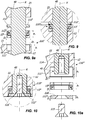
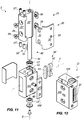
- the cam means 50 and the follower means 60 may be configured so that the substantially flat faces 52' , 52" and the operative surfaces 67' , 67" are substantially parallel and in mutual contact when the door D is in the closed position, as shown for example in FIGS 11a to 11d , and are substantially perpendicular and spaced apart each other when the door D is in the open position, as shown for example in FIGS 13a to 13d .
- the plate-shaped element 51 may further define a plane ⁇ substantially perpendicular to the substantially planar faces 52' , 52".
- the substantially flat faces 52' , 52" and the operative surfaces 67' , 67" interact with each other to partially compress the elastomeric body 61 , thus urging it from the rest or starting stroke position to an intermediate compressed position.
- the plate-shaped element 51 and the operating surface 66 of the interface element 62 interact each other so as to further compress the elastomeric body 61 , thus compressing it from the intermediate compressed position to the totally compressed or end stroke position.
- the interface element 62 may be configured as a pushing member 68' and include a protrusion 300, having a generally hemispherical shape.
- the cam means 50 may include a plurality of seats 310 , 320 , 330 each corresponding to a supper position of the door.
- the seats 310 , 320 , 330 is able to receive the protrusion 300 to supper the door in the supper positions.
- the seat 310 may correspond to the closed door position, while the seats 320 , 330 may correspond to the open door positions.
- the latter may be mutually opposite with respect to the closed door position.
- the seat 310 corresponding to the closed door position may have a generally "V"-shape with two consecutive planes 311 , 312 angled each other with predetermined angle.
- the user can rotate the door from the closed door position in both opening directions.
- the angle between the planes 311 , 312 may be at least 90°, preferably at least 110°. In a preferred but not exclusive embodiment, the angle between the planes 311 , 312 may be 120°.
- each of the seats 320 , 330 corresponding to the open door positions may advantageously have two consecutive portions 321 , 322 ; 331 , 332 having different shape.
- the first portions 322 ; 332 may be generally flat, while the second portions 321 ; 331 may be countershaped with respect to the shape of the protrusion 300 , and in particular may be hemispherical.
- the first flat portions 322 ; 332 may promote the sliding of the projection 310 thereon to convey it towards the second portions 321 ; 331, suitable to supper the door.
- the first flat portions 322 ; 332 act as pilot members for the second hemispherical portions 321 ; 331 , so that the insertion of the protrusion 300 in the latter takes place without noise.
- the first flat portions 322 ; 332 may be substantially perpendicular to the planes 312 , 311.
- the door may be rotated from the supper position only in one direction. In other words, the rotation in the other direction is prevented.
- the elastic counteracting element 61 may be configured so as to allow a further slight rotation of the door after the supper position in the door open position. To this end, the elastic counteracting element 61 after this minimum rotation can reach the position of maximum compression.
- This configuration is particularly advantageous in the case of glass door, which in the case of abrupt shock could be damaged or broken.
- cam means 50 and the follower means 60 shown in FIGs. 13a to 19 and described above is particularly advantageous with the above described elastic counteracting element 61 made of elastomer.
- the elastic counteracting element 61 made of elastomer maximizes the effect of stopping the rotation, as described above.
- an adjusting screw 80 may be provided transversely inserted in the hinge body 11 with a first operating end 81 accessible by a user to adjust the penetration of the former 80 through the corresponding wall of the latter 11 and an opposite end 82 susceptible to come into contact with the plate-shaped element 51.
- the opening angle of the door can be adjusted in a simple and rapid manner, so as to avoid any impact of the door D against the stationary support W.
- the hinge 1 is extremely effective and performing, and is also greatly simple to assemble.
- the hinge body 11 may have, in addition to the passing-through seat 12 for containing the pivot 40 , a passing-through opening 16 to make accessible the working chamber 14 from the outside.
- the passing-through opening 16 may be susceptible to allow the insertion within the working chamber 14 of both the follower means 60 and the cam means 50, in particular of the plate-shaped element 51.
- the passing-through opening 16 defines an axis Y' perpendicular to both the axis Y and the axis X.
- both the cam means 50 and the follower means 60 may be removably inserted in the working chamber 14 by sliding along the axis Y'.
- the hinge 1 in addition to the above mentioned features and advantages, is particularly advantageous because it is possible to adjust the position of the door D in the three dimensions, that is both in height and in a plane substantially parallel to the floor as shown for example in FIG. 3c .
- the connecting plate 21 may include a first portion 25' susceptible to receive the pivot 40 and a second portion 25" susceptible to receive the mounting bracket 30 and to allow the adjustment along the directions d , d' , as shown in FIG. 2b .
- the mounting bracket 30 may have a first plate portion 31 operatively fixable to the first portion 25' of the mounting body 24 monolithically coupled with a second plate portion 32, connectable in turn to the door D by means of suitable screws insertable into the holes 33.
- the operational connection between the first portion 25' of the mounting body 24 and the first plate portion 31 of the mounting bracket 30 may be made by means of suitable screws 34 inserted through the holes 26 of the mounting body 24 and the openings 35 of the mounting bracket 30 and lockable in suitable locking elements 36.
- the screws 37' , 37" can be operated by unscrewing the screws 34 , that allow the movement of the mounting bracket 30 with a stroke equal to the height H of the openings 35 in which the screws 34 are inserted.
- the hinge body 11 may be movably mounted on an anchor plate 100 , which may be anchored to the tubular support structure F , CF by using the screws 101.
- a backplate 102 may be provided, which may be coupled to the hinge body 11 by means of screws 103 to define an interspace 104 therebetween, in which interspace the anchor plate 100 is housed.
- the interpace 104 may include two side abutment surfaces 105' , 105".
- the backplate 102 may be integrated into the hinge body 11 , i.e. the two parts can be made in a single piece. This allows to provide a more economic hinge 1.
- the screws 101 are engageable in the anchor plate 100 by passing through the slots 106 of the backplate 102.
- the hinge 1 may further be designed to minimize friction between the fixed half-hinge 10 and the movable half-hinge 20.
- the upper end 110' of the seat 12 may include a respective upper annular housing 111' suitable to receive a respective upper antifriction element 13' , such as a bearing.
- the pivot 40 may include a upper radial expansion 112' , for example a flange, with an upper operating surface 113' susceptible to come in contact with the connecting plate 21 and a lower operating surface 113" susceptibleto remain faced to the upper annular housing 111'.
- a upper radial expansion 112' for example a flange
- the upper annular housing 111' and the upper antifriction element 13' may be mutually configured so that the lower operating surface 113" of the upper radial expansion 112' is susceptible to abut against the upper antifriction element 13'.
- the pivot 40 can rotate onto the upper antifriction element 13' by remaining mutually spaced from the hinge body 11.
- the inner diameter D 1 of the upper annular housing 111' may be substantially equal to the outer diameter D 2 of the upper antifriction element 13' , while the height h 2 of the latter may be slightly greater than the height h 1 of the former, for example a few tenths of a millimeter.
- the lower end 110" of the seat 12 suitably includes a lower annular housing 111" susceptible to receive a respective lower antifriction element 13".
- the lower end 41 of the pivot 40 may include a blind axial hole 114 susceptible to receive a locking screw 115.
- a pressure element 112" may further be provided, for example a washer, susceptible to be interposed between the locking screw 115 and the lower antifriction element 13" to define a lower radial expansion.
- the latter may include an upper operative surface 116 susceptible to remain faced to the lower annular housing 111".
- the lower antifriction element 13" and the pivot 40 may be mutually configured so that the upper operative surface 116 of the pressure element 112" is susceptible to abut against the pivot 40 and to remain spaced apart from the lower antifriction element 13".
- the inner diameter D 3 of the lower annular housing 111" may be substantially equal to the outer diameter D 4 of the lower antifriction element 13" , while the outer diameter D 5 of the pressure element 112" may be slightly less than the inner diameter D 3 of the lower annular housing 111".
- the height h 3 of the latter may suitably be substantially equal to the sum of the height h 4 of the lower antifriction element 13" and the height h 5 of the pressure element 112".
- the upper and lower antifriction elements 13' , 13" may consist of bearings of the axial-radial type, in order to suitably load thereon both the axial and the radial stresses due to the weight of the door D and/or their reactions forces.
- the hinge 1 is susceptible to many changes and variants. All particulars may be replaced by other technically equivalent elements, and the materials may be different according to the needs, without exceeding the scope of the invention defined by the appended claims.
Landscapes
- Engineering & Computer Science (AREA)
- Mechanical Engineering (AREA)
- Hinges (AREA)
- Closing And Opening Devices For Wings, And Checks For Wings (AREA)
Claims (13)
- Charnière camouflée pour le mouvement rotatif d'une porte (D), en particulier une porte renforcée, raccordée à une structure de support tubulaire (F, CF) qui inclut un contre-bâti arrière (CF) ancré à un mur (W) ou un support similaire et un bâti avant (F) ancré au contre-bâti (CF), la charnière comprenant une demi-charnière fixe inférieure (10) et une demi-charnière mobile supérieure (20) accouplées l'une à l'autre de façon rotative pour tourner autour d'un premier axe longitudinal (X) entre une position ouverte et une position fermée ;
dans laquelle ladite demi-charnière fixe inférieure (10) inclut un corps de charnière en forme de boîte (11) destiné à être camouflé à l'intérieur de la structure de support tubulaire (F, CF) et pouvant être ancré à celle-ci, ladite demi-charnière mobile supérieure (20) incluant un pivot (40) définissant ledit premier axe (X) et une plaque de raccordement (21) pouvant être ancrée à la porte (D), la plaque de raccordement (21) étant raccordée de façon réciproque audit pivot (40) pour s'étendre à partir de la structure de support tubulaire (F, CF) dans ladite position ouverte et pour se rétracter de façon camouflée à l'intérieur de la structure de support tubulaire (F, CF) dans ladite position fermée ;
dans laquelle ledit corps de charnière en forme de boîte (11) inclut un siège (12) logeant de façon interne ledit pivot (40),
caractérisé en ce que le pivot inclut un moyen à came (50) tournant autour dudit premier axe longitudinal (X), ledit corps de charnière en forme de boîte (11) incluant en outre au moins une chambre fonctionnelle (14) définissant un second axe longitudinal (Y) sensiblement perpendiculaire audit premier axe (X), ladite au moins une chambre fonctionnelle (14) incluant un moyen suiveur (60) interagissant avec ledit moyen à came (50) pour coulisser le long dudit second axe longitudinal (Y) entre une première position et une seconde position de fin de course, ledit moyen suiveur (60) incluant au moins un élément élastique à action contraire (61) ;
dans laquelle ledit moyen à came (50) dudit pivot (40) inclut au moins un appendice allongé (51) s'étendant transversalement par rapport audit premier axe (X) pour tourner à l'intérieur dudit siège (12), ledit moyen suiveur (60) incluant au moins un élément d'interface (62) possédant une première extrémité (63') interagissant avec ledit au moins un élément élastique à action contraire (61) et une seconde extrémité (63") interagissant avec ledit au moins un appendice allongé (51) ;
dans laquelle ledit appendice allongé (51) est défini par un élément en forme de plaque insérable de façon amovible dans un siège (42) dudit pivot (40). - Charnière selon la revendication 1, dans laquelle ledit appendice allongé (51) définit un plan (π) sensiblement parallèle audit premier axe (X) et sensiblement perpendiculaire à audit second axe (Y).
- Charnière selon la revendication 1 ou 2, dans laquelle ledit corps de charnière en forme de boîte (11) possède au moins une ouverture de passage (16) pour permettre l'insertion/l'enlèvement dudit élément en forme de plaque (51) dans ledit/à partir dudit siège (42) dudit pivot (40) lorsque ce dernier est monté à l'intérieur du siège respectif (12).
- Charnière selon la revendication 3, dans laquelle ladite ouverture de passage (16) permet l'insertion/l'enlèvement dudit élément en forme de plaque (51) dans ledit/à partir dudit siège (42) ainsi que du moyen suiveur (60) dans/à partir de la chambre fonctionnelle (14).
- Charnière selon la revendication 4, dans laquelle ledit siège (42) dudit pivot (40), ladite chambre fonctionnelle (14) et ladite au moins une ouverture de passage (16) sont configurés de façon réciproque de manière telle que le montage dudit moyen à came (50) et dudit moyen suiveur (60) se produise par, d'abord l'insertion dudit moyen suiveur (60) à l'intérieur de ladite chambre fonctionnelle (14) à travers ladite ouverture de passage (16), ensuite par l'insertion du pivot (40) dans ledit siège (12) et alors en tournant ce dernier pour déplacer le siège (42) de celui-ci en correspondance de ladite ouverture de passage (16), afin de permettre à un utilisateur d'insérer ledit élément en forme de plaque (51).
- Charnière selon l'une ou plusieurs des revendications précédentes, dans laquelle ledit corps de charnière en forme de boîte (11) comprend en outre au moins une vis de butée (80) possédant une première extrémité de fonctionnement (82) se trouvant à l'intérieur dudit siège (12) pour prendre appui contre ledit appendice allongé (51) dudit pivot (40) et une second extrémité de fonctionnement (81) accessible à partir de l'extérieur par un utilisateur pour ajuster la pénétration de ladite au moins une vis de butée (80) à l'intérieur dudit siège (12), afin d'ajuster l'angle d'ouverture et/ou de fermeture de la charnière.
- Charnière selon la revendication 6, dans laquelle ladite au moins une vis de butée (80) est insérée transversalement à l'intérieur du corps de charnière (11) par rapport audit premier axe (X), ledit appendice allongé (51) définissant un plan (π) avec au moins une paroi latérale (54) susceptible d'effectuer un impact contre ladite première extrémité de fonctionnement (82) de ladite au moins une vis de butée (80).
- Charnière selon l'une ou plusieurs des revendications précédentes, dans laquelle ledit au moins un élément élastique à action contraire (61) inclut au moins, respectivement est constitué d'au moins, une portion de matériau polymère déformable de façon élastique.
- Charnière selon la revendication 8, dans laquelle ledit élément élastique à action contraire (61) est constitué d'un corps fait de matériau polymère.
- Charnière selon la revendication 9, dans laquelle ledit corps de matériau polymère déformable de façon élastique présente une forme cylindrique ou discoïde ou de plaque.
- Charnière selon l'une ou plusieurs des revendications 8 à 10, dans laquelle ledit matériau polymère est constitué d'un élastomère.
- Charnière selon la revendication 11, dans laquelle ledit élastomère est du polyuréthane du type compact.
- Charnière selon la revendication 11 ou 12, dans laquelle ledit élastomère présente une dureté Shore A de 50 ShA à 95 ShA, de préférence de 70 ShA à 90 ShA.
Priority Applications (1)
| Application Number | Priority Date | Filing Date | Title |
|---|---|---|---|
| EP17195715.2A EP3306022A1 (fr) | 2013-04-12 | 2014-04-11 | Charnière dissimulée pour le mouvement rotatif contrôlé d'une porte, en particulier d'une porte renforcée |
Applications Claiming Priority (3)
| Application Number | Priority Date | Filing Date | Title |
|---|---|---|---|
| IT000106A ITVI20130106A1 (it) | 2013-04-12 | 2013-04-12 | Cerniera per la movimentazione girevole di una porta |
| IT000101A ITVI20130101A1 (it) | 2013-04-12 | 2013-04-12 | Cerniera per la movimentazione girevole di una porta |
| PCT/IB2014/060661 WO2014167546A2 (fr) | 2013-04-12 | 2014-04-11 | Charnière pouvant être cachée pour le mouvement de rotation régulé d'une porte, en particulier d'une porte renforcée |
Related Child Applications (1)
| Application Number | Title | Priority Date | Filing Date |
|---|---|---|---|
| EP17195715.2A Division EP3306022A1 (fr) | 2013-04-12 | 2014-04-11 | Charnière dissimulée pour le mouvement rotatif contrôlé d'une porte, en particulier d'une porte renforcée |
Publications (2)
| Publication Number | Publication Date |
|---|---|
| EP2984263A2 EP2984263A2 (fr) | 2016-02-17 |
| EP2984263B1 true EP2984263B1 (fr) | 2017-10-11 |
Family
ID=50884961
Family Applications (2)
| Application Number | Title | Priority Date | Filing Date |
|---|---|---|---|
| EP14728296.6A Not-in-force EP2984263B1 (fr) | 2013-04-12 | 2014-04-11 | Charnière pouvant être cachée pour le mouvement de rotation régulé d'une porte, en particulier d'une porte renforcée |
| EP17195715.2A Withdrawn EP3306022A1 (fr) | 2013-04-12 | 2014-04-11 | Charnière dissimulée pour le mouvement rotatif contrôlé d'une porte, en particulier d'une porte renforcée |
Family Applications After (1)
| Application Number | Title | Priority Date | Filing Date |
|---|---|---|---|
| EP17195715.2A Withdrawn EP3306022A1 (fr) | 2013-04-12 | 2014-04-11 | Charnière dissimulée pour le mouvement rotatif contrôlé d'une porte, en particulier d'une porte renforcée |
Country Status (6)
| Country | Link |
|---|---|
| US (1) | US9422756B2 (fr) |
| EP (2) | EP2984263B1 (fr) |
| CA (1) | CA2908308C (fr) |
| EA (1) | EA030890B1 (fr) |
| ES (1) | ES2654213T3 (fr) |
| WO (1) | WO2014167546A2 (fr) |
Families Citing this family (9)
| Publication number | Priority date | Publication date | Assignee | Title |
|---|---|---|---|---|
| US9605457B2 (en) * | 2008-10-29 | 2017-03-28 | Steven Humble | Three-dimensionally adjustable pivot device |
| EA030833B1 (ru) * | 2013-04-12 | 2018-10-31 | Ин Энд Тек С.Р.Л. | Петля для регулируемого вращательного движения двери |
| ITUB20153873A1 (it) * | 2015-09-24 | 2017-03-24 | Mgt Ind S R L | Cerniera perfezionata per ante girevoli, specialmente di cabine doccia |
| ITUB20160495A1 (it) * | 2016-02-03 | 2017-08-03 | Tubes Radiatori S R L | Struttura di radiatore modulare per riscaldamento di ambienti |
| CN108678582B (zh) * | 2018-06-21 | 2023-05-02 | 广东东泰五金精密制造有限公司 | 一种家具翻转装置的防位移活动定位结构 |
| US11598119B2 (en) * | 2019-08-17 | 2023-03-07 | Travis Brett Creighton | Securable deadbolt, hinge, and sliding assemblies |
| AT17584U1 (de) * | 2021-03-17 | 2022-07-15 | Roto Frank Fenster Und Tuertechnologie Gmbh | Band für eine Tür oder ein Fenster |
| IT202200015315A1 (it) | 2022-07-21 | 2024-01-21 | In & Tec Srl | Cerniera idraulica per la movimentazione girevole controllata di una porta o anta |
| AU2023384823B2 (en) * | 2022-11-22 | 2025-08-07 | Rh Us, Llc | Hinge and cabinet incorporating the same |
Family Cites Families (24)
| Publication number | Priority date | Publication date | Assignee | Title |
|---|---|---|---|---|
| FR1586435A (fr) * | 1968-08-22 | 1970-02-20 | ||
| DE2035597A1 (de) * | 1969-07-17 | 1971-02-04 | Hansen, Carl A , Goransson Gote L , Bethel, Conn (V St A ) | Stark belastbares Doppelgelenk Scharnier |
| DE2356166A1 (de) * | 1973-11-09 | 1975-05-15 | Juergen Disput | Verstellbares tuerband |
| DE3014087A1 (de) * | 1980-04-12 | 1981-10-15 | Friedrich 8500 Nürnberg Puchtler | Dreirollen-tuerband mit gesichertem bandstift |
| IT1192109B (it) * | 1985-10-22 | 1988-03-31 | Otlav Spa | Cerniera con posizioni stabili predeterminate |
| US5075928A (en) | 1990-08-17 | 1991-12-31 | The Stanley Works | Concealed architectural hinge assembly |
| US5799370A (en) * | 1996-06-12 | 1998-09-01 | The Stanley Works | Adjustable hinge |
| DE19623539B4 (de) * | 1996-06-13 | 2010-06-24 | KL-Beschläge Karl Loggen GmbH | Gelenkband |
| IT248724Y1 (it) * | 1999-06-25 | 2003-02-12 | Koblenz Spa | Cerniera a scomparsa, in particolare per porte e/o per ante di mobili. |
| US6430779B1 (en) * | 2000-03-31 | 2002-08-13 | Modernfold, Inc. | Mounting apparatus for concealed hinge of operable wall |
| EP1308592B1 (fr) * | 2001-10-31 | 2009-12-09 | Simonswerk, Gesellschaft mit beschränkter Haftung | Charnière de porte pour arrangement caché entre battant et cadre de porte |
| PL1602794T3 (pl) * | 2004-06-03 | 2013-06-28 | Roto Gluske Bkv Gmbh | Zawias ościeżnicy |
| US8234753B2 (en) * | 2008-10-24 | 2012-08-07 | L-3 Communications Integrated Systems L.P. | Cook hinge |
| IT1391640B1 (it) | 2008-10-28 | 2012-01-17 | Omf S R L | Dispositivo di regolazione per cerniere a scomparsa e cerniera a scomparsa comprendente detto dispositivo di regolazione |
| DE102008057341B3 (de) * | 2008-11-14 | 2009-12-31 | Simonswerk, Gesellschaft mit beschränkter Haftung | Türband für eine verdeckte Anordnung zwischen Türzarge und Türflügel |
| IT1393499B1 (it) * | 2009-03-27 | 2012-04-27 | Evi Srl Unipersonale Ora Evi S R L | Cerniera per porte, finestre e simili. |
| DE102010012574B3 (de) * | 2010-03-23 | 2011-05-12 | Simonswerk, Gesellschaft mit beschränkter Haftung | Band, inbesondere für Kunststofftüren und Kunststofffenster |
| GB2484527B (en) * | 2010-10-14 | 2015-05-20 | Chung Chow | Hinge having self centering means |
| DE102011000150B3 (de) * | 2011-01-14 | 2011-10-06 | Simonswerk, Gesellschaft mit beschränkter Haftung | Türband für eine verdeckte Anordnung zwischen Türrahmen und Türflügel |
| DE102011050413B3 (de) * | 2011-05-17 | 2012-04-12 | Simonswerk, Gesellschaft mit beschränkter Haftung | Türband für eine verdeckte Anordnung zwischen Türflügel und Türzarge |
| EP2570575B1 (fr) * | 2011-09-16 | 2016-09-07 | Koblenz S.P.A. | Charnière totalement dissimulée dotée d'un dispositif de fermeture intégré pour portes et/ou parties de meubles pouvant être ouvertes |
| DE102012101644B3 (de) * | 2012-02-29 | 2012-10-18 | Simonswerk, Gesellschaft mit beschränkter Haftung | Türband für eine verdeckte Anordnung zwischen Türzarge und Türflügel |
| WO2014006587A1 (fr) * | 2012-07-04 | 2014-01-09 | In & Tec S.R.L. | Charnière pour le déplacement rotatif d'une porte, en particulier d'une porte renforcée |
| EA030833B1 (ru) * | 2013-04-12 | 2018-10-31 | Ин Энд Тек С.Р.Л. | Петля для регулируемого вращательного движения двери |
-
2014
- 2014-04-11 CA CA2908308A patent/CA2908308C/fr active Active
- 2014-04-11 EP EP14728296.6A patent/EP2984263B1/fr not_active Not-in-force
- 2014-04-11 ES ES14728296.6T patent/ES2654213T3/es active Active
- 2014-04-11 EA EA201591963A patent/EA030890B1/ru not_active IP Right Cessation
- 2014-04-11 EP EP17195715.2A patent/EP3306022A1/fr not_active Withdrawn
- 2014-04-11 WO PCT/IB2014/060661 patent/WO2014167546A2/fr not_active Ceased
-
2015
- 2015-10-11 US US14/880,255 patent/US9422756B2/en not_active Expired - Fee Related
Non-Patent Citations (1)
| Title |
|---|
| None * |
Also Published As
| Publication number | Publication date |
|---|---|
| WO2014167546A2 (fr) | 2014-10-16 |
| CA2908308A1 (fr) | 2014-10-16 |
| EA201591963A1 (ru) | 2016-04-29 |
| EP3306022A1 (fr) | 2018-04-11 |
| ES2654213T3 (es) | 2018-02-12 |
| CA2908308C (fr) | 2021-04-06 |
| US20160060930A1 (en) | 2016-03-03 |
| EP2984263A2 (fr) | 2016-02-17 |
| US9422756B2 (en) | 2016-08-23 |
| WO2014167546A3 (fr) | 2015-03-12 |
| EA030890B1 (ru) | 2018-10-31 |
Similar Documents
| Publication | Publication Date | Title |
|---|---|---|
| EP2984263B1 (fr) | Charnière pouvant être cachée pour le mouvement de rotation régulé d'une porte, en particulier d'une porte renforcée | |
| EP2984267B1 (fr) | Charnière pour le mouvement de rotation régulé d'une porte, en particulier d'une porte en verre | |
| US10151129B2 (en) | Low-bulkiness hydraulic hinge | |
| US9657507B2 (en) | Hinge for the controlled rotatable movement of a door | |
| EP3099876B1 (fr) | Charnière à faible encombrement | |
| KR100938132B1 (ko) | 도어클로저 어셈블리 | |
| US20160369542A1 (en) | Concealable hinge for the controlled rotatable movement of a door, in particular a reinforced door | |
| US11261637B2 (en) | Hinge for the rotatable movement of a door, a shutter or the like | |
| EP2872717B1 (fr) | Charnière pour le mouvement rotatif d'une porte en particulier porte renforcee |
Legal Events
| Date | Code | Title | Description |
|---|---|---|---|
| PUAI | Public reference made under article 153(3) epc to a published international application that has entered the european phase |
Free format text: ORIGINAL CODE: 0009012 |
|
| 17P | Request for examination filed |
Effective date: 20151112 |
|
| AK | Designated contracting states |
Kind code of ref document: A2 Designated state(s): AL AT BE BG CH CY CZ DE DK EE ES FI FR GB GR HR HU IE IS IT LI LT LU LV MC MK MT NL NO PL PT RO RS SE SI SK SM TR |
|
| AX | Request for extension of the european patent |
Extension state: BA ME |
|
| DAX | Request for extension of the european patent (deleted) | ||
| GRAP | Despatch of communication of intention to grant a patent |
Free format text: ORIGINAL CODE: EPIDOSNIGR1 |
|
| INTG | Intention to grant announced |
Effective date: 20170418 |
|
| GRAS | Grant fee paid |
Free format text: ORIGINAL CODE: EPIDOSNIGR3 |
|
| GRAA | (expected) grant |
Free format text: ORIGINAL CODE: 0009210 |
|
| AK | Designated contracting states |
Kind code of ref document: B1 Designated state(s): AL AT BE BG CH CY CZ DE DK EE ES FI FR GB GR HR HU IE IS IT LI LT LU LV MC MK MT NL NO PL PT RO RS SE SI SK SM TR |
|
| REG | Reference to a national code |
Ref country code: GB Ref legal event code: FG4D |
|
| REG | Reference to a national code |
Ref country code: CH Ref legal event code: EP |
|
| REG | Reference to a national code |
Ref country code: IE Ref legal event code: FG4D |
|
| REG | Reference to a national code |
Ref country code: AT Ref legal event code: REF Ref document number: 936201 Country of ref document: AT Kind code of ref document: T Effective date: 20171115 |
|
| REG | Reference to a national code |
Ref country code: DE Ref legal event code: R096 Ref document number: 602014015683 Country of ref document: DE |
|
| REG | Reference to a national code |
Ref country code: ES Ref legal event code: FG2A Ref document number: 2654213 Country of ref document: ES Kind code of ref document: T3 Effective date: 20180212 |
|
| REG | Reference to a national code |
Ref country code: NL Ref legal event code: MP Effective date: 20171011 |
|
| REG | Reference to a national code |
Ref country code: LT Ref legal event code: MG4D |
|
| REG | Reference to a national code |
Ref country code: AT Ref legal event code: MK05 Ref document number: 936201 Country of ref document: AT Kind code of ref document: T Effective date: 20171011 |
|
| REG | Reference to a national code |
Ref country code: FR Ref legal event code: PLFP Year of fee payment: 5 |
|
| PG25 | Lapsed in a contracting state [announced via postgrant information from national office to epo] |
Ref country code: NL Free format text: LAPSE BECAUSE OF FAILURE TO SUBMIT A TRANSLATION OF THE DESCRIPTION OR TO PAY THE FEE WITHIN THE PRESCRIBED TIME-LIMIT Effective date: 20171011 |
|
| PG25 | Lapsed in a contracting state [announced via postgrant information from national office to epo] |
Ref country code: SE Free format text: LAPSE BECAUSE OF FAILURE TO SUBMIT A TRANSLATION OF THE DESCRIPTION OR TO PAY THE FEE WITHIN THE PRESCRIBED TIME-LIMIT Effective date: 20171011 Ref country code: NO Free format text: LAPSE BECAUSE OF FAILURE TO SUBMIT A TRANSLATION OF THE DESCRIPTION OR TO PAY THE FEE WITHIN THE PRESCRIBED TIME-LIMIT Effective date: 20180111 Ref country code: LT Free format text: LAPSE BECAUSE OF FAILURE TO SUBMIT A TRANSLATION OF THE DESCRIPTION OR TO PAY THE FEE WITHIN THE PRESCRIBED TIME-LIMIT Effective date: 20171011 Ref country code: FI Free format text: LAPSE BECAUSE OF FAILURE TO SUBMIT A TRANSLATION OF THE DESCRIPTION OR TO PAY THE FEE WITHIN THE PRESCRIBED TIME-LIMIT Effective date: 20171011 |
|
| PG25 | Lapsed in a contracting state [announced via postgrant information from national office to epo] |
Ref country code: HR Free format text: LAPSE BECAUSE OF FAILURE TO SUBMIT A TRANSLATION OF THE DESCRIPTION OR TO PAY THE FEE WITHIN THE PRESCRIBED TIME-LIMIT Effective date: 20171011 Ref country code: AT Free format text: LAPSE BECAUSE OF FAILURE TO SUBMIT A TRANSLATION OF THE DESCRIPTION OR TO PAY THE FEE WITHIN THE PRESCRIBED TIME-LIMIT Effective date: 20171011 Ref country code: RS Free format text: LAPSE BECAUSE OF FAILURE TO SUBMIT A TRANSLATION OF THE DESCRIPTION OR TO PAY THE FEE WITHIN THE PRESCRIBED TIME-LIMIT Effective date: 20171011 Ref country code: IS Free format text: LAPSE BECAUSE OF FAILURE TO SUBMIT A TRANSLATION OF THE DESCRIPTION OR TO PAY THE FEE WITHIN THE PRESCRIBED TIME-LIMIT Effective date: 20180211 Ref country code: BG Free format text: LAPSE BECAUSE OF FAILURE TO SUBMIT A TRANSLATION OF THE DESCRIPTION OR TO PAY THE FEE WITHIN THE PRESCRIBED TIME-LIMIT Effective date: 20180111 Ref country code: GR Free format text: LAPSE BECAUSE OF FAILURE TO SUBMIT A TRANSLATION OF THE DESCRIPTION OR TO PAY THE FEE WITHIN THE PRESCRIBED TIME-LIMIT Effective date: 20180112 Ref country code: LV Free format text: LAPSE BECAUSE OF FAILURE TO SUBMIT A TRANSLATION OF THE DESCRIPTION OR TO PAY THE FEE WITHIN THE PRESCRIBED TIME-LIMIT Effective date: 20171011 |
|
| REG | Reference to a national code |
Ref country code: DE Ref legal event code: R097 Ref document number: 602014015683 Country of ref document: DE |
|
| PG25 | Lapsed in a contracting state [announced via postgrant information from national office to epo] |
Ref country code: EE Free format text: LAPSE BECAUSE OF FAILURE TO SUBMIT A TRANSLATION OF THE DESCRIPTION OR TO PAY THE FEE WITHIN THE PRESCRIBED TIME-LIMIT Effective date: 20171011 Ref country code: SK Free format text: LAPSE BECAUSE OF FAILURE TO SUBMIT A TRANSLATION OF THE DESCRIPTION OR TO PAY THE FEE WITHIN THE PRESCRIBED TIME-LIMIT Effective date: 20171011 Ref country code: DK Free format text: LAPSE BECAUSE OF FAILURE TO SUBMIT A TRANSLATION OF THE DESCRIPTION OR TO PAY THE FEE WITHIN THE PRESCRIBED TIME-LIMIT Effective date: 20171011 Ref country code: CZ Free format text: LAPSE BECAUSE OF FAILURE TO SUBMIT A TRANSLATION OF THE DESCRIPTION OR TO PAY THE FEE WITHIN THE PRESCRIBED TIME-LIMIT Effective date: 20171011 |
|
| PLBE | No opposition filed within time limit |
Free format text: ORIGINAL CODE: 0009261 |
|
| STAA | Information on the status of an ep patent application or granted ep patent |
Free format text: STATUS: NO OPPOSITION FILED WITHIN TIME LIMIT |
|
| PG25 | Lapsed in a contracting state [announced via postgrant information from national office to epo] |
Ref country code: PL Free format text: LAPSE BECAUSE OF FAILURE TO SUBMIT A TRANSLATION OF THE DESCRIPTION OR TO PAY THE FEE WITHIN THE PRESCRIBED TIME-LIMIT Effective date: 20171011 Ref country code: SM Free format text: LAPSE BECAUSE OF FAILURE TO SUBMIT A TRANSLATION OF THE DESCRIPTION OR TO PAY THE FEE WITHIN THE PRESCRIBED TIME-LIMIT Effective date: 20171011 Ref country code: RO Free format text: LAPSE BECAUSE OF FAILURE TO SUBMIT A TRANSLATION OF THE DESCRIPTION OR TO PAY THE FEE WITHIN THE PRESCRIBED TIME-LIMIT Effective date: 20171011 |
|
| 26N | No opposition filed |
Effective date: 20180712 |
|
| PG25 | Lapsed in a contracting state [announced via postgrant information from national office to epo] |
Ref country code: SI Free format text: LAPSE BECAUSE OF FAILURE TO SUBMIT A TRANSLATION OF THE DESCRIPTION OR TO PAY THE FEE WITHIN THE PRESCRIBED TIME-LIMIT Effective date: 20171011 Ref country code: MC Free format text: LAPSE BECAUSE OF FAILURE TO SUBMIT A TRANSLATION OF THE DESCRIPTION OR TO PAY THE FEE WITHIN THE PRESCRIBED TIME-LIMIT Effective date: 20171011 |
|
| REG | Reference to a national code |
Ref country code: BE Ref legal event code: MM Effective date: 20180430 |
|
| REG | Reference to a national code |
Ref country code: IE Ref legal event code: MM4A |
|
| PG25 | Lapsed in a contracting state [announced via postgrant information from national office to epo] |
Ref country code: LU Free format text: LAPSE BECAUSE OF NON-PAYMENT OF DUE FEES Effective date: 20180411 |
|
| PG25 | Lapsed in a contracting state [announced via postgrant information from national office to epo] |
Ref country code: BE Free format text: LAPSE BECAUSE OF NON-PAYMENT OF DUE FEES Effective date: 20180430 |
|
| PG25 | Lapsed in a contracting state [announced via postgrant information from national office to epo] |
Ref country code: IE Free format text: LAPSE BECAUSE OF NON-PAYMENT OF DUE FEES Effective date: 20180411 |
|
| PG25 | Lapsed in a contracting state [announced via postgrant information from national office to epo] |
Ref country code: MT Free format text: LAPSE BECAUSE OF NON-PAYMENT OF DUE FEES Effective date: 20180411 |
|
| PG25 | Lapsed in a contracting state [announced via postgrant information from national office to epo] |
Ref country code: TR Free format text: LAPSE BECAUSE OF FAILURE TO SUBMIT A TRANSLATION OF THE DESCRIPTION OR TO PAY THE FEE WITHIN THE PRESCRIBED TIME-LIMIT Effective date: 20171011 |
|
| PG25 | Lapsed in a contracting state [announced via postgrant information from national office to epo] |
Ref country code: PT Free format text: LAPSE BECAUSE OF FAILURE TO SUBMIT A TRANSLATION OF THE DESCRIPTION OR TO PAY THE FEE WITHIN THE PRESCRIBED TIME-LIMIT Effective date: 20171011 |
|
| PG25 | Lapsed in a contracting state [announced via postgrant information from national office to epo] |
Ref country code: MK Free format text: LAPSE BECAUSE OF NON-PAYMENT OF DUE FEES Effective date: 20171011 Ref country code: HU Free format text: LAPSE BECAUSE OF FAILURE TO SUBMIT A TRANSLATION OF THE DESCRIPTION OR TO PAY THE FEE WITHIN THE PRESCRIBED TIME-LIMIT; INVALID AB INITIO Effective date: 20140411 Ref country code: CY Free format text: LAPSE BECAUSE OF FAILURE TO SUBMIT A TRANSLATION OF THE DESCRIPTION OR TO PAY THE FEE WITHIN THE PRESCRIBED TIME-LIMIT Effective date: 20171011 |
|
| PG25 | Lapsed in a contracting state [announced via postgrant information from national office to epo] |
Ref country code: AL Free format text: LAPSE BECAUSE OF FAILURE TO SUBMIT A TRANSLATION OF THE DESCRIPTION OR TO PAY THE FEE WITHIN THE PRESCRIBED TIME-LIMIT Effective date: 20171011 |
|
| PGFP | Annual fee paid to national office [announced via postgrant information from national office to epo] |
Ref country code: GB Payment date: 20220422 Year of fee payment: 9 Ref country code: FR Payment date: 20220422 Year of fee payment: 9 Ref country code: ES Payment date: 20220511 Year of fee payment: 9 |
|
| PGFP | Annual fee paid to national office [announced via postgrant information from national office to epo] |
Ref country code: CH Payment date: 20220422 Year of fee payment: 9 |
|
| PGFP | Annual fee paid to national office [announced via postgrant information from national office to epo] |
Ref country code: IT Payment date: 20230426 Year of fee payment: 10 Ref country code: DE Payment date: 20230414 Year of fee payment: 10 |
|
| REG | Reference to a national code |
Ref country code: CH Ref legal event code: PL |
|
| GBPC | Gb: european patent ceased through non-payment of renewal fee |
Effective date: 20230411 |
|
| PG25 | Lapsed in a contracting state [announced via postgrant information from national office to epo] |
Ref country code: GB Free format text: LAPSE BECAUSE OF NON-PAYMENT OF DUE FEES Effective date: 20230411 |
|
| PG25 | Lapsed in a contracting state [announced via postgrant information from national office to epo] |
Ref country code: LI Free format text: LAPSE BECAUSE OF NON-PAYMENT OF DUE FEES Effective date: 20230430 Ref country code: GB Free format text: LAPSE BECAUSE OF NON-PAYMENT OF DUE FEES Effective date: 20230411 Ref country code: FR Free format text: LAPSE BECAUSE OF NON-PAYMENT OF DUE FEES Effective date: 20230430 Ref country code: CH Free format text: LAPSE BECAUSE OF NON-PAYMENT OF DUE FEES Effective date: 20230430 |
|
| REG | Reference to a national code |
Ref country code: ES Ref legal event code: FD2A Effective date: 20240604 |
|
| PG25 | Lapsed in a contracting state [announced via postgrant information from national office to epo] |
Ref country code: ES Free format text: LAPSE BECAUSE OF NON-PAYMENT OF DUE FEES Effective date: 20230412 |
|
| PG25 | Lapsed in a contracting state [announced via postgrant information from national office to epo] |
Ref country code: ES Free format text: LAPSE BECAUSE OF NON-PAYMENT OF DUE FEES Effective date: 20230412 |
|
| REG | Reference to a national code |
Ref country code: DE Ref legal event code: R119 Ref document number: 602014015683 Country of ref document: DE |
|
| PG25 | Lapsed in a contracting state [announced via postgrant information from national office to epo] |
Ref country code: DE Free format text: LAPSE BECAUSE OF NON-PAYMENT OF DUE FEES Effective date: 20241105 |
|
| PG25 | Lapsed in a contracting state [announced via postgrant information from national office to epo] |
Ref country code: DE Free format text: LAPSE BECAUSE OF NON-PAYMENT OF DUE FEES Effective date: 20241105 |
|
| PG25 | Lapsed in a contracting state [announced via postgrant information from national office to epo] |
Ref country code: IT Free format text: LAPSE BECAUSE OF NON-PAYMENT OF DUE FEES Effective date: 20240411 |