EP2985021A1 - Verwendung von amidoximcarbonsäureestern und n-hydroxyguanidincarbonsäureestern zur herstellung von prodrugs - Google Patents
Verwendung von amidoximcarbonsäureestern und n-hydroxyguanidincarbonsäureestern zur herstellung von prodrugs Download PDFInfo
- Publication number
- EP2985021A1 EP2985021A1 EP15178466.7A EP15178466A EP2985021A1 EP 2985021 A1 EP2985021 A1 EP 2985021A1 EP 15178466 A EP15178466 A EP 15178466A EP 2985021 A1 EP2985021 A1 EP 2985021A1
- Authority
- EP
- European Patent Office
- Prior art keywords
- inhibitor
- drug
- prodrug
- trypanosomiasis
- viral
- Prior art date
- Legal status (The legal status is an assumption and is not a legal conclusion. Google has not performed a legal analysis and makes no representation as to the accuracy of the status listed.)
- Withdrawn
Links
- 239000000651 prodrug Substances 0.000 title claims description 22
- 229940002612 prodrug Drugs 0.000 title claims description 22
- -1 amidoxime carboxylic acid esters Chemical class 0.000 title claims description 14
- 239000003814 drug Substances 0.000 claims abstract description 39
- 229940079593 drug Drugs 0.000 claims abstract description 34
- ZRALSGWEFCBTJO-UHFFFAOYSA-N Guanidine Chemical compound NC(N)=N ZRALSGWEFCBTJO-UHFFFAOYSA-N 0.000 claims abstract description 31
- 150000001409 amidines Chemical class 0.000 claims abstract description 21
- 230000008499 blood brain barrier function Effects 0.000 claims abstract description 18
- 210000001218 blood-brain barrier Anatomy 0.000 claims abstract description 17
- WFBHRSAKANVBKH-UHFFFAOYSA-N N-hydroxyguanidine Chemical group NC(=N)NO WFBHRSAKANVBKH-UHFFFAOYSA-N 0.000 claims abstract description 16
- CHJJGSNFBQVOTG-UHFFFAOYSA-N N-methyl-guanidine Natural products CNC(N)=N CHJJGSNFBQVOTG-UHFFFAOYSA-N 0.000 claims abstract description 14
- SFZULDYEOVSIKM-UHFFFAOYSA-N chembl321317 Chemical compound C1=CC(C(=N)NO)=CC=C1C1=CC=C(C=2C=CC(=CC=2)C(=N)NO)O1 SFZULDYEOVSIKM-UHFFFAOYSA-N 0.000 claims abstract description 14
- SWSQBOPZIKWTGO-UHFFFAOYSA-N dimethylaminoamidine Natural products CN(C)C(N)=N SWSQBOPZIKWTGO-UHFFFAOYSA-N 0.000 claims abstract description 14
- 150000002148 esters Chemical class 0.000 claims description 20
- 150000001875 compounds Chemical class 0.000 claims description 16
- 229960004448 pentamidine Drugs 0.000 claims description 12
- 201000002311 trypanosomiasis Diseases 0.000 claims description 12
- 239000002253 acid Substances 0.000 claims description 11
- XDRYMKDFEDOLFX-UHFFFAOYSA-N pentamidine Chemical compound C1=CC(C(=N)N)=CC=C1OCCCCCOC1=CC=C(C(N)=N)C=C1 XDRYMKDFEDOLFX-UHFFFAOYSA-N 0.000 claims description 11
- 229910052739 hydrogen Inorganic materials 0.000 claims description 10
- 239000000137 peptide hydrolase inhibitor Substances 0.000 claims description 10
- 102000004190 Enzymes Human genes 0.000 claims description 9
- 108090000790 Enzymes Proteins 0.000 claims description 9
- 229940088598 enzyme Drugs 0.000 claims description 9
- 239000003112 inhibitor Substances 0.000 claims description 8
- 238000009830 intercalation Methods 0.000 claims description 8
- 230000003612 virological effect Effects 0.000 claims description 8
- XNYZHCFCZNMTFY-UHFFFAOYSA-N diminazene Chemical compound C1=CC(C(=N)N)=CC=C1N\N=N\C1=CC=C(C(N)=N)C=C1 XNYZHCFCZNMTFY-UHFFFAOYSA-N 0.000 claims description 7
- UGKOYGZYLRKTJH-UHFFFAOYSA-O 3-[2-(3-amino-5-ethyl-6-phenylphenanthridin-5-ium-8-yl)iminohydrazinyl]benzenecarboximidamide Chemical compound C12=CC(N=NNC=3C=C(C=CC=3)C(N)=N)=CC=C2C2=CC=C(N)C=C2[N+](CC)=C1C1=CC=CC=C1 UGKOYGZYLRKTJH-UHFFFAOYSA-O 0.000 claims description 6
- 206010035664 Pneumonia Diseases 0.000 claims description 6
- 229950007095 diminazene Drugs 0.000 claims description 6
- 239000001257 hydrogen Substances 0.000 claims description 6
- 206010022000 influenza Diseases 0.000 claims description 6
- 238000011321 prophylaxis Methods 0.000 claims description 6
- 238000011282 treatment Methods 0.000 claims description 6
- 102100023804 Coagulation factor VII Human genes 0.000 claims description 5
- 206010011668 Cutaneous leishmaniasis Diseases 0.000 claims description 5
- 108010023321 Factor VII Proteins 0.000 claims description 5
- 208000031886 HIV Infections Diseases 0.000 claims description 5
- 108091005804 Peptidases Proteins 0.000 claims description 5
- 102000035195 Peptidases Human genes 0.000 claims description 5
- 241000233872 Pneumocystis carinii Species 0.000 claims description 5
- 239000004365 Protease Substances 0.000 claims description 5
- 229940124158 Protease/peptidase inhibitor Drugs 0.000 claims description 5
- 229940122388 Thrombin inhibitor Drugs 0.000 claims description 5
- 208000036142 Viral infection Diseases 0.000 claims description 5
- 206010047505 Visceral leishmaniasis Diseases 0.000 claims description 5
- 150000005840 aryl radicals Chemical class 0.000 claims description 5
- 230000036772 blood pressure Effects 0.000 claims description 5
- 201000011510 cancer Diseases 0.000 claims description 5
- 230000015271 coagulation Effects 0.000 claims description 5
- 238000005345 coagulation Methods 0.000 claims description 5
- 229940042399 direct acting antivirals protease inhibitors Drugs 0.000 claims description 5
- 229940012413 factor vii Drugs 0.000 claims description 5
- 230000009036 growth inhibition Effects 0.000 claims description 5
- 230000004112 neuroprotection Effects 0.000 claims description 5
- 150000003839 salts Chemical class 0.000 claims description 5
- 239000002911 sialidase inhibitor Substances 0.000 claims description 5
- 239000003868 thrombin inhibitor Substances 0.000 claims description 5
- 230000009385 viral infection Effects 0.000 claims description 5
- 230000009278 visceral effect Effects 0.000 claims description 5
- 229940123583 Factor Xa inhibitor Drugs 0.000 claims description 4
- 229940123394 Matriptase inhibitor Drugs 0.000 claims description 4
- 229940123424 Neuraminidase inhibitor Drugs 0.000 claims description 4
- 101000712605 Theromyzon tessulatum Theromin Proteins 0.000 claims description 4
- 230000010100 anticoagulation Effects 0.000 claims description 4
- 102000004868 N-Methyl-D-Aspartate Receptors Human genes 0.000 claims description 3
- 108090001041 N-Methyl-D-Aspartate Receptors Proteins 0.000 claims description 3
- 239000002464 receptor antagonist Substances 0.000 claims description 3
- 229940044551 receptor antagonist Drugs 0.000 claims description 3
- 238000002560 therapeutic procedure Methods 0.000 claims description 3
- 229940099433 NMDA receptor antagonist Drugs 0.000 claims description 2
- 239000003703 n methyl dextro aspartic acid receptor blocking agent Substances 0.000 claims description 2
- 125000004435 hydrogen atom Chemical group [H]* 0.000 claims 2
- 239000003443 antiviral agent Substances 0.000 claims 1
- 238000000034 method Methods 0.000 abstract description 12
- PXXJHWLDUBFPOL-UHFFFAOYSA-N benzamidine Chemical compound NC(=N)C1=CC=CC=C1 PXXJHWLDUBFPOL-UHFFFAOYSA-N 0.000 description 14
- 239000000126 substance Substances 0.000 description 12
- 239000008280 blood Substances 0.000 description 11
- 210000004369 blood Anatomy 0.000 description 11
- OKKJLVBELUTLKV-UHFFFAOYSA-N Methanol Chemical compound OC OKKJLVBELUTLKV-UHFFFAOYSA-N 0.000 description 9
- 241000700159 Rattus Species 0.000 description 9
- 239000013543 active substance Substances 0.000 description 9
- XLYOFNOQVPJJNP-UHFFFAOYSA-N water Substances O XLYOFNOQVPJJNP-UHFFFAOYSA-N 0.000 description 8
- 238000004128 high performance liquid chromatography Methods 0.000 description 7
- 238000002360 preparation method Methods 0.000 description 7
- WEVYAHXRMPXWCK-UHFFFAOYSA-N Acetonitrile Chemical compound CC#N WEVYAHXRMPXWCK-UHFFFAOYSA-N 0.000 description 6
- 208000000230 African Trypanosomiasis Diseases 0.000 description 6
- 241001465754 Metazoa Species 0.000 description 6
- FAPWRFPIFSIZLT-UHFFFAOYSA-M Sodium chloride Chemical compound [Na+].[Cl-] FAPWRFPIFSIZLT-UHFFFAOYSA-M 0.000 description 6
- 238000010521 absorption reaction Methods 0.000 description 6
- 239000004480 active ingredient Substances 0.000 description 6
- MXOQNVMDKHLYCZ-UHFFFAOYSA-N benzamidoxime Chemical compound ON=C(N)C1=CC=CC=C1 MXOQNVMDKHLYCZ-UHFFFAOYSA-N 0.000 description 6
- 208000029080 human African trypanosomiasis Diseases 0.000 description 6
- 239000012071 phase Substances 0.000 description 6
- 201000002612 sleeping sickness Diseases 0.000 description 6
- 239000007787 solid Substances 0.000 description 6
- 239000003643 water by type Substances 0.000 description 6
- 238000009792 diffusion process Methods 0.000 description 5
- 201000010099 disease Diseases 0.000 description 5
- 208000037265 diseases, disorders, signs and symptoms Diseases 0.000 description 5
- 210000001035 gastrointestinal tract Anatomy 0.000 description 5
- 108010078791 Carrier Proteins Proteins 0.000 description 4
- IAZDPXIOMUYVGZ-WFGJKAKNSA-N Dimethyl sulfoxide Chemical compound [2H]C([2H])([2H])S(=O)C([2H])([2H])[2H] IAZDPXIOMUYVGZ-WFGJKAKNSA-N 0.000 description 4
- 208000005384 Pneumocystis Pneumonia Diseases 0.000 description 4
- 206010073755 Pneumocystis jirovecii pneumonia Diseases 0.000 description 4
- 238000002835 absorbance Methods 0.000 description 4
- 230000037396 body weight Effects 0.000 description 4
- VYFYYTLLBUKUHU-UHFFFAOYSA-N dopamine Chemical compound NCCC1=CC=C(O)C(O)=C1 VYFYYTLLBUKUHU-UHFFFAOYSA-N 0.000 description 4
- 238000002347 injection Methods 0.000 description 4
- 239000007924 injection Substances 0.000 description 4
- NOESYZHRGYRDHS-UHFFFAOYSA-N insulin Chemical compound N1C(=O)C(NC(=O)C(CCC(N)=O)NC(=O)C(CCC(O)=O)NC(=O)C(C(C)C)NC(=O)C(NC(=O)CN)C(C)CC)CSSCC(C(NC(CO)C(=O)NC(CC(C)C)C(=O)NC(CC=2C=CC(O)=CC=2)C(=O)NC(CCC(N)=O)C(=O)NC(CC(C)C)C(=O)NC(CCC(O)=O)C(=O)NC(CC(N)=O)C(=O)NC(CC=2C=CC(O)=CC=2)C(=O)NC(CSSCC(NC(=O)C(C(C)C)NC(=O)C(CC(C)C)NC(=O)C(CC=2C=CC(O)=CC=2)NC(=O)C(CC(C)C)NC(=O)C(C)NC(=O)C(CCC(O)=O)NC(=O)C(C(C)C)NC(=O)C(CC(C)C)NC(=O)C(CC=2NC=NC=2)NC(=O)C(CO)NC(=O)CNC2=O)C(=O)NCC(=O)NC(CCC(O)=O)C(=O)NC(CCCNC(N)=N)C(=O)NCC(=O)NC(CC=3C=CC=CC=3)C(=O)NC(CC=3C=CC=CC=3)C(=O)NC(CC=3C=CC(O)=CC=3)C(=O)NC(C(C)O)C(=O)N3C(CCC3)C(=O)NC(CCCCN)C(=O)NC(C)C(O)=O)C(=O)NC(CC(N)=O)C(O)=O)=O)NC(=O)C(C(C)CC)NC(=O)C(CO)NC(=O)C(C(C)O)NC(=O)C1CSSCC2NC(=O)C(CC(C)C)NC(=O)C(NC(=O)C(CCC(N)=O)NC(=O)C(CC(N)=O)NC(=O)C(NC(=O)C(N)CC=1C=CC=CC=1)C(C)C)CC1=CN=CN1 NOESYZHRGYRDHS-UHFFFAOYSA-N 0.000 description 4
- 239000000463 material Substances 0.000 description 4
- 239000000203 mixture Substances 0.000 description 4
- 125000000896 monocarboxylic acid group Chemical group 0.000 description 4
- 150000002923 oximes Chemical class 0.000 description 4
- 201000000317 pneumocystosis Diseases 0.000 description 4
- CSCPPACGZOOCGX-UHFFFAOYSA-N Acetone Chemical compound CC(C)=O CSCPPACGZOOCGX-UHFFFAOYSA-N 0.000 description 3
- PEDCQBHIVMGVHV-UHFFFAOYSA-N Glycerine Chemical compound OCC(O)CO PEDCQBHIVMGVHV-UHFFFAOYSA-N 0.000 description 3
- 102000007990 Organic Anion Transporters Human genes 0.000 description 3
- 108010089503 Organic Anion Transporters Proteins 0.000 description 3
- YXFVVABEGXRONW-UHFFFAOYSA-N Toluene Chemical compound CC1=CC=CC=C1 YXFVVABEGXRONW-UHFFFAOYSA-N 0.000 description 3
- 230000004888 barrier function Effects 0.000 description 3
- 210000003169 central nervous system Anatomy 0.000 description 3
- 150000001991 dicarboxylic acids Chemical class 0.000 description 3
- 239000012154 double-distilled water Substances 0.000 description 3
- 230000032050 esterification Effects 0.000 description 3
- 238000005886 esterification reaction Methods 0.000 description 3
- 235000019441 ethanol Nutrition 0.000 description 3
- 238000002474 experimental method Methods 0.000 description 3
- 150000002431 hydrogen Chemical class 0.000 description 3
- 239000007788 liquid Substances 0.000 description 3
- 239000012528 membrane Substances 0.000 description 3
- 230000004060 metabolic process Effects 0.000 description 3
- 150000002891 organic anions Chemical class 0.000 description 3
- 230000009467 reduction Effects 0.000 description 3
- 239000011780 sodium chloride Substances 0.000 description 3
- 238000005160 1H NMR spectroscopy Methods 0.000 description 2
- 108050005273 Amino acid transporters Proteins 0.000 description 2
- 102000034263 Amino acid transporters Human genes 0.000 description 2
- 230000005526 G1 to G0 transition Effects 0.000 description 2
- UFHFLCQGNIYNRP-UHFFFAOYSA-N Hydrogen Chemical compound [H][H] UFHFLCQGNIYNRP-UHFFFAOYSA-N 0.000 description 2
- 102000004877 Insulin Human genes 0.000 description 2
- 108090001061 Insulin Proteins 0.000 description 2
- XEEYBQQBJWHFJM-UHFFFAOYSA-N Iron Chemical compound [Fe] XEEYBQQBJWHFJM-UHFFFAOYSA-N 0.000 description 2
- 230000009471 action Effects 0.000 description 2
- 229940024606 amino acid Drugs 0.000 description 2
- 150000001413 amino acids Chemical class 0.000 description 2
- 230000003110 anti-inflammatory effect Effects 0.000 description 2
- 239000003146 anticoagulant agent Substances 0.000 description 2
- 239000012736 aqueous medium Substances 0.000 description 2
- 210000004556 brain Anatomy 0.000 description 2
- 150000001735 carboxylic acids Chemical class 0.000 description 2
- 238000006243 chemical reaction Methods 0.000 description 2
- 238000001514 detection method Methods 0.000 description 2
- 235000014113 dietary fatty acids Nutrition 0.000 description 2
- 229960003638 dopamine Drugs 0.000 description 2
- 239000002552 dosage form Substances 0.000 description 2
- 230000000694 effects Effects 0.000 description 2
- 239000003480 eluent Substances 0.000 description 2
- 239000002532 enzyme inhibitor Substances 0.000 description 2
- 239000000194 fatty acid Substances 0.000 description 2
- 229930195729 fatty acid Natural products 0.000 description 2
- 150000002357 guanidines Chemical class 0.000 description 2
- 229940125396 insulin Drugs 0.000 description 2
- 238000001990 intravenous administration Methods 0.000 description 2
- 230000014759 maintenance of location Effects 0.000 description 2
- 239000006186 oral dosage form Substances 0.000 description 2
- WEXRUCMBJFQVBZ-UHFFFAOYSA-N pentobarbital Chemical compound CCCC(C)C1(CC)C(=O)NC(=O)NC1=O WEXRUCMBJFQVBZ-UHFFFAOYSA-N 0.000 description 2
- 230000000144 pharmacologic effect Effects 0.000 description 2
- 239000008363 phosphate buffer Substances 0.000 description 2
- 229920001223 polyethylene glycol Polymers 0.000 description 2
- 230000008569 process Effects 0.000 description 2
- 230000035945 sensitivity Effects 0.000 description 2
- 239000000243 solution Substances 0.000 description 2
- 239000002904 solvent Substances 0.000 description 2
- 239000000758 substrate Substances 0.000 description 2
- CLFHABXQJQAYEF-UHFFFAOYSA-N 1-benzoylpyrrolidine-2,5-dione Chemical compound C=1C=CC=CC=1C(=O)N1C(=O)CCC1=O CLFHABXQJQAYEF-UHFFFAOYSA-N 0.000 description 1
- 238000001644 13C nuclear magnetic resonance spectroscopy Methods 0.000 description 1
- FALRKNHUBBKYCC-UHFFFAOYSA-N 2-(chloromethyl)pyridine-3-carbonitrile Chemical compound ClCC1=NC=CC=C1C#N FALRKNHUBBKYCC-UHFFFAOYSA-N 0.000 description 1
- 206010002091 Anaesthesia Diseases 0.000 description 1
- 208000003174 Brain Neoplasms Diseases 0.000 description 1
- 0 CC(C(C)(C)*(C)C(C)(C)COCN=*(N)NC)O* Chemical compound CC(C(C)(C)*(C)C(C)(C)COCN=*(N)NC)O* 0.000 description 1
- 229920002134 Carboxymethyl cellulose Polymers 0.000 description 1
- 208000000094 Chronic Pain Diseases 0.000 description 1
- 208000020401 Depressive disease Diseases 0.000 description 1
- 108090000371 Esterases Proteins 0.000 description 1
- LFQSCWFLJHTTHZ-UHFFFAOYSA-N Ethanol Chemical class CCO LFQSCWFLJHTTHZ-UHFFFAOYSA-N 0.000 description 1
- 108010074860 Factor Xa Proteins 0.000 description 1
- 239000004606 Fillers/Extenders Substances 0.000 description 1
- 108010010803 Gelatin Proteins 0.000 description 1
- WQZGKKKJIJFFOK-GASJEMHNSA-N Glucose Natural products OC[C@H]1OC(O)[C@H](O)[C@@H](O)[C@@H]1O WQZGKKKJIJFFOK-GASJEMHNSA-N 0.000 description 1
- 108091052347 Glucose transporter family Proteins 0.000 description 1
- 102000042092 Glucose transporter family Human genes 0.000 description 1
- 229920002907 Guar gum Polymers 0.000 description 1
- 206010018910 Haemolysis Diseases 0.000 description 1
- HTTJABKRGRZYRN-UHFFFAOYSA-N Heparin Chemical compound OC1C(NC(=O)C)C(O)OC(COS(O)(=O)=O)C1OC1C(OS(O)(=O)=O)C(O)C(OC2C(C(OS(O)(=O)=O)C(OC3C(C(O)C(O)C(O3)C(O)=O)OS(O)(=O)=O)C(CO)O2)NS(O)(=O)=O)C(C(O)=O)O1 HTTJABKRGRZYRN-UHFFFAOYSA-N 0.000 description 1
- YQEZLKZALYSWHR-UHFFFAOYSA-N Ketamine Chemical compound C=1C=CC=C(Cl)C=1C1(NC)CCCCC1=O YQEZLKZALYSWHR-UHFFFAOYSA-N 0.000 description 1
- WTDRDQBEARUVNC-LURJTMIESA-N L-DOPA Chemical compound OC(=O)[C@@H](N)CC1=CC=C(O)C(O)=C1 WTDRDQBEARUVNC-LURJTMIESA-N 0.000 description 1
- WTDRDQBEARUVNC-UHFFFAOYSA-N L-Dopa Natural products OC(=O)C(N)CC1=CC=C(O)C(O)=C1 WTDRDQBEARUVNC-UHFFFAOYSA-N 0.000 description 1
- GUBGYTABKSRVRQ-QKKXKWKRSA-N Lactose Natural products OC[C@H]1O[C@@H](O[C@H]2[C@H](O)[C@@H](O)C(O)O[C@@H]2CO)[C@H](O)[C@@H](O)[C@H]1O GUBGYTABKSRVRQ-QKKXKWKRSA-N 0.000 description 1
- 208000004554 Leishmaniasis Diseases 0.000 description 1
- 239000000232 Lipid Bilayer Substances 0.000 description 1
- 108010091175 Matriptase Proteins 0.000 description 1
- WHNWPMSKXPGLAX-UHFFFAOYSA-N N-Vinyl-2-pyrrolidone Chemical class C=CN1CCCC1=O WHNWPMSKXPGLAX-UHFFFAOYSA-N 0.000 description 1
- 238000005481 NMR spectroscopy Methods 0.000 description 1
- 102000012106 Neutral Amino Acid Transport Systems Human genes 0.000 description 1
- 108010036505 Neutral Amino Acid Transport Systems Proteins 0.000 description 1
- 108090000854 Oxidoreductases Proteins 0.000 description 1
- 102000004316 Oxidoreductases Human genes 0.000 description 1
- 208000002193 Pain Diseases 0.000 description 1
- 102100039419 Plasminogen activator inhibitor 2 Human genes 0.000 description 1
- 241000142787 Pneumocystis jirovecii Species 0.000 description 1
- 241000700157 Rattus norvegicus Species 0.000 description 1
- 108091007187 Reductases Proteins 0.000 description 1
- 239000008156 Ringer's lactate solution Substances 0.000 description 1
- VYPSYNLAJGMNEJ-UHFFFAOYSA-N Silicium dioxide Chemical compound O=[Si]=O VYPSYNLAJGMNEJ-UHFFFAOYSA-N 0.000 description 1
- 229920002472 Starch Polymers 0.000 description 1
- 102100037942 Suppressor of tumorigenicity 14 protein Human genes 0.000 description 1
- 102000004338 Transferrin Human genes 0.000 description 1
- 108090000901 Transferrin Proteins 0.000 description 1
- 108010033576 Transferrin Receptors Proteins 0.000 description 1
- 102000007238 Transferrin Receptors Human genes 0.000 description 1
- 235000019742 Vitamins premix Nutrition 0.000 description 1
- 150000001242 acetic acid derivatives Chemical class 0.000 description 1
- 239000000654 additive Substances 0.000 description 1
- 150000001298 alcohols Chemical class 0.000 description 1
- 235000010443 alginic acid Nutrition 0.000 description 1
- 229920000615 alginic acid Polymers 0.000 description 1
- 125000000217 alkyl group Chemical group 0.000 description 1
- LSQZJLSUYDQPKJ-NJBDSQKTSA-N amoxicillin Chemical compound C1([C@@H](N)C(=O)N[C@H]2[C@H]3SC([C@@H](N3C2=O)C(O)=O)(C)C)=CC=C(O)C=C1 LSQZJLSUYDQPKJ-NJBDSQKTSA-N 0.000 description 1
- 229960003022 amoxicillin Drugs 0.000 description 1
- 206010002026 amyotrophic lateral sclerosis Diseases 0.000 description 1
- 230000037005 anaesthesia Effects 0.000 description 1
- 229940035676 analgesics Drugs 0.000 description 1
- 238000004458 analytical method Methods 0.000 description 1
- 238000010171 animal model Methods 0.000 description 1
- 239000000730 antalgic agent Substances 0.000 description 1
- 239000003242 anti bacterial agent Substances 0.000 description 1
- 230000001567 anti-fibrinolytic effect Effects 0.000 description 1
- 230000002785 anti-thrombosis Effects 0.000 description 1
- 229940127219 anticoagulant drug Drugs 0.000 description 1
- 239000000504 antifibrinolytic agent Substances 0.000 description 1
- 229940082620 antifibrinolytics Drugs 0.000 description 1
- 229940111131 antiinflammatory and antirheumatic product propionic acid derivative Drugs 0.000 description 1
- 239000003096 antiparasitic agent Substances 0.000 description 1
- 229940125687 antiparasitic agent Drugs 0.000 description 1
- 239000007864 aqueous solution Substances 0.000 description 1
- 150000001495 arsenic compounds Chemical class 0.000 description 1
- 150000007514 bases Chemical class 0.000 description 1
- 230000008901 benefit Effects 0.000 description 1
- 239000000440 bentonite Substances 0.000 description 1
- 229910000278 bentonite Inorganic materials 0.000 description 1
- SVPXDRXYRYOSEX-UHFFFAOYSA-N bentoquatam Chemical compound O.O=[Si]=O.O=[Al]O[Al]=O SVPXDRXYRYOSEX-UHFFFAOYSA-N 0.000 description 1
- WQZGKKKJIJFFOK-VFUOTHLCSA-N beta-D-glucose Chemical compound OC[C@H]1O[C@@H](O)[C@H](O)[C@@H](O)[C@@H]1O WQZGKKKJIJFFOK-VFUOTHLCSA-N 0.000 description 1
- 230000003115 biocidal effect Effects 0.000 description 1
- 239000001768 carboxy methyl cellulose Substances 0.000 description 1
- 235000010948 carboxy methyl cellulose Nutrition 0.000 description 1
- 239000008112 carboxymethyl-cellulose Substances 0.000 description 1
- 210000001715 carotid artery Anatomy 0.000 description 1
- 150000003943 catecholamines Chemical class 0.000 description 1
- 239000001913 cellulose Substances 0.000 description 1
- 229920002678 cellulose Polymers 0.000 description 1
- 235000012716 cod liver oil Nutrition 0.000 description 1
- 239000003026 cod liver oil Substances 0.000 description 1
- 239000008119 colloidal silica Substances 0.000 description 1
- 230000003750 conditioning effect Effects 0.000 description 1
- 239000000470 constituent Substances 0.000 description 1
- 239000012043 crude product Substances 0.000 description 1
- 238000006114 decarboxylation reaction Methods 0.000 description 1
- 125000000118 dimethyl group Chemical group [H]C([H])([H])* 0.000 description 1
- 229940042406 direct acting antivirals neuraminidase inhibitors Drugs 0.000 description 1
- 239000002270 dispersing agent Substances 0.000 description 1
- 239000008298 dragée Substances 0.000 description 1
- 230000004064 dysfunction Effects 0.000 description 1
- 238000010828 elution Methods 0.000 description 1
- 239000003995 emulsifying agent Substances 0.000 description 1
- 230000002255 enzymatic effect Effects 0.000 description 1
- 206010015037 epilepsy Diseases 0.000 description 1
- 238000000605 extraction Methods 0.000 description 1
- 150000004665 fatty acids Chemical class 0.000 description 1
- 150000002191 fatty alcohols Chemical class 0.000 description 1
- MGCCHNLNRBULBU-WZTVWXICSA-N flunixin meglumine Chemical compound CNC[C@H](O)[C@@H](O)[C@H](O)[C@H](O)CO.C1=CC=C(C(F)(F)F)C(C)=C1NC1=NC=CC=C1C(O)=O MGCCHNLNRBULBU-WZTVWXICSA-N 0.000 description 1
- 235000013305 food Nutrition 0.000 description 1
- 238000009472 formulation Methods 0.000 description 1
- 125000000524 functional group Chemical group 0.000 description 1
- 238000003304 gavage Methods 0.000 description 1
- 229920000159 gelatin Polymers 0.000 description 1
- 239000008273 gelatin Substances 0.000 description 1
- 235000019322 gelatine Nutrition 0.000 description 1
- 235000011852 gelatine desserts Nutrition 0.000 description 1
- 239000008103 glucose Substances 0.000 description 1
- 229940074076 glycerol formal Drugs 0.000 description 1
- 239000000665 guar gum Substances 0.000 description 1
- 235000010417 guar gum Nutrition 0.000 description 1
- 229960002154 guar gum Drugs 0.000 description 1
- 229940093920 gynecological arsenic compound Drugs 0.000 description 1
- 230000008588 hemolysis Effects 0.000 description 1
- 229960002897 heparin Drugs 0.000 description 1
- 229920000669 heparin Polymers 0.000 description 1
- 238000001727 in vivo Methods 0.000 description 1
- 230000004941 influx Effects 0.000 description 1
- 229910052500 inorganic mineral Inorganic materials 0.000 description 1
- 229910052742 iron Inorganic materials 0.000 description 1
- 210000004731 jugular vein Anatomy 0.000 description 1
- 229960003299 ketamine Drugs 0.000 description 1
- 239000008101 lactose Substances 0.000 description 1
- 201000004792 malaria Diseases 0.000 description 1
- 235000013372 meat Nutrition 0.000 description 1
- 230000007246 mechanism Effects 0.000 description 1
- 230000001404 mediated effect Effects 0.000 description 1
- DKWNMCUOEDMMIN-PKOBYXMFSA-N melagatran Chemical compound C1=CC(C(=N)N)=CC=C1CNC(=O)[C@H]1N(C(=O)[C@H](NCC(O)=O)C2CCCCC2)CC1 DKWNMCUOEDMMIN-PKOBYXMFSA-N 0.000 description 1
- 229960002137 melagatran Drugs 0.000 description 1
- 238000002844 melting Methods 0.000 description 1
- 230000008018 melting Effects 0.000 description 1
- 229910052751 metal Inorganic materials 0.000 description 1
- 239000002184 metal Substances 0.000 description 1
- 229910044991 metal oxide Inorganic materials 0.000 description 1
- 150000004706 metal oxides Chemical class 0.000 description 1
- 229920000609 methyl cellulose Polymers 0.000 description 1
- 239000001923 methylcellulose Substances 0.000 description 1
- 239000003094 microcapsule Substances 0.000 description 1
- 239000011707 mineral Substances 0.000 description 1
- 235000013379 molasses Nutrition 0.000 description 1
- 230000017570 negative regulation of blood coagulation Effects 0.000 description 1
- 231100000252 nontoxic Toxicity 0.000 description 1
- 230000003000 nontoxic effect Effects 0.000 description 1
- 238000002414 normal-phase solid-phase extraction Methods 0.000 description 1
- 108091006527 nucleoside transporters Proteins 0.000 description 1
- 102000037831 nucleoside transporters Human genes 0.000 description 1
- 239000003921 oil Substances 0.000 description 1
- 235000019198 oils Nutrition 0.000 description 1
- 239000002674 ointment Substances 0.000 description 1
- 125000004430 oxygen atom Chemical group O* 0.000 description 1
- LSQZJLSUYDQPKJ-UHFFFAOYSA-N p-Hydroxyampicillin Natural products O=C1N2C(C(O)=O)C(C)(C)SC2C1NC(=O)C(N)C1=CC=C(O)C=C1 LSQZJLSUYDQPKJ-UHFFFAOYSA-N 0.000 description 1
- 239000001814 pectin Substances 0.000 description 1
- 229920001277 pectin Polymers 0.000 description 1
- 235000010987 pectin Nutrition 0.000 description 1
- 239000008188 pellet Substances 0.000 description 1
- 230000035515 penetration Effects 0.000 description 1
- 229960001412 pentobarbital Drugs 0.000 description 1
- 108010082406 peptide permease Proteins 0.000 description 1
- 239000000825 pharmaceutical preparation Substances 0.000 description 1
- 230000004962 physiological condition Effects 0.000 description 1
- 230000036470 plasma concentration Effects 0.000 description 1
- 239000002797 plasminogen activator inhibitor Substances 0.000 description 1
- 229920000058 polyacrylate Polymers 0.000 description 1
- 229920000151 polyglycol Polymers 0.000 description 1
- 239000010695 polyglycol Substances 0.000 description 1
- 229920000642 polymer Polymers 0.000 description 1
- 229920001296 polysiloxane Polymers 0.000 description 1
- 230000002980 postoperative effect Effects 0.000 description 1
- 239000000843 powder Substances 0.000 description 1
- 239000003755 preservative agent Substances 0.000 description 1
- ULWHHBHJGPPBCO-UHFFFAOYSA-N propane-1,1-diol Chemical compound CCC(O)O ULWHHBHJGPPBCO-UHFFFAOYSA-N 0.000 description 1
- 150000005599 propionic acid derivatives Chemical class 0.000 description 1
- 108020003175 receptors Proteins 0.000 description 1
- 102000005962 receptors Human genes 0.000 description 1
- 238000010992 reflux Methods 0.000 description 1
- 229940058287 salicylic acid derivative anticestodals Drugs 0.000 description 1
- 150000003872 salicylic acid derivatives Chemical class 0.000 description 1
- 238000000926 separation method Methods 0.000 description 1
- 210000000813 small intestine Anatomy 0.000 description 1
- 150000003384 small molecules Chemical class 0.000 description 1
- 239000002594 sorbent Substances 0.000 description 1
- 235000012424 soybean oil Nutrition 0.000 description 1
- 239000003549 soybean oil Substances 0.000 description 1
- 239000003381 stabilizer Substances 0.000 description 1
- 239000008107 starch Substances 0.000 description 1
- 235000019698 starch Nutrition 0.000 description 1
- 210000002784 stomach Anatomy 0.000 description 1
- 229940014800 succinic anhydride Drugs 0.000 description 1
- 150000005846 sugar alcohols Polymers 0.000 description 1
- 239000006228 supernatant Substances 0.000 description 1
- 239000003826 tablet Substances 0.000 description 1
- 239000000454 talc Substances 0.000 description 1
- 229910052623 talc Inorganic materials 0.000 description 1
- 238000010257 thawing Methods 0.000 description 1
- 230000001225 therapeutic effect Effects 0.000 description 1
- 229960000103 thrombolytic agent Drugs 0.000 description 1
- 230000002537 thrombolytic effect Effects 0.000 description 1
- 231100000331 toxic Toxicity 0.000 description 1
- 230000002588 toxic effect Effects 0.000 description 1
- 239000012581 transferrin Substances 0.000 description 1
- 108010065822 urokinase inhibitor Proteins 0.000 description 1
- 229940099259 vaseline Drugs 0.000 description 1
- 229920002554 vinyl polymer Polymers 0.000 description 1
- 239000001993 wax Substances 0.000 description 1
- 229960001600 xylazine Drugs 0.000 description 1
- BPICBUSOMSTKRF-UHFFFAOYSA-N xylazine Chemical compound CC1=CC=CC(C)=C1NC1=NCCCS1 BPICBUSOMSTKRF-UHFFFAOYSA-N 0.000 description 1
Images


Classifications
-
- C—CHEMISTRY; METALLURGY
- C07—ORGANIC CHEMISTRY
- C07C—ACYCLIC OR CARBOCYCLIC COMPOUNDS
- C07C251/00—Compounds containing nitrogen atoms doubly-bound to a carbon skeleton
- C07C251/32—Oximes
- C07C251/62—Oximes having oxygen atoms of oxyimino groups esterified
- C07C251/64—Oximes having oxygen atoms of oxyimino groups esterified by carboxylic acids
- C07C251/66—Oximes having oxygen atoms of oxyimino groups esterified by carboxylic acids with the esterifying carboxyl groups bound to hydrogen atoms, to acyclic carbon atoms or to carbon atoms of rings other than six-membered aromatic rings
-
- A—HUMAN NECESSITIES
- A61—MEDICAL OR VETERINARY SCIENCE; HYGIENE
- A61K—PREPARATIONS FOR MEDICAL, DENTAL OR TOILETRY PURPOSES
- A61K31/00—Medicinal preparations containing organic active ingredients
- A61K31/13—Amines
- A61K31/155—Amidines (), e.g. guanidine (H2N—C(=NH)—NH2), isourea (N=C(OH)—NH2), isothiourea (—N=C(SH)—NH2)
-
- A—HUMAN NECESSITIES
- A61—MEDICAL OR VETERINARY SCIENCE; HYGIENE
- A61K—PREPARATIONS FOR MEDICAL, DENTAL OR TOILETRY PURPOSES
- A61K31/00—Medicinal preparations containing organic active ingredients
- A61K31/21—Esters, e.g. nitroglycerine, selenocyanates
- A61K31/215—Esters, e.g. nitroglycerine, selenocyanates of carboxylic acids
- A61K31/22—Esters, e.g. nitroglycerine, selenocyanates of carboxylic acids of acyclic acids, e.g. pravastatin
- A61K31/222—Esters, e.g. nitroglycerine, selenocyanates of carboxylic acids of acyclic acids, e.g. pravastatin with compounds having aromatic groups, e.g. dipivefrine, ibopamine
-
- A—HUMAN NECESSITIES
- A61—MEDICAL OR VETERINARY SCIENCE; HYGIENE
- A61P—SPECIFIC THERAPEUTIC ACTIVITY OF CHEMICAL COMPOUNDS OR MEDICINAL PREPARATIONS
- A61P11/00—Drugs for disorders of the respiratory system
-
- A—HUMAN NECESSITIES
- A61—MEDICAL OR VETERINARY SCIENCE; HYGIENE
- A61P—SPECIFIC THERAPEUTIC ACTIVITY OF CHEMICAL COMPOUNDS OR MEDICINAL PREPARATIONS
- A61P25/00—Drugs for disorders of the nervous system
-
- A—HUMAN NECESSITIES
- A61—MEDICAL OR VETERINARY SCIENCE; HYGIENE
- A61P—SPECIFIC THERAPEUTIC ACTIVITY OF CHEMICAL COMPOUNDS OR MEDICINAL PREPARATIONS
- A61P25/00—Drugs for disorders of the nervous system
- A61P25/28—Drugs for disorders of the nervous system for treating neurodegenerative disorders of the central nervous system, e.g. nootropic agents, cognition enhancers, drugs for treating Alzheimer's disease or other forms of dementia
-
- A—HUMAN NECESSITIES
- A61—MEDICAL OR VETERINARY SCIENCE; HYGIENE
- A61P—SPECIFIC THERAPEUTIC ACTIVITY OF CHEMICAL COMPOUNDS OR MEDICINAL PREPARATIONS
- A61P31/00—Antiinfectives, i.e. antibiotics, antiseptics, chemotherapeutics
-
- A—HUMAN NECESSITIES
- A61—MEDICAL OR VETERINARY SCIENCE; HYGIENE
- A61P—SPECIFIC THERAPEUTIC ACTIVITY OF CHEMICAL COMPOUNDS OR MEDICINAL PREPARATIONS
- A61P31/00—Antiinfectives, i.e. antibiotics, antiseptics, chemotherapeutics
- A61P31/12—Antivirals
-
- A—HUMAN NECESSITIES
- A61—MEDICAL OR VETERINARY SCIENCE; HYGIENE
- A61P—SPECIFIC THERAPEUTIC ACTIVITY OF CHEMICAL COMPOUNDS OR MEDICINAL PREPARATIONS
- A61P31/00—Antiinfectives, i.e. antibiotics, antiseptics, chemotherapeutics
- A61P31/12—Antivirals
- A61P31/14—Antivirals for RNA viruses
- A61P31/16—Antivirals for RNA viruses for influenza or rhinoviruses
-
- A—HUMAN NECESSITIES
- A61—MEDICAL OR VETERINARY SCIENCE; HYGIENE
- A61P—SPECIFIC THERAPEUTIC ACTIVITY OF CHEMICAL COMPOUNDS OR MEDICINAL PREPARATIONS
- A61P31/00—Antiinfectives, i.e. antibiotics, antiseptics, chemotherapeutics
- A61P31/12—Antivirals
- A61P31/14—Antivirals for RNA viruses
- A61P31/18—Antivirals for RNA viruses for HIV
-
- A—HUMAN NECESSITIES
- A61—MEDICAL OR VETERINARY SCIENCE; HYGIENE
- A61P—SPECIFIC THERAPEUTIC ACTIVITY OF CHEMICAL COMPOUNDS OR MEDICINAL PREPARATIONS
- A61P33/00—Antiparasitic agents
-
- A—HUMAN NECESSITIES
- A61—MEDICAL OR VETERINARY SCIENCE; HYGIENE
- A61P—SPECIFIC THERAPEUTIC ACTIVITY OF CHEMICAL COMPOUNDS OR MEDICINAL PREPARATIONS
- A61P33/00—Antiparasitic agents
- A61P33/02—Antiprotozoals, e.g. for leishmaniasis, trichomoniasis, toxoplasmosis
-
- A—HUMAN NECESSITIES
- A61—MEDICAL OR VETERINARY SCIENCE; HYGIENE
- A61P—SPECIFIC THERAPEUTIC ACTIVITY OF CHEMICAL COMPOUNDS OR MEDICINAL PREPARATIONS
- A61P35/00—Antineoplastic agents
-
- A—HUMAN NECESSITIES
- A61—MEDICAL OR VETERINARY SCIENCE; HYGIENE
- A61P—SPECIFIC THERAPEUTIC ACTIVITY OF CHEMICAL COMPOUNDS OR MEDICINAL PREPARATIONS
- A61P43/00—Drugs for specific purposes, not provided for in groups A61P1/00-A61P41/00
-
- A—HUMAN NECESSITIES
- A61—MEDICAL OR VETERINARY SCIENCE; HYGIENE
- A61P—SPECIFIC THERAPEUTIC ACTIVITY OF CHEMICAL COMPOUNDS OR MEDICINAL PREPARATIONS
- A61P7/00—Drugs for disorders of the blood or the extracellular fluid
-
- A—HUMAN NECESSITIES
- A61—MEDICAL OR VETERINARY SCIENCE; HYGIENE
- A61P—SPECIFIC THERAPEUTIC ACTIVITY OF CHEMICAL COMPOUNDS OR MEDICINAL PREPARATIONS
- A61P7/00—Drugs for disorders of the blood or the extracellular fluid
- A61P7/02—Antithrombotic agents; Anticoagulants; Platelet aggregation inhibitors
-
- A—HUMAN NECESSITIES
- A61—MEDICAL OR VETERINARY SCIENCE; HYGIENE
- A61P—SPECIFIC THERAPEUTIC ACTIVITY OF CHEMICAL COMPOUNDS OR MEDICINAL PREPARATIONS
- A61P9/00—Drugs for disorders of the cardiovascular system
-
- A—HUMAN NECESSITIES
- A61—MEDICAL OR VETERINARY SCIENCE; HYGIENE
- A61P—SPECIFIC THERAPEUTIC ACTIVITY OF CHEMICAL COMPOUNDS OR MEDICINAL PREPARATIONS
- A61P9/00—Drugs for disorders of the cardiovascular system
- A61P9/12—Antihypertensives
-
- Y—GENERAL TAGGING OF NEW TECHNOLOGICAL DEVELOPMENTS; GENERAL TAGGING OF CROSS-SECTIONAL TECHNOLOGIES SPANNING OVER SEVERAL SECTIONS OF THE IPC; TECHNICAL SUBJECTS COVERED BY FORMER USPC CROSS-REFERENCE ART COLLECTIONS [XRACs] AND DIGESTS
- Y02—TECHNOLOGIES OR APPLICATIONS FOR MITIGATION OR ADAPTATION AGAINST CLIMATE CHANGE
- Y02A—TECHNOLOGIES FOR ADAPTATION TO CLIMATE CHANGE
- Y02A50/00—TECHNOLOGIES FOR ADAPTATION TO CLIMATE CHANGE in human health protection, e.g. against extreme weather
- Y02A50/30—Against vector-borne diseases, e.g. mosquito-borne, fly-borne, tick-borne or waterborne diseases whose impact is exacerbated by climate change
Definitions
- the present invention relates to a use of an amidoximcarboxylic acid ester in a method of improving the bioavailability and enabling the blood-brain barrier of drugs comprising at least one or more amidine, guanidine, N- hydroxyamidine (amidoxime) and N- hydroxyguanidine functions, respectively and corresponding medicaments containing modified drugs.
- N -hydroxyamidines (amidoximes) and N- hydroxyguanidines provide known prodrug principles for increasing the oral bioavailability of the amidines [ Clement, B. Methods for the treatment and prophylaxis of Pneumocystis carinii pneumonia (PCP) and other diseases as well as compounds and formulations for use in said methods. P 432444.4, 1993 ] and guanidines.
- compositions containing an active substance with one or more amidine or guanidine functions show almost no pharmacological action when administered orally.
- the prerequisite for a therapeutic effect of an active substance after oral administration is its absorption from the gastrointestinal tract.
- the most important mechanism of such an effect is passive diffusion.
- the degree of absorption on the path of passive diffusion depends on the lipophilicity and thus also on the acidity and the basicity of the active substance.
- the Blood-Him barrier provides an effective barrier to the absorption of substances into the brain. It ensures selective uptake and prevents the ingress of substances.
- the blood-brain barrier functions not only as a physical, but also as an enzymatic barrier.
- Various processes are involved in the penetration of substances into the brain
- CNS central nervous system
- various transporter systems such as nucleoside transporters, influx and efflux transporters for organic anions, glucose transporters, Peptide transporter and amino acid transporter expressed at the blood-brain barrier [TAMAI, L; Tsun, A.J Pharm Sci 2000, 89, 1371-1388 AND DEBOER, A .; VAN DER SANDT, I. Annu Rev Pharmacol Toxicol 2003, 43, 629-656 ].
- Larger molecules, such as insulin or iron-containing transferrin are taken up via receptor-mediated transport. In particular, the insulin and the transferrin receptor play a major role DE BOER, A .; VAN DER SANDT, I.
- Diamidines are used as antiparasitic agents against malaria, against Pneumocystis jiroveci (formerly carinii) pneumonia, against trypanosomiasis (African sleeping sickness) and against leishmaniasis [ WERBOVETZ, K. Curr Opin Investig Drugs 2006, 7, 147-157 ]. Especially in developing countries, these diseases are a serious problem with high mortality rates.
- Pentamidine has been used in the early stages of African sleeping sickness for 60 years. In the second stage of African sleeping sickness, the meningoencephalitic stage, efficacy is no longer present as the blood-brain barrier can not be successfully passed. It must therefore be given highly toxic arsenic compounds. There is a lack of drugs that act in the second stage of African sleeping sickness.
- Drugs with carboxylic acids are very common and can also be used as oral dosage forms. Here are particularly all analgesics from the group of acetic, propionic and salicylic acid derivatives mentioned.
- N- hydroxylated derivatives such as the amidoximes and the N -hydroxyguanidines, show less basicity by the introduction of the oxygen atom. Under physiological conditions, they are not protonated.
- Benzamidoxime is a model compound for many drugs that contain an amidoxime function [ Clement, B. Drug Met Rev 2002, 34, 565-579 ].
- Pentamidine and diminazene are diamidines and are not absorbed after oral administration. Therefore, they were converted into amidoxime prodrugs. ( DE 10 2006 034 256.9 ).
- pentamidine shows that the conversion into the pentoxime ester is accompanied by a reduction of the solubility. This is probably also the reason for the not 100% bioavailability of the pentamidine after oral application of the pentoxime ester [ Clement B .; Bürenheide A; Rieckert W .; Black J. ChemMedChem 2006, 1, 1260-7 ].
- amidoximecarboxylic acid ester (I) and the N- hydroxyguanidinecarboxylic acid ester (II) of the formulas: where n is: n 0-12 and R 1 is hydrogen, an alkyl or an aryl radical, or salts thereof as a substitute for one or more amidine, N- hydroxyamidine (amidoxime), guanidine or N- hydroxyguanidine
- n is greater than 12, the solubility, bioavailability, and blood-brain barrier mobility are no longer improved.
- N- hydroxyamidines (amidoximes) and N- hydroxyguanidines are successful prodrug principles for increasing the oral bioavailability of amidines ( DE 10 2006 034 256.9 ).
- the inventively proposed esterification of the amidoximes or N- hydroxyguanidines with with dicarboxylic acids and esters of dicarboxylic acids significantly improves the solubility, in particular the solubility in aqueous media and the bioavailability compared to the known prodrugs.
- the particular advantage of the compounds according to the invention is that they are deprotonated in the blood and thus act as substrate for the transporter for organic anions (OAT) and in this way show markedly improved absorption from the gastrointestinal tract and thus increased bioavailability
- OAT organic anions
- this esterification should allow the overcoming of the blood-brain barrier.
- the compound In the blood, the compound will be deprotonated so that it could be a substrate for the organic anion transporter (OAT) at the blood-brain barrier.
- OAT organic anion transporter
- the Amidoximdicarbonklarester uses a plurality of amidine, N -Hydroxyamidin- (amidoxime), guanidine or N--Hydroxyguanidin functions by the Amidoximdicarbonklareester and the N is at least one or achieved by replacing Hydroxyguanidindicarbon yarnreester that the solubility of the drug in question is increased .
- the amidine or guanidine by the body's own esterases and N- reductases (prodrug principle).
- the excellent absorbability of the modified amidoxime or N- hydroxyguanidine function in the gastrointestinal tract is obviously due to the increased solubility of the drug molecules.
- the new prodrug principles can help overcome the blood-brain barrier.
- the active ingredient contains at least one or more active amidine , N- hydroxyamidine (amidoxime), guanidine or N- hydroxyguanidine functions in the proposed form.
- the active ingredient can eg have several amidoxime functions (eg two such contain -Hydroxyguanidin functions in the Pentoximester) or N, in which case at least one of these groups is modified in the way described above
- mixtures of active substances can be used, provided that at least one active ingredient one or more amidine, N -Hydroxyamidin- ( having amidoxime), guanidine or N -Hydroxyguanidin functions.
- the oral dosage form may be presented as a liquid, semi-solid or solid preparation, in particular as a tablet, dragee, pellet or microcapsule.
- a suitable non-toxic solvent such as water, monohydric alcohols, in particular ethanols, polyhydric alcohols, in particular glycerol and / or propanediol, polyglycols, in particular polyethylene glycols and / or miglyol, glycerol formal, dimethyl isosorbitol, natural or synthetic oils.
- the usual basic materials such as bentonite, veegum, guar gum and / or cellulose derivatives, in particular methylcellulose and / or carboxymethylcellulose, as well as polymers of vinyl alcohols and / or vinylpyrrolidones, alginates, pectins, polyacrylates, solid and / or liquid polyethylene glycols, paraffins, fatty alcohols, Vaseline and / or waxes, fatty acids and / or fatty acid esters for use.
- bentonite veegum, guar gum and / or cellulose derivatives, in particular methylcellulose and / or carboxymethylcellulose
- polymers of vinyl alcohols and / or vinylpyrrolidones alginates, pectins, polyacrylates, solid and / or liquid polyethylene glycols, paraffins, fatty alcohols, Vaseline and / or waxes, fatty acids and / or fatty acid esters for use.
- the per se known extenders such as, for example, colloidal silica, talc, lactose, starch powder, sugar, gelatin, metal oxides and / or metal salts, may be contained in solid preparations.
- Other additives include stabilizers, emulsifiers, dispersants and preservatives.
- the medicaments modified according to the use according to the invention have an excellent absorbability and thus bioavailability when administered orally, as a result of which the pharmacological action of amidine or guanidine is markedly increased.
- an optimal dosage form for the oral administration of amidines can now be provided.
- protease inhibitors thrombin inhibitors such as melagatran, inhibitors of factor Xa, factor VII or all proteases of the coagulation cascade, matriptase inhibitors
- anticoagulants thrombolytics
- antifibrinolytics DNA and RNA intercalating compounds (such as pentamidine, diminazene, Isometamidium), N-methyl-D-aspartate receptor antagonists and inhibitors of viral enzymes (such as neuraminidase inhibitors).
- Active agents which contain an effective amidine function or guanidine function can i.a. for the inhibition of blood coagulation, for the prophylaxis and therapy of visceral and cutaneous leishmaniasis, trypanosomiasis (African sleeping sickness), Pneumocystis carinii pneumonia (PCP), growth inhibition of malignant tumors, blood pressure reduction, neuroprotection, as well as for the control of viral infections such as influenza and used by HIV infections.
- the invention basically comprises all active ingredients which have at least one amidine function or guanidine function, which has been converted according to the invention into an improved prodrug.
- the method according to the invention is thus applicable to a very broad range of classes of active ingredient and indications and can significantly increase the bioavailability of many drugs whose active form contains an amidine or a guanidine.
- Examples of compounds modified by the process according to the invention include O- succinylbenzamidoxime, pentamidine succinic acid ester and diminazosuccinic acid ester.
- O- succinylbenzamidoxime is selected as a model compound for the new prodrug principles and administered orally to three rats.
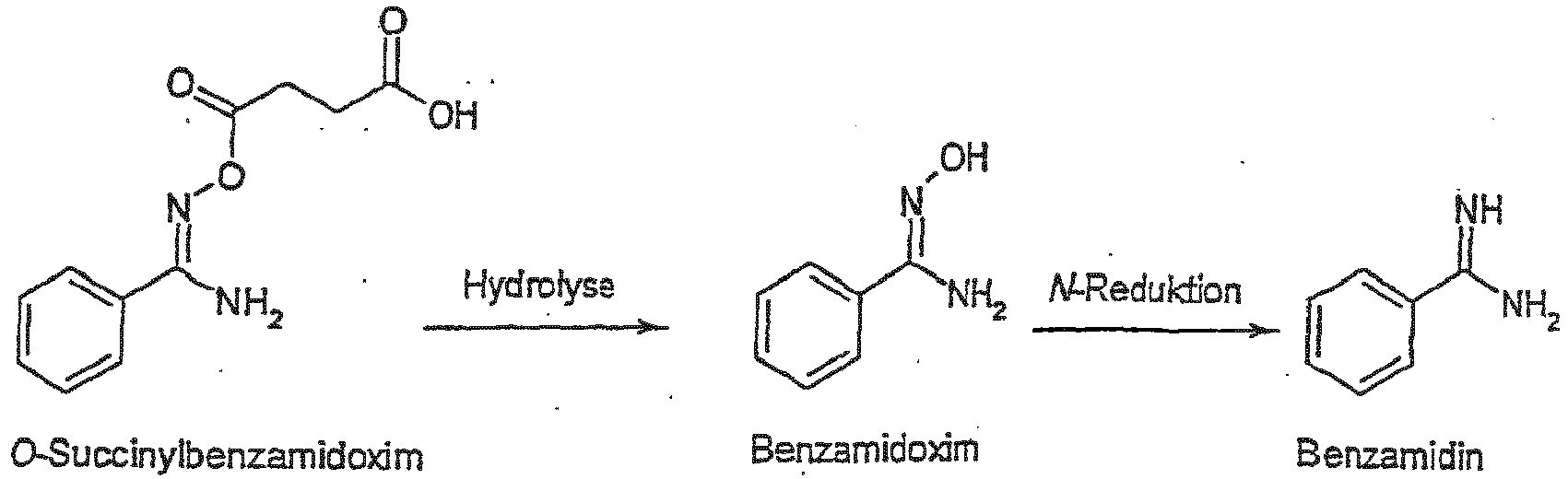
- the metabolization of the two esters to benzamidine proceeds in vivo as follows:
- the anesthesia is done by xylazine and ketamine. Both were injected in the.
- the silicone catheters are implanted in the jugular vein and the carotid artery. They have local antithrombotic and anti-inflammatory properties, but do not work systemically.
- the eyes were protected during the operation by means of a comeaprotektiven ointment (Oculotect ®) as well as 3-4 ml Ringer's lactate solution sc applied to improve the post-operative power supply.
- the animals are anti-inflammatory (® Finadyne, 1 mg / kg body weight) and an antibiotic (amoxicillin ® 15%, 10 mg / kg body weight) and postoperatively until awake supervised and kept warm.
- the day after the operation the animals receive Nutri plus ® , an energy paste (soybean oil, molasses, cod liver oil, meat extract, mineral premix, vitamin premix).
- the experimental animals are male Wistar rats with an average weight of 200 g.
- the animals are kept individually in cages. Every two days they receive concentrated feed. Water and dry food is available ad libitum .
- the animals are weighed in the evening before the substance application.
- the orally administered substances are administered via a gavage.
- the O- succinylbenzamidoxime are dissolved in 100 mM phosphate buffer pH 8.5.
- the benzamidine given intravenously is dissolved in NaCl solution 0.9% in order to prevent hemolysis. After the injection, 0.9% is rinsed again with at least 0.5 ml of NaCl solution.
- the substance application takes place in the morning in each case.
- the prodrugs are applied to three rats.
- Benzamidine is administered intravenously to two rats.
- the oral doses of O- succinylbenzamide oxime are 50 mg / kg body weight.
- Benzamidine was administered at a concentration of 10 mg / kg body weight.
- the trial period for a condition lasts one day.
- the blood samples are collected over a period of eight hours after oral administration and six hours after intravenous administration. After oral administration, the samples are taken after 30, 60, 90, 120, 240 and 480 minutes, after intravenous administration after 5, 10, 20, 40, 80 and 360 minutes.
- the catheter is emptied by briefly aspirating until the appearance of blood. Blood collection (300 ⁇ l) is carried out using multivets (Multivetten ® 600, Sahrstedt, Nümbrecht). To keep the catheter free, about 0.3 ml of a mixture of heparin and NaCl are subsequently injected. The recovered whole blood is centrifuged (1500 g, 10 min, 4 ° C). After Zentrifugalion about 150 ul of plasma are removed as supernatant, pipetted into Eppendorf tubes and frozen at -80 ° C.
- HPLC pump Waters 600 detector Waters 2417 Tunable Absorbance Detector Autosampler: Waters 717 plus autosampler integrator: EZChrom TM Elite Client / Server Version 2.8.3 Build 2249 Recording and Evaluation Software Stationary phase: Synergy Max RP 80A; 250 * 4.6 mm with precolumn C 18 4.0 * 3.0 mm (Phenomenex, Aillesburg) Column temperature: constant 24 ° C, with column oven Mobile phase: 10 mM octylsulfonate in double-distilled water, pH 2.5 (with concentrated H 3 PO 4 ) / acetonitrile (82.5 / 17.5, v / v) Running time: 30 minutes detection: UV detector, 229 nm Flow rate: 1.0 ml / min Injection volume: 10 ⁇ l Sensitivity: Absorbance units full scale: 2,000 Retention times: Benzamidoxime: 23.5 ⁇ 0.5 min
- the eluent was filtered with a Satorius membrane filter (0.45 ⁇ m) and degassed in an ultrasonic bath for 15 minutes.
- HPLC pump Waters 600 Detector: Waters 2417 Tunable Absorbance Detector Autosampler: Waters 717 plus autosampler integrator: EZChrom TM Elite Client / Server Version 2.8.3 Build 2249 Recording and Evaluation Software Stationary phase: Synergy Max RP 80A; 250 * 4.6 mm with precolumn C 18 4.0 * 3.0 mm (Phenomenex, Aillesburg) Mobile phase: 100 mM phosphate buffer in double-distilled water, pH 7.0 (with 30% KOH) / acetonitrile (92/8, V / V) Running time: 25 min detection: 229 nm Flow rate: 1.0 ml / min Injection volume: 10 ⁇ l Sensitivity: Absorbance units full scale: 2,000 Retention times: Benzamidine: 5.3 ⁇ 0.3 min O- succinylbenzamidoxime: 11.7 ⁇ 0.3 min Benzamidoxime: 15.2
- the eluent was filtered with a Sartorius membrane filter (0.45 ⁇ m) and degassed in an ultrasonic bath for 15 minutes
- benzamidine has a bioavailability of 32% after oral administration of O- succinylbenzamide oxime. This shows that the prodrug is absorbed after oral administration and reduced in the blood to the active form.
Landscapes
- Health & Medical Sciences (AREA)
- Life Sciences & Earth Sciences (AREA)
- Chemical & Material Sciences (AREA)
- Veterinary Medicine (AREA)
- General Health & Medical Sciences (AREA)
- Pharmacology & Pharmacy (AREA)
- Public Health (AREA)
- Animal Behavior & Ethology (AREA)
- Medicinal Chemistry (AREA)
- Organic Chemistry (AREA)
- General Chemical & Material Sciences (AREA)
- Nuclear Medicine, Radiotherapy & Molecular Imaging (AREA)
- Chemical Kinetics & Catalysis (AREA)
- Bioinformatics & Cheminformatics (AREA)
- Engineering & Computer Science (AREA)
- Virology (AREA)
- Epidemiology (AREA)
- Communicable Diseases (AREA)
- Oncology (AREA)
- Neurosurgery (AREA)
- Biomedical Technology (AREA)
- Tropical Medicine & Parasitology (AREA)
- Neurology (AREA)
- Emergency Medicine (AREA)
- Cardiology (AREA)
- Heart & Thoracic Surgery (AREA)
- Molecular Biology (AREA)
- Hematology (AREA)
- Pulmonology (AREA)
- Diabetes (AREA)
- Hospice & Palliative Care (AREA)
- Psychiatry (AREA)
- AIDS & HIV (AREA)
- Acyclic And Carbocyclic Compounds In Medicinal Compositions (AREA)
- Pharmaceuticals Containing Other Organic And Inorganic Compounds (AREA)
- Organic Low-Molecular-Weight Compounds And Preparation Thereof (AREA)
Abstract
Description
- Die vorliegende Erfindung betrifft eine Verwendung eines Amidoximcarbonsäureesters bei einem Verfahren zur Verbesserung der Bioverfügbarkeit und Ermöglichung der Blut-Him Schrankengängigkeit von Arzneistoffen, die wenigstens eine oder mehrere Amidin-, Guanidin-, N-Hydroxyamidin- (Amidoxim) bzw. N-Hydroxyguanidin-Funktionen aufweisen und entsprechend modifizierte Arzneistoffe enthaltende Arzneimittel.
- N-Hydroxyamidine (Amidoxime) und N-Hydroxyguanidine stellen bekannte Prodrug-Prinzipien zur Erhöhung der oralen Bioverfügbarkeit der Amidine [Clement, B. Methoden zur Behandlung und Prophylaxe der Pneumocystis carinii Pneumonie (PCP) und anderen Erkrankungen sowie Verbindungen und Formulierungen zum Gebrauch bei besagten Methoden. P 432444.4, 1993] und Guanidine dar.
- Pharmazeutische Zubereitungen, die einen Wirkstoff mit einer oder mehreren Amidin- oder Guanidin-Funktionen enthalten, zeigen bei oraler Anwendung nahezu keine pharmakologische Wirkung. Die Voraussetzung für einen therapeutischen Effekt eines Wirkstoffs nach oraler Gabe stellt dessen Aufnahme aus dem Gastrointestinaltrakt dar. Der wichtigste Mechanismus eines solchen Effekts ist die passive Diffusion. Der Grad der Resorption auf dem Weg der passiven Diffusion ist abhängig von der Lipophilie und somit auch abhängig von der Azidität und der Basizität des Wirkstoffs.
- Stark basische Verbindungen, wie Amidine und Guanidine, liegen im Magen (pH 1) und im Dünndarm (pH 6,4) nahezu vollständig protoniert vor. Eine Resorption nach oraler Gabe, die den Durchtritt durch die Lipiddoppelschichten der Membranen des Gastrointestinaltrakts erfordert, erfolgt daher nur in sehr geringem Ausmaß.
- Ein weiteres Problem bei der medikamentösen Behandlung vieler Krankheiten ist die Notwendigkeit die Blut-Hirn-Schranke zu passieren. Die Blut-Him-Schranke stellt eine effektive Barriere in Bezug auf die Resorption von Substanzen ins Gehirn dar. Sie sichert die selektive Aufnahme und verhindert das Eindringen von Substanzen. Darüber hinaus fungiert die Blut-Hirn-Schranke nicht nur als physikalische, sondern auch als enzymatische Barriere. An der Penetration von Substanzen ins Gehirn sind verschiedene Prozesse beteiligt Im Handel befinden sich im Vergleich zu anderen Indikationen nur wenige Arzneimittel, die im Zentralen Nervensystem (ZNS) ihre Wirkung entfalten. Davon gelangt der überwiegende Teil durch Diffusion ins ZNS. Auf diesem Wege werden Krankheiten wie die Epilepsie, chronische Schmerzen oder Depressionen behandelt. Andere schwerwiegende Funktionsstörungen wie beispielsweise Himtumore oder die Amyotrophe Lateralsklerose können auf diesem Wege heutzutage noch nicht behandelt werden [PARDRIDGE, W. M. NeuroRx 2005, 2, 3-14]. Um die Blut-Him-Schranke durch passive Diffusion überwinden zu können, muss eine Sustanz lipophil sein, ein geringeres Molekulargewicht besitzen als 400-500 Da, und sie muss ungeladen vorliegen. Um spezifisch kleine Moleküle, wie Glucose oder Aminosäuren zu resorbieren, sind verschiedene Transporter-Systeme, wie beispielsweise Nukleosid-Transporter, Influx- und Efflux-Transporter für organische Anionen, Glucose-Transporter, Peptid-Transporter und Aminosäure-Transporter an der Blut-Him-Schranke exprimiert [TAMAI, L; Tsun, A. J Pharm Sci 2000, 89, 1371-1388 UND DEBOER, A.; VAN DER SANDT, I. Annu Rev Pharmacol Toxicol 2003, 43, 629-656]. Größere Moleküle, wie Insulin oder eisenhaltiges Transferrin, werden über den rezeptorvermittelten Transport aufgenommen. Dabei spielen besonders der Insulin-und der Transferrinrezeptor eine große Rolle [DE BOER, A.; VAN DER SANDT, I. Annu Rev Pharmacol Toxicol 2003, 43, 629-656; PARDRIDGE, W. M. Mol Interv 2003, 3, 90-105]. Am Beispiel der Aminosäure L-Dopa hat man sich eines Prodrug-Prinzips bedient, damit das wasserlösliche Catecholamin Dopamin die Blut-Hirn-Schranke überwinden kann. Der Transport geschieht durch den Aminosäure-Transporter LAT1 (large neutral amino acid transporter). Nach der Passage erfolgt die Decarboxylierung zu Dopamin [PARDRIDGE, W. M. Mol Interv 2003, 3, 90-105].
- Diamidine werden als Antiparasitika gegen Malaria, gegen die Pneumocystis jiroveci (früher carinii) Pneumonie, gegen die Trypanosomiasis (Afrikanische Schlafkrankheit) und gegen die Leishmaniose eingesetzt [WERBOVETZ, K. Curr Opin Investig Drugs 2006, 7, 147-157]. Insbesondere in den Entwicklungsländern stellen diese Erkrankungen ein ernstzunehmendes Problem mit hohen Sterblichkeitsraten dar.
- Auf dem Markt befinden sich drei parenteral zu applizierende Diamidine. Pentamidin (Pentacarinat®) wird schon seit 60 Jahren im Frühstadium der Afrikanischen Schlafkrankheit eingesetzt Im 2. Stadium der Afrikanischen Schlafkrankheit, dem meningoenzephalitischem Stadium liegt keine Wirksamkeit mehr vor, da die Blut-Him-Schranke nicht erfolgreich passiert werden kann. Es müssen daher stark toxische Arsen-Verbindungen gegeben werden. Es besteht ein Mangel an Arzneistoffen, die im 2. Stadium der Afrikanischen Schlafkrankheit wirken.
- Es ist zu vermuten, dass alle Wirkstoffe, die als funktionelle Gruppe ein Amidin oder ein Guanidin aufweisen, eine ungenügende Resorption bei der oralen Anwendung zeigen, wenn sie nur durch passive Diffusion aufgenommen werden können.
- Arzneistoffe mit Carbonsäuren sind sehr weit verbreitet und können auch als orale Arzneiformen angewendet werden. Hier sind besonders alle Analgetika aus der Gruppe der Essig-, Propion- und Salicylsäurederivate zu nennen.
- Die N-hydroxylierten Derivate, wie die Amidoxime und die N-Hydroxyguanidine, zeigen durch die Einführung des Sauerstoffatoms eine geringere Basizität Unter physiologischen Bedingungen liegen sie nicht protoniert vor. Benzamidoxim stellt eine Modellverbindung für viele Arzneistoffe dar, die eine Amidoxim-Funktion enthalten [Clement, B. Drug Met Rev 2002, 34, 565-579].
- Pentamidin und Diminazen stellen Diamidine dar und werden nach oraler Applikation nicht resorbiert. Daher wurden sie in Amidoxim-Prodrugs überführt. (
DE 10 2006 034 256.9 ). - Am Beispiel des Pentamidins zeigt sich, dass mit der Überführung in den Pentoximester auch eine Verringerung der Löslichkeit einhergeht Dieses ist wahrscheinlich auch der Grund für die nicht hundertprozentige Bioverfügbarkeit des Pentamidins nach oraler Applikation des Pentoximesters [Clement B.; Bürenheide A; Rieckert W.; Schwarz J. ChemMedChem 2006, 1, 1260-7].
- Des Weiteren führt die verminderte Wasserlöslichkeit zu dem Nachteil, dass eine Gabe des Arzneimittels durch Injektion wässriger Lösungen nicht mehr möglich ist. Dieses ist insbesondere dann ein Problem, wenn eine orale Gabe nicht in Frage kommt
- Daher ist es die Aufgabe der vorliegenden Erfindung, die Wasserlöslichkeit und somit auch die orale Bioverfügbarkeit von Substanzen, die in Amidoxim- bzw. in N-Hydroxyguanidin-Prodrugs überführt wurden, zu erhöhen und / oder somit das Passieren der Blut-Him-Schranke zu ermöglichen.
- Die Aufgabe wird durch die erfindungsgemäße Verwendung mit den Merkmalen nach Anspruch 1 gelöst Die Unteransprüche geben vorteilhafte Ausgestaltungen der Erfindung an.
- Erfindungsgemäß wird vorgeschlagen, Amidoximcarbonsäureester (I) und der N-Hydroxyguanidincarbonsäureester (II) der Formeln:

- Wird n größer als 12 gewählt, so ist eine Verbesserung der Löslichkeit, Bioverfügbarkeit und Blut-Hirn-Schrankengängigkeit nicht mehr gegeben.
- N-Hydroxyamidine (Amidoxime) und N-Hydroxyguanidine sind erfolgreiche Prodrug-Prinzipien zur Erhöhung der oralen Bioverfügbarkeit der Amidine (
DE 10 2006 034 256.9 ). - Die erfindungsgemäß vorgeschlagene Veresterung der Amidoxime bzw. der N-Hydroxyguanidine mit mit Dicarbonsäuren und Estern der Dicarbonsäuren verbessert die Löslichkeit, insbesondere die Löslichkeit in wässrigen Medien und die Bioverfügbarkeit gegenüber den bekannten Prodrugs erheblich.
- Die Veresterung der Amidoxime bzw. der N-Hydroxyguanidine mit Dicarbonsäuren/Dicarbonsäureestem stellt aufgrund der eingeführten negativen Ladung der deprotonierten Säurefunktion eine Umpolung der Ladungen im Vergleich zum Benzamidin dar, somit wird eine erhöhte Bioverfügbarkeit und Löslichkeit in wässrigen Medien bewirkt
- Der besondere Vorteil der erfindungsgemäßen Verbindungen liegt darin, dass sie im Blut deprotoniert vorliegen und so als Substrat für den Transporter für organische Anionen (organic anion transporter (OAT)) wirken und auf diesem Wege eine deutliche verbesserte Absorption aus dem Gastrointestinaltrakt und damit erhöhte Bioverfügbarkeit zeigen, die Überwindung der Blut-Him-Schranke durch derartige Transporter für organische Anionen kann somit ermöglicht werden. Dies wäre ein entscheidender Fortschritt in der Therapie der Afrikanischen Schlafkrankheit, da auch die 2. Phase der Erkrankung effektiv behandelt werden kann.
- Darüber hinaus soll diese Veresterung die Überwindung der Blut-Him-Schranke ermöglichen. Im Blut wird die Verbindung deprotoniert vorliegen, so dass sie ein Substrat für den Transporter für organische Anionen (organic anion transporter (OAT)) an der Blut-Hirn-Schranke darstellen könnte.
- Durch die Einführung von Carbonsäuren sind auch injizierbare Arzneiformen möglich, da wie bei den Amidinen die Wasserlöslichkeit wieder hergestellt wird. Dieses trifft insbesondere gut auf den Fall dass R1 gleich Wasserstoff ist zu.
- Gemäß der erfindungsgemäßen Verwendung wird durch das Ersetzen wenigstens einer oder mehrerer Amidin-, N-Hydroxyamidin- (Amidoxim), Guanidin- bzw. N-Hydroxyguanidin-Funktionen durch den Amidoximdicarbonsäureester und den N-Hydroxyguanidindicarbonsäureester erreicht, dass die Löslichkeit des betreffenden Arzneistoffs erhöht wird. Dadurch kann er nach oraler Verabreichung zunächst effektiv resorbiert und anschließend durch körpereigene Esterasen und N-Reduktasen wieder in die eigentliche Wirkform, das Amidin bzw. das Guanidin, zurückverwandelt werden (Prodrug-Prinzip). Die ausgezeichnete Resorbierbarkeit der abgewandelten Amidoxim- bzw. N-Hydroxyguanidin-Funktion im Gastrointestinaltrakt ist offensichtlich auf die erhöhte Löslichkeit der Wirkstoffmoleküle zurückzuführen. Darüber hinaus können die neuen Prodrug-Prinzipien die Überwindung der Blut-Him-Schranke ermöglichen.
- Es ist ausreichend, wenn der Wirkstoff mindestens eine oder mehrere wirksame Amidin-, N-Hydroxyamidin- (Amidoxim), Guanidin- bzw. N-Hydroxyguanidin-Funktionen in der vorgeschlagenen Form enthält Der Wirkstoff kann demnach z.B. mehrere Amidoxim-Funktionen (z.B. zwei wie bei dem Pentoximester) bzw. N-Hydroxyguanidin-Funktionen enthalten, wobei dann mindestens eine dieser Gruppen in der vorstehend beschrieben Art modifiziert ist Genauso können auch Mischungen von Wirkstoffen eingesetzt werden, sofern mindestens ein Wirkstoff eine oder mehrere Amidin-, N-Hydroxyamidin- (Amidoxim), Guanidin- bzw. N-Hydroxyguanidin-Funktionen aufweist. Die orale Darreichungsform kann als flüssige, halbfeste oder feste Zubereitung, insbesondere als Tablette, Dragee, Pellet oder Mikrokapsel aufgemacht sein. Hierbei werden für solche Ausführungsformen, bei denen flüssige Zubereitungen eingesetzt werden, der Wirkstoff bzw. das Wirkstoffgemisch in einem geeigneten, nicht toxischen Lösungsmittel, wie zum Beispiel Wasser, einwertige Alkohole, insbesondere Ethanole, mehrwertige Alkohole, insbesondere Glycerin und/oder Propandiol, Polyglykole, insbesondere Polyethylenglykole und/oder Miglyol, Glycerinfomal, Dimethylisosorbit, natürliche oder synthetische Öle, aufgenommen. Für die Herstellung von halbfesten oder festen Zubereitungen gelangen die üblichen Grundmassen, wie beispielsweise Bentonit, Veegum, Guarmehl und/oder Cellulosederivate, insbesondere Methylcellulose und/oder Carboxymethylcellulose, sowie Polymere aus Vinylalkoholen und/oder Vinylpyrrolidonen, Alginate, Pektine, Polyacrylate, feste und/oder flüssige Polyethylenglykole, Paraffine, Fettalkohole, Vaseline und/oder Wachse, Fettsäuren und/oder Fettsäureester zur Anwendung.
- Des Weiteren können in festen Zubereitungen die an sich bekannten Streckmittel, wie beispielsweise kolloidale Kieselsäure, Talkum, Milchzucker, Stärkepulver, Zucker, Gelatine, Metalloxide und/oder Metallsalze enthalten sein. Als weitere Zusatzstoffe bieten sich Stabilisatoren, Emulgatoren, Dispergatoren sowie Konservierungsstoffe an.
- Die nach der erfindungsgemäßen Verwendung modifizierten Arzneistoffe weisen bei oraler Verabreichung eine hervorragende Resorbierbarkeit und somit Bioverfügbarkeit auf, wodurch die pharmakologische Wirkung des Amidins bzw. des Guanidins deutlich erhöht wird. Somit kann nunmehr eine optimale Arzneiform für die orale Anwendung von Amidinen bereitgestellt werden.
- Besondere Bedeutung erlangt die erfindungsgemäße Verwendung dadurch, dass die funktionellen Gruppen Amidin und Guanidin wesentliche Bestandteile von verschiedenen wichtigen Wirkstoffen für verschiedene Anwendungsgebiete sind. Sie sind u.a. Bestandteil der folgenden Wirkstoffklassen bzw. Wirkstoffe: Proteasehemmstoffe (Thrombinhemmstoffe wie Melagatran, Hemmstoffe von Faktor Xa, Faktor VII bzw. aller Proteasen der Gerinnungskaskade; Matriptasehemmstoffe), Antikoagulantien, Thrombolytika, Antifibrinolytika, DNA- und RNA- interkalierende Verbindungen (wie Pentamidin, Diminazen, Isometamidium), N-Methyl-D-Aspartat Rezeptor-Antagonisten und Hemmstoffe viraler Enzyme (wie z. B. Neuraminidasehemmstoffe).
- Wirkstoffe, die eine wirksame Amidin-Funktion bzw. Guanidin-Funktion enthalten, können u.a. zur Hemmung der Blutgerinnung, zur Prophylaxe und Therapie der viszeralen und der kutanen Leishmaniose, der Trypanosomiasis (Afrikanische Schlafkrankheit), der durch Pneumocystis carinii verursachten Pneumonie (PCP), zur Wachstumshemmung maligner Tumoren, Blutdrucksenkung, Neuroprotektion, sowie zur Bekämpfung von viralen Infektionen wie Influenza und von HIV-Infektionen eingesetzt werden.
- Die obigen Aufzählungen sind nur beispielhaft und die Erfindung umfasst grundsätzlich alle Wirkstoffe, die mindestens eine Amidin-Funktion bzw. Guanidin-Funktion aufweisen, welche erfindungsgemäß in ein verbessertes Prodrug überführt wurde. Das erfindungsgemäße Verfahren ist somit auf einen sehr breiten Bereich von Wirkstoffklassen und Indikationen anwendbar und kann die Bioverfügbarkeit von vielen Arzneistoffen, deren aktive Form ein Amidin bzw. ein Guanidin enthält, deutlich erhöhen.
- Als Beispiele für nach dem erfindungsgemäßen Verfahren modifizierte Verbindungen seien das O-Succinylbenzamidoxim, der Pentamidinbernsteinsäureester und der Diminazenbernsteinsäureester genannt.
- Die erfindungsgemäße Zubereitung wird anhand von Ausführungsbeispielen näher erläutert:
- Die erfindungsgemäße Zubereitung wird anhand von Ausführungsbeispielen im Kapitel Material und Methoden näher erläutert.
-

- 1,0 g Benzamidoxim wurden in 40 ml wasserfreiem Aceton gelöst Nach Zugabe von 1,64 g Bernsteinsäureanhydrid wurde vier Stunden unter Rückfluss gerührt. Die Vollständigkeit der Umsetzung wurde mittels DC überprüft. Nach beendeter Reaktion wurde das Lösungsmittel vollständig abgezogen und das Rohprodukt aus Toluol umkristallisiert.
Ausbeute: 82 %
Schmelzpunkt: 151°C
IR (KBr): - Y=3648, 3480, 3062, 2912, 1744, 1704, 1614, 1368 cm-1.
- δ/ppm (TMS) = 2,55 (t, 2H, 3J = 6,9 Hz, CH2), 2,69 (t, 2H, 3J = 6,9 Hz, CH2), 6,75 (s, 2H, NH2), 7,44 (m, 3H, Ar-H), 7,70 (m, 2H, Ar-H), 12,20 (s, 1H, COOH).
- δ/ppm (TMS) = 27,86 (CH2), 28,72 (CH2), 126,65 (C Ar 2,6), 128,26 (CAr 3,5), 130,36 (CAr 1), 131,59 (CAr 4), 156,56 (C-NH2), 170,19 (C=O), 173,50 (COOH).
- m/z (%) = 495 [2M+Na+H+] (100), 259 [M+Na+H+] (20), 237 [M+H+] (43), 137 [BAO+H+] (35), 121 [BA+H+](13), 119 [C4H6O4+H+] (70).
- Zum Nachweis der Resorption ans dem Gastrointestinaltrakt and der anschließenden Re duktion zu Benzamidin wird das O-Succinylbenzamidoxim als Modellverbindungen für die neuen Prodrug-Prinzipien gewählt und jeweils drei Ratten oral verabreicht Die Metabolisierung der beiden Ester zu Benzamidin verläuft dabei in vivo folgendermaßen:
- Der Metabolismus des Diminazenbemsteinsäureesters und des Pentamidinbernsteinsäureesters ist in den
Fig. 2-3 im Anhang dargestellt. - Der Tierversuch wurde vom Ministerium für Landwirtschaft, Umwelt und längliche Räume des Landes Schleswig-Holstein am 04.07.2007 genehmigt.
- Die Narkose erfolgt mittels Xylazin und Ketamin. Beides wurde i.m. injiziert. Die Silikonkatheter werden in die Vena jugularis und in die Arteria carotis implantiert Sie besitzen lokal antithrombotisch und antiinflammatorische Eigenschaften, wirken aber nicht systemisch. Die Augen wurden während der Operation mittels einer comeaprotektiven Salbe (Oculotect®) geschützt sowie 3-4 ml Ringer-Lactat-Lösung s.c. zur Verbesserung der postoperativen Energieversorgung appliziert. Die Tiere werden antiphlogistisch (Finadyne®, 1mg/kg KG) und antibiotisch (Amoxicillin® 15%, 10 mg/kg KG) behandelt und postoperativ bis zum Aufwachen betreut und warm gehalten. Am Tag nach der Operation erhalten die Tiere Nutri plus®, eine Energiepaste (Sojaöl, Melasse, Lebertranöl, Fleischextrakt, Mineralstoffvormischung, Vitaminvormischung).
- Die Tiere werden nach Beendigung des Versuches mit Pentobarbital (i.v.) eufhanasiert.
- Als Versuchstiere dienen männliche Wistar-Ratten mit einem durchschnittlichen Gewicht von 200 g. Die Tiere werden einzeln in Käfigen gehalten. Alle zwei Tage erhalten sie Kraftfutter. Wasser und Trockenfutter steht ad libitum zur Verfügung.
- Um die genaue Dosierung der Substanzen ermitteln zu können, werden die Tiere am Abend vor der Substanzapplikation gewogen. Die oral zu verabreichenden Substanzen (Prodrugs) werden über eine Schlundsonde appliziert. Dazu werden das O-Succinylbenzamidoxim in 100 mM Phosphatpuffer pH 8,5 gelöst Das intravenös gegebene Benzamidin wird in NaCl-Lösung 0,9% gelöst, um eine Hämolyse zu verhindern. Nach der Injektion wird noch einmal mit mindestens 0,5 ml NaCl-Lösung 0,9% nachgespült Die Substanzapplikation erfolgt jeweils morgens.
- Die Prodrugs werden drei Ratten appliziert. Benzamidin wird zwei Ratten intravenös appliziert Die oral verabreichten Dosen des O-Succinylbenzamidoxims betragen 50 mg/kg KG. Benzamidin wurde in einer Konzentration von 10 mg/kg KG appliziert.
- Aus einer Ratte können sechs Blutproben gewonnen werden. Die Versuchsperiode für eine Kondition dauert einen Tag. Die Blutproben werden über einen Zeitraum von acht Stunden nach oraler Applikation bzw. sechs Stunden nach intravenöser Applikation gewonnen. Nach oraler Gabe erfolgt die Probenentnahme nach 30, 60, 90, 120, 240 und 480 Minuten, nach intravenöser Applikation nach 5, 10, 20, 40, 80 und 360 Minuten. Vor der Blutentnahme wird der Katheter durch kurzes Ansaugen bis zum Erscheinen von Blut geleert. Die Blutentnahme (300 µl) erfolgt mittels Multivetten (Multivetten® 600, Sahrstedt, Nümbrecht). Zum Freihalten des Katheters werden nachträglich ca. 0,3 ml einer Mischung aus Heparin und NaCl gespritzt. Das gewonnene Vollblut wird zentrifugiert (1500 g, 10 min, 4°C). Nach der Zentrifugalion werden ca. 150 µl Plasma als Überstand abgenommen, in Eppendorfgefäße pipettiert und bei -80°C eingefroren.
- Nach langsamem Auftauen werden 150 µl Plasma mit Aqua bidest. ad 600 µl verdünnt. Anschließend werden die Plasmaproben mittels Festphasenextraktion aufgearbeitet Nach dem Konditionieren der Säule mit 1000 µl Methanol und dem Equilibrieren mit 1000 µl Aqua bidest. erfolgt der Probenauftrag (600 µl). Das Sorbens wird nach dem Probenauftrag mit 600 µl Aqua bidest. gewaschen. Die Elution der Substanzen erfolgt mittels Aqua bidest. pH 3/Methanol (6/4, V/V). Daraufhin wird das Eluat zur Trockne einkonzentriert und mit 100 µl Aqua bidest./Methanol (9/1, V/V) aufgenommen und der HPLC zugeführt.
- Zur Trennung der zu analysierenden Substanzen wurde folgende HPLC-Methode verwendet
HPLC-Pumpe: Waters 600 Detektor Waters 2417 Tunable Absorbance Detektor Autosampler: Waters 717 plus Autosampler Integrator: EZChrom™ Elite Client/Server Version 2.8.3 Build 2249 Aufnahme und Auswertsoftware Stationäre Phase: Synergy Max-RP 80A; 250*4,6 mm mit Vorsäule C 18 4,0 * 3,0 mm (Phenomenex, Aschaffenburg) Säulentemperatur: konstant 24°C, mittels Säulenofen Mobile Phase: 10 mM Octylsulfonat in Aqua bidest., pH 2,5 (mit konz. H3PO4)/Acetonitril (82,5/17,5, V/V) Laufzeit: 30 Minuten Detektion: UV-Detektor, 229 nm Flussrate: 1,0 ml/min Injektionsvolumen: 10 µl Detektorempfindlichkeit: Absorbance units fullscale: 2,000 Retentionszeiten: Benzamidoxim: 23,5 ± 0,5 min Benzamidin: 26,5 ± 0,5 min - Der Eluent wurde mit einem Satorius Membranfilter (0,45 µm) filtriert und im Ultraschallbad 15 Minuten entgast.
- Zur Trennung der zu analysierenden Substanzen wurde folgende HPLC-Methode verwendet
HPLC-Pumpe: Waters 600 Detektor: Waters 2417 Tunable Absorbance Detektor Autosampler: Waters 717 plus Autosampler Integrator: EZChrom™Elite Client/Server Version 2.8.3 Build 2249 Aufnahme und Auswertsoftware Stationäre Phase: Synergy Max-RP 80A; 250 * 4,6 mm mit Vorsäule C 18 4,0 * 3,0 mm (Phenomenex, Aschaffenburg) Mobile Phase: 100 mM Phosphatpuffer in Aqua bidest., pH 7,0 (mit 30% KOH)/Acetonitril (92/8, V/V) Laufzeit: 25 min Detektion: 229 nm Flussrate: 1,0 ml/min Injektionsvolumen: 10 µl Detektorempfindlichkeit: Absorbance units fullscale: 2,000 Retentionszeiten: Benzamidin: 5,3 ± 0,3 min O-Succinylbenzamidoxim: 11,7 ± 0,3 min Benzamidoxim: 15,2 ± 0,3 min - Der Eluent wurde mit einem Sartorius Membranfilter (0,45 µm) filtriert und im Ultraschallbad 15 Minuten entgast
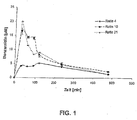
- Aus den gewonnenen Daten konnte die orale Bioverfügbarkeit des Benzamidins nach oraler Gabe des O-Succinylbenzamidoxims bestimmt werden (Tab1):
Tabelle 1: Bioverfügbarkeit des Benzamidins nach oraler Gabe des O-Succinylbenzaimdoxims Bioverfügbarkeit [%] Mittelwert [%] Staadardabweichuag [%] Ratte 4 19,9 Ratte 10 36,1 31,6 10,2 Ratte 21 38,7 - Wie obiger Tabelle zu entnehmen ist, besitzt Benzamidin nach oraler Gabe des O-Succinylbenzamidoxims eine Bioverfügbarkeit von 32%. Dies zeigt, dass das Prodrug nach oraler Gabe resorbiert und im Blut zur Wirkform reduziert wird.
- Die Ergebnisse der Versuche sind in den beigefügten Zeichnungen dargelegt, in denen:
- Fig. 1
- die Plasmaspiegelkurven des Benzamidins nach oraler Applikation des O-Succinylbenzamidoxims,
- Fig. 2
- den Metabolismus des Diminazensuccinylsäureesters und
- Fig. 3
- den Metabolismus des Pentamidinsuccinylsäureesters zeigt
-
- 1. Verwendung eines Amidoximcarbonsäureesters der Formel (I) oder eines N-Hydxoxyguanidincarbonsäureesters der Formel (II)

- 2. Verwendung nach Ausführungsform 1,
dadurch gekennzeichnet, dass
der Arzneistoff ausgewählt ist aus der Gruppe der Proteasehemmstoffe, der DNA- und RNA-interkalierenden Verbindungen, der Hemmstoffe viraler Enzyme und der N-Methyl-D-Aspartat-Rezeptor-Antagonisten. - 3. Verwendung nach Ausführungsform 2,
dadurch gekennzeichnet, dass der Proteasehemmstoff ein Thrombinhemmstoff, ein Hemmstoff von Faktor Xa, Faktor VII oder aller Proteasen der Gerinnungskaskade oder ein Matriptasehemmstoff ist. - 4. Verwendung nach Ausführungsform 2,
dadurch gekennzeichnet, dass
der Proteasehemmstoff ein Urokinasehemmstoff ist. - 5. Verwendung nach Ausführungsform 2,
dadurch gekennzeichnet, dass
die DNA- und RNA-interkalierende Verbindung Pentamidin, Diminazen oder Isometamidium ist. - 6. Verwendung nach Ausführungsform 2, dadurch gekennzeichnet, dass
der Hemmstoff viraler Enzyme eine Neuraminidasehemmstoff ist. - 7. Verwendung nach einem der vorgehenden Ausführungsformen,
dadurch gekennzeichnet, dass
der Arzneistoff zur Prophylaxe und Therapie der viszeralen und/oder kutanen Leishmaniose, der Trypanosomiasis, der 2. Phase der Trypanosomiasis oder der durch Pneumocystis carinii verursachten Pneumonie, zur Wachstumshemmung maligner Tumoren, zur Blutgerinnungshemmung, zur Blutdrucksenkung, zur Neuroprotektion oder zur Bekämpfung von viralen Infekten, einschließlich Influenza und HIV-Infektionen eingerichtet ist. - Besondere Ausführungsformen der Erfindung sind:
- 1. Verwendung eines Amidoximcarbonsäureesters der Formel (I) oder eines N-Hydroxyguanidincarbonsäureesters der Formel (II)

dadurch gekennzeichnet, dass
der Arzneistoff ausgewählt ist aus der Gruppe der Proteasehemmstoffe, wobei der Proteasehemmstoff ein Thrombinhemmstoff, ein Hemmstoff von Faktor Xa, Faktor VII oder aller Proteasen der Gerinnungskaskade oder ein Matriptasehemmstoff ist, der DNA- und RNA-interkalierenden Verbindungen, der Hemmstoffe viraler Enzyme und der N-Methyl-D-Aspartat-Rezeptor-Antagonisten. - 2. Verwendung nach Ausführungsform 1,
dadurch gekennzeichnet, dass
die DNA- und RNA-interkalierende Verbindung Pentamidin, Diminazen oder Isometamidium ist. - 3. Verwendung nach Ausführungsform 1,
dadurch gekennzeichnet, dass
der Hemmstoff viraler Enzyme eine Neuraminidasehemmstoff ist. - 4. Verwendung nach einer der vorgehenden Ausführungsformen,
dadurch gekennze ichnet, dass
der Arzneistoff zur Prophylaxe und Therapie der viszeralen und/oder kutanen Leishmaniose, der Trypanosomiasis, der 2. Phase der Trypanosomiasis oder der durch Pneumocystis carinii verursachten Pneumonie, zur Wachstumshemmung maligner Tumoren, zur Blutgerinnungshemmung, zur Blutdrucksenkung, zur Neuroprotektion oder zur Bekämpfung von viralen Infekten, einschließlich Influenza und HIV-Infektionen eingerichtet ist.
| Ber. | C 55,93% | H 5, 12% | N 11,86% |
| Gef. | C 55,88% | H 5,19% | N 11,55% |
Claims (11)
- Verwendung eines Amidoximcarbonsäureesters der Formel (I) oder eines N-Hydroxyguanidincarbonsäureesters der Formel (II)

- Verwendung nach Anspruch 1,
dadurch gekennzeichnet, dass
der Arzneistoff ausgewählt ist aus der Gruppe der Proteasehemmstoffe, wobei der Proteasehemmstoff ein Thrombinhemmstoff, ein Hemmstoff von Faktor Xa, Faktor VII oder aller Proteasen der Gerinnungskaskade oder ein Matriptasehemmstoff ist, der DNA- und RNA-interkalierenden Verbindungen, der Hemmstoffe viraler Enzyme und der N-Methyl-D-Aspartat-Rezeptor-Antagonisten - Verwendung nach Anspruch 2,
dadurch gekennzeichnet, dass
die DNA- und RNA-interkalierende Verbindung Pentamidin, Diminazen oder Isometamidium ist. - Verwendung nach Anspruch 2,
dadurch gekennzeichnet, dass
der Hemmstoff viraler Enzyme eine Neuraminidasehemmstoff ist. - Verwendung nach einer der vorgehenden Ansprüche,
dadurch gekennzeichnet, dass
der Arzneistoff zur Prophylaxe und Therapie der viszeralen und/oder kutanen Leishmaniose, der Trypanosomiasis, der 2. Phase der Trypanosomiasis oder der durch Pneumocystis carinii verursachten Pneumonie, zur Wachstumshemmung maligner Tumoren, zur Blutgerinnungshemmung, zur Blutdrucksenkung, zur Neuroprotektion oder zur Bekämpfung von viralen Infekten, einschließlich Influenza und HIV-Infektionen eingerichtet ist. - Prodrug umfassend eine die Formel (I) oder (II) aufweisende Teilstruktur,

- Prodrug gemäß Anspruch 6,
dadurch gekennzeichnet, dass der Arzneistoff ausgewählt ist aus der Gruppe der Proteasehemmstoffe, wobei der Proteasehemmstoff ein Thrombinhemmstoff, ein Hemmstoff von Faktor Xa, Faktor VII oder aller Proteasen der Gerinnungskaskade oder ein Matriptasehemmstoff ist, der DNA- und RNA-interkalierenden Verbindungen, der Hemmstoffe viraler Enzyme und der N-Methyl-D-Aspartat-Rezeptor-Antagonisten. - Prodrug gemäß Anspruch 7,
dadurch gekennzeichnet, dass die DNA- und RNA-interkalierende Verbindung Pentamidin, Diminazen oder Isometamidium ist. - Prodrug gemäß Anspruch 7,
dadurch gekennzeichnet, dass der Hemmstoff viraler Enzyme eine Neuraminidasehemmstoff ist. - Prodrug gemäß mindestens einem der Anprüche 6-9,
dadurch gekennzeichnet, dass der Arzneistoff zur Prophylaxe und Therapie der viszeralen und/oder kutanen Leishmaniose, der Trypanosomiasis, der 2. Phase der Trypanosomiasis oder der durch Pneumocystis carinii verursachten Pneumonie, zur Wachstumshemmung maligner Tumoren, zur Blutgerinnungshemmung, zur Blutdrucksenkung, zur Neuroprotektion oder zur Bekämpfung von viralen Infekten, einschließlich Influenza und HIV-Infektionen eingerichtet ist. - Prodrug gemäß mindestens einem der Ansprüche 6-10,
wobei die Gesamtstruktur des Prodrugs mehrere Teilstrukturen der Formel (I) und/oder (II) umfasst.
Applications Claiming Priority (2)
| Application Number | Priority Date | Filing Date | Title |
|---|---|---|---|
| DE102008007381A DE102008007381A1 (de) | 2008-02-01 | 2008-02-01 | Amidine und Guanidine und deren Derivate zur Behandlung von Krankheiten |
| EP09705303.7A EP2249821B1 (de) | 2008-02-01 | 2009-02-02 | Verwendung von amidoximcarbonsäureesters und n-hydroxyguanidincarbonsäureesters zur herstellung von prodrugs |
Related Parent Applications (1)
| Application Number | Title | Priority Date | Filing Date |
|---|---|---|---|
| EP09705303.7A Division EP2249821B1 (de) | 2008-02-01 | 2009-02-02 | Verwendung von amidoximcarbonsäureesters und n-hydroxyguanidincarbonsäureesters zur herstellung von prodrugs |
Publications (1)
| Publication Number | Publication Date |
|---|---|
| EP2985021A1 true EP2985021A1 (de) | 2016-02-17 |
Family
ID=40532565
Family Applications (3)
| Application Number | Title | Priority Date | Filing Date |
|---|---|---|---|
| EP20140155230 Ceased EP2732816A1 (de) | 2008-02-01 | 2009-02-02 | Verwendung von Amidoximcarbonsäureestern und n-hydroxyguanidincarbonsäureestern zur Herstellung von Prodrugs |
| EP09705303.7A Active EP2249821B1 (de) | 2008-02-01 | 2009-02-02 | Verwendung von amidoximcarbonsäureesters und n-hydroxyguanidincarbonsäureesters zur herstellung von prodrugs |
| EP15178466.7A Withdrawn EP2985021A1 (de) | 2008-02-01 | 2009-02-02 | Verwendung von amidoximcarbonsäureestern und n-hydroxyguanidincarbonsäureestern zur herstellung von prodrugs |
Family Applications Before (2)
| Application Number | Title | Priority Date | Filing Date |
|---|---|---|---|
| EP20140155230 Ceased EP2732816A1 (de) | 2008-02-01 | 2009-02-02 | Verwendung von Amidoximcarbonsäureestern und n-hydroxyguanidincarbonsäureestern zur Herstellung von Prodrugs |
| EP09705303.7A Active EP2249821B1 (de) | 2008-02-01 | 2009-02-02 | Verwendung von amidoximcarbonsäureesters und n-hydroxyguanidincarbonsäureesters zur herstellung von prodrugs |
Country Status (20)
| Country | Link |
|---|---|
| US (2) | US20110028756A1 (de) |
| EP (3) | EP2732816A1 (de) |
| JP (2) | JP2011510956A (de) |
| KR (1) | KR20100110875A (de) |
| CN (1) | CN101951897B (de) |
| AU (1) | AU2009209560B2 (de) |
| BR (1) | BRPI0906569A2 (de) |
| CA (1) | CA2713784C (de) |
| CY (1) | CY1116801T1 (de) |
| DE (1) | DE102008007381A1 (de) |
| DK (1) | DK2249821T3 (de) |
| ES (1) | ES2547117T3 (de) |
| HR (1) | HRP20150961T1 (de) |
| HU (1) | HUE026276T2 (de) |
| IL (1) | IL207286A0 (de) |
| PL (1) | PL2249821T3 (de) |
| PT (1) | PT2249821E (de) |
| SI (1) | SI2249821T1 (de) |
| WO (1) | WO2009095499A1 (de) |
| ZA (1) | ZA201004767B (de) |
Families Citing this family (9)
| Publication number | Priority date | Publication date | Assignee | Title |
|---|---|---|---|---|
| DE102008007381A1 (de) | 2008-02-01 | 2009-08-13 | Dritte Patentportfolio Beteiligungsgesellschaft Mbh & Co.Kg | Amidine und Guanidine und deren Derivate zur Behandlung von Krankheiten |
| US9662308B2 (en) | 2008-02-01 | 2017-05-30 | Dritte Patentportfolio Beteiligungsgesellschaft Mbh & Co. Kg | Orally bioavailable pentamidine prodrugs for the treatment of diseases |
| DE102009004204A1 (de) * | 2009-01-09 | 2010-07-15 | Christian-Albrechts-Universität Zu Kiel | Verfahren zur verbesserten Bioaktivierung von Arzneistoffen |
| ES2611610T3 (es) * | 2011-07-25 | 2017-05-09 | Develco Pharma Schweiz Ag | Ésteres de ácidos amidoxima-carboxílicos de dabigatrán como profármacos y su utilización como un medicamento |
| PT2550963T (pt) * | 2011-07-25 | 2017-01-19 | Dritte Patentportfolio Beteili | Ésteres de ácido carboxílico de amidoxima de pentamidina como pró-drogas, e a utilização dos mesmos como fármaco |
| ES2416004B1 (es) * | 2012-01-24 | 2014-01-28 | Investigaciones Farmaceuticas Y Veterinarias, S.L. | Composición farmacéutica que comprende cloruro de isometamidium en solución para el tratamiento de la tripanosomiasis en animales. |
| CN103420994B (zh) * | 2012-05-24 | 2016-04-06 | 天津药物研究院 | 作为前药的达比加群酯衍生物及其制备方法和用途 |
| CN104968340A (zh) * | 2012-12-21 | 2015-10-07 | 沃利克斯制药股份有限公司 | 治疗肝脏疾病或病状的用途和方法 |
| CN106831611B (zh) * | 2017-01-23 | 2019-06-21 | 北京化工大学 | 一种偕胺肟类化合物及其在制备抑制癌细胞增殖药的应用 |
Citations (2)
| Publication number | Priority date | Publication date | Assignee | Title |
|---|---|---|---|---|
| DE4321444A1 (de) | 1993-06-28 | 1995-01-05 | Bernd Prof Dr Clement | Pharmazeutische Zubereitung |
| WO2008009264A1 (de) * | 2006-07-21 | 2008-01-24 | Dritte Patentportfolio Beteiligungsgesellschaft Mbh & Co. Kg | Verbesserung der bioverfügbarkeit von wirkstoffen mit amidinfunktion in arzneimitteln |
Family Cites Families (8)
| Publication number | Priority date | Publication date | Assignee | Title |
|---|---|---|---|---|
| JP2001031586A (ja) * | 1999-07-14 | 2001-02-06 | Sunstar Inc | 動脈硬化症及び動脈硬化症に起因する疾患の予防又は治療組成物 |
| EP1294405A2 (de) | 2000-06-14 | 2003-03-26 | Corixa Corporation | Durch thimet oligopeptidase spaltbare prodrugs |
| US6897034B2 (en) * | 2001-06-11 | 2005-05-24 | Medarex, Inc. | CD10-activated prodrug compounds |
| JP2005509606A (ja) * | 2001-10-03 | 2005-04-14 | ファルマシア・コーポレーション | 凝血カスケードを選択的に阻害するのに有用な置換された多環式化合物のプロドラッグ |
| DE10323898A1 (de) * | 2003-05-26 | 2004-12-23 | Wilex Ag | Hydroxyamidin- und Hydroxyguanidin-Verbindungen als Urokinase-Hemmstoffe |
| JPWO2005049636A1 (ja) * | 2003-11-21 | 2007-06-07 | 日本電気株式会社 | タンパク質の分析方法 |
| EP1767526B1 (de) * | 2004-06-30 | 2012-10-24 | Toyama Chemical Co., Ltd. | Arylamidinderivat, salz davon und diese enthaltendes fungizid |
| DE102008007381A1 (de) | 2008-02-01 | 2009-08-13 | Dritte Patentportfolio Beteiligungsgesellschaft Mbh & Co.Kg | Amidine und Guanidine und deren Derivate zur Behandlung von Krankheiten |
-
2008
- 2008-02-01 DE DE102008007381A patent/DE102008007381A1/de not_active Withdrawn
-
2009
- 2009-02-02 EP EP20140155230 patent/EP2732816A1/de not_active Ceased
- 2009-02-02 WO PCT/EP2009/051132 patent/WO2009095499A1/de not_active Ceased
- 2009-02-02 EP EP09705303.7A patent/EP2249821B1/de active Active
- 2009-02-02 KR KR1020107018471A patent/KR20100110875A/ko not_active Abandoned
- 2009-02-02 ES ES09705303.7T patent/ES2547117T3/es active Active
- 2009-02-02 PL PL09705303T patent/PL2249821T3/pl unknown
- 2009-02-02 CA CA2713784A patent/CA2713784C/en active Active
- 2009-02-02 BR BRPI0906569-5A patent/BRPI0906569A2/pt not_active IP Right Cessation
- 2009-02-02 AU AU2009209560A patent/AU2009209560B2/en not_active Ceased
- 2009-02-02 HR HRP20150961TT patent/HRP20150961T1/hr unknown
- 2009-02-02 DK DK09705303.7T patent/DK2249821T3/en active
- 2009-02-02 CN CN200980103401.7A patent/CN101951897B/zh not_active Expired - Fee Related
- 2009-02-02 PT PT97053037T patent/PT2249821E/pt unknown
- 2009-02-02 JP JP2010544724A patent/JP2011510956A/ja not_active Withdrawn
- 2009-02-02 EP EP15178466.7A patent/EP2985021A1/de not_active Withdrawn
- 2009-02-02 SI SI200931253T patent/SI2249821T1/sl unknown
- 2009-02-02 HU HUE09705303A patent/HUE026276T2/en unknown
-
2010
- 2010-07-07 ZA ZA2010/04767A patent/ZA201004767B/en unknown
- 2010-07-29 IL IL207286A patent/IL207286A0/en unknown
- 2010-07-30 US US12/847,415 patent/US20110028756A1/en not_active Abandoned
-
2014
- 2014-08-08 US US14/455,272 patent/US9353047B2/en active Active
-
2015
- 2015-10-20 CY CY20151100936T patent/CY1116801T1/el unknown
-
2016
- 2016-06-14 JP JP2016117936A patent/JP2016193927A/ja active Pending
Patent Citations (4)
| Publication number | Priority date | Publication date | Assignee | Title |
|---|---|---|---|---|
| DE4321444A1 (de) | 1993-06-28 | 1995-01-05 | Bernd Prof Dr Clement | Pharmazeutische Zubereitung |
| US5786383A (en) * | 1993-06-28 | 1998-07-28 | Clement; Bernd | Pharmaceutical preparation |
| WO2008009264A1 (de) * | 2006-07-21 | 2008-01-24 | Dritte Patentportfolio Beteiligungsgesellschaft Mbh & Co. Kg | Verbesserung der bioverfügbarkeit von wirkstoffen mit amidinfunktion in arzneimitteln |
| DE102006034256A1 (de) | 2006-07-21 | 2008-01-31 | Christian-Albrechts-Universität Zu Kiel | Verbesserung der Bioverfügbarkeit von Wirkstoffen mit Amidinfunktion in Arzneimitteln |
Non-Patent Citations (11)
| Title |
|---|
| CLEMENT B.; BÜRENHEIDE A; RIECKERT W.; SCHWARZ J., CHEMMEDCHEM, vol. 1, 2006, pages 1260 - 7 |
| CLEMENT, B, DRUG MET REV, vol. 34, 2002, pages 565 - 579 |
| D BOER, A; VAN DER S , I., ANNU REV PHARMACOL TOXIEOL, vol. 43, 2003, pages 629 - 656 |
| DEBOER, A.; Y DER S T, L, ANNU REV PHARMACOL TOXICOL, vol. 43, 2003, pages 629 - 656 |
| PARDRIDGE, W. M, NEURORX, vol. 2, 2005, pages 3 - 14 |
| PARDRIDGE, W. M., MOL INTERV, vol. 3, 2003, pages 90 - 105 |
| PARDRIDGE, W. M., MOLLNTERV, vol. 3, 2003, pages 90 - 105 |
| REEH CHRISTIANE ET AL: "N,N '-dihydroxyamidines: A new prodrug principle to improve the oral bioavailability of amidines", JOURNAL OF MEDICINAL CHEMISTRY, vol. 50, no. 26, December 2007 (2007-12-01), pages 6730 - 6734, XP002524112, ISSN: 0022-2623 * |
| SRIDHAR VARADARAJAN: "PRODRUGS", 19 April 2004 (2004-04-19), Universidad of North Carolina Wilmington, pages 1 - 5, XP002524119, Retrieved from the Internet <URL:http://uncw.edu/chem/courses/varadarajan/chm417/Course%20Materials/Prodrugs.pdf> [retrieved on 20070419] * |
| TAMAI, I.; TSUJI, A., J PHARM SCI, vol. 89, 2000, pages 1371 - 1388 |
| WERBOVETZ, K., CUUR OPIN INVESTIG DRUGS, vol. 7, 2006, pages 147 - 157 |
Also Published As
| Publication number | Publication date |
|---|---|
| PT2249821E (pt) | 2015-10-13 |
| HUE026276T2 (en) | 2016-06-28 |
| JP2016193927A (ja) | 2016-11-17 |
| KR20100110875A (ko) | 2010-10-13 |
| CN101951897A (zh) | 2011-01-19 |
| DK2249821T3 (en) | 2015-10-05 |
| WO2009095499A1 (de) | 2009-08-06 |
| DE102008007381A1 (de) | 2009-08-13 |
| US20110028756A1 (en) | 2011-02-03 |
| AU2009209560B2 (en) | 2013-10-31 |
| CA2713784C (en) | 2016-09-27 |
| US20140350293A1 (en) | 2014-11-27 |
| CN101951897B (zh) | 2016-01-20 |
| CA2713784A1 (en) | 2009-08-06 |
| AU2009209560A1 (en) | 2009-08-06 |
| EP2249821A1 (de) | 2010-11-17 |
| PL2249821T3 (pl) | 2015-12-31 |
| CY1116801T1 (el) | 2017-03-15 |
| EP2732816A1 (de) | 2014-05-21 |
| SI2249821T1 (sl) | 2015-12-31 |
| HK1153144A1 (zh) | 2012-03-23 |
| ZA201004767B (en) | 2011-04-28 |
| EP2249821B1 (de) | 2015-07-29 |
| HRP20150961T1 (hr) | 2015-11-06 |
| BRPI0906569A2 (pt) | 2015-07-07 |
| IL207286A0 (en) | 2010-12-30 |
| US9353047B2 (en) | 2016-05-31 |
| JP2011510956A (ja) | 2011-04-07 |
| ES2547117T3 (es) | 2015-10-01 |
Similar Documents
| Publication | Publication Date | Title |
|---|---|---|
| EP2249821B1 (de) | Verwendung von amidoximcarbonsäureesters und n-hydroxyguanidincarbonsäureesters zur herstellung von prodrugs | |
| DE69227512T2 (de) | N6-(hydrazinoiminomethyl)lysin und verfahren zur hemmung der stickstoffbildung im körper | |
| DE602004007352T2 (de) | Hydroxamsäurederivate mit entzündungshemmender wirkung | |
| EP2046732B1 (de) | Verbesserung der bioverfügbarkeit von wirkstoffen mit amidinfunktion in arzneimitteln | |
| EP2848249A2 (de) | Aminosäurederivate als Arzneimittel | |
| DE2455353B2 (de) | Substituierte a -Aminooxycarbonsäurehydrazidderivate und ihre Säureadditionssalze sowie ihre Verwendung und Verfahren zur Herstellung derselben | |
| EP2376074B1 (de) | Verfahren zur verbesserten bioaktivierung von arzneistoffen | |
| AU2014200451B2 (en) | Use of amidoxime carboxylic acid esters and n-hydroxyguanidine carboxylic acid esters for producing prodrugs | |
| KR20160027967A (ko) | 전구약물을 생성하기 위한 아미드옥심 카르복실산 에스테르류 및 엔-하이드록시구아니딘 카르복실산 에스테르류의 용도 | |
| HK1153144B (en) | Use of amidoxime carboxylic acid esters and n-hydroxyguanidine carboxylic acid esters for producing prodrugs |
Legal Events
| Date | Code | Title | Description |
|---|---|---|---|
| PUAI | Public reference made under article 153(3) epc to a published international application that has entered the european phase |
Free format text: ORIGINAL CODE: 0009012 |
|
| 17P | Request for examination filed |
Effective date: 20150727 |
|
| AC | Divisional application: reference to earlier application |
Ref document number: 2249821 Country of ref document: EP Kind code of ref document: P |
|
| AK | Designated contracting states |
Kind code of ref document: A1 Designated state(s): AT BE BG CH CY CZ DE DK EE ES FI FR GB GR HR HU IE IS IT LI LT LU LV MC MK MT NL NO PL PT RO SE SI SK TR |
|
| 17Q | First examination report despatched |
Effective date: 20161108 |
|
| RAP1 | Party data changed (applicant data changed or rights of an application transferred) |
Owner name: DEVELCO PHARMA SCHWEIZ AG |
|
| STAA | Information on the status of an ep patent application or granted ep patent |
Free format text: STATUS: THE APPLICATION IS DEEMED TO BE WITHDRAWN |
|
| 18D | Application deemed to be withdrawn |
Effective date: 20180623 |