EP2985041B1 - Vaisseau sanguin artificiel antithrombotique - Google Patents
Vaisseau sanguin artificiel antithrombotique Download PDFInfo
- Publication number
- EP2985041B1 EP2985041B1 EP14782317.3A EP14782317A EP2985041B1 EP 2985041 B1 EP2985041 B1 EP 2985041B1 EP 14782317 A EP14782317 A EP 14782317A EP 2985041 B1 EP2985041 B1 EP 2985041B1
- Authority
- EP
- European Patent Office
- Prior art keywords
- blood vessel
- artificial blood
- fiber
- vessel according
- less
- Prior art date
- Legal status (The legal status is an assumption and is not a legal conclusion. Google has not performed a legal analysis and makes no representation as to the accuracy of the status listed.)
- Not-in-force
Links
- 210000004204 blood vessel Anatomy 0.000 title claims description 96
- 239000002473 artificial blood Substances 0.000 title claims description 84
- 230000002785 anti-thrombosis Effects 0.000 title description 27
- 239000003146 anticoagulant agent Substances 0.000 title description 27
- 239000000835 fiber Substances 0.000 claims description 84
- 239000004744 fabric Substances 0.000 claims description 63
- 230000000694 effects Effects 0.000 claims description 49
- 239000003527 fibrinolytic agent Substances 0.000 claims description 48
- 108090000190 Thrombin Proteins 0.000 claims description 39
- 229960004072 thrombin Drugs 0.000 claims description 39
- 229920001410 Microfiber Polymers 0.000 claims description 34
- 230000005764 inhibitory process Effects 0.000 claims description 34
- 229920000642 polymer Polymers 0.000 claims description 27
- XLYOFNOQVPJJNP-UHFFFAOYSA-N water Substances O XLYOFNOQVPJJNP-UHFFFAOYSA-N 0.000 claims description 25
- 229960002897 heparin Drugs 0.000 claims description 23
- 229920000669 heparin Polymers 0.000 claims description 23
- HTTJABKRGRZYRN-UHFFFAOYSA-N Heparin Chemical compound OC1C(NC(=O)C)C(O)OC(COS(O)(=O)=O)C1OC1C(OS(O)(=O)=O)C(O)C(OC2C(C(OS(O)(=O)=O)C(OC3C(C(O)C(O)C(O3)C(O)=O)OS(O)(=O)=O)C(CO)O2)NS(O)(=O)=O)C(C(O)=O)O1 HTTJABKRGRZYRN-UHFFFAOYSA-N 0.000 claims description 22
- -1 guanido group Chemical group 0.000 claims description 14
- 230000035699 permeability Effects 0.000 claims description 13
- 239000000126 substance Substances 0.000 claims description 10
- 239000002504 physiological saline solution Substances 0.000 claims description 9
- 229920000728 polyester Polymers 0.000 claims description 8
- 238000006482 condensation reaction Methods 0.000 claims description 6
- 239000004372 Polyvinyl alcohol Substances 0.000 claims description 4
- 229920002451 polyvinyl alcohol Polymers 0.000 claims description 4
- 229920000036 polyvinylpyrrolidone Polymers 0.000 claims description 4
- 239000001267 polyvinylpyrrolidone Substances 0.000 claims description 4
- 235000013855 polyvinylpyrrolidone Nutrition 0.000 claims description 4
- 238000007259 addition reaction Methods 0.000 claims description 3
- 125000003739 carbamimidoyl group Chemical group C(N)(=N)* 0.000 claims description 3
- 238000000605 extraction Methods 0.000 claims description 3
- 125000002795 guanidino group Chemical group C(N)(=N)N* 0.000 claims description 3
- 229920001515 polyalkylene glycol Polymers 0.000 claims description 3
- 238000000034 method Methods 0.000 description 26
- 230000015572 biosynthetic process Effects 0.000 description 21
- 208000007536 Thrombosis Diseases 0.000 description 17
- 210000004369 blood Anatomy 0.000 description 15
- 239000008280 blood Substances 0.000 description 15
- 210000004027 cell Anatomy 0.000 description 15
- 230000005251 gamma ray Effects 0.000 description 14
- HEMHJVSKTPXQMS-UHFFFAOYSA-M Sodium hydroxide Chemical compound [OH-].[Na+] HEMHJVSKTPXQMS-UHFFFAOYSA-M 0.000 description 12
- 230000001413 cellular effect Effects 0.000 description 12
- 239000004019 antithrombin Substances 0.000 description 11
- 230000015556 catabolic process Effects 0.000 description 11
- 238000006731 degradation reaction Methods 0.000 description 11
- 210000001519 tissue Anatomy 0.000 description 10
- YXFVVABEGXRONW-UHFFFAOYSA-N Toluene Chemical compound CC1=CC=CC=C1 YXFVVABEGXRONW-UHFFFAOYSA-N 0.000 description 9
- 230000021164 cell adhesion Effects 0.000 description 9
- 239000003795 chemical substances by application Substances 0.000 description 9
- 230000000052 comparative effect Effects 0.000 description 9
- 239000000243 solution Substances 0.000 description 9
- 238000005259 measurement Methods 0.000 description 8
- 229920000139 polyethylene terephthalate Polymers 0.000 description 8
- 239000005020 polyethylene terephthalate Substances 0.000 description 8
- 239000007864 aqueous solution Substances 0.000 description 7
- 238000006243 chemical reaction Methods 0.000 description 7
- 229920001477 hydrophilic polymer Polymers 0.000 description 7
- ZMXDDKWLCZADIW-UHFFFAOYSA-N N,N-Dimethylformamide Chemical compound CN(C)C=O ZMXDDKWLCZADIW-UHFFFAOYSA-N 0.000 description 6
- 238000011156 evaluation Methods 0.000 description 6
- 238000004080 punching Methods 0.000 description 6
- 229920004890 Triton X-100 Polymers 0.000 description 5
- 238000011282 treatment Methods 0.000 description 5
- 210000003556 vascular endothelial cell Anatomy 0.000 description 5
- VEXZGXHMUGYJMC-UHFFFAOYSA-N Hydrochloric acid Chemical compound Cl VEXZGXHMUGYJMC-UHFFFAOYSA-N 0.000 description 4
- 230000001464 adherent effect Effects 0.000 description 4
- 239000002585 base Substances 0.000 description 4
- 150000001875 compounds Chemical class 0.000 description 4
- 230000007423 decrease Effects 0.000 description 4
- 238000001914 filtration Methods 0.000 description 4
- 230000008595 infiltration Effects 0.000 description 4
- 238000001764 infiltration Methods 0.000 description 4
- 238000012360 testing method Methods 0.000 description 4
- 206010003210 Arteriosclerosis Diseases 0.000 description 3
- 239000002202 Polyethylene glycol Substances 0.000 description 3
- 239000004793 Polystyrene Substances 0.000 description 3
- 208000011775 arteriosclerosis disease Diseases 0.000 description 3
- 230000004087 circulation Effects 0.000 description 3
- 230000007850 degeneration Effects 0.000 description 3
- 239000002657 fibrous material Substances 0.000 description 3
- 125000000524 functional group Chemical group 0.000 description 3
- 230000007774 longterm Effects 0.000 description 3
- 239000000463 material Substances 0.000 description 3
- 210000004623 platelet-rich plasma Anatomy 0.000 description 3
- 229920001223 polyethylene glycol Polymers 0.000 description 3
- 229920001451 polypropylene glycol Polymers 0.000 description 3
- 229920002223 polystyrene Polymers 0.000 description 3
- 238000004381 surface treatment Methods 0.000 description 3
- 230000002792 vascular Effects 0.000 description 3
- TYMLOMAKGOJONV-UHFFFAOYSA-N 4-nitroaniline Chemical compound NC1=CC=C([N+]([O-])=O)C=C1 TYMLOMAKGOJONV-UHFFFAOYSA-N 0.000 description 2
- 102000004411 Antithrombin III Human genes 0.000 description 2
- 108090000935 Antithrombin III Proteins 0.000 description 2
- 229920001342 Bakelite® Polymers 0.000 description 2
- 108010010803 Gelatin Proteins 0.000 description 2
- 238000002835 absorbance Methods 0.000 description 2
- 229960005348 antithrombin iii Drugs 0.000 description 2
- 230000008033 biological extinction Effects 0.000 description 2
- 230000017531 blood circulation Effects 0.000 description 2
- 238000004113 cell culture Methods 0.000 description 2
- 239000012295 chemical reaction liquid Substances 0.000 description 2
- 238000005520 cutting process Methods 0.000 description 2
- 238000000502 dialysis Methods 0.000 description 2
- 238000010828 elution Methods 0.000 description 2
- 210000002889 endothelial cell Anatomy 0.000 description 2
- 238000005516 engineering process Methods 0.000 description 2
- 229920000159 gelatin Polymers 0.000 description 2
- 239000008273 gelatin Substances 0.000 description 2
- 235000019322 gelatine Nutrition 0.000 description 2
- 235000011852 gelatine desserts Nutrition 0.000 description 2
- 238000010559 graft polymerization reaction Methods 0.000 description 2
- 229940127215 low-molecular weight heparin Drugs 0.000 description 2
- 238000004519 manufacturing process Methods 0.000 description 2
- 239000012528 membrane Substances 0.000 description 2
- 239000000203 mixture Substances 0.000 description 2
- 239000013642 negative control Substances 0.000 description 2
- 239000004745 nonwoven fabric Substances 0.000 description 2
- 239000012466 permeate Substances 0.000 description 2
- 229920000915 polyvinyl chloride Polymers 0.000 description 2
- 239000004800 polyvinyl chloride Substances 0.000 description 2
- 238000001223 reverse osmosis Methods 0.000 description 2
- 125000006850 spacer group Chemical group 0.000 description 2
- RYHBNJHYFVUHQT-UHFFFAOYSA-N 1,4-Dioxane Chemical compound C1COCCO1 RYHBNJHYFVUHQT-UHFFFAOYSA-N 0.000 description 1
- JMTMSDXUXJISAY-UHFFFAOYSA-N 2H-benzotriazol-4-ol Chemical compound OC1=CC=CC2=C1N=NN2 JMTMSDXUXJISAY-UHFFFAOYSA-N 0.000 description 1
- 0 CC(CCN*(CC(C(NC(Cc(cc1)ccc1C(N)=N)C(*=O)N1CCCCC1)=O)NS(C(C(C)=CC1)=C(C)C(C)=C1OC)(=O)=O)=O)OCCOC Chemical compound CC(CCN*(CC(C(NC(Cc(cc1)ccc1C(N)=N)C(*=O)N1CCCCC1)=O)NS(C(C(C)=CC1)=C(C)C(C)=C1OC)(=O)=O)=O)OCCOC 0.000 description 1
- QOSSAOTZNIDXMA-UHFFFAOYSA-N Dicylcohexylcarbodiimide Chemical compound C1CCCCC1N=C=NC1CCCCC1 QOSSAOTZNIDXMA-UHFFFAOYSA-N 0.000 description 1
- 239000006144 Dulbecco’s modified Eagle's medium Substances 0.000 description 1
- 238000012276 Endovascular treatment Methods 0.000 description 1
- 108090000790 Enzymes Proteins 0.000 description 1
- 102000004190 Enzymes Human genes 0.000 description 1
- 206010062506 Heparin-induced thrombocytopenia Diseases 0.000 description 1
- 206010020751 Hypersensitivity Diseases 0.000 description 1
- 231100000002 MTT assay Toxicity 0.000 description 1
- 238000000134 MTT assay Methods 0.000 description 1
- 208000001145 Metabolic Syndrome Diseases 0.000 description 1
- 239000004677 Nylon Substances 0.000 description 1
- 239000004952 Polyamide Substances 0.000 description 1
- 239000004698 Polyethylene Substances 0.000 description 1
- 201000000690 abdominal obesity-metabolic syndrome Diseases 0.000 description 1
- 230000005856 abnormality Effects 0.000 description 1
- 230000032683 aging Effects 0.000 description 1
- 239000003513 alkali Substances 0.000 description 1
- 208000026935 allergic disease Diseases 0.000 description 1
- 230000007815 allergy Effects 0.000 description 1
- 125000003277 amino group Chemical group 0.000 description 1
- 230000002965 anti-thrombogenic effect Effects 0.000 description 1
- 229920002988 biodegradable polymer Polymers 0.000 description 1
- 239000004621 biodegradable polymer Substances 0.000 description 1
- 230000023555 blood coagulation Effects 0.000 description 1
- 230000036772 blood pressure Effects 0.000 description 1
- 230000002308 calcification Effects 0.000 description 1
- 238000011088 calibration curve Methods 0.000 description 1
- 150000001718 carbodiimides Chemical class 0.000 description 1
- 230000010261 cell growth Effects 0.000 description 1
- 238000007796 conventional method Methods 0.000 description 1
- 231100000135 cytotoxicity Toxicity 0.000 description 1
- 230000003013 cytotoxicity Effects 0.000 description 1
- 230000006378 damage Effects 0.000 description 1
- 230000008021 deposition Effects 0.000 description 1
- 238000001514 detection method Methods 0.000 description 1
- 230000006866 deterioration Effects 0.000 description 1
- 238000011161 development Methods 0.000 description 1
- 230000018109 developmental process Effects 0.000 description 1
- 238000010586 diagram Methods 0.000 description 1
- 230000010339 dilation Effects 0.000 description 1
- 239000012153 distilled water Substances 0.000 description 1
- 238000001035 drying Methods 0.000 description 1
- 238000010894 electron beam technology Methods 0.000 description 1
- 229940088598 enzyme Drugs 0.000 description 1
- 230000002349 favourable effect Effects 0.000 description 1
- 210000002950 fibroblast Anatomy 0.000 description 1
- 239000000706 filtrate Substances 0.000 description 1
- 239000000499 gel Substances 0.000 description 1
- 239000003102 growth factor Substances 0.000 description 1
- 230000007062 hydrolysis Effects 0.000 description 1
- 238000006460 hydrolysis reaction Methods 0.000 description 1
- 230000003345 hyperglycaemic effect Effects 0.000 description 1
- 230000003100 immobilizing effect Effects 0.000 description 1
- 239000000411 inducer Substances 0.000 description 1
- 230000006698 induction Effects 0.000 description 1
- 230000002401 inhibitory effect Effects 0.000 description 1
- 238000009940 knitting Methods 0.000 description 1
- 150000002605 large molecules Chemical class 0.000 description 1
- 239000007788 liquid Substances 0.000 description 1
- 229920002521 macromolecule Polymers 0.000 description 1
- 239000002609 medium Substances 0.000 description 1
- 210000002464 muscle smooth vascular Anatomy 0.000 description 1
- 229920001778 nylon Polymers 0.000 description 1
- 230000003647 oxidation Effects 0.000 description 1
- 238000007254 oxidation reaction Methods 0.000 description 1
- 238000012856 packing Methods 0.000 description 1
- 210000005259 peripheral blood Anatomy 0.000 description 1
- 239000011886 peripheral blood Substances 0.000 description 1
- 230000000704 physical effect Effects 0.000 description 1
- 238000009832 plasma treatment Methods 0.000 description 1
- 229920002647 polyamide Polymers 0.000 description 1
- 229920000573 polyethylene Polymers 0.000 description 1
- 238000006116 polymerization reaction Methods 0.000 description 1
- 229920001296 polysiloxane Polymers 0.000 description 1
- 229920001343 polytetrafluoroethylene Polymers 0.000 description 1
- 239000004810 polytetrafluoroethylene Substances 0.000 description 1
- 229920002635 polyurethane Polymers 0.000 description 1
- 239000004814 polyurethane Substances 0.000 description 1
- 239000012286 potassium permanganate Substances 0.000 description 1
- 238000012545 processing Methods 0.000 description 1
- 230000001737 promoting effect Effects 0.000 description 1
- 210000001243 pseudopodia Anatomy 0.000 description 1
- 150000003254 radicals Chemical class 0.000 description 1
- 230000002829 reductive effect Effects 0.000 description 1
- 230000004044 response Effects 0.000 description 1
- 239000002904 solvent Substances 0.000 description 1
- 238000001228 spectrum Methods 0.000 description 1
- 238000001356 surgical procedure Methods 0.000 description 1
- 230000002885 thrombogenetic effect Effects 0.000 description 1
- 210000003606 umbilical vein Anatomy 0.000 description 1
- 238000009941 weaving Methods 0.000 description 1
Images

Classifications
-
- A—HUMAN NECESSITIES
- A61—MEDICAL OR VETERINARY SCIENCE; HYGIENE
- A61F—FILTERS IMPLANTABLE INTO BLOOD VESSELS; PROSTHESES; DEVICES PROVIDING PATENCY TO, OR PREVENTING COLLAPSING OF, TUBULAR STRUCTURES OF THE BODY, e.g. STENTS; ORTHOPAEDIC, NURSING OR CONTRACEPTIVE DEVICES; FOMENTATION; TREATMENT OR PROTECTION OF EYES OR EARS; BANDAGES, DRESSINGS OR ABSORBENT PADS; FIRST-AID KITS
- A61F2/00—Filters implantable into blood vessels; Prostheses, i.e. artificial substitutes or replacements for parts of the body; Appliances for connecting them with the body; Devices providing patency to, or preventing collapsing of, tubular structures of the body, e.g. stents
- A61F2/82—Devices providing patency to, or preventing collapsing of, tubular structures of the body, e.g. stents
- A61F2/86—Stents in a form characterised by the wire-like elements; Stents in the form characterised by a net-like or mesh-like structure
-
- A—HUMAN NECESSITIES
- A61—MEDICAL OR VETERINARY SCIENCE; HYGIENE
- A61L—METHODS OR APPARATUS FOR STERILISING MATERIALS OR OBJECTS IN GENERAL; DISINFECTION, STERILISATION OR DEODORISATION OF AIR; CHEMICAL ASPECTS OF BANDAGES, DRESSINGS, ABSORBENT PADS OR SURGICAL ARTICLES; MATERIALS FOR BANDAGES, DRESSINGS, ABSORBENT PADS OR SURGICAL ARTICLES
- A61L27/00—Materials for grafts or prostheses or for coating grafts or prostheses
- A61L27/50—Materials characterised by their function or physical properties, e.g. injectable or lubricating compositions, shape-memory materials, surface modified materials
- A61L27/507—Materials characterised by their function or physical properties, e.g. injectable or lubricating compositions, shape-memory materials, surface modified materials for artificial blood vessels
-
- A—HUMAN NECESSITIES
- A61—MEDICAL OR VETERINARY SCIENCE; HYGIENE
- A61L—METHODS OR APPARATUS FOR STERILISING MATERIALS OR OBJECTS IN GENERAL; DISINFECTION, STERILISATION OR DEODORISATION OF AIR; CHEMICAL ASPECTS OF BANDAGES, DRESSINGS, ABSORBENT PADS OR SURGICAL ARTICLES; MATERIALS FOR BANDAGES, DRESSINGS, ABSORBENT PADS OR SURGICAL ARTICLES
- A61L27/00—Materials for grafts or prostheses or for coating grafts or prostheses
- A61L27/14—Macromolecular materials
- A61L27/18—Macromolecular materials obtained otherwise than by reactions only involving carbon-to-carbon unsaturated bonds
-
- A—HUMAN NECESSITIES
- A61—MEDICAL OR VETERINARY SCIENCE; HYGIENE
- A61L—METHODS OR APPARATUS FOR STERILISING MATERIALS OR OBJECTS IN GENERAL; DISINFECTION, STERILISATION OR DEODORISATION OF AIR; CHEMICAL ASPECTS OF BANDAGES, DRESSINGS, ABSORBENT PADS OR SURGICAL ARTICLES; MATERIALS FOR BANDAGES, DRESSINGS, ABSORBENT PADS OR SURGICAL ARTICLES
- A61L27/00—Materials for grafts or prostheses or for coating grafts or prostheses
- A61L27/50—Materials characterised by their function or physical properties, e.g. injectable or lubricating compositions, shape-memory materials, surface modified materials
- A61L27/54—Biologically active materials, e.g. therapeutic substances
-
- A—HUMAN NECESSITIES
- A61—MEDICAL OR VETERINARY SCIENCE; HYGIENE
- A61L—METHODS OR APPARATUS FOR STERILISING MATERIALS OR OBJECTS IN GENERAL; DISINFECTION, STERILISATION OR DEODORISATION OF AIR; CHEMICAL ASPECTS OF BANDAGES, DRESSINGS, ABSORBENT PADS OR SURGICAL ARTICLES; MATERIALS FOR BANDAGES, DRESSINGS, ABSORBENT PADS OR SURGICAL ARTICLES
- A61L33/00—Antithrombogenic treatment of surgical articles, e.g. sutures, catheters, prostheses, or of articles for the manipulation or conditioning of blood; Materials for such treatment
- A61L33/0005—Use of materials characterised by their function or physical properties
- A61L33/0011—Anticoagulant, e.g. heparin, platelet aggregation inhibitor, fibrinolytic agent, other than enzymes, attached to the substrate
- A61L33/0041—Anticoagulant, e.g. heparin, platelet aggregation inhibitor, fibrinolytic agent, other than enzymes, attached to the substrate characterised by the choice of an antithrombatic agent other than heparin
-
- A—HUMAN NECESSITIES
- A61—MEDICAL OR VETERINARY SCIENCE; HYGIENE
- A61F—FILTERS IMPLANTABLE INTO BLOOD VESSELS; PROSTHESES; DEVICES PROVIDING PATENCY TO, OR PREVENTING COLLAPSING OF, TUBULAR STRUCTURES OF THE BODY, e.g. STENTS; ORTHOPAEDIC, NURSING OR CONTRACEPTIVE DEVICES; FOMENTATION; TREATMENT OR PROTECTION OF EYES OR EARS; BANDAGES, DRESSINGS OR ABSORBENT PADS; FIRST-AID KITS
- A61F2210/00—Particular material properties of prostheses classified in groups A61F2/00 - A61F2/26 or A61F2/82 or A61F9/00 or A61F11/00 or subgroups thereof
- A61F2210/0076—Particular material properties of prostheses classified in groups A61F2/00 - A61F2/26 or A61F2/82 or A61F9/00 or A61F11/00 or subgroups thereof multilayered, e.g. laminated structures
-
- A—HUMAN NECESSITIES
- A61—MEDICAL OR VETERINARY SCIENCE; HYGIENE
- A61F—FILTERS IMPLANTABLE INTO BLOOD VESSELS; PROSTHESES; DEVICES PROVIDING PATENCY TO, OR PREVENTING COLLAPSING OF, TUBULAR STRUCTURES OF THE BODY, e.g. STENTS; ORTHOPAEDIC, NURSING OR CONTRACEPTIVE DEVICES; FOMENTATION; TREATMENT OR PROTECTION OF EYES OR EARS; BANDAGES, DRESSINGS OR ABSORBENT PADS; FIRST-AID KITS
- A61F2250/00—Special features of prostheses classified in groups A61F2/00 - A61F2/26 or A61F2/82 or A61F9/00 or A61F11/00 or subgroups thereof
- A61F2250/0058—Additional features; Implant or prostheses properties not otherwise provided for
- A61F2250/0067—Means for introducing or releasing pharmaceutical products into the body
-
- A—HUMAN NECESSITIES
- A61—MEDICAL OR VETERINARY SCIENCE; HYGIENE
- A61L—METHODS OR APPARATUS FOR STERILISING MATERIALS OR OBJECTS IN GENERAL; DISINFECTION, STERILISATION OR DEODORISATION OF AIR; CHEMICAL ASPECTS OF BANDAGES, DRESSINGS, ABSORBENT PADS OR SURGICAL ARTICLES; MATERIALS FOR BANDAGES, DRESSINGS, ABSORBENT PADS OR SURGICAL ARTICLES
- A61L2300/00—Biologically active materials used in bandages, wound dressings, absorbent pads or medical devices
- A61L2300/40—Biologically active materials used in bandages, wound dressings, absorbent pads or medical devices characterised by a specific therapeutic activity or mode of action
- A61L2300/42—Anti-thrombotic agents, anticoagulants, anti-platelet agents
Definitions
- the present invention relates to an artificial blood vessel to be used for reconstruction, repair, or replacement of a blood vessel that has undergone damage and/or the like.
- arteriosclerosis is abnormality of arterial walls.
- a hyperglycemic state or hyperlipidemic state of blood causes degeneration of the vascular wall, and, as a result, the vascular wall becomes weak or thickened, or calcification occurs to make the vascular wall hard and fragile.
- blood vessel degeneration may occur at any site in the blood vessels in the body, peripheral blood vessels are especially remarkably affected by the degeneration.
- Treatment of such a degenerated blood vessel is conventionally carried out by a minimally invasive endovascular treatment such as balloon dilation or stent placement using a catheter, or by surgery for replacement of the damaged blood vessel with a blood vessel of the patient himself or with an artificial blood vessel.
- a minimally invasive endovascular treatment such as balloon dilation or stent placement using a catheter, or by surgery for replacement of the damaged blood vessel with a blood vessel of the patient himself or with an artificial blood vessel.
- the body recognizes the artificial blood vessel as a foreign substance, and blood clotting reaction proceeds on the blood-contacting surface of the artificial blood vessel to form a thrombus.
- a blood vessel in the body has an intima having vascular endothelial cells on its surface contacting with blood, and the intima plays a role in inhibiting formation of a thrombus.
- vascular endothelial cells cover the blood-contacting surface of the artificial blood vessel to form an intima.
- the artificial blood vessel is recognized as a foreign substance until the intima is covered with the endothelial cells, means for preventing thrombus formation is required until the formation of the intima.
- the blood flow is low, so that deposition of thrombi easily occurs, and the blood vessel is likely to be clogged even with a small amount of thrombi.
- the long-term performance of artificial blood vessels having small diameters is not good, and none of such artificial blood vessels is applicable for clinical use.
- Examples of methods for promoting the intimal formation include a method in which a growth factor or an inducer of cells is carried by the artificial blood vessel, and a method in which an artificial blood vessel containing, as its constitutional material, a fabric, knit, or non-woven fabric of a fiber such as a polyester fiber is used.
- a method in which a growth factor or an inducer of cells is carried by the artificial blood vessel and a method in which an artificial blood vessel containing, as its constitutional material, a fabric, knit, or non-woven fabric of a fiber such as a polyester fiber is used.
- an ultrafine fiber of less than 10 ⁇ m is included, the size of the ultrafine fiber or the size of the fiber gap is suitable for cell growth or cell infiltration.
- ultrafine fibers have effects to promote adhesion of platelets and to prevent leakage of blood from the blood vessel wall when the fibers are indwelling (Patent Document 4).
- heparin is carried by the artificial blood vessel. Since the fiber itself does not have a capacity to carry heparin, the artificial blood vessel is made to carry a sufficient amount of heparin by a known method such as a method in which a gel composed of a biodegradable polymer or gelatin containing heparin is filled into fibers (Patent Document 5), or a method in which heparin is immobilized on the fiber surface by covalent bonds (Patent Document 6).
- examples of known methods for giving antithrombogenicity using a substance other than heparin include methods in which an antithrombogenic agent or a polymer containing an antithrombogenic agent is bound to the surface using a high-energy ray such as ⁇ -ray (Patent Documents 7 and 8).
- an aqueous solution with high surface tension does not permeate into gaps of polyester ultrafine fibers having high hydrophobicity, and this results in unevenness of the surface treatment of the fiber surface in the inner portion, leading to induction of thrombogenic response in the portion that has not undergone the surface treatment.
- a hydrophilic polymer does not adhere to polyester, adherence of the antithrombogenic agent does not occur unless the antithrombogenic agent itself has affinity to polyester, so that the amount of the agent immobilized on the surface may decrease.
- the antithrombogenic agent is bound to the surface without intermediation by a hydrophilic polymer as a spacer, there is only a low degree of spatial freedom, and binding with thrombin is therefor limited, which is problematic.
- an object of the present invention is to provide an artificial blood vessel which promotes intimal formation after indwelling, and is capable of maintaining antithrombogenicity during the intimal formation, and of maintaining its patency for a long time.
- the present inventors intensively studied to solve the problems described above, and, as a result, discovered that, by covalent bonding of an antithrombogenic agent having a polymer chain other than heparin to an ultrafine fiber via the polymer chain by a condensation reaction, an addition reaction, or graft polymerization, antithrombogenicity can be given while the fine structure composed of the ultrafine fiber is maintained, that is, both cellular affinity and antithrombogenicity can be realized.
- the present invention provides the artificial blood vessels of the following (1) to (12).
- an artificial blood vessel which promotes intimal formation after indwelling, and is capable of maintaining antithrombogenicity during the intimal formation, and of maintaining its patency for a long time can be provided.
- Fig. 1 is a schematic diagram showing the fiber structure of the artificial blood vessel of the present invention.
- the ultrafine fiber in the present invention means a fiber having a fiber diameter of not less than 10 nm and not more than 3 ⁇ m.
- the number of scaffolds suitable for adhesion of living cells remarkably increases because of the extreme fineness of the fiber, and excellent cellular infiltration can be achieved.
- Favorable intimal formation occurs in an extremely early phase, and leakage of blood hardly occurs.
- the artificial blood vessel of the present invention has a fiber structure composed of, as shown in Fig. 1 , a fiber layer 2 in which ultrafine fibers 1 are dispersed in gaps of a basic tissue formed by a coarse texture, stitch, or the like constituted by thick fibers; and an ultrafine fiber layer 3 composed of ultrafine fibers 1, inside the fiber layer 2.
- the artificial blood vessel of the present invention is formed by making this fiber structure into a tubular shape.
- a common production method for ultrafine fibers may be employed.
- a multicomponent fiber having a sea-island structure is subjected to weaving, knitting, or processing into a braid or a non-woven fabric, and then the sea structure of part of the multicomponent fiber is dissolved using an alkali or the like to perform ultrafining treatment.
- the ultrafine fiber in the base fabric and the ultrafine fiber layer are preferably prepared.
- a gap structure which is more desirable for cells can be achieved by interlacing the ultrafine fiber with the basic tissue by a water-jet process, air-jet process, or the like.
- formation of the ultrafine fiber layer on the blood-contacting surface can be further promoted by a method in which, for example, the blood-contacting surface is rubbed with a file to fuzz the surface.
- the fiber material is not limited as long as it is a polymer having biocompatibility.
- the fiber material include polyester, polyethylene, polytetrafluoroethylene, polyurethane, polyamide, and nylon.
- polyester, especially polyethylene terephthalate is preferred since it has been conventionally clinically used as a material of artificial blood vessels, and has excellent strength.
- the fiber may be in any form, and examples of the form include a spun yarn, multifilament yarn, monofilament yarn, and film split fiber yarn. From the viewpoint of strength, uniformity of physical properties, and flexibility, a multifilament yarn is excellent as the form of the fiber.
- the yarn may be either untwisted or twisted.
- the yarn may be crimped to a certain extent.
- the total fineness of the fiber is preferably 1 to 60 decitex (Dtex), more preferably 1 to 40 decitex.
- the lower limit of the total fineness is more preferably 5 decitex, most preferably 10 decitex.
- the upper limit of the total fineness is more preferably 35 decitex, most preferably 25 decitex.
- the single yarn fineness is preferably 0.5 to 10 decitex (Dtex), more preferably 0.5 to 3.0 decitex.
- the lower limit of the single yarn fineness is more preferably 1 decitex, and the upper limit of the single yarn fineness is more preferably 2 decitex.
- the single yarn fineness is not less than 3 decitex, the flexibility is deteriorated.
- the single yarn fineness is not more than 0.5 decitex, the hydrolysis rate is high, and there is a problem of deterioration of the strength.
- the cloth is provided as a fabric because of its excellent dimensional stability and strength.
- ultrafine single-yarn-fineness multifilament yarns may be effectively placed in a part of the cloth.
- the single-yarn fiber diameter of this ultrafine single-yarn-fineness multifilament yarns is preferably 10 nm to 20 ⁇ m, more preferably 10 nm to 3 ⁇ m, most preferably 0.8 to 1.2 ⁇ m.
- the size and the amount of the fiber gaps in the fiber layer and the ultrafine fiber layer of the artificial blood vessel can be represented using as an index the water permeability under a pressure of 120 mmHg, and the fiber gap is preferably 100 mL/cm 2 /min. to 4000 mL/cm 2 /min.
- a cell layer which supports the intima and mainly contains vascular smooth muscle and fibroblasts is important. Cells in this cell layer, together with vascular endothelial cells that migrate on the surface of the blood vessel, pass through fiber gaps, and infiltrate from the anastomotic site into the inside.
- Vascular endothelial cells not only infiltrate from the anastomotic site, but also infiltrate from sites on the inner wall of the artificial blood vessel where openings are formed by blood capillaries that infiltrated from the outer wall of the artificial blood vessel through fiber gaps.
- the fiber gap is preferably not less than 100 mL/cm 2 /min. since, in such cases, intimal formation due to infiltration of the inside of the fiber layer by cells and blood capillaries easily occurs. In cases where the fiber gap is not more than 4000 mL/cm 2 /min., cellular pseudopodia more easily reach the inside of the fiber layer, and fill the gaps to prevent blood leakage, which is preferred.
- the size of the artificial blood vessel of the present invention is not limited.
- the artificial blood vessel of the present invention is most effective as a thin artificial blood vessel having an inner diameter of not less than 1 mm and less than 10 mm.
- the present invention realized both cellular affinity and antithrombogenicity since, in the present invention, an antithrombogenic agent having a polymer chain other than heparin is covalently bound, via the polymer chain, to the surface of the fiber and the ultrafine fiber constituting the basic tissue.
- antithrombogenic agents having a polymer chain other than heparin a low-molecular-weight antithrombogenic agent is preferably used. More specifically, an antithrombogenic agent having a molecular weight of not more than 3000 is preferred.
- heparin which is widely known as an antithrombogenic agent, is a large molecule having a molecular weight of 30,000 to 35,000 daltons, it can be immobilized on the surface in only a limited amount. Although low-molecular-weight heparins, whose molecular weights are lower than that of heparin, are also clinically used, even these low-molecular-weight heparins have molecular weights of as large as 4,000 to 6,000, which are about 10 times the molecular weights of synthetic antithrombogenic substances. Heparin can inhibit the activity of thrombin only after binding to antithrombin III and thrombin.
- the binding sites of antithrombin III and thrombin are separately present in the molecule, it is very difficult to control the immobilization on the surface while allowing these binding sites to be arranged in optimum positions. This difficulty also causes the low reaction efficiency of the immobilization on the surface.
- the antithrombin activity itself of heparin is about 10 times lower than those of synthetic antithrombin substances. Thus, the activity of heparin is originally low.
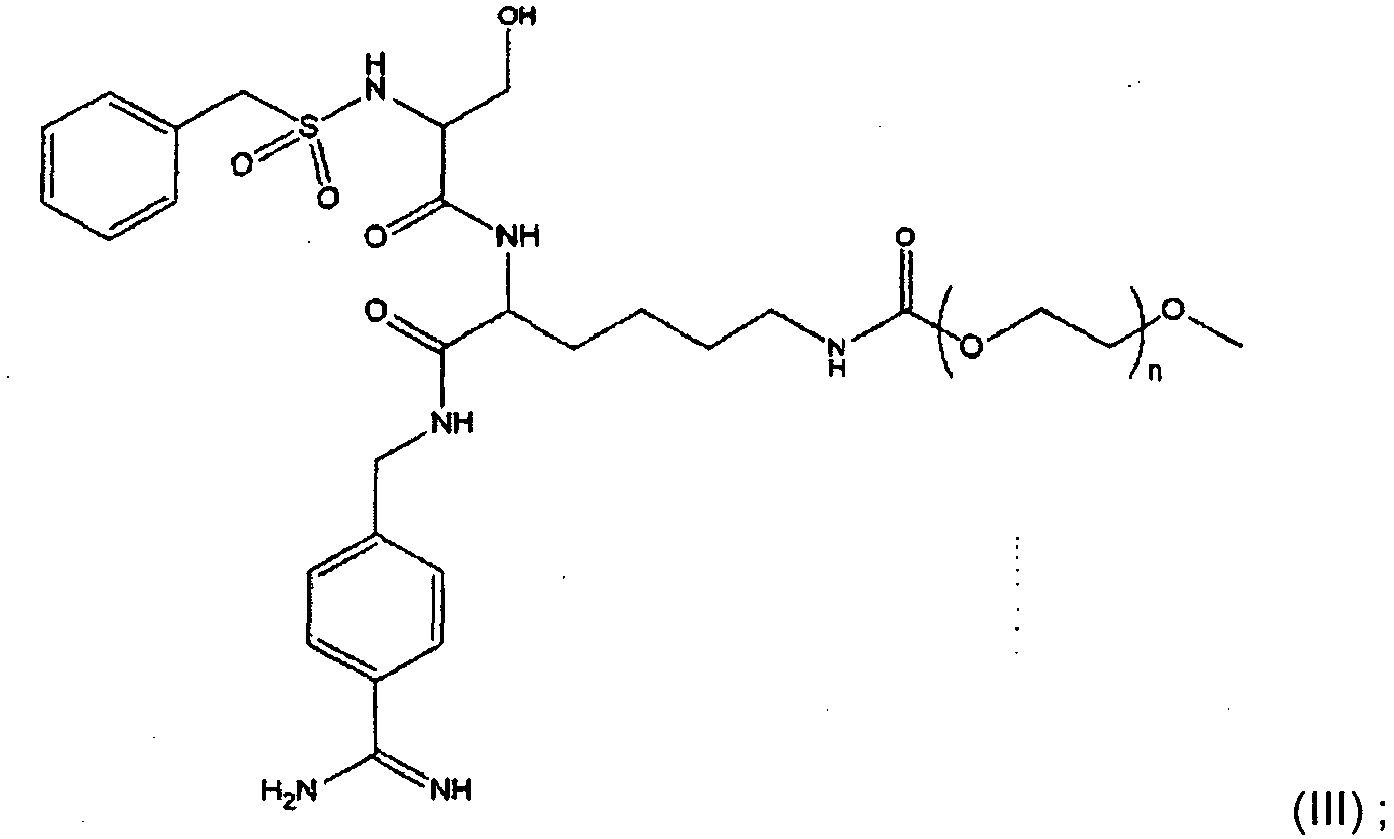
- the antithrombin activity substance having a polymer chain used in the present invention is preferably a substance having a guanidino group, guanido group, and/or amidino group, more preferably a substance selected from the following General Formulae (I) to (IV): and
- the method for immobilizing the antithrombogenic agent on the fiber surface by covalent bonding while maintaining its antithrombin activity is a method in which the reactive functional group to be used for the immobilization reaction is introduced to a site distant from the active site of the antithrombogenic agent, for example, to a site in the opposite side with respect to the polymer chain, to provide a derivative, and a chemical reaction such as condensation reaction, addition reaction, or graft polymerization is then performed to achieve the immobilization.
- the immobilization of the antithrombogenic agent is preferably carried out by a method in which the distance between the immobilization site and the active site is as long as possible, and the reactive functional group is introduced via the polymer chain for securing the freedom after the immobilization.
- the polymer chain preferably has hydrophilicity.
- the structure of the hydrophilic polymer chain is not limited, and is preferably a high molecular structure selected from polyalkylene glycols such as polyethylene glycol (PEG), polypropylene glycol (PPG), and polyethylene glycol/polypropylene glycol copolymers (PEG-PPG); polyvinyl alcohol (PVA); and polyvinyl pyrrolidone (PVP); for exertion of the effect especially in blood, which is hydrophilic.
- the degree of polymerization of the hydrophilic polymer chain, n is not limited, and is preferably 1 to 500 since, in cases where n is too large, the hydrophilicity increases, and therefore the cellular adhesiveness decreases.
- the antithrombogenicity and the cellular affinity of the artificial blood vessel of the present invention are shown by measurement of the water permeability, the thrombin activity inhibition rate in an extract, the thrombin activity inhibition rate on the fiber surface, the platelet adhesion rate, the cell adhesion rate, and thrombus adhesion. These are measured by the following methods.
- Two sites are randomly sampled from the artificial blood vessel, and measurement is carried out twice for each sample by the method described below, followed by calculating the arithmetic mean of the measured values.
- the artificial blood vessel was cut along the axial direction, and a sample piece having a size of 1 cm ⁇ 1 cm was prepared. Between two doughnut-shaped packings with a diameter of 4 cm on each of which a hole having a diameter of 0.5 cm is formed by punching, the fabric sample having a size of 1 cm ⁇ 1 cm is sandwiched such that liquid flow is allowed only through the punched portion.
- the resultant is stored in a housing for a circular filtration filter.
- Water filtered through a reverse osmosis membrane is passed through this circular filtration filter at a temperature of 25°C for not less than 2 minutes until the sample piece sufficiently contains water.
- external-pressure dead-end filtration of water filtered through a reverse osmosis membrane is carried out for 30 seconds to measure the amount of the water (mL) that permeates the portion with a diameter of 1 cm.
- the permeation volume is calculated by rounding the measured value to an integer. By converting the permeation volume (mL) to the value per unit time (min.) per effective area on the sample piece (cm 2 ), the water permeability at a pressure of 120 mmHg is determined.
- the thrombin activity inhibition rate in an extract may be measured by the following method.
- the thrombin activity inhibition rate in this extract is preferably as low as possible.
- the thrombin activity inhibition rate is preferably less than 5%, more preferably less than 1%.
- One gram of a ring-shaped sample prepared by cutting the artificial blood vessel into round slices in the transverse direction is cut into 10 small pieces each having a weight of 0.1 g along the longitudinal direction of the original blood vessel, and extraction is carried out with 10 mL of physiological saline per 1 g of the sample at 37°C for 24 hours.
- 10 ⁇ L of sample-free physiological saline, or to 10 ⁇ L of the sample extract 0.5 mL of 0.1 U/mL aqueous thrombin (Haematologic Technologies Inc.) solution and 0.5 mL of 200 ⁇ M aqueous S2238 (Sekisui Medical Co., Ltd.) solution are added.
- the absorbance at 405 nm is measured using a microplate reader (Corona Electric Co., Ltd., MTP-300).
- MTP-300 molar extinction coefficient of p-nitroaniline at a wavelength of 316 nm (1.27 ⁇ 10 4 mol -1 ⁇ L ⁇ cm -1 )
- the amount of S2238 degraded per unit time that is, the degradation rate of S2238, was calculated.
- Equation 1 the ratio of the degradation rate in the extract to the degradation rate in the sample-free physiological saline, which is taken as 100, is determined, to calculate the thrombin activity inhibition rate at 37°C.
- the Equation 1 is used to provide the thrombin activity inhibition rate in the extract.
- Thrombin activity inhibition rate % 1 ⁇ degradation rate in extract / degradation rate in physiological saline ⁇ 100
- the antithrombin performance on the fiber surface can be measured by the following method for measuring the thrombin activity inhibition rate on the fiber surface.
- the thrombin activity inhibition rate is preferably as high as possible.
- the thrombin activity inhibition rate is preferably not less than 60%, more preferably not less than 80%.
- One gram of a ring-shaped sample prepared by cutting the artificial blood vessel into round slices in the transverse direction is cut into 10 small pieces each having a weight of 0.1 g along the longitudinal direction of the original blood vessel, and 5 mL of 0.1 U/mL aqueous thrombin (Haematologic Technologies Inc.) solution and 0.5 mL of 200 ⁇ M aqueous S2238 (Sekisui Medical Co., Ltd.) solution per 1 g of the sample are added thereto. After leaving the resulting mixture to stand at 37°C for 45 minutes, the absorbance at 405 nm is measured using a microplate reader (Corona Electric Co., Ltd., MTP-300).
- the amount of S2238 degraded per unit time that is, the degradation rate of S2238 was calculated.
- the ratio of the degradation rate on the fiber surface to the degradation rate in the sample-free physiological saline, which is taken as 100, is determined, to calculate the thrombin activity inhibition rate at 37°C.
- the Equation 2 is used to provide the thrombin activity inhibition rate on the fiber surface.
- Thrombin activity inhibition rate % 1 ⁇ degradation rate on fiber surface / degradation rate in physiological saline ⁇ 100
- the platelet adhesion rate on the fiber surface can be measured by the following method for measuring the platelet adhesion rate on the fiber surface.
- the platelet adhesion rate on the fiber surface is preferably less than 20%.
- the artificial blood vessel is cut along the axial direction, and a disk sample with a diameter of 12 mm is prepared by punching using a puncher.
- the sample piece is placed in a well of a 24-well microplate for cell culture (Sumitomo Bakelite Co., Ltd.) such that the blood-contacting surface faces upward, and a metallic pipe-shaped weight with a wall thickness of 3 mm is loaded thereon.
- Platelet-rich plasma prepared separately is added to the well such that the number of platelets is about 10 8 per well.
- the artificial blood vessel is cut along the axial direction, and a disk sample with a diameter of 12 mm is prepared by punching using a puncher.
- the sample piece is placed in a well of a 24-well microplate for cell culture (Sumitomo Bakelite Co., Ltd.), and a metallic pipe-shaped weight with a wall thickness of 3 mm is loaded thereon.
- Normal human umbilical vein endothelial cells suspended in DMEM medium supplemented with 10% FCS are added thereto such that 10 6 cells are contained in the well.
- the microplate is left to stand at 37°C for 12 hours, and the sample is then removed therefrom and rinsed with PBS(-) (Nissui), followed by detaching the cells by enzyme treatment and measuring the number of detached cells using an MTT Assay Kit (Funakoshi Corporation). As shown in Equation 4 below, the ratio of the number of adherent cells to the number of cells plated on the sample is determined, to provide the cell adhesion rate.
- Cell adhesion rate % number of adherent cells / number of cells plated ⁇ 100
- the artificial blood vessel was cut into a length of 4 cm, and connected to a polyvinyl chloride tube having the same inner diameter as the artificial blood vessel, and a length of 32 cm.
- a polyvinyl chloride tube having the same inner diameter as the artificial blood vessel, and a length of 32 cm.
- Into the tube 4.5 mL of human fresh blood supplemented with heparin at a final concentration of 0.5 IU/mL was introduced, and both ends were immediately sealed to form a loop.
- the prepared loop was fixed on a frame attached to a rotor operated at a rotation speed of 14 rpm in a thermo-hygrostat drier whose temperature was preliminarily adjusted to 37°C, and rotated for 120 minutes.
- the loop is then taken out, and the polyvinyl chloride tube is cut to remove blood, followed by rinsing with PBS(-) (Nissui). Thereafter, the presence or absence of thrombi formed in the artificial blood vessel is quantified.
- the same test is carried out using, as a negative control, PBS(-) instead of the human fresh blood.
- the dry weight of the artificial blood vessel with a length of 4 cm is measured before the test and after the removal of blood and rinsing, and the difference between these measured values is regarded as the thrombus weight, and its mean and standard deviation are calculated.
- a tubular fabric was prepared as a plain-weave tissue using polyethylene terephthalate of 55 Dtex-48 f as a warp, and polymer array fiber of 245 Dtex-40 f as a weft.
- the polymer array fiber used therefor was composed of 20 parts of polystyrene as sea-component and 80 parts of polyethylene terephthalate as island-component, and the number of islands was 36/f.
- This tubular fabric was sufficiently treated with an aqueous sodium hydroxide solution at 80°C, and immersed in toluene. Subsequently, the fabric was subjected to raising by using a raising machine, and then to water-jet punching.
- the tubular fabric after the treatments described above was treated with 0.5% aqueous sodium hydroxide solution, and then subjected to oxidation treatment with 5% potassium permanganate. Subsequently, the tubular fabric was immersed in 1 to 50 mg/mL solutions of the compounds of General Formulae (V) to (VIII), which were produced by introducing an amino group to the end of the hydrophilic polymer chain contained in General Formulae (I) to (IV). Condensation reaction was allowed to proceed in the presence of 0.1% carbodiimide, and the fabric was then rinsed with physiological saline, to provide an antithrombotic tubular fabric to be used as an artificial blood vessel.
- Table 1 shows the performance evaluation results of each antithrombotic tubular fabric, obtained by measurement of the water permeability, the thrombin activity inhibition rate in an extract, the thrombin activity inhibition rate on the fiber surface, the platelet adhesion rate, the cell adhesion rate, and thrombus adhesion.
- the antithrombotic tubular fabric treated in 1 mg/mL of the antithrombin agent of General Formula (V) was provided as Example 1; the antithrombotic tubular fabric treated in 2 mg/mL of the antithrombogenic agent of General Formula (V) was provided as Example 2; the antithrombotic tubular fabric treated in 5 mg/mL of the antithrombogenic agent of General Formula (V) was provided as Example 3; the antithrombotic tubular fabric treated in 10 mg/mL of the antithombogenic agent of General Formula (V) was provided as Example 4; the antithrombotic tubular fabric treated in 20 mg/mL of the antithrombogenic agent of General Formula (V) was provided as Example 5; the antithrombotic tubular fabric treated in 50 mg/mL of the antithrombogenic agent of General Formula (V) was provided as Example 6; the antithrombotic tubular fabric treated in 50 mg/mL of the antithrombogenic agent of General Formula (VI) was provided as Example 7; the antithrombotic tubular fabric treated in 50 mg/mL
- Example 2 The same tubular fabric as that obtained in Example 1 was immersed in 50 mg/mL aqueous solutions of the antithrombogenic agents of General Formulae (I) to (IV), and, in this state, irradiated with ⁇ -ray at 5 kGy at Koga Isotope. Each fabric was washed with Triton-X100 and water, to provide an antithrombotic tubular fabric.
- the antithrombotic tubular fabric irradiated with ⁇ -ray in 50 mg/mL of the antithrombogenic agent of General Formula (I) was provided as Comparative Example 1; the antithrombotic tubular fabric irradiated with ⁇ -ray in 50 mg/mL of the antithrombogenic agent of General Formula (II) was provided as Comparative Example 2; the antithrombotic tubular fabric irradiated with ⁇ -ray in 50 mg/mL of the antithrombogenic agent of General Formula (III) was provided as Comparative Example 3; and the antithrombotic tubular fabric irradiated with ⁇ -ray in 50 mg/mL of the antithrombogenic agent of General Formula (IV) was provided as Comparative Example 4.
- Table 1 shows the performance evaluation results of each antithrombotic tubular fabric, obtained by measurement of the water permeability, the thrombin activity inhibition rate in an extract, the thrombin activity inhibition rate on the fiber surface, the platelet adhesion rate, the cell adhesion rate, and thrombus adhesion.
- a tubular fabric was prepared as a high-density plain-weave tissue using polyethylene terephthalate of 55 Dtex-48 f as a warp and polymer array fiber of 245 Dtex-40 f as a weft.
- the polymer array fiber used therefor was composed of 20 parts of polystyrene as sea-component and 80 parts of polyethylene terephthalate as island-component, and the number of islands was 36/f.
- This tubular fabric was sufficiently treated with hot water containing NaOH at 80°C, and immersed in toluene. Subsequently, the fabric was subjected to raising by using a raising machine, and then to water-jet punching.
- the fabric was then immersed in 50 mg/mL aqueous solution of the antithrombogenic agent of General Formula (I), and, in this state, irradiated with ⁇ -ray at 5 kGy at Koga Isotope.
- the fabric was washed with Triton-X100 and water, to provide an antithrombotic tubular fabric (Comparative Example 5).
- Table 1 shows the performance evaluation results of the antithrombotic tubular fabric, obtained by measurement of the water permeability, the thrombin activity inhibition rate in an extract, the thrombin activity inhibition rate on the fiber surface, the platelet adhesion rate, the cell adhesion rate, and thrombus adhesion.
- a tubular fabric was prepared as a low-density plain-weave tissue using polyethylene terephthalate of 55 Dtex-48 f as a warp and polymer array fiber of 245 Dtex-40 f as a weft.
- the polymer array fiber used therefor was composed of 20 parts of polystyrene as sea-component and 80 parts of polyethylene terephthalate as island-component, and the number of islands was 36/f.
- This tubular fabric was sufficiently treated with hot water containing NaOH at 80°C, and immersed in toluene. Subsequently, the fabric was subjected to raising by using a raising machine, and then to water-jet punching.
- the fabric was then immersed in 50 mg/mL aqueous solution of the antithrombogenic agent of General Formula (I), and, in this state, irradiated with ⁇ -ray at 5 kGy at Koga Isotope.
- the fabric was washed with Triton-X100 and water, to provide an antithrombotic tubular fabric (Comparative Example 6).
- Table 1 shows the performance evaluation results of the antithrombotic tubular fabric, obtained by measurement of the water permeability, the thrombin activity inhibition rate in an extract, the thrombin activity inhibition rate on the fiber surface, the platelet adhesion rate, the cell adhesion rate, and thrombus adhesion.
- a tubular fabric was prepared as a plain-weave tissue using polyethylene terephthalate of 55 Dtex-48 f both as a warp and as a weft.
- the fabric was immersed in 50 mg/mL aqueous solution of the antithrombogenic agent of General Formula (I), and, in this state, irradiated with ⁇ -ray at 5 kGy at Koga Isotope.
- the fabric was washed with Triton-X100 and water, to provide an antithrombotic tubular fabric (Comparative Example 7).
- Table 1 shows the performance evaluation results of the antithrombotic tubular fabric, obtained by measurement of the water permeability, the thrombin activity inhibition rate in an extract, the thrombin activity inhibition rate on the fiber surface, the platelet adhesion rate, the cell adhesion rate, and thrombus adhesion.
- the reaction liquid after the dialysis was filtered, and the solvent in the filtrate was removed, followed by drying the resultant to obtain a hydrophilic polymer compound.
- the fabric was then immersed in 50 mg/mL aqueous solution of the hydrophilic polymer compound obtained, and, in this state, irradiated with ⁇ -ray at 5 kGy at Koga Isotope.
- the fabric was washed with Triton-X100 and water, to provide an antithrombotic tubular fabric (Comparative Example 8).
- Table 1 shows the performance evaluation results of the antithrombotic tubular fabric, obtained by measurement of the water permeability, the thrombin activity inhibition rate in an extract, the thrombin activity inhibition rate on the fiber surface, the platelet adhesion rate, the cell adhesion rate, and thrombus adhesion.
- the present invention can be used as an artificial blood vessel with which both antithrombogenicity and cellular affinity can be achieved, which promotes intimal formation after indwelling and maintains antithrombogenicity during the intimal formation, and which can maintain its patency for a long time.
Landscapes
- Health & Medical Sciences (AREA)
- Chemical & Material Sciences (AREA)
- Life Sciences & Earth Sciences (AREA)
- Animal Behavior & Ethology (AREA)
- Veterinary Medicine (AREA)
- Public Health (AREA)
- General Health & Medical Sciences (AREA)
- Medicinal Chemistry (AREA)
- Epidemiology (AREA)
- Transplantation (AREA)
- Oral & Maxillofacial Surgery (AREA)
- Engineering & Computer Science (AREA)
- Dermatology (AREA)
- Biomedical Technology (AREA)
- Vascular Medicine (AREA)
- Surgery (AREA)
- Hematology (AREA)
- Chemical Kinetics & Catalysis (AREA)
- Materials Engineering (AREA)
- Molecular Biology (AREA)
- Cardiology (AREA)
- Heart & Thoracic Surgery (AREA)
- Materials For Medical Uses (AREA)
- Prostheses (AREA)
Claims (12)
- Vaisseau sanguin artificiel qui est un tissu tubulaire comprenant, une couche de fibres contenant une ou plusieurs fibre(s) ultrafine(s) et une couche de fibres ultrafines à l'intérieur de la couche de fibres, la couche de fibres ultrafines étant composée d'une ou plusieurs fibre(s) ultrafine(s) ayant un ou plusieurs diamètre(s) de fibre d'au moins 10 nm et de pas plus de 3 µm, dans lequel
un agent antithrombogène ayant une chaîne de polymère autre que l'héparine est lié de façon covalente à ladite fibre ultrafine par l'intermédiaire de ladite chaîne de polymère par une réaction de condensation, une réaction d'addition ou une polymérisation par greffage, et
le taux d'inhibition de l'activité thrombine sur la surface des fibres à 37 °C n'est pas inférieur à 60 %. - Vaisseau sanguin artificiel selon la revendication 1, dans lequel le poids moléculaire dudit agent antithrombogène n'est pas supérieur à 3000.
- Vaisseau sanguin artificiel selon la revendication 1 ou 2, dont la perméabilité à l'eau à 120 mmHg n'est pas inférieure à 100 ml/cm2/min et est inférieure à 4000 ml/cm2/min.
- Vaisseau sanguin artificiel selon l'une quelconque des revendications 1 à 3, dans lequel le taux d'inhibition de l'activité thrombine dans un extrait obtenu par 24 heures d'extraction à 37 °C dans 10 ml de sérum physiologique par 1 g dudit vaisseau sanguin artificiel est inférieur à 5 %.
- Vaisseau sanguin artificiel selon l'une quelconque des revendications 1 à 4, dans lequel ledit agent antithrombogène comporte un groupe guanidino, un groupe guanido et/ou un groupe amidino.
- Vaisseau sanguin artificiel selon l'une quelconque des revendications 1 à 5, dans lequel ladite chaîne de polymère est une structure de polymère choisie parmi le polyalkylène glycol, l'alcool polyvinylique et la polyvinylpyrrolidone.
- Vaisseau sanguin artificiel selon l'une quelconque des revendications 1 à 6, dans lequel ledit agent antithrombogène est choisi parmi les formules chimiques (I) à (IV) suivantes :



- Vaisseau sanguin artificiel selon l'une quelconque des revendications 1 à 7, dans lequel ladite couche de fibres est composée desdites une ou plusieurs fibre(s) ultrafine(s) et d'un ou plusieurs multifilament(s), le(s) multifilament(s) ayant une finesse totale de 1 à 60 decitex.
- Vaisseau sanguin artificiel selon la revendication 8, dans lequel la finesse de simples fils constituant ledit multifilament est de 0,5 à 10,0 decitex.
- Vaisseau sanguin artificiel selon l'une quelconque des revendications 1 à 9, ayant un taux d'adhésion plaquettaire inférieur à 20 %.
- Vaisseau sanguin artificiel selon l'une quelconque des revendications 1 à 10, dans lequel ledit tissu tubulaire est composé de fibre(s) de polyester.
- Vaisseau sanguin artificiel selon l'une quelconque des revendications 1 à 11, dans lequel le diamètre interne dudit tissu tubulaire n'est pas inférieur à 1 mm et est inférieur à 10 mm.
Applications Claiming Priority (2)
| Application Number | Priority Date | Filing Date | Title |
|---|---|---|---|
| JP2013084121 | 2013-04-12 | ||
| PCT/JP2014/060376 WO2014168197A1 (fr) | 2013-04-12 | 2014-04-10 | Vaisseau sanguin artificiel antithrombotique |
Publications (3)
| Publication Number | Publication Date |
|---|---|
| EP2985041A1 EP2985041A1 (fr) | 2016-02-17 |
| EP2985041A4 EP2985041A4 (fr) | 2016-10-19 |
| EP2985041B1 true EP2985041B1 (fr) | 2017-07-19 |
Family
ID=51689601
Family Applications (1)
| Application Number | Title | Priority Date | Filing Date |
|---|---|---|---|
| EP14782317.3A Not-in-force EP2985041B1 (fr) | 2013-04-12 | 2014-04-10 | Vaisseau sanguin artificiel antithrombotique |
Country Status (6)
| Country | Link |
|---|---|
| US (1) | US20160067066A1 (fr) |
| EP (1) | EP2985041B1 (fr) |
| JP (1) | JPWO2014168197A1 (fr) |
| CN (1) | CN105102007B (fr) |
| RU (1) | RU2015148536A (fr) |
| WO (1) | WO2014168197A1 (fr) |
Families Citing this family (6)
| Publication number | Priority date | Publication date | Assignee | Title |
|---|---|---|---|---|
| WO2015080176A1 (fr) * | 2013-11-28 | 2015-06-04 | 東レ株式会社 | Matériau antithrombotique |
| JPWO2016190202A1 (ja) * | 2015-05-27 | 2018-03-08 | 東レ株式会社 | 筒状織物構造体 |
| CN109790654B (zh) * | 2016-10-07 | 2020-09-18 | 东丽株式会社 | 筒状织物 |
| CN110372869B (zh) * | 2019-08-24 | 2021-08-27 | 思必康(厦门)新材料有限公司 | 一种聚乙烯醇-肝素聚合物及其制备方法和应用 |
| CN110548187A (zh) * | 2019-09-16 | 2019-12-10 | 生纳科技(上海)有限公司 | 一种即时穿刺透析型纳米纤维人工血管 |
| CN114796673A (zh) * | 2022-04-29 | 2022-07-29 | 陕西科技大学 | 一种两性离子水凝胶体外循环管路材料及其制备方法 |
Family Cites Families (18)
| Publication number | Priority date | Publication date | Assignee | Title |
|---|---|---|---|---|
| JPS59225052A (ja) | 1983-06-07 | 1984-12-18 | 東レ株式会社 | 人工血管 |
| JPS6077764A (ja) * | 1983-10-05 | 1985-05-02 | 東レ株式会社 | 人工血管 |
| JPS6192666A (ja) * | 1984-10-15 | 1986-05-10 | 東レ株式会社 | 人工血管 |
| JPS63115554A (ja) | 1986-11-04 | 1988-05-20 | 東レ株式会社 | 擬内膜形成性に優れた人工血管及びその製法 |
| JPS63115555A (ja) * | 1986-11-04 | 1988-05-20 | 東レ株式会社 | 生体適合性とプリクロツテイング性に優れた人工血管 |
| JP3003208B2 (ja) * | 1990-11-21 | 2000-01-24 | 東レ株式会社 | 人工血管およびパッチ |
| JP3799626B2 (ja) | 1995-04-25 | 2006-07-19 | 有限会社ナイセム | 心臓血管修復材及びその製造方法 |
| DE10102878A1 (de) * | 2001-01-23 | 2002-08-01 | Haemosys Gmbh | Oligo- oder Polyalkylengekoppelte Thrombininhibitoren |
| US7838560B2 (en) * | 2002-03-11 | 2010-11-23 | The Medicines Company (Leipzig) Gmbh | Urokinase inhibitors, production and use thereof |
| JP4627978B2 (ja) | 2003-10-27 | 2011-02-09 | 泰晴 野一色 | 低血液透過性医用材料 |
| JP5391520B2 (ja) * | 2006-02-21 | 2014-01-15 | 東レ株式会社 | 改質基材の製造方法 |
| CA2651804C (fr) | 2006-05-12 | 2012-07-03 | Gore Enterprise Holdings, Inc. | Entites immobilisees biologiquement actives presentant une intense activite biologique apres manipulation mecanique ou sterilisation |
| CA2664299C (fr) * | 2006-09-15 | 2016-01-19 | Toray Industries, Inc. | Substrat renfermant un anticoagulant et un polymere hydrophile et methode de fabrication associee |
| JP5343377B2 (ja) * | 2008-03-19 | 2013-11-13 | 東レ株式会社 | 基材およびその製造方法 |
| JP5320941B2 (ja) * | 2008-09-30 | 2013-10-23 | 東レ株式会社 | 生体成分接触用途の膜の製造方法 |
| RU2539566C2 (ru) * | 2009-12-24 | 2015-01-20 | Торэй Индастриз, Инк. | Гидрофильное полимерное соединение, имеющее антикоагулянтный эффект |
| JP2011245282A (ja) * | 2010-04-28 | 2011-12-08 | Toray Ind Inc | ステントグラフト用基布およびステントグラフト |
| JP5729111B2 (ja) * | 2010-04-28 | 2015-06-03 | 東レ株式会社 | ステントグラフト用基布およびステントグラフト |
-
2014
- 2014-04-10 US US14/783,956 patent/US20160067066A1/en not_active Abandoned
- 2014-04-10 WO PCT/JP2014/060376 patent/WO2014168197A1/fr not_active Ceased
- 2014-04-10 RU RU2015148536A patent/RU2015148536A/ru not_active Application Discontinuation
- 2014-04-10 EP EP14782317.3A patent/EP2985041B1/fr not_active Not-in-force
- 2014-04-10 CN CN201480020874.1A patent/CN105102007B/zh not_active Expired - Fee Related
- 2014-04-10 JP JP2014517316A patent/JPWO2014168197A1/ja active Pending
Non-Patent Citations (1)
| Title |
|---|
| None * |
Also Published As
| Publication number | Publication date |
|---|---|
| US20160067066A1 (en) | 2016-03-10 |
| EP2985041A1 (fr) | 2016-02-17 |
| WO2014168197A1 (fr) | 2014-10-16 |
| CN105102007A (zh) | 2015-11-25 |
| RU2015148536A (ru) | 2017-05-18 |
| CN105102007B (zh) | 2017-09-08 |
| EP2985041A4 (fr) | 2016-10-19 |
| JPWO2014168197A1 (ja) | 2017-02-16 |
Similar Documents
| Publication | Publication Date | Title |
|---|---|---|
| EP2985042B1 (fr) | Vaisseau sanguin artificiel antithrombotique | |
| EP2985041A1 (fr) | Vaisseau sanguin artificiel antithrombotique | |
| EP2861273B1 (fr) | Utilisation de l'héparine et des hydrates de carbone pour traiter le cancer | |
| Ye et al. | Antifouling blood purification membrane composed of cellulose acetate and phospholipid polymer | |
| JP4101460B2 (ja) | フッ素原子を有するポリスルホンを含む抗血栓性に優れた医療用材料 | |
| EP2724735A1 (fr) | Fournitures médicales | |
| US20030059631A1 (en) | Biocompatible medical articles and process for their production | |
| EP2518100B1 (fr) | Composé polymère hydrophile possédant une activité anticoagulante | |
| EP2724733A1 (fr) | Composé polymère hydrophobe ayant un effet anticoagulant | |
| AU2014355478B2 (en) | Vascular prosthesis | |
| EP3919664A1 (fr) | Matériau de base médical pour dispositif cardiovasculaire à demeure | |
| WO2000018321A1 (fr) | Vaisseaux sanguins synthetiques hydrophiles | |
| JP2019213842A (ja) | インプラント用の医療材料 | |
| Nakabayashi | Preparation of new biomedical materials and their application in clinics | |
| Nakabayashi | Preparation of biocompatible materials and their evaluation | |
| JP2019063214A (ja) | 人工血管 | |
| JP2013006921A (ja) | 抗血液凝固作用を有する高分子化合物 |
Legal Events
| Date | Code | Title | Description |
|---|---|---|---|
| PUAI | Public reference made under article 153(3) epc to a published international application that has entered the european phase |
Free format text: ORIGINAL CODE: 0009012 |
|
| 17P | Request for examination filed |
Effective date: 20150925 |
|
| AK | Designated contracting states |
Kind code of ref document: A1 Designated state(s): AL AT BE BG CH CY CZ DE DK EE ES FI FR GB GR HR HU IE IS IT LI LT LU LV MC MK MT NL NO PL PT RO RS SE SI SK SM TR |
|
| AX | Request for extension of the european patent |
Extension state: BA ME |
|
| DAX | Request for extension of the european patent (deleted) | ||
| RIC1 | Information provided on ipc code assigned before grant |
Ipc: A61L 27/00 20060101AFI20160908BHEP Ipc: A61F 2/06 20060101ALI20160908BHEP |
|
| A4 | Supplementary search report drawn up and despatched |
Effective date: 20160916 |
|
| REG | Reference to a national code |
Ref country code: DE Ref legal event code: R079 Ref document number: 602014012081 Country of ref document: DE Free format text: PREVIOUS MAIN CLASS: A61L0027000000 Ipc: A61L0027500000 |
|
| GRAP | Despatch of communication of intention to grant a patent |
Free format text: ORIGINAL CODE: EPIDOSNIGR1 |
|
| STAA | Information on the status of an ep patent application or granted ep patent |
Free format text: STATUS: GRANT OF PATENT IS INTENDED |
|
| RIC1 | Information provided on ipc code assigned before grant |
Ipc: A61L 33/00 20060101ALI20170314BHEP Ipc: A61L 27/54 20060101ALI20170314BHEP Ipc: A61L 27/50 20060101AFI20170314BHEP Ipc: A61L 27/18 20060101ALI20170314BHEP |
|
| INTG | Intention to grant announced |
Effective date: 20170328 |
|
| GRAS | Grant fee paid |
Free format text: ORIGINAL CODE: EPIDOSNIGR3 |
|
| GRAA | (expected) grant |
Free format text: ORIGINAL CODE: 0009210 |
|
| STAA | Information on the status of an ep patent application or granted ep patent |
Free format text: STATUS: THE PATENT HAS BEEN GRANTED |
|
| AK | Designated contracting states |
Kind code of ref document: B1 Designated state(s): AL AT BE BG CH CY CZ DE DK EE ES FI FR GB GR HR HU IE IS IT LI LT LU LV MC MK MT NL NO PL PT RO RS SE SI SK SM TR |
|
| REG | Reference to a national code |
Ref country code: GB Ref legal event code: FG4D |
|
| REG | Reference to a national code |
Ref country code: CH Ref legal event code: EP |
|
| REG | Reference to a national code |
Ref country code: IE Ref legal event code: FG4D |
|
| REG | Reference to a national code |
Ref country code: AT Ref legal event code: REF Ref document number: 909764 Country of ref document: AT Kind code of ref document: T Effective date: 20170815 |
|
| REG | Reference to a national code |
Ref country code: DE Ref legal event code: R096 Ref document number: 602014012081 Country of ref document: DE |
|
| REG | Reference to a national code |
Ref country code: NL Ref legal event code: MP Effective date: 20170719 |
|
| REG | Reference to a national code |
Ref country code: LT Ref legal event code: MG4D |
|
| REG | Reference to a national code |
Ref country code: AT Ref legal event code: MK05 Ref document number: 909764 Country of ref document: AT Kind code of ref document: T Effective date: 20170719 |
|
| PG25 | Lapsed in a contracting state [announced via postgrant information from national office to epo] |
Ref country code: LT Free format text: LAPSE BECAUSE OF FAILURE TO SUBMIT A TRANSLATION OF THE DESCRIPTION OR TO PAY THE FEE WITHIN THE PRESCRIBED TIME-LIMIT Effective date: 20170719 Ref country code: NO Free format text: LAPSE BECAUSE OF FAILURE TO SUBMIT A TRANSLATION OF THE DESCRIPTION OR TO PAY THE FEE WITHIN THE PRESCRIBED TIME-LIMIT Effective date: 20171019 Ref country code: AT Free format text: LAPSE BECAUSE OF FAILURE TO SUBMIT A TRANSLATION OF THE DESCRIPTION OR TO PAY THE FEE WITHIN THE PRESCRIBED TIME-LIMIT Effective date: 20170719 Ref country code: HR Free format text: LAPSE BECAUSE OF FAILURE TO SUBMIT A TRANSLATION OF THE DESCRIPTION OR TO PAY THE FEE WITHIN THE PRESCRIBED TIME-LIMIT Effective date: 20170719 Ref country code: NL Free format text: LAPSE BECAUSE OF FAILURE TO SUBMIT A TRANSLATION OF THE DESCRIPTION OR TO PAY THE FEE WITHIN THE PRESCRIBED TIME-LIMIT Effective date: 20170719 Ref country code: FI Free format text: LAPSE BECAUSE OF FAILURE TO SUBMIT A TRANSLATION OF THE DESCRIPTION OR TO PAY THE FEE WITHIN THE PRESCRIBED TIME-LIMIT Effective date: 20170719 Ref country code: SE Free format text: LAPSE BECAUSE OF FAILURE TO SUBMIT A TRANSLATION OF THE DESCRIPTION OR TO PAY THE FEE WITHIN THE PRESCRIBED TIME-LIMIT Effective date: 20170719 |
|
| PG25 | Lapsed in a contracting state [announced via postgrant information from national office to epo] |
Ref country code: ES Free format text: LAPSE BECAUSE OF FAILURE TO SUBMIT A TRANSLATION OF THE DESCRIPTION OR TO PAY THE FEE WITHIN THE PRESCRIBED TIME-LIMIT Effective date: 20170719 Ref country code: RS Free format text: LAPSE BECAUSE OF FAILURE TO SUBMIT A TRANSLATION OF THE DESCRIPTION OR TO PAY THE FEE WITHIN THE PRESCRIBED TIME-LIMIT Effective date: 20170719 Ref country code: PL Free format text: LAPSE BECAUSE OF FAILURE TO SUBMIT A TRANSLATION OF THE DESCRIPTION OR TO PAY THE FEE WITHIN THE PRESCRIBED TIME-LIMIT Effective date: 20170719 Ref country code: BG Free format text: LAPSE BECAUSE OF FAILURE TO SUBMIT A TRANSLATION OF THE DESCRIPTION OR TO PAY THE FEE WITHIN THE PRESCRIBED TIME-LIMIT Effective date: 20171019 Ref country code: LV Free format text: LAPSE BECAUSE OF FAILURE TO SUBMIT A TRANSLATION OF THE DESCRIPTION OR TO PAY THE FEE WITHIN THE PRESCRIBED TIME-LIMIT Effective date: 20170719 Ref country code: GR Free format text: LAPSE BECAUSE OF FAILURE TO SUBMIT A TRANSLATION OF THE DESCRIPTION OR TO PAY THE FEE WITHIN THE PRESCRIBED TIME-LIMIT Effective date: 20171020 Ref country code: IS Free format text: LAPSE BECAUSE OF FAILURE TO SUBMIT A TRANSLATION OF THE DESCRIPTION OR TO PAY THE FEE WITHIN THE PRESCRIBED TIME-LIMIT Effective date: 20171119 |
|
| REG | Reference to a national code |
Ref country code: DE Ref legal event code: R097 Ref document number: 602014012081 Country of ref document: DE |
|
| PG25 | Lapsed in a contracting state [announced via postgrant information from national office to epo] |
Ref country code: RO Free format text: LAPSE BECAUSE OF FAILURE TO SUBMIT A TRANSLATION OF THE DESCRIPTION OR TO PAY THE FEE WITHIN THE PRESCRIBED TIME-LIMIT Effective date: 20170719 Ref country code: DK Free format text: LAPSE BECAUSE OF FAILURE TO SUBMIT A TRANSLATION OF THE DESCRIPTION OR TO PAY THE FEE WITHIN THE PRESCRIBED TIME-LIMIT Effective date: 20170719 Ref country code: CZ Free format text: LAPSE BECAUSE OF FAILURE TO SUBMIT A TRANSLATION OF THE DESCRIPTION OR TO PAY THE FEE WITHIN THE PRESCRIBED TIME-LIMIT Effective date: 20170719 |
|
| PLBE | No opposition filed within time limit |
Free format text: ORIGINAL CODE: 0009261 |
|
| STAA | Information on the status of an ep patent application or granted ep patent |
Free format text: STATUS: NO OPPOSITION FILED WITHIN TIME LIMIT |
|
| PG25 | Lapsed in a contracting state [announced via postgrant information from national office to epo] |
Ref country code: EE Free format text: LAPSE BECAUSE OF FAILURE TO SUBMIT A TRANSLATION OF THE DESCRIPTION OR TO PAY THE FEE WITHIN THE PRESCRIBED TIME-LIMIT Effective date: 20170719 Ref country code: IT Free format text: LAPSE BECAUSE OF FAILURE TO SUBMIT A TRANSLATION OF THE DESCRIPTION OR TO PAY THE FEE WITHIN THE PRESCRIBED TIME-LIMIT Effective date: 20170719 Ref country code: SK Free format text: LAPSE BECAUSE OF FAILURE TO SUBMIT A TRANSLATION OF THE DESCRIPTION OR TO PAY THE FEE WITHIN THE PRESCRIBED TIME-LIMIT Effective date: 20170719 Ref country code: SM Free format text: LAPSE BECAUSE OF FAILURE TO SUBMIT A TRANSLATION OF THE DESCRIPTION OR TO PAY THE FEE WITHIN THE PRESCRIBED TIME-LIMIT Effective date: 20170719 |
|
| 26N | No opposition filed |
Effective date: 20180420 |
|
| PG25 | Lapsed in a contracting state [announced via postgrant information from national office to epo] |
Ref country code: SI Free format text: LAPSE BECAUSE OF FAILURE TO SUBMIT A TRANSLATION OF THE DESCRIPTION OR TO PAY THE FEE WITHIN THE PRESCRIBED TIME-LIMIT Effective date: 20170719 |
|
| REG | Reference to a national code |
Ref country code: DE Ref legal event code: R119 Ref document number: 602014012081 Country of ref document: DE |
|
| PG25 | Lapsed in a contracting state [announced via postgrant information from national office to epo] |
Ref country code: MC Free format text: LAPSE BECAUSE OF FAILURE TO SUBMIT A TRANSLATION OF THE DESCRIPTION OR TO PAY THE FEE WITHIN THE PRESCRIBED TIME-LIMIT Effective date: 20170719 |
|
| REG | Reference to a national code |
Ref country code: CH Ref legal event code: PL |
|
| REG | Reference to a national code |
Ref country code: BE Ref legal event code: MM Effective date: 20180430 |
|
| GBPC | Gb: european patent ceased through non-payment of renewal fee |
Effective date: 20180410 |
|
| REG | Reference to a national code |
Ref country code: IE Ref legal event code: MM4A |
|
| PG25 | Lapsed in a contracting state [announced via postgrant information from national office to epo] |
Ref country code: LU Free format text: LAPSE BECAUSE OF NON-PAYMENT OF DUE FEES Effective date: 20180410 Ref country code: DE Free format text: LAPSE BECAUSE OF NON-PAYMENT OF DUE FEES Effective date: 20181101 |
|
| PG25 | Lapsed in a contracting state [announced via postgrant information from national office to epo] |
Ref country code: LI Free format text: LAPSE BECAUSE OF NON-PAYMENT OF DUE FEES Effective date: 20180430 Ref country code: GB Free format text: LAPSE BECAUSE OF NON-PAYMENT OF DUE FEES Effective date: 20180410 Ref country code: CH Free format text: LAPSE BECAUSE OF NON-PAYMENT OF DUE FEES Effective date: 20180430 Ref country code: BE Free format text: LAPSE BECAUSE OF NON-PAYMENT OF DUE FEES Effective date: 20180430 |
|
| PG25 | Lapsed in a contracting state [announced via postgrant information from national office to epo] |
Ref country code: IE Free format text: LAPSE BECAUSE OF NON-PAYMENT OF DUE FEES Effective date: 20180410 Ref country code: FR Free format text: LAPSE BECAUSE OF NON-PAYMENT OF DUE FEES Effective date: 20180430 |
|
| PG25 | Lapsed in a contracting state [announced via postgrant information from national office to epo] |
Ref country code: MT Free format text: LAPSE BECAUSE OF NON-PAYMENT OF DUE FEES Effective date: 20180410 |
|
| PG25 | Lapsed in a contracting state [announced via postgrant information from national office to epo] |
Ref country code: TR Free format text: LAPSE BECAUSE OF FAILURE TO SUBMIT A TRANSLATION OF THE DESCRIPTION OR TO PAY THE FEE WITHIN THE PRESCRIBED TIME-LIMIT Effective date: 20170719 |
|
| PG25 | Lapsed in a contracting state [announced via postgrant information from national office to epo] |
Ref country code: PT Free format text: LAPSE BECAUSE OF FAILURE TO SUBMIT A TRANSLATION OF THE DESCRIPTION OR TO PAY THE FEE WITHIN THE PRESCRIBED TIME-LIMIT Effective date: 20170719 |
|
| PG25 | Lapsed in a contracting state [announced via postgrant information from national office to epo] |
Ref country code: MK Free format text: LAPSE BECAUSE OF NON-PAYMENT OF DUE FEES Effective date: 20170719 Ref country code: CY Free format text: LAPSE BECAUSE OF FAILURE TO SUBMIT A TRANSLATION OF THE DESCRIPTION OR TO PAY THE FEE WITHIN THE PRESCRIBED TIME-LIMIT Effective date: 20170719 Ref country code: HU Free format text: LAPSE BECAUSE OF FAILURE TO SUBMIT A TRANSLATION OF THE DESCRIPTION OR TO PAY THE FEE WITHIN THE PRESCRIBED TIME-LIMIT; INVALID AB INITIO Effective date: 20140410 |
|
| PG25 | Lapsed in a contracting state [announced via postgrant information from national office to epo] |
Ref country code: AL Free format text: LAPSE BECAUSE OF FAILURE TO SUBMIT A TRANSLATION OF THE DESCRIPTION OR TO PAY THE FEE WITHIN THE PRESCRIBED TIME-LIMIT Effective date: 20170719 |